


Abstract
Sensory evaluation is essential for analyzing fish quality, as it describes its organoleptic profile and reflects consumer perception. Attributes such as appearance, smell, taste, and texture can vary depending on the origin of the fish, its diet, and thermal processing. In order to obtain reproducible results, it is necessary to control factors such as temperature, cooking time, and portion thickness during fish sample preparation for testing. This study develops a standardized guide for the sensory evaluation of cooked fish, particularly Sparus aurata. The guide includes detailed preparation protocols, a structured descriptive method, and a tasting sheet to ensure objective, reproducible evaluations that are applicable in research, industry, training, and quality control.
1. Introduction
The gilthead seabream (Sparus aurata L., Fam. Sparidae) is one of the most commercially important marine species along the Mediterranean coast and the eastern Atlantic, both in aquaculture and fishing. In 2024, global seabream production increased by 2% compared to that in the previous year [1]. In addition, in Spain, sea bream purchases increased by 10.2% in 2025 [2]. Farmed seabream (Sparus aurata) is a white fish valued for its desirable characteristics of smell, taste, and texture [3].
Sensory evaluation of fish is essential to ensure quality and meet consumer expectations. This process involves analyzing attributes such as appearance, smell, taste, and texture, which allows for the detection of possible defects and ensures product freshness. It also contributes to the standardization of quality criteria within the fishing and aquaculture industry. The importance of sensory evaluation increases in the case of cooked fish, as cooking can alter the original sensory characteristics. Factors such as production method, feed, and thermal processing significantly influence the final sensory profile, making it essential to have standardized protocols in place to ensure adequate comparisons and rigorous quality control.
The objective of this study was to develop a standardized guide for the sensory evaluation of cooked fish, focusing specifically on Sparus aurata (gilthead seabream) based on international sensory guidelines and the scientific literature.
2. Materials and Methods
2.1. Samples
After a literature search, a detailed protocol was developed with selected standard conditions for the preparation, cooking, and presentation of the samples: two filets were separated; the parts corresponding to the areas closest to the head and tail, as well as the belly, were removed. Each filet was divided into two portions of approximately 3 × 3 cm. Samples were wrapped in aluminum foil without any seasoning added and baked in a preheated (30 min at 200 °C) conventional household oven as described by other authors [3], for a cooking time of 8 min for portions of approximately 3 × 3 cm (Figure 1).
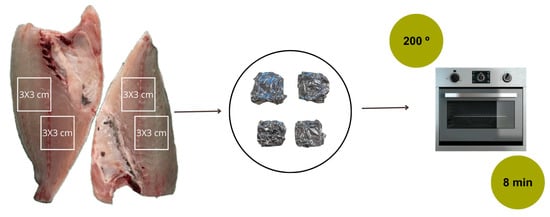
Figure 1.
Sample preparation.
2.2. Sensory Analysis
All sensory analysis tests were performed according to UNE-ISO 4121:2006 [4]. The tasting sessions were best carried out in the morning between 10:00 a.m. and 12:00 p.m., since it is recommended to choose times for testing in the late morning and early or mid-afternoon. This is one of the most common factors influencing test results [5]. At the time of testing, each taster had the coded samples that were to be evaluated, the tasting form, a glass of mineral water and unsalted bread-sticks used as a palate cleanser. Evaluators received portions of fish measuring approximately 3 × 3 cm each. Samples were served at a temperature at which the food is normally consumed, which, in the case of fish, is around 57 °C [6]. To avoid dehydration, cooked samples were served wrapped in aluminum foil and inside heating units that were able to maintain them at a constant temperature of 57 °C during tasting.
Once the methodology was stablished, a tasting session was run in a standardized room equipped with individual tasting booths belonging to the Department of Agri-Food Technology of the Miguel Hernández University of Elche, complying with the conditions that a facility of these characteristics should have [4]. This session was carried out in the morning. Two fish pieces were served, and a trained sensory panel of 8 people tasted the samples to describe the attributes, which were compared with those found in the scientific literature and in official guidelines.
3. Results
As a result of the development of this sensory guide for cooked fish, a proposed table of specific attributes for the sensory analysis of cooked fish was developed (Table 1). This table gathers the most representative descriptors, organized into five sensory categories: (i) visual appearance, (ii) aromas/odors, (iii) basic flavors, (iv) texture and (v) mouthfeel. For each attribute, the table presents a specific definition, its sensory location (internal or external), and standard references that serve as a point of comparison during the analysis. In the appearance category, attributes such as color uniformity, brightness, lamination and self-color are included, allowing visual evaluation of the condition of the cooked fish. As for odors, notes such as marine, crustacean, fermented, lactic and hydrogen sulfide are identified, all associated with recognizable references that facilitate their identification. Likewise, the basic flavors (sweet, sour, salty, bitter and umami) and specific fish flavors are detailed with their respective reference standards. Texture is characterized by attributes including juiciness, fibrousness, crumbliness, firmness, chewiness, and fat content, while the mouthfeel category includes aspects such as dryness, salivation and persistence.

Table 1.
Lexicon for cooked fish.
Table 1.
Lexicon for cooked fish.
| ATTRIBUTES | ZONE | DESCRIPTION | REFERENCE STANDARS | R | |
|---|---|---|---|---|---|
| Low | High | ||||
| Visual/Appearance | |||||
| Color uniformity | Internal | Homogeneity of the characteristic color of the fish filet | Cooked fish filet with grayish areas | Homogeneous cooked fish filet | [7] |
| Brightness | Internal | Perception of brightness of the fish flesh | Dried fish (without fat) | Fish with characteristic fat sheen | [8] |
| Flaking | External | Number of visible scales associated with the lamellar structure | [7] | ||
| Own color | Internal | Intensity of characteristic white color of the cooked white fish muscle | Translucent | Uniform opaque white | [8] |
| Anomalous and unpleasant color | Internal | Loss of characteristic white color of the cooked white fish muscle | — | — | [8] |
| Aroma/Smells | |||||
| Intensity | Overall olfactory intensity of cooked food | [4] | |||
| Marine | Associated with raw shrimp reference, related to seawater/fresh seaweed | — | Fresh seaweed | [7] | |
| Crustacean | Associated with cooked crab reference, cooked shrimp, cooked scallops | — | Cooked crab | [7] | |
| Fermented | Associated with fish sauce reference | — | Fish sauce | [7] | |
| Lactic | Associated with lactic acid reference | — | Acid lactic | [7] | |
| Sulfuric | Associated with cooked egg reference, cooked broccoli/cauliflower | — | Cooked egg | [7] | |
| Basic Flavor | |||||
| Sweet | Basic flavor caused by sugar | — | Sugar | [9] | |
| Acid | Basic flavor caused by acid | — | Lemon | [9] | |
| Salty | Basic flavor caused by salts | — | NaCl | [9] | |
| Bitter | Basic flavor associated with caffeine | — | Coffee | [9] | |
| Umami | Flavor associated with umami compounds | — | Monosodium Glutamate -MSG- | [9] | |
| Specific fish flavor | |||||
| Intensity | Overall flavor intensity of the sample as a whole | — | — | [7] | |
| Lactic acid | Associated with lactic acid reference | — | Acid lactic | [7] | |
| Fermented | Associated with fish sauce reference | — | Fish sauce | [7] | |
| Texture | |||||
| Juiciness | Amount of liquid released when the sample is chewed | Swordfish | Halibut | [3] | |
| Fibrous | Perception of filaments or strands of muscle tissue during mastication | Mango | Pineapple | [10] | |
| Flaky | The ease of breaking the fish into small pieces with a fork | Canned tuna | Honney | [10] | |
| Firmness | Force required to cut the tissue (first bite), using the front teeth | Halibut | Swordfish | [3] | |
| Chewiness | Mechanical property related to cohesion and the number of chews needed to break down solid food until it can be swallowed | Halibut | Swordfish | [3] | |
| Fatness | Surface texture attribute related to the perception of the quantity or quality of fat in a product | Halibut filet | Salmon filet | [3] | |
| Mouthfeel | |||||
| Mouth drying | Degree to which the product creates dryness in the oral cavity | — | — | [7] | |
| Mouthwatering | Degree to which the product creates salivation | — | Orange | [10] | |
| Persistence | Perception of sensation of dirt inside the oral cavity after swallowing the sample | — | — | [11] | |
R: References. A tasting sheet (Table S1) was also prepared, showing a descriptive quantitative analysis, which systematically indicates the intensity of each attribute on a scale of 1 to 10.
4. Discussion
The results obtained from the development of the sensory guide for cooked seabream confirm the usefulness of structuring descriptors into categories widely recognized in the scientific literature—appearance, smell, taste, texture, and mouthfeel—and are in agreement with those of the approaches applied in recent studies of the sensory profile of Sparus aurata and other cooked fish species [7,12,13]. Research using trained panels has shown that cooking significantly modifies key attributes such as juiciness, firmness, sulfur notes, and characteristic fish flavors, reinforcing the need for an organized evaluation system that allows these changes to be identified objectively [3,11]. On the other hand, the tasting sheet, on a scale of 1 to 10, provides a quantitative tool that facilitates comparison between samples, and allows for the detection of variations associated with both technological changes and the intrinsic quality of the fish, making it a useful tool for industry and research, as it facilitates quality control, process standardization, and objective comparison between batches or experimental conditions.
5. Conclusions
The guide developed for cooked fish, especially gilthead seabream (Sparus aurata), provides a reliable and replicable approach to the sensory evaluation of cooked fish, which reinforces quality control processes.
Supplementary Materials
The following supporting information can be downloaded at https://www.mdpi.com/article/10.3390/blsf2026056003/s1, Table S1: Tasting sheet.
Author Contributions
Conceptualization, I.C.-M., E.S. and M.C.-L.; methodology, E.S. and Á.A.C.-B.; validation, N.J.-R., D.L.-L., Á.A.C.-B., E.S. and M.C.-L.; writing—original draft preparation, I.C.-M.; writing—review and editing, N.J.-R., D.L.-L., Á.A.C.-B., E.S. and M.C.-L. All authors have read and agreed to the published version of the manuscript.
Funding
This study forms part of the ThinkInAzul program and was supported by MICIU with funding from European Union NextGenerationEU (PRTR-C17.I1) and from Generalitat Valenciana (GVA-THINKINAZUL/2021/019; Principal Investigator: E. Sendra.
Institutional Review Board Statement
Not applicable.
Informed Consent Statement
Not applicable.
Data Availability Statement
The original contributions presented in this study are included in the article. Further inquiries can be directed to the corresponding author.
Acknowledgments
The author I.C.-M. was funded by the Ayudas a la contratación de personal investigador en formación grant from the Universidad Miguel Hernández de Elche (line code 04-541-6-2025-0153-N). I.C.-M., N.J.-R., and M.C.-L.’s contract was partially financed by the ThinkInAzul program (GVA-THINKINAZUL/2021/019; principal investigator: E. Sendra, UMH1).
Conflicts of Interest
The authors declare no conflicts of interest.
References
- Food and Agriculture Organization of the United Nations. Seabass and Seabream. 2024. Available online: https://openknowledge.fao.org/handle/20.500.14283/cd3518en (accessed on 1 November 2025).
- Ministerio de Agricultura, Pesca y Alimentación. La Pesca Mes a Mes. Julio 25. Avance de Datos Provisionales Cálculos Realizados a Partir del Último Censo Publicado por el INE. 2025. Available online: https://www.mapa.gob.es/es/dam/jcr:1039c69c-5e0d-435d-9b70-857f28c450ae/la-pesca-mes-a-mes-julio-2025.pdf (accessed on 1 November 2025).
- Carbonell, I.; Izquierdo, L.; Costell, E. Sensory Profiling of Cooked Gilthead Sea Bream (Sparus aurata): Sensory Evaluation Procedures and Panel Training. Food Sci. Technol. Int. 2002, 8, 169–177. [Google Scholar] [CrossRef]
- ISO-8589; Sensory Analysis—General Guidance for the Design of Test Rooms. ISO: Geneva, Switzerland, 2007.
- Hernández, E. Evaluación Sensorial; Centro Nacional de Medios para el Aprendizaje: Bogotá, Colombia, 2005. [Google Scholar]
- Minnesota Department of Health. Temperature and Time Requirements for Food. 2019. Available online: https://www.health.state.mn.us/communities/environment/food/docs/fs/timetempfs.pdf (accessed on 1 November 2025).
- Alexi, N.; Sfyra, K.; Basdeki, E.; Athanasopoulou, E.; Spanou, A.; Chryssolouris, M.; Tsironi, T. Raw and Cooked Quality of Gilthead Seabream Fillets (Sparus aurata, L.) after Mild Processing via Osmotic Dehydration for Shelf-Life Extension. Foods 2022, 11, 2017. [Google Scholar] [CrossRef] [PubMed]
- Díaz Molins, P. Calidad y Deterioro de Platos “Sous Vide” Preparados a Base de Carne y Pescado Almacenados en Refrigeración. Universidad de Murcia. Proyecto de Investigación. 2009. Available online: https://digitum.um.es/server/api/core/bitstreams/de562cce-c7fe-42d1-bab5-0df4829c56f1/content (accessed on 1 November 2025).
- ISO-3972; Sensory Analysis—Methodology—Method of Investigating Sensitivity of Taste. ISO: Geneva, Switzerland, 2011.
- Bland, J.M.; Bett-Garber, K.L.; Li, C.H.; Brashear, S.S.; Lea, J.M.; Bechtel, P.J. Comparison of sensory and instrumental methods for the analysis of texture of cooked individually quick frozen and fresh-frozen catfish fillets. Food Sci. Nutr. 2018, 6, 1692–1705. [Google Scholar] [CrossRef] [PubMed]
- Velázquez-Martínez, R.I.; Criado, C.; Muñoz-González, C.; Crespo, J.; Pozo-Bayón, M.Á. Evaluation of the Long-Lasting Flavour Perception after the Consumption of Wines Treated with Different Types of Oenological Additives Considering Individual 6-n-Propylthiouracil Taster Status. Foods 2023, 12, 2835. [Google Scholar] [CrossRef] [PubMed]
- Calanche Morales, J.B.; Tomás-Vidal, A.; Cusiyunca Phoco, E.R.; Martínez-Llorens, S.; Marquina, P.L.; Jover-Cerdá, M.; Beltrán, J.A. An approach to the spanish consumer’s perception of the sensory quality of environmentally friendly seabass. Foods 2021, 10, 2694. [Google Scholar] [CrossRef] [PubMed]
- Calanche, J.; Tomas, A.; Martinez, S.; Jover, M.; Alonso, V.; Roncalés, P.; Beltrán, J.A. Relation of quality and sensory perception with changes in free amino acids of thawed seabream (Sparus aurata). Food Res. Int. 2019, 119, 126–134. [Google Scholar] [CrossRef] [PubMed]
Disclaimer/Publisher’s Note: The statements, opinions and data contained in all publications are solely those of the individual author(s) and contributor(s) and not of MDPI and/or the editor(s). MDPI and/or the editor(s) disclaim responsibility for any injury to people or property resulting from any ideas, methods, instructions or products referred to in the content. |
© 2026 by the authors. Licensee MDPI, Basel, Switzerland. This article is an open access article distributed under the terms and conditions of the Creative Commons Attribution (CC BY) license.