


What Does Quality Fish Taste Like? A Sensory Guide for the Evaluation of Cooked Sparus aurata †

 , , ,
, , ,  ,
,  and
and 
Abstract
1. Introduction
2. Materials and Methods
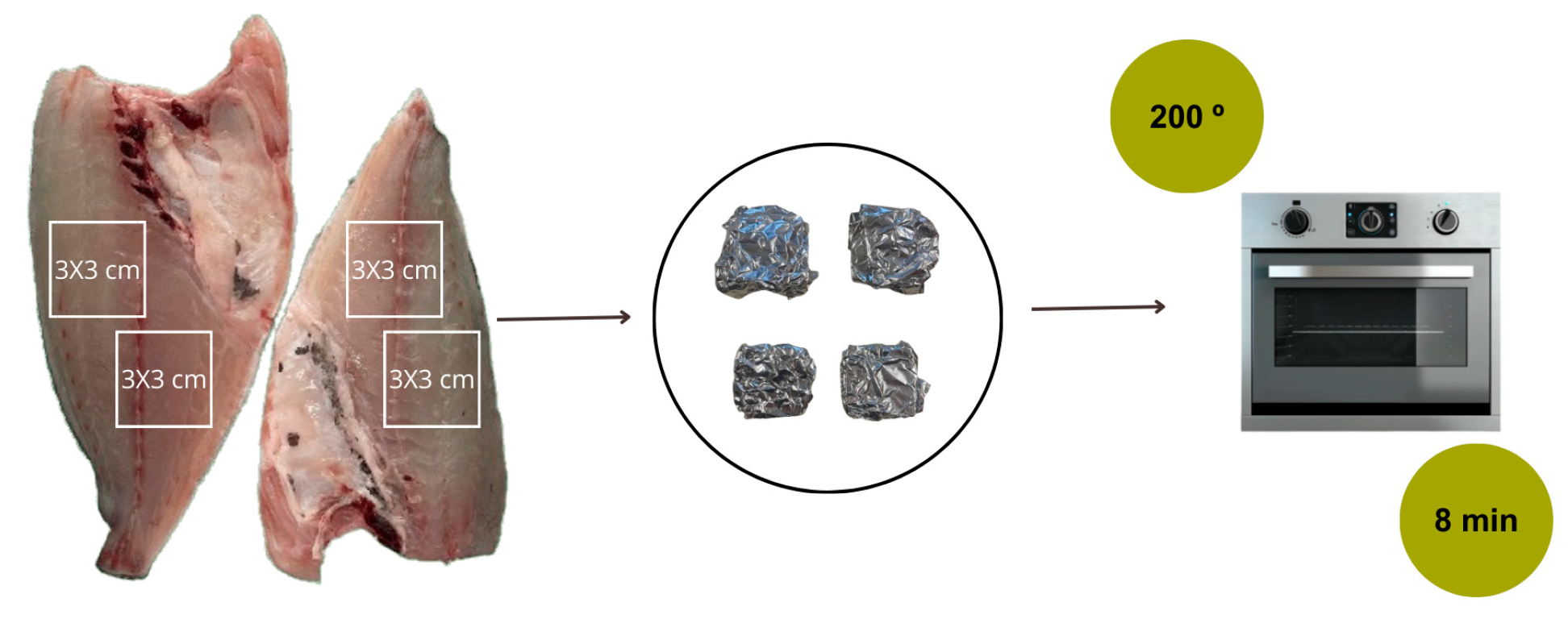
2.1. Samples
2.2. Sensory Analysis
3. Results

| ATTRIBUTES | ZONE | DESCRIPTION | REFERENCE STANDARS | R | |
|---|---|---|---|---|---|
| Low | High | ||||
| Visual/Appearance | |||||
| Color uniformity | Internal | Homogeneity of the characteristic color of the fish filet | Cooked fish filet with grayish areas | Homogeneous cooked fish filet | [7] |
| Brightness | Internal | Perception of brightness of the fish flesh | Dried fish (without fat) | Fish with characteristic fat sheen | [8] |
| Flaking | External | Number of visible scales associated with the lamellar structure | [7] | ||
| Own color | Internal | Intensity of characteristic white color of the cooked white fish muscle | Translucent | Uniform opaque white | [8] |
| Anomalous and unpleasant color | Internal | Loss of characteristic white color of the cooked white fish muscle | — | — | [8] |
| Aroma/Smells | |||||
| Intensity | Overall olfactory intensity of cooked food | [4] | |||
| Marine | Associated with raw shrimp reference, related to seawater/fresh seaweed | — | Fresh seaweed | [7] | |
| Crustacean | Associated with cooked crab reference, cooked shrimp, cooked scallops | — | Cooked crab | [7] | |
| Fermented | Associated with fish sauce reference | — | Fish sauce | [7] | |
| Lactic | Associated with lactic acid reference | — | Acid lactic | [7] | |
| Sulfuric | Associated with cooked egg reference, cooked broccoli/cauliflower | — | Cooked egg | [7] | |
| Basic Flavor | |||||
| Sweet | Basic flavor caused by sugar | — | Sugar | [9] | |
| Acid | Basic flavor caused by acid | — | Lemon | [9] | |
| Salty | Basic flavor caused by salts | — | NaCl | [9] | |
| Bitter | Basic flavor associated with caffeine | — | Coffee | [9] | |
| Umami | Flavor associated with umami compounds | — | Monosodium Glutamate -MSG- | [9] | |
| Specific fish flavor | |||||
| Intensity | Overall flavor intensity of the sample as a whole | — | — | [7] | |
| Lactic acid | Associated with lactic acid reference | — | Acid lactic | [7] | |
| Fermented | Associated with fish sauce reference | — | Fish sauce | [7] | |
| Texture | |||||
| Juiciness | Amount of liquid released when the sample is chewed | Swordfish | Halibut | [3] | |
| Fibrous | Perception of filaments or strands of muscle tissue during mastication | Mango | Pineapple | [10] | |
| Flaky | The ease of breaking the fish into small pieces with a fork | Canned tuna | Honney | [10] | |
| Firmness | Force required to cut the tissue (first bite), using the front teeth | Halibut | Swordfish | [3] | |
| Chewiness | Mechanical property related to cohesion and the number of chews needed to break down solid food until it can be swallowed | Halibut | Swordfish | [3] | |
| Fatness | Surface texture attribute related to the perception of the quantity or quality of fat in a product | Halibut filet | Salmon filet | [3] | |
| Mouthfeel | |||||
| Mouth drying | Degree to which the product creates dryness in the oral cavity | — | — | [7] | |
| Mouthwatering | Degree to which the product creates salivation | — | Orange | [10] | |
| Persistence | Perception of sensation of dirt inside the oral cavity after swallowing the sample | — | — | [11] | |
4. Discussion
5. Conclusions
Supplementary Materials
Author Contributions
Funding
Institutional Review Board Statement
Informed Consent Statement
Data Availability Statement
Acknowledgments
Conflicts of Interest
References
- Food and Agriculture Organization of the United Nations. Seabass and Seabream. 2024. Available online: https://openknowledge.fao.org/handle/20.500.14283/cd3518en (accessed on 1 November 2025).
- Ministerio de Agricultura, Pesca y Alimentación. La Pesca Mes a Mes. Julio 25. Avance de Datos Provisionales Cálculos Realizados a Partir del Último Censo Publicado por el INE. 2025. Available online: https://www.mapa.gob.es/es/dam/jcr:1039c69c-5e0d-435d-9b70-857f28c450ae/la-pesca-mes-a-mes-julio-2025.pdf (accessed on 1 November 2025).
- Carbonell, I.; Izquierdo, L.; Costell, E. Sensory Profiling of Cooked Gilthead Sea Bream (Sparus aurata): Sensory Evaluation Procedures and Panel Training. Food Sci. Technol. Int. 2002, 8, 169–177. [Google Scholar] [CrossRef]
- ISO-8589; Sensory Analysis—General Guidance for the Design of Test Rooms. ISO: Geneva, Switzerland, 2007.
- Hernández, E. Evaluación Sensorial; Centro Nacional de Medios para el Aprendizaje: Bogotá, Colombia, 2005. [Google Scholar]
- Minnesota Department of Health. Temperature and Time Requirements for Food. 2019. Available online: https://www.health.state.mn.us/communities/environment/food/docs/fs/timetempfs.pdf (accessed on 1 November 2025).
- Alexi, N.; Sfyra, K.; Basdeki, E.; Athanasopoulou, E.; Spanou, A.; Chryssolouris, M.; Tsironi, T. Raw and Cooked Quality of Gilthead Seabream Fillets (Sparus aurata, L.) after Mild Processing via Osmotic Dehydration for Shelf-Life Extension. Foods 2022, 11, 2017. [Google Scholar] [CrossRef] [PubMed]
- Díaz Molins, P. Calidad y Deterioro de Platos “Sous Vide” Preparados a Base de Carne y Pescado Almacenados en Refrigeración. Universidad de Murcia. Proyecto de Investigación. 2009. Available online: https://digitum.um.es/server/api/core/bitstreams/de562cce-c7fe-42d1-bab5-0df4829c56f1/content (accessed on 1 November 2025).
- ISO-3972; Sensory Analysis—Methodology—Method of Investigating Sensitivity of Taste. ISO: Geneva, Switzerland, 2011.
- Bland, J.M.; Bett-Garber, K.L.; Li, C.H.; Brashear, S.S.; Lea, J.M.; Bechtel, P.J. Comparison of sensory and instrumental methods for the analysis of texture of cooked individually quick frozen and fresh-frozen catfish fillets. Food Sci. Nutr. 2018, 6, 1692–1705. [Google Scholar] [CrossRef] [PubMed]
- Velázquez-Martínez, R.I.; Criado, C.; Muñoz-González, C.; Crespo, J.; Pozo-Bayón, M.Á. Evaluation of the Long-Lasting Flavour Perception after the Consumption of Wines Treated with Different Types of Oenological Additives Considering Individual 6-n-Propylthiouracil Taster Status. Foods 2023, 12, 2835. [Google Scholar] [CrossRef] [PubMed]
- Calanche Morales, J.B.; Tomás-Vidal, A.; Cusiyunca Phoco, E.R.; Martínez-Llorens, S.; Marquina, P.L.; Jover-Cerdá, M.; Beltrán, J.A. An approach to the spanish consumer’s perception of the sensory quality of environmentally friendly seabass. Foods 2021, 10, 2694. [Google Scholar] [CrossRef] [PubMed]
- Calanche, J.; Tomas, A.; Martinez, S.; Jover, M.; Alonso, V.; Roncalés, P.; Beltrán, J.A. Relation of quality and sensory perception with changes in free amino acids of thawed seabream (Sparus aurata). Food Res. Int. 2019, 119, 126–134. [Google Scholar] [CrossRef] [PubMed]
Disclaimer/Publisher’s Note: The statements, opinions and data contained in all publications are solely those of the individual author(s) and contributor(s) and not of MDPI and/or the editor(s). MDPI and/or the editor(s) disclaim responsibility for any injury to people or property resulting from any ideas, methods, instructions or products referred to in the content. |
© 2026 by the authors. Licensee MDPI, Basel, Switzerland. This article is an open access article distributed under the terms and conditions of the Creative Commons Attribution (CC BY) license.
Share and Cite
Casanova-Martínez, I.; Jiménez-Redondo, N.; Lopéz-Lluch, D.; Carbonell-Barrachina, Á.A.; Sendra, E.; Cano-Lamadrid, M. What Does Quality Fish Taste Like? A Sensory Guide for the Evaluation of Cooked Sparus aurata . Biol. Life Sci. Forum 2026, 56, 3. https://doi.org/10.3390/blsf2026056003
Casanova-Martínez I, Jiménez-Redondo N, Lopéz-Lluch D, Carbonell-Barrachina ÁA, Sendra E, Cano-Lamadrid M. What Does Quality Fish Taste Like? A Sensory Guide for the Evaluation of Cooked Sparus aurata . Biology and Life Sciences Forum. 2026; 56(1):3. https://doi.org/10.3390/blsf2026056003
Chicago/Turabian StyleCasanova-Martínez, Isabel, Nuria Jiménez-Redondo, David Lopéz-Lluch, Ángel A. Carbonell-Barrachina, Esther Sendra, and Marina Cano-Lamadrid. 2026. "What Does Quality Fish Taste Like? A Sensory Guide for the Evaluation of Cooked Sparus aurata " Biology and Life Sciences Forum 56, no. 1: 3. https://doi.org/10.3390/blsf2026056003
APA StyleCasanova-Martínez, I., Jiménez-Redondo, N., Lopéz-Lluch, D., Carbonell-Barrachina, Á. A., Sendra, E., & Cano-Lamadrid, M. (2026). What Does Quality Fish Taste Like? A Sensory Guide for the Evaluation of Cooked Sparus aurata . Biology and Life Sciences Forum, 56(1), 3. https://doi.org/10.3390/blsf2026056003

