
Potential of Open-Pollinated Varieties (OPVs) in Chilli Crop Breeding—A Review †
 ,
,  , ,
, ,  ,
,
Abstract
1. Introduction
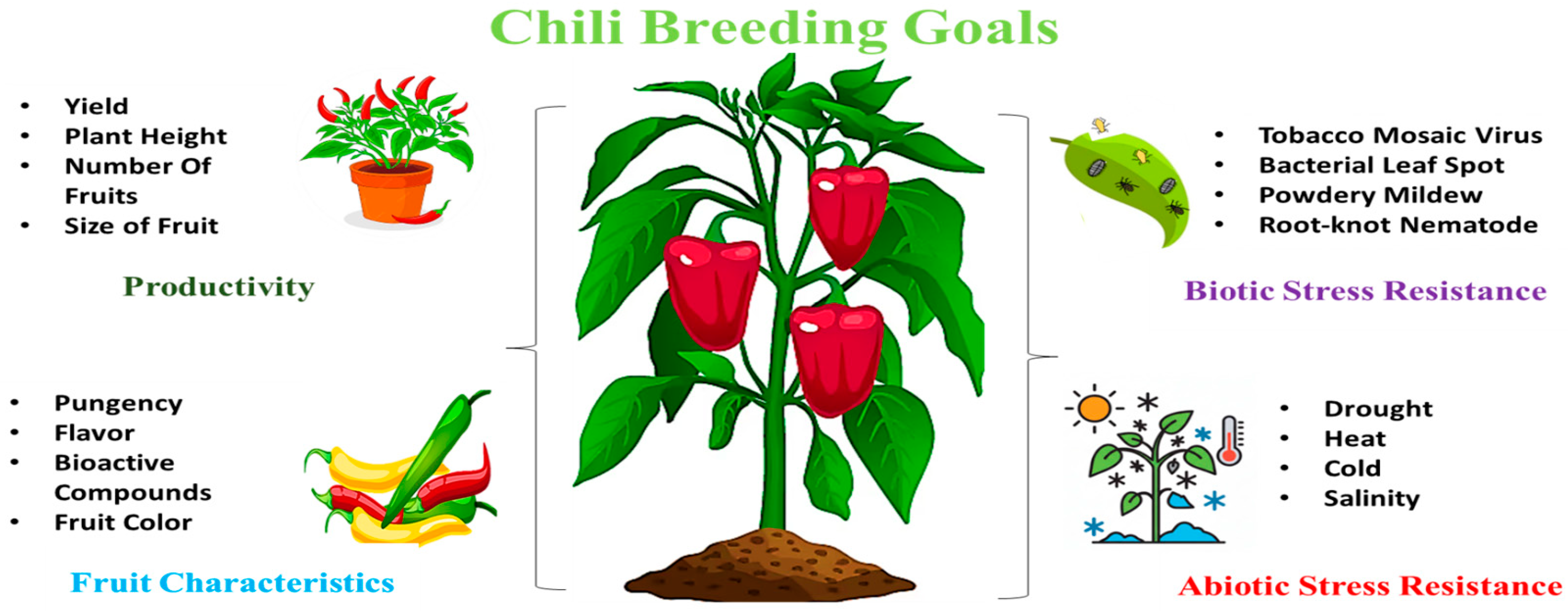
2. Common Goals for Chilli Breeding
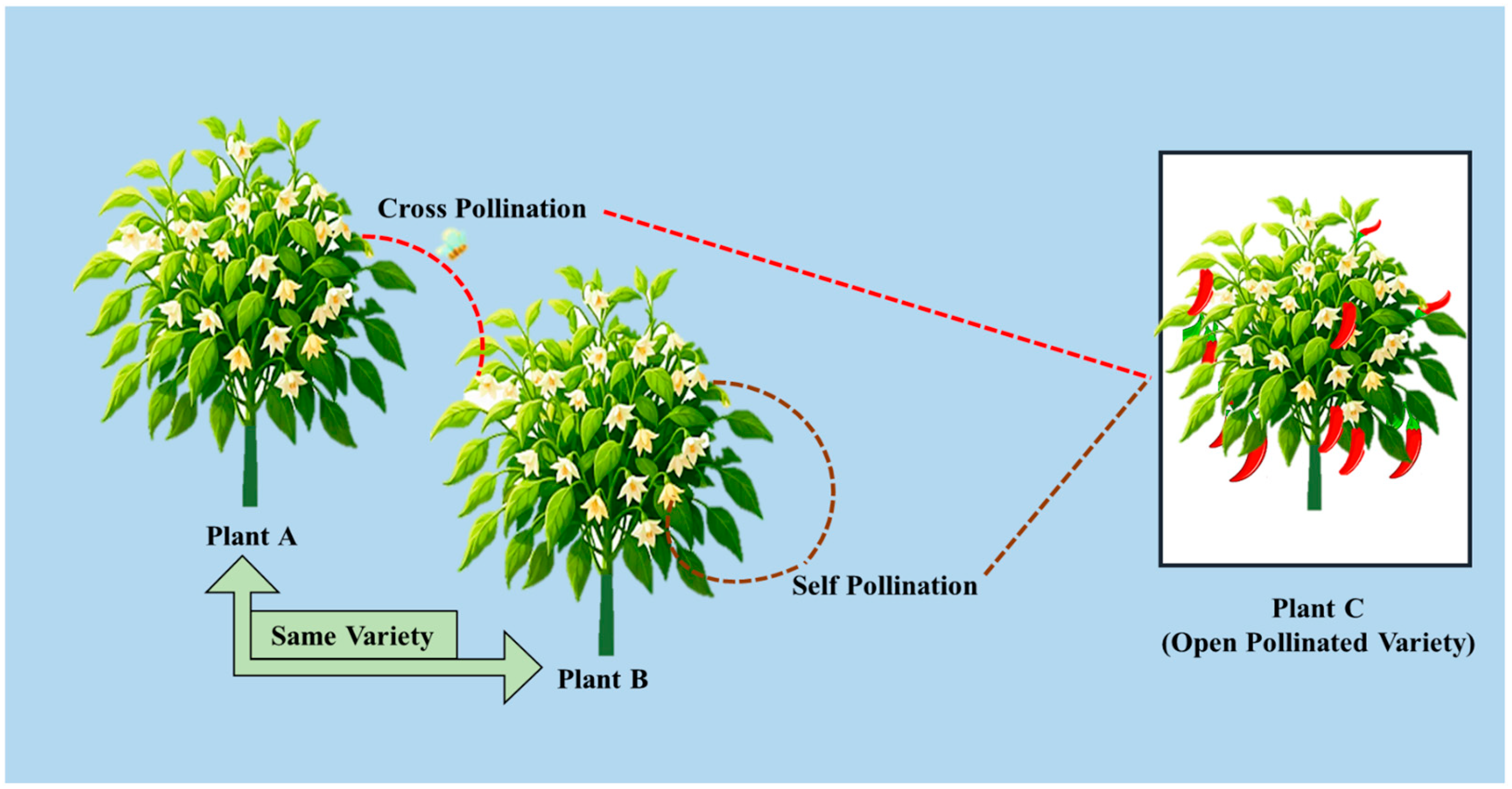
3. Open-Pollinated Variety (OPV)
- Farmers can save true-to-type seeds across generations, enabling them to be seed self-sufficient, economical, and independent from seed companies.
- OPVs develop in situ (within the local environment), which enables them to be well suited to local climatic conditions, soil, and diseases, making them resilient varieties.
- OPVs exhibit a wide range of genetic diversity as compared to hybrids, making them better suited to changes like high temperature, drought stress, and insect pests.
- The seed of OPVs can be recycled each year, allowing farmers to save the harvest for next year’s sowing, which reduces the cost of production and creates opportunities for higher profits [13].
- OPVs that are native to certain areas have unique taste and flavour, resulting in high demand in local markets. They often contain high levels of phenolics, carotenoids, and vitamins (11).
3.1. Role of OPVs in Biodiversity Conservation
3.2. Role of OPVs in Chilli Crop Breeding
- They can be improved through repeated selection and cultivation for yield, fruit quality, and stress resistance.
- The two breeding approaches such as participatory and evolutionary breeding enable farmers to co-select traits of importance, aligning breeding outcomes with local demands [22].
- Selected OPVs can act as a base for hybrid development by contributing resistance genes and quality traits to heterotic pools.
4. Concluding Remarks and Prospects
Author Contributions
Funding
Institutional Review Board Statement
Informed Consent Statement
Data Availability Statement
Conflicts of Interest
Abbreviations
| OPVs | Open-Pollinated Varieties |
References
- Dagnoko, S.; Yaro-Diarisso, N.; Sanogo, P.N.; Adetula, O.; Dolo-Nantoumé, A.; Gamby-Touré, K.; Diallo-Ba, D. Overview of pepper (Capsicum spp.) breeding in West Africa. Afr. J. Agric. Res. 2013, 8, 1108–1114. [Google Scholar] [CrossRef] [Scilit]
- Karim, K.R.; Rafii, M.Y.; Misran, A.B.; Ismail, M.F.B.; Harun, A.R.; Khan, M.M.H.; Chowdhury, M.F.N. Current and prospective strategies in the varietal improvement of chilli (Capsicum annuum L.) specially heterosis breeding. Agron. J. 2021, 11, 2217. [Google Scholar] [CrossRef] [Scilit]
- Olatunji, T.L.; Afolayan, A.J. The suitability of chili pepper (Capsicum annuum L.) for alleviating human micronutrient dietary deficiencies: A review. Food Sci. Nutr. 2018, 6, 2239–2251. [Google Scholar] [CrossRef] [Scilit] [PubMed]
- Bosland, P.W.; Votava, E.J.; Votava, E.M. Peppers: Vegetable and Spice Capsicums; CABI: Oxfordshire, UK, 2012; Volume 22. [Google Scholar]
- Singh, P.; Cheema, D.S.; Dhaliwal, M.S.; Garg, N. Heterosis and combining ability for earliness, plant growth, yield and fruit attributes in hot pepper (Capsicum annuum L.) involving genetic and cytoplasmic-genetic male sterile lines. Sci. Hortic. 2014, 168, 175–188. [Google Scholar] [CrossRef] [Scilit]
- Acquaah, G. Principles of Genetics and Plant Breeding; Classic Methods of Plant Breeding; Wiley-Blackwell: West Sussex, UK, 2012; pp. 281–350. [Google Scholar]
- Hajjar, R.; Jarvis, D.I.; Gemmill-Herren, B. The utility of crop genetic diversity in maintaining ecosystem services. Agric. Ecosyst. Environ. 2008, 123, 261–270. [Google Scholar] [CrossRef] [Scilit]
- Mohan Rao, A.; Anilkumar, C. Conventional and contemporary approaches to enhance efficiency in breeding chilli/hot pepper. In Accelerated Plant Breeding, Volume 2: Vegetable Crops; Springer International Publishing: Cham, Switzerland, 2014; pp. 223–269. [Google Scholar]
- Correjado, V.M.; Magulama, E.E. Usefulness of improved open-pollinated varieties in the development of top-cross white maize hybrids. USM R&D J. 2008, 16, 97–103. [Google Scholar]
- Moscone, E.A.; Scaldaferro, M.A.; Grabiele, M.; Cecchini, N.M.; Sanchez García, Y.; Jarret, R.; Daviña, J.R.; Ducasse, D.A.; Barboza, G.E.; Ehrendorfer, F. The evolution of chili peppers (Capsicum-Solanaceae): A cytogenetic perspective. Acta Hortic. 2007, 745, 137–170. [Google Scholar] [CrossRef] [Scilit]
- Ribes-Moya, A.M.; Raigón, M.D.; Moreno-Peris, E.; Fita, A.; Rodríguez-Burruezo, A. Response to organic cultivation of heirloom Capsicum peppers: Variation in the level of bioactive compounds and effect of ripening. PLoS ONE 2018, 13, e0207888. [Google Scholar] [CrossRef] [Scilit] [PubMed]
- Azmi, C.; Sembiring, A.; Manik, F. Performance and seed quality of several open pollinated chili seed lots. IOP Conf. Ser. Earth Environ. Sci. 2023, 1168, 012002. [Google Scholar] [CrossRef] [Scilit]
- Mariyono, J. Impacts seed technology improvement on economic aspects of chilli production in Central Java-Indonesia. J. Ekon. Pembang. 2016, 17, 1–14. [Google Scholar] [CrossRef] [Scilit]
- Ghasemnezhad, M.; Sherafati, M.; Payvast, G.A. Variation in phenolic compounds, ascorbic acid and antioxidant activity of five colored bell pepper (Capsicum annum) fruits at two different harvest times. J. Funct. Foods 2011, 3, 44–49. [Google Scholar] [CrossRef] [Scilit]
- Al Kafi, A.; Ferdousi, J.; Hossain, M.I.; Islam, M.S.; Nath, D.D. Assessment of nutritional and phytochemical quality in newly developed sweet pepper (Capsicum annuum L.) hybrids compared to check varieties. Dis. Plants 2025, 2, 199. [Google Scholar] [CrossRef] [Scilit]
- Freshley, D.; Delgado-Serrano, M.M. Learning from the past in the transition to open-pollinated varieties. Sustainability 2020, 12, 4716. [Google Scholar] [CrossRef] [Scilit]
- Begna, T. Importance of participatory variety selection and participatory plant breeding in variety development and adoption. Adv. Crop Sci. Tech. 2022, 10, 2–7. [Google Scholar] [CrossRef] [Scilit]
- Mekonnen, S.A. Genetic Diversity of Ethiopian Capsicum spp. and Molecular Mapping of the Up Gene in Pepper (Capsicum spp.). Ph.D. Dissertation, Seoul National University, Seoul, Republic of Korea, February 2020. [Google Scholar]
- Serpolay-Besson, E.; Giuliano, S.; Nicolas Schermann, N.; Chable, V. Evaluation of evolution and diversity of maize open-pollinated varieties cultivated under contrasting environmental and farmers’ selection pressures: A phenotypical approach. Open J. Genet. 2014, 4, 125–145. [Google Scholar] [CrossRef]
- Sun, K. Susceptibility Genes: An Additional Source for Improved Resistance. Ph.D. Thesis, Wageningen University, Wageningen, The Netherlands, May 2017. [Google Scholar]
- Khoury, C.K.; Brush, S.; Costich, D.E.; Curry, H.A.; De Haan, S.; Engels, J.M.; Thormann, I. Crop genetic erosion: Understanding and responding to loss of crop diversity. New Phytol. 2022, 233, 84–118. [Google Scholar] [CrossRef] [Scilit] [PubMed]
- Ceccarelli, S.; Grando, S. Evolutionary plant breeding as a response to the complexity of climate change. Iscience 2020, 23, 101815. [Google Scholar] [CrossRef] [Scilit] [PubMed]


| Feature | OPV Chilli Varieties | F1 Hybrid Chilli Varieties |
|---|---|---|
| Seed-Saving | Yes—stable across generations | No—seeds segregate, traits lost |
| Genetic Uniformity | Moderate, some variation | High—uniform fruit and plant type |
| Local Adaptation | Excellent—evolves with environment | Limited—bred for fixed broad environments |
| Yield Potential | Good under adapted conditions | Often higher under optimal inputs |
| Disease/Stress Resilience | Broader genetic diversity resilience | Often built-in resistance but narrow spectrum |
| Seed Cost | Low (self-saved) | High (must be purchased new, each season) |
| Aspect | OPV Contribution |
|---|---|
| Biodiversity Conservation | Maintains genetic diversity; adapted to local conditions; preserved via seed banks and farmer networks. |
| Climate Resilience | Broad genetic pool increases stress tolerance; dynamic “ultra-cross” populations; long-term system resilience through diversification. |
| Agro-ecological/Organic Support | Meets organic seed standards; enables participatory breeding; thrives under low-input, biodiversity-rich systems. |
| Seed Sovereignty and Farmer Empowerment | Encourages local seed-saving, exchange, and innovation; reduces dependency on commercial hybrids and proprietary seed systems. |
| Economic Sustainability | Provides affordable seed options for smallholders; ensures stable yields across variable seasons; reduces input costs due to inherent adaptability. |
| Genetic Resource for Breeding | Acts as a source of diverse alleles for developing new varieties and hybrids; valuable for pre-breeding and adaptation studies. |
| Socio-cultural Significance | Preserves traditional varieties and associated cultural heritage; fosters farmer identity and community-based innovation in seed systems. |
Disclaimer/Publisher’s Note: The statements, opinions and data contained in all publications are solely those of the individual author(s) and contributor(s) and not of MDPI and/or the editor(s). MDPI and/or the editor(s) disclaim responsibility for any injury to people or property resulting from any ideas, methods, instructions or products referred to in the content. |
© 2026 by the authors. Licensee MDPI, Basel, Switzerland. This article is an open access article distributed under the terms and conditions of the Creative Commons Attribution (CC BY) license (https://creativecommons.org/licenses/by/4.0/).
Share and Cite
Ali, I.; Khan, M.A.; Akram, M.T.; Rana, R.M.; Hawraa, I.; Nawaz, H.; Tipu, F.A. Potential of Open-Pollinated Varieties (OPVs) in Chilli Crop Breeding—A Review. Biol. Life Sci. Forum 2025, 51, 11. https://doi.org/10.3390/blsf2025051011
Ali I, Khan MA, Akram MT, Rana RM, Hawraa I, Nawaz H, Tipu FA. Potential of Open-Pollinated Varieties (OPVs) in Chilli Crop Breeding—A Review. Biology and Life Sciences Forum. 2025; 51(1):11. https://doi.org/10.3390/blsf2025051011
Chicago/Turabian StyleAli, Israr, Muhammad Azam Khan, Muhammad Tahir Akram, Rashid Mehmood Rana, Inaba Hawraa, Hina Nawaz, and Feroz Ahmed Tipu. 2025. "Potential of Open-Pollinated Varieties (OPVs) in Chilli Crop Breeding—A Review" Biology and Life Sciences Forum 51, no. 1: 11. https://doi.org/10.3390/blsf2025051011
APA StyleAli, I., Khan, M. A., Akram, M. T., Rana, R. M., Hawraa, I., Nawaz, H., & Tipu, F. A. (2025). Potential of Open-Pollinated Varieties (OPVs) in Chilli Crop Breeding—A Review. Biology and Life Sciences Forum, 51(1), 11. https://doi.org/10.3390/blsf2025051011