
Evaluation of Nutritional and Popping Quality of Popcorn Genotypes Under Rainfed Conditions †
 , , ,
, , ,
Abstract
1. Introduction
2. Materials and Methods
Statistical Analysis
3. Results
3.1. Morphological Traits
3.2. Physiological Traits
3.3. Popping Quality Traits
3.4. Nutritional Traits
4. Discussion
5. Conclusions
Author Contributions
Funding
Institutional Review Board Statement
Informed Consent Statement
Data Availability Statement
Acknowledgments
Conflicts of Interest
References
- Pandita, D.; Parthasarathy, S.; Dhivyapriya, D.; Premkumar, R.; Pandita, A.; Wani, S.H. Genome diversity in maize. In Maize Improvement: Current Advances in Yield, Quality, and Stress Tolerance Under Changing Climatic Scenarios; Springer: Berlin/Heidelberg, Germany, 2023; pp. 1–24. [Google Scholar]
- Oz, A.; Kapar, H. Determination of grain yield, some yield and quality traits of promising hybrid popcorn genotypes. Turk. J. Field Crops 2011, 16, 233–238. [Google Scholar]
- García-Lara, S.; Serna-Saldivar, S.O. Corn history and culture. In Corn; Elsevier: Amsterdam, The Netherlands, 2019; pp. 1–18. [Google Scholar]
- Serna-Saldivar, S.O. Maize. In ICC Handbook of 21st Century Cereal Science and Technology; Academic Press: New York, NY, USA, 2023; pp. 131–143. [Google Scholar]
- Shavandi, M.; Javanmard, M.; Basiri, A. Novel popping through infrared: Effect on some physicochemical properties of popcorn (Zea mays L. var. everta). LWT 2022, 155, 112955. [Google Scholar] [CrossRef]
- Shukla, S.; Gour, S. Evaluation of physical, nutritional and popping quality of some maize (Zea mays) varieties. Asian J. Dairy Food Res. 2014, 33, 285–291. [Google Scholar] [CrossRef]
- Serna-Saldivar, S.O. Popcorn and other puffed grains. In Snack Foods; CRC Press: Boca Raton, FL, USA, 2022; pp. 201–220. [Google Scholar]
- Al, F.; Öztürk, E.; Akay, H.; Sezer, İ. Determination of Yield and Yield Components of Popcorn (Zea mays L. everta) Genotypes. Black Sea J. Agric. 2023, 6, 492–499. [Google Scholar] [CrossRef]
- Yeboah, B. Impact of Farm and Producer Characteristics on the Adoption of Best Management Practices among Popcorn Producers in the United States. Master’s Thesis, Illinois State University, Normal, IL, USA, 2023. [Google Scholar]
- Yadesa, L.; Diro, D. Nutritional and specialty maize production, consumption, and promising impact on Ethiopia’s food and nutrition security: A review. EAS J. Mlad. Drinić 2023, 5, 142–157. [Google Scholar] [CrossRef]
- Naveed, M.; Ahsan, M.; Akram, H.M.; Aslam, M.; Ahmed, N. Measurement of cell membrane thermostability and leaf temperature for heat tolerance in maize (Zea mays L.): Genotypic variability and inheritance patterns. Maydica 2016, 61, M14. [Google Scholar]
- Aguk, J.; Onwonga, R.N.; Chemining’wa, G.N.; Jumbo, M.B.; George, A. Enhancing yellow maize production for sustainable food and nutrition security in Kenya. East Afr. J. Sci. Technol. Innov. 2021, 2. [Google Scholar] [CrossRef]
- Singh, J.; Singh, V. Prediction of spring maize yields using leaf color chart, chlorophyll meter, and Green Seeker optical sensor. Exp. Agric. 2021, 57, 45–56. [Google Scholar] [CrossRef]
- Song, L.; Jin, J. Effects of severe water stress on maize growth processes in the field. Sustainability 2019, 11, 5086. [Google Scholar] [CrossRef]
- Sánchez, J.; Rivera, M.; García, L. Effect of water deficit on biochemical composition and popping performance in popcorn maize. Agric. Water Manag. 2021, 254, 106978. [Google Scholar]
- Basha, H.A.; Khan, F.; Tariq, M. Impact of moisture stress on kernel hardness and popping performance in popcorn maize. J. Cereal Sci. 2020, 94, 102988. [Google Scholar]
- Ali, M.; Hussain, M.; Rehman, A.; Ahmad, N. Influence of drought stress on yield and quality attributes of maize (Zea mays L.). J. Plant Stress Physiol. 2022, 18, 112–120. [Google Scholar]
- Zulkadir, G.; İdikut, L. Determination of popping traits and grain quality of landrace popcorn populations. J. Food Sci. Technol. 2021, 58, 1302–1312. [Google Scholar] [CrossRef] [PubMed]
- Hussain, M.; Qamar, A.; Saeed, F.; Rasheed, R.; Niaz, B.; Afzaal, M.; Mushtaq, Z.; Anjum, F. Biochemical properties of maize bran with special reference to different phenolic acids. Int. J. Food Prop. 2021, 24, 1468–1478. [Google Scholar] [CrossRef]
- Wattoo, F.M.; Rana, R.M.; Fiaz, S.; Zafar, S.A.; Noor, M.A.; Hassan, H.M.; Amir, R.M. Identification of drought-tolerant maize genotypes and seedling-based morpho-physiological selection indices for crop improvement. Sains Malays 2018, 47, 295–302. [Google Scholar]
- Shafai, S.; Kanth, R.H.; Alie, B.A.; Abdullah, A.; Saad, S.M.; Nazir, S. Behavior of popcorn (Zea mays everta) under different nitrogen regimes in the rainfed conditions of valley. Int. J. Chem. Stud. 2020, 8, 980–984. [Google Scholar] [CrossRef]
- Öktem, A.; Kahramanoğlu, Y. Determination of grain yield and some quality parameters of popcorn (Zea mays L. everta) genotypes. Eurasian J. Agric. Res. 2021, 5, 26–36. [Google Scholar]
- Muthusamy, V. Unraveling popping quality through insights on kernel physical, agro-morphological, and quality traits of diverse popcorn (Zea mays var. everta) inbreds from indigenous and exotic germplasm. Food Res. Int. 2024, 191, 114676. [Google Scholar] [CrossRef] [PubMed]



| S. No. | Code | Source |
|---|---|---|
| 1 | Pop-1 | ARI Swat-Mingora |
| 2 | Pop-2 | CCRI, Pirsabak-Nowshera |
| 3 | Pop-3 | CCRI, Pirsabak-Nowshera |
| 4 | Pop-4 | ARS, Sarai-Naurang |
| 5 | Pop-5 | ARI, Swat-Mingora |
| 6 | Pop-6 | ARS, Sarai-Naurang |
| 7 | Pirsabak (Check) | CCRI, Pirsabak-Nowshera |
| Source of Variations with Degree of Freedom | ||||
|---|---|---|---|---|
| Traits | Replication (2) | Genotypes (6) | Error (12) | CV (%) |
| Days to 50% germination | 1 | 5.63 * | 0.4 | 7.91 |
| Days to 50% tasseling | 4.9 | 19.43 ** | 2.24 | 2.60 |
| Days to 50% silking | 2.3 | 35.54 * | 0.44 | 1.07 |
| Plant height (cm) | 94.9 | 193.89 ** | 55.96 | 4.49 |
| No. of kernel rows ear−1 | 0.01 | 4.60 ** | 1.27 | 7.21 |
| No. of kernels row−1 | 2.3 | 14.32 ** | 1.72 | 4.08 |
| Grain yield plant−1 (g) | 142.1 | 1527.10 ** | 356.9 | 12.28 |
| Source of Variations with Degree of Freedom | ||||
|---|---|---|---|---|
| Traits | Replication (2) | Genotypes (6) | Error (12) | CV (%) |
| Chlorophyll content (%) | 2.8 | 67.7 ** | 3.2 | 4.62 |
| Leaf area index (LAI) | 0.02 | 0.57 ** | 0.03 | 5.8 |
| Cell membrane thermostability | 44.3 | 180.97 ** | 3.4 | 2.36 |
| Kernel size | 0.01 | 0.04 * | 0.001 | 6.39 |
| Popability (%) | 1.2 | 190.28 * | 2.20 | 1.75 |
| Expansion volume (cm3 g−1) | 6 | 41.54 ** | 1.52 | 7.94 |
| Protein content (%) | 3.75 | 58.84 ** | 3.75 | 20.9 |
| Kernel oil content (%) | 0.3 | 3.96 ** | 0.04 | 4.17 |
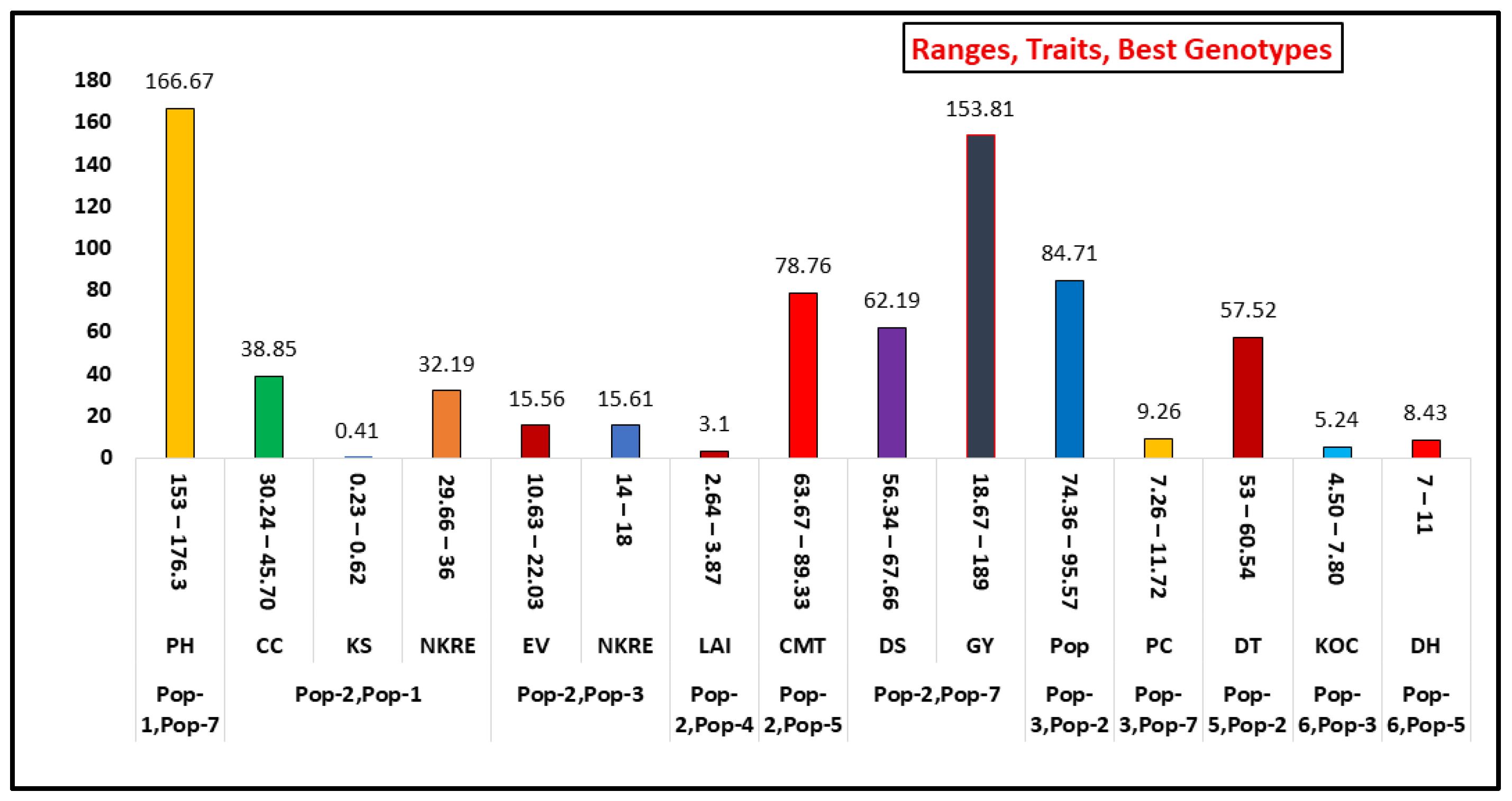
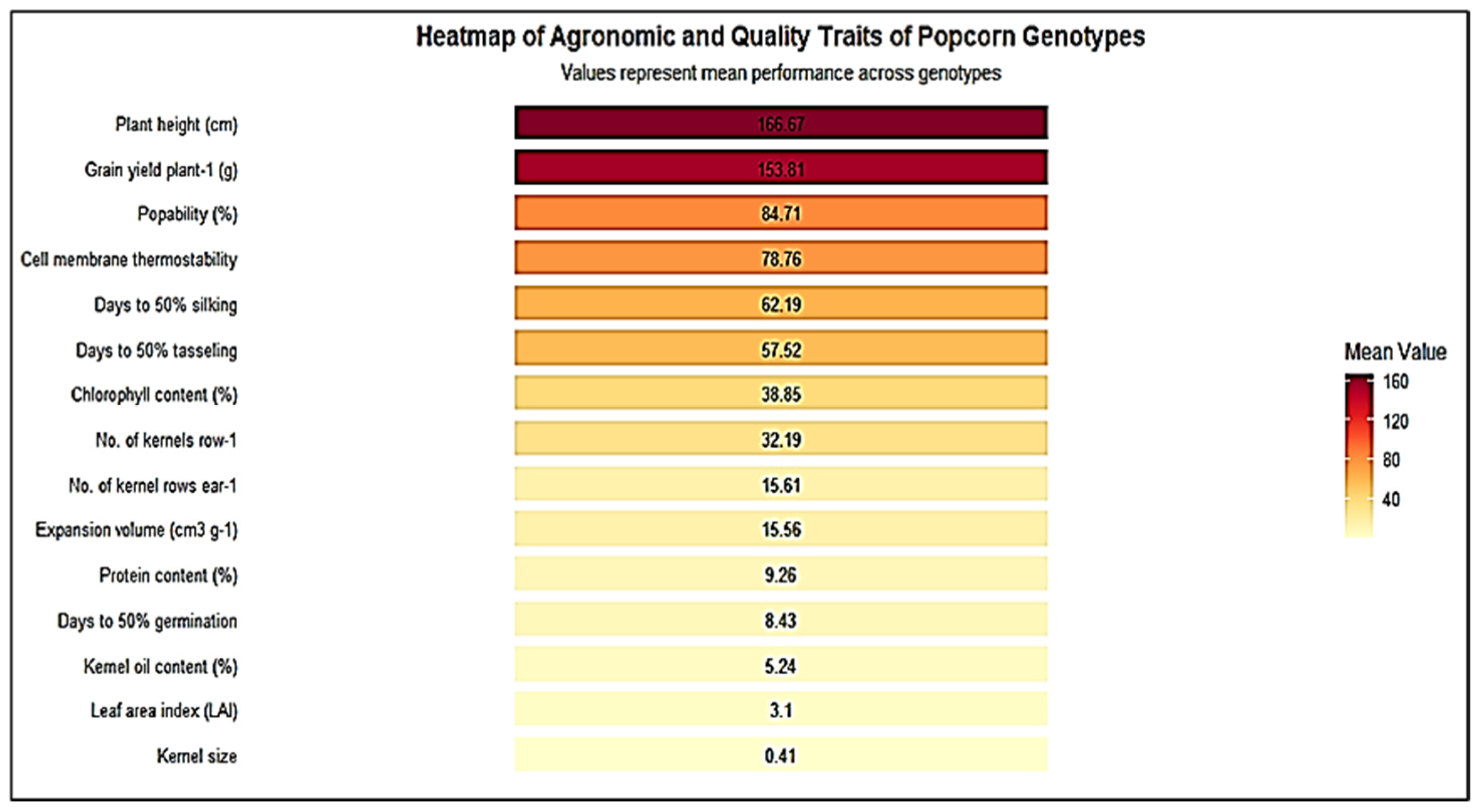
| Traits | Range | Mean | Best Genotypes |
|---|---|---|---|
| Days to 50% germination | 7–11 | 8.43 | Pop-5, Pop-6 |
| Days to 50% tasseling | 53–60.54 | 57.52 | Pop-5, Pop-2 |
| Days to 50% silking | 56.34–67.66 | 62.19 | Pop-2, Pop-7 |
| Plant height (cm) | 153–176.3 | 166.67 | Pop-1, Pop-7 |
| No. of kernel rows ear−1 | 14–18 | 15.61 | Pop-2, Pop-3 |
| No. of kernels row−1 | 29.66–36 | 32.19 | Pop-2, Pop-1 |
| Grain yield plant−1 (g) | 18.67–189 | 153.81 | Pop-2, Pop-7 |
| Chlorophyll content (%) | 30.24–45.70 | 38.85 | Pop-2, Pop-1 |
| Leaf area index (LAI) | 2.64–3.87 | 3.10 | Pop-2, Pop-4 |
| Cell membrane thermostability | 63.67–89.33 | 78.76 | Pop-2, Pop-5 |
| Kernel size | 0.23–0.62 | 0.41 | Pop-2, Pop-1 |
| Popability (%) | 74.36–95.57 | 84.71 | Pop-3, Pop-2 |
| Expansion volume (cm3 g−1) | 10.63–22.03 | 15.56 | Pop-2, Pop-3 |
| Protein content (%) | 7.26–11.72 | 9.26 | Pop-3, Pop-7 |
| Kernel oil content (%) | 4.50–7.80 | 5.24 | Pop-6, Pop-3 |
| Traits | Vg | Ve | Vp | h2 |
|---|---|---|---|---|
| Days to 50% germination | 1.73 | 0.44 | 2.17 | 79.725 |
| Days to 50% tasseling | 5.73 | 2.2381 | 7.97 | 71.912 |
| Days to 50% silking | 11.70 | 0.4444 | 12.14 | 96.340 |
| Plant height (cm) | 45.98 | 55.96 | 101.94 | 45.103 |
| No. of kernel rows ear−1 | 1.11 | 1.26984 | 2.38 | 46.667 |
| No. of kernels row−1 | 4.20 | 1.7222 | 5.92 | 70.912 |
| Grain yield plant−1 (g) | 390.07 | 356.88 | 746.95 | 52.222 |
| Chlorophyll content (%) | 21.51 | 3.2284 | 24.74 | 86.949 |
| Leaf area index (LAI) | 0.18 | 0.03278 | 0.21 | 84.600 |
| Cell membrane thermostability | 59.18 | 3.444 | 62.62 | 94.500 |
| Kernel size | 0.02 | 0.0007 | 0.02 | 95.702 |
| Popability (%) | 62.69 | 2.201 | 64.89 | 96.608 |
| Expansion volume (cm3 g−1) | 13.34 | 1.5252 | 14.87 | 89.741 |
| Protein content (%) | 18.36 | 3.76 | 22.12 | 83 |
| Kernel oil content (%) | 1.30 | 0.04798 | 1.35 | 96.453 |
Disclaimer/Publisher’s Note: The statements, opinions and data contained in all publications are solely those of the individual author(s) and contributor(s) and not of MDPI and/or the editor(s). MDPI and/or the editor(s) disclaim responsibility for any injury to people or property resulting from any ideas, methods, instructions or products referred to in the content. |
© 2025 by the authors. Licensee MDPI, Basel, Switzerland. This article is an open access article distributed under the terms and conditions of the Creative Commons Attribution (CC BY) license (https://creativecommons.org/licenses/by/4.0/).
Share and Cite
Ullah, S.; Wattoo, F.M.; Rana, R.M.; Ullah, K.F.; Khaliq, S.; Khan, A.A.; Din, S.U. Evaluation of Nutritional and Popping Quality of Popcorn Genotypes Under Rainfed Conditions. Biol. Life Sci. Forum 2025, 51, 6. https://doi.org/10.3390/blsf2025051006
Ullah S, Wattoo FM, Rana RM, Ullah KF, Khaliq S, Khan AA, Din SU. Evaluation of Nutritional and Popping Quality of Popcorn Genotypes Under Rainfed Conditions. Biology and Life Sciences Forum. 2025; 51(1):6. https://doi.org/10.3390/blsf2025051006
Chicago/Turabian StyleUllah, Sharif, Fahad Masoud Wattoo, Rashid Mehmood Rana, Kainat Faiz Ullah, Sabreena Khaliq, Ahmad Ali Khan, and Shahab Ud Din. 2025. "Evaluation of Nutritional and Popping Quality of Popcorn Genotypes Under Rainfed Conditions" Biology and Life Sciences Forum 51, no. 1: 6. https://doi.org/10.3390/blsf2025051006
APA StyleUllah, S., Wattoo, F. M., Rana, R. M., Ullah, K. F., Khaliq, S., Khan, A. A., & Din, S. U. (2025). Evaluation of Nutritional and Popping Quality of Popcorn Genotypes Under Rainfed Conditions. Biology and Life Sciences Forum, 51(1), 6. https://doi.org/10.3390/blsf2025051006