


Abstract
Silicon dioxide (SiO2) has been extensively studied as an alternative method to pest management chemical applications in agriculture. The present work aimed to evaluate the insecticidal efficacy of different SiO2 nanoparticle formulations and their effectiveness when integrated into the textiles of an insect-proof net. For this reason, Sitophilus oryzae and Tribolium confusum were exposed to three inert dust formulations, namely Sylobloc® S200, S200-OH, and S200MEC, to investigate their effect on the mortality of the aforementioned stored-product insects. The results of a series of bioassays showed that Sylobloc® S200 was the most effective nanoparticle among all the formulations tested. Thus, five samples of the same 50 mesh size insect-proof net were coated with the S200 nanoparticle, followed either by different coating repetitions or by the addition of paraffin. T. confusum was indicated as the most tolerant species, as the recorded mortality rate was significantly low when exposed to all samples tested. However, the mortality rate of S. oryzae was strongly related to the coating repetition, in addition to the exposure intervals. The highest mortality (70%) was detected after seven days of exposure to the net and consisted of three coating repetitions, while no paraffin was added to its surface. The results of the present study underline the insecticidal efficacy of SiO2 treated nets against storage insects, and their subsequent application in greenhouses for the control of more susceptible insects.
1. Introduction
The use of inert dust formulations, such as silicon dioxide (SiO2), as a non-toxic and environmentally friendly substance, has been well established in agriculture. The mode of action of SiO2 lies in the adherence and friction of its nanoparticles on the insect’s exoskeleton, increasing water loss and mortality [1,2]. Nanoparticles present significant differences in comparison to their bulk formation [3]. Sitophilus oryzae, an important stored-product insect, was significantly affected by the use of nanoparticles in contrast with bulk silica, which did not have any significant effect on the mortality of the species [4]. Unlike other nanoparticles, SiO2 is a very promising substance in stored-product pest management, as its insecticidal efficacy was indicated to be greater than that of ZnO and TiO2 nanoparticles on S. oryzae and Tribolium castaneum due to its spherical morphology [5]. Moreover, silica aerogels and mixtures consisting of enhanced SiO2 nanoparticles are expected to lead to higher and faster levels of pest mortality [6]. The efficacy of inert dust formulations in the control of insect population density depends, to a great extent, on the time intervals of exposure. Contrary to synthetic insecticides, inert dust’s time of action is not direct, which means that recovery is likely to happen when insects are exposed for short periods to the dust [6,7]. In a recent study, it was demonstrated that a significant mortality of S. oryzae and T. confusum is likely to occur at a slower rate when exposed to siliceous nanoparticles, as they are considerably hard-bodied and tolerant insects [8]. Following the previous study, the insecticidal efficacy of a 50-mesh size screen coated with SiO2 nanoparticles was evaluated under laboratory conditions against S. oryzae and T. confusum [9]. The results indicated the efficiency of SiO2 nanoparticles as an alternative insect control agent, as delayed mortality was promoted after 7 days of post-exposure to the treated screens. Considering the above, this study aimed to determine the mortality of two stored-product insects, T. confusum and S. oryzae when exposed to three silica nanoparticle types, and five insect-proof screen formulations of different properties coated with SiO2 nanoparticles, for different time intervals in laboratory experiments.
2. Materials and Methods
Sitophilus oryzae (Coleoptera: Curculionidae) adults and Tribolium confusum Jacquelin du Val (Coleoptera: Tenebrionidae) larvae were reared at the Laboratory of Entomology and Agricultural Zoology (LEAZ), Department of Agriculture, Crop Production and Rural Environment at the University of Thessaly in a growth chamber at 25 °C and 65% relative humidity, in continuous darkness, on whole wheat kernels and wheat flour, respectively.
Two bioassay series were performed under laboratory conditions to investigate the insecticidal efficacy of dust and insect-proof screen formulations against the aforementioned pests. During the 1st bioassay, three inert nanoparticle formulations, namely Sylobloc® S200, S200–OH, and S200MEC, were tested as wheat protectants to monitor their effect on the mortality of S. oryzae adults and T. confusum larvae. A dosage of 1000 ppm of each silica dust was added in a glass jar containing soft wheat and the mixture was shaken manually for 5 min to achieve equal distribution of the silica nanoparticles in the entire wheat mass. A total of 20 individuals of each species were carefully transferred in a plastic cylindrical vial (3 × 8 cm), in which 20g of the aforementioned mixture were added, with separate vials for each species. The mortality rate of each species was measured 1 and 7 days post-exposure to the dust formulations. Each bioassay was replicated three times per treatment.
In the 2nd bioassay, S. oryzae and T. confusum individuals were exposed to a 50-mesh insect-proof screen provided by Thrace Nonwovens and Geosynthetics S.A, without being a commercial product of the company, using High-Density Polyethylene (HDPE) monofilament woven yarns. The textiles of the screen were coated with the Sylobloc® S200 formulation. Table 1 shows the physical properties of each tested screen.

Table 1.
Properties of the coated insect-proof screens.
The mass of deposited silica particles on the screen’s surface reached the maximum deposition rate after two coating repetitions and differ between samples due to the coating repetition, as well as, to the addition of paraffin. In this series of bioassays, screens were cut and glued at the bottom of plastic Petri dishes (59.4 cm2 on the surface). Ten insects of each species were transferred on each Petri dish and exposed to each treated screen for 72 h. Then, the insects were carefully transferred to a Petri dish consisting of a “clear” screen without any dust added. The response of all insects exposed to the treated screens was monitored at different time intervals, specifically after 1, 3, 5, and 7 days. For each of the five samples, the bioassay was replicated three times per exposure interval, followed by three sub replicates. Cracked wheat (0.5 ± 0.1 g) and wheat flour (1.0 ± 0.1 g) were added in all Petri dishes to supply food to S. oryzae and T. confusum, respectively.
Statistical Analysis
Multiple Comparison of means was performed by applying one-way ANOVA using the Tukey–Kramer HSD test at the 5% level (p ≤ 0.05). In case data did not follow a normal distribution, a non-parametric Kruskal–Wallis test (p ≤ 0.05) was performed. Significance of values have been adjusted by the Bonferroni correction for multiple tests. All comparisons were performed through SPSS (Statistical Package for the Social Sciences, IBM, Armonk, NY, USA).
3. Results
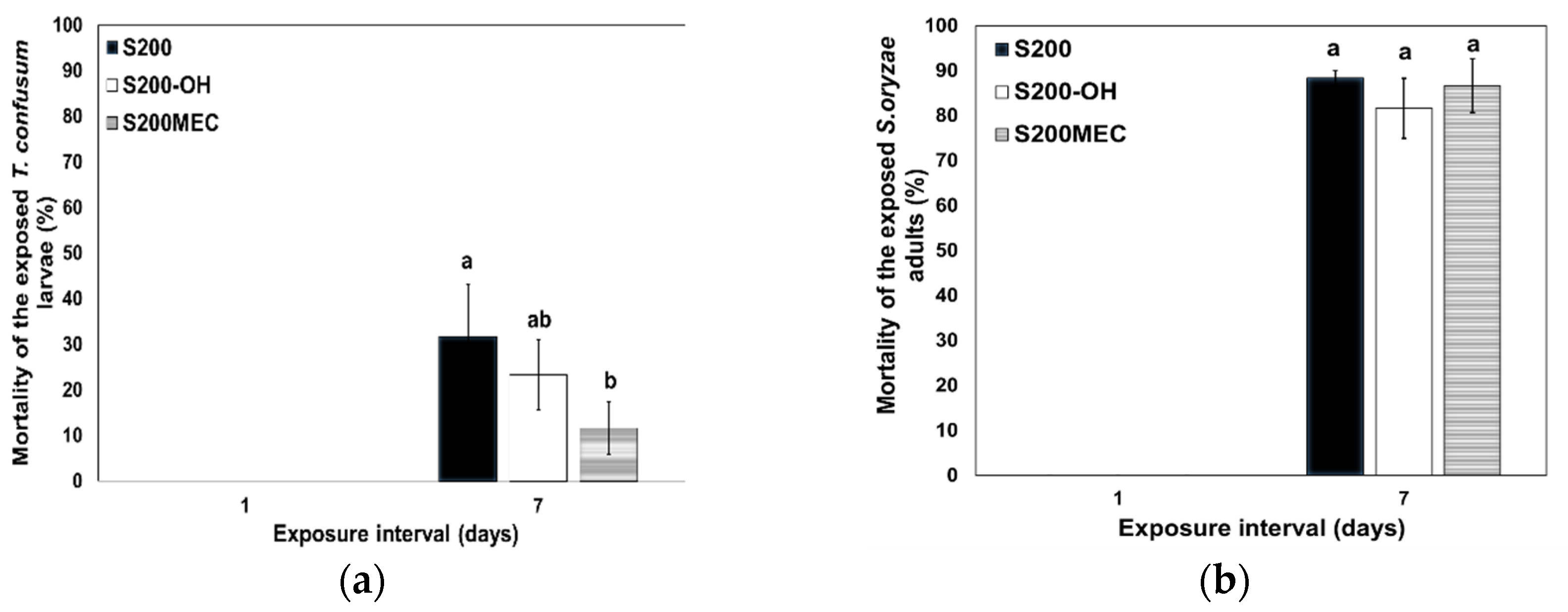
The recorded mortality of T. confusum larvae was significantly low. None of the tested stored-product insects were affected after 24 h of continuous exposure to the three silica nanoparticle formulations. However, as shown in Figure 1a, the highest mortality rate was recorded 7 days after the initial exposure of the larvae to the S200 formulation. In particular, Sylobloc® S200 was the most effective since the mortality rate was three times higher in comparison to the S200MEC formulation.
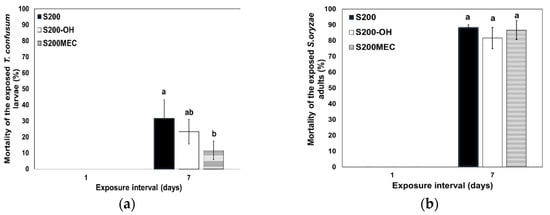
Figure 1.
(a) Mortality rate of T. confusum larvae; (b) Mortality rate of S. oryzae adults after 1 and 7 days of post-exposure to the S200, S200–OH, S200MEC formulation.
On the other hand, the results depicted in Figure 1b indicated that the tested nanoparticle formulations were more lethal for S. oryzae adults as compared to T. confusum larvae. No mortality was detected one day after the exposure of S. oryzae to the siliceous nanoparticles. However, on the 7th day of exposure, all formulations led to an increase in mortality rate up to 86%. Taking into consideration the results of the three siliceous dust trials, S200 was selected as the most efficient formulation against both insects. Thus, the following experiments with the silica-treated screens were conducted on samples that were coated only with the Sylobloc® S200 nanoparticles.
As shown in Table 2, T. confusum larvae were indicated as the most tolerant species when exposed to all SiO2-treated screens. In all bioassays, it was shown that none of the five tested samples affected significantly the population density of T. confusum, since the highest recorded mortality did not exceed 8.3% (S200-0-P), even 7 days after the exposure of the individuals to the treated screens.
Table 2.
Mortality rate of T. confusum larvae after 72 h of continuous exposure to the treated screens and 1, 3, 5, and 7 days of post-exposure to treated SiO2-treated screens.
In contrast to the results obtained from the T. confusum bioassay, the mortality rate of S. oryzae followed an upward trend for all tested screens as the exposure interval increased. In particular, the highest mortality was achieved 7 days post-exposure to all treated screens, except for the S200-1-P screen, and ranged from 56.7 to 70.0% (Table 3).
Table 3.
Mortality rate of S. oryzae adults after 72 h of continuous exposure to the treated screens and 1, 3, 5, and 7 days of post-exposure to treated SiO2-treated screens.
4. Discussion
The results of the present study clearly show that the effect of inert dust formulations on insect mortality varies considerably among the selected species. Specifically, the mortality of T. confusum was relatively low, as only 32% of the larvae were affected after 7 days of continuous exposure to the S200 formulation. On the other hand, S. oryzae adults were more susceptible to all dust formulations, particularly to S200, as the mortality rate increased at 88% after 7 days of post-exposure to the dust. In a recent study conducted to determine the efficacy of siliceous formulations against storage insects, it was indicated that after 6 h of exposure to different silica formulations, 99% of the S. oryzae adults were under knockdown effect (KDt99), i.e., they had limited movement which could not affect the commodities. Unlike S. oryzae, T. confusum, larvae were more tolerant to such formulations, requiring at least 8.5 h of continuous exposure to achieve KDt99. Moreover, in the same study, long term exposure bioassays were assessed, suggesting that the delayed mortality of the insects was increased to 100% after 7 days post-exposure for only 15 min to the SiO2 nanoparticles [9]. However, desiccation is more likely to occur for soft-bodied insects such as aphids, whilst in the case of stored-product insects, water loss becomes more difficult due to their hard exoskeleton. Thus, SiO2 nanoparticles could be introduced in greenhouses to enhance pest management.
Moreover, a more recent survey regarding pest management under SiO2 treated screens against S. oryzae adults and T. confusum larvae showed that the mortality of the individuals reached 100% and 34% after 10 days post-exposure for only 15 min to the treated screen, underlying the strong tolerance of the latter species to the treated screens. In the same study, it was argued that the mortality of S. oryzae was independent of the addition of paraffin on the screen’s surface. Our results are in agreement with those of the aforementioned study, as paraffin did not play a decisive role in insect mortality. The delayed mortality recorded for both of the tested stored-product insects can also be associated with the slow-acting mode of inert dusts, as the mortality is possible to occur over a period of weeks after continuous exposure to the screens [9]. There are also cases where some species such as T. confusum larvae, although soft-bodied, are extremely tolerant to water loss. In a recent study [6], stored product psocids (Psocoptera: Liposcelididae) were extremely tolerant to diatomaceous earth and had the ability to moderate desiccation.
The tested stored-product insects are considered a more tolerant species compared to insects that usually penetrate the interior of a greenhouse structure. SiO2 offers an innovative technological solution for sustainable agriculture, preserving pest management, whilst minimizing the environmental footprint through its non-toxic and pesticide-free basis. In this way, insect-proof screens coated with SiO2 nanoparticles could be integrated on the greenhouses’ vent openings by serving a dual role as a barrier and as a natural insecticide contributing to pest control and adequate ventilation.
Supplementary Materials
The poster presentation can be downloaded at https://www.mdpi.com/article/10.3390/IECAG2021-09720/s1.
Author Contributions
Conceptualization, N.K.; methodology, C.G.A., R.G. and P.A.; validation, S.F., N.K., R.G. and P.A.; formal analysis, S.F.; investigation, R.G., P.A., P.X. and S.F.; data curation, N.K., S.F., and R.G.; writing—original draft preparation, S.F.; writing—review and editing, S.F. and N.K.; supervision, N.K. and C.G.A.; project administration, N.K.; funding acquisition, N.K. and P.X. All authors have read and agreed to the published version of the manuscript.
Funding
This research has been co-financed by the European Union and Greek national funds through the National Action “Bilateral and Multilateral E&T Cooperation Greece-Germany” (project code: T2DGE-0120).
Institutional Review Board Statement
Not applicable.
Informed Consent Statement
Not applicable.
Conflicts of Interest
The authors declare no conflict of interest. The funders had no role in the design of the study; in the collection, analyses, or interpretation of data; in the writing of the manuscript, or in the decision to publish the results.
References
- Barik, T.K.; Sahu, B.; Swain, V. Nanosilica—From medicine to pest control. Parasitol. Res. 2008, 103, 253–258. [Google Scholar] [CrossRef] [PubMed]
- Benelli, G. Mode of action of nanoparticles against insects. Environ. Sci. Pollut. Res. 2018, 25, 12329–12341. [Google Scholar] [CrossRef] [PubMed]
- Rastogi, A.; Tripathi, D.K.; Yadav, S.; Chauhan, D.K.; Živčák, M.; Ghorbanpour, M.; El-Sheery, N.I.; Brestic, M. Application of silicon nanoparticles in agriculture. 3 Biotech 2019, 9, 90. [Google Scholar] [CrossRef] [PubMed] [Green Version]
- Debnath, N.; Das, S.; Seth, D.; Chandra, R.; Bhattacharya, S.C.; Goswami, A. Entomotoxic effect of silica nanoparticles against Sitophilus oryzae (L.). J. Pest Sci. 2011, 84, 99–105. [Google Scholar] [CrossRef]
- Goswami, A.; Roy, I.; Sengupta, S.; Debnath, N. Novel applications of solid and liquid formulations of nanoparticles against insect pests and pathogens. Thin Solid Films 2010, 519, 1252–1257. [Google Scholar] [CrossRef]
- Athanassiou, C.G.; Arthur, F.H.; Campbell, J.F.; Donaldson, J.E. Particle size matters: Efficacy of aerosols for the control of stored product psocids. J. Stored Prod. Res. 2019, 83, 148–152. [Google Scholar] [CrossRef]
- Golob, P. Current status and future perspectives for inert dusts for control of stored product insects. J. Stored Prod. Res. 1997, 33, 69–79. [Google Scholar] [CrossRef]
- Faliagka, S.; Agrafioti, P.; Lampiri, E.; Katsoulas, N.; Athanassiou, C.G. Assessment of different inert dust formulations for the control of Sitophilus oryzae, Tribolium confusum and Aphis fabae. Crop Prot. 2020, 137, 105–312. [Google Scholar] [CrossRef]
- Agrafioti, P.; Faliagka, S.; Lampiri, E.; Orth, M.; Pätzel, M.; Katsoulas, N.; Athanassiou, C.G. Evaluation of silica-coated insect proof nets for the control of Aphis fabae, Sitophilus oryzae, and Tribolium confusum. Nanomaterials 2020, 10, 1658. [Google Scholar] [CrossRef] [PubMed]
Publisher’s Note: MDPI stays neutral with regard to jurisdictional claims in published maps and institutional affiliations. |
© 2021 by the authors. Licensee MDPI, Basel, Switzerland. This article is an open access article distributed under the terms and conditions of the Creative Commons Attribution (CC BY) license (https://creativecommons.org/licenses/by/4.0/).