


Abstract
This paper aims to evaluate the maturity of Brazilian companies regarding the inclusion of local communities in sustainability reporting. The analysis was based on sustainability reports from a sample of 26 companies listed on the Brazilian stock exchange sustainability index. The study employs a mixed-methods approach and includes the following sequential steps: literature review and content analysis of sustainability reporting standards to identify critical success factors; application of the CRITIC method to define weights for decision criteria; analysis of corporate practices related to the inclusion of local communities in sustainability reports performed by Brazilian companies to determine maturity levels using the Grey Fixed Weighted Clustering method and the Kernel technique. The findings reveal that transparency, comprehensive assessment, and accountability are the most critical factors of sustainability reporting maturity regarding local communities. The analysis shows that companies in the energy sector perform better and can serve as a benchmark for companies in other sectors, such as manufacturing, in which most companies present low maturity. Key corporate practices are identified and discussed for improving engagement with local communities aiming to enhance corporate social responsibility and sustainability reporting. This study advances the understanding of corporate sustainability by highlighting the role of businesses in fostering socio-economic development through the inclusion of local communities in sustainability reporting. It extends theoretical discussions on corporate social responsibility by emphasizing transparency, accountability, and comprehensive assessment as critical factors for sustainability reporting. Practically, the findings provide insights for companies seeking to enhance engagement with local communities, offering a benchmark for industries with lower maturity levels. By demonstrating how sustainability reporting can serve as a strategic tool for social impact, the study reinforces the broader role of businesses in sustainable development.
1. Introduction
According to Stibbe e Prescott [1], there has been a recent shift in the private sector’s perception of the importance of sustainable development. This change is attributed to the extensive reach of their activities and the relationships they maintain with various members of their supply chains. The authors argue that organizations can contribute to sustainable development across a spectrum of possibilities. This spectrum ranges from “non-core” activities, such as philanthropic investments, to activities directly related to the company’s business, such as the development of products and services that promote a positive impact on sustainability.
Sustainability-oriented organizations need to consider the importance of economic, environmental, and social dimensions of sustainable development. However, the importance given by companies to social sustainability has been, proportionally, less than that given to economic and environmental dimensions, especially in developing countries [2]. In this context, social sustainability can encompass both internal stakeholders, focusing on employees, and external stakeholders outside the organization [3,4].
One of the main external stakeholders of organizations is their local communities. These communities have been demanding greater participation in investment decision-making processes, not only to benefit economically but also to ensure the maintenance of their safety. In this context, the concept of a Social License to Operate (SLO) is relevant [5].
Sustainability reports have become an important tool used by organizations to communicate their environmental, social, and governance performance to their external stakeholders [6]. They are also crucial for highlighting events that may generate positive impacts (opportunities) or negative impacts (risks) in the governance, environmental, and social areas of the organizations [7].
The need for organizations to develop sustainability reports has encouraged the emergence of frameworks and standards to assist companies in disclosing their sustainability information. Notable examples include the International Integrated Reporting (IR), Global Reporting Initiative (GRI), Task Force on Climate-Related Financial Disclosure (TCFD), and Sustainability Accounting Standards Board (SASB) [8,9,10]. Among the various standards and guidelines, the GRI standards have been the most widely used by organizations [7].
Companies that include local communities in their lists of material topics recognize that their activities and business relationships significantly impact these communities. The actions developed in this regard should be reported in sustainability reports so that the entire society is informed [11]. Naturally, the maturity of the actions taken with local communities varies from company to company, making it essential for society to demand increasingly well-planned and developed actions.
When examining the literature related to corporate sustainability, one finds models that aim to analyze organizational management as a whole across various sectors and activities [12,13,14]. However, studies on the maturity of actions that companies undertake with local communities are scarce.
Despite the growing number of publications on sustainability reporting [15,16], few studies offer structured assessments of maturity levels in how companies engage local communities. The existing literature often focuses on overall reporting quality or stakeholder engagement in general [6,7], but does not provide detailed insights into the progressive development of corporate practices toward local communities. This study addresses this gap by evaluating maturity based on established GRI standards, providing a diagnostic beyond binary presence/absence of disclosure.
In the context presented, this research aims to identify the level of maturity of organizations listed on the main Brazilian stock exchange index concerning their engagement with local communities. More specifically, the study seeks to analyze how these organizations incorporate sustainability indicators related to local development, using mathematical and statistical methods to generate evidence-based insights. In this study, the term local communities refer to small, often traditional populations located in environmentally preserved areas, which may include indigenous or rural groups committed to protecting their land, natural resources, and ways of life. The concept of a sustainable economy is understood as a development model that balances economic viability with environmental conservation and social equity at the local level.
2. Theoretical Background
From a sustainability perspective, local communities are defined as “individuals or groups of individuals living or working in areas affected or that may be affected by the organization’s activities. Local communities are considered both those living in areas adjacent to the organization’s operations and those at a distance” (Global Reporting Initiative, 2016).
Local communities are thus part of the group of stakeholders of organizations according to Freeman’s [17] definition and are considered one of their indirect stakeholders [18]. Due to their nature and proximity to operational impacts, affected communities constitute a major stakeholder group that must be managed with care and inclusion [19]. Local communities exert influence on organizations by offering their expertise [20] and by granting the so-called Social License to Operate (SLO) [5].
On the other hand, corporate activities can also directly affect these communities. This bidirectional relationship demands structured engagement strategies. Several scholars have emphasized that the relationship between companies and their surrounding communities has become a strategic concern, not only for for-profit but also for non-profit organizations [21]. The increasing relevance of local communities in governance and decision-making processes reflects their demand for shared benefits and meaningful participation [22].
In certain sectors of the economy, the relationship between local communities and organizations tends to be more intense, such as in the following sectors: energy [23,24]; mining [20]; oil and gas [25]; construction and infrastructure [26]; Agriculture and Forestry [27,28]; Logistics and Transportation [29]; and Tourism [30].
While communities may support the installation of operations with sustainable potential—such as wind farms or recycling plants—they may also resist such projects when these are perceived as threats to their well-being, territory, or livelihoods. This dual behaviour is often described in the literature as the “Not In My Backyard” (NIMBY) effect [31]. In this context of increasing influence, the integration of local communities into the activities of organizations is crucial for delivering social sustainability results, as observed in Maddaloni and Sabini [32] and Que et al. [33].
According to [34], investing in social sustainability actions targeted at local communities can have positive impacts on organizational performance. Several publications reinforce the importance of stakeholder management techniques as essential for organizations to integrate local communities into their management. Local communities form a heterogeneous group of stakeholders and should not be managed as a single entity by organizations in Maddaloni and Sabini [32]. In this regard, stakeholder theory is widely used in studies and works on sustainability in organizations [35].
Sustainability reports (SR) have become an important tool used by organizations to communicate their environmental, social, and governance performance to their stakeholders [6]. Mihai and Aleca [36] note that sustainability reports are of interest not only to other stakeholders but also to local communities of organizations.
According to Boiral and Heras-Saizarbitoria [37], the disclosure of sustainability reports has become common in organizations. Similarly, Gunawan et al. [9] note that sustainability reports have increased in both quantity and quality, with this effect observed in various regions around the globe.
As organizations increasingly focus on disclosing sustainability reports, their interest in entities that support them with guidance and direction on report preparation also grows [38]. Consequently, the quality of reports becomes important for organizations. Prashar [39] linked better organizational performance to the level and quality of their sustainability reports. Improved results were observed operationally, in marketing and accounting terms, both in large companies with mature management and investors participating in the board of directors, as well as in those participating in sustainability awards.
There is no universal standard for the preparation of sustainability reports. However, some norms and guidelines are widely known, such as the GRI standards and the SASB standards, with the GRI standard being the most widely used worldwide by organizations [7]. The prevalence of the use of the GRI standard is also observed in various studies on sustainability reporting [40,41,42,43].
Local communities are a point of special attention in the GRI sustainability reporting standards system [7]. Within this set of standards, there is a specific one for this theme, called GRI 413: Local Communities [11], published in 2016.
The GRI 413 standard consists of two chapters that guide companies in disclosing information about their local communities (LC). In the “management approach disclosures” chapter, the standard guides the company to follow the general requirements established by the universal GRI 3 standard, which instructs the disclosure of management information from the perspective of the company’s local communities. In the “topic-specific disclosures” chapter, aspects directly related to the management of local communities by organizations are addressed. In the first part of this chapter, the organization is required to report the percentage of its operations where it has established, or is establishing, impact assessments, development of programmes, or engagement actions with stakeholders related to local communities. In the second section, the organization must report which of its operations are or may be related to generating significant negative impacts on its local communities [11].
In the Brazilian context, sustainability reporting has grown substantially, especially among companies listed in the B3 Corporate Sustainability Index (ISE). Notable examples include Petrobras, which provides detailed GRI-based reports covering community engagement and local development, and Natura, whose sustainability reports highlight investments in traditional communities in the Amazon region. These examples illustrate how Brazilian companies can play a central role in aligning sustainability reporting with social impact at the local level.
3. Materials and Methods
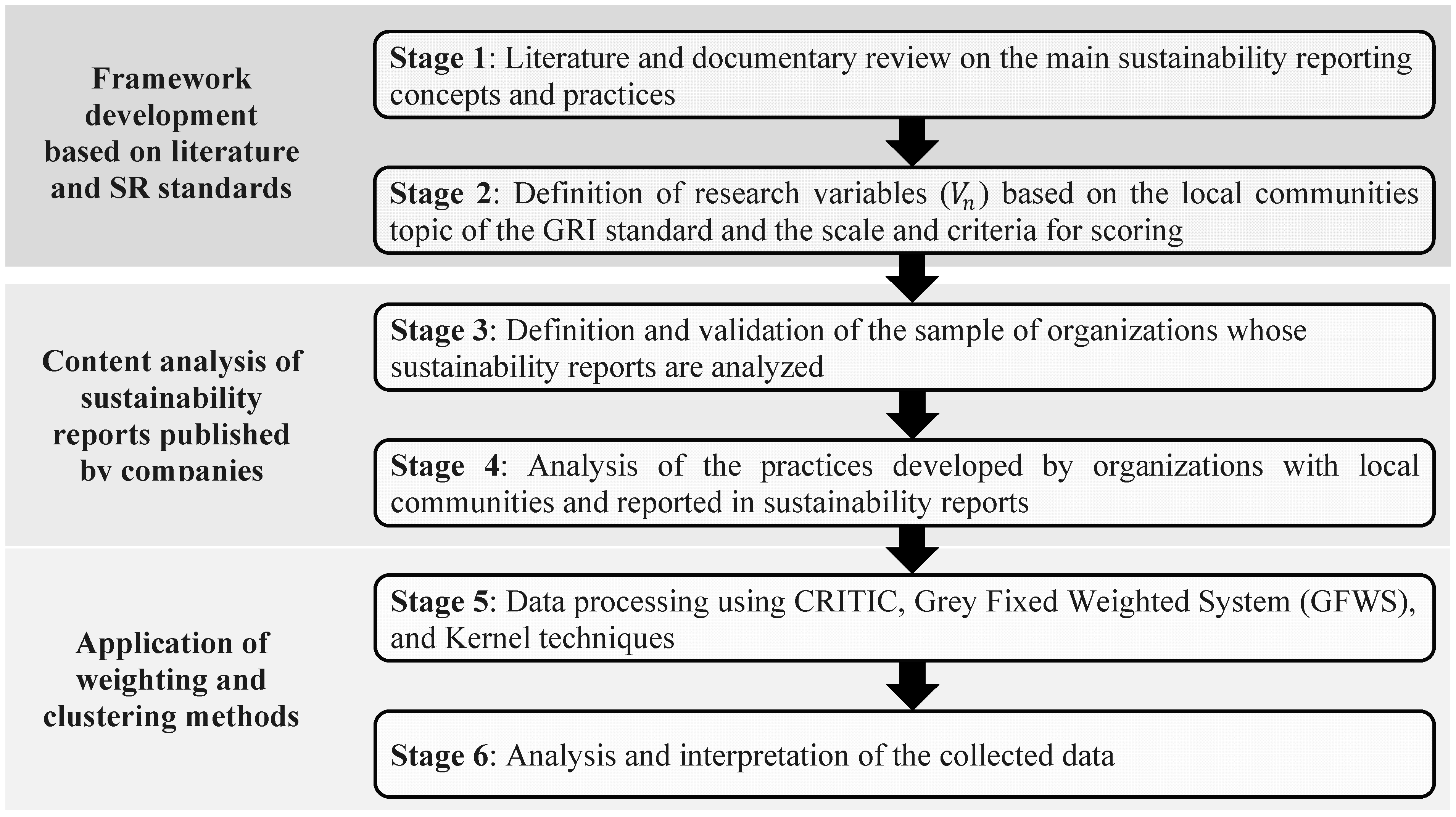
This study was developed in six stages as illustrated in Figure 1.
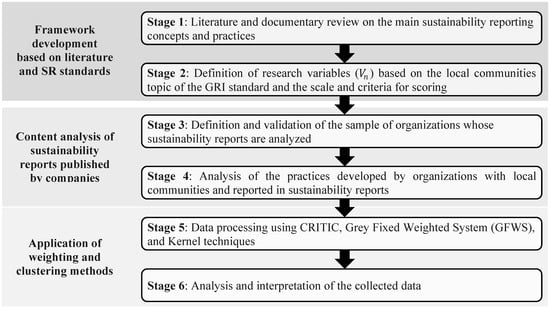
Figure 1.
Research stages. Source: Authors’ own creation.
The literature review (Stage 1) was conducted using the Web of Science, Scopus, and Taylor & Francis databases. The initial search string used for the research was “sustainability” and “local communities”. Subsequently, to refine the searches, the following logical operators and terms were added to the search string: and [“social sustainability” or “reporting” or “maturity level”]. The content of the main articles researched was considered in the development of the theoretical framework section of this article. In addition to the academic literature search, a documentary search was conducted at this stage on the main standards, guidelines, and frameworks used by organizations in the preparation of sustainability reports. Based on the results of the literature and documentary review, Section 2 of this article was structured.
Continuing, all recommendations made by the GRI standard related to actions with communities were analyzed, and the variables to be studied were defined (Stage 2). It is worth noting that the GRI 413 standard, which directly presents recommendations on actions with the local community, consists of two items. The first item guides management approach disclosures and directly references item 3.3 of the GRI 3 standard, recommending its use. The second item of the GRI 413 standard, divided into two sections, guides companies on specific disclosures about local communities [11]. Furthermore, other sections of the GRI standard and sectoral recommendations were considered. Through the analysis of other topic standards, relevant elements were identified in the GRI 201 and GRI 203 standards, and as a general result of the process, 8 variables were defined.
The prioritization of GRI 3 and GRI 413 standards is justified by their direct alignment with the topic of local communities. GRI 3 provides guidance on how organizations should determine and disclose material issues, including stakeholder perspectives, while GRI 413 focuses on the impacts and engagement with local communities. These two standards offer a comprehensive and structured foundation to evaluate company practices regarding local community inclusion in sustainability management and reporting [7,11].
The first six variables (from to ) were formed from the content extracted from the mandatory requirements present in the GRI 3 standard, item 3.3. The remaining variables ( and ) were constructed from the content of item 2 of the GRI 413 topic standard. Additionally, variable received contributions from content originating from the GRI 201 and GRI 203 standards. It is also worth noting that within each variable, verification points were defined to ensure higher quality in subsequent analyses (see Table 1).

Table 1.
Research variables and content evaluation points.
A 5-point scale was used to measure the variables. A rating of 1 indicates a practice not identified in the sustainability report; a rating of 2 indicates a weakly identified practice, a rating of 3 indicates a practice moderately identified, a rating of 4 indicates a practice strongly identified, and finally, a rating of 5 indicates a fully identified variable.
In Stage 3, the sample of companies to be analyzed was defined. Initially, sustainability reports from companies listed on the Corporate Sustainability Index (ISE) of B3, the Brazilian stock exchange, were collected publicly. A total of 63 sustainability reports from companies across various sectors comprised this initial sample. Subsequently, a second screening was conducted, considering only the sustainability reports of companies that mentioned local communities in their materiality list. From this analysis, it was found that only 26 companies listed local communities in their materiality list, and they were considered as the study’s sample.
To address the geographical scope, it is essential to clarify that the local communities referenced in the sustainability reports are not concentrated in a single region of Brazil. Instead, they are distributed across various states and municipalities, reflecting the operational presence of the sampled companies in sectors such as energy, mining, manufacturing, and retail. Depending on the company’s area of activity, these communities sometimes include both rural and urban populations and traditional and indigenous groups. However, the study does not analyze individual communities directly; instead, it assesses how companies report engagement practices with local communities.
Once the research variables (Vn), the measurement scale, and the sample to be studied were defined, the analyses could be conducted among companies with the same disclosure requirement. The sustainability reports analyzed are referred to in the study as SRm, with m ranging from 1 to 26.
The information collection relied on the content analysis technique following the guidelines of Elo and Kyngäs [44]. This process guided the reading of each report and supported the assignment of scores to each of the eight variables (Stage 4). Based on the scores xmn assigned to the 8 research variables, for each of the 26 sustainability reports analyzed, it was possible to form the M26x8 (Equation (1)), which became the database upon which descriptive analyses and the application of multicriteria techniques were performed.
In Stage 5, the chosen data analysis technique was the Grey Fixed Weighted System (GFWS), which falls within the important framework of Grey Systems theory [45,46]. This technique is particularly suitable for extracting useful information from available data and in scenarios where there are uncertainties in the reported information [47].
The choice of the Grey Fixed Weighted Clustering method over traditional clustering techniques (e.g., k-means, hierarchical clustering) was driven by the inherent uncertainty and imprecision in sustainability reporting data. Unlike conventional methods that require complete and quantitative datasets, the GFWS approach is specifically designed to handle incomplete, ambiguous, or Grey data, which is often the case in qualitative evaluations of corporate practices. As Liu et al. [46] discussed, Grey clustering is particularly useful for classifying alternatives under uncertainty, while Liu and Lin [44] highlight its flexibility in dealing with heterogeneous data. Moreover, the method allows for the incorporation of expert judgement and weighting of criteria through integration with the CRITIC method [48], enhancing the robustness of the analysis. This makes GFWS particularly suitable for assessing maturity levels in domains where information may be fragmented, subjective, or heterogeneous, such as sustainability disclosure [43].
The GFWS method in this research was adapted from the process proposed by Liu et al. [48]. According to the terminology of the GFWS technique, “objects” are what one wishes to cluster into certain “categories” based on pre-established “criteria”. In this study, the objects are the companies (m = 26) in the research sample. The “n” categorization criteria will be referred to as Cn, and the categories as “k”. The criteria Cn adopted were directly related to each of the eight research variables.
In the GFWS, the criteria can be weighed, and in this research, we used the CRITIC (Criteria Importance Through Intercriteria Correlation) method for weighting the relative importance of [49,50].
The first step of the CRITIC method involved defining the maximum (Pmax_n) and minimum (Pmin_n) scores for each value , followed by data normalization according to Equation (2).
With the normalized scores data (), the standard deviation snorm of these normalized data is calculated for each of the criteria . The third step of the method is the construction of a correlation matrix , where “n” is the number of criteria, and where the elements of this matrix are calculated by the correlation between the values of the criteria . Such correlation thus forms an identity symmetric matrix [50].
The fourth step involves determining the amount of information that each criterion carries [50]. To do this, the value of 1 is subtracted from the cnn values of the matrix defined in the correlation matrix , which generates another symmetric matrix , called the adjusted correlation matrix, as shown in Equation (3).
Based on the data from the adjusted correlation matrix , the sum of all values for each of the “n” rows of the matrix is calculated. This forms a vector V1xn, which indicates the amount of information for each criterion , as shown in Equation (4).
With the amount of information obtained for each criterion, the fifth step proceeds. This step involves calculating the absolute weight () and relative weight () of each criterion by multiplying the values of by the standard deviation of the normalized scores of each criterion , as shown in Equation (5).
From the definition of the absolute weight , the relative weight of each criterion in relation to the set of the other “n” criteria can be calculated using Equation (6). The values of the relative weights for each criterion were then used in calculating the coefficients of the GFWS model.
With the weights obtained, the clustering model was structured. Initially, three groups of “Local Community Insertion Maturity” were defined, denoted by “K”, following a structure similar to that described by [51].
- (low maturity): The organization presents insufficient elements to be considered as one that integrates local communities into its management;
- (medium maturity): The organization presents some elements indicating the integration of local communities into its management practices;
- (high maturity): The organization presents consistent elements indicating the integration of local communities into its management practices.
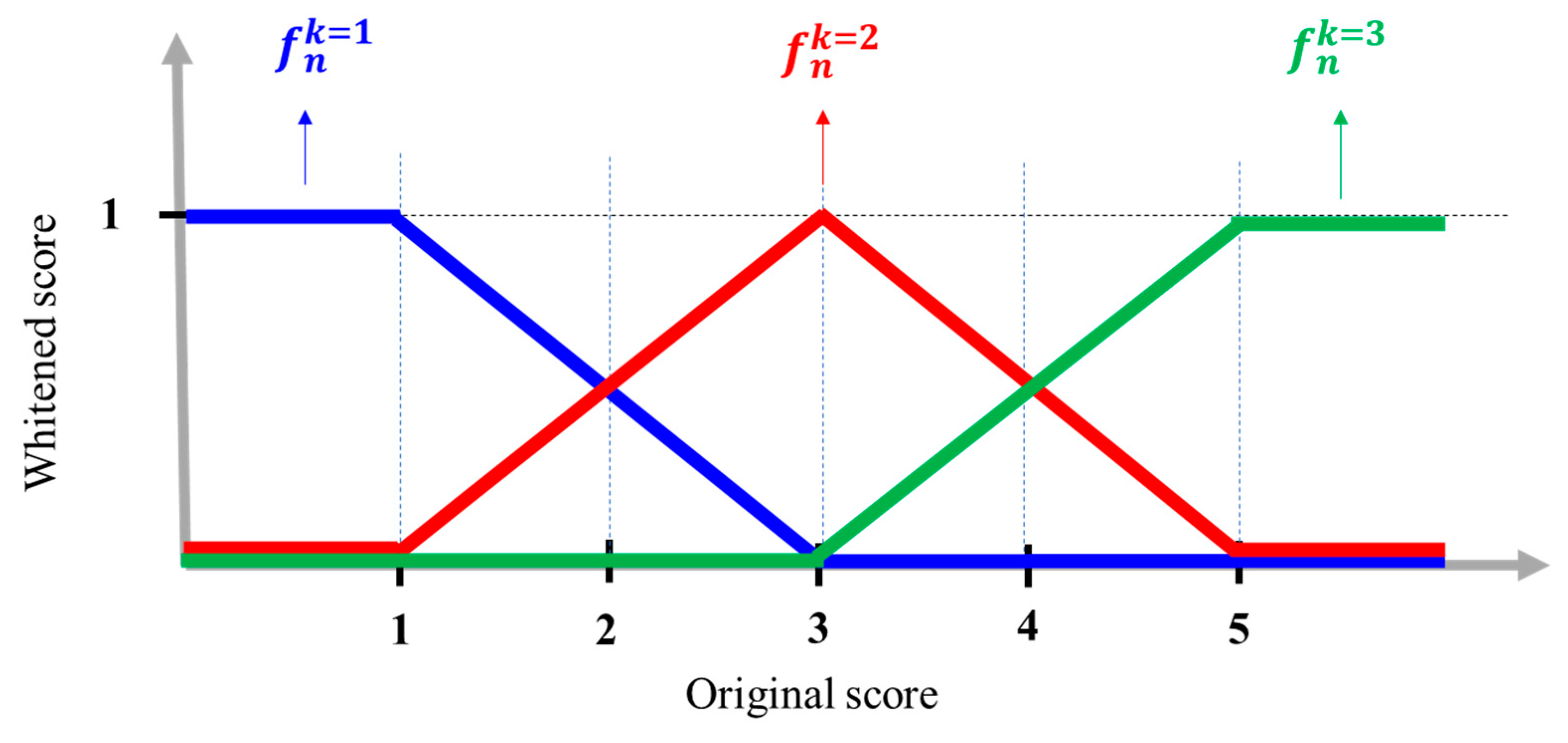
After defining the maturity classes, the next step involved constructing the possibility functions or whitening functions. A whitening function is used to describe the degree to which an object can be classified within the defined categories, based on the classification criteria used [48].
Depending on the nature or units of measurement of the criteria used, the same “k” whitening functions can be used for all “n” criteria [48], or it may be necessary to have “k” whitening functions for each of the “n” criteria [51]. The whitening functions do not have a predefined structure and must be developed based on the knowledge and judgement of the problem being studied [47].
For this study, we opted for the same mathematical structure for the whitening functions, as graphically evidenced in Figure 2.

Figure 2.
Graphical representation of whitening functions. Source: Elaborated by the authors based on Liu et al. [48].
To determine the maturity categories to which each object belongs, the respective Grey coefficient () corresponding to company “m” that will be categorized is calculated. The Grey coefficient () of a company “m” is calculated by summing each whitened score value weighted by the relative weight of each analysis criterion, in the case of each of the eight variables, as shown in Equation (10) [47].
Thus, each company “m” will have Grey coefficients. The consolidation of all rows of Grey coefficients for each company “m” forms a matrix of Grey coefficients, as shown in Equation (11).
For each row “m” of the matrix , the is obtained. According to [48], the index “k” where the maximum Grey coefficient is found indicates that the company should be classified within category “k” (Equation (12)).
To conclude Stage 5, the Kernel method was employed to refine clustering. This method allows for the determination of subclusters within the initial clusters, enabling the decision-maker to identify the best-positioned companies. According to Liu et al. [52], this method is utilized to highlight the superiority of each item (company).
In the Kernel method, it is assumed that = (, , …, ), where is the number of decision-making classes. Subsequently, the normalized clustering coefficient vectors are computed through Equations (13) and (14).
Subsequently, the weight vectors group with the kernel, (k = 1, 2,..., s), are defined using Equation (15).
Then, the weighted comprehensive clustering coefficient vectors () are calculated using Equation (16).
Thus, based on the values of , it is possible to establish subclusters based on the assessment of the maturity of companies’ SRs.
Finally, in the last stage of the study (Stage 6), the data from all stages were consolidated and analyzed in an integrated manner, allowing for discussions and generating insights into critical indicators, maturity levels, and support for informed decision-making in sustainability reporting.
4. Results
4.1. Defining Weights Through the CRITIC Method
The 26 sustainability reports (SR) of the eligible companies for this study were analyzed and scored according to criteria defined in Section 3. Table 2 presents the sustainability report scores after analysis.
Table 2.
Scores of the sustainability reports after analysis.
From the scores assigned to each of the eight variables, it was possible to identify the maximum values () and minimum values () assigned and create the normalized scoring matrix. With the normalized data, the standard deviation for each variable was calculated. Table 3 displays the results.
Table 3.
Normalized scores of sustainability reports.
Using the matrix presented in Table 3, it was possible to structure the correlation matrix between the variables, with the results presented in Table 4.
Table 4.
Correlation matrix of the variables.
Next, the adjusted correlation was calculated, and then the sum of correlations was determined, as shown in Table 5.
Table 5.
Adjusted correlation matrix and sum of correlations.
Subsequently, the calculation of the absolute weight and the calculation of the relative weight were performed using the CRITIC method (Table 6).
Table 6.
Absolute and relative weights of variables according to the CRITIC method.
4.2. Clusterization Through Grey Fixed Weighted System
With the relative weights d of each variable defined, a multicriteria analysis was performed using the GFWS method.
Table 7, Table 8 and Table 9, respectively, show the whitened scores applied using the whitening function for low (), medium (), and high () maturity (see Figure 2). Additionally, the last column of each table includes the respective Grey coefficient value for the analyzed cluster according to the whitening function used.
Table 7.
Whitened scores of the sustainability reports and Grey coefficients for .
Table 8.
Whitened scores of the sustainability reports and Grey coefficients for .
Table 9.
Whitened scores of the sustainability reports and Grey coefficients for .
With the vectors formed by the last columns of Table 7, Table 8 and Table 9, which present the coefficients , it was possible to identify, for each row “m”, the value σmax. Thus, it was possible to categorize each of the companies into the previously established categories (Table 10).
Table 10.
Categorization of companies according to the maturity class.
Summarizing the clustering results, Table 11 shows the quantity and percentage of companies allocated in each cluster.
Table 11.
Summary of the clusterization process.
4.3. Clustering Refinement for Decision-Making Support Using the Kernel Method
Advancing in the analysis, the Kernel method was used to refine clustering, providing valuable data for decision-making (Table 12).
Table 12.
Refinement of clustering using the Kernel method.
The following section discusses these results in light of the broader literature on corporate sustainability and stakeholder engagement, highlighting critical sectoral trends and implications for practice.
5. Discussion
5.1. Critical Indicators of Sustainability Reporting Maturity Regarding Local Communities
The variables with the highest weight in the analysis serve as critical indicators of a company’s approach to managing its impacts on local communities. Among these, , ranked in first place, highlights the importance of transparency in describing operations with potential negative impacts on local communities. Companies must provide detailed accounts of such operations, including their nature, scope, and potential consequences. This transparency extends to actions taken to manage these impacts, as emphasized by (ranked in 2nd). SRs should not only identify potential negative impacts but also highlight the measures taken to address them [53,54]. These measures may include community engagement initiatives, stakeholder consultations, and impact assessments [55,56,57].
Comprehensive assessment, as underscored by (ranked in third), is crucial in understanding the full spectrum of a company’s impacts on local communities. SRs should provide a systemic view of these impacts, identifying both positive contributions and negative consequences across economic, environmental, and social dimensions [58,59]. Positive contributions may include job creation, infrastructure development, and community investments, while negative impacts could involve pollution, displacement, and human rights violations [60]. Strategies for maximizing positive impacts and minimizing negative ones should be outlined in these reports [61].
(ranked in fourth) emphasizes the importance of accountability and transparency in addressing the ways in which organizations are involved in negative impacts on local communities. Companies must disclose instances where their activities, or those of their business relationships, have resulted in adverse consequences for local communities [62,63]. This includes both direct impacts from company operations and indirect impacts from supply chains or business partnerships [64].
5.2. Maturity Landscape of Brazilian Companies
The assessment of Brazilian companies’ maturity level regarding the inclusion of local communities in their SRs reveals some noteworthy insights. Firstly, it is striking that only 2 out of 26 companies attained a high maturity classification, and notably, both hail from the energy sector. This suggests that the energy industry in Brazil has made significant strides in integrating local community considerations into their sustainability practices, positioning them at the forefront of responsible corporate behaviour [23,24].
Furthermore, the prominence of energy companies at the top subclusters, including the top three best-positioned ones (SR3, SR10, and SR18), underscores the sector’s leadership in this aspect [65]. This could be attributed to the nature of energy operations, which often necessitate close engagement with local communities, thus fostering a culture of community inclusion and accountability.
On the other hand, the performance of companies from the paper and pulp sector presents a mixed picture, with both companies achieving a medium performance level, securing positions in the best subclusters for medium maturity class (SR25 and SR4). While these companies demonstrate a commendable effort, there is room for improvement to match the high maturity level seen in the energy sector.
The situation is particularly concerning for manufacturing companies, with three out of five presenting low performance and falling into the low maturity class (SR20, SR22, and SR6), and one in the worst subcluster for the medium maturity class (SR1). This highlights a significant gap in the manufacturing sector’s approach to engaging with local communities and integrating community concerns into their sustainability reporting practices.
Overall, the distribution of maturity levels among the sample is worrisome, with 50% falling into the medium maturity class and 42.3% classified as low maturity. This is especially concerning considering that the companies analyzed belong to a selected group of companies in the country, indicating a broader systemic issue within the corporate landscape.
While some sectors, such as energy, have made commendable progress in including local communities in their sustainability reporting, there is a clear need for improvement across industries to ensure more comprehensive and responsible engagement with local stakeholders. This is not only essential for fulfilling corporate social responsibility but also for fostering sustainable development and long-term success in Brazil’s business environment.
A decision-maker could leverage the findings of this analysis to inform strategic decision-making processes aimed at enhancing corporate sustainability and community engagement efforts. By understanding the maturity levels of different sectors in terms of their inclusion of local communities in sustainability reporting, decision-makers can identify areas of strength and weakness within their organization and industry [64]. For instance, if the decision-maker is leading a company in the energy sector, they could benchmark against the top-performing companies in their sector and adopt best practices to further improve their community engagement initiatives. On the other hand, if they operate in a sector with lower maturity levels, such as manufacturing, they could use the study to advocate for increased focus and investment in community engagement programmes to align with industry standards and enhance their company’s reputation and stakeholder trust. Thus, this study provides decision-makers with valuable insights to prioritize resources effectively, drive continuous improvement, and ultimately contribute to sustainable business practices and positive social impact.
These findings may reflect the regulatory demands and stakeholder scrutiny faced by energy companies, which often operate in environmentally sensitive contexts. In contrast, manufacturing firms may experience less external pressure regarding community disclosure, which could explain their lower maturity levels.
6. Conclusions
This paper aimed to identify the level of maturity of organizations listed on the main Brazilian stock exchange index concerning their engagement with local communities. It sheds light on critical indicators of sustainability reporting maturity concerning local communities, emphasizing transparency, comprehensive assessment, and accountability. Factors such as the description of operations () and actions taken regarding potential negative impacts () underscore the importance of transparency and proactive management. Additionally, a comprehensive assessment () plays a crucial role in understanding the full spectrum of a company’s impacts, while accountability and transparency () are paramount in addressing negative impacts effectively.
The study also provides insights into the maturity landscape of Brazilian companies, revealing disparities across sectors. While the energy sector demonstrates commendable progress and leadership in community engagement, particularly in integrating local community considerations into sustainability practices, other sectors, such as manufacturing and paper and pulp, show room for improvement. The prevalence of low and medium maturity levels among the sampled companies highlights the need for a more comprehensive and responsible approach to engaging with local stakeholders.
The findings of this research paper offer valuable insights for decision-makers to enhance corporate sustainability and community engagement efforts. By understanding the maturity levels within their organization and industry, decision-makers can identify areas for improvement, benchmark against top-performing companies, and prioritize resources effectively. Ultimately, this fosters sustainable development, enhances stakeholder trust, and promotes positive social impact within Brazil’s business environment.
6.1. Research Implications
As extensively discussed in the literature, sustainability reports are essential communication tools for organizations with their stakeholders. The influence and importance of local communities in the context of organizational sustainability management were also discussed. Furthermore, the research sample was selected considering companies that consistently demonstrate high standards and behaviours of sustainability. Therefore, it was expected that the selected companies in the sample would publish sustainability reports. Moreover, it was expected that companies would present programmes, projects, and techniques that integrate their local communities in their respective sustainability reports. Thus, it was expected that the percentage of companies classified as “high maturity” would represent a higher proportion in the results. However, the opposite was observed. From this observation, two potential possibilities arise to explain such results:
- The first possibility is that companies have projects, actions, and techniques that integrate local communities into their sustainability management, but even though they follow the GRI standard, companies fail to communicate such programmes consistently;
- The second possible reason is related to the low investment of organizations to strengthen and enhance their relationship with their local communities. In this case, even for companies considered highly committed to sustainable development practices, the topic of local communities does not receive the same attention and priority as other topics, such as environmental or social issues, which focus internally on their employees.
The work presents contributions to both organizations and the academic community through its proposed methodology. Therefore, companies and researchers can benefit from the proposed method in projects to assess the level of sustainability maturity of organizations. Thus, it is possible to replicate it, both under the theme of local communities and in other material topics addressed in the GRI standards.
6.2. Research Limitations
The study presents the following limitations in research development:
- The proposed method relied on a specific database from the B3 ISE portfolio of Brazilian companies to define the research sample;
- Data collection was conducted through content analysis of the sustainability reports of the companies comprising the sample;
- The variables were defined based on the GRI standards;
- The sample was limited to 26 companies listed on the B3 Corporate Sustainability Index (ISE), representing a select group of Brazilian firms with recognized sustainability practices. While this enhances the internal validity and relevance of the findings within a high-performing context, it may limit the generalizability to broader or less mature corporate environments. Additionally, specific industry sectors were underrepresented due to the availability of sustainability reports mentioning local communities. This sample limitation reinforces the need for caution when extrapolating results to all Brazilian companies or companies in other emerging economies;
- The quality and completeness of sustainability reports may vary among companies, which can introduce bias in data collection. To minimize this, we used a standardized evaluation framework based on GRI 3 and GRI 413 standards, with predefined variables and verification points. Content analysis followed a systematic procedure, using a five-point scale and cross-validation by the authors to ensure consistency and reduce subjectivity.
6.3. Future Research Proposals
Upon conclusion of the study, the following proposals for future work are suggested:
- Develop new maturity studies utilizing different groups of companies with sectoral selection parameters, size, or geographical location;
- Conduct studies on the topic using other research strategies, such as case studies, to assess, from different perspectives, how the inclusion of local communities occurs in sustainability analyses, thus enabling comparisons of results with this research;
- Conduct a study to investigate the reasons why companies exhibit low levels of maturity in including local communities in their sustainability programmes and/or actions;
- Future studies should consider expanding the sample size and including companies from a broader range of industries, including those that are currently underrepresented in sustainability rankings or indices. Such expansion would allow for a more comprehensive understanding of maturity patterns across sectors and enhance the generalizability of the findings to a broader range of organizational contexts.
Author Contributions
Conceptualization, E.R.D., J.d.S.P. and R.A.; methodology, E.R.D., J.d.S.P., T.F.A.C.S. and R.A.; software, E.R.D., T.F.A.C.S. and R.A.; validation, E.R.D., J.d.S.P., T.F.A.C.S., G.H.S.M.d.M., W.L.F. and R.A.; formal analysis, E.R.D., J.d.S.P., T.F.A.C.S., G.H.S.M.d.M., W.L.F. and R.A.; investigation, E.R.D., J.d.S.P., T.F.A.C.S. and R.A.; resources, J.d.S.P., T.F.A.C.S., G.H.S.M.d.M., W.L.F. and R.A.; data curation, E.R.D., J.d.S.P., T.F.A.C.S., G.H.S.M.d.M., W.L.F. and R.A.; writing—original draft preparation, E.R.D., J.d.S.P., T.F.A.C.S., G.H.S.M.d.M., W.L.F. and R.A.; writing—review and editing, J.d.S.P., T.F.A.C.S., G.H.S.M.d.M., W.L.F. and R.A.; visualization, E.R.D., J.d.S.P., T.F.A.C.S., G.H.S.M.d.M., W.L.F. and R.A.; supervision, J.d.S.P. and R.A.; project administration, J.d.S.P. and R.A.; funding acquisition, J.d.S.P., T.F.A.C.S., G.H.S.M.d.M., W.L.F. and R.A. All authors have read and agreed to the published version of the manuscript.
Funding
The authors are grateful for the support of the National Council for Scientific and Technological Development (CNPq/Brazil) under the grants nº 304145/2021-1 and nº 303924/2021-7.
Data Availability Statement
The data presented in this study are available on request from the corresponding author.
Conflicts of Interest
The authors declare no conflicts of interest.
References
- Stibbe, D.; Prescott, D. The SDG Partnership Guidebook: A Practical Guide to Building High Impact Multi-Stakeholder Partnerships for the Sustainable Development Goals; The United Nations: New York, NY, USA, 2020. [Google Scholar]
- Kumar, A.; Anbanandam, R. Development of Social Sustainability Index for Freight Transportation System. J. Clean. Prod. 2019, 210, 77–92. [Google Scholar] [CrossRef]
- Digalwar, A.K.; Dambhare, S.; Saraswat, S. Social Sustainability Assessment Framework for Indian Manufacturing Industry. Mater. Today Proc. 2019, 28, 591–598. [Google Scholar]
- Zhang, M.; Chen, Z. Assessing the Social Sustainability Impact on Suppliers: The Role of Global Value Chains Governance Strategies. Environ. Sci. Pollut. Res. 2023, 30, 83587–83599. [Google Scholar] [CrossRef] [PubMed]
- Santiago, A.L.; Demajorovic, J.; Rossetto, D.E.; Luke, H. Understanding the Fundamentals of the Social Licence to Operate: Its Evolution, Current State of Development and Future Avenues for Research. Resour. Policy 2021, 70, 101941. [Google Scholar] [CrossRef]
- Stocker, F.; de Arruda, M.P.; de Mascena, K.M.; Boaventura, J.M. Stakeholder Engagement in Sustainability Reporting: A Classification Model. Corp. Soc. Responsib. Environ. Manag. 2020, 27, 2071–2080. [Google Scholar] [CrossRef]
- Janik, A.; Ryszko, A. Sustainability Reporting during the Crisis—What Was Disclosed by Companies in Response to the COVID-19 Pandemic Based on Evidence from Poland. Sustainability 2023, 15, 12894. [Google Scholar] [CrossRef]
- Grueso-Gala, M.; Zornoza, C.C. A Bibliometric Analysis of the Literature on Non-Financial Information Reporting: Review of the Research and Network Visualization. Cuad. De Gest. 2022, 22, 175–192. [Google Scholar] [CrossRef]
- Gunawan, J.; Permatasari, P.; Fauzi, H. The Evolution of Sustainability Reporting Practices in Indonesia. J. Clean. Prod. 2022, 358, 131798. [Google Scholar] [CrossRef]
- Mio, C.; Fasan, M.; Costantini, A. Materiality in Integrated and Sustainability Reporting: A Paradigm Shift? Bus. Strategy Environ. 2020, 29, 306–320. [Google Scholar] [CrossRef]
- Global Reporting Initiative. GRI 413: Local Communities; Topic Standards: Amsterdam, The Netherlands, 2016. [Google Scholar]
- Franciosi, C.; Tortora, A.M.R.; Miranda, S. A Maintenance Maturity and Sustainability Assessment Model for Manufacturing Systems. Manag. Prod. Eng. Rev. 2023, 14, 137–155. [Google Scholar] [CrossRef]
- de Almeida Santos, D.; Luiz Gonçalves Quelhas, O.; Francisco Simões Gomes, C.; Perez Zotes, L.; Luiz Braga França, S.; Vinagre Pinto de Souza, G.; Amarante de Araújo, R.; da Silva Carvalho Santos, S. Proposal for a Maturity Model in Sustainability in the Supply Chain. Sustainability 2020, 12, 9655. [Google Scholar] [CrossRef]
- Correia, E.; Carvalho, H.; Azevedo, S.G.; Govindan, K. Maturity Models in Supply Chain Sustainability: A Systematic Literature Review. Sustainability 2017, 9, 64. [Google Scholar] [CrossRef]
- Setyaningsih, S.; Widjojo, R.; Kelle, P. Challenges and Opportunities in Sustainability Reporting: A Focus on Small and Medium Enterprises (SMEs). Cogent Bus. Manag. 2024, 11, 2298215. [Google Scholar] [CrossRef]
- Wagenhofer, A. Sustainability Reporting: A Financial Reporting Perspective. Account. Eur. 2024, 21, 1–13. [Google Scholar] [CrossRef]
- Freeman, R.E. Strategic Management. A Stakeholder Approach, 1st ed.; Cambridge University Press: Cambridge, UK, 1984. [Google Scholar]
- Clarkson, M.B.E. A Stakeholder Framework for Analyzing and Evaluating Corporate Social Performance. Source Acad. Manag. Rev. 1995, 20, 92–117. [Google Scholar]
- Chan, A.P.C.; Oppong, G.D. Managing the Expectations of External Stakeholders in Construction Projects. Eng. Constr. Archit. Manag. 2017, 24, 736–756. [Google Scholar] [CrossRef]
- Matikainen, L.S. Addressing Sustainability in the Mining Industry Through Stakeholder Engagement. South Asian J. Bus. Manag. Cases 2022, 11, 35–48. [Google Scholar] [CrossRef]
- Bowen, F.; Newenham-Kahindi, A.; Herremans, I. When Suits Meet Roots: The Antecedents and Consequences of Community Engagement Strategy. J. Bus. Ethics 2010, 95, 297–318. [Google Scholar] [CrossRef]
- Prno, J.; Slocombe, D.S. Exploring the Origins of “Social License to Operate” in the Mining Sector: Perspectives from Governance and Sustainability Theories. Resour. Policy 2012, 37, 346–357. [Google Scholar] [CrossRef]
- Bell, D.; Gray, T.; Haggett, C.; Swaffield, J. Re-Visiting the “Social Gap”: Public Opinion and Relations of Power in the Local Politics of Wind Energy. Environ. Politics 2013, 22, 115–135. [Google Scholar] [CrossRef]
- Carley, S.; Konisky, D.M.; Atiq, Z.; Land, N. Energy Infrastructure, NIMBYism, and Public Opinion: A Systematic Literature Review of Three Decades of Empirical Survey Literature. Environ. Res. Lett. 2020, 15, 093007. [Google Scholar] [CrossRef]
- Britcyna, E. Industrial Projects and Benefit-Sharing Arrangements in the Russian North. Is Contracting Possible? Resources 2019, 8, 104. [Google Scholar] [CrossRef]
- Di Maddaloni, F.; Davis, K. The Influence of Local Community Stakeholders in Megaprojects: Rethinking Their Inclusiveness to Improve Project Performance. Int. J. Proj. Manag. 2017, 35, 1537–1556. [Google Scholar] [CrossRef]
- Rahmah, D.M.; Purnomo, D.; Filianty, F.; Ardiansah, I.; Pramulya, R.; Noguchi, R. Social Life Cycle Assessment of a Coffee Production Management System in a Rural Area: A Regional Evaluation of the Coffee Industry in West Java, Indonesia. Sustainability 2023, 15, 13834. [Google Scholar] [CrossRef]
- Toppinen, A.; Korhonen-Kurki, K. Global Reporting Initiative and Social Impact in Managing Corporate Responsibility: A Case Study of Three Multinationals in the Forest Industry. Bus. Ethics 2013, 22, 202–217. [Google Scholar] [CrossRef]
- Ashrafi, M.; Acciaro, M.; Walker, T.R.; Magnan, G.M.; Adams, M. Corporate Sustainability in Canadian and US Maritime Ports. J. Clean. Prod. 2019, 220, 386–397. [Google Scholar] [CrossRef]
- Widawski, K.; Krzemińska, A.; Zaręba, A.; Dzikowska, A. A Sustainable Approach to Tourism Development in Rural Areas: The Example of Poland. Agriculture 2023, 13, 2028. [Google Scholar] [CrossRef]
- Bell, D.; Gray, T.; Haggett, C. The “social Gap” in Wind Farm Siting Decisions: Explanations and Policy Responses. Environ. Politics 2005, 14, 460–477. [Google Scholar] [CrossRef]
- Di Maddaloni, F.; Sabini, L. Very Important, yet Very Neglected: Where Do Local Communities Stand When Examining Social Sustainability in Major Construction Projects? Int. J. Proj. Manag. 2022, 40, 778–797. [Google Scholar] [CrossRef]
- Que, S.; Wang, L.; Awuah-Offei, K.; Chen, Y.; Yang, W. The Status of the Local Community in Mining Sustainable Development beyond the Triple Bottom Line. Sustainability 2018, 10, 1749. [Google Scholar] [CrossRef]
- Khan, S.Z.; Yang, Q.; Khan, N.U.; Kherbachi, S.; Huemann, M. Sustainable Social Responsibility toward Multiple Stakeholders as a Trump Card for Small and Medium-Sized Enterprise Performance (Evidence from China). Corp. Soc. Responsib. Environ. Manag. 2020, 27, 95–108. [Google Scholar] [CrossRef]
- Sabirali, K.P.; Mahalakshmi, S. Corporate Sustainability Practices: A Systematic Literature Review and Bibliometric Analysis. Vision 2023. [Google Scholar] [CrossRef]
- Mihai, F.; Aleca, O.E. Sustainability Reporting Based on GRI Standards within Organizations in Romania. Electronics 2023, 12, 690. [Google Scholar] [CrossRef]
- Boiral, O.; Heras-Saizarbitoria, I. Sustainability Reporting Assurance: Creating Stakeholder Accountability through Hyperreality? J. Clean. Prod. 2020, 243, 118596. [Google Scholar] [CrossRef]
- Igwe, M.N.; Khatib, S.F.A.; Bazhair, A.H. Sustainability Reporting in Africa: A Systematic Review and Agenda for Future Research. Corp. Soc. Responsib. Environ. Manag. 2023, 30, 2081–2100. [Google Scholar] [CrossRef]
- Prashar, A. Moderating Effects on Sustainability Reporting and Firm Performance Relationships: A Meta-Analytical Review. Int. J. Product. Perform. Manag. 2023, 72, 1154–1181. [Google Scholar] [CrossRef]
- Yang, Y.; Orzes, G.; Jia, F.; Chen, L. Does GRI Sustainability Reporting Pay Off? An Empirical Investigation of Publicly Listed Firms in China. Bus. Soc. 2021, 60, 1738–1772. [Google Scholar] [CrossRef]
- Anguiano-Santos, C.; Salazar-Ordóñez, M. Sustainability Reporting as a Tool for Fostering Sustainable Growth in the Agri-Food Sector: The Case of Spain. J. Environ. Plan. Manag. 2024, 67, 426–453. [Google Scholar] [CrossRef]
- Girón, A.; Kazemikhasragh, A.; Cicchiello, A.F.; Panetti, E. Sustainability Reporting and Firms’ Economic Performance: Evidence from Asia and Africa. J. Knowl. Econ. 2021, 12, 1741–1759. [Google Scholar] [CrossRef]
- Kumar, K. Emerging Phenomenon of Corporate Sustainability Reporting: Evidence from Top 100 NSE Listed Companies in India. J. Public Aff. 2022, 22, 2368. [Google Scholar] [CrossRef]
- Elo, S.; Kyngäs, H. The Qualitative Content Analysis Process. J. Adv. Nurs. 2008, 62, 107–115. [Google Scholar] [CrossRef]
- Timóteo, T.R.; Cazeri, G.T.; Moraes, G.H.; Sigahi, T.F.A.C.; Zanon, L.G.; Rampasso, I.S.; Anholon, R. Use of AHP and Grey Fixed Weight Clustering to Assess the Maturity Level of Strategic Communication Management in Brazilian Startups. Grey Syst. Theory Appl. 2024, 14, 69–90. [Google Scholar] [CrossRef]
- Liu, S.; Lin, Y. Grey Systems: Theory and Applications; Springer: Berlin/Heidelberg, Germany, 2011; Volume 68, ISBN 978-3-642-16157-5. [Google Scholar]
- Liu, S.; Lin, Y. Introduction to Grey Systems Theory. In Grey Systems: Theory and Applications, 1st ed.; Springer: Berlin/Heidelberg, Germany, 2010; pp. 1–18. ISBN 978-3-642-16157-5. [Google Scholar] [CrossRef]
- Liu, W.; Wu, C.; Chang, X.; Chen, Y.; Liu, S. Evaluating Remanufacturing Industry of China Using an Improved Grey Fixed Weight Clustering Method-a Case of Jiangsu Province. J. Clean. Prod. 2017, 142, 2006–2020. [Google Scholar] [CrossRef]
- Barbanti, A.M.; Anholon, R.; Rampasso, I.S.; Martins, V.W.B.; Quelhas, O.L.G.; Leal Filho, W. Sustainable Procurement Practices in the Supplier Selection Process: An Exploratory Study in the Context of Brazilian Manufacturing Companies. Corp. Gov. 2022, 22, 114–127. [Google Scholar] [CrossRef]
- Diakoulaki, D.; Mavrotas, G.; Papayannakis, L. Determining Objective Weights in Multiple Criteria Problems: The CRITIC Method. Comput. Oper. Res. 1995, 22, 763–770. [Google Scholar] [CrossRef]
- Golinska, P.; Kosacka, M.; Mierzwiak, R.; Werner-Lewandowska, K. Grey Decision Making as a Tool for the Classification of the Sustainability Level of Remanufacturing Companies. J. Clean. Prod. 2015, 105, 28–40. [Google Scholar] [CrossRef]
- Liu, S.; Liu, T.; Yuan, W.; Yang, Y. Solving the Dilemma in Supplier Selection by the Group of Weight Vector with Kernel. Grey Syst. Theory Appl. 2022, 12, 624–634. [Google Scholar] [CrossRef]
- Christensen, H.B.; Hail, L.; Leuz, C. Mandatory CSR and Sustainability Reporting: Economic Analysis and Literature Review. Rev. Account. Stud. 2021, 26, 1176–1248. [Google Scholar] [CrossRef]
- An, E. Accelerating Sustainability through Better Reporting. Sustain. Account. Manag. Policy J. 2023, 14, 904–914. [Google Scholar] [CrossRef]
- Orazalin, N.; Mahmood, M. Determinants of GRI-Based Sustainability Reporting: Evidence from an Emerging Economy. J. Account. Emerg. Econ. 2019, 10, 140–164. [Google Scholar] [CrossRef]
- Ali, I.; Fukofuka, P.T.; Narayan, A.K. Critical Reflections on Sustainability Reporting Standard Setting. Sustain. Account. Manag. Policy J. 2023, 14, 776–791. [Google Scholar] [CrossRef]
- Baumüller, J.; Sopp, K. Double Materiality and the Shift from Non-Financial to European Sustainability Reporting: Review, Outlook and Implications. J. Appl. Account. Res. 2022, 23, 8–28. [Google Scholar] [CrossRef]
- Tsalis, T.A.; Malamateniou, K.E.; Koulouriotis, D.; Nikolaou, I.E. New Challenges for Corporate Sustainability Reporting: United Nations’ 2030 Agenda for Sustainable Development and the Sustainable Development Goals. Corp. Soc. Responsib. Environ. Manag. 2020, 27, 1617–1629. [Google Scholar] [CrossRef]
- Afolabi, H.; Ram, R.; Rimmel, G. Influence and Behaviour of the New Standard Setters in the Sustainability Reporting Arena: Implications for the Global Reporting Initiative’s Current Position. Sustain. Account. Manag. Policy J. 2023, 14, 743–775. [Google Scholar] [CrossRef]
- de Villiers, C.; Sharma, U. A Critical Reflection on the Future of Financial, Intellectual Capital, Sustainability and Integrated Reporting. Crit. Perspect. Account. 2020, 70, 101999. [Google Scholar] [CrossRef]
- Correa-Garcia, J.A.; Garcia-Benau, M.A.; Garcia-Meca, E. Corporate Governance and Its Implications for Sustainability Reporting Quality in Latin American Business Groups. J. Clean. Prod. 2020, 260, 121142. [Google Scholar] [CrossRef]
- Mougenot, B.; Doussoulin, J.-P. A Bibliometric Analysis of the Global Reporting Initiative (GRI): Global Trends in Developed and Developing Countries. Environ. Dev. Sustain. 2023, 26, 6543–6560. [Google Scholar] [CrossRef]
- Larrán Jorge, M.; Andrades Peña, F.J.; Herrera Madueño, J. An Analysis of University Sustainability Reports from the GRI Database: An Examination of Influential Variables. J. Environ. Plan. Manag. 2019, 62, 1019–1044. [Google Scholar] [CrossRef]
- Sousa, I.C.D.; Sigahi, T.F.A.C.; Rampasso, I.S.; Pinto, J.D.S.; Zanon, L.G.; Leal Filho, W.; Anholon, R. Analysis of the Quality of Sustainability Reports Published by Brazilian Companies: An Analytic Hierarchy Process-grey Clustering Approach. Corp. Soc. Responsib. Environ. Manag. 2024, 31, 4298–4314. [Google Scholar] [CrossRef]
- Thun, T.W.; Zülch, H. The Effect of Chief Sustainability Officers on Sustainability Reporting—A Management Perspective. Bus. Strategy Environ. 2023, 32, 2093–2110. [Google Scholar] [CrossRef]
Disclaimer/Publisher’s Note: The statements, opinions and data contained in all publications are solely those of the individual author(s) and contributor(s) and not of MDPI and/or the editor(s). MDPI and/or the editor(s) disclaim responsibility for any injury to people or property resulting from any ideas, methods, instructions or products referred to in the content. |
© 2025 by the authors. Licensee MDPI, Basel, Switzerland. This article is an open access article distributed under the terms and conditions of the Creative Commons Attribution (CC BY) license (https://creativecommons.org/licenses/by/4.0/).