


Abstract
This study intended to identify the perception of quality of life (QoL) among architects, how architecture can impact QoL, and which barriers architects perceive to impact QoL. Numerous studies have emphasized the significance of the built environment in determining QoL, especially in institutional buildings. However, there has been less focus on how architects perceive QoL and how the concept is applied in their planning and design for residential buildings. The contribution of this study is to provide an increasingly important awareness of how to improve the architects’ considerations to build for QoL. The study is based on qualitative data from in-depth interviews with ten architects and one workshop with seven architects. The participants were selected by quota sampling and were all partners or owners of Danish architectural firms that provide housing services and are representative of the Danish architectural industry. The results reveal that the perceptions of QoL among architects are linked to three primary dimensions: health, a sense of harmony, and the experience of enchantment. The participants perceived that architectural design could impact QoL in three primary dimensions: the environment, the experience of enchantment, and health. The most frequent perceived barriers are linked to the economy and resources, building codes and regulations, and knowledge and communication.
1. Introduction
There is a growing awareness and interest in the connection between quality of life (QoL) and the built environment. Attention is shifting from traditional economic metrics such as GDP to include QoL when evaluating and certifying the impact and value of architectural design [1,2]. The development has sparked several private and philanthropic initiatives, such as the Quality-of-Life Foundation [3], that work to ensure that homes are acquired, planned, built, and managed to actively provide a better QoL. However, architecture for improved QoL is a complex process that balances the interests, influence, and values of various stakeholders. Architectural firms play a significant part in the process because they produce architectural designs in a spatial synthesis of demands of the market, authorities, and the end users. Architectural design impacts the built environment and the QoL, which is realized through many perspectives in various contexts. QoL is a complex and multifaceted concept with no clear or agreed definition, and likewise, in the field of architecture, it comes with various definitions and contexts [1,2]. It usually refers to the general well-being of individuals and societies, and often, it describes relationships, dynamics, and networks that exist among physical features [4]. A commonly used understanding of QoL is the “goodness of life” and the ability to live happily and successfully within the environment [2,5]. However, as other scholars have emphasized, it becomes difficult to differentiate between related notions such as well-being, satisfaction, happiness, urban QoL, community QoL, neighborhood quality, and sense of community [1,2,4,6,7]. The beginning of the QoL concept can be traced back to the early philosophical period (427–322 BC) [2], with characteristics of happiness serving as the central objective of a good life, defined by attitudes, feelings, and beliefs [2]. Although society and worldviews have changed dramatically since the time of Socrates and Aristotle, some historical factors determine how QoL is perceived today. The characteristics of a good life are still essential to the individual and his or her environment. Yadava and Gupta [2] provide a valuable historical perspective of QoL and include some of the complexities and conditions of QoL. Interestingly, QoL is still founded on the basic idea that people should live a good life, which includes both internal and external conditions, where, in particular, external aspects may be beyond individuals’ control.
Despite its long history, architecture has adopted and implemented QoL quite late in terms of specific design implementations. However, over the past few decades, there has been a shift in the overall perception of QoL, and numerous studies have emphasized the significance of built environments (both indoor and outdoor) in determining QoL [8,9,10,11,12], as the built environment can stimulate a safe environment; provide income opportunities; and support health, education, and recreation [2]. Lots of previous research has been carried out on the built environment and QoL in institutional settings with older or vulnerable user groups [13,14,15,16,17]. There is also a substantial amount of research addressing the notion of sustainable development and its relationship with QoL on macro levels (theoretical and political), e.g., for municipalities, communities, and neighborhoods [1,4,5,9,11,18]. However, further perspectives on how architects specifically understand and build for QoL are missing. Most often, architectural firms have a specific framework and building codes with a set of outliers for the urban planning and building plan. The developers, architects, civil engineers, and other stakeholders play essential roles in planning a successful building construction project. Even though the architectural firm alone does not decide how the housing and urban environment should be when building with the consideration of QoL, it is essential to understand how architects perceive QoL. This study is based on the following research questions:
RQs: What is the perception of QoL among Danish architects, how can architecture impact QoL, and what barriers do architects perceive to building for QoL in their architectural practice?
2. Materials and Methods
2.1. Participants
The study is based on qualitative data from in-depth interviews with ten architects and one workshop with seven architects. The emphasis on qualitative methods was intended to provide knowledge of complex relationships with the architects’ values and perceptions of QoL. The ten participants (Table 1) were chosen from Danish architectural firms that provide services in housing and are representative of the Danish architectural industry; they were selected by quota sampling [19], using industry expertise and information sourced from company websites, ensuring diversity in gender, company size, market position, and region. In total, 6 out of 10 participants are employed in large companies (+40 employees), as companies of this size account for over 60% of architect employment. A validation check, conducted by two independent stakeholders, included reflections on varied market positions and design approaches. The participants were all owners, partners, or associated partners with formal responsibility for architectural design. Most of the participants had more than 15 years of experience. The participants were selected from members of the Danish Association of Architectural Firms (including 5000 architects from 700 firms), which is a trade and industry organization for private consulting architectural firms. All participants gave informed consent, and they were informed that they could withdraw from the study at any time. In addition, all participants were provided anonymized ID numbers, and all data were labeled with these IDs.

Table 1.
Included participants for interviews and the workshop.
2.2. Procedure
The procedure consisted of in-depth interviews with ten participants and a workshop with seven participants. The ten in-depth interviews were guided by a semi-structured interview guide with four themes: architectural quality, QoL, architecture’s impact on QoL, and barriers for QoL in architecture. As a central part of the interview, the participants performed four tasks using projective techniques [19], which can be especially useful within research focused on issues that the participants find difficult to discuss. For some architects, QoL can be rather difficult to talk about (e.g., as being too diffuse or not very well defined), and projective techniques can be a useful method as part of an opening question or ice breaker to have the participant talk within an already given framework [19,20,21,22]. Table 2 shows the tasks with projective methods [22,23,24] used during the in-depth interviews.
Table 2.
Tasks and projective methods in the interviews.
For Task 1, in the free association method [22,23,24], participants were asked to mention what came to their minds when they thought of a particular stimulus—in this case, their immediate example of one multi-residential house related to architectural quality. The method of free association has the advantage of its spontaneous character and its projective dimension, allowing for faster access to elements that establish the context and semantic universe of the term studied [23]. The free association technique ensures that the participant elicits realistic cognitions and feelings [23] of architectural quality from their point of view. Thus, the participant can be more engaged in the interview and provide further reasons, emotions, and experiences via departures from the immediate mentioned example [23,24]. Tasks 2 and 3 used card sorting as part of the projective technique. The card sorting method is aligned with the constructivist approach and more particularly with personal construct theory [26], which is based on the premise that participants make sense of the world by categorizing it, and they can describe their categorization of the world with reasonable validity and reliability [27]. Card sorting was used as a gateway for stimulating reflections and as a method for content analysis.
The workshop was used as validation and took place three months after the interviews. This validation included assessing whether the QoL variables were consistent with those found in the interviews. The workshop consisted of two tasks for the participants (Table 3).
Table 3.
Tasks in the validation workshop.
For the workshop, the participants were divided into three groups. All the conversations during the workshop were recorded, including the notetaking by three researchers, following the condensed account [28], in which all notes were taken from the actual observation and were used to create a condensed version of what was said.
2.3. Data Analysis
Two coders analyzed the interview data using content analysis. The interview data were organized in a spreadsheet after being transcribed by the first coder and quality-checked by the second. Codes were developed based on the procedure for intercoder reliability [29]. Two coders coded the interviews independently, following a comparison and discussion to develop a common set of codes. Finally, the codes were validated by a third researcher who had not participated in the coding process. As part of a qualitative validation, drafted findings were distributed to the participants as in a member check; five responded with few or no comments, and five did not respond.
3. Results
3.1. Housing Examples Associated with Quality in Architecture
Figure 1 shows which housing examples the architects first related (free association) to architectural quality. The selected examples varied in user groups (students, singles, and families), ownership forms (owner-occupied, private rental, and public housing), building categories (new construction, transformation, and renovation), and typologies (low-rise, high-rise, and row housing).
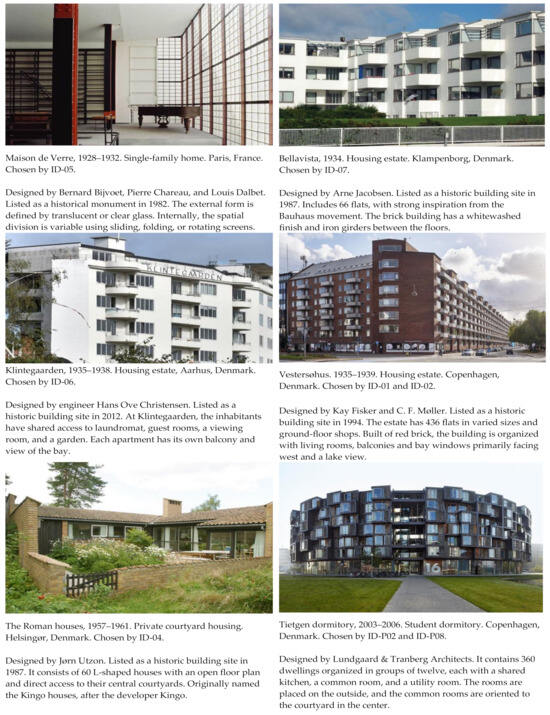
Figure 1.
Housing examples that the architects associated with architectural quality.
However, there are also common architectural design principles from the selected examples. All examples, except Maison de Verre, are from a Danish context. It is also very interesting that, independent from each other, architects chose the same example twice—Vestersøhus and the Tietgen dormitory. The architectural examples are also social representations, to a high degree [30], with a shared cultural and contextual common sense from the included architects. The examples are also very alike within a Danish historical tradition, embodied within the collective memory of familiar and architecturally recognized buildings. Except for the Tiegen Dormitory, all the Danish examples are listed buildings. However, the Tietgen Dormitory is suggested as a listed building.
Table 4 outlines qualitative descriptions of how the participants associated the chosen buildings with QoL. In general, the participants highlighted the context and qualities of the housing sites as significant factors for QoL. Participants linked view of the sky, daylight levels, and access to outdoor spaces and nature positively with QoL.
Table 4.
Housing examples with ascribed QoL and verbatim descriptions from the participants.
To promote a sense of community and enhance QoL on a city scale, the participants emphasized designing ground floors with varied edge zones that were open to the wider public. It is also noteworthy that the participants, besides the importance of shared space, also emphasized the importance of providing inhabitants with opportunities for privacy. The shared space is also mentioned in the literature as one of the factors that can be a facilitator for QoL [31,32,33], as it is indicative of rising levels of trust and common concerns about the space [34]. Encouraging a sense of community was mentioned as a key driver for organizing spaces in the buildings, especially in student housing (e.g., Tietgen), while securing a sense of privacy and opportunities for interaction was the primary spatial strategy in family housing. Community design involves functional strategies, such as providing communal spaces in- and outside; spatial strategies, such as adding more openings, doors, and passages, increasing the possibility of daily encounters; or providing transition zones, such as semiprivate gardens, terraces, and balconies, where inhabitants could meet informally. Zoning and visual contact were applied as spatial strategies in student and family housing as a way of breaking down barriers of contact and allowing for a progression toward autonomy in the private residence.
3.2. What Impacts QoL
Figure 2 shows the categories of the cards the participants chose based on Task 2 in the interview. The participants were asked to choose 5 cards (out of 21) that they perceived to have a positive impact on QoL. There was sone word written on each card. The used words are revealed in light grey in Figure 2. The participants were not informed about the labels of the categories, marked in bold in Figure 2.
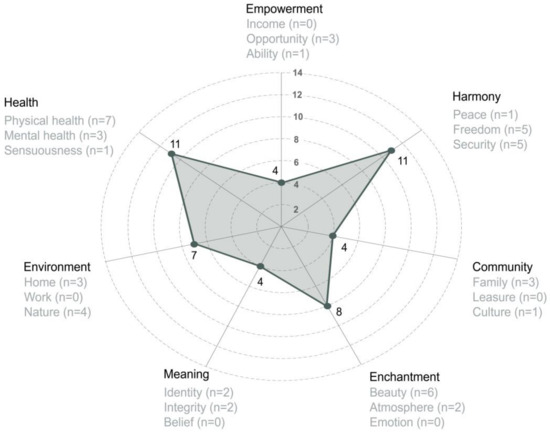
Figure 2.
Impacts of QoL. Frequency of cards in seven categories, ten participants each selecting five cards.
The content analysis in Figure 2 revealed that the sub-elements in harmony and health were chosen equally, with 11 cards. The predominant card chosen in harmony was freedom (five times), and the predominant card chosen in health was physical health (seven times).
There was much emphasis on health as a variable influencing QoL. When elaborating on chosen concepts within the health category, participants emphasized health as a fundamental human need. Even though some of the participants mentioned that they believed physical and mental health to be interlinked, several made the point that physical health is underprioritized in design, listing access to outdoor facilities such as balconies, gardens, and daylight, as well as indoor climate, design, and planning that promote physical movement, such as attractive stairs and pedestrian and bicycle spaces. When the participants elaborated on their card choices in the harmony category, the answers were not as specific as in the health category. However, the participants highlighted the sense of feeling secure as a very fundamental part of QoL, with some linking it to a sense of belonging. The participants mentioned the importance of linking a sense of security with contact and relation to neighbors and the near community. Some of the participants also mentioned the importance of facilitating this security by providing open views so that the residents can see what happens outside.
3.3. How Can Architecture Impact QoL?
The participants were asked to choose 5 dimensions of QoL out of a total of 21 that they perceived had a positive impact on QoL. Each subdimension was subsequently ascribed to a category and summed up across participants (n = 10). The participants perceived that architecture could impact QoL in three primary dimensions: environment (14 cards), the experience of enchantment (14 cards), and health (7 cards). Figure 3 reveals the categories of the chosen cards.
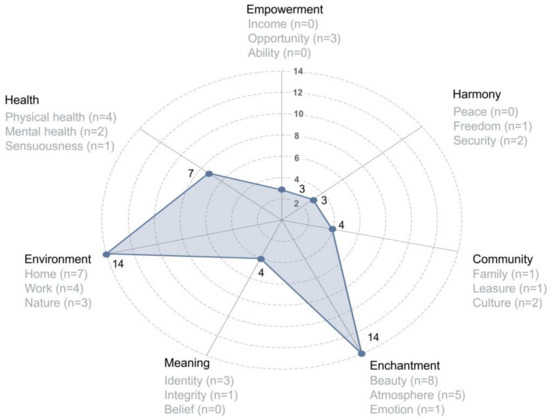
Figure 3.
Frequency of selected cards with variables of QoL that architecture can impact.
Table 5 contains various verbatim examples of the statements within the three main selected categories, environment, enchantment, and health.
Table 5.
Verbatim examples within environment, beauty, and physical health.
In the interviews, participants pointed to the fact that architecture has obvious effects on the environment (Table 5) as their reason for choosing the environment as a key variable of QoL that architecture can impact. They emphasized architects’ critical role in designing the environment and the responsibility that follows, especially when designing homes that affect daily lives. The understanding of beauty was heterogeneous; some participants perceived beauty as a design tool for QoL, while others perceived it as a design goal with QoL as a positive side effect, and some endowed beauty with the capacity to counteract the negative impact of other variables of QoL. Across the positions, participants agreed that beauty is a profound dimension of QoL and a key variable that architecture could influence. Health was also seen as a variable that architecture can impact, not only in the home but also in workplaces or institutions, such as schools or healthcare. Some emphasized indoor climate as key to QoL in architecture; others, the spatial, functional, and aesthetical qualities of the design; and some, the way design at various scales can promote movement. Variables within the community category were chosen by fewer participants, even though the keyword analysis of interviews showed that almost all the participants highlighted the experience of community as something that architecture can affect. The validation workshop underscored this, with participants emphasizing organizing individual dwellings around common spaces and creating visual connections, as well as communal functions such as laundry and shared outdoor spaces, as ways of designing for the community and QoL.
3.4. Barriers to Building for QoL
One of the themes of this study was to investigate factors that the participants perceived as barriers to building for QoL. The analysis reveals that the most commonly perceived barriers were economy/resources and building codes/regulations (Table 6). However, it is also interesting that several participants explicitly contradicted the idea that the economy is a barrier to building for QoL, perceiving the economy as a condition. Another commonly perceived barrier among the architects was the lack of knowledge of how to build for QoL (especially concerning evidential effects) and their capabilities to communicate their design choices. Clients and/or owners were also mentioned as a barrier (Table 6), as they were perceived to call for well-known housing formats that have proven themselves in the market. The economic barrier was often mentioned as being linked to the client or owner.
Table 6.
Frequency of coded statements within four themes concerning barriers to building for QoL (total out of 94 coded words).
4. Discussion
Value, in the context of the built environment, is increasingly being linked to QoL [35,36,37]. QoL, in the context of the built environment, has been linked to comfort and health, but the approach to well-being in buildings is becoming more heterogeneous and ambiguous in its conceptual approaches [38,39,40], corresponding with the rise in interdisciplinary research on the social impact of architecture [41]. This is in line with this study’s ambition to provide knowledge that can set new perspectives within the field of architecture and QoL. However, despite the growing interest in the relationship between architecture and QoL in research, policy, and practice, the research is challenged by methodological heterogeneity and unclear causal relationships, and several scholars have already argued for greater clarity on how the variables affect society and individuals [38,40,41].
Our results revealed that perceptions of QoL among architects are linked to three primary dimensions: health, a sense of harmony, and the experience of enchantment. In particular, the health dimensions have already been adequately covered in other studies [17,35,36,42], with most studies using self-reported surveys as the methodology [35,36,42]. An increasing number of studies on residential housing environments, offering a similar emphasis to that of the current study, have focused on the importance of a sense of harmony [14,18,43,44]. In Turkey, Kayseri [43] revealed, in a recent study, that the most influential factors on the overall QoL of individuals living in different residential neighborhoods were satisfaction with a neighborhood, neighborhood relations, and urban services. However, less focus was placed on residential housing and the experience of enchantment with its relation to QoL. The experience of enchantment has been described in tourism research [45,46] but might become more dominant in future architecture studies, especially in the highly relevant and current focus on the green transition [44]. However, in general, there is a need for a more integrative framework when building for QoL, including both objective and subjective approaches. This is also in line with the recently published and edited book Quality of Life Research: Place and Space Perspectives [41], which also emphasizes the importance of the situational context in which people live, as it is an influential factor in people’s QoL experiences.
We argue that further investigations into how architects define and design for QoL are needed. In addition, the literature lacks an understanding of how architects perceive QoL and how architecture can impact QoL. This study contributes some answers. However, future studies could also look into how architects and end users evaluate QoL in housing projects. Based on this study, there are indications that a majority of Danish architecture firms do not have a systematic practice in designing or evaluating QoL in housing. Most companies revisit projects after completion, primarily to reflect on the design, but only a few companies perform post-occupancy evaluations (e.g., metrics, assessment, and qualitative data) to evaluate QoL, factoring in, for example, residents’ sense of community, their satisfaction between private and public spaces, daylight conditions, and indoor climate. However, the architects were eager for more knowledge on how to design for QoL and how to evaluate QoL with improved scientific validity.
5. Limitations
This study is based on relatively few participants, and even though they were carefully sampled, the results should not be overinterpreted. Due to the relatively small and geographically concentrated sample, it is important to emphasize that the results may not be representative of all architects, especially outside Denmark. The participants represent a certain generation of Danish architects (aged 40–60) with more than 15 years of experience, and it is not unlikely that younger peers would have a different understanding of QoL in architecture. This study used projective techniques as a very successful method to elicit and stimulate conversations and discussions about QoL in architectural practice. Free association and card sorting elicited descriptions, comments, and verbal accounts about QoL. The methods used also engaged the participants and helped them focus on the topic, and the methods were used to generate a mapping and content analysis as part of the results. The workshop was also useful in facilitating engagement among a group of architects from different competitive companies to provide further explanation of the nature of the evidence produced in the individual in-depth interviews. However, concerning card sorting, our inclusion of the right wording on the cards and the categories’ accuracy could be discussed. The words were theoretically founded with inspiration from Eger and Maridal’s [25] classification of QoL concepts. The cards were pilot-tested, and the cards and categories were validated among a group of experts in the field. During the task, participants had the opportunity to include a new card/word to the table (one did that, choosing sustainability). Despite all of these qualitative validation methods, we recognize that there could be limitations in the specific wording and categorization chosen. In particular, the category and the cards concerning enchantment (beauty, atmosphere, and emotion) and community (family, leisure, and culture) could be further investigated. Lastly, an important limitation of this study is the translation. All the interviews, the workshop, and the analysis took place in Danish and were translated for publication purposes.
6. Conclusions
We can conclude that Danish architects perceive that architecture could impact QoL in three primary dimensions: the environment, the experience of enchantment, and health. The participants highlighted the context and qualities of the housing site as significant factors for QoL; however, more specifically, indoor air quality, view of the sky, daylight levels, private spaces, and access to outdoor spaces and nature are positively linked with QoL. Special emphasis was also given to a sense of community and shared space as important elements for QoL. Furthermore, we can conclude that the most frequently perceived barriers to building for QoL were the economy, building codes/regulations, and a lack of knowledge. Although architecture firms might have limited influence on the economy and regulations, they can impact how they collect information and collaborate in order to build knowledge for creating QoL in design practices. This study recommends enhancing the research on QoL in housing, especially from an end-user perspective. We recommend that architectural firms develop and share practices so that they can learn more systematically from projects as a profession and document how architecture impacts the dimensions of QoL, such as a sense of community. Future research should also provide recommendations that include specific metrics and knowledge on how to improve the evaluation of QoL’s impact.
We outlined a proposed framework with variables of QoL that architecture can impact. However, this is just a starting point for further development, which also has advantages that can be linked to theories and fields, including smart city research, environmental psychology, green transition, urban design [37,47,48,49], digital architecture and building systems [50], and neuro architecture [51]. Architecture can and should contribute to QoL in regard to improving and maintaining a good life for the residents. We argue that, in order to enhance QoL in housing, we require both a common metric of QoL variables and a deeper understanding of the concept of QoL in housing from various perspectives and practices that could challenge architects’ seemingly homogenous perceptions.
Author Contributions
All credits are equally attributed to both authors, S.L.J. and T.B. All authors have read and agreed to the published version of the manuscript.
Funding
Desk research received internal funding from Realdania.
Institutional Review Board Statement
Not applicable.
Informed Consent Statement
Informed consent was obtained from all subjects involved in the study. All participants gave informed consent and were informed that they could withdraw from the study at any time. In addition, all participants were provided with anonymous ID numbers, and all data were labeled with these IDs.
Data Availability Statement
The datasets used and/or analyzed during the current study are available from the corresponding authors on reasonable request.
Acknowledgments
Thanks to all the participants for their valuable contributions. A special thanks to Anna Møller Teilmann, hired as a student helper in the project, for her assistance especially for the interviews, transcription, and coding.
Conflicts of Interest
Author Stine Lea Jacobi was employed by the company Realdania. The remaining author declare no conflicts of interest.
References
- Vogt, C.A.; Andereck, K.L.; Pham, K. Designing for quality of life and sustainability. Ann. Tour. Res. 2020, 83, 102963. [Google Scholar] [CrossRef]
- Yadav, J.; Gupta, N. Urban Quality of Life: Domains, Dimensions and Indicators for Indian Cities. IOP Conf. Ser. Earth Environ. Sci. 2021, 796, 12032. [Google Scholar] [CrossRef]
- Quality of Life Foundation. Available online: https://www.qolf.org/ (accessed on 6 March 2024).
- Serag El Din, H.; Shalaby, A.; Farouh, H.E.; Elariane, S.A. Principles of urban quality of life for a neighborhood. HBRC J. 2013, 9, 86–92. [Google Scholar] [CrossRef]
- Brown, R.I.; Brown, I. The application of quality of life. J. Intellect. Disabil. Res. 2005, 49, 718–727. [Google Scholar] [CrossRef] [PubMed]
- Sun, Y. Development of Neighborhood Quality of Life Indicators; University of Saskatchewan: Saskatoon, SK, Canada, 2005. [Google Scholar]
- Veenhoven, R. Subjective measures of well-being. In Human Well-being: Concept and Measurement; McGillivray, M., Ed.; Palgrave /McMillan: Houndmills, NH, USA, 2007; pp. 214–239. [Google Scholar]
- Keles, R. The quality of life and the environment. Procedia Soc. Behav. Sci. 2012, 35, 23–32. [Google Scholar] [CrossRef][Green Version]
- Garcia-Mira, R.; Uzzell, D.L.; Real, J.E.; Romay, J. (Eds.) Housing, Space and Quality of Life; Routledge: London, UK, 2017. [Google Scholar] [CrossRef]
- Becerik-Gerber, B.; Lucas, G.; Aryal, A.; Awada, M.; Bergés, M.; Billington, S.L.; Boric-Lubecke, O.; Ghahramani, A.; Heydarian, A.; Jazizadeh, F.; et al. Ten questions concerning human-building interaction research for improving the quality of life. Build. Environ. 2022, 226, 109681. [Google Scholar] [CrossRef]
- de Hollander, A.E.; Staatsen, B.A. Health, environment and quality of life: An epidemiological perspective on urban development. Landsc. Urban. Plan. 2003, 65, 53–62. [Google Scholar] [CrossRef]
- Jones, S.; Grigoriou, E. Wellbeing Matters: Assessing Views on the Impact of the Built Environment on Wellbeing; Feeling Good Foundation: London, UK, 2014. [Google Scholar]
- Leung, M.Y.; Famakin, I.; Kwok, T. Relationships between indoor facilities management components and elderly people’s quality of life: A study of private domestic buildings. Habitat. Int. 2017, 66, 13–23. [Google Scholar] [CrossRef]
- Dash, S.P.; Thilagam, N.L. A Systematic Review on Inter-Relationship of Residential Neighborhood Characteristics on Quality of Life of Elderly. Pertanika J. Soc. Sci. Humanit. 2022, 30, 1533–1566. [Google Scholar] [CrossRef]
- Feng, I.M.; Chen, J.H.; Zhu, B.W.; Xiong, L. Assessment of and improvement strategies for the housing of healthy elderly: Improving quality of life. Sustainability 2018, 10, 722. [Google Scholar] [CrossRef]
- Pasquina, P.F.; Pasquina, L.F.; Anderson-Barnes, V.C.; Giuggio, J.S.; Cooper, R.A. Using architecture and technology to promote improved quality of life for military service members with traumatic brain injury. Phys. Med. Rehabil. Clin. N. Am. 2010, 21, 207–220. [Google Scholar] [CrossRef] [PubMed]
- Simonsen, T.P.H.; Brown, S.D.; Reavey, P. Vitality and nature in psychiatric spaces: Challenges and prospects for ‘healing architecture’ in the design of inpatient mental health environments. Health Place 2024, 85, 103169. [Google Scholar] [CrossRef] [PubMed]
- Zhang, J.; Wang, G.; Xiong, L. Using a Data Mining Method to Explore Strategies for Improving the Social Interaction Environment Quality of Urban Neighborhood Open Spaces. Architecture 2023, 3, 128–136. [Google Scholar] [CrossRef]
- Bjørner, T. Data collection. In Qualitative Methods for Consumer Research: The Value of the Qualitative Approach in Theory and Practice; Bjørner, T., Ed.; Hans Reitzels: Copenhagen, Denmark, 2015. [Google Scholar]
- Navas-Martín, M.Á.; Cuerdo-Vilches, T. A Visual–Emotional Analysis of Perception in the Homes of Chronic Patients during Confinement by COVID-19 in Spain. Architecture 2023, 3, 107–127. [Google Scholar] [CrossRef]
- McLaughlan, R. Engaging young people in architectural research: Three visual methods for understanding the impact of the built environment on children’s wellbeing. Vis. Stud. 2023, 1–14. [Google Scholar] [CrossRef]
- Hollway, W.; Jefferson, T. Doing Qualitative Research Differently: Free Association, Narrative and the Interview Method; Sage: London, UK, 2000. [Google Scholar]
- Joffe, H.; Elsey, J.W. Free association in psychology and the grid elaboration method. Rev. Gen. Psychol. 2014, 18, 173–185. [Google Scholar] [CrossRef]
- Tagomori, H.; Fardghassemi, S.; Joffe, H. How young adults cope with loneliness: A study of London’s most deprived boroughs. Int. J. Adolesc. Youth 2022, 27, 2013263. [Google Scholar] [CrossRef]
- Eger, R.J.; Maridal, J.H. A statistical meta-analysis of the wellbeing literature. Int. J. Wellbeing 2015, 5, 45–74. [Google Scholar] [CrossRef]
- Kelly, G.A. The Psychology of Personal Constructs; W. W. Norton: New York, NY, USA, 1955. [Google Scholar]
- Rugg, G.; McGeorge, P. The sorting techniques: A tutorial paper on card sorts, picture sorts and item sorts. Expert. Syst. 1997, 14, 80–93. [Google Scholar] [CrossRef]
- Spradley, J.P. Participants Observation; Waveland Press: Long Grove, IL, USA, 2016. [Google Scholar]
- MacPhail, C.; Khoza, N.; Abler, L.; Ranganathan, M. Process guidelines for establishing intercoder reliability in qualitative studies. Qual. Res. J. 2016, 16, 198–212. [Google Scholar] [CrossRef]
- Moscovici, S. Social Representations: Explorations in Social Psychology; New York University Press: New York, NY, USA, 2001. [Google Scholar]
- Ataman, C.; Dino, I.G. Collective residential spaces in sustainability development: Turkish housing units within Co-living understanding. IOP Conf. Ser. Earth Environ. Sci. 2019, 296, 012049. [Google Scholar] [CrossRef]
- Wu, W.; Ge, X.J. Communal space design of high-rise apartments: A literature review. J. Des. Built Environ. 2020, 20, 35–49. [Google Scholar] [CrossRef]
- Farida, N. Effects of outdoor shared spaces on social interaction in a housing estate in Algeria. Front. Archit. Res. 2013, 2, 457–467. [Google Scholar] [CrossRef]
- Märtsin, M.; Niit, T. The Home as a Territorial System (II). In Housing, Space and Quality of Life; Garcia-Mira, R., Uzzell, D.L., Real, J.E., Romay, J., Eds.; Routledge: New York, NY, USA, 2017; pp. 151–170. [Google Scholar] [CrossRef]
- Hooper, P.; Kleeman, A.; Edwards, N.; Bolleter, J.; Foster, S. The architecture of mental health: Identifying the combination of apartment building design requirements for positive mental health outcomes. Lancet Reg. Health West. Pacct. 2023, 37, 100807. [Google Scholar] [CrossRef] [PubMed]
- Alidoust, S.; Huang, W. A decade of research on housing and health: A systematic literature review. Rev. Environ. Health 2023, 38, 45–64. [Google Scholar] [CrossRef]
- Chang, S.; Smith, M.K. Residents’ Quality of Life in Smart Cities: A Systematic Literature Review. Land 2023, 12, 876. [Google Scholar] [CrossRef]
- Hanc, M.; McAndrew, C.; Ucci, M. Conceptual approaches to wellbeing in buildings: A scoping review. Build. Res. Inf. 2019, 47, 767–783. [Google Scholar] [CrossRef]
- Chimed-Ochir, O.; Ikaga, T.; Ando, S.; Ishimaru, T.; Kubo, T.; Murakami, S.; Fujino, Y. Effect of housing condition on quality of life. Indoor Air 2021, 31, 1029–1037. [Google Scholar] [CrossRef] [PubMed]
- Prescott-Allen, R. The Wellbeing of Nations: A Country-by-Country Index of Quality of Life and the Environment; Island Press: Washington, WA, USA, 2001. [Google Scholar]
- Marans, R.W.; Stimson, R.J.; Webster, N.J. (Eds.) Handbook of Quality of Life: Place and Space Perspectives; Edward Elgar: Cheltenham, UK, 2024. [Google Scholar]
- Barros, P.; Fat, L.N.; Garcia, L.M.; Slovic, A.D.; Thomopoulos, N.; de Sá, T.H.; Morais, P.; Mindell, J.S. Social consequences and mental health outcomes of living in high-rise residential buildings and the influence of planning, urban design and architectural decisions: A systematic review. Cities 2019, 93, 263–272. [Google Scholar] [CrossRef]
- Güngör, M.K.; Terzi, F. Residential satisfaction and quality of urban life: Examining diverse housing environments. Archnet-IJAR 2024, 18, 58–80. [Google Scholar] [CrossRef]
- Ingaramo, R.; Negrello, M. ‘Surviving the City’. Nature as an Architecture Design Strategy for a More Resilient Urban Ecosystem. In Green Infrastructure: Planning Strategies and Environmental Design; Giudice, B., Novarina, G., Voghera, A., Eds.; The Urban Book Series; Springer: Cham, Switzerland, 2023; pp. 139–150. [Google Scholar] [CrossRef]
- Pyyry, N. Learning with the city via enchantment: Photo-walks as creative encounters. Discourse Stud. Cult. Politics Educ. 2016, 37, 102–115. [Google Scholar] [CrossRef]
- Wu, J.; Zeng, G.; Zhong, S. Between the everyday and the extraordinary: Encounters in the wet market study tour. Curr. Issues Tourism 2023, 1–20. [Google Scholar] [CrossRef]
- Fleury-Bahi, G.; Pol, E.; Navarro, O. Introduction: Environmental psychology and quality of life. In Handbook of Environmental Psychology and Quality of Life Research; Fleury-Bahi, G., Pol, E., Navarro, O., Eds.; Springer: Cham, Switzerland, 2017; pp. 1–8. [Google Scholar] [CrossRef]
- Joye, Y. Architectural lessons from environmental psychology: The case of biophilic architecture. Rev. Gen. Psychol. 2007, 11, 305–328. [Google Scholar] [CrossRef]
- Tabb, P.J.; Deviren, A.S. The Greening of Architecture: A Critical History and Survey of Contemporary Sustainable Architecture and Urban Design; Ashgate: Farnham, UK, 2013. [Google Scholar]
- Ma, C.Y.; van Ameijde, J. Adaptable modular construction systems and multi-objective optimisation strategies for mass-customised housing: A new user-driven paradigm for high-rise living in Hong Kong. Int. J. Archit. Comput. 2022, 20, 96–113. [Google Scholar] [CrossRef]
- Abbas, S.; Okdeh, N.; Roufayel, R.; Kovacic, H.; Sabatier, J.M.; Fajloun, Z.; Abi Khattar, Z. Neuroarchitecture: How the Perception of Our Surroundings Impacts the Brain. Biology 2024, 13, 220. [Google Scholar] [CrossRef] [PubMed]
Disclaimer/Publisher’s Note: The statements, opinions and data contained in all publications are solely those of the individual author(s) and contributor(s) and not of MDPI and/or the editor(s). MDPI and/or the editor(s) disclaim responsibility for any injury to people or property resulting from any ideas, methods, instructions or products referred to in the content. |
© 2024 by the authors. Licensee MDPI, Basel, Switzerland. This article is an open access article distributed under the terms and conditions of the Creative Commons Attribution (CC BY) license (https://creativecommons.org/licenses/by/4.0/).