


Abstract
Naturopathy or herbal medicine has been widely used as an alternative treatment for several illnesses, such as cancer, as they are generally acknowledged as a treatment with lesser side effects. This research evaluated the bioactive compounds profiling, antioxidant, and anticancer potential in Mentha longifolia L. (essential oil and extract), using different solvent polarities (hexane, methanol, and diethyl ether). Meanwhile, the caspase 3 gene expression and cell cycle status of methanolic extract were determined in colorectal cancer cells (Caco-2 and SW48). The overall findings showed that methanolic extraction exhibited the highest total phenolic and flavonoid with respective values of 59.25 mg GAE (Gallic acid) eq./g DW (dry weight) and 20.02 mg RE (Rutin) eq./g DW, respectively, compared to hexane and diethyl ether. Furthermore, piperitenone oxid and piperitonone were found to be the dominant volatile compounds in methanolic extracts and essential oils. Additionally, the methanolic extract possesses higher antioxidant and anticancer activities. The molecular analysis indicated that methanolic extract up-regulated the expression of caspase 3 and increased the SubG1 (method to detecting cell death) peaks in treated Caco-2 and SW48 cell lines. To conclude, M. longifolia L. could serve as an effective therapeutic agent and a remedy for several illnesses, such as cancer caused by oxidative stress.
1. Introduction
There has been a noticeable trend towards plant-based medicines for the last few years due to the high cost and increased risks associated with allopathic medicines. Plants have been used for medicinal purposes throughout history and have played an essential role in human health [1]. Most research in the 19th century mainly focused on secondary metabolites, which are compounds produced by plants through metabolic pathways derived from primary metabolic pathways. Secondary metabolites have been used as the foundation for many commercial pharmaceutical drugs and herbal remedies, and they are effective in treating diabetes, cancer, hypertension, anemia, and malaria [2,3]. Flavonoids and phenolics are examples of secondary metabolites with promising medical benefits [4,5]. Several new cytotoxic secondary metabolites are isolated from plants each year and constitute a source of new possibilities to explore to fight against cancerous diseases. However, some natural compounds cannot be used in clinical practice due to their physico-chemical properties (e.g., limited bioavailability) and/or their toxicity. On the other hand, plant-occurring secondary metabolites can often be excellent leads for drug development. Overall, secondary metabolites of medicinal plants offer a promising area of research for developing new therapies for various diseases.
Mentha longifolia L. is a herb widely used in Southeast Asian countries to treat various ailments. Its essential oils and aerial parts have been used as a food preservative and a protective and curative alternative for treating many illnesses, including gastrointestinal and respiratory disorders, infectious diseases, and inflammatory diseases [6,7]. M. longifolia contains a large number of phenolic and flavonoid compounds, which have high antioxidant properties with free radical scavenging activities, which are indirectly able to reduce the inflammatory response and prevent cancer [7,8].
Consuming nutrients rich in anti-inflammatory bioactive components from plants, such as polyphenols and flavonoid compounds with antioxidant activities, has demonstrated anti-inflammatory activity with reduced inflammation in breast cancer tissue [9]. The health benefits of the regional diet are accredited for having a substantial quantity of bioactive compounds recognized as foods containing potential antioxidant and anti-inflammatory activities [10]. There have been several studies on cells, animals, and human clinical trials that can provide substantial proof that bioactive components found in the diet may perform as an anti-inflammatory and antioxidant mediator, especially in elevating energy usage and increasing the thermogenesis of the body while reducing oxidative stress and inflammation [11,12,13,14]. The previous literature has suggested that consuming mixed fruits and herbal supplements significantly reduces oxidative stress activity and elevates antioxidant levels in systemic circulation [15,16]. Research laboratory experiments have shown that the anticancer potential of a polyphenol-rich fraction of herbal extracts may be due to the capability of polyphenols to act directly or indirectly on cancer tissues without any side effect on normal cells [17]. The aim of this study was to evaluate the bioactive compounds of essential oil and different extractions of Mentha longifolia L., as well as its antioxidant and anticancer activities against the Caco-2 and SW48 cell lines. Additionally, the molecular mechanism and induction of apoptosis in colorectal cancer were assessed.
2. Materials and Methods
All the methods used in this study were developed and published previously by our research group, and we performed them with no additional modifications.
2.1. Extraction Procedure
The aerial parts of the M. longifolia L. were extracted based on a previously published method [18]. The essential oil was extracted using Soxhlet, as described earlier by Ghareh Bashlouei et al. [19].
2.2. Phenolic and Flavonoid Content
Total phenol (TPC) and flavonoid contents (TFC) of M. longifolia L. extracts were determined and extracted based on a previously published method [20].
2.3. Method of Gas Chromatography–Mass Spectrophotometry
The samples were processed based on a previously published method [21]. The analysis of the bioactive compound peak was used based on the National Institute of Standards and Technology (NlST 08 and NIST 08s) library.
2.4. FRAP Assay
The assay was performed based on a published paper [22]. The percentage of antioxidant activity in the FRAP assay of the samples was calculated according to the formula below:
A0 = absorbance of the control (potassium phosphate buffer + FRAP reagent) and A1 = absorbance of the sample.
Antioxidant Activity (%) = (A1 × A0)/A1
2.5. Apoptotic Activity
Apoptotic activity was performed based on a published method [19]. Real-time PCR was applied under the below condition: 95 °C, 15 min 1 cycle (holding step), 95 °C 15 s, 58.5 °C, 20 s 39 cycles (annealing), 72 °C, 20 s 39 cycles (extension); 65–95 °C, 1 cycle (melting). GAPDH was used as a housekeeping gene [19].
2.6. Statistical Analysis
Data were analyzed by one-way ANOVA, using the MIXED procedure of the SAS software package, version 9.1 (SAS Inst. Inc., Cary, NC, USA). The data were checked for normality using the UNIVARIATE procedure of SAS software Version 9.4. Differences in a p-value of <0.05 were significant.
3. Results
3.1. Total Phenolic and Flavonoid Analysis
The obtained results from different extractions of Mentha longifolia L. revealed that the methanolic extract had the highest TPC and TFC with respective values of 59.25 mg GAE (gallic acid) eq./g DW (dry weight) and 20.02 mg RE eq./g DW, respectively, compared to hexane and diethyl ether. As shown in Table 1, all the extracts were significant (p < 0.05).

Table 1.
Total phenolic and flavonoid compounds of essential oil and extracts of Mentha longifolia L.
3.2. Gas Chromatography–Mass Spectrophotometry of Mentha longifolia L. Compounds
The volatile compounds screening was conducted using GCMS analysis in the methanolic extracts and essential oils of Mentha longifolia L., which led to various natural components (Table 2 and Table 3). Among them, piperitenone oxid and piperitonone were found to be the dominant compounds in methanolic extracts and essential oils.
Table 2.
Bioactive profiling of Mentha longifolia L. essential oil using gas chromatography–mass spectrophotometry.
Table 3.
Bioactive profiling of methanolic extract of Mentha longifolia L. using gas chromatography–mass spectrophotometry.
3.3. Antioxidant Potential
The antioxidant properties of Mentha longifolia L. essential oil and different solvent polarity extraction were conducted using FRAP assay. The results showed that (Figure 1) the essential oil and different fractionations exhibited a more potent reduction of Fe3+ as free radicals. As shown in Table 4, the methanolic extract was more active compared to other fractionations and essential oils. The free radical scavenging of Mentha longifolia L. essential oil, various extractions, and standards at a concentration of 400 μg/mL (Table 4) were found to be in the ascending order: vitamin E > methanol > essential oil> diethyl ether > hexane, respectively.

Figure 1.
The free radical scavenging of Mentha longifolia L. essential oil and different fractions.
Table 4.
FRAP activity of Mentha longifolia L. essential oil and extracts using different solvents (hexane, methanol, diethyl ether).
3.4. Anticancer Properties
The cytotoxicity assessment of M. longifolia L. fractionation against colorectal cancer (Caco-2 and SW48) is presented in Figure 2 and Figure 3. In the light of this experiment, an increase in various extract concentrations up to 500 μg/mL decreased the cell viabilities notably (p < 0.001) in a dose-dependent manner in the mentioned cancer cell line. The anticancer activity of methanolic extract appeared to be more remarkable on the Cac02 (IC50 = 167.6) and SW48 (IC50 = 97.3) cell lines compared to other extractions. Doxorubicin was used as a positive control in this study (Table 5). Furthermore, our results illustrated that all the extractions of M. longifolia L. exhibited low toxicity against the HFF cell line as a normal cell (Figure 4).
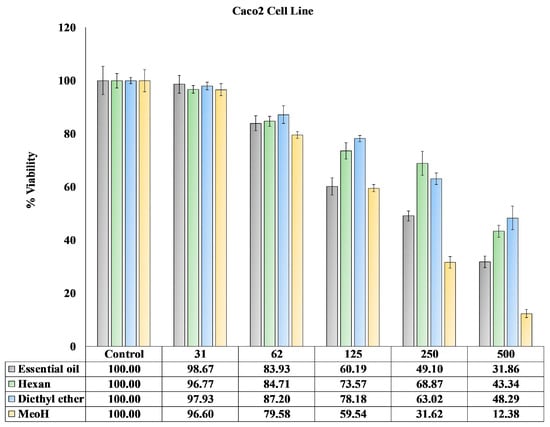
Figure 2.
The impact of Mentha longifolia L. essential oil and different fractionations on the viability of the Caco-2 cell line. All values represent the mean ± standard deviation from three independent experiments.
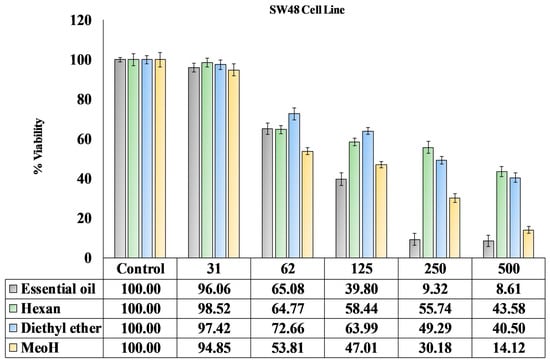
Figure 3.
The impact of Mentha longifolia L. essential oil and different fractionations on the viability of SW48 cell line. All values represent the mean ± standard deviation from three independent experiments.
Table 5.
IC50 values of Mentha longifolia L. essential oil and different fractionation and positive control on Sw48 and Caco-2 cell lines.
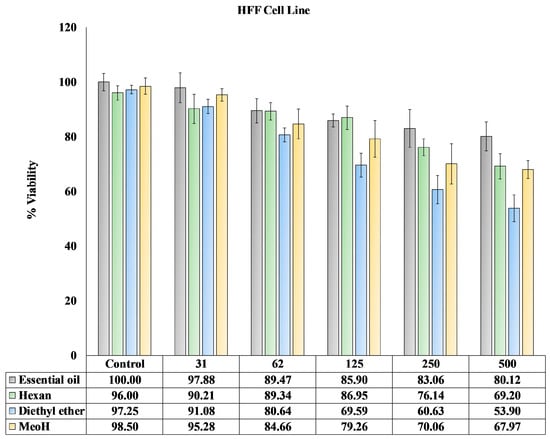
Figure 4.
The impact of Mentha longifolia L. essential oil and different fractionations on the viability of the HFF cell line. All values represent the mean ± standard deviation from three independent experiments.
3.5. Flow Cytometry Observation
According to our previous results, methanolic extraction exhibited the strongest antioxidant and anticancer potential, so further experiments, including flow cytometry and gene expression methanolic extraction, have been selected. The flow cytometry findings showed a significant increase in the SubG1 peak (53.4%) in Caco-2 and SW48 (75%) cell lines by enhancing treatment doses of methanolic extraction of M. longifolia L. The results confirmed the apoptotic death in both treated colorectal cancer cell lines of Caco-2 and SW48 (Figure 5).
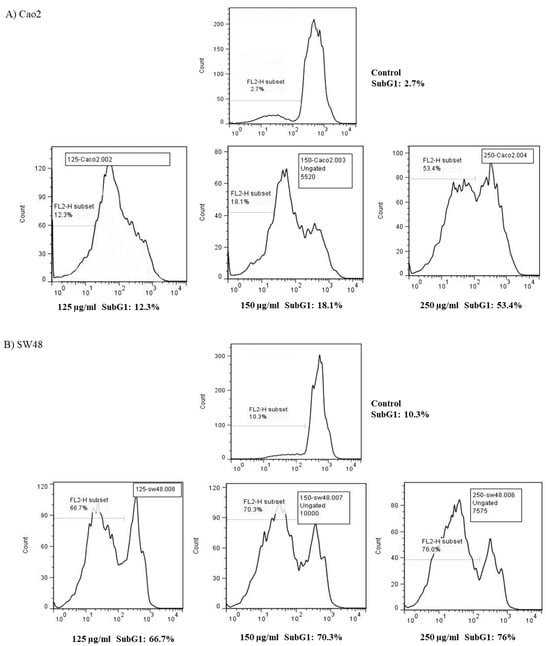
Figure 5.
Flow cytometric evaluation of the cell cycle in colorectal cancer cell lines (Caco-2 and SW48) treated with methanolic extraction of M. longifolia L. Increased in the SubG1 peak in Caco-2 (A) and SW48 (B) cell lines by enhancing treatment doses of methanolic extraction of M. longifolia L.
3.6. Caspase 3 Gene Expression in Caco-2 and SW48 Cancer Cells
The caspase 3 gene expression in Caco-2 and SW48 cell lines was significantly up-regulated after 48 h incubation with an IC50 concentration of methanolic extraction of M. longifolia L. (Figure 6). Our results proved that methanolic extraction resulted in apoptotic death in both mentioned cancer cell lines by up-regulating the caspase 3 gene.
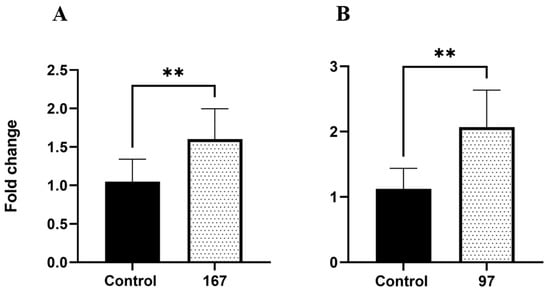
Figure 6.
Caspase-3 gene profiling in (A) Caco-2 and (B) SW48 cell lines treated with methanolic extraction of M. longifolia L. The ** shows a significant relationship (p < 0.05). All values represent the mean ± standard deviation from three independent experiments. Concentrations were μg/mL.
4. Discussion
The present study elucidates the mechanism of apoptosis provoked by M. longifolia L. extract and its essential oil against colorectal cancer (Caco-2 and SW48). In addition, M. longifolia did not reveal any toxic impact on the HFF normal cell line.
Medicinal herbs are commonly used to treat various ailments, including cancer and malignancies [23,24]. Earlier studies showed that natural products could exhibit several biological activities, such as inducing apoptosis-mediated proliferation inhibition through up-regulation of bax and caspase-3 and down-regulation of bcl2 genes [25,26,27], repressing insulin-like growth factor-1 and inducing Waf-1 gene expression [28,29], glutathione S-transferase activity [30] heat shock protein [31], anti-inflammatory [32,33] and inhibitor of GLI-mediated transcription, a pathway that causes the formation and progression of a variety of tumors [34]. The natural bioactive compound of the Lamiaceae family was also reported to exert anti-proliferative activity, which inhibits oncocyte growth, induction of differentiation, apoptosis, and induces G2/M arrest on cancer cells [35,36,37], and has potential antioxidant, anti-microbe, and anti-inflammatory properties [38,39]. The data obtained in this research were in agreement with the mentioned experiments. The gene profiling of caspase-3 confirmed the incidence of apoptosis and indicated that the occurrence of apoptosis possibly occurred through the intrinsic mitochondrial pathway. Cell cycle arrest at G2/M has been characterized in detail, in context of DNA damage. These observations enable us to understand the molecular pathways leading to the cellular consequences of cell cycle checkpoint activation. Accordingly, checkpoint activation leads to cell cycle arrest prior to DNA replication (G1/S arrest) or prior to mitosis (G2/M arrest) to allow time for repair. If the damage is irreparable, the cell dies through apoptosis. This phenomenon of apoptosis preceded by metaphasal arrest (G2/M arrest) could be observed in the colon cancer cells treated with M. Longifolia. Overall results obtained from the biological assays suggest that M. Longifolia is a source of bioactive natural phytoconstituents endowed with interesting biological activities, probably mainly as strongly antioxidant and anticancer agents. Thus, the presence of phenolic acids, flavonoids, essential oils and other compounds with possible cytotoxicity and antioxidative action, may present this herbal plant as a new potential source of natural products and a natural antioxidant.
5. Conclusions
Based on the results, the methanolic extraction of Mentha longifolia L. displays the highest bioactive compounds, appreciable antioxidant, and anticancer power, notably induced apoptosis via caspase 3 gene regulation. Therefore, we recommended that methanolic extraction has the potential to apply to human health and food industries. However, further experiments need to be carried out in animal models.
Author Contributions
Conceptualization, E.K.; methodology, N.B. (Nadia Beheshtin), N.B. (Nazanin Beheshtian), H.H.L. and M.S.; software, J.A.; validation, E.K.; formal analysis, E.K.; investigation, N.B. (Nadia Beheshtin), N.B. (Nazanin Beheshtian), J.A.; resources, E.K.; data curation, E.K.; writing—original draft preparation, N.B. (Nadia Beheshtin) and N.B. (Nazanin Beheshtian); writing—review and editing, E.K. and M.S.; supervision, E.K., M.S. and H.H.L. did not analyze the data but provided comments and suggestions based on the analyzed data. All authors have read and agreed to the published version of the manuscript.
Funding
This research received no external funding.
Institutional Review Board Statement
Not applicable.
Informed Consent Statement
Not applicable.
Data Availability Statement
No new data were created.
Acknowledgments
The authors are grateful to the Islamic Azad University of Mashhad for the laboratory facilities.
Conflicts of Interest
The authors declare no conflict of interest.
References
- Najjar, R.S.; Moore, C.E.; Montgomery, B.D. A defined, plant-based diet utilized in an outpatient cardiovascular clinic effectively treats hypercholesterolemia and hypertension and reduces medications. Clin. Cardiol. 2018, 41, 307–313. [Google Scholar] [CrossRef]
- Tiwari, R.; Rana, C.J. Plant secondary metabolites: A review. Int. J. Eng. Res. Gen. Sci. 2015, 3, 661–670. [Google Scholar]
- Gonçalves, J.; Rosado, T.; Soares, S.; Simão, A.Y.; Caramelo, D.; Luís, Â.; Fernández, N.; Barroso, M.; Gallardo, E.; Duarte, A.P. Cannabis and its secondary metabolites: Their use as therapeutic drugs, toxicological aspects, and analytical determination. Medicines 2019, 6, 31. [Google Scholar] [CrossRef]
- Jucá, M.M.; Cysne Filho, F.M.S.; de Almeida, J.C.; Mesquita, D.d.S.; Barriga, J.R.d.M.; Dias, K.C.F.; Barbosa, T.M.; Vasconcelos, L.C.; Leal, L.K.A.M.; Ribeiro, J.E.J. Flavonoids: Biological activities and therapeutic potential. Nat. Prod. Res. 2020, 34, 692–705. [Google Scholar] [CrossRef]
- Shakeri, M.; Le, H.H. Deleterious Effects of Heat Stress on Poultry Production: Unveiling the Benefits of Betaine and Polyphenols. Poultry 2022, 1, 147–156. [Google Scholar] [CrossRef]
- Farzaei, M.H.; Bahramsoltani, R.; Ghobadi, A.; Farzaei, F.; Najafi, F. Pharmacological activity of Mentha longifolia and its phytoconstituents. J. Tradit. Chin. Med. 2017, 37, 710–720. [Google Scholar] [CrossRef]
- Bahadori, M.B.; Zengin, G.; Bahadori, S.; Dinparast, L.; Movahhedin, N. Phenolic composition and functional properties of wild mint (Mentha longifolia var. calliantha (Stapf) Briq.). Int. J. Food Prop. 2018, 21, 183–193. [Google Scholar] [CrossRef]
- Abootalebian, M.; Keramat, J.; Kadivar, M.; Ahmadi, F.; Abdinian, M. Comparison of total phenolic and antioxidant activity of different Mentha spicata and M. longifolia accessions. Ann. Agric. Sci. 2016, 61, 175–179. [Google Scholar] [CrossRef]
- Zhang, H.; Tsao, R. Dietary polyphenols, oxidative stress and antioxidant and anti-inflammatory effects. Curr. Opin. Food Sci. 2016, 8, 33–42. [Google Scholar] [CrossRef]
- Maleki, S.J.; Crespo, J.F.; Cabanillas, B. Anti-inflammatory effects of flavonoids. Food Chem. 2019, 299, 125124. [Google Scholar] [CrossRef]
- Basilicata, M.G.; Pepe, G.; Rapa, S.F.; Merciai, F.; Ostacolo, C.; Manfra, M.; Di Sarno, V.; Autore, G.; De Vita, D.; Marzocco, S. Anti-inflammatory and antioxidant properties of dehydrated potato-derived bioactive compounds in intestinal cells. Int. J. Mol. Sci. 2019, 20, 6087. [Google Scholar] [CrossRef] [PubMed]
- Grodzicki, W.; Dziendzikowska, K. The role of selected bioactive compounds in the prevention of Alzheimer’s disease. Antioxidants 2020, 9, 229. [Google Scholar] [CrossRef] [PubMed]
- Tang, Y.; Tsao, R. Phytochemicals in quinoa and amaranth grains and their antioxidant, anti-inflammatory, and potential health beneficial effects: A review. Mol. Nutr. Food Res. 2017, 61, 1600767. [Google Scholar] [CrossRef] [PubMed]
- Shakeri, M.; Cottrell, J.J.; Wilkinson, S.; Le, H.H.; Suleria, H.A.; Warner, R.D.; Dunshea, F.R. A dietary sugarcane-derived polyphenol mix reduces the negative effects of cyclic heat exposure on growth performance, blood gas status, and meat quality in broiler chickens. Animals 2020, 10, 1158. [Google Scholar] [CrossRef]
- Nardi, G.M.; Januario, A.G.F.; Freire, C.G.; Megiolaro, F.; Schneider, K.; Perazzoli, M.R.A.; Do Nascimento, S.R.; Gon, A.C.; Mariano, L.N.B.; Wagner, G. Anti-inflammatory activity of berry fruits in mice model of inflammation is based on oxidative stress modulation. Pharmacogn. Res. 2016, 8, S42. [Google Scholar]
- Subash, S.; Essa, M.M.; Al-Asmi, A.; Al-Adawi, S.; Vaishnav, R.; Braidy, N.; Manivasagam, T.; Guillemin, G. Pomegranate from Oman alleviates the brain oxidative damage in transgenic mouse model of Alzheimer’s disease. J. Tradit. Complement. Med. 2014, 4, 232–238. [Google Scholar] [CrossRef]
- Majewska, M.; Lewandowska, U. The chemopreventive and anticancer potential against colorectal cancer of polyphenol-rich fruit extracts. Food Rev. Int. 2018, 34, 390–409. [Google Scholar] [CrossRef]
- Mehdizadeh, A.; Karimi, E.; Oskoueian, E. Nano-liposomal encapsulation of Artemisia aucheri phenolics as a potential phytobiotic against Campylobacter jejuni infection in mice. Food Sci. Nutr. 2022, 10, 3314–3322. [Google Scholar] [CrossRef]
- Bashlouei, S.G.; Karimi, E.; Zareian, M.; Oskoueian, E.; Shakeri, M. Heracleum persicum Essential Oil Nanoemulsion: A Nanocarrier System for the Delivery of Promising Anticancer and Antioxidant Bioactive Agents. Antioxidants 2022, 11, 831. [Google Scholar] [CrossRef]
- Ravanfar, S.A.; Karimi, E.; Mehrabanjoubani, P.; Ebrahimi, M. Enhancement of phenolic and flavonoids compounds, antioxidant and cytotoxic effects in regenerated red cabbage by application of Zeatin. Nat. Prod. Res. 2020, 34, 898–902. [Google Scholar] [CrossRef]
- Karimi, E.; Jaafar, H.Z. HPLC and GC-MS determination of bioactive compounds in microwave obtained extracts of three varieties of Labisia pumila Benth. Molecules 2011, 16, 6791–6805. [Google Scholar] [CrossRef] [PubMed]
- Hashemi, M.; Behboodian, B.; Karimi, E.; Oskoueian, E. Enhancing biosynthesis and bioactivity of Trachyspermum ammi seed essential oil in response to drought and Azotobacter chroococcum stimulation. Chem. Biol. Technol. Agric. 2022, 9, 26. [Google Scholar] [CrossRef]
- Twilley, D.; Rademan, S.; Lall, N. A review on traditionally used South African medicinal plants, their secondary metabolites and their potential development into anticancer agents. J. Ethnopharmacol. 2020, 261, 113101. [Google Scholar] [CrossRef] [PubMed]
- Clairet, A.-L.; Boiteux-Jurain, M.; Curtit, E.; Jeannin, M.; Gérard, B.; Nerich, V.; Limat, S. Interaction between phytotherapy and oral anticancer agents: Prospective study and literature review. Med. Oncol. 2019, 36, 45. [Google Scholar] [CrossRef]
- Sitarek, P.; Synowiec, E.; Kowalczyk, T.; Bangay, G.; Śliwiński, T.; Picot, L.; Princiotto, S.; Rijo, P. Anticancer Properties of Plectranthus ornatus-Derived Phytochemicals Inducing Apoptosis via Mitochondrial Pathway. Int. J. Mol. Sci. 2022, 23, 11653. [Google Scholar] [CrossRef]
- Hazafa, A.; Iqbal, M.; Javaid, U.; Tareen, M.; Amna, D.; Ramzan, A.; Piracha, S.; Naeem, M. Inhibitory effect of polyphenols (phenolic acids, lignans, and stilbenes) on cancer by regulating signal transduction pathways: A review. Clin. Transl. Oncol. 2022, 24, 432–445. [Google Scholar] [CrossRef]
- Abdullah, H.; Ismail, I.; Suppian, R.; Zakaria, N.M. Natural Gallic Acid and Methyl Gallate Induces Apoptosis in Hela Cells through Regulation of Intrinsic and Extrinsic Protein Expression. Int. J. Mol. Sci. 2023, 24, 8495. [Google Scholar] [CrossRef]
- Csekes, E.; Račková, L. Skin aging, cellular senescence and natural polyphenols. Int. J. Mol. Sci. 2021, 22, 12641. [Google Scholar] [CrossRef]
- Fakhri, S.; Moradi, S.Z.; Ash-Rafzadeh, A.; Bishayee, A. Targeting cellular senescence in cancer by plant secondary metabolites: A systematic review. Pharmacol. Res. 2022, 177, 105961. [Google Scholar] [CrossRef]
- Guneidy, R.A.; Amer, M.A.; Hakim, A.E.E.; Abdel-Shafy, S.; Allam, S.A. Effect of polyphenols extracted from Punica granatum and Acacia saligna plants on glutathione S-transferase of the cattle tick Rhipicephalus (Boophilus) annulatus (Acari: Ixodidae). J. Parasit. Dis. 2021, 45, 524–538. [Google Scholar] [CrossRef]
- Qie, X.; Chen, Y.; Quan, W.; Wang, Z.; Zeng, M.; Qin, F.; Chen, J.; He, Z. Analysis of β-lactoglobulin–epigallocatechin gallate interactions: The antioxidant capacity and effects of polyphenols under different heating conditions in polyphenolic–protein interactions. Food Funct. 2020, 11, 3867–3878. [Google Scholar] [CrossRef] [PubMed]
- Truong, V.-L.; Jeong, W.-S. Antioxidant and anti-inflammatory roles of tea polyphenols in inflammatory bowel diseases. Food Sci. Hum. Wellness 2022, 11, 502–511. [Google Scholar] [CrossRef]
- Ranneh, Y.; Akim, A.M.; Hamid, H.A.; Khazaai, H.; Fadel, A.; Zakaria, Z.A.; Albujja, M.; Bakar, M.F.A. Honey and its nutritional and anti-inflammatory value. BMC Complement. Med. Ther. 2021, 21, 30. [Google Scholar] [CrossRef]
- Sharma, B.; Vasudeva, N.; Sharma, S. Phytopharmacological Review on Crinum asiaticum: A Potential Medicinal Herb. Nat. Prod. J. 2020, 10, 342–354. [Google Scholar] [CrossRef]
- Elansary, H.O.; Szopa, A.; Kubica, P.; Ekiert, H.; Klimek-Szczykutowicz, M.; El-Ansary, D.O.; Mahmoud, E.A. Polyphenol profile and antimicrobial and cytotoxic activities of natural Mentha × piperita and Mentha longifolia populations in Northern Saudi Arabia. Processes 2020, 8, 479. [Google Scholar] [CrossRef]
- Kwan, L.S.; Tan, S.Y.; Hirata, Y.; Chan, L.-K.; Nagaoka, Y.; Uesato, S.; Boey, P.L. Biotic Elicitation at Different Feeding Time in Cell Suspension Cultures of Eurycoma Longifolia Jack, a Valuable Medicinal Plant, for Enhancement of Cytotoxic Activity of Bioactive Compounds against Human Colon Cancer Cell Line. In In Vitro Cellular & Developmental Biology-Plant; Springer: Berlin/Heidelberg, Germany, 2022; pp. 1–13. [Google Scholar]
- Reddy, D.N. Essential Oils Extracted from Medicinal Plants and their Applications. In Natural Bio-Active Compounds: Volume 1: Production and Applications; Elsevier: Amsterdam, The Netherlands, 2019; pp. 237–283. [Google Scholar]
- Vladimir-Knežević, S.; Blažeković, B.; Kindl, M.; Vladić, J.; Lower-Nedza, A.D.; Brantner, A.H. Acetylcholinesterase inhibitory, antioxidant and phytochemical properties of selected medicinal plants of the Lamiaceae family. Molecules 2014, 19, 767–782. [Google Scholar] [CrossRef]
- El Aanachi, S.; Gali, L.; Rammali, S.; Bensouici, C.; Aassila, H.; Dari, K. In vitro study of the antioxidant, photoprotective, anti-tyrosinase, and anti-urease effects of methanolic extracts from leaves of six Moroccan lamiaceae. J. Food Meas. Charact. 2021, 15, 1785–1795. [Google Scholar] [CrossRef]
Disclaimer/Publisher’s Note: The statements, opinions and data contained in all publications are solely those of the individual author(s) and contributor(s) and not of MDPI and/or the editor(s). MDPI and/or the editor(s) disclaim responsibility for any injury to people or property resulting from any ideas, methods, instructions or products referred to in the content. |
© 2023 by the authors. Licensee MDPI, Basel, Switzerland. This article is an open access article distributed under the terms and conditions of the Creative Commons Attribution (CC BY) license (https://creativecommons.org/licenses/by/4.0/).