1. Introduction
Network centrality measures the importance or influence of a node (e.g., a person or firm) within a network, and indicates which nodes are most central to the network’s structure—whether because they are highly connected, serve as bridges between otherwise separate groups, or are close to others in the network [
1,
2]. As a core structural dimension of social networks, network centrality provides insight into how networks function as mechanisms for information diffusion, resource mobilization, and the exercise of power and influence across interpersonal and inter-organizational domains [
3,
4]. Centrality measures are therefore fundamental to understanding information cascades, which are chain reactions in which information, behaviors, or decisions spread through a network.
Information cascades describe a social learning process in which individuals make decisions based on the observed actions of others rather than relying solely on their private information or judgment [
5]. These cascades play a critical role in explaining decision-making under uncertainty, collective behavior, market dynamics, and governance practices.
Network centrality operates as both a megaphone and a lever in shaping information cascades, influencing their initiation, reach, and intensity [
6]. Highly central “seed nodes” are most effective in triggering widespread cascades because their structural positions maximize visibility and influence. For instance, nodes with high degree or high eigenvector centrality can initiate ripple effects that accumulate momentum as they move through the network. Nodes with high betweenness centrality facilitate the transmission of information between otherwise disconnected clusters, effectively seeding new cascades in different parts of the network. Nodes with high closeness centrality can quickly observe the actions of others and are often among the first to act on new information; their early adoption is highly visible, accelerating the initiation of cascades.
In the context of undesirable information, like misinformation or fake news, network centrality also plays a pivotal role in cascade suppression. Central actors may exercise gatekeeping functions, delaying action until credible signals emerge, which slows the formation of premature cascades [
7]. Contrarian or corrective actions by highly visible nodes can disrupt ongoing cascades, thereby weakening herding pressures and potentially reversing collective misjudgments [
5,
8]. Strategic interventions aimed at nodes with high betweenness centrality can further impede the flow of harmful information across network clusters, thereby preventing its systemic amplification [
9].
Information diffusion within a network is inherently heterogeneous. The structural positions of nodes determine both the breadth and the pattern of diffusion. Bridging nodes, or those with high betweenness centrality, are especially critical for facilitating global spread because they connect otherwise disconnected communities and enable information to “jump” across structural holes [
10]. By contrast, high-centrality nodes embedded within a single community primarily drive local dynamics, reinforcing beliefs and behaviors within their immediate social circles [
11,
12]. Together, these mechanisms illustrate how both global bridges and local reinforcers jointly shape whether information cascades remain confined to subgroups or escalate into network-wide phenomena.
The primary aim of this review is to synthesize and integrate theoretical and empirical insights on how network centrality shapes information cascades, with particular attention to applications in accounting, finance, and management research. Accordingly, this review pursues three main objectives: (i) to clarify the theoretical linkage between network centrality and information cascade theory; (ii) to systematically describe and compare the four commonly used centrality measures, along with their composite or overall centrality scores; and (iii) to evaluate how these measures have been applied in prior accounting, finance, and management literature, including evidence from international contexts. Methodologically, this review adopts a structured narrative approach, systematically categorizing prior theoretical and empirical studies by centrality measure, network type, disciplinary domain, and geographic context to provide a coherent and comparative synthesis of the existing evidence.
2. Information Cascade Theory
Information cascade theory explains how individuals may ignore their private information and instead imitate the actions of those who acted before them [
5]. Bikhchandani et al. developed the seminal model showing that when decisions are made sequentially and earlier decisions are observable, even a small amount of early agreement can trigger a cascade in which subsequent actors rationally follow the herd [
5]. Welch extended this idea in the context of financial markets, demonstrating how sequential learning drives patterns of security issuance, with investors inferring information from early market participants [
13]. Laboratory experiments (e.g., [
14]) confirm the basic predictions of information cascade theory: once a few early movers act in the same direction, later participants often ignore their private signals, leading to herd-like behavior.
Subsequent research has expanded and refined the theory, exploring conditions under which cascades form, persist, or reverse. Reviewing three decades of research and emphasize the fragility of cascades, Bikhchandani et al. note that (1) a small shock, such as the arrival of even low-precision public news, can be enough to dislodge a long-standing cascade and (2) cascades can be either efficiency-enhancing (when they aggregate dispersed information) or welfare-reducing (when they amplify noise or error) [
15]. Empirical studies in management and finance find that cascades influence corporate decisions including investment, dividend policy, innovation adoption, and voluntary disclosure. For instance, Graham documents that investment newsletter editors tend to herd in their stock recommendations, frequently following the choices of other editors rather than relying solely on their own analyses [
16].
Network research adds an important dimension by showing that cascades do not spread uniformly but are shaped by network structure and node centrality. Individuals or firms with high degree, betweenness, closeness, or eigenvector centrality are more visible, more trusted, and better positioned to influence others’ decisions. Empirical evidence using board centrality measures shows that more central boards and directors play a critical role in accelerating the diffusion of governance information and practices, thereby enhancing firm performance and improving financial statement quality (e.g., [
4,
17,
18]). Similarly, Cohen et al. find that mutual fund managers connected through alumni networks are influential in shaping investment cascades [
19]. Because actions by central nodes carry greater informational weight, these actors are more likely to initiate large cascades. However, the same central actors can also suppress cascades by signaling caution or contradicting early adopters. This intersection of information cascade theory and network centrality provides a framework for understanding how visibility, credibility, and structural position jointly shape collective decision-making in management, finance and accounting.
3. Four Centrality Measures and the Overall Score
Network centrality is a core concept in network theory that captures the relative importance, influence, or prominence of a node within a network [
1]. Centrality measures allow researchers to identify which nodes are most connected and most influential in information flow. In organizational and social network research, centrality is frequently used to study power, access to resources, and the ability to affect collective outcomes such as decision-making, diffusion of information, and information cascades. By quantifying how “central” each node is, researchers can assess how network position affects behavior and outcomes across the entire system.
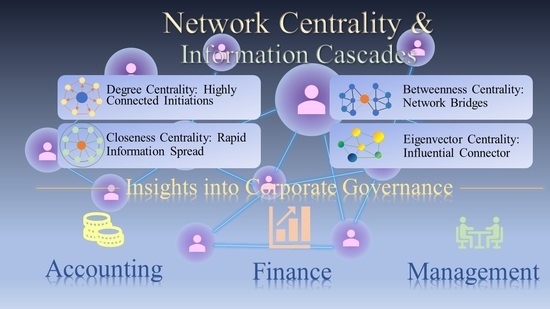
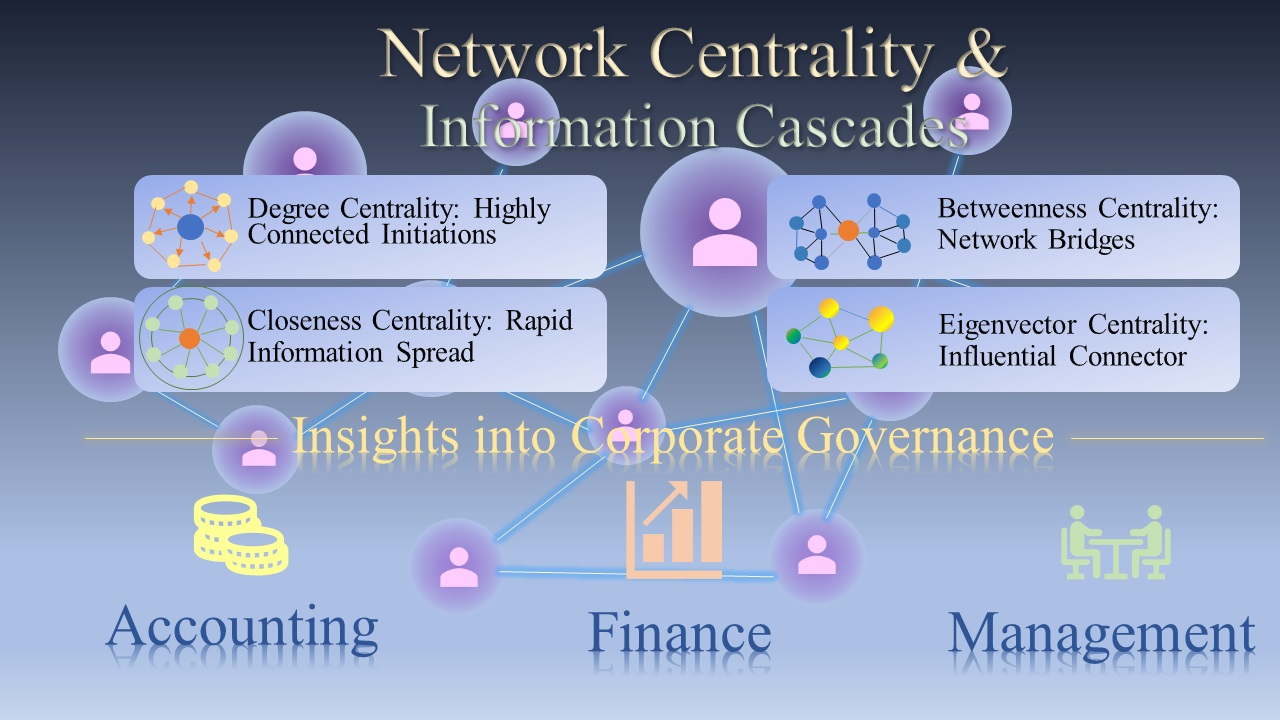
There are four widely used measures of centrality. Degree centrality measures the number of direct ties a node has, capturing its level of activity or visibility [
1]. For instance, if Director A sits on a board with seven other directors, they would have a degree of seven based on the number of direct ties their node has. Betweenness centrality measures the extent to which a node lies on the shortest paths connecting other nodes, highlighting its role as a bridge or broker [
20]. For example, Director A, who serves on two boards that otherwise have no overlapping directors, has high betweenness centrality because Director A is the only bridge linking those firms’ governance discussions. If, for example, Director A learns of a new audit committee structure from one of their boards, they can transfer it to the other. This transfer is measured through betweenness centrality.
Closeness centrality assesses how close a node is to all others in the network, indicating its ability to quickly access or disseminate information [
21,
22]. In the above example, Director A can quickly access information or spread it to other directors across the two boards, while other directors on either board must go through Director A to reach the opposite. This gives Director A a higher closeness centrality. Eigenvector centrality goes beyond counting links and considers the influence of a node’s neighbors, assigning higher scores to nodes connected to other well-connected nodes [
23,
24]. Director A, who sits on the board of a Fortune 500 firm alongside several highly connected directors, will have a high eigenvector score, even if they personally serve on only a few boards. Their endorsements or decisions carry extra weight because of the prestige and influence of their network neighbors. Together, these four measures capture complementary dimensions of influence and connectedness.
Because each centrality measure highlights a different aspect of network position, Felix assigns an overall centrality by averaging a firm’s quintile rankings across four centrality metrics each year and classifying firms in the top quintile of this average as highly central [
25]. This composite measure provides a more holistic view of a node’s overall prominence, avoiding an overemphasis on any single dimension. Using an overall centrality index is particularly useful when studying phenomena like information cascades, where multiple facets of visibility, influence, and reach jointly determine whether a node can initiate or amplify collective behavior. Most of the papers reviewed in
Section 4,
Section 5 and
Section 6 employ the four centrality measures together with a composite index, which enables researchers to capture the distinct contributions of each dimension to information diffusion as well as the overall network influence. Only a few studies explicitly use a single composite measure, and we note these cases where relevant.
Social networks and the associated proxies, such as centrality, have become important ways to consider accounting and finance network measures. A recent meta-analysis shows that different forms of centrality are systematically associated with firm performance, highlighting the practical importance of network position [
26]. Different from Bianchi et al., who provide a comprehensive review of social network analysis in accounting and finance [
27], we focus specifically on network centrality and its pivotal role in information cascades within executive and director networks.
4. Executive Network
4.1. Chief Executive Officers (CEO) Network
CEOs play a pivotal role in shaping a firm’s strategic decisions and ensuring their execution. When a CEO is positioned at the center of a network, whether through board memberships, educational or alumni ties, or other social and professional linkages, they gain privileged access to information. This positioning allows the CEO to enjoy greater influence and reputation and may help the CEO acquire additional legitimacy and power. This power extends both within the firm (influencing boards, CFOs, and other executives) and externally (interacting with markets, other CEOs, and auditors). Higher network centrality generally facilitates richer information flows, enabling earlier or timelier disclosures, reducing the risk of hidden bad news, and mitigating crash risk. Central CEOs often act as “leading” nodes in their networks, setting behavioral norms that others may observe and emulate. While these advantages can lead to improved governance and performance, they can also produce adverse outcomes when power is misused or when governance mechanisms fail to provide adequate checks and balances.
Empirical research documents both the positive and negative behavioral spillovers associated with CEO centrality. Chahine et al. find that CEOs who are more centrally located in executive networks are less likely to engage in fraudulent reporting [
28]. Moreover, they show that the behavior of the most central CEO in a network spills over to peers and that connected CEOs are also less likely to commit fraud. This evidence suggests that centrality can foster positive norm diffusion and strengthen ethical standards. However, He offers a different perspective, finding that highly central CEOs and CFOs are more likely to engage in financial misreporting [
29]. Notably, the study shows that internal governance mechanisms do little to constrain executives’ fraud behavior [
29]. Although He does not explicitly analyze CEO-to-CEO cascades, the findings imply that if multiple central figures misbehave, their influence could propagate negative externalities and erode reporting norms [
29].
Other studies examine the mechanisms through which CEO network centrality affects firm outcomes. Fan et al. identify enhanced information flow as a channel through which centrality reduces bank risk: central CEOs’ extensive connections help them access superior information, enabling less risky decision-making [
30]. Egginton and McCumber show that firms with more central executives experience improved market liquidity, as evidenced by narrower bid–ask spreads [
31]. Exploiting “network centrality shocks” caused by executive turnover, they provide causal evidence that hiring a more central executive leads to measurable improvements in liquidity [
31].
Similarly, Islam et al. demonstrate that well-connected CEOs facilitate timelier financial reporting, including shorter earnings announcement, audit, and filing lags, which benefits investors and markets [
32]. Krishnamurti et al. study bad-news hoarding and find that firms with central CEOs are less likely to withhold adverse information, thereby reducing stock price crash risk [
33]. This result is consistent with the idea that information about bad news diffuses more quickly in networks with well-connected CEOs.
El-Khatib et al. challenges the assumption that more socially connected CEOs always leverage their networks for firm advantage [
34]. The study by El-Khatib et al. finds that despite their frequency of making deals, high-centrality CEOs initiate deals that tend to produce lower gains or greater losses for acquiring shareholders. They also find that combined entity post-deal performance tends to be poorer when the bidding CEO is highly central. This suggests that CEOs with large networks derive private and non-pecuniary benefits from their centrality, which may bias them toward doing more deals even when the deals are not value-creating [
34].
4.2. CFO Network
CFOs, like CEOs, form networks through previous jobs, social ties, board interlocks, or external connections in financial markets. A more central CFO can provide greater access to information, enhanced influence over internal financial reporting, cash management, forecasting, and financial oversight. Because CFOs are closer to the financial reporting process, accounting controls, auditor interactions, and firm-internal financial decisions, their network centrality can have outsized effects on how information is generated, disseminated, or withheld.
The possibility of cascades or spillovers arises because central CFOs may set norms in internal reporting behavior, influence or mentor other financial executives, or because their practices are observed and emulated across peer firms. Moreover, a CFO’s network effects might differ in magnitude or direction compared to CEOs, given their distinct role, distinct constraints, and potential opportunity for misreporting. One example is a CFOs direct involvement in accruals and interaction with auditors. Additionally, CFOs may have an information advantage given their proximity to the creation of financial statements for external reporting purposes.
CFO network centrality has become recognized as a meaningful factor in corporate reporting behavior. Researchers study both CEOs and CFOs and find that high-centrality CFOs are more likely than low-centrality CFOs to engage in financial misreporting, with even greater magnitudes than CEOs [
29]. The paper asserts that when a CFO occupies a central position in a network that consists of outside corporate leaders (e.g., via social or professional ties), they have enhanced social power that can facilitate adverse reporting decisions [
29]. Governance mechanisms, such as internal board oversight or external monitoring, appear to have limited ability to constrain such behavior in high-centrality CFOs [
29]. This suggests that CFO centrality can contribute to negative information cascades. If central CFOs misreport, their behavior might set norms that can be imitated by connected CFOs.
Another line of research closely related to network centrality focuses on CFO social capital in financial decisions, going beyond misreporting or disclosure alone. Researchers find that firms with CFOs who have extensive connections within the finance industry tend to hold less precautionary cash [
35]. The finding can be interpreted as reflecting that well-connected CFOs have better access to external capital and better negotiation ability, which reduces the need to hold “just in case” cash buffers. In this case, CFO centrality helps optimize resource allocation and demonstrates an information advantage.
Across these studies, several mechanisms and boundary conditions emerge. First, visibility and norm settings suggest that highly central CFOs may influence less-central ones, either by example or through reputational norms. From the perspective of misreporting, when central CFOs engage in such behavior, it may erode norms or tacitly provide cover for others. Conversely, positive behavior by central CFOs, such as good reporting oversight, may encourage better behavior elsewhere. Second, governance strength and institutional contexts matter. In weak governance environments or where formal oversight is lax, the risks of negative cascades are greater. Third, the type of ties matters. Social ties including connections with alumni or through a common birthplace may differ from more formal professional networks in terms of strength, influence, and oversight intensity.
5. Board Network
5.1. Director Network
Director network centrality refers to how central or well-connected a director is embedded in their board social ties. When directors are more central, they are better positioned to observe, obtain, or transmit information about practices, norms, disclosure, and governance across boards. Through their oversight role, they may also shape norms of disclosure, accounting, and fraud detection. Central directors can exert influence through their reputations and by serving as the information conduit between firms. Because director interlocks connect firms, these networks can facilitate cascades. For example, if the network observes one firm shifting disclosure policy or becoming involved in financial statement misconduct, it may affect audit risk, board behavior, or disclosure norms for other firms in the network.
Director network centrality can generate benefits for firms. For example, Larcker et al. find that firms with more central boards of directors earn superior risk-adjusted stock returns, enjoy higher future return-on-assets growth, and receive more positive analyst forecast errors [
4]. These effects are especially strong in high-growth firms or those facing adverse conditions, suggesting that boardroom connections matter most when firms stand to gain from the information and resources exchanged through director networks [
4]. Building on this perspective, Fang et al. examine stock price crash risk, defined as the likelihood of a sudden, extreme drop in stock price caused by managers hoarding bad news and releasing it all at once [
36]. They show that well-connected boards provide downside protection by reducing the potential for such crashes [
36].
Network centrality can also enhance the reporting and monitoring quality of a firm and improve forecast accuracy. Using the composite centrality measure, Felix shows that a firm’s reporting quality improves when it shares a director with a high-quality reporting firm and is connected to a central firm in the network [
25]. This suggests that high-quality reporting requires endorsement from central firms to disseminate through the network effectively [
25]. Additionally, firms prone to poor reporting are more receptive to these positive signals, indicating that central firms play a pivotal role in initiating positive reporting contagion [
25]. Similarly, Kim et al. indicate that firms whose boards are more connected tend to have higher audit quality [
37]. They argue that socially well-connected boards face stronger demands for oversight, which increases monitoring pressure and motivates the selection of higher quality auditors [
37]. In addition, Schabus reports that firms with directors who have higher degrees of centrality in their networks tend to produce more accurate earnings forecasts [
38].
However, centrality is not without cost. Chen et al. show that firms with highly central boards exhibit higher systematic risk [
39]. Greater boardroom centrality is associated with stronger correlation in accounting fundamentals and corporate policies with other firms, less idiosyncratic behavior, and a higher cost of equity [
39]. These findings suggest that central boards, while well-informed, also make firms more exposed to market-wide shocks because of increasing synchronization with the broader economy.
On the downside, the same network channels that transmit good governance practices can also spread undesirable behavior. Godigbe et al. show that earnings management tends to diffuse more readily in connection-dense networks, especially when firm performance is weak [
40]. These results indicate that the same channels that transmit good governance practices can also propagate harmful ones.
5.2. Audit Committee Chair Network
Audit committees are critical governance sub-bodies responsible for overseeing financial reporting, internal controls, auditor relationships, and fraud risk. When audit committee members are connected across firms through interlocking audit committees, audit committee member relationships, and social ties, these networks can facilitate information transmission and the diffusion of various practices. Network centrality within audit committees allows members, especially chairs, to observe peer firms’ behaviors, enabling them to imitate best practices, adjust policies proactively, or anticipate regulatory scrutiny. Consequently, audit committee networks can serve as conduits for positive spillovers, such as stronger oversight and improved practices. Alternatively, they can provide the foundation for negative cascades, such as the spread of weak or opportunistic behaviors.
Empirical evidence supports these dual effects. Omer et al. show that firms whose audit committees are more connected through director networks are less likely to have restatements of annual financial statements. Moreover, audit committee connectedness moderates the negative effect of board interlocks on misstatement risk [
18]. This points toward connected audit committees being able to observe or influence better reporting practices via their network relationships.
However, Carrera et al. find that greater social capital among audit committee members may reduce financial reporting quality in certain cases. For example, audit committee members with high degree centrality tend to have lower monitoring, which is associated with poorer reporting [
41]. This suggests the potential for negative consequences of audit committee centrality.
6. International Evidence
Network centrality at the international level reveals that firms and corporate leadership can be associated with large, cross-border networks whose structural properties matter with regard to information transmission, governance, and firm outcomes. Empirical work that studies global networks demonstrates that centrality is not merely a national phenomenon but a transnational one. Research shows that central firms or directors in the global network act as hubs that connect clusters across countries and thereby accelerate the diffusion of policies, practices, and norms across the network [
42,
43].
Evidence from country-specific settings illustrates how network centrality affects compensation, firm performance, and value creation. In the UK, Horton et al. find that directors who are more central within their networks receive higher compensation, and their firms tend to perform better in subsequent periods [
44]. Importantly, these connected directors do not appear to extract economic rents; rather, their pay aligns with the resources and information their networks provide [
44]. In Italy, Croci and Grassi show that degree centrality and eigenvector centrality are negatively associated with firm value, while other centrality measures, such as betweenness and flow betweenness, do not exhibit a negative effect [
45]. Additionally, they find a positive relationship between eigenvector centrality and stock price synchronicity, indicating that more connected firms’ returns move more closely with the market [
45]. In Canada, Bakke et al. report that the sudden loss of a central director leads to a significant decline in the stock value of interlocked firms, suggesting that these networks are valuable in enhancing access to information and resources [
46]. This negative impact is more pronounced for firms that are more likely to benefit from such connections, highlighting the importance of director networks in firm performance [
46].
Research from China and other emerging markets further underscores the role of institutional context in shaping network effects. Xing et al. show that independent director social network reduces the likelihood of financial fraud, suggesting that networks strengthen monitoring and deterrence [
47]. Wang et al. find that firms with higher network centrality tend to have better innovation outcomes because central firms have greater access to knowledge, resources, and collaborative opportunities. Firms in emerging economies should actively build central positions in networks and leverage institutional contexts to maximize innovation capabilities [
48].
Cross-national evidence further links network centrality to financing and market outcomes. Khanna and Thomas report that firms connected to foreign directors or multinational networks gain better access to external finance and are more likely to adopt globally prevalent governance practices [
49]. Similarly, Fan et al. show that CEOs with political connections improve access to financing and government support but are associated with lower operational efficiency and take higher risks post-IPO [
50]. Together, these findings suggest that network centrality provides informational and reputational benefits that can substitute for weaker institutions, allowing firms to signal quality and reduce risk premia.
7. Limitations and Future Research Directions
Research on network centrality among CEOs, CFOs, directors, and audit committee chairs is limited by measurement and identification challenges inherent in their networks. Centrality is typically inferred from observable ties such as board interlocks, shared employment histories, or committee overlaps, which capture structural proximity but not the intensity, direction, or informational content of interactions. As a result, empirical proxies may conflate access to information with status, visibility, or reputation, and may fail to distinguish active information exchange from passive co-membership. Future research could advance this literature by developing designs that better isolate exogenous variation in network centrality and by refining measures to capture role-specific information channels.
Second, the literature tends to focus on single actor types, such as CEOs, CFOs, directors, or audit committee members, without fully accounting for interdependent networks. In practice, information transmission may emerge from overlapping executive, board, auditor, analyst, and institutional investor networks. For example, a highly central CEO embedded in a dense board network may exert greater influence when also connected to central auditors or analysts. Future research could model multilayer or multiplex networks to better capture how information and norms propagate across governance channels and how cascades are reinforced or dampened by complementary actors.
A third limitation concerns the incomplete treatment of institutional and cross-country heterogeneity. Although international evidence is growing, most empirical insights are still drawn from the U.S. context, where disclosure regimes, labor mobility, and enforcement mechanisms are relatively strong. In weaker institutional environments, centrality may substitute for formal governance, amplifying both beneficial and harmful cascades. Future research could adopt comparative designs to examine how legal enforcement, cultural norms, media freedom, and labor market frictions moderate the effects of centrality on information diffusion and behavioral convergence. Such work would help reconcile mixed findings in the literature regarding whether centrality disciplines or exacerbates misconduct.
Finally, the literature on explicit CEO-, CFO-, or director-level information cascades remains limited across accounting, finance, and management. A primary reason for this gap lies in the empirical requirements of information cascade theory, which depend on observable sequences of actions (who acted first, who followed, and under what information set). However, because executive and board decision-making processes are largely private, the timing of actions is often coarse or endogenous, and public disclosures frequently bundle multiple strategic and reporting choices into a single observable event. These features make it empirically challenging to disentangle belief updating based on peers’ observed actions from parallel responses to shared fundamentals or common shocks. Addressing this challenge represents a promising avenue for future research, particularly through the use of granular disclosure data, experimental or survey-based approaches, and novel identification strategies that allow scholars to more directly capture sequential learning and isolate cascade dynamics at the executive level.
8. Conclusions
Network centrality is a foundational construct for understanding how information, behaviors, and norms propagate through economic and organizational systems. By quantifying a node’s prominence in terms of its connections, brokerage position, proximity, and association with other influential nodes, centrality provides insight into who has the capacity to initiate, accelerate, or suppress collective dynamics. When applied to information cascade theory, network centrality becomes a powerful explanatory lens. Network centrality clarifies why cascades often start from a few highly visible “seed” nodes, why they sometimes remain localized, and why they can collapse when influential actors signal caution or act contrarian. In other words, centrality shapes not only the reach but also the resilience of cascades.
In management, finance, and accounting research, the implications of centrality are both practical and far-reaching. Central CEOs, CFOs, directors, and audit committee chairs enjoy privileged access to information and greater capacity to diffuse norms across firms, industries, and markets. These effects are not unidirectionally positive, with central networks providing avenues for good governance, timely disclosure, and efficient capital allocation, but also propagating misreporting norms, risky financial policies, or herding behavior that could undermine market stability. The literature underscores that the outcomes of network centrality are contingent on institutional context, governance quality, and the incentives of the actors involved.