Systematic Review

Shades of Darkness Below Ground: A Systematic Literature Review of Dark Tourism in Mining Heritage


1
Research Center in Economics & Business Sciences (CICEE), Universidade Autónoma de Lisboa, 1150-293 Lisboa, Portugal
2
Higher Institute of Business and Tourism Sciences (ISCET), 4050-180 Porto, Portugal
Tour. Hosp. 2026, 7(6), 167; https://doi.org/10.3390/tourhosp7060167
Submission received: 18 May 2026 / Revised: 4 June 2026 / Accepted: 8 June 2026 / Published: 10 June 2026

Abstract

Research on dark tourism and industrial heritage has largely evolved in parallel, despite their shared focus on sites shaped by death, suffering, and socio-environmental transformation. This study aims to map and synthesise the empirical and conceptual literature at this intersection in order to clarify how the darker dimensions of industrial and mining heritage are conceptualised, experienced, and interpreted, and to develop an integrated framework for their analysis. Following the PRISMA 2020 framework, it systematically reviews 33 peer-reviewed studies published between 2009 and the first quarter of 2026. Three main findings emerge. First, sanitisation—the marginalisation of suffering and exploitation in favour of narratives of technological achievement—is a dominant feature of industrial heritage interpretation and research. Second, visitors consistently experience emotional responses to dark heritage, with distinct affective profiles linked to environmental damage, human suffering, and labour histories. Third, labour exploitation remains under-theorised despite its centrality, reflecting its structural and long-term character, which challenges event-based dark tourism models. Building on these findings, the study proposes a tripartite typology of industrial darkness and introduces the concept of the evidence landscape to explain how sites communicate difficult pasts beyond formal interpretation.

1. Introduction

Places associated with death, suffering, tragedy, and the macabre have long attracted human curiosity. Early formulations such as negative sightseeing or black spot tourism (Rojek, 1993) and thanatourism (A. V. Seaton, 1996) anticipated what is now widely conceptualised as dark tourism following the work of Foley and Lennon (1996). Commonly understood as the visitation of sites associated with real or commodified death and disaster (Foley & Lennon, 1996; Lennon & Foley, 1999), dark tourism has become a prominent and theoretically rich area of tourism scholarship. Over time, the concept has been refined and debated. P. R. Stone (2006, p. 146), for instance, described it as “an old concept in a new world”, highlighting the growing commodification of death-related sites, while Tarlow (Tarlow, 2005) emphasised the continued relevance of places where past tragedies shape contemporary life. Across these perspectives, a number of recurring concerns can be identified, particularly around the ethics of consuming suffering, the role of interpretation and memory, and the often-blurred boundaries between education, commemoration, and spectacle (Forero et al., 2023; Light, 2017; Magano et al., 2023).
Over the past three decades, this field has expanded rapidly, both conceptually and methodologically. Research now spans a wide range of contexts—including Holocaust tourism (Magano et al., 2023), battlefield tourism (García-Madurga & Grilló-Méndez, 2023), disaster tourism (Korstanje, 2020), and penal heritage tourism (Walby & Piché, 2011)—and draws on diverse approaches, from qualitative ethnography to quantitative and experimental designs (Taplin, 2026). Publication trends indicate a marked acceleration in output, particularly since 2018, with journals such as Tourism Management, Current Issues in Tourism, and the Journal of Heritage Tourism playing a central role in shaping the field (Forero et al., 2023).
At the same time, this growth has not fully resolved some longstanding challenges. Definitions of dark tourism remain contested, typologies often overlap, and empirical work continues to focus more heavily on supply-side perspectives than on visitor experience (Iliev, 2021; Light, 2017; Magano et al., 2023). As a result, the field still lacks a fully consolidated theoretical core, particularly when it comes to applying its frameworks beyond the canonical cases on which much of the literature has been built.
It is within this context that the relationship between dark tourism and industrial heritage becomes particularly relevant. Industrial and mining heritage sites are frequently associated with occupational death, labour exploitation, environmental degradation, and broader socio-economic disruption. Yet these dimensions are rarely examined through the lens of dark tourism. Instead, the industrial heritage literature has tended to emphasise regeneration, sustainability, and technological achievement, often leaving more difficult histories in the background. By contrast, dark tourism research has focused primarily on sites defined by relatively discrete events—such as battlefields, disaster zones, or memorial complexes—without fully engaging with the longer-term and more diffuse forms of suffering associated with industrial production systems.
This is not to suggest that the two fields have remained hermetically sealed from one another. Critical heritage scholarship has increasingly turned its conceptual apparatus—the authorised heritage discourse, affect, and the politics of class—toward industrial and labour heritage, treating sites of work, deindustrialisation, and their attendant loss as objects of the same difficult-heritage analysis more commonly associated with sites of death and atrocity (Smith & Campbell, 2017). Work at this intersection has shown that industrial heritage sites are routinely remembered as sites of hardship and exploitation, not merely of technological achievement (Smith & Campbell, 2017), and that heritage-making is itself an affective, performative process through which contested pasts are negotiated in the present (Smith, 2022). The contribution of the present review, then, is not to inaugurate a connection between these literatures but to systematise an intersection that has so far been approached piecemeal, and to make explicit the analytical gains of treating industrial heritage through a dark- and difficult-heritage lens.
We argue that this disconnect has both theoretical and practical consequences. From a theoretical perspective, existing frameworks struggle to account for forms of heritage whose significance derives from extended processes rather than clearly bounded events. From a practical perspective, heritage managers and policymakers lack conceptual tools for interpreting these sites in ways that acknowledge their darker dimensions while remaining accessible and meaningful to visitors. It is directly from this twofold disconnect that the aims and research questions of the present review follow: the questions set out below are framed to interrogate, in turn, how the darker dimensions of industrial heritage are conceptualised, experienced, interpreted, and theorised.
It is this disconnect that the present study seeks to bridge. Following the PRISMA 2020 framework (Page et al., 2021), a systematic literature review of 33 peer-reviewed studies at the intersection of dark tourism and industrial/mining heritage, with a particular focus on mining contexts, is conducted with the aim of bringing these two strands of scholarship into clearer dialogue, identifying patterns and omissions in the existing literature, and developing a more integrated understanding of industrial dark heritage.
The review is guided by four research questions:
(1) How is dark tourism conceptualised in industrial and mining heritage contexts?
(2) What motivates visitors to engage with these sites, and what emotional responses do they report?
(3) How do heritage managers interpret and present the darker dimensions of industrial heritage?
(4) What role does labour exploitation play as a form of dark heritage, and how is it theorised in the literature?
Building on this synthesis, the study makes three main contributions. First, it shows that sanitisation operates not only at the level of interpretation but also within the methodological and epistemological frameworks through which industrial heritage is studied. Second, it demonstrates that visitor emotional responses vary systematically according to different forms of industrial “darkness”. Third, it conceptualises labour exploitation as a distinct and under-theorised form of dark heritage that challenges existing typological assumptions. Based on these insights, the review proposes a tripartite typology of industrial darkness and introduces the concept of the evidence landscape as a foundation for future research and interpretive practice. These contributions extend, rather than replace, existing dark tourism frameworks by adapting them to contexts characterised by long-term and structural forms of harm.
The remainder of the article is structured as follows. Section 2 outlines the methodology, including the search strategy, screening procedures, and bias assessment. Section 3 presents the results, including a bibliometric overview of the corpus. Section 4 develops the thematic synthesis, while Section 5 discusses the findings in relation to existing theory. The article concludes with implications, limitations, and directions for future research.

2. Methods

2.1. Search Strategy

A systematic literature review was conducted to identify, evaluate, and synthesise peer-reviewed studies addressing dark tourism within industrial heritage, with particular attention to mining contexts. Systematic reviews are widely regarded as a rigorous approach for organising fragmented bodies of literature and identifying research gaps (Snyder, 2019). This review followed the Preferred Reporting Items for Systematic Reviews and Meta-Analyses (PRISMA) 2020 framework (Page et al., 2021), which provides guidance for ensuring transparency and reproducibility in review design and reporting. In brief, PRISMA is an internationally recognised, evidence-based protocol that sets out a standard procedure for identifying, screening, selecting, and reporting the studies included in a systematic review. Its purpose is to make the review process explicit and replicable, so that readers can see exactly how the body of evidence was assembled and could, in principle, reproduce it. It is adopted here both to structure the four successive stages of study selection described below and to document, through the accompanying flow diagram, how the corpus was reduced from the initial search results to the final set of included studies.
The search strategy was developed iteratively to capture the intersection of three conceptual domains: dark tourism, industrial heritage, and mining. Two major bibliographic databases were used: Web of Science Core Collection and Scopus. The use of multiple databases helps reduce publication bias and improves coverage (Bramer et al., 2016).
The primary search string combined controlled vocabulary and free-text terms across titles, abstracts, and keywords. The dark tourism domain was represented by (“dark tourism” OR “thanatourism”), while the industrial heritage domain included (“industrial heritage” OR “industrial tourism” OR “mining heritage” OR “mine tourism” OR “extractive heritage”). These were combined using the Boolean operator AND. A secondary search added (“mining disaster” OR “mining accident”) to capture event-focused studies not explicitly framed as heritage tourism. Truncation was applied where appropriate to include variant word forms.
The search was limited to peer-reviewed journal articles published in English between 2009 and 2026. This timeframe reflects the consolidation of dark tourism as a field in the early 2000s (Light, 2017; P. Stone, 2005) and captures the period in which empirical research on industrial and mining contexts has emerged. A preliminary scoping search confirmed that peer-reviewed empirical work explicitly addressing the intersection of dark tourism and industrial or mining heritage was negligible before 2009, with foundational theoretical contributions from the mid-1990s (Foley & Lennon, 1996; A. V. Seaton, 1996; P. R. Stone, 2006) predating the applied empirical literature that forms this review’s primary object of analysis. The lower boundary therefore reflects the emergence of the field under study rather than an arbitrary convention. Conference proceedings, books, editorials, and other non-peer-reviewed outputs were excluded from the main analysis.

2.2. Database Results and Duplicate Removal

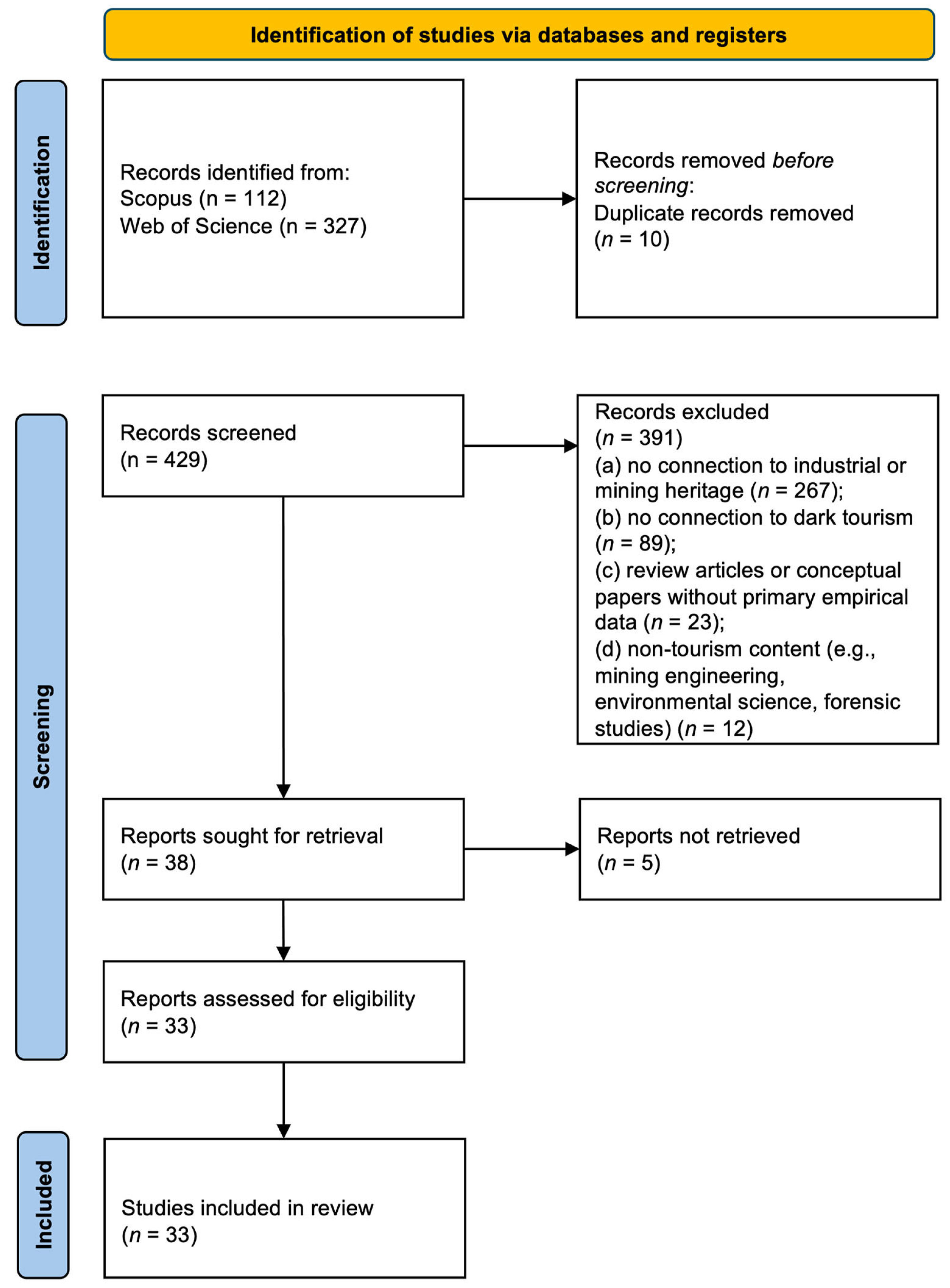
The database searches were completed on 30 March 2026. The Web of Science search returned 327 records, while Scopus yielded 112, resulting in a combined total of 439 records. After removing 10 duplicate entries, 429 unique records remained for screening. The PRISMA 2020 flow diagram (Page et al., 2021) was used to document each stage of the selection process, ensuring transparency in how studies were identified, screened, and included.

2.3. Screening and Inclusion Criteria

The selection process followed the four-stage PRISMA model: identification, screening, eligibility, and inclusion. Two independent reviewers screened the titles and abstracts of all 429 records using predefined criteria. A study was included if it met the following criteria: (a) it reported primary empirical data (qualitative, quantitative, or mixed methods) or offered a substantive conceptual or theoretical contribution, (b) it addressed industrial heritage tourism or mining tourism as a central theme, and (c) it explicitly or implicitly connected to dark tourism, defined as tourism associated with death, suffering, disaster, dissonant heritage, or the macabre.
Studies were excluded if they focused exclusively on non-industrial heritage, on active industrial sites without relevant heritage dimensions, on natural disasters unrelated to industrial contexts, or on purely technical aspects of mining without a tourism component. Disagreements between the two reviewers were resolved through discussion and consensus. Full texts were then retrieved for all potentially eligible studies and assessed against the same criteria. A structured data extraction form was developed and refined through a pilot analysis of five studies.

2.4. Inter-Rater Agreement

To assess the consistency of the screening process, inter-rater agreement was calculated using both the observed agreement rate and Cohen’s Kappa (κ), which accounts for agreement occurring by chance (Cohen, 1960; Landis & Koch, 1977).
As reported in Table 1, the reviewers agreed on 410 out of 429 records, corresponding to an observed agreement of 95.6%. The 19 disagreements were resolved through discussion. The resulting Cohen’s Kappa value of 0.75 indicates substantial agreement, suggesting that the inclusion and exclusion criteria were applied consistently.

2.5. Bias Assessment

Two forms of bias were considered in line with PRISMA 2020 recommendations: (1) bias within the included studies, and (2) bias affecting the overall corpus. In relation to individual studies, formal quality appraisal tools were considered but not applied as strict inclusion criteria. The diversity of methods across the corpus—ranging from ethnographic case studies to quantitative surveys and conceptual analyses—makes it difficult to apply a single standardised tool without imposing inappropriate assumptions. Instead, studies were assessed qualitatively during data extraction, with attention to research design, methodological coherence, analytical transparency, and acknowledgment of limitations. These criteria were informed by the dimensions covered in established appraisal tools—including the Critical Appraisal Skills Programme (CASP) checklist for qualitative studies and the Methodological Index for Non-Randomised Studies (MINORS) for quantitative designs—used here as a reference framework to verify internal coherence rather than to generate exclusionary scores. For mixed-methods studies, the Mixed Methods Appraisal Tool (MMAT) provided an analogous reference point. This approach ensured that quality considerations were systematically guided by recognised methodological standards while remaining sensitive to the diversity of designs represented in the corpus, where applying a single numerical instrument would risk imposing inappropriate assumptions about what constitutes rigour across qualitative, quantitative, and conceptual contributions. No study in the final corpus presented methodological inconsistencies of a severity that would have warranted exclusion under these criteria.
To support the synthesis, studies were grouped into three analytical tiers based on their engagement with dark tourism frameworks. Tier 1 includes studies that explicitly integrate dark tourism and industrial heritage, Tier 2 includes studies in related areas where this connection is partial, and Tier 3 includes studies that do not explicitly engage with dark tourism but remain relevant to the topic. This approach allowed differences in conceptual depth to be taken into account without reducing methodological diversity to a single numerical score.
At the corpus level, several potential sources of bias were identified. The English-only restriction likely underrepresents research from Latin America (Spanish/Portuguese), Central/Eastern Europe (German, Polish, Russian), and East Asia (Chinese, Japanese), where mining heritage is extensively studied. Although the use of both Web of Science and Scopus improves coverage, it does not capture all relevant outputs, particularly those available through regional databases or grey literature. In addition, the exclusion of book chapters may omit important theoretical contributions, which remain influential in heritage studies.
A further consideration concerns the breadth of the inclusion criterion related to dark tourism. Because studies were included if they engaged either explicitly or implicitly with dark heritage themes, some degree of interpretive judgement was required. This introduces the possibility of selection bias. However, the use of predefined criteria, independent screening, and the inter-rater agreement process reported above helps mitigate this risk and supports the reliability of the final corpus.

3. Results

3.1. Selection of Included Studies

The screening process resulted in a final corpus of 33 studies. After the initial title and abstract screening, 38 articles met the inclusion criteria and were selected for full-text assessment. Of these, five could not be retrieved through institutional access or open repositories despite repeated attempts.
The final dataset therefore comprises 33 studies, which form the basis of the subsequent analysis. Figure 1 presents the PRISMA 2020 flow diagram, summarising the full selection process.
Of the 429 records initially identified, 391 were excluded during the screening phase. The most common reasons for exclusion were the absence of a clear connection to industrial or mining heritage (n = 267) and lack of relevance to dark tourism (n = 89). Smaller numbers were excluded because they were review or conceptual papers without sufficient empirical or analytical contribution (n = 23), or because they addressed technical aspects of mining unrelated to tourism (n = 12).
An overview of the included studies is provided in Appendix A (Table A1), organised according to the analytical tiers described in Section 2.5. Each study is characterised in terms of geographical context, heritage type, methodological approach, and degree of engagement with dark tourism frameworks.
Across the corpus, Tier 1 (n = 12) comprises studies that explicitly integrate dark tourism theory with industrial or mining heritage. Tier 2 (n = 12) includes studies where such engagement is partial or implicit, while Tier 3 (n = 9) consists of studies framed primarily through alternative perspectives, such as sustainable development or heritage management, but which remain relevant to the review’s focus. This distribution reflects an emerging but still uneven integration between industrial heritage research and dark tourism scholarship.

3.2. Bibliometric Analysis

The bibliometric analysis provides an overview of the structure and development of the field as represented by the 33 included studies. The results are reported across several dimensions, including publication trends, geographic distribution, methodologies, conceptual framing, and citation patterns.

3.2.1. Publication Trends

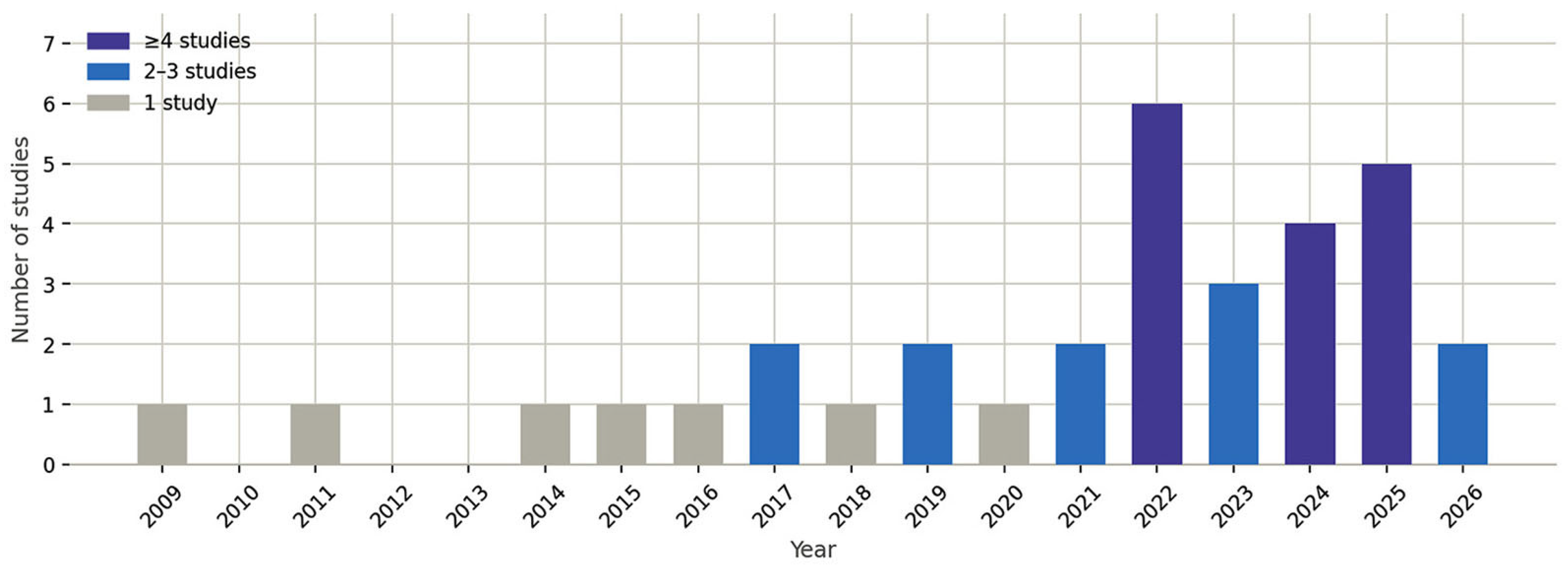
The corpus covers the period from 2009 to 2026 but shows a clear concentration in more recent years (Figure 2). Only nine studies were published before 2021, whereas 20 have appeared since then, including six in 2022 alone and five in 2025.
This pattern suggests that research at the intersection of dark tourism and industrial heritage is still developing, with much of the relevant work emerging only recently.

3.2.2. Geographical Distribution

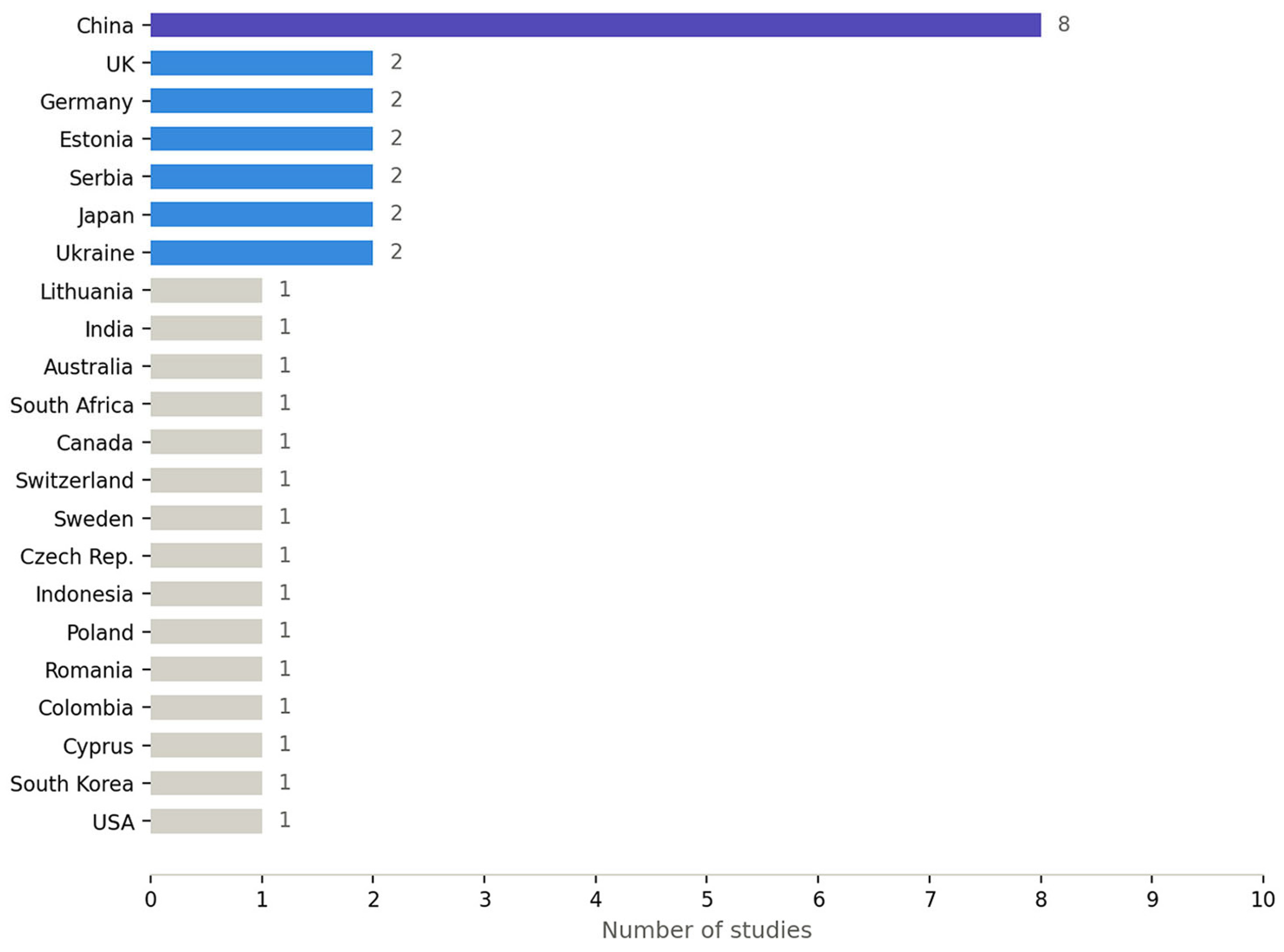
The geographical distribution of the studies is uneven. China is the most represented country (n = 8), reflecting the large-scale development of industrial and mining heritage tourism in that context. European countries collectively account for a substantial portion of the remaining studies, although representation is dispersed across multiple national settings. In contrast, Global South contexts are comparatively underrepresented. Given the global significance of mining and industrial activity, this imbalance points to a gap in the current literature rather than a lack of relevant heritage sites.
China’s dominance in the corpus is not incidental. It reflects the convergence of three mutually reinforcing factors. First, China has invested substantially in industrial heritage tourism since the mid-2000s as part of a deliberate policy response to deindustrialisation: the National Industrial Heritage List, launched in 2017, systematised the conversion of former state-owned industrial sites into parks, museums, and tourism destinations, creating both the empirical material and the institutional incentive to study it. Second, Chinese tourism scholarship has expanded considerably in English-language output over the same period, ensuring that this work reaches the international databases used in this review. Third, the Chinese academic context has been relatively receptive to dark tourism as an analytical lens, partly because landmark dark sites in China established the framework early and made it available as a theoretical tool for adjacent industrial heritage research. Taken together, these factors produce a genuine density of relevant sites, a policy environment that turned them into tourism products, and a scholarly community equipped to study them using frameworks compatible with this review’s inclusion criteria. This has implications for the thematic findings: the particular form that sanitisation takes in the corpus, foregrounding national industrial achievement and socialist productive identity, is partly a product of the Chinese heritage management context, and may not travel straightforwardly to other national or political settings.

3.2.3. Methodologies

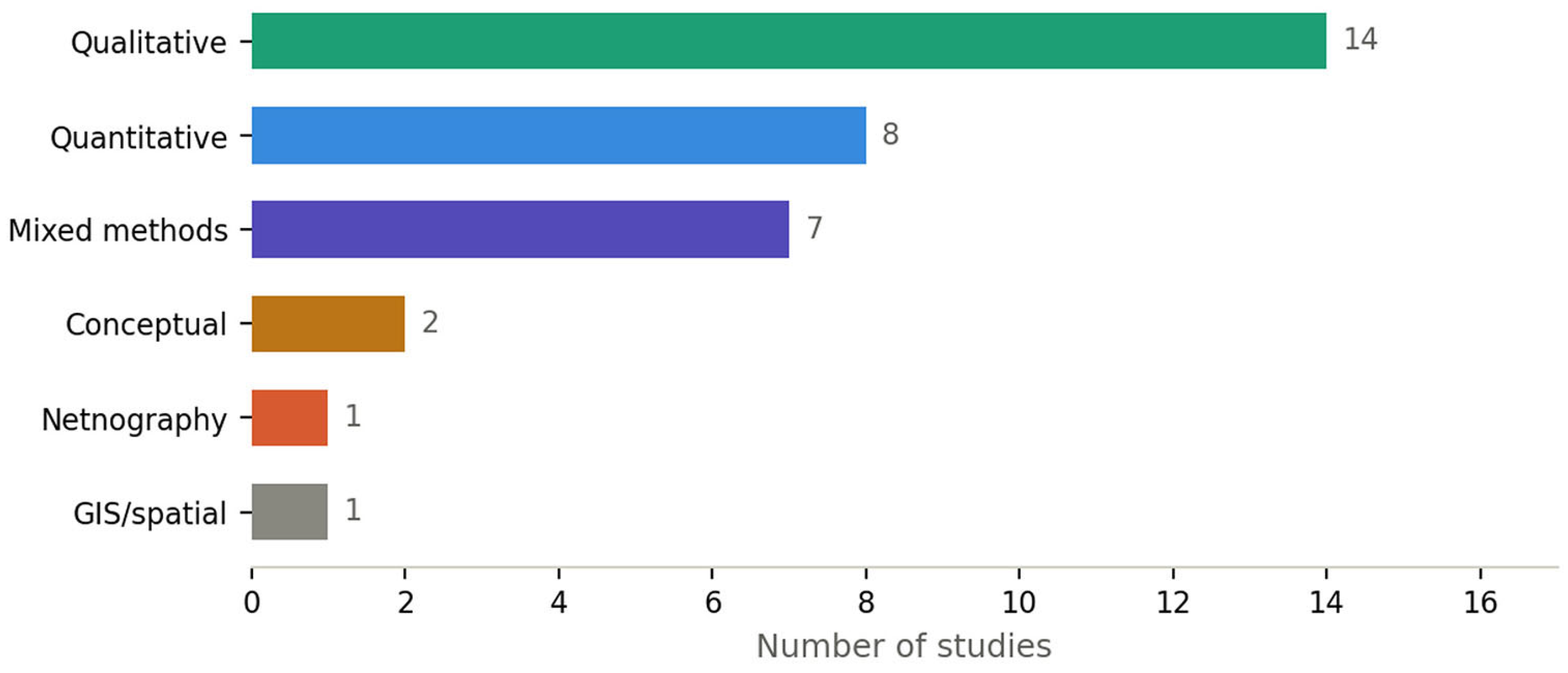
Qualitative case studies are the most common methodological approach in the corpus (n = 14). These studies typically rely on interviews, observation, and document analysis to explore visitor experience and heritage interpretation in depth (Figure 3).
Quantitative studies (n = 8) make use of surveys, structural equation modelling, or experimental designs, often focusing on visitor behaviour and emotional responses. Mixed-methods approaches (n = 7) combine these strategies, while four studies are conceptual or theoretical in nature and do not involve primary data collection (Figure 4).
Overall, the methodological profile suggests a field that is still exploratory, with qualitative approaches playing a central role but quantitative work beginning to provide more generalisable insights.

3.2.4. Dark Tourism Framing

Only 10 of the 33 studies (approximately 30%) explicitly adopt a dark tourism framework. The majority engage with industrial or mining heritage without directly referencing dark or dissonant heritage concepts.
This distinction is central to the present review. It indicates that, although the empirical material often relates to themes of suffering, risk, or environmental damage, it is not consistently interpreted through the lens of dark tourism.

3.2.5. Journals

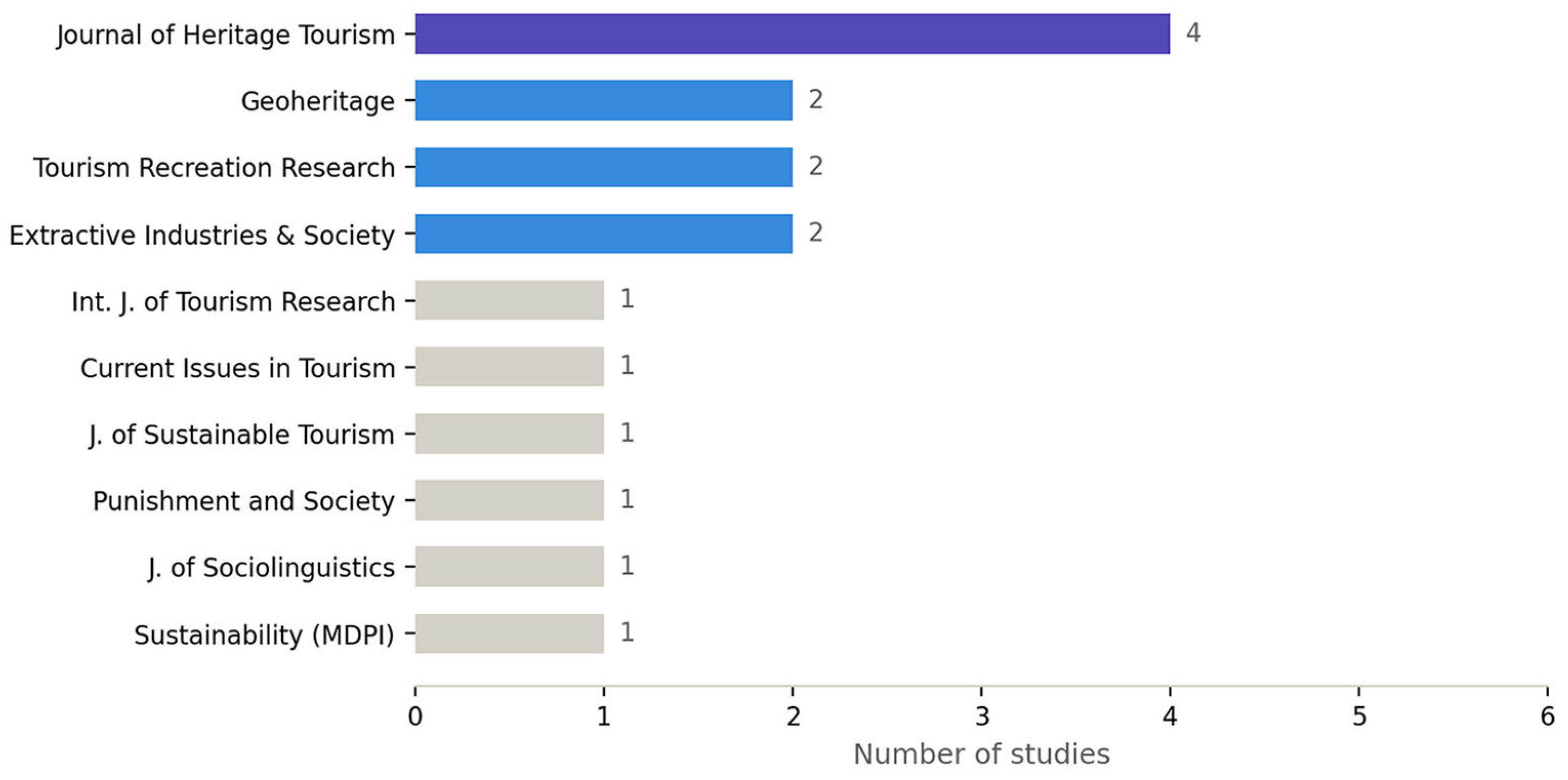
The dispersion across journals in tourism, geography, sociology, and environmental studies suggests that research on industrial and mining heritage is not consolidated within a single disciplinary space (Figure 5).

3.2.6. Citation Patterns

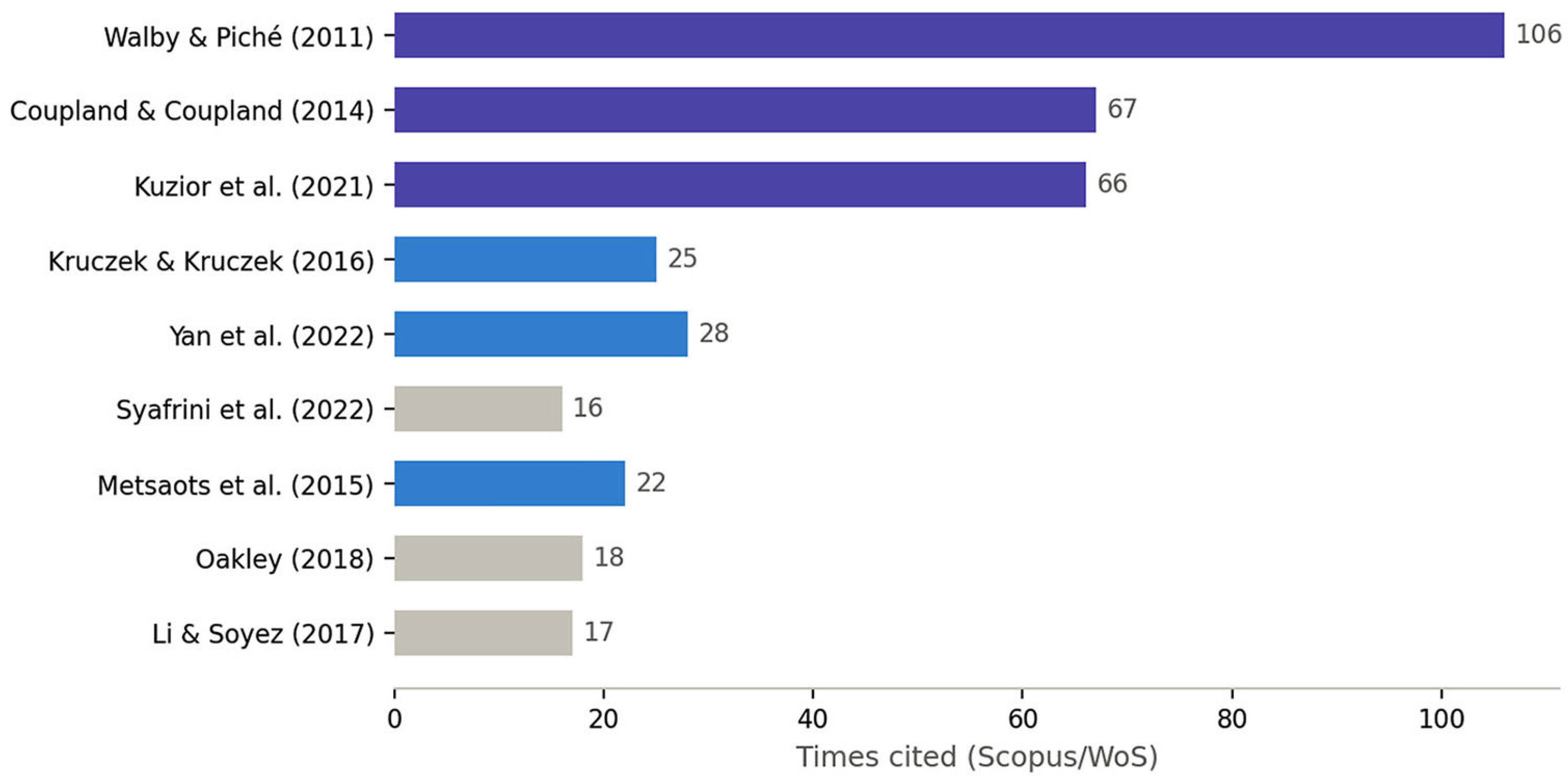
Citation counts vary considerably across the corpus. Walby and Piché (2011) is the most cited study, reflecting its broader influence on dark tourism research beyond industrial contexts (Figure 6).
Among studies more directly focused on mining or industrial heritage, Coupland and Coupland (2014) and Kuzior et al. (2021) are the most frequently cited. These patterns suggest that foundational theoretical contributions continue to shape the field, even as newer empirical studies expand its scope.

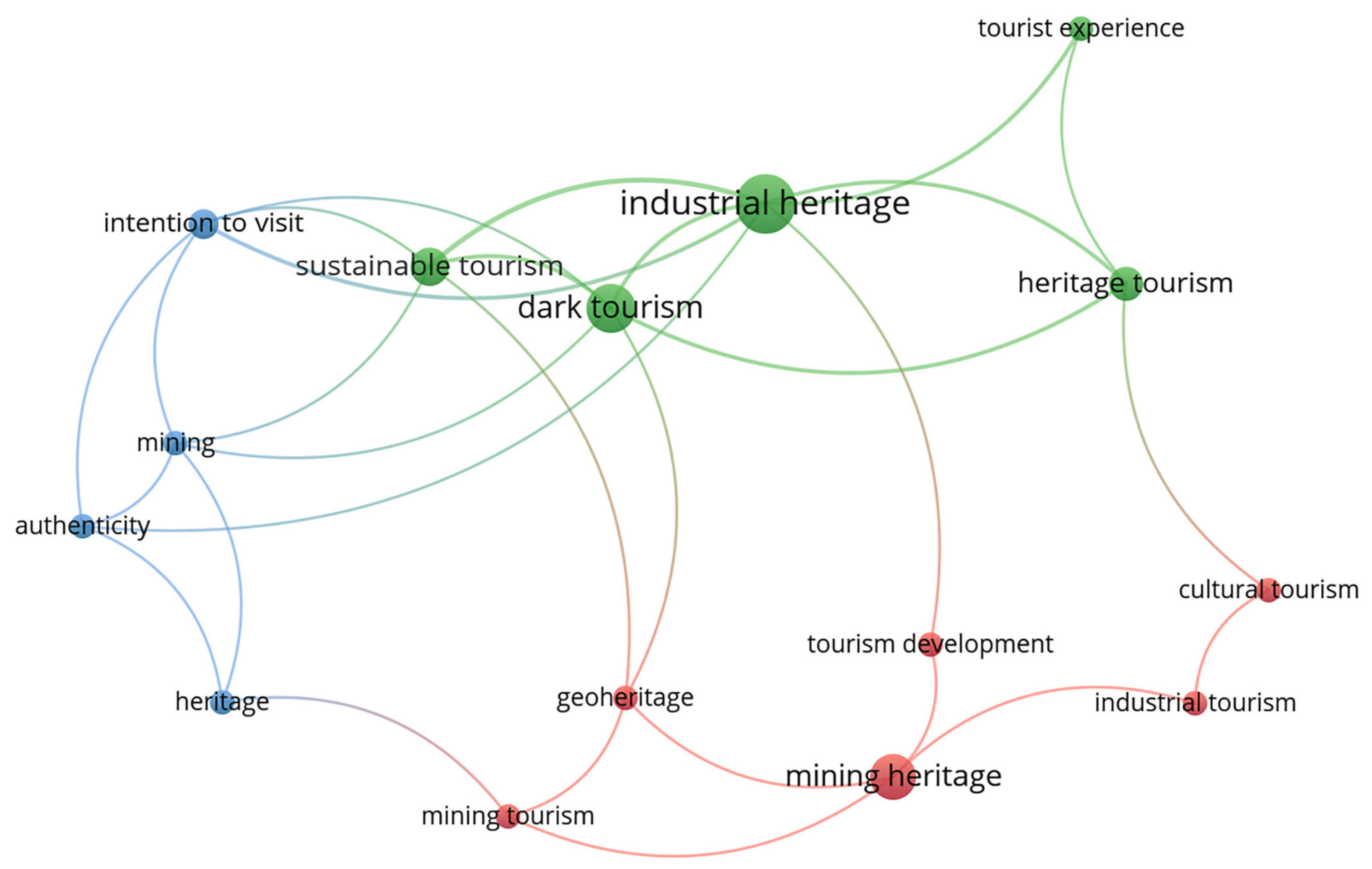
3.2.7. Keyword Co-Occurrence Analysis

The keyword co-occurrence analysis (Figure 7) provides further insight into the structure of the literature. The analysis identified three main clusters: one centred on industrial heritage and dark tourism, another on mining heritage and tourism development, and a third focused on visitor experience and behavioural dimensions. A notable finding is that “dark tourism” and “mining heritage” do not co-occur directly in the network. Instead, “industrial heritage” serves as the intermediary linking the two. This pattern reinforces the argument developed throughout the review: that dark tourism and mining heritage research remain only partially integrated, with industrial heritage acting as the primary conceptual bridge between them.
The structural position of “industrial heritage” as mediator deserves closer examination, because it reveals something important about how knowledge in this field is organised and about the limits of the current integration. “Dark tourism” as a cluster operates with its own conceptual gravity, oriented toward established frameworks, canonical sites, and event-based forms of suffering. “Mining heritage” as a cluster operates with a different gravity, oriented toward landscape, development, sustainability, and resource management. These two clusters do not naturally speak to each other because they inhabit different disciplinary registers, ask different questions, and address different audiences. “Industrial heritage” is sufficiently flexible to appear in both registers—it can function simultaneously as a development resource and as a site of difficult memory—and it is this flexibility that makes it available as a bridge term. The consequence, however, is that the connection between dark tourism and mining heritage remains mediated and therefore fragile. Researchers working primarily within the mining heritage cluster can use industrial heritage as their organising concept without ever arriving at questions of suffering, exploitation, or moral responsibility. Researchers working within the dark tourism cluster can treat industrial heritage as one site type among many without engaging the specific logics of extraction, labour coercion, or environmental destruction. The result is precisely the pattern documented throughout this review: two literatures that are aware of each other but not genuinely in dialogue. Recognising this structural condition also clarifies what a more integrated approach would require: not simply more cross-citation, but a conceptual reorientation that brings dark tourism and mining heritage into direct contact, treating the darker dimensions of industrial extraction as constitutive rather than incidental. This is the ambition that underlies the typology proposed in Section 4.5.

4. Thematic Synthesis

The thematic synthesis draws on the 33 studies included in the final corpus and follows the three-stage approach proposed by Thomas and Harden (2008): inductive coding of findings, development of descriptive themes, and the construction of higher-level analytical themes.
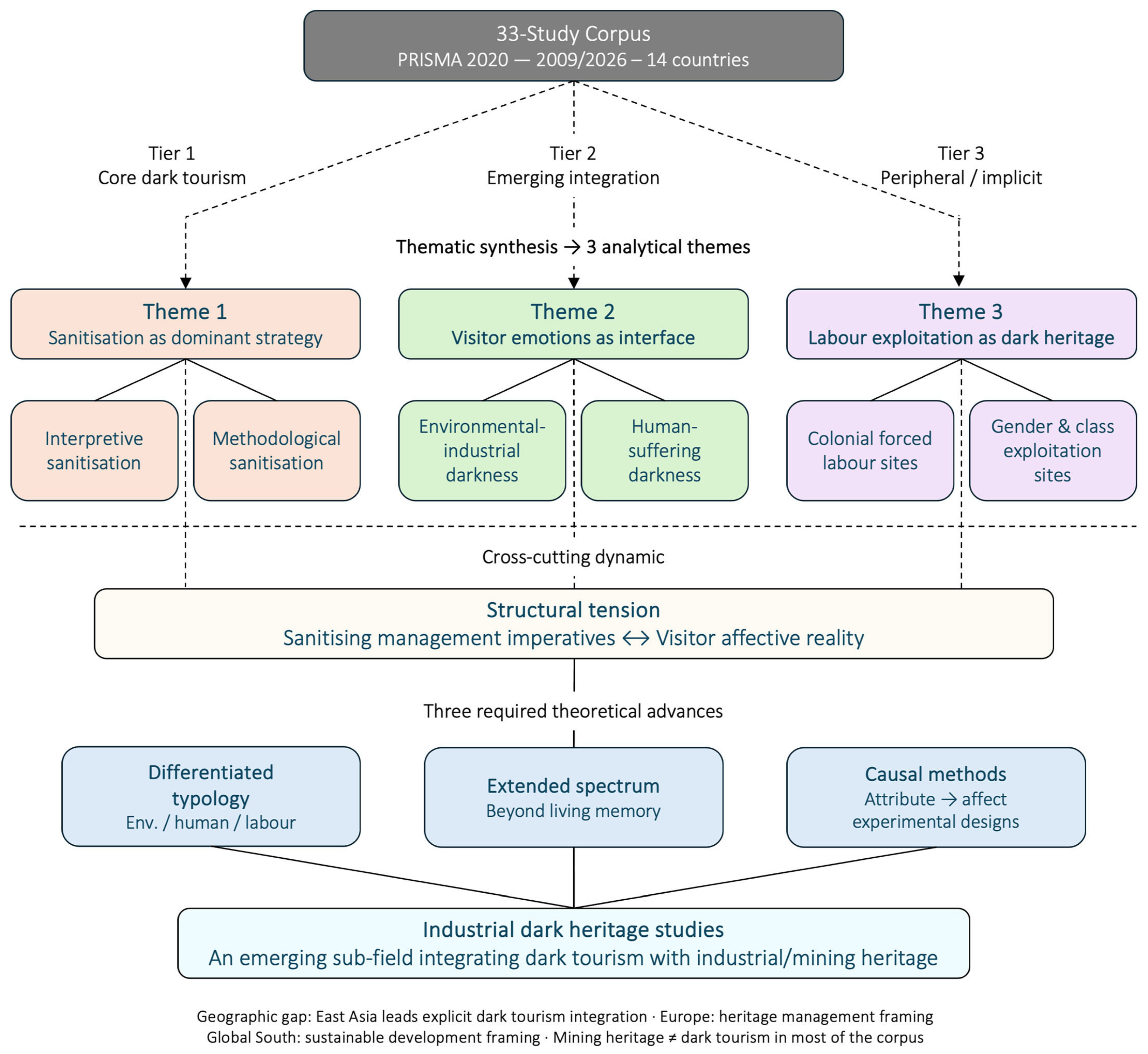
Three overarching themes emerge from this process. These address: (1) sanitisation as a dominant strategy in the representation of industrial dark heritage, (2) the role of visitor experience as an interface between dark heritage and tourism behaviour, and (3) labour exploitation as an under-theorised but empirically distinctive form of industrial darkness. Figure 8 summarises the relationships between these themes. The sections that follow develop each theme in turn, drawing systematically on the evidence within the corpus while also extending it analytically.

4.1. Sanitisation as a Dominant Feature of Industrial Dark Heritage Interpretation

The most consistent pattern across the corpus is the tendency for industrial and mining heritage sites to underplay or reframe the darker dimensions of the industrial past. Rather than presenting these histories directly, sites often foreground narratives of technological achievement, economic development, or regional identity. This tendency corresponds closely to what Soyez (2009) described as sanitised industrial heritage—a process through which the difficult or dissonant aspects of industrialisation are selectively muted.
What is striking, however, is the extent to which this pattern appears across very different contexts. It is not confined to a particular country, heritage model, or institutional setting. Instead, it emerges as a recurring feature of how industrial heritage is both interpreted and studied. In this sense, sanitisation does not appear as an occasional distortion, but as a broadly normalised approach.
The literature provides many concrete illustrations of how this operates. In the case of the Mitsubishi workers’ housing in South Korea, Choung and Yoon (2024) show how the physical environment clearly reflects a system of labour control, yet this dimension is only weakly articulated in official interpretation. The result is what might be described as a form of latent darkness: the material traces are present, but their meaning is not fully developed. A similar dynamic is evident at the Tomioka Silk Mill, where narratives emphasise national achievement while downplaying the exploitative conditions experienced by female workers (Maruyama & Woosnam, 2021).
These examples point to an important distinction. Sanitisation is not simply about omission; it is also about framing. Difficult histories are not always erased but are reconfigured in ways that render them less confrontational or less politically charged. Over time, such framing can shift the meaning of a site from one of critical reflection to one of heritage celebration.
Across the corpus, this process can be observed at several levels. At the most visible level, it takes the form of interpretive choices—what is included in exhibitions, how stories are told, and which voices are amplified. The work of Walby and Piché (2011), although focused on penal heritage, is particularly instructive here. Their concept of narrative “distancing” helps explain how past injustices can be presented as safely resolved, allowing visitors to engage without confronting their contemporary relevance. Comparable dynamics are evident in mining contexts, where harsh labour conditions are often framed as belonging to a closed historical period.
Beyond interpretation, sanitisation also operates through methodological choices. Many studies in the corpus rely on frameworks that prioritise sustainability, development, or visitor satisfaction. While these perspectives are legitimate, they tend to leave little space for analysing suffering, coercion, or injustice. As a result, certain dimensions of industrial heritage become difficult to “see” within the research process itself. A further institutional dimension is worth noting: the European Route of Industrial Heritage (ERIH), invoked as a legitimating framework by Kruczek and Kruczek (2016) and Yang et al. (2023), is itself oriented toward celebrating industrial achievement and regional identity rather than toward critical engagement with darker histories—suggesting that supranational heritage infrastructure may function as a structural force reinforcing sanitisation across national contexts.
At a deeper level still, these patterns reflect underlying assumptions about what industrial heritage is for. When it is treated primarily as a resource for economic regeneration, questions about historical responsibility or ethical representation tend to recede. This pattern is clearly illustrated across several Tier 3 studies in the corpus. Kuzior et al. (2021), Dragin et al. (2023), and Antić et al. (2025) each apply sustainable development, attitude-scale, or geotourism assessment frameworks to sites whose histories include documented labour exploitation and environmental harm, yet their analytical designs offer no mechanism for registering those dimensions as heritage value. The absence is not incidental: it is a structural consequence of the frameworks employed, which are calibrated to measure economic impact, resident attitudes, or geological significance rather than historical suffering or moral responsibility.
A further, more subtle mechanism can also be identified: what might be termed dilution through diversification. When industrial sites are incorporated into broader tourism circuits, their darker elements often lose prominence as they become part of a wider, more heterogeneous visitor experience. In such contexts, no single site carries the interpretive weight necessary to sustain deeper engagement with difficult histories. Syafrini et al. (2022) provide an instructive illustration in the case of Sawahlunto, Indonesia, a former colonial coal mining city incorporated into a broader cultural heritage tourism circuit. Although the site’s history of forced labour—workers brought under colonial compulsion to build and operate the mines—is formally acknowledged through a museum exhibit, this acknowledgement takes the form of a municipal tourism product rather than a community-led act of critical memory. The inclusion of difficult history without the interpretive weight needed to sustain genuine reckoning exemplifies how diversification can absorb darkness while neutralising its force.
Taken together, these observations suggest that sanitisation is not simply the result of individual decisions, but part of a broader structural dynamic. It reflects how industrial heritage is positioned within tourism economies, policy frameworks, and research practices. Understanding this dynamic is essential if more critical and balanced approaches to industrial heritage are to be developed.

4.2. Visitor Emotions as the Empirical Interface Between Dark Heritage and Tourism Behaviour

Another theme concerns how visitors experience industrial heritage, specifically how they respond emotionally to its darker dimensions. If the first theme focuses primarily on how these sites are presented, this theme turns attention to how they are encountered.
Across the corpus, visitor responses are neither uniform nor entirely predictable. Instead, they tend to combine multiple emotional registers, ranging from curiosity and interest to discomfort, fear, and sympathy. This variability suggests that industrial dark heritage operates through a more complex affective landscape than is typically assumed in the literature.
Zhang et al. (2024), in their multi-method study of eight industrial heritage sites in Tianjin, China, demonstrated that different categories of negative attribute generate statistically distinct emotional profiles in visitors. Their taxonomy distinguishes three attribute types: environmental–ecological (pollution, ecological damage, resource depletion), aesthetic–physical (decay, dilapidation, desolation), and historical–social (war, colonisation, forced labour, human rights violations). The key empirical finding—central to both Theme 2 and Theme 3—is that forced labour and human rights violation attributes generated the strongest negative emotional responses across all sites, with irritable as the dominant emotion (mean 2.857 across sites), followed by afraid (mean 2.709). The forced-labour sites—Fujuxing Machine Building Factory and the Baocheng/Yuda Cotton Mills—generated the highest emotional intensity overall, including a significant positive correlation between irritability and fear (r = 0.332, p < 0.001) that did not occur at environment- or war-themed sites. This finding confirms, at an empirical level, that the category of dark heritage the visitor encounters matters: the emotional mechanism at a site of environmental pollution differs from that at a site of human exploitation, and existing typologies that treat all dark heritage as equivalent risk obscuring these differences.
Crucially, Zhang et al. (2024) also documented that the site’s interpretive strategy moderated emotional response: the Dagang Oilfield, whose management had deliberately de-emphasised pollution in favour of positive narratives about energy workers’ dedication, generated notably lower negative emotions than its environmental attributes would predict. This finding provides direct empirical confirmation of the link between Theme 1 and Theme 2: sanitisation does not merely change what visitors are told; it changes what they feel. The emotional architecture of an industrial heritage site—the configuration of affects made available to visitors—is a product of curatorial choice as much as of the site’s intrinsic attributes.
Tang (2019), in her qualitative study of visitors to the Hanwang Earthquake Memorial Park—a site combining an abandoned industrial town with seismic memorials from the 2008 Wenchuan earthquake—identified a distinctive emotional profile characterised by obligation to commemorate mixed with curiosity, and affective experiences dominated by fear, sympathy, and gratification at the reconstruction narrative. The industrial dimension of the site—the destroyed factory town, the workers’ lives—was found to be inseparable from the dark tourism experience, generating a composite dark heritage encounter that differed qualitatively from other earthquake memorial contexts. Tang’s (2019) finding supports the synthesis’s argument that industrial heritage adds a distinctive emotional register to dark tourism encounters: the destruction of productive place, of working lives, and of industrial community generates forms of grief and sympathy that are not reducible to the affects associated with disaster or death alone.
Taplin’s (2026) randomised experiment in the Darling Range, Western Australia, introduced a critical qualification to the emotional interface between mining sites and visitor behaviour. Exposing 1022 residents to photos of bauxite mining significantly decreased intention to visit the adjacent forest recreation area (B = −0.38, p < 0.001), and mining activity increased distress while reducing enjoyment and relaxation. However (and this is the theoretically important finding), this distress did not translate into increased curiosity or visit intention, distinguishing the response from dark tourism dynamics at canonical sites where distress can attract visitors. Taplin (2026) concluded that dark tourism as an explanatory framework did not apply in this context, arguing instead that affect theory and hedonistic tourism better accounted for the results. This finding is important, but its generalisability may be limited to the specific recreational forest context studied; distress from environmental damage might function differently when the site is explicitly memorialised and interpreted as industrial heritage rather than encountered as an active landscape intrusion. For the synthesis, this finding suggests that not all mining-related negative affect constitutes dark tourism affect: the distress evoked by environmental destruction in a recreational context differs qualitatively from the distress associated with death, atrocity, or human suffering at explicitly memorialised sites. The field requires, as Taplin (2026) implies without fully developing, a more differentiated typology of darkness that distinguishes environmental–industrial darkness (provoked by landscape destruction, ecological damage, and productive despoliation) from human-suffering darkness (provoked by death, forced labour, atrocity, and the violation of human dignity).
Laaksonen and Varga (2024), in their netnographic and interview study of Chernobyl Exclusion Zone tour guides, contributed an important relocation of the emotional interface: from the visitor to the host. Their finding that guides suppressed reactions of frustration and discomfort in response to selfie-taking tourists—performing surface acting, in Ashforth and Humphrey’s (1993) terms—revealed that the emotional dynamics of industrial dark heritage encounters are not exclusively visitor phenomena but involve a host-side emotional labour that is frequently invisible to tourism research. For mining tourism specifically, this finding has significant implications: guides with personal or familial connections to the industry may perform similar emotional suppression when narrating industrial injury, death, or exploitation to visitors who engage with the heritage recreationally. The micro-level sanitisation performed by guides in real time—through selective narrative emphasis, emotional neutrality, and the management of visitor conduct—may be as consequential for the transmission of dark heritage meanings as institutional interpretive strategies, yet it has received almost no attention in the corpus. Laaksonen and Varga (2024) also documented that online community norms were more permissive of selfie-taking than in-person guide reactions, suggesting a methodological caution: digital and social media data may systematically underrepresent the affective tensions present at industrial dark heritage sites.
L. Li et al. (2025) and Yan et al. (2022), while not primarily focused on dark dimensions, contribute evidence about the positive emotional dimensions of industrial heritage tourism—nostalgia, awe, authenticity—that are analytically relevant to Theme 2 as counterweights. L. Li et al. (2025) demonstrated that the nostalgic atmosphere at Chinese industrial heritage sites mediates revisit intention through perceived authenticity and positive emotions, with prior knowledge moderating the relationship. Yan et al. (2022) documented that awe—generated by the visible industrial transformation of the Mt. Tangshan Quarry Park—mediates between authenticity experience and overall experience quality. These findings suggest that industrial heritage visitors do not occupy a uniformly dark affective register: positive emotions of awe, nostalgia, and wonder co-exist with, and may compete with, the negative emotions of fear, irritability, and distress. The emotional interface between industrial dark heritage and visitor behaviour is thus best understood as a composite affective field in which multiple emotional registers are simultaneously activated, and the balance between them is shaped by site attributes, interpretive strategy, visitor demographics, and cultural context. Evidence from outside the Chinese context reinforces this picture while adding important nuance. Metsaots et al. (2015), in their mixed-methods study of public attitudes toward oil shale mining heritage in Estonia’s Ida-Viru region, found that even residents with strongly negative associations with the mining past, including those whose families had been directly affected by industrial decline and environmental damage, simultaneously recognised aesthetic and nostalgic value in the same landscapes. Grief, ambivalence, and attachment coexisted within the same respondents rather than occupying separate emotional positions. This finding extends the composite affective field argument beyond the East Asian contexts that dominate the corpus and suggests that the simultaneous activation of contradictory emotional registers is a structural feature of industrial dark heritage experience rather than a cultural or geographic particularity.
A related dimension concerns visitors who encounter dark heritage without having sought it. P. Seaton (2019), in his study of war-related tourism on five islands in Japan’s Seto Inland Sea, identifies a category of visitors motivated primarily by media associations, local culture, or landscape curiosity who nonetheless arrive at sites with deeply dark historical content—poison gas factories, kamikaze training bases, military ruins. These visitors experience dark heritage incidentally rather than purposefully, yet the emotional encounter still occurs. For industrial and mining heritage, where dark dimensions are often not foregrounded in marketing or interpretation, this serendipitous encounter may be the norm rather than the exception: visitors arrive for the landscape, the industrial aesthetics, or the nostalgia, and the darkness reaches them through material atmosphere and spatial evidence rather than through explicit interpretive framing. This is precisely the mechanism the evidence landscape concept, developed in Theme 3, is designed to explain.

4.3. Labour Exploitation as an Undertheorised Form of Industrial Dark Heritage

Across the corpus, labour exploitation emerges as a central, yet insufficiently theorised, dimension of industrial heritage. While many studies acknowledge the role of labour in shaping these sites, the conditions under which that labour took place—coercion, exposure to risk, and structural inequality—are rarely developed as a primary analytical focus. This creates a noticeable imbalance between historical significance and conceptual visibility.
This imbalance is itself consistent with critical heritage scholarship on industrial and working-class sites, which has documented how labour exploitation is remembered and reframed by the communities and visitors who engage with such heritage. Smith and Campbell (2017) show that what is recalled at industrial heritage sites is frequently a time of hard work, and indeed exploitation, yet one held in tension with pride, camaraderie, and a sense of communal achievement. In their interviews, visitors articulate the underlying economic injustice of industrial labour directly—recognising, for instance, that industrial fortunes were built on the labour of workers and immigrants—while simultaneously affirming the value of the working lives lived under those conditions (Smith & Campbell, 2017). This affective doubling, in which exploitation and pride are remembered together rather than as alternatives, helps explain the pattern observed across the present corpus: the sanitisation of labour history operates not only through omission but through a selective emotional framing that renders difficult labour histories bearable, and even celebratory, by foregrounding achievement over the conditions of work.
The evidence suggests that this is not due to a lack of relevant material. On the contrary, some of the most compelling and emotionally charged aspects of industrial heritage relate directly to labour histories. Studies such as Zhang et al. (2024) show that sites associated with forced labour or human rights violations generate particularly strong emotional responses among visitors. Yet, despite this, labour exploitation tends to remain only partially integrated into the theoretical frameworks of dark tourism.
One reason for this gap lies in the way dark tourism has been conceptualised. Much of the literature has developed around sites defined by relatively discrete events—wars, disasters, or acts of violence—where death or tragedy can be clearly located in time and space (P. Seaton, 2019; P. R. Stone, 2006). These models implicitly assume that “darkness” is tied to identifiable moments of crisis. By contrast, labour exploitation rarely takes this form. Its significance lies in sustained processes rather than singular events, unfolding over extended periods and embedded within systems of industrial production.
This difference has important consequences. Because labour exploitation is not easily reduced to a single event, it is less straightforward to represent within conventional interpretive frameworks. It often appears in a fragmented or indirect way, through spatial arrangements, archival references, or partial narrative, rather than as a clearly defined focus. As a result, it becomes more vulnerable to omission or reframing, frequently absorbed into broader narratives of industrial progress, national development, or technological achievement.
Two studies of the same site make this challenge concrete. At Geevor tin mine in Cornwall, UK, Coupland and Coupland (2014) show how former miner-guides construct authenticity through narratives of endurance and hardship that are temporally open-ended: the suffering communicated is not an event but a condition of labour sustained across generations, with no single moment of crisis to anchor it. Oakley (2018), also at Geevor, examines the preserved “Dry”—the miners’ changing room maintained exactly as it was on the final day of mining—and argues that this space communicates exploitation through spatial atmosphere and material presence rather than through memorialisation of a death or disaster. Neither the discursive evidence Coupland and Coupland analyse nor the material evidence Oakley describes maps onto P. R. Stone’s (2006) event-anchored spectrum: the darkness at Geevor is not “lighter” than that of a battlefield or disaster site, but structurally different—chronic, cumulative, and inscribed in everyday space rather than concentrated in a moment. This incommensurability is precisely what existing typologies cannot accommodate and what a framework centred on labour exploitation as a distinct form of industrial darkness is designed to address.
The empirical studies in the corpus illustrate this pattern in different ways. Walby and Piché (2011) show how labour within carceral institutions—closely linked to industrial systems of discipline and production—is reframed through narratives of penal reform, which distance contemporary visitors from the realities of coercion. Maruyama and Woosnam (2021) demonstrate how the experiences of female workers at the Tomioka Silk Mill are commemorated while the exploitative structures that shaped those experiences are significantly softened. Similarly, Choung and Yoon (2024) highlight how the spatial organisation of workers’ housing in colonial industrial contexts continues to encode relations of control, even when those relations are not explicitly interpreted.
A further variant of this pattern appears at Sawahlunto, Indonesia, where forced labour history is not absent from interpretation but present in a form that stops short of genuine recognition. Syafrini et al. (2022) document how the city’s museum includes an exhibit depicting workers in chains, yet this exhibit was designed by municipal government as a tourism product rather than emerging from the communities descended from that labour. The presence of difficult content without the agency or critical framing necessary to carry its full meaning constitutes what might be called interpreted absence: the history is technically visible but effectively neutralised, absorbed into a narrative of heritage celebration rather than moral reckoning.
These examples point to a broader issue. Labour exploitation is not simply overlooked; rather, it is present in ways that are difficult to articulate within existing conceptual and interpretive frameworks. In several Tier 3 studies, this becomes particularly evident. Here, labour forms the historical core of the sites being analysed, yet it contributes little or nothing to the evaluation of heritage value. Frameworks based on sustainability, development, or resource management tend to prioritise measurable outcomes, such as economic impact or visitor satisfaction, while leaving little room for engaging with the historical realities of exploitation.
From a theoretical perspective, this suggests that current models of dark tourism require extension. If dark heritage continues to be defined primarily in relation to event-based intensity, then forms of suffering that are gradual, systemic, and spatially dispersed will remain difficult to capture. Earlier contributions, such as Soyez’s (2009) argument for extending dark heritage beyond the requirement of living memory, provide an important starting point. However, the findings of this review indicate that a further step is needed: one that explicitly incorporates structural and process-based forms of harm into the conceptual framework.
The case of Sillamäe, Estonia, provides perhaps the starkest illustration of this dynamic in the corpus. Mildeberg and Vider (2022) document a Soviet-era nuclear industrial town built by prisoners of war and construction battalions under conditions of severe coercive control: workers were assigned different-coloured helmets according to their status, housed in a surveilled closed town, and denied freedom of movement. The town’s spatial layout—its street grid, residential blocks, and proximity of housing to the industrial plant—encodes these relations of coercion in material form. Yet none of this appears in the town’s tourism narratives, museum exhibitions, or stakeholder discussions. The architecture speaks; the interpretation is silent.
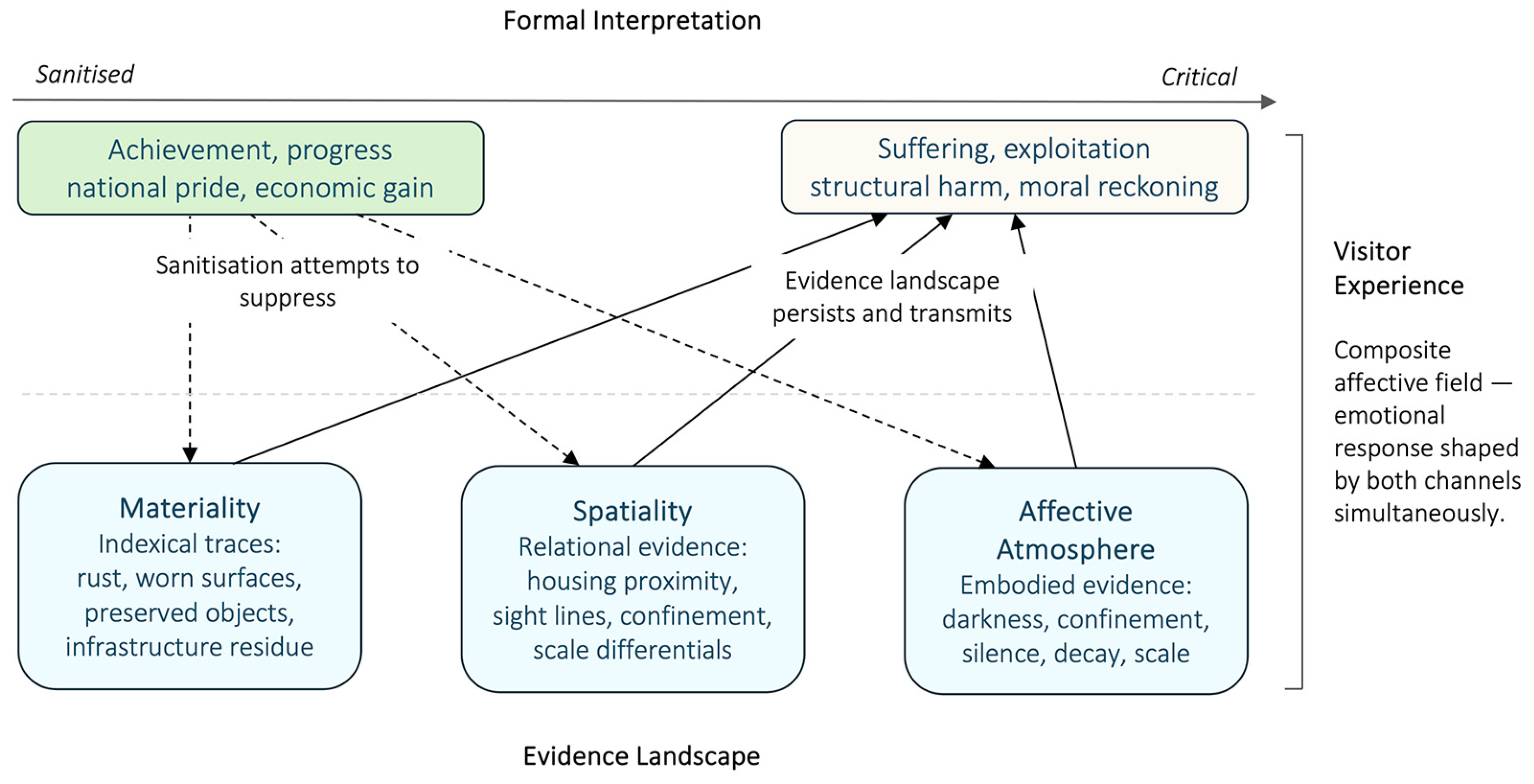
This dynamic—material evidence present, interpretive acknowledgement absent—is precisely what the concept of the evidence landscape, introduced in this review, is designed to theorise. The evidence landscape designates the ensemble of material, spatial, and atmospheric features through which an industrial site communicates its history of labour, harm, and control independently of, and sometimes against, its formal interpretive apparatus. It comprises three analytically distinct but mutually reinforcing channels. In framing the evidence landscape this way, the review treats the interpretation of material remains not as a fixed property of the site but as something produced through situated, affective practices of heritage-making, in which the same physical features may be mobilised differently by different visitors (Smith, 2022). This provides a theoretical basis for specifying the channels below as analytically separable dimensions rather than as a single undifferentiated field, and for the methods of operationalisation proposed in the sections that follow.
The first is materiality: the physical substance of surviving objects, surfaces, and infrastructure. Rust, worn floors, preserved equipment, and objects left in place at the moment of closure are not representations of past conditions, but indexical traces causally connected to them—they carry evidential weight precisely because they were not designed to communicate. The preserved Dry at Geevor tin mine exemplifies this channel: the hooks, the accumulated dust, and the boots left behind on the final day of mining are residues of a labour condition rather than exhibits about it, and their communicative force derives from this material directness (Oakley, 2018).
The second channel is spatiality: the relational organisation of space across a site. The proximity of workers’ housing to production areas, the sight lines between supervisory positions and work floors, the scale differential between managerial and worker accommodation, the physical isolation of a company town—these features encode relations of power and control not in any single element but in the logic of the layout as a whole. Choung and Yoon (2024) demonstrate this at the Mitsubishi Workers’ Housing in Samneung, where the spatial arrangement of the complex indexed a system of surveillance that persisted in the built environment long after the colonial industrial system that produced it had ended. The Sillamäe case discussed above represents the same channel operating at its most extreme: a street grid and residential layout that materially encode a coercive labour regime, in a town where the formal interpretive apparatus acknowledges none of it.
The third channel is affective atmosphere: the sensory and emotional qualities that sites generate through darkness, confinement, scale, silence, and decay. These communicate through embodied experience—visitors register them somatically, before and often independently of cognitive interpretation. This is the mechanism that explains one of the synthesis’s most consistent findings: visitors report fear, discomfort, and a sense of obligation at sites whose formal interpretation foregrounds achievement and progress. The atmosphere is transmitting what the signage suppresses.
The theoretical significance of the evidence landscape lies in its relationship to sanitisation. Sanitisation operates primarily on the discursive register; it controls what is said, which narratives are foregrounded, and what signage appears. But it cannot easily control what the materiality, spatiality, and atmosphere of a site communicate independently. The Dagang Oilfield management suppressed the pollution narrative in its interpretation, yet the site’s industrial infrastructure remained materially present and emotionally legible (Zhang et al., 2024). The Tomioka Silk Mill promotes a model factory narrative, yet the spatial separation of the dormitory from the production floor and the worn stairs climbed by thousands of young women persist as spatial evidence (Maruyama & Woosnam, 2021). Sanitisation is therefore structurally incomplete: the evidence landscape operates as a parallel communicative system that runs alongside—and frequently in tension with—the official interpretive frame, transmitting histories of labour and harm that formal narration has chosen not to tell. Figure 9 maps this relationship conceptually, showing the three channels and their interaction with formal interpretation across a spectrum from sanitised to critical.
Recognising labour exploitation as a distinct form of industrial dark heritage has several implications. At the theoretical level, it challenges the assumption, implicit in much of the literature, that darkness is primarily event driven. Instead, it suggests a model in which darkness can also emerge from long-term structural conditions. At the practical level, it highlights the need for interpretive approaches that can make these conditions visible without reducing them to simplified or symbolic narratives.
Taken together, the findings suggest that labour exploitation is not a peripheral aspect of industrial dark heritage but one of its defining features. Integrating it more fully into dark tourism theory is therefore not simply a matter of extending existing typologies, but of rethinking how “darkness” itself is conceptualised in relation to industrial pasts.

4.4. Cross-Cutting Observations: Geographic Patterning and Methodological Gaps

Beyond the three core themes, several broader patterns emerge from the analysis. These relate to the geographical distribution of research, the methodological profile of the field, and the continuing separation between dark tourism and mining heritage scholarship.
A first observation concerns geography. The engagement with dark tourism frameworks is clearly uneven across regions. Studies from China, South Korea, and Japan are more likely to engage explicitly with dark tourism concepts, often integrating them directly into empirical research (Choung & Yoon, 2024; P. Seaton, 2019; Tang, 2019; Zhang et al., 2024). By contrast, much of the European literature approaches industrial and mining heritage through heritage management, landscape, or sustainability perspectives (Dragin et al., 2023; Kruczek & Kruczek, 2016; Mildeberg & Vider, 2022; Pashkevich, 2017), with comparatively limited use of dark tourism frameworks.
This difference appears to reflect contrasting disciplinary traditions as much as empirical variation. In East Asian contexts, dark tourism has become a more established conceptual lens for analysing heritage and visitor experience. In Europe, industrial heritage has more often been framed as a question of conservation, regeneration, or regional identity. As a result, similar types of sites are interpreted through quite different theoretical perspectives.
The pattern is even more pronounced in studies from the Global South. Here, the literature is dominated by approaches grounded in sustainable development, planning, or community impact, with little explicit engagement with dark tourism. This is notable given the historical significance of labour exploitation, colonial extraction, and environmental degradation in many of these contexts. The relative absence of dark tourism perspectives therefore suggests a gap in the literature rather than an absence of relevant material.
A second observation concerns methodology. The corpus remains strongly oriented toward qualitative case study approaches, reflecting the exploratory stage of the field. These studies provide rich, context-sensitive insights into heritage interpretation and visitor experience. At the same time, quantitative and mixed-methods studies—although fewer in number—tend to generate more generalisable findings, particularly in relation to visitor emotions and behavioural responses (e.g., Taplin, 2026; Zhang et al., 2024).
However, some notable gaps remain. There is little use of longitudinal designs, which would allow for analysis of how sites and visitor responses evolve over time. Cross-site comparative studies are also limited, making it difficult to assess whether observed patterns hold across different cultural and geographical contexts. In addition, methods capable of capturing embodied or physiological responses, potentially relevant in the study of affect, are largely absent.
A third, and perhaps most important, observation concerns the structure of the field itself. As already indicated by the keyword co-occurrence analysis (Section 3.2.7), dark tourism and mining heritage continue to operate as largely separate areas of research. Direct conceptual overlap between them remains limited, with industrial heritage acting as the primary point of connection.
This separation has several implications. Studies of mining heritage that focus on development or planning often overlook the interpretive and ethical dimensions highlighted in dark tourism research. Conversely, studies grounded in dark tourism theory have tended to focus on more conventional or event-based sites, without fully engaging with the specific characteristics of industrial and mining contexts.
Taken together, these observations reinforce the central argument of the review: that the integration of dark tourism and industrial heritage research is still partial and uneven. Addressing this gap will require both conceptual and empirical work. Conceptually, there is a need to adapt dark tourism frameworks to account for the temporal, spatial, and structural characteristics of industrial heritage. Empirically, more attention is needed to contexts that are currently underrepresented, as well as to comparative and longitudinal approaches that can test and refine emerging theoretical insights.

4.5. Integrative Synthesis: Towards a Conceptual Framework

The three analytical themes and cross-cutting observations converge on a central argument: the intersection of dark tourism and industrial/mining heritage is characterised by a structural tension between the sanitising imperatives of heritage management—driven by economic, political, and methodological forces—and the affective realities of visitor experience, which consistently register the darker dimensions of the industrial past even when those dimensions are not explicitly interpreted. Visitors to forced labour sites commonly report feelings of irritability and fear; visitors to abandoned industrial towns feel obligated to commemorate and afraid; visitors to active mining landscapes feel distress. These emotional responses are data—evidence that the industrial past’s dark dimensions are not neutralised by sanitising management strategies but are transmitted through site atmosphere, material culture, and visitor imagination in ways that exceed institutional control.
The synthesis suggests that the field requires three theoretical advances. First, a typology of industrial dark heritage that distinguishes environmental–industrial darkness, human-suffering darkness, and labour exploitation darkness as qualitatively distinct forms, each with its own characteristic emotional profile, interpretive logic, and management challenge. Second, an extension of existing dark tourism typologies—particularly P. R. Stone’s (2006) spectrum—to accommodate the chronic, structural, and temporally distributed character of labour exploitation as dark heritage, building on Soyez’s (2009) proposal to extend the dark heritage concept beyond living memory. Third, a methodological agenda that centres visitor emotional response as an empirical indicator of which dark heritage dimensions are being transmitted even in the absence of explicit interpretation, using experimental and mixed-methods designs capable of establishing causal links between heritage attributes, interpretive strategies, and affective outcomes. Taken together, these advances would constitute the theoretical foundation for a sub-field this review provisionally designates industrial dark heritage studies—one in which the distinctive characteristics of industrial sites, industrial labour, and industrial capitalism receive adequate theoretical treatment within the broader dark tourism literature.

5. Discussion

This systematic literature review set out to bring dark tourism theory and industrial/mining heritage scholarship into closer dialogue. The evidence confirms a persistent disconnect between these literatures. While both fields engage with sites shaped by death and suffering, they have largely evolved along separate trajectories, with industrial heritage only partially bridging the gap. In what follows, we interpret the three analytical themes in relation to existing theory and revisit the research questions outlined in the Introduction. Rather than restating the synthesis, the discussion focuses on what these findings mean for how dark tourism is conceptualised, studied, and applied to industrial contexts.

5.1. Sanitisation as a Structural Feature of Industrial Heritage

This subsection addresses the first and third research questions, concerning how dark tourism is conceptualised in industrial and mining heritage contexts and how heritage managers interpret and present the darker dimensions of these sites. The findings confirm that sanitisation is a pervasive feature of industrial heritage, extending well beyond site-level interpretation. As the synthesis showed, narratives of technological achievement, progress, and regeneration tend to dominate, while histories of labour exploitation, environmental harm, and social injustice are often downplayed or selectively framed (L. L. Li & Soyez, 2017; Soyez, 2009).
What this review adds is a clearer sense of how far this process reaches. Sanitisation does not only occur through curatorial decisions. It is also embedded in the research frameworks used to study industrial heritage and in the broader assumptions that shape how these sites are understood. At the interpretive level, difficult pasts may be acknowledged but not fully explored. At the methodological level, commonly used research instruments tend to foreground economic or experiential dimensions, leaving little room for analysing suffering or injustice. At a deeper level, development-oriented paradigms position industrial heritage primarily as a resource for economic and regional growth, rather than as a site of moral reflection.
Seen in this light, sanitisation appears less as a series of isolated choices and more as a structural condition. This extends earlier accounts of sanitised industrial heritage (Soyez, 2009) and resonates with broader work on difficult heritage, where institutional narratives often create distance from uncomfortable histories (Light, 2017; Walby & Piché, 2011).
Industrial heritage contexts, however, present a particular challenge. Unlike many canonical dark tourism sites, they are not organised around a single event. Their histories unfold over extended periods, making them more easily absorbed into narratives of progress or transformation. As a result, what is omitted is not always obvious, and what remains is often framed in ways that soften its critical implications.
Recognising sanitisation in this broader sense has implications for both research and practice. For researchers, it suggests the need for greater reflexivity in how frameworks and methods shape what can be seen. For practitioners, it highlights the importance of developing interpretive approaches that can engage with complex and extended forms of suffering without reducing them to simplified or symbolic narratives.

5.2. Visitor Motivations and the Composite Affective Field of Industrial Dark Tourism

The second research question focused on visitor motivations and emotional responses. Here, the findings suggest a more complex picture than is often assumed in the dark tourism literature.
Much of that literature has tended to explain visitor engagement through some relationship to death—whether curiosity, education, or existential reflection (A. V. Seaton, 1996; P. Stone & Sharpley, 2008). However, the studies reviewed here indicate that this perspective only partially captures what is happening in industrial contexts. Visitors are not primarily drawn by the spectacle of death itself. Instead, their motivations often combine curiosity, social memory, and an implicit sense of obligation to engage with the past.
The emotional responses observed across the corpus reinforce this complexity. Visitors experience a mixture of reaction, namely fear, discomfort, and sympathy, but also nostalgia, awe, and even pride. Rather than occupying a single emotional register, they move across what can be described as a composite affective field. This idea helps explain why industrial heritage cannot be fully understood through models that assume a predominantly negative or death-oriented experience.
Recent empirical work supports this interpretation. Studies such as Zhang et al. (2024) demonstrate that different attributes of industrial heritage generate distinct emotional responses, while research on individual sites (e.g., Tang, 2019; Taplin, 2026) shows that these responses are shaped by both the nature of the site and the way it is interpreted. Taken together, this suggests that emotional engagement is not incidental but central to how industrial dark heritage is experienced.
This has important implications for theory. Existing typologies of dark tourism—particularly those organised around proximity to death events—may be too coarse to capture these dynamics. A more differentiated approach, sensitive to the specific forms of “darkness” present at industrial sites, appears necessary.

5.3. Labour Exploitation as a Distinct Form of Industrial Dark Heritage

This subsection addresses the fourth research question, concerning the role labour exploitation plays as a form of dark heritage and how it is theorised in the literature. Perhaps the most significant theoretical implication of this review concerns the status of labour exploitation within dark tourism research. Across the corpus, labour-related histories—especially those involving coercion, unsafe conditions, and systemic inequality—emerge as central to the meaning of many industrial heritage sites. Yet they remain only weakly integrated into existing conceptual frameworks.
This gap reflects a deeper issue. Most dark tourism models have been developed in relation to sites defined by discrete events—disasters, conflicts, or acts of violence—where death can be clearly located in time and space (P. Seaton, 2019; P. R. Stone, 2006). Labour exploitation, by contrast, is not easily reduced to a single moment. It is embedded in longer-term processes and production systems, making it less visible within event-centred approaches.
The consequence is that labour-related forms of suffering are often mediated indirectly. They appear through fragments of narrative, spatial arrangements, or material traces rather than as a clearly defined interpretive focus. This helps explain why they are frequently marginalised or reframed within narratives of development and progress, as discussed earlier.
At the same time, the evidence suggests that visitors do not overlook these dimensions. Studies such as Zhang et al. (2024) indicate that sites associated with forced labour or human rights violations generate particularly strong emotional responses. This points to a disconnect: what is most affectively powerful for visitors is not always what is most explicitly interpreted.
From a theoretical standpoint, this calls for a shift in how dark heritage is conceptualised. Rather than viewing “darkness” primarily in terms of event-based intensity, it may be more appropriate to consider forms of harm that are structural and process-based. Earlier attempts to expand the scope of dark heritage (e.g., Soyez, 2009) provide a useful starting point, but the findings here suggest the need for a more systematic integration of labour-focused perspectives.

5.4. Positioning the Typology in Relation to Stone’s Dark Tourism Spectrum

Having established the distinctive character of labour exploitation as industrial dark heritage, this subsection states explicitly how the proposed typology relates to existing theory, and in particular whether it is complementary to P. R. Stone’s (2006) spectrum or constitutes an alternative framework. The argument advanced here is not simply that the spectrum should be supplemented with additional site types, nor that it should be discarded. Rather, the typology proposed in this review revises the organisational logic on which the spectrum rests. Stone’s spectrum is calibrated around a single axis, that is, proximity to death events, from the darkest sites of mass mortality to the lightest forms of macabre entertainment, and this axis has genuine explanatory power for the event-anchored sites it was designed to describe. The problem is not the axis itself but its universalisation: when applied to industrial heritage, it forces a question—how dark is this site?—that misrepresents what is actually at stake. A site of chronic labour exploitation is not “lighter” than a battlefield on Stone’s scale; it is differently dark in a way the scale cannot register, because its darkness derives from sustained structural harm rather than from a concentrated death event. The evidence assembled in this review, particularly from Zhang et al. (2024) and the Geevor studies (Coupland & Coupland, 2014; Oakley, 2018), suggests that darkness-as-type and darkness-as-intensity are orthogonal dimensions: reorganising typological logic around type first, with intensity as a secondary variable within each type, preserves the utility of Stone’s contribution for event-based sites while creating space for structural forms of harm that his framework cannot currently accommodate. This revision is domain-specific: the typology of industrial darkness proposed here is calibrated for industrial and mining heritage contexts and does not claim to replace Stone’s spectrum as a general framework for dark tourism scholarship. What it does claim is that any framework applied to industrial heritage must be able to distinguish between forms of darkness whose temporal, spatial, and moral structures are qualitatively different, and that Stone’s spectrum, as currently formulated, cannot do this.
The concept of the evidence landscape, developed in Section 4.3, offers one possible direction for operationalising this shift. By attending to the material, spatial, and atmospheric channels through which industrial sites communicate histories of labour and harm independently of formal interpretation, researchers and practitioners gain a tool for analysing what sanitisation suppresses without erasing. Operationalising the evidence landscape empirically could involve systematic spatial analysis of site layouts, archival mapping of historical land use, or visitor tracking combined with cued recall interviews designed to capture what visitors register through atmosphere and materiality rather than through guided narration.
Recognising labour exploitation as a distinct form of dark heritage has both theoretical and practical implications. It challenges existing assumptions about how “darkness” is defined and invites the development of typologies that account for sustained and structural forms of suffering. At the practical level, it underscores the need for interpretive strategies that can make these histories visible without oversimplifying them.

5.5. Positioning the Field: Industrial Dark Heritage Studies as an Emerging Sub-Field

Taken together, the findings point toward an emerging area of inquiry at the intersection of dark tourism and industrial heritage. While industrial sites are among the most widely visited heritage attractions globally, the extent to which their darker dimensions have been systematically analysed remains limited.
This review suggests that bringing these dimensions into focus is not only an academic exercise but also an ethical one. The ways in which industrial heritage is interpreted shape how histories of labour, inequality, and environmental impact are remembered—or forgotten.
In this context, the notion of industrial dark heritage studies serves as a useful organising concept. It does not imply a separate discipline, but rather a space in which existing theoretical and empirical approaches can be brought together more coherently. As the field develops, greater integration between dark tourism frameworks and industrial heritage research will be essential for addressing the complexities identified in this review.

6. Conclusions

This systematic literature review set out to examine the intersection between dark tourism and industrial/mining heritage—two fields that have developed largely in parallel despite their shared focus on sites shaped by death, suffering, and socio-environmental transformation. The 33 studies analysed confirm the existence of a persistent disconnect between these literatures, with significant implications for both theory and practice.

6.1. Key Findings

Three main findings emerge from the synthesis. First, sanitisation is a pervasive feature of industrial heritage. Across diverse contexts, narratives of technological achievement, identity, and regeneration tend to dominate, while labour exploitation, environmental harm, and social injustice are frequently marginalised. Importantly, sanitisation operates not only at the level of interpretation but also through the research frameworks and epistemological assumptions that shape how industrial heritage is studied.
Then, visitor experiences of industrial heritage are characterised by complex and differentiated emotional responses. Visitors consistently engage with dark dimensions—such as fear, discomfort, sympathy, and obligation—even where these are not explicitly interpreted. Moreover, different types of industrial heritage attributes appear to generate distinct affective responses, suggesting that the nature of “darkness” matters for understanding visitor experience.
Finally, labour exploitation emerges as a significant yet under-theorised dimension of industrial dark heritage. Its importance lies in its association with sustained forms of coercion, risk, and inequality that are embedded within industrial systems. These characteristics challenge conventional dark tourism frameworks, which have largely been developed around event-based forms of tragedy.

6.2. Theoretical Contributions

This review proposes a tripartite typology of industrial darkness, distinguishing between environmental–industrial, human-suffering, and labour exploitation forms. This typology reflects the empirical diversity of industrial heritage experiences and provides a more differentiated basis for analysis.
The study also extends the concept of sanitisation beyond site-level interpretation to include the methodological and epistemological frameworks through which industrial heritage is researched and evaluated. This broader understanding highlights the role of academic and policy frameworks in shaping what can be recognised as heritage value.
In addition, the review introduces and structurally defines the concept of the evidence landscape—the ensemble of material, spatial, and atmospheric channels through which industrial sites communicate histories of labour, harm, and control independently of their formal interpretive apparatus. Where existing approaches to dark heritage interpretation focus primarily on what sites say through signage, guided narration, and curatorial framing, the evidence landscape concept draws attention to what sites communicate through indexical materiality, relational spatiality, and embodied atmosphere regardless of, and sometimes in direct contradiction to, official narrative. Its principal theoretical contribution is to explain why sanitisation is structurally incomplete: heritage management can control the discursive register of a site but cannot easily suppress what its physical fabric, spatial organisation, and sensory qualities transmit to visitors who move through it. This concept extends Soyez’s (2009) argument that industrial heritage carries inherent dark dimensions beyond the reach of institutional framing and provides a three-channel communicative structure through which that argument can be operationalised empirically and applied in interpretive practice. Together, these contributions support the development of industrial dark heritage studies as an emerging area of inquiry within tourism and heritage research.

6.3. Practical Implications

The findings have several implications for heritage management and tourism practice, and the typology of industrial darkness proposed in this review offers concrete tools for operationalising them.
These implications also bear on the wider politics of recognition that heritage decisions enact. Drawing on Fraser, Smith (2022) argues that heritage-making materially facilitates or impedes recognition, and that recognition is consequential only insofar as it is linked to redistribution. Read through this lens, the systematic foregrounding of industrial achievement over the conditions of labour is not a neutral interpretive choice but a withholding of recognition from the working lives that produced these sites, with downstream consequences for whose histories are deemed worthy of public resources and protection. For heritage managers, this suggests that interpretive strategies should be assessed not only for historical accuracy but for whether they recognise or efface the labour and communities embedded in a site. For policymakers, it implies that frameworks governing designation, funding, and evaluation might incorporate explicit recognition criteria, so that the difficult and inequitable dimensions of industrial heritage are treated as grounds for value rather than as liabilities to be smoothed away. Such measures would align heritage practice with the redistributive aims that, as Smith (2022) stresses, give recognition its material force.
For heritage professionals, the most actionable implication is diagnostic. The tripartite typology provides a vocabulary for identifying which form, or combination of forms, of industrial darkness a site carries, and different profiles call for different interpretive strategies. A site high on environmental–industrial darkness but with limited labour history requires a different interpretive approach from one whose darkness derives primarily from forced labour or occupational death. Currently, heritage managers lack a framework for making this distinction systematically; the typology offers one. Equally important is the empirical finding from Zhang et al. (2024) that sanitising labour-related content measurably suppresses visitor emotional engagement—not just ethically, but experientially. The Dagang Oilfield, where management had deliberately de-emphasised pollution in favour of positive narratives, generated notably lower emotional responses than its attributes would predict. This means sanitisation carries a demonstrable cost in visitor experience terms, not only a moral one. Heritage managers seeking to enhance authentic engagement have an evidence-based argument for more honest interpretation: visitors respond more deeply, not less comfortably, when difficult histories are present and legible.
For policymakers and planners, the review points to a specific institutional problem: heritage designation frameworks are themselves a vector of sanitisation. The ERIH network, as reflected in the corpus (Kruczek & Kruczek, 2016; Yang et al., 2023), is oriented toward celebrating industrial achievement and regional identity rather than toward critical engagement with darker histories. The UNESCO World Heritage designation process at the Tomioka Silk Mill, as Maruyama and Woosnam (2021) document, actively discouraged engagement with the site’s labour exploitation history as inconvenient to the nomination case. These are not abstract tendencies: they are specific institutional mechanisms that shape what gets interpreted, what gets funded, and what counts as heritage value. Reforming evaluation frameworks to include historical and ethical dimensions alongside economic and conservation criteria—for example, by incorporating recognition justice assessments or community-facing interpretive audits into designation processes—would begin to address the structural roots of sanitisation rather than leaving it to individual site managers to resist.
For interpreters and educators, the evidence landscape concept provides a practical methodology rather than merely a theoretical observation. Its operational form is a spatial and material audit: a systematic examination of what a site’s physical layout, preserved objects, and spatial organisation communicate independently of formal signage or guided narration. What does the proximity of workers’ housing to the pit head encode about the relationship between labour and capital? What does the Geevor Dry—the miners’ changing room preserved exactly as it was on the final day—communicate about the condition of labour before its sudden cessation (Oakley, 2018)? What does Sillamäe’s colour-coded helmet system, still visible in archival photographs and described in local memory, say about hierarchy and surveillance in Soviet industrial production (Mildeberg & Vider, 2022)? Developing guided experiences—walking tours, audio layers, digital overlays—that train visitors to read spatial evidence of this kind transforms the evidence landscape from a theoretical concept into an interpretive instrument. Such approaches do not require major investment in new exhibition infrastructure; they require reframing what is already present as legible evidence rather than inert background. They also have the advantage of aligning interpretive practice with what visitors already do emotionally: as the corpus consistently shows, visitors register the darker dimensions of industrial heritage through atmosphere, materiality, and spatial encounter even when those dimensions are not explicitly named.

6.4. Limitations

The restriction to English-language, peer-reviewed journal articles introduces potential language and publication bias that may shape not only the coverage but also the thematic profile of the review’s findings. In particular, sanitisation, as identified here, draws most heavily on cases from Europe and East Asia, where industrial heritage has been institutionally repositioned for tourism through regeneration frameworks and national park models. In Global South contexts, the dynamics of heritage interpretation may differ substantially: darkness may be more nakedly present, less institutionally managed, and theorised through frameworks of extractivism, postcolonial memory, or ongoing labour conflict rather than dark tourism per se, which is precisely the reason such scholarship is underrepresented in English-language databases. Similarly, labour exploitation may appear under-theorised within this corpus partly because the scholarly traditions most attentive to it operate in other languages and disciplinary spaces. These possibilities do not invalidate the findings, but they suggest that sanitisation and under-theorisation should be understood as features of the English-language literature on industrial heritage rather than as universal conditions of the field.
The relatively small and geographically uneven corpus further reflects broader patterns in the field, with limited representation of Global South and Eastern European contexts. However, this reflects the current state of the field rather than a limitation of the search strategy, as evidenced by the limited number of studies explicitly engaging both dark tourism and industrial heritage frameworks. In addition, the thematic synthesis is inherently interpretive. While the themes identified provide a coherent and evidence-based account of the literature, alternative analytical pathways are possible.
Finally, the corpus reflects primarily academic perspectives, with limited representation of community and practitioner voices directly involved in industrial heritage. Incorporating these perspectives in future research would enrich both the empirical and ethical dimensions of the field.

6.5. Future Research

The review highlights several priorities for future research. First, empirical testing of the proposed typology of industrial darkness across different geographic and cultural contexts is needed to assess its applicability and refine its categories.
Second, longitudinal and comparative studies are required to better understand how visitor responses to industrial dark heritage evolve over time and across sites. Third, greater attention should be given to underrepresented regions, particularly in the Global South, where histories of industrial labour exploitation and environmental harm are especially significant.
Fourth, research should focus more directly on heritage workers, guides, and local communities, whose perspectives remain underrepresented in the literature. Finally, there is a need to develop interpretive frameworks and evaluation tools specifically designed for labour-related forms of industrial dark heritage, bridging the gap between theoretical advances and practical application.
Industrial and mining heritage sites embody complex histories that combine technological achievement with human and environmental cost. Integrating these dimensions within tourism research and practice remains a key challenge. This review contributes to that effort by providing a clearer conceptual foundation for understanding industrial dark heritage and by outlining directions for its future development. Future research must therefore move beyond reductive interpretations and engage directly with the diverse shades of darkness that shape industrial heritage and its contemporary meanings.

Funding

This research received no external funding.

Institutional Review Board Statement

Not applicable.

Informed Consent Statement

Not applicable.

Data Availability Statement

The data presented in the study are openly available in OSF at https://doi.org/10.17605/OSF.IO/BJG58.

Acknowledgments

The author would like to thank a colleague for their support in the independent screening of records, contributing to the robustness and consistency of the study selection process.

Conflicts of Interest

The author declares no conflicts of interest.

Appendix A

Table A1. List of Included studies.
Author(s) & YearCountry/ContextHeritage Type/SiteMethodDark Tourism FramingTier
Choung and Yoon (2024)South KoreaColonial workers’ housing (Mitsubishi, Samneung)Qualitative case study (field visits, interviews)Explicit—dark tourism site designation, forced labour1
Korstanje (2020)ConceptualPost-disaster/industrial sites (general)Book chapter—conceptual/theoreticalExplicit—dark tourism, post-disaster ethics1
Laaksonen and Varga (2024)UkraineNuclear–industrial site (Chernobyl Exclusion Zone)Mixed methods (netnography + interviews)Explicit—dark tourism location, emotional labour1
L. L. Li and Soyez (2017)Germany/ChinaIndustrial heritage (cross-national)Conceptual/comparative case studyExplicit—dark heritage, transnational dark sides1
Maruyama and Woosnam (2021)JapanTextile industrial heritage (Tomioka Silk Mill)Qualitative case study (document analysis, observation)Implicit—labour exploitation, recognition injustice1
Oakley (2018)USA/UKMining heritage (Kennecott, Bodie, Geevor)Qualitative case study (site visits, document analysis)Implicit—contrived dereliction, interpretive politics1
P. Seaton (2019)JapanWar–industrial sites (Seto Inland Sea islands)Qualitative case study (5 island case studies)Explicit—dark/light/lite spectrum, contents tourism1
Soyez (2009)Europe (multi)Industrial heritage (European ERIH network)Conceptual/policy analysisExplicit—sanitised industrial heritage, dark sides framework1
Tang (2019)ChinaIndustrial town + seismic memorial (Hanwang)Qualitative (observation, interviews)Explicit—dark tourism narratives, visitor motivations1
Taplin (2026)AustraliaActive mining landscape (Darling Range, bauxite)Quantitative (randomised experiment, n = 1022)Explicit—dark tourism framework tested and qualified1
Walby and Piché (2011)CanadaCarceral/industrial heritage (Ontario penal museums)Qualitative case study (observation, guide narratives)Explicit—dark tourism, penal memorialisation, sanitisation1
Zhang et al. (2024)ChinaIndustrial heritage (8 sites, Tianjin)Mixed methods (interviews + survey, n = unspecified)Explicit—negative emotions, dark attributes taxonomy1
Anastasiei et al. (2025)RomaniaGeoheritage + dark sites (Iași urban)Qualitative (themed tour design, document analysis)Partial—geoheritage + dark stories framework2
Coupland and Coupland (2014)UK (Cornwall/Wales)Mining heritage (Big Pit, Geevor)Qualitative (discourse analysis of promo materials)Implicit—authenticity discourse, labour history undercurrent2
Gillette and Boyd (2024)ChinaCoal mining heritage parks (3 national parks)Qualitative (digital ethnography, UGC analysis)Implicit—visitor meaning-making, industrial legacy2
Jelen (2022)Czech RepublicMining heritage (Jáchymov/Krušnohoří UNESCO)Mixed methods (stakeholder interviews + document analysis)Implicit—heritage mgmt, stakeholder dissonance2
L. Li et al. (2025)ChinaIndustrial heritage (multiple sites)Quantitative (survey, SEM, n = 391)Implicit—nostalgia, authenticity, emotional response2
Mažeikienė and Gerulaitienė (2022)LithuaniaNuclear–industrial heritage (Ignalina NPP, Visaginas)Qualitative (PAR, stakeholder workshops)Partial—dissonant heritage, negative legacy negotiation2
Metsaots et al. (2015)EstoniaOil shale mining heritage (Ida-Viru County)Mixed methods (focus groups + survey, n = 255)Implicit—ambivalent Soviet-era attitudes, dark legacy2
Mildeberg and Vider (2022)EstoniaSoviet nuclear–industrial heritage (Sillamäe)Qualitative (stakeholder interviews, heritagescape)Implicit—Soviet dark legacy, nuclear industry memory2
Pashkevich (2017)SwedenMining heritage (Bergslagen region)Qualitative case study (destination development analysis)Implicit—deindustrialisation, limited heritage representation2
Phori et al. (2025)South AfricaMining + agricultural heritage (Sekhukhune)Quantitative (survey, n = 208)Implicit—post-mining landscapes, motivation research2
Syafrini et al. (2022)IndonesiaCoal mining city heritage (Sawahlunto)Qualitative case study (stakeholder analysis)Implicit—ghost-town legacy, post-mining transformation2
Yan et al. (2022)ChinaQuarry park industrial heritage (Mt. Tangshan)Quantitative (survey, SEM)Implicit—awe, contested scars, industrial transformation2
Antić et al. (2025)SwitzerlandUnderground mining heritage (10 show mines)Mixed methods (assessment model, site analysis)Absent—geotourism and heritage management focus3
Dragin et al. (2023)SerbiaGerman minority industrial heritage (Vojvodina)Quantitative (SUS-TAS survey, n = 300)Absent—sustainable tourism attitude scale only3
Kruczek and Kruczek (2016)PolandOil/petroleum heritage (Polish Carpathians)Qualitative (SWOT + route planning)Absent—post-industrial revitalisation focus3
Kuzior et al. (2021)Ukraine/multiPost-industrial heritage (general)Quantitative (survey, n = 2334; ANOVA, regression)Absent—SDG/sustainable development framework3
Ladičorbić et al. (2023)SerbiaGerman minority industrial heritage (Vojvodina)Quantitative (SUS-TAS survey, n = 300)Absent—community perceptions, planning focus3
Saha et al. (2026)IndiaCoal mining heritage (Raniganj Coalfield)Mixed methods (fieldwork + online survey)Absent—SDG alignment, circuit tourism planning3
Sánchez-Arredondo et al. (2025)ColombiaCoal/iron mining heritage (La Ferrería, Amagá)Mixed methods (surveys, interviews, documents)Absent—geotourism and economic revitalisation3
Vehbi et al. (2022)CyprusCopper mining heritage (CMC, Lefka)Qualitative (conservation/values assessment)Absent—conservation planning framework3
Wang et al. (2020)ChinaCoal mining heritage (national, 1840–1970)Quantitative (GIS, spatial analysis)Absent—resource identification, spatial planning3
Yang et al. (2023)ChinaMining heritage reuse (Jiaozuo-Centennial Park)Quantitative (SEM + matter–element extension model)Absent—PPP risk governance framework3

References

  1. Anastasiei, A.-M., Niacsu, L., & Loghin, S. (2025). Geoheritage and dark tourism in Iași (Romania): From building stones to sustainable tourism development. Present Environment and Sustainable Development, 19(1), 1–36. [Google Scholar] [CrossRef]
  2. Antić, A., Scapozza, C., Ferrando, A., & Reynard, E. (2025). The application of the show mine assessment model on underground mining heritage and mine tourism in Switzerland. The Extractive Industries and Society, 24, 101730. [Google Scholar] [CrossRef]
  3. Ashforth, B. E., & Humphrey, R. H. (1993). Emotional labor in service roles: The influence of identity. Academy of Management Review, 18(1), 88–115. [Google Scholar] [CrossRef]
  4. Bramer, W. M., Giustini, D., De Jonge, G. B., Holland, L., & Bekhuis, T. (2016). De-duplication of database search results for systematic reviews in EndNote. Journal of the Medical Library Association: JMLA, 104(3), 240–243. [Google Scholar] [CrossRef]
  5. Choung, E.-h., & Yoon, H.-w. (2024). From colonial company housing to dark tourism site: The complex legacy of the Mitsubishi Workers’ Housing in Samneung. Asia Pacific Journal of Tourism Research, 29(2), 177–192. [Google Scholar] [CrossRef]
  6. Cohen, J. (1960). A coefficient of agreement for nominal scales. Educational and Psychological Measurement, 20(1), 37–46. [Google Scholar] [CrossRef]
  7. Coupland, B., & Coupland, N. (2014). The authenticating discourses of mining heritage tourism in Cornwall and Wales. Journal of Sociolinguistics, 18(4), 495–517. [Google Scholar] [CrossRef]
  8. Dragin, A., Mijatov Ladičorbić, M., Stojanović, V., Lazić, L., Komnenić, B., Damnjanović, J., Carmer, A., & Hansen, B. (2023). Evaluating resident attitudes on German industrial heritage and tourism using the sustainable tourism attitude scale in Vojvodina, Serbia. Journal of Heritage Tourism, 18(6), 864–884. [Google Scholar] [CrossRef]
  9. Foley, M., & Lennon, J. J. (1996). JFK and dark tourism: A fascination with assassination. International Journal of Heritage Studies, 2(4), 198–211. [Google Scholar] [CrossRef]
  10. Forero, J. A. M., Mejia, A. N., & León-Gómez, A. (2023). A bibliometric analysis and systematic review of dark tourism: Trends, impact, and prospects. Administrative Sciences, 13(11), 238. [Google Scholar] [CrossRef]
  11. García-Madurga, M.-Á., & Grilló-Méndez, A.-J. (2023). Battlefield tourism: Exploring the successful marriage of history and unforgettable experiences: A systematic review. Tourism and Hospitality, 4(2), 307–320. [Google Scholar] [CrossRef]
  12. Gillette, M. B., & Boyd, E. (2024). Mining for tourists in China: A digital ethnography of user-generated content from coal mining heritage parks. Journal of Heritage Tourism, 19(1), 1–19. [Google Scholar] [CrossRef]
  13. Iliev, D. (2021). Consumption, motivation and experience in dark tourism: A conceptual and critical analysis. Tourism Geographies, 23(5–6), 963–984. [Google Scholar] [CrossRef]
  14. Jelen, J. (2022). Mining heritage and mining landscape krušnohoří/erzgebirge as a part of the UNESCO heritage. Land, 11(7), 955. [Google Scholar] [CrossRef]
  15. Korstanje, M. E. (2020). The dark tourist: Consuming dark spaces in the periphery. In M. E. Korstanje, & H. Seraphin (Eds.), Tourism, terrorism and security (pp. 135–150). Emerald Publishing Limited. [Google Scholar] [CrossRef]
  16. Kruczek, Z., & Kruczek, M. (2016). Post-industrial tourism as a means to revitalize the environment of the former oil basin in the Polish Carpathian Mountains. Polish Journal of Environmental Studies, 25(2), 895–902. [Google Scholar] [CrossRef] [PubMed]
  17. Kuzior, A., Lyulyov, O., Pimonenko, T., Kwilinski, A., & Krawczyk, D. (2021). Post-industrial tourism as a driver of sustainable development. Sustainability, 13(15), 8145. [Google Scholar] [CrossRef]
  18. Laaksonen, S. H., & Varga, P. (2024). Assessing the impact of selfie-taking tourists on local tour guides in the Chernobyl Exclusion Zone: A netnographic analysis of a dark tourism location. Journal of Heritage Tourism, 19(3), 331–346. [Google Scholar] [CrossRef]
  19. Ladičorbić, M. M., Dragin, A., Stojanović, V., Lazić, L., Janjušević, B., Carmer, A., & Hansen, B. (2023). Do we want to be involved? Tourism promotion and the industrial heritage of Germans in Vojvodina. Sociologija i Prostor: Časopis za Istraživanje Prostornoga i Sociokulturnog Razvoja, 61(1), 79–104. [Google Scholar] [CrossRef]
  20. Landis, J. R., & Koch, G. G. (1977). An application of hierarchical kappa-type statistics in the assessment of majority agreement among multiple observers. Biometrics, 33(2), 363–374. [Google Scholar] [CrossRef]
  21. Lennon, J. J., & Foley, M. (1999). Interpretation of the unimaginable: The US Holocaust Memorial Museum, Washington, DC, and “dark tourism”. Journal of Travel Research, 38(1), 46–50. [Google Scholar] [CrossRef]
  22. Li, L., Yang, F., & Zeng, R. (2025). Nostalgic atmosphere and revisit intentions in industrial heritage tourism: A mediated chain model. Tourism Recreation Research, 1–14. [Google Scholar] [CrossRef]
  23. Li, L. L., & Soyez, D. (2017). Transnationalizing industrial heritage valorizations in Germany and China-and addressing inherent dark sides. Journal of Heritage Tourism, 12(3), 296–310. [Google Scholar] [CrossRef]
  24. Light, D. (2017). Progress in dark tourism and thanatourism research: An uneasy relationship with heritage tourism. Tourism Management, 61, 275–301. [Google Scholar] [CrossRef]
  25. Magano, J., Fraiz-Brea, J. A., & Leite, Â. (2023). Dark tourism, the holocaust, and well-being: A systematic review. Heliyon, 9(1), e13064. [Google Scholar] [CrossRef]
  26. Maruyama, N. U., & Woosnam, K. M. (2021). Representation of “mill girls” at a UNESCO World Heritage Site in Gunma, Japan. In Justice and tourism (pp. 135–152). Routledge. [Google Scholar]
  27. Mažeikienė, N., & Gerulaitienė, E. (2022). Negotiating post-nuclear identities through tourism development in the ‘atomic town’ Visaginas. Journal of Baltic Studies, 53(3), 437–457. [Google Scholar] [CrossRef]
  28. Metsaots, K., Printsmann, A., & Sepp, K. (2015). Public opinions on oil shale mining heritage and its tourism potential. Scandinavian Journal of Hospitality and Tourism, 15(4), 380–399. [Google Scholar] [CrossRef]
  29. Mildeberg, S., & Vider, J. (2022). Soviet Heritage (scape) in Sillamäe: Documenting the potential in an emerging tourism destination. Societies, 12(5), 127. [Google Scholar] [CrossRef]
  30. Oakley, P. (2018). After mining: Contrived dereliction, dualistic time and the moment of rupture in the presentation of mining heritage. The Extractive Industries and Society, 5(2), 274–280. [Google Scholar] [CrossRef]
  31. Page, M. J., Moher, D., Bossuyt, P. M., Boutron, I., Hoffmann, T. C., Mulrow, C. D., Shamseer, L., Tetzlaff, J. M., Akl, E. A., & Brennan, S. E. (2021). PRISMA 2020 explanation and elaboration: Updated guidance and exemplars for reporting systematic reviews. The BMJ, 372, n160. [Google Scholar] [CrossRef] [PubMed]
  32. Pashkevich, A. (2017). Processes of reinterpretation of mining heritage: The case of Bergslagen, Sweden. Almatourism-Journal of Tourism, Culture and Territorial Development, 8(7), 107–123. [Google Scholar] [CrossRef]
  33. Phori, M. M., Hermann, U. P., & Grobbelaar, L. (2025). Travel behaviour and tourists’ motivations for visiting heritage tourism attractions in a rural municipality. Tourism and Hospitality, 6(5), 260. [Google Scholar] [CrossRef]
  34. Rojek, C. (1993). Ways of escape: Modern transformations in leisure and travel. Springer. [Google Scholar] [CrossRef]
  35. Saha, D., Roy, K., Saha, A., Nazir, M., Das, U., & Saha, M. (2026). Sustainable circuit tourism: A path to renewal for India’s mining-affected regions. Environmental Development, 57, 101388. [Google Scholar] [CrossRef]
  36. Sánchez-Arredondo, L. H., López-Gómez, A., & Garavito-Higuera, S. A. (2025). Exploration of mining heritage and evaluation of mining tourism potential in the La Ferrería village, mining territory of the municipality of Amagá, in the northwestern Colombian Andes. International Journal of Geoheritage and Parks, 13(2), 274–289. [Google Scholar] [CrossRef]
  37. Seaton, A. V. (1996). Guided by the dark: From thanatopsis to thanatourism. International Journal of Heritage Studies, 2(4), 234–244. [Google Scholar] [CrossRef]
  38. Seaton, P. (2019). Islands of “Dark” and “Light/Lite” tourism war-related contents tourism around the Seto Inland Sea. Japan Review, (33), 299–328. Available online: https://www.jstor.org/stable/26652985 (accessed on 15 April 2026).
  39. Smith, L. (2022). Heritage, the power of the past, and the politics of (mis)recognition. Journal for the Theory of Social Behaviour, 52(4), 623–642. [Google Scholar] [CrossRef]
  40. Smith, L., & Campbell, G. (2017). ‘Nostalgia for the future’: Memory, nostalgia and the politics of class. International Journal of Heritage Studies, 23(7), 612–627. [Google Scholar] [CrossRef]
  41. Snyder, H. (2019). Literature review as a research methodology: An overview and guidelines. Journal of Business Research, 104, 333–339. [Google Scholar] [CrossRef]
  42. Soyez, D. (2009). Europeanizing industrial heritage in Europe: Addressing its transboundary and dark sides. Geographische Zeitschrift, 97, 43–55. Available online: https://www.jstor.org/stable/25758632 (accessed on 15 April 2026). [CrossRef]
  43. Stone, P. (2005). Dark tourism consumption—A call for research. E-Review of Tourism Research (eRTR), 3(5), 109–117. [Google Scholar]
  44. Stone, P., & Sharpley, R. (2008). Consuming dark tourism: A thanatological perspective. Annals of Tourism Research, 35(2), 574–595. [Google Scholar] [CrossRef]
  45. Stone, P. R. (2006). A dark tourism spectrum: Towards a typology of death and macabre related tourist sites, attractions and exhibitions. Tourism: An International Interdisciplinary Journal, 54(2), 145–160. [Google Scholar]
  46. Syafrini, D., Nurdin, M. F., Sugandi, Y. S., & Miko, A. (2022). Transformation of a coal mining city into a cultured mining heritage tourism city in Sawahlunto, Indonesia: A response to the threat of becoming a ghost town. Tourism Planning & Development, 19(4), 296–315. [Google Scholar] [CrossRef]
  47. Tang, Y. (2019). Contested narratives at the hanwang earthquake memorial park: Where ghost industrial town and seismic memorial meet. Geoheritage, 11(2), 561–575. [Google Scholar] [CrossRef]
  48. Taplin, R. (2026). Nature-based tourism or mining tourism, a case study of sustainable tourism. Tourism Recreation Research, 1–13. [Google Scholar] [CrossRef]
  49. Tarlow, P. (2005). Dark tourism: The appealing ‘dark’side of tourism and more. In M. Novelli (Ed.), Niche tourism: Contemporary issues, trends and cases (1st ed., pp. 61–72). Routledge. [Google Scholar]
  50. Thomas, J., & Harden, A. (2008). Methods for the thematic synthesis of qualitative research in systematic reviews. BMC Medical Research Methodology, 8(1), 45. [Google Scholar] [CrossRef] [PubMed]
  51. Van Eck, N. J., & Waltman, L. (2020). VOSViewer manual. Available online: https://www.vosviewer.com/documentation/Manual_VOSviewer_1.6.16.pdf (accessed on 15 April 2026).
  52. Vehbi, B. O., Mısırlısoy, D., Günçe, K., & Yüceer, H. (2022). The tourism potential of post-mining heritage sites: The Cyprus mining cooperation in Lefka, Cyprus. Geoheritage, 14(2), 58. [Google Scholar] [CrossRef]
  53. Walby, K., & Piché, J. (2011). The polysemy of punishment memorialization: Dark tourism and Ontario’s penal history museums. Punishment & Society, 13(4), 451–472. [Google Scholar] [CrossRef]
  54. Wang, Q.-J., Wang, Z.-H., Zhou, J.-L., & Dong, S. (2020). Spatial identification and development sequence of coal mine tourism resources. Sensors & Materials, 32, 3867–3878. [Google Scholar] [CrossRef]
  55. Yan, Y. Q., Shen, H. J., Ye, B. H., & Zhou, L. (2022). From axe to awe: Assessing the co-effects of awe and authenticity on industrial heritage tourism. Current Issues in Tourism, 25(17), 2821–2837. [Google Scholar] [CrossRef]
  56. Yang, S., Zhuo, S., Xu, Z., & Chen, J. (2023). Risk assessment of mining heritage reuse in public–private-partnership mode based on improved matter–element extension model. Mathematics, 11(16), 3599. [Google Scholar] [CrossRef]
  57. Zhang, Y., Shi, P., Liang, Y., & Wang, L. (2024). Negative emotions of industrial heritage tourists. International Journal of Tourism Research, 26(4), e2702. [Google Scholar] [CrossRef]
Figure 1. Flowchart of the systematic literature review process.
Tourismhosp 07 00167 g001
Figure 2. Publication trend (2009–2026).
Tourismhosp 07 00167 g002
Figure 3. Country/region of study context.
Tourismhosp 07 00167 g003
Figure 4. Research methodology.
Tourismhosp 07 00167 g004
Figure 5. Journals contributing two or more studies, plus selected single-study outlets.
Tourismhosp 07 00167 g005
Figure 6. Most-cited studies in the corpus. Citation counts retrieved from Scopus and Web of Science on 30 March 2026 (Coupland & Coupland, 2014; Walby & Piché, 2011; Kruczek & Kruczek, 2016; Kuzior et al., 2021; Metsaots et al., 2015; Oakley, 2018; L. L. Li & Soyez, 2017; Syafrini et al., 2022; Yan et al., 2022).
Tourismhosp 07 00167 g006
Figure 7. Co-occurrence map—Generated using VOSviewer (version 1.6.16; Van Eck & Waltman, 2020). Node size reflects term frequency; line thickness reflects co-occurrence strength. Minimum term frequency threshold: 2 occurrences.
Tourismhosp 07 00167 g007
Figure 8. Integrative conceptual diagram summarising the themes and their interrelations.
Tourismhosp 07 00167 g008
Figure 9. The Evidence Landscape: Communicative Channels and Their Interaction with Formal Interpretation.
Tourismhosp 07 00167 g009
Table 1. Inter-Rater Agreement Between Reviewers.
MetricReviewer 1Reviewer 2
Articles Included (Yes)4540
Articles Excluded (No)384389
Agreed Include (A)33
Disagreements (B + C)19
Agreed Exclude (D)377
Observed Agreement (Po)95.60%
Cohen’s Kappa (κ)0.75 (Substantial)
Disclaimer/Publisher’s Note: The statements, opinions and data contained in all publications are solely those of the individual author(s) and contributor(s) and not of MDPI and/or the editor(s). MDPI and/or the editor(s) disclaim responsibility for any injury to people or property resulting from any ideas, methods, instructions or products referred to in the content.