1. Introduction
Different discourses on memory have been structurally examined in sociology, philosophy, psychology, psychoanalysis, and cultural studies (
Hall, 1997). The wave of memory in the humanities has contributed to the impressive intensity of interest in cultural history. However, the success in memory studies has not been supported by significant conceptual and methodological developments in collective memory research (
Kansteiner, 2002). When the terminology related to this field is examined, the terms collective memory, communicative memory, cultural memory, public memory, and social memory are encountered (
Erll, 2011;
J. Assmann, 2011).
Every society needs and displays a sense of continuity with the past. The past offers an identity for individuals and groups by demonstrating that collective memory is a fundamental element of social life (
Misztal, 2003).
Halbwachs (
1925) stated that individual memory does not exist in isolation. Individuals must refer to external reference points of society and the memories of others to remember their own past (
J. Winter, 1999).
A widely shared view among researchers is that memory is fundamentally social in nature. Even memories that appear personal are formed within social contexts and through interaction with others. Social memory concerns the ways in which memories are created, sustained, negotiated, and contested within social and cultural groups (
Antze & Lambek, 1996;
Radstone, 2003).
Although memory is experienced by individuals, it is simultaneously shaped by group affiliations and social belonging. The continuity of such memories depends on individuals who actively recall, communicate, and enact them within everyday life (
Fentress & Wickham, 1992). In this sense, memory is closely linked to identity, as shared forms of remembering contribute to the formation and maintenance of social groups.
Remembering the past does not involve a simple or unified path from the individual to a single social identity. Individuals often belong to more than one group. They may make consistent and similar or inconsistent and contradictory interpretations of the past.
Swedenburg (
1995) suggested that strong identification with a group does not prevent the coexistence of alternative narratives. To understand the social aspect of memory, it is often important to examine how memories are formed and lost. Tensions and differences exist between dominant or hegemonic narratives and the memories of marginalized groups. This illustrates the selective and subjective nature of memory (
Harvey et al., 2001). Questions concerning which pasts are remembered, whose memories are legitimized, and which narratives are excluded are central to social memory studies (
Fentress & Wickham, 1992). These struggles frequently lead to debates over heritage and inheritance, through which particular versions of the past become closely tied to collective identity.
In this context, the studies on the separation of memory from social and individual life have increased significantly (
Valérie et al., 2025). Since
Halbwachs (
1925), many studies have been conducted on the collective (social) aspect of memory specific to groups (
A. Assmann, 2006;
Olick, 2025). These studies on collective memory have led researchers to consider how memory is transmitted between generations and how the past is used as a tool in the construction of group identities and identification with the past (
Verovšek, 2016).
Research on social memory and heritage tourism has expanded considerably in recent decades as scholars have increasingly explored how interpretations of the past interact with present-day social realities. This body of work has focused on the ways in which social memory and heritage landscapes are shaped through the representations, experiences, emotions, identities, and perspectives of multiple actors. As a result, theoretical reflection and methodological innovation have progressed alongside this growing interest, encouraging the use of diverse research strategies, including qualitative, quantitative, and mixed-methods approaches, to investigate both the mechanisms and power relations involved in remembering the past and engaging with places (
DeLyser, 2004;
Hoelscher & Alderman, 2004).
Tourism is one of the key areas where social memory is activated spatially and experientially. Because tourism can contribute to the construction of both individual and collective memory (
Tuncel, 2014;
Pfoser & Stach, 2025). The individual memories people acquire during their travels, and the collective memories they acquire regarding the destinations they visit, show how important tourism is in the revival, production, preservation, and transmission of individual and collective memory to the future (
Marschall, 2012). Some destinations draw tourists in with memories offering sensory environments. Museums, monuments, historical, cultural, political, religious-sacred areas, etc., can serve as examples of these environments. Such memories take them from their present time and beyond the past. Thus, they include tourists in the collective memory of a past they have never witnessed (
Singh et al., 2023). Tourists experience the feeling of visiting the past and continue by reconstructing the past and incorporating it into their own existences (
Marschall, 2014).
Memory studies in tourism have been triggered by the tourism boom, memory boom, memory craze, or turn to memory (
C. Winter, 2009;
Küchler, 2011). The vast majority of studies conducted have addressed social memory in the context of heritage and battlefield tourism, museum tourism, or dark tourism (
C. Winter, 2009;
Ahmad & Hertzog, 2016;
Akbulut & Ekin, 2021). Because tourism is an activity driven by commercial purposes, the connection of tourism with individual and social memory cannot be considered only from a positive perspective (
Pfoser, 2025). Tourist values, which are a product for the tourism market, gradually lose their original meanings and turn into an empty but externally decorated commodity (
Coşkun, 2021).
At this point, the marketed cultural, historical, and religious values serve not to maintain a collective memory protected by society, but rather to allow for a fabricated and polished commercial memory to seize, exploit, and superficialize the collective memory for profit (
Urry & Larsen, 2011). Sometimes a cultural value or place fades from the collective memory by being brought to light because some memory tools both remind and preserve the past (
Mandolessi, 2024). Although tourism is a type of activity that allows the social memory to be carried into the future, it also has the characteristic of destroying and quickly consuming the existing memory (
Cho, 2022). Accordingly, this study does not treat religious tourism as a one-sided and entirely positive mechanism for preserving social memory. Instead, it examines the conditions under which religious tourism can sustain social memory, while also considering how tourism can selectively frame, commodify, or simplify sacred meanings.
Faith tourism encompasses various activities such as visiting religious sites, participating in religious festivals, and sharing spiritual experiences. These activities are memory carriers that allow individuals to reinforce their religious identities and strengthen their sense of social belonging, as well as contributing to the preservation and promotion of the historical and cultural values of the visited areas. These structures are important tools filled with selected and organized information for the transmission of collective memories to future generations (
C. Winter, 2009). The connections that visitors establish with these structures, which allow for the shaping of the common memory of society by offering concrete reference points for remembering and understanding the past, play an important role in the formation of social memory (
Orianne & Eustache, 2023). The main purpose of this article is to address the relationship between faith tourism and social memory and to reveal how these two phenomena influence and support each other.
Despite the growing interest in tourism memory studies, the specific dynamics of social memory within the context of faith tourism remain significantly underexplored. While the existing literature heavily emphasizes heritage and dark tourism or the commercialization of memory, there is a distinct research gap regarding how faith-based travel uniquely functions as a mechanism for collective remembering. To address this gap, this conceptual and thematic narrative analysis critically examines the relationship between faith tourism and social memory. Moving beyond general descriptive definitions, the specific scope of this study is to provide an analytical framework that reveals how these two phenomena mutually influence and support each other, thereby highlighting the positive role of faith tourism in preserving and transferring collective consciousness.
This article does not claim that the relationships between memory, religion, tourism, and identity have not been previously established. These relationships have already been examined within the tourism-memory literature and memory studies (
Halbwachs, 1992;
J. Assmann, 2011;
Marschall, 2012;
C. Winter, 2009). The specific contribution of the present review is to transform these established discussions into a framework specific to faith tourism, indicating how sacred spaces, ritual repetition, bodily mobility, visitor interpretation, emotional belonging, and institutional mediation work together in the production and transmission of collective memory. In this sense, the article advances existing theory not by producing a new and disconnected theoretical claim, but by organizing scattered conceptual discussions within a conditional and analytical model for examining faith tourism as a study of social memory.
2. Review Methodology
This study adopts a conceptual and thematic narrative review design to examine the relationship between social memory and faith tourism. A systematic review was not preferred because the aim of the article is not to produce a comprehensive quantitative synthesis, measure effect sizes, or evaluate a narrowly limited empirical literature. Instead, the aim is to synthesize and interpret interdisciplinary discussions to develop a theory-based conceptual framework. Conceptual and narrative reviews are appropriate when the research aim is to clarify concepts, integrate fragmented literature areas, and identify theoretical relationships between disciplines (
Green et al., 2006;
Snyder, 2019).
This review draws on fundamental theoretical works in the field of social and collective memory and peer-reviewed works on tourism, heritage, religion, sacred space, and collective identity. The current synthesis is based on 63 key academic sources, including classical memory studies and contemporary tourism and memory publications. Literature searches were conducted in Scopus, Web of Science, and Google Scholar databases using the following keyword combinations: social memory, collective memory, cultural memory, faith tourism, religious tourism, pilgrimage, sacred space, memory space, heritage tourism, identity, commodification, authenticity, and tourism memory. Furthermore, backward and forward citation tracing was employed to identify frequently cited theoretical works and current research central to the development of the argument.
Inclusion criteria were: peer-reviewed journal articles or academic books; publications explicitly addressing social/collective memory, cultural memory, faith or religious tourism, sacred places, pilgrimage, heritage, or collective identity; and studies offering conceptual, theoretical, or interpretive insights into the relationship between memory, space, ritual, tourism, and identity. Non-academic publications, studies focusing solely on the economic or managerial dimensions of tourism without addressing social or cultural memory, and descriptive destination narratives lacking conceptual relevance to the research objective were excluded.
Selected sources were analyzed through thematic and interpretive synthesis. First, each text was read in terms of memory, sacred space, ritualized mobility, visitor experience, and collective identity. Second, recurring concepts were grouped under the following thematic categories: social/collective memory; sacred space and the material foundations of memory; ritualized mobility and faith tourism; identity formation and belonging; authenticity, commodification, and selective reconstruction. Third, these categories were synthesized within an interpretive framework that identifies the mechanisms by which faith tourism can preserve, activate, transform, or commodify social memory. This process led the review to move away from a descriptive literature review and towards an analytical model that treats faith tourism as a study of social memory.
This study did not conduct any empirical data collection, participant recruitment, snowball sampling, or visitor-based sampling procedures. Therefore, the selection references in this review relate to the selection of academic literature, not to the sampling of human participants. This clarification is important because the article is designed as a conceptual review, not an empirical study on tourists or digital heritage users.
3. Conceptual Framework
3.1. Social (Collective) Memory
The past is an important reference in individuals’ discovery of their own identities and the definition of their existence. It is also possible for individuals to refer to and be aware of the past through memory. Because the knowledge of events that occurred within a specific time period is preserved through memory and carried into the future (
Prezioso & Alessandroni, 2023).
Social or collective memory is based on shared experiences related to the past, knowledge, accumulation, and production. It is based on the interactions established between the previous and new inhabitants of a community that comes together within a social structure over time. Historical, cultural, and artistic accumulations produced and experienced by them are the fundamentals (
Figueiredo et al., 2017). Therefore, social memory is expressed through structures that indicate common belonging, such as culture, religion, traditions, and customs. Therefore, it would be more appropriate to think of social memory as a cultural archive rather than a personal archive (
Schellnack-Kelly, 2024).
Unlike individual memories that have been directly experienced in the past, social memory emphasizes a shared past acquired from socially produced cultural artifacts, frameworks, and media (
Harth, 2008). This is because social memory arises, changes, and transforms depending on social conditions, and is shaped by social structures, institutions, and values (
Smagambet et al., 2021). Here, individuals or groups read the past through certain social forms and create a memory. For example, the memory imbued in a sacred place or a sacred book also brings messages to the present through certain forms of bodily posture.
Although memory has often been approached through psychological assumptions, social or collective memory is considered here as a sociological process in which groups organize, transmit, and discuss their shared understandings of the past (
Conway, 2010;
Orianne & Eustache, 2023;
Finley, 2025). Following
Halbwachs (
1925), the fundamental assumption of social memory theory is that individuals never remember in isolation. Individuals remember and forget through the social groups, cultural frameworks, and institutional contexts to which they belong. Therefore, the remnants of the past, preserved in memory and reproduced and continued by new generations, can be read as a testament from past ancestors to new generations (
Tamm, 2013).
A. Assmann (
2018) points out that social and cultural frameworks determine what memory contains, how this content is organized, and how long it is preserved rather than the physiological dimension of memory. Memory frameworks are the totality of concepts, context, and ideas surrounding memories and are largely created by society (
Wydra, 2018).
Connerton (
1989) defines the concept of social memory as the discovery of a common identity that unites any social group. Social memory is formed by the transfer of past knowledge from one communication source to another, such as family, social groups, and mass media. Social memory can be read as a way of giving an eternal form to limited individual memories (
Adriaansen & Smit, 2025). Collective memories acquired by individuals within a group do not disappear with the disappearance of individuals. They are passed on to new members as long as the social group they belong to exists. In this sense, collective memories are not temporary (
Russell, 2006;
Harth, 2008).
Studies have shown that social memory cannot exist on its own. It needs external reference points and practices to concretize it. Socio-spatial mechanisms that ensure the continuity of identity construction become important at this point. The transmission of social memory from the past to the future does not occur only through abstract narratives. It becomes possible through spatial practices that individuals and groups experience firsthand. One of the most important factors in this situation is tourism mobility, in particular.
3.2. Faith Tourism
Unlike other types of tourism, people visit sacred places that they consider religiously important in order to fulfill the religious obligations required by their beliefs in religious tourism (
Choe, 2025). The history of faith-motivated travel dates back to ancient times. Nonetheless, the emergence of faith tourism in its modern sense is relatively recent. In this context, the places of faith produced by the phenomenon of faith have not only remained as places visited by tourists but have also played a role as places where social memory is preserved and reproduced. Religious buildings, rituals, religious festivals, beliefs, and religious events are considerable factors that influence tourist behavior (
Huang et al., 2020).
In antiquity, after economic and sporting travel, the third most important form of travel was for religious purposes (
Romero, 2013). With the collapse of the Roman Empire in the Middle Ages, the perception of entertainment-oriented tourism shifted and took shape through religious tourism (
Iliev, 2020). For many years, faith tourism was considered among the activities carried out under the names of cultural tourism, cultural heritage tourism, and spiritual tourism. Individuals participating in faith tourism act with the desire to renew themselves and fulfill a duty. They carry out the visits with this motivation (
Collins-Kreiner & Wall, 2014).
The reasons why people visit certain places of worship are not only to pray and worship. Among the factors that direct them to certain places of worship are instantaneous decisions, family connections established with places of visit, and seeing well-known figures from that place. Religiously based architecture, historical structures, and works of art are among the factors that can influence the decision to visit. Other reasons, such as education and recreation activities, also play a role in these decisions (
Raj, 2012).
The structures that are the subject of religious tourism are also preferred because of their historical, aesthetic, architectural, artistic, and cultural values. This shows that the areas that are the subject of religious tourism have the potential to meet many of the expectations of tourists in terms of religion, history, and culture (
Raj & Morpeth, 2007).
Faith tourism is often defined as travel motivated wholly or partly by religious or spiritual purposes, including visits to sacred places, participation in rituals, pilgrimages, and religious festivals (
Choe, 2025). While early studies tended to conceptualize faith tourism primarily as a form of devotion or religious obligation, more recent scholarship has emphasized its complex social, cultural, and experiential dimensions. From the perspective of social memory, faith tourism is not merely a mobility practice. It should be considered a ritualized form of commemoration where faith, place, and collective identity intersect. Throughout history, faith tourism has always represented more than just a physical journey. It is a social practice where shared narratives are preserved, repeated, and transmitted.
Faith tourism differs from heritage tourism and dark tourism not because it is detached from heritage or difficult pasts, but because memory practices are organized around sacred narratives, ritual obligations, bodily repetition, and cyclical sacred time. While heritage tourism often places the past within interpretive and museology-based frameworks, dark tourism frequently focuses on trauma, loss, and moral reflection. In contrast, faith tourism can engage visitors in living ritual systems where the remembered past is not only represented but repeatedly performed. However, these boundaries are permeable. Sacred spaces can also be heritage sites, and religious memories can involve conflict, exclusion, or trauma. In this way, the past is not merely represented. It is constantly revived. As a result, a cyclical experience of time is created. In faith tourism, memory is not only valued cognitively or symbolically. Performative and emotional experiences are also added to the product.
Sacred places are not passive environments for tourism activities. They function as memory spaces where collective meanings are constantly produced and reaffirmed. These spaces provide concrete frameworks that structure how the past is remembered and interpreted. The aspects that create these concrete frameworks are realized through architecture, symbols, narratives, and defined bodily practices. Visits involve the repetition of established rituals, prayers, or routes that link the individual experience to a pre-existing collective memory.
Religious tourism has a unique capacity for sustaining social memory. It can create long-term mnemonic structures. Examples include pilgrimage routes, sacred calendars, and recurring festivals. Such structures can resist rapid change. Religious tourism offers its visitors a process of identity negotiation. Visitors encounter religious narratives and symbols. During these encounters, they can affirm, question, or reshape their sense of self and belonging. They participate in the reactivation of collective identities based on shared histories and values. In this type of tourism, visitors are not merely observers of the past. They can also find their place as temporary participants in memory practices that sustain collective identity over the years. Faith tourism is a form of social memory work that operates at the intersection of place, ritual, narrative, and embodiment. Belief systems are linked to spatial practices. Therefore, religious tourism should not be defined solely as a niche within general tourism practices.
Pilgrimage routes like the Camino de Santiago demonstrate how repetitive movement within a marked landscape can transform route, body, and narrative into a lasting structure of remembrance. The route not merely displays the Christian past; it invites walkers to enact continuity through walking, encounter, hospitality, and reflection. The Pilgrimage, in turn, demonstrates a highly coded form of sacred mobility where spatial ordering, sacred time, bodily discipline, and simultaneous communal experience converge. In both cases, memory is sustained primarily through repetitive practice, not representation. Nevertheless, both examples show how access, interpretation, commercialization, and institutional arrangement shape which meanings become visible to visitors and which remain marginal.
Religious, historical, and cultural layers can also intersect. These intersections can be observed at major Christian pilgrimage sites such as Jerusalem or Rome. This allows visitors to interact with collective memories embedded in the physical and symbolic organization of the place. The intensity of belief can vary among visitors. Nevertheless, faith tourism continues to sustain social memory. Sacred narratives can be selectively framed. Rituals in faith tourism can be adapted to visitors. Areas can be shaped according to the requirements of tourism. Commodification should be considered as a process in which memory is reorganized, debated, and made visible in new social contexts.
3.3. Religion, Tourism, and Memory
Many academic studies have been and are being conducted that examine the relationship between religion and memory through many religions that have existed throughout history. The common point of these studies is that a religion devoid of social or cultural memory cannot exist. It can be said that religions are closely related to social memory (
Sakaranaho, 2011). They are important in the formation and preservation of cultural values, identity, and social consciousness, as well as in their transmission from generation to generation and carrying them into the future.
Greenfield and Marks (
2007) state that religious beliefs and practices strengthen group consciousness and indicate the belonging of a group by contributing to the establishment and maintenance of social bonds of a community.
A. Assmann (
2018) says that since the biological transfer of memory in a social sense is not possible, it is essential to keep the social bond between generations constantly alive. Because societies remember the things they interact with and can place within the frames of their common memory. Religions connect with future generations by facilitating the flow between the past and the future, and by allowing for contact with the mystical as well as the scientific. Tourism, in particular, offers the unique elements that reflect the identities of societies, and it connects them with people (
Pfoser, 2025).
Furthermore, individuals participating in tourism activities have the opportunity to build new social frameworks by encountering other groups and to develop social memory and carry existing memory.
Abram and Waldren (
2021) state that what and how we remember about the places, communities, and cultures we visit shapes our tourist experiences. The information acquired before the visit determines the degree of emotional and mental connection to be established with the destination. The prior knowledge and personal memories that tourists have about the destination are reconstructed with the new information, memories, and experiences felt, lived, and acquired at the destination. Because every new experience gained in the field of memory changes our thoughts and the way we develop narratives about that place (
Järdmo et al., 2023).
Marschall (
2012) draws attention to the relationship between memory and tourism, stating that memory permeates tourist experiences and activities in many dimensions. She claims that the relationship between tourism and memory is complex and multifaceted, both individually and collectively. There are significant connections between tourism and sacred and secular pilgrimage in terms of both travel and community experience.
Beliefs allow for social memory to remain alive and the framework of social memory to expand and multiply.
C. Winter (
2009) emphasizes that tourists or pilgrims participating in religious tourism are among the primary people carrying memories. Faith tourism, which has an indirect relationship with cultural, historical, and heritage tourism, is nourished by the faith and religious heritage that people find spiritually enriching, connect with by finding meaning, and glorify by attributing sacredness to.
From mythological legends and narratives to sacred texts, hymns, holy persons, areas, and places, every element that falls within the context of both memory and faith tourism is part of this heritage. Similarly, religious structures, tombs, sacred places, and temples are faith and religious heritage sites that people visit to find spiritual satisfaction. These are reference points to be consulted as a means of perceiving the common values that societies have built from past periods to the present, as well as social, religious, and class connections, and as a protector of the common identity produced in a social sense and a result of cultural accumulation (
Rahman, 2025).
Harth (
2008) states that religious memory is a more specific dimension of cultural memory and that belief is almost glued to memory with its narrative, ritual, and other dimensions. Although religious beliefs sometimes play a decisive role in visiting a place, cultural motivation is felt much more intensely and comes to the forefront, taking the visit beyond being just a religious experience (
Raj, 2012).
Raj and Morpeth (
2007) say that faith tourism is not limited only to contemporary religions or beliefs. Because many religions and beliefs have disappeared throughout world history. However, they have left behind cultural heritage such as temples, statues, shrines, and tombs. Therefore, faith tourism is not only done to fulfill certain religious duties.
Faith tourism is not simply a travel industry, but rather a profound memory work. While religion (belief) is a fundamental structure that encodes societal values, tourism serves as an active carrier that enables the transmission of this structure to new generations and different groups.
3.4. Religious Tourism and Memory Spaces
Addressing social memory in relation to tourism means remembering the past in a specific tourist location within the context of the present. At this point, it is necessary to look at the tangible elements, events, physical places, and objects called memory spaces that help visitors experience and remember the past. A memory space refers to structures where the most striking symbols and information about humanity’s past are accumulated and preserved, ranging from the most concrete structures, such as monuments, archives, museums, and places of worship; to the most abstract structures, such as lineage, race, religion, and nation (
Demaria et al., 2022).
Together with the objects in question and the narratives transmitted about them, they become a tool of remembrance where collective experiences are reconstructed and experienced (
Wertsch, 2008).
Marschall (
2014) concluded that when people establish emotional ties to a place, they maintain their connection to it and want to revisit there. Religious tourism, on the other hand, offers a multifaceted ground where these elements are brought together and put into practice. The religious attractions that are the subject of this activity offer visitors the chance to be included in a specific time and space context where they can connect with the past, present, and a possible future (
C. Winter, 2009).
Religious sites that are considered sacred and valuable in the memory of a group are the socially reflected form of the relationship that a community establishes with the sacred (
Liutikas, 2023). Space is formed by the communication forms of groups within their emotional and value-laden living context. Therefore, it is not only a concrete space but also reflects concrete identities, thus referring to spaces as carriers of the identity of societies or, more specifically, groups (
A. Assmann, 2018). The search for information, the desire to connect with important events, curiosity about history and identity, and the desire to interact with other people bring people together in collective memory (
Sakki, 2025).
Many practices within tourism such as visits, rituals, bodily and spatial practices, commemorations, festivals, and prayers, spread the group’s history to the community spirit. They enable visitors to meet in collective values as well as maintaining and organizing group identity (
Liao & Dai, 2020).
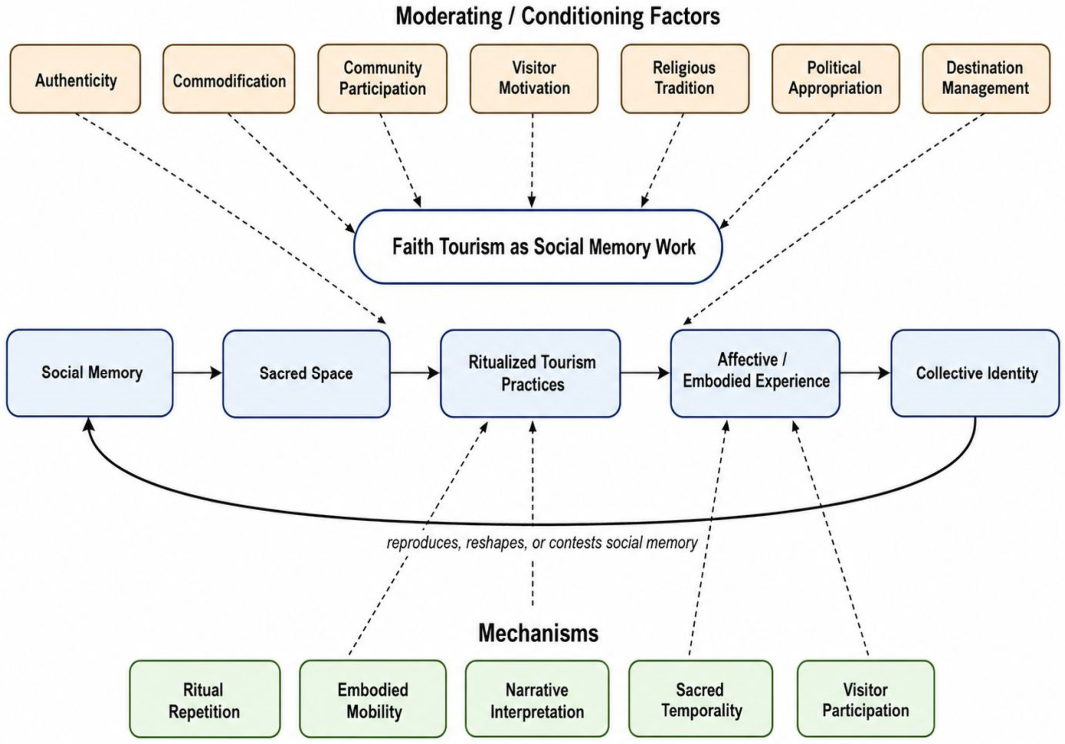
When all the approaches examined throughout the article are brought together, a tightly interconnected four-part conceptual framework emerges that explains the dynamics of faith tourism as memory, space, tourism, and identity. In this integrated structure, memory is the fundamental source containing knowledge of the past and social values. Sacred spaces are positioned as physical carriers where this abstract memory is embodied, preserved, and made visible. Tourism is the active tool that connects individuals with these memory spaces, offering them a physical and emotional experience that enables the active recollection of the past. Ultimately, the continuous interaction of these three elements (memory, space, and tourism) nourishes and shapes the sense of belonging, or identity, of both the individual and society. This central framework demonstrates why faith tourism is not merely a personal ritual related to faith, but a vital sociological phenomenon where collective consciousness is constructed through spatial experience. The conceptual framework of social memory, sacred space, and collective identity is presented in
Figure 1, which points out faith tourism as social memory work, mechanisms, and moderating conditions.
Solid arrows indicate the main directional process through which social memory is materialized in sacred space, activated through ritualized tourism practices, embodied in visitor experience, and fed back into collective identity. Dashed arrows indicate mechanisms and moderating conditions that shape whether faith tourism preserves, transforms, contests, or commodifies social memory.
Therefore, the framework should be understood not as a simple thematic map, but as a set of directional and conditional relationships. Social memory provides the symbolic narratives through which the sacred space acquires meaning. The sacred space materializes and stabilizes these narratives. Faith tourism activates these narratives through movement, ritual, interpretation, and affective experience. These activated experiences, in turn, reinforce belonging, and continuity. In some cases, they supply feedback to the collective identity. The model is also dependent on regulatory conditions such as authenticity, commodification, visitor motivation, community participation, religious tradition, political appropriation, and destination management. These conditions determine whether faith tourism will preserve memory, transform it, or reduce it to a simplified tourism product.
These regulatory conditions require special attention because faith tourism does not operate uniformly within different religious traditions or cultural contexts. Theological differences shape what is remembered, which rituals are considered legitimate, and how sacred narratives are interpreted by visitors and host communities. Institutional structures such as religious authorities, heritage institutions, tourism organizations, and local governments influence which memories are legitimized, displayed, preserved, or commercialized. Similarly, cultural contexts and visitor motivations determine whether encounters with sacred places are experienced as pilgrimage, heritage tourism, nostalgia, identity search, education, or leisure experience. Therefore, these variables should be considered not as external limitations of the framework, but as conditioning elements that enable, limit, or transform the social memory work of faith tourism.
4. Conclusions
The rise of the experience economy and the increasing search for experience and authenticity by tourists make it important to investigate the intersection points of tourism and social memory. In addition to the link between tourism and memory, the connections between both individual and collective narratives are far more complex and multifaceted. These issues have revealed a neglected area of research that deserves more academic attention. More useful theoretical models need to be developed in these areas (
Marschall, 2012).
This review examines the relationship between faith tourism, social memory, sacred space, and collective identity. The study’s central argument is that faith tourism can be understood as a form of social memory work where sacred narratives are embodied in space, activated through ritualized mobility and visitor interpretation, and linked to the formation of individual and collective identities.
The theoretical contribution of the article lies not in claiming an entirely new relationship between memory, religion, and tourism, but in organizing these relationships within an integrative and conditional analytical framework in the context of faith tourism. This conceptual perspective indicates that visitors become temporary participants in collectively constructed narratives. The article supports the view that tourism can function as a meaningful cultural practice. Faith tourism also advocates the sustainability of intangible dimensions, not solely the tangible ones.
The article does not merely reaffirm the meaningfulness of sacred sites. It identifies how sacred sites, ritualized movement, narrative interpretation, and bodily experience function together as memory work. Thus, it provides a framework that allows future empirical studies to examine faith tourism not merely as spiritual travel or heritage consumption, but as a structured process in which collective memory is preserved, negotiated, and at times commodified. Instead of repeating existing knowledge, this review reveals a clear theoretical pattern. Faith tourism acts as the functional mechanism that translates abstract social memory and physical sacred spaces into the active reconstruction of collective identity. This review offers a new analytical viewpoint for future empirical research to evaluate tourist experiences not simply as spiritual travels, but as structured memory work.
The study stresses the constructive role of faith tourism in sustaining social memory when managed with symbolic sensitivity. Through integrating social memory theory with tourism studies, this article highlights faith tourism not simply as an economic phenomenon, but as a socially embedded practice that determines how societies remember, interpret, and transmit their past. At the same time, this framework should not be read as an idealized narrative of faith tourism. Religious sites are increasingly being incorporated into tourism economies, and this inclusion can reshape sacred meanings through commercialization, standardization, and selective representation. Tourism institutions, destination managers, religious authorities, and political actors may support some narratives while marginalizing others. Consequently, faith tourism can preserve collective memory. However, it can also shape memory, simplify complex belief systems, or transform sacred practices into marketable symbols. Therefore, issues of authenticity, representation, power, and the tourist gaze should be central to the ethical management of faith tourism.
Significant ethical issues concerning authenticity, representation, and power must be questioned in conjunction with this change. Which memories are highlighted is often not decided impartially. The priorities of tourism institutions can come to the forefront at this point. The commercialization of memory can reduce complex belief systems to symbolic resources. The symbolic integrity of sacred places can potentially be eroded. Tourism practices must not fail in respect for faith. The ideas of residents living in the area should be taken into consideration.
This approach also has practical implications. For destination managers, religious institutions, and policymakers, faith tourism should be considered not merely as an economic or promotional activity, but as a cultural process concerning the preservation, interpretation, and transmission of sacred narratives. Therefore, the management of faith tourism must consider the tensions between authenticity, community participation, religious sensitivity, institutional representation, and commercialization. From a practical perspective, the study suggests that destination managers and policy-makers should design faith tourism experiences that prioritize meaning, interpretation, and emotional engagement. Collaborative practices involving local communities and religious institutions are particularly crucial for safeguarding the symbolic integrity of sacred spaces while enhancing visitor understanding and satisfaction.
This study has several limitations. As a conceptual narrative review, it does not offer an empirical analysis of tourist experiences, stakeholder perspectives, or destination practices. Therefore, the proposed framework should be understood as an intuitive/interpretive model, not a universally applicable explanation for all religious traditions. Faith tourism can operate in different ways within different pilgrimage systems, sacred geographies, visitor motivations, political contexts, and local community structures. Furthermore, because the analysis relies on an interpretive synthesis rather than a reproducible systematic review protocol, its claim to encompass the entire literature is limited. The discussion remains general and devoted to the intersection of the mentioned conceptions. It does not differentiate systematically between religious traditions, destination types, or visitor motivations. Eventually, there exist limitations in the ability to assess how memory processes are actually perceived, enacted, and negotiated by tourists in real-world contexts. This situation is due to the reliance on theoretical synthesis.
Future research should empirically test this framework and conduct comparative studies across different religious traditions, cultural contexts, visitor profiles, and institutional arrangements. In particular, how theological differences, visitor motivations, heritage policies, and destination management strategies influence the direction and intensity of social memory studies should be examined in more detail. Such research can foster a more contextual and critical understanding of how faith tourism operates at the intersection of memory, space, and identity in contemporary societies.
Future research should therefore incorporate qualitative and quantitative empirical methods to examine how faith tourism experiences shape individual and collective memory, how different religious contexts influence memory transmission, and how destination management practices affect the sustainability of memory landscapes.