Review

Metaverse Festivals Beyond Overtourism: Digital Transformation of Cultural Events Towards Accessibility, Cultural Engagement and Sustainable Tourism Policy


by
Nansy Kouroupi
1,2
1
Les Roches Global Hospitality Education, 3963 Crans Montana, Switzerland
2
Department of Economics, University of Thessaly, 38221 Volos, Greece
Tour. Hosp. 2026, 7(2), 41; https://doi.org/10.3390/tourhosp7020041
Submission received: 23 December 2025 / Revised: 18 January 2026 / Accepted: 3 February 2026 / Published: 9 February 2026
(This article belongs to the Special Issue Tourism Event and Management)

Abstract

Cultural festivals have long been anchored in co-located, resource-intensive events, which increasingly raises questions about who can participate, at what environmental cost and with what consequences for cultural integrity in destinations facing overtourism. This paper examines how metaverse-based, metaverse-adjacent and hybrid festival configurations may reconfigure festival tourism by reshaping accessibility, cultural engagement and environmental performance, and considers the implications for governance and policy. Drawing on a narrative literature review of academic and institutional sources published mainly between 2010 and 2025, it synthesises work on digital transformation, virtual and hybrid events, accessible tourism, digital inequality, overtourism and sustainable festival management. The paper offers a structured, critically informed synthesis and a set of propositions intended to guide future empirical and theoretical research on metaverse applications in tourism and hospitality. The review suggests that “metaverse-based” festivals can ease geographical, financial and some physical constraints for some groups, widen participation for underserved groups and support new forms of cultural preservation and co-creation, while also risking deeper digital inequalities and renewed concerns about cultural commodification, data governance and authenticity. Environmentally, virtual participation may reduce travel-related emissions and local crowding when it substitutes for physical attendance, while shifting impacts towards energy-intensive digital infrastructures and device lifecycles.

1. Introduction

Cultural festivals have long served as platforms for the collective celebration of culture, arts and values. They range from music festivals such as Glastonbury, to carnivals like Rio Carnival, and cultural biennales such as the Venice Biennale, which combine performance, spectacle and collective cultural celebration. Traditionally, such festivals were very much associated with the geographical region and people both local and international would have to attend the festival physically. However, with the increase in globalisation, these events have grown in size and complexity, drawing ever-larger audiences and placing increasing demands on infrastructure, environmental resources, and access (Laing & Frost, 2010).
A growing body of work on overtourism underscores why this reconfiguration of festivals matters for destinations already under pressure. Overtourism is increasingly used to describe situations where tourism intensity undermines environmental quality, resident well-being and visitor experience, often in urban and heritage settings that host major events and recurring festivals (Gössling et al., 2020; Mihalič, 2020; Nilsson, 2020; Mananda et al., 2025). Policy reports similarly frame crowding, congestion and tourism-related protest as symptoms of deeper structural imbalances between tourism growth, carrying capacity and governance arrangements (World Tourism Organization et al., 2018). Recent studies show that festivals can act both as catalysts of overtourism and as focal points for community resistance to tourism saturation, highlighting tensions around public space, housing and cultural authenticity (de Quadros et al., 2024; Duignan et al., 2022). By examining “metaverse-based” and hybrid cultural festivals, this paper therefore speaks not only to questions of digital innovation, but also to ongoing debates on how destinations might relieve pressure on overstretched sites, redistribute forms of participation and experiment with alternative models of access in contexts where overtourism has become a critical concern.
Over the past few decades, the advent of the digital era has redefined many ways through which people engage in cultural practices. With the help of social networks, streaming services, and applications, users have been able to consume cultural content from a distance, and social media and digital platforms have become new channels for cultural engagement (Boyle et al., 2024). Even as digital platforms have expanded how cultural content is produced and consumed, most festivals have remained anchored in co-located settings. The COVID-19 disruption (from early 2020) accelerated experimentation with remote and hybrid formats, as organisers sought to maintain cultural programming under restrictions on travel and mass gatherings (Kouroupi & Metaxas, 2023). As a result, many festivals expanded online delivery (e.g., streaming, platform-mediated interaction, XR showcases), prompting renewed debate about whether digital participation can widen access while also reshaping cultural engagement and environmental burdens (Boyle et al., 2024; Massi et al., 2021). This shift brought into focus the vision of a new blended (or even a completely online) model that can loosen some geographic constraints for some groups and could still provide cultural interaction.

Research Question and Paper Objectives

In light of this context, the key question directing this paper is “In what ways can the metaverse reconfigure global festivals to enhance accessibility, cultural engagement, and sustainability?”. This question goes beyond the technical feasibility of hosting festivals in immersive environments to examine how such formats may reconfigure participation, cultural meaning-making, and sustainability claims within festival tourism.
To operationalise this question, the review addresses five linked sub-questions. First, which barriers to participation can “metaverse-adjacent” festival formats realistically lower, and which barriers are likely to remain or be reshaped into digital forms (Darcy, 2010; Darcy et al., 2020; UNWTO, 2016). Second, how do these formats change cultural engagement, including questions of authenticity, co-creation, and cultural integrity across contexts (Appadurai, 1996; Buhalis & Sinarta, 2019; Zhang et al., 2019). Third, what sustainability pathways are plausible, and how should claims about local footprint reduction be separated from broader footprint shifts into digital infrastructures and associated energy demand (Gössling et al., 2020; UNWTO, 2018; Zhao & You, 2023). Fourth, what governance and policy arrangements influence accessibility outcomes, value capture, and ethical risks in platform-mediated cultural participation (Dwivedi et al., 2022; European Parliament, 2018; OECD, 2020). Fifth, under what conditions can virtual and hybrid participation substitute for physical travel in ways that could relieve crowding pressures, rather than stimulate additional demand (Guttentag, 2010; Koens et al., 2018; Tussyadiah et al., 2018).
The review pursues three objectives. First, it examines how metaverse-adjacent and hybrid configurations may lower some participation barriers linked to cost, distance, and on-site mobility, while also generating new digital exclusions. Second, it synthesises how immersive and platform-mediated formats may reshape cultural engagement, including authenticity, co-creation, and cultural integrity. Third, it evaluates sustainability claims by distinguishing between potential local footprint reductions (where substitution occurs) and broader lifecycle impacts and rebound effects.
Conceptually, this article brings metaverse and extended reality debates in tourism and hospitality (Buhalis et al., 2023; Dwivedi et al., 2022; Yung & Khoo-Lattimore, 2019) into dialogue with accessible tourism and digital inequality research (Darcy, 2010; Darcy et al., 2020; Gonzales, 2016; Helsper, 2021; van Deursen & van Dijk, 2018) and long-standing work on sustainable festivals and destination decarbonisation (Laing & Frost, 2010; Mair & Laing, 2012; OECD, 2020; UNWTO, 2018).
Methodologically, the article employs a narrative literature review of peer-reviewed and high-quality institutional sources published mainly between 2010 and 2025, following established guidance for integrative narrative synthesis in emerging and interdisciplinary fields (Baumeister & Leary, 1997; Ferrari, 2015). The article is structured as follows: the next section clarifies how “metaverse-based” cultural festivals are conceptualised in relation to tourism, events and digital transformation. This is followed by a brief account of the narrative review design. The core analytical sections examine, in turn, accessibility and inclusion, cultural engagement and environmental performance in metaverse and hybrid festival configurations. The conclusion outlines theoretical and practical implications and advances a cautious agenda for future research and policy.
To ground this conceptual analysis, the article draws on three high-profile examples that experimented with “metaverse-adjacent” formats during the COVID-19 pandemic: SXSW Online, Tomorrowland Around the World and Venice Film Festival’s VR section, Venice VR Expanded. Cases were selected for global visibility, genre diversity, distinctive metaverse-adjacent configurations, and the availability of sufficiently detailed public documentation to support cross-case comparison.
These cases are not treated as comprehensive empirical evaluations, but as illustrative instances that reveal how different segments of the festival sector have begun to translate co-located experiences into virtual and extended reality environments. In line with emerging research on virtual music festivals and XR-based exhibitions, they highlight both the potential of digital infrastructures to widen participation and diversify cultural engagement, and the persistent challenges associated with liveness, authenticity, digital inequality and environmental performance (Bossey, 2022; Ceuterick, 2021; Gallarza et al., 2023; Green, 2025; Martínez-Cano, 2023). The cases are revisited in the analysis to exemplify how the broader themes of accessibility, cultural engagement and sustainability manifest in concrete festival settings.
For tourism and hospitality policy agendas, these questions are not only technological but also institutional. International organisations and national governments increasingly frame digital transformation, accessible tourism and decarbonisation as intertwined priorities, yet policy guidance on how to integrate immersive and metaverse infrastructures into destination strategies remains limited (OECD, 2020; UNWTO, 2016, 2018). By focusing on cultural festivals as a highly visible and policy-relevant segment of event tourism, this paper offers a lens through which destination authorities, cultural ministries and festival funders can consider whether, and under what conditions, “metaverse-based” formats contribute to objectives such as accessibility, overtourism mitigation and emissions reduction, and where new regulation, coordination or public investment may be required.

2. Theoretical Framework

2.1. The Role of the Metaverse in Reconfiguring Festivals

Virtual and augmented reality, 3D worlds and digital environments are increasingly converging in what is termed the metaverse, which is emerging as a significant platform for cultural festivals. The metaverse is often referred to as a continuous, virtual, and synchronous environment in which users can directly engage with avatars, objects and places. Unlike typical Web 2.0 platforms that provide content in a more or less static manner, the metaverse provides an active, realistic experience of many aspects of participation.
In this digital space, cultural festivals can be conducted in substantially different ways. The metaverse can transform such occasions into more flexible and open formats that allow people to attend beyond the physical space limitations of a venue (Mele & Russo-Spena, 2025). The use of the metaverse may reduce, particularly where substitution occurs, the barriers of travel and physical attendance to such events, making it easier for people from distant, less privileged or economically challenged areas to be part of global cultural events. Furthermore, the virtual environment is an opportunity for artists, performers, and cultural organisers to try out new formats of performance, using VR, AR, and real-time interactive content to enhance the audience’s experience.
This shift is sometimes presented as a sustainability opportunity, mainly because remote participation may avoid some travel emissions and reduce certain on-site materials. In festival settings, however, net environmental outcomes remain contingent: benefits depend on whether virtual attendance substitutes for a trip that would otherwise occur, and on the lifecycle burdens of streaming, data centres and end-user devices, including energy use and e-waste (Masanet et al., 2020; Cucchiella et al., 2015). For that reason, this paper treats sustainability impacts as conditional rather than automatic, and returns in Section 2.3 to the mechanisms and governance choices that shape when hybrid and metaverse-adjacent formats reduce, shift or amplify environmental pressures.
However, the metaverse is not only concerned with enhancing accessibility and sustainability, but also constitutes a broader socio-technical development with potentially far-reaching implications. This interactivity provides new opportunities for cultural participation in this digital environment (Huggett, 2020). Users can engage with artificial replicas of artists, engage in virtual art classes, tours of 3D art pieces, or even contribute to aspects of the festival, enhancing the interactivity and open dialogue. Such level of engagement enhances the cultural interaction (Zhang et al., 2019; Wu et al., 2022) and promotes the sustainable management of the intangible cultural assets in a creative manner. Virtual representations of traditional performances or interactive displays facilitate the preservation and transmission of cultural practices that might otherwise be inaccessible to a worldwide audience (Huggett, 2020; Wu et al., 2022).

2.2. Digital Transformation Theory

Digital Transformation theory (Agarwal et al., 2010; Matt et al., 2015; Rogers, 2016) can also be used to explain the implementation of a new technology, such as the metaverse, into cultural festivals. This theory when applied into festivals, posits that the amalgamation of digital and physical realms transforms experiences, transitioning festivals from conventional, in-person formats to immersive virtual versions (Massi et al., 2021; Boyle et al., 2024).
Metaverse discourse can be read as one expression of wider digital transformation in events, in the sense that it imagines persistent, shared environments through which festivals can extend participation beyond a single place and time. In this framing, virtual or hybrid festival formats may broaden cultural reach and reshape audience participation, although the scale and distribution of these benefits depend on platform design, governance choices, and uneven access to devices and connectivity (Dwivedi et al., 2022; Mele & Russo-Spena, 2025). Rather than assuming a uniform democratisation of access, it is more defensible to argue that some barriers linked to distance, cost, or on-site mobility may be reduced for some groups, while other barriers are reconfigured into digital forms of exclusion (de Reuver et al., 2018).
The metaverse also fosters co-creation, where people who attend the festival are also creators of what happens. According to Grappi and Montanari (2011), the festival participants’ emotional reactions and perceived pleasure affect their loyalty to festivals. Whereas in virtual context of the interactions these are even heightened because the attendees can not only interact with the content, but with each other, thus building memories that connect them to the festival and its location (Zhang et al., 2019).
However, in the contemporary digital context, such transitions question the authenticity. While spatial authenticity is usually associated with real-world physical spaces, virtual environments create “phygital” experiences that engage both spaces, physical and digital (Kouroupi, 2025). This merge can respect and preserve culture, while accepts and promotes innovation (Mele & Russo-Spena, 2025). This balance is key in retaining the proven and tried traditions whilst also being able to tap into the new world, global audiences and international markets.
The economic impact of this transformation is notable. Festivals are key drivers of tourism in local economies, and virtual expansion can attract new sponsors and partnerships, offering additional funding and resources (Hager & Sung, 2011; Kouroupi & Metaxas, 2024). This increased revenue allows festivals to improve their offerings while boosting visitor experiences.
Another important factor that can be mentioned in relation to digital transformation is sustainability. Virtual festivals may at a level reduce travel-related emissions and on-site resource use, compared with large, fully co-located events, although they also depend on energy-intensive digital infrastructures whose impacts need to be considered (Laing & Frost, 2010). Hybrid models may contribute to sustainability goals by reducing some forms of travel demand and onsite material throughput, but the net effect is likely to be context-dependent and should be treated as an empirical question rather than an intrinsic outcome of digitalisation (Collins & Cooper, 2017; Mair & Laing, 2012).

2.3. Sustainability and the Virtual Shift

Sustainability is commonly framed as the interdependent pursuit of environmental integrity, social equity, and economic viability. In festival contexts, this lens highlights both the impacts generated by event production and travel, and the governance choices that determine who benefits and who bears the costs. “Metaverse-adjacent” and hybrid festival formats may widen the design space for sustainability because they can reduce certain forms of material intensity, but the direction and scale of any net benefit is conditional.
A first potential pathway concerns local footprint reductions. Where remote participation substitutes for, rather than supplements, physical attendance, virtual or hybrid formats may reduce, particularly where substitution occurs, some travel-related emissions and destination-side pressures associated with crowding, accommodation, and on-site service provision. This is plausible in principle, particularly for long-haul visitors, but it depends on how organisers structure access and pricing, how audiences respond, and whether digital participation is positioned as a distinct experience rather than a teaser for future travel. Claims about environmental improvement should therefore be framed as contingent and context-specific, rather than as automatic outcomes of digitalisation (Go & Kang, 2022; Kouroupi & Metaxas, 2023; Laing & Frost, 2010).
A second pathway concerns footprint shifting rather than footprint elimination. The environmental burdens associated with physical travel and on-site consumption may be partially displaced to the digital infrastructures that enable “metaverse-adjacent” participation, including data transmission, device production and charging, and platform operations. These trade-offs become more salient as immersive formats rely on higher-resolution media, persistent 3D environments, and longer engagement times. For this reason, sustainability assessment in “metaverse-adjacent” festivals should separate claims about reduced travel and on-site waste from the energy and material demands embedded in devices and digital services, and it should treat “virtual” impacts as distributed rather than negligible (Boyle et al., 2024; Nleya & Velempini, 2024).
A third pathway relates to rebound and induced demand. Even where digital formats reduce the intensity of a single event instance, lower access barriers can expand the total market, stimulate additional consumption, or increase future intention to travel, which may offset local savings. This possibility is particularly relevant for globally visible cultural events, where virtual reach can function as marketing and community building as well as access provision. The policy-relevant question is therefore not whether metaverse formats are sustainable by default, but under what design and governance conditions substitution is more likely than complementarity or induced demand.
In this context, Zhao and You (2023) provide a useful, but necessarily indirect, reference point. Their argument about potential emissions reductions from metaverse use is based on economy-wide modelling rather than festival-specific evidence, so it should be interpreted as indicative of possible system-level effects under particular assumptions, not as a direct estimate of festival impacts. Translating such projections to festivals requires additional, context-specific evidence on travel substitution rates, audience behavioural responses, and the lifecycle impacts of the relevant devices and digital services (Zhao & You, 2023).
Beyond footprint questions, the metaverse may support sustainability-oriented governance and practice in more qualitative ways. Digital platforms can enable alternative forms of programming, experimentation with lower-waste marketing and ticketing processes, and new modes of stakeholder coordination, which may support sustainability goals if they are embedded into organisational routines rather than treated as peripheral. For example, virtual ticketing and digital merchandise can reduce some material throughput, and platform-enabled value co-creation may support more adaptive business models, although the sustainability relevance of co-creation depends on how benefits and responsibilities are distributed among stakeholders (Buhalis et al., 2023; Boyle et al., 2024; Kouroupi, 2025).
Virtual environments may also be used for experiential sustainability communication. Immersive storytelling and simulation can make environmental issues more tangible, and some evidence suggests that immersive experiences can shape attitudes and intentions. Even so, behavioural spillover from virtual learning to sustained real-world practice remains context-dependent and should be framed cautiously, particularly in festival settings where entertainment and consumption logics may compete with educational aims (Asad et al., 2021).
Taken together, sustainability theory helps organise the claim that “metaverse-adjacent” festivals may contribute to sustainability, but primarily as a conditional set of pathways. Potential local reductions in travel and destination pressure need to be assessed alongside shifted impacts to digital infrastructures and the risk of rebound effects. This implies that credible sustainability claims in this area require careful boundary setting, transparent assumptions, and, where possible, lifecycle-aware evaluation rather than blanket assertions of environmental benefit (Nleya & Velempini, 2024; Zhao & You, 2023).

2.4. Conceptual Positioning: “Metaverse-Based” Cultural Festivals

The term “metaverse” is used loosely in both technology and tourism debates. In practice, it can refer to anything from livestreamed festival broadcasts to XR exhibitions and fully immersive virtual worlds (Dwivedi et al., 2022; Lee et al., 2021). To avoid conceptual drift, this paper reserves the term “metaverse festival” for persistent, multi-user 3D environments with ongoing social interaction and revisitable cultural content. Formats that include immersive or platform-mediated elements but do not meet this threshold are treated as “metaverse-adjacent”. They are analysed here as transition pathways, with attention to what they enable, what they constrain, and what they imply for governance, rather than being presented as fully realised metaverse festivals (Dwivedi et al., 2022; Kouroupi & Metaxas, 2023).
Within this boundary, “metaverse-based” cultural festivals are understood as curated, time-bounded cultural events whose core programme is staged in persistent, three-dimensional, multi-user virtual environments, often alongside physical venues or parallel on-site activities. This aligns with interdisciplinary accounts that frame the metaverse as an evolving socio-technical assemblage of immersive, networked and potentially interoperable virtual spaces, rather than a single platform or product (Buhalis et al., 2023; Dwivedi et al., 2022; Hollensen et al., 2023). It also builds on tourism and event research that distinguishes between on-site, hybrid and fully virtual formats while foregrounding experience quality, co-presence and value co-creation as central to how events generate meaning and value (Guttentag, 2010; Tussyadiah et al., 2018; Yung et al., 2022; Yung & Khoo-Lattimore, 2019).
This framing treats metaverse-based cultural festivals not as technological novelties, but as cultural infrastructures shaped by wider agendas around digital transformation, inclusion and sustainability in tourism and culture (Bekele & Raj, 2025; OECD, 2020; UNWTO, 2016, 2018). Three research branches are particularly relevant. First, accessible tourism research shows that equitable participation depends on information access, mobility, infrastructure and service culture across the visitor journey, not simply on the availability of a digital alternative (Darcy, 2010; Darcy et al., 2020; Suárez Henríquez et al., 2022; UNWTO, 2016). Second, digital inequality studies demonstrate that device quality, connectivity, ongoing costs and digital skills condition who can meaningfully use online services and who is left at the margins (Gonzales, 2016; Helsper, 2021; van Deursen & van Dijk, 2018). Third, festival sustainability research indicates that impacts are often concentrated in audience travel, energy use, materials and waste, but that outcomes can be improved through careful design choices and governance arrangements (Laing & Frost, 2010; Mair & Laing, 2012; Niñerola et al., 2019). Taken together, these strands position metaverse-based and metaverse-adjacent festivals as useful “stress tests” for how cultural tourism may evolve under accelerating digitalisation and tightening climate and capacity constraints.
To prevent conceptual drift in the sections that follow, Table 1 provides a boundary typology that distinguishes livestreamed online festivals, XR exhibitions, platform-based 3D event worlds, hybrid festival configurations and fully metaverse-based festivals. This typology also clarifies why some formats are treated here as metaverse-adjacent and therefore analysed as transition pathways rather than as realised metaverse festivals (Dwivedi et al., 2022; Hollensen et al., 2023).

3. Methodology

3.1. Narrative Literature Review (NLR) Approach

This paper adopts a narrative literature review (NLR) as its principal methodological approach. Narrative reviews are particularly well suited to emerging, conceptually complex topics because they prioritise interpretation, theoretical integration, and critical questioning over exhaustive coverage or quantitative aggregation of effects (Baumeister & Leary, 1997; Sukhera, 2022).
In line with arguments that narrative and systematic reviews should be regarded as methodologically distinct but complementary forms of knowledge synthesis, the NLR here is used to deepen understanding rather than to adjudicate narrowly defined causal questions (Greenhalgh et al., 2018).
The choice of NLR reflects both the interdisciplinary nature of the research question and the current state of the evidence. The metaverse-festival nexus cuts across technology studies, cultural and media studies, tourism, events management, and sustainability research. For such cross-cutting topics, rigid, highly standardised protocols may exclude relevant conceptual and practice-oriented work, including studies that are theoretically rich but methodologically diverse (Cronin et al., 2008; Jesson et al., 2011).
A narrative design also allows for the inclusion of carefully selected non-academic sources, such as policy reports and practitioner accounts, where these contribute substantively to understanding how metaverse-related technologies are being imagined and operationalised in festival contexts (Rumrill & Fitzgerald, 2001).
To maintain a clear evidentiary boundary, organiser webpages, trade press coverage, and other non-peer reviewed documents were used only to document descriptive case characteristics (e.g., access modalities, declared platform functionalities, and programme structures) and to support boundary-setting in an emergent terminology. They were not treated as evidence for analytical claims about accessibility outcomes, cultural engagement, sustainability impacts, or overtourism mechanisms, which are grounded in peer-reviewed scholarship (Ferrari, 2015; Grant & Booth, 2009; Sukhera, 2022).
The review is conceptual rather than empirical in orientation. It focuses on peer-reviewed journal articles, book chapters, and institutional reports published predominantly between 2010 and 2025, when metaverse-related infrastructures, virtual and hybrid festivals, and extended reality applications began to mature and to attract sustained academic attention. Guided by established descriptions of rigorous narrative reviewing, the process followed four overlapping steps: clarifying the review question and boundaries; identifying potentially relevant literature through iterative database searching and citation chaining; screening and selecting sources judged to offer meaningful conceptual or empirical insight; and synthesising recurring themes and tensions across the corpus (Ferrari, 2015; Rumrill & Fitzgerald, 2001).

3.2. Search Strategy and Data Sources

Following guidance on rigorous narrative and critical reviews, the search strategy was designed to be explicit enough for readers to judge its adequacy, while preserving the flexibility needed for an emergent and interdisciplinary field (Ferrari, 2015; Grant & Booth, 2009; Sukhera, 2022).
The review drew primarily on major abstracting and indexing databases, notably Scopus and Web of Science Core Collection, given their comprehensive coverage of tourism, hospitality, information systems, cultural studies, and sustainability research (Cronin et al., 2008; Pahlevan-Sharif et al., 2019). Database searches were executed between March and July 2025, with the final database run completed on 30th of July 2025. The database search targeted publications dated January 2010 to July 2025. Across Scopus and Web of Science, the combined retrieval was approximately 346 records prior to screening. These searches were complemented by targeted queries in Google Scholar, manual and digital screening of databases and key journals in tourism, events, and digital media, and specialist outlets that have begun to publish work on the metaverse and extended reality. In addition, on the industry and policy level, around 15 candidate industry or policy reports were initially identified through Google Scholar and targeted web searching, before selection against the quality and relevance criteria described below.
Search strings combined metaverse-related terms with terms related to festivals, culture, tourism, and sustainability, using Boolean operators and truncation. Search strings included:
-
TITLE-ABS-KEY (((metaverse OR “virtual world*” OR “extended reality” OR “virtual festival*”)) AND ((festival* OR “cultural festival*” OR “cultural event*”)));
-
TITLE-ABS-KEY ((“virtual festival*” OR “hybrid festival*” OR “virtual event*”) AND (touris* OR destination* OR overtourism OR crowding OR congestion));
-
TITLE-ABS-KEY ((“extended reality” OR XR OR VR) AND (“cultural participation” OR “cultural heritage” OR museum*) AND (governance OR policy OR ethics)));
-
TITLE-ABS-KEY ((“virtual festival*” OR (“hybrid” W/1 festival*) OR (“online” W/1 festival*) OR ((“virtual” OR online OR hybrid) W/2 (festival* OR “cultural event*”))); AND (touris* OR destination* OR “destination marketing” OR “place branding” OR visitor* OR “tourist experience”)).
These strings were combined and refined iteratively as familiarity with the literature increased, and backward and forward citation chaining from influential metaverse and virtual festival studies helped surface additional contributions in adjacent areas, such as virtual tourism, hybrid events, and digital heritage.

3.3. Screening, Inclusion Criteria, and Corpus Composition

Screening and selection procedures were guided by the overarching research question rather than a rigid protocol, but followed clearly articulated inclusion and exclusion criteria in line with contemporary guidance on transparent narrative reviewing (Ferrari, 2015; Greenhalgh et al., 2018; Sukhera, 2022).
Studies were included when they: (a) addressed the metaverse or closely related immersive, persistent virtual environments; (b) examined festivals, cultural events, or cultural heritage experiences (including hybrid and online formats); and (c) explicitly engaged with issues of accessibility, participation, cultural engagement, and or environmental implications. Contributions focusing solely on gaming, speculative finance, or generic virtual reality applications were excluded unless they offered conceptually transferable insights for festival design, governance, or audience experience. Only English-language publications were retained, which introduces a likely bias towards Global North scholarship that is acknowledged in the discussion.
Screening was conducted iteratively at title and abstract level, with full-text checks where eligibility was ambiguous. Because the review follows an integrative narrative synthesis logic, exclusions were recorded at a coarse-grained level (e.g., topic mismatch; non-festival setting; insufficient methodological transparency; non-scholarly format), rather than reported as an itemised PRISMA-style log; however, the key decision rules, search dates, and screening totals are documented to make the process reasonably auditable and to reduce narrative selectivity (Grant & Booth, 2009; Greenhalgh et al., 2018).
To strengthen transparency within the narrative approach, sources were appraised using three pragmatic criteria. First, relevance: the source needed to contribute materially to the review constructs (accessibility, cultural engagement, sustainability, governance, and overtourism-related mechanisms in virtual or hybrid festival settings). Second, credibility: peer reviewed outlets were prioritised, while non-academic sources were included only when produced by established organisations with clear mandates and traceable evidence bases. Organiser webpages, trade press coverage, and other non-peer reviewed documents were treated separately from the Scopus and Web of Science indexed evidentiary base and were used only for case documentation and boundary setting. Third, clarity of evidence: empirical papers were expected to specify data and method sufficiently for readers to judge plausibility, while conceptual papers were expected to state scope, assumptions, and argumentative logic.
Within these parameters, the final corpus comprised approximately fifty-eight (58) peer-reviewed journal articles and book chapters and four (4) industry or policy reports retained from an initial set of around fifteen (15) candidate reports identified via Google Scholar and targeted academic tools searching. Consistent with conceptually oriented narrative reviews in tourism and hospitality, this scale reflects an emphasis on theoretical saturation and interpretive depth rather than exhaustive enumeration (Baumeister & Leary, 1997; Pahlevan-Sharif et al., 2019).
The analysis relied on close, iterative reading rather than formal coding software. Studies were first grouped according to their primary focus (e.g., metaverse technologies, virtual festivals, cultural participation, accessibility, environmental sustainability) and then read comparatively to identify convergent and divergent claims, underlying assumptions, and recurring conceptual linkages. This approach is consistent with guidance that positions narrative reviews as vehicles for building synthetic, theory-informed accounts of fragmented evidence fields (Baumeister & Leary, 1997; Rumrill & Fitzgerald, 2001).
Particular attention was paid to how different strands of literature frame accessibility, cultural engagement, and environmental impact in digital and hybrid festival formats, and to the conditions they identify as enabling or constraining more equitable and sustainable outcomes.
Finally, the review acknowledges the inherent subjectivity and selectivity involved in narrative syntheses. Narrative reviews are vulnerable to risks such as non-transparent inclusion criteria, over-reliance on familiar sources, and unexamined normative commitments (Ferrari, 2015; Greenhalgh et al., 2018). To mitigate these concerns, the review uses iterative citation chaining across diverse disciplinary entry points to reduce over-reliance on a narrow set of familiar sources, makes its temporal focus, conceptual boundaries, and interpretive stance explicit, foregrounds areas of contestation alongside areas of convergence, and remains cautious in translating current evidence into strong normative claims. The aim is not to offer a definitive or exhaustive account, but to construct a transparent and critically engaged analytical narrative that clarifies how the metaverse is currently conceptualised in relation to cultural festivals and where the most salient empirical and theoretical gaps lie.

4. Accessibility, Cultural Engagement, and Sustainability in the Metaverse

4.1. Accessibility

Accessibility has long been a central concern in tourism and events, particularly in relation to disability, ageing populations and broader social inclusion (Darcy, 2010; Darcy et al., 2020; UNWTO, 2016). Yet, empirical work consistently shows that many cultural festivals remain difficult to access for people with mobility, sensory or cognitive impairments, as well as for those facing financial, geographic or caregiving constraints (Darcy, 2010; Suárez Henríquez et al., 2022). At the same time, the deepening digitalisation of tourism supply chains-from ticketing and information provision to live streaming and remote participation-has introduced new layers of infrastructural dependence (Bekele & Raj, 2025; OECD, 2020). Against this backdrop, the metaverse raises a double-edged question: to what extent can immersive virtual festivals remove long-standing barriers related to mobility, safety and cost, and to what extent might they introduce fresh exclusions rooted in device ownership, connectivity, maintenance and digital skills (Gonzales, 2016; Helsper, 2021; van Deursen & van Dijk, 2018). This section examines metaverse festivals through the combined lenses of accessible tourism and digital inequalities.
To avoid conflating distinct forms of exclusion, this section treats accessibility as operating across two analytically separable layers. The first concerns participation constraints that shape festival attendance generally (economic, geographic, and time/care constraints), which hybrid and digital formats may partially relax by reducing travel and accommodation burdens. The second concerns impairment-related accessibility, where barriers emerge from the interaction between bodies, environments, and service systems (physical, sensory, and cognitive accessibility). In festival contexts, this layer is shaped by venue design, crowd density, sensory intensity, communication formats, and staff capability, among other factors (Darcy, 2010; Darcy et al., 2020). Importantly, metaverse-adjacent participation introduces a cross-cutting ‘digital accessibility’ dimension (device quality and maintenance, connectivity, platform usability, language options, and ongoing costs), which is unevenly distributed and can reproduce inequality even when geographic distance is reduced (Gonzales, 2016; Helsper, 2012; van Deursen & van Dijk, 2018).
Table 2 summarises how six accessibility dimensions intersect with metaverse-adjacent enablers, digital barriers, and governance levers, to keep the discussion mechanism-led and policy-relevant (Darcy, 2010; Darcy et al., 2020; Gonzales, 2016; Helsper, 2021; OECD, 2020; UNWTO, 2016).
Metaverse-related participation can reduce some costs associated with physical attendance, particularly travel and on-site mobility burdens, but any accessibility gain is conditional rather than automatic. Accessible design features such as captioning, sign-language overlays, audio description, adjustable viewpoints, and customisable avatars may improve sensory and cognitive access for some users, yet they do not necessarily guarantee parity of experience across audiences. Whether these affordances translate into inclusion depends on platform design choices and the user’s ability to sustain access to suitable devices, connectivity, updates, and support networks, which digital inequality research shows are unevenly distributed across income, geography, age, and disability status (Darcy, 2010; Darcy et al., 2020; Gonzales, 2016; Helsper, 2021; UNWTO, 2016; van Deursen & van Dijk, 2018; Dwivedi et al., 2022).
Accessible tourism scholarship underscores that accessibility is a property of the entire tourism system, spanning pre-trip information, booking processes, transport, accommodation, on-site environments and staff attitudes (Darcy, 2010; Darcy et al., 2020; UNWTO, 2016). Substituting physical attendance with “metaverse-based” participation can, in principle, improve informational and sensory accessibility for some audiences-for instance, through captioning, sign-language overlays, audio description, adjustable viewpoints or customisable avatars that could reduce stigma (Guttentag, 2010; Tussyadiah et al., 2018; Yung & Khoo-Lattimore, 2019). Yet, digital inequality research shows that equitable use of such features depends on sustained access to appropriate devices, high-speed connectivity, software updates and local support networks (Gonzales, 2016; Helsper, 2021; van Deursen & van Dijk, 2018). Costs of hardware and data plans, the need to maintain and replace devices and the uneven distribution of digital skills systematically disadvantage low-income, rural and older users, including many disabled people (Gonzales, 2016; Suárez Henríquez et al., 2022). Unless organisers and policymakers explicitly address these structural gaps—through inclusive design standards, subsidised equipment schemes, community access points and targeted digital skills initiatives—metaverse festivals risk widening, rather than narrowing, participation divides within and across societies (OECD, 2020; UNWTO, 2016, 2018).
From a governance perspective, this implies that accessibility in the metaverse cannot be left solely to the discretion of individual festival organisers or platform providers. Accessible tourism research and digital inequality policy debates both point to the importance of system-level interventions, including public investment in broadband infrastructure, regulatory standards for accessible digital services, and targeted support for disabled and low-income users (Darcy et al., 2020; Gonzales, 2016; Helsper, 2021; OECD, 2020; UNWTO, 2016). Embedding metaverse festivals within these wider policy frameworks (for example, by linking public funding or cultural grants to compliance with accessibility guidelines and inclusive design principles), may be more effective than relying on voluntary, project-level initiatives alone.
Yet, accessibility gains are conditional rather than automatic. Digital participation can reduce some location-based constraints while simultaneously intensifying “maintenance” burdens: reliable devices, peripheral equipment, stable bandwidth, and recurrent subscription or data costs. These requirements matter because digital inequality is not only a question of initial access, but also of sustained, good-quality access and the capacity to convert connectivity into meaningful participation (Gonzales, 2016; van Deursen & van Dijk, 2018). A further implication is that accessibility features often cited as straightforward solutions (such as avatar embodiment, captions, or multilingual overlays), depend on platform design choices, content workflows, and governance priorities, and they may remain partial for users with sensory or cognitive access needs if they are implemented as optional add-ons rather than as default design principles (Darcy et al., 2020; Helsper, 2012). Accordingly, the accessibility potential of metaverse-adjacent festivals should be framed as contingent on design and governance, not treated as an intrinsic property of “virtuality”.
To overcome these challenges, it may be required to invest in digital infrastructure and technology education. Policy instruments could include private organisations, and cultural institutions to make sure that the targeted vulnerable groups have the necessary equipment and understanding to be able to participate in the metaverse. Thus, expanding affordable and reliable connectivity is a precondition for metaverse environments to support more equitable opportunities for cultural engagement.

4.2. Cultural Engagement

Cultural festivals have traditionally been theorised as place-based, time-bounded events that generate dense experiences of co-presence, liminality and collective meaning-making (Laing & Frost, 2010; Mair & Laing, 2012). The rapid diffusion of immersive media and virtual event platforms complicates this picture by enabling remote participants to experience performances, exhibitions and social interaction through avatars, 3D environments and real-time communication tools (Guttentag, 2010; Yung & Khoo-Lattimore, 2019; Yung et al., 2022).
Cultural participation is not only social but also spatial, because festivals produce place meanings through co-presence, movement, and the shared use of public and symbolic space (Appadurai, 1996; Green, 2025). By contrast, digital environments produce a different kind of space that is partly abstract (platform architecture and code), partly relational (networked communities), and still anchored to physical geographies through language, time zones, regulation, and uneven digital infrastructures (Boyle et al., 2024; Dwivedi et al., 2022). This matters because the same “metaverse-adjacent” format may support cultural connection in one context and cultural flattening in another, depending on whose spatial norms and cultural codes are embedded in design and governance (Appadurai, 1996; Ceuterick & Ingraham, 2021). Treating space as a cross-cutting variable helps explain why accessibility gains may be uneven and why cultural integrity risks cannot be reduced to individual preferences alone (Green, 2025; Dwivedi et al., 2022).
Tourism and marketing research on virtual reality suggests that carefully designed immersive environments can elicit spatial presence, emotional engagement and attitudinal change comparable to, and in some cases exceeding, conventional media (Tussyadiah et al., 2018; Buhalis et al., 2023; Hollensen et al., 2023; Kouroupi, 2025). At the same time, questions of authenticity, cultural authority and the commodification of heritage take on new forms when cultural content is curated and mediated through proprietary platforms and algorithmic interfaces (Dwivedi et al., 2022; UNWTO, 2018).
This section therefore examines how “metaverse-based” festivals redistribute cultural engagement between on-site and remote publics, and what this implies for co-creation, representation and cultural power.
Metaverse-related environments may provide additional channels for representing cultural heritage and widening interpretive access, especially where physical access is constrained by distance, cost, disability, or capacity limits. At the same time, digitisation does not automatically preserve cultural meaning or authority. It can shift control towards platform architectures and commercial logics, and it can intensify long-standing risks around cultural appropriation, misrepresentation, and uneven value capture if communities are not meaningfully involved in governance and content curation (Dwivedi et al., 2022; UNWTO, 2018; Ceuterick & Ingraham, 2021; Park et al., 2019; McIntosh & Prentice, 1999). For that reason, “preservation” is treated here as a plausible pathway that depends on governance conditions, rather than as an assured outcome of virtualisation.

4.2.1. Quadrant Implications (Expected Patterns)

  • Platform-led and low hybridity (fully virtual, high scale): Accessibility depends heavily on device quality, bandwidth and ongoing costs; value capture and data extraction risks tend to be higher; environmental burdens are more likely to shift towards infrastructure and devices unless constrained by efficiency and hosting choices (de Reuver et al., 2018; OECD, 2020; UNWTO, 2018);
  • Curator-led and low hybridity (platform-hosted showcases): Cultural stewardship is strengthened through programming control, but platform rules still shape data governance, visibility and monetisation; substitution effects for travel remain uncertain and may vary by audience segment and pricing (Dwivedi et al., 2022; UNWTO, 2018);
  • Institution-led and high hybridity (hybrid extensions of on-site festivals): Place anchoring and legitimacy are typically stronger (rights management, accessibility policy, curatorial standards), yet exclusions can persist if assistive features, language options and hybrid ticketing remain secondary (Buhalis et al., 2023; UNWTO, 2016);
  • Community-led and high hybridity (local or artist-led hybrid micro-festivals): Inclusion and cultural specificity may be stronger where governance is local, but resource constraints can weaken moderation, safeguarding and quality assurance; environmental outcomes depend on low-tech access routes and infrastructure choices (Dwivedi et al., 2022; OECD, 2020).
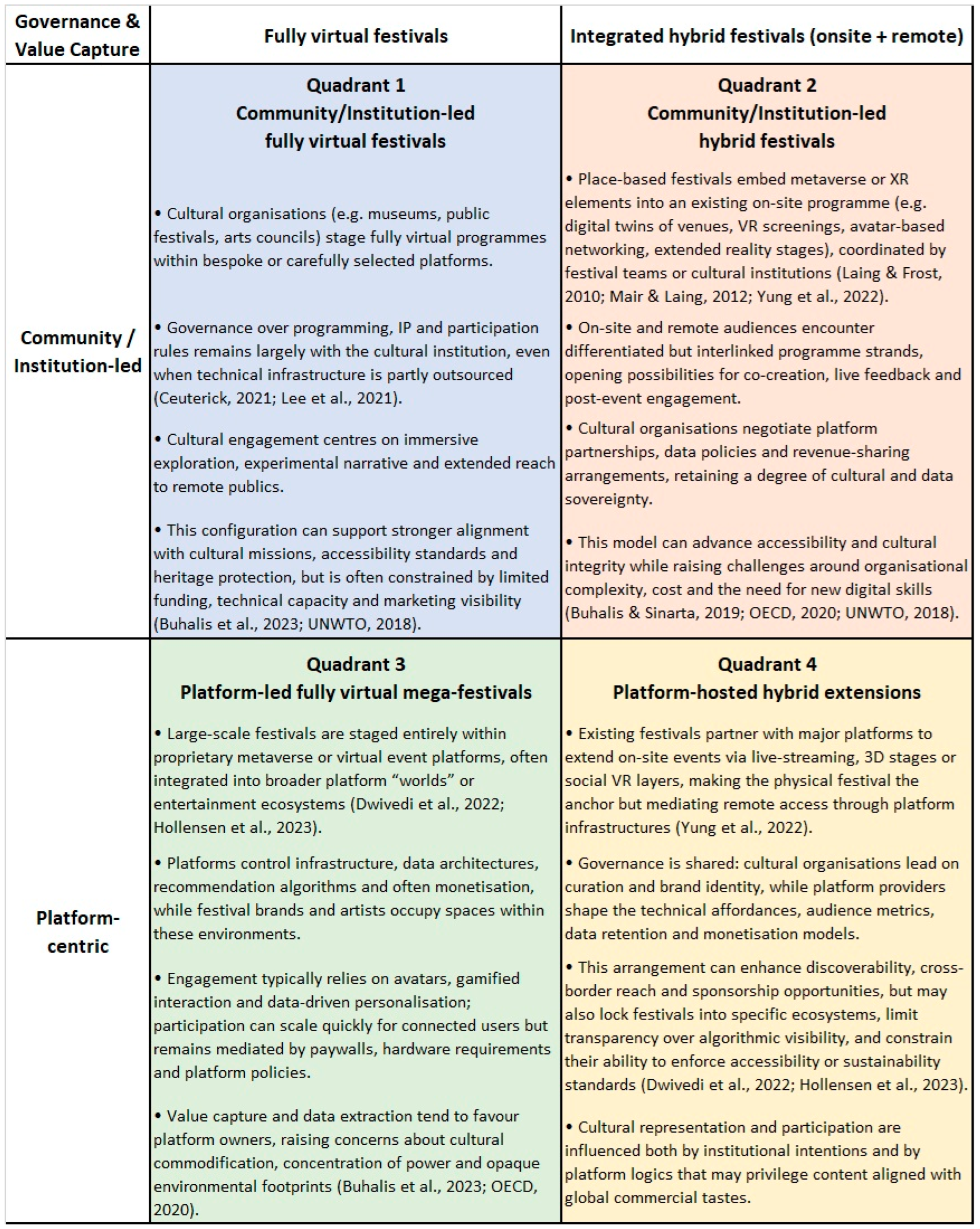
Figure 1 proposes an ideal-type map of “metaverse-based” cultural festival configurations along two intersecting dimensions: (1) governance and value capture, ranging from platform-centric models dominated by global technology firms to community- or institution-led models where cultural organisations retain strategic control; and (2) degrees of hybridity, ranging from fully virtual to tightly integrated hybrid formats that combine co-located audiences with immersive remote participation (Buhalis et al., 2023; Dwivedi et al., 2022; Hollensen et al., 2023; Yung et al., 2022). The four quadrants illustrate stylised configurations such as: platform-led, fully virtual mega-festivals; platform-hosted but curator-led virtual showcases; institution-led hybrid festivals where metaverse elements extend on-site programming; and community- or artist-led micro-festivals that leverage open or low-carbon virtual infrastructures. Spatial anchoring is also expected to vary across the quadrants: platform-led, low-hybridity formats tend to be more deterritorialised and governed by platform architectures, whereas higher-hybridity and curator or community-led configurations tend to retain stronger place anchoring through institutional narratives, local partnerships, and culturally specific participation rules, even when participation is partly remote (UNWTO, 2018; Dwivedi et al., 2022; Hollensen et al., 2023).
This ideal-typical mapping is not intended as an exhaustive classification, but as a heuristic to clarify how different socio-technical choices (around platform selection, data governance, revenue-sharing, interoperability and openness) could shape who can participate, whose cultural forms are foregrounded, and how risks and benefits are distributed (Dwivedi et al., 2022; OECD, 2020; UNWTO, 2018). It also highlights that questions of accessibility, cultural integrity and environmental performance are likely to vary across quadrants: for example, platform-led models may benefit from scale but amplify concerns about cultural commodification and data extraction, whereas community-led models may align more closely with local cultural agendas yet face resource and visibility constraints.
To make Figure 1 more operational, the quadrants can be read as predicting distinct governance “risk clusters”. In platform-led virtual formats, platform architectures tend to concentrate control over identity, moderation, data, and monetisation, creating strong value-capture asymmetries unless counterbalanced by clear boundary resources and accountability mechanisms (de Reuver et al., 2018; Ghazawneh & Henfridsson, 2013). In curator-led but platform-hosted formats, cultural integrity is often strengthened through programming control, yet data governance and commercial rules remain partially externalised to the host platform. In institution-led hybrids, legitimacy and stewardship are typically stronger (e.g., rights management, curatorial standards, accessibility policy), but the model can reproduce conventional exclusions if ticketing, language, or assistive features remain secondary. In community-led hybrids, participatory value may increase, yet content moderation, safeguarding, and quality assurance become more fragile. Across quadrants, the central governance question is not whether the format is “virtual” or “physical”, but where decision rights sit, and how those decision rights shape accessibility design, cultural stewardship, and the distribution of environmental burdens across travel and digital infrastructure.

4.2.2. Space and Geography Implications

Space and geography matter because festivals do not merely take place in locations; they actively produce place meanings through co-presence, movement, and the shared use of public and symbolic space (Laing & Frost, 2010; Mair & Laing, 2012; Quinn, 2005). “Metaverse-adjacent” formats introduce a layered spatiality in which the event is shaped by (i) physical geographies of hosts and audiences, including time zones, language, and regulatory regimes, (ii) infrastructural geographies, including connectivity, device access, and the energy systems that sustain data intensive participation, and (iii) platform architectures that script what kinds of interaction, visibility, and representation are possible (Ash et al., 2016; Kitchin & Dodge, 2011; Leszczynski, 2019; Dwivedi et al., 2022; Hollensen et al., 2023; UNWTO, 2018). Treating spatiality as a cross-cutting condition therefore helps explain why accessibility gains and cultural integrity risks may vary across the four quadrants in Figure 1 even when the headline technology appears similar, because the underlying geographies of code, infrastructure, and governance are not evenly distributed (Sheller & Urry, 2006).
In addition to preservation, the metaverse also fosters innovation in how culture is displayed and interacted with. Artists and curators can experiment with formats that would be impossible in the physical world, creating fully immersive environments that engage users through sight, sound, and touch (Lee et al., 2021). These innovations offer dynamic new ways for people to experience culture, blending traditional elements with cutting-edge technology to create multi-sensory, participatory experiences. However, such new forms of participation entail threats that are cultural imperialism and commercialization of cultures. When cultural events migrate into globally networked virtual environments, there is a risk that the specificities of particular cultures may be simplified or standardised to align with perceived global tastes. The desire to produce content that would appeal to the international audience may result in the distortion of cultural artefacts for commercial purposes, which may not be genuine (Lee et al., 2021; Dwivedi et al., 2022). Moreover, the manner in which culture is presented in the metaverse where cultural products are commercialized in the form of products or experiences causes concerns about who owns, controls, and benefits from culture where heritage is digitized (Buhalis & Sinarta, 2019).
Thus, when considering the metaverse as a nascent approach to experiencing and fostering cultures, it is important to foreground the unresolved issues, given the scale of the opportunities and risks involved. The hazards of cultural imperialism and commercialization point to the need to maintain cultural sensitivity and integrity in the design and governance of these virtual domains.

4.3. Sustainability

Environmental debates around festivals have traditionally centred on audience travel, energy use, material consumption and waste management, with travel-related emissions consistently identified as the largest single contributor to event footprints (Laing & Frost, 2010; Mair & Laing, 2012; Niñerola et al., 2019). In tourism more broadly, digital transformation is increasingly framed as both an enabler of low-carbon innovation and a growing source of energy demand and electronic waste (Bekele & Raj, 2025; OECD, 2020; UNWTO, 2018). “metaverse-based” festivals crystallise this tension: virtual attendance can reduce transport, accommodation and on-site resource consumption, yet depends on data centres, communication networks and user devices whose lifecycle impacts are unevenly understood and geographically dispersed (Buquicchio et al., 2024; Nleya & Velempini, 2024; Zhao & You, 2023). This section considers the conditions under which metaverse festivals might contribute to more environmentally sustainable festival ecologies, and where sustainability claims remain speculative or problematic.
From an environmental perspective, virtual and hybrid participation may reduce, particularly where substitution occurs, some on-site burdens associated with travel, temporary infrastructure, and festival waste, but the direction and size of any net benefit remains contingent on substitution rates, the carbon intensity of electricity, and device and data centre lifecycles. Even if local pressures ease, impacts can be displaced to digital infrastructures through increased data traffic and data centre energy demand, as well as to device manufacture and end-of-life e-waste streams (Masanet et al., 2020; Cucchiella et al., 2015). Recent assessments of virtual worlds emphasise that energy and climate implications depend on platform design, user behaviour, and accounting boundaries, and should not be assumed to be inherently low impact (Buquicchio et al., 2024). For festivals, this suggests that sustainability claims need to separate local footprint changes at the host destination and event site from broader footprint shifts and rebound effects, and that evaluation should build on established event sustainability and footprint approaches rather than on generic digital promises (Collins & Cooper, 2017; Mair & Laing, 2012).
At the same time, any environmental benefit is not automatic. Metaverse and XR experiences rely on energy-intensive digital infrastructures, including data centres and communication networks, particularly when delivering high-quality, real-time content (Masanet et al., 2020). The associated emissions depend on electricity mixes and efficiency trends, and should be considered alongside rebound effects and usage growth. In addition, the manufacture and disposal of devices, including VR headsets, raises concerns about resource depletion and e-waste (Cucchiella et al., 2015).
Recent modelling studies suggest that, under specific conditions, the expansion of metaverse applications could produce substantial emissions reductions by substituting high-carbon activities, including commuting, business travel and some leisure mobility. Zhao and You (2023), for instance, estimate that metaverse adoption in the United States could reduce cumulative greenhouse gas emissions by up to 10 Gt CO2e by 2050 through virtualisation of work, education and entertainment, assuming rapid decarbonisation of the electricity mix and continued efficiency gains in data centres and networks. In a different context, Nleya and Velempini (2024) argue that industrial metaverse applications can support emissions reductions via process optimisation, digital twins and predictive maintenance, while simultaneously emphasising that potential gains are highly sensitive to hardware lifetimes, rebound effects and system design choices. By analogy, claims that “metaverse-based” festivals are environmentally beneficial are plausible only when they evidently displace high-emission travel and material production, and when the digital infrastructures supporting them are powered by low-carbon energy and designed for efficiency.
Seen through the overtourism lens, the sustainability stakes of “metaverse-based” festivals extend beyond incremental efficiency gains to questions of how visitor pressure is spatially and temporally organised. Empirical work on festival and event footprints shows that concentrated visitor flows at specific sites generate substantial ecological impacts through transport, temporary infrastructure and waste (Collins & Cooper, 2017; Mair & Laing, 2012). At the same time, overtourism research demonstrates that destinations experiencing recurrent crowding, protest and perceived loss of liveability are often grappling with structural imbalances between tourism demand, carrying capacity and local governance (Koens et al., 2018; Mihalič, 2020). By enabling some forms of festival participation to be decoupled from physically saturated inner-city districts or heritage cores, metaverse and hybrid configurations may contribute to the dispersal strategies advocated in policy reports on overtourism, which emphasise spatial and temporal redistribution rather than simple growth constraints (European Parliament, 2018; World Tourism Organization et al., 2018). However, any such contribution will depend on whether virtual formats are deliberately integrated into destination-wide strategies for managing visitor pressure, or whether they merely supplement already intense on-site demand while adding new layers of energy use and digital infrastructure dependency (Mihalič, 2020; Seraphin et al., 2018).
At the same time, critical assessments of virtual worlds caution that immersive digital infrastructures are far from immaterial. The Shift Project’s recent report on virtual worlds shows that large-scale deployment of high-resolution, low-latency immersive services could significantly increase electricity consumption and associated emissions if demand is left unconstrained and networks are optimised solely for performance (Buquicchio et al., 2024). The report highlights, for example, that expanded use of bandwidth-intensive immersive applications can dramatically raise the energy intensity of mobile networks, especially if additional hardware is required to meet latency and quality expectations. In the festival context, any apparent environmental gains from possible reduced audience travel may therefore be assessed against the energy profiles of streaming, rendering and device use, as well as the e-waste generated by accelerated upgrade cycles (Nleya & Velempini, 2024). Rather than assuming that metaverse festivals are “green by default”, organisers and policymakers need to adopt explicit digital-sobriety strategies-such as capping resolution where appropriate, prioritising efficient coding and hosting, using renewable-powered data centres, and designing experiences that are compatible with longer-lived, lower-spec devices-if virtualisation is to translate into genuine reductions in lifecycle impacts (OECD, 2020; UNWTO, 2018; Buquicchio et al., 2024).
These considerations point towards a need for closer alignment between festival strategies, climate policy and digital policy. Destination authorities and cultural funders increasingly commit to national or local net-zero targets, yet few event guidelines explicitly address the energy and material footprints of immersive infrastructures (OECD, 2020; UNWTO, 2018). Integrating metaverse festivals into climate action plans, green event standards and public procurement criteria—for instance, by prioritising renewable-powered hosting, efficiency-optimised platforms and longer-lived devices—would help ensure that virtual and hybrid formats contribute to, rather than undermine, tourism decarbonisation objectives. At the same time, digital policy instruments, such as incentives for energy-efficient data centres and support for repair and recycling ecosystems, become part of the enabling environment for environmentally credible “metaverse-based” festivals.

5. Examples of Metaverse Festivals

The cases are selected as globally visible, well-documented experiments that span different festival genres and degrees of platform-mediated immersion, allowing the review to illustrate how “metaverse-adjacent” features are being assembled in practice. Selection was guided by three pragmatic criteria: public documentation and scholarly commentary sufficient to support transparent description; diversity of cultural and event formats (a media and creative industries festival, a large-scale music festival, and an immersive exhibition within an international film festival); and the presence of “metaverse-adjacent” design elements such as avatar-mediated interaction, 3D or XR environments, and platform-based social participation. They are not treated as fully “metaverse-based” festivals, but as boundary cases that clarify transition pathways and analytical limits (Ceuterick, 2021; Gallarza et al., 2023; Green, 2025; Dwivedi et al., 2022).

5.1. SXSW Online and Tomorrowland Around the World

SXSW Online and Tomorrowland Around the World exemplify how large-scale festivals experimented with “metaverse-adjacent” formats during the COVID-19 pandemic, while grappling with enduring questions of liveness, place and authenticity. Rather than isolated anomalies, these events sit within a broader shift towards virtual music festivals (VMFs), in which digital architectures seek to reproduce—and, at times, reimagine—the affective and social qualities traditionally associated with co-located gatherings (Green, 2025; Gallarza et al., 2023). SXSW’s 2021 online edition combined multi-track live-streamed conference and performance content with an extended reality (XR) environment, enabling remote attendees to access screenings, talks and networking functions via web, mobile and VR interfaces (SXSW, 2020; Hoffman, 2021). Tomorrowland Around the World, launched in 2020 as a fully virtual iteration of the Belgian electronic dance music festival, offered a 3D island with multiple stages, avatar-based navigation and digitally rendered scenography, explicitly framing the event as a festival “world” rather than a simple broadcast of performances (Machado et al., 2022; King, 2021). These platforms illustrate how online and metaverse-like environments can loosen some geographic and financial constraints for some groups, enabling international participation without the need for long-haul travel or on-site accommodation, and thus extending festival brands to audiences who might otherwise remain excluded.
From an experience perspective, research on VMFs suggests that such formats can generate meaningful value for audiences across both cognitive (e.g., musical content quality) and affective (e.g., enjoyment, escapism) dimensions, even when participation occurs from domestic spaces (Gallarza et al., 2023). At the same time, qualitative work on Splendour XR—an extended reality festival that similarly sought to reconstruct a physical site in a virtual environment—indicates that the translation of “liveness” and festival place into digital form remains contested and uneven, with participants negotiating tensions between immersion, technical limitations and the absence of embodied crowd dynamics (Green, 2025). These findings resonate with industry-facing research showing ambivalent attitudes among festival gatekeepers: while ICT-enhanced performances are recognised as tools for broadening access and potentially improving environmental performance, many practitioners question whether virtual festivals can deliver a sufficiently authentic sense of co-present performance to justify long-term substitution of physical events (Bossey, 2022).
For the purposes of this paper, SXSW Online and Tomorrowland Around the World are treated as illustrative cases rather than outcomes in themselves. They demonstrate that virtual and metaverse-aligned festivals can expand cultural reach, diversify participation and support new forms of transnational engagement. However, they also foreground the ongoing significance of digital divides (high-speed connectivity, adequate devices, XR hardware) and raise questions about the distribution of environmental burdens across energy-intensive data infrastructures and user devices (Bossey, 2022; Green, 2025). These examples thus underscore the central argument of the article: metaverse festivals and hybrid formats may contribute to more inclusive and potentially more sustainable cultural festival ecologies, but they do so under conditions shaped by unequal access to digital infrastructures, contested notions of authenticity and unresolved trade-offs between material and digital resource use.

5.2. Venice Film Festival VR Expanded

Venice Film Festival’s VR section (rebranded as Venice VR Expanded in 2020) offers a complementary perspective by foregrounding immersive narrative and exhibition design rather than music performance (La Biennale di Venezia, 2020). Curated as an official competition and showcase for VR and XR works, the 2020 and 2021 editions were delivered entirely online, with visitors entering a virtual Venice Biennale via VR headsets and navigating a gondola-based hub to access 360-degree films and room-scale experiences (La Biennale di Venezia, 2020; Ceuterick, 2021). Unlike live-streamed concerts, these experiences were conceived from the outset as spatialised, interactive environments in which the audience’s embodied presence (and their capacity to move, turn and explore) forms part of the text itself. This aligns with broader accounts of “metaverse film” and cinematic virtual reality (CVR) as emerging audiovisual practices that embed viewers within diegetic worlds, often blurring boundaries between cinema, game engines and networked worlds (Martínez-Cano, 2023; Säks, 2022).
Scholars of immersive media have argued that such VR exhibition contexts demand a rethinking of spectatorship, as viewers oscillate between more constrained three-degrees-of-freedom (3DoF) 360-degree viewing and highly mobile six-degrees-of-freedom (6DoF) room-scale exploration (Ceuterick, 2021; Ceuterick & Ingraham, 2021). In the case of Venice VR Expanded, this translated into sophisticated choreographies of entry, navigation and interaction: audiences moved through architecturally evocative lobbies, selected works from virtual arcades, and then shifted into discrete narrative spaces where bodily orientation and motion shaped what could be seen, heard and felt. This mode of engagement extends beyond simple replication of a physical festival site; it experiments with forms of cultural encounter that are only possible in virtual environments, including gravity-defying perspectives, volumetric performances and multi-sensory scenographies that resist direct analogues in conventional cinemas or festival theatres (Martínez-Cano, 2023).
At the same time, Venice VR Expanded exposes structural limitations that sit at the centre of debates about cultural accessibility in “metaverse-adjacent” contexts. Access to the full programme required relatively high-end VR equipment and stable broadband connectivity, conditions that complicate claims that digital festivals are inherently more inclusive (Ceuterick, 2021; Säks, 2022). From a sustainability perspective, Venice VR Expanded may reduce, particularly where substitution occurs, travel-related emissions associated with international festival tourism when remote participation substitutes for physical attendance, yet it also relies on energy-intensive infrastructures and hardware lifecycles whose environmental impacts are only beginning to be systematically examined within events and tourism scholarship (Bossey, 2022; Green, 2025). In this paper, Venice VR Expanded is therefore positioned as an advanced experiment in immersive festival design that expands the repertoire of cultural engagement while foregrounding the conditions under which metaverse-related festival formats may reproduce, shift, or mitigate inequalities in access, representation, and environmental burden.

6. Challenges and Future Directions for Metaverse Festivals

6.1. Addressing the Digital Divide

The expansion of “metaverse-adjacent” and virtual festival formats can widen access for some audiences, but it can also reproduce or intensify digital inequality when participation depends on unevenly distributed resources and capabilities. In the paper’s organising framework, the digital divide is treated as a multi-layer constraint that operates through (i) material access to suitable devices and reliable connectivity, (ii) digital skills and confidence needed to navigate immersive environments, (iii) platform design choices that determine usability and accessibility features, (iv) ongoing costs linked to subscriptions, upgrades, data use, and hardware replacement, and (v) the presence or absence of enforceable accessibility standards (Gonzales, 2016; Helsper, 2021; van Deursen & van Dijk, 2018; Darcy et al., 2020).
The policy relevance follows directly, as inclusion is more likely when governance levers are used to reduce these barriers, for example through minimum accessibility-by-design requirements in procurement, transparent pricing and low-cost access routes, public access points (such as libraries, community hubs, or cultural institutions), and hybrid participation models that preserve meaningful engagement without making high-end devices the default entry ticket to culture (UNWTO, 2016; European Parliament, 2018; OECD, 2020).
Operationally, this points to a small set of governance levers. Material access can be supported through pricing and access routes that lower up-front and recurring costs (for example, subsidised tickets, device loan schemes, and public access points in libraries, schools or cultural venues). Skills barriers can be addressed through targeted support and multilingual guidance, designed with disabled users, older adults and rural communities in mind. Platform design choices can be governed through licensing and procurement requirements that treat accessibility-by-design, interoperability and safety features as baseline conditions rather than optional add-ons. Finally, hybrid access routes, including low-bandwidth streams and on-site partner hubs, can reduce exclusion for participants who cannot or do not wish to use immersive devices (Gonzales, 2016; Helsper, 2021; van Deursen & van Dijk, 2018; Darcy et al., 2020).

6.2. Preserving Cultural Authenticity

When festivals move to the metaverse, there is a problem of how to preserve cultural integrity while transitioning to the new platform. Cultural festivals are traditionally associated with certain cultural settings and cultural practices, and fears are justified that their transition to the online environment may lead to the loss or distortion of these aspects. Since the metaverse is a global environment and digital, it is possible to reduce the specific local or indigenous cultural practices to the lowest common denominator, thus erasing the contextual meaning (McIntosh & Prentice, 1999; Park et al., 2019; Kouroupi & Metaxas, 2023).

6.2.1. Challenges of Maintaining Cultural Authenticity

Globalization and Homogenization: The first risk is that it may be possible to erase or flatten local and indigenous cultural practices in the process of conforming to global virtual festivals. For instance, the requirement to adapt to an international audience in the metaverse may cause cultural domestication or westernisation of some aspects because they may be unfamiliar to a global audience. Such globalization tends to erase cultural differences while failing to preserve the identified facets of locale-specific experience, culture, and history (Appadurai, 1996; Niezen, 2008).
Commercialization: The other issue of concern is commercialization or commodification of culture. In a virtual festival, culture may be commodified into easily digestible objects, such as virtual personas, or artefacts that are bought and sold in the form of NFTs. Such commercialization can help deepen traditions, but can also endanger rich, vibrant traditions of becoming petrified cultural objects, the lifelessness that Park et al. (2019) discusses about. There is a possibility that local or indigenous people might have little or no say on how their culture is depicted or commercialized online, thus resulting in cultural appropriation.

6.2.2. Strategies to Preserve Cultural Authenticity in the Metaverse

Involving Local Communities in Content Creation: Cultural integrity in the metaverse means that local or indigenous communities are able to determine how their cultural assets are presented. These communities should be involved in creating the content (Kouroupi & Metaxas, 2023) so that virtual representations of their practices are correct and not offensive. Engagement with artists, performers, and cultural guardians from these communities might assist in preserving cultural authenticity (McIntosh & Prentice, 1999; Park et al., 2019).
Contextualizing Cultural Elements: One of the critical approaches is to make sure that the cultural aspects are well anchored in the virtual context. For example, the metaverse performances should offer live descriptions, historical backgrounds, and informative materials together with the performances or artefacts to make sure that the audience grasps the meaning of the festivals as cultural practices (McIntosh & Prentice, 1999). This can be done by avatars, additional information, or question and answer sessions with cultural consultants.
Protecting Cultural Intellectual Property (IP): Another important strategy of maintaining authenticity is the protection of cultural heritage as the object of intellectual property. Indigenous and local people should be able to regulate how their cultural assets are disseminated and commercialised in the metaverse. This can include provisions that can support, under certain conditions, that any revenues that may accrue from the use of cultural assets are split with the owners of such cultural heritage (McIntosh & Prentice, 1999; Hutson, 2024).
Designing Platforms for Cultural Specificity: Last but not least, metaverse platforms should not erase culture by making all experiences fit into a single digital mould. One can design the virtual environment to reflect the specific look and feel, meaning, and practice of various cultures without using a standard template (Helsper, 2021; Hutson, 2024). This design flexibility could help to support that each festival is unique and does not gradually turn into a standardised global event.
On one hand the metaverse provides new opportunities for cultural festivals to reach a global audience, but on the other hand it poses challenges to cultural integrity. This means that in order not to cause distress or eventual dilution of local or indigenous practices, the following strategies are needed including local community involvement, contextualization of cultural benchmarks, cultural intellectual property rights protection and creation of customized platforms that fully appreciate and respect cultural contexts. With the right approach, metaverse can be used as a platform for the respectful and authentic representation of diverse cultures, rather than a platform contributing to their homogenization or commodification.

6.3. Future Trends in Metaverse Festivals

The future of virtual festivals is likely to be shaped by ongoing developments in augmented reality (AR) and virtual reality (VR). These technologies may add new dimensions to cultural festival experiences by supporting more immersive, multi-sensory, and personalised forms of engagement. At the same time, the extent to which these developments translate into meaningful improvements in festival experience, inclusion, or learning remains conditional on design choices, governance arrangements, and the uneven distribution of digital resources and skills.

6.3.1. Enhanced Immersive Experiences

Advancements in AR and VR may allow some dimensions of festival participation to be approximated for certain users, particularly those linked to visual immersion, guided interpretation, and interactive cultural learning. However, such experiences are likely to remain weaker on others that are central to physical festivals, including crowd co-presence, place atmosphere, and the embodied spontaneity of being in a shared public space. Emerging capabilities such as haptic feedback and more sophisticated spatial computing may increase perceived presence and interactivity, yet evidence on the extent to which these affordances produce comparable cultural meaning, emotional intensity, or sustained engagement is still limited in festival-specific contexts (Hager & Sung, 2011; Asad et al., 2021; Cranmer et al., 2023; Hutson, 2024). For that reason, the most defensible claim at present is that immersive technologies may broaden the repertoire of cultural encounter and co-creation, rather than replacing the distinctive social and spatial qualities of in-person festival participation.

6.3.2. Expanded Access and Personalisation

Future AR and VR developments may widen access and enable more tailored participation, but only under governance and affordability conditions that address persistent barriers linked to connectivity, device costs, platform usability, and digital skills. AI-enabled personalisation may support adaptive navigation, content recommendations, and configurable modes of engagement (for example, allowing users to select specific performances, customise avatars, or adjust sensory and cognitive settings). In principle, these features could support some forms of accessibility, yet they may also introduce new exclusions if they are designed for high-end devices, require continuous upgrades, or assume advanced digital literacy (Desai, 2022; Rafieian & Yoganarasimhan, 2023). Consequently, any inclusion benefits should be framed as contingent outcomes of accessibility-by-design, transparent pricing and hybrid access routes, rather than as automatic effects of technological progress.

6.4. Overtourism and Metaverse Implications

Positioning “metaverse-based” festivals within overtourism debates also clarifies what such formats can and cannot plausibly achieve for destinations under pressure. Studies on overtourism underscore that resident discontent, protest and perceived loss of place are rooted in wider governance failures, uneven benefit distribution and cumulative pressures on housing, mobility and public space, rather than visitor numbers alone (García-Buades et al., 2022; Koens et al., 2018; Mihalič, 2020). Conceptual and policy work suggests that meaningful mitigation requires a portfolio of measures, including dispersal, capacity management, regulatory reform and community participation (Milano et al., 2019; European Parliament, 2018; World Tourism Organization et al., 2018).
Whether “metaverse-adjacent” festival participation alleviates or amplifies overtourism pressures is likely to depend on behavioural mechanisms rather than on technology alone (Mihalič, 2020; Milano et al., 2019). A substitution effect occurs when remote participation replaces a trip that would otherwise have taken place, potentially reducing peak crowding and travel-related emissions (Guttentag, 2010; Tussyadiah et al., 2018). A complementary effect occurs when digital participation increases desire for future in-person attendance, which may intensify demand rather than relieve it (Guttentag, 2010; Tussyadiah et al., 2018). A temporal or portfolio effect occurs when digital formats redistribute participation across time, locations, or visitor segments, easing pressure on specific sites while maintaining cultural reach (Koens et al., 2018; World Tourism Organization et al., 2018).
These mechanisms can interact with induced or expanded demand, especially where virtual access lowers barriers and enlarges the total market (Gössling et al., 2020; Seraphin et al., 2018). For policy relevance, the key question becomes conditional: which governance designs (for example ticketing structures, programming differentiation, accessibility standards, and data and value governance) increase the probability of substitution and redistribution while limiting rebound effects (Dwivedi et al., 2022; European Parliament, 2018).
In this context, metaverse and hybrid cultural festivals are better understood as potential instruments within a broader destination strategy: they may help redistribute attention and participation away from highly contested sites, trial lower-impact modes of access and create alternative spaces for cultural co-creation, but they will not by themselves resolve structural drivers of overtourism (Seraphin et al., 2018; Kouroupi & Metaxas, 2023). This paper thus provides a conceptual stepping stone for subsequent empirical work that can test when, where and for whom metaverse-enabled festivals function as credible tools for easing pressure on overstretched destinations, rather than as additional layers of spectacle.

6.5. Regulatory, Ethical, and Economic Implications

Regulatory Concerns: While further developing the festival industry, regulators will need to face such problems as data protection, non-proprietary use of technologies, and security of participants. Virtual festivals gather large amount of user data and, in some cases, biometric data such as haptic feedback and gaze tracking. This data could be at risk of misuse, and this means that may require strong data protection laws to protect the users (Wylde et al., 2023; Fiaz et al., 2024). Moreover, issues related to the ownership and distribution of digital content and distribution of cultural artefacts or performance, especially through virtual means, will require further definition to safeguard the rights of the creators of cultural content and festival promoters.
Ethical Considerations: AR/VR in virtual festivals pose many ethical concerns, especially with regard to portraying local or indigenous peoples. It is also easy to misrepresent the culture of a people or to commercialise it since the virtual environment is not a real place. Festival promoters will have to engage with cultural stakeholders to make sure that the above technologies are used appropriately, and culturally sensitive performances are not distorted (Hutson, 2024). This can be critical in avoiding exploitation of the cultures by other people with a different intention other than the actual representation of the cultures by the respective communities.
Economic Opportunities and Challenges: From the point of view of economics, the use of highly developed technologies like AR/VR in virtual festivals has its advantages and disadvantages. On the one hand, the global accessibility of virtual festivals enables the organisers to create new revenue streams by using tiered experiences, virtual products, and exclusive AR/VR content (Dwivedi et al., 2022; Kang et al., 2024; Kouroupi & Metaxas, 2024). On the other hand, the high costs of creating and sustaining the AR/VR infrastructures may reduce, particularly where substitution occurs, the feasibility of the technologies for small-scale festivals or low-income groups, thus widening the digital gap (Helsper, 2021; Kouroupi & Metaxas, 2023). Hence there will be a constant tension between profitability and inclusiveness that can be a major consideration for the festival’s organisers.
With the advancement in AR/VR technologies, virtual festivals could become even more realistic, inclusive and personalised giving people unique experiences in relation to cultural materials. However, all these advancements come with regulatory, ethical, and economic issues that the festival organisers and cultural stakeholders need to consider. The privacy of the users, the cultural integrity, and the costs of these technologies will be significant factors affecting the future development of virtual festivals.
Taken together, these regulatory, ethical and economic issues suggest that metaverse festivals will require forms of governance that cut across conventional sectoral and scalar boundaries. Data protection authorities, cultural ministries, tourism boards, competition regulators and local governments each hold partial responsibilities for aspects of digital infrastructure, cultural rights, market power and environmental performance, yet there is currently little coordination between them in relation to immersive event platforms (Dwivedi et al., 2022; OECD, 2020; UNWTO, 2018). Multi-level governance arrangements (such as for example, co-regulatory frameworks that combine statutory protections with industry codes, or public–private partnerships that condition support on accessibility, cultural integrity and environmental criteria) may offer more promising routes than narrow, single-issue interventions. For tourism and hospitality policy-makers, metaverse festivals thus become a test case for how to govern emerging socio-technical systems in ways that align digital innovation with inclusive and sustainable destination development.

7. Limitations and Directions for Future Research

This study has several limitations that should be recognised when interpreting its arguments. Methodologically, the article adopts a narrative literature review rather than a systematic review. This choice is appropriate for an emergent, heterogeneous and conceptually diffuse field, but it also implies a higher degree of subjectivity in study selection and interpretation (Baumeister & Leary, 1997; Ferrari, 2015; Greenhalgh et al., 2018).
The search strategy was transparent but not exhaustive. It prioritised Scopus and Web of Science, supplemented by Google Scholar, targeted journal searches and citation chaining, which may under-represent relevant work published in non-indexed outlets or in disciplines adjacent to tourism and hospitality (Grant & Booth, 2009; Pahlevan-Sharif et al., 2019).
The focus on English-language sources almost certainly biases the review towards Global North perspectives and may underplay how metaverse-related infrastructures and inequalities are playing out in the Global South, where connectivity, affordability and governance patterns can differ substantially. These constraints are consistent with contemporary understandings of narrative reviews as interpretive syntheses rather than comprehensive inventories and are acknowledged as such (Ferrari, 2015; Sukhera, 2022).
There are also substantive limitations tied to the underlying evidence base. Empirical research on “metaverse-based” cultural festivals remains sparse, often extrapolated from adjacent domains such as virtual tourism, online events and digital heritage, which limits the strength of any generalisations about accessibility, cultural engagement and environmental performance (Guttentag, 2010; Tussyadiah et al., 2018; Yung & Khoo-Lattimore, 2019; Yung et al., 2022). Many of the environmental claims referenced are scenario-based and focus on broader metaverse applications rather than festivals specifically, which means that estimated emission reductions and rebound effects should be treated as indicative rather than definitive (Buquicchio et al., 2024; Nleya & Velempini, 2024; Zhao & You, 2023).
Future research could address these gaps in at least three ways. First, comparative case studies of fully virtual, hybrid and predominantly physical festivals across different destinations would help clarify how accessibility and participation actually change for diverse audience groups, including disabled people, older adults and communities with constrained digital access (Darcy, 2010; Darcy et al., 2020; Suárez Henríquez et al., 2022).
Second, multi-actor and longitudinal designs that combine ethnography, digital trace data and interviews with organisers, platform providers, artists and audiences could illuminate how governance arrangements, commercial models and platform logics shape cultural representation, co-creation and local value capture over time (Buhalis et al., 2023; Dwivedi et al., 2022; Hollensen et al., 2023).
Third, tailored environmental assessments—including life cycle analyses of devices and infrastructures, and empirically grounded estimates of travel substitution—are needed to test whether metaverse or hybrid festivals can genuinely reduce lifecycle impacts in specific tourism contexts, or merely shift burdens spatially and temporally (Laing & Frost, 2010; Mair & Laing, 2012; Niñerola et al., 2019).
Together, such studies would both complement and challenge the conceptual propositions offered here, and help move debates about cultural festivals in the metaverse from informed speculation towards empirically anchored evaluation.

8. Conclusions

The metaverse has emerged as a promising, albeit contested, platform for enhancing accessibility and cultural interaction and for supporting more sustainable festival practices under certain conditions.
At a conceptual level, the review suggests that metaverse infrastructures have the capacity to widen access to cultural festivals by loosening the coupling between participation and physical co-presence. High-profile virtual events such as SXSW Online and Tomorrowland Around the World demonstrate how extensive programmes of performances, talks and networking can be delivered to globally distributed audiences, echoing broader findings that online music festivals can foster distinctive forms of experiential value, satisfaction and loyalty among remote participants (Gallarza et al., 2023; Wang et al., 2024). At the same time, the available evidence does not yet permit firm conclusions about who gains most from these formats, and persistent digital inequalities continue to constrain participation for people without reliable connectivity, appropriate devices or relevant digital skills (Gonzales, 2016; Helsper, 2021).
This expansion of access can make cultural experiences more widely available, providing a platform for people in geographically distant areas or structurally disadvantaged groups to participate in festivals that were previously difficult to reach.
With regard to culture, emerging forms of cultural consumption are increasingly mediated through metaverse environments supported by VR and AR technologies. In terms of cultural engagement, immersive sections such as Venice VR Expanded at the Venice International Film Festival illustrate how VR-based exhibition spaces can move festivalgoers from predominantly passive spectating towards more active, embodied exploration of curated environments. Analyses of works such as Queerskins: Ark, which premiered in Venice VR Expanded, show how virtual reality can reconfigure spectatorship, presence and embodiment in ways that differ from conventional cinema (Ceuterick, 2021). These developments align with wider research on immersive storytelling and metaverse-oriented audiovisual practices, which highlights the potential of XR to support new, affectively rich modes of cultural encounter while simultaneously raising complex questions about authorship, cultural memory and representational ethics (Ceuterick & Ingraham, 2021; Martínez-Cano, 2023; Säks, 2022). For festival and destination managers, a key implication is that “metaverse-based” initiatives are best framed not as substitutes for embodied cultural participation, but as complementary spaces that can extend reach, diversify formats and experiment with more inclusive, community-informed models of cultural production.
From a sustainability perspective, virtual and hybrid festivals may reduce certain onsite impacts and some travel-related pressures, particularly where they generate genuine substitution; however, environmental burdens are also displaced towards energy use in networks, devices, and data centres, and the overall balance depends on participation patterns, production choices, and infrastructure intensity (Collins & Cooper, 2017; Masanet et al., 2020). Digital platforms can reduce the need for some forms of long-distance travel and on-site resource use, although the energy consumption of data centres and the manufacture of virtual reality equipment mean that careful life-cycle assessment remains essential. However, actual energy consumption by data centres and the energy used for the manufacture of virtual reality equipment need to be considered and require sustainable energy and recycling solutions.
The three illustrative cases discussed in this article give concrete shape to these broader arguments. SXSW Online and Tomorrowland Around the World show how multi-stage, high-profile festivals can be reconfigured as virtual or hybrid events that attract dispersed audiences and deliver affective, socially meaningful experiences through avatar-based environments, interactive scenography and multi-channel streaming (Gallarza et al., 2023; Green, 2025). Venice VR Expanded, in turn, demonstrates how immersive exhibitions can reconceptualise spectatorship by situating audiences inside narrative worlds and curatorial architectures that have no direct equivalent in conventional festival venues (Ceuterick, 2021; Martínez-Cano, 2023; Säks, 2022). Across these examples, digital infrastructures clearly relax some spatial and financial barriers, yet they also depend on relatively high levels of connectivity and device quality, and they shift aspects of environmental burden to energy-intensive data centres and hardware lifecycles (Bossey, 2022; Green, 2025). As such, the cases support a cautious interpretation: “metaverse-based” and hybrid cultural festivals can extend access and diversify modes of cultural engagement, but their inclusivity and sustainability remain contingent on how technologies are governed, financed and integrated into wider tourism and cultural policy frameworks.
To connect these illustrations to the ideal-type map (Figure 1), each case can be read as approximating a different governance-by-hybridity configuration rather than as a fully realised “metaverse festival”. SXSW Online most closely aligns with a platform-hosted but curator-led virtual showcase, Tomorrowland Around the World approximates a platform-led, highly scalable virtual mega-event, and Venice VR Expanded reflects an institution-led immersive exhibition format that foregrounds curated cultural authority while still relying on relatively high-end user-side infrastructures (Ceuterick, 2021; Gallarza et al., 2023; Green, 2025; Säks, 2022). More explicitly in Figure 1 terms, SXSW Online maps most closely onto the lower-hybridity, curator-led quadrant because it primarily repackages festival programming through digital access with limited persistent world-building; Tomorrowland Around the World aligns with the lower-hybridity, platform-led quadrant because scalability and platform control dominate the experience design; and Venice VR Expanded aligns most closely with the higher-hybridity, curator-led quadrant because immersive content is institutionally curated but the experience remains constrained by specialised access conditions and exhibition logics rather than open-ended platform sociality.
For festival organisers, the analysis suggests prioritising metaverse and hybrid designs that could, under certain governance conditions, widen access and support meaningful cultural co-creation, rather than treating virtual elements as peripheral add-ons or purely promotional tools. For destination managers, the framework highlights “metaverse-based” festivals as one potential instrument within broader strategies to relieve pressure on saturated sites, diversify temporal and spatial patterns of visitation, and align event portfolios with accessibility and decarbonisation goals. For policy-makers, the findings point to the importance of embedding metaverse festivals within coherent accessibility, cultural and climate policy frameworks, using funding, regulation and standards to ensure that emerging digital infrastructures support inclusive and sustainable destination development rather than reinforcing existing inequalities or environmental burdens.
For destinations already grappling with overtourism, the implications of these findings are both promising and constrained. Existing work shows that concentrated visitor flows associated with hallmark events and iconic festival districts can intensify pressures on public space, housing and local quality of life, and that technical fixes alone rarely resolve the underlying governance and distributional issues (Koens et al., 2018; Mihalič, 2020; European Parliament, 2018). In this context, “metaverse-based” and hybrid cultural festivals may be most usefully understood as complementary tools within broader strategies for managing visitor pressure and rebalancing tourism portfolios, rather than as stand-alone solutions. They can help trial lower-impact forms of access, experiment with alternative modes of cultural participation and provide additional levers for spatial or temporal dispersion, but their effectiveness will ultimately depend on how they are embedded in destination-wide policies aimed at addressing the structural drivers of overtourism (Milano et al., 2019; World Tourism Organization et al., 2018).
Looking ahead, advances in immersive media are likely to expand the design space for hybrid cultural participation, but the direction of their social, cultural, and environmental effects remains contingent. Metaverse-related festival formats may complement place-based festivals by widening interpretive access and experimenting with lower-impact participation models, yet they also risk amplifying digital inequalities, shifting environmental burdens into device and data infrastructures, and reproducing cultural harms if governance and accountability are weak (OECD, 2020; UNWTO, 2016, 2018; Dwivedi et al., 2022; Buquicchio et al., 2024). A defensible conclusion, therefore, is conditional: inclusive and sustainable outcomes are more likely when accessibility standards, cultural co-creation rights, and lifecycle-aware sustainability assessment are embedded into funding, platform governance, and destination policy, rather than treated as voluntary add-ons.
To synthesise these threads into a compact framework, Table 3 summarises the practical logic of “metaverse-based” and “metaverse-adjacent” cultural festivals by linking key technological functions to likely benefits, constraints and governance questions that condition accessibility, cultural integrity and environmental performance (Dwivedi et al., 2022; OECD, 2020; UNWTO, 2016, 2018).
Taken together, this review suggests three interrelated propositions that can guide future research and practice on cultural festivals in the metaverse. First, accessible and inclusive festival design now requires integrating insights from accessible tourism with digital inequality research: removing physical and sensory barriers while neglecting connectivity, device and skills gaps risks merely reconfiguring, rather than resolving, exclusion (Darcy, 2010; Darcy et al., 2020; Gonzales, 2016; Helsper, 2021; Suárez Henríquez et al., 2022; van Deursen & van Dijk, 2018). Second, “metaverse-based” cultural festivals should be understood as socio-technical cultural infrastructures in which governance arrangements, platform architectures and content curation practices jointly shape who can participate, what cultural forms are made visible, and how value and risk are distributed (Buhalis et al., 2023; Dwivedi et al., 2022; Hollensen et al., 2023; UNWTO, 2018; Yung et al., 2022). Third, any assertion of environmental superiority for metaverse or hybrid festivals needs to be grounded in transparent, system-level assessments that account for both avoided travel and the full lifecycle of digital infrastructures, aligning festival strategies with broader decarbonisation and digital-transformation agendas in tourism (Laing & Frost, 2010; Mair & Laing, 2012; Buquicchio et al., 2024; OECD, 2020; Zhao & You, 2023). These propositions are deliberately cautious, but they provide a structured agenda for empirical and conceptual work that can test, refine and contest the conditions under which “metaverse-based” cultural festivals contribute to more inclusive and sustainable cultural futures.

Funding

This research received no external funding.

Institutional Review Board Statement

Not applicable.

Informed Consent Statement

Not applicable.

Data Availability Statement

No new data were created or analyzed in this study. Data sharing is not applicable to this article.

Acknowledgments

During the preparation of this manuscript, the author used Elicit and Semantic Scholar for the purposes of identify relevant sources and organise insights from the academic literature, and employed Grammarly to assist with copy-editing, language refinement and enhancing the clarity and readability of the text. The use of these tools was limited to literature support and linguistic editing; they were not employed to generate original empirical results or theoretical arguments. The author has thoroughly reviewed and revised all contents and take full responsibility for the final version of the manuscript.

Conflicts of Interest

The author declares no conflicts of interest.

Abbreviations

The following abbreviations are used in this manuscript:
ARAugmented reality
ICTInformation and communication technology
NLRNarrative literature review
SDGsSustainable Development Goals
UNWTOWorld Tourism Organization
VRVirtual reality
3DoFThree degrees of freedom
CVRCinematic virtual reality
IPIntellectual property
OECDOrganisation for Economic Co-operation and Development
SXSWSouth by Southwest
VMFVirtual music festival
XRExtended reality
6DoFSix degrees of freedom

References

  1. Agarwal, R., Gao, G., DesRoches, C., & Jha, A. K. (2010). The digital transformation of healthcare: Current status and the road ahead. Information Systems Research, 21(4), 796–809. [Google Scholar] [CrossRef]
  2. Appadurai, A. (1996). Modernity at large: Cultural dimensions of globalization (Vol. 1). University of Minnesota Press. [Google Scholar]
  3. Asad, M. M., Naz, A., Churi, P., & Tahanzadeh, M. M. (2021). Virtual reality as pedagogical tool to enhance experiential learning: A systematic literature review. Education Research International, 2021(1), 7061623. [Google Scholar] [CrossRef]
  4. Ash, J., Kitchin, R., & Leszczynski, A. (2016). Digital turn, digital geographies? Progress in Human Geography, 42(1), 25–43. [Google Scholar] [CrossRef]
  5. Baumeister, R. F., & Leary, M. R. (1997). Writing narrative literature reviews. Review of General Psychology, 1(3), 311–320. [Google Scholar] [CrossRef]
  6. Bekele, H., & Raj, S. (2025). Digitalization and digital transformation in the tourism industry: A bibliometric review and research agenda. Tourism Review, 80(4), 894–913. [Google Scholar] [CrossRef]
  7. Bossey, A. (2022). Gatekeeper perceptions on adopting environmentally sound information and communication technology-enhanced live performances to improve the sustainability of music festivals. International Journal of Event and Festival Management, 13(3), 307–325. [Google Scholar] [CrossRef]
  8. Boyle, S., Reaiche, C., & Akbari, M. (2024). Digital transformation of events and live performances. In J. Bérubé, M.-L. Dioh, & A. C. Cuyler (Eds.), Accessibility, diversity, equity and inclusion in the cultural sector (pp. 215–226). Emerald Publishing Limited. [Google Scholar] [CrossRef]
  9. Buhalis, D., Lin, M., & Leung, D. (2023). Metaverse as a driver for customer experience and value co-creation: Implications for hospitality and tourism management and marketing. International Journal of Contemporary Hospitality Management, 35(2), 701–716. [Google Scholar] [CrossRef]
  10. Buhalis, D., & Sinarta, Y. (2019). Real-time co-creation and nowness service: Lessons from tourism and hospitality. Journal of Travel & Tourism Marketing, 36(5), 563–582. [Google Scholar] [CrossRef]
  11. Buquicchio, I., Coudreau, J., de Bank, M., Durand, B., Efoui-Hess, M., Egal, L., Ferreboeuf, H., Gueguen, A., Jeanningros, H., Kissi, A., Ninassi, B., Souchet, A., & Theve, A. (2024). Energy and climate: What virtual worlds for a sustainable real world? The Shift Project. [Google Scholar] [CrossRef]
  12. Ceuterick, M. (2021). Post-cinematic spectatorship in virtual reality: Negotiating 3DoF and 6DoF in QUEERSKINS: ARK. NECSUS_European Journal of Media Studies, 10(1), 1–20. [Google Scholar] [CrossRef]
  13. Ceuterick, M., & Ingraham, C. (2021). Immersive storytelling and affective ethnography in virtual reality. Review of Communication, 21(1), 9–22. [Google Scholar] [CrossRef]
  14. Collins, A., & Cooper, C. (2017). Measuring and managing the environmental impact of festivals: The contribution of the ecological footprint. Journal of Sustainable Tourism, 25(1), 148–162. [Google Scholar] [CrossRef]
  15. Cranmer, E. E., Tom Dieck, M. C., & Jung, T. (2023). The role of augmented reality for sustainable development: Evidence from cultural heritage tourism. Tourism Management Perspectives, 49, 101196. [Google Scholar] [CrossRef]
  16. Cronin, P., Ryan, F., & Coughlan, M. (2008). Undertaking a literature review: A step-by-step approach. British Journal of Nursing, 17(1), 38–43. [Google Scholar] [CrossRef]
  17. Cucchiella, F., D’Adamo, I., Lenny Koh, S. C., & Rosa, P. (2015). Recycling of WEEE: An economic assessment of present and future e-waste streams. Renewable and Sustainable Energy Reviews, 51, 263–272. [Google Scholar] [CrossRef]
  18. Darcy, S. (2010). Inherent complexity: Disability, accessible tourism and accommodation information preferences. Tourism Management, 31(6), 816–826. [Google Scholar] [CrossRef]
  19. Darcy, S., McKercher, B., & Schweinsberg, S. (2020). From tourism and disability to accessible tourism: A perspective article. Tourism Review, 75(1), 140–144. [Google Scholar] [CrossRef]
  20. de Quadros, C. M. B., Zucco, F. D., Pereira, T., & Limberger, P. F. (2024). Pride (in the name of tourism): Mitigating the effects of overtourism on festivals. Journal of Destination Marketing & Management, 32, 100896. [Google Scholar] [CrossRef]
  21. de Reuver, M., Sørensen, C., & Basole, R. C. (2018). The digital platform: A research agenda. Journal of Information Technology, 33(2), 124–135. [Google Scholar] [CrossRef]
  22. Desai, D. (2022). Hyper-personalization: An AI-enabled personalization for customer-centric marketing. In S. Singh (Ed.), Adoption and implementation of AI in customer relationship management (pp. 40–53). IGI Global. [Google Scholar] [CrossRef]
  23. Duignan, M. B., Everett, S., & McCabe, S. (2022). Events as catalysts for communal resistance to overtourism. Annals of Tourism Research, 96, 103438. [Google Scholar] [CrossRef]
  24. Dwivedi, Y. K., Hughes, L., Baabdullah, A. M., Ribeiro-Navarrete, S., Giannakis, M., Al-Debei, M. M., Dennehy, D., Metri, B., Buhalis, D., Cheung, C. M., Conboy, K., Doyle, R., Dubey, R., Dutot, V., Felix, R., Goyal, D., Gustafsson, A., Hinsch, C., Jebabli, I., … Wamba, S. F. (2022). Metaverse beyond the hype: Multidisciplinary perspectives on emerging challenges, opportunities, and agenda for research, practice and policy. International Journal of Information Management, 66, 102542. [Google Scholar] [CrossRef]
  25. European Parliament. (2018). Overtourism: Impact and possible policy responses: Research for TRAN committee. European Parliament: Directorate-General for Internal Policies of the Union. Available online: https://data.europa.eu/doi/10.2861/919195 (accessed on 20 July 2025).
  26. Ferrari, R. (2015). Writing narrative style literature reviews. Medical Writing, 24(4), 230–235. [Google Scholar] [CrossRef]
  27. Fiaz, F., Sajjad, S. M., Iqbal, Z., Yousaf, M., & Muhammad, Z. (2024). MetaSSI: A framework for personal data protection, enhanced cybersecurity and privacy in metaverse virtual reality platforms. Future Internet, 16(5), 176. [Google Scholar] [CrossRef]
  28. Flavián, C., Ibáñez-Sánchez, S., & Orús, C. (2019). The impact of virtual, augmented and mixed reality technologies on the customer experience. Journal of Business Research, 100, 547–560. [Google Scholar] [CrossRef]
  29. Gallarza, M. G., Tubillejas-Andrés, B., & Samartin, K. (2023). Consumer value of virtual music festivals. International Journal of Consumer Studies, 47(5), 2012–2030. [Google Scholar] [CrossRef]
  30. García-Buades, M. E., García-Sastre, M. A., & Alemany-Hormaeche, M. (2022). Effects of overtourism, local government, and tourist behaviour on residents’ perceptions in Alcúdia (Majorca, Spain). Journal of Outdoor Recreation and Tourism, 39, 100499. [Google Scholar] [CrossRef]
  31. Ghazawneh, A., & Henfridsson, O. (2013). Balancing platform control and external contribution in third-party development: The boundary resources model. Information Systems Journal, 23(2), 173–192. [Google Scholar] [CrossRef]
  32. Go, H., & Kang, M. (2022). Metaverse tourism for sustainable tourism development: Tourism agenda 2030. Tourism Review, 78(2), 381–394. [Google Scholar] [CrossRef]
  33. Gonzales, A. L. (2016). The contemporary US digital divide: From initial access to technology maintenance. Information, Communication & Society, 19(2), 234–248. [Google Scholar] [CrossRef]
  34. Gössling, S., McCabe, S., & Chen, N. (2020). A socio-psychological conceptualisation of overtourism. Annals of Tourism Research, 84, 102976. [Google Scholar] [CrossRef]
  35. Grant, M. J., & Booth, A. (2009). A typology of reviews: An analysis of 14 review types and associated methodologies. Health Information & Libraries Journal, 26(2), 91–108. [Google Scholar] [CrossRef]
  36. Grappi, S., & Montanari, F. (2011). The role of social identification and hedonism in affecting tourist re-patronizing behaviours: The case of an Italian festival. Tourism Management, 32(5), 1128–1140. [Google Scholar] [CrossRef]
  37. Green, B. (2025). Splendour XR: Place, experience and liveness at a virtual music festival. Leisure Sciences, 47(5), 958–975. [Google Scholar] [CrossRef]
  38. Greenhalgh, T., Thorne, S., & Malterud, K. (2018). Time to challenge the spurious hierarchy of systematic over narrative reviews? European Journal of Clinical Investigation, 48(6), e12931. [Google Scholar] [CrossRef]
  39. Guttentag, D. A. (2010). Virtual reality: Applications and implications for tourism. Tourism Management, 31(5), 637–651. [Google Scholar] [CrossRef]
  40. Hager, M., & Sung, H. (2011). Local arts agencies as destination management organizations. Journal of Travel Research, 51(4), 400–411. [Google Scholar] [CrossRef]
  41. Helsper, E. J. (2012). A corresponding fields model for the links between social and digital exclusion. Communication Theory, 22(4), 403–426. [Google Scholar] [CrossRef]
  42. Helsper, E. J. (2021). The digital disconnect: The social causes and consequences of digital inequalities. SAGE Publications. [Google Scholar] [CrossRef]
  43. Hoffman, C. (2021, September 21). Most innovative meetings 2021: SXSW online 2021. BizBash. Available online: https://www.bizbash.com/meetings/most-innovative-meetings-2021-sxsw-online-2021 (accessed on 11 July 2025).
  44. Hollensen, S., Kotler, P., & Opresnik, M. O. (2023). Metaverse—The new marketing universe. Journal of Business Strategy, 44(3), 119–125. [Google Scholar] [CrossRef]
  45. Huggett, J. (2020). Virtually real or really virtual: Towards a heritage metaverse. Studies in Digital Heritage, 4(1), 1–15. [Google Scholar] [CrossRef]
  46. Hutson, J. (2024). Combining large language models and immersive technologies to represent cultural heritage in the metaverse context. In V. Geroimenko (Ed.), Augmented and virtual reality in the metaverse. Springer series on cultural computing. Springer. [Google Scholar] [CrossRef]
  47. Jesson, J., Matheson, L., & Lacey, F. M. (2011). Doing your literature review: Traditional and systematic techniques. SAGE Publications. [Google Scholar]
  48. Kang, S., Hill, R., & Thilmany, D. (2024). Assessing economic impacts of mile high 420 festival in Colorado. Tourism and Hospitality, 5(3), 521–536. [Google Scholar] [CrossRef]
  49. King, A. (2021). Tomorrowland around the world 2020: A virtual pilgrimage. Journal of Communication Technology, 4(3), 80–103. [Google Scholar] [CrossRef]
  50. Kitchin, R., & Dodge, M. (2011). Code/Space: Software and everyday life. MIT Press. [Google Scholar] [CrossRef]
  51. Koens, K., Postma, A., & Papp, B. (2018). Is overtourism overused? Understanding the impact of tourism in a city context. Sustainability, 10(12), 4384. [Google Scholar] [CrossRef]
  52. Kouroupi, N. (2025). Parallel universes: A fresh perspective in tourism. In J. D. Santos, B. Barbosa Sousa, & P. Botelho Pires (Eds.), Leveraging digital marketing for tourism. tourism on the verge (pp. 147–167). Springer. [Google Scholar] [CrossRef]
  53. Kouroupi, N., & Metaxas, T. (2023). Can the metaverse and its associated digital tools and technologies provide an opportunity for destinations to address the vulnerability of overtourism? Tourism and Hospitality, 4(2), 355–373. [Google Scholar] [CrossRef]
  54. Kouroupi, N., & Metaxas, T. (2024). Economic transformation in traditional tourism destinations: The role of metaverse and artificial intelligence technologies. In H. Ramkissoon, R. Singh, & J. Iqbal (Eds.), A research agenda for tourism, hospitality and the metaverse (pp. 55–70). Elgar Publications. [Google Scholar] [CrossRef]
  55. La Biennale di Venezia. (2020). Venice VR Expanded accessible in the VR Lounge of cultural institutions. Available online: https://www.labiennale.org/en/news/venice-vr-expanded-accessible-vr-lounge-cultural-institutions (accessed on 11 July 2025).
  56. Laing, J., & Frost, W. (2010). How green was my festival: Exploring challenges and opportunities associated with staging green events. International Journal of Hospitality Management, 29(2), 261–267. [Google Scholar] [CrossRef]
  57. Lee, L. H., Braud, T., Zhou, P., Wang, L., Xu, D., Lin, Z., & Hui, P. (2021). All one needs to know about metaverse: A complete survey on technological singularity, virtual ecosystem, and research agenda. Foundations and Trends in Human-Computer Interaction, 18(2–3), 100–337. [Google Scholar] [CrossRef]
  58. Leszczynski, A. (2019). Glitchy vignettes of platform urbanism. Environment and Planning D: Society and Space, 38(2), 189–208. [Google Scholar] [CrossRef]
  59. Machado, A. F., Sousa, B. B., Ribeiro, M., Kelmer, M. A., & de Vasconcellos, B. (2022). The relevance of virtual reality and increased reality in events with streaming and livestreaming in Covid and Post-Covid-19 era: A touristic perspective. In N. Kumar, B. Barbosa Sousa, & S. Sharma (Eds.), Tourist behavior: Past, present, and future (pp. 277–293). Apple Academic Press. [Google Scholar] [CrossRef]
  60. Mair, J., & Laing, J. (2012). The greening of music festivals: Motivations, barriers and outcomes. Applying the Mair and Jago model. Journal of Sustainable Tourism, 20(5), 683–700. [Google Scholar] [CrossRef]
  61. Mananda, I. G. P. B. S., Negara, I. M. K., Kristianto, Y., Angligan, I. G. K. H., & Deuchar, C. (2025). From overtourism to regeneration: A penta-helix governance model for sustainable tourism in Bali. Tourism and Hospitality, 6(5), 240. [Google Scholar] [CrossRef]
  62. Martínez-Cano, F. J. (2023). Metaverse film: The rising of immersive audiovisual through disrupting traditional moving image and its conventions. Avanca Cinema Journal, 14, 525–531. [Google Scholar] [CrossRef]
  63. Masanet, E., Shehabi, A., Lei, N., Smith, S., & Koomey, J. (2020). Recalibrating global data center energy-use estimates. Science, 367(6481), 984–986. [Google Scholar] [CrossRef]
  64. Massi, M., Vecco, M., & Lin, Y. (Eds.). (2021). Digital transformation in the cultural and creative industries: Production, consumption and entrepreneurship in the digital and sharing economy. Routledge. [Google Scholar]
  65. Matt, C., Hess, T., & Benlian, A. (2015). Digital transformation strategies. Business & Information Systems Engineering, 57(5), 339–343. [Google Scholar] [CrossRef]
  66. McIntosh, A. J., & Prentice, R. C. (1999). Affirming authenticity consuming cultural heritage. Annals of Tourism Research, 26, 589–612. [Google Scholar] [CrossRef]
  67. Mele, C., & Russo-Spena, T. (2025). Agencement of onlife and phygital: Smart tech–enabled value co-creation practices. Journal of Service Management, 36(2), 217–240. [Google Scholar] [CrossRef]
  68. Mihalič, T. (2020). Conceptualising overtourism: A sustainability approach. Annals of Tourism Research, 84, 103025. [Google Scholar] [CrossRef]
  69. Milano, C., Novelli, M., & Cheer, J. M. (2019). Overtourism and degrowth: A social movements perspective. Journal of Sustainable Tourism, 27(12), 1857–1875. [Google Scholar] [CrossRef]
  70. Niezen, R. (2008). A world beyond difference: Cultural identity in the age of globalization. John Wiley & Sons. [Google Scholar]
  71. Nilsson, J.-H. (2020). Conceptualizing and contextualizing overtourism: The dynamics of accelerating urban tourism. International Journal of Tourism Cities, 6(4), 657–671. [Google Scholar] [CrossRef]
  72. Niñerola, A., Sánchez-Rebull, M.-V., & Hernández-Lara, A.-B. (2019). Tourism research on sustainability: A bibliometric analysis. Sustainability, 11(5), 1377. [Google Scholar] [CrossRef]
  73. Nleya, S. M., & Velempini, M. (2024). Industrial metaverse: A comprehensive review, environmental impact, and challenges. Applied Sciences, 14(13), 5736. [Google Scholar] [CrossRef]
  74. OECD. (2020). OECD tourism trends and policies 2020. OECD Publishing. [Google Scholar] [CrossRef]
  75. Pahlevan-Sharif, S., Mura, P., & Wijesinghe, S. N. R. (2019). A systematic review of systematic reviews in tourism. Journal of Hospitality and Tourism Management, 39, 158–165. [Google Scholar] [CrossRef]
  76. Park, E., Choi, B. K., & Lee, T. J. (2019). The role and dimensions of authenticity in heritage tourism. Tourism Management, 74, 99–109. [Google Scholar] [CrossRef]
  77. Quinn, B. (2005). Arts festivals and the city. Urban Studies, 42(5–6), 927–943. [Google Scholar] [CrossRef]
  78. Rafieian, O., & Yoganarasimhan, H. (2023). AI and personalization. In K. Sudhir, & O. Toubia (Eds.), Artificial intelligence in marketing (pp. 77–102). Emerald Publishing Limited. [Google Scholar] [CrossRef]
  79. Rogers, D. (2016). The digital transformation playbook: Rethink your business for the digital age. Columbia Business School Publishing. [Google Scholar]
  80. Rumrill, P. D., Jr., & Fitzgerald, S. M. (2001). Using narrative literature reviews to build a scientific knowledge base. WORK: A Journal of Prevention, Assessment & Rehabilitation, 16(2), 165–170. [Google Scholar] [CrossRef]
  81. Säks, E. (2022). Using cinematic virtual reality to get acquainted with the metaverse. Baltic Screen Media Review, 10(2), 181–199. [Google Scholar] [CrossRef]
  82. Seraphin, H., Sheeran, P., & Pilato, M. (2018). Over-tourism and the fall of Venice as a destination. Journal of Destination Marketing & Management, 9, 374–376. [Google Scholar] [CrossRef]
  83. Sheller, M., & Urry, J. (2006). The new mobilities paradigm. Environment and Planning A: Economy and Space, 38(2), 207–226. [Google Scholar] [CrossRef]
  84. Suárez Henríquez, C., Ricoy-Cano, A. J., Hernández-Galán, J., & de la Fuente Robles, Y. M. (2022). The past, present, and future of accessible tourism research: A bibliometric analysis using the Scopus database. Journal of Accessibility and Design for All, 12(1), 26–60. [Google Scholar] [CrossRef]
  85. Sukhera, J. (2022). Narrative reviews: Flexible, rigorous, and practical. Journal of Graduate Medical Education, 14(4), 414–417. [Google Scholar] [CrossRef]
  86. SXSW. (2020). Announcing SXSW online: A digital experience from March 16–20, 2021. SXSW. Available online: https://sxsw.com/news/2020/announcing-sxsw-online-a-digital-experience-from-march-16-20-2021/ (accessed on 20 July 2025).
  87. Tussyadiah, I. P., Wang, D., Jung, T. H., & tom Dieck, M. C. (2018). Virtual reality, presence, and attitude change: Empirical evidence from tourism. Tourism Management, 66, 140–154. [Google Scholar] [CrossRef]
  88. UNWTO. (2016). Manual on accessible tourism for all: Principles, tools and best practices—Module I: Accessible tourism—Definition and context. World Tourism Organization. [Google Scholar] [CrossRef]
  89. UNWTO. (2018). Tourism and the digital transformation (Executive Council document CE/108/9 rev.1). World Tourism Organization. Available online: https://www.e-unwto.org/doi/pdf/10.18111/unwtoecd.2018.1.g51w645001604520 (accessed on 20 July 2025).
  90. van Deursen, A. J., & van Dijk, J. A. (2018). The first-level digital divide shifts from inequalities in physical access to inequalities in material access. New Media & Society, 21(2), 354–375. [Google Scholar] [CrossRef]
  91. Wang, R., Codina, R., Sun, Y., & Ding, X. (2024). Experience, satisfaction and loyalty in the context of online music festivals in China. International Journal of Event and Festival Management, 15(2), 228–248. [Google Scholar] [CrossRef]
  92. World Tourism Organization (UNWTO), Centre of Expertise Leisure, Tourism & Hospitality, NHTV Breda University of Applied Sciences & NHL Stenden University of Applied Sciences. (2018). ‘Overtourism’?—Understanding and managing urban tourism growth beyond perceptions, executive summary. UNWTO. [Google Scholar] [CrossRef]
  93. Wu, L., Yu, R., Su, W., & Ye, S. (2022). Design and implementation of a metaverse platform for traditional culture: The chime bells of Marquis Yi of Zeng. Heritage Science, 10(1), 193. [Google Scholar] [CrossRef]
  94. Wylde, V., Prakash, E., Hewage, C., & Platts, J. (2023). Post-COVID-19 metaverse cybersecurity and data privacy: Present and future challenges. In C. Hewage, Y. Rahulamathavan, & D. Ratnayake (Eds.), Data protection in a post-pandemic society. Springer. [Google Scholar] [CrossRef]
  95. Yung, R., & Khoo-Lattimore, C. (2019). New realities: A systematic literature review on virtual reality and augmented reality in tourism research. Current Issues in Tourism, 22(17), 2056–2081. [Google Scholar] [CrossRef]
  96. Yung, R., Le, T. H., Moyle, B., & Arcodia, C. (2022). Towards a typology of virtual events. Tourism Management, 92, 104560. [Google Scholar] [CrossRef]
  97. Zhang, C., Fong, L., & Li, S. (2019). Co-creation experience and place attachment: Festival evaluation. International Journal of Hospitality Management, 81, 193–204. [Google Scholar] [CrossRef]
  98. Zhao, N., & You, F. (2023). The growing metaverse sector can reduce greenhouse gas emissions by 10 gt co2e in the united states by 2050. Energy & Environmental Science, 16(6), 2382–2397. [Google Scholar] [CrossRef]
Figure 1. Ideal type map of “metaverse-based” cultural festivals configurations, by governance and degree of hybridity. Note: For reference tracking, sources cited within the figure are consolidated here: Buhalis and Sinarta (2019); Buhalis et al. (2023); Ceuterick (2021); Dwivedi et al. (2022); Hollensen et al. (2023); Laing and Frost (2010); Lee et al. (2021); Mair and Laing (2012); OECD (2020); UNWTO (2018); Yung et al. (2022).
Tourismhosp 07 00041 g001
Table 1. Boundary typology for “metaverse-based” and “metaverse-adjacent” festival formats.
Format LabelDefining Features
(Indicative)
Analytical Treatment
in This Review
Livestreamed online festivalPrimarily 2D broadcast or streaming; limited interaction; time-bound programming; minimal avatar embodiment.Not treated as metaverse; used only where it informs access and engagement mechanisms in remote participation.
XR exhibition/Immersive showcaseCurated immersive works accessed via VR or AR, typically delivered as time-bounded, programme-led experiences. Interaction is centred on engaging with the content rather than on persistent world-building, and social features are usually limited compared with multi-user 3D event worlds.Treated as “metaverse-adjacent” where platform-mediated immersion and audience embodiment shape cultural engagement and access conditions.
Platform-based 3D event world3D environment with navigable space; avatar-mediated presence; synchronous social features; typically event-bounded rather than persistent.Treated as “metaverse-adjacent”: exhibits key affordances (avatars, spatial sociality) but does not necessarily meet persistence threshold.
Hybrid festival configurationCoupled physical and virtual layers (on-site plus remote participation); partial substitution and redistribution effects possible; governance spans venues and platforms.Treated as hybrid “metaverse-adjacent”: analysed for governance, value capture and accessibility trade-offs across physical and digital layers.
Metaverse-based festival (threshold definition)Persistent multi-user 3D environment; embodied avatars; social interaction and co-creation; event world remains available beyond a single broadcast window.Baseline ideal-type for conceptual clarity; used to specify analytical limits and to frame transition pathways from adjacent formats.
Note. Table 1 distinguishes between (i) livestreamed online festivals, (ii) platform-based multi-user 3D social worlds, (iii) XR exhibitions/immersive showcases, and (iv) hybrid configurations that combine onsite and digitally mediated participation. Throughout the article, “metaverse-adjacent” is used as a boundary term for festival formats that selectively approximate metaverse characteristics (e.g., avatar-mediated co-presence, 3D spatiality, and some degree of persistence), without fully meeting all criteria simultaneously (Dwivedi et al., 2022; Flavián et al., 2019). This boundary framing is important analytically because governance, accessibility, and environmental claims vary materially by configuration (i.e., livestream versus XR showcase versus persistent social world).
Table 2. Accessibility dimensions, metaverse-adjacent enablers, digital barriers, and governance levers.
Accessibility DimensionPotential Enablers in Metaverse-Adjacent FormatsLikely Digital Barriers or RisksGovernance and Design Levers
Physical and mobilityReduced travel and queuing; controllable navigation and viewpoints; remote participation optionsDevice fit and comfort; motion sickness; inaccessible interfaces; lack of assistive-device compatibilityAccessibility-by-design requirements; tested interface standards; hybrid access routes; staffed support channels (Darcy et al., 2020; UNWTO, 2016)
SensoryCaptioning; sign-language overlays; audio description; adjustable sound and visualsFeatures treated as optional add-ons; inconsistent content workflows; bandwidth constraintsProcurement and funding tied to accessibility standards; platform accountability for default settings (Darcy et al., 2020; OECD, 2020)
Cognitive and neurodiversityPacing control; reduced crowd intensity; personalisable environments; clear wayfindingCognitive overload from complex interfaces; unclear information architecture; poor moderationUsability testing with diverse users; clear content labelling; safeguarding and moderation rules (Darcy et al., 2020; Dwivedi et al., 2022)
EconomicAvoided transport and accommodation costs; tiered digital ticketsHigh upfront device costs; subscriptions and data plans; maintenance and replacement costsPricing rules and concessions; public access points (libraries, cultural hubs); subsidised equipment schemes (Gonzales, 2016; OECD, 2020)
GeographicParticipation without long-haul travel; access from peripheral regionsUneven broadband; unstable connectivity; language and time-zone frictionsBroadband investment; multilingual and low-bandwidth options; asynchronous access windows (Helsper, 2021; UNWTO, 2018)
Time and caregiving constraintsOn-demand viewing; shorter participation windows; flexible schedulingAlways-on participation norms; attention and device-sharing constraints in householdsHybrid programming design; scheduling transparency; family-friendly access pathways (UNWTO, 2016; Helsper, 2021)
Table 3. Practical logic of “metaverse-based” and “metaverse-adjacent” cultural festivals.
Analytical
Element
What It Can EnableConditions, Limits and Governance Questions
Technological function and experience designEmbodied co-presence, multimodal storytelling and new forms of interaction that can extend curated cultural encounters beyond a single venue or broadcast window.Outcomes depend on platform architecture, interoperability, moderation and safety controls, and accessibility-by-design rather than default settings (Dwivedi et al., 2022; Hollensen et al., 2023).
Accessibility and inclusionLower geographic and some financial barriers, and offer alternative participation modes for people who cannot attend in person.Digital exclusion remains material where connectivity, device access and skills are uneven; policy and standards need to address ongoing costs, language and assistive design (Darcy, 2010; Helsper, 2021; van Deursen & van Dijk, 2018; UNWTO, 2016).
Cultural engagement and integrityParticipatory curation, co-creation and immersive narrative worlds that can deepen engagement for some audience segments.Risks include cultural flattening, misrepresentation, contested authorship and intellectual property disputes; governance needs clear curation mandates, consent and benefit-sharing arrangements (Ceuterick, 2021; Ceuterick & Ingraham, 2021; Buhalis & Sinarta, 2019).
Spatiality and place anchoringHybrid layering can keep festivals anchored in local place meanings while widening reach through remote participation.Spatial effects are conditioned by time zones, language, regulation, data jurisdiction and unequal infrastructures; designs that embed local narratives and local control are less likely to detach culture from place (Laing & Frost, 2010; Mair & Laing, 2012; UNWTO, 2018).
Environmental performancePotential reductions in travel-related emissions and some on-site impacts when remote participation substitutes for a trip that would otherwise occur.Environmental burdens can shift to data centres and device lifecycles, and rebound effects may offset savings; credible claims require transparent life-cycle-aware accounting (Cucchiella et al., 2015; Masanet et al., 2020; OECD, 2020).
Overtourism and destination pressuresRemote participation can, in some settings, redistribute demand across time, sites or audience segments and relieve peak crowding pressures.Complementary and induced-demand effects remain possible; policy design (ticketing, programme differentiation and portfolio strategy) shapes whether substitution or stimulation dominates (Koens et al., 2018; Milano et al., 2019; World Tourism Organization et al., 2018).
Value capture and platform governanceNew revenue streams and data-driven personalisation that can support experimentation and new festival business models.Value capture may concentrate in dominant platforms via data extraction and opaque algorithms; governance questions include revenue sharing, transparency and accountability for cultural and accessibility standards (OECD, 2020; Dwivedi et al., 2022).
Disclaimer/Publisher’s Note: The statements, opinions and data contained in all publications are solely those of the individual author(s) and contributor(s) and not of MDPI and/or the editor(s). MDPI and/or the editor(s) disclaim responsibility for any injury to people or property resulting from any ideas, methods, instructions or products referred to in the content.