


Abstract
Tourism and destination healthcare systems are increasingly interdependent, yet this relationship remains weakly conceptualised within tourism and hospitality research. Expanding travel flows introduce transient populations, seasonal demand volatility, and distinctive risk profiles that reshape local healthcare demand, while healthcare capacity and governance have become critical enabling conditions for destination resilience and competitiveness. This conceptual paper synthesises contemporary research and practice-based evidence to develop an integrated framework explaining how tourism development and healthcare systems co-evolve. Using a narrative review and conceptual synthesis approach, the framework is informed by two contrasting destination contexts: Phuket, Thailand, a high-volume international and medical tourism hub, and Australia’s Northern Territory, a low-density remote tourism region reliant on aeromedical retrieval and public health services. The proposed framework identifies three interlinked pillars—tourism pressure pathways, health system response capacities, and opportunity leverage mechanisms—positioning healthcare systems as core tourism infrastructure and health system resilience as a central dimension of sustainable destination governance. The framework offers a transferable analytical tool to support tourism planning, health policy integration, and cross-sectoral governance across diverse destination settings.
1. Introduction
Tourism is one of the world’s most dynamic economic sectors, yet its rapid expansion presents growing governance challenges. Rising population mobility redistributes health risks and reshapes healthcare demand within destination communities, strengthening interdependence between tourism systems and public health systems (Hall & Page, 2014; World Health Organization, 2012). Tourist inflows—often seasonal, concentrated, and demographically diverse—modify population denominators and generate volatile and unpredictable healthcare needs. These shifts place pressure on disease surveillance, emergency response capacity, workforce planning, and the financial sustainability of local health systems (LaRocque & Jentes, 2011; Rosselló et al., 2017).
Tourism research has traditionally prioritised economic performance, destination competitiveness, and visitor experience, with comparatively limited attention to healthcare systems as a core component of destination infrastructure. However, tourism development can generate seasonal and episodic healthcare demand, particularly for acute injury, infectious disease, and short-term illness, with impacts most pronounced in destinations hosting large international visitor volumes or operating in geographically remote environments (Hall & Page, 2014; LaRocque & Jentes, 2011; Rosselló et al., 2017; World Health Organization, 2012). Healthcare systems, in turn, shape tourism trajectories: emergency response capability, public health surveillance, and perceptions of destination safety influence destination reputation, crisis recovery, and visitor confidence (Sapsirisavat & Mahikul, 2021; World Health Organization, 2012). The COVID-19 pandemic further highlighted how healthcare systems can function as instruments of tourism governance, border management, and risk regulation (Sapsirisavat & Mahikul, 2021).
While tourism is frequently framed as a source of pressure on healthcare systems, growing evidence also demonstrates its capacity to catalyse investment, innovation, and public health improvement (Roupa et al., 2012; Song et al., 2022; Tangcharoensathien et al., 2015). Health and wellness tourism, medical tourism, and wellness-oriented destination development may contribute to strengthened infrastructure, workforce skill development, and more diversified service provision (European Travel Commission & UNWTO, 2018; Godovykh & Ridderstaat, 2020; Roupa et al., 2012). However, these effects are often examined in isolation, limiting understanding of system-level interactions and the co-evolution of tourism and healthcare systems.
This conceptual paper addresses this gap by integrating literature from tourism, public health, and health systems research to propose a holistic framework for understanding tourism’s dualistic influence on healthcare systems.
2. Methods: Conceptual Synthesis Approach
This study adopts a conceptual research design based on a narrative literature review and conceptual synthesis. While conceptual papers do not aim for empirical generalisation, methodological transparency remains important (Hall & Page, 2014). The review drew on peer-reviewed literature and policy-oriented sources spanning tourism and hospitality studies, public health, health systems research, travel medicine, and destination governance.
Sources were selected for their conceptual relevance rather than exhaustiveness, with emphasis on work that explicitly addressed tourism-related health risks, healthcare system capacity, destination resilience, and governance (Rosselló et al., 2017; Song et al., 2022). Iterative reading and thematic comparison were used to identify recurring mechanisms linking tourism development and healthcare system change. These mechanisms were progressively integrated into a three-pillar conceptual structure.
Two contrasting destination contexts—Phuket, Thailand, and Northern Australia—are used as analytical illustrations rather than empirical case studies. They serve to demonstrate how the same underlying mechanisms operate differently across tourism systems characterised by high-density international visitation versus low-density, highly mobile tourism in remote settings (Tangcharoensathien et al., 2015; Wakerman et al., 2017). The cases informed refinement of the framework, but the framework itself is derived primarily from conceptual synthesis rather than case-based inference.
3. Conceptual Framework for Tourism–Healthcare Co-Evolution
3.1. Conceptual Background: Tourism–Healthcare System Interactions
Tourism influences healthcare systems through population mobility, risk transfer, and economic flows. Fluctuating visitor numbers introduce demand volatility, complicating service planning and workforce allocation (LaRocque & Jentes, 2011; Rosselló et al., 2017). Tourists also carry diverse epidemiological profiles, reshaping disease transmission patterns and reinforcing links between tourism competitiveness and health security (Rosselló et al., 2017; World Health Organization, 2012).
Economic interactions further connect tourism and healthcare systems. Tourism revenue, labour markets, and investment influence healthcare financing and service distribution. While tourism can stimulate private sector expansion and innovation, it may also generate inequities where resources concentrate in tourist zones or private facilities (Godovykh & Ridderstaat, 2020; Song et al., 2022). These interactions create both systemic pressures and development opportunities, underscoring the need for integrated, health-sensitive tourism governance (Hall & Page, 2014).
3.2. Systemic Challenges: Tourism Pressure Pathways
Tourism generates pressure through four primary pathways: infectious disease risk, volatile and seasonal demand, workforce and infrastructure strain, and regulatory complexity (Hall & Page, 2014; Rosselló et al., 2017; World Health Organization, 2012). High-density tourism environments amplify transmission risk, complicate disease surveillance, and challenge multilingual risk communication, particularly in destinations with large international visitor flows (LaRocque & Jentes, 2011; Rosselló et al., 2017). Seasonal demand surges can overwhelm emergency and primary care services, while off-peak periods may result in under-utilised capacity and operational inefficiency (LaRocque & Jentes, 2011; Hall & Page, 2014).
In destinations with limited workforce supply or significant geographic constraints, tourism-related pressure may exacerbate staff burnout, workforce turnover, and inequitable access to care for resident populations (Hall & Page, 2014; Song et al., 2022). Medical and health tourism introduce additional regulatory challenges related to quality assurance, pricing transparency, and patient safety across borders (Tangcharoensathien et al., 2015; Askari et al., 2025). When unmanaged, these combined pressures can erode health system performance and undermine destination reputation and long-term tourism sustainability (Hall & Page, 2014; World Health Organization, 2012).
3.3. Systemic Opportunities: Opportunity Leverage Mechanisms
Tourism can also strengthen healthcare systems when opportunity leverage mechanisms are actively governed. Tourism-related demand may stimulate investment in healthcare infrastructure, diagnostic capacity, emergency response systems, and digital health technologies (Gholipour, 2024; Song et al., 2022). Workforce development, international collaboration, and the accumulation of niche clinical expertise can emerge in destinations specialising in wellness, adventure, or ageing-related tourism, with potential spill-over benefits for domestic health systems (European Travel Commission & UNWTO, 2018; Ladkin et al., 2021; Wen, 2024).
Public health awareness and prevention efforts targeting tourists frequently generate spill-over benefits for resident populations, particularly through strengthened health communication, hygiene standards, and disease prevention measures (LaRocque & Jentes, 2011; Rosselló et al., 2017). However, equity considerations are critical: without effective regulation, private sector expansion driven by tourism may contribute to system dualisation, workforce maldistribution, and reduced access for local residents (Hall & Page, 2014; Song et al., 2022). Health-centred governance is therefore essential to ensure that tourism-generated investment enhances overall system capacity while safeguarding equitable access and social licence (Roupa et al., 2012; Tangcharoensathien et al., 2015).
3.4. Tourism–Healthcare System Co-Evolution: A Conceptual Framework
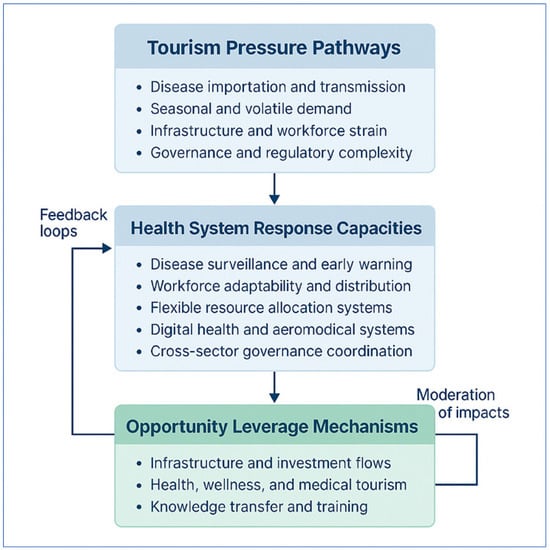
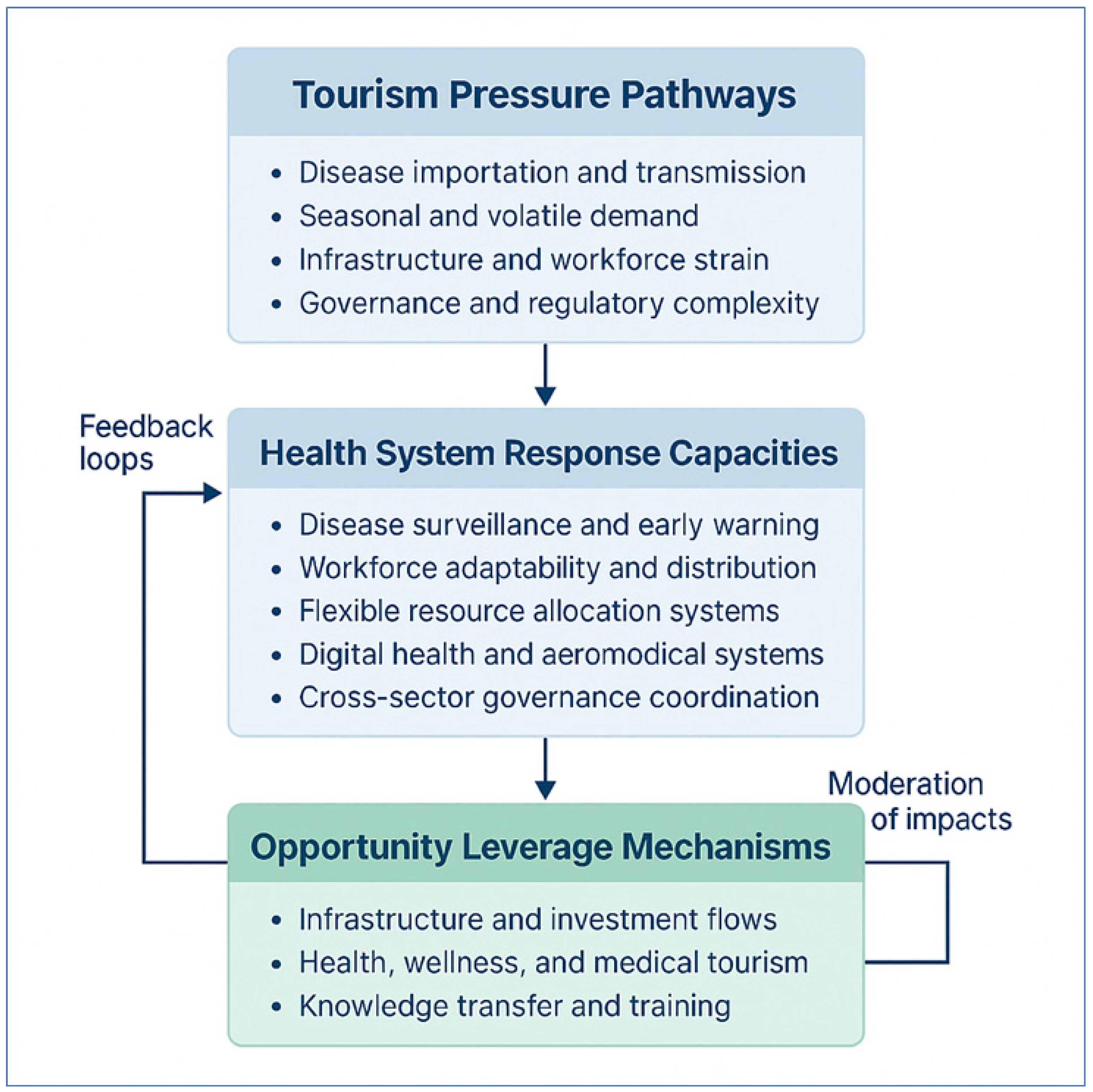
Drawing on the synthesis, we propose an integrated framework comprising three interlinked pillars and explicit feedback loops (Figure 1). The framework positions tourism as both a source of system pressures and a potential catalyst for long-term health system strengthening when governed effectively.
Figure 1.
Tourism development and healthcare system co-evolution: pressure pathways, response capacities, and opportunity leverage mechanisms (with feedback to destination reputation and sustainable tourism outcomes).
The proposed framework comprises three interlinked pillars—tourism pressure pathways, health system response capacities, and opportunity leverage mechanisms—connected through explicit feedback loops linking healthcare system performance with destination sustainability and competitiveness (Hall & Page, 2014; World Health Organization, 2024). Certain elements, such as disease surveillance and governance capacity, span multiple pillars because they simultaneously mitigate tourism-related pressures and enable the effective transformation of demand into longer-term system opportunities (Rosselló et al., 2017; Tangcharoensathien et al., 2015).
Effective health system response capacities include early warning and surveillance systems, workforce adaptability, surge planning, service coordination (including aeromedical retrieval systems), and cross-sector governance arrangements (LaRocque & Jentes, 2011; Russell et al., 2024; World Health Organization, 2024). When these capacities are strategically aligned with opportunity leverage mechanisms, tourism-related demand and investment can be converted into sustained improvements in system resilience, preparedness, and equity rather than remaining short-term stressors (Song et al., 2022; Wen, 2024).
3.4.1. Pillar 1: Tourism Pressure Pathways
Tourism generates pressure through: (i) infectious disease risk and health security demands; (ii) volatile and seasonal acute-care demand; (iii) workforce and infrastructure strain and equity risks; and (iv) regulatory complexity linked to cross-border flows and service standards (Askari et al., 2025; Hall & Page, 2014; LaRocque & Jentes, 2011; Rosselló et al., 2017; World Health Organization, 2012, 2024).
3.4.2. Pillar 2: Health System Response Capacities
Destinations respond through surveillance and early warning, workforce adaptability, surge planning, flexible resource allocation, inter-facility coordination (including retrieval), and governance capacity for cross-sector risks (LaRocque & Jentes, 2011; Parks Australia, 2016, 2020; Quilty et al., 2024; Rosselló et al., 2017; Russell et al., 2024; World Health Organization, 2024)
3.4.3. Pillar 3: Opportunity Leverage Mechanisms
Tourism can be leveraged to strengthen health systems through infrastructure investment, service diversification (wellness/health tourism, travel medicine, telehealth), workforce development, knowledge transfer, and health promotion aligned with sustainable development goals (European Travel Commission & UNWTO, 2018; Godovykh & Ridderstaat, 2020; Khazaee-Pool et al., 2024; Ladkin et al., 2021; Roupa et al., 2012; Song et al., 2022; Tangcharoensathien et al., 2015; Wen, 2024, 2025).
3.4.4. Feedback Loops and Sustainability
Unmanaged tourism pressures can erode health system performance and reduce destination competitiveness and social licence. Conversely, health-sensitive governance can transform tourism-related demand and revenue into assets for equitable and resilient care. This feedback logic positions health system resilience as a central dimension of sustainable destination governance.
3.5. Governance and Management Implications
The framework implies that healthcare capacity should be treated as core destination infrastructure within tourism governance, rather than as an external or residual service function (Hall & Page, 2014; World Health Organization, 2024). Strategic planning should therefore assess healthcare carrying capacity, seasonal variation, and the spatial concentration of tourism demand, integrating tourism scenarios into health system planning processes (Rosselló et al., 2017; World Health Organization, 2024).
Dynamic resource allocation, public–private coordination, and strengthened regulatory frameworks are essential to balance visitor healthcare needs with equitable access for resident populations, particularly in destinations experiencing high visitor turnover or structural service constraints (European Travel Commission & UNWTO, 2018; Tangcharoensathien et al., 2015; Song et al., 2022).
4. Illustrative Cases: Tourism and Healthcare Dynamics
4.1. Case 1: Phuket, Thailand—Tourism Intensity and Healthcare Market Expansion
Phuket illustrates tourism intensity and healthcare market expansion. High visitor volumes generate acute demand and infectious disease risk, while tourism has stimulated private healthcare investment and international accreditation. Governance challenges include workforce maldistribution and equity impacts on residents.
Phuket is one of Southeast Asia’s most tourism-intensive destinations and forms a key component of Thailand’s global tourism and medical tourism economy. High volumes of international visitors reshape local healthcare systems through multiple interacting pathways. Tourism increases acute healthcare demand and shifts clinical case-mix towards emergency presentations, including road traffic injuries, water-sport accidents, and alcohol-related trauma (Sapsirisavat & Mahikul, 2021; Tangcharoensathien et al., 2015). High visitor turnover also elevates infectious disease risks, with outbreaks placing sustained pressure on emergency departments and public health surveillance systems (European Travel Commission & UNWTO, 2018; Roupa et al., 2012; Song et al., 2022).
At the same time, tourism has stimulated substantial private healthcare investment, supporting internationally accredited facilities and advanced diagnostic and treatment capacity. However, risks include workforce diversion from public hospitals, health system dualism, and equity impacts on resident access (Godovykh & Ridderstaat, 2020; Hall & Page, 2014; World Health Organization, 2024). Governance arrangements therefore shape whether tourism becomes a net burden or asset to local health systems.
The COVID-19 Phuket Sandbox programme illustrates tourism–health system co-evolution: healthcare infrastructure was mobilised to enable quarantine-free tourism through testing, surveillance, and isolation protocols, embedding public health capacity within tourism policy and border governance (Figueiredo et al., 2024; Gholipour, 2024). Beyond acute care and public health pressures, Phuket has pursued development as a wellness and health tourism hub, with guidance emphasising culturally appropriate accommodation, transport, health information, and safety standards, highlighting integration between tourism planning and health system design.
4.1.1. Key Challenges
- Seasonal pressure on public hospitals and increased waiting times for residents (Chanin et al., 2015).
- Infectious disease exposure, including dengue and gastrointestinal outbreaks in high-density zones (Rosselló et al., 2017).
- Workforce constraints, including multilingual staffing and specialist availability during peaks.
4.1.2. Key Opportunities
- Tourism-linked healthcare investment supporting specialist and emergency capacity (Pattanapokinsakul, 2024).
- Public–private coordination and strengthened preparedness following major events (Supasettaysa, 2023).
- Service diversification through wellness tourism and preventive/rehabilitative offerings (Chanin et al., 2015).
4.2. Case 2: Northern Australia—Mobile Tourism and Remote Healthcare Systems
Northern Australia presents a contrasting tourism–healthcare context characterised by vast distances, sparse populations, and tourism patterns shaped by mobility rather than density. Tourism includes long-distance road travel, remote camping, nature-based and adventure tourism, and extended travel by older Australians (“grey nomads”). These dynamics interact with healthcare systems already operating under structural constraints, making impacts particularly salient for service access, emergency response, and system resilience.
Grey nomads frequently present to remote and regional primary healthcare services for chronic disease management, medication continuity, minor injuries, and acute exacerbations (Yates et al., 2022). Cumulative demand intersects with workforce shortages and high turnover in remote clinics (Wakerman et al., 2017), and seasonal influxes can strain primary care capacity and continuity of care for residents.
Remote tourism increases exposure to environmental and logistical risks, with serious illness or injury often occurring far from definitive care. Aeromedical retrieval therefore functions as core infrastructure. The Royal Flying Doctor Service provides emergency retrieval and inter-facility transfers for residents and visitors (Royal Flying Doctor Service SA/NT, n.d.). Evidence from Central Australia indicates retrieval models have evolved to improve efficiency, timeliness, and cost-effectiveness (Russell et al., 2024), while climate stressors (including extreme heat) further intensify retrieval demand (Quilty et al., 2024).
Tourism also intersects with visitor safety governance in protected and culturally significant areas. Risk management strategies—including closures, safety messaging, and visitor education—are framed as upstream interventions to prevent injury and reduce downstream pressure on emergency and retrieval services (Parks Australia, 2016, 2020). National policy discussions have explored medical tourism potential in Northern Australia but emphasise capacity constraints and the need for cautious planning (Parliament of Australia, 2012). Unlike Phuket, private medical tourism plays a limited role; public service capacity, retrieval logistics, and equitable access underpin tourism viability and social licence.
4.2.1. Key Challenges
- Structural service constraints limiting surge response during peak tourism periods.
- High reliance on retrieval systems with substantial cost and logistical complexity (Parks Australia, 2016, 2020; Quilty et al., 2024; Russell et al., 2024).
- Equity and continuity of care risks for remote and Indigenous communities.
4.2.2. Key Opportunities
- System innovation through retrieval optimisation improving responsiveness for residents and (Russell et al., 2024)
- Prevention through destination governance reducing preventable injury and system strain (Parks Australia, 2016, 2020).
- Telehealth and outreach pathways supporting mobile populations and strengthening access.
4.3. Cross-Case Synthesis and Comparative Alignment
Together, the Phuket and Northern Australia cases show how tourism and healthcare systems co-evolve through shared pressure pathways expressed differently across dense international tourism and remote mobility tourism contexts. While pressure varies—from volume-driven demand and market restructuring in Phuket to distance-driven logistical complexity in Northern Australia—the governing challenge is consistent: aligning tourism development with health system capacity, equity, and long-term resilience (Table 1).
Table 1.
Explicit alignment with the conceptual framework.
The paired cases jointly operationalise the three-pillar conceptual framework. This alignment demonstrates the framework’s transferability across destination types, strengthening its theoretical robustness. Across both cases, shared mechanisms operate differently depending on tourism form and system context. The comparison demonstrates the framework’s transferability while underscoring the need for context sensitive governance.
5. Discussion
Tourism development and local healthcare systems are deeply interconnected, yet their relationship has often been addressed in fragmented or sector-specific ways within tourism and hospitality research (Hall & Page, 2014; World Health Organization, 2012). By integrating tourism development and healthcare systems within a co-evolutionary framework, this study advances sustainable tourism and destination governance scholarship by explicitly linking health system performance to destination dynamics (Hall & Page, 2014; Wen, 2025). In doing so, healthcare systems are repositioned as foundational destination infrastructure, shaping destination resilience, competitiveness, crisis preparedness and recovery, and the maintenance of social licence among host communities (World Health Organization, 2012, 2024).
A central contribution of the framework lies in explaining why tourism’s health im-pacts are path-dependent and contingent on governance capacity. Short-term pressures associated with visitor growth—such as demand volatility, infectious disease risk, and workforce strain—may undermine system performance in the absence of coordination and regulation. However, where governance is proactive, integrated, and health-centred, these same pressures can be converted into longer-term gains in healthcare system resilience and destination sustainability (Roupa et al., 2012; Song et al., 2022; Wen, 2024). This perspective shifts analytical attention away from tourism volume alone and towards the institutional conditions under which tourism–health interactions unfold.
The comparative cases of Phuket and Northern Australia illustrate how shared mechanisms operate differently across contrasting tourism contexts. In Phuket, the dominant governance challenge concerns managing market restructuring, private sector expansion, and equity risks associated with medical and wellness tourism (Tangcharoensathien et al., 2015). In Northern Australia, by contrast, key issues relate to logistics, access, and continuity of care within a structurally high-cost system characterised by remoteness, reliance on aeromedical retrieval, and constrained workforce supply (Wakerman et al., 2017). These contrasts demonstrate that while common pressure pathways and response mechanisms are evident across destinations, their expression is highly con-text-dependent, underscoring the need for context-sensitive governance responses rather than uniform policy prescriptions.
From a governance perspective, the framework highlights that tourism-related health pressures do not inevitably undermine destination sustainability. When health considerations are explicitly integrated into tourism planning, investment, and regulation, tourism demand and revenue can be leveraged to strengthen healthcare capacity, preparedness, and equity (Song et al., 2022; Wen, 2024). At the same time, the analysis cautions against assuming automatic benefits from tourism growth, emphasising the importance of regulatory oversight to avoid system dualisation, workforce maldistribution, and resident disadvantage (Roupa et al., 2012). This governance lens reinforces the importance of treating healthcare capacity as a strategic component of destination management rather than a residual policy concern.
Taken together, the findings reinforce the view that tourism and public health function as mutually reinforcing systems. Health system quality shapes destination safety, crisis recovery, and visitor confidence, while tourism growth reshapes healthcare demand, risk exposure, and governance requirements. Net impacts therefore depend not on tourism growth per se, but on how health system response capacities and opportunity leverage mechanisms are governed over time (Roupa et al., 2012; Song et al., 2022; Wen, 2024, 2025).
For tourism and hospitality research, the framework shifts analytical focus away from tourism growth and visitor experience alone and towards the institutional conditions shaping tourism–health system interactions. By modelling feedback loops between healthcare system performance and destination competitiveness, it advances a system-level perspective that integrates health system capacity, governance, and equity into destination sustainability debates. This reframing extends tourism and hospitality scholarship beyond traditional economic and experiential emphases.
Finally, several limitations should be acknowledged. As a conceptual synthesis, the study relies on secondary literature and illustrative cases rather than primary empirical data, and the framework has not been empirically tested. Its applicability may be con-strained in destinations with weak institutional capacity or limited health system data. Future research should empirically examine and refine the framework across a wider range of destination types—such as small islands, rural and remote regions, global cities, and established health tourism hubs—using mixed-methods and longitudinal designs. Priority areas include equity impacts on host communities, digital health innovations in tourism settings, and governance models that enable sustained collaboration between tourism and health sectors.
6. Conclusions
Tourism development and local healthcare systems are deeply interconnected, yet their relationship has often been addressed in fragmented and sector-specific ways. This paper advances a co-evolutionary conceptual framework that integrates tourism pressure pathways, health system response capacities, and opportunity leverage mechanisms, explicitly linking healthcare system performance to destination sustainability and competitiveness.
By positioning healthcare systems as core destination infrastructure, the framework moves beyond treating health impacts as short-term externalities of tourism growth. In-stead, it demonstrates how tourism and healthcare systems mutually shape one another over time, with outcomes determined less by tourism intensity than by governance capacity and policy integration. The illustrative cases show that shared mechanisms operate across destinations but manifest differently depending on tourism form, mobility patterns, and structural health system constraints.
From a governance perspective, the framework highlights that tourism-related health pressures do not inevitably undermine destination sustainability. When health considerations are integrated into tourism planning, investment, and regulation, tourism demand and revenue can be leveraged to strengthen healthcare capacity, preparedness, and equity. Conversely, weak or fragmented governance risks system dualisation and resident disadvantage.
This study is conceptual in nature and relies on secondary literature and illustrative cases. Future research should empirically test and refine the framework across diverse destination types using mixed-methods and longitudinal designs, with particular attention to equity impacts, digital health innovation in tourism settings, and cross-sector governance models.
Overall, the framework provides a clear and transferable lens for advancing more resilient, equitable, and health-centred approaches to sustainable tourism development.
Funding
This research received no external funding.
Institutional Review Board Statement
Not applicable.
Informed Consent Statement
Not applicable.
Data Availability Statement
No new data were created or analyzed in this study. Data sharing is not applicable to this article.
Conflicts of Interest
The author declares no conflicts of interest.
References
- Askari, A., Delshad, Z., Dabirifard, M., Hajiabadi, F., Poursadeghiyan, M., Moghaddam, H. R., Sahlabadi, A. S., Eshaghzadeh, M., Hosseinpour, R., & Arbabi, Y. H. (2025). Explanation of challenges to health tourism development: A qualitative study. Journal of Education and Health Promotion, 14, e283. [Google Scholar] [CrossRef] [Scilit] [PubMed]
- Chanin, O., Khunchumnan, P., Amphansookko, S., Thongyai, K., Rodneum, J., & Sriprasert, P. (2015). Guidelines on health tourism management for middle Eastern tourists in Phuket Province. Procedia Computer Science, 65, 1146–1153. [Google Scholar] [CrossRef] [Scilit]
- European Travel Commission & UNWTO. (2018). Exploring health tourism. UNWTO. [Google Scholar] [CrossRef] [Scilit]
- Figueiredo, N., Abrantes, J. L., & Costa, S. (2024). Mapping the sustainable development in health tourism: A systematic literature review. Sustainability, 16(5), 1901. [Google Scholar] [CrossRef] [Scilit]
- Gholipour, H. F. (2024). Does medical tourism promote growth in the healthcare sector? Journal of Policy Research in Tourism, Leisure and Events, 16(2), 123–140. [Google Scholar]
- Godovykh, M., & Ridderstaat, J. (2020). Health outcomes of tourism development: A longitudinal study of the impact of tourism arrivals on residents’ health. Journal of Destination Marketing & Management, 17, 100462. [Google Scholar] [CrossRef] [Scilit]
- Hall, C. M., & Page, S. J. (2014). The geography of tourism and recreation: Environment, place and space (4th ed.). Routledge. [Google Scholar]
- Khazaee-Pool, M., Pashaei, T., Rastegar, H., & Ponnet, K. (2024). A comprehensive perspective on local drivers in community-based health tourism industry development: A qualitative study of Mazandaran Province, Iran. BMC Health Services Research, 24, 11375. [Google Scholar] [CrossRef] [Scilit] [PubMed]
- Ladkin, A., Hemingway, A., & Crossen-White, H. (2021). Health, active ageing and tourism. Annals of Tourism Research Empirical Insights, 2(2), 100030. [Google Scholar] [CrossRef] [Scilit]
- LaRocque, R. C., & Jentes, E. S. (2011). Health recommendations for international travel: A review of the evidence base of travel medicine. Current Opinion in Infectious Diseases, 24(5), 403–409. [Google Scholar] [CrossRef] [Scilit] [PubMed]
- Parks Australia. (2016). Kakadu national park walking strategy: Background report. Australian Government.
- Parks Australia. (2020). Kakadu national park tourism master plan 2020–2030. Australian Government.
- Parliament of Australia. (2012). Increasing medical capacity in Northern Australia through medical tourism. Available online: https://www.bing.com/ck/a?!&&p=6646d3d331e165272e7f1afc7d3dc3b0f10c51aac7d21b09c3e70e61a93fe12bJmltdHM9MTc2NzU3MTIwMA&ptn=3&ver=2&hsh=4&fclid=1f3be621-1a25-6c5b-2deb-f01b1b2a6d91&psq=Increasing+Medical+Capacity+in+Northern+Australia+through+Medical+Tourism&u=a1aHR0cHM6Ly93d3cuYXBoLmdvdi5hdS9wYXJsaWFtZW50YXJ5X2J1c2luZXNzL2NvbW1pdHRlZXMvaG91c2Vfb2ZfcmVwcmVzZW50YXRpdmVzX2NvbW1pdHRlZXM_dXJsPWpzY25hL3N1YnMvc3ViMDE0NyUyMGF0dGFjaCUyMGQucGRm (accessed on 20 November 2025).
- Pattanapokinsakul, K. (2024). The readiness for development of Phuket as a world-class wellness tourist destination. Journal of Administration and Management, 30(1), 1–20. [Google Scholar]
- Quilty, S., Lal, A., Honan, B., Chateau, D., O’Donnell, E., & Mills, J. (2024). The impact of climate change on aeromedical retrieval services in remote Northern Australia: Planning for a hotter future. International Journal of Environmental Research and Public Health, 21, 114. [Google Scholar] [CrossRef] [Scilit] [PubMed]
- Rosselló, J., Santana-Gallego, M., & Awan, W. (2017). Infectious disease risk and international tourism demand. Health Policy and Planning, 32(4), 538–548. [Google Scholar] [CrossRef] [Scilit] [PubMed]
- Roupa, Z., Zikos, D., Vasilopoulos, A., & Diomidous, M. (2012). Common health risks, required precautions of travelers and their customs towards the use of travel medicine services. Materia Socio-Medica, 24(2), 131–134. [Google Scholar] [CrossRef] [Scilit] [PubMed]
- Royal Flying Doctor Service SA/NT. (n.d.). Your flying doctor in SA and NT. Available online: https://www.flyingdoctor.org.au/sant/what-we-do/ (accessed on 20 November 2025).
- Russell, D. J., Zhao, Y., Mathew, S., Fitts, M. S., Johnson, R., Reeve, D. M., Honan, B., Niclasen, P., Liddle, Z., Green, D., & Wakerman, J. (2024). The efficiency, timeliness, health outcomes and cost-effectiveness of a new aeromedical retrieval model in Central Australia: A pre- and post-implementation observational study. Australian Journal of Rural Health, 32(1), 17–28. [Google Scholar] [CrossRef] [Scilit] [PubMed]
- Sapsirisavat, V., & Mahikul, W. (2021). Drinking and night-time driving and traffic injury among international travelers. International Journal of Environmental Research and Public Health, 18, 9823. [Google Scholar] [PubMed]
- Song, Y., Su, Z. W., Tao, R., & Umut, A. (2022). Revealing the effectiveness of tourism development on health status in Asian economies. Frontiers in Public Health, 10, 895221. [Google Scholar] [CrossRef] [Scilit]
- Supasettaysa, G. (2023). Public–private partnerships in the Thailand medical tourism industry (policy brief). Harvard Kennedy School, Ash Center for Democratic Governance and Innovation. [Google Scholar]
- Tangcharoensathien, V., Lim, J., Pocock, N. S., Rannan-Eliya, R. P., Siriluck, R., Shuib, A., Yusof, R., Hong, P. K., Teerawattananon, Y., Chunkhu, S., & Patcharanarumol, W. (2015). Health system implications of tourism-related injuries. Lancet Regional Health-Western Pacific, 386, 863–873. [Google Scholar]
- Wakerman, J., Sparrow, L., Thomas, S. L., Humphreys, J. S., & Jones, M. (2017). Equitable resourcing of primary health care in remote communities in Australia’s Northern Territory: A pilot study. BMC Family Practice, 18, 75. [Google Scholar] [CrossRef] [Scilit] [PubMed]
- Wen, J. (2024). A lack of tourism-based health services amid global aging: How tourism and health practices can combine to benefit the aging population. Health Services Insights, 17, 11786329241271570. [Google Scholar] [CrossRef] [Scilit] [PubMed]
- Wen, J. (2025). Interdisciplinary research among tourism, public health, and psychology: Opportunities and challenges. Journal of Travel Research, 64(3), 345–360. [Google Scholar]
- World Health Organization. (2012). International travel and health: Situation as on 1 January 2012 (updated 2019). WHO. [Google Scholar]
- World Health Organization. (2024). WHO and UN tourism make health a priority for developing resilient, inclusive and sustainable tourism. World Health Organization. Available online: https://www.who.int/europe/news/item/05-03-2024-who-and-un-tourism-make-health-a-priority-for-developing-resilient--inclusive-and-sustainable-tourism (accessed on 20 November 2025).
- Yates, M., Perry, L., Onyx, J., & Levett-Jones, T. (2022). ‘Grey nomad’ travellers’ use of remote health services in Australia: A qualitative enquiry of hospital managers’ perspectives. BMC Health Services Research, 22, 151. [Google Scholar] [CrossRef] [Scilit] [PubMed]

Disclaimer/Publisher’s Note: The statements, opinions and data contained in all publications are solely those of the individual author(s) and contributor(s) and not of MDPI and/or the editor(s). MDPI and/or the editor(s) disclaim responsibility for any injury to people or property resulting from any ideas, methods, instructions or products referred to in the content. |
© 2026 by the author. Licensee MDPI, Basel, Switzerland. This article is an open access article distributed under the terms and conditions of the Creative Commons Attribution (CC BY) license.