

Metaverse Festivals Beyond Overtourism: Digital Transformation of Cultural Events Towards Accessibility, Cultural Engagement and Sustainable Tourism Policy


Abstract
1. Introduction
Research Question and Paper Objectives
2. Theoretical Framework
2.1. The Role of the Metaverse in Reconfiguring Festivals
2.2. Digital Transformation Theory
2.3. Sustainability and the Virtual Shift
2.4. Conceptual Positioning: “Metaverse-Based” Cultural Festivals
3. Methodology
3.1. Narrative Literature Review (NLR) Approach
3.2. Search Strategy and Data Sources
- -
- TITLE-ABS-KEY (((metaverse OR “virtual world*” OR “extended reality” OR “virtual festival*”)) AND ((festival* OR “cultural festival*” OR “cultural event*”)));
- -
- TITLE-ABS-KEY ((“virtual festival*” OR “hybrid festival*” OR “virtual event*”) AND (touris* OR destination* OR overtourism OR crowding OR congestion));
- -
- TITLE-ABS-KEY ((“extended reality” OR XR OR VR) AND (“cultural participation” OR “cultural heritage” OR museum*) AND (governance OR policy OR ethics)));
- -
- TITLE-ABS-KEY ((“virtual festival*” OR (“hybrid” W/1 festival*) OR (“online” W/1 festival*) OR ((“virtual” OR online OR hybrid) W/2 (festival* OR “cultural event*”))); AND (touris* OR destination* OR “destination marketing” OR “place branding” OR visitor* OR “tourist experience”)).
3.3. Screening, Inclusion Criteria, and Corpus Composition
4. Accessibility, Cultural Engagement, and Sustainability in the Metaverse
4.1. Accessibility
4.2. Cultural Engagement
4.2.1. Quadrant Implications (Expected Patterns)
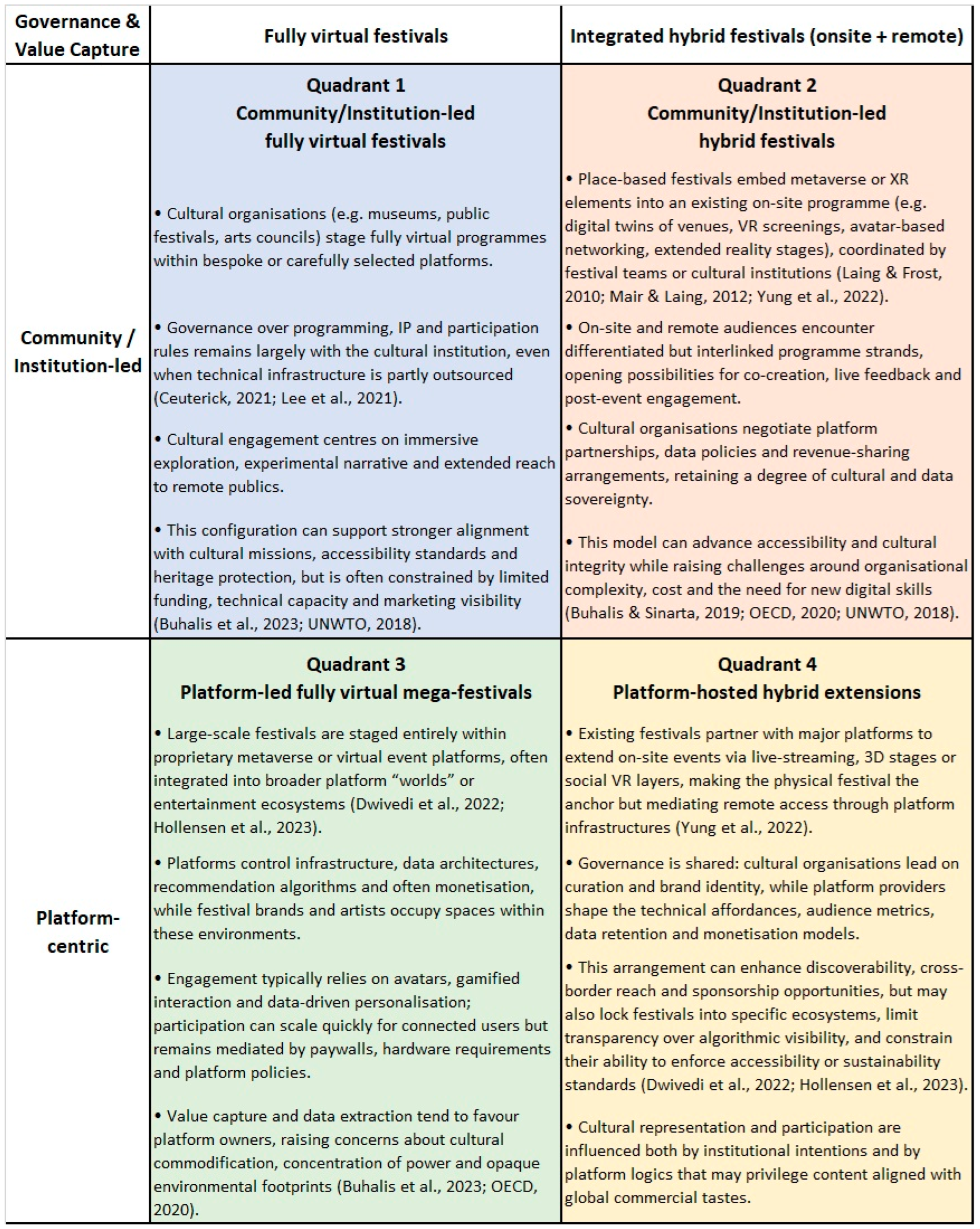
- Platform-led and low hybridity (fully virtual, high scale): Accessibility depends heavily on device quality, bandwidth and ongoing costs; value capture and data extraction risks tend to be higher; environmental burdens are more likely to shift towards infrastructure and devices unless constrained by efficiency and hosting choices (de Reuver et al., 2018; OECD, 2020; UNWTO, 2018);
- Curator-led and low hybridity (platform-hosted showcases): Cultural stewardship is strengthened through programming control, but platform rules still shape data governance, visibility and monetisation; substitution effects for travel remain uncertain and may vary by audience segment and pricing (Dwivedi et al., 2022; UNWTO, 2018);
- Institution-led and high hybridity (hybrid extensions of on-site festivals): Place anchoring and legitimacy are typically stronger (rights management, accessibility policy, curatorial standards), yet exclusions can persist if assistive features, language options and hybrid ticketing remain secondary (Buhalis et al., 2023; UNWTO, 2016);
- Community-led and high hybridity (local or artist-led hybrid micro-festivals): Inclusion and cultural specificity may be stronger where governance is local, but resource constraints can weaken moderation, safeguarding and quality assurance; environmental outcomes depend on low-tech access routes and infrastructure choices (Dwivedi et al., 2022; OECD, 2020).
4.2.2. Space and Geography Implications
4.3. Sustainability
5. Examples of Metaverse Festivals
5.1. SXSW Online and Tomorrowland Around the World
5.2. Venice Film Festival VR Expanded
6. Challenges and Future Directions for Metaverse Festivals
6.1. Addressing the Digital Divide
6.2. Preserving Cultural Authenticity
6.2.1. Challenges of Maintaining Cultural Authenticity
6.2.2. Strategies to Preserve Cultural Authenticity in the Metaverse
6.3. Future Trends in Metaverse Festivals
6.3.1. Enhanced Immersive Experiences
6.3.2. Expanded Access and Personalisation
6.4. Overtourism and Metaverse Implications
6.5. Regulatory, Ethical, and Economic Implications
7. Limitations and Directions for Future Research
8. Conclusions
Funding
Institutional Review Board Statement
Informed Consent Statement
Data Availability Statement
Acknowledgments
Conflicts of Interest
Abbreviations
| AR | Augmented reality |
| ICT | Information and communication technology |
| NLR | Narrative literature review |
| SDGs | Sustainable Development Goals |
| UNWTO | World Tourism Organization |
| VR | Virtual reality |
| 3DoF | Three degrees of freedom |
| CVR | Cinematic virtual reality |
| IP | Intellectual property |
| OECD | Organisation for Economic Co-operation and Development |
| SXSW | South by Southwest |
| VMF | Virtual music festival |
| XR | Extended reality |
| 6DoF | Six degrees of freedom |
References
- Agarwal, R., Gao, G., DesRoches, C., & Jha, A. K. (2010). The digital transformation of healthcare: Current status and the road ahead. Information Systems Research, 21(4), 796–809. [Google Scholar] [CrossRef]
- Appadurai, A. (1996). Modernity at large: Cultural dimensions of globalization (Vol. 1). University of Minnesota Press. [Google Scholar]
- Asad, M. M., Naz, A., Churi, P., & Tahanzadeh, M. M. (2021). Virtual reality as pedagogical tool to enhance experiential learning: A systematic literature review. Education Research International, 2021(1), 7061623. [Google Scholar] [CrossRef]
- Ash, J., Kitchin, R., & Leszczynski, A. (2016). Digital turn, digital geographies? Progress in Human Geography, 42(1), 25–43. [Google Scholar] [CrossRef]
- Baumeister, R. F., & Leary, M. R. (1997). Writing narrative literature reviews. Review of General Psychology, 1(3), 311–320. [Google Scholar] [CrossRef]
- Bekele, H., & Raj, S. (2025). Digitalization and digital transformation in the tourism industry: A bibliometric review and research agenda. Tourism Review, 80(4), 894–913. [Google Scholar] [CrossRef]
- Bossey, A. (2022). Gatekeeper perceptions on adopting environmentally sound information and communication technology-enhanced live performances to improve the sustainability of music festivals. International Journal of Event and Festival Management, 13(3), 307–325. [Google Scholar] [CrossRef]
- Boyle, S., Reaiche, C., & Akbari, M. (2024). Digital transformation of events and live performances. In J. Bérubé, M.-L. Dioh, & A. C. Cuyler (Eds.), Accessibility, diversity, equity and inclusion in the cultural sector (pp. 215–226). Emerald Publishing Limited. [Google Scholar] [CrossRef]
- Buhalis, D., Lin, M., & Leung, D. (2023). Metaverse as a driver for customer experience and value co-creation: Implications for hospitality and tourism management and marketing. International Journal of Contemporary Hospitality Management, 35(2), 701–716. [Google Scholar] [CrossRef]
- Buhalis, D., & Sinarta, Y. (2019). Real-time co-creation and nowness service: Lessons from tourism and hospitality. Journal of Travel & Tourism Marketing, 36(5), 563–582. [Google Scholar] [CrossRef]
- Buquicchio, I., Coudreau, J., de Bank, M., Durand, B., Efoui-Hess, M., Egal, L., Ferreboeuf, H., Gueguen, A., Jeanningros, H., Kissi, A., Ninassi, B., Souchet, A., & Theve, A. (2024). Energy and climate: What virtual worlds for a sustainable real world? The Shift Project. [Google Scholar] [CrossRef]
- Ceuterick, M. (2021). Post-cinematic spectatorship in virtual reality: Negotiating 3DoF and 6DoF in QUEERSKINS: ARK. NECSUS_European Journal of Media Studies, 10(1), 1–20. [Google Scholar] [CrossRef]
- Ceuterick, M., & Ingraham, C. (2021). Immersive storytelling and affective ethnography in virtual reality. Review of Communication, 21(1), 9–22. [Google Scholar] [CrossRef]
- Collins, A., & Cooper, C. (2017). Measuring and managing the environmental impact of festivals: The contribution of the ecological footprint. Journal of Sustainable Tourism, 25(1), 148–162. [Google Scholar] [CrossRef]
- Cranmer, E. E., Tom Dieck, M. C., & Jung, T. (2023). The role of augmented reality for sustainable development: Evidence from cultural heritage tourism. Tourism Management Perspectives, 49, 101196. [Google Scholar] [CrossRef]
- Cronin, P., Ryan, F., & Coughlan, M. (2008). Undertaking a literature review: A step-by-step approach. British Journal of Nursing, 17(1), 38–43. [Google Scholar] [CrossRef]
- Cucchiella, F., D’Adamo, I., Lenny Koh, S. C., & Rosa, P. (2015). Recycling of WEEE: An economic assessment of present and future e-waste streams. Renewable and Sustainable Energy Reviews, 51, 263–272. [Google Scholar] [CrossRef]
- Darcy, S. (2010). Inherent complexity: Disability, accessible tourism and accommodation information preferences. Tourism Management, 31(6), 816–826. [Google Scholar] [CrossRef]
- Darcy, S., McKercher, B., & Schweinsberg, S. (2020). From tourism and disability to accessible tourism: A perspective article. Tourism Review, 75(1), 140–144. [Google Scholar] [CrossRef]
- de Quadros, C. M. B., Zucco, F. D., Pereira, T., & Limberger, P. F. (2024). Pride (in the name of tourism): Mitigating the effects of overtourism on festivals. Journal of Destination Marketing & Management, 32, 100896. [Google Scholar] [CrossRef]
- de Reuver, M., Sørensen, C., & Basole, R. C. (2018). The digital platform: A research agenda. Journal of Information Technology, 33(2), 124–135. [Google Scholar] [CrossRef]
- Desai, D. (2022). Hyper-personalization: An AI-enabled personalization for customer-centric marketing. In S. Singh (Ed.), Adoption and implementation of AI in customer relationship management (pp. 40–53). IGI Global. [Google Scholar] [CrossRef]
- Duignan, M. B., Everett, S., & McCabe, S. (2022). Events as catalysts for communal resistance to overtourism. Annals of Tourism Research, 96, 103438. [Google Scholar] [CrossRef]
- Dwivedi, Y. K., Hughes, L., Baabdullah, A. M., Ribeiro-Navarrete, S., Giannakis, M., Al-Debei, M. M., Dennehy, D., Metri, B., Buhalis, D., Cheung, C. M., Conboy, K., Doyle, R., Dubey, R., Dutot, V., Felix, R., Goyal, D., Gustafsson, A., Hinsch, C., Jebabli, I., … Wamba, S. F. (2022). Metaverse beyond the hype: Multidisciplinary perspectives on emerging challenges, opportunities, and agenda for research, practice and policy. International Journal of Information Management, 66, 102542. [Google Scholar] [CrossRef]
- European Parliament. (2018). Overtourism: Impact and possible policy responses: Research for TRAN committee. European Parliament: Directorate-General for Internal Policies of the Union. Available online: https://data.europa.eu/doi/10.2861/919195 (accessed on 20 July 2025).
- Ferrari, R. (2015). Writing narrative style literature reviews. Medical Writing, 24(4), 230–235. [Google Scholar] [CrossRef]
- Fiaz, F., Sajjad, S. M., Iqbal, Z., Yousaf, M., & Muhammad, Z. (2024). MetaSSI: A framework for personal data protection, enhanced cybersecurity and privacy in metaverse virtual reality platforms. Future Internet, 16(5), 176. [Google Scholar] [CrossRef]
- Flavián, C., Ibáñez-Sánchez, S., & Orús, C. (2019). The impact of virtual, augmented and mixed reality technologies on the customer experience. Journal of Business Research, 100, 547–560. [Google Scholar] [CrossRef]
- Gallarza, M. G., Tubillejas-Andrés, B., & Samartin, K. (2023). Consumer value of virtual music festivals. International Journal of Consumer Studies, 47(5), 2012–2030. [Google Scholar] [CrossRef]
- García-Buades, M. E., García-Sastre, M. A., & Alemany-Hormaeche, M. (2022). Effects of overtourism, local government, and tourist behaviour on residents’ perceptions in Alcúdia (Majorca, Spain). Journal of Outdoor Recreation and Tourism, 39, 100499. [Google Scholar] [CrossRef]
- Ghazawneh, A., & Henfridsson, O. (2013). Balancing platform control and external contribution in third-party development: The boundary resources model. Information Systems Journal, 23(2), 173–192. [Google Scholar] [CrossRef]
- Go, H., & Kang, M. (2022). Metaverse tourism for sustainable tourism development: Tourism agenda 2030. Tourism Review, 78(2), 381–394. [Google Scholar] [CrossRef]
- Gonzales, A. L. (2016). The contemporary US digital divide: From initial access to technology maintenance. Information, Communication & Society, 19(2), 234–248. [Google Scholar] [CrossRef]
- Gössling, S., McCabe, S., & Chen, N. (2020). A socio-psychological conceptualisation of overtourism. Annals of Tourism Research, 84, 102976. [Google Scholar] [CrossRef]
- Grant, M. J., & Booth, A. (2009). A typology of reviews: An analysis of 14 review types and associated methodologies. Health Information & Libraries Journal, 26(2), 91–108. [Google Scholar] [CrossRef]
- Grappi, S., & Montanari, F. (2011). The role of social identification and hedonism in affecting tourist re-patronizing behaviours: The case of an Italian festival. Tourism Management, 32(5), 1128–1140. [Google Scholar] [CrossRef]
- Green, B. (2025). Splendour XR: Place, experience and liveness at a virtual music festival. Leisure Sciences, 47(5), 958–975. [Google Scholar] [CrossRef]
- Greenhalgh, T., Thorne, S., & Malterud, K. (2018). Time to challenge the spurious hierarchy of systematic over narrative reviews? European Journal of Clinical Investigation, 48(6), e12931. [Google Scholar] [CrossRef]
- Guttentag, D. A. (2010). Virtual reality: Applications and implications for tourism. Tourism Management, 31(5), 637–651. [Google Scholar] [CrossRef]
- Hager, M., & Sung, H. (2011). Local arts agencies as destination management organizations. Journal of Travel Research, 51(4), 400–411. [Google Scholar] [CrossRef]
- Helsper, E. J. (2012). A corresponding fields model for the links between social and digital exclusion. Communication Theory, 22(4), 403–426. [Google Scholar] [CrossRef]
- Helsper, E. J. (2021). The digital disconnect: The social causes and consequences of digital inequalities. SAGE Publications. [Google Scholar] [CrossRef]
- Hoffman, C. (2021, September 21). Most innovative meetings 2021: SXSW online 2021. BizBash. Available online: https://www.bizbash.com/meetings/most-innovative-meetings-2021-sxsw-online-2021 (accessed on 11 July 2025).
- Hollensen, S., Kotler, P., & Opresnik, M. O. (2023). Metaverse—The new marketing universe. Journal of Business Strategy, 44(3), 119–125. [Google Scholar] [CrossRef]
- Huggett, J. (2020). Virtually real or really virtual: Towards a heritage metaverse. Studies in Digital Heritage, 4(1), 1–15. [Google Scholar] [CrossRef]
- Hutson, J. (2024). Combining large language models and immersive technologies to represent cultural heritage in the metaverse context. In V. Geroimenko (Ed.), Augmented and virtual reality in the metaverse. Springer series on cultural computing. Springer. [Google Scholar] [CrossRef]
- Jesson, J., Matheson, L., & Lacey, F. M. (2011). Doing your literature review: Traditional and systematic techniques. SAGE Publications. [Google Scholar]
- Kang, S., Hill, R., & Thilmany, D. (2024). Assessing economic impacts of mile high 420 festival in Colorado. Tourism and Hospitality, 5(3), 521–536. [Google Scholar] [CrossRef]
- King, A. (2021). Tomorrowland around the world 2020: A virtual pilgrimage. Journal of Communication Technology, 4(3), 80–103. [Google Scholar] [CrossRef]
- Kitchin, R., & Dodge, M. (2011). Code/Space: Software and everyday life. MIT Press. [Google Scholar] [CrossRef]
- Koens, K., Postma, A., & Papp, B. (2018). Is overtourism overused? Understanding the impact of tourism in a city context. Sustainability, 10(12), 4384. [Google Scholar] [CrossRef]
- Kouroupi, N. (2025). Parallel universes: A fresh perspective in tourism. In J. D. Santos, B. Barbosa Sousa, & P. Botelho Pires (Eds.), Leveraging digital marketing for tourism. tourism on the verge (pp. 147–167). Springer. [Google Scholar] [CrossRef]
- Kouroupi, N., & Metaxas, T. (2023). Can the metaverse and its associated digital tools and technologies provide an opportunity for destinations to address the vulnerability of overtourism? Tourism and Hospitality, 4(2), 355–373. [Google Scholar] [CrossRef]
- Kouroupi, N., & Metaxas, T. (2024). Economic transformation in traditional tourism destinations: The role of metaverse and artificial intelligence technologies. In H. Ramkissoon, R. Singh, & J. Iqbal (Eds.), A research agenda for tourism, hospitality and the metaverse (pp. 55–70). Elgar Publications. [Google Scholar] [CrossRef]
- La Biennale di Venezia. (2020). Venice VR Expanded accessible in the VR Lounge of cultural institutions. Available online: https://www.labiennale.org/en/news/venice-vr-expanded-accessible-vr-lounge-cultural-institutions (accessed on 11 July 2025).
- Laing, J., & Frost, W. (2010). How green was my festival: Exploring challenges and opportunities associated with staging green events. International Journal of Hospitality Management, 29(2), 261–267. [Google Scholar] [CrossRef]
- Lee, L. H., Braud, T., Zhou, P., Wang, L., Xu, D., Lin, Z., & Hui, P. (2021). All one needs to know about metaverse: A complete survey on technological singularity, virtual ecosystem, and research agenda. Foundations and Trends in Human-Computer Interaction, 18(2–3), 100–337. [Google Scholar] [CrossRef]
- Leszczynski, A. (2019). Glitchy vignettes of platform urbanism. Environment and Planning D: Society and Space, 38(2), 189–208. [Google Scholar] [CrossRef]
- Machado, A. F., Sousa, B. B., Ribeiro, M., Kelmer, M. A., & de Vasconcellos, B. (2022). The relevance of virtual reality and increased reality in events with streaming and livestreaming in Covid and Post-Covid-19 era: A touristic perspective. In N. Kumar, B. Barbosa Sousa, & S. Sharma (Eds.), Tourist behavior: Past, present, and future (pp. 277–293). Apple Academic Press. [Google Scholar] [CrossRef]
- Mair, J., & Laing, J. (2012). The greening of music festivals: Motivations, barriers and outcomes. Applying the Mair and Jago model. Journal of Sustainable Tourism, 20(5), 683–700. [Google Scholar] [CrossRef]
- Mananda, I. G. P. B. S., Negara, I. M. K., Kristianto, Y., Angligan, I. G. K. H., & Deuchar, C. (2025). From overtourism to regeneration: A penta-helix governance model for sustainable tourism in Bali. Tourism and Hospitality, 6(5), 240. [Google Scholar] [CrossRef]
- Martínez-Cano, F. J. (2023). Metaverse film: The rising of immersive audiovisual through disrupting traditional moving image and its conventions. Avanca Cinema Journal, 14, 525–531. [Google Scholar] [CrossRef]
- Masanet, E., Shehabi, A., Lei, N., Smith, S., & Koomey, J. (2020). Recalibrating global data center energy-use estimates. Science, 367(6481), 984–986. [Google Scholar] [CrossRef]
- Massi, M., Vecco, M., & Lin, Y. (Eds.). (2021). Digital transformation in the cultural and creative industries: Production, consumption and entrepreneurship in the digital and sharing economy. Routledge. [Google Scholar]
- Matt, C., Hess, T., & Benlian, A. (2015). Digital transformation strategies. Business & Information Systems Engineering, 57(5), 339–343. [Google Scholar] [CrossRef]
- McIntosh, A. J., & Prentice, R. C. (1999). Affirming authenticity consuming cultural heritage. Annals of Tourism Research, 26, 589–612. [Google Scholar] [CrossRef]
- Mele, C., & Russo-Spena, T. (2025). Agencement of onlife and phygital: Smart tech–enabled value co-creation practices. Journal of Service Management, 36(2), 217–240. [Google Scholar] [CrossRef]
- Mihalič, T. (2020). Conceptualising overtourism: A sustainability approach. Annals of Tourism Research, 84, 103025. [Google Scholar] [CrossRef]
- Milano, C., Novelli, M., & Cheer, J. M. (2019). Overtourism and degrowth: A social movements perspective. Journal of Sustainable Tourism, 27(12), 1857–1875. [Google Scholar] [CrossRef]
- Niezen, R. (2008). A world beyond difference: Cultural identity in the age of globalization. John Wiley & Sons. [Google Scholar]
- Nilsson, J.-H. (2020). Conceptualizing and contextualizing overtourism: The dynamics of accelerating urban tourism. International Journal of Tourism Cities, 6(4), 657–671. [Google Scholar] [CrossRef]
- Niñerola, A., Sánchez-Rebull, M.-V., & Hernández-Lara, A.-B. (2019). Tourism research on sustainability: A bibliometric analysis. Sustainability, 11(5), 1377. [Google Scholar] [CrossRef]
- Nleya, S. M., & Velempini, M. (2024). Industrial metaverse: A comprehensive review, environmental impact, and challenges. Applied Sciences, 14(13), 5736. [Google Scholar] [CrossRef]
- OECD. (2020). OECD tourism trends and policies 2020. OECD Publishing. [Google Scholar] [CrossRef]
- Pahlevan-Sharif, S., Mura, P., & Wijesinghe, S. N. R. (2019). A systematic review of systematic reviews in tourism. Journal of Hospitality and Tourism Management, 39, 158–165. [Google Scholar] [CrossRef]
- Park, E., Choi, B. K., & Lee, T. J. (2019). The role and dimensions of authenticity in heritage tourism. Tourism Management, 74, 99–109. [Google Scholar] [CrossRef]
- Quinn, B. (2005). Arts festivals and the city. Urban Studies, 42(5–6), 927–943. [Google Scholar] [CrossRef]
- Rafieian, O., & Yoganarasimhan, H. (2023). AI and personalization. In K. Sudhir, & O. Toubia (Eds.), Artificial intelligence in marketing (pp. 77–102). Emerald Publishing Limited. [Google Scholar] [CrossRef]
- Rogers, D. (2016). The digital transformation playbook: Rethink your business for the digital age. Columbia Business School Publishing. [Google Scholar]
- Rumrill, P. D., Jr., & Fitzgerald, S. M. (2001). Using narrative literature reviews to build a scientific knowledge base. WORK: A Journal of Prevention, Assessment & Rehabilitation, 16(2), 165–170. [Google Scholar] [CrossRef]
- Säks, E. (2022). Using cinematic virtual reality to get acquainted with the metaverse. Baltic Screen Media Review, 10(2), 181–199. [Google Scholar] [CrossRef]
- Seraphin, H., Sheeran, P., & Pilato, M. (2018). Over-tourism and the fall of Venice as a destination. Journal of Destination Marketing & Management, 9, 374–376. [Google Scholar] [CrossRef]
- Sheller, M., & Urry, J. (2006). The new mobilities paradigm. Environment and Planning A: Economy and Space, 38(2), 207–226. [Google Scholar] [CrossRef]
- Suárez Henríquez, C., Ricoy-Cano, A. J., Hernández-Galán, J., & de la Fuente Robles, Y. M. (2022). The past, present, and future of accessible tourism research: A bibliometric analysis using the Scopus database. Journal of Accessibility and Design for All, 12(1), 26–60. [Google Scholar] [CrossRef]
- Sukhera, J. (2022). Narrative reviews: Flexible, rigorous, and practical. Journal of Graduate Medical Education, 14(4), 414–417. [Google Scholar] [CrossRef]
- SXSW. (2020). Announcing SXSW online: A digital experience from March 16–20, 2021. SXSW. Available online: https://sxsw.com/news/2020/announcing-sxsw-online-a-digital-experience-from-march-16-20-2021/ (accessed on 20 July 2025).
- Tussyadiah, I. P., Wang, D., Jung, T. H., & tom Dieck, M. C. (2018). Virtual reality, presence, and attitude change: Empirical evidence from tourism. Tourism Management, 66, 140–154. [Google Scholar] [CrossRef]
- UNWTO. (2016). Manual on accessible tourism for all: Principles, tools and best practices—Module I: Accessible tourism—Definition and context. World Tourism Organization. [Google Scholar] [CrossRef]
- UNWTO. (2018). Tourism and the digital transformation (Executive Council document CE/108/9 rev.1). World Tourism Organization. Available online: https://www.e-unwto.org/doi/pdf/10.18111/unwtoecd.2018.1.g51w645001604520 (accessed on 20 July 2025).
- van Deursen, A. J., & van Dijk, J. A. (2018). The first-level digital divide shifts from inequalities in physical access to inequalities in material access. New Media & Society, 21(2), 354–375. [Google Scholar] [CrossRef]
- Wang, R., Codina, R., Sun, Y., & Ding, X. (2024). Experience, satisfaction and loyalty in the context of online music festivals in China. International Journal of Event and Festival Management, 15(2), 228–248. [Google Scholar] [CrossRef]
- World Tourism Organization (UNWTO), Centre of Expertise Leisure, Tourism & Hospitality, NHTV Breda University of Applied Sciences & NHL Stenden University of Applied Sciences. (2018). ‘Overtourism’?—Understanding and managing urban tourism growth beyond perceptions, executive summary. UNWTO. [Google Scholar] [CrossRef]
- Wu, L., Yu, R., Su, W., & Ye, S. (2022). Design and implementation of a metaverse platform for traditional culture: The chime bells of Marquis Yi of Zeng. Heritage Science, 10(1), 193. [Google Scholar] [CrossRef]
- Wylde, V., Prakash, E., Hewage, C., & Platts, J. (2023). Post-COVID-19 metaverse cybersecurity and data privacy: Present and future challenges. In C. Hewage, Y. Rahulamathavan, & D. Ratnayake (Eds.), Data protection in a post-pandemic society. Springer. [Google Scholar] [CrossRef]
- Yung, R., & Khoo-Lattimore, C. (2019). New realities: A systematic literature review on virtual reality and augmented reality in tourism research. Current Issues in Tourism, 22(17), 2056–2081. [Google Scholar] [CrossRef]
- Yung, R., Le, T. H., Moyle, B., & Arcodia, C. (2022). Towards a typology of virtual events. Tourism Management, 92, 104560. [Google Scholar] [CrossRef]
- Zhang, C., Fong, L., & Li, S. (2019). Co-creation experience and place attachment: Festival evaluation. International Journal of Hospitality Management, 81, 193–204. [Google Scholar] [CrossRef]
- Zhao, N., & You, F. (2023). The growing metaverse sector can reduce greenhouse gas emissions by 10 gt co2e in the united states by 2050. Energy & Environmental Science, 16(6), 2382–2397. [Google Scholar] [CrossRef]


| Format Label | Defining Features (Indicative) | Analytical Treatment in This Review |
|---|---|---|
| Livestreamed online festival | Primarily 2D broadcast or streaming; limited interaction; time-bound programming; minimal avatar embodiment. | Not treated as metaverse; used only where it informs access and engagement mechanisms in remote participation. |
| XR exhibition/Immersive showcase | Curated immersive works accessed via VR or AR, typically delivered as time-bounded, programme-led experiences. Interaction is centred on engaging with the content rather than on persistent world-building, and social features are usually limited compared with multi-user 3D event worlds. | Treated as “metaverse-adjacent” where platform-mediated immersion and audience embodiment shape cultural engagement and access conditions. |
| Platform-based 3D event world | 3D environment with navigable space; avatar-mediated presence; synchronous social features; typically event-bounded rather than persistent. | Treated as “metaverse-adjacent”: exhibits key affordances (avatars, spatial sociality) but does not necessarily meet persistence threshold. |
| Hybrid festival configuration | Coupled physical and virtual layers (on-site plus remote participation); partial substitution and redistribution effects possible; governance spans venues and platforms. | Treated as hybrid “metaverse-adjacent”: analysed for governance, value capture and accessibility trade-offs across physical and digital layers. |
| Metaverse-based festival (threshold definition) | Persistent multi-user 3D environment; embodied avatars; social interaction and co-creation; event world remains available beyond a single broadcast window. | Baseline ideal-type for conceptual clarity; used to specify analytical limits and to frame transition pathways from adjacent formats. |
| Accessibility Dimension | Potential Enablers in Metaverse-Adjacent Formats | Likely Digital Barriers or Risks | Governance and Design Levers |
|---|---|---|---|
| Physical and mobility | Reduced travel and queuing; controllable navigation and viewpoints; remote participation options | Device fit and comfort; motion sickness; inaccessible interfaces; lack of assistive-device compatibility | Accessibility-by-design requirements; tested interface standards; hybrid access routes; staffed support channels (Darcy et al., 2020; UNWTO, 2016) |
| Sensory | Captioning; sign-language overlays; audio description; adjustable sound and visuals | Features treated as optional add-ons; inconsistent content workflows; bandwidth constraints | Procurement and funding tied to accessibility standards; platform accountability for default settings (Darcy et al., 2020; OECD, 2020) |
| Cognitive and neurodiversity | Pacing control; reduced crowd intensity; personalisable environments; clear wayfinding | Cognitive overload from complex interfaces; unclear information architecture; poor moderation | Usability testing with diverse users; clear content labelling; safeguarding and moderation rules (Darcy et al., 2020; Dwivedi et al., 2022) |
| Economic | Avoided transport and accommodation costs; tiered digital tickets | High upfront device costs; subscriptions and data plans; maintenance and replacement costs | Pricing rules and concessions; public access points (libraries, cultural hubs); subsidised equipment schemes (Gonzales, 2016; OECD, 2020) |
| Geographic | Participation without long-haul travel; access from peripheral regions | Uneven broadband; unstable connectivity; language and time-zone frictions | Broadband investment; multilingual and low-bandwidth options; asynchronous access windows (Helsper, 2021; UNWTO, 2018) |
| Time and caregiving constraints | On-demand viewing; shorter participation windows; flexible scheduling | Always-on participation norms; attention and device-sharing constraints in households | Hybrid programming design; scheduling transparency; family-friendly access pathways (UNWTO, 2016; Helsper, 2021) |
| Analytical Element | What It Can Enable | Conditions, Limits and Governance Questions |
|---|---|---|
| Technological function and experience design | Embodied co-presence, multimodal storytelling and new forms of interaction that can extend curated cultural encounters beyond a single venue or broadcast window. | Outcomes depend on platform architecture, interoperability, moderation and safety controls, and accessibility-by-design rather than default settings (Dwivedi et al., 2022; Hollensen et al., 2023). |
| Accessibility and inclusion | Lower geographic and some financial barriers, and offer alternative participation modes for people who cannot attend in person. | Digital exclusion remains material where connectivity, device access and skills are uneven; policy and standards need to address ongoing costs, language and assistive design (Darcy, 2010; Helsper, 2021; van Deursen & van Dijk, 2018; UNWTO, 2016). |
| Cultural engagement and integrity | Participatory curation, co-creation and immersive narrative worlds that can deepen engagement for some audience segments. | Risks include cultural flattening, misrepresentation, contested authorship and intellectual property disputes; governance needs clear curation mandates, consent and benefit-sharing arrangements (Ceuterick, 2021; Ceuterick & Ingraham, 2021; Buhalis & Sinarta, 2019). |
| Spatiality and place anchoring | Hybrid layering can keep festivals anchored in local place meanings while widening reach through remote participation. | Spatial effects are conditioned by time zones, language, regulation, data jurisdiction and unequal infrastructures; designs that embed local narratives and local control are less likely to detach culture from place (Laing & Frost, 2010; Mair & Laing, 2012; UNWTO, 2018). |
| Environmental performance | Potential reductions in travel-related emissions and some on-site impacts when remote participation substitutes for a trip that would otherwise occur. | Environmental burdens can shift to data centres and device lifecycles, and rebound effects may offset savings; credible claims require transparent life-cycle-aware accounting (Cucchiella et al., 2015; Masanet et al., 2020; OECD, 2020). |
| Overtourism and destination pressures | Remote participation can, in some settings, redistribute demand across time, sites or audience segments and relieve peak crowding pressures. | Complementary and induced-demand effects remain possible; policy design (ticketing, programme differentiation and portfolio strategy) shapes whether substitution or stimulation dominates (Koens et al., 2018; Milano et al., 2019; World Tourism Organization et al., 2018). |
| Value capture and platform governance | New revenue streams and data-driven personalisation that can support experimentation and new festival business models. | Value capture may concentrate in dominant platforms via data extraction and opaque algorithms; governance questions include revenue sharing, transparency and accountability for cultural and accessibility standards (OECD, 2020; Dwivedi et al., 2022). |
Disclaimer/Publisher’s Note: The statements, opinions and data contained in all publications are solely those of the individual author(s) and contributor(s) and not of MDPI and/or the editor(s). MDPI and/or the editor(s) disclaim responsibility for any injury to people or property resulting from any ideas, methods, instructions or products referred to in the content. |
© 2026 by the author. Licensee MDPI, Basel, Switzerland. This article is an open access article distributed under the terms and conditions of the Creative Commons Attribution (CC BY) license.
Share and Cite
Kouroupi, N. Metaverse Festivals Beyond Overtourism: Digital Transformation of Cultural Events Towards Accessibility, Cultural Engagement and Sustainable Tourism Policy. Tour. Hosp. 2026, 7, 41. https://doi.org/10.3390/tourhosp7020041
Kouroupi N. Metaverse Festivals Beyond Overtourism: Digital Transformation of Cultural Events Towards Accessibility, Cultural Engagement and Sustainable Tourism Policy. Tourism and Hospitality. 2026; 7(2):41. https://doi.org/10.3390/tourhosp7020041
Chicago/Turabian StyleKouroupi, Nansy. 2026. "Metaverse Festivals Beyond Overtourism: Digital Transformation of Cultural Events Towards Accessibility, Cultural Engagement and Sustainable Tourism Policy" Tourism and Hospitality 7, no. 2: 41. https://doi.org/10.3390/tourhosp7020041
APA StyleKouroupi, N. (2026). Metaverse Festivals Beyond Overtourism: Digital Transformation of Cultural Events Towards Accessibility, Cultural Engagement and Sustainable Tourism Policy. Tourism and Hospitality, 7(2), 41. https://doi.org/10.3390/tourhosp7020041