
Article

First-Time Versus Repeat Travellers: Perceptions of the Destination Image of Thailand and Destination Loyalty

by
Ammarn Sodawan
1,2 and
Robert Li-Wei Hsu
3,*
1
Graduate Institute of Tourism Management, National Kaohsiung University of Hospitality and Tourism, Kaohsiung City 81271, Taiwan
2
Tourism Management Program, Faculty of Commerce and Management, Prince of Songkla University, Trang Campus, Trang 92000, Thailand
3
Graduate Institute of Hospitality Management, National Kaohsiung University of Hospitality and Tourism, Kaohsiung City 81271, Taiwan
*
Author to whom correspondence should be addressed.
Tour. Hosp. 2025, 6(5), 278; https://doi.org/10.3390/tourhosp6050278
Submission received: 25 September 2025 / Revised: 28 November 2025 / Accepted: 3 December 2025 / Published: 11 December 2025

Abstract

Understanding destination image perceptions is critical for tourism destinations seeking to maintain competitive advantage and foster visitor loyalty. While the traditional literature suggests that first-time and repeat visitors differ significantly in their cognitive and affective destination image perceptions due to experiential differences, emerging evidence from destinations with established branding challenges these conventional assumptions. Thailand, as a globally prominent destination with sustained branding initiatives since 1998, provides an ideal context for examining whether visitor experience moderates destination image formation and loyalty outcomes. This study investigates differences in cognitive and affective destination image perceptions and destination loyalty between first-time and repeat international travellers to Thailand, applying the cognitive–affective–behavioural (CAB) model to examine how these constructs influence revisit and recommendation intentions across visitor segments. Data were collected from 392 international tourists visiting three major southern coastal destinations in Thailand (Phuket, Krabi, and Phang-Nga) through face-to-face surveys using purposive sampling. The sample comprised 185 first-time travellers and 207 repeat visitors. Partial least squares structural equation modeling (PLS-SEM) with multigroup analysis was employed to examine structural relationships and test for significant differences between visitor cohorts using parametric, Welch–Satterthwaite, and permutations tests. Contrary to theoretical expectations, multigroup analysis revealed no statistically significant differences between first-time and repeat travellers across all examined pathways (all permutation p-values > 0.05). Both groups demonstrated equivalent perceptions regarding how cognitive image influences affective image, and how these dimensions affect revisit and recommendation intentions. Affective image emerged as the dominant predictor of destination loyalty for both segments, while cognitive image primarily served as an enabler of emotional responses. These findings challenge traditional assumptions about experiential differences between visitor types suggesting that mature destinations with consistent long-term branding may achieve perceptual uniformity that transcends direct experience. Destination marketing organizations should implement unified rather than segmented strategies, prioritizing emotional engagement mechanisms over rational attribute promotion to cultivate destination loyalty across all visitor segments. However, these findings are specific to coastal leisure destination and may not fully generalize to other destination types.

1. Introduction

Many destinations worldwide rely heavily on tourists’ future behavioural intentions, which are frequently conceptualized as loyalty (Afshardoost & Eshaghi, 2020; Torres-Pruñonosa et al., 2024). In an increasingly competitive global tourism landscape, understanding the complex interplay between cognitive and affective destination image components has become vital for comprehending tourists’ perceptions and subsequent behavioural responses (Woosnam et al., 2020; X. Zhou et al., 2024). Consequently, tourism destinations strive to attract and retain both first-time and repeat travellers, as these segments represent distinct yet complementary revenue streams crucial for long-term sustainability and competitive advantage (Rather et al., 2022).
Destination image comprises two fundamental dimensions: cognitive image (CO), encompassing travellers’ knowledge and beliefs regarding destination attributes—such as infrastructure, climate, and cultural offerings—and affective image (AF), relating to emotional responses toward these features (Lam et al., 2024; Woosnam et al., 2020). These dimensions interplay to influence first-time travellers’ intention to recommend a destination, and repeat travellers’ revisit intention, collectively constituting destination loyalty (Chauhan et al., 2024; Lu et al., 2023). The affective and cognitive images are crucial in constructing travellers’ travel decisions and destination-linked behaviour, with perceptions influenced by experiences, general impressions, and cultural backgrounds (X. Guo & Pesonen, 2022; Zou & Yu, 2022).
Destination loyalty integrates travellers’ revisit intention (IV) and recommendation intention regarding the destination, and serves as a major marker of its long-term success (Li et al., 2022). Previous research has documented significant differences between first-time and repeat visitors regarding motivations (Rather et al., 2022), perceptions (Schofield et al., 2020), and loyalty formation mechanisms (Lu et al., 2023; Yoo & Katsumata, 2022). These distinctions are traditionally attributed to information asymmetry: first-time visitors construct images through secondary sources such as marketing materials, word-of-mouth communications, and increasingly, user-generated content on social media platforms, whereas repeat visitors rely on accumulated direct experiences and stored memories (Anton Martin et al., 2021; Qiu et al., 2023). First-time travellers are frequently inspired by novelty—eager for new or different experiences—which creates their travel-connected inspirations (Y. Zhang et al., 2021), while loyalty, contingent on service quality, brand relationships, and memorable experiences, influences repeat travellers (Tabaeeian et al., 2023).
However, emerging evidence challenges these conventional assumptions. Recent studies report non-significant differences between visitor types in certain contexts (Dong & Qu, 2022; Kaplanidou & Gibson, 2012), suggesting that the first-timer/repeater dichotomy may not universally hold. This contradiction is particularly pertinent for mature destinations with decades of consistent branding, where pervasive destination images may transcend experiential differences. When destination images are formed through pervasive long-term marketing campaigns and extensive secondary information accumulated over decades, the distinction between “mediated” images held by first-time visitors and experiential images held by repeaters may diminish (Torres-Pruñonosa et al., 2024).
This theoretical proposition of destination image convergence diverges from conventional destination image literature, which mainly documents differences between visitor cohorts. Three mechanisms explain why previous studies identified divergence while mature destinations like Thailand exhibit convergence. First, most prior research has examined emerging or repositioning destinations where brand identity remains unstable and visitor knowledge asymmetry is pronounced (Lu et al., 2023; Shapoval et al., 2021). In such contexts, first-time visitors rely on limited secondary information while repeat visitors possess experiential knowledge that may contradict marketing messages, resulting in divergent perceptions. Conversely, mature destinations with consistent long-term branding create stable, pervasive images that permeate both mediated and experiential knowledge domains. Second, temporal branding consistency is crucial. Thailand’s “Amazing Thailand” campaign has maintained consistent positioning since 1998, emphasizing cultural heritage, natural landscapes, and hospitality excellence.
This creates “perceptual saturation”—a state where destination images achieve sufficient stability and penetration to override individual experiential variations. This 25-year consistency far exceeds the typical 3–5 year campaigns examined in prior studies. Third, Thailand’s status as a top ten global destination with 35.5 million annual arrivals generates unprecedented user-generated content and word-of-mouth exposure (United Nations World Tourism Organization [UNWTO], 2024). Contemporary first-time visitors access extensive experiential narratives through digital platforms before arrival, reducing the information asymmetry that traditionally differentiated them from repeat visitors—a phenomenon less pronounced in the pre-digital era when most divergence studies were conducted.
This knowledge gap is critical, as understanding whether these segments perceive Thailand’s destination image differently has profound implications for resource allocation, marketing strategy differentiation, and sustainable tourism development (Rasoolimanesh et al., 2025). Torres-Pruñonosa et al. (2024) identify insufficient understanding of how destination image operates in mature, globally prominent destinations with decades of consistent branding, while noting that despite extensive research on destination loyalty, most studies examine either cognitive or affective antecedents in isolation, rather than integrating both within comprehensive theoretical frameworks.
This study addresses these gaps by applying the cognitive–affective–behavioural (CAB) model to investigate perceptual differences between first-time (n = 185) and repeat travellers (n = 207) regarding Thailand’s destination image and destination loyalty outcomes. The CAB model offers a robust theoretical framework for examining the interrelationships between tourists’ cognitive evaluations, affective response, and behavioural intentions within destination contexts (Li et al., 2022; Lifshitz, 2020). Employing advanced multigroup analysis through partial least squares structural equation modeling (PLS-SEM)—an advanced analytical method that evaluates differences between sub-groups within identical models (Troiville et al., 2025)—this research provides empirical evidence on whether visitor experience level moderates the relationships between cognitive image, affective image, revisit intention, and recommendation intention. The results provide valuable understandings for tailoring strategies by destination marketing organizations and policymakers and increasing the appeal of Thailand to varied visitor sectors, thereby contributing both theoretical insights and practical guidance for destination management in an increasingly competitive global tourism landscape.

2. Literature Review

2.1. The Cognitive–Affective–Behavioural (CAB) Model

The CAB model provides a robust theorical framework for examining the interrelationships between tourists’ cognitive evaluations, affective responses, and behavioural intentions within destination context (Lifshitz, 2020). The model proposes that human behaviour follows a sequential progression whereby cognitive processes (knowledge-based evaluations) influence affective states (emotional responses), which subsequently shape behavioural outcomes (intended actions) (Li et al., 2022). While alternative theoretical frameworks—including the Theory of Planned Behaviour (TPB) (Ajzen, 1991), the Stimulus–Organism–Response (S-O-R) model (Mehrabian & Russell, 1974), and place attachment theory (Scannell & Gifford, 2010)—have been employed in tourism research, the CAB model presents distinct advantages for investigating destination image dynamics.
The CAB model’s superiority for this study resides in three distinctive features. First, it explicitly recognizes the sequential relationship between cognitive and affective processes, rather than treating them as independent constructs (Joo et al., 2023). Second, the model acknowledges that affective responses serve as mediating mechanisms between cognitive evaluations and behavioural outcomes, providing a nuanced understanding of psychological processes underlying tourist behaviour (X. Zhou et al., 2024). Third, the CAB framework accommodates bidirectional relationships—recognizing that while cognition typically precedes affect, experiential contexts may reverse this sequence, particularly for repeat visitors whose emotional memories precede rational reassessment (Woosnam et al., 2020).
Recent tourism studies have successfully applied the CAB model to diverse contexts, including marine environmental protection (Lin & Tsao, 2023), smart tourism technology adoption (Chang, 2022), and sustainable tourism behaviour (Wang et al., 2020). However, the model’s application to comparative visitor segments (first-time versus repeat travellers) remains limited, representing a significant theoretical gap. Moreover, Torres-Pruñonosa et al. (2024) note that destination image research has evolved substantially post-COVID-19, yet the CAB model’s applicability in mature destination contexts with established branding requires empirical validation.

2.2. Destination Image

Destination image has emerged as one of the most critical constructs in tourism research since Jenkins’ (1999) seminal conceptualization of its central importance in destination selection. The traditional two-dimensional framework distinguishes between cognitive image (knowledge-based evaluations of destination attributes) and affective image (emotional responses to the destination) (Baloglu & McCleary, 1999). While this dichotomy has proven remarkably durable and continues to dominate empirical research, contemporary scholarship has expanded understanding of destination image as a more complex, multidimensional construct (Torres-Pruñonosa et al., 2024).
Recent developments have identified several additional dimensions extending beyond the cognitive–affective dichotomy, including multidimensional perspectives incorporating conative and sensory dimensions (Dong & Qu, 2022), and emerging dimensions related to digital and social media influences (Aboalganam et al., 2025).
Despite these theoretical expansions, the cognitive–affective framework remains particularly salient for several reasons. First, it provides a parsimonious yet comprehensive foundation for understanding destination evaluation processes (Stylidis, 2022). Second, this framework proves especially effective in distinguishing between visitor segments, as cognitive and affective processes operate differently for first-time versus repeat visitors—a key consideration in loyalty research (Schofield et al., 2020). Third, empirical evidence consistently demonstrates that these two dimensions adequately capture the primary drivers of behavioural intentions in tourism contexts (X. Zhou et al., 2024).
Destination image formation differs fundamentally between first-time and repeat visitors. For first-time visitors, images are formed prior to actual visitation and are consequently shaped by secondary information sources, including marketing materials, word-of-mouth communications, and increasingly, user-generated content on social media platforms (Qiu et al., 2023). Tourists’ cognitive assessments may be characterized by idealization and stereotypical perceptions, while their affective response tend to be anticipatory, derived from expectations rather than direct experience (Giannopoulos et al., 2022). Conversely, repeat visitors’ destination images are grounded in actual experiential knowledge, facilitating development of more nuanced and realistic cognitive assessments (Anton Martin et al., 2021). Their affective responses are rooted in personal memories and nostalgic associations, reflecting deeper, experience-based connections to the destination (Liu et al., 2022).
While extensive research examines destination image formation and its behavioural consequences, Torres-Pruñonosa et al. (2024) identify a critical gap: insufficient understanding of how destination image operates in mature, globally prominent destination with decades of consistent branding. Thailand represents an ideal context for addressing this gap, having maintained stable destination positioning emphasizing cultural heritage, natural landscapes, and hospitality excellence since the 1970s (Hussain et al., 2024).

2.3. Cognitive and Affective Destination Image

The hierarchical relationship between cognitve and affective destination image components represents a foundation of destination image theory. Baloglu and McCleary (1999) first articulated this sequential relationship, proposing that cognitive assessments precede emotional responses in destination evaluation processes. This theoretical proposition has garnered substantial empirical support across diverse destination contexts. Woosnam et al. (2020) demonstrated that cognitive perceptions substantially influenced affective responses among tourists visiting Central European destinations. Lam et al. (2024) established positive linkages between cognitive and affective heritage images in cultural tourism contexts, with cognitive evaluations explaining 36% of variance in emotional responses.
However, recent research has identified important boundary conditions to this hierarchical relationship. Stylidis (2022) argues that in experiential contexts such as tourism, immediate emotional responses to memorable experiences can occur prior to rational cognitive assessments, suggesting bidirectional rather than strictly unidirectional relationships. X. Zhou et al. (2024) found that behavioural experiences reciprocally shape both cognitive and affective components through mechanisms such as actual visitation experiences and post-visit image formation. These findings indicate that the relationships among cognition, affect, and behaviour are not characterized by dynamic and bidirectional interactions, particularly for repeat visitors.
Despite evidence of potential reverse causality, the preponderance of empirical research supports cognitive primacy in initial image formation, particularly for first-time visitors relying on information search processes (Pramanik, 2023). For repeat visitors, however, the relationship may be more complex, with affective memories potentially priming cognitive reassessments (Chauhan et al., 2024). This distinction suggests potential moderating effects of visitor experience, yet such moderation remains underexplored. Most studies examine either first-time or repeat visitors independently, rather than explicitly testing whether the cognitive–affective relationship differs across these segments—a gap this study addresses.

2.4. Destination Loyalty

Destination loyalty represents a multidimensional construct encompassing both behavioural and attitudinal components (J. Zhang & Walsh, 2020). Behavioural loyalty refers to observable actions, primarily destination revisits, while attitudinal loyalty emphasizes emotional commitment and positive attitudes toward a destination, manifested through recommendation intentions and favourable word-of-mouth (M. Zhou & Yu, 2022). This dual conceptualization recognizes that true loyalty requires both repeated behaviour and positive psychological attachment, rather than mere repeat visitation driven by convenience or lack of alternatives (Gautam, 2025).
Destination loyalty’s significance extends beyond theoretical interest to practical economic imperatives. Retaining existing visitors is substantially more cost-effective than acquiring new ones, with estimates suggesting that gaining new customers can be five to ten times more expensive (Xu et al., 2021). Moreover, a modest 5% increase in customer retention can generate profit increases of 25–28% (Lentz et al., 2022). Post-pandemic tourism focuses on the tourist experience in the destination loyalty as a critical success factor. (Treviño-Villalobos et al., 2025).
Recent research identifies multiple pathways to destination loyalty. Cognitive image components directly influence loyalty through perceptions of destination quality and infrastructure (Rasoolimanesh et al., 2025), while affective image components exert stronger effects through emotional connections and memorable experiences (Chauhan et al., 2024; Rather et al., 2022).

2.5. Revisit Intention

Revisit intention represents tourists’ predisposition to return to a destination, typically created by their cognitive and affective perceptions (Liao et al., 2021). From an economic perspective, cultivating revisit intention is substantially more efficient than attracting new visitors, with research indicating that a 5% increase in customer retention can boost profitability by 25–85% (Lentz et al., 2022; Xu et al., 2021).
The psychological processes driving revisit intention differ notably between first-time and repeat visitors. For first-time visitors, revisit intention is predominantly influenced by satisfaction with the initial experience and emotional responses during the trip (Schofield et al., 2020). For repeat visitors, customer engagement and nostalgia serve as powerful motivators (S. Kim et al., 2019; Rather et al., 2022).
Empirical evidence on cognitive and affective image effects on revisit intention presents mixed findings. Carvalho (2022) and Rasoolimanesh et al. (2025) reported that cognitive images positively affect revisit intention. However, Liang and Xue (2021) highlighted emotional connections’ primacy in encouraging revisits. X. Zhou et al. (2024) discovered that cognitive image’s effect on revisit intention is fully mediated by affective image, suggesting indirect rather than direct pathways—a finding that aligns with the CAB model’s theoretical predictions.
Despite extensive empirical research, Schofield et al. (2020) observe that most studies examine first-time and repeat visitors separately rather than explicitly comparing their image-loyalty pathways. Lu et al. (2023) found that first-time visitors exhibited stronger associations between perceived value and loyalty than repeat visitors, suggesting differential mechanism operations. However, Dong and Qu (2022) reported non-significant differences between visitor types, challenging assumptions of fundamental differences.

2.6. Intention to Recommend (WOM)

Recommendation intention, operationalized as willingness to endorse a destination through word-of-mouth (WOM) communication, represents a critical component of attitudinal loyalty (Westbrook, 1987). WOM functions as a particularly persuasive tourism information source due to its perceived credibility and lack of commercial bias (Teng et al., 2014). The proliferation of digital platforms has transformed WOM into electronic word-of-mouth (eWOM), exponentially amplifying its reach and influence (Y.-F. Chen & Law, 2016).
Recent empirical research establishes clear linkages between destination image components and recommendation intention. Cognitive image exerts direct effects, as tourists base recommendations partly on tangible destination attributes such as infrastructure, leisure and entertainment, and attraction (X. Zhou et al., 2024). Prayag et al. (2017) determined that perceptions of sustainability substantially improved tourist satisfaction and WOM intentions. Affective image components, however, demonstrate even stronger effects on recommendation intention. Manthiou et al. (2017) and Rather et al. (2022) report that satisfied tourists with positive emotional responses are more likely to share positive feedback and inspire visits from others.
The WOM-related behaviours of first-time and repeat visitors differ noticeably. First-time travellers’ recommendations are driven by novelty and excitement (J. Kim & Hwang, 2021), while repeat travellers are motivated by deeper factors including familiarity and attachment (Clarke & Bowen, 2021).

2.7. First-Time Versus Repeat Visitors

The tourism literature has extensively differentiated between first-time and repeat visitors, documenting systematic variations in motivations (Heydari Fard et al., 2021), behaviour (Rather et al., 2022), and destination perceptions (Badu-Baiden et al., 2022). However, recent evidence suggests this assumption may not universally hold, particularly in a mature destination context with stable branding.
Prior research has established significant variations based on visitation frequency. Shapoval et al. (2021) found that first-time and repeat visitors differ significantly in their perceptions of destination quality dimensions. Lu et al. (2023) discovered that first-time visitors exhibited stronger association between perceived value and loyalty than repeat visitors.
Motivational research further supports the first-timer/repeater distinction. Ji et al. (2024) found that first-time visitors predominantly pursue novelty, while Liu et al. (2022) demonstrated that repeat visitors seek familiarity and emotional reinforcement.
Despite substantial literature supporting distinctions between first-time and repeat visitors, a critical theoretical gap exists: prior research has not systematically examined whether destination maturity moderates the relationship between visit experience and perceptual processes. This study proposes a reconciliation framework explaining apparent contradictions in the existing literature. Studies documenting significant visitor differences (Lu et al., 2023; Schofield et al., 2020; Shapoval et al., 2021) share common contextual characteristics—examination of emerging destinations (Beijing’s Grand Canal Forest Park), specialized destinations (botanical gardens), or destinations undergoing repositioning. In such contexts, three conditions favour divergence: (1) limited destination awareness creates high information asymmetry between visitor types; (2) inconsistent or evolving brand message provide fragmented cognitive schemas; and (3) insufficient user-generated content availability necessitates reliance on formal marketing materials rather than experiential knowledge. Conversely, studies finding non-significant differences (Dong & Qu, 2022; Kaplanidou & Gibson, 2012) examined contexts characterized by (1) extensive destination familiarity even among first-time visitors; (2) stable destination positioning; or (3) abundant digital information availability. These contextual factors suggest a boundary condition; when destinations achieve “perceptual maturity”—defined as stable, ubiquitous destination images resulting from sustained branding and extensive secondary information—the traditional first-timer/repeater distinction may attenuate.
Thailand exemplifies this theoretical boundary condition through four distinctive characteristics. First, 25 years of consistent “Amazing Thailand” branding since 1998 vastly exceeds typical campaign durations in prior studies. Second, top ten global destination status ensures unprecedented exposure levels—35.5 million annual arrivals generate massive user-generated content, virtual tours, and real-time information accessible to prospective visitors. Third, Thailand tourism infrastructure standardization ensures high consistency between promoted images and actual experience, reducing experience-based perception revision. Fourth, the coastal destinations examined herein (Phuket, Krabi, Phang-Nga) represent Thailand’s most internationally recognized tourism products with decades of stable positioning. This theoretical reconciliation generates a testable proposition; in mature destinations with sustained branding, perceptual convergence should emerge across visitor segments, whereas emerging or repositioning destinations should exhibit traditional divergence patterns.
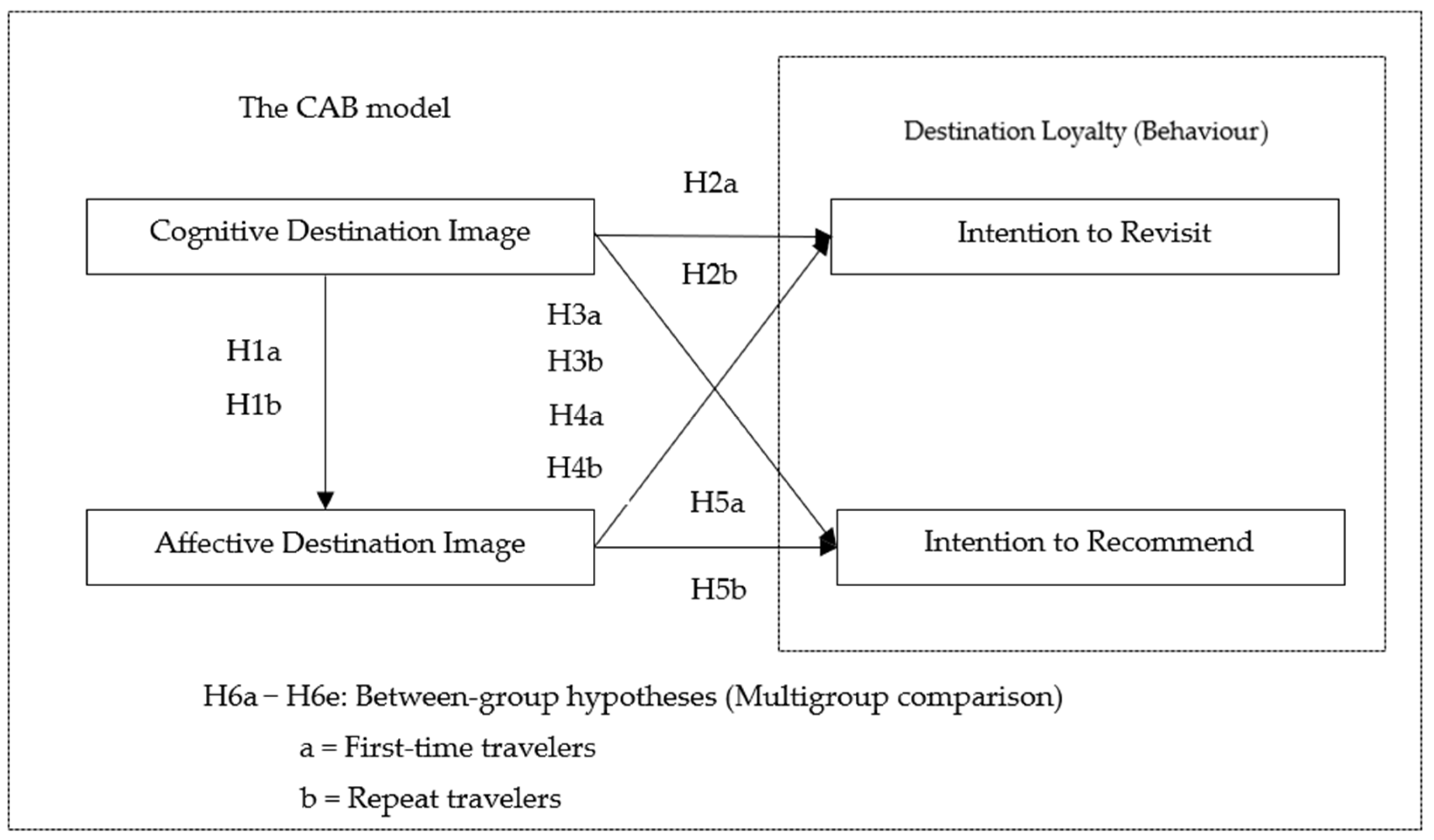
This study addressed the knowledge gap by investigating these connections using the CAB model, where international tourists’ perceptions were referenced and these dynamics were examined. Throughout this study, the following acronyms are used consistently: cognitive destination image (CO), affective destination image (AF), intention to revisit (IV), and intention to recommend (IR). Based on these constructs, the following hypotheses were developed (H):
H1a: 
Cognitive destination image positively affects affective destination image for first-time travellers.
H1b: 
Cognitive destination image positively affects affective destination image for repeat travellers.
H2a: 
Cognitive destination image positively affects intention to revisit for first-time travellers.
H2b: 
Cognitive destination image positively affects intention to revisit for repeat travellers.
H3a: 
Cognitive destination image positively affects intention to recommend for first-time travellers.
H3b: 
Cognitive destination image positively affects intention to recommend for repeat travellers.
H4a: 
Affective destination image positively affects intention to revisit for first-time travellers.
H4b: 
Affective destination image positively affects intention to revisit for repeat travellers.
H5a: 
Affective destination image positively affects intention to recommend for first-time travellers.
H5b: 
Affective destination image positively affects intention to recommend for repeat travellers.
H6a: 
The effect of cognitive destination image on affective destination image differs significantly between first-time and repeat travellers.
H6b: 
The effect of cognitive destination image on intention to revisit differs significantly between first-time and repeat travellers.
H6c: 
The effect of cognitive destination image on intention to recommend differs significantly between first-time and repeat travellers.
H6d: 
The effect of affective destination image on intention to revisit differs significantly between first-time and repeat travellers.
H6e: 
The effect of affective destination image on intention to recommend differs significantly between first-time and repeat travellers.
This study extended the CAB model to address international tourists’ perceptions about the affective and cognitive destination images, and behavioural loyalty. Figure 1 illustrates the conceptual model.

3. Methodology

3.1. Instrument Development

The research instrument comprised a structured questionnaire encompassing respondents’ demographic characteristics (marital status, gender, education level, age, and monthly income), cognitive and affective destination image dimensions, revisit intention, and recommendation intention. All constructs were operationalized using five-point Likert scales, ranging from 1 (strongly disagree) to 5 (strongly agree). The measurement scales were adapted from validated instruments in the established tourism literature. Specifically, cognitive image (CO: three items) and affective image (AF: five items) were derived by Casali et al. (2021), Jeong and Holland (2012), J.-H. Kim et al. (2021), and Schofield et al. (2020). Behavioural loyalty was measured through two distinct constructs: intention to revisit (IV: four items) and intention to recommend (IR: four items), adapted from Lee and Xue (2020) and Maghrifani et al. (2022). The complete measurement items are presented in Appendix A.
To establish content validity, the research instrument underwent rigorous evaluation by an expert panel comprising three tourism specialists: two professors with expertise in tourism and hospitality management from research-intensive universities, and one senior tourism industry practitioner. The panel independently assessed each questionnaire item for relevance to the research objectives, clarity and comprehensibility, and appropriateness for the target population based on the experts’ feedback, and ensured cultural appropriateness for international respondents. The content validity index (CVI) exceeded 0.80 for all retained items, surpassing the recommend threshold of 0.78 (Polit & Beck, 2006).
Following content validation, the English-language questionnaire was pilot-tested with 30 international travellers in Trang province, Thailand. This sample size aligns with recommendations for pilot studies, which suggest that 25–40 participants are sufficient for detecting comprehension issues and assessing preliminary reliability (Hertzog, 2008). Pilot test participants were required to meet identical eligibility criteria as the main study but were excluded from the final data collection. The pilot testing phase served three primary purposes: identifying ambiguous items, assessing questionnaire completion time, and evaluating preliminary psychometric properties. Cronbach’s alpha coefficients for all constructs ranged from 0.862 to 0.867, indicating satisfactory internal consistency. Based on pilot participants’ feedback, minor wording adjustments were made to improve readability, and the questionnaire layout was reformatted to enhance visual clarity. All constructs exceeded the required Cronbach’s alpha threshold of 0.70 (J. F. Hair et al., 2019).

3.2. Data Collection

The target population consisted of international tourists visiting Thailand’s southern coastal destinations. According to the Ministry of Tourism and Sports (2024b), Thailand received 35,545,714 international arrivals during this period. To ensure representativeness, the populations was stratified into seven geographical regions based on official tourism statistics: East Asia and ASEAN, Europe, South Asia, The Americas, Oceania, Middle East, and Africa. Using Yamane’s formula at 95% confidence level with ±5% margin of error, this calculation yielded a minimum required sample of 384 respondents (Yamane, 1973). This sample size substantially exceeds the minimum recommendations for PLS-SEM, which suggest 150–400 respondents for complex models (Dash & Paul, 2021). In this study, the maximum number of paths directed at a single construct is 2 (for revisit intention and recommendation intention), requiring a minimum of 20 cases per group. With 185 first-time and 207 repeat travellers, both groups substantially exceeded this threshold.
Prior to participation, all subjects were informed about the study objectives, procedures, potential risks, and benefits. Written informed consent was obtained from all participants before data collection commenced. Detailed information on the population distribution and sample allocation by geographic region is reported in Table 1.
Data were obtained from 392 respondents via face-to-face surveys at three popular tourist destinations in southern Thailand: Phuket, Krabi, and Phang-Nga. These locations were strategically selected as they ranked among the top 10 destinations for international tourists in Thailand during 2024 (Ministry of Tourism and Sports, 2024b). A nonprobability sampling technique (purposive sampling) was employed to contact only international tourists who possessed relevant experiences and opinions about Thailand’s destination image. The selection of southern coastal destination (Phuket, Krabi, Phang-Nga) was strategically justified by several methodological and theoretical considerations that prioritize internal validity over broad geographic representativeness. These locations represent Thailand’s most internationally recognized beach tourism destinations, collectively receiving over 35% of international arrivals and exemplifying the country’s sustained “Amazing Thailand” coastal branding initiatives, making them ideal contexts for examining destination image maturity effects (Ministry of Tourism and Sports, 2024a).
Coastal leisure tourism constitutes a relatively homogeneous destination type characterized by consistent visitor motivations—relaxation, beach activities, and natural scenery appreciation—thereby reducing confounding variables inherent in mixed-purpose destinations. However, this sampling strategy necessitates acknowledgement that coastal leisure destinations attract tourist profiles potentially differing systematically from visitors to cultural heritage sites, urban destinations, or ecological tourism areas. Purposive sampling was employed to ensure participants possessed relevant destination image experiences specific to Thailand’s tourism context, aligning with the study’s theoretical focus on mature destination branding effects. While this approach limits claims of national representativeness, it enhances analytical precision by examining perceptual processes within a theoretically coherent destination category, thereby strengthening construct validity and theoretical generalizability within the coastal tourism domain.
Respondents were required to meet three eligibility criteria for inclusion: participants must be 18 years of age or older, participants must be non-residents of Thailand, and participants must have visited Thailand within the past three years. Only participants satisfying all three criteria simultaneously were permitted to proceed with the questionnaire. This study was approved by the Institute Ethics Committee of Research Ethics (Social Sciences). Written informed consent was obtained from all participants before date collection began.

3.3. Data Analysis

Data were analyzed using SmartPLS 4.1.0.9 following a three-stage approach recommended for PLS-SEM multigroup analysis (J. Hair et al., 2017).
Stage 1: Measurement model assessment was conducted for internal consistency evaluations of latent variables (J. F. Hair et al., 2014; Manley et al., 2021).
Stage 2: Measurement invariance testing employed the measurement invariance of composite model (MICOM) procedure (Henseler et al., 2016) comprising three sequential steps: configural invariance, ensuring identical indicators, data treatment, and algorithm settings across groups; compositional invariance (partial invariance), testing whether construct composites are equivalent across groups (correlation = 1; permutation p-value > 0.05); and scale invariance (full invariance), testing equal mean values and equal variances across groups. Partial measurement invariance (Steps 1–2) permits valid between-group path coefficient comparisons, while full invariance (all three steps) additionally allows latent mean comparisons.
Stage 3: Structural model and multigroup analysis involved evaluating the structural model using bootstrapping (5000 resamples) to assess path significance within each group. Between-group differences were tested using three convergent methods: parametric test, Welch–Satterthwaite test, and permutation test (5000 permutations). Significance was determined using permutation-based p-values (α = 0.05), which provide distribution-free robust estimates for group comparisons (Matthews, 2017).

4. Results

4.1. Descriptive Statistics

The sample comprised 392 respondents, categorized into first-time travellers (n = 185, 47.19%) and repeat travellers (n = 207, 52.81%). Gender distribution revealed a male predominance in both cohorts, with males constituting 54.59% of first-time travellers and 59.42% of repeat travellers. Regarding marital status, married respondents represented the largest proportion in both groups (47.03% and 51.70%, respectively), followed by single respondents (41.08% and 38.16%, respectively).
Substantial differences emerged in age distribution between the two cohorts. First-time travellers demonstrated the highest concentration in the 26–32 years age bracket (31.35%), whereas repeat travellers exhibited a more heterogeneous age profile, with peak concentration in the 40–49 years category (25.60%). This finding suggests that repeat visitation to Thailand correlates with increased age and potentially greater disposable income and travel experience.
Educational attainment analysis revealed that bachelor’s degree holders constituted the largest segment across both groups (41.08% for first-time travellers and 34.78% for repeat travellers), followed by respondents with high school or secondary education (23.25% and 22.22%, respectively). Master’s degree holders represented 23.24% of first-time travellers and 21.26% of repeat travellers, indicating a relatively highly educated sample population.
Income distribution patterns exhibited notable variation between cohorts. First-time travellers predominantly reported monthly earnings in the USD 500–1000 range (30.27%), while repeat travellers displayed a more dispersed income profile across higher income brackets, with the highest proportion earning USD 1001–2000 per month (28.02%). Additionally, a substantial proportion of repeat travellers reported monthly income exceeding USD 3000 (20.77% compared to 18.38% for first-time travellers), suggesting that repeat visitation may be associated with higher socioeconomic status. Comprehensive demographic characteristics are presented in Table 2.
Descriptive statistics for the measurement items revealed consistently high mean values across all constructs (Table 3). For cognitive image dimensions, mean scores ranged from 4.02 to 4.28 for first-time travellers and 4.08 to 4.21 for repeat travellers, indicating favourable perceptions of Thailand’s tangible attributes. Affective image items demonstrated similarly elevated mean values, with first-time travellers rating Thailand as “an interesting place” highest (M = 4.58, SD = 0.537) and repeat travellers showing comparable sentiments (M = 4.43, SD = 0.670). Intention to revisit and intention to recommend exhibited strong mean values exceeding 4.19 across all indicators in both groups, suggesting robust behavioural intentions toward Thailand as a tourist destination.

4.2. The PLS-SEM Model Assessment

4.2.1. Measurement Model Assessment

The measurement model comprised four latent constructs: cognitive image (CO), affective image (AF), intent to revisit (IV), and intent to recommend (IR). Model evaluation employed multiple reliability and validity criteria in accordance with established PLS-SEM guidelines.
Indicator reliability was established through factor loadings, which ranged from 0.648 to 0.945 across both groups. The majority of indicators exceeded the recommended 0.70 threshold, with only one item (AF4F for first-time travellers: 0.684) falling marginally below this criterion. The retention of AF4F is examined through three complementary measures. First, cross-loading analysis confirmed adequate discriminant validity for AF4F, notwithstanding its loading value of 0.684 falling marginally below the conventional 0.70 threshold. Second, sensitivity analysis indicated that removing AF4F would reduce the composite reliability from 0.832 to 0.824 and average variance extracted from 0.594 to 0.651 for the affective image construct. However, both metrics would remain above minimum thresholds.
Third, there was a theoretical justification for retention on AF4 (First-time travellers) (“a comfortable place”), the conceptual distinctiveness in capturing the safety and security dimension of the affective image. Prior destination image research emphasizes comfort as a foundational affective dimension, it particularly reflects the feelings or emotions a destination evokes, representing psychological impressions (Wu & Liang, 2020). This item was retained given its theoretical importance and its loading exceeding the more lenient 0.60 threshold for exploratory research (Bagozzi & Yi, 1988).
Internal consistency reliability was evaluated using two complementary measures. Cronbach’s alpha coefficients ranged from 0.769 to 0.937, substantially exceeding the 0.70 threshold recommended for confirmatory research. Composite reliability (CR) values ranged from 0.832 to 0.937, further corroborating the measurement model’s internal consistency (Cham et al., 2022). These findings collectively demonstrate that the measurement instruments exhibit robust reliability across both visitor segments.
Convergent validity was assessed through average variance extracted (AVE), with all constructs demonstrating AVE values exceeding the 0.50 threshold. Specifically, AVE values ranged from 0.594 to 0.812 across constructs and groups, indicating that latent variables account for the majority of variance in their respective indicators (Hulland, 1999). This finding confirms that items within each construct converge to measure the intended theoretical concepts.
Discriminant validity was examined using the heterotrait–monotrait (HTMT) criterion, recognized for superior performance compared to traditional approaches such as the Fornell–Larcker criterion. All HTMT ratios remained substantially below the conservative 0.85 threshold for conceptually distinct constructs (Henseler et al., 2015). For first-time travellers, HTMT values ranged from 0.293 to 0.724; for repeat travellers, values ranged from 0.416 to 0.792. These results confirm that each constructs possesses adequate discriminant validity and remains empirically distinct from other constructs in the model.
Common method bias was evaluated through full collinearity variance inflation factors (VIFs). All VIF values ranged from 1.000 to 1.367, substantially below the conservative threshold of 3.33, indicating the absence of significant common method variance (Kock & Lynn, 2012). This finding demonstrates that single-source data collection did not introduce systematic bias that would compromise the validity of the structural model results. Complete measurement model assessment results are presented in Table 4, Table 5 and Table 6.

4.2.2. Measurement Invariance Assessment (MICOM)

Prior to conducting multigroup analysis, measurement invariance was rigorously assessed using the three-step MICOM procedure. This evaluation is essential to ensure that observed differences between groups reflect true population differences rather than measurement artifacts.
Step 1: Configural invariance—All four constructs demonstrated configural invariance, confirming that both groups interpret the measurement items identically. This finding validates the use of identical measurement specifications across first-time and repeat travellers.
Step 2: Compositional invariance—Compositional invariance was established for all constructs, with correlation values approximating 1.000 and confidence intervals not including significantly lower values. Specifically, cognitive image (C = 1.000, 95% CI [0.996, 1.000]), affective image (C = 0.998, 95% CI [0.998, 1.000]), intention to revisit (C = 0.999, 95% CI [0.998, 1.000]), and intention to recommend (C = 1.000, 95% CI [0.999, 1.000]) all satisfied compositional invariance requirements. These results confirm that both groups assign equivalent weights to construct indicators.
Step 3: Equality of composite mean values and variances—The assessment of equal mean values and variances yielded mixed results. Cognitive image and intention to revisit achieved full measurement invariance, with mean and variance differences falling within permutation-based confidence intervals. However, affective image and intention to recommend demonstrate significant differences in either mean values or variances, resulting in partial rather than full measurement invariance for these constructs.
The establishment of partial measurement invariance is sufficient to proceed with multigroup analysis, as compositional invariance (Step 2) is the critical prerequisite for meaningful group comparisons. The observed differences in mean values and variances represents substantive rather than methodological differences between first-time and repeat travellers, which is precisely what the multigroup analysis aims to investigate. Complete MICOM results are presented in Table 7.

4.2.3. Within-Group Path Analysis

Structural model assessment was conducted separately for first-time and repeat travellers to examine the hypothesized relationships between destination image components and behavioural intentions (Table 8).
Hypothesis 1 (H1a, H1b):
Cognitive destination image positively affects affective destination image for first-time travellers (H1a) and repeat travellers (H1b).
Both groups demonstrated a strong positive relationship between cognitive and affective destination image. First-time travellers exhibited a path coefficient of β = 0.520 (t = 8.726, p < 0.001), while repeat travellers showed β = 0.557 (t = 10.097, p < 0.001). These large sizes confirm that favourable cognitive assessments of Thailand’s tangible attributes significantly influence emotional responses, supporting the hierarchical relationship proposed in destination image theory.
Hypothesis 2 (H2a, H2b):
Cognitive destination image positively affects intention to revisit for first-time travellers (H2a) and repeat travellers (H2b).
Contrary to theoretical expectations, cognitive image exerted negligible direct effects on revisit intention in both groups (first time: β = 0.001, t = 0.009, p = 0.993; repeat: β = 0.035, t = 0.539, p = 0.590). These non-significant paths suggest that cognitive assessments alone do not directly drive revisit intentions, indicating full mediation through affective image.
Hypothesis 3 (H3a, H3b):
Cognitive destination image positively affects intention to recommend for first-time travellers (H3a) and repeat travellers (H3b).
Cognitive image positively influenced recommendation intention across both groups, demonstrating small to medium effect sizes. (first time: β = 0.165, t = 2.578, p < 0.010; repeat: β = 0.230, t = 3.593, p < 0.001). This finding indicates that tangible destination attributes contribute directly to word-of-mouth intentions, independent of emotional responses.
Hypothesis 4 (H4a, H4b):
Affective destination image positively affects intention to revisit for first-time travellers (H4a) and repeat travellers (H4b).
Strong positive relationships emerged between affective image and revisit intention for both segments (first time: β = 0.523, t = 7.727, p < 0.001; repeat: β = 0.569, t = 7.845, p < 0.001). These large effect sizes underscore the critical role of emotional connections in driving return visit intentions, regardless of whether emotions stem from anticipated experiences or accumulated memories.
Hypothesis 5 (H5a, H5b):
Affective destination image positively affects intention to recommend for first-time travellers (H5a) and repeat travellers (H5b).
Affective image strongly predicted recommendation intentions in both groups (first time: β = 0.548, t = 7.925, p < 0.001; repeat: β = 0.424, t = 5.263, p < 0.001). Both coefficients represent medium to large effects, with first-time travellers demonstrating numerically stronger relationships, potentially reflecting heightened enthusiasm associated with novel experiences.

4.2.4. Multigroup Analysis (MGA): Testing for Group Differences

The central research question examined whether first-time and repeat travellers differ significantly in how destination image components influence loyalty outcomes. Hypotheses H6a through H6e predicted significant group differences across all five structural paths. Three convergent statistical tests were employed: parametric test, Welch–Satterthwaite test, and permutation test with 5000 permutations. Following Sarstedt et al.’s (2011) conservative criterion, a path difference is considered statistically significant only when at least two of the three tests indicate p < 0.05.
H6a: 
The effect of cognitive destination image on affective destination image differs significantly between first-time and repeat travellers.
A path coefficient difference of Δβ = −0.037 (parametric test: p = 0.648; Welch–Satterthwaite: p = 0.649; permutation: p = 0.656) revealed no significant group differences. Despite repeat travellers exhibiting numerically higher coefficients, this difference was not statistically significant, indicating that cognitive perceptions shape emotional responses equivalently across visitor types.
H6b: 
The effect of cognitive destination image on intention to revisit differs significantly between first-time and repeat travellers.
Path coefficient difference of Δβ = −0.034 (parametric: p = 0.697; Welch–Satterthwaite: p = 0.696; permutation: p = 0.654) showed no significant differences. Neither group demonstrated significant direct effects, and the groups did not differ in the strength of this negligible relationship.
H6c: 
The effect of cognitive destination image on intention to recommend differs significantly between first-time and repeat travellers.
A path coefficient difference of Δβ = −0.065 (parametric: p = 0.462; Welch–Satterthwaite: p = 0.461; permutation: p = 0.487) indicated no significant group differences. While repeat travellers showed numerically stronger effects, this difference failed to achieve statistical significance.
H6d: 
The effect of affective destination image on intention to revisit differs significantly between first-time and repeat travellers.
A path coefficient difference of Δβ = −0.046 (parametric: p = 0.611; Welch–Satterthwaite: p = 0.609; permutation: p = 0.653) revealed no significant group differences. Emotional connections drive revisit intentions with equivalent strength regardless of visit history.
H6e: 
The effect of affective destination image on intention to recommend differs significantly between first-time and repeat travellers.
A path coefficient difference of Δβ = 0.124 (parametric: p = 0.260; Welch–Satterthwaite: p = 0.255; permutation: p = 0.307) showed no significant group differences. First-time travellers exhibited numerically stronger effects, potentially reflecting greater enthusiasm associated with novelty, but this difference did not achieve statistical significance.
Complete multigroup comparison results are presented in Table 9. The model explained substantial variance in outcome variables across both groups (Table 10), with R2 values ranging from 26.8% to 41.9%, supporting the conclusion that the destination image model operates equivalently for both visitor types.
The substantive impact of excluding a specific predictor construct on the explained variance (R2) of an endogenous construct was evaluated through f2 effect size values, whereby thresholds of f2 ≥ 0.02, f2 ≥ 0.15, and f2 ≥ 0.35 represent small, medium, and large effects, respectively (Cohen, 1988). In Table 11, the effect size analysis revealed a substantive difference between first-time and repeat travellers. Although the majority of structural paths exhibited comparable effect sizes across both cohorts, the AF → IR relationship demonstrated a marked attenuation, declining from a large effect (f2 = 0.376) among first-time travellers to a medium effect (f2 = 0.191) among repeat travellers. This finding indicates that the predictive power of AF on IR diminishes considerably as travellers accumulate destination experience. In contrast, repeat travellers exhibited marginally stronger effects for the CO → AF pathway (f2 = 0.444 versus 0.367) and the AF → IV pathway (f2 = 0.344 versus 0.269). These results suggest that experienced travellers may process these theoretical relationships through distinct cognitive mechanisms informed by their accumulated destination knowledge and prior visitation history.
According to Liengaard et al. (2021), the assessment of predictive relevance (Q2) serves to examine whether exogenous constructs demonstrated predictive capability for a given endogenous construct through the blindfolding procedure. A Q2 value exceeding zero indicates that the exogenous constructs possess predictive relevance for the endogenous construct under examination (J. F. Hair et al., 2014). As presented in Table 12, all endogenous constructs—namely, affective image (AF), intention to revisit (IV), and intention to recommend (IR)—exhibited Q2 values greater zero, thereby confirming the predictive relevance and validity of the proposed model.

5. Discussion, Implications, and Limitations

5.1. Discussion

5.1.1. The Puzzle of Perception

This study contributes significantly through its unexpected findings that challenge the existing literature. Contrary to expectations and prior research suggesting differences between visitor types (Lu et al., 2023; Schofield et al., 2020; Yoo & Katsumata, 2022), this multigroup analysis comparing first-time and repeat travellers to Thailand demonstrated statistically equivalent perceptions across all examined relationships between destination image components and loyalty outcomes (all permutation p-value > 0.05). The study advances theoretical understanding by introducing the direct relationship between perceptual uniformity and destination image maturity. It is important to acknowledge that these findings are contextualized within coastal leisure destinations, which may demonstrate greater branding consistency relative to more heterogeneous destination typologies. The comparatively homogeneous characteristics of beach tourism experiences—encompassing standardized service offerings, predictable natural amenities, and consistent leisure activities—may partially account for the observed perceptual uniformity among visitors.
Three plausible explanations emerge from these findings, each addressing why prior research documented divergence while this study reveals convergence. First, Thailand represents a qualitatively different stage of destination lifecycle maturity than contexts examined in prior research. Studies documenting significant visitor differences typically examined emerging destinations (Lu et al., 2023) or specialized destinations with limited awareness (Shapoval et al., 2021). These contexts share a common characteristic: insufficient temporal duration for destination images to achieve stability across information sources. In contrast, Thailand’s 25+ years of consistent “Amazing Thailand” branding since 1998—combined with its status as a top ten global destination—has created the term “perceptual maturity”, a state where destination images have achieved such stability and ubiquity that they transcend individual experiential differences.
Second, the digital information revolution has fundamentally altered the information asymmetry that underpinned traditional first-timer/repeater distinctions, but this effect manifests disproportionately in high-profile destinations. While scholars have theorized about digital equalization effects (Aboalganam et al., 2025; Y.-F. Chen & Law, 2016), empirical evidence has remained limited. Thailand’s 35.5 million annual arrivals generate unprecedented volumes of user-generated content—TripAdvisor contains Thailand reviews, Instagram hosts #Thailand posts, and YouTube features travel vlogs. This creates an “experiential knowledge democratization” effect, where contemporary first-time visitors access extensive experiential narratives, virtual tours, and real-time destination information before arrival, fundamentally reducing the knowledge gap that traditionally separated them from repeat visitors. Importantly, this digital saturation effect likely operates primarily in globally prominent destinations, explaining why emerging destinations continue to exhibit divergence.
Third, Thailand’s tourism infrastructure standardization ensures remarkable consistency between promoted destination images and actual visitor experiences—a condition not universally present in destinations showing visitor segment differences. When destination reality consistently matches destination promises across multiple touchpoints (accommodation, attractions, services), both first-time and repeat visitors encounter confirmation rather than disconfirmation, leading to convergent perceptions. Prior research documenting divergence often examined destinations where experience–brand misalignment prompted repeat visitors to revise their initially positive perceptions (Schofield et al., 2020). Thailand’s decades of tourism development have created sufficient quality standardization that keeps cognitive evaluations stable across experience levels.
Critically, the following three mechanisms operate synergistically rather than independently: long-term branding creates stable expectations, digital information approximates experiential knowledge, and infrastructure standardization ensures experience-brand alignment—together producing the perceptual uniformity observed in this study. This synergistic explanation reconciles apparent contradictions in the existing literature by identifying boundary conditions under which traditional first-timer/repeater distinctions attenuate.

5.1.2. Cognitive Component

The strong relationship between cognitive image and affective image across both groups (βF = 0.520, p < 0.001; βR = 0.557, p < 0.001) confirms that rational assessments of destination attributes remain foundational to destination image formation, consistent with the hierarchical model by Baloglu and McCleary (1999). However, cognitive image functions more as an enabler than a direct driver of loyalty behaviour.
This study reveals that tangible destination attributes (beaches, temples, climate) register cognitively but must undergo emotional processing before influencing behaviour intentions. Thailand’s cognitive strengths—high ratings for outdoor activities, weather, and cultural sites—provide necessary but insufficient conditions for loyalty. First-time travellers frequently depend on external sources (marketing tools, recommendations, and social media) to form cognitive assessments. Marketing channels, including social networks, digital media, and mobile applications (Facebook, WhatsApp, and TikTok), are vital for forming perceptions that affect emotions regarding Thailand. Contrastingly, repeat travellers depend on accumulated experiences and emotional connections, such as nostalgia or memorable events, which creates a stronger link between cognitive and affective images.
The relationship between cognitive image and recommendation intention across both groups (βF = 0.165, p < 0.001; βR = 0.230, p < 0.001) suggests that rational attributes support word-of-mouth through evidential endorsement—tourists cite tangible destination qualities when explaining recommendations to others. However, the substantially stronger affective-to-recommendation paths indicate that emotional conviction, not rational evidence, primarily drives recommendation enthusiasm. This dual pathway structure aligns with recent findings by N. C. Chen et al. (2018), Cubillas-Para et al. (2023), and Prayag et al. (2017), demonstrating that the effective destination advocacy combines emotional conviction with rational justification.

5.1.3. Affective Component

Within-group analysis revealed critical insights about loyalty formation mechanism. Across both groups, affective image emerged as the dominant predictor of both revisit intention (βF = 0.523, p < 0.001; βR = 0.569, p < 0.001) and recommendation intention (βF = 0.548, p < 0.001; βR = 0.424, p < 0.001), while cognitive image showed negligible direct effects on revisit intention and modest effect on recommendation intention.
This study reveals the emotional gateway to loyalty: rational evaluations of destination attributes (climate, attraction, infrastructure, and destination) matter primarily insofar as they generate emotional responses (pleasure, excitement, interest). These emotional responses then drive behavioural intentions. This finding extends recent theoretical developments in destination image research. Rather et al. (2022) demonstrated affect-dominant pathways in an experiential tourism context, arguing that emotional resonance creates the psychological necessary for loyalty development.
The slightly stronger the relationship between affective image and revisit intention for repeat travellers (βF = 0.523 vs. βR = 0.569), though not statistically significant, suggests nuanced differences in emotional processing (Liang & Xue, 2021; Rather et al., 2022). First-time travellers’ excitement or satisfaction during the visit affects their decision to revisit; however, these emotional responses are frequently limited to the immediate trip experience. Contrastingly, repeat travellers’ decisions are motivated by deeper emotional connections, including nostalgia, attachment, and familiarity established over multiple visits.
Conversely, the stronger relationship between affective image and recommendation intention for first travellers (βF = 0.548 vs. βR = 0.424), again not statistically significant, reflects different recommendation motivations (Manthiou et al., 2017; Prayag et al., 2017; Rather et al., 2022). For first-time travellers, intense emotions of pleasure, stimulation, interest, comfort, and excitement are central to creating meaningful experiences and contribute positively to word-of-mouth enthusiasm, whereas repeat visitors’ more tempered, comfort-based emotions generate less urgent recommendation impulses.

5.1.4. Multigroup Comparison

These findings revealed no statistically significant differences across all five hypothesized paths (H6a–H6e). The absence of group differences (all permutation p-values > 0.05) indicates that Thailand’s destination image operates through similar psychological mechanisms regardless of visit history. Similar findings were reported by Kaplanidou and Gibson (2012), who found non-signifiant differences between first-tme and repeat attendess regarding their future behaviours and images of the events and destionations. This finding aligns with Dong and Qu (2022), who similarly reported non-significant differences between first-time and repeat tourists in their study of multisensory impressions and place identity.
However, contrasting findings exist in the literature. Shapoval et al. (2021) documented significant perceptual differences in garden quality dimensions between visitor types. Lu et al. (2023) found that stronger perceived value-loyalty links for first-time visitors to Beijing’s Grand Canal Forest Park. Schofield et al. (2020) revealed distinct destination image formation across visitor segments. These divergent findings suggest that mature destination processes with clear, consistent brands (like Thailand) may exhibit perceptual uniformity, while emerging or repositioning destinations show greater perceptual variation across visitor types. This study indicates that destination maturity moderates the relationship between visit experience and perceptual processes, representing an important avenue for future research.

5.2. Implications

This investigation examined perceptual differences between first-time (n = 185) and repeat international travellers (n = 207) to Thailand concerning destination image dimensions and loyalty outcomes, employing the cognitive–affective–behavioural (CAB) model through advanced multigroup analysis using PLS-SEM. The findings challenge conventional assumptions in destination image research.
Contrary to theoretical expectations and prior empirical evidence suggesting fundamental differences between visitor segments, multigroup analysis revealed no statistically significant differences between first-time and repeat travellers across all examined structural pathways (all permutation p-values > 0.05). Both cohorts demonstrated equivalent perceptions regarding how cognitive image influences affective image and how these dimensions affect revisit and recommendation intentions. This perceptual uniformity suggests that mature destinations with sustained branding may achieve stable image structures that transcend direct experiential differences.
Affective image emerged as the dominant predictor of destination loyalty for both segments, exerting substantially stronger effects on revisit intention (βF = 0.523, βR = 0.569) and recommendation intention (βF = 0.548, βR = 0.424) compared to cognitive image. Cognitive image exhibited negligible direct effects on revisit intention (βF = 0.001, βR = 0.035) and modest positive effects on recommendation intention (βF = 0.165, βR = 0.230), suggesting its primary role as an emotional enabler rather than a direct loyalty driver. This finding underscores that rational evaluations of destination attributes matter primarily insofar as they generate emotional responses, which subsequently drive behavioural intentions.
The relationship between cognitive and affective dimensions across both groups (both p < 0.001) confirms the hierarchical structure proposed in destination image theory, where cognitive assessments precede and shape emotional responses. However, this cognition–affect pathway operates equivalently regardless of visit history, suggesting that Thailand’s decades-long “Amazing Thailand” branding campaign since 1998 has successfully established uniform cognitive–affective processing mechanisms across visitor segments with varying experiential backgrounds.

5.2.1. Theoretical Implications

This study advances destination image theory through three substantive contributions.
First, the research introduces the concept of “destination image maturity” as a theoretical construct that moderates the relationship between visitor experience and perceptual processes. Traditional destination image theory posits fundamental differences between first-time visitors versus repeat visitors. This study demonstrates that in mature destinations with sustained, consistent branding over decades, these traditional distinctions may dissolve, resulting in perceptual uniformity.
The duration of destination image consistency influences the relationship between visitation experience and destination image formation. Perceptual divergence was measured across three temporal categories: short-term (less than 5 years), medium-term (5–15 years), and long-term (more than 15 years).
Short-term branding (less than 5 years) generates high perceptual divergence. First-time visitors rely predominantly on mediated promotional content, while repeat visitors develop experiential knowledge that deviates from brand communications, resulting classical separation between “mediated” and experiential” images (Baloglu & McCleary, 1999). Medium-term branding (5–15 years) produces partial information equalization through proliferated user-generated content and word-of-mouth communication, reflecting moderate divergence. First-time visitors increasingly access experientially grounded secondary information as brand identity crystallizes in collective consciousness.
Long-term sustained branding (more than 15 years) produces perceptual saturation—a state where destination image achieves such stability that experiential learning yields minimal perceptual revision. The distinction between “organic” and “induced” images effectively dissolves (Gartner, 1994). This finding suggests a boundary condition to experiential learning theories in tourism contexts: when destination image achieve sufficient stability and ubiquity through long-term marketing efforts and extensive secondary information accumulation, the distinction between “mediated” images and “experiential” images diminishes (Torres-Pruñonosa et al., 2024). This theoretical advancement challenges researchers to reconsider the universality of experience-based segmentation in established tourism destinations.
Second, this research validates and extends the CAB model’s applicability to comparative visitor segment analysis in mature destination contexts (Chang, 2022). While previous applications of the CAB model have examined individual visitor groups independently, this study demonstrates that the models’ sequential structure (cognition → affect → behaviour) operates with equivalent strength across visitor segments with fundamentally different information bases. The model’s cross-segment consistency suggests its robustness as a theoretical framework for understanding destination image dynamics, particularly in contexts where branding has achieved perceptual stability. This validation extends the model’s theoretical boundaries from individual-level analysis to cross-segment comparative contexts.
Third, this research challenges the digital information equalization hypothesis by demonstrating its practical manifestation in mature destination contexts (Aboalganam et al., 2025). The perceptual uniformity observed between first-time and repeat visitors provides empirical evidence that contemporary digital proliferation-including user-generated content, virtual tours, and real-time destination information has fundamentally altered traditional information asymmetries. In destinations characterized by minimal digital visibility, a substantial information asymmetry emerges between first-time visitors, who rely predominantly on official marketing communications, and repeat visitors, who draw upon accumulated experiential knowledge. Destinations exhibiting moderate levels of digital infrastructure demonstrate a partial reduction in this informational disparity, although notable differences persist.
Conversely, well-established destinations with extensive digital ecosystems exhibit a convergence phenomenon whereby first-time visitors gain access to experience-proximate information that approximates the knowledge acquisition typically associated with direct visitation. Thailand exemplifies this convergence pattern, as its status among the world’s top ten tourism destinations generates substantial volumes of user-generated content, virtual tours, and real-time destination intelligence. This digital proliferation facilitates what may be conceptualized as “experiential knowledge democratization”—a thorough process where first-time visitors arrive equipped with knowledge structures that approximate those derived from direct experiential engagement. This finding contributes to emerging theoretical perspectives on how digital transformation reshapes destination image formation processes, suggesting that digital engagement may approximate direct experience effects even before actual visitation.

5.2.2. Practical Implications

The findings offer critical strategic implications for destination marketing organizations (DMOs), tourism policymakers, and hospitality practitioners managing Thailand and comparable mature destinations.
First, marketing investments should prioritize emotional engagement over rational attribute promotion. Given affective image’s dominant role in driving both revisit and recommendation intentions, DMOs should develop experiential marketing initiatives that cultivate emotional connections. Practical implementation strategies include authentic cultural encounters that generate memorable emotional experiences and storytelling campaigns emphasizing emotional narrative rather than factual destination descriptions. To operationalize these findings, DMOs should adopt integrated marketing communication strategies encompassing four key elements: (1) user-generated content campaigns should be deployed to facilitate visitor participation in constructing emotional narratives through designated social media hashtags (e.g., #AmazingThailandModents), thereby amplifying authentic emotional discourse and fostering community engagement (Munar & Jacobsen, 2014); (2) immersive digital experiences, including 360-degree virtual reality tours of cultural and natural attractions, should be leveraged to stimulate anticipatory emotions during the pre-travel phase, enhancing emotional priming effects (Tussyadiah et al., 2018); (3) influencer collaboration strategies should prioritize emotional journey documentation over destination attribute enumeration, emphasizing affective experiences throughout the visitor journey rather than superficial destination features (Pourazad et al., 2025); (4) video storytelling initiatives featuring authentic visitor testimonials should foreground transformative emotional experiences, demonstrating the enduring impact of destination encounters beyond initial expectations (Moin et al., 2020).
As an illustrative application, the Tourism Authority of Thailand could develop a comprehensive campaign such as “Thailand Changed Me”, which would systematically document visitors’ emotional trajectories from anticipation through post-visit transformation. This campaign would emphasize how emotional connections transcend cognitive evaluations, utilizing narrative frameworks that capture the evolution of visitor affect across temporal stages of the tourism experience (Servidio & Ruffolo, 2016). Such strategic implementation would align marketing communications with the emotional dimensions identified as central to destination loyalty formation. Thailand’s existing strengths in hospitality, cultural richness, and natural beauty provide substantial foundation for emotion-focused marketing approaches.
Second, destination quality management should recognize that cognitive attributes, while not directly driving loyalty, remain essential as enablers of emotional responses. Infrastructure, attractions, and service quality create the foundation upon which emotional experiences are built. DMOs must maintain high standards in tangible destination attributes while simultaneously investing in emotional engagement mechanisms. The operationalization of this dual-pathway framework necessitates three interconnected strategic interventions: (1) service excellence programs must be developed to cultivate emotional intelligence competencies among tourism personnel, enabling empathetic guest interactions that transform transactional encounters into emotionally resonant experiences (Pizam & Tasci, 2019). Such training initiatives should emphasize affective labour practices that facilitate memorable emotional engagement beyond standardized service protocols (Chi & Wang, 2018); (2) experience design frameworks should be constructed to systematically integrate cognitive touchpoints—including wayfinding systems, transportation infrastructure, and facility quality—with affective touchpoints such as cultural performances, unanticipated service enhancements, and personalized guest interactions (Tung & Ritchie, 2011). This integration ensures that functional destination attributes serve as enablers of emotional experiences rather than as discrete service components. (3) Quality assurance mechanisms must incorporate dual measurement systems that monitor both operational metrics (e.g., cleanliness standards, safety protocols, accessibility compliance) and emotional metrics, including guest sentiment analysis and emotional satisfaction indicators. This bifurcated monitoring approach acknowledges that service quality encompasses both cognitive and affective dimensions of visitor evaluations.
As a practical application, Thai hospitality establishments could implement “Emotional Journey Mapping” methodologies to identify critical touchpoints where cognitive infrastructure facilitates affective breakthroughs. For example, streamlined check-in procedures may service as cognitive facilitators that enable immediate guest immersion in culturally enriching experiences, thereby minimizing functional barriers to emotional engagement. This approach recognizes that operational efficiency constitutes a necessary but insufficient condition for emotional destination experiences. This dual approach ensures that cognitive evaluations facilitate rather than impede affective response development.
Third, digital marketing strategies should leverage the equalization effect demonstrated in this study. Since first-time visitors arrive with experience-like knowledge due to digital information access, DMOs should prioritize high-quality digital content that accurately represents destination experiences. To facilitate affective loyalty development across the temporal visitor journey, DOMs should implement four strategic initiatives grounded in relationship marketing theory (Morgan & Hunt, 1994) and destination attachment frameworks (Yuksel et al., 2010). (1) Pre-visit engagement platforms should be designed to provide virtual destination exploration tools, interactive cultural education modules, and personalized itinerary construction systems. These platforms serve dual functions: building cognitive destination knowledge while simultaneously stimulating anticipatory emotions that prime visitors for affective experiences. This approach recognizes that emotional destination connections commence during the pre-consumption phase rather than exclusively during on-site experiences. (2) Emotional loyalty programs should be reconceptualized to reward affective engagement behaviours—including narrative sharing, review generation, and peer recommendations—rather than solely incentivizing transactional repeat visitation (Brakus et al., 2009). Rewards should emphasize experiential benefits such as exclusive cultural access or personalized ceremonial welcomes, thereby reinforcing emotional bonds through symbolic recognition of visitor–destination relationships (Barnes et al., 2014). (3) Continuous narrative marketing strategies should be employed to maintain emotional connections during inter-visit periods through personalized post-trip communications, anniversary reminders, and exclusive content distribution to previous visitors (Pearce & Kang, 2009).
This sustained engagement approach prevents emotional attenuation between visits and reinforces long-term destination attachment (Gross & Brown, 2008). (4) Digital community platforms should be established to facilitate peer-to-peer emotional storytelling, enabling prospective visitors to access authentic experiential narratives from previous travellers (W. Guo & Qiu, 2025). Such communities leverage social validation mechanisms to enhance the credibility and emotional resonance of destination narratives beyond institutional marketing communications. As an illustrative implementation, a mobile application such as “Thailand Insider community” could operationalize these principles by connecting prospective visitors with experienced travellers for real-time affective insights while incorporating gamification elements—including achievement recognition for emotional milestones (e.g., contemplative moments, cultural immersion experiences, interpersonal connections with local communities)—to enhance sustained engagement. This integrated approach acknowledges that emotional loyalty cultivation requires systematic intervention across pre-visit, experiential, and post-visit phases of the destination relationship lifecycle. User-generated content, virtual reality experiences, and authentic social media narratives help align expectations with reality, ensuring that actual visitation confirms rather than contradicts pre-visit images. This alignment between mediated and experiential images strengthens both cognitive and affective components across visitor segments.

5.3. Limitations of Study and Future Research Directions

Several limitations ensure consideration for future research directions. First, the geographic scope is constrained to coastal leisure destinations in southern Thailand (Phuket, Krabi, Phang-Nga), which, despite representing the country’s most prominent beach tourism locations, attract visitors with relatively homogeneous motivations—relaxation, beach activities, and natural scenery appreciation—may differ systematically from those visiting cultural heritage sites, urban centers, ecological tourism areas. The observed perceptual uniformity between first-time and repeat visitors may be partially attributable to the homogeneous characteristics of coastal leisure experiences rather than exclusively to destination image maturity effects. Future research should explicitly compare perceptual processes across multiple destination types within Thailand to determine whether perceptual uniformity constitutes a function of destination maturity, destination type, or their interaction.
Second, while purposive sampling enabled theoretically coherent examination within a specific destination category, it limits national representativeness; future studies should employ probability sampling across diverse destination types to enhance external validity. Third, subsequent investigations should integrate additional variables including travel motivations, prior expectations, satisfaction, perceived value, digital information sources, familiarity, cultural distance, and perceived risk—particularly social media and user-generated content—which may moderate or mediate relationships within the cognitive–affective–behavioural framework, with the digital equalization hypothesis warranting direct empirical validation through measurement of pre-visit digital engagement levels. Finally, longitudinal research designs are essential to examine temporal evolution of destination image and loyalty formation as visitors transition from first-time to repeat status, thereby explaining dynamic processes underlying destination image development across varying destination contexts.

6. Conclusions

This study examined how first-time and repeat travellers perceived Thailand’s destination image and its influence on destination loyalty, employing the cognitive–affective–behavioural model with data from 392 international tourists. The findings reveal a significant insight: first-time and repeat travellers demonstrate no significant differences in their perceptions of Thailand’s destination image, challenging traditional assumptions about experiential disparities between visitor segments. Thailand’s destination image, encompassing both cognitive attributes and affective responses strongly influences destination loyalty across both visitor groups. The consistent perceptions across segments suggest that Thailand’ sustained “Amazing Thailand” branding since 1998, combined with extensive digital marketing and user-generated content, has successfully established stable and unified destination image structures that transcend direct experience. However, these findings must be interpreted within the specific context of leisure destinations, which may demonstrate greater perceptual consistency relative to more heterogeneous destination typologies. Further empirical investigation across multiple destination contexts is necessary to comprehensively assess the generalizability of perceptual uniformity phenomena in mature tourism destinations and to determine whether such uniformity constitutes a function of destination maturity, destination type characteristics, or their interaction.

Author Contributions

A.S.: conceptualization, methodology, formal analysis, investigation, data curation, writing—original draft preparation, writing—review and editing, visualization, project administration. R.L.-W.H.: conceptualization, methodology, validation, writing—review and editing, supervision. All authors have read and agreed to the published version of the manuscript.

Funding

This research received no external funding.

Institutional Review Board Statement

The study was conducted in accordance with the Declaration of Helsinki, and approved by Ethics Committee of the Bangkokthonburi University (protocol code 2568/170/17 and with approval date 23 July 2025).

Informed Consent Statement

Informed consent was obtained from all subjects involved in the study.

Data Availability Statement

The original contributions presented in this study are included in the article. Further inquiries can be directed to the corresponding author.

Conflicts of Interest

The authors declare no conflict of interest.

Appendix A

Table A1. Measurement items.
ConstructsItemsLatent Variables
Cognitive image (Casali et al., 2021; Jeong & Holland, 2012; Schofield et al., 2020)
CO1I guess Thailand has a variety of outdoor activities
CO2I guess Thailand has pleasant weather
CO3I guess Thailand has plentiful cultural and historical sites
Affective image (Casali et al., 2021; Jeong & Holland, 2012; Schofield et al., 2020)
AF1Thailand is a pleasant place
AF2Thailand is a stimulating place
AF3Thailand is an interesting place
AF4Thailand is a comfortable place
AF5Thailand is an exciting place
Intention to revisit (Lee & Xue, 2020; Maghrifani et al., 2022)
IV1In the future, I intent to visit/revisit Thailand
IV2In the future, I will likely visit/revisit Thailand
IV3In the future, I am interested in visiting/revisiting Thailand
IV4In the future, Thailand will still be my choice travel destination
Intention to recommend (Lee & Xue, 2020; Maghrifani et al., 2022)
IR1In the future, I am likely to recommend Thailand to those who want advice on travel
IR2In the future, I will willingly recommend visiting Thailand to others
IR3In the future, I will willingly encourage friends and family to visit Thailand
IR4In the future, I will willingly say positive things about Thailand

References

  1. Aboalganam, K. M., AlFraihat, S. F., & Tarabieh, S. (2025). The impact of user-generated content on tourist visit intentions: The mediating role of destination imagery. Administrative Sciences, 15(4), 117. [Google Scholar] [CrossRef]
  2. Afshardoost, M., & Eshaghi, M. S. (2020). Destination image and tourist behavioural intentions: A meta-analysis. Tourism Management, 81, 104154. [Google Scholar] [CrossRef]
  3. Ajzen, I. (1991). The theory of planned behavior. Organizational Behavior and Human Decision Processes, 50(2), 179–211. [Google Scholar] [CrossRef]
  4. Anton Martin, C., Camarero Izquierdo, C., & Laguna-Garcia, M. (2021). Culinary tourism experiences: The effect of iconic food on tourist intentions. Tourism Management Perspectives, 40, 100911. [Google Scholar] [CrossRef]
  5. Badu-Baiden, F., Kim, S., Xiao, H., & Kim, J. (2022). Understanding tourists’ memorable local food experiences and their consequences: The moderating role of food destination, neophobia and previous tasting experience. International Journal of Contemporary Hospitality Management, 34(4), 1515–1542. [Google Scholar] [CrossRef]
  6. Bagozzi, R. P., & Yi, Y. (1988). On the evaluation of structural equation models. Journal of the Academy of Marketing Science, 16(1), 74–94. [Google Scholar] [CrossRef]
  7. Baloglu, S., & McCleary, K. W. (1999). U.S. international pleasure travelers’ images of four mediterranean destinations: A comparison of visitors and nonvisitors. Journal of Travel Research, 38(2), 144–152. [Google Scholar] [CrossRef]
  8. Barnes, S. J., Mattsson, J., & Sørensen, F. (2014). Destination brand experience and visitor behavior: Testing a scale in the tourism context. Annals of Tourism Research, 48, 121–139. [Google Scholar] [CrossRef]
  9. Brakus, J., Schmitt, B., & Zarantonello, L. (2009). Brand experience: What is it? how is it measured? does it affect loyalty? Journal of Marketing, 73(3), 52–68. [Google Scholar] [CrossRef]
  10. Carvalho, M. A. M. (2022). Factors affecting future travel intentions: Awareness, image, past visitation and risk perception. International Journal of Tourism Cities, 8(3), 761–778. [Google Scholar] [CrossRef]
  11. Casali, G. L., Liu, Y., Presenza, A., & Moyle, C.-L. (2021). How does familiarity shape destination image and loyalty for visitors and residents? Journal of Vacation Marketing, 27(2), 151–167. [Google Scholar] [CrossRef]
  12. Cham, T.-H., Lim, Y.-M., & Sigala, M. (2022). Marketing and social influences, hospital branding, and medical tourists’ behavioural intention: Before- and after-service consumption perspective. International Journal of Tourism Research, 24(1), 140–157. [Google Scholar] [CrossRef]
  13. Chang, S. (2022). Can smart tourism technology enhance destination image? The case of the 2018 Taichung world flora exposition. Journal of Hospitality and Tourism Technology, 13(4), 590–607. [Google Scholar] [CrossRef]
  14. Chauhan, R., Kashyap, H., & Jishtu, H. (2024). Transformative adventure experiences scale: Validation and behavioral impacts. Journal of Sport & Tourism, 28(4), 221–240. [Google Scholar] [CrossRef]
  15. Chen, N. C., Dwyer, L., & Firth, T. (2018). Residents’ place attachment and word-of-mouth behaviours: A tale of two cities. Journal of Hospitality and Tourism Management, 36, 1–11. [Google Scholar] [CrossRef]
  16. Chen, Y.-F., & Law, R. (2016). A review of research on electronic word-of-mouth in hospitality and tourism management. International Journal of Hospitality & Tourism Administration, 17(4), 347–372. [Google Scholar] [CrossRef]
  17. Chi, N.-W., & Wang, I.-A. (2018). The relationship between newcomers’ emotional labor and service performance: The moderating roles of service training and mentoring functions. The International Journal of Human Resource Management, 29(19), 2729–2757. [Google Scholar] [CrossRef]
  18. Clarke, J., & Bowen, D. (2021). Repeat tourists and familiar place formation: Conversion, inheritance and discovery. Journal of Destination Marketing & Management, 20, 100605. [Google Scholar] [CrossRef]
  19. Cohen, J. (1988). Statistical power analysis for the behavioral science (2nd ed.). Lawrence Erlbaum Associates. [Google Scholar]
  20. Cubillas-Para, C., Cegarra-Navarro, J. G., & Tomaseti-Solano, E. (2023). Linking unlearning with the intention to recommend through destination image. International Journal of Tourism Cities, 9(2), 394–410. [Google Scholar] [CrossRef]
  21. Dash, G., & Paul, J. (2021). CB-SEM vs. PLS-SEM methods for research in social sciences and technology forecasting. Technological Forecasting and Social Change, 173, 121092. [Google Scholar] [CrossRef]
  22. Dong, Y., & Qu, Y. (2022). The mechanism of body–mind integration in the formation of destination attachment: A comparison of first-time and repeat tourists. Frontiers in Psychology, 13, 1010589. [Google Scholar] [CrossRef]
  23. Gartner, W. C. (1994). Image formation process. Journal of Travel & Tourism Marketing, 2(2–3), 191–216. [Google Scholar] [CrossRef]
  24. Gautam, V. (2025). Examining relationships among festival satisfaction, place attachment, emotional experience, and destination loyalty. Leisure Sciences, 47(2), 348–365. [Google Scholar] [CrossRef]
  25. Giannopoulos, A., Livas, C., Simeli, I., & Achlada, C. (2022). Is destination image instagrammable visit intentions and value co-creation through social media content. International Journal of Technology Marketing, 16(4), 349. [Google Scholar] [CrossRef]
  26. Gross, M. J., & Brown, G. (2008). An empirical structural model of tourists and places: Progressing involvement and place attachment into tourism. Tourism Management, 29(6), 1141–1151. [Google Scholar] [CrossRef]
  27. Guo, W., & Qiu, L. (2025). Constructing extraordinary experience from everyday life: Zibo barbecue check-in vlogs’ digital narratives. Tourist Studies, 25(1), 50–70. [Google Scholar] [CrossRef]
  28. Guo, X., & Pesonen, J. A. (2022). The role of online travel reviews in evolving tourists’ perceived destination image. Scandinavian Journal of Hospitality and Tourism, 22(4–5), 372–392. [Google Scholar] [CrossRef]
  29. Hair, J., Hollingsworth, C. L., Randolph, A. B., & Chong, A. Y. L. (2017). An updated and expanded assessment of PLS-SEM in information systems research. Industrial Management & Data Systems, 117(3), 442–458. [Google Scholar] [CrossRef]
  30. Hair, J. F., Risher, J. J., Sarstedt, M., & Ringle, C. M. (2019). When to use and how to report the results of PLS-SEM. European Business Review, 31(1), 2–24. [Google Scholar] [CrossRef]
  31. Hair, J. F., Jr., Sarstedt, M., Hopkins, L., & Kuppelwieser, V. G. (2014). Partial least squares structural equation modeling (PLS-SEM): An emerging tool in business research. European Business Review, 26(2), 106–121. [Google Scholar] [CrossRef]
  32. Henseler, J., Ringle, C. M., & Sarstedt, M. (2015). A new criterion for assessing discriminant validity in variance-based structural equation modeling. Journal of the Academy of Marketing Science, 43(1), 115–135. [Google Scholar] [CrossRef]
  33. Henseler, J., Ringle, C. M., & Sarstedt, M. (2016). Testing measurement invariance of composites using partial least squares. International Marketing Review, 33(3), 405–431. [Google Scholar] [CrossRef]
  34. Hertzog, M. A. (2008). Considerations in determining sample size for pilot studies. Research in Nursing & Health, 31(2), 180–191. [Google Scholar] [CrossRef]
  35. Heydari Fard, M., Sanayei, A., & Ansari, A. (2021). Determinants of medical tourists’ revisit and recommend intention. International Journal of Hospitality & Tourism Administration, 22(4), 429–454. [Google Scholar] [CrossRef]
  36. Hulland, J. (1999). Use of partial least squares (PLS) in strategic management research: A review of four recent studies. Strategic Management Journal, 20(2), 195–204. [Google Scholar] [CrossRef]
  37. Hussain, K., Raman, M., Falahat, M., & Siddiqui, Y. A. (2024). Thai cultural tourism attributes: Emerging trends and sustainable practices. In T.-C. Wong, H.-P. See, & M. Milligan (Eds.), Cultural tourism in the Asia Pacific (pp. 103–114). Springer Nature Switzerland. [Google Scholar] [CrossRef]
  38. Jenkins, O. H. (1999). Understanding and measuring tourist destination images. International Journal of Tourism Research, 1(1), 1–15. [Google Scholar] [CrossRef]
  39. Jeong, C., & Holland, S. (2012). Destination image saturation. Journal of Travel & Tourism Marketing, 29(6), 501–519. [Google Scholar] [CrossRef]
  40. Ji, X., Nicolau, J. L., Law, R., & Liu, X. (2024). Repeat customers and satisfaction: Uncovering new intricacies through restaurant reviews. Journal of Hospitality & Tourism Research, 48(7), 1226–1237. [Google Scholar] [CrossRef]
  41. Joo, D., Cho, H., & Woosnam, K. M. (2023). Anticipated emotional solidarity, emotional reasoning, and travel intention: A comparison of two destination image models. Tourism Management Perspectives, 46, 101075. [Google Scholar] [CrossRef]
  42. Kaplanidou, K., & Gibson, H. (2012). Differences between first time and repeat spectator tourists of a youth soccer event: Intentions and image approaches. Current Issues in Tourism, 15(5), 477–487. [Google Scholar] [CrossRef]
  43. Kim, J., & Hwang, J. (2021). Who is an evangelist? Food tourists’ positive and negative eWOM behavior. International Journal of Contemporary Hospitality Management, 34(2), 555–577. [Google Scholar] [CrossRef]
  44. Kim, J.-H., Wang, Y., & Song, H. (2021). Understanding the causes of negative tourism experiences. Current Issues in Tourism, 24(3), 304–320. [Google Scholar] [CrossRef]
  45. Kim, S., Kim, S., & Petrick, J. F. (2019). The effect of film nostalgia on involvement, familiarity, and behavioral intentions. Journal of Travel Research, 58(2), 283–297. [Google Scholar] [CrossRef]
  46. Kock, N., & Lynn, G. S. (2012). Lateral collinearity and misleading result in variance-based SEM: An illustration and recommendations. Journal of the Association for Information Shystems, 13(7), 546–580. [Google Scholar] [CrossRef]
  47. Lam, J. M. S., Makhbul, Z. K. M., Aziz, N. A., & Ahmat, M. A. H. (2024). Incorporating multidimensional images into cultural heritage destination: Does it help to explain and analyse better? Journal of Cultural Heritage Management and Sustainable Development, 14(4), 563–580. [Google Scholar] [CrossRef]
  48. Lee, S. W., & Xue, K. (2020). A model of destination loyalty: Integrating destination image and sustainable tourism. Asia Pacific Journal of Tourism Research, 25(4), 393–408. [Google Scholar] [CrossRef]
  49. Lentz, M., Berezan, O., & Raab, C. (2022). Uncovering the relationship between revenue management and hotel loyalty programs. Journal of Revenue and Pricing Management, 21(3), 306–320. [Google Scholar] [CrossRef]
  50. Li, S., Liu, Y., Dai, S., & Chen, M. (2022). A review of tourism and hospitality studies on behavioural economics. Tourism Economics, 28(3), 843–859. [Google Scholar] [CrossRef]
  51. Liang, X., & Xue, J. (2021). Mediating effect of destination image on the relationship between risk perception of smog and revisit intention: A case of Chengdu. Asia Pacific Journal of Tourism Research, 26(9), 1024–1037. [Google Scholar] [CrossRef]
  52. Liao, Y. K., Wu, W. Y., Truong, G. N. T., Binh, P. N. M., & Van Vu, V. (2021). A model of destination consumption, attitude, religious involvement, satisfaction, and revisit intention. Journal of Vacation Marketing, 27(3), 330–345. [Google Scholar] [CrossRef]
  53. Liengaard, B. D., Sharma, P. N., Hult, G. T. M., Jensen, M. B., Sarstedt, M., Hair, J. F., & Ringle, C. M. (2021). Prediction: Coveted, yet forsaken? Introducing a cross-validated predictive ability test in partial least squares path modeling. Decision Sciences, 52(2), 362–392. [Google Scholar] [CrossRef]
  54. Lifshitz, H. (2020). The triple CAB model: Enhancing cognition, affect, and behavior in adults with intellectual disability. In H. Lifshitz (Ed.), Growth and development in adulthood among persons with intellectual disability: New frontiers in theory, research, and intervention (pp. 53–82). Springer International Publishing. [Google Scholar] [CrossRef]
  55. Lin, J.-W., & Tsao, H.-C. (2023). Exploring first-time and repeat volunteer scuba divers’ environmentally responsible behaviors based on the C-A-B model. Sustainability, 15(14), 11425. [Google Scholar] [CrossRef]
  56. Liu, B., Li, Y., Kralj, A., Moyle, B., & He, M. (2022). Inspiration and wellness tourism: The role of cognitive appraisal. Journal of Travel & Tourism Marketing, 39(2), 173–187. [Google Scholar] [CrossRef]
  57. Lu, L., Jiao, M., & Weng, L. (2023). Influence of first-time visitors’ perceptions of destination image on perceived value and destination loyalty: A case study of grand canal forest park, Beijing. Forests, 14(3), 504. [Google Scholar] [CrossRef]
  58. Maghrifani, D., Liu, F., & Sneddon, J. (2022). Understanding potential and repeat visitors’ travel intentions: The roles of travel motivations, destination image, and visitor image congruity. Journal of Travel Research, 61(5), 1121–1137. [Google Scholar] [CrossRef]
  59. Manley, S. C., Hair, J. F., Williams, R. I., & McDowell, W. C. (2021). Essential new PLS-SEM analysis methods for your entrepreneurship analytical toolbox. International Entrepreneurship and Management Journal, 17(4), 1805–1825. [Google Scholar] [CrossRef]
  60. Manthiou, A., Ayadi, K., Lee, S., Chiang, L., & Tang, L. (2017). Exploring the roles of self-concept and future memory at consumer events: The application of an extended Mehrabian–Russell model. Journal of Travel & Tourism Marketing, 34(4), 531–543. [Google Scholar] [CrossRef]
  61. Matthews, L. (2017). Applying multigroup analysis in PLS-SEM: A step-by-step process. In H. Latan, & R. Noonan (Eds.), Partial least squares path modeling (pp. 219–243). Springer International Publishing. [Google Scholar] [CrossRef]
  62. Mehrabian, A., & Russell, J. A. (1974). A verbal measure of information rate for studies in environmental psychology. Environment and Behavior, 6(2), 233. [Google Scholar] [CrossRef]
  63. Ministry of Tourism and Sports. (2024a). Domestic tourism statistics (Classify by region and province 2024). Available online: https://www.mots.go.th/more_news_new.php?cid=411 (accessed on 5 October 2025).
  64. Ministry of Tourism and Sports. (2024b). Thailand tourism statistics report. Available online: https://www.mots.go.th/more_news_new.php?cid=411 (accessed on 5 October 2025).
  65. Moin, S. M. A., Hosany, S., & O’Brien, J. (2020). Storytelling in destination brands’ promotional videos. Tourism Management Perspectives, 34, 100639. [Google Scholar] [CrossRef]
  66. Morgan, R. M., & Hunt, S. D. (1994). The commitment-trust theory of relationship marketing. Journal of Marketing, 58(3), 20–38. [Google Scholar] [CrossRef]
  67. Munar, A. M., & Jacobsen, J. K. S. (2014). Motivations for sharing tourism experiences through social media. Tourism Management, 43, 46–54. [Google Scholar] [CrossRef]
  68. Pearce, P. L., & Kang, M. (2009). The effects of prior and recent experience on continuing interest in tourist settings. Annals of Tourism Research, 36(2), 172–190. [Google Scholar] [CrossRef]
  69. Pizam, A., & Tasci, A. D. A. (2019). Experienscape: Expanding the concept of servicescape with a multi-stakeholder and multi-disciplinary approach (invited paper for ‘luminaries’ special issue of International Journal of Hospitality Management). International Journal of Hospitality Management, 76, 25–37. [Google Scholar] [CrossRef]
  70. Polit, D. F., & Beck, C. T. (2006). The content validity index: Are you sure you know what’s being reported? critique and recommendations. Research in Nursing & Health, 29(5), 489–497. [Google Scholar] [CrossRef]
  71. Pourazad, N., Stocchi, L., & Simmonds, L. (2025). Influencers and the choice of a travel destination: A customer journey and information processing perspective. Information Technology & Tourism, 27(4), 1185–1228. [Google Scholar] [CrossRef]
  72. Pramanik, S. A. K. (2023). Influences of the underlying dimensions of destination image on destination loyalty in a cultural heritage destination. Asia Pacific Journal of Tourism Research, 28(9), 984–999. [Google Scholar] [CrossRef]
  73. Prayag, G., Hosany, S., Muskat, B., & Del Chiappa, G. (2017). Understanding the relationships between tourists’ emotional experiences, perceived overall image, satisfaction, and intention to recommend. Journal of Travel Research, 56(1), 41–54. [Google Scholar] [CrossRef]
  74. Qiu, H., Wang, X., Wu, M. Y., Wei, W., Morrison, A. M., & Kelly, C. (2023). The effect of destination source credibility on tourist environmentally responsible behavior: An application of stimulus-organism-response theory. Journal of Sustainable Tourism, 31(8), 1797–1817. [Google Scholar] [CrossRef]
  75. Rasoolimanesh, S. M., Chee, S. Y., & Ari Ragavan, N. (2025). Tourists’ perceptions of the sustainability of destination, satisfaction, and revisit intention. Tourism Recreation Research, 50(1), 106–125. [Google Scholar] [CrossRef]
  76. Rather, R. A., Hollebeek, L. D., & Rasoolimanesh, S. M. (2022). First-time versus repeat tourism customer engagement, experience, and value cocreation: An empirical investigation. Journal of Travel Research, 61(3), 549–564. [Google Scholar] [CrossRef]
  77. Sarstedt, M., Henseler, J., & Ringle, C. M. (2011). Multigroup analysis in Partial Least Squares (PLS) path modeling: Alternative methods and empirical results. In Measurement and research methods in international marketing (pp. 195–218). Emerald Group Publishing Limited. [Google Scholar]
  78. Scannell, L., & Gifford, R. (2010). Defining place attachment: A tripartite organizing framework. Journal of Environmental Psychology, 30(1), 1–10. [Google Scholar] [CrossRef]
  79. Schofield, P., Coromina, L., Camprubi, R., & Kim, S. (2020). An analysis of first-time and repeat-visitor destination images through the prism of the three-factor theory of consumer satisfaction. Journal of Destination Marketing & Management, 17, 100463. [Google Scholar] [CrossRef]
  80. Servidio, R., & Ruffolo, I. (2016). Exploring the relationship between emotions and memorable tourism experiences through narratives. Tourism Management Perspectives, 20, 151–160. [Google Scholar] [CrossRef]
  81. Shapoval, V., Rivera, M., & Croes, R. (2021). The quality of gardens tourism and the visitor experience: Differentiating between first time and repeat visitors. Annals of Leisure Research, 24(4), 449–467. [Google Scholar] [CrossRef]
  82. Stylidis, D. (2022). Exploring resident–tourist interaction and its impact on tourists’ destination image. Journal of Travel Research, 61(1), 186–201. [Google Scholar] [CrossRef]
  83. Tabaeeian, R. A., Yazdi, A., Mokhtari, N., & Khoshfetrat, A. (2023). Host-tourist interaction, revisit intention and memorable tourism experience through relationship quality and perceived service quality in ecotourism. Journal of Ecotourism, 22(3), 406–429. [Google Scholar] [CrossRef]
  84. Teng, S., Wei Khong, K., Wei Goh, W., & Yee Loong Chong, A. (2014). Examining the antecedents of persuasive eWOM messages in social media. Online Information Review, 38(6), 746–768. [Google Scholar] [CrossRef]
  85. Torres-Pruñonosa, J., Batlle, A. A., De Esteban Curiel, J., & Díez-Martín, F. (2024). The intellectual structure of destination image research in tourism (2001–2023): Background, pre-pandemic overview, shifts during COVID-19 and implications for the future. Journal of Vacation Marketing, 30(1), 143–165. [Google Scholar] [CrossRef]
  86. Treviño-Villalobos, M., Sancho-Jiménez, L. F., Carvache-Franco, M., Víquez-Paniagua, A. G., Carvache-Franco, O., & Carvache-Franco, W. (2025). Fostering sustainable rural tourism Post-COVID-19: Determinants of revisit intention among costa Rican tourists. Sustainability, 17(12), 5231. [Google Scholar] [CrossRef]
  87. Troiville, J., Moisescu, O. I., & Radomir, L. (2025). Using necessary condition analysis to complement multigroup analysis in partial least squares structural equation modeling. Journal of Retailing and Consumer Services, 82, 104018. [Google Scholar] [CrossRef]
  88. Tung, V. W. S., & Ritchie, J. R. B. (2011). Exploring the essence of memorable tourism experiences. Annals of Tourism Research, 38(4), 1367–1386. [Google Scholar] [CrossRef]
  89. Tussyadiah, I. P., Wang, D., Jung, T. H., & Tom Dieck, M. C. (2018). Virtual reality, presence, and attitude change: Empirical evidence from tourism. Tourism Management, 66, 140–154. [Google Scholar] [CrossRef]
  90. United Nations World Tourism Organization [UNWTO]. (2024). Tourism statistics database. Available online: https://www.unwto.org/tourism-statistics/tourism-statistics-database (accessed on 1 October 2025).
  91. Wang, X., Qin, X., & Zhou, Y. (2020). A comparative study of relative roles and sequences of cognitive and affective attitudes on tourists’ pro-environmental behavioral intention. Journal of Sustainable Tourism, 28(5), 727–746. [Google Scholar] [CrossRef]
  92. Westbrook, R. A. (1987). Product/consumption-based affective responses and postpurchase processes. Journal of Marketing Research, 24(3), 258–270. [Google Scholar] [CrossRef]
  93. Woosnam, K. M., Stylidis, D., & Ivkov, M. (2020). Explaining conative destination image through cognitive and affective destination image and emotional solidarity with residents. Journal of Sustainable Tourism, 28(6), 917–935. [Google Scholar] [CrossRef]
  94. Wu, G., & Liang, L. (2020). Examining the effect of potential tourists’ wine product involvement on wine tourism destination image and travel intention. Current Issues in Tourism, 1–16. [Google Scholar] [CrossRef]
  95. Xu, T., Ma, Y., & Kim, K. (2021). Telecom churn prediction system based on ensemble learning using feature grouping. Applied Sciences, 11(11), 4742. [Google Scholar] [CrossRef]
  96. Yamane, T. (1973). Statistics: An introductory analysis. Journal of the American Statistical Association, 60(310), 678–680. [Google Scholar] [CrossRef]
  97. Yoo, B., & Katsumata, S. (2022). Sightseeing spot satisfaction of inbound tourists: Comparative analysis of first-time visitors and repeat visitors in Japan. International Journal of Tourism Cities, 9(1), 111–127. [Google Scholar] [CrossRef]
  98. Yuksel, A., Yuksel, F., & Bilim, Y. (2010). Destination attachment: Effects on customer satisfaction and cognitive, affective and conative loyalty. Tourism Management, 31(2), 274–284. [Google Scholar] [CrossRef]
  99. Zhang, J., & Walsh, J. (2020). Tourist experience, tourist motivation and destination loyalty for historic and cultural tourists. Pertanika Journal of Social Sciences and Humanities, 28(4), 3277–3296. [Google Scholar] [CrossRef]
  100. Zhang, Y., Li, J., Liu, C.-H., Shen, Y., & Li, G. (2021). The effect of novelty on travel intention: The mediating effect of brand equity and travel motivation. Management Decision, 59(6), 1271–1290. [Google Scholar] [CrossRef]
  101. Zhou, M., & Yu, H. (2022). Exploring how tourist engagement affects destination loyalty: The intermediary role of value and satisfaction. Sustainability, 14(3), 1621. [Google Scholar] [CrossRef]
  102. Zhou, X., Ng, S. I., & Deng, W. (2024). Why I revisit a historic town in Chengdu? Roles of cognitive image, affective image and memorable tourism experiences. Asia Pacific Journal of Marketing and Logistics, 36(11), 2869–2888. [Google Scholar] [CrossRef]
  103. Zou, Y., & Yu, Q. (2022). Sense of safety toward tourism destinations: A social constructivist perspective. Journal of Destination Marketing & Management, 24, 100708. [Google Scholar] [CrossRef]
Figure 1. Conceptual model.
Tourismhosp 06 00278 g001
Table 1. Population distribution and sample allocation by geographic region.
RegionTourist Arrivals (2024)Percentage (%)Target Sample (n = 392)Acceptable Range (±5%)
East Asia and ASEAN22,371,10362.93247235–259
Europe 7,340,69020.658177–85
South Asia2,573,5097.242827–29
The Americas1,478,7024.161615–17
Oceania877,8792.47109–10
Middle East742,7052.0988–8
Africa167,0650.4622
Total 35,545,714100.00392392
Table 2. Respondents’ demographic profile.
CharacteristicsFrequencyPercentage (%)
First-Time
Travellers
Repeat
Travellers
First-Time
Travellers
Repeat
Travellers
Gender
Male10112354.5959.42
Female848445.4140.58
Marital status
Single 767941.0838.16
Married8710747.0351.70
Other222111.8910.14
Age (Years)
19–25482925.9514.01
26–32584531.3521.74
33–39413922.1618.84
40–49275314.5925.60
≥5011415.9519.81
Education Level
High school or secondary434623.2522.22
Vocational college10205.419.66
Bachelor’s degree767241.0834.78
Master’s degree434423.2421.26
Doctorate or PhD7143.786.76
Other6113.245.32
Income per month (USD)
<500362519.4612.08
500–1000563830.2718.36
1001–2000295815.6828.02
2001–3000304316.2120.77
>3000344318.3820.77
Table 3. Descriptive statistics and measurement items.
Constructs or Associated ItemsFirst-Time TravellersRepeat Travellers
Mean ValueSDMean ValueSD
Cognitive image (CO), I guess Thailand…
CO1has a variety of outdoor activities4.280.7624.210.726
CO2has pleasant weather4.070.9734.080.929
CO3has plentiful cultural and historical sites4.020.8244.140.756
Affective image (AF), Thailand is…
AF1a pleasant place4.440.5974.380.670
AF2a stimulating place4.050.8124.020.812
AF3an interesting place4.580.5374.430.670
AF4a comfortable place4.250.6284.160.710
AF5an exciting place4.290.7654.060.825
Intention to revisit (IV), In the future,
IV1I intent to visit/revisit Thailand4.380.6974.290.833
IV2I will likely visit/revisit Thailand4.350.6594.290.727
IV3I am interested in visiting/revisiting Thailand4.390.6594.350.735
IV4Thailand will still be my choice travel destination4.190.7954.190.865
Intention to recommend (IR), In the future,
IR1I am likely to recommend Thailand to those who want advice on travel4.450.5894.370.731
IR2I will willingly recommend visiting Thailand to others4.480.5814.410.683
IR3I will willingly encourage friends and family to visit Thailand4.460.5714.350.747
IR4I will willingly say positive things about Thailand4.480.5534.410.690
Note: SD: standard deviation.
Table 4. Full collinearity results.
Relationship Between ConstructsVIF
Cognitive image → Affective image1.000
Cognitive image → Intention to revisit1.367
Cognitive image → Intention to recommend1.367
Affective image → Intention to revisit 1.367
Affective image → Intention to recommend1.367
Table 5. Reliability coefficients of the constructs.
ConstructItemsLoadingsReliability and Validity
Cronbach’s AlphaCRAVE
FTRTFTRTFTRTFTRT
Cognitive imageCO10.8440.8550.7670.810.7690.8120.6830.725
CO20.8580.851
CO30.7740.848
Affective imageAF10.7480.8140.8270.8460.8320.8530.5940.618
AF20.8360.819
AF30.7510.776
AF40.6840.749
AF50.8240.771
Intention to revisitIV10.8730.7470.90.8570.9370.8610.7720.703
IV20.9450.902
IV30.9380.882
IV40.7430.814
Intention to recommendIR10.8920.8650.9220.9260.9220.9280.8120.82
IR20.9390.931
IR30.9250.935
IR40.8460.889
Note: FT = first-time travellers; RT = repeat travellers; CR = composite reliability; AVE = average variance extracted.
Table 6. Discriminant validity results (HTMT).
ConstructsGroupFirst-Time TravellersRepeat Travellers
AFCOIRIVAFCOIRIVAFCOIRIV
AF
CO0.646 0.640 0.660
IR0.6610.527 0.7240.527 0.6150.536
IV0.6400.3590.734 0.5900.2930.657 0.6760.4160.792
Note: AF: affective image; CO: cognitive image; IR: intention to recommend; IV: intention to revisit.
Table 7. Invariance measurement testing results using permutation.
ConstructConfigural Invariance (Same Algorithms for Both Groups)Compositional Invariance
(Correlation = 1)
Partial Measurement Invariance EstablishedEqual Mean ValueEqual VarianceFull Measurement Invariance Established
C = 1CIDifferenceCIDifferenceCI
AFYes0.998[0.998, 1.000]Yes0.208[−0.178, 0.183]−0.259[−0.312, 0.302]No
COYes1.000[0.996, 1.000]No−0.033[−0.208, 0.195]0.057[−0.257, 0.261]Yes
IRYes1.000[0.999, 1.000]Yes0.144[−0.200, 0.196]−0.445[−0.297, 0.306]No
IVYes0.999[0.998, 1.000]No0.072[−0.188, 0.199]−0.131[−0.456, 0.456]Yes
Note: CI: confidence interval; AF: affective image; CO: cognitive image; IR: intention to recommend; IV: intention to revisit.
Table 8. Structural model and multigroup analysis: within-group path coefficients.
HypothesisPathFirst-Time Travellers (n = 185)Repeat Travellers (n = 207)
βt-ValuesConfidence Interval (95%) Bias Corrected (2.5%, 97.5%)p-Valuesβt-ValuesConfidence Interval (95%) Bias Corrected (2.5%, 97.5%)p-Values
H1CO → AF0.5208.726[0.384, 0.622]0.000 ***0.55710.097[0.436, 0.652]0.000 ***
H2CO → IV0.0010.009[−0144, 0.128]0.9930.0350.539[−0.103, 0.175]0.590
H3CO → IR0.1652.578[0.038, 0.292]0.010 **0.2303.593[0.097, 0.349]0.000 ***
H4AF → IV0.5237.727[0.369, 0.637]0.000 ***0.5697.845[0.423, 0.709]0.000 ***
H5AF → IR0.5487.925[0.394, 0.670]0.000 ***0.4245.263[0.263, 0.577]0.000 ***
Note: ** p < 0.010; *** p < 0.001; AF: affective image; CO: cognitive image; IR: intention to recommend; IV: intention to revisit.
Table 9. Multigroup comparison (between-group difference).
HypothesisPathPath
Coefficient
Difference
Parametric TestWelch–
Satterthwaite Test
p-Values
Permutation
Test
p-Values
Group Difference
H6aCOF → AFF ≠ COR → AFR−0.0370.6480.6490.656No
H6bCOF → IVF ≠ COR → IVR−0.0340.6970.6960.654No
H6cCOF → IRF ≠ COR → IRR−0.0650.4620.4610.487No
H6dAFF → IVF ≠ AFR → IVR−0.0460.6110.6090.653No
H6eAFF → IR F≠ AFR → IRR0.1240.2600.2550.307No
Note: COF: cognitive image (first-time travellers); COR: cognitive image (repeat travellers); AFF: affective image (first-time travellers); AFR: affective image (repeat travellers); IVF: intention to re-visit (first-time travellers); IVR: intention to revisit (repeat travellers); IRF: intention to recommend (first-time travellers); IRR: intention to recommend (repeat travellers).
Table 10. Explained variance (R2).
ConstructCombined SampleFirst-Time TravellersRepeat Travellers
Affective image (AF)28.0%26.8%30.8%
Intention to revisit (IV)31.1%26.8%34.9%
Intention to recommend (IR)37.0%41.9%34.3%
Table 11. Assess the effect size (f2).
Path RelationshipsFirst-Time TravellersRepeat Travellers
f2Effect Sizef2Effect Size
CO → AF0.367Large0.444Large
CO → IV0.000Trivial0.002Trivial
CO → IR0.034Small0.056Small
AF → IV0.269Medium0.344Medium
AF → IR0.376Large0.191Medium
Note: f2 score interpretation (0.35—Large, 0.15—Medium, 0.02—Small, ˂0.02—Trivial). AF: affective image; CO: cognitive image; IR: intention to recommend; IV: intention to revisit.
Table 12. Assess the predictive relevance (Q2).
ConstructQ2 Predict
First-Time TravellersRepeat Travellers
Affective image (AF)0.2550.296
Intention to revisit (IV)0.1880.207
Intention to recommend (IR)0.0580.109
Note: Q2 > 0.
Disclaimer/Publisher’s Note: The statements, opinions and data contained in all publications are solely those of the individual author(s) and contributor(s) and not of MDPI and/or the editor(s). MDPI and/or the editor(s) disclaim responsibility for any injury to people or property resulting from any ideas, methods, instructions or products referred to in the content.