You are currently viewing a new version of our website. To view the old version click .
Psychiatry International
  • Article
  • Open Access

8 December 2025

Adverse Childhood Experiences in Patients with Psychotic Disorders: A Single-Centre Study in South-Eastern Serbia


,
,
,
,
and
1
Department of Psychiatry, Medical Faculty, University of Niš, 18000 Niš, Serbia
2
Center for Mental Health Protection, University Clinical Center Niš, 18000 Niš, Serbia
3
Clinic for Psychiatry, University Clinical Center Niš, 18000 Niš, Serbia
4
College of Applied Health Sciences, 35230 Ćuprija, Serbia

Abstract

Introduction: Adverse Childhood Experiences (ACEs) refer to traumatic events occurring before the age of 18 that can negatively impact physical and mental health, often disrupting development. Numerous studies have shown associations between ACEs and the onset or severity of psychotic disorders. The aim of this study was to assess the prevalence of ACEs among patients with psychotic disorders and to examine an association between ACEs and the sociodemographic and clinical characteristics of psychosis. Material and Methods: The study was conducted at the Center for Mental Health and the Psychiatric Clinic of the University Clinical Center Nis, from March to July 2025. The sample included adult patients of both sexes diagnosed with psychotic spectrum disorders based on ICD-10 criteria. The Adverse Childhood Experiences Questionnaire (ACE-Q), along with sociodemographic and clinical data from medical records, was used. Results: The sample included 60 patients, with a mean age of 36.7 years. The average ACE-Q score was 2.57 ± 1.98, with one-third of patients reporting high exposure (≥4 ACEs) to childhood adversity. Patients with high ACEs exposure (≥4 ACEs) differed significantly from those with low to moderate or no exposure (<4 ACEs) in terms of economic status, family history of psychiatric disorders, substance use, and treatment adherence. Conclusion: Despite the small sample size, our results point to a potential link between childhood adversity and certain sociodemographic and clinical characteristics in patients with psychotic disorders. Integrating systematic assessments of trauma history into routine clinical practice may support the development of more effective treatment strategies.

1. Introduction

Adverse Childhood Experiences (ACEs) refer to traumatic events occurring before age 18 that threaten children’s physical and psychological well-being and disrupt development [1]. ACEs include various forms of abuse (physical, emotional, sexual), neglect, and family dysfunction such as substance abuse, mental illness, suicide, incarceration, domestic violence, parental separation, and exposure to community or collective violence [1].
The concepts of adverse childhood experience and early trauma often overlap, especially regarding emotional and psychological outcomes. Both concepts refer to long-term negative impacts from early development that may shape a person’s life. One of the most influential studies in this field, the CDC–Kaiser Permanente Adverse Childhood Experiences (ACE) Study from the late 1990s, established a clear association between ACEs and wide range of negative health outcomes, including risky health behaviors, mental illness, reduced life expectancy, and premature death [2]. Meta-analytic, longitudinal, and clinical studies involving patients with psychosis have confirmed that childhood adversity increases the risk of developing psychosis [3,4,5]. The largest meta-analysis to date, conducted by Varese et al. with 45,441 participants, found that childhood trauma nearly triples the risk of psychotic disorders, with the risk increasing proportionally with the number and severity of traumatic experiences [3]. When examining the relationship between specific type of trauma and particular psychotic symptoms, research indicated that physical or emotional abuse has been linked to positive psychotic symptoms [5,6]. Sexual abuse may be associated with schizotypal disorder and an increased risk of psychosis in the ultra-high-risk (UHR) population [7,8]. Childhood neglect has been associated with paranoid delusions and negative symptoms [9].
It is important to emphasize that childhood trauma should be understood as a cumulative effect of multiple stressful experiences, with the risk of developing psychotic disorders increasing proportionally to the number, frequency, and intensity of these events [10]. Beyond its role in the onset of psychosis, childhood adversity can significantly influence the course of the illness and clinical outcomes. Research has shown that childhood adversity is associated with persistent psychotic symptoms [11], an increased number of suicide attempts [12], poor medication adherence [13], and a higher risk of relapse and rehospitalization [14]. A recent Canadian cohort study (N = 970) showed that individuals with psychotic disorders and a history of adverse childhood experiences exhibited persistently lower levels of social functioning, as well as higher levels of depression, anxiety, and substance misuse over a one-year follow-up period, compared to those without such experiences [15]. The authors emphasize that trauma-exposed patients present with more complex clinical profiles, highlighting the importance of trauma-informed care in the treatment of psychotic disorders [15].
Epidemiological data from Serbia show high rates of adverse childhood experiences (ACEs) in the general population. A UNICEF study (2019) reported that approximately 70% of adults reported at least one adverse experience event, while around 20% reported four or more ACEs [16]. Although these figures suggest widespread trauma exposure, there is a notable lack of detailed research focusing on clinical populations, such as individuals diagnosed with psychotic disorders. Targeted studies are therefore needed to clarify ACEs impact in this vulnerable population and support the development of tailored interventions.
The aim of this study was to assess the prevalence of ACEs among patients with psychotic disorders, including experience of abuse, neglect, and family dysfunction, and to examine an association between ACEs and the sociodemographic and clinical characteristics of psychosis.

2. Material and Methods

The study was conducted at the Day Hospital of the Center for Mental Health Protection and the Psychiatry Clinic of the University Clinical Centre Nis, from March to July 2025. Adult participants of both sexes, diagnosed with psychotic spectrum disorders (ranging from schizophrenia, F20, to psychosis not otherwise specified, F29) were included. Diagnoses were established by psychiatric specialists according to ICD-10 criteria [17]. Assessment was performed following the initial stabilization of the patient’s mental state. The study was approved by the Ethics Committee of the University Clinical Center Nis, No 3856/5 from 13 February 2025. All participants provided informed consent statement to participate in the study. Inclusion criteria were signed informed consent, a psychotic disorder diagnosis established at least six months before the study, age over 18 years, and independent ability to complete the questionnaire. Participant confidentiality was maintained throughout the study. Exclusion criteria were an IQ below 70, the presence of acute psychotic symptoms, acute suicidality, and inability to complete the questionnaire independently.
Sociodemographic data included gender, age, residential environment, household structure, education level, partnership status, employment status, economic status, and migration. Additional clinical data were obtained from medical records, including psychiatric diagnosis according to ICD-10, family history of psychiatric disorders defined as the presence of any diagnosed psychiatric disorder in first- and second-degree relatives, based on patient report and clinical records, previous psychiatric hospitalizations, treatment adherence, course of illness, and comorbid conditions such as other psychiatric disorders, personality disorders, and somatic disorders (classified based on the former DSM multiaxial diagnostic model). Data were also collected on the history of cannabis and alcohol use, as well as the presence of catatonic phenomena and suicidal behavior across the patients’ lifespan. These were recorded as binary summary variables (absent = 0, present = 1).
The Adverse Childhood Experiences Questionnaire (ACE-Q) assesses exposure to adverse childhood experiences across two domains: abuse/neglect (5 items) and family dysfunction (5 items). The questionnaire was originally developed for the CDC–Kaiser Permanente Adverse Childhood Experiences (ACE) Study [2]. The ACE-Q consists of ten dichotomous items scored as YES/NO, which each item scored as 0 or 1. For clinical interpretation, ACE-Q scores are commonly categorized as follows: 0 ACEs (No Reported Adversity) indicates no exposure to the adverse childhood experiences; 1–3 ACEs (Low to Moderate Adversity) indicates exposure to one or more types of adversity, which elevates the risk for various health and social problems compared to individuals with no adverse experiences; 4+ ACEs (High Adversity) represent a clinically significant threshold with increased risk of negative health outcomes; 6+ ACEs (Very High Adversity) reflect exposure to multiple forms of adversity and the highest risk of complex health problems [2,18]. However, in our study, we categorized ACE-Q scores into two categories: ACE-Q Score < 4, and ACE-Q Score ≥ 4. The category ACE-Q Score < 4 was considered as Low Adversity, and ACE-Q Score ≥ 4 was considered as High Adversity.
Filling out the ACE-Q requires reading ability at the fourth-grade level and takes approximately two minutes to complete.
Statistical data processing: data are presented as arithmetic mean with standard deviation, or as absolute and relative numbers. Categorical characteristics between two groups were compared using the Chi-square test or Fisher’s test. Numerical values between groups were compared with the Mann–Whitney test. The null hypothesis was tested at a significance threshold of p < 0.05. Statistical processing was performed using SPSS version 16.0.

3. Results

A total of 60 patients, 33 males (55%) and 27 females (45%), were included in the study. The average age of the study population was 36.7 ± 13.3 years (min 18 years, max 64 years). Schizophrenia was the most frequently diagnosed disorder (40%), while delusional disorder was rare (1.7%). Regarding ACE-Q scores, the average score in the sample was 2.57 ± 1.98. A total of 13 patients (21.7%) reported no adverse childhood experiences (ACEs = 0). Twenty-seven patients (45.0%) obtained ACEs in the low to moderate adversity category. In total, there were 20 patients with high adversity (33.3%), precisely clinically significant exposure to childhood adversity (ACE-Q score ≥4) was observed in 16 patients (26.7%), while 4 patients (6.7%) reported very high adversity (ACE-Q score ≥6) (Figure 1).
Figure 1. Frequency of ACEs categories and positive psychiatric family history in relation to ACEs.
ACE-Q scores did not differ significantly across most sociodemographic characteristics, with the exception of economic status (p = 0.036) (Table 1).
Table 1. Sociodemographic characteristics in relation to low and high ACE-Q score.
In examining clinical characteristics, a family history of psychiatric disorders was present in 85.0% of patients with high levels of adverse childhood experiences, compared to 35.0% of those without such experiences. This difference was statistically significant (p = 0.002).
Additional significant differences were found in the prevalence of cannabis use (p = 0.032) and alcohol use (p = 0.043). Likewise, treatment adherence differed significantly in relation to high exposure to adverse childhood experiences (p = 0.011) (Table 2).
Table 2. Clinical Characteristics of Psychosis in Relation to ACE-Q score.
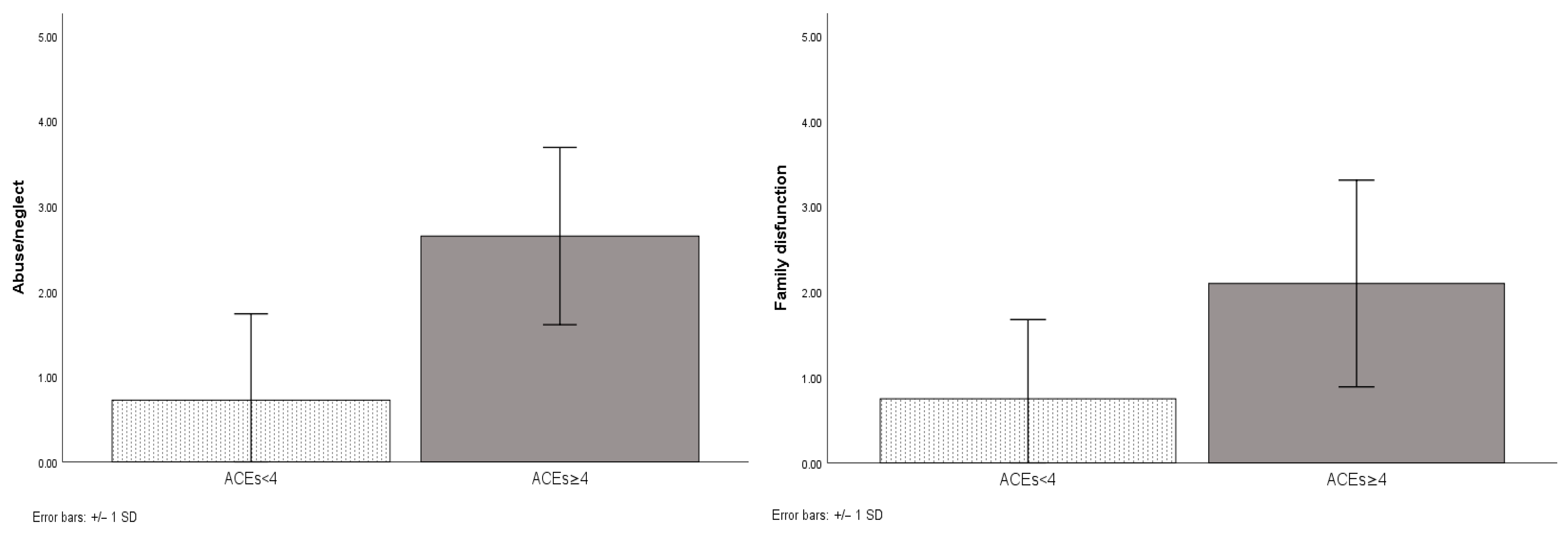
Among patients with high adverse childhood experiences, the mean scores for abuse/neglect and family dysfunction were relatively similar (2.65 ± 1.04 vs. 2.10 ± 1.21), and both were significantly higher compared to patients without adverse experiences (p < 0.001) (Figure 2).
Figure 2. Categories of Abuse/Neglect and Family Dysfunction in relation to ACEs.

4. Discussion

Retrospective assessment of adverse childhood experiences may be compromised by forgetting processes [19], cognitive impairments [20], or delusional beliefs [21]. However, research on the reliability of childhood trauma assessments has shown that reports of childhood abuse by adult psychiatric patients remain stable over time [22] and that retrospective self-report questionnaires for assessing childhood traumatic experiences in individuals with psychotic disorders are reliable [23].
The mean ACE-Q score for the study sample was 2.57 ± 1.98, indicating low to moderate exposure to adverse childhood experiences. One-third of patients (33.3%) had an ACE-Q score of ≥4, indicating a high level of childhood adversity, while four patients (6.7%) scored 6 or higher, reflecting very high exposure to multiple forms of severe adversity. As mentioned before, a UNICEF study (2019) found that approximately 20% of adults in the general population of Serbia reported experiencing four or more adverse childhood experiences [16]. This difference in ACEs prevalence between the general and clinical populations aligns with findings showing that the prevalence of multiple childhood traumas in significantly higher across various diagnostic categories than in the general population [24].
In the clinical populations, the reported prevalence of adverse childhood experiences (ACEs) varies across studies due to differences in assessment tools, sample size, cultural contexts, and methodological approaches. For instance, Turner et al. found that the prevalence of at least one ACE among individuals with psychotic disorders often exceeded 60–70%, while Reeder et al. reported that 66% of participants had experienced multiple traumatic events [25,26]. In a sample of 165 patients with schizophrenia, Yousef et al. found that nearly a quarter of participants had experienced four or more ACEs [27]. In our study, the prevalence of high childhood adversity (≥4 ACEs) was lower compared to previously mentioned studies, yet it still reflects a consistent trend and clinical relevance within the local population of patients with psychosis. Since the ACE-Q measures two key categories of adverse experiences—abuse/neglect and family dysfunction—our results show that both categories were equally prevalent and significantly more common among individuals with high ACEs. These categories often occur together, potentially amplifying long-term negative mental health outcomes [2,18]. Both abuse and family dysfunction have been shown to play significant roles in the development of psychotic symptoms, each contributing to poorer psychosocial outcomes [25].
The sociodemographic characteristics of the study population indicate a notable difference in the economic status between patients with high exposure to adverse childhood experiences (ACE-Q score ≥ 4) and those with low to moderate or no exposure (ACE-Q < 4). Specifically, 62.5% of participants with high ACE exposure were unemployed, and 15% lived without their own income, compared to 50% unemployed and no participants living without income in the lower exposure group. These findings align with other studies [27,28] that demonstrated similar trends of lower socioeconomic status in patients with psychosis and history of adverse childhood experiences, emphasizing the need for a multidimensional approach to treatment [2,15].
Regarding family history of psychiatric disorders, our results show that patients with high exposure to childhood adversity were more likely to have family members with psychiatric disorders (85%, compared to 35% in patients with low-to-moderate or no exposure to ACEs). Among patients with high exposure to ACEs, 35% had relatives with psychosis, 10% with affective disorders, 30% with addiction disorders and 10% with other psychiatric conditions. Trotta et al. [29] examined how family history of psychiatric disorders and childhood trauma influence the risk of developing psychosis, showing that both factors act as independent risk factors. Our findings suggest a pattern where patient with high exposure to childhood adversity more often come from families with psychiatric disorders. This may reflect shared environmental, but not necessarily genetic, factors. In addition, mental disorders within the family may disrupt communication patterns and emotional support, creating an unfavorable psychosocial environment that increases the risk of mental illness among other family members [30]. The presence of parental psychopathology may also reflect reduced resilience within the entire family and an increased need for support [31]. It is important to note that our study focused on the presence of psychiatric disorders in first—and second—degree relatives; however, the analysis did not distinguish between individual family members which, which may be relevant for future research.
Alcohol use (55% vs. 25%) and cannabis use (45% vs. 17.5%) were significantly higher among patients with high exposure to adverse childhood experiences (ACE-Q ≥ 4) compared to those with no or low to moderate ACEs (ACE-Q < 4). Our study examined cannabis and alcohol use across the lifespan; therefore, substance use reflects a broader pattern of lifetime use rather than current consumption, which may relate differently to psychotic symptoms. Previous research found that 44.9% of patients with schizophrenia met the criteria for lifetime drug misuse, and 14.0% met the criteria for current abuse or dependence, with alcohol and cannabis being the most commonly used substances [32]. Our findings of increased substance use among patients with high exposure to adverse childhood experiences are consistent with previous studies [15,33,34]. For example, Ramsay et al., in a study of a predominantly African American population with psychotic disorders and childhood trauma, reported that childhood abuse was associated with higher rates of cannabis and alcohol use [33]. Fraser et al., in a study involving 61 patients in the early stages of psychosis who were concurrently abusing psychoactive substances, found that 85% had a history of childhood trauma [34]. Yusuf et al., reported a statistically significant positive correlation between total ACE scores and the Addiction Severity Index in patients with schizophrenia [27]. However, some studies, such as Duhig et al., did not find a clear link between cannabis use and psychotic symptoms in the context of childhood trauma, suggesting that cannabis may contribute to the development of psychosis independently of traumatic factors [5].
As for comorbidity, comorbid conditions across all three axes were present in both patients with high ACE exposure and those with low to no exposure; however, no statistically significant differences were observed between groups. Previous studies report that 14% to 34% of individuals with psychosis experience depressive disorders, and 20% to 40% suffer from anxiety disorders [35], with those who have a history of ACEs exhibiting even higher levels of depression and anxiety [5]. Furthermore, the association between early traumatic experiences and the development of both psychosis and personality disorders is well established [36,37]. Trauma can act as a common etiological factor by disrupting emotional regulation, attachment patterns, and identity development, thereby increasing vulnerability to comorbid psychopathology. However, a recent study [38] suggests that childhood trauma is not specifically associated with any single diagnostic category, but may serve as either a non-specific or specific risk factor for comorbid mental conditions. These findings imply that focusing solely on childhood trauma in relation to a specific mental health disorder may not be the most effective approach; instead, a broader consideration of all possible comorbid conditions should be considered [39].
Although previous research indicates that patients with traumatic experiences tend to show poorer adherence to therapy [13], our results reveal a different pattern. In our study, treatment adherence was higher among patients who reported higher levels of adverse childhood experiences compared to those with no or low to moderate ACEs exposure. Even though specialized trauma-informed therapeutic approaches, which are widely discussed [40], are not readily accessible in our region, it is possible that common non-specific therapeutic factors such as empathy, consistency and structured, supportive care environment may contribute these findings. Patients with psychosis and a history of childhood adversity may develop a sense of safety during hospital stays and intensive treatment, particularly through the formation of a therapeutic alliance. Once the stabilization phase is achieved and the patient accepts the medication, it is well known that ongoing cooperation largely depends on the quality of the therapeutic relationship between the patient and the treating physician [41]. We do not exclude that the cultural and social context of the Balkan region also influence the findings. Namely, a large study conducted in Balkan countries, specifically Serbia, Bulgaria and Macedonia [42], showed that patients in these countries still express a high level of trust in medical professionals, which stood out as a key factor in overall satisfaction with health care services. In this context, the doctor–patient relationship, which in our culture remains partly rooted is authority and an expectation of obedience, may lead to greater treatment compliance, rather than genuine, internally motivated adherence.

5. Limitations

Several limitations should be considered when interpreting these findings. First, the sample was relatively small and drawn from a single center, which limits the generalizability of the findings and reduces statistical power. Second, only basic information on ACEs was collected; important variables such as duration, frequency, and the age at which the adverse events occurred were not assessed, potentially affecting the precision of the findings. Additionally, there is a possibility of self-report bias regarding trauma; however, the study was conducted within the context of a stable therapeutic relationship, which likely helped reduced recall bias commonly observed in other studies. Finally, the cross-sectional and single-center design limits the ability to establish causal relationships between childhood adversity and clinical outcomes.

6. Conclusions

The results of this study show that approximately one-third of patients with psychotic disorders have experienced a high level of adverse childhood experiences, confirming the clinical significance of early trauma in this population. Greater exposure to childhood adversity among patients with psychosis was associated with a more frequent family history of psychiatric disorders, increased use of alcohol and cannabis over the lifespan, and lower economic status. Interestingly, patients with psychosis who experienced a high level of childhood adversity showed higher adherence to therapy. This could be explained by a combination of factors, including cultural influences and the development of a stable therapeutic relationship during treatment.
These findings underscore the need for trauma-informed and multidimensional approaches in the treatment of psychotic disorders, especially among trauma-exposed patients. Integrating assessments of childhood adversity into routine clinical practice, alongside psychotherapeutic interventions targeting the impact of early trauma, may improve our understanding of trauma’s influence on clinical outcomes and support the development of more effective treatment strategies for this vulnerable clinical population.

Author Contributions

Conceptualization, J.K.; methodology, J.K. and Ž.K.; formal analysis, J.K.; investigation, J.K., I.B., A.M. and S.S.; data curation, I.B., A.M. and S.S.; writing—original draft, J.K.; writing—original draft preparation, J.K.; writing—review and editing, J.K.; visualization, M.P. All authors have read and agreed to the published version of the manuscript.

Funding

This research received no external funding.

Institutional Review Board Statement

The study was conducted in accordance with the Declaration of Helsinki, and approved by the Ethics Committee of University Clinical Center (Approval Code: Nis 3856/5; Approval date: 13 February 2025).

Data Availability Statement

The data supporting the findings of this study are stored in the institutional archive and are available on request from the corresponding author. The data are not publicly available due to privacy restrictions.

Conflicts of Interest

The authors declare no conflicts of interest.

References

  1. Ports, K.A.; Ford, D.C.; Merrick, M.T.; Guinn, A.S. ACEs: Definitions, measurement, and prevalence. In Adverse Childhood Experiences: Using Evidence to Advance Research, Practice, Policy, and Prevention; Asmundson, G.J.G., Afifi, T.O., Eds.; Elsevier Academic Press: Amsterdam, The Netherlands, 2020; pp. 17–34. [Google Scholar]
  2. Felitti, V.J.; Anda, R.F.; Nordenberg, D.; Williamson, D.F.; Spitz, A.M.; Edwards, V.; Koss, M.P.; Marks, J.S. Relationship of childhood abuse and household dysfunction to many of the leading causes of death in adults. The Adverse Childhood Experiences (ACE) Study. Am. J. Prev. Med. 1998, 14, 245–258. [Google Scholar] [CrossRef] [PubMed]
  3. Varese, F.; Smeets, F.; Drukker, M.; Lieverse, R.; Lataster, T.; Viechtbauer, W.; Read, J.; van Os, J.; Bentall, R.P. Childhood Adversities Increase the Risk of Psychosis: A Meta-Analysis of Patient-Control, Prospective- and Cross-sectional Cohort Studies. Schizophr. Bull. 2012, 38, 661–671. [Google Scholar] [CrossRef] [PubMed]
  4. Croft, J.; Heron, J.; Teufel, C.; Cannon, M.; Wolke, D.; Thompson, A.; Houtepen, L.; Zammit, S. Association of trauma type, age of exposure, and frequency in childhood and adolescence with psychotic experiences in early adulthood. JAMA Psychiatry 2019, 76, 79–86. [Google Scholar] [CrossRef] [PubMed]
  5. Duhig, M.; Patterson, S.; Connell, M.; Foley, S.; Capra, C.; Dark, F.; Gordon, A.; Singh, S.; Hides, L.; McGrath, J.J.; et al. The prevalence and correlates of childhood trauma in patients with early psychosis. Aust. N. Z. J. Psychiatry 2015, 49, 651–659. [Google Scholar] [CrossRef]
  6. Ajnakina, O.; Trotta, A.; Oakley-Hannibal, E.; Di Forti, M.; Stilo, S.A.; Kolliakou, A.; Gardner-Sood, P.; Gaughran, F.; David, A.S.; Dazzan, P.; et al. Impact of childhood adversities on specific symptom dimensions in first-episode psychosis. Psychol. Med. 2016, 46, 317–326. [Google Scholar] [CrossRef]
  7. Afifi, T.O.; Mather, A.; Boman, J.; Fleisher, W.; Enns, M.W.; MacMillan, H.; Sareen, J. Childhood adversity and personality disorders: Results from a nationally representative population-based study. J. Psychiatr. Res. 2011, 45, 814–822. [Google Scholar] [CrossRef]
  8. Thompson, A.D.; Nelson, B.; Yuen, H.P.; Lin, A.; Amminger, G.P.; McGorry, P.D.; Wood, S.J.; Yung, A.R. Sexual trauma increases the risk of developing psychosis in an ultrahigh risk “prodromal” population. Schizophr. Bull. 2014, 40, 697–706. [Google Scholar] [CrossRef]
  9. Humphrey, C.; Berry, K.; Degnan, A.; Bucci, S. Childhood interpersonal trauma and paranoia in psychosis: The role of disorganized attachment and negative schema. Schizophr. Res. 2022, 241, 142–148. [Google Scholar] [CrossRef]
  10. Shevlin, M.; Houston, J.E.; Dorahy, M.J.; Adamson, G. Cumulative traumas and psychosis: An analysis of the national comorbidity survey and the British Psychiatric Morbidity Survey. Schizophr. Bull. 2008, 34, 193–199. [Google Scholar] [CrossRef]
  11. Trotta, A.; Murray, R.M.; Fisher, H.L. The impact of childhood adversity on the persistence of psychotic symptoms: A systematic review and meta-analysis. Psychol. Med. 2015, 45, 2481–2498. [Google Scholar] [CrossRef]
  12. Bruffaerts, R.; Demyttenaere, K.; Borges, G.; Haro, J.M.; Chiu, W.T.; Hwang, I.; Karam, E.G.; Kessler, R.C.; Sampson, N.; Alonso, J.; et al. Childhood adversities as risk factors for onset and persistence of suicidal behaviour. Br. J. Psychiatry 2010, 197, 20–27. [Google Scholar] [CrossRef]
  13. Lecomte, T.; Spidel, A.; Leclerc, C.; MacEwan, G.W.; Greaves, C.; Bentall, R.P. Predictors and profiles of treatment non-adherence and engagement in services problems in early psychosis. Schizophr. Res. 2008, 102, 295–302. [Google Scholar] [CrossRef] [PubMed]
  14. Alvarez, M.-J.; Roura, P.; Osés, A.; Foguet, Q.; Solà, J.; Arrufat, F.-X. Prevalence and clinical impact of childhood trauma in patients with severe mental disorders. J. Nerv. Ment. Dis. 2011, 199, 156–161. [Google Scholar] [CrossRef] [PubMed]
  15. Abou Chabake, S.; Daigneault, I.; Giguère, C.E.; Consortium, S.; Lecomte, T. Adverse childhood experiences, social functioning deficits and comorbid clinical symptoms among individuals with psychotic disorders: A prospective cohort study. Schizophr. Res. 2025, 283, 27–35. [Google Scholar] [CrossRef] [PubMed]
  16. UNICEF. Adverse Childhood Experiences Research in Serbia (ACE Study); UNICEF: Belgrade, Serbia, 2019. [Google Scholar]
  17. World Health Organization. The ICD-10 Classification of Mental and Behavioural Disorders; Zavod za Udžbenike i Nastavna Sredstva: Belgrade, Serbia, 1992. [Google Scholar]
  18. Hughes, K.; Bellis, M.A.; Hardcastle, K.A.; Sethi, D.; Butchart, A.; Mikton, C.; Jones, L.; Dunne, M.P. The effect of multiple adverse childhood experiences on health: A systematic review and meta-analysis. Lancet Public Health 2017, 2, 356–366. [Google Scholar] [CrossRef]
  19. Piolino, P.; Desgranges, B.; Benali, K.; Eustache, F. Episodic and semantic remote autobiographical memory in ageing. Memory 2002, 10, 239–257. [Google Scholar] [CrossRef]
  20. Saykin, A.J.; Gur, R.C.; Gur, R.E.; Mozley, P.D.; Mozley, L.H.; Resnick, S.M.; Kester, D.B.; Stafiniak, P. Neuropsychological function in schizophrenia: Selective impairment in memory and learning. Arch. Gen. Psychiatry 1991, 48, 618–624. [Google Scholar] [CrossRef]
  21. Young, M.; Read, J.; Barker-Collo, S.; Harrison, R. Evaluating and overcoming barriers to taking abuse histories. Prof. Psychol. Res. Pract. 2001, 32, 407–414. [Google Scholar] [CrossRef]
  22. Goodman, L.A.; Thompson, K.M.; Weinfurt, K.; Corl, S.; Acker, P.; Mueser, K.T.; Rosenberg, S.D. Reliability of reports of violent victimization and posttraumatic stress disorder among men and women with serious mental illness. J. Trauma Stress 1999, 12, 587–599. [Google Scholar] [CrossRef]
  23. Fisher, H.L.; Craig, T.K.; Fearon, P.; Morgan, K.; Dazzan, P.; Lappin, J.; Hutchinson, G.; Doody, G.A.; Jones, P.B.; McGuffin, P.; et al. Reliability and comparability of psychosis patients’ retrospective reports of childhood abuse. Schizophr. Bull. 2011, 37, 546–553. [Google Scholar] [CrossRef]
  24. Xie, P.; Wu, K.; Zheng, Y.; Guo, Y.; Yang, Y.; He, J.; Ding, Y.; Peng, H. Prevalence of childhood trauma and correlations between childhood trauma, suicidal ideation, and social support in patients with depression, bipolar disorder, and schizophrenia in southern China. J. Affect. Disord. 2018, 228, 41–48. [Google Scholar] [CrossRef] [PubMed]
  25. Turner, S.; Harvey, C.; Hayes, L.; Castle, D.; Galletly, C.; Sweeney, S.; Shah, S.; Keogh, L.; Spittal, M.J. Childhood adversity and clinical and psychosocial outcomes in psychosis. Epidemiol. Psychiatr. Sci. 2019, 29, e78. [Google Scholar] [CrossRef] [PubMed]
  26. Reeder, F.D.; Husain, N.; Rhouma, A.; Haddad, P.M.; Munshi, T.; Naeem, F.; Khachatryan, D.; Chaudhry, I.B. The relationship between childhood trauma and adult psychosis in a UK Early Intervention Service: Results of a retrospective case note study. Neuropsychiatr. Dis. Treat. 2017, 13, 269–273. [Google Scholar] [CrossRef] [PubMed]
  27. Yousef, A.M.; Mohamed, A.E.; Eldeeb, S.M.; Mahdy, R.S. Prevalence and clinical implication of adverse childhood experiences and their association with substance use disorder among patients with schizophrenia. Egypt. J. Neurol. Psychiatry Neurosurg. 2022, 58, 4. [Google Scholar] [CrossRef]
  28. Longden, E.; Sampson, M.; Read, J. Childhood adversity and psychosis: Generalised or specific effects? Epidemiol. Psychiatr. Sci. 2016, 25, 349–359. [Google Scholar] [CrossRef]
  29. Trotta, A.; Di Forti, M.; Lyegbe, C.; Green, P.; Dazzan, P.; Mondelli, V.; Morgan, C.; Murray, R.M.; Fisher, H.L. Familial risk and childhood adversity interplay in the onset of psychosis. BJPsych Open. 2015, 1, 6–13. [Google Scholar] [CrossRef]
  30. Repetti, R.L.; Taylor, S.E.; Seeman, T.E. Risky families: Family social environments and the mental and physical health of offspring. Psychol. Bull. 2002, 128, 330–366. [Google Scholar] [CrossRef]
  31. Källquist, A.; Salzmann-Erikson, M. Experiences of having a parent with serious mental illness: An interpretive meta-synthesis of qualitative literature. J. Child Fam. Stud. 2019, 28, 2056–2068. [Google Scholar] [CrossRef]
  32. Margolese, H.C.; Malchy, L.; Negrete, J.C.; Tempier, R.; Gill, K. Drug and alcohol use among patients with schizophrenia and related psychoses: Levels and consequences. Schizophr. Res. 2004, 67, 157–166. [Google Scholar] [CrossRef]
  33. Ramsay, C.E.; Flanagan, P.; Gantt, S.; Broussard, B.; Compton, M.T. Clinical correlates of maltreatment and traumatic experiences in childhood and adolescence among predominantly African American, socially disadvantaged, hospitalized, first-episode psychosis patients. Psychiatry Res. 2011, 188, 343–349. [Google Scholar] [CrossRef]
  34. Fraser, S.; Hides, L.; Philips, L.; Proctor, D.; Lubman, D.I. Differentiating first episode substance induced and primary psychotic disorders with concurrent substance use in young people. Schizophr. Res. 2012, 136, 110–115. [Google Scholar] [CrossRef] [PubMed]
  35. Wilson, R.S.; Yung, A.R.; Morrison, A.P. Comorbidity rates of depression and anxiety in first episode psychosis: A systematic review and meta-analysis. Schizophr. Res. 2020, 216, 322–329. [Google Scholar] [CrossRef] [PubMed]
  36. Simonsen, E.; Newton-Howes, G. Personality Pathology and Schizophrenia. Schizophr. Bull. 2018, 44, 1180–1184. [Google Scholar] [CrossRef] [PubMed]
  37. Gibson, L.E.; Alloy, L.B.; Ellman, L.M. Trauma and the psychosis spectrum: A review of symptom specificity and explanatory mechanisms. Clin. Psychol. Rev. 2016, 49, 92–105. [Google Scholar] [CrossRef]
  38. Lecei, A.; Decoster, J.; De Hert, M.; Derom, C.; Jacobs, N.; Menne-Lothmann, C.; van Os, J.; Thiery, E.; Rutten, B.P.; Wichers, M.; et al. Evidence that the association of childhood trauma with psychosis and related psychopathology is not explained by gene-environment correlation: A monozygotic twin differences approach. Schizophr. Res. 2019, 205, 58–62. [Google Scholar] [CrossRef]
  39. Van Winkel, R. Aetiological stratification as a conceptual framework for gene-by-environment interaction research in psychiatry. Epidemiol. Psychiatr. Sci. 2015, 24, 6–11. [Google Scholar] [CrossRef]
  40. Hardy, A.; Keen, N.; van den Berg, D.; Varese, F.; Longden, E.; Ward, T.; Brand, R.M. Trauma therapies for psychosis: A state-of-the-art review. Psychol. Psychother. Theory Res. Pract. 2024, 97, 74–90. [Google Scholar] [CrossRef]
  41. Tessier, A.; Boyer, L.; Husky, M.; Baylé, F.; Llorca, P.M.; Misdrahi, D. Medication adherence in schizophrenia: The role of insight, therapeutic alliance and perceived trauma associated with psychiatric care. Psychiatry Res. 2017, 257, 315–321. [Google Scholar] [CrossRef]
  42. Lazarevik, V.; Kasapinov, B. Predictors of patients’ satisfaction with health care services in three Balkan countries (Macedonia, Bulgaria and Serbia): A crosscountry survey. Acta Inform. Med. 2015, 23, 53–56. [Google Scholar] [CrossRef]
Disclaimer/Publisher’s Note: The statements, opinions and data contained in all publications are solely those of the individual author(s) and contributor(s) and not of MDPI and/or the editor(s). MDPI and/or the editor(s) disclaim responsibility for any injury to people or property resulting from any ideas, methods, instructions or products referred to in the content.

Article Metrics

Citations

Article Access Statistics

Article metric data becomes available approximately 24 hours after publication online.