
Abstract
Water is a crucial component of ecosystems and a critical resource that cannot be replaced for social progress or human life. In this study, Agulu Lake, an inland water body located in Anambra, southeast Nigeria, was mapped, classified, and delineated with remotely sensed data so as to monitor the spatial-temporal changes that occurred in the lake’s surface water every 15 years, in 1985, 2000, and 2015, in order to achieve sustainable development by 2030. The Sustainable Development Goals (SDGs) of the United Nations emphasize the need to manage the marine environment. Some of the goals of the SDGs have some connection to open surface water, but goal 6a and indicator 6.6.1 are significant to this study. The study adopted Landsat 5 TM (1985), ETM+ (2000), Landsat 8 OLI (2015), ArcGIS 10.5 software, and the maximum likelihood classifier to create various classification maps. The Google Earth image (2015) was also used to show the general overview of Agulu Lake and its environs. The findings demonstrate that during the study period, the land surface class grew while the water surface class (Agulu Lake) shrank.
1. Introduction
Lake water is a crucial component of ecosystems and a critical resource that cannot be replaced for social progress or human life [1]. It supports temperature variation, the cycling of carbon, and other ecological processes. A lake is an important component of infrastructure that promotes the growth of business, trade, agriculture, and transportation, while also offering essential services for human survival [2]. A lake can develop as a widening of water along a river’s course, as a network of connected lakes, or as an isolated lake [3]. A headwater lake that receives no input from a single river is maintained by inflow from multiple small tributary streams, direct surface precipitation, and groundwater influx. The study of open surface water, such as lakes, as well as ponds and other freshwater bodies, is known as limnology [4,5].
Lakes are quite promising in all respects, so it is important to monitor their spatial-temporal changes. Remote sensing has been embraced as a tool for monitoring surface water and is preferred over the traditional methods [3,5]. Landsat imagery is a great resource for tracking spatial-temporal changes in surface water as a result of its wide coverage and availability. The lake as an important ecosystem has been recognized by the United Nations. In 2015, the UN’s member states put forth the 2030 agenda [6]. These goals have 17 SDGs, whose objective is to solve global problems by 2030. SDG 6 is one of the 17 goals established by the UN. The UN’s SDG 6 has six goals with indicators that focus on access to hygienic and clean water [7]. Several studies have been conducted on open surface water. Researchers such as Rokni et al. (2014) [8], Miles et al. (2017) [9], and Sichangi and Makokha (2017) [10] used remotely sensed data to delineate lake water. Their results showed that their areas (the lakes) changed over a period of time. Remote sensing data were used in this study to examine the spatial-temporal changes to Agulu Lake from 1985 to 2015 in order to achieve sustainability by 2030. This study bridges the gap between multiple studies as it relates surface lake water to the UN’s SDG. Agulu Lake, an inland body of water located in Agulu, Anambra State, has been experiencing problems of erosion, deforestation, and soil sterility. A visit to the area showed that Agulu Lake was fast depreciating as a result of numerous anthropogenic activities.
2. Description of the Study Area
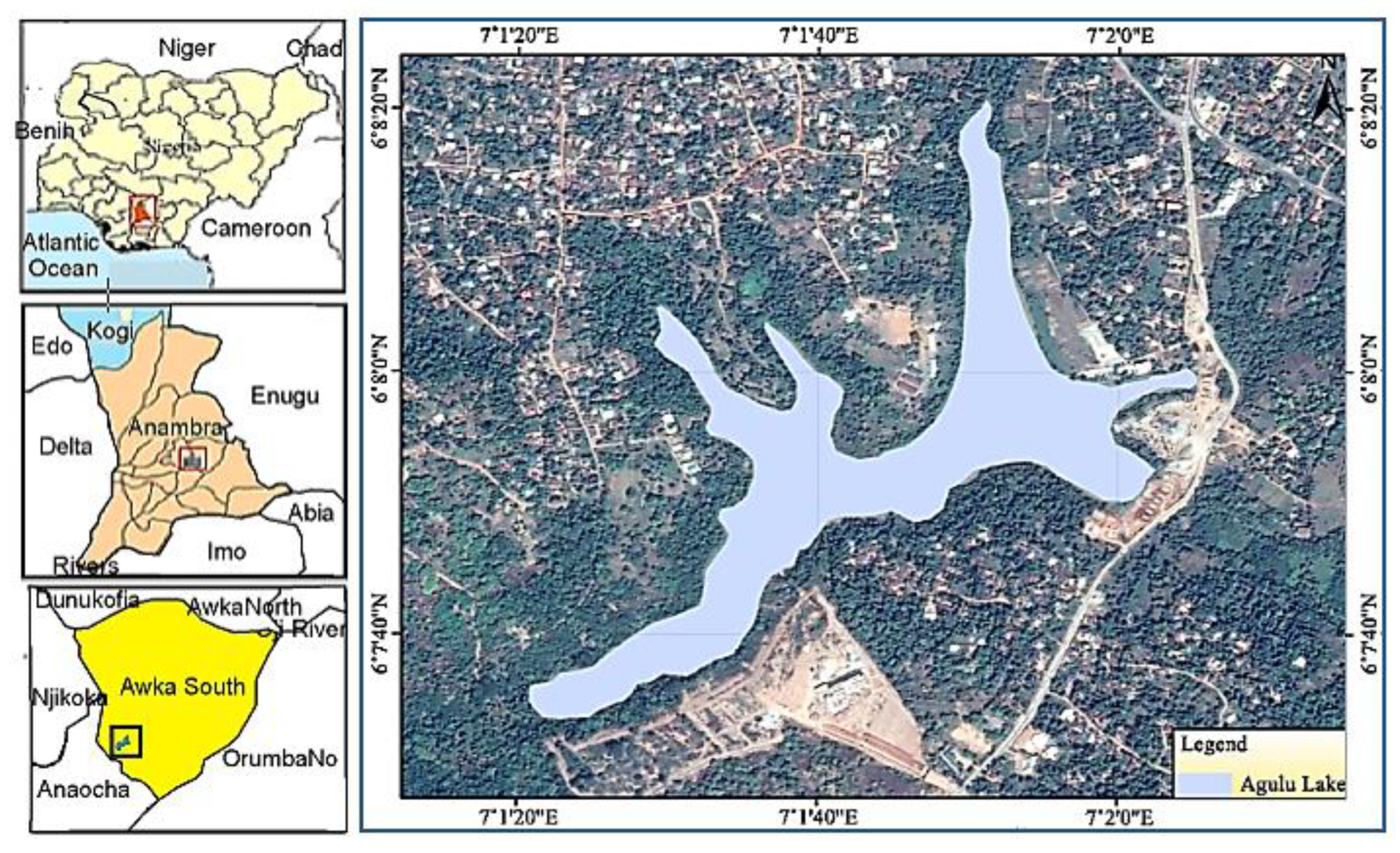
The study area, “Agulu Lake”, is located in Agulu, in the Anaocha Local Government Area of Anambra State, Southeastern, Nigeria. Agulu Lake is a naturally occurring inland body of water with a significant cultural landmark that is slowly being destroyed by flooding, erosion, and landslides [11]. Agulu Lake is the largest lacustrine environment in Anambra State. It is found between latitudes 6 07′ N and 6 09′ N and longitudes 7 01′ E and 7 03′ E of the Greenwich meridian (Figure 1). The study area has a catchment area of 32 km2 and a depth of 11.2 m at its deepest point, with a mean depth of 5.2 m. The rainfall varies from 1383 mm to 2090 mm per year, with a mean rainfall value of 1851.9 mm. The average temperature is as high as 32.1 °C and as low as 23.5 °C [12].
Figure 1.
The study area.
3. Materials and Methods
The study used Landsat satellite data for three epochs to monitor the spatial-temporal changes in the lake’s water. The three Landsat data sets, Landsat 5 TM (thematic mapper) for 1985, Landsat 7 ETM+ (enhanced thematic mapper plus) for 2000, and Landsat 8 OLI (operational land imager) for 2015, with a spatial resolution of 30 m, were chosen because of their quality and accessibility. These datasets had zero cloud cover and were accessed with a path and row of 188 and 56 from the Global Land Cover Facility (GLCF). To minimize the impact of seasonal variations, the satellite images were collected during the same months. ArcGIS 10.5 and ERDAS Imagine 10.5 were the software used for the classification and change detection processes. False color composite (FCC) analysis, image subsetting, and enhancement were some of the procedures adopted. The Landsat data were aligned with the zone 32N coordinate system of the Universal Transverse Mercator (UTM) using the World Geodetic System (WGS) 1984 ellipsoid. Data layering was carried out via the layer stacking function of the ERDAS Imagine software by combining the image spectral bands in the RGB format. The maximum likelihood classification served as the foundation for the supervised classification approaches carried out with the ERDAS Imagine (2015) program. In this study, land and water bodies were the chosen classification categories. Change detection is an important aspect of the classification process. Here, ArcGIS 10.5 software was used to analyze the change detection process by adopting the postclassification comparison (PCC) method [13]. PCC is widely used by researchers in spatial-temporal change analysis.
4. Results and Discussion
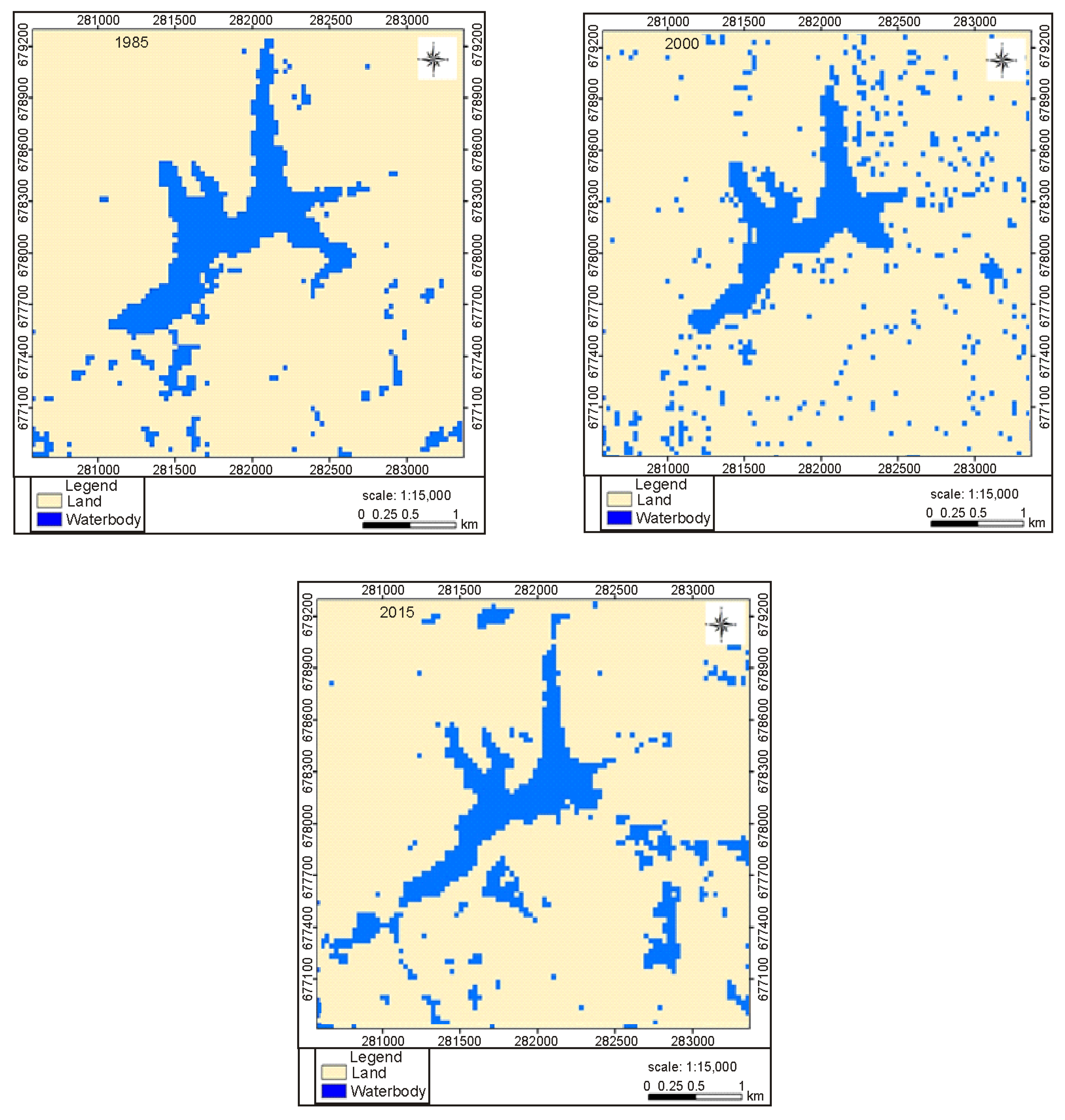
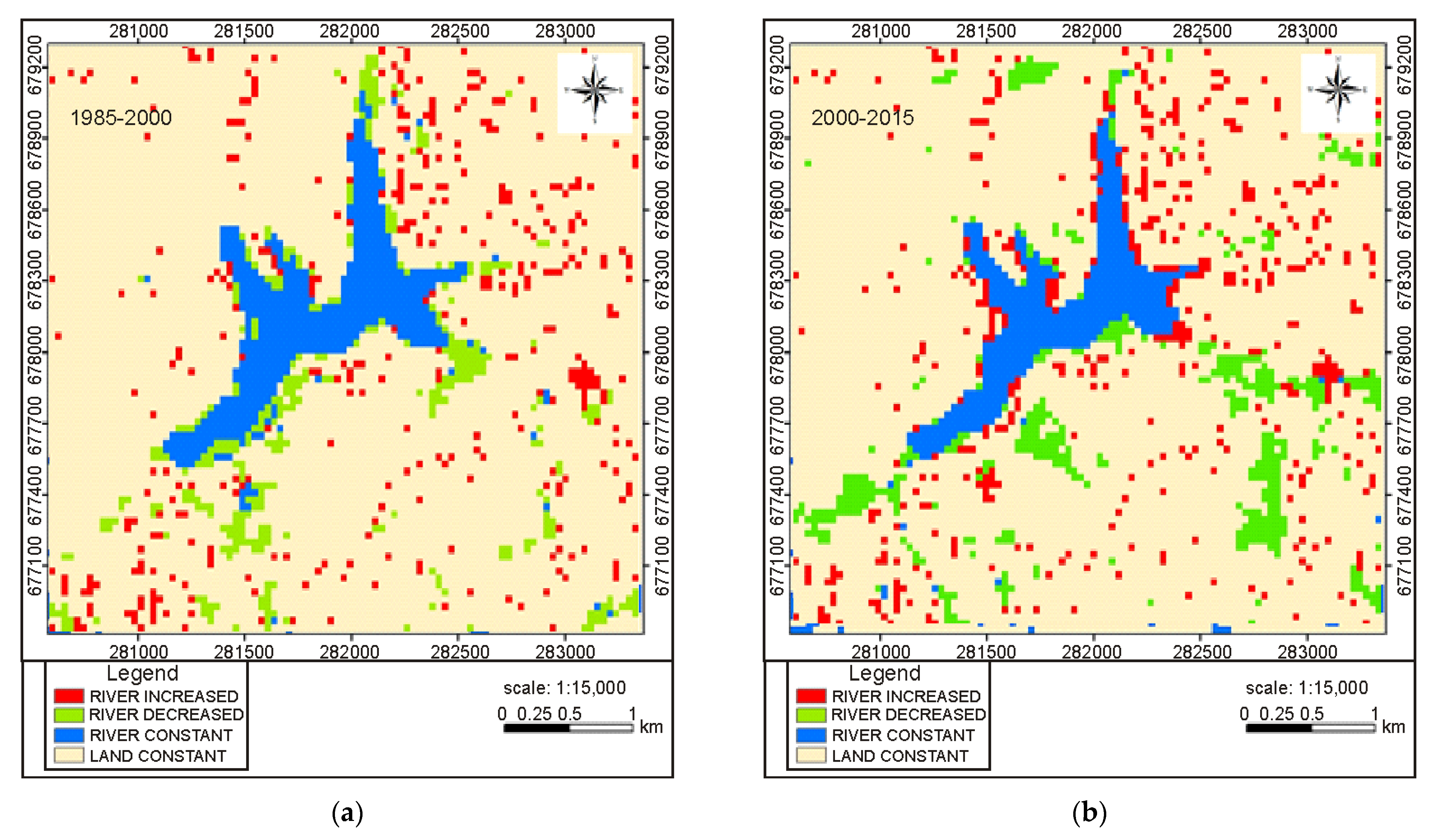
Table 1 provides an overview of the study years’ aerial distribution and their corresponding proportions in percentage during the 1985, 2000, and 2015 study years. According to the study, the land class increased from 6,353,100 m2 (87.56%) in 1985 to 6,358,100 m2 (87.61%) in 2000 to 6,366,600 m2 (87.72%) in 2015. The water class sank from 904,500 m2 (12.46%) in 1985 to 899,500 m2 (12.46%) in 2000 and to 891,000 m2 (12.28%) in 2015. Table 2 depicts the spatial-temporal changes (change detection) in the study classes from 1985 to 2000 and from 2000 to 2015. These changes in the study classes may be a result of the various anthropogenic activities taking place in the study area. While Figure 2 demonstrates the study’s classification output maps, Figure 3 shows the change detection maps between 1985 and 2000 and 2000 and 2015.
Table 1.
Area extent of the study classes.
Table 2.
Change detection from 1985 to 2000 to 2015.
Figure 2.
Classification maps.
Figure 3.
Change detection dynamics maps. (a) Change detection between 1985 and 2000. (b) Change detection between 2000 and 2015.
5. Discussion
Lakes are essential to achieving the SDGs because they offer solutions to a variety of global problems. The majority of the SDGs are linked to surface water, but this study concentrated on goal 6, target 6a, and indicator 6.6.1. Target 6a emphasizes the involvement of the local community in improving the availability of water and sewage management. Indicator 6.6.1 highlights the extent to which the water-related ecosystem can change over time. In the study, we see that Agulu Lake has been shrinking during the 1985–2000–2015 study years and is anticipated to shrink further by 2030. If we are set to achieve UN SDG 6 by 2030, then there is a need to manage, maintain, and rehabilitate deteriorating lakes and other open water bodies.
6. Conclusions and Recommendations
This study demonstrated the ability to capture spatial-temporal data using GIS and remote sensing every 15 years, from 1985 to 2000 and from 2015 to 2030. Remote sensing technology is widely used for monitoring and mapping water bodies as a result of its availability and wide coverage. The Sustainable Development Goals (SDGs) of the United Nations emphasize the need to manage the marine environment. Altogether, there are 17 SDGs in total, but goals 6a and 6.6.1 are crucial to this study. The study’s findings show that Agulu Lake has been shrinking and is anticipated to shrink further by 2030. This shrinkage in the study area (Agulu Lake) may be a result of the numerous anthropogenic activities taking place in the study area’s periphery. To accomplish SDG 6 by 2030, it is recommended that sustainable practices be mandated. Due to this, the following suggestions are offered based on the study’s findings: An interim master plan should be created to prevent shrinkage, and the local authority should publish a stop notice to all types of development within and around the study area. In conclusion, open surface water should be monitored frequently with remote sensing technology.
Author Contributions
Conceptualization, M.A.E. and C.A.O.; methodology, M.A.E.; software, M.A.E.; validation, M.A.E., C.A.O. and N.Y.N.; formal analysis, M.A.E. and N.Y.N.; investigation, C.A.O.; writing original draft preparation, M.A.E.; writing-review and editing supervision, M.A.E., C.A.O. and N.Y.N.; project administration, M.A.E., funding acquisition, C.A.O. and N.Y.N. All authors have read and agreed to the published version of the manuscript.
Funding
This study had received no external funding.
Institutional Review Board Statement
Not applicable.
Informed Consent Statement
Not applicable.
Data Availability Statement
Not applicable.
Conflicts of Interest
The authors declare that no conflict of interest exists.
References
- Crétaux, J.-F.; Abarca-Del-Río, R.; Bergé-Nguyen, M.; Arsen, A.; Drolon, V.; Clos, G.; Maisongrande, P. Lake Volume Monitoring from Space. Surv. Geophys. 2016, 37, 269–305. [Google Scholar] [CrossRef]
- Gleeson, T.; Wada, Y.; Bierkens, M.F.P.; Van Beek, L.P.H. Water balance of global aquifers revealed by groundwater footprint. Nature 2012, 488, 197–200. [Google Scholar] [CrossRef] [PubMed]
- Messager, M.L.; Lehner, B.; Grill, G.; Nedeva, I.; Schmitt, O. Estimating the volume and age of water stored in global lakes using a geo-statistical approach. Nat. Commun. 2016, 7, 13603. [Google Scholar] [CrossRef] [PubMed]
- Omondi, R.; Kembenya, E.; Nyamweya, C.; Ouma, H.; Machua, S.; Ogari, Z. Recent limnological changes and their implication on fisheries in Lake Baringo, Kenya. J. Ecol. Nat. Environ. 2014, 6, 154–163. [Google Scholar] [CrossRef]
- Ma, L.; Wu, J.; Liu, W.; Abuduwaili, J. Distinguishing between Anthropogenic and climatic impacts on Lake Size: A modelling approach using data from Ebinur Lake in Arid Northwest China. J. Limnol. 2014, 73, 350–357. [Google Scholar] [CrossRef]
- United Nation. Sustainable Development Goal 6, Synthesis Report on Water and Sanitation; United Nations: New York, NY, USA, 2018; ISBN 9789211013702. OCLC 1107804829. [Google Scholar]
- United Nations & Nations. Transforming our world: The 2030 agenda for Sustainable Development. In Proceedings of the General Assembly 70 Session, New York, NY, USA, 25–27 September 2015. [Google Scholar] [CrossRef]
- Rokni, K.; Ahmad, A.; Selamat, A.; Hazini, S. Water Feature Extraction and Change Detection Using Multitemporal Landsat Imagery. Remote Sens. 2014, 6, 4173–4189. [Google Scholar] [CrossRef]
- Miles, K.E.; Willis, I.C.; Benedek, C.L.; Williamson, A.G.; Tedesco, M. Toward Monitoring Surface and Subsurface Lakes on the Greenland Ice Sheet Using Sentinel-1 SAR and Landsat-8 OLI Imagery. Front. Earth Sci. 2017, 5, 58. [Google Scholar] [CrossRef]
- Sichangi, A.W.; Makokha, G.O. Monitoring water depth, surface area and volume changes in Lake Victoria: Integrating the bathymetry map and remote sensing data during 1993–2016. Model. Earth Syst. Environ. 2017, 3, 533–538. [Google Scholar] [CrossRef]
- Okeke, I.O.C.; Nwokolo, O.C. Conservation and preservation of traditional Agulu Lake in Anambra State, Nigeria. In Proceedings of the Taal: 12th World Lake Conference, Jaipur, India, 15–19 October 2008; Volume 29, pp. 2209–2211. [Google Scholar]
- Egboka, B.; Nfor, B.; Banlanjo, E. Water budget analysis of Agulu Lake in Anambra State, Nigeria. J. Appl. Sci. Environ. Manag. 2006, 10, 27–30. [Google Scholar] [CrossRef]
- Singh, S.K.; Mustak, S.; Srivastava, P.K.; Szabó, S.; Islam, T. Predicting Spatial and Decadal LULC Changes Through Cellular Automata Markov Chain Models Using Earth Observation Datasets and Geo-information. Environ. Process. 2015, 2, 61–78. [Google Scholar] [CrossRef]
Disclaimer/Publisher’s Note: The statements, opinions and data contained in all publications are solely those of the individual author(s) and contributor(s) and not of MDPI and/or the editor(s). MDPI and/or the editor(s) disclaim responsibility for any injury to people or property resulting from any ideas, methods, instructions or products referred to in the content. |
© 2023 by the authors. Licensee MDPI, Basel, Switzerland. This article is an open access article distributed under the terms and conditions of the Creative Commons Attribution (CC BY) license (https://creativecommons.org/licenses/by/4.0/).