
Abstract
Water is imperative for life and plays a vital role in sustaining multiple environmental services. Currently, water resources are under stress, and rainwater harvesting (RWH) is one of the solutions available to address water shortages. In this study, the potential of RWH for irrigation and recreational activities in a public park (i.e., Fatima Jinnah Park-Islamabad) is discussed. The soil conservation service-curve number (SCS-CN) method was used to estimate the runoff. Results revealed that annually 1.80 million cubic meters (MCM) runoff is generated at this park. If this runoff volume is accommodated and managed effectively, it can fulfill the requirements of irrigation and other water-related activities. Hence, the adoption of RWH technology is vital for managing water; therefore, this approach should be used to support any policy changes that lead to widespread use of RWH.
1. Introduction
Water, being the most valued resource on earth [1] is considered to be an integral development index of a society [2]. Unfortunately, ongoing depletion of this valuable resource has caused worldwide water scarcity. The major user of the water resources related to the production of vital food crops is agriculture, while inaccessibility to water is limiting agricultural production [3,4,5]. Similarly, the level of groundwater decreases as a result of increased groundwater exploitation for domestic and commercial irrigation purposes. Therefore, the judicious utilization of water resources is the need of the hour [6]. This can only be achieved by using available water supplies efficiently and adopting conservation practices. Therefore, rainwater harvesting (RWH) is an answer to water scarcity at all levels. The RWH technology is a relatively low-cost option [7], and highly decentralized which empowers individuals and communities to manage their water [8,9]. Mostly, recreational activities (i.e., fountains, etc.) and irrigation of public parks are carried out by pumping water from underground aquifers; because of this, groundwater reserves are being depleted rapidly. In this context, the RWH technique is the prominent adaptive strategy for managing water efficiently. The current study was designed to evaluate the importance of RWH system for irrigation and other water-related activities at public parks.
2. Materials and Methods
2.1. Study Area
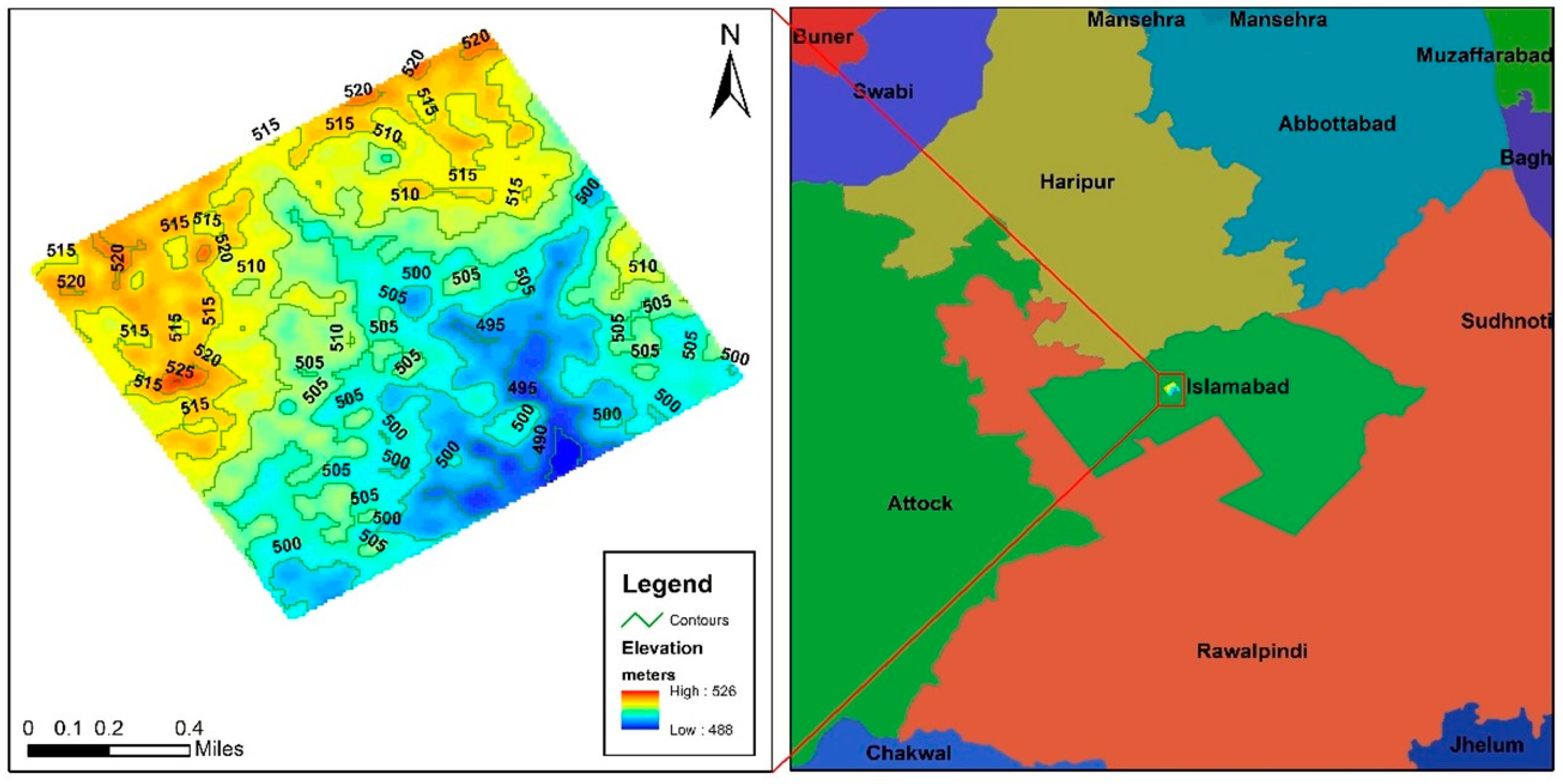
To assess the potential of RWH, Fatima Jinnah Park (F9-Park) was chosen. This park is located in Islamabad Capital Territory (ICT), the location coordinates of the site are 33.702433°N, 73.023105°E (Figure 1).
Figure 1.
Location Map of Fatima Jinnah Park (F9-Park) ICT, showing the elevation of the study area along with contours at 2 m interval.
2.2. Runoff Calculation
Runoff depth is used to assess the potential water supply during runoff. The soil conservation service-curve number (SCS-CN) method was used to estimate the runoff, which can be expressed as follows:
where Q is runoff depth (mm), P is precipitation (mm), Ia is an initial abstraction (mm), and S is potential maximum retention (mm). Whereas, according to [10] Ia = 0.2 S. Hence, the above equation (Equation (1)) can be re-write as follows:
Potential maximum retention (S) can be determined using the following relation:
CN varies from 0 to 100 and represents the runoff response to a given rain. High CNs indicate that a large proportion of the rainfall will become surface runoff [2]. The curve number was obtained (Table 1), after selecting a land-use type and a corresponding hydrologic soil group according to (USDA-SCS, 1985).
Table 1.
Runoff Calculation at Fatima Jinnah Park (F9-Park) ICT.
3. Results and Discussion
The total area of the park is around 300 hectares, with 526 m as the maximum elevation and 488 m as the minimum elevation (Figure 1). The summation of normal monthly rainfall of the study area is 1323.30 mm, while maximum rainfall amounted to 368.60 mm observed during the month of July (Table 1). Moreover, an average CN was chosen (i.e., 67.50) given by (USDA-SCS, 1985), and the maximum potential retention of the study area is calculated as 122.30 mm.
The maximum runoff generated during the monsoon period (i.e., July–September), while the annual runoff volume of the park is 1,804,505 m3. Moreover, the possible location for harvesting rainwater is shown in Figure 2. Many other studies from different regions also reported the importance of using RWH for municipal purposes i.e., park irrigation [11], commercial sites [12], and to reduce on ground water shortages [13,14].
Figure 2.
Showing possible location for RWH, reaches, longest flow paths, and elevations.
4. Conclusions
RWH is the collection of rainwater during the rainy season in order to use it later when there is a shortage of water. The present study found that a significant volume of runoff can be harvested, stored, and reused for irrigation of parks. Hence, RWH is a holistic technique for enhancing water resources, and is indispensable in terms of groundwater sustainability and protecting the natural ecosystem.
Author Contributions
Conceptualization, M.S.W., M.J.M.C. and S.H.; methodology, M.S.W., M.J.M.C. and S.H.; software, M.S.W.; validation, M.S.W., M.J.M.C., S.H., and M.U.K.; formal analysis, M.S.W. and M.J.M.C.; investigation, M.S.W. and S.H.; resources, M.S.W., S.H. and M.S.K.; data curation, M.S.W., S.H., M.U.K. and M.S.K.; writing—original draft preparation, M.S.W.; writing—review and editing, M.S.W., M.J.M.C. and S.H.; visualization, M.S.W.; supervision, M.J.M.C. All authors have read and agreed to the published version of the manuscript.
Funding
This research received no external funding.
Institutional Review Board Statement
Not applicable.
Informed Consent Statement
Not applicable.
Data Availability Statement
Not applicable.
Conflicts of Interest
The authors declare no conflict of interest.
References
- Hossain, M.Z. Water: The most precious resource of our life. Glob. J. Adv. Res. 2015, 2, 1436–1445. [Google Scholar]
- Khoso, S.; Wagan, F.H.; Tunio, A.H.; Ansari, A.A. An overview on emerging water scarcity in Pakistan, its causes, impacts and remedial measures. J. Appl. Eng. Sci. 2015, 13, 35–44. [Google Scholar] [CrossRef]
- Waqas, M.S.; Cheema, M.J.M.; Hussain, S.; Ullah, M.K.; Iqbal, M.M. Delayed irrigation: An approach to enhance crop water productivity and to investigate its effects on potato yield and growth parameters. Agric. Water Manag. 2021, 245, 106576. [Google Scholar] [CrossRef]
- Iqbal, M.M.; Hussain, S.; Cheema, M.J.M.; Lyul, J. Seasonal effect of agricultural pollutants on coastline environment: A case study of the southern estuarine water ecosystem of the boseong county Korea. Pak. J. Agri. Sci. 2022, 59, 117–124. [Google Scholar]
- Dilawar, A.; Chen, B.; Ashraf, A.; Alphonse, K.; Hussain, Y.; Ali, S.; Jinghong, J.; Shafeeque, M.; Boyang, S.; Sun, X.; et al. Development of a GIS based hazard, exposure, and vulnerability analyzing method for monitoring drought risk at Karachi, Pakistan. Geomat. Nat. Hazards Risk 2022, 13, 1700–1720. [Google Scholar] [CrossRef]
- Waqas, M.; Cheema, M.J.M.; Hussain, S.; Daccache, A.; Ullah, M.K.; Iqbal, M.M.; Hussain, H. Impact of advanced and delayed irrigation practices on physico-chemical attributes of potato tubers under bed sowing. J. Anim. Plant Sci. 2022, 32, 705–720. [Google Scholar]
- Aftab, T.B.; Hasnain, S.A.; Iqbal, S.R. Save water and safe water; evaluation of design and storage period on water quality of rainwater harvesting system. J. Environ. Earth Sci. 2012, 2, 145–160. [Google Scholar]
- Ali, A. Water harvesting in dry environments. In Innovations in Dryland Agriculture; Springer: Cham, Switzerland, 2016; pp. 49–98. [Google Scholar]
- Iqbal, M.M.; Li, L.; Hussain, S.; Lee, J.L.; Mumtaz, F.; Elbeltagi, A.; Waqas, M.S.; Dilawar, A. Analysis of Seasonal Variations in Surface Water Quality over Wet and Dry Regions. Water 2022, 14, 1058. [Google Scholar] [CrossRef]
- Melesse, A.M.; Shih, S. Spatially distributed storm runoff depth estimation using Landsat images and GIS. Comput. Electron. Agric. 2002, 37, 173–183. [Google Scholar] [CrossRef]
- Nachshon, U.; Netzer, L.; Livshitz, Y. Land cover properties and rain water harvesting in urban environments. Sustain. Cities Soc. 2016, 27, 398–406. [Google Scholar] [CrossRef]
- Mohammed, T.A.; Noor, M.; Ghazali, A.H. Study on potential uses of rainwater harvesting in urban areas. In Proceedings of the Colloquium on Rainwater Utilization, Putrajaya, Malaysia, 19–20 April 2007; pp. 1–15. [Google Scholar]
- Krishna, R.; Mishra, J.; Ighalo, J.O. rising demand for rain water harvesting system in the world: A case study of Joda Town, India. World Sci. News 2020, 146, 47–59. [Google Scholar]
- Cheema, M.; Bastiaanssen, W.G. Land use and land cover classification in the irrigated Indus Basin using growth phenology information from satellite data to support water management analysis. Agric. Water Manag. 2010, 97, 1541–1552. [Google Scholar] [CrossRef]
Disclaimer/Publisher’s Note: The statements, opinions and data contained in all publications are solely those of the individual author(s) and contributor(s) and not of MDPI and/or the editor(s). MDPI and/or the editor(s) disclaim responsibility for any injury to people or property resulting from any ideas, methods, instructions or products referred to in the content. |
© 2022 by the authors. Licensee MDPI, Basel, Switzerland. This article is an open access article distributed under the terms and conditions of the Creative Commons Attribution (CC BY) license (https://creativecommons.org/licenses/by/4.0/).