
Abstract
The energy crisis in Pakistan has amplified the need for solar photovoltaic (PV) technologies in the agriculture sector. Currently, solar PV systems in Pakistan are primarily used for water-pumping irrigation. This article presents an investigation of the cost–benefit analysis of solar photovoltaic energy systems in the agriculture sector in the Baluchistan province of Pakistan. The findings of the study reveal that solar PV systems are relatively economical, as a benefit-to-cost ratio for the solar system is calculated to be 9.3 as compared to grid electricity which is calculated to be 8.4. Furthermore, solar photovoltaics can increase agricultural productivity substantially by providing a continuous power supply for water-pumping irrigation. However, the high initial cost and weather dependency of solar systems are the main obstacles to adopting PV technologies in the agriculture sector. Nevertheless, inconsistent grid power supply and sky-rocketing energy costs in Pakistan cause the local farmers to shift to solar PV systems for water-pumping irrigation to boost their agricultural productivity.
1. Introduction
The energy crisis in Pakistan not only affects the domestic life of the people but also hinders the economic development of the country [1]. Electricity shortages impose a high cost on the economy as a whole, which is estimated to be approximately two percent of the country’s annual GDP [2]. The long power outage has detrimental effects on every sector that consumes electricity including domestic, commercial, industrial, and agricultural sectors [3].
Although Pakistan has abundant renewable energy resources which are more than sufficient to meet the present and future electricity demands in various sectors including agriculture [4], the current share of renewable energy is insufficient for the total energy mix in the country [5]. However, the local people, particularly in rural areas of Pakistan, are shifting to renewable energy, mainly solar PVs [4], as solar energy is richly available in most parts of the country and has the potential to be effectively utilized for electricity generation [6] to fill the demand–supply gap in the agriculture sector [1].
The Balochistan province of Pakistan has the highest average sunshine hours in the world [7], which provides a viable choice for installing standalone solar PVs in remote arable areas for groundwater harvesting. However, at present, solar PV systems are occupying a central position in the agricultural sector of the province [8] as, in Balochistan, solar panels are an agreeable option being economically viable [9]. The present study is an investigation and comparison of a cost–benefit analysis of solar PV systems and grid electricity use in the agriculture sector in the current practicing scenario.
2. Materials and Methods
This article employs the cost–benefit analysis (CBA) technique to ascertain the economic benefits and cost-effectiveness of solar photovoltaic technologies in the agriculture sector. Cost–benefit analysis is a process in which economists sum the benefits and then subtract them from the total cost [10]. The benefit–cost ratio was calculated separately for both grid electricity and photovoltaic solar system to determine the most economical alternative.
Benefit–cost ratio B/C is calculated by the formula
where denotes present value of benefit, and denotes present value of cost, while , , and represent cash inflow, cash outflow, discount rate, and number of years, respectively.
The study was carried out in the Balochistan province of Pakistan, which receives an average daily global irradiation of about 19–20 MJ/m2 and average daily sunshine of about 8–8.5 h [11]. For this study, 392 farmers using solar PV technologies for water pumping were randomly interviewed. Furthermore, data pertaining to grid electricity were obtained from Quetta Electric Supply Company (QESCO). The comparison between the solar photovoltaic system and grid electricity system was meant to probe into the relatively economical alternative for the agriculture sector in the study area. Moreover, costs/prices of photovoltaic solar panels and other accessories were retrieved from MRS-2020 and apple crop was treated as an assumed crop subject to the anticipated increase in yield.
3. Results and Discussion
3.1. Annual Power Costs and Production Differences
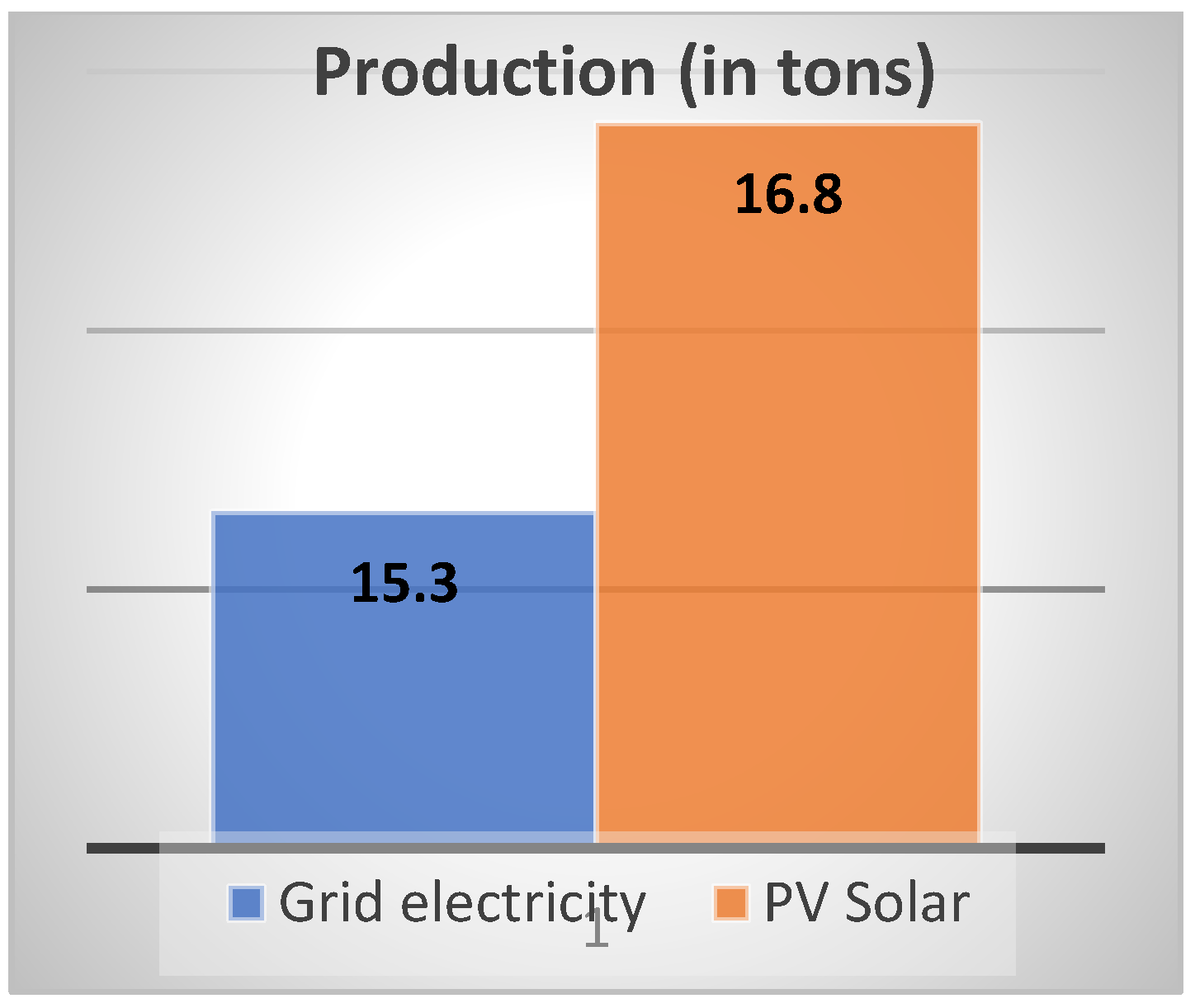
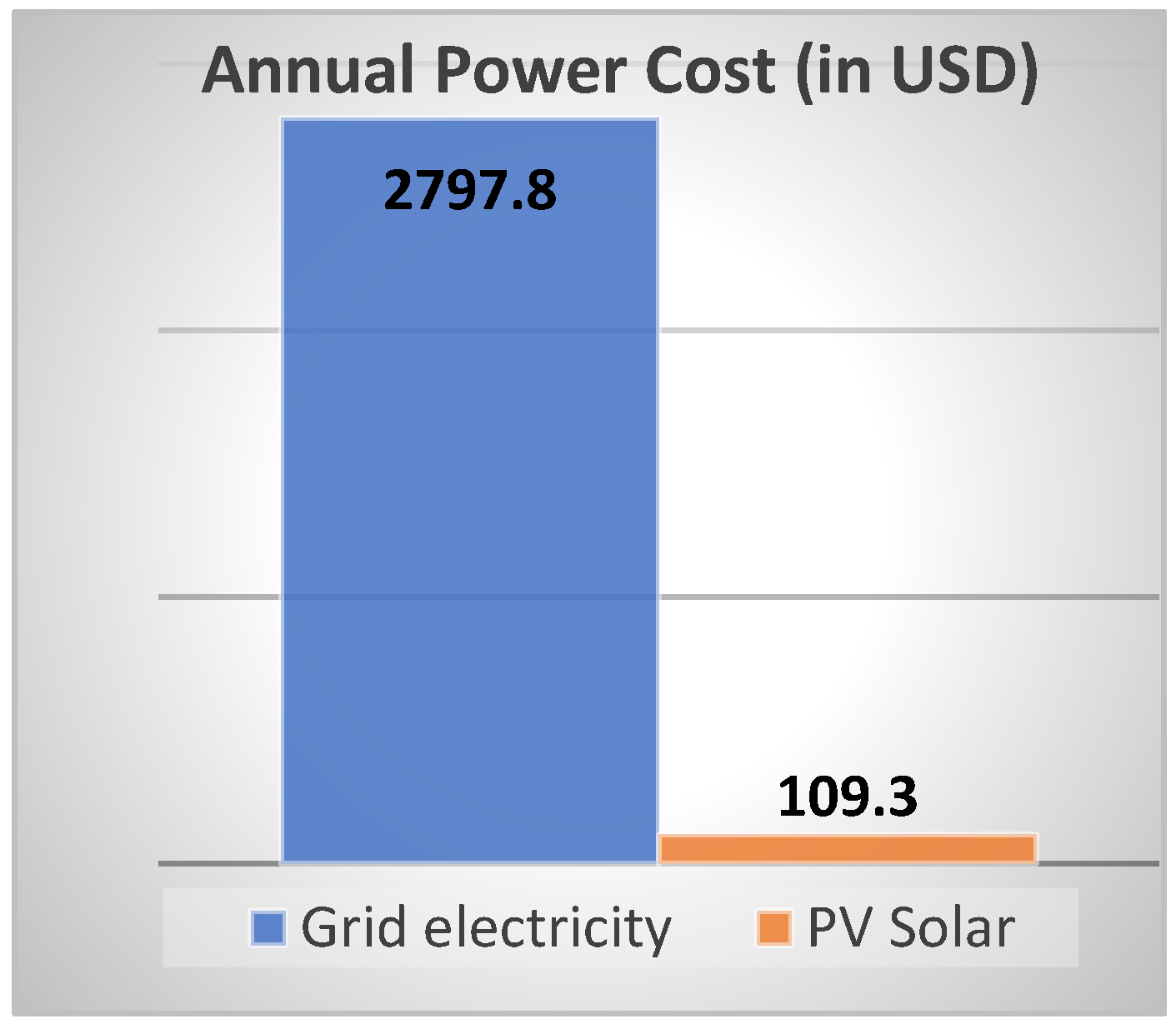
The annual power cost and production differences are shown in the following figures (Figure 1 and Figure 2).
Figure 1.
Annual power cost.
Figure 2.
Production.
3.2. Cost–Benefit Analysis
Cost–benefit analysis was applied to ascertain the net benefit of installing a solar photovoltaic system in terms of savings in expenditures and increase in agricultural yield as a result of consistent power supply for water pumping. For this purpose, all related costs and benefits were calculated and compared to decide upon the cost-effectiveness and ensuing benefits of installing a PV solar system as an alternative to grid electricity. Table 1 shows all the costs associated with a water-pumping system run by grid electricity and required for an average of a 5.7-acre piece of land.
Table 1.
Costs related to grid electricity.
Table 2 indicates all the associated costs of installing a PV solar system derived from an analysis of primary data. The rates are based on the average rates of 392 respondents using a PV solar system for water-pumping irrigation in the study area.
Table 2.
Costs related to PV solar system.
According to the Government of Balochistan, the annual per-acre production of apples is 2.676 tons in Balochistan, approximately. Assuming the same production for a respondent growing an apple orchard in agricultural fields in the study area, the total apple yield is calculated to be 15.252 tons for an area of 5.7 acres when all the other factors are assumed to be constant. An analysis of the primary data indicates an average increase of 9.9% in agricultural production as a result of using a PV solar system for water pumping, increasing the total yield for an area of 5.7 acres from 15.252 tons to 16.763 tons per annum.
According to Agriculture Marketing Information Service 2020, the price of apples per ton is USD 553.4, so the total amount for 15.252 tons is calculated to be USD 8502.9, and for 16.763 is calculated to be USD 9276.7, with a net difference of USD 773.8 per annum.
Based on the assumptions and analysis of primary data, Benefit–Cost Ratio (CBR) was applied separately for grid electricity and PV solar. The discount rate is taken as 7% for 25 years of life span of PV solar system.
3.2.1. Benefit–Cost Ratio for Grid Electricity
Total initial investment () = USD 7845.4
Annual cash flow () = USD 5669.2 (total income—O and M)
Life span () = 25 years
Discount rate () = 7%
By putting the values in the formula, we get
3.2.2. Benefit–Cost Ratio for PV Solar System
Total initial investment () = USD 11560.3
Annual cash flow () = USD 9250.1 (total income—O and M)
Life span () = 25 years
Discount rate () = 7%
By putting the values in the formula, we get
The results reveal that both the alternatives are feasible as and ; however, the benefit–cost ratio suggests that a PV solar system is relatively economical compared with grid electricity for water-pumping irrigation in the agriculture sector.
4. Conclusions and Recommendations
An ocularly photovoltaic solar system seems to be the economical alternative to grid electricity for water pumping in the agriculture sector. However, the results of the study bring to the surface a slight difference between the two in terms of benefits. The findings discern that BCR for solar photovoltaic systems differs from grid electricity by just 0.9 which needs further improvement to raise its efficiency primarily through multi-junction PV cells. Nevertheless, the crop productivity can be enhanced substantially through consistent power supply for water pumping in areas where grid electricity is hard to reach.
Author Contributions
R.I. conducted the research under the supervision of Z.M.; M.S. and I.H. critically reviewed and improved the manuscript linguistically. All authors have read and agreed to the published version of the manuscript.
Funding
This research received no external funding.
Institutional Review Board Statement
Not applicable.
Informed Consent Statement
Not applicable.
Data Availability Statement
Not applicable.
Acknowledgments
The authors are grateful to their colleagues at the Department of Agricultural Sciences, AIOU, and Islamabad for their valuable comments and suggestions to the original version of this article.
Conflicts of Interest
All authors declare that there are no competing interest.
References
- Irfan, M.; Zhao, Z.Y.; Ahmad, M.; Mukeshimana, M.C. Solar energy development in Pakistan: Barriers and policy recommendations. Sustainability 2019, 11, 1206. [Google Scholar] [CrossRef]
- Abbasi, K.R.; Abbas, J.; Tufail, M. Revisiting electricity consumption, price, and real GDP: A modified sectoral level analysis from Pakistan. Energy Policy 2021, 149, 112087. [Google Scholar] [CrossRef]
- Yaqoob, H.; Teoh, Y.H.; Din, Z.U.; Sabah, N.U.; Jamil, M.A.; Mujtaba, M.; Abid, A. The potential of sustainable biogas production from biomass waste for power generation in Pakistan. J. Clean. Prod. 2021, 307, 127250. [Google Scholar] [CrossRef]
- Shah, S.A.A.; Solangi, Y.A. A sustainable solution for electricity crisis in Pakistan: Opportunities, barriers, and policy implications for 100% renewable energy. Environ. Sci. Pollut. Res. 2019, 26, 29687–29703. [Google Scholar] [CrossRef] [PubMed]
- Wakeel, M.; Chen, B.; Jahangir, S. Overview of energy portfolio in Pakistan. Energy Procedia 2016, 88, 71–75. [Google Scholar] [CrossRef]
- Solangi, Y.A.; Shah, S.A.A.; Zameer, H.; Ikram, M.; Saracoglu, B.O. Assessing the solar PV power project site selection in Pakistan: Based on AHP-fuzzy VIKOR approach. Environ. Sci. Pollut. Res. 2019, 26, 30286–30302. [Google Scholar] [CrossRef] [PubMed]
- Shah, S.A.A.; Valasai, G.D.; Memon, A.A.; Laghari, A.N.; Jalbani, N.B.; Strait, J.L. Techno-economic analysis of solar pv electricity supply to rural areas of Balochistan, Pakistan. Energies 2018, 11, 1777. [Google Scholar] [CrossRef]
- Ali, M.A.; Yamin, M.; Arslan, C.; Farid, U.; Nasir, A. A Feasibility Study: Off-Grid Photovoltaic Solar Power Supply to the Remote Areas of Pakistan. Pak. J. Agri. Sci. 2020, 57, 1313–1316. [Google Scholar]
- Kakar, M.Z.K.; Harijan, K.; Kumar, L. Load Assessment of Solar PV System: Case Study of Tor Tang Village of Baluchistan. Int. J. Renew. Energy Resour. 2018, 8, 29–35. [Google Scholar]
- O'Mahony, T. Cost-Benefit Analysis and the environment: The time horizon is of the essence. Environ. Impact Assess. Rev. 2021, 89, 106587. [Google Scholar] [CrossRef]
- Waheed, A. To Electrify a Flood Affected Village in Sajawal, Pakistan by Utilizing the Available Renewable Energy Resources. Available online: http://urn.kb.se/resolve?urn=urn:nbn:se:kth:diva-149865 (accessed on 20 September 2022).
Disclaimer/Publisher’s Note: The statements, opinions and data contained in all publications are solely those of the individual author(s) and contributor(s) and not of MDPI and/or the editor(s). MDPI and/or the editor(s) disclaim responsibility for any injury to people or property resulting from any ideas, methods, instructions or products referred to in the content. |
© 2022 by the authors. Licensee MDPI, Basel, Switzerland. This article is an open access article distributed under the terms and conditions of the Creative Commons Attribution (CC BY) license (https://creativecommons.org/licenses/by/4.0/).