


Abstract
The use of magnetic technology in irrigation is increasing significantly in the world as it has been established in several research studies that its application on irrigation water can improves crop productivity and even alleviate plant salt stress. The aim of this study was to investigate the effect of magnetic treatment of saline water on greenhouse tomatoes in Morocco. The preliminary results showed significant decrease in soil conductivity measured at different depths. The soil irrigated with magnetically treated water had a high-water retention capacity. A slight increase in the yield with plants exhibiting an early flowering was recorded, and fruit quality was also improved in terms of weight and juice content.
1. Introduction
Some studies report that magnetic treatment of water improves water quality by breaking water clusters into smaller water clusters [1,2] and reducing the surface water tension [3] that affects the water’s hydrophobicity, and some reports also mention reducing water conductivity [3,4].
Also, it has been found that magnetic treated water had an impact on some properties of the soil such as decrease of soil NaCl content, which causes salinity, in some case with magnetic treated water irrigation [5,6]; increase in soil nutrient content and microbial activity [7]. Some trials with saline water have given satisfactory results both on the vegetative development of plant and on the yield [8,9,10].
The aim of this study is to determine the effects of magnetic treatment of saline irrigation water on plants and soils in order to investigate the possibility of using saline water for agriculture by magnetic treatment.
2. Materials & Methods
2.1. Experimental Site
The study was conducted at the ASNI domains (NL 30°19′1″; WL 9°30′11″) located in the rural commune of Inchaden, circle of Belfaa, Province of Chtouka-Ait Baha (Souss-Massa Region) from July to October 2021. The soil (loamy soil) and water mineral analysis results are reported in the tables below (Table 1 and Table 2).

Table 1.
Water irrigation analysis.
Table 2.
Soil mineral analysis.
2.2. Treatment Device
The magnetic treatment of water was done with magnet device Alva5 from the company AlvaTech Water Revolution. The Alva5 device is presented as an irrigation pipe (50 cm diameter and 81 cm length) with a control box.
The irrigation water was magnetically treated by passing once through this device. In the following document, the treated water with the Alvatech device will be noted T1.
2.3. Experimental Design
The experimental setup chosen for this study is a complete randomized block design consisting of 6 blocks of 5 m width (i.e., two ridges) and in each block there are two replicates for the different treatments (T0: untreated water the control and T1) represented by the experimental units. The experimental units are as wide as the blocks and 6 m long. In total we have 12 repetitions for each treatment.
2.4. Data Recorded
The data recorded during this study can be divided into three main groups. The first is the parameters related to plant growth and development of the plant. The second is the parameters related to yield and fruit quality, followed by soil parameters. The flowering tomato plant index was calculated to estimate early plant maturity. The first metric is the percentage of flowers opened through the truss and the second is the percentage of flowers set through the truss.
2.5. Statistical Analysis
The data collection and organization were made with EXCEL spreadsheet. The analysis of variance (ANOVA) was performed with the MINITAB 16 software. Tukey’s test was adopted to compare the means between different treatments, at 5% significance level.
3. Results
3.1. Yield and Fruit Quality
In this part, three parameters were studied. The first is the earliness of the plants, it is based essentially on the flowering and setting of the truss. Statistical tests of the calculated values show that there is a highly significant difference between treatments for the %Open flower Truss N°1 and %Open flower Truss N°2 index, but not for the two others Table 3 below summarizes the precocity index.
Table 3.
Precocity index. The means followed by the same letter are not statistically different at p < 5% according to the Tukey test.
In the same perspective of evaluating earliness, the distances between trusses were also measured, from the base to the fourth truss. However, the statistical analysis of these data indicates that there is no significant difference between the two treatments. Same results were obtained with the yield even if the treated plot produced 10% more than the control. The statistical tests of the data of the analysis of the quality of the fruits obtained indicate that there is a significant difference between the average weight of the fruits, the firmness of the fruits and the juice content of the fruits.
3.2. Soil Parameters
The installation of capacitive sensors allowed us to monitor the soil moisture over several depths. The measurements were taken every 15 min and stored in a cloud file on the website http://cloud.yobeen.com/ (accessed on 1 August 2021). Thus, the graphs above represent the evolution of soil moisture at 10 cm depth from 4–11 October 2021 and from 11–19 October 2021. The Figure 1 shows clearly a difference between the evolution of the moisture in the soil. The soil irrigated with treated water hold more water and the decrease of the soil moisture is slower.
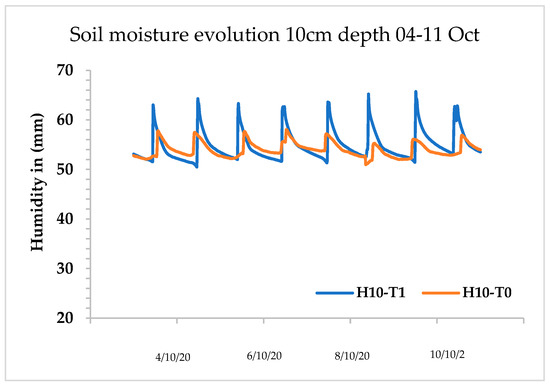
Figure 1.
Evolution of soil moisture at 10 cm depth (a) From 4 to 11 October.
The electric conductivity (EC1/5: (dS/m) and pH of the different layers were measured from representative samples of the plots. The measured values show that at all horizons, the electrical conductivities of the plot irrigated with magnetically treated water are lower than those of the control, Table 4 bellow summarizes the variation of conductivity and pH.
Table 4.
Soil Conductivity and pH.
4. Discussion
The results obtained in soil conductivity are partly due to the leaching capacity of magnetically treated water. In addition, it prevents the build-up of soil salinity [6] because the treated water has a greater affinity to bind with soil particles and therefore percolates with more difficultly [3] solubilizing by the way more mineral elements. This same phenomenon could also explain the evolution of moisture at the soil level.
Since the plant has better water and mineral status, it’s more likely to produce more with better quality fruit than stressed plant. Similar results as ours concerning yield and fruit quality were obtained in other studies [7,8,9,10].
5. Conclusions
Magnet processing technology as a means to utilize resources affected by salinity for production. As we demonstrated in our study, magnetically treated water was able to reduce soil conductivity by nearly half and keep it within a range that is favorable for plant development. On the other hand, irrigation with magnetically treated water improves the moisture status of the soil by retaining more water. Under these conditions, even if the irrigation water is salty, it creates an ideal environment for plants to grow.
Author Contributions
Conceptualization M.H.E.O., H.T. and S.S.; methodology, M.H.E.O. and H.T.; software, M.E.; validation, M.H.E.O. and H.T.; investigation, S.S.; data curation, S.S., M.E. and H.T.; writing—original draft preparation, S.S., S.E.M. and J.Z.; writing—review and editing, M.H.E.O., S.S., J.Z. and H.T. All authors have read and agreed to the published version of the manuscript.
Funding
This research received no external funding.
Institutional Review Board Statement
Not applicable.
Informed Consent Statement
Not applicable.
Data Availability Statement
Not applicable.
Acknowledgments
We’d also like to express our gratitude to COMATECH SARL who provided us with the device and helped us find the experimental site, ‘’Les Domaines ASNI” we thank in the meantime, to conduct the experiment.
Conflicts of Interest
The authors declare no conflict of interest.
References
- Toledo, E.J.; Ramalho, T.C.; Magriotis, Z.M. Influence of magnetic field on physical–chemical properties of the liquid water: Insights from experimental and theoretical models. J. Mol. Struct. 2008, 888, 409–415. [Google Scholar] [CrossRef]
- Su, N.; Wu, C. Effect of magnetic field treated water on mortar and concrete containing fly ash. Cem. Concr. Compos. 2003, 25, 681–688. [Google Scholar] [CrossRef]
- Surendran, U.; Sandeep, O.; Joseph, E.J. The impacts of magnetic treatment of irrigation water on plant, water and soil characteristics. Agric. Water Manag. 2016, 178, 21–29. [Google Scholar]
- Ashraf, M.W. Magnetic treatment of irrigation water and its effect on water salinity. In Proceedings of the 2 nd International Conference on Food and Agricultural Sciences, Auckland, New Zealand, 12 November 2014; Volume 77, pp. 1–5. [Google Scholar]
- Hachicha, M.; Kahlaoui, B.; Khamassi, N.; Misle, E.; Jouzdan, O. Effect of electromagnetic treatment of saline water on soil and crops. J. Saudi Soc. Agric. Sci. 2018, 17, 154–162. [Google Scholar] [CrossRef]
- Zlotopolski, V. The impact of magnetic water treatment on salt distribution in a large unsaturated soil column. Int. Soil Water Conserv. Res. 2017, 5, 253–257. [Google Scholar] [CrossRef]
- Cui, H.; Liu, X.; Jing, R.; Zhang, M.; Wang, L.; Zheng, L.; Kong, L.; Wang, H.; Ma, F. Irrigation with Magnetized Water Affects the Soil Microenvironment and Fruit Quality of Eggplants in a Covered Vegetable Production System in Shouguang City, China. J. Soil Sci. Plant Nutr. 2020, 20, 2684–2697. [Google Scholar] [CrossRef]
- Taimourya, H.; Oussible, M.; Baamal, L.; EL Harif, A.; Zaid, E.; Abdelkarim, G.; Abdelaziz, S. Magnetic treatment of culture medium enhance growth and minerals uptake of strawberry (Fragaria × ananassa Duch.) and tomato (Solanum lycopersicum) in Fe deficiency conditions. Int. J. Sci. Eng. Res. 2017, 8, 1414–1436. [Google Scholar]
- Samarah, N.H.; Hani, B.; Makhadmeh, I.M. Effect of Magnetic Treatment of Water or Seeds on Germination and Productivity of Tomato Plants under Salinity Stress. Horticulturae 2021, 7, 220. [Google Scholar] [CrossRef]
- Akrimi, R.; Hajlaoui, H.; Batelli, G.; Ruggiero, A.; Badri, M.; Grillo, S.; Mhamdi, M. Electromagnetic water enhanced metabolism and agro-physiological responses of potato (Solanum tuberosum L.) under saline conditions. J. Agron. Crop Sci. 2021, 207, 44–58. [Google Scholar] [CrossRef]
Publisher’s Note: MDPI stays neutral with regard to jurisdictional claims in published maps and institutional affiliations. |
© 2022 by the authors. Licensee MDPI, Basel, Switzerland. This article is an open access article distributed under the terms and conditions of the Creative Commons Attribution (CC BY) license (https://creativecommons.org/licenses/by/4.0/).