


Temperature is a preponderant factor in the packaging sector. In the food industry, the temperature may change with the environment and it impacts the shelf life and food spoilage [1]. As a result, the temperature to which food has been exposed throughout distribution and storage can be used to evaluate its viability.
This research aimed to develop a user-friendly system capable of monitoring the temperatures to which the packages have been exposed and generating a colorimetric response easily perceptible by the consumer/transporter. Therefore, reversible and irreversible thermochromic inks were stamped onto two different cardboard substrates typically used for packaging. In both samples, by studying the RGB color values and using the CieLab color system, it was concluded that there is a significant color change when the cardboard is subjected to different temperatures, according to the ink threshold (Figure 1). Additionally, the inks showed high abrasion (>100 cycles) and adhesion resistance after stamping.
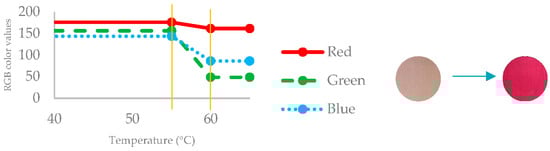
Figure 1.
Representative results for RGB color values and color change of cardboard with an irreversible thermochromic ink (threshold of 61 °C).
Thus, the results show great potential for the application of this technology in food monitoring and signaling a possible risk for consumption.
Author Contributions
Conceptualization, L.L., L.N., I.B., M.N., J.B., F.C., P.N. and R.F.; methodology, L.L, L.N., I.B., M.N. and J.B.; validation, F.C., P.N. and R.F.; formal analysis, L.L.; investigation, L.L., I.B. and M.N.; data curation, L.L., I.B. and M.N.; writing—original draft preparation, L.L. and L.N.; writing—review and editing, L.L. and L.N.; supervision, J.B., F.C., P.N. and R.F.; project administration, R.F.; funding acquisition, F.C. and R.F. All authors have read and agreed to the published version of the manuscript.
Funding
This work was funded by P2020, under individual project SI I&DT nº POCI-01-0247-FEDER-045258.
Institutional Review Board Statement
Not applicable.
Informed Consent Statement
Not applicable.
Data Availability Statement
Not applicable.
Acknowledgments
The authors gratefully acknowledge the funding by P2020, under individual project SI I&DT nº POCI-01-0247-FEDER-045258, entitled as “TechPack—Embalagens de cartão inteligentes com sistemas integrados de identificação e deteção de temperatura, microrganismos e degradação de alimentos”.
Conflicts of Interest
The authors declare no conflict of interest.
Reference
- Wang, S.; Liu, X.; Yang, M.; Zhang, Y.; Xiang, K.; Tang, R. Review of Time Temperature Indicators as Quality Monitors in Food Packaging. Packag. Technol. Sci. 2015, 28, 839–867. [Google Scholar] [CrossRef]
Publisher’s Note: MDPI stays neutral with regard to jurisdictional claims in published maps and institutional affiliations. |
© 2022 by the authors. Licensee MDPI, Basel, Switzerland. This article is an open access article distributed under the terms and conditions of the Creative Commons Attribution (CC BY) license (https://creativecommons.org/licenses/by/4.0/).