


Abstract
We propose a multiple-input multiple-output (MIMO) multi-band antenna for the WiFi-6E band. The planar size of the proposed antenna is 40 × 7.6 mm2, and it is built on a FR4 substrate with a thickness of 0.8 mm. By utilizing a 3 × 3.8 mm2 L-shaped parasitic element, additional resonant modes are introduced through coupling and resonance. The operating frequency bands are WLAN 2.4 GHz (2.4–2.8 GHz) and Wi-Fi 6E (5.06–7.13 GHz). The average antenna gain is 4.2 dBi, with an envelope correlation coefficient (ECC) less than 0.020 and a radiation efficiency between 70% and 92%.
1. Introduction
With the advent of fifth-generation (5G) technology, communication systems have acquired high transmission speeds. Multiple-input multiple-output (MIMO) technology effectively reduces signal attenuation and interference, and enhances communication quality, stability, and wireless data transmission rates by using multiple antennas to transmit and receive signals simultaneously [1], which is crucial for laptop computers.
Currently, various antenna designs for Wi-Fi 6E applications have been proposed [2,3]. The introduction of Wi-Fi 6E technology makes the 6 GHz band an effective complement to the existing 2.4 and 5 GHz bands. The 6 GHz band offers more non-overlapping channels, significantly reducing interference and improving spectrum utilization. Additionally, Wi-Fi 6E provides higher data rates, lower latency, and better spectral efficiency [4]. In the antenna design process, mutual coupling issues occur, reducing antenna performance and affecting efficiency and the envelope correlation coefficient (ECC). Parasitic elements are used to influence the surface current distribution, alter the electromagnetic field, and reduce mutual coupling [5].
In this study, we propose a new parasitic element design [6]. By adding an L-shaped parasitic element 0.3 mm away from the feed point, the frequency distribution is altered, covering the 5–7.17 GHz band of Wi-Fi 6E, increasing the frequency coverage and improving antenna gain and efficiency. The additional L-shaped structure introduces additional current paths, generating resonance and altering the antenna’s radiation characteristics and frequency response. With dimensions of only 3 × 3.8 mm2, it is appropriate for portable electronic devices.
2. Design and Characteristics of Antenna
Figure 1 shows the antenna structure proposed in this study, and Table 1 lists the precise dimensions of the antenna. The design is implemented on an FR-4 substrate with dimensions of 40 × 7.6 × 0.8 mm3, a dielectric constant of 4.4, and a dielectric loss of 0.02. This material provides stable dielectric properties, especially under high-frequency conditions where loss significantly impacts performance. The 0.8 mm thickness is chosen for a lightweight, portable laptop computer. The limited space in a laptop computer is efficiently utilized by the 3 × 3.8 mm2 parasitic element, which generates electromagnetic coupling and resonance to adjust the antenna’s radiation mode, covering the Wi-Fi 6E bands (2.4–2.5, 5.15–5.85, and 5.925–7.125 GHz).
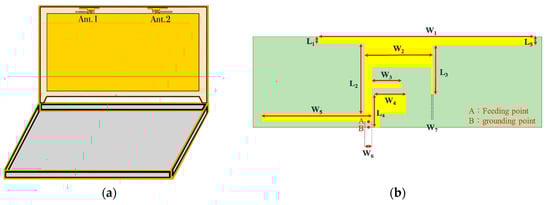
Figure 1.
Structure of antenna for WiFi-6E applications: (a) antenna 3D model and (b) antenna model top view.

Table 1.
The detailed dimensions of the antenna for Wi-Fi 6E applications.
3. Simulation Results and Discussions
The simulated results were performed by using CST Studio Suite 2023. Figure 2 shows the results of S-parameters of the antenna. The antenna bandwidths with a reflection coefficient less than −10 dB are 2.4–2.8 GHz and 5.06–7.13 GHz, respectively. The effectiveness of the parasitic element in expanding the frequency band is evident, improving impedance matching and output power. The S12 results show an isolation better than −10 dB, indicating low interference between antennas.
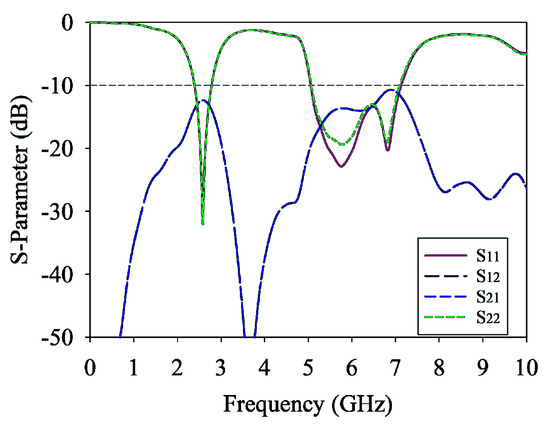
Figure 2.
S-parameter chart simulated using MIMO arrangement.
Efficiency means the ability of the antenna in converting input power into effective radiated power. Figure 3 shows the efficiency of the proposed antenna. The overall efficiency ranges from 70 to 92.3%, with a peak efficiency of 92.3% at 2.4 GHz. Gain analyzes the antenna’s ability to concentrate input power in a specific direction. High-gain antennas enhance signal strength and transmission distance, improving communication quality. Figure 4 shows the gain of the proposed antenna. The average gain is 4.2 dBi, with a peak gain of 5.6 dBi at 6.8 GHz, indicating the antenna’s capability to radiate or receive stronger signals in specific directions.
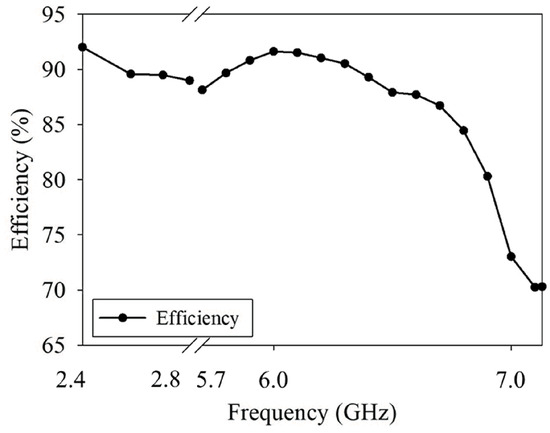
Figure 3.
Simulated efficiency of MIMO antenna.
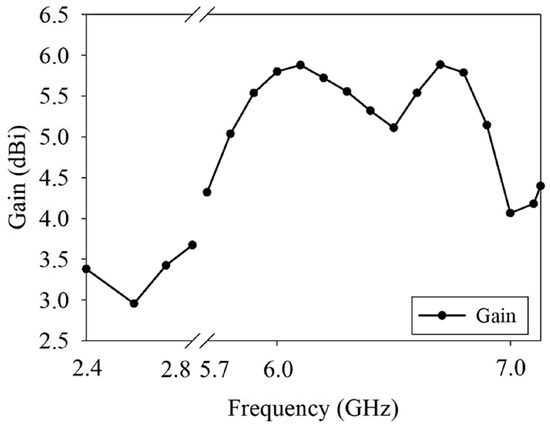
Figure 4.
Simulated gain of MIMO antenna.
The ECC shows the correlation of received signal amplitudes between different antenna elements. A value of 0.3 or less is considered excellent for MIMO applications. As shown in Figure 5, the ECC values are below 0.025, indicating a low correlation between antenna elements, with values below 0.001 in the 2.4 GHz and 5.67 GHz bands.
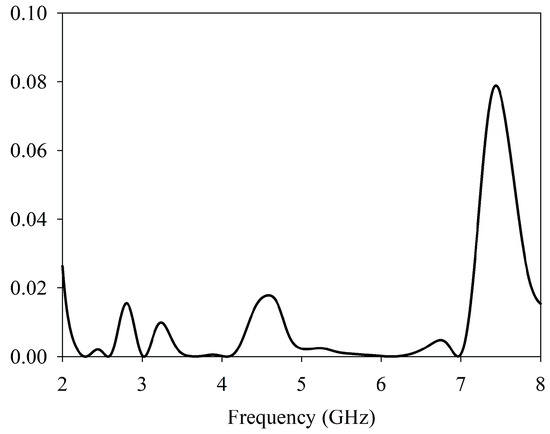
Figure 5.
Simulated ECC of MIMO antenna.
4. Conclusions
We created a MIMO antenna for a laptop computer with an L-shaped parasitic element 0.3 mm from the feed point, covering the 5/6G bands (5.06–7.13 GHz). The coupling effect between the main radiator and parasitic element enables effective radiation across multiple bands. The antenna achieves isolation below −10 dB and covers the 2.4–2.8 GHz and 5.06–7.13 GHz bands. Additionally, the antenna has an average gain of 4.2 dBi, ECC below 0.020, and radiation efficiency between 70 and 92.3%, which makes it appropriate for Wi-Fi 6E-spectrum applications.
Author Contributions
Conceptualization, C.-H.H. and Y.-C.H.; methodology, C.-H.H. and Y.-C.H.; software, C.-H.H. and Y.-C.H.; validation, C.-H.H. and S.-Y.L.; formal analysis, C.-H.H. and Y.-C.C.; investigation, Y.-C.H., S.-Y.L. and Y.-C.C.; writing—original draft preparation, C.-H.H. and Y.-C.H.; writing—review and editing, C.-H.H.; visualization, Y.-C.H., S.-Y.L. and Y.-C.C.; supervision, C.-H.H.; funding acquisition, C.-H.H. All authors have read and agreed to the published version of the manuscript.
Funding
This research received no external funding.
Institutional Review Board Statement
Not applicable.
Informed Consent Statement
Not applicable.
Data Availability Statement
Data are contained within the article.
Conflicts of Interest
The author declares no conflict of interest.
References
- Yuan, X.-T.; Chen, Z.; Gu, T.; Yuan, T. A wideband PIFA-pair-based MIMO antenna for 5G smartphones. IEEE Antennas Wirel. Propag. Lett. 2021, 20, 371–375. [Google Scholar] [CrossRef]
- Su, S.-W.; Yusuf, D.P.; Chu, F.-H. Conjoined, wi-fi 6E MIMO antennas for laptop. In Proceedings of the 2021 International Symposium on Antennas and Propagation (ISAP), Taipei, Taiwan, 19–22 October 2021; pp. 1–2. [Google Scholar] [CrossRef]
- Sim, C.-Y.-D.; Kulkarni, J.; Apte, A.M.; Cao, R.; Chen, C.-C.; Wang, S.-H.; Shu, Y.-R.; Lai, H.-Z. A PIFA design with WLAN and wi-fi 6E band for laptop computer applications. In Proceedings of the 2022 IEEE International Symposium on Antennas and Propagation and USNC-URSI Radio Science Meeting (AP-S/URSI), Denver, CO, USA, 10–15 July 2022; pp. 1808–1809. [Google Scholar] [CrossRef]
- Cai, C.-A.; Kai, K.-Y.; Liao, W.-J. A WLAN/WiFi-6E MIMO antenna design for handset devices. In Proceedings of the 2021 International Symposium on Antennas and Propagation (ISAP), Taipei, Taiwan, 19–22 October 2021; pp. 1–2. [Google Scholar] [CrossRef]
- Li, Z.; Du, Z.; Takahashi, M.; Saito, K.; Ito, K. Reducing mutual coupling of MIMO antennas with parasitic elements for mobile terminals. IEEE Trans. Antennas Propag. 2012, 60, 473–481. [Google Scholar] [CrossRef]
- Chung, M.-A.; Hsu, C.-C.; Lee, M.-C.; Lin, C.-W. Enhancing multi-band MIMO antenna stability for various electronic applications with human-body interaction consideration. IEEE Access 2023, 11, 129376–129398. [Google Scholar] [CrossRef]
Disclaimer/Publisher’s Note: The statements, opinions and data contained in all publications are solely those of the individual author(s) and contributor(s) and not of MDPI and/or the editor(s). MDPI and/or the editor(s) disclaim responsibility for any injury to people or property resulting from any ideas, methods, instructions or products referred to in the content. |
© 2025 by the authors. Licensee MDPI, Basel, Switzerland. This article is an open access article distributed under the terms and conditions of the Creative Commons Attribution (CC BY) license (https://creativecommons.org/licenses/by/4.0/).