


Abstract
Our method is to keep a close eye on the patient’s health and inform the person responsible for their care on a regular basis. Since it is not possible for an individual to always watch over a single patient in a hospital setting, the primary objective is to monitor the patient around-the-clock. There is going to be aWe employed an apparatus that continuously observed the patient and sent frequent updates to the attending physician, regardless of the physician’s location. This device also has an extra feature that allows it to sound an alarm to notify hospital staff members of a patient emergency.
1. Introduction
There are rumours that deaths are happening in hospitals globally because of medical mismanagement and doctors’ negligence. AI is one of the fastest growing technologies throughout the world. AI has made the impossible possible, for example, robots that behave like humans (in some cases, better than humans). Expert systems have also been developed that can monitor and diagnose patients, in addition to performing tasks beyond human capabilities. This technology has been slow to improve; it has been in use since the 1990s, but only became famous in 2020 [1,2,3]. The invention of sensors has advanced every field. RPHM provides each and every detail of a patient’s health condition to their doctor and nurses, so that they can have complete knowledge to diagnose the patient. This helps to give the best treatment to the patient, so that they can recover as soon as possible. The proposed system helps to reduce deaths due to a lack of medical care. There will always be a doctor who is monitoring the patient through the sensors and updating the nurses on what medicines should be given through online mode. In this way, we can reduce the death rate due to a lack of monitoring and miscommunication between doctors.
2. Related Work
In recent years, in the Journal of Innovation & Knowledge, Ali et al. have said that RPHM facilitates decision making, early prediction and cure, performance efficiency, continuous monitoring, and time efficiency. But, it experiences errors in data digitization and consolidation, data availability, privacy issues, and decision making. It also has the potential for future enhancements; until now, monitoring of patients has occurred through video and providing in-person updates to doctors in hospital. In 2022, Mr. Thanveer’s paper “Remote Patient Monitoring Using Artificial Intelligence” advises to provide complete care before preparations for an emergency, as it is less expensive and there is less chance for miscommunication and supply demand mismatch. Greater utilization of telecommunication services increased provider costs, with arguments over rural and urban charges. In the paper “Smart Health Monitoring System of Patient Through IOT”, the patient’s BP and body temperature were monitored continuously but not accurately, resulting in decision errors and data collection errors. In “A Review of Uncertainty Quantification in Deep-Learning”, Abdar says implementation is easy, the training process is the same, complexity is reduced, it is fast, and it is suitable for big datasets. In this study, training process implantation is complex, more samples are needed for training, calculations are complicated, and it is very slow. In 2017, in “Smart Health Monitoring System”, Mr. Khan says that it helps some rural areas to connect to the clinics near the villages. However, there are some demerits like calculation errors, slow internet, and server crashes [4,5,6].
3. Methodology
The patient health monitoring system contains Raspberry Pi to control the sensors as well as other electronic parts; it is the most efficient platform and is more versatile. Using pulse sensors amped to measure patients’ heartbeat, it can visualize the heartbeat by connecting to the Arduino UNO. Pulse-rate-amped sensors have three primary links: red wire, dark wire, and purple wire. These should be connected to the Arduino board to reach the heartbeat. Now that we have the heartbeat, with the help of ECG measuring sensor, we will be able to display the ECG curves [7]. Pulse sensors measure the pulse of the patient. Consequently, the heartbeat pulse will be stored in the database. These stored records will be periodically delivered to doctor in charge, irrespective of location, place, etc. The additional and most important feature of this system is that the doctor will be provided with the specific range of the heartbeat and BP for every patient; if there are any abnormal changes or it drops below the expected range, there will be an alert for staff nearby the patient or in the hospital in the form of alarm with the bed number [8]. This ensures the patient receives immediate treatment, which can help them to survive. In this way, the patient can be monitored continuously by doctors, who can check and receive updates on the patient from any location. RPHM gives each detail of a patient’s health condition to the doctor and nurses, so that they can have complete knowledge to diagnose the patient. They should know where the emergency is, so the bed number is displayed with alarm sound. In this study, we used classification algorithms: Random Forest, Logistic, and Decision Tress. A classification algorithm is a Supervised Learning technique that is used to identify the category of new observations because of training data. By using IOT sensors, we can collect data from a patient and these data can be used to train the model to give an automatic alarm when a specific condition is met [9].
4. Results and Comparison
The RPHM system can be used to continuously monitor a patient’s condition (heartbeat, BP, etc.), record the information obtained, and give the information to the doctors and nurses who are in charge.
The additional feature is that it gives an alert alarm when there is an emergency [10].
RPHM gives each detail of the patient’s health condition to the doctor and nurses, so that they can have complete knowledge to diagnose the patient. This helps to give the best treatment to the patient, so that they can recover as soon as possible (Figure 1). We do not know when there will be an emergency, so the patient should be continuously monitored; when there is an emergency, this system will produce an alarm sound so that the staff and doctor can provide immediate treatment, which helps the patient to survive [11]. They should know where the emergency is, so the bed number is displayed with the alarm sound, allowing staff to reach the patient as fast as possible. Compared to the existing systems, this is more accurate in terms of measuring [12].
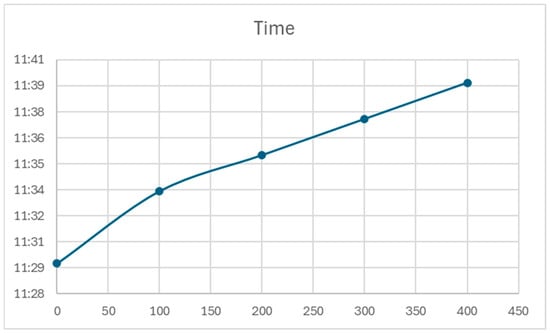
Figure 1.
Patient health monitoring data.
5. Conclusions and Future Enhancement
Continuous monitoring of patients in hospital is very important and it should be conducted very efficiently. The proposed system helps to reduce deaths due to a lack of medical care. There will always be a doctor who is monitoring the patient through the sensors and updating the nurses on what medicines should be given through online mode in Table 1.

Table 1.
Applications of sensors.
As we know, every patient’s health condition is different from others. So, we utilize user input from the attending doctor to facilitate patient monitoring that is easy and effective. Specifically, the heartbeat range and BP (etc.) are different for each patient; if there are any abnormal changes or it drops below the minimum range given by the doctor, then it sends alerts to staff and doctors, which helps to provide immediate treatment. In this way, we can reduce the death rate due to a lack of monitoring and miscommunication between doctors. In future enhancements, we can improve the system to measure recovery in bones that are fractured and show the recovery percentage to the injured person and doctor. It would also tell the patient when they should visit the doctor.
Author Contributions
D.A.: conceptualization; G.R.C.: Methodology; V.K.V. and A.S.:Data set; S.L.M.T.: Modularization; S.S.R.and H.K.: Article description. All authors have read and agreed to the published version of the manuscript.
Funding
This research received no external funding.
Institutional Review Board Statement
Not applicable.
Informed Consent Statement
Not applicable.
Data Availability Statement
No new data were created.
Conflicts of Interest
The authors declare no conflict of interest.
References
- Zanella, A.; Bui, N.; Castellani, A.; Vangelista, L.; Zorzi, M. Internet of Things for Smart Cities. IEEE Internet Things J. 2014, 1, 22–32. [Google Scholar] [CrossRef]
- Bourouis, A.; Feham, M.; Bouchachia, A. Ubiquitous Mobile Health Monitoring System for Elderly (UMHMSE). Int. J. Comput. Sci. Inf. Technol. 2011, 2, 74–82. [Google Scholar] [CrossRef]
- Mukhopadhyay, S.C. Wearable Sensors for Human ActivityMonitoring: A Review. IEEE Sens. J. 2015, 15, 1321–1330. [Google Scholar] [CrossRef]
- Ali, O.; Abdelbaki, W.; Shrestha, A.; Elbasi, E.; Alryalat, M.A.A.; Dwivedi, Y.K. A systematic literature review of artificial intelligence in the healthcare sector: Benefits, challenges, methodologies, and functionalities. J. Innov. Knowl. 2023, 8, 100333. [Google Scholar] [CrossRef]
- Anand, D.; Arulselvi, G.; Balaji, G.N. An assessment on bone cancer detection using various techniques in image processing. In Applications of Computational Methods in Manufacturing and Product Design; Deepak, B.B.V.L., Parhi, D., Biswal, B., Jena, P.C., Eds.; Springer: Berlin/Heidelberg, Germany, 2022. [Google Scholar]
- Anand, D.; Arulselvi, G.; Balaji, G.N.; Chandra, G.R. A deep convolutional extreme machine learning classification method to detect bone cancer from histopathological images. Int. J. Intell. Syst. Appl. Eng. 2022, 10, 39. [Google Scholar]
- Deepak, B.B.V.L.; Parhi, D.R.; Raju, B.M.V.A. Advance Particle Swarm Optimization-Based Navigational Controller For Mobile Robot. Arab. J. Sci. Eng. 2014, 39, 6477–6487. [Google Scholar] [CrossRef]
- Khalaf, O.I.; Anand, D.; Abdulsahib, G.M.; Chandra, G.R. Original Research Article A coherent salp swarm optimization based deep reinforced neuralnet work algorithm for securing the mobile cloud systems. J. Auton. Intell. 2024. [Google Scholar] [CrossRef]
- Rajesh Chandra, G.; Tata, V.; Anand, D. Real-Time Voice Cloning System Using Machine Learning Algorithms. In Conference of Innovative Product Design and Intelligent Manufacturing System; Springer Nature: Singapore, 2022; pp. 525–534. [Google Scholar]
- Deepak, B.; Murali, G.B.; Bahubalendruni, M.R.; Biswal, B. Assembly sequence planning using soft computing methods: A review. Proc. Inst. Mech. Eng. Part E J. Process Mech. Eng. 2019, 233, 653–683. [Google Scholar] [CrossRef]
- Anand, D.; Tata, V.; Samriya, J.K.; Kumar, M. A Review on Deep Learning-Enabled Healthcare Prediction Technique: An Emerging Digital Governance Approach. Soft Comput. Theor. Appl. Proc. SoCTA 2023, 2022, 253–263. [Google Scholar]
- Rout, A.; Deepak, B.; Biswal, B. Advances in weld seam tracking techniques for robotic welding: A review. Robot. Comput. Manuf. 2019, 56, 12–37. [Google Scholar] [CrossRef]
Disclaimer/Publisher’s Note: The statements, opinions and data contained in all publications are solely those of the individual author(s) and contributor(s) and not of MDPI and/or the editor(s). MDPI and/or the editor(s) disclaim responsibility for any injury to people or property resulting from any ideas, methods, instructions or products referred to in the content. |
© 2024 by the authors. Licensee MDPI, Basel, Switzerland. This article is an open access article distributed under the terms and conditions of the Creative Commons Attribution (CC BY) license (https://creativecommons.org/licenses/by/4.0/).