


Abstract
This study presents the development of a novel material for a spherical impact pad for tundishes during steel production, focusing on improving steel cleanliness and flow optimization. Traditional low-carbon and ultra-low carbon concrete (LCC/ULCC) materials are replaced with a new cement-free mixture, utilizing a sol–gel method binder. This innovative approach leads to the creation of IPC TECAST BPV CST, a refractory concrete with enhanced resistance to corrosion and shape stability under extreme conditions. The material’s effectiveness is demonstrated through operational tests, showing remarkable durability and no erosion defects after extensive use in casting liquid metal. The sol–gel binder significantly reduces the carbon footprint and energy consumption during the drying process, compared to traditional concretes. This study concludes that the new material not only withstands the dynamic environment of liquid steel but also ensures consistent dynamic flow conditions throughout the steel casting process, marking a significant advancement in tundish impact pad technology.
1. Introduction
To address the need for higher cleanliness standards in steel manufacturing, it is crucial to explore innovative approaches. The tundish, acting as the last stage before steel solidification and lined with refractory material, presents an opportunity to reduce inclusion levels by refining the steel flow. Central to the tundish’s functionality is the impact pad, a key element influencing the flow pattern of steel and playing an essential role in the metallurgy within the tundish. To eliminate stagnant areas and prevent the formation of slag barriers around the ladle shroud, an optimal flow pattern in the tundish is necessary. This flow should enhance the removal of inclusions at the steel–slag interface and lessen the wear on the tundish’s refractory lining. Recent studies have led to the development of an innovative design for the impact pad, featuring a convex hemispherical shape, aimed at reducing the hydrodynamic drag from the molten steel flow. This novel shape for the impact pads, validated through physical and mathematical modeling across various tundish designs, indicates the requirement for a new, sophisticated material that satisfies stringent specifications. The requirements imposed on the used refractory concrete are defined by the operating conditions on the continuous casting machine [1,2]. The operating temperature, usually in the range of 1540–1570 °C, and the exposure time in this environment, often reaching more than 30 hours, are considered essential [3,4,5]. During this time, several thousand tons of liquid metal are cast, which places high demands on the shape stability of the prefab placed in such a working environment Figure 1. This research is focused on the synthesis of cement-independent compositions using a binder produced by the sol–gel process. These formulations exhibited increased resistance to corrosion induced by cast steel. [5,6,7,8]. IPC TECAST BPV CST was made, which is a new advanced technology of cement-free castables bound with a binder based on the sol–gel method [1,2,3].
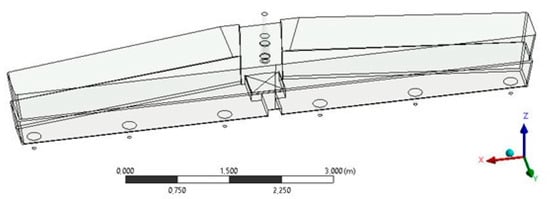
Figure 1.
Illustration of application of the special modification of “SPHERIC” impact pad in Delta tundish.
2. Methodology
Based on a recent study, we examined two types of sol–gel binders: a conventional commercially available colloidal silica solution and a unique silicate–aluminate colloidal solution developed with VŠB-TU Ostrava, CZ. This latter binder is noteworthy for its composition and properties, aligning well with the second goal of our research. The motivation behind using sol–gel-derived binders was to overcome the limitations of traditional ceramic materials, such as their high-temperature processing and structural instability. The sol–gel methodology provides enhanced control over the chemical purity and structural integrity of precursor materials, significantly influencing binder attributes including microstructural porosity and the cohesiveness of the binding matrix. An essential advantage of employing the sol–gel method in ceramics lies in the creation of an oxide network at reduced temperatures, thanks to the molecular-level distribution of reactants, leading to an expedited reaction in less severe conditions [3,4].
The primary goals of this research in materials science were as follows:
- (1)
- Create a material capable of enduring prolonged exposure to the dynamic conditions of liquid steel without altering the shape of surfaces that regulate the flow of prefabricated elements, especially in the area where steel enters the tundish;
- (2)
- Furthermore, the intention was to formulate a composition for fabricating these prefabricated elements that minimizes energy usage and reduces the carbon footprint. To meet these goals, the concept of utilizing low-carbon concrete (LCC) and ultra-low carbon concrete (ULCC) for the production of these elements was discarded due to significant limitations, particularly in relation to objectives (1) and (2).
The new type of refractory concrete with an advanced bonding system technology, IPC TECAST BPV CST, has a corundum matrix and a liquid component composed of silicate sol [9,10]. The chemical composition and physical properties are shown in Table 1. The liquid component, composed of silicate sol, is a substitute for calcium–aluminate cement (CAC) in the concrete mix. This advanced technology, employing a binder system derived via the sol–gel method, enables the elimination of chemically bound water within concrete compositions, thereby preventing the emergence of cracking phenomena during the drying and thermal processing of prefabricated units. This is achieved by avoiding the degradation of the hydraulic bond formed between the mixing water and Calcium Aluminate Cement (CAC), which traditionally contributes to structural weaknesses. This propriety of such bound concretes ensures their surface–shape stability [11,12,13,14,15].

Table 1.
Composition and properties of refractory concrete IPC TECAST BPV CST.
3. Results Analysis
The workability of IPC TECAST BPV CST refractory concrete is extremely good. With the help of casting in plastic forms, it is possible to achieve a smooth spherical surface and at the same time fine details. This fact is documented in Figure 2, which shows a specially designed and fully customized tundish impact pad for a six-stream continuous casting machine at Celsa Huta Ostrowiec sp. z o.o., Ostrowiec Świętokrzyski, Poland.
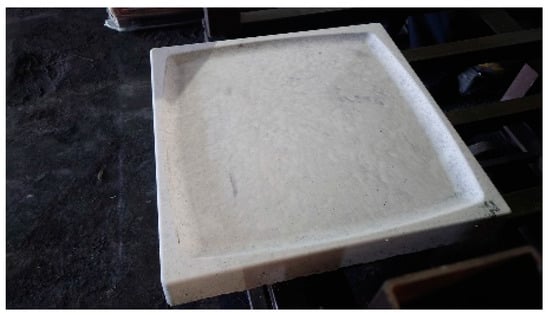
Figure 2.
New developed special modification of “Spheric” impact pad for Delta tundish.
Shape stability was validated during operational trials at U.S. Steel Košice, Slovakia. The evaluated impact pad was utilized for the casting of 32 heats, each weighing roughly 180 tons, amounting to a total of 5760 tons of cast steel over a duration of about 30 hours, without any noticeable damage or change in its form. The status of the impact pad after the sequence is illustrated in Figure 3.
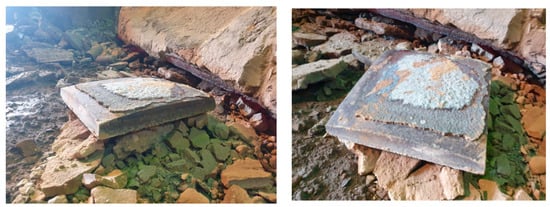
Figure 3.
Post-casting examination of the spherical impact pad after 32 heats from diverse viewpoints.
The properties of IPC TECAST BPV CST concrete make it suitable for a wider application than for just the production of individual precast parts. Concrete also shows very good resistance to thermal shock and subsequent cracking. The tested impact pads were subject to extensive analysis, focusing on the examination of potential internal fractures, geometric and surface integrity, and steel infiltration. Figure 4 displays the material’s internal structure at the impact pad’s fracture point, broken for analysis. The image confirms the material’s compactness, as well as how it is free from internal cracks, and shows no surface deformation, even where the steel stream directly hits the pad.
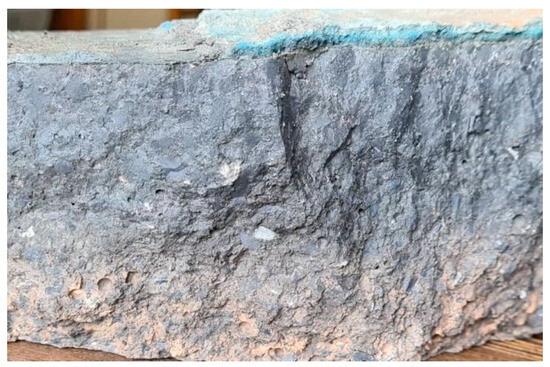
Figure 4.
Fracture (observed in the laboratory) of the spherical impact pad in the area directly affected by the stream of cast steel after the casting of 32 heats (equivalent to 5760 tons of steel).
The material of the impact pad was closely analyzed under a microscope to find structural defects, especially cracks that might lead to metal seeping into the material, as shown in Figure 5. In addition, a focused qualitative study was carried out to check for iron (Fe) in the impact pad’s material, aiming to measure how deep the iron penetrated. This measurement found iron present up to a depth of 45–55 mm, with a maximum iron content of 1.8%wt. The Keyence VHX microscope’s laser unit was used for this analysis.
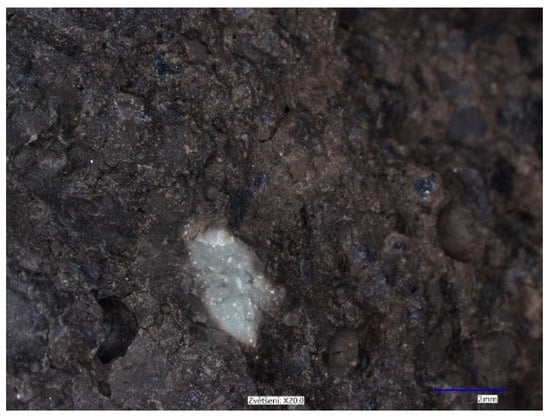
Figure 5.
Material structure of the impact pad after use (magnification ×20).
4. Conclusions
The evaluation of the utilized impact pads leads to the conclusion that the newly developed material successfully meets the primary objectives. This material’s formulation and processing significantly reduce the carbon footprint compared to traditional LCC/ULCC concretes. This reduction is attributed to the elimination of energy-intensive cement in the mix and the use of a more manageable Si-Al sol–gel binder. A key advantage is the substantial energy savings during the drying process, where drying time can be reduced by up to 20 h depending on environmental temperature. The quality and characteristics of the chosen material ensure consistent and uniform dynamic flow throughout the entire casting process. The advanced material not only meets but exceeds the basic requirement of strength properties to maintain stable dynamic flow conditions throughout the steel casting period.
Author Contributions
Conceptualization, B.B. and L.F.; methodology, P.D.; software, S.H.; validation, I.P., J.D. and A.P.; formal analysis, M.H.; investigation, D.D.; resources, O.L.; data curation, D.V.; writing—original draft preparation, B.B.; writing—review and editing, L.F.; visualization, P.D.; supervision, L.F.; project administration, D.V.; funding acquisition, M.H. All authors have read and agreed to the published version of the manuscript.
Funding
This research was funded by project APVV-21-0396: The development of a spherical impact pads in ladles and tundishes for high-quality steel grades.
Institutional Review Board Statement
Not applicable.
Informed Consent Statement
Not applicable.
Data Availability Statement
Data are available in this manuscript.
Conflicts of Interest
Author Ivan Priesol was employed by the company IPC REFRACTORIES a.s.. The remaining authors declare that the research was conducted in the absence of any commercial or financial relationships that could be construed as a potential conflict of interest.
References
- Buľko, B.; Priesol, I.; Demeter, P.; Gašparovič, P. Geometric Modification of the Tundish Impact Point and the Advanced Material for this Application. Available online: https://www.alafar.org/papers/2022/03-Bulko.pdf (accessed on 1 December 2022).
- Buľko, B.; Fogaraš, L.; Hubatka, S.; Demeter, P.; Ondrejkovič, K.; Buček, P. Verification of non-standard f-curves during steel intermixing in a tundish. Metalurgija 2023, 62, 187–190. [Google Scholar]
- Tkadleckova, M.; Valek, L.; Socha, L.; Saternus, M.; Pieprzyca, J.; Merder, T.; Michalek, K.; Kovac, M. Study of solidification of continuously cast steel round billets using numerical modelling. Arch. Metall. Mater. 2016, 61, 221–226. [Google Scholar] [CrossRef]
- Michalek, K.; Tkadleckova, M.; Socha, L.; Gryc, K.; Saternus, M.; Pieprzyca, J.; Merder, T. Physical Modelling of Degassing Process by Blowing of Inert Gas. Arch. Metal. Mater. 2018, 63, 987–992. [Google Scholar]
- Socha, L.; Bazan, J.; Gryc, K.; Moravka, J.; Styrnal, P.; Pilka, V.; Piegza, Z. Optimalisation of the Slag Mode in the Ladle During the Steel Processing of Secondary Metallurgy. Mater. Tehnol. 2013, 47, 673–678. [Google Scholar]
- Prášil, T.; Socha, L.; Gryc, K.; Sviželová, J.; Saternus, M.; Merder, T.; Pieprzyca, J.; Gráf, M. Using Physical Modeling to Optimize the Aluminium Refining Process. Materials 2022, 15, 7385. [Google Scholar] [CrossRef] [PubMed]
- Warzecha, M. Numerical Modelling of Non-Metallic Inclusion Separation in a Continuous Casting Tundish. Comput. Fluid Dyn. Technol. Appl. 2011. [Google Scholar] [CrossRef]
- Sviželová, J.; Tkadlečková, M.; Michalek, K.; Strouhalová, M. Influence of Casting Speed on Centerline Porosity Formation in Continuously Cast Round Steel Billets. In Proceedings of the METAL 2017: 26TH International Conference on Metallurgy and Materials, Brno, Czech Republic, 24–26 May 2017; TANGER: Ostrava, Czech Republic, 2017; pp. 235–240, ISBN 978-80-87294-79-6. [Google Scholar]
- Worldsteel Association. Steel Statistical Yearbook. 2016. Available online: https://www.worldsteel.org/publications/bookshop/product-details.~Steel-Statistical-Yearbook-2016~PRODUCT~SSY2016~.html (accessed on 22 April 2023).
- Tkadlečková, M.; Michalek, K.; Socha, L.; Válek, L.; Sviželová, J. Investigation of technology of continuously cast steel billets using numerical modelling. In Proceedings of the METAL 2016: 25th International Conference on Metallurgy and Materials, Brno, Czech Republic, 25–27 May 2016; TANGER: Ostrava, Czech Republic, 2016; pp. 60–65, ISBN 978-80-87294-67-3. [Google Scholar]
- Buľko, B.; Molnár, M.; Demeter, P. Physical modeling of different configurations of a tundish for casting grades of steel that must satisfy stringent requirements on quality. Metallurgist 2014, 57, 976–980. [Google Scholar] [CrossRef]
- Chatterjee, D. Designing of a novel shroud for improving the quality of steel in tundish. Adv. Mater. Res. 2012, 585, 359–363. [Google Scholar] [CrossRef]
- Priesol, I. A Method of Molten Metal Casting Utilizing an Impact Pad in the Tundish. International Patent Application No. PCT/IB2016/056207, 10 October 2016. [Google Scholar]
- Priesol, I. Spôsob Liatia Roztaveného Kovu s Využitím Dopadovej Dosky v Medzipanve. International Patent Classification: B22D 11/10 B22D 41/00, Application No. 109-2016, 11 October 2016; B22D 11/00 B22D 41/00, Application No. 89-2016, 10 October 2016. [Google Scholar]
- Priesol, I.; Priesolová, N.; Slosiar, Š.; Vlček, J.; Klárová, M. Comparision of characteristics selected refractory castables using free-cement nano-binder. In Proceedings of the Refractories, Furnaces and the Thermal Insulations 2021—International Conference on Refractory and Thermos Insulation, Košice, Slovakia, 3–5 November 2021. [Google Scholar]
Disclaimer/Publisher’s Note: The statements, opinions and data contained in all publications are solely those of the individual author(s) and contributor(s) and not of MDPI and/or the editor(s). MDPI and/or the editor(s) disclaim responsibility for any injury to people or property resulting from any ideas, methods, instructions or products referred to in the content. |
© 2024 by the authors. Licensee MDPI, Basel, Switzerland. This article is an open access article distributed under the terms and conditions of the Creative Commons Attribution (CC BY) license (https://creativecommons.org/licenses/by/4.0/).