


Abstract
The article deals with the post-mining landscape of the Karviná region from the point of view of nature and landscape protection. From different perspectives, the subsidence of Lake Kozinec is presented, which can play an important role in the protection of nature and landscape of the post-mining landscape. A faunistic and floristic survey of the model area, including a habitat survey, was carried out.
1. Introduction
The aim of the research was to evaluate the natural and ecological parameters for the possibility of declaring the aquiferous subsidence of basins in the Karviná region in the category of a small-scale special protection area under Act No. 114/1992 Coll. on nature and landscape protection. The selected model area of Lake Kozinec in Doubrava is very interesting. Already at the beginning of the creation of this lake, technical reclamation measures were taken to model the terrain in such a way as to create a high diversity of micro-habitats (islands and islets for nesting birds, shallows; see Figure 1). At present, the Kozinec model area is a local biocenter within the territorial ecological stability systems.
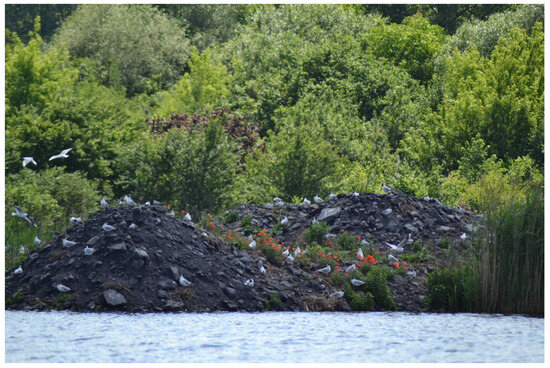
Figure 1.
Artificially created islands for nesting gulls.
Research conducted in Poland, e.g., [1,2,3], demonstrated that reservoirs formed in subsidence basins form an extremely important element of the natural environment, which often restores in a natural way thanks to the “forces of nature” and spontaneously creates valuable and productive ecosystems [4].
2. Materials and Methods
The research work was divided into three parts:
- Faunistic survey;
- Floristic survey;
- Habitat survey.
It is necessary to mention that these surveys were focused on the evaluation of biological qualities, not on a detailed inventory survey. For a detailed description of the flora and especially the fauna, not only longer-term research would be needed, but it would also involve a whole range of experts on individual groups and taxa. The basic sources of information for the faunistic and floristic surveys, which were carried out during the years 2021 and 2022, were field mapping and data published in the literature.
2.1. Faunistic Survey
The fauna survey was mainly focused on aquatic animals and their immediate surrounding. There is a number of methods for catching animals, collecting them, and identifying them, but the most reliable methods usually mean a significant intervention in the life of the animal, possibly even causing their injury or death (mainly applying to invertebrates). This research was based on the belief that it should not take place at the cost of injuring the animal and should interfere with its life as little as possible. The survey was specifically focused on the inventory of endangered species listed in Annex III of the Decree of the Ministry of the Environment of the Czech Republic No. 395/1992 Coll., as amended, which implements certain provisions of Act No. 114/1992 Coll., as amended. At the same time, attention was paid to the species listed in the Red Lists [5]. Basic non-invasive methods included direct observation, photography, and using camera traps and a bat detector.
The measured data were recorded in a chronological field notebook and then transcribed into the database. The determination of individual species of animals took place directly in the field; photo documentation was taken, and, if necessary, specialist literature was used for their determination [5,6,7,8,9,10].
2.2. Floristic Survey
The floristic survey was carried out regularly every 14 days during the growing season to capture both spring and summer aspects. The measured data were noted in a chronological field notebook and subsequently transcribed into a database. The determination of individual plant species was carried out directly in the field using the publication key to the flora of the Czech Republic [11], while in some cases, the mobile application, “Plant net Plant identification” (Copyright © 2014–2023 Pl@ntNet™), was used for orientation of the found plants.
2.3. Habitat Survey
The creation of the list of natural habitat types occurring in the model area was based mainly on data from the Natura 2000 habitat mapping from 2007 to 2022 and our own field survey, which followed the floristic survey. Characteristics of individual natural habitat types were then based on the Catalogue of Biotopes of the Czech Republic [12]. Although this catalog was created primarily for the purpose of mapping Natura 2000 biotopes, it was prepared in such a way that it represents essentially a complete inventory of all biotopes occurring in the territory of the Czech Republic. These are divided into nine main categorizations, the last of which includes habitats heavily influenced or created by human activity.
3. Results
3.1. Faunistic Survey
According to Decree No. 395/1992 Coll., a total of 7 species of animals are in the category of critically endangered, another 16 species of animals are in the category of highly endangered, and then 12 species of animals are in the category of endangered. According to the Red Lists of Invertebrates and Vertebrates [5,13], four species are in the critically endangered (CR) category, five species in the endangered (EN) category, eighteen species in the vulnerable (VU) category, and eleven species in the near-threatened (NT) category.
Table 1 shows the characteristics of the relationship of animals to the aquatic environment (categories A, B, and C). Table 2 shows the selected species of animals found, characterized in terms of their endangerment according to the Decree of the Ministry of Environment of the Czech Republic No. 395/1992 Coll. as amended and according to the Red Lists of Vertebrates and Invertebrates of the Czech Republic [5,13]. This list of animals was also supplemented with species whose occurrence could not be demonstrated during the orientation survey but are documented in literature sources related to the model area.

Table 1.
The relationship of the species to the aquatic environment.
Table 2.
List of proven species of animals in the model area. Abbreviations expressing the level of endangerment of IUCN Red Lists: CR—critically endangered; EN—endangered; VU—vulnerable; NT—near-threatened; LC—least concern; DD—data deficient, NE—not evaluated. Abbreviations expressing threat according to Decree 395/92 Coll.: KO—critically endangered, SO—severely endangered, O—endangered). The column “ Eco. relations “ was drawn up according to Table 1.
3.2. Floristic Survey
A total of 168 plant species were found during the flora survey, of which two species are listed as critically endangered according to Decree No. 395/1992 Coll. According to the Red List of Vascular Plants [15], two species are listed in the endangered (EN) category, and another four species are listed in the near-threatened (NT) category (see Table 3).
Table 3.
List of proven plants in the model site (abbreviations expressing the level of threat of IUCN Red Lists: CR—critically endangered; EN—endangered; VU—vulnerable; NT—near-threatened; LC—least concern; DD—data deficient, NE—not evaluated; and threat according to Decree 395/92 Coll.: KO—critically endangered, SO—severely endangered, O—endangered).
3.3. Habitat Survey
Of the nine main habitat types [12], 30 habitat units from seven types were recorded in the model area (see Table 4). The most valuable series of habitats were found in the southern and southeastern part of the drop-off of Lake Kozinec (wetland alder, wetland willow, sedge and rush stand and in the water body itself, macrophyte vegetation of naturally eutrophic and mesotrophic standing waters, and macrophyte vegetation of shallow standing waters). Also of value was the eastern and northeastern part of the lake subsidence, which is naturally connected to the remnants of floodplain forest (hardwood meadow) and which is part of the local biocenter. None of the identified habitats is included in the Red List of habitats of the Czech Republic.
Table 4.
List of natural categories and biotope units of the model area except for biotopes strongly influenced by humans [12].
4. Discussion
The research, which included faunistic, floristic, and biotope surveys, was aimed at evaluating the model area of Lake Kozinec in the Karviná post-mining landscape for designation as a small-scale special protection area under Act No. 114/1992 Coll. on Nature and Landscape Protection.
In the Czech Republic, there are a number of sites of importance for nature and landscape protection that are located in landscapes that have been significantly affected by mining and mineral raw material processing in the past, and in some cases, their creation was directly initiated by mining. Some of these important places are part of the state nature and landscape protection as small-scale special protection areas or as special areas of conservation (SACs). Understandably, such places as part of cultural heritage are listed as important cultural monuments.
In the Czech Republic, the formation of subsidence lakes results from quite specific remnants of mining, which, for example, are associated with other valuable animal and plant communities compared to those mentioned above and in which dragonflies (Odonata) or amphibians (Amphibia) find their refugia, and for migratory birds (Aves), they become important stops during their migration.
The multi-aspect and multi-dimensionality concept of biological diversity results in a variety of ways of measuring it and constructing its assessment indicators. The species richness of the recorded species—329 species—was reported in [3,4] in the area of subsidence reservoirs in Upper Silesia (Poland).
The topic of the small-scale special protection area in the Karviná post-mining landscape is made even more interesting by the fact that it has been more than thirty years since the interesting and scientifically significant nature reserve Loucké rybníky (Loučky Ponds) was closed in Louky nad Olší (today Karviná—Louky) as a result of mining activities. Today, the area has very little in common with its former state, although it still retains some importance (e.g., a stopover for many rare bird species). It is, therefore, be an interesting and certainly a worthy legacy after more than two centuries of coal mining in the Karviná region if the formerly important Loucké rybníky Nature Reserve in the Olza River floodplain (after all, these ponds were also created by human activity) found its “counterpart” in, for example, the newly declared small-scale special protection area, which in turn was created as a result of mining activity (and coincidentally also in the Olza River floodplain).
Subsequently, surveys of fauna and flora, including habitat surveys, were carried out in the area of this model area. The results of these surveys are presented in Section 3. Already in the early days of the creation of the lake subsidence, technical reclamation measures were taken to model the terrain in such a way as to create a high diversity of microhabitats (islands and islets for nesting birds, shallows).
An indicative survey of the fauna showed a total of 113 species of animals, the most important of which are according to Decree No. 395/1992 Coll. from the category of critically endangered species: Botaurus stellaris, Ergus merganser, Haliaeetus albicilla, Ixobrychus minutus, Pelo-phylax ridibunda, Rana arvalis, Tringa tota-nus; according to the Red Lists of Invertebrates and Vertebrates [5,13], these are four species in the critically endangered (CR) category: Botaurus stellaris, Ergus merganser, Ixobrychus minutus, and Tringa totanus.
A total of 168 plant species were found during the orientation survey of the flora, of which the most important according to Decree No. 395/1992 Coll. are the critically endangered species: Salvinia natans and Trapa natans; according to the Red List of Vascular Plants [15], two species are in the endangered (EN) category: Salvinia natans and Trapa natans; four other species are in the near-threatened (NT) category: Dysphania botrys, Equisetum telmateia, Orobanche flava, and Potamogeton nodosus.
Of the nine major habitat categories [12], 31 habitat units from seven categories were recorded in the model area. However, none of the documented biotopes belongs to the Red List of biotopes of the Czech Republic. The macrophyte vegetation of naturally eutrophic and mesotrophic standing waters (V4) and macrophyte vegetation of shallow standing waters (V2) that have been documented in the model area, although man-made, are so close to nature in their condition that they were not categorized as heavily impacted by man (X) in the research.
On the basis of indicative surveys, it can be stated that the model area of Lake Kozinec is very interesting in terms of the occurrence of animals and plants. Further surveys of the flora and fauna carried out by experts on individual taxa can yield a number of other interesting findings.
The model area of Lake Kozinec and its surroundings can become a small-scale special protection area in the category of natural monuments (PP Poklesové jezero Kozinec). Given its anthropogenic origin, this category seems much more appropriate than the nature reserve category. Alternatively, the site may be designated as a Natura 2000 bird area (54 bird species have been recorded in the model area). The possibility of designating the model area as a site of a special area of conservation (SAC Poklesové jezero Kozinec) can also be considered. Changing the status of the model area (e.g., declaring it as a small-scale special protection area) is not only important from the point of view of nature and landscape protection interests but also, as already outlined, is important for the mining landscape of Karviná as such, for its prestige in the eyes of the population.
One of the current intentions in the model area (in its southwestern part) is that part of the Lake Kozinec subsidence should be used by the public (fishermen, recreational users). In the public part, a beach with a gently sloping bottom should be created, as the bottom in this part is steep. This arrangement is not the most suitable for a potential change in the status of the model area, not only in terms of disturbance to birds, for example, but also in terms of hygiene for the visitors themselves. The so-called Karviná Sea is suitable for recreational purposes, and there is a public swimming pool in the village of Doubrava itself, not far from Kozinec.
Mining subsidence reservoirs are important for the development of the post-industrial areas of the coal basins, which will be able to be sensibly used for the development of post-mining areas under the condition of a general change in the way of thinking about the environment. The consequence of this change (and not the source!) should be the transformation of the existing economic models of the world and their reasonable application [16].
The mountain landscape in the Erzgebirge has already “lived to see” its recognition and is now a UNESCO World Heritage Site as the “Mining Cultural Landscape of the Erzgebirge”. It is perhaps possible to look to the future with some hope that the mining landscape of the Karviná region (and Ostrava region) may also be heading toward a similar goal. It has the potential to do so!
5. Conclusions
The aim of the research was to evaluate the natural and ecological parameters of the model area of Lake Kozinec in Doubrava for the possibility of its declaration as a small-scale special protection area according to Act No. 114/1992 Coll. on Nature and Landscape Protection.
The second section, “Material and Methodology”, presents the methods of work (data collection of the fauna and flora orientation survey, habitat survey) and the material used.
In the third section, the results of the surveys of fauna and flora and the evaluation and elaboration of the list of habitat types of the model area are presented.
From the results carried out, it follows that 168 species of plants, 113 species of animals, and 31 habitat units from seven categories of habitats from the Catalogue of Habitats of the Czech Republic could be found or documented in the literature.
Section 4 summarizes the findings and discusses the future of the model area. The content of this discussion and one of the objectives of the research include, among other things, a presentation of the model area of Lake Kozinec (lake subsidence) as a place that can become a small-scale special protection area (nature monument) or a Natura 2000 protected area (bird area or a site of European importance) in the future. However, this is a very long run. The technical and biological reclamation phase, which is essentially entirely in the hands of humans, will be replaced by a third phase, the naturalization phase, which will be entirely “in the hands” of nature, but it is up to people to decide what the final approach to this model area will be. The question is whether the change in its status will ultimately succeed. This area does indeed have this potential, and so, it is more than symbolic that it was mining activity that contributed to the creation of the “blue-green” pearl of Karviná!
Author Contributions
Conceptualization, L.K. and B.S.; methodology, L.K. and B.S.; investigation, L.K.; resources, L.K. and B.S.; data curation, L.K. and B.S.; writing—original draft preparation, L.K. and B.S.; writing—review and editing, L.K. and B.S.; visualization, L.K.; supervision, B.S.; funding acquisition, B.S. All authors have read and agreed to the published version of the manuscript.
Funding
This research was funded by the EU Programme LIFE, project No. LIFE20 IPC/CZ/000004 “IP LIFE for Coal Mining Landscape Adaptation”.
Institutional Review Board Statement
Not applicable.
Informed Consent Statement
Not applicable.
Data Availability Statement
Data are contained within article.
Conflicts of Interest
The authors declare no conflict of interest.
References
- Tokarska-Guzik, B.; Rostański, A. Rola zatopisk (zalewisk) pogórniczych w renaturalizacji przemysłowego krajobrazu Górnego Śląska. Przegląd Przyr. 1996, 7, 267–272. [Google Scholar]
- Sierka, E.; Molenda, T.; Chmura, D. Environmental repercussion of subsidence reservoirs reclamation. J. Water Land Dev. 2009, 13a, 41–52. [Google Scholar] [CrossRef]
- Sierka, E.; Stalmachová, B.; Molenda, T.; Chmura, D.; Pierzchała, Ł. Environmental and Socio-Economic Importance of Mining Subsidance Reservoirs; BEN-Technicka Literatura: Praha, Czech Republic, 2012; 112p. [Google Scholar]
- Woźniak, G. Diversity of Vegetation on Coalmine Heaps of the Upper Silesia (Poland); Szafer Institute of Botany, Polish Academy of Science: Kraków, Poland, 2010; 319p. [Google Scholar]
- Hejda, R.; Farkač, J.; Chobot, K. (Eds.) Červený seznam ohrožených druhů České republiky. Bezobratlí.; Agentura ochrany přírody a krajiny ČR: Praha, Czech Republic, 2017; p. 760. [Google Scholar]
- Balát, F. Klíč k určování našich ptáků v přírodě; Ilustroval Jan DUNGEL. Academia: Praha, Czech Republic, 1986. [Google Scholar]
- Horsák, M.; Juřičková, L.; Picka, J. Měkkýši České a Slovenské republiky; Kabourek: Zlín, Czech Republic, 2013; ISBN 978-80-86447-15-5. [Google Scholar]
- Zwach, I. Obojživelníci a plazi České republiky: Encyklopedie všech druhů, určovací klíč; Grada: Praha, Czech Republic, 2009; ISBN 978-80-247-2509-3. [Google Scholar]
- Waldhauser, M.; Černý, M. Vážky České republiky: Příručka pro určování našich druhů a jejich larev; Český svaz ochránců přírody Vlašim: Vlašim, Czech Republic, 2014; ISBN 978-80-87964-00-2. [Google Scholar]
- Macek, J.; Laštůvka, Z.; Beneš, J.; Traxler, L. Motýli a housenky střední Evropy; Academia: Praha, Czech Republic, 2015; ISBN 978-80-200-2429-9. [Google Scholar]
- Kubát, K. (Ed.) Klíč ke květeně České republiky; Academia: Praha, Czech Republic, 2002; ISBN 80-200-0836-5. [Google Scholar]
- Chytrý, M. Katalog biotopů České republiky: Habitat catalogue of the Czech Republic, 2nd ed.; Agentura ochrany přírody a krajiny ČR: Praha, Czech Republic, 2010; ISBN 978-80-87457-02-3. [Google Scholar]
- Chobot, K.; Němec, M. (Eds.) Červený seznam ohrožených druhů České republiky. Obratlovci.; Agentura ochrany přírody a krajiny: Praha, Czech Republic, 2017; p. 760. [Google Scholar]
- Moravskoslezské Investice a Development, a.s. Koncepce rozvoje pohornické krajiny Karvinska do roku. 2030. Available online: https://poho2030.cz/wp-content/uploads/2023/10/koncepce-pohornicka-final.pdf (accessed on 29 November 2023).
- Chobot, K. et Grulich. In Červený seznam cévnatých rostlin České republiky; AOPK ČR: Praha, Czech Republic, 2017; ISBN 978-88-80076-47-6. ISSN 1211-3603. [Google Scholar]
- Sierka, E.; Radosz, Ł.; Ryś, K.; Woźniak, G. Ecosystem Services and Post-industrial Areas. In Green Scenarios: Mining Industry Responses to Environmental Challenges of the Anthropocene Epoch; Dyczko, A., Jagodziński, A.M., Woźniak, G., Eds.; Taylor & Francis Group: London, UK, 2022; pp. 265–274. [Google Scholar]
Disclaimer/Publisher’s Note: The statements, opinions and data contained in all publications are solely those of the individual author(s) and contributor(s) and not of MDPI and/or the editor(s). MDPI and/or the editor(s) disclaim responsibility for any injury to people or property resulting from any ideas, methods, instructions or products referred to in the content. |
© 2023 by the authors. Licensee MDPI, Basel, Switzerland. This article is an open access article distributed under the terms and conditions of the Creative Commons Attribution (CC BY) license (https://creativecommons.org/licenses/by/4.0/).