


Abstract
Many traditional methods for the repair and rehabilitation of concrete pavements require meticulous construction processes with specialized equipment and long material curing periods in order to develop adequate strength and durability prior to returning the pavement to service. This paper summarizes the results of research projects conducted by the U.S. Army Engineer Research and Development Center in order to develop innovative pavement repair procedures and evaluate numerous commercial repair materials that can produce fast long-lasting repairs that facilitate the rapid re-opening of critical pavement infrastructure to traffic. This paper summarizes methods used for the certification and selection of suitable concrete pavement repair materials. In addition, this paper outlines the key activities included in expedient concrete repair processes. Thus, this paper provides a valuable summary of state-of-the-art concrete repair procedures and materials for the rapid and effective repair and rehabilitation of concrete pavements.
1. Introduction
Traditional concrete pavement repair methods can be characterized as meticulous procedures that require extensive specialized equipment and a lengthy return to service periods. Legacy materials and methods, such as Portland cement concrete placed with fixed forms or slipform pavers, require extensive planning and time commitments from maintenance crews, resulting in fewer repair completions for a given period of execution. In many instances, operational requirements require expedited repairs to either meet non-negotiable operational needs or to mitigate unacceptable user costs associated with extended delays. Examples include critical road and airfield pavements that support military missions, primary corridor highway repairs, and international airports. Figure 1 presents a photograph that illustrates the complexity associated with legacy concrete repair methods. Detailed planning and safety resources are required for the extended diversion of traffic for meticulous repair methods that effectively close the pavement to service for weeks or months.
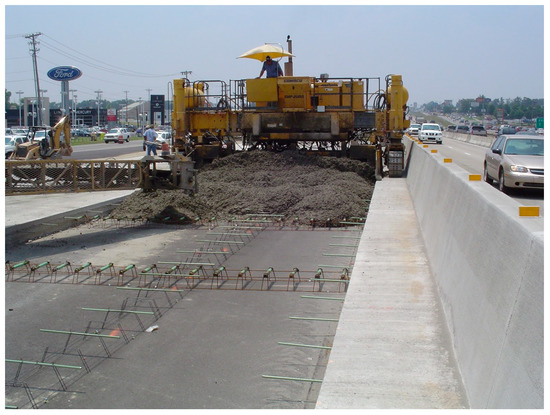
Figure 1.
Typical legacy concrete pavement repair in progress.
The U.S. Army Engineer Research and Development Center (ERDC) has evaluated novel concrete pavement repair materials and developed expedient pavement repair processes (specifically for military operational needs). However, the same materials and methods can be applied to commercial applications, where the urgency of repair is of utmost importance. The pavement repair scenario often determines whether the utilization of expedient concrete pavement repair methods is suitable for a specific project. If suitable, then specific project needs, particularly the time allotted for repairs and the required time for return to service, will dictate what types of material solutions and repair processes are used. This paper summarizes the ERDC’s concrete pavement repair material certification program and expedient construction practices in an effort to transfer these technologies to the public pavement repair industry.
2. Repair Material Evaluation and Selection
As with any infrastructure engineering project, proper material selection is critical to achieving the required performance for an individual project. Thus, the selection of repair materials for concrete pavement repair is a critical aspect of the repair project that often dictates the equipment requirements necessary for compatibility with the material solution. The ERDC has developed and refined extensive laboratory test protocols that are used to certify concrete pavement repair materials. For small patches and spall repairs, the ERDC has developed two separate laboratory test protocols for cementitious and polymeric repair materials, as shown in Table 1 and Table 2, respectively [1,2]. The required laboratory tests were selected to ensure that repair materials provide the required strength and environmental compatibility to provide expedient but long-lasting repairs. It should be noted that these protocols were developed specifically for expedient repairs with a focus on rapid return to service. These repair protocols were also adapted for the use of larger repairs, such as full-slab replacements [3].

Table 1.
Laboratory test protocols for cementitious concrete pavement repair materials.
Table 2.
Laboratory test protocols for polymeric concrete pavement repair materials.
3. Expedient Concrete Pavement Repair Processes
The overall pavement repair strategy must ensure that repair materials that meet project requirements are selected and that the pavement repair process is compatible with the required material solutions. In general, the concrete pavement repair process consists of several steps: defining the extent of damage, marking repair boundaries, cutting around the repair boundaries to maximum depth, demolishing and removing the damaged material, restoring the substrate, installing any dowels/tie bars, placing the repair material, and curing the repair material [3,4]. Suitable methods for sounding the concrete pavement, including the use of hammers or chains, should be used to identify the boundary between the damaged pavement and the sound intact pavement. This boundary should be clearly marked using paint or chalk lines to guide the pavement cutting activities. Cutting is ideally accomplished with walk-behind saws using diamond blades or skid-steer attachments equipped with diamond blades. In addition, wheel-saw attachments are successfully used for expedient repairs that provide a larger relief cut for the easier demolition of thick concrete pavements. Backhoes or excavators equipped with pavement breaker attachments and suitably sized buckets are also used to remove large debris. Hand tools and/or vacuum trucks are used to remove smaller debris. Any damage to the substrate resulting from the removal of the surface slab should be repaired either by compaction or the placement of rapid setting flowable fill. Once the foundation has been restored, dowels and/or tie bars can be installed. For expedient repairs of thick concrete pavements (PCC > 12 in.), the dowel bars and/or tie bars may be omitted, depending on the required service life. Once any reinforcement is placed, the rapid setting materials are placed in the repair and finished with a minimum of hand work. Rapid setting materials should be placed quickly from mixing buckets for small repairs or a volumetric mixer for large repairs. Care should be taken not to over finish rapid setting materials as excess paste will result in shrinkage cracks. Finally, the repair should be allowed to cure for the required period using either a topically applied polymeric curing compound or a wet burlap.
4. Recommendations/Conclusions
The laboratory test protocols and expedient repair processes described in this paper have been thoroughly evaluated through multiple projects by the ERDC and the Department of Defense for both road and airfield applications. Testing potential repair products according to recommended protocols ensures that the repair material will provide an adequate working time while meeting return to service requirements. In addition, strength testing will ensure that the repair materials are capable of withstanding applied loads, while environmental testing will ensure compatibility with the surrounding pavement under diverse environmental conditions. The expedient repair processes can be generally followed for most expedient concrete pavement repair scenarios with minor modifications to allow the use of existing equipment. The urgency of both repair and the service life required will dictate if any of the steps may be omitted for expediency while still meeting performance requirements.
Author Contributions
This project was conceived and executed by J.S.T. Laboratory testing and analyses were completed by C.E.W.J. Field testing for repair process development was performed by W.D.C. and C.M.T. The original draft was prepared by J.S.T. and C.E.W.J. The paper was reviewed and edited by W.D.C. and C.M.T. All authors have read and agreed to the published version of the manuscript.
Funding
This research received no external funding.
Data Availability Statement
The data are contained within this article. Additional details can be obtained by contacting any of the authors.
Acknowledgments
The authors would like to acknowledge Craig Rutland and the Air Force Civil Engineering Center for their general technical support.
Conflicts of Interest
The authors declare no conflict of interest.
References
- Ramsey, M.A.; Tingle, J.S.; Rutland, C.S. Evaluation of Rapid-Setting Cementitious Materials and Testing Protocol for Airfield Spall Repair; ERDC/GSL TR-20-9; U.S. Army Engineer Research and Development Center: Vicksburg, MS, USA, 2020. [Google Scholar]
- Tri-Service Pavement Working Group Manual 3-270-01.08-4 Testing Protocol for Polymeric Spall Repair Materials. 2017. Available online: https://www.wbdg.org/ffc/dod/supplemental-technical-documents/tspwg-m-3-270-01-08-4 (accessed on 12 April 2023).
- Priddy, L.P.; Tingle, J.S.; McCaffrey, T.J.; Rollings, R.S. Laboratory and Field Investigations of Small Crater Repair Technologies; ERDC/GSL TR-07-27; U.S. Army Engineer Research and Development Center: Vicksburg, MS, USA, 2007. [Google Scholar]
- Carruth, W.D. Full-Scale Testing of Commercially Available Cementitious Backfill and Surface Capping Materials for Crater Repairs; ERDC/GSL TR-20-17; U.S. Army Engineer Research and Development Center: Vicksburg, MS, USA, 2020. [Google Scholar]
Disclaimer/Publisher’s Note: The statements, opinions and data contained in all publications are solely those of the individual author(s) and contributor(s) and not of MDPI and/or the editor(s). MDPI and/or the editor(s) disclaim responsibility for any injury to people or property resulting from any ideas, methods, instructions or products referred to in the content. |
© 2023 by the authors. Licensee MDPI, Basel, Switzerland. This article is an open access article distributed under the terms and conditions of the Creative Commons Attribution (CC BY) license (https://creativecommons.org/licenses/by/4.0/).