


Abstract
Herein, we numerically elucidate the effect of varying surface recombination velocity () at the front and back metal contact on the device performance for our reported lead-free formamidinium tin triiodide () perovskite solar cell. The is generally contemplated as a trivial non-radiative recombination loss factor but determinately impacts the characteristics of the solar cell. Given that, we simultaneously varied the at the back and front metal contacts in the range of . Such values for can be realized by ideally passivating the perovskite film and with passivated perovskite films or metallic contact resistive nature. It was inferred that at of , the device efficiency was 21.24% and was steeply increased to 21.42% after decreasing the rate to , revealing that recombination losses are enhanced at a higher rate because of increased carrier recombination at the defect surface, thereby reducing the efficiency and overall performance of the solar cell.
1. Introduction
Among emerging photovoltaic technology, solar cells based on perovskite material (materials of the type ) have attracted enormous attention due to their favorable optoelectronic properties, low fabrication cost, and potential of attaining high efficiency () except the downside of stability [1,2,3]. The state of the art lab-scale fabricated perovskite solar cell characterized by pseudo halide engineering holds the encouraging 25.6% [4]. Apart from this, non-radiative recombination losses are inevitable in solar cells and more readily emerge in perovskite solar cells due to the ionic nature of perovskite material [5].
Here, we focused on discussing the impact of surface recombination velocity () (one of the non-radiative recombination losses) for the perovskite solar cell. is the rate at which excess minority carriers recombine at the surface (or interface) analogue to the minority carrier lifetime in the bulk of the semiconductor layer [5]. High and low minority carrier lifetime are combined to reduce the carrier collection probability and decline the [5,6]. The device needs careful optimization in relation to these factors to achieve desirable output characteristics.
Various studies, including numerical and practical investigations, have explored the impacts on the output electrical characteristics, the carrier lifetime, the diffusion length, the collection probability of carriers, and the recombination rate of the solar cells [5,6,7,8,9,10,11,12,13]. We hereby focused on finding the degree to which influences our recently reported perovskite solar cell [14], wherein we detailed in-depth investigation on the effect of defect density, grain boundaries, and gradient doping on the performance of the solar. Further details to ascertain the likely impact of for the perovskite solar cell are comprehensively provided in this study in the subsequent sections.
2. Materials and Methods
We employed a SCAPS-1D environment to perform drift–diffusion simulations for investigating the influence on device characteristics. The perovskite solar cell is the architecture of FTO-etched glass/graphene nano-composites doped with /Spiro OmeTAD/Au back metal contact, as depicted in Figure 1a. The material parameters for the simulation can be obtained from the [14]. The device has an open-circuit voltage () of 0.984 V, a short-circuit current density () of 30.235 , a fill factor (FF) of 74.07%, and of 21.24%. The current–voltage characteristics of the solar cell under AM 1.5G one-sum illumination conditions are depicted in Figure 1b, while the external quantum efficiency is shown in Figure 1c. For investigating the , we assumed that is identical at the front and back metal contacts. This assumption is in line with practical realizations [7]. The was varied in the range of . The lower values of can be perceived for the encapsulated and passivated perovskite solar cell, while un-passivated perovskite solar cells usually exhibit higher values [15]. Further, it was noticed that devices with metallic contact generally exhibit . This study covers all these scenarios and discusses the impact of on the output characteristics, generation–recombination profiles, and quantum efficiency of the solar cell in the later sections.
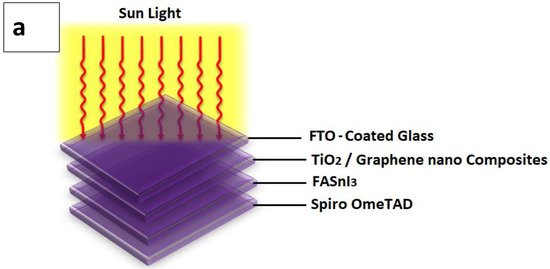
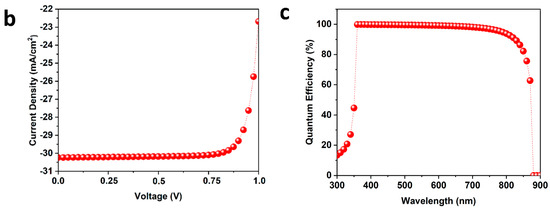
Figure 1.
(a) The structure of the considered perovskite solar cell; (b) current density–voltage curve of the solar cell; (c) quantum efficiency of the solar cell.
3. Results and Discussion
3.1. Surface Recombination Velocity Effect on Current–Voltage Characteristics
As discussed earlier, is the rate at which excess minority carriers recombine at the surface. The mathematical expression relating , surface recombination rate (), excess minority carriers ( or ), and carrier lifetime () are given by Equation (1) [15]. This tells us that an increase in results in increased , reducing the carrier lifetime as well as the diffusion length according to [16], wherein = the diffusion length and = the diffusion coefficient. Further, the relationship between and and and , can be given by Equations (2) and (3), respectively [16,17]. In summary, the relation among these implications can be related as .
In the above expressions, q = the charge, G = the illumination, = the intrinsic carrier concentration, N = the majority carrier dopant concentration, T = the room temperature in Kelvin, and = the Boltzmann constant. The current–voltage curves for varying values from for the perovskite solar cell are illustrated in Figure 2a. It can be observed that a decrease in values enhanced the maximum voltage/current points, and , of the perovskite solar cell. Figure 2c provides further detailed insight on output parameters extracted from the current–voltage curves shown in Figure 2a. At = , and were 0.948 V and 30.235 , respectively, and were noticeably improved to 0.9505 V and 30.485 as dropped to . The maximum FF was obtained at of . Further, was 21.24% at and steeply increased to 21.42% as we decreased the to . The improvement in device parameters on lowering the corroborates the mitigation of dangling bonds (or the breakdown of the atomic lattice to prompt defect states in energy levels) at lower values and vice versa [12,13,14,15].
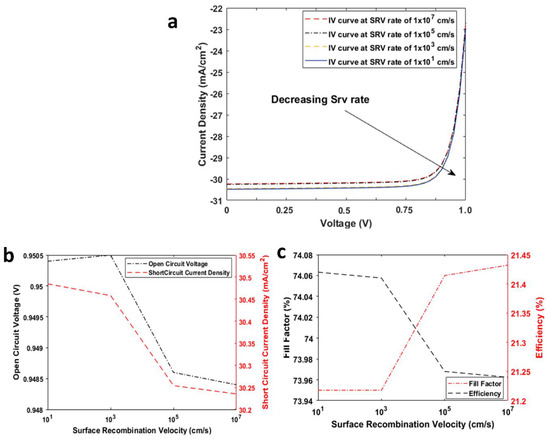
Figure 2.
Impact of varying surface recombination velocity on the (a) current–voltage curves; (b) open-circuit voltage and short-circuit current density; and (c) fill factor and efficiency of the solar cell.
3.2. Surface Recombination Velocity Effect on Generation/RecmobinationRate
The deterministic impact of on the generation–recombination profile for the perovskite solar is illustrated in Figure 3. The total carrier generation rate across all the layers was and was the same for all rates. This is because the carrier generation rate is primarily dependent on the incident light intensity. However, the total carrier recombination () was highest when was and decreases alongside the set minimum boundary value for . The was , ,, and at values of , , , and , respectively. This is because with the increase in , the minority carrier lifetime and diffusion length decrease due to the emergence of defect states, thereby increasing the recombination rate of the carriers and vice versa [15,16,17].
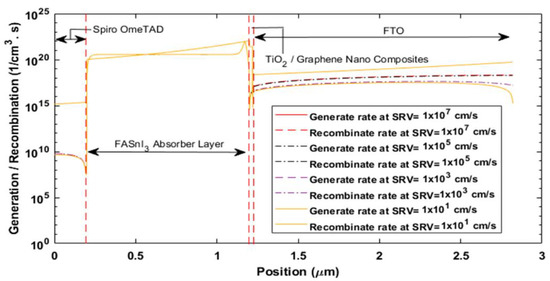
Figure 3.
Impact of varying surface recombination velocity on the generation–recombination rate of the solar cell.
3.3. Surface Recombination Velocity Effect on External Quantum Efficiency
The external quantum efficiency as a function of incident light wavelength for the perovskite solar cell is also observed to be influenced by the variation in , as shown in Figure 4. It can be noticed that the device quantum efficiency profile improved as we decreased the from . The prominent difference in the quantum efficiency is easily noticeable for the wavelengths and 360 nm. The quantum efficiency at the inception (at an incident light wavelength of 300 nm) was 13.3% and 18.9% for values of and , respectively. The quantum efficiency unprecedently enhanced to 79% as decreased beyond the . This is because the quantum efficiency of the solar cell is highly deterministic on the proportion of light being transmitted (and absorbed) or reflected from the surface of the solar cell [8]. In the current context, the decrease in quantum efficiency at higher values can be related to the inability of perovskite solar cells to harvest incident photons because of inappropriate surface texturing and defects at the interface of metal contacts and perovskite film [5,15,16,17].
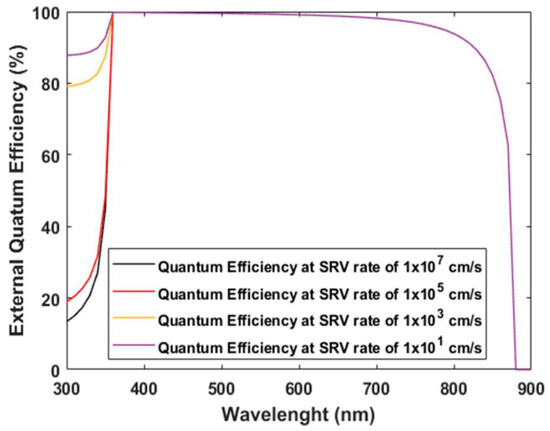
Figure 4.
Impact of varying surface recombination velocity on the external quantum efficiency of the solar cell.
4. Conclusions
The computational investigation demonstrated that can strongly influence the carrier generation–recombination rate, quantum efficiency, power conversion efficiency, and overall device performance. Higher results in reduced increases in the carrier recombination before collection at the respective contacts, as well as decreased quantum efficiency of the solar cell, and vice versa. The of the device is enhanced to 21.42% from the reported 21.24% on decreasing the from and , respectively. So, the adverse effects of can be controlled by carefully passivating the surface (and interface) and the synthetization of reduced defect perovskite films.
Author Contributions
Conceptualization, F.S.; methodology, F.S., T.U.R., A.Z., A.F., M.H.K., M.A.K., H.A.T. and A.I.; software, F.S., T.U.R., A.Z., A.F., M.H.K., M.A.K., H.A.T. and A.I.; writing—original draft preparation, F.S., T.U.R., A.Z., A.F., M.H.K., M.A.K., H.A.T. and A.I.; Writing-reviewing and editing, F.S. All authors have read and agreed to the published version of the manuscript.
Funding
This research received no external funding.
Conflicts of Interest
The authors declare no conflict of interest.
References
- Ashworth, C. Reproducible, high-performance perovskite solar cells. Nat. Rev. Mater. 2021, 6, 293. [Google Scholar] [CrossRef]
- Jung, J.W.; Son, S.H.; Choi, J. Polyaniline/reduced graphene oxide composites for hole transporting layer of high-performance inverted perovskite solar cells. Polymers 2021, 13, 1281. [Google Scholar] [CrossRef] [PubMed]
- Saeed, F.; Tauqeer, H.A.; Idrees, A.; Ali, M.Z.; Raza, A.; Khan, M.A. Buffer Layered PbS Colloidal Quantum Dot Solar Cell with Enhanced Efficiency. In Proceedings of the 2021 4th International Conference on Energy Conservation and Efficiency, ICECE 2021, Lahore, Pakistan, 16–17 March 2021. [Google Scholar]
- Jeong, J.; Kim, M.; Seo, J.; Lu, H.; Ahlawat, P.; Mishra, A.; Yang, Y.; Hope, M.A.; Eickemeyer, F.T.; Kim, M.; et al. Pseudo-halide anion engineering for α-FAPbI3 perovskite solar cells. Nature 2021, 592, 381–385. [Google Scholar] [CrossRef] [PubMed]
- Jariwala, S.; Burke, S.; Dunfield, S.; Shallcross, R.C.; Taddei, M.; Wang, J.; Eperon, G.E.; Armstrong, N.R.; Berry, J.J.; Ginger, D.S. Reducing surface recombination velocity of methylammonium-free mixed-cation mixed-halide perovskites via surface passivation. Chem. Mater. 2021, 33, 5035–5044. [Google Scholar] [CrossRef]
- Tainter, G.D.; Hörantner, M.T.; Pazos-Outón, L.M.; Lamboll, R.D.; Āboliņš, H.; Leijtens, T.; Mahesh, S.; Friend, R.H.; Snaith, H.J.; Joyce, H.J.; et al. Long-Range Charge Extraction in Back-Contact Perovskite Architectures via Suppressed Recombination. Joule 2019, 3, 1301–1313. [Google Scholar] [CrossRef] [Green Version]
- Kuciauskas, D.; Kephart, J.M.; Moseley, J.; Metzger, W.K.; Sampath, W.S.; Dippo, P. Recombination velocity less than 100 cm/s at polycrystalline Al2O3/CdSeTe interfaces. Appl. Phys. Lett. 2018, 112, 263901. [Google Scholar] [CrossRef]
- Saeed, F.; Zohaib, A. Quantification of Losses in a Photovoltaic System: A Review. Eng. Proc. 2021, 11, 35. [Google Scholar]
- Idígoras, J.; Contreras-Bernal, L.; Cave, J.M.; Courtier, N.E.; Barranco, Á.; Borras, A.; Sánchez-Valencia, J.R.; Anta, J.A.; Walker, A.B. The Role of Surface Recombination on the Performance of Perovskite Solar Cells: Effect of Morphology and Crystalline Phase of TiO2 Contact. Adv. Mater. Interfaces 2018, 5, 1801076. [Google Scholar] [CrossRef]
- Sandberg, O.J.; Armin, A. On the effect of surface recombination in thin film solar cells, light emitting diodes and photodetectors. Synth. Met. 2019, 254, 114–121. [Google Scholar] [CrossRef] [Green Version]
- Yavari, M.; Mazloum-Ardakani, M.; Gholipour, S.; Tavakoli, M.M.; Taghavinia, N.; Hagfeldt, A.; Tress, W. Reducing Surface Recombination by a Poly(4-vinylpyridine) Interlayer in Perovskite Solar Cells with High Open-Circuit Voltage and Efficiency. ACS Omega 2018, 3, 5038–5043. [Google Scholar] [CrossRef] [PubMed]
- Sarraf, S.Y.; Singh, S.; Garcia-Castro, A.C.; Trappen, R.; Mottaghi, N.; Cabrera, G.B.; Huang, C.Y.; Kumari, S.; Bhandari, G.; Bristow, A.D.; et al. Surface Recombination in Ultra-Fast Carrier Dynamics of Perovskite Oxide La0.7Sr0.3MnO3 Thin Films. ACS Nano 2019, 13, 3457–3465. [Google Scholar] [CrossRef] [PubMed]
- Islam, M.; Wahid, S.; Alam, M.K. Physics-based modeling and performance analysis of dual junction perovskite/silicon tandem solar cells. Phys. Status Solidi Appl. Mater. Sci. 2017, 214, 1600306. [Google Scholar] [CrossRef]
- Saeed, F.; Gelani, H.E. Unravelling the effect of defect density, grain boundary and gradient doping in an efficient lead-free formamidinium perovskite solar cell. Opt. Mater. 2022, 124, 111952. [Google Scholar] [CrossRef]
- Wang, J.; Fu, W.; Jariwala, S.; Sinha, I.; Jen, A.K.Y.; Ginger, D.S. Reducing Surface Recombination Velocities at the Electrical Contacts Will Improve Perovskite Photovoltaics. ACS Energy Lett. 2019, 4, 222–227. [Google Scholar] [CrossRef]
- Poortmans, J.; Arkhipov, V. Thin Film Solar Cells Fabrication, Characterization and Applications; John Wiley & Sons: Hoboken, NJ, USA, 2006. [Google Scholar]
- Schroder, D.K. Semiconductor Material and Device Characterization; John Wiley & Sons: Hoboken, NJ, USA, 2005. [Google Scholar]
Publisher’s Note: MDPI stays neutral with regard to jurisdictional claims in published maps and institutional affiliations. |
© 2022 by the authors. Licensee MDPI, Basel, Switzerland. This article is an open access article distributed under the terms and conditions of the Creative Commons Attribution (CC BY) license (https://creativecommons.org/licenses/by/4.0/).