


Abstract
Amyloid-β (Aβ) peptides are crucial in the pathology of Alzheimer’s disease. On the other hand, their metal complexes possess distinctive coordination properties that could be of great importance in the selective recognition of (bio)analytes, such as anions. Here, we report a novel group of molecular receptors for phosphate anions recognition: metal–peptide complexes of Aβ peptides, which combine features of synthetic inorganic ligands and naturally occurring binding proteins. The influence of the change in the metal ion center on the coordination and redox properties of binary Cu(II)/Ni(II)-Aβ complexes, as well as the affinity of these complexes towards phosphate species, were analyzed. This approach offers the possibility of fine-tuning the receptor affinity for desired applications.
1. Introduction
The determination of phosphate anions in body fluids provides information about various disorders such as hyperparathyroidism or vitamin D deficiency [1]. Therefore, the monitoring of phosphate levels is of interest for human health. Chemical sensors are an ideal alternative to classic analytical methods, but their construction requires the synthesis of appropriate receptors, selectively binding to the analyte.
Amyloid β peptides (Aβ) related to Alzheimer’s disease are well known for their neurotoxic properties [2]. However, metal complexes, with their N-terminally truncated analogs, have unique coordination properties that could be employed in the design of potential receptors for biorelevant anionic species [3,4]. The Aβ5-9 (Arg-His-Asp-Ser-Gly-NH2) peptide possesses a His-2 binding motif, and thus forms stable complexes with transition metal ions such as Cu(II) or Ni(II). At pH 7.4, the Cu(II) or Ni(II) ion is bound by three nitrogen atoms (3N) from the His residue, the N-terminal amine, and the peptide backbone amide [5]. The resulting chelates also exhibit a labile coordination site, enabling ternary interactions. Hence, metal–peptide complexes offer the possibility of fine-tuning their affinity for desired applications by altering the amino acid sequence and the metal ion center.
The present work explores and compares the coordination and redox properties of Cu(II) and Ni(II) complexes of the Aβ5-9 peptide, followed by their ability to interact with biologically relevant phosphate anions and nucleotides.
2. Materials and Methods
2.1. Chemicals and Reagents
All chemicals were purchased from Merck and Sigma Aldrich. All solutions were prepared daily with deionized water (18 MΩ∙cm). In order to avoid Cu(II)/Ni(II) contamination, the glassware was raised with 6 M HNO3 followed by deionized water. AMP and ATP stock solutions were adjusted to pH 7.0–7.4 and kept on ice during measurements to prevent nucleotides hydrolysis.
2.2. Peptide Synthesis
Synthesis of the Aβ5-9 peptide was performed according to the Fmoc/tBu strategy [6] on a Prelude™ peptide synthesizer (Protein Technologies, Inc., Tucson, AZ, USA). The crude was purified by HPLC with the UV detection (Waters, Milford, MA, USA) at 220 nm. The purity of the peptide was verified by ESI-MS (Waters, Milford, MA, USA).
2.3. Voltammetry
Electrochemical measurements (CV, DPV) were performed using the CHI 1030 potentiostat (CH Instrument, Austin, TX, USA) in a three-electrode arrangement with a GCE (BASi, 3 mm diameter) as a working electrode, an Ag/AgCl electrode (Mineral, Warsaw, Poland) as a reference, and a platinum wire as an auxiliary electrode. The GCE was sequentially polished with the alumina powder (1.0 μm and 0.3 μm) on a Buehler polishing cloth. Then, the working electrode was sonicated for 1 min and rinsed thoroughly with deionized water. All voltametric experiments were carried out in 100 mM KNO3 at pH 7.4 under argon. The pH was adjusted with small aliquots of concentrated KOH or HNO3 solutions. The peptide-to-metal(II) ratio was 1.0:0.9.
3. Results and Discussion
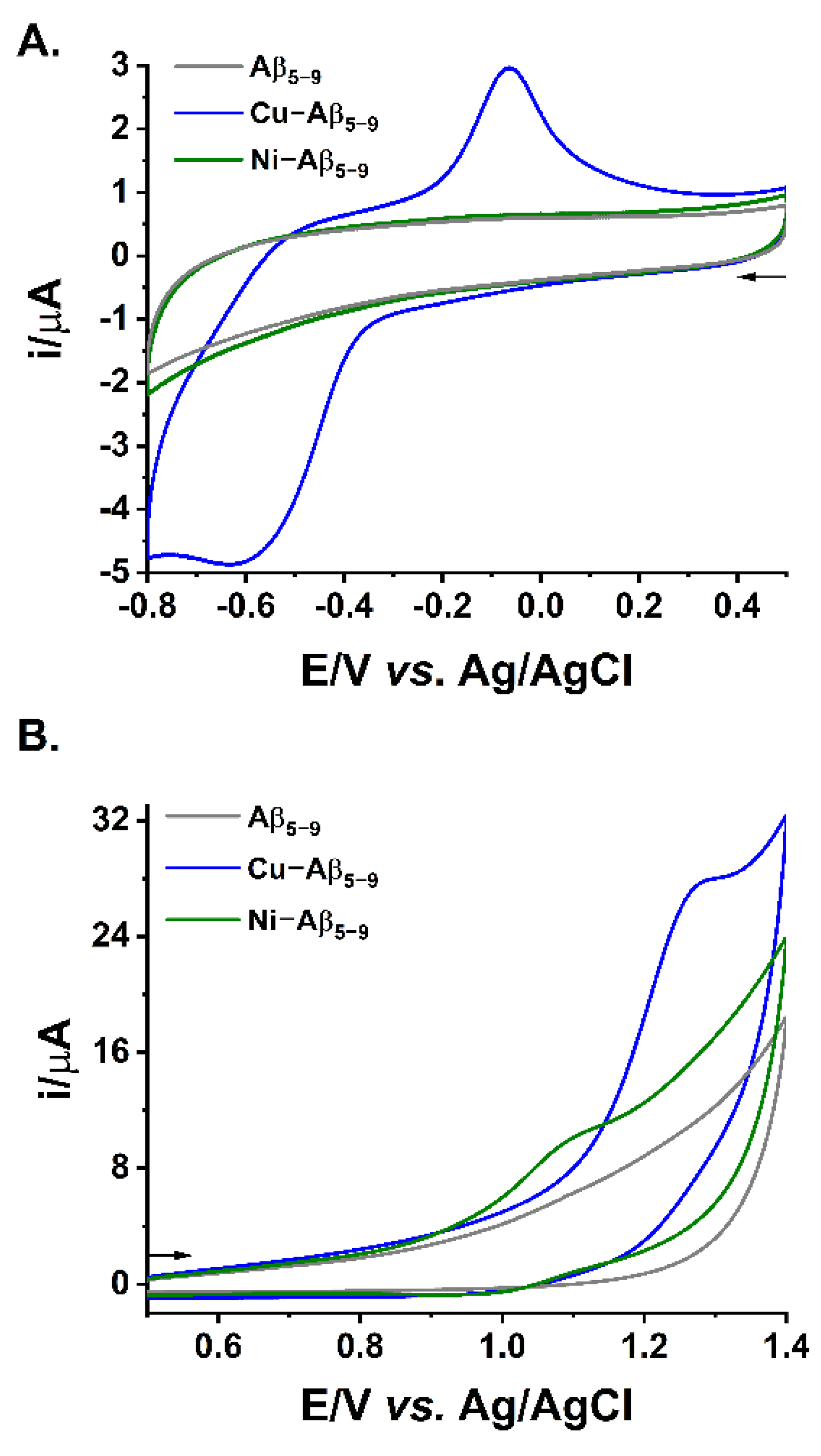
The electrochemical response for the Aβ5-9 metal complexes recorded at pH 7.4 is depicted in Figure 1. The binary Cu(II)-Aβ5-9 complex enabled both the reduction (Figure 1A, blue line) and oxidation of Cu(II) ions (Figure 1B, blue line). The exchange of the metal center complex to Ni(II) caused significant differences in the redox behavior, with a decrease in metal center oxidation by 188 mV compared to Cu(II) complexes (Figure 1B, green line). We did not observe any signals associated with Ni(II) reduction (Figure 1A, green line).
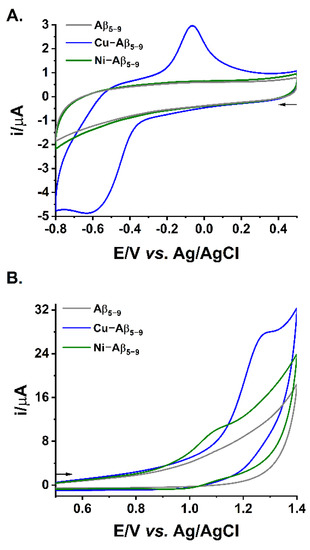
Figure 1.
CV curves registered for 0.5 mM Aβ5-9 in absence (grey line) and in the presence of 0.45 mM Cu(II) (blue line), or 0.45 mM Ni(II) (green line) scanned towards negative (A) and positive (B) potentials and recorded in 100 mM KNO3 at pH 7.4, scan rate v = 0.1 V/s. Analyzed based on data published in the literature [3,4,5].
Distinct electrochemical properties are likely caused by the differences in geometry and the stabilities of the Aβ5-9 complexes. Under studied conditions, Cu(II) complex is square-planar, while Ni(II) complexes are mostly octahedral. Additionally, the conditional stability constant of the Cu(II)-Aβ5-9 (5.8 × 10¹² M−1) is about five orders magnitude higher than for Ni(II)-Aβ5-9 (1.7 × 10⁶ M−1) [3,5].
Considering the application of the metal complexes of Aβ5-9 as a recognition element, we studied their response to selected anionic species. Observed changes in the oxidation potentials of the metal center upon the addition of 10 mM phosphates were similar (~150–160 mV) for Cu(II) and Ni(II) complexes of Aβ5-9. Comparable sensitivity of chelates is probably related to a similar Lewis acidity of the metal centers. Furthermore, both complexes exhibit a good selectivity towards phosphates in the presence of chlorides and sulfates (Table 1). Aside from phosphates, only acetates, among other tested analytes, interacted with the metal–peptide complexes, causing changes in redox activity. Nevertheless, the voltametric signals for acetates occurred at different potentials than for phosphates.

Table 1.
Comparison of the affinity towards selected anions and nucleotides of the Cu(II)-Aβ5-9 and Ni(II)-Aβ5-9 complexes. ΔEM(II)/M(III) is the difference of the potential values of Cu(II) or Ni(II) oxidation of the respective ternary system and the binary complex. Calculated based on results published previously [3,4].
Since the intercellular level of organic phosphates can be 20 times higher than inorganic phosphates, we decided to investigate the affinities of the studied metal–peptide complexes for selected nucleotides (AMP, ATP). Similar to phosphate anions, the presence of nucleotides shifted the oxidation peak to less positive values. However, in contrast to Cu(II)-Aβ5-9, the signal of the metal center oxidation for Ni(II)-Aβ5-9 occurs at different potentials for mono- and triphosphates (see Table 1). We suggest that this is due to the ability of the octahedral nickel complex to interact with more than one phosphate group of ATP as a result of the chelate effect.
4. Conclusions
Metal–peptide complexes of peptides possessing the His-2 motif ensure there are labile coordination sites, enabling ternary interactions with phosphate anions and nucleotides. Such interactions lead to a strong electrochemical response, which could be valuable for designing a promising class of peptide-based molecular receptors with potential applications as recognition elements in electrochemical biosensors and in vitro clinical diagnostics.Our research proved that the change in the metallic center of the Aβ5-9 complex significantly influences its coordination properties and redox activity. Nevertheless, altering the metal center from Cu(II) to Ni(II) does not change the sensitivity of the complex toward phosphate anions.
Supplementary Materials
The following are available online at https://www.mdpi.com/article/10.3390/CSAC2021-10449/s1.
Author Contributions
Conceptualization, W.B., N.E.W. and U.E.W.; methodology, W.W., U.E.W. and N.E.W.; formal analysis, A.T., U.E.W. and N.E.W.; investigation, A.T.; resources, W.W. and W.B.; data curation, A.T., U.E.W. and N.E.W.; writing—original draft preparation, A.T.; writing—review and editing, A.T., N.E.W. and W.W.; visualization, A.T.; supervision, N.E.W., W.W. and W.B.; project administration, N.E.W. and A.T.; funding acquisition, N.E.W. and A.T. All authors have read and agreed to the published version of the manuscript.
Funding
This work was financially supported by the Warsaw University of Technology under the program Excellence Initiative, Research University (ID-UB), BIOTECHMED-1 project no. PSP 504/04496/1020/45.010407 (N.E.W.) and implemented as a part of the Operational Program Knowledge Education Development 2014–2020 (Project No POWR.03.02.00-00-I007/16-00) co-financed by the European Social Fund (A.T.).
Institutional Review Board Statement
Not applicable.
Informed Consent Statement
Not applicable.
Data Availability Statement
The data presented in this study are available on request from the corresponding author.
Acknowledgments
We gratefully acknowledge the assistance of Dawid Płonka (Institute of Biochemistry and Biophysics, Polish Academy of Sciences) in peptide synthesis.
Conflicts of Interest
The authors declare no conflict of interest. The funders had no role in the design of the study; in the collection, analyses, or interpretation of data; in the writing of the manuscript, or in the decision to publish the results.
References
- Ramakrishnam Raju, M.V.; Harris, S.M.; Pierre, V.C. Design and applications of metal-based molecular receptors and probes for inorganic phosphate. Chem. Soc. Rev. 2020, 49, 1090–1108. [Google Scholar] [CrossRef] [PubMed]
- Rauk, A. Why is the amyloid beta peptide of Alzheimer’s disease neurotoxic? Dalton Trans. 2008, 1273–1282. [Google Scholar] [CrossRef] [PubMed]
- Tobolska, A.; Wezynfeld, N.E.; Wawrzyniak, U.E.; Bal, W.; Wróblewski, W. Tuning Receptor Properties of Metal-Amyloid Beta Complexes. Studies on the Interaction between Ni(II)-Aβ5-9 and Phosphates/Nucleotides. Inorg. Chem. 2021. [Google Scholar] [CrossRef] [PubMed]
- Tobolska, A.; Wezynfeld, N.E.; Wawrzyniak, U.E.; Bal, W.; Wróblewski, W. Copper(II) complex of N-truncated amyloid-β peptide bearing a His-2 motif as a potential receptor for phosphate anions. Dalton Trans. 2021, 50, 2726–2730. [Google Scholar] [CrossRef] [PubMed]
- Wezynfeld, N.E.; Tobolska, A.; Mital, M.; Wawrzyniak, U.E.; Wiloch, M.Z.; Płonka, D.; Bossak-Ahmad, K.; Wroblewski, W.; Bal, W. Aβ5-x Peptides: N-Terminal Truncation Yields Tunable Cu(II) Complexes. Inorg. Chem. 2020, 59, 14000–14011. [Google Scholar] [CrossRef] [PubMed]
- Chan, W.C.; White, P.D. Fmoc Solid Phase Peptide Synthesis: A Practical Approach. In Fmoc Solid Phase Peptide Synthesis: A Practical Approach; Chan, W.C., White, P.D., Eds.; Oxford University Press: New York, NY, USA, 2000; pp. 41–76. [Google Scholar]
Publisher’s Note: MDPI stays neutral with regard to jurisdictional claims in published maps and institutional affiliations. |
© 2021 by the authors. Licensee MDPI, Basel, Switzerland. This article is an open access article distributed under the terms and conditions of the Creative Commons Attribution (CC BY) license (https://creativecommons.org/licenses/by/4.0/).