
You are currently viewing a new version of our website. To view the old version click .
Chemistry Proceedings
  • Abstract
  • Open Access

5 July 2021

From Single Nanowires to Smart Systems: Different Ways to Assess Food Quality †

,
and
1
IMEM-CNR, Sede di Trento-FBK, Via alla Cascata 56/C, 38123 Povo, Trento, Italy
2
Research and Innovation Centre, Fondazione Edmund Mach, 38010 San Michele all’Adige, Trento, Italy
3
Research and Innovation Centre, Department of Food Quality and Nutrition, Fondazione Edmund Mach, Via Edmund Mach 1, 38010 San Michele all’Adige, Trento, Italy
*
Author to whom correspondence should be addressed.
This article belongs to the Proceedings The 1st International Electronic Conference on Chemical Sensors and Analytical Chemistry

Abstract

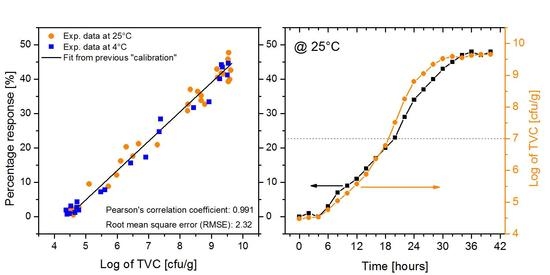
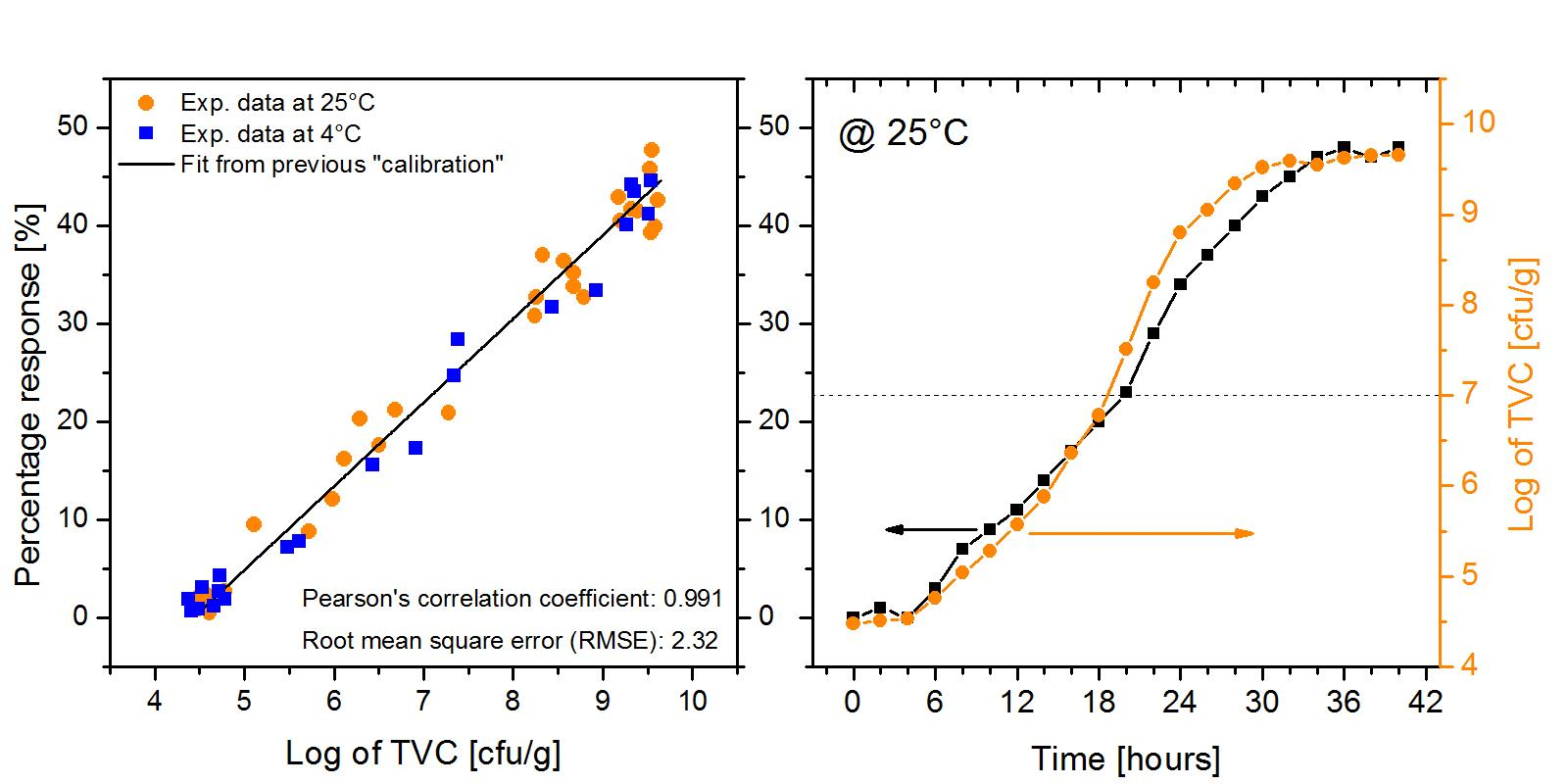
Recently, low-dimensional (1D, 2D) nanostructured materials have been attracting more and more interest as building blocks for innovative systems. Metal oxide nanowires are one of the most widely used materials for solid-state gas sensors, as they are simple to make, inexpensive, and sensitive to a wide range of gases and volatiles. Unfortunately, their broad sensitivity has a price to pay, which is very low selectivity. Fortunately, this flaw is not a problem for all applications. Where the boundary conditions are defined and “simple” (only the presence of a target gas is expected, without any interfering gases), a single traditional chemiresistor may be the best choice, while in cases where the variables are many, it is better to use an intelligent system. In this paper, we will show a resistive sensor based on a single SnO2 nanowire which, working at three temperatures (200, 250, and 300 °C), is able to detect tens of ppb of ammonia (30 ppb at 300 °C). The limit of detection (LoD) was calculated as 3 N/S, where N is the standard deviation of the sensor signal in air and S is the sensor sensitivity. We will show that the performance of this nanosensor is excellent and can be used in various applications, including agri-food quality monitoring. We will demonstrate that the SnO2 nanowire in a thermal gradient can act as a nano-electronic nose thanks to machine learning algorithms. The single nanowire-based sensor can estimate the total viable count with an error of 2.32% on mackerel fish samples stored at room temperature (25 °C) and in a fridge (4 °C). The integration of such a small (less than one square mm) and cheap device into the food supply chain would greatly reduce waste and the frequency of food poisoning.

Supplementary Materials

The following are available online at https://www.mdpi.com/article/10.3390/CSAC2021-10605/s1.

Author Contributions

Conceptualization, M.T.; methodology, M.T.; software, M.T.; validation, M.T., F.B. and F.G.; formal analysis, M.T.; investigation, M.T.; resources, F.B., F.G.; data curation, M.T.; writing—original draft preparation, M.T.; writing—review and editing, M.T., F.B. and F.G.; visualization, M.T.; supervision, F.B. and F.G.; project administration, F.B. and F.G.; funding acquisition, F.B. and F.G. All authors have read and agreed to the published version of the manuscript.

Funding

This research received no external funding.

Institutional Review Board Statement

Not applicable.

Data Availability Statement

The data presented in this study are openly available in Open Science Framework at doi:10.17605/OSF.IO/83SMW.

Conflicts of Interest

The authors declare no conflict of interest.
Publisher’s Note: MDPI stays neutral with regard to jurisdictional claims in published maps and institutional affiliations.

Article Metrics

Citations

Article Access Statistics

Multiple requests from the same IP address are counted as one view.