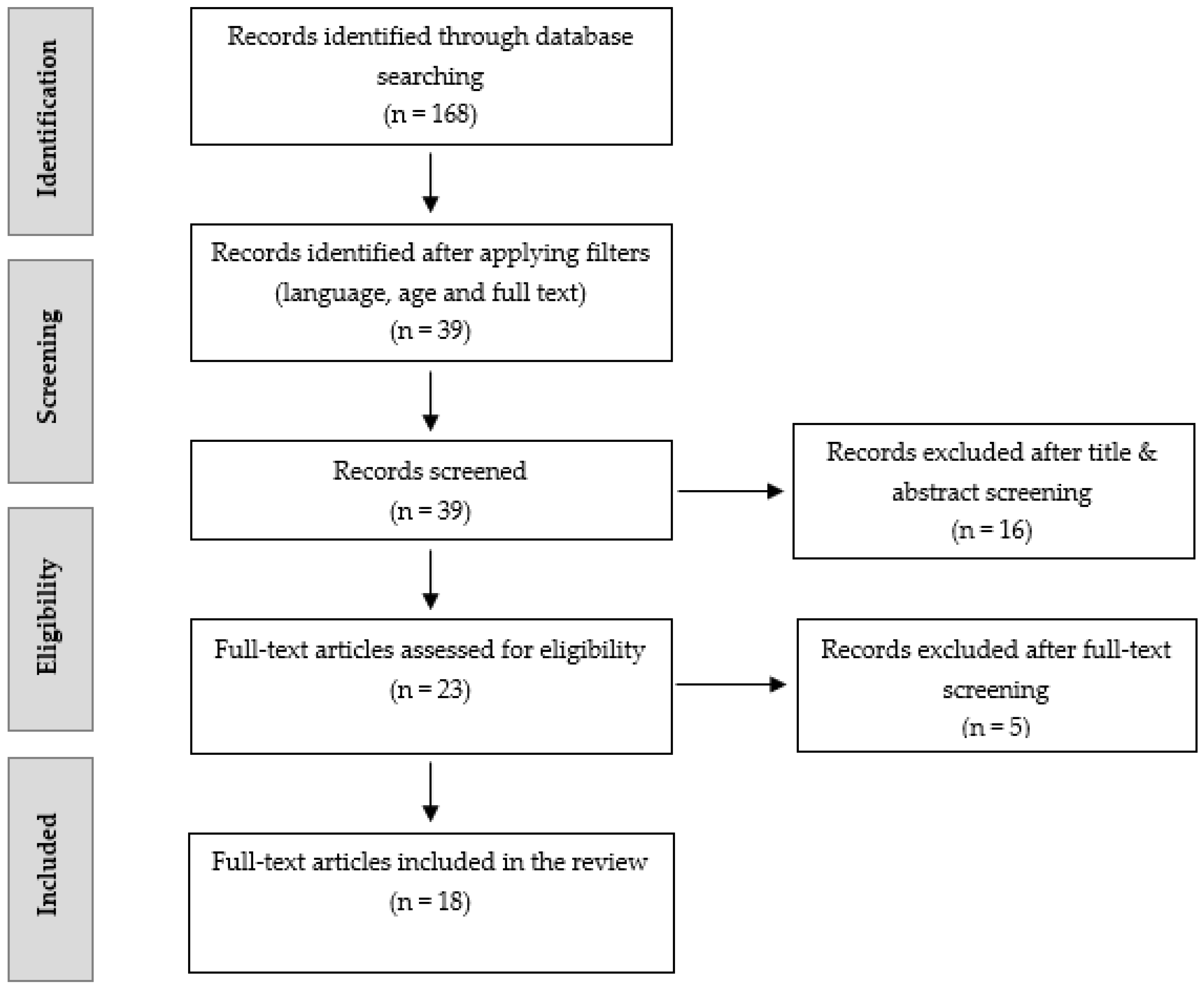

Motherhood and Childhood in the Context of Mental Illness: A Narrative Review

Abstract
1. Introduction
2. Results
3. Discussion
4. Materials and Methods
5. Conclusions
Supplementary Materials
Author Contributions
Funding
Institutional Review Board Statement
Informed Consent Statement
Conflicts of Interest
References
- Díaz-Pons, A.; Soler-Andrés, M.; Ortiz-García de la Foz, V.; Murillo-García, N.; Yorca-Ruiz, A.; Magdaleno Herrero, R.; Castaño-Castaño, S.; González-Rodríguez, A.; Setién-Suero, E.; Ayesa-Arriola, R. Exploring parenthood in first episode of psychosis: The potential role of the offspring in the outcome of women. Arch. Womens Ment. Health 2024, 27, 693–703. [Google Scholar] [CrossRef] [Scilit] [PubMed]
- Modak, A.; Ronghe, V.; Gomase, K.P.; Mahakalkar, M.G.; Taksande, V. A Comprehensive Review of Motherhood and Mental Health: Postpartum Mood Disorders in Focus. Cureus 2023, 15, e46209. [Google Scholar] [CrossRef] [Scilit] [PubMed]
- Frosch, C.A.; Schoppe-Sullivan, S.J.; O’Banion, D.D. Parenting and Child Development: A Relational Health Perspective. Am. J. Lifestyle Med. 2021, 15, 45–59. [Google Scholar] [CrossRef] [Scilit] [PubMed]
- Kirkbride, J.B.; Anglin, D.M.; Colman, I.; Dykxhoorn, J.; Jones, P.B.; Patalay, P.; Pitman, A.; Soneson, E.; Steare, T.; Wright, T.; et al. The social determinants of mental health and disorder: Evidence, prevention and recommendations. World Psychiatry Off. J. World Psychiatr. Assoc. WPA 2024, 23, 58–90. [Google Scholar] [CrossRef] [Scilit] [PubMed]
- Beesdo, K.; Knappe, S.; Pine, D.S. Anxiety and anxiety disorders in children and adolescents: Developmental issues and implications for DSM-V. Psychiatr. Clin. N. Am. 2009, 32, 483–524. [Google Scholar] [CrossRef] [Scilit] [PubMed]
- Karimzadeh, M.; Rostami, M.; Teymouri, R.; Moazzen, Z.; Tahmasebi, S. The association between parental mental health and behavioral disorders in pre-school children. Electron. Physician 2017, 9, 4497–4502. [Google Scholar] [CrossRef] [Scilit] [PubMed]
- Paulus, F.W.; Ohmann, S.; Möhler, E.; Plener, P.; Popow, C. Emotional Dysregulation in Children and Adolescents With Psychiatric Disorders. A Narrative Review. Front. Psychiatry 2021, 12, 628252. [Google Scholar] [CrossRef] [Scilit] [PubMed]
- Phillips, R.; Durkin, M.; Engward, H.; Cable, G.; Iancu, M. The impact of caring for family members with mental illnesses on the caregiver: A scoping review. Health Promot. Int. 2023, 38, daac049. [Google Scholar] [CrossRef] [Scilit] [PubMed]
- Schmitz, K.; Patel, M.; Ragavan, M.I.; Rojas, C.R. Prioritizing caregiver mental health to promote child health. Pediatr. Res. 2024. [Google Scholar] [CrossRef] [Scilit] [PubMed]
- Ciciolla, L.; Gerstein, E.D.; Crnic, K.A. Reciprocity among maternal distress, child behavior, and parenting: Transactional processes and early childhood risk. J. Clin. Child Adolesc. Psychol. 2014, 43, 751–764. [Google Scholar] [CrossRef] [Scilit] [PubMed]
- Radley, J.; Barlow, J.; Johns, L.C. Parenting and psychosis: An experience sampling methodology study investigating the inter-relationship between stress from parenting and positive psychotic symptoms. Br. J. Clin. Psychol. 2022, 61, 1236–1258. [Google Scholar] [CrossRef] [Scilit] [PubMed]
- Tahmasian, K.; Anari, A.; Fathabadi, M. Evaluation of Effective Maternal Characteristics in Behavioral Problems of 2–6 Years Old Children. J. Mod. Psychol. Res. 2012, 7, 89–104. [Google Scholar]
- Dubois-Comtois, K.; Bernier, A.; Tarabulsy, G.M.; Cyr, C.; St-Laurent, D.; Lanctôt, A.-S.; St-Onge, J.; Moss, E.; Béliveau, M.-J. Behavior problems of children in foster care: Associations with foster mothers’ representations, commitment, and the quality of mother-child interaction. Child Abuse Negl. 2015, 48, 119–130. [Google Scholar] [CrossRef] [Scilit] [PubMed]
- Narayanan, M.K.; Nærde, A. Associations between maternal and paternal depressive symptoms and early child behavior problems: Testing a mutually adjusted prospective longitudinal model. J. Affect. Disord. 2016, 196, 181–189. [Google Scholar] [CrossRef] [Scilit] [PubMed]
- Aunola, K.; Ruusunen, A.-K.; Viljaranta, J.; Nurmi, J.-E. Parental Affection and Psychological Control as Mediators Between Parents’ Depressive Symptoms and Child Distress. J. Fam. Issues 2015, 36, 1022–1042. [Google Scholar] [CrossRef] [Scilit]
- Dette-Hagenmeyer, D.E.; Reichle, B. Parents’ depressive symptoms and children’s adjustment over time are mediated by parenting, but differentially for fathers and mothers. Eur. J. Dev. Psychol. 2014, 11, 196–210. [Google Scholar] [CrossRef] [Scilit]
- Bagner, D.M.; Pettit, J.W.; Lewinsohn, P.M.; Seeley, J.R.; Jaccard, J. Disentangling the temporal relationship between parental depressive symptoms and early child behavior problems: A transactional framework. J. Clin. Child Adolesc. Psychol. 2013, 42, 78–90. [Google Scholar] [CrossRef] [Scilit] [PubMed]
- Li, F.; Godinet, M.T.; Arnsberger, P. Protective factors among families with children at risk of maltreatment: Follow up to early school years. Child. Youth Serv. Rev. 2011, 33, 139–148. [Google Scholar] [CrossRef] [Scilit]
- Ferrari, A.M. The impact of culture upon child rearing practices and definitions of maltreatment. Child Abuse Negl. 2002, 26, 793–813. [Google Scholar] [CrossRef] [Scilit] [PubMed]
- Wolfradt, U.; Hempel, S.; Miles, J.N.V. Perceived parenting styles, depersonalisation, anxiety and coping behaviour in adolescents. Personal. Individ. Differ. 2003, 34, 521–532. [Google Scholar] [CrossRef] [Scilit]
- Stevenson, C.; Wakefield, J.R.H.; Kellezi, B.; Stack, R.J.; Dogra, S. Families as support and burden: A mixed methods exploration of the extent to which family identification and support predicts reductions in stress among disadvantaged neighbourhood residents. J. Soc. Pers. Relatsh. 2022, 39, 886–907. [Google Scholar] [CrossRef] [Scilit]
- Putnick, D.L.; Bell, E.M.; Ghassabian, A.; Mendola, P.; Sundaram, R.; Yeung, E.H. Maternal antenatal depression’s effects on child developmental delays: Gestational age, postnatal depressive symptoms, and breastfeeding as mediators. J. Affect. Disord. 2023, 324, 424–432. [Google Scholar] [CrossRef] [Scilit] [PubMed]
- Wang, H.; Guo, X.W.; Song, Q.X.; Liang, Q.W.; Su, W.Y.; Li, N.; Ding, X.X.; Qin, Q.R.; Chen, M.C.; Sun, L.; et al. Adverse childhood experiences of emotional and physical abuse and emotional and behavioral problems: The mediating effects of family function and resilience. Psychol. Health Med. 2023, 28, 2121–2136. [Google Scholar] [CrossRef] [PubMed]
- Du, Y.; Dang, Q.; Zhang, B.; Wu, R.; Rasool, A. The effects of parenting differences on psychological resilience in adolescent students: The role of gratitude. Child. Youth Serv. Rev. 2021, 130, 106224. [Google Scholar] [CrossRef] [Scilit]
- Hock, E.S.; Blank, L.; Fairbrother, H.; Clowes, M.; Cuevas, D.C.; Booth, A.; Clair, A.; Goyder, E. Exploring the impact of housing insecurity on the health and wellbeing of children and young people in the United Kingdom: A qualitative systematic review. BMC Public Health 2024, 24, 2453. [Google Scholar] [CrossRef] [Scilit] [PubMed]
- De Sousa Machado, T.; Chur-Hansen, A.; Due, C. First-time mothers’ perceptions of social support: Recommendations for best practice. Health Psychol. Open 2020, 7, 2055102919898611. [Google Scholar] [CrossRef] [Scilit] [PubMed]
- Kay, T.L.; Moulson, M.C.; Vigod, S.N.; Schoueri-Mychasiw, N.; Singla, D.R. The Role of Social Support in Perinatal Mental Health and Psychosocial Stimulation. Yale J. Biol. Med. 2024, 97, 3–16. [Google Scholar] [CrossRef] [Scilit] [PubMed]
- United Nations Children’s Fund; World Health Organization; United Nations Educational, Scientific and Cultural Organization. Five Essential Pillars for Promoting and Protecting Mental Health and Psychosocial Well-Being in Schools and Learning Environments: A Briefing Note for National Governments. Available online: https://unesdoc.unesco.org/ark:/48223/pf0000384614 (accessed on 3 April 2025).
- Thomas, P.A.; Liu, H.; Umberson, D. Family Relationships and Well-Being. Innov. Aging 2017, 1, igx025. [Google Scholar] [CrossRef] [Scilit] [PubMed]
- Seeman, M.V. Grappling with Issues of Motherhood for Women with Schizophrenia. Healthcare 2023, 11, 2882. [Google Scholar] [CrossRef] [Scilit] [PubMed]
- Tuncer, G.Z.; Sarı, A.; Çetinkaya Duman, Z.; Taşkın, N. Domestic difficulties faced by women with a severe mental disorder: A qualitative study. Health Care Women Int. 2025, 46, 375–400. [Google Scholar] [CrossRef] [Scilit] [PubMed]
- Barker, E.D.; Copeland, W.; Maughan, B.; Jaffee, S.R.; Uher, R. Relative impact of maternal depression and associated risk factors on offspring psychopathology. Br. J. Psychiatry 2012, 200, 124–129. [Google Scholar] [CrossRef] [Scilit] [PubMed]
- Kim, S.-I.; Kim, S.M.; Park, S.J.; Song, J.; Lee, J.; Kim, K.H.; Park, S.M. Association of parental depression with adolescent children’s psychological well-being and health behaviors. BMC Public Health 2024, 24, 1412. [Google Scholar] [CrossRef] [Scilit] [PubMed]
- Wirehag Nordh, E.-L.; Grip, K.; Axberg, U. The patient and the family: Investigating parental mental health problems, family functioning, and parent involvement in child and adolescent mental health services (CAMHS). Eur. Child Adolesc. Psychiatry 2024. [Google Scholar] [CrossRef] [Scilit] [PubMed]
- Gillen, M.; Goodman, A.; Danaher, F.; Bosson, R.; Greenwald, M.; Jasrasaria, R. Intergenerational Trauma and Resilience among Im/Migrant Families: Child Mental Health Outcomes and Psychosocial Mechanisms of Transmission. Health 2024, 16, 888–920. [Google Scholar] [CrossRef]
- Stein, A.; Pearson, R.M.; Goodman, S.H.; Rapa, E.; Rahman, A.; McCallum, M.; Howard, L.M.; Pariante, C.M. Effects of perinatal mental disorders on the fetus and child. Lancet 2014, 384, 1800–1819. [Google Scholar] [CrossRef] [Scilit] [PubMed]
- Rodrigues, J.d.S.; Pastor-Valero, M.; Trambaiolli, L.R.; Bozzini, A.B.; Matijasevich, A. Impact of maternal depressive symptoms on offspring executive functions: A systematic review. Braz. J. Psychiatry 2024, 46, e20233387. [Google Scholar] [CrossRef] [Scilit] [PubMed]
- Wang, C.J.; Lavigne, K.M.; Raucher-Chéné, D. Back to The Future: Linking Early Psychiatric Symptoms to Transdiagnostic Cognitive Impairments in At-Risk Youth from the Adolescent Brain Cognitive Development Study. arXiv 2024. [Google Scholar] [CrossRef] [Scilit]
- MacKenzie, L.E.; Howes Vallis, E.; Rempel, S.; Zwicker, A.; Drobinin, V.; Pavlova, B.; Uher, R. Cognition in offspring of parents with psychotic and non-psychotic severe mental illness. J. Psychiatr. Res. 2020, 130, 306–312. [Google Scholar] [CrossRef] [Scilit] [PubMed]
- di Giacomo, E.; Aliberti, F.; Colmegna, F.; Pescatore, F.; Clerici, M. The Burden of Intergenerational Transmission of Self-Threatening Behaviors in Adolescence; Elsevier B.V.: Amsterdam, The Netherlands, 2024. [Google Scholar] [CrossRef] [Scilit]
- Goldstein, T.R.; Obreja, M.; Shamseddeen, W.; Iyengar, S.; Axelson, D.A.; Goldstein, B.I.; Monk, K.; Hickey, M.B.; Sakolsky, D.; Kupfer, D.J.; et al. Risk for Suicidal Ideation Among the Offspring of Bipolar Parents: Results From the Bipolar Offspring Study (BIOS). Arch. Suicide Res. 2011, 15, 207–222. [Google Scholar] [CrossRef] [Scilit] [PubMed]
- Bertolín-Guillén, J.M. Salud mental intergeneracional. Rev. Neuro-Psiquiatr. 2023, 86, 35–44. [Google Scholar] [CrossRef] [Scilit]
- Labriola, M.; Lund, T.; Lindholdt, L. An intergenerational study of mental health among parents and adolescents. Eur. J. Public Health 2024, 34, ckae144.1100. [Google Scholar] [CrossRef] [Scilit]
- Sunde, H.F.; Eilertsen, E.M.; Kinge, J.M.; Kleppesto, T.H.; Nordmo, M.; Caspi, A.; Moffitt, T.E.; Torvik, F.A. Parental income and psychiatric disorders from age 10 to 40: A genetically informative population study. arXiv 2024. [Google Scholar] [CrossRef] [Scilit]
- Rasic, D.; Hajek, T.; Alda, M.; Uher, R. Risk of mental illness in offspring of parents with schizophrenia, bipolar disorder, and major depressive disorder: A meta-analysis of family high-risk studies. Schizophr. Bull. 2014, 40, 28–38. [Google Scholar] [CrossRef] [Scilit] [PubMed]
- McFarlane, E.; Burrell, L.; Duggan, A.; Tandon, D. Outcomes of a Randomized Trial of a Cognitive Behavioral Enhancement to Address Maternal Distress in Home Visited Mothers. Matern. Child Health J. 2017, 21, 475–484. [Google Scholar] [CrossRef] [Scilit] [PubMed]
- Wadephul, F.; Jones, C.; Jomeen, J. The Impact of Antenatal Psychological Group Interventions on Psychological Well-Being: A Systematic Review of the Qualitative and Quantitative Evidence. Healthcare 2016, 4, 32. [Google Scholar] [CrossRef] [Scilit] [PubMed]
- Sunde, H.F. Reproduction of Socioeconomic Differences and Mental Health Across Generations. Ph.D. Thesis, Department of Psychology, University of Oslo, Oslo, Norway, 2024. [Google Scholar]


| Concepts | Definition |
|---|---|
| Maternal Challenges | Difficulties maintaining care routines, symptoms of depression and anxiety, emotional overload, social isolation, and dual role as caregiver and patient. |
| Child and Adolescent Impact | Increased risk of anxiety, depression, behavioral problems (aggression, withdrawal), difficulties in social relationships, and poor school performance. |
| Cognitive Deficits in Offspring | Problems with memory, attention, executive functions, and language from an early age, persisting into adolescence. |
| Suicide Risks and Self-Harm | Adolescence with a higher probability of suicidal ideation, self-harming behaviors and difficulties in regulating emotions in context of family instability. |
| Intergenerational Transmission | Greater likelihood of developing mental illness in adulthood, with genetic, epigenetic, and family environment influencing future mental health. |
| Intervention and Support Systems | Strategies such as cognitive behavioral therapy, family interventions, community programs, and parental education help to reduce distress and increase resilience. |
| Author | Maternal Diagnosis | Results in Mothers | Results in Children | Mediating/Moderating Factors | Interventions/Key Considerations |
|---|---|---|---|---|---|
| Seeman [30] | Schizophrenia | High frequency of external custody; difficulties in ongoing parenting; sedative effects of antipsychotics; institutional and societal stigma | Frequent separations at birth or infancy; risk of genetic and environmental transmission; development rarely monitored | Severity and chronicity; social/familial support; adherence to treatment; stigma | Need for social support, family monitoring, and comprehensive services |
| Tuncer et al. [31] | Severe mental illness | Domestic violence; dual role as caregiver and patient; stigmatization; limited coping strategies; stigmatization; limited coping strategies | Not directly specified in the study | Gender roles; social inequality; lack of family and community support | Need for psychosocial support programs, intervention against domestic violence, stigma reduction and strengthening of support networks for women with severe mental illness |
| Barker et al. [32] | Perinatal depression and anxiety | Difficulties in parenting; exposure to environmental and familial risk factors | Increased internalizing and externalizing disorders in infancy | Accumulation of environmental, family, and lifestyle risks | Intervention must address environmental risks in addition to maternal depression |
| Kim et al. [33] | Postpartum depression | Maternal depressive symptoms associated with lower maternal responsiveness | Increased risk of attachment problems and alterations in socioemotional development in infants | Quality of mother-child relationship; social support | Parenting support and early detection programs |
| Nordh et al. [34] | Bipolar disorder | Increased risk of postpartum psychiatric hospitalization; difficulties in maternal-infant bonding | Increased behavioral and emotional problems in young children | Severity of bipolar episode; family support | Intensive psychiatric follow-up and postpartum family support |
| Gillen et al. [35] | History of child abuse + depression | Increased prevalence of maternal depression; difficulties in emotional regulation | Increased vulnerability to emotional and attachment problems in children | Maternal history of child abuse; presence of support network | Trauma-focused interventions and parenting strengthening |
| Stein et al. [36] | Depression, anxiety, psychosis, BDD, bipolar | Increased risk of premature delivery and low birth weight; postnatal depressive and anxious symptoms | Emotional and behavioral problems from infancy to adolescence; cognitive and attachment deficits | Quality of parenting; social/material support; duration and severity of the disorder | Family and parenting interventions; emphasis on early identification and support |
| Rodrigues et al. [37] | Perinatal depression | Persistence of depressive symptoms throughout the first year postpartum | Delayed language development and behavioral problems in young children | Persistence of maternal depression; socioeconomic status | Perinatal mental health interventions and home visits |
| MacKenzie et al. [39] | Generalized anxiety | Maternal anxiety associated with difficulties in emotional regulation | Higher incidence of anxiety and behavioral problems in preschool-age children | Severity of maternal anxiety; presence of social support | Emotional regulation and psychological support interventions |
| di Giacomo et al. [40] | Schizophrenia | Increased frequency of hospitalization and separation of children | Increased prevalence of cognitive and emotional difficulties in children | Severity of the disorder; access to mental health services | Comprehensive family support programs |
| Goldstein et al. [41] | Maternal mental illness and suicide | High risk of maternal suicidal behavior; impact on family dynamics | Increased risk of suicidal ideation and emotional problems in adolescent children | Presence of maternal suicidal behaviors; family support | Suicide prevention and family psychosocial support interventions |
| Labriola et al. [43] | Parental mental illness (ICD-10 and adolescent self-report) | Parental mental illness associated with poorer self-perceived health; higher risk with low work integration | Worse self-perceived health in adolescents; OR 1.2–1.8 depending on diagnostic source | Parental diagnosis, work integration, previous adolescent disorders, parental education | Public interventions targeting vulnerable adolescents and families with intergenerational problems |
| Sunde et al. [44] (pre-print) | Parental income range | Lower parental income linked to higher prevalence of psychiatric disorders in parents | Increased prevalence of psychiatric disorders in offspring, especially in adolescence; association decreases in adulthood | Direct parental effect (social causation) in adolescence; shared factors (social selection) in adulthood | Social policies more effective in adolescence; distinguish mechanisms by age group |
| Bertolín-Guillén et al. [42] | Parental SMI, genetic/epigenetic transmission | Heritable vulnerability and epigenetic marks influence transmission | Higher risk of mental illness across generations; fetal programming and prenatal stress impact neurodevelopment | Genetic, epigenetic, prenatal stress; environmental factors | Need for more research; intergenerational programs still limited |
| Rasic et al. [45] | Schizophrenia, bipolar disorder, or major depression in parents | Increased risk of SMI transmission to offspring; risk higher if parental diagnosis is schizophrenia or bipolar | 32% of offspring develop SMI by age 20 (vs. 14% in controls); RR for SMI: 2.52; risk is both diagnosis-specific and transdiagnostic | Offspring age, parental diagnosis type, diagnostic method, comorbidity in the other parent | Family information and early preventive monitoring in high-risk offspring |
| McFarlane et al. [46] | Parental psychosis | More parenting difficulties, higher stress, less social support | Increased behavioral and school problems in children | Severity of parental disorder, social support, family stability | Psychoeducational and social support interventions |
| Wadephul et al. [47] | Perinatal depression/ anxiety | Higher parental stress, difficulties in mother–infant bonding | More emotional and developmental problems in young children | Social support, severity, and duration of maternal disorder | Early intervention and parental support programs |
| Wang et al. [38] | Maternal mental illness and family adversity | More family adversity and parenting difficulties | Increased risk of psychiatric disorders and poor academic performance in children | Environmental factors, access to community resources | Comprehensive family and community interventions |
| Author(s) | Year | Study Design | Key Findings |
|---|---|---|---|
| Barker et al. [32] | 2012 | Longitudinal observational | Maternal depression and associated risk factors significantly increase the risk of both internalizing and externalizing psychopathology in offspring. |
| Bertolín-Guillén [42] | 2023 | Narrative review | Intergenerational transmission of mental illness is mediated by early emotional dysregulation and attachment issues, highlighting the need for preventive family interventions. |
| di Giacomo et al. [40] | 2024 | Cohort | Increased risk of self-threatening behaviors in adolescents of parents with mental illness. |
| Gillen et al. [35] | 2024 | Qualitative | Intergenerational trauma impacts child mental health in immigrant families. |
| Goldstein et al. [41] | 2009 | Cross-sectional | Offspring of parents with bipolar disorder have a substantially elevated risk of suicidal ideation compared to peers with mentally healthy parents. |
| Kim et al. [33] | 2024 | Cross-sectional | Parental depression associated with adolescent psychological well-being and health behaviors. |
| Labriola et al. [43] | 2024 | Intergenerational | Mental health issues persist across generations of parents and adolescents. |
| MacKenzie et al. [39] | 2020 | Cognitive testing cohort | Found widespread cognitive deficits (attention, working memory, processing speed) in offspring of parents with psychotic but not in those with non-psychotic disorders. |
| McFarlane et al. [46] | 2017 | Randomized trial | CBT enhancement is effective in addressing maternal distress. |
| Nordh et al. [34] | 2024 | Observational | Parental mental illness affects family functioning and involvement in child mental health services. |
| Rasic et al. [45] | 2014 | Meta-analysis | Estimated a 32% lifetime risk of SMI in offspring of parents with schizophrenia, bipolar, or depression, 2.5× higher than controls. |
| Rodrigues et al. [37] | 2024 | Systematic Review | Maternal depressive symptoms impact offspring’s executive functions. |
| Seeman [30] | 2023 | Review | Women with schizophrenia face unique challenges in motherhood. |
| Stein et al. [36] | 2014 | Review | Perinatal mental illness in mothers is linked to a wide range of adverse developmental, emotional, and behavioral outcomes in children from infancy through adolescence. |
| Sunde [44] | 2024 | Cohort (gray literature) | Socioeconomic differences influence mental health across generations. |
| Tuncer et al. [31] | 2024 | Qualitative | Women with severe mental illness face significant domestic difficulties |
| Wadephul et al. [47] | 2016 | Systematic Review | Antenatal psychological interventions improve maternal well-being. |
| Wang et al. [38] | 2024 | Cohort | Early psychiatric symptoms linked to cognitive impairments in at-risk youth. |
Disclaimer/Publisher’s Note: The statements, opinions and data contained in all publications are solely those of the individual author(s) and contributor(s) and not of MDPI and/or the editor(s). MDPI and/or the editor(s) disclaim responsibility for any injury to people or property resulting from any ideas, methods, instructions or products referred to in the content. |
© 2025 by the authors. Licensee MDPI, Basel, Switzerland. This article is an open access article distributed under the terms and conditions of the Creative Commons Attribution (CC BY) license (https://creativecommons.org/licenses/by/4.0/).
Share and Cite
Ayesa-Arriola, R.; Parás, C.; Díaz-Pons, A. Motherhood and Childhood in the Context of Mental Illness: A Narrative Review. Women 2025, 5, 26. https://doi.org/10.3390/women5030026
Ayesa-Arriola R, Parás C, Díaz-Pons A. Motherhood and Childhood in the Context of Mental Illness: A Narrative Review. Women. 2025; 5(3):26. https://doi.org/10.3390/women5030026
Chicago/Turabian StyleAyesa-Arriola, Rosa, Claudia Parás, and Alexandre Díaz-Pons. 2025. "Motherhood and Childhood in the Context of Mental Illness: A Narrative Review" Women 5, no. 3: 26. https://doi.org/10.3390/women5030026
APA StyleAyesa-Arriola, R., Parás, C., & Díaz-Pons, A. (2025). Motherhood and Childhood in the Context of Mental Illness: A Narrative Review. Women, 5(3), 26. https://doi.org/10.3390/women5030026