


Abstract
This study investigates the effectiveness of inclusion measures for women with disabilities at a public university in southern Spain, aiming to understand their needs and experiences. Utilizing a gender perspective, the research engaged 12 women from various university roles in semi-structured interviews, later analyzed using NVivo 20, and organized into categories assessing institutional resources, working/academic conditions, and the interplay of disability and gender. Findings indicate that, despite no direct discrimination based on sex, the patriarchal social framework still fosters gender and inclusion gaps. Peer support emerges as a protective factor, whereas obstacles such as resource scarcity, access challenges, and a lack of awareness about disability measures pose risks. The study highlights the need for enhanced visibility of inclusive measures and the development of agile, individualized policies. It underscores the importance of raising awareness, particularly about non-visible disabilities, through educational initiatives.
1. Introduction
Researching inequality implies conducting an intersectional analysis, not only through stratification based on gender, race and ethnicity, social status, or sexual orientation, but also understanding that the origins of inequality are diverse and intertwined. This perspective aligns with the findings of Wolbring and Lillywhite (2021), who emphasize the need for comprehensive and critical engagement of disabled students, non-academic staff, and academic staff within equity, diversity, and inclusion (EDI) initiatives in universities. Their study revealed that effective inclusion must address multiple dimensions of identity and experiences of inequality to be truly impactful. Understanding women as a diverse group per se and focusing on functional diversity within higher education is essential to developing inclusive policies that recognize and address the complexities of inequality. Thus, it underscores the importance of enhancing visibility and developing agile, individualized policies to foster a truly inclusive educational environment [1].
According to the World Health Organization, around 15% of the global population has some kind of disability, specifically more than one thousand million people, according to UN Women [2]. However, despite all the advances in equality and equity, there are still great barriers to the social inclusion of people with disabilities [3], and the average prevalence rate in the female population aged 18 or over is 19.2% compared with 12% for men, which represents one in five women [2]. Moreover, women with disabilities face a double discrimination and inequality burden for being women and having a disability [3].
In higher education and the university spheres, there have been changes in the last few years regarding awareness, legislation, and the need to guarantee inclusion and access, resulting in an increase in students, administrative staff, and lecturers. Notwithstanding, the report by the Spanish Committee of Representatives of Persons with Disabilities [4] indicates that the representation of people with disabilities in Spain is a concern, being just 1.5% of the total student population. Moreover, this percentage decreases in subsequent university years, reaching 1.2% in postgraduate and master courses and just 0.8% in Ph.D. studies. This student population shows a high rate of dropout in comparison to the general population [4]. This underscores the need for universities to not only focus on admission rates but also on retention and success strategies for students, administrative staff, and lecturers with disabilities.
Thus, this study combines gender, functional diversity, and educational level, although it must be considered that currently there is not a deep knowledge of the reality of women with functional diversity in the university. It was therefore necessary to understand their situations, needs, and experiences in relation to the services available to improve the social response in general, that of the University of Seville, Spain, and thus advance the agenda of real equality. The objective of this research was to explore the situation of women with disabilities who are part of the university community at the University of Seville, analyzing their risk factors and protection measures, as well as their difficulties and felt needs, as a way to offer a guide for institutional actions to be developed.
2. Materials and Methods
2.1. Study Design
After a bibliographical search in databases related to this subject, it is decided that a qualitative methodology will be applied to analyze in depth the experiences and opinions of the protagonists through their discourses in order to understand their life experiences, expectations, perceptions, and feelings. A descriptive, qualitative study is designed with a gender approach, establishing as units of observation women with disabilities (students, lecturers, and administrative staff) of the University of Seville community, and gender and disability, risk and protection factors, and requirements and difficulties as units of analysis. The study was conducted between January and July 2022. The COREQ criteria list was adapted to report the study’s findings.
2.2. Participants and Sample Selection
A total of 12 participants were enrolled in this study, i.e., 4 students, 5 administrative staff, and 3 lecturers. To select the sample, key informants were contacted, i.e., individuals authorized to identify students and workers with disabilities who were contacted via email asking them to be part of this project. A convenience sampling was used to select participants considering the following inclusion criteria: women of legal age who were part of the US community, had any type of disability, were included in the university program for people with disabilities, and were able to communicate and understand the study requirements, therefore accepting and signing the informed consent.
After establishing a basic segmentation criterion for the collective they belong to within the university community, 3 types of profiles resulted from the following division: students, lecturers, and administrative staff. A minimum of 3 interviews per profile were planned, though it could be expanded if the degree of saturation was not reached. The following features or variables must be distributed: age, years at the institution, type of disability, area of knowledge, family/personal/close background regarding disability (indicating the type), and membership in any association for people with disabilities.
2.3. Techniques, Instruments, and Procedures for Information Gathering
The study conducted 12 semi-structured interviews with University of Seville lecturers, administrative staff, and students. None of the women contacted to join the project refused to participate. The technique selected was semi-structured interviews, as it fosters free expression on the part of participants and allows greater flexibility from the initial script to explore relevant topics when they arise.
The interview script designed contained open questions related to the study objectives, the bibliographic review conducted, and the opinions of key informants agreed upon by the research team. In total, they included 22–24 items, depending on the type of participant (female students/lecturers/administrative staff women).
The approximate duration of each interview was 40–50 min. After a personal introduction to the research, objectives, use of the information, and confidentiality, each participant signed her own informed consent. All interviews were recorded for their subsequent literal transcription and analysis. Due to the COVID-19 pandemic, interviews were conducted face-to-face, sometimes at the request of the interviewee, and online. They were carried out by two collaborators, nursing students at the University of Seville, trained in the execution of interviews and having no work or personal relationship with the interviewee. The interviews took place, when possible, at a location of the participant’s choice. In situations where it was not possible to do so, the interview was conducted online, adapted to the circumstances and requirements of the interviewee. In these cases, the chosen format was the best-adapted videocall possible.
2.4. Ethical Consideration
This research complies with all the ethical guidelines and EU national and international legislation applicable regarding the protection of personal data, as well as relevant legislation regarding research.
Data processing follows a process of anonymity in which interviewees cannot be identified; each participant was assigned a fictitious name to preserve anonymity and guarantee data protection. The information and consent document signed by the participants contains all the information regarding data processing, and consent was explicitly asked in order to conduct data processing within the research to ensure transparency.
The data were stored in the cloud with an access code only known to the research team. Once the research and analysis end, these data will be deleted. This research has passed approval by the ethics committee at the University of Seville (1015-N-22).
2.5. Data Analysis and Interpretation of Results
Once the interview stage was completed, the information obtained was analyzed, assigning text fragments to the previously set categories and emerging categories. The information obtained was analyzed, assigning (Figure 1) text fragments to the previously set categories (institutional resources, working and/or academic conditions, disability, and gender) and emerging categories (subcategory gender role, reconciliation, and co-responsibility).
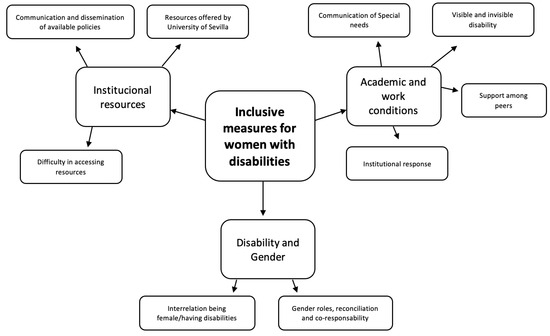
Figure 1.
Category Tree of Inclusive Measures for Women with Disabilities: Institutional Resources, Academic and Work conditions, and Gender Perspective.
Transcribed interviews were analyzed through an inductive method of content analysis using the QSR NUD*IST Vivo20 using a thematic analysis with a gender approach. To this end, a systematic, iterative process was conducted following the phases described by the following [5]: (1) becoming familiar with the data through readings and notes; (2) codification; (3) elaboration of a thematic map; (4) identification of themes or categories; and (5) preparation of the report with the analysis of the selected data. This codified information was analyzed and compared with the scientific evidence currently available, with the aim of establishing conclusions and proposals that would improve the inclusion of people with disabilities at the University of Seville.
The triangulation and result debate with the team managing the care of people with disabilities at the University of Seville granted the study quality and validity. The structural analysis of the different parts of the study, researchers’ reflexivity, and semantic and pragmatic triangulation (providing different perspectives from their fields of specialization, i.e., nursery, physiotherapy, anthropology, and gender studies) of data sources enabled validity. The study’s transferability, confirmability, dependability, and credibility ensured its trustworthiness.
3. Results
The number of participants was determined by reaching data saturation. The total number of participants was 12 women belonging to the University of Seville community, as previously determined, had four students, five administrative staff, and three lecturers. Profiles and characteristics, or variables, are reflected in Table 1.

Table 1.
Participant’s profiles and characteristics.
3.1. Institutional Resources: Resources Offered by the University of Seville
As shown in Table 2, interviewees indicated that the resources offered by the University of Seville regarding their disability are insufficient, even more so when the individual needs any type of complementary resource to adapt their needs to university daily life. The situation derived from the coronavirus pandemic was an enabling factor for inclusion, as some of the interviewees observed how the virtual environment facilitated by the institution for their class follow-up or work performance met their needs much better. Thus, what for other students and workers was a limitation, for them was an advantage.
Table 2.
Category “institutional resources” and its participants´ verbatims.
3.2. Institutional Resources: Communication and Dissemination of Available Policies
Support policies available at the University of Seville are not conveniently disseminated among the community members, as participants commented in Table 2. In fact, interviewees perceive it necessary to conduct a complex search and consultation task in order to become familiar with the resources and initiatives that may be helpful in their daily lives.
As a complementary measure, training sessions and seminars on types of disabilities conducted by people belonging to the institution who could share their experiences with the rest of the university community are also suggested.
3.3. Institutional Resources: Difficulty in Accessing Resources. Complex Bureaucratization of Processes
Bureaucracy is a difficult and excruciating barrier when accessing resources, as timeframes are long and complex. Moreover, there is an added complexity of bureaucracy associated with the use of measures and resources available to students. Obtaining resources is also a limitation identified by both administrative staff and lecturers. The processes and procedures established to authorize measures aimed at women with disabilities inclusion are not clear enough.
3.4. Academic and Work Conditions: Communication of Special Needs
Women perceive, as Table 3 shows, that they must be continuously explaining their situation of disability for every procedure and every university year. There is no efficient communication within the University of Seville allowing all people involved in this process to be informed of the situation and requirements of these women, and therefore their common demand is that the procedure be streamlined. Even so, there are some instances of mistrust regarding capacities and abilities due to the situation of disability.
Table 3.
Category “academic and work conditions” and its participants´ verbatims.
3.5. Academic and Work Conditions: Visible Disability versus Invisible Disability
The feeling that visible and objective disabilities are more believed to be dependable than other types of disabilities is shared by many of the interviewees, as shown in Table 3. Even so, there are some instances of mistrust regarding capacities and abilities due to the situation of disability. However, there seems to be a general sense that women with disabilities need to prove their competences much more than the rest, because sometimes their success is attributed to the measures they benefit from due to their disability. Consequently, they feel the urge to prove their own merits.
3.6. Academic and Work Conditions: Support among Peers
Support among peers is evident and declared among participants, as is shown in Table 3. They consider it an extra value and aid during their university years. No feelings of rejection are perceived on the part of their colleagues due to the resources received, but instead they perceive respect.
3.7. Academic and Work Conditions: Institutional Response
Interviewees declared, as Table 3 collected, that the University of Seville offers standardized procedures for all people with disabilities. However, this generates a complex situation, as every individual has different needs. This is why they demand greater individualization to meet everyone’s requirements.
3.8. Disability and Gender: Interrelation Being Female/Having Disabilities
There is no general perception on the part of participants of the fact that being female places them in a dismissed or displaced position, and even less on the part of the institution, as is shown in Table 4. However, they are aware that this is very different within society, expressing that the discrimination they may suffer is precisely social, framed by the patriarchal society we live in.
Table 4.
Category “Disability and gender” and its participants’ verbatims.
Some participants expressed that disability affects them more than the fact of being a woman. Other participants consider that both limitations, being a woman and having a disability, add up.
3.9. Disability and Gender: Gender Roles, Reconciliation, and Co-Responsibility
A subcategory where care is part of the gender roles powerfully emerges, i.e., being a woman is associated with the role of caregiver above the condition of disability. This is expressed in Table 4 as a limitation in the performance of work or academic duties.
4. Discussion
The strategy for the rights of people with disabilities 2021–2030 is aimed at reducing the barriers that prevent them from participating in a full and effective way in all aspects of society and the economy [6]. The objective is that people with disabilities achieve individual autonomy, equal opportunities, involvement in society, freedom to make their own choices, and not suffer discrimination [1,7,8]. In this context, this study aimed to explore the situations experienced by women members of the University of Seville community during their years at the institution.
Higher university education may be a main form of preventive action against the social exclusion of people with disabilities, with positive results proven in the physical, cognitive, emotional, and social spheres [9]. As some studies have shown, students who complete their university studies see this situation reflected in an improvement in their quality of life [10].
Although in the University of Seville the integral program for people with disabilities [II Plan Integral de atención a las necesidades de apoyo para personas con discapacidad o con necesidad de apoyo por situación de salud sobrevenida] [11] is in force and has the objective of coordinating all the policies and practical guidance regarding disabilities and other health conditions so these people have equal opportunities, enjoy a secure, accessible and healthy work and study place, facilitating their integration in the labor market and society, it is however a fact that greater dissemination of this program is necessary to inform and sensitize, not just the people with any type of disability, but the university community as a whole.
Although most universities implement a positive action admission policy for students with disabilities, there is often no subsequent follow-up to ensure real inclusion, as effective resources to achieve equality within the university are lacking [12,13,14,15]. This has been identified throughout the research work, where participants pointed out precisely how necessary complementary resources were to facilitate their inclusion in the university, that bureaucracy was slowing down the processes, and, as a result, the required measures or resources were not easily achieved. In this sense, several studies highlight that universities make noted efforts to solve architectural problems [16], though other requirements may still need to be addressed.
Numerous sources agree with the experiences of the interviewees regarding the benefits of remote work towards fostering equality, as this practice relies completely on talent. Specifically, it confirms that people with disabilities benefited from this flexibility; people with reduced mobility needed fewer transfers; and blind and deaf people could adapt more easily. Clearly, remote work may help to reduce stress levels and improve well-being. However, it is important to maintain the balance and build social bonds to avoid isolation [17].
The demand of interviewees in favor of creating more sensitization strategies for the staff and personnel working with people with disabilities is aligned with the petitions of other entities, such as Fundación ONCE (2016), which consider it necessary to include within the educational programs offered by the University of Seville, particularly those related to teacher training [12,13,18], contents specialized in diversity and disability. This will allow those future professionals to be more aware of social diversity, which in turn will foster much more positive attitudes and behaviors towards the inclusion of people with disabilities [15,19,20,21].
Interviewees also pointed out the need to foster education in the academic community, as a lack of information on disability may contribute to strengthening the barriers to student inclusion [8]. To this problem area, it could be added the lack of knowledge about possible methodological strategies facilitating curriculum adaptation [6,13,18,22,23]. Moreover, there is not always complete awareness and sensitization on the part of the body of educators on the importance of university inclusive education [18], even though the most significant changes should be fostered by the professors involved in order to guarantee equal education. This lack of information or awareness is aggravated if there is no clear regulation raising awareness in society about the needs of this collective and the lack of institutional support [8]. Moreover, Martins et al. (2018) highlight that while staff attitudes towards the inclusion of students with disabilities are generally positive, there remains a prevalent perception of disabilities as deficits, underscoring the need for comprehensive changes to effectively adopt a social and educational model of disability [24].
This perspective aligns with the findings of Valle-Flórez et al. (2021), who analyzed the perceptions of faculty members regarding the inclusion of university students with disabilities. Their study highlights significant barriers related to accessibility, willingness to accommodate, and interaction dynamics, emphasizing the need for targeted training and policy development to address these issues. Effective inclusion must address multiple dimensions of identity and experiences of inequality to be truly impactful. Understanding women as a diverse group per se and focusing on functional diversity within higher education is essential to developing inclusive policies that recognize and address the complexities of inequality. Thus, it underscores the importance of enhancing visibility and developing agile, individualized policies to foster a truly inclusive educational environment. Notwithstanding, it is crucial to keep in mind that adaptations must be accomplished on a case-by-case basis. No general measures can be applied to cover all the individual requirements, as the particularity of each disability process makes it necessary to conduct an in-depth analysis of each individual’s circumstances [12,25].
Some people declare that they find it more difficult to face discrimination experienced during their educational stages than their own disability, thus affecting their self-esteem and confidence and resulting in an increase in stress [14]. This can translate into students hiding their disability condition in order to avoid a situation of prejudice [26]. The fact that every year and on a daily basis, women’s disabilities have to be made visible and explained sometimes leads to their concealment. Besides, people with non-visible disabilities feel more pressure to justify their circumstances, as participants largely declared.
From the perspective of the essential intersectional analysis, it is common to consider that being female is another constraint to be discriminated against in a situation of disability [3]. However, there is no agreement in this study regarding the following aspect: some women argue that discrimination suffered by women with disabilities is inherent in patriarchal society and the process of socialization, which puts more discriminatory weight on the fact of being female; other participants expressed that disability is a more significant constraint; and the rest considered that it is the sum of the two. Similarly, a lack of consensus or disagreement has been found among the references; double discrimination has been historically asserted [2,3]. Nevertheless, other studies, such as the one conducted in New Zealand, surprisingly found that women with disabilities were not as disadvantaged in terms of employment, socioeconomic status, and domestic circumstances as men with disabilities. A particularly surprising finding was the fact that, in some instances, women with disabilities obtain better basic educational qualifications than both men with disabilities and women without disabilities [27]. This points to the need for thorough research on this double discrimination.
Being women, and despite their disability situation, participants are no exception to the gender imposition associated with care [28]. Disability aggravates the difficulties of reconciling personal, family, work, and academic life spheres. Although the University of Seville does not avoid its obligations as a co-responsible institution [29,30], in line with the social concern on matters of reconciliation and co-responsibility, it is probably necessary to give further consideration and importance to individuals, and particularly women with any situation of disability where difficulties to reconcile increase.
As originally planned, in order to increase validity, a triangulation was conducted on the information and bibliographical sources, interviews, and researchers from different fields, i.e., nursery, physiotherapy, social and cultural anthropology, psychology, and gender studies. The authors were also in contact with and debated with the team responsible for the care of people with disabilities at the University of Seville, a strength in the study that will help launch new adjustments in the strategies aimed at caring for people with disabilities in light of these results.
Limitations
Among the limitations found in this study, it is important to highlight the impossibility of approaching in depth all kinds of disabilities. There are probably other people with specific situations and concerns who require or would have expressed other types of needs. Likewise, given the fact that the sample only included women, it is not possible to establish a comparison between the experiences of men and women, which could have enriched this study. Another limitation that could be identified is that, due to COVID-19 restrictions, some interviews were conducted online while others were face-to-face. This could limit the expression of the interviewees.
5. Conclusions
The study underscores that although direct discrimination based on gender may not be overtly perceived, it operates within a patriarchal framework where such discrimination is embedded. To bridge the gender gap and foster the inclusion of women with disabilities, there is a need for more targeted efforts and policies. Peer support and respect are crucial protective factors for individuals with disabilities, especially women. Challenges that undermine an equitable and wholesome experience for people with special needs include a shortage of resources or barriers to access, a lack of understanding about disability issues, insufficient awareness within the university community, and a one-size-fits-all approach to disability support. Consequently, there is an imperative to enhance the visibility of resources. Therefore, further studies are essential to provide evidence that can lead to more effective interventions and policies.
Author Contributions
Conceptualization, F.L.-L., R.C.-M., C.A.-C. and L.S.M.; methodology, R.C.-M.; validation, F.L.-L., R.C.-M., C.A.-C. and L.S.M.; formal analysis, F.L.-L. and R.C.-M.; data curation, F.L.-L. and R.C.-M. writing—original draft preparation, F.L.-L. and R.C.-M.; review and editing, F.L.-L., R.C.-M., I.C.-G. and M.-L.B.-L.; supervision, R.C.-M.; funding acquisition, F.L.-L. All authors have read and agreed to the published version of the manuscript.
Funding
This research was funded by the Andalusian Government Equality Department, Consejería de Igualdad, Políticas Sociales y Conciliación. Instituto Andaluz de la Mujer. Junta de Andalucía.
Institutional Review Board Statement
The study was conducted in accordance with the Declaration of Helsinki and approved by the Ethics Committee of the University of Seville (protocol code 105-N-22).
Informed Consent Statement
Written informed consents were obtained from all participants involved in this study, in order to publish this paper. This research has passed approval by the ethics committee at the University of Seville (1015-N-22).
Data Availability Statement
The data supporting this study’s findings are available from the corresponding author upon reasonable request.
Acknowledgments
We would also like to express our gratitude to all the participants of the study.
Conflicts of Interest
The authors declare no conflicts of interest.
References
- Wolbring, G.; Lillywhite, A. Equity/Equality, Diversity, and Inclusion (EDI) in Universities: The Case of Disabled People. Societies 2021, 11, 49. [Google Scholar] [CrossRef]
- UN-WOMEN. The Empowerment of Women and Girls with Disabilities Towards Full and Effective Participation and Gender Equality [Internet]. 2018, pp. 1–44. Available online: https://www.unwomen.org/en/digital-library/publications/2018/12/the-empowerment-of-women-and-girls-with-disabilities (accessed on 21 May 2023).
- UNESCO. Incheon Declaration Framework for Action for the Implementation of Sustainable Development Goal 4 Ensure Inclusive and Equitable Quality Education and Promote Lifelong Learning Opportunities for All [Internet]. 2016, pp. 1–83. Available online: https://unesdoc.unesco.org/ark:/48223/pf0000245656_spa (accessed on 21 May 2023).
- Comité Español de Representantes de Personas con Discapacidad (CERMI). 2020. Universidad y Discapacidad. La Inclusión de las Personas con Discapacidad en la Universidad Española. Available online: https://www.cermi.es/es/colecciones/universidad-y-discapacidad-la-inclusión-de-las-personas-con-discapacidad-en-la (accessed on 8 March 2022).
- Braun, V.; Clarke, V. Using thematic analysis in psychology. Qual. Res. Psychol. 2006, 3, 77–101. [Google Scholar] [CrossRef]
- Mejía-Cajamarca, P.E.; Pallisera Díaz, M. Las Personas con Discapacidad Intelectual y la Inclusión en la Universidad: Una Investigación Centrada en las Opiniones de Responsables Académicos y Personas con Discapacidad Intelectual. Rev. Nac. E Int. Educ. Inclusiva 2020, 13, 40–61. [Google Scholar]
- European Commision. Committee and the Committee of the Regions Union of Equality: Strategy for the Rights of Persons with Disabilities 2021–2030. 2021, pp. 1–30. Available online: https://ec.europa.eu/social/main.jsp?catId=1484&langId=en (accessed on 8 March 2022).
- Mosia, P.A.; Phasha, N. Access to curriculum for students with disabilities at higher education institutions: How does the National University of Lesotho fare? Afr. J. Disabil. 2017, 6, 257. [Google Scholar] [CrossRef] [PubMed]
- Ocampo, J.C. Disability, Inclusiveness and Higher Education in Ecuador: The Case of Universidad Católica de Santiago de Guayaquil. Rev. Latinoam. Educ. Inclusiva 2018, 12, 97–114. [Google Scholar] [CrossRef][Green Version]
- Castaño Morcillo MPHS Alba María. La formación universitaria como garantía del derecho a una calidad de vida óptima de jóvenes con discapacidad intelectual. Derecho Discapac. 2020, 5, 259–275. [Google Scholar]
- Universidad de Sevilla. II Plan Integral de Atención a las Necesidades de Apoyo para las Personas con Discapacidad o con Necesidad de Apoyo por Situación de Salud Sobrevenida (acuerdo 9.1/CG 23-6-17). 2017. Available online: https://www.us.es/bous-numeros/numero-4-24-de-julio-de-2017/acuerdo-91cg-23-6-17-por-el-que-se-aprueba-el-ii-plan (accessed on 21 May 2023).
- Gonzalez, H.C.; Hsiao, E.-L. Disability Inclusion in Nursing Education. Teach. Learn. Nurs. 2019, 15, 53–56. [Google Scholar] [CrossRef]
- Lorenzo-Lledó, G.; Carreres, A.L.; Lledó, A.L.; Vera, G.A. La acción tutorial como acompañamiento en el alumnado universitario con discapacidad: Hacia una educación inclusiva. Int. J. Dev. Educ. Psychol. 2017, 4, 137. [Google Scholar] [CrossRef]
- Marks, B.; McCulloh, K. Success for Students and Nurses with Disabilities: A Call to Action for Nurse Educators. Nurse Educ. 2016, 41, 9–12. [Google Scholar] [CrossRef] [PubMed]
- Munsuri Rosado, J.; Sacramento, P.H. Actitudes de los estudiantes de enfermería hacia las personas con discapacidad. Análisis y propuestas. Index Enferm. Inf. Bibliogr. Investig. Humanidades 2016, 25, 114–118. [Google Scholar]
- González Alonso, M.Y.; Martínez Martín, M.Á.; Juan Barriuso, M.N. Atención a Estudiantes con Discapacidad en la Universidad. En: Investigación en Docencia Universitaria: Diseñando el Futuro a Partir de la Innovación Educativa. 2017, pp. 795–803. Available online: https://dialnet.unirioja.es/servlet/extart?codigo=6180963 (accessed on 19 May 2023).
- ECOAULA. El talento Femenino, los Empleados en Zonas Rurales y las Personas con Discapacidad, los Colectivos más Benefi-ciados por el Teletrabajo. Eleconomista.es. Available online: https://www.eleconomista.es/ecoaula/noticias/11951908/09/22/El-talento-femenino-los-empleados-en-zonas-rurales-y-las-personas-con-discapacidad-los-colectivos-mas-beneficiados-por-el-teletrabajo.html (accessed on 19 May 2023).
- Lorenzo, G.; Lledó Carreres, A. Dificultades Percibidas por los Docentes Universitarios en la Atención del Alumnado con dis-Capacidad. En: Investigación en Docencia Universitaria: Diseñando el Futuro a Partir de la Innovación Educativa. 2017, pp. 804–813. Available online: https://dialnet.unirioja.es/servlet/articulo?codigo=6180999 (accessed on 5 February 2023).
- Valenzuela-Zambrano, B. La Inclusión de Estudiantes con Discapacidad en Educación Superior Chilena, Factores favo-Recedores y Obstaculizadores para su acceso y Permanencia [Internet]; University of Granada: Granada, Spain, 2017; Available online: http://hdl.handle.net/10481/44844 (accessed on 20 May 2023).
- Aparicio Payá, M. Accesibilidad universal: Sentido normativo e implicaciones en la educación y la práctica pro-fesional. Rev. Esp. Discapac. REDIS 2017, 5, 25–41. [Google Scholar] [CrossRef]
- Valenzuela-Zambrano, B.; López-Justicia, M.D. Autoconcepto de Estudiantes Universitarios Chilenos con Discapacidad. Diferencias en Función del Género. Rev. Nac. E Int. Educ. Inclusiva 2015, 8, 153–170. [Google Scholar]
- Serrano, E.L.; Gutiérrez, V.F.; de la Fuente Robles, Y.M. Enfoques y Políticas Dirigidas a la inserción Socio-Educativa de las Personas con Discapacidad. Análisis Comparado Entre Bolivia y España. En: Actas del VII Congreso de la Red Española de Política Social (REPS): ‘Políticas Sociales ante Horizontes de Incertidumbre y Desigualdad’. Zaragoza. 2018, pp. 848–861. Available online: https://dialnet.unirioja.es/servlet/articulo?codigo=6833602 (accessed on 5 May 2023).
- Rodríguez Molina, G.A.; Valenzuela Zambrano, B. Acceso y permanencia de estudiantes con discapacidad en las universidades chilenas. Sinéctica Rev. Electrónica Educ. 2019, 1–16. [Google Scholar] [CrossRef]
- Martins, M.H.; Borges, M.L.; Gonçalves, T. Attitudes towards inclusion in higher education in a Portuguese university. Int. J. Incl. Educ. 2018, 22, 527–542. [Google Scholar] [CrossRef]
- Valle-Flórez, R.-E.; Fuertes, A.M.d.C.; Baelo, R.; García-Martín, S. Faculty of Education Professors’ Perception about the Inclusion of University Students with Disabilities. Int. J. Environ. Res. Public Health 2021, 18, 11667. [Google Scholar] [CrossRef] [PubMed]
- Neal-Boylan, L.; Smith, D. Nursing Students With Physical Disabilities: Dis-pelling Myths and Correcting Misconceptions. Nurse Educ. 2016, 41, 13–18. [Google Scholar] [CrossRef] [PubMed]
- Beatson, P.; Perry, P. Disability and Gender: Querying the «Double Handicap» Assumption. N. Z. Sociol. 2002, 17, 300–321. [Google Scholar] [CrossRef][Green Version]
- Rudman, L.A.; Glick, P.; Phelan, J.E. From the laboratory to the bench: Gender stereotyping research in the courtroom. In Beyond Common Sense: Psychological Science in the Courtroom; Wiley: Hoboken, NJ, USA, 2008; pp. 83–102. [Google Scholar] [CrossRef]
- University of Seville. Guía de Programas y Medidas de Conciliación y Corresponsabilidad de la Universidad de Sevilla. 2018, pp. 1–28. Available online: https://igualdad.us.es/wpblog/wp-content/uploads/2019/04/Guia-de-Programas-y-Medidas-Conciliacion-Corresponsabilidad-US_v20181213.pdf (accessed on 20 May 2023).
- Universidad de Sevilla. III Plan de Igualdad (Acuerdo 6.1/CG 20-126-21). 2021, pp. 1–24. Available online: https://igualdad.us.es/?page_id=817 (accessed on 20 May 2023).
Disclaimer/Publisher’s Note: The statements, opinions and data contained in all publications are solely those of the individual author(s) and contributor(s) and not of MDPI and/or the editor(s). MDPI and/or the editor(s) disclaim responsibility for any injury to people or property resulting from any ideas, methods, instructions or products referred to in the content. |
© 2024 by the authors. Licensee MDPI, Basel, Switzerland. This article is an open access article distributed under the terms and conditions of the Creative Commons Attribution (CC BY) license (https://creativecommons.org/licenses/by/4.0/).