


Abstract
Constructed wetlands (CWs), increasingly adopted as nature-based solutions (NBS) for wastewater treatment, require a rigorous assessment of the durability and structural performance of the materials used in their supporting systems. In contrast to the extensive literature addressing hydraulic efficiency and contaminant removal, the structural behavior of CWs has been scarcely examined, with existing studies offering only general references to reinforced concrete and masonry and lacking explicit design criteria or deterioration analyses. This study integrates evidence from real-world CW installations with a systematic review of 31 studies on the degradation of cementitious materials in analogous environmental conditions, following PRISMA 2020 guidelines, with inclusion criteria based on quantified wastewater-related exposure conditions (e.g., chemical aggressiveness, persistent saturation, and biogenic activity). Results indicate that reinforced concrete, despite its structural capacity, is susceptible to biogenic corrosion, accelerated carbonation, and sulfate–chloride attack under conditions of persistent moisture, with reported degradation rates in analogous wastewater infrastructures on the order of millimeters per year for concrete loss and tens of micrometers per year for reinforcement corrosion. Masonry structures, similarly, exhibit performance constraints when exposed to mechanical overloads and repeated wetting–drying cycles. In contrast, emerging alternatives—such as nanomodified matrices and concretes incorporating supplementary cementitious additives—demonstrate potential to enhance durability while contributing to a reduced carbon footprint, without compromising mechanical strength. These findings reinforce the need for explicit structural design criteria tailored to CW applications to improve sustainability, durability, and long-term performance.
1. Introduction
CWs have gained increasing prominence as NBS for wastewater treatment, offering a sustainable alternative to conventional technologies [1]. Beyond their well-established capacity for pollutant removal, these systems require structural components capable of withstanding hydraulic loads, substrate and vegetation weight, and the circulation of operation and maintenance personnel [2]. In tropical and rural settings, however, high humidity, saturation cycles, aggressive chemical compounds, and corrosion or carbonation processes can accelerate the deterioration of structural materials [3]. Despite these challenges, no specific design guidelines or regulatory frameworks exist for the structural elements of CWs, which limits their large-scale technical standardization and creates uncertainty regarding service life and safety.
Research on CWs has focused primarily on their hydraulic and biological performance, including flow configuration [4,5,6], macrophyte selection [7,8,9], and pollutant removal efficiency [10,11,12]. Although concrete can achieve service lives exceeding 30 years in humid environments [13,14] and masonry remains an attractive low-cost alternative for rural communities, existing CW literature has focused predominantly on hydraulic performance and pollutant removal efficiency, rather than on structural behavior. As a result, neither material has been systematically evaluated in terms of its structural performance, load-bearing capacity, or durability-driven design criteria within CWs. The literature rarely reports fundamental parameters such as design strength, reinforcement detailing, wall thickness, foundation criteria, or deterioration mechanisms under the combined hydraulic, biological, and environmental loads characteristic of these systems. This contrasts with other hydraulic infrastructures—such as sewer networks, reservoirs, and pipelines—where the degradation of concrete and masonry in aggressive environments has been widely studied, although with limited translation to the context of CWs.
In response to this gap, the present study introduces a structural and materials-focused perspective specifically applied to CWs. The objectives are to: (i) systematize available records of CWs constructed with reinforced concrete or masonry, highlighting both documented information and common omissions related to geometry, configuration, and material specifications; (ii) compile and analyze indirect evidence on the behavior of cementitious materials in CW-analogous environments through a systematic review conducted under PRISMA 2020 guidelines, with emphasis on chemical, physicochemical, and biogenic deterioration; and (iii) discuss protective strategies, material selection criteria, and emerging alternatives capable of enhancing durability and contributing to a reduced carbon footprint without compromising structural performance. The principal contribution of this work is the development of an integrated conceptual framework that bridges structural engineering, materials science, and environmental engineering, providing guidance for future experimental research, numerical validation, and the formulation of technical criteria applicable to the design and construction of CWs across diverse socio-environmental contexts.
2. Current State of Structural Knowledge in Constructed Wetlands
The structural design of CWs has received considerably less attention in the scientific literature compared with the vast body of work addressing hydraulics, pollutant removal, or vegetation performance. Most academic studies examine CWs primarily as treatment systems, focusing on flow behavior, removal efficiencies, or plant–substrate interactions. Consequently, the materials that form their supporting structures are rarely described in detail. As a result, technical knowledge regarding the mechanical performance, degradation mechanisms, and long-term durability of structural components in CWs remains limited, fragmented, and often anecdotal.
To clarify the current state of knowledge, a systematic search was conducted in Scopus, Web of Science, ScienceDirect, and Google Scholar. The search employed keywords and Boolean combinations such as “structural concrete,” “concrete,” “constructed wetlands,” “masonry,” “brick,” “partition,” and “structural system,” linked through AND/OR operators. Searches in Scopus, ScienceDirect, and Web of Science revealed studies that examined the use of concrete and masonry derived from construction and demolition waste, but only as substrate materials. Publications that addressed these materials as structural systems—considering aspects such as load-bearing capacity, reinforcement configuration, wall thickness, foundation criteria, or durability—were virtually absent.
Google Scholar provided a small number of manuscripts that briefly mentioned structural systems used in CW construction. However, even in these cases, the descriptions lacked engineering detail and did not document design considerations, degradation mechanisms, or long-term structural behavior under the combined hydraulic, biological, and environmental loads typical of CWs. This gap underscores the need for systematic engineering research to support the development of reliable structural criteria for CW implementation.
2.1. Reports on the Use of Reinforced Concrete
Reinforced concrete is the most commonly used structural material for CWs due to its high compressive strength, durability, and broad commercial availability—characteristics that allow its adaptation to vertical-flow, horizontal-flow, and surface-flow configurations [15,16]. As summarized in Table 1, its use is predominant in large-scale facilities and pilot systems designed to withstand substantial hydraulic pressures and long-term operational conditions, as documented by Anand et al. [17], He et al. [18], and Bedessem et al. [19].

Table 1.
Records of wetlands built with a structural system made of concrete or masonry.
However, the environmental conditions characteristic of CWs—permanent moisture, the presence of organic matter, and exposure to chemically aggressive compounds—pose significant durability challenges for reinforced concrete structures. The literature consistently reports deterioration processes such as steel reinforcement corrosion, microcracking, and accelerated carbonation, all of which may compromise structural integrity in the absence of waterproofing systems or protective admixtures [26,27]. Despite this, none of the studies summarized in Table 1 provide quantitative assessments of these deterioration mechanisms under real operating conditions.
Consequently, although reinforced concrete is the best-documented structural alternative for CWs (Figure 1), its specific mechanical and durability performance under hydrobio logical environments has not yet been systematically evaluated. This gap limits the development of evidence-based design criteria that ensure long-term structural safety and sustainability.
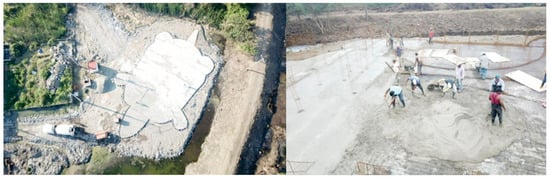
Figure 1.
Representative examples of reinforced concrete foundation slabs used in full-scale constructed wetlands during construction.
2.2. Reports on the Use of Masonry
Masonry is frequently used in CWs due to its low cost, local availability, and ease of construction—attributes that make it a practical option for rural and community-based projects [28,29]. As shown in Table 1, brick and concrete block systems are commonly implemented in small- to medium-scale CWs and, in some cases, combined with reinforced concrete elements, as reported in the hybrid configurations described by Deng et al. [25], Lomelí et al. [20], and Monzón-Reyes et al. [21].
Despite its widespread application (Figure 2), the structural information available in the literature is scarce. Most studies do not specify key parameters such as wall compressive strength, mortar type, degree of confinement, or the waterproofing systems employed. Existing reports suggest that masonry performs adequately in structures less than approximately 1.5 m in height and under moderate hydraulic pressures; however, it is more vulnerable to concentrated loads, bending stresses, and differential settlements—particularly when foundations are insufficiently designed. Its inherent porosity and the frequent absence of surface sealing increase the risk of mortar degradation and leakage under conditions of continuous saturation.
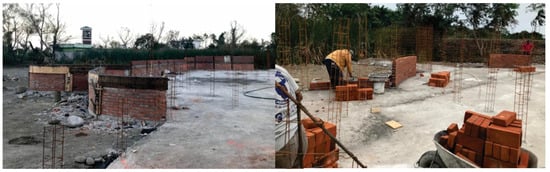
Figure 2.
Representative examples of hybrid masonry–reinforced concrete systems used in constructed wetlands during construction stages.
None of the reviewed studies provides a systematic evaluation of masonry deterioration under wetting–drying cycles or its stability during long-term exposure to wastewater. This gap highlights the need for targeted research on the mechanical behavior and durability of masonry in CW environments, particularly in settings where it continues to be a preferred construction alternative.
2.3. Limitations of the Available Literature
The literature review indicates significant gaps in the structural understanding of CWs. Although CWs share certain functional characteristics with other hydraulic infrastructures, their mechanical behavior is considerably more complex due to the combined action of static, hydraulic, biological, and time-dependent loads, all of which evolve as vegetation grows and the system matures. This inherent complexity is not adequately reflected in the existing scientific evidence.
As shown in Table 1, there is an almost complete absence of studies that examine the structural performance of CWs from an engineering standpoint. Most publications simply describe the construction materials used—typically reinforced concrete or masonry—without evaluating their mechanical behavior under operational conditions, such as lateral hydraulic pressures, saturated media loads, vegetation-induced forces, or concentrated loads associated with routine maintenance activities [18,25]. The literature also seldom reports internal stresses, deformations, differential settlements, or long-term degradation mechanisms.
A major limitation is the lack of analytical, numerical, or experimental models that characterize the response of walls, slabs, and foundations under the combined effects of saturated granular media, wastewater flow, vegetation growth, and environmental exposure. For example, hydraulic loads generated by saturated substrates—commonly composed of gravel, sand, or lightweight aggregates such as pumice—can induce significant lateral pressures and permanent loads, especially in horizontal subsurface-flow systems [30,31,32]. Although these loads have been studied in other hydraulic structures, the methodologies have not been formally transferred to CW design, resulting in a clear methodological gap.
In reinforced concrete systems, such loads may produce excessive bending, buckling, or deformation when reinforcement detailing or wall-to-foundation continuity is insufficient [33,34]. Masonry structures are even more vulnerable to lateral pressures that can cause cracking along mortar joints, differential settlements, or loss of confinement [35,36]. Despite these well-documented mechanisms, the magnitude, spatial distribution, and temporal evolution of hydraulic loads in full-scale CWs remain unquantified, preventing the definition of reliable safety factors or optimized structural cross-sections.
Similarly, loads associated with vegetation and maintenance activities have received minimal attention. Macrophyte species commonly used in CWs—such as Canna indica, Cyperus papyrus, or Colocasia esculenta—often exceed 2 m in height [37] and develop dense root systems capable of exerting tensile forces on the substrate [38]. Under strong winds, high saturation, or excessive biomass accumulation, vegetation-related forces may increase stresses on unrestrained edges, walkways, and thin slabs. In addition, maintenance personnel generate concentrated loads that can exceed 150 kg/m2 on access platforms and pedestrian paths (Figure 3); however, these loads are rarely considered in existing CW design practices. These omissions raise concerns about the structural adequacy of walkways, inspection platforms, and thin concrete elements frequently used in operational systems.
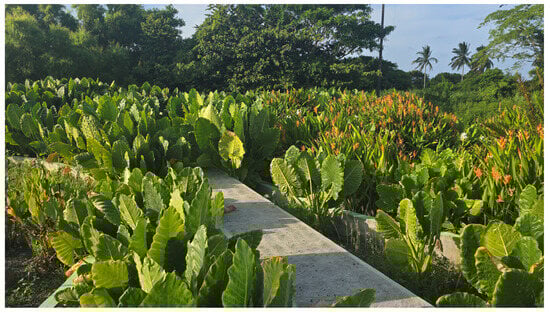
Figure 3.
Maintenance walkway integrated into a full-scale constructed wetland (La Tortuga, Nautla, Veracruz, Mexico).
Environmental exposure is an additional source of concern. CWs operate in conditions of persistent humidity, partial or total saturation, and prolonged contact with chemically aggressive compounds present in wastewater [39,40,41]. In reinforced concrete, these environments promote carbonation, leaching, steel corrosion, and loss of watertightness [42,43]. Masonry systems face risks associated with efflorescence, moisture absorption, mortar deterioration, and loss of bond between units, especially in the absence of adequate waterproofing [44,45]. Despite the clear relevance of these degradation mechanisms, the literature does not offer a systematic quantification of deterioration rates, reduction in useful life, or structural implications under real operating conditions.
Taken together, these limitations highlight a widespread lack of structural analysis in the investigation of concrete water systems (CWs). Hydraulic forces generated by saturated media, biological loads imposed by macrophyte growth, concentrated loads associated with maintenance activities, and harsh environmental conditions that accelerate material degradation remain largely undocumented, both individually and in their combined effects. This lack of quantitative evidence hinders the development of predictive models, reliable reinforcement strategies, and durability-oriented design criteria.
Therefore, there is an urgent need to generate coordinated, interdisciplinary research lines that formally integrate civil engineering, materials science, and environmental engineering. Such an agenda should include the experimental characterization of actual degradation mechanisms in CW environments; the development of structural models that capture coupled hydromechanical behavior; the optimization of wall, slab, and foundation systems exposed to saturated, anoxic, or chemically aggressive conditions; and the evaluation of sustainable building materials capable of maintaining their structural performance in these demanding environments.
Adapting well-established tank structures, anaerobic digesters, and hydraulic containment structures can serve as a solid starting point for developing a comprehensive structural understanding of CWs—an understanding that is entirely absent from the current scientific literature.
3. Indirect Evidence of the Behavior of Concrete in Environments Similar to Built Wetlands
Although CWs are hydraulic systems with unique dynamics of transport, biogeochemistry, and contaminant retention, their interaction with cementitious materials exhibits chemical, physical, and microbiological similarities to other environments where concrete has been extensively studied. Wastewater conditions (both real and simulated), prolonged anaerobic exposure, microbially induced sulfuric acid generation, and the presence of aggressive ions, such as sulfates, chlorides, ammonium, and nitrogenous compounds, provide analogous scenarios useful for understanding the behavior of concrete in CWs.
To gather this evidence, a systematic search was conducted in major scientific databases, primarily Scopus and Web of Science, following the PRISMA 2020 guidelines for systematic reviews. The search strategy was structured using Boolean combinations of keywords and operators: (concrete OR masonry) AND (“wastewater” OR “sewage” OR “anaerobic conditions”) AND (deterioration OR corrosion OR degradation).
The initial database search yielded 78 records across Scopus and Web of Science. For the purposes of this review, studies were included if they met at least one of the following exposure-relevance conditions: (i) continuous or intermittent contact with wastewater, sewage effluents, or wastewater-derived media (including sewer liquids, vapors, brines, or process waters); (ii) documented chemically aggressive conditions, such as pH values below 6.5 or above 9.0, or exposure to acidic/alkaline solutions representative of wastewater-related deterioration; (iii) documented presence or explicit consideration of aggressive species and by-products commonly associated with wastewater environments, such as sulfates, chlorides, ammonium, sulfides/H2S, dissolved CO2, sulfuric acid generated by microbial activity, or organic acids; (iv) prolonged saturated or near-saturated exposure conditions (field or laboratory) lasting several months, including long-term monitoring campaigns; and/or (v) technical/industrial or field-assessment studies reporting deterioration mechanisms, failure modes, protection system performance, or maintenance-related factors in wastewater infrastructures (e.g., sewers, tanks, pumping stations, tunnels, or pipes) that are structurally and environmentally analogous to CW supporting systems.
Studies focused exclusively on dry environments, potable water systems without aggressive exposure, or short-term laboratory tests without chemically or microbiologically aggressive conditions were excluded.
This approach enabled the identification of literature addressing the degradation of concrete and masonry in contexts dominated by wastewater, microbial corrosion, prolonged exposure to sulfides and sulfates, and persistent anaerobic conditions—scenarios that analogously reflect the hydrochemical functioning of CWs.
In this context, “environments similar to constructed wetlands” are defined as those characterized by persistent moisture or saturation, limited oxygen availability (anaerobic or sub-oxic conditions), and the presence of chemically aggressive compounds commonly reported in CWs, such as sulfates, chlorides, dissolved CO2, ammonium, and organic matter. While hydraulic residence times and biological dynamics may differ, the chemical and physicochemical exposure conditions governing concrete and masonry deterioration are considered comparable and transferable as a first-order approximation.
The process of identification, screening, eligibility assessment, and final inclusion of studies was structured according to the PRISMA 2020 flowchart, shown in Figure 4, generated using the PRISMA2020 R package and the Shiny application developed by Haddaway et al. [46]. In general, exclusion criteria included the removal of duplicates, studies lacking a direct focus on the behavior of concrete or masonry in contaminated environments, works focused exclusively on theoretical modeling without material validation, and articles whose results were too nonspecific or inconclusive regarding deterioration mechanisms.
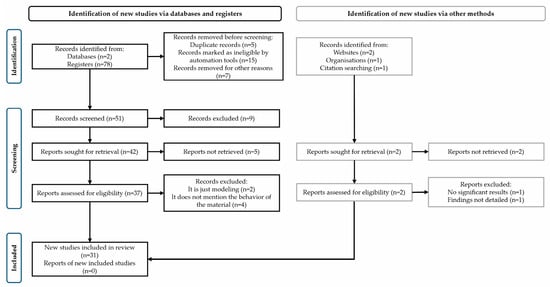
Figure 4.
PRISMA 2020 Flow Chart: Selection process of publications related to the behavior of concrete and masonry in contaminated or aggressive environments.
After this process of purification and critical evaluation, a total of 31 studies were ultimately included. These works empirically and analytically document the behavior of cementitious materials under exposure conditions highly comparable to those that characterize constructed wetlands, particularly in terms of chemical aggressiveness, microbial activity, and persistent moisture.
After this process of purification and critical evaluation, a total of 31 studies were ultimately included. These works empirically and analytically document the behavior of cementitious materials under conditions highly comparable to those that characterize constructed wetlands, particularly in terms of chemical, microbiological, and physicochemical aggressiveness.
Table 2 synthesizes the key information from these studies and provides a robust foundation for the analysis developed in the following sections, which focus on the interaction between complex wastewater environments and the structural and microstructural response of concrete and masonry.
Table 2.
Studies on the deterioration of concrete or masonry in environments similar to built wetlands.
3.1. Chemical and Physicochemical Attack on Aggressive Wastewater
The collected studies indicate that even simple contact between concrete and wastewater can significantly modify its properties in both fresh and hardened states. Partial substitution of mixing water with distiller’s vinasse increases compressive strength by up to 20% at a 15% replacement level; however, workability and strength decrease when this threshold is exceeded, underscoring the sensitivity of the cementitious matrix to highly acidic effluents rich in sulfates and organic matter [47]. Comparable findings are reported when drinking water is replaced with treated or brackish wastewater: mixtures containing 10% brine show initial strength gains and no early evidence of reinforcement corrosion, although the exposure period evaluated is short relative to the expected service life of a hydraulic structure [50]. In mixtures prepared with treated wastewater with elevated chloride content, overall mechanical strength is only moderately reduced (<10%), but steel corrosion increases by approximately 25%, accompanied by early cracking associated with ion ingress [55].
The impact of highly aggressive environments becomes more pronounced when concrete is exposed to acidic solutions or media containing multiple salts. Immersion in 5% sulfuric acid produces significant mass loss and rapid surface deterioration, effects that can be partially mitigated with vinyl ester coatings reinforced with nanocomposites or colloidal silica [53]. In marine or mixed environments (seawater, domestic wastewater, and sulfate-/acid-rich solutions), conventional concretes exhibit strength losses of up to 25% after 56 days, whereas nanomodified matrices containing superplasticizers and targeted additives limit this reduction to around 15% by refining pore structures and inhibiting expansive ettringite formation [58]. Similar improvements have been documented in nano-TiO2-modified coral concretes, where an optimal dosage of 4% enhances compressive and flexural strength and reduces erosion under wastewater exposure, although certain acidic and saline media (e.g., oxalic acid, MgCl2) still generate expansive byproducts and substantial mass loss [56].
More severe scenarios, representative of industrial effluents reaching pretreatment stages of constructed wetlands, have also been investigated. In industrial reaction tanks, prolonged immersion in acidic and alkaline wastewaters containing high concentrations of Cl− and SO42− leads to intense leaching, reduced permeability, and coating detachment. The application of GO/SiO2 protective films significantly enhances chemical stability and reduces ion transport, with performance improving as graphene oxide content increases [73]. Cement pastes exposed to NH4Cl solutions—analogous to coking wastewater—show accelerated dissolution of calcium-bearing phases and formation of gypsum, secondary calcite, ettringite, and thaumasite. The corrosion front advances progressively, causing surface disintegration, and a deterioration evolution model has even been proposed to describe this process [63].
The importance of wastewater composition is further confirmed in studies where domestic, municipal, or industrial effluents are used as mixing water. A bibliometric and systematic synthesis of 91 studies reports that 45–80% of the publications document equal or higher strengths when wastewater is used; however, higher concentrations of total dissolved solids (TDS), chlorides, and sulfates generally increase porosity, water absorption, and chloride diffusion, while reducing C–S–H formation and promoting additional microcracking [75]. More specific evaluations show that using secondarily treated water combined with fly ash and sodium nitrite results in strength reductions of less than 5%, although workability decreases by approximately 25%, changes primarily attributable to the mineral additives and inhibitor rather than the water itself [76]. In mortars reinforced with recycled steel fibers, aggressive ions in treated wastewater (phosphates, nitrates, nitrites, sulfates, chlorides) modify both the bond strength and corrosion rate of the fibers, with responses varying depending on the specific combination of water and fiber type [62].
Evidence obtained from real infrastructures complements these experimental findings. In drinking and wastewater distribution networks, as well as in urban systems lacking adequate treatment, surface degradation of concrete has been reported due to the combined effects of corrosive gases (H2S, CO2, NH3), persistent humidity, and uncontrolled industrial discharges—conditions exacerbated by poor ventilation [48,69]. In tunnels lined with shotcrete, sulfate-rich environments and entrapped air voids promote localized ettringite formation at depths of up to 8 mm, particularly at interfaces between shotcrete layers [70]. Pressurized concrete pipes for drinking and wastewater systems generally maintain good intrinsic strength when alkalinity and mortar coatings are preserved; however, in environments containing elevated sulfates, chlorides, CO2, and H2S, additional protective measures—such as polymeric linings, internal coatings, inhibitors, or cathodic protection—are recommended [70].
Together, these results provide a solid framework for predicting the behavior of concrete in CWs that receive industrial, brackish, or domestic effluents with high concentrations of salts, sulfates, nutrients, and organic matter. They further emphasize the need for thorough characterization of influent water chemistry before defining mixture proportions or selecting protection systems.
3.2. Biogenic Corrosion, Aggressive Gases, and Combined Deterioration Mechanisms
In addition to purely chemical deterioration, the literature highlights the significant role of microbiologically induced corrosion and corrosive gases such as H2S in sewer infrastructure. Numerous peer-reviewed and experimental studies concur that the microbial oxidation of H2S to H2SO4 on concrete surfaces is among the most aggressive deterioration mechanisms in wastewater systems, substantially shortening service life when protective coatings or optimized mixes are not used [52]. Field investigations at pumping stations and grit chambers further show that wastewater vapors often cause damage more rapidly than direct liquid contact, with abundant gypsum and ettringite deposits observed on surfaces exposed to humid, gas-rich atmospheres [51].
The influence of H2S on the degradation of manholes and expansion chambers has been well documented through continuous gas monitoring and structural inspections. In some systems, concrete losses of several centimeters have been reported within five years, progressing to near-failure conditions after only 11 years. Damage intensity is associated not with instantaneous gas peaks but with cumulative exposure, which in certain cases surpasses the measurable range of sensors (>500 ppm) due to extended hydraulic retention times [68]. In treatment plant inlet chambers, where sulfide loads may accumulate to several kilograms per day, artificial neural network models (RNA-LSTM) have successfully predicted H2S concentrations with moderate error, enabling the development of early-warning tools for corrosion management [61].
The mechanisms of biogenic attack have also been explored across different cementitious systems. Sequential tests that simulate abiotic neutralization, neutral exposure, and subsequent acidophilic bacterial activity indicate that alkali-activated mortars experience lower mass loss and strength reduction than ordinary Portland cement (OPC) and calcium aluminate cement (CAC), although they present deeper neutralization fronts. The estimated service life of alkali-activated mortars is approximately 2.5 times greater than that of Portland cement mortars under biogenic attack [65]. Field studies in wastewater treatment plants further confirm that concretes formulated with calcium sulfoaluminate binders exhibit minimal biodeterioration after several months of operation, in contrast with Portland cement systems whose degradation correlates with biofilm formation dominated by acidogenic and sulfate-reducing bacteria [66].
Microbiologically induced corrosion (MIC) has also been analyzed through numerical modeling. A one-dimensional diffusion–reaction model with two moving boundaries has been used to describe the development of sulfur-oxidizing bacterial biofilms and the progression of the gypsum layer generated by the resultant sulfuric acid. The model identifies CaCO3 concentration, acid diffusion, biofilm dynamics, and H2S levels as key drivers of deterioration, and suggests that, under certain conditions, the biofilm may partially restrict acid penetration [64]. A related comparative study reported thickness losses of approximately 7.8 mm in 525 days due to MIC, whereas mineral sulfuric acid produced 4.46 mm of loss in only 90 days, and immersion in wastewater without significant acid generation resulted in negligible deterioration [77].
From a structural perspective, the interaction between mechanical loading and biogenic corrosion is highly relevant for constructed wetlands. Experimental work on concrete pipes exposed simultaneously to H2S and compressive or flexural loads shows that strength loss exceeds that caused by corrosion alone by more than 10%, with synergistic effects increasing with exposure time, load magnitude, and H2S concentration; doubling the mechanical load can increase the coupling effect by up to 1.6 times [72]. Long-term exposure tests (36 months) on steel fiber-reinforced concrete under simulated sewer conditions indicate that, despite moderate reductions in compressive strength, toughness, and flexural capacity improve, suggesting that fiber reinforcement may offer enhanced resistance to extended acid attack [54].
Biocorrosion is also influenced by microbial processes that, paradoxically, can contribute to material protection. Experiments on calcium carbonate bioprecipitation using denitrifying bacteria demonstrate that CaCO3 layers can form on Q235 carbon steel even under high-salinity and variable-pH environments, significantly reducing corrosion currents [57]. Additionally, copper electrodeposition onto cement pastes produces compact, hard, antibacterial coatings that mitigate susceptibility to microbiologically induced corrosion, provided that bath pH and CuSO4 concentrations are adequately controlled [60].
4. Protection Strategies, Material Selection, and Criteria for CWs and Future Prospects for New Materials
The evidence gathered indicates that, in environments analogous to CWs, the durability of structures depends not only on the intrinsic characteristics of the concrete but also on the proper selection of coatings (including mortars applied to both concrete and masonry), construction quality, and operational management. Analyses of sewerage and drinking water systems show that a considerable share of premature infrastructure deterioration is linked to inadequate material selection, aging without maintenance, and unfavorable operating conditions, which ultimately result in significant cost overruns and reduced structural performance [48]. In systems protected with polymeric liners, failures are frequently associated not with the underlying concrete but with poor installation practices; therefore, comprehensive design and construction protocols can extend service life to nearly 100 years under wastewater exposure [49].
Several studies highlight the potential of organic, polymeric, and nanostructured coatings to mitigate the ingress of aggressive agents. Under severe acid attack, vinyl-ester barriers reinforced with nanocomposites outperform silane-based coatings by approximately 60% in terms of durability [53]. In Portland cement concretes exposed to real and simulated wastewater containing sulfates, chlorides, phosphates, H2S, and ammonium, the addition of 2–6% epoxy resin (by cement weight) reduces compressive strength loss, lowers water absorption, and improves resistance to chemical attack when compared with unmodified mixtures [59]. In industrial tanks storing highly aggressive process water, GO/SiO2 coatings have demonstrated promising performance by minimizing ionic leaching and preserving the integrity of both the concrete matrix and the embedded reinforcing steel [73].
The use of alternative binders and mineral additions constitutes another robust mitigation strategy. Calcium sulfoaluminate cements and alkali-activated mortars have exhibited markedly superior resistance to biodeterioration in wastewater treatment facilities and sewer networks compared with conventional Portland cement systems [65,66]. The incorporation of fly ash as a supplementary cementitious material reduces mass loss and neutralization depth under biogenic sulfuric acid attack by lowering portlandite availability and stabilizing phases such as hemicarbonate and hydrotalcite. Commercial crystallizing additives also appear more effective under real biological conditions than under idealized chemical scenarios [74]. Additionally, cementitious nanotechnology—based on PCE additives, resins, and gluconates—contributes to pore refinement, reduced water absorption, and limited ettringite formation, thereby enhancing durability in matrices exposed to sulfate- and chloride-rich environments [58]. The use of nano-TiO2 has also been shown to densify the matrix of coral concrete subjected to wastewater exposure [56].
Regarding the direct use of wastewater in concrete production, available evidence suggests that partial substitution of potable water with industrial, municipal, or secondarily treated effluents is feasible when the chemical composition is properly controlled and when suitable additives or corrosion inhibitors are incorporated. Studies involving wash water, brackish water, and secondary effluents report both improvements and moderate reductions in strength, while highlighting the need to evaluate workability, porosity, and risks associated with chloride and sulfate content [47,50,75,76]. In mortars incorporating recycled steel fibers, the compatibility between fiber type and wastewater chemistry is critical to prevent adhesion loss and localized corrosion [62].
From a system design and operation standpoint, reviews of precast and prestressed concrete pipes indicate that manufacturing quality and process control are key determinants of long-term performance. Failures such as cracking, internal erosion, and biogenic sulfuric-acid degradation are closely associated with deficiencies in fabrication, inspection, and unfavorable hydraulic and ventilation conditions [67,71]. Evidence from urban networks without pretreatment shows that natural or forced ventilation—combined with limiting uncontrolled industrial discharges—can significantly reduce corrosion and clogging in sewer systems [69].
Looking ahead, research trends point toward the development of more resilient, multifunctional, and adaptable materials for concrete, mortar, and masonry systems exposed to CW-like environments. Notably, self-healing concretes employing encapsulated bacteria or polymeric microcapsules capable of controlled CaCO3 precipitation [78,79] have demonstrated the capacity to autonomously seal microcracks and extend service life. Geopolymeric and alkali-activated binders derived from industrial by-products (fly ash, granulated slag, activated sludge) [80,81,82] are increasingly reported in the literature as alternatives with reduced clinker demand and enhanced chemical resistance, particularly against sulfate, chloride, and organic acid attack. Hybrid nanocomposites incorporating graphene, functionalized nanosilica, and doped metal oxides [83,84,85,86,87,88,89] also show promise in enhancing barrier performance, reducing interconnected porosity, and limiting microbial colonization. In masonry, the development of smart mortars with antimicrobial, self-healing, and hygrothermal-regulating properties is emerging as a strategy to improve performance under conditions of high humidity and chemical variability [90,91,92,93]. These next-generation materials—currently transitioning from research to large-scale application—offer a pathway toward more durable, sustainable, and adaptable infrastructure aligned with resilient engineering principles and nature-based solutions.
Key Degradation Factors and Practical Recommendations for CW Structures
Figure 5 schematically summarizes how characteristic environmental conditions in constructed wetlands lead to specific degradation mechanisms in concrete and masonry structures, and how these mechanisms can be addressed through targeted engineering responses, design strategies, and durability-oriented criteria.
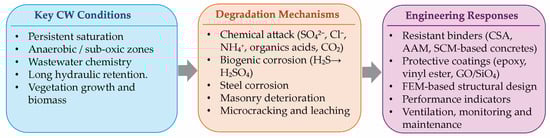
Figure 5.
Conceptual framework linking degradation factors, mechanisms, and engineering responses in constructed wetlands.
Although deterioration mechanisms affecting constructed wetland (CW) structures are often discussed in isolation across different types of hydraulic infrastructures, the present review enables the identification of a coherent set of key degradation factors that systematically govern structural performance in CW environments. These factors arise from the combined action of chemical aggressiveness, persistent saturation, biological activity, and mechanical loading, which distinguishes CWs from conventional dry or intermittently wetted structures.
As illustrated in Figure 5, the synthesis of the 31 studies reviewed and evidence from real CW installations allows the dominant degradation drivers to be grouped into five interrelated categories: (i) chemical exposure, including sulfates, chlorides, ammonium, organic acids, and dissolved CO2; (ii) biogenic processes, such as H2S generation, sulfur-oxidizing bacterial activity, and biofilm development; (iii) hydromechanical actions, including lateral pressures induced by saturated substrates, long hydraulic retention times, and pore-pressure fluctuations; (iv) material-related vulnerabilities, such as high porosity, inadequate concrete cover thickness, insufficient confinement in masonry systems, and poor interface detailing; and (v) operational factors, including limited ventilation, uncontrolled industrial discharges, and insufficient inspection and maintenance practices.
Importantly, this synthesis moves beyond descriptive observation by explicitly linking each degradation factor to actionable engineering responses, as summarized in the right-hand column of Figure 5. Practical recommendations emerging from the reviewed evidence include: (a) the use of sulfate- and biogenic-resistant binders, such as calcium sulfoaluminate or alkali-activated systems, in permanently saturated and anaerobic zones; (b) the targeted application of polymeric or nanostructured coatings (e.g., epoxy, vinyl ester, GO/SiO2-based systems) in areas exposed to wastewater vapors, acidic effluents, or aggressive ions; (c) the incorporation of durability-oriented performance indicators—including corrosion rate, crack width, chloride penetration depth, and loss of reinforcement cross-section—into routine inspection and maintenance protocols; (d) the explicit consideration of lateral pressures and coupled hydromechanical effects in structural design models, particularly for walls and slabs confining saturated substrates; and (e) the implementation of ventilation, monitoring, and preventive maintenance strategies to control H2S accumulation and mitigate biogenic corrosion in confined zones.
By structuring degradation factors, mechanisms, and engineering responses within a unified conceptual framework, the novelty of the present review lies not in identifying new damage phenomena but in translating dispersed evidence from analogous hydraulic infrastructures into an integrated, engineering-oriented framework specifically applicable to constructed wetlands. This approach provides a practical basis for future experimental research, numerical modeling efforts, and the development of durability-oriented design and maintenance guidelines for CW structures.
5. Perspectives on Modeling, Analysis, and Structural Design of Constructed Wetlands
The scarcity of studies explicitly focused on the structural behavior of constructed wetlands (CWs) has limited the development of design methodologies grounded in mechanical analysis, numerical modeling, and durability-oriented criteria. Most existing CW research prioritizes hydraulic performance, pollutant removal efficiency, or ecological aspects, while the structural response of walls, slabs, and foundations under real operating conditions remains largely unexplored. Given this lack of dedicated studies, a viable and scientifically consistent alternative is the adaptation of conceptual and computational tools originally developed for analogous hydraulic infrastructures, such as storage tanks, treatment lagoons, anaerobic digesters, lined canals, tunnels, and water containment structures.
These infrastructures share fundamental characteristics with CWs, including lateral confinement, interaction with saturated granular media, prolonged exposure to chemically aggressive environments, and degradation induced by persistent humidity and wetting–drying cycles. Consequently, their analytical and numerical approaches provide a solid starting point for advancing the structural engineering of CW systems.
5.1. Engineering Performance Indicators for Constructed Wetland Structures
Despite the recognition that CWs operate under mechanically and chemically aggressive conditions, their structural performance is rarely assessed using explicit engineering indicators. To move beyond qualitative descriptions, this study proposes a set of quantitative performance indicators that can be adopted as a first approximation for evaluating the structural behavior and durability of CW components. These indicators are widely used in analogous hydraulic infrastructures—such as wastewater tanks, anaerobic digesters, tunnels, buried retaining structures, and sewer systems—and are therefore transferable to CWs under comparable exposure conditions.
Relevant performance indicators include:
- Steel corrosion rate (μm/year or mm/year), commonly reported for reinforced concrete structures exposed to wastewater or saturated environments and directly linked to reinforcement section loss and service-life reduction.
- Chloride penetration depth (mm), defined as the depth at which the critical chloride concentration reaches the reinforcement, typically evaluated through diffusion-based models.
- Loss of steel cross-section (%), associated with corrosion progression and reduced load-bearing capacity.
- Variation in concrete porosity (%), reflecting chemical degradation processes such as calcium leaching, sulfate attack, or carbonation under prolonged saturation.
- Crack width evolution (mm), particularly relevant for loss of watertightness and accelerated ingress of aggressive agents.
- Maximum lateral deformation of walls (mm), induced by saturated substrate pressure, hydraulic loading, or coupled hydromechanical effects.
- Global factor of safety (FS) against sliding, overturning, or flexural failure, commonly used as an overall indicator of structural stability in containment and retaining systems.
Although specific threshold values for CWs remain largely undocumented, the ranges reported for analogous hydraulic infrastructures provide a robust basis for preliminary assessment, comparative analysis, and model calibration. The adoption of these indicators enables the formulation of performance-based design and maintenance strategies and facilitates the development of predictive numerical models tailored to CW operating conditions.
5.2. Numerical Modeling Approaches Applicable to CW Structures
A synthesis of the scientific literature reveals that sufficiently mature numerical and conceptual tools already exist for assessing structural behavior in systems comparable to CWs. Table 3 compiles representative studies addressing retaining walls, buried structures, saturated media, concrete tunnels, masonry systems, and chemically aggressive environments, highlighting their potential applicability to CW structural analysis.
Table 3.
Scientific articles relevant to modeling, analysis, and structural design applicable to CWs.
The studies summarized in Table 3 demonstrate that a wide range of numerical techniques—particularly finite element methods (FEM)—are capable of capturing lateral pressure distributions, internal stress development, deformation patterns, and failure mechanisms under saturated and confined conditions.
5.3. Structural, Hydromechanical, and Durability-Oriented Perspectives
First, it is necessary to move towards a systematic integration of relevant actions into the structural models of constructed wetlands. This implies that the analysis schemes include, at a minimum: (i) permanent loads (self-weight of walls and slabs, weight of the saturated substrate, operating water level, weight of attached elements); (ii) variable loads (maintenance personnel traffic, water level fluctuations, wind on aboveground biomass, seismic actions where applicable); (iii) the mechanical and hydraulic properties of the materials (strength parameters of concrete and masonry, friction angle and substrate cohesion, hydraulic conductivity, porosity, degree of saturation); and (iv) environmental conditions (presence of chlorides, sulfates, and CO2, wetting-drying cycles, temperature, and exposure time). Formalizing this minimum set of variables allows future constructed wetland models to be comparable and reproducible in different contexts.
Secondly, evidence from studies on rigid walls, buried structures, and saturated media suggests that finite element models (FEMs) are the most promising tool for capturing the distribution of lateral pressures, internal stresses, and deformations in CWs. The use of ABAQUS, PLAXIS, or other FEM codes has proven effective for analyzing walls subjected to lateral pressure, buried structures, and complex soil-structure configurations (Hosseinzadeh et al. [94]; Muni et al. [95]; Joseph et al. [96]; Kamiloğlu [99]; Ram et al. [104]). From the perspective of constructed wetlands, a clear line of research involves adapting these approaches to represent hydraulic cells of concrete or masonry, evaluating moments, shears, displacements, and safety factors against sliding, overturning, or flexural failure under the specific operating conditions of the CWs.
A third relevant perspective is the incorporation of coupled hydromechanical models, especially in concrete water structures (CWs) built on deformable soils or exposed to significant fluctuations in water level. Studies integrating water flow and porous medium deformation in saturated or partially saturated systems show that it is possible to simulate variations in pore pressure, differential settlements, and loss of confinement using tools such as PLAXIS 2D/3D, coupled formulations in ABAQUS, and advanced methodologies such as the Material Point Method (MPM) or Finite Element Limit Analysis (FELA) (Keshavarz and Khani [97]; Liang et al. [100]; Fernández et al. [105]); Transferring these approaches to constructed wetlands would allow, in future studies, for more accurate estimation of lateral wall deformations, the influence of substrate compaction, and the failure mechanisms associated with wetting-drying cycles or extreme hydrological events.
Fourth, the durability of concrete and masonry in aggressive environments suggests a broad research perspective in modeling coupled mechanical-chemical deterioration. Carbonation, calcium leaching, sulfate attack, and steel corrosion processes can be described using transport and reaction models based on Fick’s diffusion laws, as well as multiscale approaches that integrate chemical reactions with stiffness loss, cracking, and reinforcement section reduction. Recent studies have shown that tools such as COMSOL Multiphysics and coupled analytical or numerical models accurately reproduce chloride diffusion, calcium leaching, damage propagation, and service life evolution in saturated concrete and reinforced concrete structures subjected to marine or polluted environments (Guo et al. [101]; Shao et al. [110]; Chen et al. [109]; Tanhatan Naseri and Gucunski [111]; Rahman et al. [112]). Projected onto CWs, this opens the possibility of designing structures that not only meet immediate resistance criteria but also meet explicit service-life requirements in environments laden with chlorides, sulfates, CO2, and organic compounds.
Finally, a fifth perspective relates to the consolidation of guidelines and future structural design standards specific to concrete walls. The integration of AEF, coupled hydromechanical models, and chemical deterioration simulations provides the basis for establishing quantitative dimensioning criteria (wall and slab thicknesses, slenderness ratios, reinforcement details, cover requirements), as well as for objectively comparing different material alternatives (conventional concrete, modified mixes, confined masonry, hybrid systems). In the medium term, these advances could translate into technical recommendations or specialized codes that reduce dependence on empirical criteria and promote the use of safer, more durable, and more sustainable structural solutions in CWs.
Taken together, these perspectives show that the transfer and adaptation of methodologies established in other hydraulic infrastructures (such as those mentioned in Table 3) constitutes a promising way to build, in the coming years, a robust body of knowledge on the structural behavior of CWs and on the role that structural materials play in their long-term performance.
6. Conclusions
The present study reveals a clear gap in the literature on CWs: although hydraulics, treatment performance, and vegetation ecology have been widely documented, the structural dimension remains largely unexplored. The reviewed cases show that reinforced concrete and masonry constitute the backbone of most pilot- and full-scale CW support systems; however, fundamental design parameters—including material strength, reinforcement detailing, wall thickness, and foundation criteria—are seldom reported. This omission limits the development of reliable calculation methodologies and hampers the transfer of best practices from other hydraulic infrastructures to CWs.
The indirect evidence obtained through a PRISMA 2020 systematic review of 31 studies involving concrete and masonry in CW-like environments enabled the identification of a consistent set of deterioration mechanisms: chemical and physicochemical attack by sulfates, chlorides, ammonium, and organic acids; biogenic corrosion driven by H2S and H2SO4 generation; leaching, carbonation, and microcracking; and the interaction between mechanical loading and aggressive exposure conditions. Collectively, these findings indicate that CW structures operate under highly demanding durability scenarios. Persistent moisture, biofilm development, and long hydraulic retention times intensify the degradation of concrete and masonry mortars when adequate protection strategies are absent.
Building on this gap, the evidence synthesized in this study supports a transition from predominantly qualitative descriptions toward a performance-oriented structural assessment of CWs. A set of transferable engineering indicators—such as steel corrosion rate, chloride penetration depth, loss of reinforcement cross-section, variation in concrete porosity, crack-width evolution, maximum lateral wall deformation, and global safety factors—emerges as a practical basis for evaluating structural integrity and durability under CW operating conditions. In parallel, the maturity of numerical approaches originally developed for analogous hydraulic infrastructures indicates that finite element–based formulations, as well as coupled hydro-mechanical and chemo-mechanical models, can be realistically adapted to CW systems as a first-order approximation. At this stage, these approaches should be understood as part of an integrated conceptual framework, intended to guide future numerical validation and experimental calibration, rather than as fully validated design tools for CW structures. Together, these elements provide a concrete pathway for defining representative loading scenarios, supporting quantitative design checks, and developing reproducible, durability-oriented structural analyses tailored to CW applications.
Based on these insights, the study identifies three complementary pathways to enhance the structural performance of CWs: (i) the strategic use of organic, polymeric, and nanostructured coatings—such as vinyl ester, epoxy, GO/SiO2, and metallic layers—to limit ingress of aggressive agents and reduce biocorrosion; (ii) the incorporation of alternative binders and mineral additions, including calcium sulfoaluminate cements, alkali-activated mortars, fly ash, crystalline additives, nano-TiO2, and PCE-based nanomodifiers, which improve resistance to sulfate, chloride, and acid attack; and (iii) the critical assessment of wastewater as mixing water, which, although mechanically feasible, demands strict control of chemical composition and careful evaluation of porosity and reinforcement corrosion risks. These pathways, summarized within the conceptual framework presented in Figure 5, provide a structured basis for translating degradation mechanisms into engineering-oriented material selection, design decisions, and maintenance strategies for CW structures. Together, these strategies provide an initial framework for adapting durability criteria established for sewers, tanks, and pipelines to the specific exposure conditions encountered in CWs.
Finally, the assessment of emerging technologies suggests that future structural design in CWs will rely on the adoption of more resilient, multifunctional, and environmentally responsible materials. These include self-healing concretes incorporating bacteria and microcapsules, geopolymers and alkali-activated systems synthesized from industrial by-products, hybrid nanocomposites with enhanced barrier performance, and smart mortars for masonry with antimicrobial and self-repairing capabilities. However, their implementation in CWs requires interdisciplinary research programs that integrate laboratory experimentation, field monitoring, hydromechanical numerical modeling, and the development of regulatory guidelines specific to structures exposed to humid and biogenically aggressive environments. Advancing CWs as truly durable nature-based solutions, therefore, demands the explicit integration of structural engineering and materials science into their conceptualization and design.
Author Contributions
Conceptualization, writing—review and editing, B.S.T.-G., and P.J.L.-G.; validation, data curation, J.S.-L.; supervision, S.A.Z.-C. and J.R.R.-V.; methodology, O.M.-V., E.M.-R., and H.R.G.-M. All authors have read and agreed to the published version of the manuscript.
Funding
This research received no external funding.
Institutional Review Board Statement
Not applicable.
Informed Consent Statement
Not applicable.
Data Availability Statement
Request the corresponding author of this article.
Acknowledgments
The authors acknowledge the institutional support received from the Tecnológico Nacional de México (TecNM) during the development of this research.
Conflicts of Interest
The authors declare no conflicts of interest.
References
- Agaton, C.B.; Guila, P.M.C. Success factors and challenges: Implications of real options valuation of constructed wetlands as nature-based solutions for wastewater treatment. Resources 2024, 13, 11. [Google Scholar] [CrossRef]
- Zhao, X.; Yang, J.; Han, R.; Luo, H.; Chen, L.; Liu, M.; He, B. Modular Constructed Wetlands for Treatment of Rural Domestic Wastewater: Laboratory Performance and Field Application. Sustainability 2025, 17, 4427. [Google Scholar] [CrossRef]
- Santa, A.C.; Gómez, M.A.; Castano, J.G.; Tamayo, J.A.; Baena, L.M. Atmospheric deterioration of ceramic building materials and future trends in the field: A review. Heliyon 2023, 9, e15028. [Google Scholar] [CrossRef] [PubMed]
- Zhao, F.; Zhang, X.; Xu, Z.; Feng, C.; Pan, W.; Lu, L.; Luo, W. Revisión de la optimización de las condiciones hidráulicas para humedales artificiales. J. Environ. Manag. 2024, 370, 122377. [Google Scholar] [CrossRef] [PubMed]
- Nan, X.; Lavrnić, S.; Mancuso, G.; Toscano, A. Effects of design and operational conditions on the performance of constructed wetlands for agricultural pollution control–critical review. Water Air Soil Pollut. 2023, 234, 434. [Google Scholar] [CrossRef]
- Shukla, A.; Parde, D.; Gupta, V.; Vijay, R.; Kumar, R. A review on effective design processes of constructed wetlands. Int. J. Environ. Sci. Technol. 2022, 19, 12749–12774. [Google Scholar] [CrossRef]
- Singh, P.; Singh, G.; Singh, A.; Mishra, V.K.; Shukla, R. Macrophytes for utilization in constructed wetlands as efficient species for phytoremediation of emerging contaminants from wastewater. Wetlands 2024, 44, 22. [Google Scholar] [CrossRef]
- Li, K.; Qi, J.; Zhang, F.; Miwornunyuie, N.; Amaniampong, P.S.; Koomson, D.A.; Samwini, A.M.N. The role of wetland plants on wastewater treatment and electricity generation in constructed wetland coupled with microbial fuel cell. Appl. Sci. 2021, 11, 7454. [Google Scholar] [CrossRef]
- Kochi, L.Y.; Freitas, P.L.; Maranho, L.T.; Juneau, P.; Gomes, M.P. Aquatic macrophytes in constructed wetlands: A fight against water pollution. Sustainability 2020, 12, 9202. [Google Scholar] [CrossRef]
- Tadić, Đ.; Sauvêtre, A.; Cerqueira, F.; Lestremau, F.; Ait-Mouheb, N.; Chiron, S. Partially saturated vertical surface flow constructed wetland for emerging contaminants and antibiotic resistance genes removal from wastewater: The effect of bioaugmentation with Trichoderma. J. Environ. Chem. Eng. 2024, 12, 112128. [Google Scholar] [CrossRef]
- David, G.; Rana, M.S.; Saxena, S.; Sharma, S.; Pant, D.; Prajapati, S.K. A review on design, operation, and maintenance of constructed wetlands for removal of nutrients and emerging contaminants. Int. J. Environ. Sci. Technol. 2023, 20, 9249–9270. [Google Scholar] [CrossRef]
- Tang, Z.; Wood, J.; Smith, D.; Thapa, A.; Aryal, N. A review on constructed treatment wetlands for removal of pollutants in the agricultural runoff. Sustainability 2021, 13, 13578. [Google Scholar] [CrossRef]
- Rincon, L.F.; Moscoso, Y.M.; Hamami, A.E.A.; Matos, J.C.; Bastidas-Arteaga, E. Modelos de degradación y estrategias de mantenimiento para estructuras de hormigón armado en entornos costeros bajo el cambio climático: Una revisión. Buildings 2024, 14, 562. [Google Scholar]
- Wasim, M.; Ngo, T.D.; Abid, M. Investigación de la resistencia a la corrosión a largo plazo de estructuras de hormigón armado construidas con diversos tipos de hormigón en entornos marinos y climáticos diversos. Constr. Build. Mater. 2020, 237, 117701. [Google Scholar] [CrossRef]
- Sikora, O.; Ostrowski, K.A. A review of external confinement methods for enhancing the strength of concrete columns. Materials 2025, 18, 3222. [Google Scholar] [CrossRef]
- Wang, S.Y.; Liong, S.T.; Gan, Y.S.; Sheng, Y.T. Cost-effective concrete fabrication for large irregularly shaped architectural structures. Autom. Constr. 2023, 156, 105119. [Google Scholar] [CrossRef]
- Anand, S.; Gupta, D.; Siwach, C.; Nowak, J.; Rustige, H.; Mishra, V.K. French type vertical flow constructed wetland as a sustainable solution for domestic sewage treatment. Environ. Manag. 2025, 75, 2078–2088. [Google Scholar] [CrossRef] [PubMed]
- He, Y.; Peng, L.; Hua, Y.; Zhao, J.; Xiao, N. Treatment for domestic wastewater from university dorms using a hybrid constructed wetland at pilot scale. Environ. Sci. Pollut. Res. 2018, 25, 8532–8541. [Google Scholar] [CrossRef] [PubMed]
- Bedessem, M.E.; Ferro, A.M.; Hiegel, T. Pilot-scale constructed wetlands for petroleum-contaminated groundwater. Water Environ. Res. 2007, 79, 581–586. [Google Scholar] [CrossRef]
- Lomelí, J.S.; Zamora-Castro, S.A.; Zamora-Lobato, T.; Sandoval-Herazo, E.J.; Adame-García, J.; Zurita, F.; Sandoval-Herazo, M. Performance of large-scale ornamental wetlands for municipal wastewater treatment: A case study in a polluted estuary in the Gulf of Mexico. Sustainability 2025, 17, 2120. [Google Scholar] [CrossRef]
- Monzón-Reyes, B.L.; Vera-Puerto, I.; Florez, V.V.; Méndez, M.C.L.; Month, A.E.Á.; Meléndez-Armenta, R.Á.; Herazo, L.C.S. Municipal and coffee wastewater treated by a full-scale constructed wetland using ornamental plants under tropical climate. Ecol. Eng. 2026, 222, 107809. [Google Scholar] [CrossRef]
- Wang, W.; Zhao, Y.; Jiang, G.; Wang, Y. The nutrient removal ability and microbial communities in a pilot-scale horizontal subsurface flow constructed wetland fed by slightly polluted lake water. Wetlands 2020, 40, 2085–2096. [Google Scholar] [CrossRef]
- Koottatep, T.; Surinkul, N.; Polprasert, C.; Kamal, A.S.M.; Koné, D.; Montangero, A.; Strauss, M. Tratamiento de lodos sépticos en humedales artificiales en clima tropical: Lecciones aprendidas de siete años de operación. Water Sci. Technol. 2005, 51, 119–126. [Google Scholar] [CrossRef] [PubMed]
- Yi, X.H.; Jing, D.D.; Wan, J.; Ma, Y.; Wang, Y. Temporal and spatial variations of contaminant removal, enzyme activities, and microbial community structure in a pilot horizontal subsurface flow constructed wetland purifying industrial runoff. Environ. Sci. Pollut. Res. 2016, 23, 8565–8576. [Google Scholar] [CrossRef] [PubMed]
- Deng, Y.Y.; Guo, Q.M.; Jiang, Y.; Chen, C.X. A three-year study on the treatment of domestic-industrial mixed wastewater using a full-scale hybrid constructed wetland. Environ. Sci. Pollut. Res. 2023, 30, 31256–31267. [Google Scholar]
- Gaikwad, P.; Sathe, S. Effect of fly ash on compressive strength, carbonation and corrosion resistance of reinforced concrete: A systematic review. World J. Eng. 2025, 22, 40–60. [Google Scholar] [CrossRef]
- Fuhaid, A.F.A.; Niaz, A. Carbonation and corrosion problems in reinforced concrete structures. Buildings 2022, 12, 586. [Google Scholar] [CrossRef]
- Syiemiong, H.; Marthong, C. A review on improved construction methods for clay-brick and concrete-block ordinary masonry buildings. J. Struct. Integr. Maint. 2021, 6, 67–83. [Google Scholar] [CrossRef]
- Latifi, R.; Hadzima-Nyarko, M.; Radu, D.; Rouhi, R. A brief overview on crack patterns, repair and strengthening of historical masonry structures. Materials 2023, 16, 1882. [Google Scholar] [CrossRef]
- Xiao, J.; Huang, J.; Huang, M.; Chen, M.; Wang, M. Application of basalt fiber in vertical flow constructed wetland for different pollution loads wastewater: Performance, substrate enzyme activity and microorganism community. Bioresour. Technol. 2020, 318, 124229. [Google Scholar] [CrossRef]
- Zhang, G.; Ma, K.; Zhang, Z.; Shang, X.; Wu, F. Waste bricks as constructed wetland fills for wastewater treatment plant tailwater treatment. Environ. Pollut. Toxicol. Bull. 2020, 104, 273–281. [Google Scholar] [CrossRef]
- Xia, Z.; Liu, G.; She, Z.; Gao, M.; Zhao, Y.; Guo, L.; Jin, C. Performance and bacterial communities in unsaturated and saturated zones of a vertical-flow constructed wetland with continuous-feed. Bioresour. Technol. 2020, 315, 123859. [Google Scholar] [CrossRef]
- Sadeghian, V.; Said, S.A.; Lau, D. Modelling of CFRP-strengthened RC shear walls with a focus on end-anchor effects. Buildings 2023, 13, 747. [Google Scholar] [CrossRef]
- Wang, M.F.; Wu, X. Experimental and numerical investigation on seismic behavior of an innovative superimposed concrete shear wall. Structures 2021, 33, 4286–4298. [Google Scholar] [CrossRef]
- Hua, Q.; Chun, Q.; Yuan, Y.; Milani, G. Failure analysis of interacting masonry arch-wall structural systems: A micro-mechanical FEM insight. Eng. Fail. Anal. 2025, 182, 110152. [Google Scholar] [CrossRef]
- Shadlou, M.; Ahmadi, E.; Kashani, M.M. Micromechanical modelling of mortar joints and brick-mortar interfaces in masonry structures: A review of recent developments. Structures 2020, 23, 831–844. [Google Scholar] [CrossRef]
- Sangabriel-Lomeli, J.; Castro, S.Z.; Rivera, S.; Trujillo-García, B.S.; Ballut-Dajud, G.; Herazo, L.C.S. Plant biomass production in large-scale constructed wetlands under tropical climate conditions. Ecol. Eng. 2025, 221, 107760. [Google Scholar] [CrossRef]
- Karungamye, P.N. Potential of Canna indica in constructed wetlands for wastewater treatment: A review. Conservation 2022, 2, 499–513. [Google Scholar] [CrossRef]
- Zhang, X.; Lin, Y.; Lin, H.; Yan, J. Constructed wetlands and hyperaccumulators for the removal of heavy metal and metalloids: A review. J. Hazard. Mater. 2024, 479, 135643. [Google Scholar] [CrossRef] [PubMed]
- Torres Gil, L.K.; Saba, M.; Eljaiek-Urzola, M. Horizontal subsurface-flow constructed wetlands with tropical vegetation for the treatment of landfill leachate: Case study in Cartagena, Colombia. J. Environ. Eng. 2020, 146, 04020115. [Google Scholar] [CrossRef]
- Yin, X.; Jiang, C.; Xu, S.; Yu, X.; Yin, X.; Wang, J.; Zhuang, X. Greenhouse gases emissions of constructed wetlands: Mechanisms and affecting factors. Water 2023, 15, 2871. [Google Scholar] [CrossRef]
- Gots, V.; Makarenko, V.; Berdnyk, O. Destruction of reinforced concrete structures of sewage systems. Transf. Innov. Technol. 2023, 6, 3–10. [Google Scholar] [CrossRef]
- Woyciechowski, P.; Łukowski, P.; Szmigiera, E.; Adamczewski, G.; Chilmon, K.; Spodzieja, S. Concrete corrosion in a wastewater treatment plant—A comprehensive case study. Constr. Build. Mater. 2021, 303, 124388. [Google Scholar] [CrossRef]
- Millán Ramírez, G.P.; Byliński, H.; Niedostatkiewicz, M. Deterioration and protection of concrete elements embedded in contaminated soil: A review. Materials 2021, 14, 3253. [Google Scholar] [CrossRef]
- Awoyera, P.; Adesina, A.; Olalusi, O.B.; Viloria, A. Reinforced concrete deterioration caused by contaminated construction water: An overview. Eng. Fail. Anal. 2020, 116, 104715. [Google Scholar] [CrossRef]
- Haddaway, N.R.; Page, M.J.; Pritchard, C.C.; McGuinness, L.A. PRISMA2020: An R Package and Shiny Application for Creating PRISMA 2020—Compliant Flow Diagrams, with Interactivity for Enhanced Digital Transparency and Open Synthesis. Campbell Syst. Rev. 2022, 18, e1230. [Google Scholar] [CrossRef]
- Rahane, V.R.; Mate, N.U. Effects of Spent Wash Water on the Properties of Concrete. In Structural Engineering Convention Proceedings; Springer: Singapore, 2023; pp. 317–328. [Google Scholar]
- Bhutto, M.A.; Nasir, M.; Marri, A. Impact assessment of construction materials used in water supply and sewerage infrastructure. Int. J. Energy Environ. Econ. 2024, 32, 75–96. [Google Scholar]
- Teppan, J.P.E. Achieving a 100-Year Design Service Life on Wastewater Projects. In Canadian Society of Civil Engineering Annual Conference Proceedings; Springer: Cham, Switzerland, 2022; pp. 653–665. [Google Scholar]
- Alzgool, H.A.; Shawashreh, A.M.; Albtoosh, L.A.; Abusamra, B.A. Experimental investigations: Reinforced Concrete Beams Bending Strength with Brine Wastewater in Short Age. Civil. Eng. J. 2024, 10, 159–170. [Google Scholar] [CrossRef]
- Kashaija, N.T.; Gável, V.; Gergely, K.; Akos, K.; Kürthy, M.; Szabó, C.; Szabó-Krausz, Z. Deterioration of Cementitious Materials in Wastewater Treatment Plants’ Pumping Stations and Sand-Trap Structures. J. Compos. Sci. 2024, 8, 60. [Google Scholar] [CrossRef]
- Pramanik, S.K.; Bhuiyan, M.; Robert, D.; Roychand, R.; Gao, L.; Cole, I.; Pramanik, B.K. Bio-corrosion in concrete sewer systems: Mechanisms and mitigation strategies. Sci. Total Environ. 2024, 921, 171231. [Google Scholar] [CrossRef]
- Ibrahim, A.M.; Bassuoni, M.T.; Carroll, J.; Ghazy, A. Performance of concrete superficially treated with nano-modified coatings under sulfuric acid exposures. J. Build. Eng. 2024, 86, 108957. [Google Scholar] [CrossRef]
- Xu, W.; Yang, L.; Gao, D.; Tang, J.; Zhang, S.; Meng, Y. Long-term mechanical properties of steel fiber reinforced concrete under sulfuric acid attack. Tunn. Undergr. Space Technol. 2024, 153, 105977. [Google Scholar] [CrossRef]
- Deldar, O.; Akçaoğlu, T.; Ergil, M. Assessing the impacts of treated wastewater on concrete’s mechanical properties and corrosion resistance. Iran. J. Sci. Technol. Trans. Civ. Eng. 2024, 48, 4093–4112. [Google Scholar] [CrossRef]
- Tan, T.Y.; Zhang, A. Study on sewage erosion resistance of nano titanium modified coral concrete. Case Stud. Constr. Mater. 2024, 21, e03936. [Google Scholar] [CrossRef]
- Fang, C.; Achal, V. Enhanced steel corrosion inhibition through microbially induced carbonate precipitation with facultative anaerobic denitrifying bacterium. Case Stud. Constr. Mater. 2024, 21, e03607. [Google Scholar] [CrossRef]
- Rebai, B.; Messas, T.; Mansouri, K.; Mamen, B.; Litouche, B.; Hadji, M.; Berkia, A. Nanomodified Concrete for Harsh Environments: Enhancing Durability Using Nano-Admixtures and Cementitious Nanotechnology. J. Nano-Electron. Phys. 2025, 17, 04034. [Google Scholar] [CrossRef] [PubMed]
- Alazzawi, M.B.; Dawood, J.J.; Abdulkader, N.J. Investigation the Influence of Real and Simulated Sewer Water on Epoxy Resin Modified Concrete Used for Manholes. IOP Conf. Ser. Earth Environ. Sci. 2025, 1507, 012086. [Google Scholar] [CrossRef]
- Chu, H.; Chen, W.; Fang, Y.; Liang, Y.; Long, B.; Zhang, F.; Jiang, L. Effect of CuSO4 content and pH on the mechanical properties and antibacterial ability of copper-plated cement-based material. Cem. Concr. Compos. 2025, 155, 105848. [Google Scholar] [CrossRef]
- Mendizabal, J.; Vernon, D.; Martin, B.; Bajón-Fernández, Y.; Soares, A. Short-term memory artificial neural network modelling to predict concrete corrosion in wastewater treatment plant inlet chambers using sulphide sensors. J. Water Process Eng. 2025, 69, 106821. [Google Scholar] [CrossRef]
- Silva Martínez, P.I.; Meza-de Luna, A.; Rico-Martínez, R.; Arzate-Cárdenas, M.A. Chemical-mechanical behaviour of the surface interaction of mortars prepared at different concentrations of water treated with commercial and recycled steel fibres. Eur. J. Environ. Civ. Eng. 2025, 1–37. [Google Scholar] [CrossRef]
- Słomka-Słupik, B. The danger of soil contamination due to leaky walls of sewage tanks in coking plants—Description of the concrete destruction process. Ochrona Przed Koroz. 2025, 1, 4–14. [Google Scholar] [CrossRef]
- Capuozzo, A.; Tenore, A.; Russo, F.; Frunzo, L. A double free boundary problem on microbially induced corrosion in wastewater concrete. Math. Eng. 2025, 7, 481–504. [Google Scholar] [CrossRef]
- Kong, L.; Sun, Y.; Zhao, W.; Li, J.; Sun, S.; Jiao, H.; Liu, Y. Simulation study of three-stage corrosion of Portland, aluminate, and alkali-activated cementitious materials in sewers. J. Mater. Civ. Eng. 2025, 37, 04024489. [Google Scholar] [CrossRef]
- Kashaija, N.T.; Gável, V.; Iklaga, G.; Alexander, A.; Gergely, K.; Mireisz, T.; Tóth, E. Biodeterioration study of cementitious materials during sewage treatment processes. Water 2025, 17, 459. [Google Scholar] [CrossRef]
- Abbas, S.; Faisal, A.; Khan, M.A.; Nehdi, M.L.; Hameed, R.; Shaukat, S. Systematic state-of-the-art review on precast concrete pipes. Results Eng. 2025, 25, 103826. [Google Scholar] [CrossRef]
- Tarnowski, K.; Bering, S.; Głowacka, A.; Paszkiewicz, O.; Mazur, J. Effect of parameters of biogenic hydrogen sulfide emission on degradation of concrete wells in sanitary sewage systems. Desalin. Water Treat. 2025, 322, 101187. [Google Scholar] [CrossRef]
- Aliyev, M.; Maxmudova, D.; Gurinovich, A.; Tursunov, Z.; Mamadiyorov, S. Study and analysis of corrosion in sewage collectors. E3S Web Conf. 2025, 627, 05008. [Google Scholar] [CrossRef]
- de Andrade Coni, G.; de Figueiredo, A.D.; Salvador, R.P.; Monte, R. In-situ analysis of sprayed concrete in a sewage tunnel lining. Case Stud. Constr. Mater. 2025, 22, e04347. [Google Scholar] [CrossRef]
- Baas, K.; Escalante, D. Corrosion protection for concrete pressure pipe. Assoc. Mater. Prot. Perform. Conf. Proc. 2025, 64, 44–48. [Google Scholar]
- Lin, P.; Yuan, X.; Liu, T.; Yu, X. Degradation of concrete sewer pipes under coupling of corrosion and loads: I. experimental study. Constr. Build. Mater. 2025, 483, 141760. [Google Scholar] [CrossRef]
- Zhang, Y.; Zhu, Z.; Zou, H.; Dai, L.; Liu, H.; Rong, Y.; Han, W. Research on the application of graphene oxide-reinforced SiO2 corrosion-resistant coatings in the long-term protection of water treatment facilities. Processes 2025, 13, 2938. [Google Scholar] [CrossRef]
- Godinho, J.P.; Medeiros, M.H.F.; Neto, A.M.; Lima, V.M.E.; De Souza, D.J. Laboratory–field assessment of concrete exposed to biogenic sulphuric acid: Influence of SCM-based binders on long-term degradation. Constr. Build. Mater. 2025, 493, 143185. [Google Scholar] [CrossRef]
- Ahmed, A.; Ahmed, O.; Al-Fakih, A.; Muhit, I.B. A comprehensive review on the use of reclaimed wastewater in cementitious materials: Fresh, mechanical, microstructure, and durability aspects. Arab. J. Sci. Eng. 2025, 50, 16263–16295. [Google Scholar] [CrossRef]
- Rajiv, K.N.; Reddy, Y.R. Assessment of compressive strength in concrete using secondary treated wastewater, fly ash, and sodium nitrite via machine learning techniques. Asian J. Civ. Eng. 2025, 26, 4351–4365. [Google Scholar] [CrossRef]
- Wang, Y.; Hu, J.; Kou, D.; Li, W.; Liu, Y. Comparative assessment of concrete degradation in sewage pipelines: Biogenic vs. mineral sulfuric acid and sewage liquid. Case Stud. Constr. Mater. 2025, 23, e05169. [Google Scholar] [CrossRef]
- Tang, Y.; Xu, J. Application of microbial precipitation in self-healing concrete: A review on the protection strategies for bacteria. Constr. Build. Mater. 2021, 306, 124950. [Google Scholar] [CrossRef]
- Xu, J.M.; Chen, Z.T.; Cheng, F.; Liu, Z.Q.; Zheng, Y.G. Exploring a cellulose-immobilized bacteria for self-healing concrete via microbe-induced calcium carbonate precipitation. J. Build. Eng. 2024, 95, 110248. [Google Scholar] [CrossRef]
- Zhao, Q.; Ma, C.; Huang, B.; Lu, X. Development of alkali activated cementitious material from sewage sludge ash: Two-part and one-part geopolymer. J. Clean. Prod. 2023, 384, 135547. [Google Scholar] [CrossRef]
- Duan, W.; Zhuge, Y.; Chow, C.W.; Keegan, A.; Liu, Y.; Siddique, R. Mechanical performance and phase analysis of an eco-friendly alkali-activated binder made with sludge waste and blast-furnace slag. J. Clean. Prod. 2022, 374, 134024. [Google Scholar] [CrossRef]
- Kamath, M.; Prashant, S.; Kumar, M. Micro-characterisation of alkali activated paste with fly ash-GGBS-metakaolin binder system with ambient setting characteristics. Constr. Build. Mater. 2021, 277, 122323. [Google Scholar] [CrossRef]
- Zhang, X.; Kong, H.; Yang, G.; Zhu, D.; Luan, X.; He, P.; Wei, G. Graphene-based functional hybrid membranes for antimicrobial applications: A review. Appl. Sci. 2022, 12, 4834. [Google Scholar] [CrossRef]
- Yaragalla, S.; Bhavitha, K.B.; Athanassiou, A. A review on graphene based materials and their antimicrobial properties. Coatings 2021, 11, 1197. [Google Scholar] [CrossRef]
- Dabaleh, A.; Mohammadi, A.; Shojaei, A.; Nematollahzadeh, A. Eco-friendly fumed Nanosilica@Nanodiamond hybrid nanoparticles with dual sustainable self-healing and barrier anticorrosive performances in epoxy coating. ACS Appl. Mater. Interfaces 2024, 16, 5075–5092. [Google Scholar] [CrossRef]
- Thomas, P.; Sahoo, B.N.; Thomas, P.J.; Greve, M.M. Recent advances in emerging integrated anticorrosion and antifouling nanomaterial-based coating solutions. Environ. Sci. Pollut. Res. 2024, 31, 67550–67576. [Google Scholar] [CrossRef]
- Singh, A.K.; Sharma, R.; Kujur, V.S.; Poddar, M.; Kumar, A.; Kumar, S.; Kumar, R. Integration of Nanotechnology and Nanomaterials in Biomaterials Research. Biomater. Connect. 2025, 2, 188313. [Google Scholar] [CrossRef]
- Bhattacharyya, S.K.; Maiti, S.; Das, N.C.; Banerjee, S. Antibacterial and antiviral functional materials based on polymer nanocomposites. In Antibacterial and Antiviral Functional Materials; American Chemical Society: Washington, DC, USA, 2023; Volume 1, pp. 171–202. [Google Scholar]
- Arif, M.; Hannan Zahid, A.; Saghir, S.; Mahsud, A. From sunlight to sustainability: The properties, evolution, and prospects of photocatalytic building materials. Catal. Rev. 2025, 1–72. [Google Scholar] [CrossRef]
- Lima, G.T.D.S.; Silvestro, L.; Tambara Júnior, L.U.D.; Cheriaf, M.; Rocha, J.C. Autonomous self-healing agents in cementitious materials: Parameters and impacts on mortar properties. Buildings 2024, 14, 2000. [Google Scholar] [CrossRef]
- Luhar, S.; Luhar, I.; Shaikh, F.U.A. Review on performance evaluation of autonomous healing of geopolymer composites. Infrastructures 2021, 6, 94. [Google Scholar] [CrossRef]
- Ben, F. Bionanocomposites in Structural Engineering, Building and Construction. In Advanced Bionanocomposite Materials: Innovations for Sustainable Development; Springer Nature: Singapore, 2025; pp. 535–577. [Google Scholar]
- Huseien, G.F.; Nehdi, M.L.; Faridmehr, I.; Ghoshal, S.K.; Hamzah, H.K.; Benjeddou, O.; Alrshoudi, F. Smart bio-agents-activated sustainable self-healing cementitious materials: An all-inclusive overview on progress, benefits and challenges. Sustainability 2022, 14, 1980. [Google Scholar] [CrossRef]
- Hosseinzadeh, A.; Soroush, A.; Shafipour, R. A comprehensive numerical analysis of EQ-induced lateral earth pressure on structures basement walls. Soil Dyn. Earthq. Eng. 2022, 163, 107521. [Google Scholar] [CrossRef]
- Muni, T.; Devi, D.; Baishya, S. Parametric study of lateral earth pressure on rigid retaining walls using ABAQUS. Int. J. Civ. Eng. 2025, 12, 7–14. [Google Scholar] [CrossRef]
- Joseph, J.; Cherian, R.S.; Joshi, D.; Tandel, Y.; Ranjan, R. Analysing the performance of cantilever retaining walls with pressure relief shelves using PLAXIS 3D. In Proceedings of the Indian Geotechnical Conference; Springer: Singapore, 2024; pp. 97–110. [Google Scholar]
- Keshavarz, A.; Khani, F. Active and passive lateral earth pressure with anisotropic seepage effect. Int. J. Geomech 2024, 24, 04024148. [Google Scholar] [CrossRef]
- Nam, D.; Abbas, Q.; Lee, J. A method for estimating coefficient of lateral earth pressure based on cone penetration tests. Soils Found. 2024, 64, 101474. [Google Scholar] [CrossRef]
- Kamiloğlu, H.A. New RSM-FEM–based active lateral earth thrust coefficient determination method for inverted T-type cantilever retaining walls supporting narrow granular backfill. Int. J. Geomech. 2023, 23, 04023187. [Google Scholar] [CrossRef]
- Liang, J.; Zhang, G.; Ba, Z.; Liang, J. Development of a 3D fluid-saturated element for dynamic analysis of two-phase media in ABAQUS based on u–U formed equations. Comput. Geotech. 2021, 139, 104377. [Google Scholar] [CrossRef]
- Guo, B.; Li, Z.; Fu, Q.; Wang, Y.; Huang, D.; Niu, D. Reactive transport modelling of chloride ingress in saturated coral aggregate concrete. Front. Mater. 2021, 8, 755241. [Google Scholar] [CrossRef]
- Wang, J.; Meng, L.; Fan, Z.; Liu, Q.; Tong, Z. Mechanism and modelling of CO2 corrosion on downhole tools. R. Soc. Open Sci. 2019, 6, 181899. [Google Scholar] [CrossRef]
- Dhir, P.K.; Rapicavoli, D.; Panto, B.; Szyniszewski, S. Numerical simulation of the in-plane response of masonry walls retrofitted with “splints and bandages” systems. Eng. Struct. 2025, 342, 120678. [Google Scholar] [CrossRef]
- Ram, I.; Senderovich, S.; Brodsky, A. Experimental and numerical study on the impact of geometrical and mechanical properties of joints on the out-of-plane behaviour of masonry walls. Structures 2025, 75, 108849. [Google Scholar] [CrossRef]
- Fernández, F.; Juajinoy, D.S.C.; Vargas, E., Jr.; Velloso, R.Q.; Dias, D. Basal heave stability analysis of a circular shaft excavation considering FEM, NLA, and MPM approaches. Geotech. Geol. Eng. 2024, 42, 2601–2622. [Google Scholar] [CrossRef]
- Shafna, P.M.; Anjana, T.R. Generalized three-dimensional slope stability analysis of soil using PLAXIS 3D. In Proceedings of the Indian Geotechnical Conference 2019; Springer: Singapore, 2021; pp. 745–752. [Google Scholar]
- Vickneswaran, T.; Ravichandran, N. Performance of geotechnical systems under extreme hydroclimatic events using a new user-defined soil model in PLAXIS. J. GeoEng. 2023, 18, 21–31. [Google Scholar]
- Liu, L.; Fu, S.; Jia, X.; Li, X.; Zhang, L. Modeling the evolution of mechanical behavior in rocks under various water environments. Water 2025, 17, 2983. [Google Scholar] [CrossRef]
- Chen, D.; Feng, J.; Ni, P.; Hao, T. Service life of undersea RC circular lined tunnel subjected to chloride attack. Structures 2025, 73, 108347. [Google Scholar] [CrossRef]
- Shao, W.; Li, Q.; Zhang, W.; Shi, D.; Li, H. Numerical modeling of chloride diffusion in cement-based materials considering calcium leaching and external sulfate attack. Constr. Build. Mater. 2023, 401, 132913. [Google Scholar] [CrossRef]
- Tanhatan Naseri, S.G.; Gucunski, N. Comparative numerical simulation of damage propagation caused by chloride and oxygen diffusion in reinforced concrete slabs. In Proceedings of the International Conference on Transportation and Development 2023, Austin, TX, USA, 14–17 June 2023; pp. 438–448. [Google Scholar]
- Rahman, M.K.; Al-Kutti, W.A.; Shazali, M.A.; Baluch, M.H. Simulation of chloride migration in compression-induced damage in concrete. J. Mater. Civ. Eng. 2012, 24, 789–796. [Google Scholar] [CrossRef]
Disclaimer/Publisher’s Note: The statements, opinions and data contained in all publications are solely those of the individual author(s) and contributor(s) and not of MDPI and/or the editor(s). MDPI and/or the editor(s) disclaim responsibility for any injury to people or property resulting from any ideas, methods, instructions or products referred to in the content. |
© 2025 by the authors. Licensee MDPI, Basel, Switzerland. This article is an open access article distributed under the terms and conditions of the Creative Commons Attribution (CC BY) license.