
Structural Materials in Constructed Wetlands: Perspectives on Reinforced Concrete, Masonry, and Emerging Options

 ,
,  , , , ,
  , and
, and
Abstract
1. Introduction
2. Current State of Structural Knowledge in Constructed Wetlands
2.1. Reports on the Use of Reinforced Concrete
2.2. Reports on the Use of Masonry
2.3. Limitations of the Available Literature
3. Indirect Evidence of the Behavior of Concrete in Environments Similar to Built Wetlands
3.1. Chemical and Physicochemical Attack on Aggressive Wastewater
3.2. Biogenic Corrosion, Aggressive Gases, and Combined Deterioration Mechanisms
4. Protection Strategies, Material Selection, and Criteria for CWs and Future Prospects for New Materials
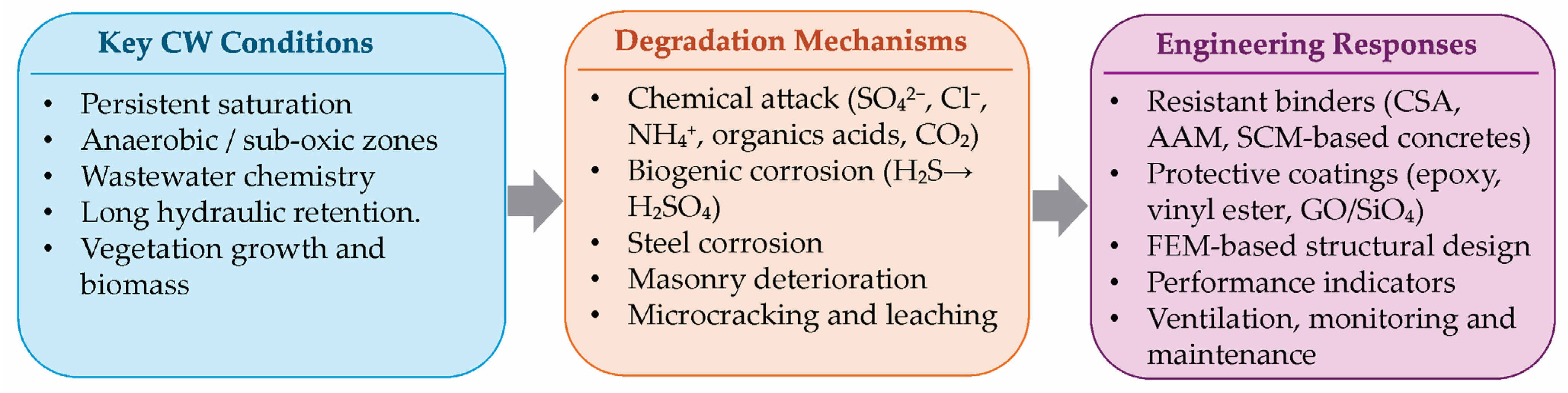
Key Degradation Factors and Practical Recommendations for CW Structures
5. Perspectives on Modeling, Analysis, and Structural Design of Constructed Wetlands
5.1. Engineering Performance Indicators for Constructed Wetland Structures
- Steel corrosion rate (μm/year or mm/year), commonly reported for reinforced concrete structures exposed to wastewater or saturated environments and directly linked to reinforcement section loss and service-life reduction.
- Chloride penetration depth (mm), defined as the depth at which the critical chloride concentration reaches the reinforcement, typically evaluated through diffusion-based models.
- Loss of steel cross-section (%), associated with corrosion progression and reduced load-bearing capacity.
- Variation in concrete porosity (%), reflecting chemical degradation processes such as calcium leaching, sulfate attack, or carbonation under prolonged saturation.
- Crack width evolution (mm), particularly relevant for loss of watertightness and accelerated ingress of aggressive agents.
- Maximum lateral deformation of walls (mm), induced by saturated substrate pressure, hydraulic loading, or coupled hydromechanical effects.
- Global factor of safety (FS) against sliding, overturning, or flexural failure, commonly used as an overall indicator of structural stability in containment and retaining systems.
5.2. Numerical Modeling Approaches Applicable to CW Structures
5.3. Structural, Hydromechanical, and Durability-Oriented Perspectives
6. Conclusions
Author Contributions
Funding
Institutional Review Board Statement
Informed Consent Statement
Data Availability Statement
Acknowledgments
Conflicts of Interest
References
- Agaton, C.B.; Guila, P.M.C. Success factors and challenges: Implications of real options valuation of constructed wetlands as nature-based solutions for wastewater treatment. Resources 2024, 13, 11. [Google Scholar] [CrossRef]
- Zhao, X.; Yang, J.; Han, R.; Luo, H.; Chen, L.; Liu, M.; He, B. Modular Constructed Wetlands for Treatment of Rural Domestic Wastewater: Laboratory Performance and Field Application. Sustainability 2025, 17, 4427. [Google Scholar] [CrossRef]
- Santa, A.C.; Gómez, M.A.; Castano, J.G.; Tamayo, J.A.; Baena, L.M. Atmospheric deterioration of ceramic building materials and future trends in the field: A review. Heliyon 2023, 9, e15028. [Google Scholar] [CrossRef] [PubMed]
- Zhao, F.; Zhang, X.; Xu, Z.; Feng, C.; Pan, W.; Lu, L.; Luo, W. Revisión de la optimización de las condiciones hidráulicas para humedales artificiales. J. Environ. Manag. 2024, 370, 122377. [Google Scholar] [CrossRef] [PubMed]
- Nan, X.; Lavrnić, S.; Mancuso, G.; Toscano, A. Effects of design and operational conditions on the performance of constructed wetlands for agricultural pollution control–critical review. Water Air Soil Pollut. 2023, 234, 434. [Google Scholar] [CrossRef]
- Shukla, A.; Parde, D.; Gupta, V.; Vijay, R.; Kumar, R. A review on effective design processes of constructed wetlands. Int. J. Environ. Sci. Technol. 2022, 19, 12749–12774. [Google Scholar] [CrossRef]
- Singh, P.; Singh, G.; Singh, A.; Mishra, V.K.; Shukla, R. Macrophytes for utilization in constructed wetlands as efficient species for phytoremediation of emerging contaminants from wastewater. Wetlands 2024, 44, 22. [Google Scholar] [CrossRef]
- Li, K.; Qi, J.; Zhang, F.; Miwornunyuie, N.; Amaniampong, P.S.; Koomson, D.A.; Samwini, A.M.N. The role of wetland plants on wastewater treatment and electricity generation in constructed wetland coupled with microbial fuel cell. Appl. Sci. 2021, 11, 7454. [Google Scholar] [CrossRef]
- Kochi, L.Y.; Freitas, P.L.; Maranho, L.T.; Juneau, P.; Gomes, M.P. Aquatic macrophytes in constructed wetlands: A fight against water pollution. Sustainability 2020, 12, 9202. [Google Scholar] [CrossRef]
- Tadić, Đ.; Sauvêtre, A.; Cerqueira, F.; Lestremau, F.; Ait-Mouheb, N.; Chiron, S. Partially saturated vertical surface flow constructed wetland for emerging contaminants and antibiotic resistance genes removal from wastewater: The effect of bioaugmentation with Trichoderma. J. Environ. Chem. Eng. 2024, 12, 112128. [Google Scholar] [CrossRef]
- David, G.; Rana, M.S.; Saxena, S.; Sharma, S.; Pant, D.; Prajapati, S.K. A review on design, operation, and maintenance of constructed wetlands for removal of nutrients and emerging contaminants. Int. J. Environ. Sci. Technol. 2023, 20, 9249–9270. [Google Scholar] [CrossRef]
- Tang, Z.; Wood, J.; Smith, D.; Thapa, A.; Aryal, N. A review on constructed treatment wetlands for removal of pollutants in the agricultural runoff. Sustainability 2021, 13, 13578. [Google Scholar] [CrossRef]
- Rincon, L.F.; Moscoso, Y.M.; Hamami, A.E.A.; Matos, J.C.; Bastidas-Arteaga, E. Modelos de degradación y estrategias de mantenimiento para estructuras de hormigón armado en entornos costeros bajo el cambio climático: Una revisión. Buildings 2024, 14, 562. [Google Scholar]
- Wasim, M.; Ngo, T.D.; Abid, M. Investigación de la resistencia a la corrosión a largo plazo de estructuras de hormigón armado construidas con diversos tipos de hormigón en entornos marinos y climáticos diversos. Constr. Build. Mater. 2020, 237, 117701. [Google Scholar] [CrossRef]
- Sikora, O.; Ostrowski, K.A. A review of external confinement methods for enhancing the strength of concrete columns. Materials 2025, 18, 3222. [Google Scholar] [CrossRef]
- Wang, S.Y.; Liong, S.T.; Gan, Y.S.; Sheng, Y.T. Cost-effective concrete fabrication for large irregularly shaped architectural structures. Autom. Constr. 2023, 156, 105119. [Google Scholar] [CrossRef]
- Anand, S.; Gupta, D.; Siwach, C.; Nowak, J.; Rustige, H.; Mishra, V.K. French type vertical flow constructed wetland as a sustainable solution for domestic sewage treatment. Environ. Manag. 2025, 75, 2078–2088. [Google Scholar] [CrossRef] [PubMed]
- He, Y.; Peng, L.; Hua, Y.; Zhao, J.; Xiao, N. Treatment for domestic wastewater from university dorms using a hybrid constructed wetland at pilot scale. Environ. Sci. Pollut. Res. 2018, 25, 8532–8541. [Google Scholar] [CrossRef] [PubMed]
- Bedessem, M.E.; Ferro, A.M.; Hiegel, T. Pilot-scale constructed wetlands for petroleum-contaminated groundwater. Water Environ. Res. 2007, 79, 581–586. [Google Scholar] [CrossRef]
- Lomelí, J.S.; Zamora-Castro, S.A.; Zamora-Lobato, T.; Sandoval-Herazo, E.J.; Adame-García, J.; Zurita, F.; Sandoval-Herazo, M. Performance of large-scale ornamental wetlands for municipal wastewater treatment: A case study in a polluted estuary in the Gulf of Mexico. Sustainability 2025, 17, 2120. [Google Scholar] [CrossRef]
- Monzón-Reyes, B.L.; Vera-Puerto, I.; Florez, V.V.; Méndez, M.C.L.; Month, A.E.Á.; Meléndez-Armenta, R.Á.; Herazo, L.C.S. Municipal and coffee wastewater treated by a full-scale constructed wetland using ornamental plants under tropical climate. Ecol. Eng. 2026, 222, 107809. [Google Scholar] [CrossRef]
- Wang, W.; Zhao, Y.; Jiang, G.; Wang, Y. The nutrient removal ability and microbial communities in a pilot-scale horizontal subsurface flow constructed wetland fed by slightly polluted lake water. Wetlands 2020, 40, 2085–2096. [Google Scholar] [CrossRef]
- Koottatep, T.; Surinkul, N.; Polprasert, C.; Kamal, A.S.M.; Koné, D.; Montangero, A.; Strauss, M. Tratamiento de lodos sépticos en humedales artificiales en clima tropical: Lecciones aprendidas de siete años de operación. Water Sci. Technol. 2005, 51, 119–126. [Google Scholar] [CrossRef] [PubMed]
- Yi, X.H.; Jing, D.D.; Wan, J.; Ma, Y.; Wang, Y. Temporal and spatial variations of contaminant removal, enzyme activities, and microbial community structure in a pilot horizontal subsurface flow constructed wetland purifying industrial runoff. Environ. Sci. Pollut. Res. 2016, 23, 8565–8576. [Google Scholar] [CrossRef] [PubMed]
- Deng, Y.Y.; Guo, Q.M.; Jiang, Y.; Chen, C.X. A three-year study on the treatment of domestic-industrial mixed wastewater using a full-scale hybrid constructed wetland. Environ. Sci. Pollut. Res. 2023, 30, 31256–31267. [Google Scholar]
- Gaikwad, P.; Sathe, S. Effect of fly ash on compressive strength, carbonation and corrosion resistance of reinforced concrete: A systematic review. World J. Eng. 2025, 22, 40–60. [Google Scholar] [CrossRef]
- Fuhaid, A.F.A.; Niaz, A. Carbonation and corrosion problems in reinforced concrete structures. Buildings 2022, 12, 586. [Google Scholar] [CrossRef]
- Syiemiong, H.; Marthong, C. A review on improved construction methods for clay-brick and concrete-block ordinary masonry buildings. J. Struct. Integr. Maint. 2021, 6, 67–83. [Google Scholar] [CrossRef]
- Latifi, R.; Hadzima-Nyarko, M.; Radu, D.; Rouhi, R. A brief overview on crack patterns, repair and strengthening of historical masonry structures. Materials 2023, 16, 1882. [Google Scholar] [CrossRef]
- Xiao, J.; Huang, J.; Huang, M.; Chen, M.; Wang, M. Application of basalt fiber in vertical flow constructed wetland for different pollution loads wastewater: Performance, substrate enzyme activity and microorganism community. Bioresour. Technol. 2020, 318, 124229. [Google Scholar] [CrossRef]
- Zhang, G.; Ma, K.; Zhang, Z.; Shang, X.; Wu, F. Waste bricks as constructed wetland fills for wastewater treatment plant tailwater treatment. Environ. Pollut. Toxicol. Bull. 2020, 104, 273–281. [Google Scholar] [CrossRef]
- Xia, Z.; Liu, G.; She, Z.; Gao, M.; Zhao, Y.; Guo, L.; Jin, C. Performance and bacterial communities in unsaturated and saturated zones of a vertical-flow constructed wetland with continuous-feed. Bioresour. Technol. 2020, 315, 123859. [Google Scholar] [CrossRef]
- Sadeghian, V.; Said, S.A.; Lau, D. Modelling of CFRP-strengthened RC shear walls with a focus on end-anchor effects. Buildings 2023, 13, 747. [Google Scholar] [CrossRef]
- Wang, M.F.; Wu, X. Experimental and numerical investigation on seismic behavior of an innovative superimposed concrete shear wall. Structures 2021, 33, 4286–4298. [Google Scholar] [CrossRef]
- Hua, Q.; Chun, Q.; Yuan, Y.; Milani, G. Failure analysis of interacting masonry arch-wall structural systems: A micro-mechanical FEM insight. Eng. Fail. Anal. 2025, 182, 110152. [Google Scholar] [CrossRef]
- Shadlou, M.; Ahmadi, E.; Kashani, M.M. Micromechanical modelling of mortar joints and brick-mortar interfaces in masonry structures: A review of recent developments. Structures 2020, 23, 831–844. [Google Scholar] [CrossRef]
- Sangabriel-Lomeli, J.; Castro, S.Z.; Rivera, S.; Trujillo-García, B.S.; Ballut-Dajud, G.; Herazo, L.C.S. Plant biomass production in large-scale constructed wetlands under tropical climate conditions. Ecol. Eng. 2025, 221, 107760. [Google Scholar] [CrossRef]
- Karungamye, P.N. Potential of Canna indica in constructed wetlands for wastewater treatment: A review. Conservation 2022, 2, 499–513. [Google Scholar] [CrossRef]
- Zhang, X.; Lin, Y.; Lin, H.; Yan, J. Constructed wetlands and hyperaccumulators for the removal of heavy metal and metalloids: A review. J. Hazard. Mater. 2024, 479, 135643. [Google Scholar] [CrossRef] [PubMed]
- Torres Gil, L.K.; Saba, M.; Eljaiek-Urzola, M. Horizontal subsurface-flow constructed wetlands with tropical vegetation for the treatment of landfill leachate: Case study in Cartagena, Colombia. J. Environ. Eng. 2020, 146, 04020115. [Google Scholar] [CrossRef]
- Yin, X.; Jiang, C.; Xu, S.; Yu, X.; Yin, X.; Wang, J.; Zhuang, X. Greenhouse gases emissions of constructed wetlands: Mechanisms and affecting factors. Water 2023, 15, 2871. [Google Scholar] [CrossRef]
- Gots, V.; Makarenko, V.; Berdnyk, O. Destruction of reinforced concrete structures of sewage systems. Transf. Innov. Technol. 2023, 6, 3–10. [Google Scholar] [CrossRef]
- Woyciechowski, P.; Łukowski, P.; Szmigiera, E.; Adamczewski, G.; Chilmon, K.; Spodzieja, S. Concrete corrosion in a wastewater treatment plant—A comprehensive case study. Constr. Build. Mater. 2021, 303, 124388. [Google Scholar] [CrossRef]
- Millán Ramírez, G.P.; Byliński, H.; Niedostatkiewicz, M. Deterioration and protection of concrete elements embedded in contaminated soil: A review. Materials 2021, 14, 3253. [Google Scholar] [CrossRef]
- Awoyera, P.; Adesina, A.; Olalusi, O.B.; Viloria, A. Reinforced concrete deterioration caused by contaminated construction water: An overview. Eng. Fail. Anal. 2020, 116, 104715. [Google Scholar] [CrossRef]
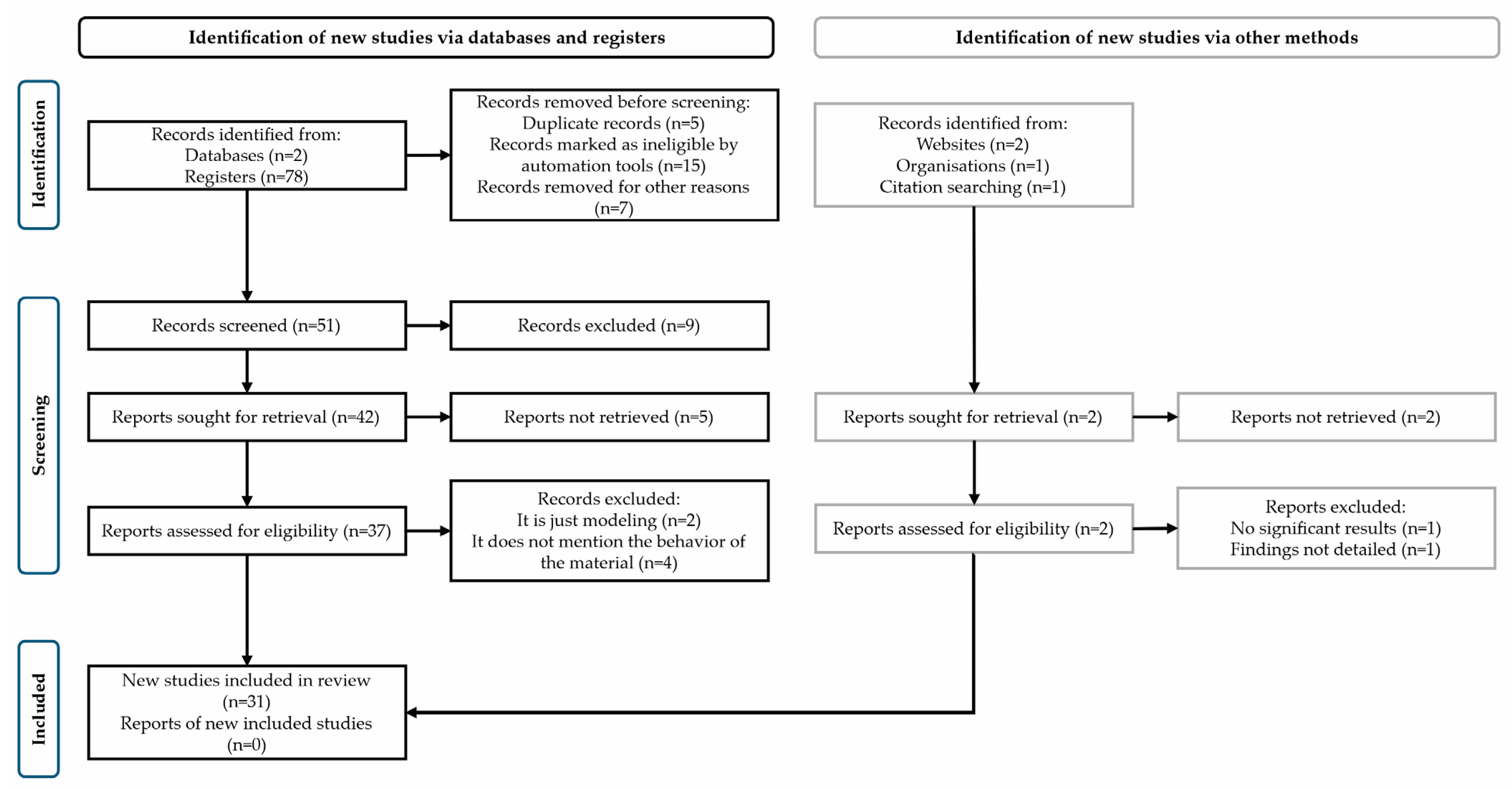
- Haddaway, N.R.; Page, M.J.; Pritchard, C.C.; McGuinness, L.A. PRISMA2020: An R Package and Shiny Application for Creating PRISMA 2020—Compliant Flow Diagrams, with Interactivity for Enhanced Digital Transparency and Open Synthesis. Campbell Syst. Rev. 2022, 18, e1230. [Google Scholar] [CrossRef]
- Rahane, V.R.; Mate, N.U. Effects of Spent Wash Water on the Properties of Concrete. In Structural Engineering Convention Proceedings; Springer: Singapore, 2023; pp. 317–328. [Google Scholar]
- Bhutto, M.A.; Nasir, M.; Marri, A. Impact assessment of construction materials used in water supply and sewerage infrastructure. Int. J. Energy Environ. Econ. 2024, 32, 75–96. [Google Scholar]
- Teppan, J.P.E. Achieving a 100-Year Design Service Life on Wastewater Projects. In Canadian Society of Civil Engineering Annual Conference Proceedings; Springer: Cham, Switzerland, 2022; pp. 653–665. [Google Scholar]
- Alzgool, H.A.; Shawashreh, A.M.; Albtoosh, L.A.; Abusamra, B.A. Experimental investigations: Reinforced Concrete Beams Bending Strength with Brine Wastewater in Short Age. Civil. Eng. J. 2024, 10, 159–170. [Google Scholar] [CrossRef]
- Kashaija, N.T.; Gável, V.; Gergely, K.; Akos, K.; Kürthy, M.; Szabó, C.; Szabó-Krausz, Z. Deterioration of Cementitious Materials in Wastewater Treatment Plants’ Pumping Stations and Sand-Trap Structures. J. Compos. Sci. 2024, 8, 60. [Google Scholar] [CrossRef]
- Pramanik, S.K.; Bhuiyan, M.; Robert, D.; Roychand, R.; Gao, L.; Cole, I.; Pramanik, B.K. Bio-corrosion in concrete sewer systems: Mechanisms and mitigation strategies. Sci. Total Environ. 2024, 921, 171231. [Google Scholar] [CrossRef]
- Ibrahim, A.M.; Bassuoni, M.T.; Carroll, J.; Ghazy, A. Performance of concrete superficially treated with nano-modified coatings under sulfuric acid exposures. J. Build. Eng. 2024, 86, 108957. [Google Scholar] [CrossRef]
- Xu, W.; Yang, L.; Gao, D.; Tang, J.; Zhang, S.; Meng, Y. Long-term mechanical properties of steel fiber reinforced concrete under sulfuric acid attack. Tunn. Undergr. Space Technol. 2024, 153, 105977. [Google Scholar] [CrossRef]
- Deldar, O.; Akçaoğlu, T.; Ergil, M. Assessing the impacts of treated wastewater on concrete’s mechanical properties and corrosion resistance. Iran. J. Sci. Technol. Trans. Civ. Eng. 2024, 48, 4093–4112. [Google Scholar] [CrossRef]
- Tan, T.Y.; Zhang, A. Study on sewage erosion resistance of nano titanium modified coral concrete. Case Stud. Constr. Mater. 2024, 21, e03936. [Google Scholar] [CrossRef]
- Fang, C.; Achal, V. Enhanced steel corrosion inhibition through microbially induced carbonate precipitation with facultative anaerobic denitrifying bacterium. Case Stud. Constr. Mater. 2024, 21, e03607. [Google Scholar] [CrossRef]
- Rebai, B.; Messas, T.; Mansouri, K.; Mamen, B.; Litouche, B.; Hadji, M.; Berkia, A. Nanomodified Concrete for Harsh Environments: Enhancing Durability Using Nano-Admixtures and Cementitious Nanotechnology. J. Nano-Electron. Phys. 2025, 17, 04034. [Google Scholar] [CrossRef] [PubMed]
- Alazzawi, M.B.; Dawood, J.J.; Abdulkader, N.J. Investigation the Influence of Real and Simulated Sewer Water on Epoxy Resin Modified Concrete Used for Manholes. IOP Conf. Ser. Earth Environ. Sci. 2025, 1507, 012086. [Google Scholar] [CrossRef]
- Chu, H.; Chen, W.; Fang, Y.; Liang, Y.; Long, B.; Zhang, F.; Jiang, L. Effect of CuSO4 content and pH on the mechanical properties and antibacterial ability of copper-plated cement-based material. Cem. Concr. Compos. 2025, 155, 105848. [Google Scholar] [CrossRef]
- Mendizabal, J.; Vernon, D.; Martin, B.; Bajón-Fernández, Y.; Soares, A. Short-term memory artificial neural network modelling to predict concrete corrosion in wastewater treatment plant inlet chambers using sulphide sensors. J. Water Process Eng. 2025, 69, 106821. [Google Scholar] [CrossRef]
- Silva Martínez, P.I.; Meza-de Luna, A.; Rico-Martínez, R.; Arzate-Cárdenas, M.A. Chemical-mechanical behaviour of the surface interaction of mortars prepared at different concentrations of water treated with commercial and recycled steel fibres. Eur. J. Environ. Civ. Eng. 2025, 1–37. [Google Scholar] [CrossRef]
- Słomka-Słupik, B. The danger of soil contamination due to leaky walls of sewage tanks in coking plants—Description of the concrete destruction process. Ochrona Przed Koroz. 2025, 1, 4–14. [Google Scholar] [CrossRef]
- Capuozzo, A.; Tenore, A.; Russo, F.; Frunzo, L. A double free boundary problem on microbially induced corrosion in wastewater concrete. Math. Eng. 2025, 7, 481–504. [Google Scholar] [CrossRef]
- Kong, L.; Sun, Y.; Zhao, W.; Li, J.; Sun, S.; Jiao, H.; Liu, Y. Simulation study of three-stage corrosion of Portland, aluminate, and alkali-activated cementitious materials in sewers. J. Mater. Civ. Eng. 2025, 37, 04024489. [Google Scholar] [CrossRef]
- Kashaija, N.T.; Gável, V.; Iklaga, G.; Alexander, A.; Gergely, K.; Mireisz, T.; Tóth, E. Biodeterioration study of cementitious materials during sewage treatment processes. Water 2025, 17, 459. [Google Scholar] [CrossRef]
- Abbas, S.; Faisal, A.; Khan, M.A.; Nehdi, M.L.; Hameed, R.; Shaukat, S. Systematic state-of-the-art review on precast concrete pipes. Results Eng. 2025, 25, 103826. [Google Scholar] [CrossRef]
- Tarnowski, K.; Bering, S.; Głowacka, A.; Paszkiewicz, O.; Mazur, J. Effect of parameters of biogenic hydrogen sulfide emission on degradation of concrete wells in sanitary sewage systems. Desalin. Water Treat. 2025, 322, 101187. [Google Scholar] [CrossRef]
- Aliyev, M.; Maxmudova, D.; Gurinovich, A.; Tursunov, Z.; Mamadiyorov, S. Study and analysis of corrosion in sewage collectors. E3S Web Conf. 2025, 627, 05008. [Google Scholar] [CrossRef]
- de Andrade Coni, G.; de Figueiredo, A.D.; Salvador, R.P.; Monte, R. In-situ analysis of sprayed concrete in a sewage tunnel lining. Case Stud. Constr. Mater. 2025, 22, e04347. [Google Scholar] [CrossRef]
- Baas, K.; Escalante, D. Corrosion protection for concrete pressure pipe. Assoc. Mater. Prot. Perform. Conf. Proc. 2025, 64, 44–48. [Google Scholar]
- Lin, P.; Yuan, X.; Liu, T.; Yu, X. Degradation of concrete sewer pipes under coupling of corrosion and loads: I. experimental study. Constr. Build. Mater. 2025, 483, 141760. [Google Scholar] [CrossRef]
- Zhang, Y.; Zhu, Z.; Zou, H.; Dai, L.; Liu, H.; Rong, Y.; Han, W. Research on the application of graphene oxide-reinforced SiO2 corrosion-resistant coatings in the long-term protection of water treatment facilities. Processes 2025, 13, 2938. [Google Scholar] [CrossRef]
- Godinho, J.P.; Medeiros, M.H.F.; Neto, A.M.; Lima, V.M.E.; De Souza, D.J. Laboratory–field assessment of concrete exposed to biogenic sulphuric acid: Influence of SCM-based binders on long-term degradation. Constr. Build. Mater. 2025, 493, 143185. [Google Scholar] [CrossRef]
- Ahmed, A.; Ahmed, O.; Al-Fakih, A.; Muhit, I.B. A comprehensive review on the use of reclaimed wastewater in cementitious materials: Fresh, mechanical, microstructure, and durability aspects. Arab. J. Sci. Eng. 2025, 50, 16263–16295. [Google Scholar] [CrossRef]
- Rajiv, K.N.; Reddy, Y.R. Assessment of compressive strength in concrete using secondary treated wastewater, fly ash, and sodium nitrite via machine learning techniques. Asian J. Civ. Eng. 2025, 26, 4351–4365. [Google Scholar] [CrossRef]
- Wang, Y.; Hu, J.; Kou, D.; Li, W.; Liu, Y. Comparative assessment of concrete degradation in sewage pipelines: Biogenic vs. mineral sulfuric acid and sewage liquid. Case Stud. Constr. Mater. 2025, 23, e05169. [Google Scholar] [CrossRef]
- Tang, Y.; Xu, J. Application of microbial precipitation in self-healing concrete: A review on the protection strategies for bacteria. Constr. Build. Mater. 2021, 306, 124950. [Google Scholar] [CrossRef]
- Xu, J.M.; Chen, Z.T.; Cheng, F.; Liu, Z.Q.; Zheng, Y.G. Exploring a cellulose-immobilized bacteria for self-healing concrete via microbe-induced calcium carbonate precipitation. J. Build. Eng. 2024, 95, 110248. [Google Scholar] [CrossRef]
- Zhao, Q.; Ma, C.; Huang, B.; Lu, X. Development of alkali activated cementitious material from sewage sludge ash: Two-part and one-part geopolymer. J. Clean. Prod. 2023, 384, 135547. [Google Scholar] [CrossRef]
- Duan, W.; Zhuge, Y.; Chow, C.W.; Keegan, A.; Liu, Y.; Siddique, R. Mechanical performance and phase analysis of an eco-friendly alkali-activated binder made with sludge waste and blast-furnace slag. J. Clean. Prod. 2022, 374, 134024. [Google Scholar] [CrossRef]
- Kamath, M.; Prashant, S.; Kumar, M. Micro-characterisation of alkali activated paste with fly ash-GGBS-metakaolin binder system with ambient setting characteristics. Constr. Build. Mater. 2021, 277, 122323. [Google Scholar] [CrossRef]
- Zhang, X.; Kong, H.; Yang, G.; Zhu, D.; Luan, X.; He, P.; Wei, G. Graphene-based functional hybrid membranes for antimicrobial applications: A review. Appl. Sci. 2022, 12, 4834. [Google Scholar] [CrossRef]
- Yaragalla, S.; Bhavitha, K.B.; Athanassiou, A. A review on graphene based materials and their antimicrobial properties. Coatings 2021, 11, 1197. [Google Scholar] [CrossRef]
- Dabaleh, A.; Mohammadi, A.; Shojaei, A.; Nematollahzadeh, A. Eco-friendly fumed Nanosilica@Nanodiamond hybrid nanoparticles with dual sustainable self-healing and barrier anticorrosive performances in epoxy coating. ACS Appl. Mater. Interfaces 2024, 16, 5075–5092. [Google Scholar] [CrossRef]
- Thomas, P.; Sahoo, B.N.; Thomas, P.J.; Greve, M.M. Recent advances in emerging integrated anticorrosion and antifouling nanomaterial-based coating solutions. Environ. Sci. Pollut. Res. 2024, 31, 67550–67576. [Google Scholar] [CrossRef]
- Singh, A.K.; Sharma, R.; Kujur, V.S.; Poddar, M.; Kumar, A.; Kumar, S.; Kumar, R. Integration of Nanotechnology and Nanomaterials in Biomaterials Research. Biomater. Connect. 2025, 2, 188313. [Google Scholar] [CrossRef]
- Bhattacharyya, S.K.; Maiti, S.; Das, N.C.; Banerjee, S. Antibacterial and antiviral functional materials based on polymer nanocomposites. In Antibacterial and Antiviral Functional Materials; American Chemical Society: Washington, DC, USA, 2023; Volume 1, pp. 171–202. [Google Scholar]
- Arif, M.; Hannan Zahid, A.; Saghir, S.; Mahsud, A. From sunlight to sustainability: The properties, evolution, and prospects of photocatalytic building materials. Catal. Rev. 2025, 1–72. [Google Scholar] [CrossRef]
- Lima, G.T.D.S.; Silvestro, L.; Tambara Júnior, L.U.D.; Cheriaf, M.; Rocha, J.C. Autonomous self-healing agents in cementitious materials: Parameters and impacts on mortar properties. Buildings 2024, 14, 2000. [Google Scholar] [CrossRef]
- Luhar, S.; Luhar, I.; Shaikh, F.U.A. Review on performance evaluation of autonomous healing of geopolymer composites. Infrastructures 2021, 6, 94. [Google Scholar] [CrossRef]
- Ben, F. Bionanocomposites in Structural Engineering, Building and Construction. In Advanced Bionanocomposite Materials: Innovations for Sustainable Development; Springer Nature: Singapore, 2025; pp. 535–577. [Google Scholar]
- Huseien, G.F.; Nehdi, M.L.; Faridmehr, I.; Ghoshal, S.K.; Hamzah, H.K.; Benjeddou, O.; Alrshoudi, F. Smart bio-agents-activated sustainable self-healing cementitious materials: An all-inclusive overview on progress, benefits and challenges. Sustainability 2022, 14, 1980. [Google Scholar] [CrossRef]
- Hosseinzadeh, A.; Soroush, A.; Shafipour, R. A comprehensive numerical analysis of EQ-induced lateral earth pressure on structures basement walls. Soil Dyn. Earthq. Eng. 2022, 163, 107521. [Google Scholar] [CrossRef]
- Muni, T.; Devi, D.; Baishya, S. Parametric study of lateral earth pressure on rigid retaining walls using ABAQUS. Int. J. Civ. Eng. 2025, 12, 7–14. [Google Scholar] [CrossRef]
- Joseph, J.; Cherian, R.S.; Joshi, D.; Tandel, Y.; Ranjan, R. Analysing the performance of cantilever retaining walls with pressure relief shelves using PLAXIS 3D. In Proceedings of the Indian Geotechnical Conference; Springer: Singapore, 2024; pp. 97–110. [Google Scholar]
- Keshavarz, A.; Khani, F. Active and passive lateral earth pressure with anisotropic seepage effect. Int. J. Geomech 2024, 24, 04024148. [Google Scholar] [CrossRef]
- Nam, D.; Abbas, Q.; Lee, J. A method for estimating coefficient of lateral earth pressure based on cone penetration tests. Soils Found. 2024, 64, 101474. [Google Scholar] [CrossRef]
- Kamiloğlu, H.A. New RSM-FEM–based active lateral earth thrust coefficient determination method for inverted T-type cantilever retaining walls supporting narrow granular backfill. Int. J. Geomech. 2023, 23, 04023187. [Google Scholar] [CrossRef]
- Liang, J.; Zhang, G.; Ba, Z.; Liang, J. Development of a 3D fluid-saturated element for dynamic analysis of two-phase media in ABAQUS based on u–U formed equations. Comput. Geotech. 2021, 139, 104377. [Google Scholar] [CrossRef]
- Guo, B.; Li, Z.; Fu, Q.; Wang, Y.; Huang, D.; Niu, D. Reactive transport modelling of chloride ingress in saturated coral aggregate concrete. Front. Mater. 2021, 8, 755241. [Google Scholar] [CrossRef]
- Wang, J.; Meng, L.; Fan, Z.; Liu, Q.; Tong, Z. Mechanism and modelling of CO2 corrosion on downhole tools. R. Soc. Open Sci. 2019, 6, 181899. [Google Scholar] [CrossRef]
- Dhir, P.K.; Rapicavoli, D.; Panto, B.; Szyniszewski, S. Numerical simulation of the in-plane response of masonry walls retrofitted with “splints and bandages” systems. Eng. Struct. 2025, 342, 120678. [Google Scholar] [CrossRef]
- Ram, I.; Senderovich, S.; Brodsky, A. Experimental and numerical study on the impact of geometrical and mechanical properties of joints on the out-of-plane behaviour of masonry walls. Structures 2025, 75, 108849. [Google Scholar] [CrossRef]
- Fernández, F.; Juajinoy, D.S.C.; Vargas, E., Jr.; Velloso, R.Q.; Dias, D. Basal heave stability analysis of a circular shaft excavation considering FEM, NLA, and MPM approaches. Geotech. Geol. Eng. 2024, 42, 2601–2622. [Google Scholar] [CrossRef]
- Shafna, P.M.; Anjana, T.R. Generalized three-dimensional slope stability analysis of soil using PLAXIS 3D. In Proceedings of the Indian Geotechnical Conference 2019; Springer: Singapore, 2021; pp. 745–752. [Google Scholar]
- Vickneswaran, T.; Ravichandran, N. Performance of geotechnical systems under extreme hydroclimatic events using a new user-defined soil model in PLAXIS. J. GeoEng. 2023, 18, 21–31. [Google Scholar]
- Liu, L.; Fu, S.; Jia, X.; Li, X.; Zhang, L. Modeling the evolution of mechanical behavior in rocks under various water environments. Water 2025, 17, 2983. [Google Scholar] [CrossRef]
- Chen, D.; Feng, J.; Ni, P.; Hao, T. Service life of undersea RC circular lined tunnel subjected to chloride attack. Structures 2025, 73, 108347. [Google Scholar] [CrossRef]
- Shao, W.; Li, Q.; Zhang, W.; Shi, D.; Li, H. Numerical modeling of chloride diffusion in cement-based materials considering calcium leaching and external sulfate attack. Constr. Build. Mater. 2023, 401, 132913. [Google Scholar] [CrossRef]
- Tanhatan Naseri, S.G.; Gucunski, N. Comparative numerical simulation of damage propagation caused by chloride and oxygen diffusion in reinforced concrete slabs. In Proceedings of the International Conference on Transportation and Development 2023, Austin, TX, USA, 14–17 June 2023; pp. 438–448. [Google Scholar]
- Rahman, M.K.; Al-Kutti, W.A.; Shazali, M.A.; Baluch, M.H. Simulation of chloride migration in compression-induced damage in concrete. J. Mater. Civ. Eng. 2012, 24, 789–796. [Google Scholar] [CrossRef]



| Country/Author | Wastewater Type | Scale | CW Structural System | Material-Specific Structural Characteristics | Flow Type | Substrate/Layers | HRT | Surface |
|---|---|---|---|---|---|---|---|---|
| Mexico/Lomeli et al. [20] | Domestic municipal wastewater | Large scale (430.49 m2) | Reinforced concrete and wetland settler with masonry | Concrete and masonry covered with cement-sand mortar; waterproof cells; walls without detailed structural specification | Mixed: VSSF, HSSF, and surface | Layer 1: boleum 5–7″ (40 cm, porosity 8%); Layer 2: 1/2″–11/2″ gravel (35% porosity); total porosity 43% | 3 days | 430.49 m2 |
| Mexico/Monzón-Reyes et al. [21] | Domestic + agro-industrial (coffee) | Large Scale/Complete Treatment Plant | Masonry coated with cementitious waterproofing | It does not specify resistance; it describes construction in masonry covered with waterproof cement-based material | SF (Surface Flow) → HF (Horizontal Subsurface Flow) in series | Red volcanic gravel (3–5 cm); 60 cm base with 5 cm gravel + 3 cm top layer | 4 days | C1: 15 m2, C2: 13 m2, C3: 11 m2, C4: 4 m2 (Total = 43 m2) |
| China/Wang et al. [22] | Slightly polluted lake water (Lake Xijiu) | Pilot | Masonry (brick) | Structure built with bricks, waterproofed with ABS plastic; total depth 1.5 m; Bottom slope 0.5%. | Subsurface Horizontal Flow (HFCW) | Gravel 8–16 mm; porosity 0.40; surface layer 20 cm | 2 days | 16 m3 volume—estimated area ≈ 15.2 m2 |
| Thailand/Koottatep et al. [23] | Septic Sludge (Septage) | Pilot | Ferrocement (walls) + reinforced concrete slab (bottom) | Square unit 5 × 5 m, ferrocement walls, reinforced concrete slab, drainage system with hollow blocks and perforated PVC pipe, ventilation with vertical pipes | Vertical-flow (VF) | 10 cm fine sand (1 mm) + 15 cm gravel 25 mm + 40 cm gravel 50 mm (total 65 cm) | Variable according to phase (impounding 0–12 days; weekly load) | 25 m2 per unit (5 × 5 m) |
| India/Anand et al. [17] | Domestic wastewater (MBBR primary reactor effluent) | Pilot (two stages) | Reinforced concrete | Four rectangular chambers built with reinforced concrete walls and slabs. Dimensions of each module: 4 m × 3 m × 1.2 m. The walls have a cementitious finish and house embedded inlet and outlet pipes. Rigid and watertight system, typical of concrete tanks for French CWs. | French VF CW vertical flow with intermittent feed | First stage: gravel filter medium. Second stage: fine sand filter medium. Macrophytes: Typha latifolia and Canna indica in both stages. | 24 h per stage (48 h total) | 48 m2 total (24 m2 per stage) |
| China/Yi et al. [24] | Synthetic industrial runoff with PAHs (phenanthrene) | Pilot | Concrete-coated masonry (concrete-plastered brick walls) | Rigid rectangular structure (4 m × 2 m × 1 m) built with brick and covered with concrete; reinforced edges; confined and watertight bed | Horizontal Subsurface Flow (HSSF) | 30 cm coarse gravel (20–30 mm); 30 cm fine sand (2–3 mm); 20 cm upper floor; Gravel inlet area 40–60 mm | Not explicitly reported (hydraulic load: 0.128 m3/m2/day) | 8 m2 |
| China/Deng et al. [25] | Mixed domestic-industrial | Full-scale | Combined concrete + masonry structure (rigid hydraulic cells with concrete walls and sections with confined masonry) | CW cells built with reinforced concrete perimeter walls, secondary areas with coated masonry, compacted soil base, and PVC pipe connections. Structural gravel beds of 0.8–1 m. | Hybrid System: VFCW + SFCW + HFCW | VFCW: fine and coarse gravel. SFCW: flooded soil. HFCW: 0.8 m gravel with pipes. | 12–28 h | 5000 m2 |
| China/He et al. [18] | Domestic Wastewater from College Dorms | Pilot | Reinforced concrete (two independent structural tanks: IVF-CW and HSF-CW built on concrete ponds) | Rectangular concrete structures with bottom slopes (0.5% in VF and 1% in HSF); connection between downstream and upstream VF via lower holes; PVC pipe for distribution; confined and watertight beds | IVF-CW: vertical flow down + up; HSF-CW: Intermittent Horizontal Subsurface Flow | Downflow VF: 0.8 m grava (30–50 mm + 10–40 mm). Upflow VF: 0.75 m grava. HSF: 0.6 m grava (30–50 mm + 10–40 mm). | IVF-CW: 1 día; HSF-CW: 2.5 días | IVF-CW: 24 m2 (3 × 8 m); HSF-CW: 24 m2 (3 × 8 m) |
| United States/Bedessem et al. [19] | Groundwater contaminated with petroleum derivatives (BTEX, TPH-DRO, MTBE) | Pilot (4 cells) | Reinforced concrete (cells built within an existing concrete structure, with new concrete partition walls) | Structure: concrete floor 7.9 × 7.9 m; 4 cells of 7.0 × 1.7 × 1.1 m; new concrete walls; insulation with solid foam; perforated PVC pipes for flow distribution and subsurface aeration. | Vertical upflow (main); possibility of horizontal operation; some cells with subsurface aeration | Layers per cell: 0–15 cm wet soil (A and B only); 15–71 cm washed sand; 61–71 cm pea gravel (C and D); 71–86 cm coarse gravel 12.5 mm; geotextile; sand around pipes (86–92 cm) | 0.61–0.76 days (depending on cell) | Usable area per cell: 11.9 m2; Total structure: 7.9 × 7.9 m |
| Author | Polluting Environment Evaluated | Material Studied | Mechanisms of Deterioration Analyzed | Methods/Tests/Models Used | Main Findings | Relevance to CWs |
|---|---|---|---|---|---|---|
| Rahane et al. [47] | Spent wash: pH < 4, high BOD, organic compounds, nutrients, and sulfates | Conventional Concrete and Geopolymer Concrete | Risk of corrosion, sulfate attack, alteration of setting, and mechanical properties | Tests for consistency, setting, slump, compressive strength (IS 10262–2009; IS 1489–2015) | Replacing up to 15% mixing water with spent wash increases resistance by 20%. At >20%, workability and resistance decrease (−6%). Direct effects on plastic and hardened properties | Demonstrate how acidic wastewater alters the mechanical properties of concrete; relevant for CWs exposed to industrial effluents, high organic load, or sulfates. |
| Bhutto et al. [48] | Drinking water and sewer systems, prolonged exposure to sewage, constant humidity, corrosion in pipes and structures | Reinforced concrete, steel, ductile iron, asbestos cement | Degradation of infrastructure due to aging, humidity, corrosion; Accelerated deterioration due to operating conditions | Field study and survey of 12 industry stakeholders; Economic and constructive analysis | The rising costs of materials (cement, steel) and their deterioration cause delays, cost overruns, and reduced structural performance. Emphasizes the need for proper material management and selection | Indirect evidence of the behavior of structures exposed to wastewater and CWs; identifies vulnerability of concrete and metals to corrosion; relevant to CWs with infrastructure exposed to conditions |
| Teppan [49] | Wastewater infrastructure, chronic exposure to wet media, and corrosive chemicals | Reinforced concrete with different protective coating systems (liners) | Premature deterioration due to lack of protection: chemical attack, moisture, internal corrosion, coating failures | Technical-industrial review; chemical and mechanical analysis of protective products; Evaluation of installation and design protocols | Most premature deterioration does not come from the concrete itself, but from poorly installed coatings. Implementing comprehensive protocols and advanced coatings allows for extended service life up to 100 years | Relevant for confirming that CWs require adequate protective coatings to prevent chemical degradation; demonstrates effective strategies for corrosive environments similar to CWs |
| Alzgool et al. [50] | Exposure to brine wastewater with varying concentrations (2.5–15%) | Reinforced concrete (beams with steel in tension and compression) | Initial corrosion of steel, salinity effects on flexural and compressive strength | Experimental tests on 72 beams; immersion in brine; tests at 7, 14, 21, and 28 days; Mechanical evaluation (compression, bending, shear) | Substituting 10% drinking water with brackish water improves strength (22% compression, 2.6% bending). No significant corrosion damage observed in 65 days | It indicates that waters with moderate salinity do not deteriorate the concrete quickly; it provides evidence on initial material performance under chemically aggressive conditions, comparable to CWs with salt loads |
| Kashaija et al. [51] | Exposure to sewage vapors and sewage liquids in pumping stations and sand traps | Cementitious materials (mortar/cement paste) | Formation of secondary minerals (gypsum, ettringite), surface degradation, morphological and mineralogical changes | On-site exposure for 1–7 months; stereoscopic microscopy; SEM; XRD | Wastewater vapors generate greater deterioration than liquid wastewater; intense formation of mineral deposits; accelerated damage in aggressive wet and gaseous environments | High relevance: CWs have areas with humid atmospheres rich in gases. Thus, this study helps to understand deterioration by vapors, not only by immersion. |
| Pramanik et al. [52] | Sewerage environments, presence of H2S, acidification by H2SO4, vapors and residual liquids | Concrete in sanitary infrastructure | H2S → H2SO4 conversion, microbial biocorrosion, chemical degradation, resistance reduction, cementitious matrix dissolution | Systematic review; chemical tests; on-site testing; microbial simulations; Comparative analysis of mitigation techniques | Biocorrosion is a highly destructive mechanism that drastically reduces the useful life; H2S is the critical precursor; special coatings and optimized mixtures are effective in mitigating damage. There is a lack of standardization of methods. | Highly relevant: CWs also produce H2S, SO42−, CO2, and biofilm. This article provides the basis for anti-corrosion strategies and material improvement in CWs. |
| Ibrahim et al. [53] | Aggressive exposure to 5% H2SO4, full immersion, wet-dry cycles in acidic medium | Surface-treated concrete with vinyl ester, vinyl ester + nanocomposites, silane, and colloidal silica coatings | Sulfuric acid attack, mass loss, surface degradation, deterioration of the cementitious matrix, and initial permeability | Acid immersion tests, wet-dry cycles, mass loss measurement, microstructural, mineralogical, and thermal analysis | Vinyl ester coatings and their nanocomposites improved durability by ~64% compared to silane; reduce acid penetration and deterioration; colloidal silica improves performance; Concretes with W/B = 0.60 require more protection. | Very relevant: CWs operate in environments with sulfates, organic acids, CO2, and H2S. This study provides surface protection strategies applicable to walls and slabs in contact with acid effluents. |
| Xu et al. [54] | Prolonged exposure (36 months) to H2SO4 simulating sewer environments; Acid Biogenic Attack | Steel Fiber Reinforced Concrete (SFRC) | Acid corrosion, loss of alkalinity, gypsum formation, progressive deterioration of surface layers, and changes in dynamic modulus | Mechanical testing (cubic compression, axial loading, and bending), morphological monitoring, mineralogical analysis, pH, and damage depth measurements | Corrosion begins after 12 months; at 36 months, the damaged and transition layers reach ~2 mm and ~8 mm; gypsum formation; slight decrease in compressive strength, but improvement in axial loads and flexural strength; Noticeable increase in toughness. | SFRC shows improved resilience under acidic environments similar to those generated in CWs; it demonstrates potential for walls and slabs exposed to anaerobic wastewater and biogenic conditions |
| Deldar et al. [55] | Concrete mixed and/or cured with treated wastewater (TWW) with high chloride content; Accelerated corrosion environment | Conventional concrete subjected to TWW in mixing and curing | Chloride-induced corrosion, decreased mechanical strength, early cracking, loss of steel mass | Mechanical Testing, Porosity, Absorption, UPV, pH, Electrochemical Potentials, Voltage-Accelerated Corrosion | Mechanical strength decreased <10%; after 6 months, he recovered almost to the level of control. However, corrosion was greater (23–25%), with early cracking and greater mass loss in the steel. The use of TWW in curing had minimal additional impact | Demonstrates that treated wastewater, although acceptable for mixing or curing, increases significantly |
| Tan and Zhang [56] | Prolonged exposure (180 days) to sewage, oxalic acid, and seawater environments | Nano-TiO2 Modified Coral Concrete | Chemical erosion, dissolution of Ca(OH)2, formation of expansive compounds (Mg(OH)2), loss of mass, reduction in resistance | Tests for compressive and bending strength, mass loss, corrosion coefficient, XRD, and SEM | Nano-TiO2 (4%) improved compression (+22%), flexural (+33%), and erosion resistance in a wastewater environment. Aggressive environments (oxalic acid, MgCl2) reduce resistance and increase mass loss. Nano-TiO2 densifies the matrix, but certain media generate expansive products. | Relevant: demonstrates that nano-modified admixtures can improve the durability of concrete in contact with wastewater, and evidences the adverse effects of acidic and saline environments similar to conditions in CWs of industrial effluents. |
| Fang and Achal [57] | Aerobic and anaerobic environments, high salinity (0–5%), pH variation (7.5–11.5), nitrate waters | Q235 Carbon Steel + Calcium Carbonate Microbial Bioprecipitation | Non-ureolytic MICP (via denitrification), corrosion inhibition, protective CaCO3 precipitation | Tapel electrochemical assays, pH variation, Ca2+ concentrations, precipitation tests, and microbial analysis | The bacterium Stutzerimonas stutzeri CF3 generates CaCO3 even in aggressive environments, improves the corrosion resistance of steel, and has high adaptation to extreme conditions (variation in pH, salinity, and nitrates). High effectiveness in anaerobic and saline environments. | It demonstrates that microbial processes can protect materials in humid, anoxic, and high-salinity environments, very similar to the internal conditions of CWs. It supports the development of self-protective and self-healing concretes. |
| Rebai et al. [58] | Domestic wastewater, seawater (high salinity), acid solutions (sulfates and chlorides) | Conventional concrete and nano-modified concrete with additives (PCE superplasticizers, Vinsol resin, gluconate) | Deterioration by sulfation and chloruriation, microcracking, dissolution of portlandite, formation of ettringite; Pore refinement protection mechanisms, electronic barriers, controlled aeration, and optimized hydration kinetics | ASTM/EN Durability Testing, SEM-EDS, XRD, Mercury Porosimetry | Conventional concrete loses 25% strength in 56 days in seawater; The nano-modified concrete reduces loss by 15% and improves durability by 40%. Reduces pore size (<50 nm), inhibits ettringite, and has low absorption. Nano-modifier additives block ion pathways and produce protective micro-bubbles | Mentions how cementitious nanotechnology can improve durability in sulfated, chlorinated, and acidic environments, similar to those that occur in wet and anaerobic CW zones. Useful for proposing reinforced concretes for distribution chambers, canals, and wetland structures exposed to aggressive wastewater. |
| Alazzawi et al. [59] | Real and simulated wastewater (sulfates, chlorides, phosphates, H2S, ammonium) | Portland concrete with and without epoxy resins (2–6% of cement) | Deterioration by chemical attack, ionic penetration, gasification (H2S), susceptibility to corrosion; Mechanisms of protection by epoxy coatings | Immersions in real and simulated wastewater; chemical analysis of water; Permeability, Penetration, and Compressive Strength Tests | The 4% epoxy resin reduced the loss of compressive strength (~19.55% in real wastewater), representing the most stable mixture. In simulated wastewater, resistance increased by 11% with 2% resin. Water absorption decreased by 0.96% with 6% resin. H2S and salts increase chemical damage in concrete without additives | The anaerobic environments of CWs can generate H2S and similar salts. Hence, epoxy resins appear as an option for distribution chambers, lids, walls, and areas of prolonged contact with wastewater. |
| Chu et al. [60] | Microbial Induced Corrosion (MICC) in Wastewater Transport Systems | Hardened cement paste coated with copper by chemical electrodeposition | Protection against MICC by means of metal coatings (Cu/CuO); effect of pH and CuSO4 concentration on compaction, hardness, and bonded mass | Chemical plating without electricity; variation in CuSO4 concentration (0–10 g/L) and pH (7–11); Vickers hardness tests, SEM microscopy, antibacterial analysis | CuSO4 = 10 g/L produced the densest coating (0.3% mass gain) and hardness of 212 HV. pH = 9 generated the highest coating quality. The coated surfaces showed great density, compaction, and improved antibacterial properties, reducing the risk of MICC | CWs can generate environments conducive to MICC in anaerobic or biofilm zones. Cu coatings could be an alternative for elements submerged or exposed to aggressive biofilm. |
| Mendizabal et al. [61] | Environments with high sulfur (H2S) loads; WWTP entrance chambers; Pressurized sewer system | Sulfide-exposed concrete infrastructure in WWTP inlet chambers | Accelerated corrosion due to generation and accumulation of H2S; identification of sources; Predictive Modeling for Corrosion Management | Sulfide sensors (data every 5 min); ANN–LSTM for H2S prediction; analysis of sulfur loads (kg/day); H2S–flow correlation | RM1 had higher sulfide loads (3.6–4.2 kg/day). H2S showed an inverse pattern with the flow. The LSTM model predicted H2S concentrations with RMSE = 0.34 and NSE = 0.57. The approach enables early warning and early control systems to reduce corrosion | CWs have anaerobic zones where H2S can be generated. Sulfide prediction allows anticipating periods of greater aggressiveness and planning maintenance and selection of materials in CWs |
| Silva Martínez et al. [62] | Treated domestic wastewater; increasing concentrations (0–100%); presence of phosphates, nitrates, nitrites, sulfates, and chlorides | Recycled steel fiber reinforced mortars (tire wire) and commercial 4D fibers | Fiber corrosion; loss of adhesion; chemical changes in surface sediments; degradation by aggressive anions | Pull-out tests, chemical sediment analysis, two-way ANOVA, repeated ANOVA, t-tests | The best mechanical performance was with 50% treated wastewater + recycled fibers (A50-1). The greatest degradation was with 100% wastewater + 4D fiber (B100-2). Corrosion was 4.13% in A50-1 and 1.53% in B100-2. Aggressiveness is associated with phosphates, nitrates, nitrites, sulfates, and chlorides. | It shows that the chemical composition of the treated influent can significantly modify the durability, especially due to the content of aggressive anions also present in CWs. It provides evidence on fiber-wastewater interaction in cementitious matrices. |
| Słomka-Słupik [63] | Industrial coking wastewater; solution of NH4Cl (ammonium + chlorides), highly aggressive compounds | Hardened Cementitious Paste/Concrete in Wastewater Tanks | Dissolution of calcium phases (Ca(OH)2, C-S-H), formation of corrosion products: gypsum, secondary calcite, secondary ethringite, thaumasasite; Corrosion Front Advance | Accelerated immersion in NH4Cl; mineralogical analysis (identification of phases); Temporary observation of the advance of the corrosive front | NH4+ and Cl− generate strong chemical degradation. The corrosion front advances over time and completely transforms the microstructure. Expansive minerals are formed that disintegrate the surface area. A model is proposed to estimate the destruction of tanks exposed to solutions with ammonium and chlorides | Ammonium and chloride ions are also present in sewage and anaerobic effluents, characteristic of CWs. Provides evidence on accelerated dissolution of concrete under environments rich in ammonium salts, common conditions in septic areas and wetland loading chambers |
| Capuozzo et al. [64] | Wastewater with H2S, SOB microorganisms, and sulfuric acid generated by biological oxidation | Concrete in sewage pipes; Concrete–Biofilm Interaction | Microbial Influenced Corrosion (MIC), SOB Biofilm Growth, Gypsum Formation, Sulfuric Acid Penetration, Corrosion-Free Double Front | 1D mathematical model of diffusion-reaction; two free borders (biofilm and gypsum layer); Stefan-type equations; Numerical simulations | SOB growth oxidizes H2S and generates H2SO4 that moves into the concrete. The plaster layer progresses over time. The model identifies key factors: CaCO3 concentration, acid diffusion, biofilm dynamics, and H2S levels. Under specific conditions, biofilms can act as a protective partial barrier, limiting acid diffusion | CWs can generate anaerobic environments where H2S, a precursor of biogenic corrosion, is formed. This article provides tools to model MIC in infrastructure exposed to H2S effluents and is applicable to chambers, pipes, tanks, and septic areas associated with CWs |
| Kong et al. [65] | Typical sequential environments of wastewater pipes: abiotic neutralization, neutral conditions, and acidophilic biological attack | Mortars: OPC (Portland), CAC (calcium aluminate), and AAM (alkaline-activated fly ash) | Acid-base neutralization, biogenic attack (acidophilic bacteria), mass loss, loss of strength, biofilm formation, staged corrosion progression | Simulated Stage Test (3 Phases), Mass Loss/Strength Measurement, Visual Evaluation, Neutralization Depth Analysis, 2-Stage Linear Model (Start + Progression) | Alkaline-activated mortars (AAMs) showed better performance: less loss of mass and strength, less adhesion of biofilms, and a more integral appearance. However, there is a greater neutralization depth compared to OPC. Estimated shelf life: AAM ≈ 2.5 times greater than OPC, and higher than CAC | It suggests that alternatives to Portland concrete (such as AAM) can increase durability in wet, anaerobic, or biogenically attacked environments, which are very common in CWs; Applicable for internal structures, pre-treatments, chambers, and areas with biomass accumulation. |
| Kashaija et al. [66] | Wastewater treatment plant; real exposure in sand-trap (liquids + biofilms); Exposure times 10–240 days | Concretos: Portland (PC) y calcium sulfoaluminate cement (CSAC) | Microbial biodeterioration, biofilm-cement interaction, ettringite and calcite formation, mass loss, mineralogical changes | In situ; prolonged exposure; microbial analysis (16S rRNA of bacteria and archaea); mineralogical and geochemical analysis; Statistical correlation | CP showed progressive deterioration, correlated with the abundance of acidogenic and sulfate-reducing bacteria (>50% of the community at 75 days). CSAC showed remarkable resistance, with very low biodeterioration. Dominance of Gammaproteobacteria, Bacilli, Clostridia, Bacteroidia, Campylobacteria, Actinobacteria, and Desulfovibrionia | Evidence that certain alternative cements (CSACs) can resist wet, anaerobic, and acidic environments similar to those of CWs. It suggests that PC is vulnerable to biodegradation and that alternative compositions could improve wetland structures. |
| Abbas et al. [67] | Wastewater transport systems; biogenic attacks on buried pipes; environments with H2S and biogenic sulfuric acid | Precast concrete pipes | Biogenic attack of H2S → H2SO4; internal erosion; degradation by soil-pipe interaction; structural failures by design and manufacture | Systematic review of scientific literature, technical reports, standards, documented failures; tabular analysis and graph of critical factors; Comparison of design methods | Manufacturing is a critical factor in performance. Common failures include cracking, internal erosion, and attack by biogenic sulfuric acid. Direct design outperforms traditional indirect design. More robust quality assessments and long-term monitoring are required to understand deterioration in buried pipes. | Biogenic attack on wastewater pipes is a global problem, and the mechanisms identified (H2S, sulfuric acid, internal erosion) are analogous to the risks in CW structures, especially inlet chambers, sedimentators, and channels. |
| Tarnowski et al. [68] | Sanitary sewer systems with high hydraulic retention; anaerobic environments producing H2S; Manholes and Expansion Chambers | Concrete Pits in Sanitary Sewer Systems | H2S formation → oxidation by SOB → sulfuric acid → sulfated corrosion of concrete | Continuous monitoring of H2S with dual sensors (base and top of the well); analysis of the register of pumping stations logs; Structural Impairment Assessment | Severe degradation observed in just 5 years: from surface film to concrete losses of several centimeters. Within 11 years, some wells were at risk of collapse. The condition of the well did not depend on the maximum peak of H2S, but on the total cumulative exposure time. Measured values exceeded the sensor range (>500 ppm). The system’s hydraulic retention raised H2S emissions. | The presence of anaerobic zones + prolonged retention periods also occurs in deep or poorly ventilated CWs. Cumulative corrosion by H2S can compromise feed chambers, settlers, and maintenance records in CWs. This indicates the need for gas control and monitoring. |
| Aliyev et al. [69] | Untreated urban networks; uncontrolled industrial wastewater; environments with corrosive gases (H2S, CO2, NH3), humidity and flow blockage | Reinforced concrete collectors and pipes in urban systems | Chemical and biogenic corrosion by gases; surface degradation of concrete; loss of coating due to acid attack; effect of ventilation on gas concentration; Impact of untreated industrial dumping | Field analysis in deteriorated networks; identification of failure modes; review of coating and ventilation technologies; Crash Evaluation | The absence of treatment and the discharge of industrial effluents generate severe corrosion and blockage of collectors. Surface degradation is reported due to the action of corrosive gases and environmental contamination. Durability can be improved through coatings (mastics, paints, liners), material enhancement, and natural or forced ventilation to dilute gases such as H2S. | CWs that receive industrial or non-pretreated effluents may exhibit accelerated degradation in concrete chambers. It reinforces the need for ventilation and protective coatings for inlet structures and pipes connected to wetlands. |
| de Andrade et al. [70] | Sewerage tunnel with a sulfate-rich environment; permanent humidity; corrosive gases typical of the sanitary system | Shotcrete used as a lining in tunnels | Secondary ettringite formation in air vacuums; sulfate penetration; increased water absorption; differential degradation between primary and secondary layers; weak areas from trapped pores | Video inspection; core extraction; physical-mechanical analysis; chemical, mineralogical, and microstructural characterization; Degraded Depth Analysis | A sulfate-rich environment generated ettringite formation up to 8 mm in the shotcrete, especially in trapped pores. High water absorption and reduced resistance were detected at the interface between the two layers of shotcrete, identified as a critical point of failure. The mechanical tests showed high dispersion, but the microstructural characterization allowed for measuring the degradation depth with high precision. The study underlines the difficulty of evaluating concrete thrown when there is no complete information on the construction process. | Relevant when CWs use shotcrete structures (chambers, shafts, tunnels). He points out that shotcrete is vulnerable to sulfates, especially if there is trapped air. It reinforces the importance of porosity and layer control during construction to avoid weak points in wet and sulfated areas of wetlands. |
| Baas and Escalante [71] | Drinking water and wastewater conduction systems; aggressive environments (sulfates, chlorides, CO2, H2S) | Pressurized Concrete Pipe (CPP) | Chemical corrosion (acid attack, sulfates, chlorides); biogenic corrosion; inherent mechanisms for the protection of concrete; supplementary methods (coatings, liners, inhibitors, cathodic protection, internal barriers) | Technical review; compilation of industrial practices; Comparative analysis between protection methods | Pressurized concrete pipe possesses inherent corrosion resistance properties due to its alkalinity and mortar coating. However, in extremely aggressive environments, additional systems are required, such as internal coatings, polymeric liners, cathodic protection, and reinforced structural design. More than 80 years of use show its durability when proper controls are implemented. The study summarizes criteria for the selection of protection systems depending on the level of aggressiveness of the wastewater or drinking water. | It provides relevant criteria for selecting coatings and protection methods for hydraulic structures in CWs exposed to sulfates or H2S. Useful for inlet chambers, distribution tanks, and pipes connected to wetlands at risk of corrosion. It reinforces the importance of design and coatings in wet/aggressive environments typical of CWs. |
| Lin et al. [72] | Hydrogen sulfide (H2S); typical sewer environment; Mechanical loads (compression + bending moment) | Sewer concrete pipes | Biogenic corrosion by H2S; mechanical degradation due to loads; load-corrosion coupling; Loss of stamina | Development of an experimental apparatus to simultaneously apply loads and H2S; 180 samples tested; compressive and flexural strength tests; H2S vs. H2S + loading Comparison | Deterioration due to the coupling of loads + H2S increases the loss of strength by more than 10% compared to corrosion alone. The effect increases with longer exposure time, higher load, and higher concentration of H2S. If the charge is doubled, the mating effect increases by 1.6 times. Structural loads accelerate chemical degradation. It offers criteria to predict the useful life of pipes. | Fundamental for CWs because it demonstrates that structures subjected to loads (soil weight, water columns, pulsating flow, settlements) suffer accelerated deterioration when exposed to H2S from the pretreatment or anaerobic chambers. Relevant to the design of distribution boxes, wells, settlers, and concrete structures in CWs. |
| Zhang et al. [73] | Complex acidic, alkaline, and ionic environments; prolonged immersion in industrial process wastewater; presence of aggressive ions (Cl−, SO42−, etc.) | Concrete and steel in reaction tanks; GO/SiO2 coatings | Ionic corrosion; detachment of concrete; corrosion of steel by aggressive ions; protection by graphene oxide nano-coatings + SiO2 | Preparation of GO/SiO2 coatings; accelerated immersion tests; permeability measurement; ion leaching analysis; Tests under “Extreme Corrosion Environments” | Uncoated samples showed high ionic leaching, decreased permeability, and significant degradation of concrete. GO/SiO2 coatings showed high stability, reduced leaching, increased resistance to acidic/alkaline environments, and improved performance as GO content increased. GO increases resistance to ionic penetration and chemical stability. | Very relevant for CWs: it shows that nanocoatings based on oxygen–silicon and graphene can protect structures exposed to aggressive wastewater. It provides innovative alternatives to protect sedimentators, distribution chambers, inlet boards, pretreatments, and contact tanks where there is high chemical corrosion. |
| Godinho et al. [74] | Environments with biogenic sulfuric acid (H2SO4 generated by sulfur-oxidizing bacteria); controlled chemical conditions + real environment in treatment plant; Continuous exposure 950 days | Reinforced Concrete with Supplemental Cementitious Additions (SCM): Fly Ash (FA), Commercial Crystallizing Additives, Sodium Silicate Solution | Biogenic acid attack; dissolution of portlandite; plaster formation; progression of the neutralization front; mechanisms of “chemical buffering”; Phase stabilization (hemicarbonate, hydrotalcite) that increases resistance | Compressive strength tests; loss of mass; neutralization depth; mapping of surface degradation by images; SEM–EDX; XRD; thermodynamic modeling GEMS/Cemdata18; Simultaneous laboratory-field exposure for 950 days | Fly ash significantly reduced degradation and mass loss under chemical and biogenic attack. The crystallizing additives showed little improvement under chemical conditions, but they did increase resistance in real biogenic environments. Thermodynamic modeling explained that durability is improved by (1) depleting portlandite, (2) saturating gypsum, and (3) stabilizing hemicarbonate/hydrotalcite. A unique connection was generated between laboratory degradation and the real field. | CWs generate biogenic environments with sulfates, sulfides, low pH, and S-oxidizing microorganisms. The findings demonstrate that: FA and SCM reduce acid damage, crystallizing additives work better under real biological conditions, and stable phase formation (hydrotalcite) increases shelf life. Provides guidelines for selecting strong cements in CWs. |
| Ahmed et al. [75] | Domestic, treated municipal, industrial wastewater and its chemical components: TDS, suspended solids, BOD, COD, chlorides, sulfates | Concrete and mortars made from wastewater (WW) as a partial or total replacement for drinking water | Variation in workability and strength; chemical effects (TDS, chlorides, sulfates); increased porosity; risk of corrosion of the reinforcement; reduction in C–S–H formation; Increased micro-cracks | Bibliometric review (Bibliometrix/Biblioshiny); systematic analysis of 91 studies; SEM for microstructure; Collection of mechanical results (strength, porosity, absorption, chloride diffusion) | 45% of studies report improvements in endurance when using WW; 35% moderate increases; 20% unchanged. However, greater replacement with WW increases porosity, absorption, and diffusion of chlorides, affecting durability. The microstructure showed lower C–S–H and more voids. The effects are strongly dependent on the chemical composition of WW. Sulfate and acid resistances are poorly studied. Specific analyses are required according to the type of WW. | CWs generate treated wastewater with high chemical and biological loads, similar to those used in WW. The study shows that wastewater can affect porosity, chloride/sulfate diffusion, and microstructure, which impacts the durability of concrete in wetlands. Indirect evidence for selecting mixtures resistant to WW and aggressive environments. |
| Rajiv et al. [76] | Secondarily treated wastewater (STW) from municipal plants; Typical chemical variations of post-treatment effluents | Concrete made of: STW as mixing water, 10% fly ash (FA), and 1–3% sodium nitrite (corrosion inhibitor) | Decrease in workability due to chemical composition of the STW; changes in mechanical strength; possible protective effect of sodium nitrite against corrosion | Slump test, compressive strength, indirect stress, bending; ML models (Random Forest, etc.) for resistance prediction | Workability 25% with STW. Strengths only decrease marginally: compression −2.91%, tension −4.95%, bending −1.75%. The changes are attributed more to FA and NaNO2 than to wastewater. The Random Forest model showed high prediction (R2 = 0.87). It is demonstrated that STW can replace drinking water without significantly compromising performance. | CWs generate treated water that is secondarily similar to STW. The study shows that these waters have a low negative impact on resistance, but they do affect the workability and initial microstructure. It confirms the feasibility of using concrete exposed to treated wastewater in CW structures. The use of inhibitors (nitrite) can be key for environments with sulfide and chlorides. |
| Wang et al. [77] | Biogenic sulfuric acid (MICC), sulfuric mineral acid, and actual sewage liquid; Areas above and below the sewage level | Sewer Pipe Concrete | Microbial Induced Corrosion (MICC), Mineral Sulfuric Acid Attack, Thickness Loss, Microstructural Degradation, Neutralization Depth | Advanced microscopy, kinetic degradation analysis, immersion tests (90 and 525 days), corrosion face characterization, zone comparison (over/low level) | MICC produced 7.8 mm loss in 525 days; H2SO4 ore produced 4.46 mm in 90 days; immersion in real wastewater generated almost zero corrosion; the neutralization depth was 0.68 mm (MICC), 0.98 mm (ore), and 1.22 mm (sewage). | It provides a comparison of relevant corrosion mechanisms in environments with sulfates and H2S; useful for providing concrete durability in hydraulic components and structures exposed to acid effluents associated with CWs. |
| Author | Type of Modeled Structure | Method/Software | Analyzed Variables | Applicability to CWs |
|---|---|---|---|---|
| Hosseinzadeh et al. [94] | Embedded basement walls (buried structures) | Dynamic finite element analysis (FEM)—soil–structure interaction | Dynamic lateral earth pressures, excavation depth, topography, geotechnical parameters, and number of levels | Useful for estimating lateral pressures on concrete walls of buried or rigidly confined CWs, considering seismic effects and soil–structure interaction |
| Muni et al. [95] | Rigid retaining walls subjected to lateral pressure | FEM using ABAQUS | Internal friction angle (ϕ), dilatancy angle (ψ), active and passive pressure distribution, AFR and NAFR effects | Provides criteria to model lateral pressures on concrete walls of CWs (HSSF/VSSF) and to optimize analyses considering the influence of the dilatancy angle of saturated substrates |
| Joseph et al. [96] | Cantilever retaining walls with relief shelves | PLAXIS 3D (geotechnical FEM) | Displacements, maximum shear force, maximum bending moment, wall height, shelf length, multi-criteria analysis | Helps assess stress reduction in CW structural walls through optimized geometries; useful for designing concrete walls subjected to lateral pressure from saturated substrates |
| Keshavarz and Khani [97] | Soil–structure retaining wall under lateral pressure with anisotropic seepage | UBM (Upper Bound Method), FELA (Finite Element Limit Analysis), SCM (Stress Characteristic Method) | Active and passive earth pressures, anisotropic hydraulic conductivity, soil friction angle, soil–wall friction, stress distribution, and failure zones | Enables estimation of lateral pressures on CW walls under saturation and preferential flow conditions; useful for modeling water–substrate–wall interaction and evaluating stability in wetlands with hydraulic gradients |
| Nam et al. [98] | Stress state in confined soil (K0) assessed by cone penetration testing (CPT) | Vertical and inclined CPT tests + CEL-FEM (Coupled Eulerian–Lagrangian) | Cone resistance (qc), cone inclination (θ), relative density (DR), estimation of at-rest lateral earth pressure (K0) | Allows estimation of K0 for CW substrates, useful for modeling soil–wall interaction, evaluating lateral loads on concrete or masonry structures, and improving the design of confined cells |
| Kamiloğlu [99] | Inverted T-shaped cantilever retaining walls with narrow granular backfill | FEM + RSM (Finite Element Method + Response Surface Method) + physical tests using particle image velocimetry | Soil friction angle (φ), soil–wall friction (δ), heel length (β), foundation thickness (α), backfill inclination (ψ), backfill width (θ), failure patterns, and active thrust | Enables modeling of lateral earth pressures on rigid walls similar to concrete/masonry CW walls; useful for estimating lateral loads from saturated substrates and evaluating structural safety of hydraulic cells |
| Liang et al. [100] | Saturated porous media (two-phase 3D elements: water–soil) | ABAQUS (custom 3D element via u–U subroutine) + implicit integration algorithm | Fluid–solid dynamics, soil nonlinearity, pore-pressure–deformation coupling, transient response, validation against analytical solutions | Enables hydro-mechanical modeling of saturated substrates in CWs, particularly for estimating deformations, dynamic consolidation, and fluid–solid coupling in walls and structural beds |
| Guo et al. [101] | Saturated structural concrete (CAC: coral aggregate concrete) subjected to chloride ingress | COMSOL Multiphysics + PHREEQC coupled via MATLAB | Reactive chloride transport, pH variation, salt precipitation (Friedel’s salt, Kuzel’s salt), penetration profile evolution, chemical changes under saturation | Enables modeling of chloride ingress and chemical degradation of concrete in CWs exposed to saline wastewater or aggressive environments; useful for assessing structural durability and service life of walls and slabs |
| Wang et al. [102] | Metallic tools and components subjected to CO2 corrosion in humid environments | CO2 corrosion model validated by SEM, EDS, XRD, and polarization curves | Lattice structure and crystallinity of corrosion products, electrochemical mechanisms, corrosion rate, and humid environment effects | Provides insight into accelerated corrosion mechanisms in CO2-saturated environments, analogous to processes affecting concrete walls or slabs in CWs exposed to wastewater with high CO2 loads and acidic compounds |
| Dhir et al. [103] | Unreinforced masonry (URM) walls retrofitted with “splints and bandages” systems | Continuum FEM (Abaqus) + DMEM (HiStrA) + comparison with mesoscale FE model | In-plane behavior, load–displacement curves, fracture energy, tensile failure, material calibration, damage mechanisms | Useful for modeling masonry structural walls in CWs, particularly to evaluate band-reinforced systems, lateral loads from saturated substrates, and calibration of mechanical parameters in heterogeneous materials |
| Ram et al. [104] | Masonry walls with interlocking hollow blocks and adhesive or mortar joints | Micro-scale FEM + explicit mesoscale model (software not specified, experimentally validated) | Block geometry, adhesive/mortar mechanical properties, out-of-plane response, block and joint failure, plastic hinge formation, bending and damage | Useful for analyzing masonry walls in CWs using non-conventional materials or adhesives, evaluating stability under saturated substrate thrust, and modeling joint and block failure |
| Fernández et al. [105] | Deep circular excavation (shaft-type cavity) under dry and saturated conditions | FEM, NLA (Numerical Limit Analysis), MPM (Material Point Method) with Strength Reduction Factor (SRF) | Failure mechanisms, failure surfaces, bearing capacity, large deformations, basal stability, behavior under saturation | Useful for modeling failures due to basal and wall instability in CWs constructed in saturated soils, evaluating large ground deformations around CWs, and predicting failure mechanisms under hydraulic loading |
| Hafna et al. [106] | Homogeneous soil slopes (3D slope stability) under dry and partially saturated conditions | PLAXIS 3D (three-dimensional FEM) | Soil cohesion, slope height, safety factor, saturation conditions | Enables modeling of slope stability and lateral slopes of excavated CWs, analyzing sliding failures at edges, and evaluating stability under moisture variations |
| Vickneswaran and Ravichandran [107] | Geotechnical systems subjected to extreme hydroclimatic events (intense rainfall, droughts, coupled flows) | PLAXIS with modified constitutive model (MMC—Modified Mohr–Coulomb) and coupled flow–deformation modeling | Slope safety factors, temporal stress variation, settlements of shallow and deep foundations, and hydro-mechanical response under extreme rainfall | Useful for modeling hydro-mechanical responses of CWs under full saturation, extreme rainfall, or droughts, predicting deformations in retaining walls, differential settlements, and stability under variable hydraulic loads |
| Liu et al. [108] | Rock slopes subjected to prolonged infiltration and saturated environments | Coupled hydro-mechanical model with nonlinear creep law (proprietary numerical implementation) | Strength degradation due to saturation, elastic modulus reduction, cohesion loss with pore pressure, and accelerated creep deformation | Relevant for long-term analysis of CW walls and foundations exposed to permanent saturation; useful for predicting time-dependent deformations, stiffness loss, and combined effects of moisture and hydraulic loads |
| Chen et al. [109] | Reinforced concrete (RC) circular tunnel subjected to chloride attack in a marine environment | Multi-stage analytical model validated with COMSOL Multiphysics (diffusion–corrosion–structural deterioration) | Chloride transport, steel corrosion rate, corrosion product volume, corrosion-induced deformations, concrete mechanical parameters (E, ν, porosity, w/c) | Highly useful for concrete CWs exposed to wastewater, enabling prediction of service life, corrosion initiation and propagation, deterioration due to moisture and contaminants, and oxide-induced deformations in walls and slabs |
| Shao et al. [110] | Reinforced concrete (cement-based materials) subjected to chloride diffusion, calcium leaching, and sulfate attack | Coupled numerical model implemented and verified in COMSOL Multiphysics | Porosity, calcium leaching, chloride diffusion, sulfate attack, disruption of bound chlorides, evolution of expansive products | Highly applicable to concrete CWs exposed to chemically loaded wastewater; enables evaluation of sulfate degradation, leaching, porosity increase, and reduction in structural service life in walls and slabs under constant effluent contact |
| Tanhatan Naseri and Gucunski [111] | Reinforced concrete slabs subjected to chloride and oxygen diffusion | Comparative numerical modeling (software not specified, diffusion- and damage-based simulations) | Oxygen vs. chloride diffusion, cracking patterns, corrosion rate, time to reach critical state | Useful for understanding damage propagation by aggressive ions (e.g., chlorides and oxygen) in concrete CW walls and slabs exposed to wastewater; allows evaluation of accelerated cracking, degradation, and service life reduction |
| Rahman et al. [112] | Concrete with compression-induced damage affected by chloride migration | Multiphysics FEM (phenomenological model + Nernst–Planck equations) | Chloride diffusion coefficient, compressive stress-induced damage, chloride–matrix binding, non-steady-state migration | Enables understanding of how mechanical damage in CW concrete walls (due to lateral pressure from saturated substrates) accelerates chloride penetration, compromising durability and promoting corrosion and leakage |
Disclaimer/Publisher’s Note: The statements, opinions and data contained in all publications are solely those of the individual author(s) and contributor(s) and not of MDPI and/or the editor(s). MDPI and/or the editor(s) disclaim responsibility for any injury to people or property resulting from any ideas, methods, instructions or products referred to in the content. |
© 2025 by the authors. Licensee MDPI, Basel, Switzerland. This article is an open access article distributed under the terms and conditions of the Creative Commons Attribution (CC BY) license.
Share and Cite
Sangabriel-Lomelí, J.; Zamora-Castro, S.A.; González-Moreno, H.R.; Moreno-Vázquez, O.; Meza-Ruiz, E.; Ramírez-Vargas, J.R.; Trujillo-García, B.S.; López-González, P.J. Structural Materials in Constructed Wetlands: Perspectives on Reinforced Concrete, Masonry, and Emerging Options. Eng 2026, 7, 11. https://doi.org/10.3390/eng7010011
Sangabriel-Lomelí J, Zamora-Castro SA, González-Moreno HR, Moreno-Vázquez O, Meza-Ruiz E, Ramírez-Vargas JR, Trujillo-García BS, López-González PJ. Structural Materials in Constructed Wetlands: Perspectives on Reinforced Concrete, Masonry, and Emerging Options. Eng. 2026; 7(1):11. https://doi.org/10.3390/eng7010011
Chicago/Turabian StyleSangabriel-Lomelí, Joaquín, Sergio Aurelio Zamora-Castro, Humberto Raymundo González-Moreno, Oscar Moreno-Vázquez, Efrén Meza-Ruiz, Jaime Romualdo Ramírez-Vargas, Brenda Suemy Trujillo-García, and Pablo Julián López-González. 2026. "Structural Materials in Constructed Wetlands: Perspectives on Reinforced Concrete, Masonry, and Emerging Options" Eng 7, no. 1: 11. https://doi.org/10.3390/eng7010011
APA StyleSangabriel-Lomelí, J., Zamora-Castro, S. A., González-Moreno, H. R., Moreno-Vázquez, O., Meza-Ruiz, E., Ramírez-Vargas, J. R., Trujillo-García, B. S., & López-González, P. J. (2026). Structural Materials in Constructed Wetlands: Perspectives on Reinforced Concrete, Masonry, and Emerging Options. Eng, 7(1), 11. https://doi.org/10.3390/eng7010011