1. Introduction
The sustained growth of the global population, together with increasing industrialization and consumption, has exerted considerable pressure on natural resources, leading to an exponential rise in the generation of both urban and industrial solid waste [
1]. This challenge has driven the development of technologies that promote environmental sustainability, circular economy principles, and the efficient use of available resources [
2]. In this context, the design and manufacture of composite materials that incorporate both lignocellulosic and polymeric waste represent a promising alternative, particularly for applications requiring high-performance materials with low environmental impact [
3,
4,
5].
Polymer matrix composites reinforced with natural fibers have attracted significant interest within the scientific community due to their ecological advantages, low cost, and favorable mechanical performance [
5]. Since ancient times, plant fibers have been used to reinforce construction materials, textiles, and tools. However, in recent decades, advances in materials science have enabled systematic studies of these fibers as reinforcing elements in synthetic matrices, particularly in thermoset and thermoplastic polymers [
6]. Recent research has demonstrated that natural fiber-reinforced composites can achieve mechanical properties comparable to those of conventional synthetic materials, with the additional advantage of being biodegradable or recyclable [
3].
The utilization of lignocellulosic residues derived from underutilized or invasive plant species constitutes a sustainable strategy from both environmental and economic perspectives [
6]. One such species is
Arundo donax (giant reed), a plant characterized by rapid growth, high biomass yield, and great adaptability, which has been classified as invasive in various regions worldwide. Despite its favorable morphological and physicochemical characteristics, such as high cellulose content and low density, its industrial application remains limited, resulting in the accumulation of unexploited residues [
7,
8]. The valorization of
Arundo donax as a reinforcement material in polymer composites represents a viable strategy to mitigate its environmental impact while opening new application possibilities in sectors such as construction, automotive, and furniture manufacturing.
Polyurethane (PU), on the other hand, is a polymer widely used across multiple industries due to its versatility, which allows the production of materials with diverse properties, from flexible and rigid foams to elastomers and coatings [
9]. However, its resistance to degradation and complex molecular structure hinder recycling and final disposal, making it an increasingly significant environmental concern [
10,
11]. In this regard, the reintegration of processed polyurethane waste into new composite matrices emerges as an innovative solution that not only reduces waste volume but also enables the development of materials with improved characteristics, leveraging the chemical and structural compatibility between components [
12].
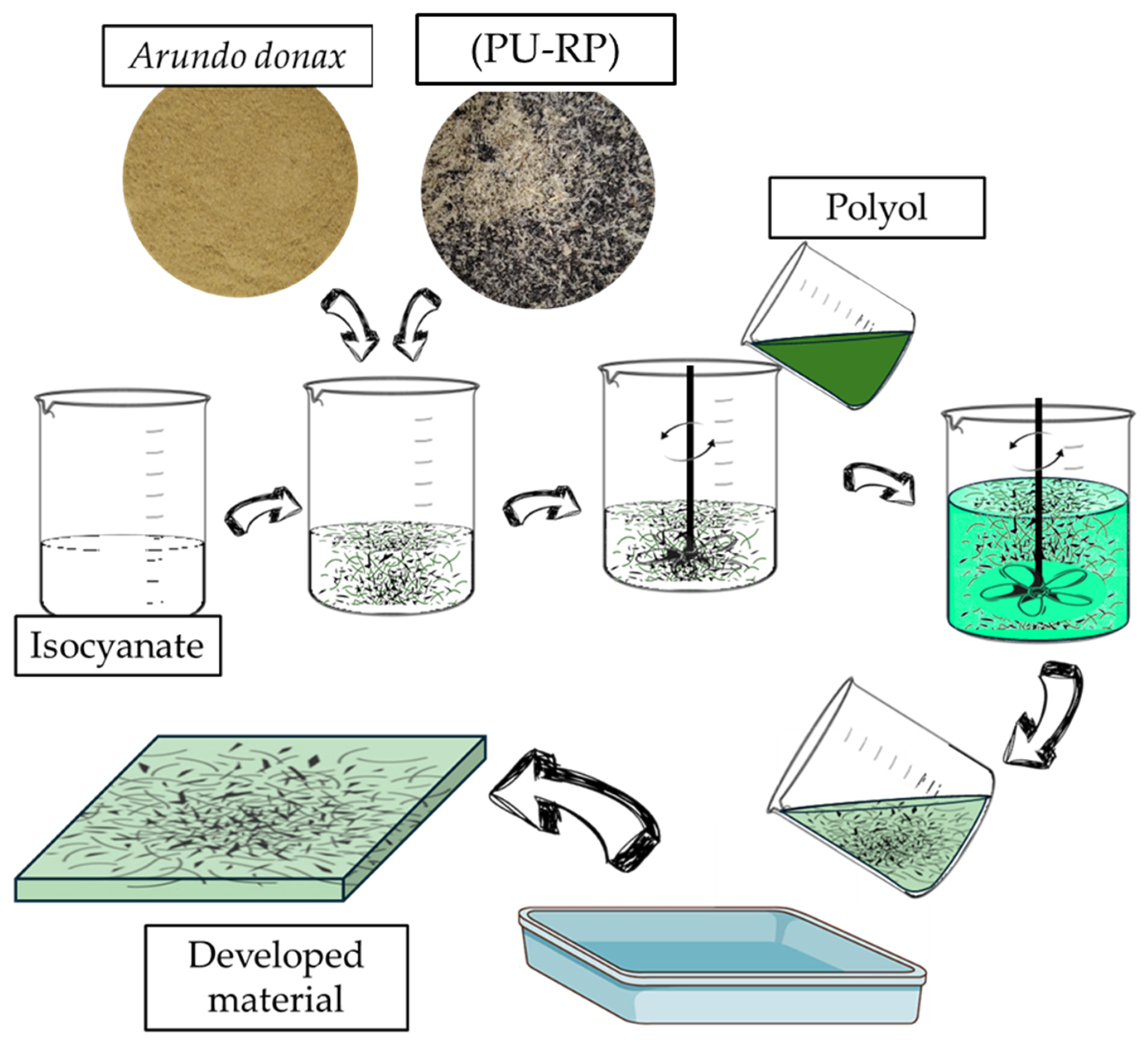
This study proposes to develop hybrid polyurethane matrix composites reinforced with Arundo donax (giant reed) fiber residues and processed polyurethane waste, with the aim of evaluating their mechanical behavior and viability as alternative materials for industrial applications. The approach combines two waste valorization strategies: on the one hand, the use of a non-conventional plant fiber with high lignocellulosic content, and on the other, the recycling of a post-consumer polymer, thereby promoting an integrated approach to waste utilization. The study encompasses the preparation of Arundo donax fibers through cleaning, drying, and conditioning processes, the incorporation of recycled polyurethane particles into the mixture, and the characterization of the final material in terms of its physical, morphological, and mechanical properties. In this way, the study seeks to identify the synergistic potential between both types of reinforcement and their effect on the polymer matrix.
Unlike previous studies that relied on common natural fibers such as bamboo, sisal, or kenaf, the present work is the first to simultaneously incorporate Arundo donax residues and processed polyurethane waste into a virgin polyurethane matrix. This hybrid reinforcement approach specifically investigates the synergistic effects on the mechanical and thermal performance of the resulting material.
The novelty of this study lies not only in the use of an underutilized and highly valorizable lignocellulosic fiber derived from an invasive species, but also in the integration of processed polymeric waste as a co-reinforcement, thereby introducing a new strategy for sustainable composite design. Recent characterization studies have highlighted the strong reinforcement potential of
Arundo donax fibers, which exhibit high cellulose content (≈70%), good thermal stability, tensile strength approaching 900 MPa, and an elastic modulus of approximately 42 GPa—values comparable or superior to those of conventional natural fibers such as sisal or kenaf [
13]. Investigations of
Arundo donax in other polymer systems, including polylactic acid (PLA) and polyethylene (PE) composites, have further confirmed its ability to significantly modify mechanical, thermal, and degradation behavior, although fiber–matrix adhesion and porosity remain critical challenges that require careful control [
14].
By combining these two waste-derived reinforcements, the resulting hybrid composite offers improved performance while addressing two distinct environmental problems: the uncontrolled spread of an invasive plant species and the accumulation of post-industrial polyurethane waste. This dual-valorization strategy simultaneously expands the range of raw materials available to the polymer composites industry and promotes the use of local, underutilized biomass as a strategic resource for sustainable development [
15,
16].
In this context, the present research is highly relevant because it not only contributes to the valorization of lignocellulosic and plastic waste but also drives the development of alternative materials with lower environmental impact and high industrial applicability. It is expected that such hybrid composites will facilitate the transition toward more circular and sustainable production models, broadening opportunities to substitute non-renewable resources with local and renewable alternatives. They also offer a clear pathway for future quantitative life-cycle assessments (LCA) to fully quantify embodied energy and CO2 savings. Moreover, this work aligns with the Sustainable Development Goals (SDGs), particularly SDG 9 (Industry, Innovation and Infrastructure), SDG 12 (Responsible Consumption and Production), and SDG 15 (Life on Land), by promoting technological innovation, efficient resource utilization, and the sustainable management of invasive species. Although the thermal conductivity obtained is higher than that of conventional commercial insulation materials, the developed material is intended for non-critical applications where sustainability and the use of agro-industrial residues are the main priorities. These applications include interior panels, ecological coatings, low-thermal-demand components, and bio-based alternatives within construction systems.
3. Results
3.1. Apparent Density
The apparent density of the composites was determined gravimetrically according to ASTM D792. Mean values and standard deviations are reported in
Table 3.
The formulations displayed apparent densities ranging from 0.287 to 0.420 g/cm3. Sample B2 exhibited the highest density (0.412 g/cm3), which aligns with its maximum flexural strength value and indicates greater internal compactness and reduced porosity. This behavior supports the direct relationship between apparent density and structural stiffness in cellular materials and polymer-matrix composites. Likewise, the C-series samples showed higher densities than the A-series, which is consistent with the increased amount of reinforcement incorporated.
3.2. Flexural Strength
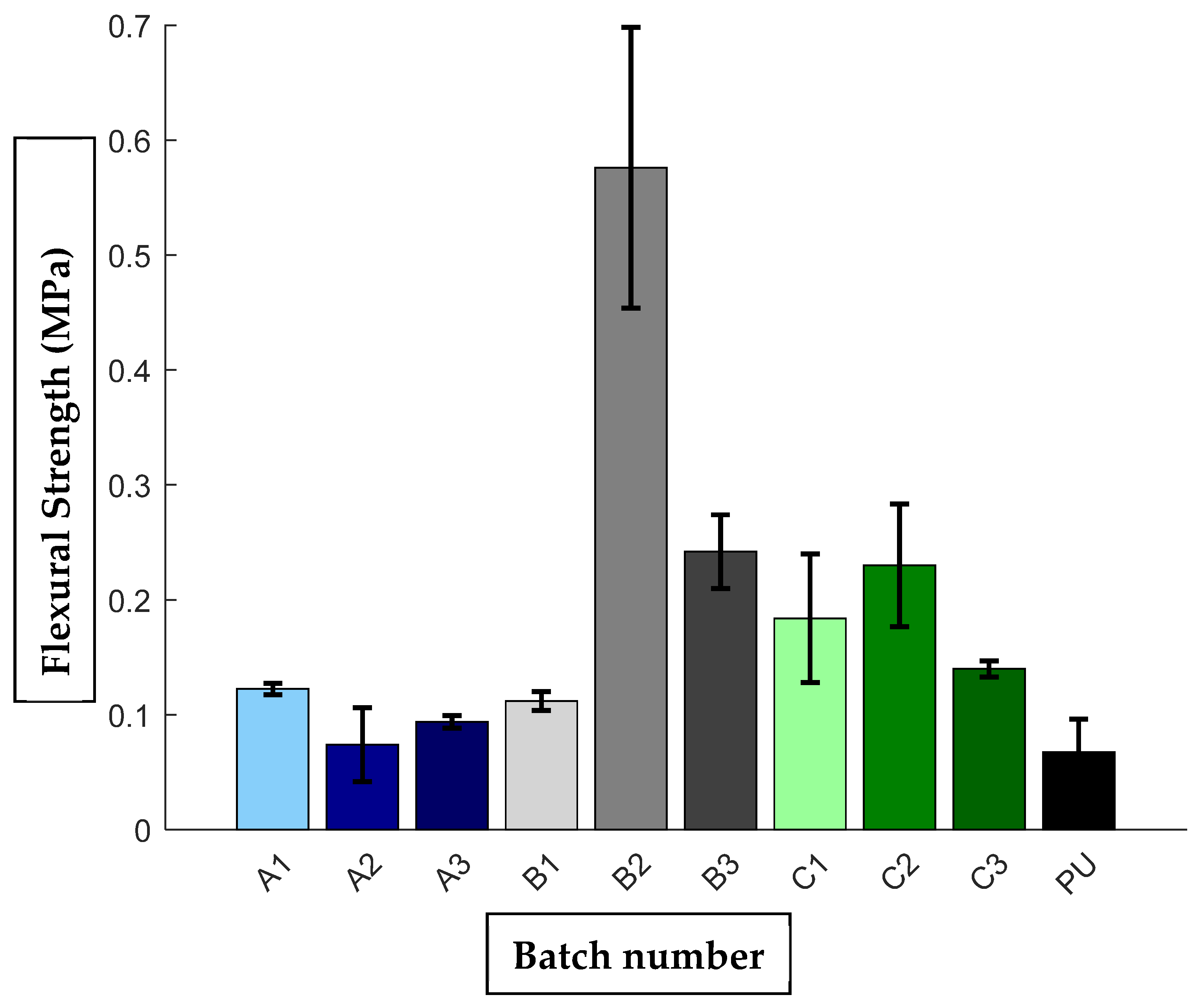
Figure 2 presents the flexural strength values obtained for both the developed materials and the unreinforced polyurethane. As can be observed, the flexural strength of the materials varies according to the content and treatment of the
Giant reed fiber when used as reinforcement within the polyurethane matrix.
The figure shows the average flexural strength values (MPa) obtained for the different experimental groups (A1, A2, A3, B1, B2, B3, C1, C2, C3, and PU). In general, the values range between 0.07 and 0.58 MPa. It noteworthy that these low values, when compared with the literature for structural composites, are consistent with the low apparent density of the material. This suggests an application primarily in the field of thermal insulation rather than load-bearing structures.
Among the results, group B2 showed the highest flexural strength, reaching approximately 0.58 MPa. Groups B3 and C2 exhibited intermediate resistance levels (0.23 ± 0.02 and 0.25 ± 0.03 MPa, respectively), with moderate standard deviations suggesting a more stable behavior compared to B2. These intermediate values indicate that, although they do not reach the maximum strength observed in B2, they present better repeatability in terms of mechanical performance.
Groups C1 and C3 displayed low strength values (0.14–0.18 MPa), with C1 showing a relatively high dispersion. This suggests that the conditions associated with this group did not provide sufficient structural reinforcement to the material. Finally, the PU group exhibited the lowest resistance (~0.07 MPa), accompanied by significant variability relative to its mean, confirming its limited ability to withstand flexural stress.
In comparison, the groups from series A (A1, A2, A3) also demonstrated very low strength values (0.07–0.12 MPa). The similarity among their results indicates that the modifications applied to this set of samples did not produce substantial improvements in flexural behavior.
Overall, these findings indicate that series B, particularly group B2, exhibits the best mechanical performance under flexural conditions. Series A and PU are the least resistant, while series C represents an intermediate range, with moderate strength values and greater consistency than B2.
3.3. Tensile Strength
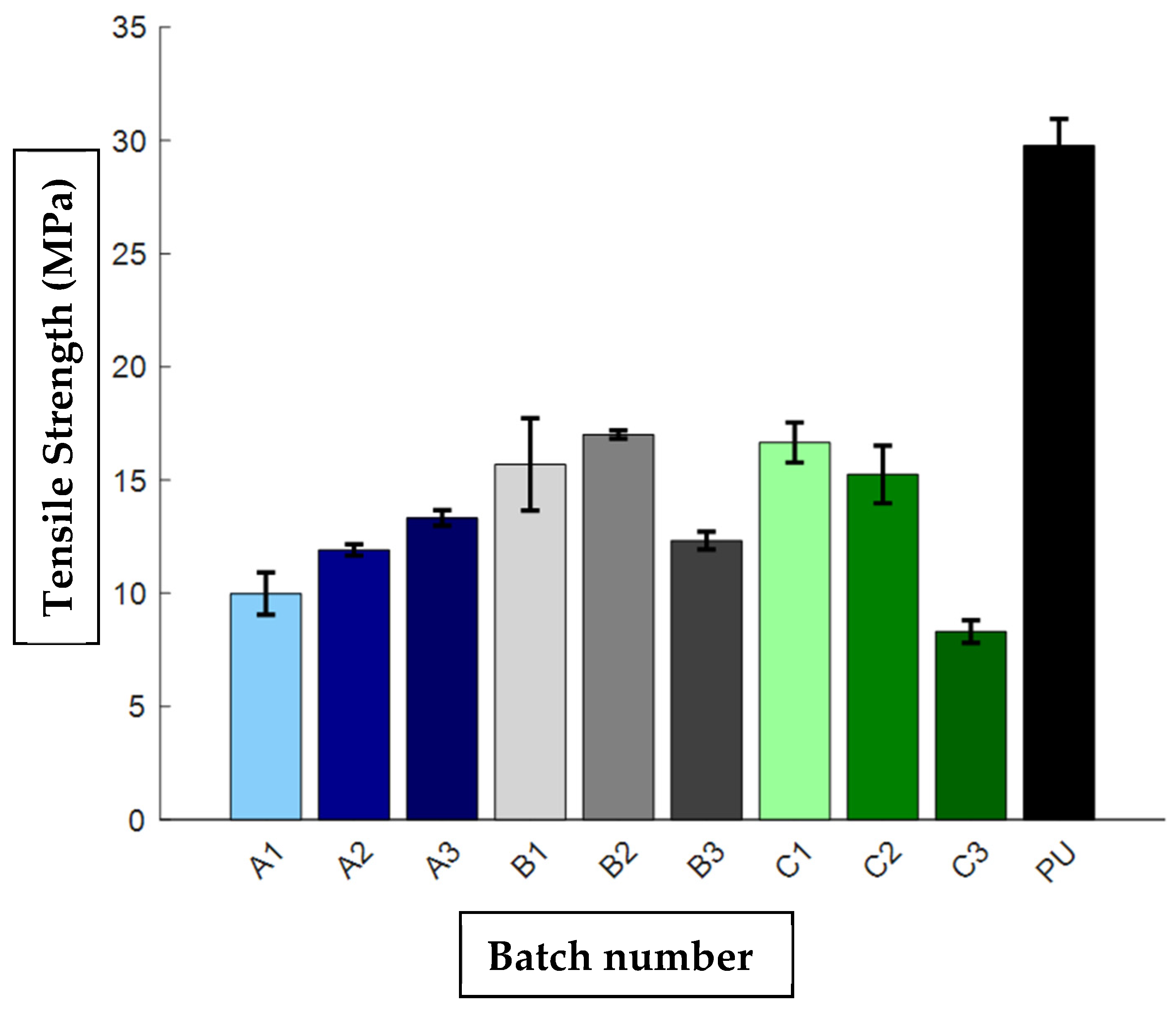
Figure 3 shows the average tensile strength values (MPa) obtained for the different study groups. It can be observed that the tensile strength results range approximately between 9 and 30 MPa, demonstrating marked differences in the mechanical behavior of the evaluated materials.
Regarding tensile strength, the reinforced materials displayed values between 9 and 17 MPa, while the unreinforced polyurethane reached approximately 30 MPa. This outcome contradicts the common reinforcement effect, highlighting that the incorporation of the hybrid filler primarily serves as a lightweight filler to enhance thermal insulation, rather than a load-bearing reinforcement for tensile applications.
The PU group exhibited the highest tensile strength (~30 MPa), with relatively low dispersion, indicating consistent performance. In contrast, the series A groups (A1, A2, A3) showed the lowest values, ranging from 10 to 13 MPa, placing them among the weakest materials in the set.
Series B and C presented intermediate results. Specifically, B1 and B2 reached values of approximately 16–17 MPa, while B3 decreased to around 12 MPa. The C series showed more variability: C1 reached a tensile strength of about 17 MPa, C2 was close to 15 MPa, and C3 dropped significantly to roughly 9 MPa, similar to the lowest values observed in series A.
3.4. Thermal Conductivity
The thermal conductivity (λ) of the polyurethane formulations reinforced with agro-industrial residues was determined using a KD2 Pro Thermal Properties Analyzer (Decagon Devices, Pullman, WA, USA), which operates based on the transient hot-wire method. Measurements were performed using the single-needle TR-1 sensor (Merit Sensor, South Jordan, UT, USA), suitable for solid materials, with an operational range of 0.1–4.0 W/m·°C and an accuracy of ±10%.
Each sample was analyzed in duplicate, ensuring prior thermal equilibrium and proper contact between the sensor and the material through the application of a thermally conductive grease. Measurements were carried out under controlled ambient conditions (23–25 °C) to ensure thermal stability of the specimens during data collection.
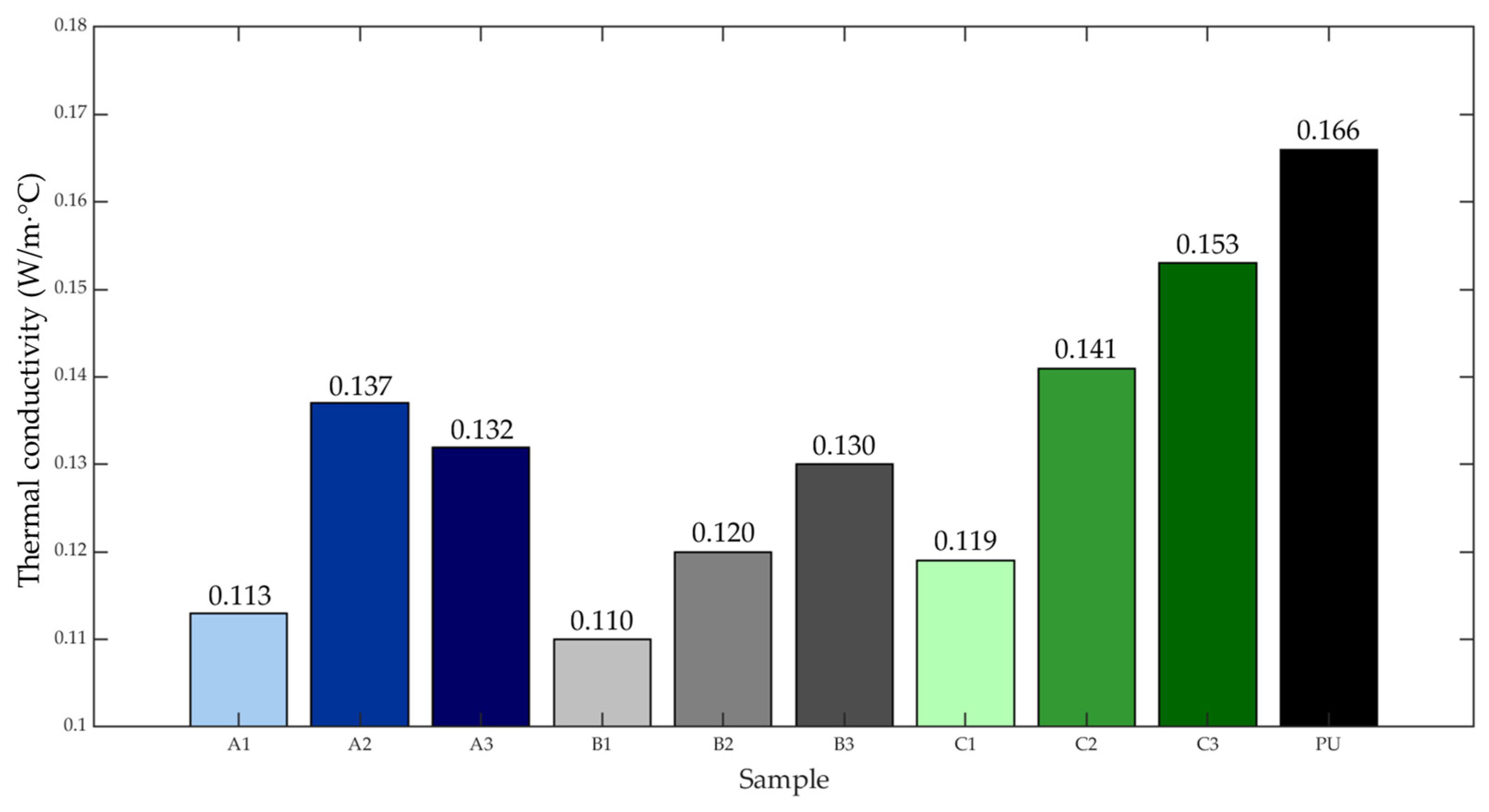
The results show that the reinforced formulations exhibited lower thermal conductivity values than the unreinforced polyurethane. Series A recorded values ranging from 0.113 to 0.137 W/m·°C, series B ranged from 0.110 to 0.130 W/m·°C, and series C from 0.119 to 0.153 W/m·°C. The highest value corresponded to the base polyurethane (PU), with 0.166 W/m·°C.
Figure 4 presents the average thermal conductivity (λ) values obtained for the different formulations of polyurethane reinforced with agro-industrial residues, as well as for unreinforced polyurethane (PU). Measurements were carried out at room temperature (23–25 °C).
The λ values ranged from 0.110 to 0.166 W/m·°C, confirming the thermal insulating nature of the evaluated materials. It was observed that the reinforced formulations generally exhibited lower thermal conductivity values compared to the base polyurethane.
The values in series A increased progressively from 0.113 to 0.137 W/m·°C, reaching a maximum in sample A2, while A3 showed a slight reduction (0.132 W/m·°C). Series B recorded intermediate values between 0.110 and 0.130 W/m·°C, with gradual increments among the formulations. Series C displayed the highest values among the reinforced composites, reaching 0.153 W/m·°C in sample C3. Finally, unreinforced polyurethane (PU) showed the highest overall thermal conductivity (0.166 W/m·°C).
The results indicate that the incorporation of agro-industrial residues alters the thermal response of the material, with slight variations depending on the formulation. The low data dispersion (±0.003 W/m·°C) demonstrates good experimental repeatability and thermal stability during testing. The high repeatability of measurements, with standard deviations below 3%, further confirms the precision of the method used and the adequate thermal stability of the samples during the experiment, suggesting that the observed differences in λ values among the formulations are statistically representative of the material variations.
4. Discussion
The incorporation of Arundo donax (giant reed) fibers and (PU-RP) residues significantly modified the mechanical and thermal properties of the polyurethane matrix. The results obtained demonstrate that both the reinforcement percentage and the alkaline treatment applied play a decisive role in the tensile strength, flexural strength, and thermal conductivity of the composites.
In the flexural strength tests, the values ranged from 0.07 to 0.58 MPa, with formulation B2 (15% reinforcement, 5% NaOH treatment) showing the highest resistance. In contrast, series A and the pure polyurethane (PU) exhibited lower values, indicating reduced structural rigidity and less efficient fiber–matrix adhesion. This trend may be attributed to better reinforcement dispersion and a potentially optimized interface in series B, which could promote more uniform stress transfer within the matrix.
These findings are consistent with those of Pattnaik et al. [
2], who reported that polyurethane foams reinforced with natural fibers reach an optimal strength point at around 15% loading. Exceeding this threshold produces interfacial defects and voids that reduce mechanical integrity, a phenomenon also observed in samples A3, B3, and C3.
Regarding tensile strength, the reinforced materials exhibited values between 9 and 17 MPa, while the unreinforced polyurethane reached approximately 30 MPa. This overall reduction is related to the partial incompatibility between the hydrophobic polymeric matrix and the hydrophilic surface of lignocellulosic fibers, as well as the formation of micro-defects at the interface, which act as stress concentration zones.
This behavior aligns with the findings of Ajayi et al. [
6], who reported a progressive decrease in tensile strength as the natural fiber fraction exceeded 20%, due to a loss of interfacial cohesion. Similarly, Vishwash et al. [
4] concluded that moderate alkaline treatments (≈5% NaOH) temporarily improve fiber–matrix adhesion by removing waxes and lignin, whereas higher concentrations damage the cell wall, reducing load transfer efficiency. This directly explains the lower mechanical values obtained for A3, B3, and C3.
Soni et al. [
1] also highlighted that the random orientation of short fibers enhances ductility but limits specific tensile strength, consistent with the intermediate behavior observed in this study. Sample B2 exhibited higher strength, suggesting an optimal balance between reinforcement content and dispersion within the matrix, which is hypothesized to result in a more homogeneous microstructure.
Moreover, Hejna et al. [
10] demonstrated that incorporating recycled polyurethane residues into virgin matrices slightly reduces strength but improves dimensional stability and energy absorption, reinforcing the idea that recycled material contributes to structural stabilization without compromising composite integrity.
Thermal conductivity values ranged from 0.110 to 0.166 W/m·°C, confirming the highly insulating character of the developed formulations. All reinforced samples exhibited lower values than the pure polyurethane (PU), attributable to the inherently low conductivity of lignocellulosic fibers, their porous structure, and the presence of interfacial regions that scatter heat flow.
These findings agree with those reported by Tiuc et al. [
15], who observed similar reductions (~0.11 W/m·°C) in polyurethane foams reinforced with spruce sawdust, due to increased air content and interfacial thermal resistance. Likewise, Kamarudin et al. [
16] demonstrated that the inclusion of natural fibers generates structural discontinuities that interrupt solid-state heat conduction, thereby reducing effective thermal transfer.
In this study, series B exhibited intermediate values (0.11–0.13 W/m·°C), whereas series C reached the highest among the reinforced composites (~0.153 W/m·°C). This can be explained by greater compaction and a lower air fraction in the C formulations, which increases solid-contact conduction, consistent with the findings of Mulla et al. [
3]. Conversely, the unreinforced polyurethane (PU) displayed the highest thermal conductivity value (0.166 W/m·°C), typical of homogeneous and high-density materials, as also documented by Drzeżdżon and Datta [
9].
Overall, the results suggest that the optimal composition corresponds to 15% reinforcement with a 5% NaOH alkaline treatment (sample B2), combining higher structural rigidity with low thermal conductivity. This balance is consistent with the trends reported by Pattnaik et al. [
2] and Ajayi et al. [
6], who emphasized the importance of controlling both fiber content and surface treatment to simultaneously optimize mechanical and thermal performance.
From a microstructural perspective, the observed improvement in flexural behavior and thermal stability is associated with a more uniform fiber distribution, moderate interfacial adhesion, and the presence of recycled polyurethane, which is hypothesized to act as a compatibilizing phase. The combination of these factors yields materials with a desirable balance between mechanical strength, thermal insulation, and environmental sustainability.
For future work, it is recommended to complement this analysis with scanning electron microscopy (SEM) and multiscale thermal conduction modeling to specifically investigate the influence of reinforcement on apparent density and porosity, which are key determinants of conductivity. This approach will enable the correlation of cellular morphology and structural anisotropy with functional properties, and facilitate normalization of λ values, following the methods proposed by Mulla et al. [
3] and Soni et al. [
1].
5. Conclusions
The development of polyurethane composites reinforced with agro-industrial residues of Arundo donax yielded materials that exhibit a favorable combination of mechanical and thermal properties, particularly a significant reduction in thermal conductivity compared to the base polyurethane. The results demonstrate that the use of lignocellulosic reinforcements and (PU-RP) enables controlled modification of the material’s microstructure, directly influencing its stiffness, strength, and insulating capacity.
In the bending tests, formulation B2 (15% reinforcement and 5% alkaline treatment) exhibited the highest strength (0.58 MPa), indicating a more efficient stress transfer between the treated fibers and the matrix. Although the tensile strength was lower than that of the unreinforced polyurethane, the obtained values remained within acceptable ranges for structural bio-composites, confirming that the natural reinforcement enhances stiffness without excessively compromising the material’s integrity. Given the moderate mechanical performance, particularly the lower tensile strength, the material is primarily recommended for non-structural applications where thermal insulation is the primary requirement, such as an insulating coating or layer for conventional building materials.
Regarding thermal conductivity, the reinforced composites showed values between 0.110 and 0.153 W/m·°C, all lower than that of pure polyurethane (0.166 W/m·°C). This decrease is attributed to the low intrinsic conductivity of Arundo donax fibers, their porous structure, and the thermal discontinuity generated at the fiber–matrix interface, making these materials effective thermal insulators for applications in sustainable construction systems and energy-efficient solutions.
The combined analysis of the properties indicates that formulation B2 represents an optimal configuration, achieving an effective combination of maximum flexural strength, reduced thermal conductivity, and high dimensional stability. This performance is associated with a uniform dispersion of the reinforcement, stable interfacial adhesion, and the presence of (PU-RP), which acts as a compatibilizing phase between components. Due to its characteristics, this material is proposed for non-structural applications requiring low thermal conductivity, where the primary objective is to reduce the environmental impact through the use of lignocellulosic residues and (PU-RP).
In summary, the results confirm the technical and environmental potential of using Arundo donax agro-industrial residues as reinforcement in polyurethane matrices, contributing both to the valorization of agricultural by-products and to the reduction in polymer waste. Future work should focus on quantifying the eco-efficiency of the process, including metrics such as embodied energy and CO2 savings, to substantiate claims related to the circular economy and the Sustainable Development Goals (SDGs).






 ,
,