Comparison of Biodegradable Versus Titanium Fixation Systems in Mandibular Fractures: Systematic Review and Meta-Analysis

 , , , , ,
  ,
,
Abstract
1. Introduction
2. Methods
2.1. Protocol and Registration
2.2. Eligibility Criteria
2.3. Information Sources and Search Strategy
2.4. Study Selection Strategy
2.5. Data Extraction
2.6. Risk of Bias Assessment
2.7. Data Synthesis and Statistical Analysis
3. Results
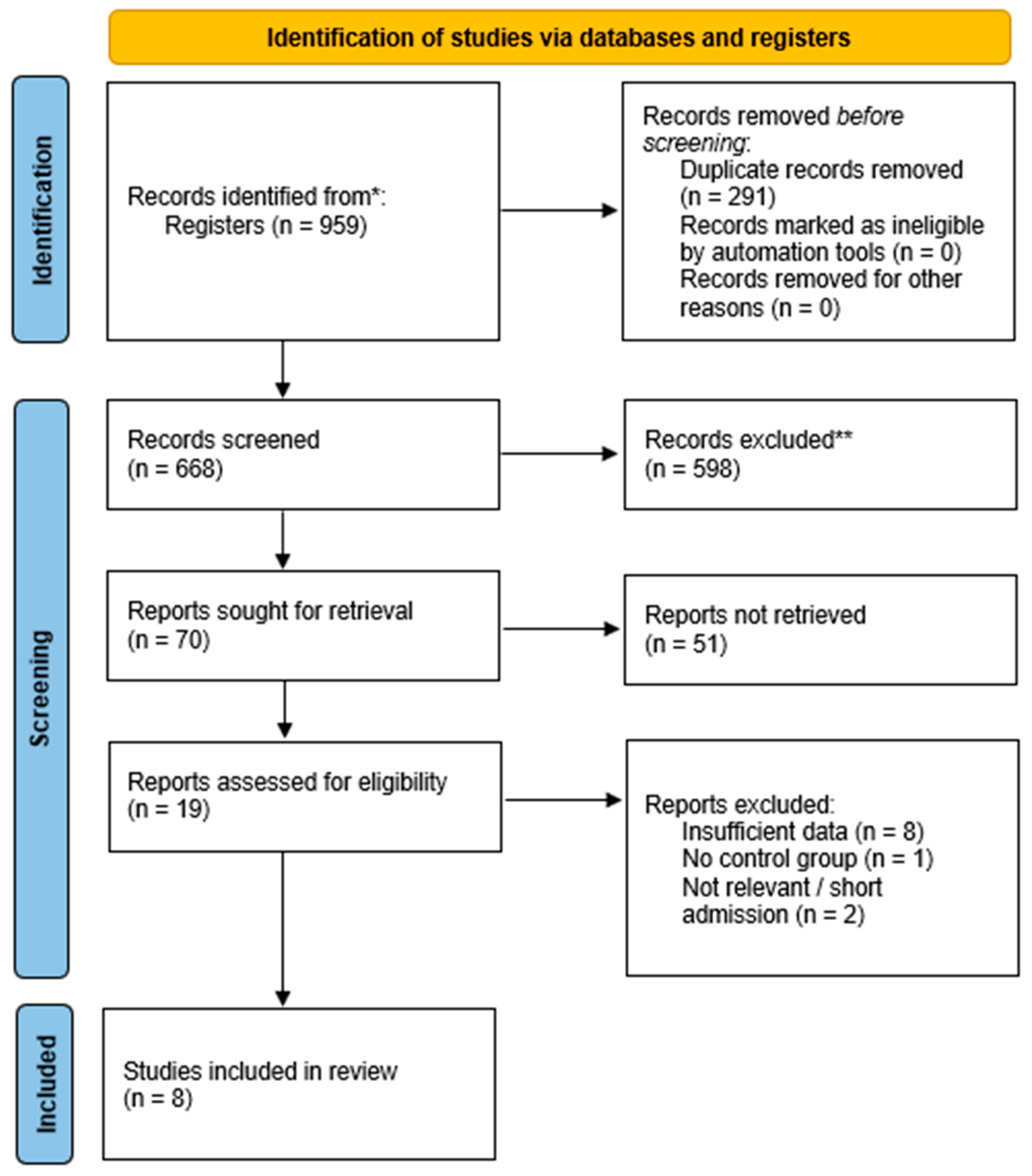
3.1. Study Selection
3.2. Characteristics of Included Studies
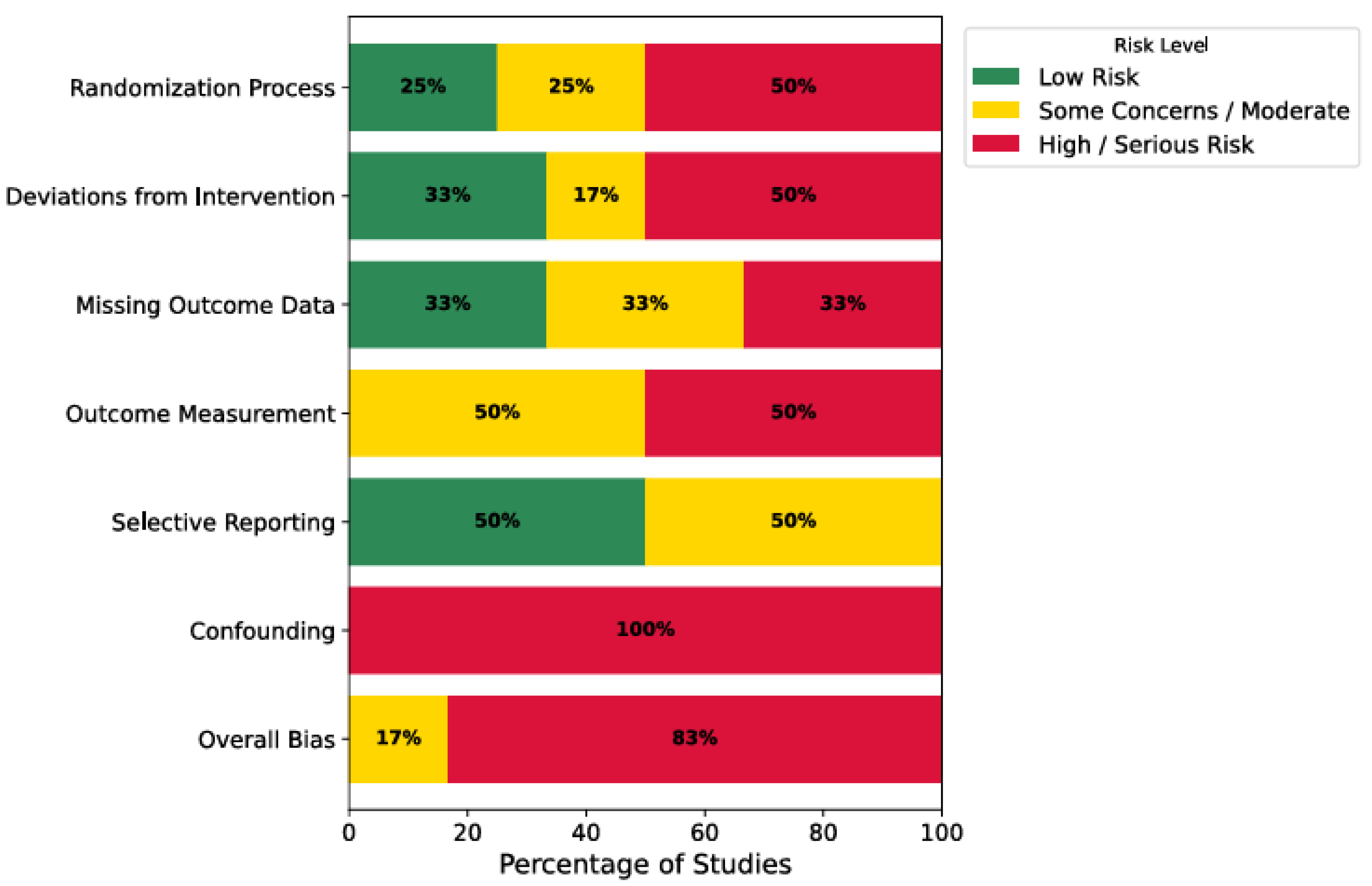
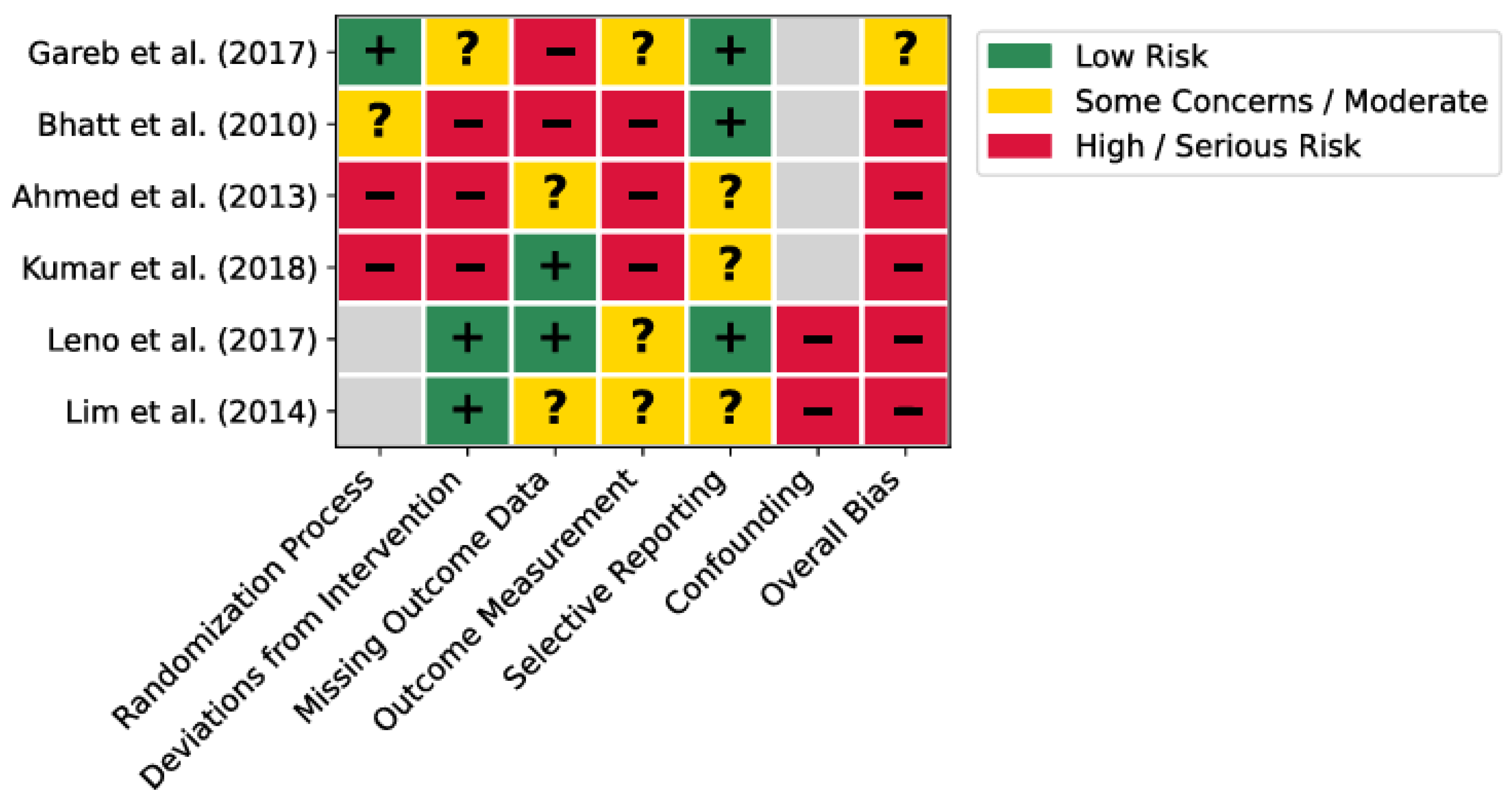
3.3. Risk of Bias Judgement
3.4. Synthesis of Results
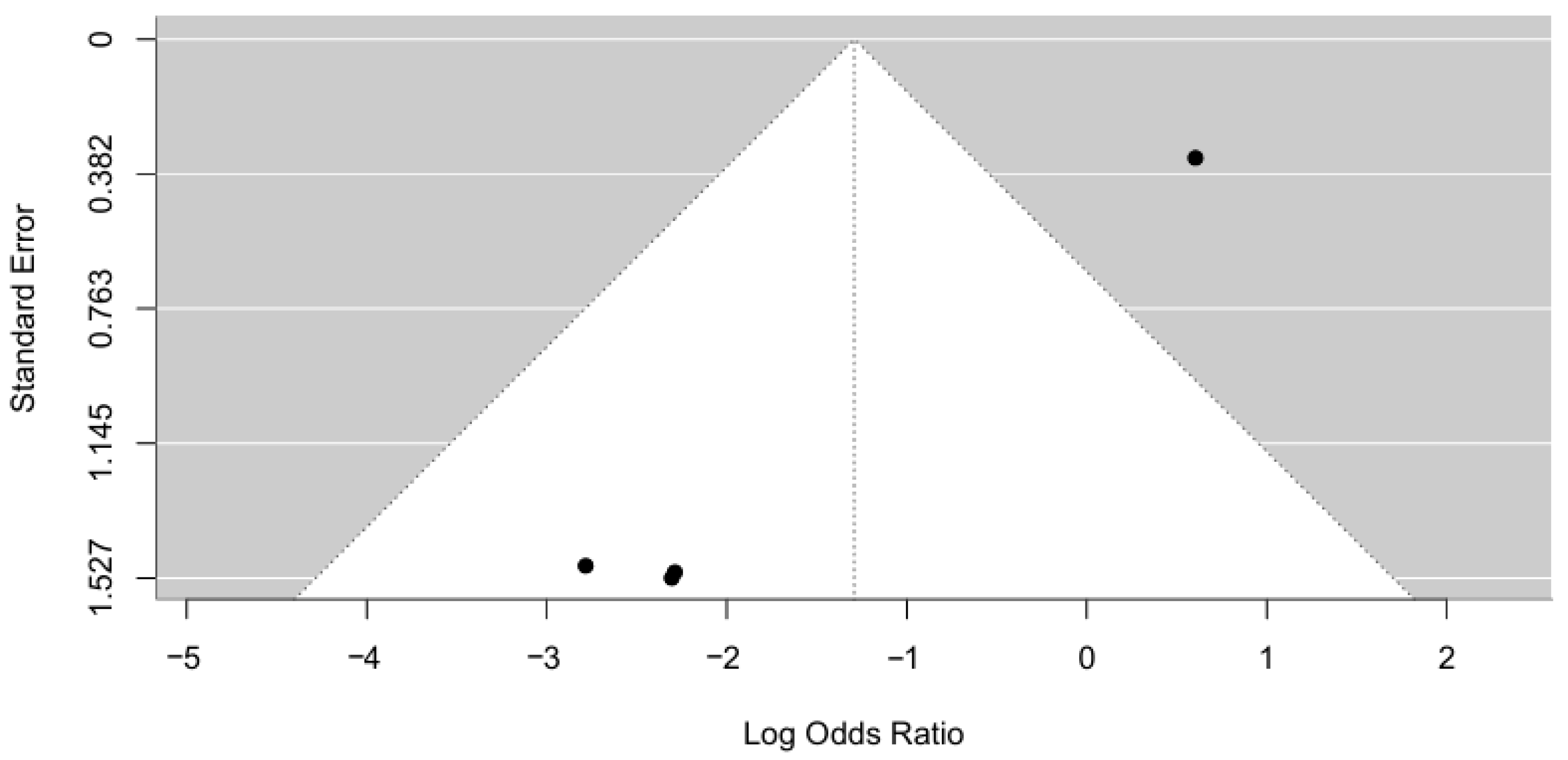
3.5. Assessment of Publication Bias
4. Discussion
5. Conclusions
Supplementary Materials
Author Contributions
Funding
Institutional Review Board Statement
Informed Consent Statement
Data Availability Statement
Conflicts of Interest
Abbreviations
| CI | Confidence Interval |
| GRADE | Grading of Recommendations Assessment, Development and Evaluation |
| IMF | Intermaxillary Fixation |
| MFIQ | Mandibular Function Impairment Questionnaire |
| MMF | Maxillomandibular Fixation |
| NRSI | Non-randomized Study of Intervention |
| OR | Odds Ratio |
| ORIF | Open Reduction and Internal Fixation |
| PGA | Polyglycolic Acid |
| PLLA | Poly-L-lactic Acid |
| PRISMA | Preferred Reporting Items for Systematic Reviews and Meta-Analyses |
| RCT | Randomized Controlled Trial |
| RoB 2 | Cochrane Risk-of-Bias tool for randomized trials |
| ROBINS-I | Risk Of Bias In Non-randomized Studies of Interventions |
| SD | Standard Deviation |
References
- Agarwal, S.; Gupta, A.; Grevious, M.; Reid, R.R. Use of resorbable implants for mandibular fixation: A systematic review. J. Craniofac. Surg. 2009, 20, 331–339. [Google Scholar] [CrossRef] [PubMed]
- Sanino Zavala, I.; Carrazana Díaz, M.; Fuentes Fernández, D.; Guzmán Aguilera, V.; Quitral Argandoña, R. Resorbable Osteosynthesis in Mandibular Fractures. An Exploratory Systematic Review. Odovtos Int. J. Dent. Sci. 2024; Online First. [Google Scholar] [CrossRef]
- Hochuli-Vieira, E.; Cabrini Gabrielli, M.A.; Pereira-Filho, V.A.; Gabrielli, M.F.R.; Padilha, J.G. Rigid internal fixation with titanium versus bioresorbable miniplates in the repair of mandibular fractures in rabbits. Int. J. Oral Maxillofac. Surg. 2005, 34, 167–173. [Google Scholar] [CrossRef] [PubMed]
- Gareb, B.; Van Bakelen, N.B.; Vissink, A.; Bos, R.R.M.; Van Minnen, B. Titanium or Biodegradable Osteosynthesis in Maxillofacial Surgery? In Vitro and In Vivo Performances. Polymers 2022, 14, 2782. [Google Scholar] [CrossRef]
- Gareb, B.; van Bakelen, N.B.; Dijkstra, P.U.; Vissink, A.; Bos, R.R.M.; Van Minnen, B. Biodegradable versus titanium osteosyntheses in maxillofacial traumatology: A systematic review with meta-analysis and trial sequential analysis. Int. J. Oral Maxillofac. Surg. 2020, 49, 914–931. [Google Scholar] [CrossRef]
- Liu, J.N.; Ong, H.S.; Wang, M.Y.; Wan, K.; Qu, X.Z.; Zhang, C.P. Randomized control trial comparing the titanium osteosynthesis and the biodegradable osteosynthesis in mandibulotomy access. Head Neck 2019, 41, 915–923. [Google Scholar] [CrossRef]
- Champy, M.; Lodde, J.P.; Jaeger, J.H.; Wilk, A. Ostéosynthèses mandibulaires selon la technique de Michelet. I Bases biomécaniques. Rev. Stomatol. Chir. Maxillofac. 1976, 77, 569–576. [Google Scholar] [PubMed]
- Haerle, F.; Champy, M.; Terry, B.C. Atlas of Craniomaxillofacial Osteosynthesis; Thieme: Stuttgart, Germany, 2009. [Google Scholar]
- Yaremchuk, M.J.; Posnick, J.C. Resolving controversies related to plate and screw fixation in the growing craniofacial skeleton. J. Craniofac. Surg. 1995, 6, 525–538. [Google Scholar] [CrossRef]
- Postlethwaite, K.R.; Philips, J.G.; Booth, S.; Shaw, J.; Slater, A. The effects of small plate osteosynthesis on postoperative radiotherapy. Br. J. Oral Maxillofac. Surg. 1989, 27, 375–378. [Google Scholar] [CrossRef]
- Armencea, G.; Gheban, D.; Onisor, F.; Mitre, I.; Manea, A.; Trombitas, V.; Lazar, M.; Baciut, G.; Baciut, M.; Bran, S. Histological Change in Soft Tissue Surrounding Titanium Plates after Jaw Surgery. Materials 2019, 12, 3205. [Google Scholar] [CrossRef]
- Borys, J.; Maciejczyk, M.; Antonowicz, B.; Krętowski, A.; Sidun, J.; Domel, E.; Dąbrowski, J.R.; Ładny, J.R.; Morawska, K.; Zalewska, A. Glutathione Metabolism, Mitochondria Activity, and Nitrosative Stress in Patients Treated for Mandible Fractures. J. Clin. Med. 2019, 8, 127. [Google Scholar] [CrossRef] [PubMed]
- Jorgenson, D.S.; Mayer, M.H.; Ellenbogen, R.G.; Centeno, J.A.; Johnson, F.B.; Mullick, F.G.; Manson, P.N. Detection of titanium in human tissues after craniofacial surgery. Plast. Reconstr. Surg. 1997, 99, 976–981. [Google Scholar] [CrossRef] [PubMed]
- Alpert, B.; Seligson, D. Removal of asymptomatic bone plates used for orthognathic surgery and facial fractures. J. Oral Maxillofac. Surg. 1996, 54, 618–621. [Google Scholar] [CrossRef] [PubMed]
- Bergsma, J.E.; de Bruijn, W.C.; Rozema, F.R.; Bos, R.R.M.; Boering, G. Late degradation tissue response to poly(L-lactide) bone plates and screws. Biomaterials 1995, 16, 25–31. [Google Scholar] [CrossRef]
- Page, M.J.; McKenzie, J.E.; Bossuyt, P.M.; Boutron, I.; Hoffmann, T.C.; Mulrow, C.D.; Shamseer, L.; Tetzlaff, J.M.; Akl, E.A.; Brennan, S.E.; et al. The PRISMA 2020 statement: An updated guideline for reporting systematic reviews. BMJ 2021, 372, n71. [Google Scholar] [CrossRef]
- Sterne, J.A.C.; Savović, J.; Page, M.J.; Elbers, R.G.; Blencowe, N.S.; Boutron, I.; Cates, C.J.; Cheng, H.Y.; Corbett, M.S.; Eldridge, S.M.; et al. RoB 2: A revised tool for assessing risk of bias in randomised trials. BMJ 2019, 366, l4898. [Google Scholar] [CrossRef]
- Sterne, J.A.C.; Hernán, M.A.; Reeves, B.C.; Savović, J.; Berkman, N.D.; Viswanathan, M.; Henry, D.; Altman, D.G.; Ansari, M.T.; Boutron, I.; et al. ROBINS-I: A tool for assessing risk of bias in non-randomised studies of interventions. BMJ 2016, 355, i4919. [Google Scholar] [CrossRef]
- DerSimonian, R.; Laird, N. Meta-analysis in clinical trials. Control. Clin. Trials 1986, 7, 177–188. [Google Scholar] [CrossRef]
- R Core Team. R: A Language and Environment for Statistical Computing; R Foundation for Statistical Computing: Vienna, Austria, 2024; Available online: https://www.R-project.org/ (accessed on 20 October 2025).
- Balduzzi, S.; Rücker, G.; Schwarzer, G. How to perform a meta-analysis with R: A practical tutorial. Evid. Based Ment. Health 2019, 22, 153–160. [Google Scholar] [CrossRef]
- Ahmed, W.; Bukhari, S.G.A.; Janjua, O.S.; Luqman, U.; Shah, I. Bioresorbable versus titanium plates for mandibular fractures. J. Coll. Physicians Surg. Pak. 2013, 23, 480–483. [Google Scholar]
- Bhatt, K.; Roychoudhury, A.; Bhutia, O.; Trikha, A.; Seith, A.; Pandey, R.M. Equivalence Randomized Controlled Trial of Bioresorbable Versus Titanium Miniplates in Treatment of Mandibular Fracture: A Pilot Study. J. Oral Maxillofac. Surg. 2010, 68, 1842–1848. [Google Scholar] [CrossRef]
- Gareb, B.; van Bakelen, N.B.; Buijs, G.J.; Jansma, J.; De Visscher, J.G.A.M.; Hoppenreijs, T.J.M.; Bergsma, J.E.; Stegenga, B.; Bos, R.R.M. Comparison of the long-term clinical performance of a biodegradable and a titanium fixation system in maxillofacial surgery: A multicenter randomized controlled trial. PLoS ONE 2017, 12, e0177152. [Google Scholar] [CrossRef] [PubMed]
- Kumar, V.; Gour, S.; Chaube, R.K.; Chaube, R.K.; Tiwari, M.; Chaube, S.K. Comparative Efficacy and Adaptability of Bioresorbable Plates with Titanium Miniplates in the Management of Mandibular Fractures. Clin. Res. Open Access 2018, 4, 1–8. [Google Scholar]
- Leno, M.B.; Liu, S.Y.; Chen, C.T.; Liao, H.T. Comparison of functional outcomes and patient-reported satisfaction between titanium and absorbable plates and screws for fixation of mandibular fractures: A one-year prospective study. J. Cranio-Maxillofac. Surg. 2017, 45, 704–709. [Google Scholar] [CrossRef]
- Lim, H.Y.; Jung, C.H.; Kim, S.Y.; Cho, J.Y.; Ryu, J.Y.; Kim, H.M. Comparison of resorbable plates and titanium plates for fixation stability of combined mandibular symphysis and angle fractures. J. Korean Assoc. Oral Maxillofac. Surg. 2014, 40, 285–290. [Google Scholar] [CrossRef] [PubMed]
- van Bakelen, N.B.; Buijs, G.J.; Jansma, J.; de Visscher, J.G.A.M.; Hoppenreijs, T.J.M.; Bergsma, J.E.; Stegenga, B.; Bos, R.R.M. Comparison of biodegradable and titanium fixation systems in maxillofacial surgery: A two-year multi-center randomized controlled trial. J. Dent. Res. 2013, 92, 1100–1105. [Google Scholar] [CrossRef]
- Buijs, G.J.; van Bakelen, N.B.; Jansma, J.; de Visscher, J.G.A.M.; Hoppenreijs, T.J.M.; Bergsma, J.E.; Stegenga, B.; Bos, R.R.M. A randomized clinical trial of biodegradable and titanium fixation systems in maxillofacial surgery. J. Dent. Res. 2012, 91, 299–304. [Google Scholar] [CrossRef]
- Gareb, B.; Roossien, C.C.; van Bakelen, N.B.; Verkerke, G.J.; Vissink, A.; Bos, R.R.M.; van Minnen, B. Comparison of the mechanical properties of biodegradable and titanium osteosynthesis systems used in oral and maxillofacial surgery. Sci. Rep. 2020, 10, 18143. [Google Scholar] [CrossRef]




| Study | Year | Design | Country | Population (n) | Intervention Group (Biodegradable) | Comparator Group (Titanium) | Mean Age ± SD (Years) (Bio/Ti) | Sex (% Male) (Bio/Ti) | Fracture Location(s) |
|---|---|---|---|---|---|---|---|---|---|
| Gareb et al. 1 [24] | 2017 | RCT | Netherlands | 221 | Inion CPS (n = 87) | KLS Martin (n = 134) | 33.0 ± 12/31.0 ± 11 | 52%/62% | Mixed (Mandibular, Maxillary, Zygomatic) |
| Bhatt et al. [23] | 2010 | RCT | India | 40 | Inion CPS (n = 19) | Synthes (n = 21) | 26.6/28.7 | 95%/95% | Mandibular (Angle, Parasymphysis) |
| Ahmed et al. [22] | 2013 | RCT | Pakistan | 69 | Bonamates (n = 34) | Treu-dynamic (n = 35) | 31.4 ± 11.2/34.3 ± 10.7 | 91%/91% | Mandibular |
| Kumar et al. [25] | 2018 | RCT | India | 60 | Bioresorbable (n = 30) | Titanium (n = 30) | NR | 93%/93% | Mandibular |
| Leno et al. [26] | 2017 | NRSI (Cohort) | Taiwan | 41 | Bonamets (n = 21) | Stryker (n = 20) | 26.2 ± 9.7/27.3 ± 10 | 41%/43% | Mandibular (Symphysis, Body, Angle) |
| Lim et al. [27] | 2014 | NRSI (Cohort) | South Korea | 29 | Inion CPS/Biosorb FX (n = 13) | Osteo-fit/Synthes (n = 16) | 24.2 ± 6.9/28.3 ± 12.9 | 92%/94% | Combined Angle and Symphysis |
| Kumar et al. [25] | 2018 | NRSI (Cohort) | India | 60 | Bioresorbable (n = 30) | Titanium (n = 30) | 29.8 ± 11.8/29.8 ± 11.8 | 90%/90% | Mandibular |
| Ahmed et al. [22] | 2013 | NRSI (Cohort) | Pakistan | 69 | Bonamates (n = 34) | Titanium (n = 35) | 31.4 ± 11.2/34.3 ± 10.7 | 91%/91% | Mandibular |
| Outcome | Study | Biodegradable Group Events/Total) | Titanium Group Events/Total) | Notes and Comments |
|---|---|---|---|---|
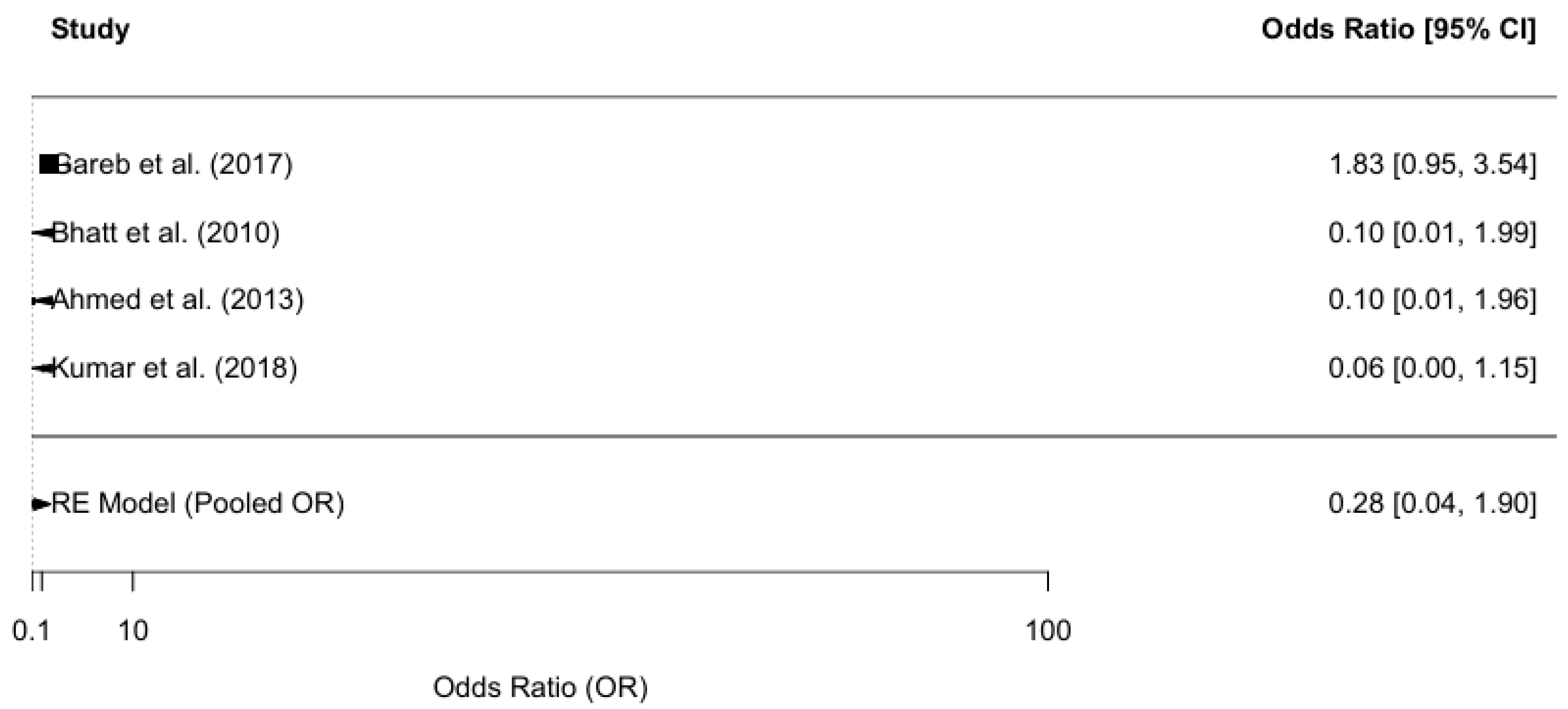
| Hardware Removal | Gareb et al. [24] | 23/87 | 22/134 | Primary reason for removal in the biodegradable group was foreign body reaction; in the titanium group, it was pain/discomfort. |
| Bhatt et al. [23] | 0/19 | 4/21 | All removals in the titanium group were due to reoperation for complications or patient request. | |
| Ahmed et al. [22] | 0/34 | 4/35 | All four removals in the titanium group were due to chronic infection or patient preference. | |
| Kumar et al. [25] | 0/30 | 6/30 | Complications leading to removal were not specified. | |
| Perioperative Screw Breakage | Ahmed et al. [22] | 16/216 | 0/208 | Breakage occurred in 8% of resorbable screws inserted. |
| Lim et al. [27] | 2/166 | 0/192 | Represented a 15.4% incidence of specific technical problems in the resorbable group. | |
| Infection | Bhatt et al. [23] | 0/19 | 1/21 (5.2%) | Low event rates in both groups. |
| Ahmed et al. [22] | 0/34 | 2/35 (5.7%) | Infections in the titanium group were managed with hardware removal. | |
| Malunion/Malocclusion | Bhatt et al. [23] | Nonunion: 1/19 (4.2%) Malocclusion: 2/19 (11.1%) | Nonunion: 0/21 (0%) Malocclusion: 1/21 (7.7%) | Differences were not statistically significant due to small sample size. |
| Ahmed et al. [22] | Malocclusion: 1/34 (2.9%) | Malocclusion: 0/35 (0%) | Low event rates overall. |
| Outcome | No. of Studies (Participants) | Assumed Risk (Titanium) | Corresponding Risk (Biodegradable) | Relative Effect (95% CI) | Certainty of Evidence (GRADE) | Explanation for Certainty Rating |
|---|---|---|---|---|---|---|
| Hardware Removal | 4 RCTs (369 patients) | 164 per 1000 | 55 per 1000 (from 7 fewer to 311 more) | OR 0.28 (0.04 to 1.90) | Very Low | Downgraded three levels:
|
Disclaimer/Publisher’s Note: The statements, opinions and data contained in all publications are solely those of the individual author(s) and contributor(s) and not of MDPI and/or the editor(s). MDPI and/or the editor(s) disclaim responsibility for any injury to people or property resulting from any ideas, methods, instructions or products referred to in the content. |
© 2026 by the authors. Licensee MDPI, Basel, Switzerland. This article is an open access article distributed under the terms and conditions of the Creative Commons Attribution (CC BY) license.
Share and Cite
Zailai, A.; Alenizi, T.; Sbitan, R.; AlBraik, R.; Abujohar, T.; Albraheem, A.; Suliman, S.A.; Altayyar, R.; Mohammed, A.; Alshahrani, A.; et al. Comparison of Biodegradable Versus Titanium Fixation Systems in Mandibular Fractures: Systematic Review and Meta-Analysis. Surgeries 2026, 7, 20. https://doi.org/10.3390/surgeries7010020
Zailai A, Alenizi T, Sbitan R, AlBraik R, Abujohar T, Albraheem A, Suliman SA, Altayyar R, Mohammed A, Alshahrani A, et al. Comparison of Biodegradable Versus Titanium Fixation Systems in Mandibular Fractures: Systematic Review and Meta-Analysis. Surgeries. 2026; 7(1):20. https://doi.org/10.3390/surgeries7010020
Chicago/Turabian StyleZailai, Abdulaziz, Tahani Alenizi, Rakan Sbitan, Rana AlBraik, Taha Abujohar, Abdulmohsen Albraheem, Sajad Al Suliman, Raand Altayyar, Abdullah Mohammed, Abdullah Alshahrani, and et al. 2026. "Comparison of Biodegradable Versus Titanium Fixation Systems in Mandibular Fractures: Systematic Review and Meta-Analysis" Surgeries 7, no. 1: 20. https://doi.org/10.3390/surgeries7010020
APA StyleZailai, A., Alenizi, T., Sbitan, R., AlBraik, R., Abujohar, T., Albraheem, A., Suliman, S. A., Altayyar, R., Mohammed, A., Alshahrani, A., Alghandour, A., Aldouiri, F., & Bukhari, A. (2026). Comparison of Biodegradable Versus Titanium Fixation Systems in Mandibular Fractures: Systematic Review and Meta-Analysis. Surgeries, 7(1), 20. https://doi.org/10.3390/surgeries7010020