


Abstract
Background/Objectives: Point-of-care ultrasound (POCUS) is an accessible and low-cost diagnostic tool that is seldom used by orthopedic residents. This study aims to assess the efficacy of a POCUS training program within an orthopedic surgery residency curriculum in terms of knowledge retention and clinical usage among the group of residents. Methods: This study included didactic and hands-on teaching sessions. The impact of the teaching sessions was evaluated through surveys (pre-course, immediate post-course, and 6 months post-course). The surveys were divided into three sections: participant’s interest in and usage of POCUS, ultrasound-related knowledge, and perceived limitations related to the usage of ultrasound. All orthopedic residents who attended the teaching sessions and completed all the surveys were included. Results: There were 14 participants. There was a significant increase in interest in POCUS (scale 1 to 5) from 3.36 ± 0.50 in the pre-course survey to 3.93 ± 0.83 in the final post-course survey (p = 0.04). However, there was no significant change in the amount of POCUS usage in clinical settings. Levels of comfort with ultrasound-related procedures significantly increased immediately following the teaching session but did not stay significantly higher after 6 months. When tested on knowledge, the residents’ scores were still significantly greater than they were at the time of the pre-course test at 6 months (p = 0.01). Lack of ultrasound-related knowledge, lack of time, and site culture were the two most prevalent perceived barriers. Conclusions: This study demonstrates that POCUS teaching for orthopedic residents yields long-term benefits in terms of interest and knowledge. However, recurrent teaching sessions and further efforts are required to address perceived obstacles to PoCUS usage and increase clinical implementation.
1. Introduction
The popularity of point-of-care ultrasound (POCUS) has grown, with significant expansion in its clinical applications in most medical and surgical specialties. Its noninvasive nature, safety profile, accessibility, and cost-effectiveness have made it an indispensable tool for physicians [1].
Over a decade ago, soft-tissue and musculoskeletal (MSK) pathologies were qualified as being among the core conditions suitable for emergency ultrasound by the American College of Emergency Physicians [2]. Ultrasound has been shown to be an invaluable tool in evaluating fracture reductions, tendinous tears, and joint aspirations [3]. Consequently, POCUS teaching is widely implemented in the curricula of Canadian medical undergraduate programs [4].
Despite the versatility and reliability of POCUS with respect to MSK injuries, acquisition of this skill is not an official mandate of the Royal College of Physicians and Surgeons of Canada for orthopedic surgery residents [5]. Different groups have shown that didactic content provided either alone or in combination with hands-on sessions leads to significant knowledge acquisition among residents [5,6,7]. However, despite the residents’ increased knowledge, their use of POCUS in clinical situations is still limited. This could be related to many factors, such as the availability of ultrasound machines, limited time for POCUS practice or performance, and a potentially steep learning curve associated with mastering certain concepts [8,9].
This study aims to introduce a longitudinal POCUS training program as an addition to the orthopedic surgery curriculum and assess the efficacy of such a training program in terms of knowledge retention and POCUS usage among a group of residents. We hypothesize that a practical, longitudinal POCUS curriculum increases interest in ultrasound and knowledge and hands-on clinical use of POCUS among orthopedic residents.
2. Materials and Methods
Recruitment for this prospective project was carried out within the McGill University orthopedic surgery Program. The study included all junior and senior orthopedic residents who were enrolled during the 2024–2025 academic year, attended the teaching session, and completed all surveys. All participants provided their consent prior to participating in the study. A half-day course was organized during the program’s weekly scheduled teaching session. The residents attended a one-hour didactic lecture that addressed common indications for the use of POCUS. The lecture covered the following topics: basic principles of ultrasound machines, principles of needle tracking, imaging/access of various joints, and usage of POCUS for different pathologies. Afterwards, the residents participated in a hands-on session using volunteer models and a cadaver.
Evaluation of the impact of the teaching session was performed via a pre-course survey and two post-course surveys. All surveys were designed manually online on the website “Limesurvey” (Hamburg, Germany). The surveys were divided into 3 sections: participant’s interest and usage of POCUS, ultrasound-related knowledge, and perceived limitations related to the usage of ultrasound in their clinical settings. The three surveys contained the same questions to allow evaluation of each resident’s progress. The first post-course survey was conducted on the same day immediately after the course was taught. The second post-course survey was delivered 6 months after the course to evaluate knowledge retention and changes in POCUS usage.
The surveys were based on a previously published study by M.A. and modified by S.C., M.A., and P.B [10]. The first section focused on reporting the frequency with which the participants used POCUS and their levels of comfort with various practices involving the use of ultrasound in the context of orthopedics. Comfort levels and agreement with different statements were documented using a numerical scale ranging from 1 to 5. POCUS knowledge was evaluated in the survey via 8 multiple-choice questions that included various topics related to ultrasound within orthopedics. The third section asked the participants to agree or disagree with 9 possible perceived obstacles to the use of POCUS; the participants were allowed to add additional barriers if they experienced them.
All the data was compiled using “Excel” software (Washington, United States). Knowledge scores and self-reported levels of comfort with POCUS were compiled within the group and compared across different surveys using a paired Student’s t-test. To be able to detect a statistical difference between the different surveys, it was calculated that a minimum of 6 participants were required with power set at 80%. Significance was established at 0.05. No funding was obtained for this project.
3. Results
In total, 14 orthopedic residents participated in the teaching session and filled out all the surveys. Out of the 14 participants, 6 (42.86%) of them reported having undergone basic POCUS training in medical school, and 3 (21.43%) residents had enrolled in optional POCUS courses in the past. All the participants reported that they had never used POCUS at baseline during their clinical duties. However, in the pre-course survey, eight (57.14%) participants reported that the program should host POCUS training sessions 2–3 times per year, with the remaining participants reporting that they wanted one training session per year. The final survey yielded similar results, with 9/14 (64.29%) reporting interest in 2–3 sessions per year and 5/14 (35.71%) wanting one session per year. When asked to quantify their interest in having POCUS training included regularly within the program (scale 1–5), the group reported a mean level of interest of 3.36 ± 0.50 in the pre-course survey. There was a statistically significant increase to 3.93 ± 0.83 in the final post-course survey (p = 0.04). However, this increased interest in POCUS training did not translate into increased use of ultrasound during clinical activities, as all residents still reported in the final survey that they never use POCUS in the clinical setting (see Table 1).
Table 1.
Survey scores for the interest, comfort, and knowledge sections.
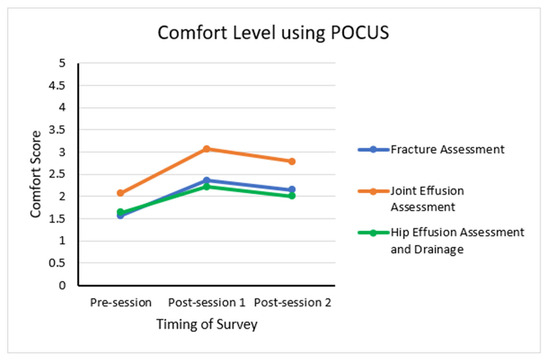
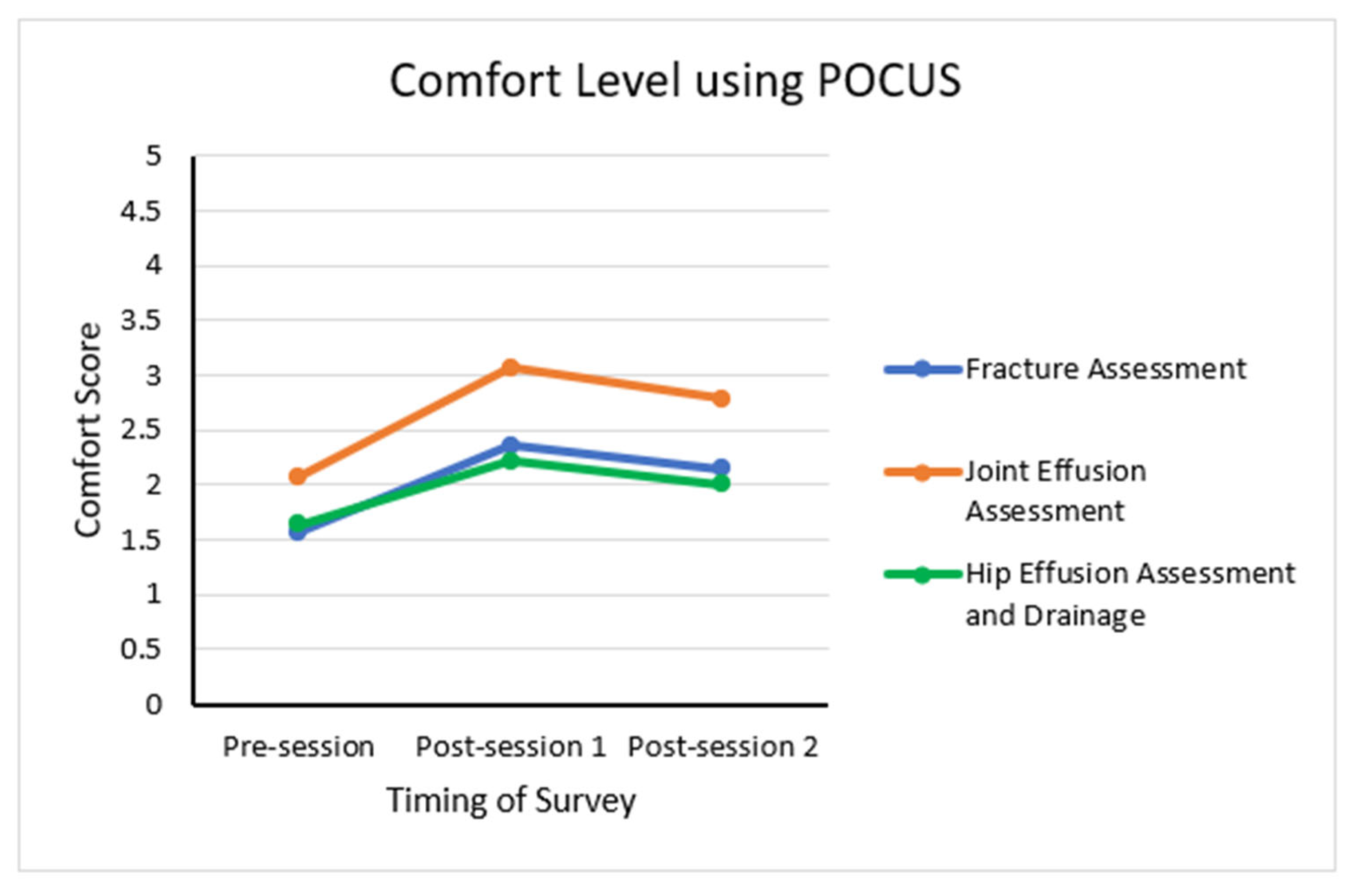
The next section of the surveys evaluated the participants’ levels of comfort with the use of POCUS for evaluating fractures, assessing joint effusions, and identifying and draining hip effusions (scale 1–5). In the pre-course survey, the self-reported mean comfort levels of the group were 1.57 ± 0.76, 2.07 ± 1.07, and 1.64 ± 0.92, respectively, for the previous skills. Immediately after the ultrasound course, the participants’ confidence in assessing fractures and joint effusions significantly increased, with means of 2.36 ± 0.74 (p = 0.02) and 3.07 ± 0.83 (p = 0.02). Confidence in draining hip effusions did improve after the class but not significantly, corresponding to 2.21 ± 0.89 (p = 0.14). In the final post-course survey, self-reported scores decreased to 2.14 ± 1.03 (p = 0.12), 2.79 ± 0.80 (p = 0.08), and 2.00 ± 0.88 (p = 0.31) for fracture evaluation, joint effusion assessment, and hip drainage, respectively. These final scores showed no statistical differences with respect to the pre-course scores (see Figure 1).
Figure 1.
Orthopedic residents’ mean self-reported levels of comfort with using point-of-care ultrasound (POCUS).
The survey comprised eight questions that evaluated the participants’ knowledge related to POCUS. Prior to the teaching session, the participants’ mean score was 36.61% ± 19.28%. In the immediate post-session survey, the mean score improved significantly to 68.75% ± 18.83% (p = 0.0002). In the final survey conducted 6 months afterwards, the participants had an average score of 52.68% ± 17.11%. This final score was significantly inferior to the score for the immediate post-course survey (p = 0.02) but still significantly greater than that for the pre-course test (p = 0.01) (see Table 1).
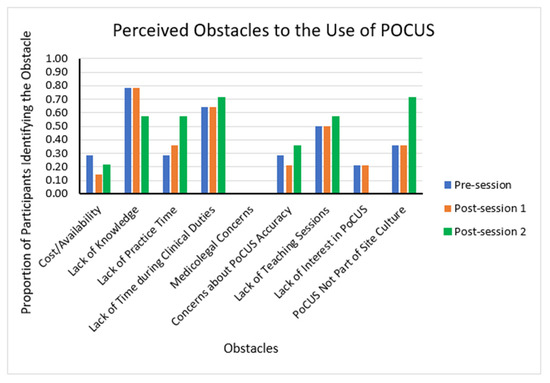
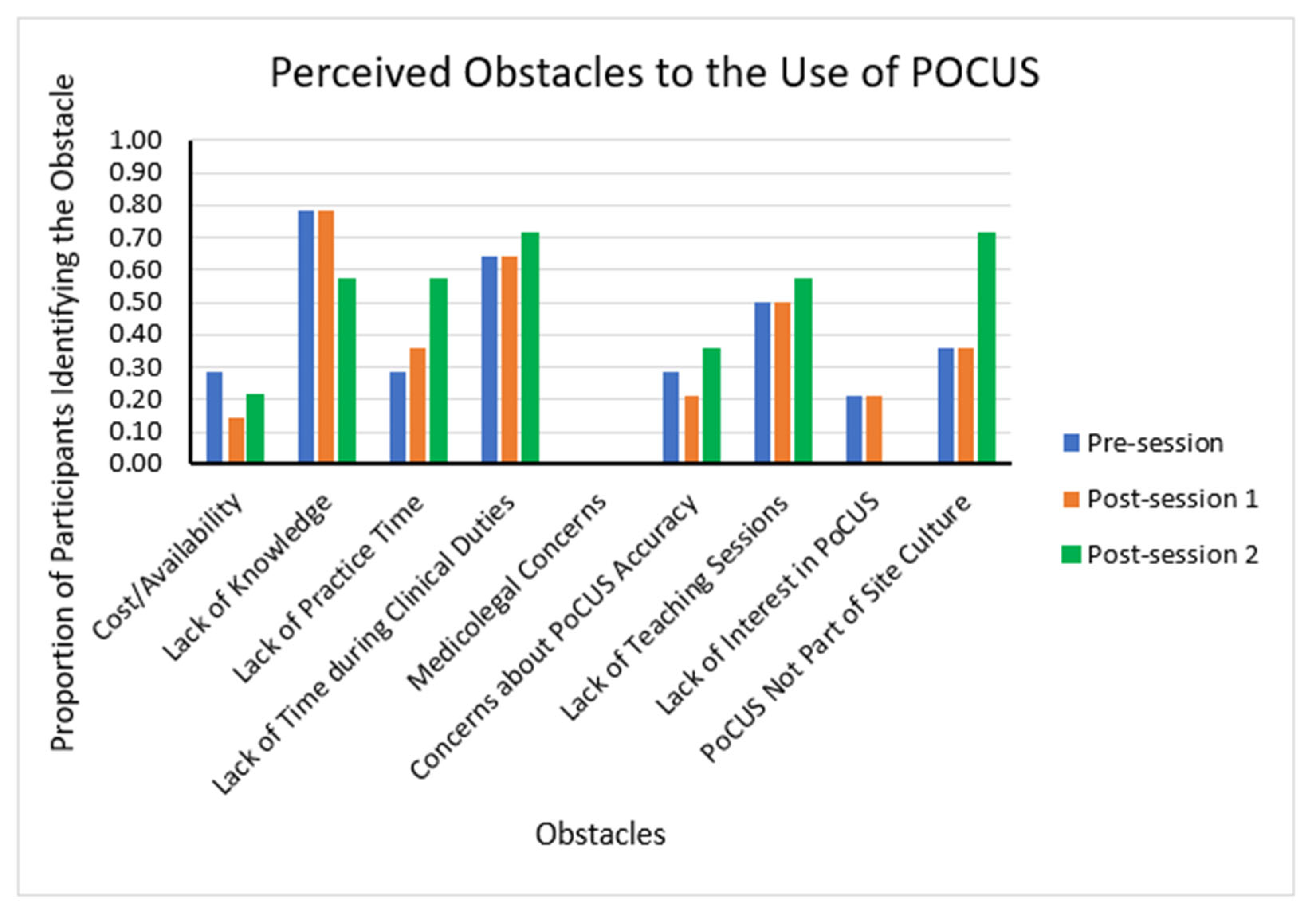
The surveys also evaluated the participants’ perceived obstacles to the daily inclusion of POCUS in their clinical activities. Lack of ultrasound-related knowledge and lack of time were the two most prevalent perceived barriers in the first two surveys. Overall, 78.57% and 64.29% of the participants noted these two factors in the first two surveys, respectively. In the last survey, 57.14% of the participants identified lack of knowledge as an issue, and 71.43% of them identified lack of time as a problem. In the last survey, 71.43% of the residents also identified site culture as an obstacle. However, medicolegal considerations and lack of interest seemed to be the least prevalent concerns among the participants (see Figure 2).
Figure 2.
Perceived obstacles to the use of POCUS.
4. Discussion
The aim of this study was to evaluate the impact of an ultrasound training program for orthopedic surgery residents in terms of knowledge retention and changes in POCUS usage. The findings indicate that the training significantly increased the interest of the resident cohort in POCUS. Furthermore, the group of participants demonstrated significant retention of information related to ultrasound at the 6-month follow-up. The participants also reported greater levels of confidence immediately following the teaching session. However, confidence levels decreased at the 6-month mark and were similar to the initial scores prior to the educational session. These findings are contrary to the results reported by Larrivée et al., who reported that orthopedic residents exhibited a sustained increase in comfort levels 6 months after the educational session [5]. We hypothesize that this absence of a sustained improvement in comfort level is related to a lack of regular practice within their clinical activities and a lack of repeated teaching sessions conducted to reinforce skills. Furthermore, the significant increase in interest that was reported by the participants did not translate into an increased use of POCUS in the final survey. These findings are similar to the study by Larrivée et al., who reported that their cohort of orthopedic residents did not significantly increase their POCUS usage 6 months following their educational session, suggesting a disconnect between education and bedside implementation [5]. The drop in confidence and the low adoption of POCUS in clinical practice indicate a need for multiple sessions. One session, shown to be impactful in our study, is probably not enough for long-term retention as it lacks spaced repetition.
The failure to translate greater interest in POCUS following the training into an increase in ultrasound usage in the clinical setting is likely secondary to the various perceived barriers. Lack of knowledge, absence of formal ultrasound training, and limited time for clinical activities were the most cited obstacles in this study. This is consistent with other studies, which reported that inadequate training, lack of time, limited supervision, and difficulty accessing devices were significant barriers [8,9]. These findings highlight the fact that POCUS is highly user-dependent and requires regular practice in order to yield reliable and replicable results in clinical practice. Anatomy knowledge may also be a source of difficulty when implementing POCUS, as it has a significant impact on one’s ability to obtain and interpret ultrasound images. Thus, ultrasound can present clinicians with an imposing learning curve. Having approachable mentors comfortable with this tool is consequently an important factor in the introduction of POCUS in clinical practice. Schnittke et al. identified unfamiliarity with documenting POCUS results for medical decision-making and lack of time as the two most cited obstacles in their cohort of residents [11]. They reported that establishing clear guidelines for documenting ultrasound resulted in a significant increase in the number of POCUS examinations performed by their residents. However, our results did not demonstrate that medicolegal or documentation concerns were a significant obstacle. This might be associated with the fact that Canadian residents are less exposed to medicolegal conflicts. Furthermore, the lack of a formal requirement for POCUS proficiency in the Royal College’s orthopedic surgery curriculum may also contribute to a lack of interest in and institutional support for the regular use of POCUS. We do not believe that access to ultrasound machines had an impact on the implementation of POCUS, since multiple machines were available at all the emergency departments and clinics that the orthopedic residents cover.
One of the key strengths of our study is its integration of both didactic and hands-on training components, providing a comprehensive educational experience. Furthermore, the use of a prospective study design with a six-month follow-up allowed for adequate evaluation of knowledge retention and long-term changes to the usage of POCUS. The combination of formal knowledge testing and subjective questioning also yielded a broad view of the teaching program’s impact. To our knowledge, this study is the first to evaluate perceived barriers to ultrasound use specifically for orthopedic residents. This study has limitations, such as its small sample size, with 14 residents. However, this is the largest study related to POCUS training specifically for orthopedic residents. No participants were lost to follow-up, and the power analysis indicated that six participants were required in order to establish statistical significance. Furthermore, there were no objective measurements of POCUS usage. Much of the survey was based on self-reported or subjective outcomes, which could be affected by response or recall bias. A control group would have also mitigated the impact of any confounding factors. However, given the limited number of residents in the orthopedic surgery program, we decided not to establish a control group in order to maximize the amount of data in the intervention group.
In conclusion, this study highlights the value of introducing a POCUS curriculum in orthopedic residency training. Ultrasound is another tool orthopedic residents can use to diagnose and treat a variety of conditions that they encounter. This study suggests that these training sessions had a lasting educational impact with significant knowledge retention 6 months later. However, the findings do not demonstrate that clinical use of POCUS increased following the training session. Consequently, additional efforts are required in order to integrate ultrasound use within residents’ routine clinical practice. This study also seems to indicate that recurrent training sessions are required to optimize levels of comfort with POCUS-related procedures and long-term integration of knowledge. Future studies should focus on longitudinal teaching programs and evaluating measures to address perceived obstacles to the use of POCUS within orthopedics.
Author Contributions
Conceptualization, all authors; methodology, all authors; validation, P.B. and A.A.; formal analysis, S.C.; investigation, S.C., M.A., and P.B.; resources, P.B. and A.A.; data curation, S.C.; writing—original draft preparation, S.C.; writing—review and editing, M.A., P.B., and A.A.; visualization, S.C.; supervision, P.B. and A.A.; project administration, P.B. and A.A. All authors have read and agreed to the published version of the manuscript.
Funding
This research received no external funding.
Institutional Review Board Statement
The study was conducted in accordance with the Declaration of Helsinki and approved by the Institutional Review Board of McGill University, (protocol code A09-B15-23B and date of approval: 15 November 2023).
Informed Consent Statement
Informed consent was obtained from all subjects involved in the study.
Data Availability Statement
Data can be made available upon request. Data not shared currently due to ethical restrictions and protocols of the institution.
Conflicts of Interest
The authors declare no conflicts of interest.
Abbreviations
The following abbreviations are used in this manuscript:
| POCUS | Point-of-Care Ultrasound |
| MSK | Musculoskeletal |
References
- Mok, D.; Schwarz, S.K.W.; Rondi, K. Point-of-care ultrasonography in Canadian anesthesiology residency programs: A national survey of program directors. Can. J. Anaesth. 2017, 64, 1023–1036. [Google Scholar] [CrossRef] [Scilit] [PubMed]
- American College of Emergency Physicians. ACEP emergency ultrasound guidelines-2001. Ann. Emerg. Med. 2001, 38, 470–481. [Google Scholar] [CrossRef] [Scilit]
- Chen, K.C.; Lin, A.C.M.; Chong, C.F.; Wang, T.L. An overview of point-of-care ultrasound for soft tissue and musculoskeletal applications in the emergency department. J. Intensive Care 2016, 4, 55. [Google Scholar] [CrossRef] [Scilit] [PubMed]
- Steinmetz, P.; Dobrescu, O.; Oleskevich, S.; Lewis, J. Bedside ultrasound education in Canadian medical schools: A national survey. Can. Med. Educ. J. 2016, 7, e78–e86. [Google Scholar] [CrossRef] [Scilit]
- Larrivée, S.; Rodger, R.; Larouche, P.; Leiter, J.; Jelic, T.; MacDonald, P. Orthopaedic residents demonstrate retention of point of care ultrasound knowledge after a brief educational session: A quasi experimental study. BMC Med. Educ. 2019, 19, 474. [Google Scholar] [CrossRef] [Scilit] [PubMed]
- Finnoff, J.; Smith, J.; Nutz, D.; Grogg, B. A musculoskeletal ultrasound course for physical medicine and rehabilitation residents. Am. J. Phys. Med. Rehabil. 2010, 89, 56–69. [Google Scholar] [CrossRef] [Scilit] [PubMed]
- Piposar, J.R.; Easley, M.; Nunley, J.A.; DeOrio, J.K.; Talusan, P.G.; Gubler, K.E.; Reach, J.S. Musculoskeletal ultrasound education: Orthopaedic resident ability following a multimedia tutorial. J. Surg. Orthop. Adv. 2015, 24, 64–68. [Google Scholar] [PubMed]
- Wong, J.; Montague, S.; Wallace, P.; Negishi, K.; Liteplo, A.; Ringrose, J.; Dversdal, R.; Buchanan, B.; Desy, J.; Ma, I.W.Y. Barriers to learning and using point-of-care ultrasound: A survey of practicing internists in six North American institutions. Ultrasound J. 2020, 12, 19. [Google Scholar] [CrossRef] [Scilit] [PubMed]
- Järvinen, J.; Hannula, O.; Meuronen, A.; Mattila, K. Perceptions and barriers to the use and training of point-of-care ultrasound among Finnish emergency physicians—A nationwide survey. BMC Med. Educ. 2025, 25, 92. [Google Scholar] [CrossRef] [Scilit] [PubMed]
- Alhabboubi, M.; Chughtai, T.; Liberman, S.; Wong, E.; Turner, J. Attitudes of Canadian general surgery staff and residents towards point-of-care ultrasound. J. Emerg. Med. Trauma Acute Care 2023, 2023, 36. [Google Scholar] [CrossRef] [Scilit]
- Schnittke, N.; Damewood, S. Identifying and Overcoming Barriers to Resident Use of Point-of-Care Ultrasound. West. J. Emerg. Med. 2019, 20, 918–925. [Google Scholar] [CrossRef] [Scilit] [PubMed]

Disclaimer/Publisher’s Note: The statements, opinions and data contained in all publications are solely those of the individual author(s) and contributor(s) and not of MDPI and/or the editor(s). MDPI and/or the editor(s) disclaim responsibility for any injury to people or property resulting from any ideas, methods, instructions or products referred to in the content. |
© 2026 by the authors. Licensee MDPI, Basel, Switzerland. This article is an open access article distributed under the terms and conditions of the Creative Commons Attribution (CC BY) license.