Abstract
Riparian ecosystems provide key ecosystem services, yet their degradation is accelerating under growing human pressures. This study performs a systematic and bibliometric assessment to identify global trends in riparian restoration, specifying three objectives: (i) analyze the temporal evolution of scientific production, (ii) evaluate geographical patterns and North–South asymmetries, and (iii) identify dominant restoration approaches and research gaps. A total of 322 documents (1984–2025) were analyzed using productivity indicators, Lotka-based authorship patterns, co-authorship networks, keyword co-occurrence, and a logistic growth model fitted to annual publication counts, combined with descriptive statistics. Annual scientific output showed a steady 4% growth, while 78.2% of studies were led by institutions in the Global North, mainly in North America (39.1%), Europe (17.8%), and Asia (18.5%), highlighting geographical biases and limited representation of tropical regions. Restoration efforts were centered on natural regeneration and tree planting, with less emphasis on cultural ecosystem services and community participation. Despite scientific advances, challenges persist in adopting adaptive and socio-ecologically grounded approaches, especially in underrepresented regions. Strengthening science–policy links, promoting interdisciplinary collaborations, and expanding community involvement are essential to enhance riparian resilience and sustainability. We call for co-creation processes that integrate traditional knowledge and position local communities as partners in restoration efforts.
1. Introduction
Riparian ecosystems play a crucial role in the provision of ecosystem services essential for environmental stability and human well-being, including biodiversity conservation, water quality improvement, hydrological flow regulation, flood mitigation, and cultural values [1,2,3]. Their structure and dynamics make them key regulators of the hydrological cycle, natural filters of water quality, and fundamental habitats for specialized biodiversity [4]. However, increasing anthropogenic pressures—such as land-use change, agricultural intensification, urbanization, and hydrological alterations—have triggered accelerated degradation of these environments [5,6,7]. These processes have significantly altered riparian ecosystem structure and functionality, compromising their ability to provide essential services and increasing the vulnerability of human communities and the biodiversity that depend on them [7,8]. In particular, Ramos et al. [8] emphasized how these transformations jeopardize long-term ecological resilience, highlighting the urgency of implementing integrated restoration strategies.
Among the multiple benefits they offer, riparian ecosystems contribute to freshwater provision, hydrological regulation, soil stabilization, and the mitigation of extreme events such as floods and droughts [1,9]. Additionally, they function as biological corridors, facilitating connectivity between habitat fragments and supporting species migration—an aspect especially crucial under climate change scenarios [6]. However, the loss of vegetation cover in these areas has intensified soil erosion and reduced sediment and nutrient retention, generating direct impacts on water quality and affecting associated aquatic ecosystems [10,11]. The disruption of hydrological regimes further threatens species survival and ecosystem resilience [12].
Ecological restoration has emerged as a critical strategy to recover the structure, functions, and services of riparian ecosystems [10,13,14]. Restoration approaches include reforestation, invasive species control, hydrological reconnection, and enhancement of habitat complexity [8,15,16]. Several studies have demonstrated that restoration outcomes depend on multiple factors, such as species selection, site preparation, competition control, and protection against herbivory [17,18]. Environmental drivers such as climate, hydrology, soil conditions, and land-use context also influence the establishment and persistence of restored vegetation [7,19,20]. In Mediterranean and tropical agricultural landscapes, restoration success is closely linked to maintaining hydrological connectivity and reducing nutrient and sediment inputs [10,21,22].
Importantly, riparian restoration is currently understood as a multi-stage process that transcends the initial “greening” phase. Beyond the establishment of native vegetation communities, it involves a second stage focused on biodiversity recovery, and a third aimed at restoring ecosystem functions such as biogeochemical regulation, hydrological stability, and habitat provisioning. Recent literature highlights that many projects remain concentrated in the first stage, limiting long-term functional recovery and resilience, especially under changing climatic conditions [23,24,25,26,27].
Adaptive management and long-term monitoring are essential to evaluate restoration effectiveness and guide necessary adjustments [9,28,29]. Recent research emphasizes the importance of using historical reference conditions and functional diversity assessments to select appropriate restoration targets and avoid biotic homogenization [23,24,25]. Climate change introduces additional challenges, as altered precipitation patterns, temperature regimes, and extreme events affect riparian species composition and water availability [26,27].
The success of riparian restoration projects is also influenced by governance frameworks, stakeholder participation, and indigenous knowledge integration [8,10,30]. Community participation emerges as a key element for ensuring long-term sustainability, facilitating monitoring, maintenance, and social ownership of projects [15]. However, participation levels vary widely, ranging from one-way consultation to active co-management, influencing the perception of success and the durability of restoration impacts [16]. Accordingly, this review explicitly foregrounds regional variability in restoration outcomes and the role of power dynamics and institutional barriers in shaping participation, using these as interpretive lenses throughout the synthesis.
In this context, the present study analyzes global trends in riparian ecosystem restoration through a bibliometric and systematic approach. Studies are evaluated based on their geographical distribution, the ecosystem services considered, the methodological approaches employed, and the level of community participation. Additionally, the main environmental challenges faced by these ecosystems are explored, with special emphasis on the effectiveness of implemented restoration strategies. Unlike previous reviews that have addressed restoration efforts in specific regions or with limited thematic scope, this study provides a global and integrative synthesis, highlighting patterns, gaps, and opportunities for advancing the science and practice of riparian restoration. Specifically, this review aims to (i) examine temporal and geographical patterns in scientific production, (ii) assess North–South asymmetries and regional research gaps, and (iii) identify dominant restoration approaches and the extent to which they address greening, biodiversity recovery, and ecosystem function restoration.
2. Materials and Methods
This review was reported following the PRISMA 2020 guidelines to ensure transparency in the information sources, search, selection, and synthesis processes [31]. A complete PRISMA 2020 checklist is provided as Table S1. The workflow includes the following steps: justification for the selection of databases and criteria; implementation of the search, selection, and classification procedure; and synthesis of findings through bibliometric and qualitative content analysis. This review adheres to the PRISMA guidelines regarding planning, inclusion/exclusion criteria, and study selection procedures. Although the study was not prospectively registered, transparency is ensured through the inclusion of the PRISMA flowchart.
The review was designed to provide a comprehensive understanding of the evolution, geographical distribution, thematic trends, and methodological approaches associated with riparian ecosystem restoration worldwide. Following PRISMA 2020 recommendations, the study combined bibliometric techniques with systematic review principles to ensure analytical breadth and depth [32,33]. Three authoritative databases were selected—Scopus, Web of Science (WoS), and OpenAlex—due to their broad disciplinary coverage and recognized reliability in environmental sciences, allowing for an inclusive and representative mapping of scientific production.
Eligibility criteria were applied to full articles and reviews published between 1984 and June 2025. The inclusion criteria were: explicit focus on riparian ecosystem restoration; journal article, technical report, or review format; and potential contribution to bibliometric or content-based analysis. Exclusion criteria involved irrelevant documents, theses, conference proceedings, and book chapters that did not meet the eligibility requirements. A limited number of technical reports and indexed grey literature were included when they satisfied the remaining criteria. Eligibility validation was performed independently by two researchers, and discrepancies were discussed before final inclusion.
The literature search was conducted in June 2025, covering studies published from 1984 to June 2025. A Boolean equation was developed from three conceptual dimensions: watershed systems, restoration terminology, and riparian ecosystem descriptors. The search terms were: (“watershed” OR “catchment” OR “drainage basin” OR “fluvial basin”) AND (“riparian restoration” OR “ecosystem recovery” OR “habitat restoration” OR “basin restoration”) AND (“riparian zone” OR “riparian belt” OR “riparian ecosystems” OR “riparian areas” OR “riparian corridor” OR “fluvial ecosystem” OR “riparian vegetation”). All retrieved records were exported in BibTeX and CSV formats and processed using the Bibliometrix R package (v5.1.0) [32], which facilitated the management, cleaning, and structuring of bibliographic data. The full search strings, export dates, and file formats are provided in Table S2.
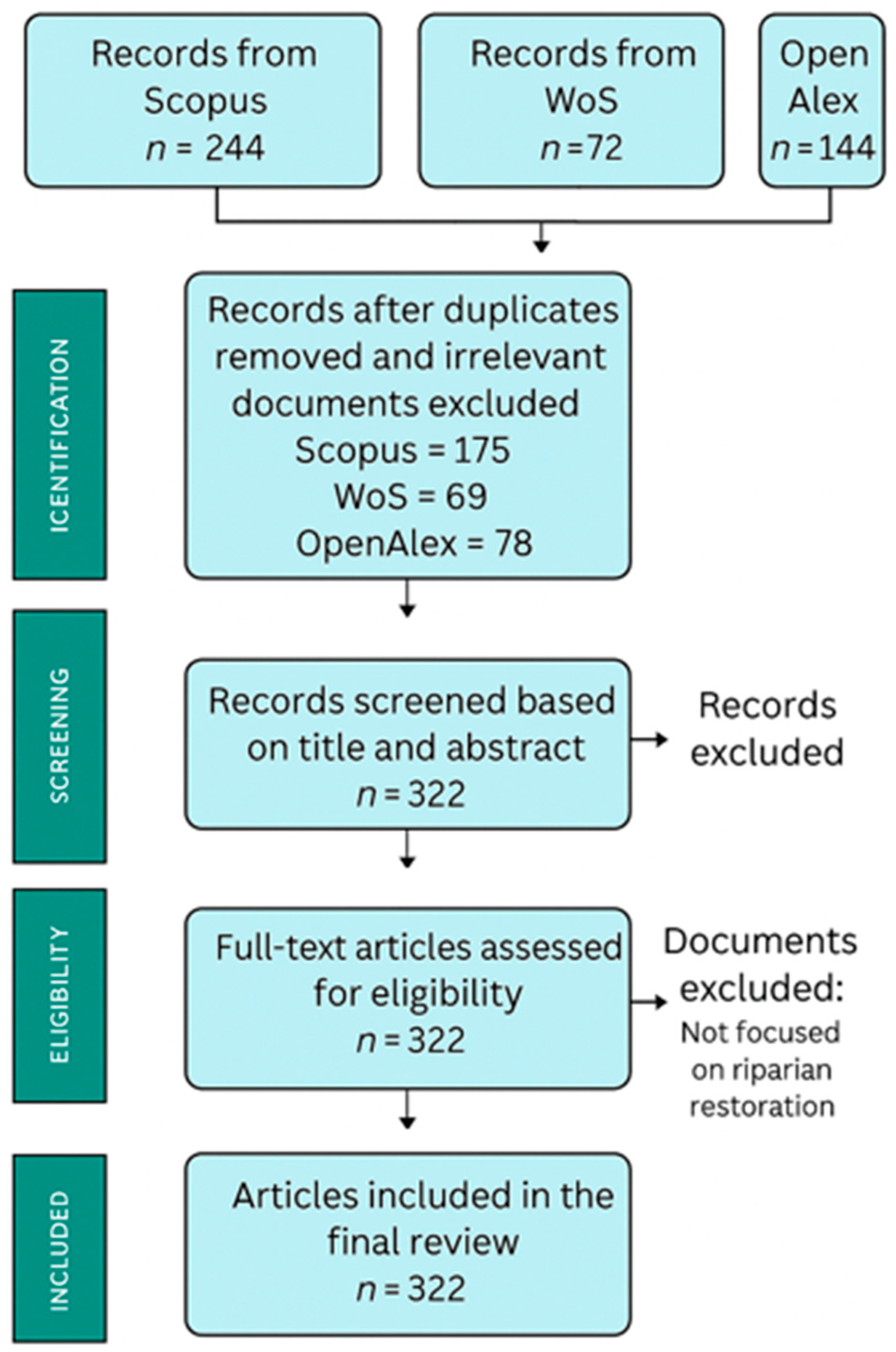
Following PRISMA 2020, a deduplication process was carried out, followed by selection based on title/abstract and full-text assessment against predefined criteria. The selection process is summarized in the PRISMA flowchart (Figure 1), depicting the stages of identification, screening, eligibility, and inclusion. A final set of 322 articles and reviews met all criteria and were included in the analyses.
Figure 1.
PRISMA flowchart for the selection of studies included in the analysis.
2.1. Data Collection and Items
For each included record, bibliographic data were structured using Bibliometrix [32]. The captured items allowed the following analytical dimensions:
- Evolution of scientific production: publication counts and annual growth [34].
- Geographic distribution and international collaboration: production at the country level and co-authorship networks [35].
- Research impact: citation counts at the article and author levels to identify influential contributions [34,35].
- Keyword analysis: high-frequency descriptors to define thematic lines [34].
- Research trends: temporal mapping of emerging topics and methodological approaches [36].
The Table S2 contains the analysis of the documents used in this review.
2.2. Synthesis Methods
The synthesis followed a dual analytical strategy, combining bibliometric and qualitative analysis:
- Bibliometric analysis: Conducted in R (Bibliometrix) to examine production, collaboration, impact, and thematic structures [32].
- Qualitative content analysis: Applied to the 322 articles to classify and describe the main perspectives in riparian ecosystem restoration (Table S3). The classification framework integrates established models and guidelines on ecological restoration, ecosystem services, community participation, and riparian management, selected for their international relevance and operational clarity.
2.3. Risk of Bias/Quality Assessment
Since this review is bibliometric and descriptive, and does not synthesize clinical/experimental effect sizes, no formal risk of bias assessment was conducted on the primary studies. However, potential selection and publication biases were addressed by providing a transparent report of the information sources, date ranges, inclusion of indexed grey literature, and full disclosure of the search/selection workflow, in alignment with the PRISMA 2020 reporting items.
For the bibliometric analysis, descriptive statistical procedures were applied to quantify temporal, geographical, and thematic patterns in the literature. Using the publication year (PY), we calculated annual frequencies, mean and median publication counts, and identified the most productive year. The compound annual growth rate (CAGR) was estimated to assess the relative increase in scientific production between 1984 and 2025. Geographical patterns were assessed by identifying the country of the corresponding author and classifying each article by continent and geopolitical region (Global North/Global South), enabling the quantification of regional contributions to riparian restoration research. All statistics were computed in R using base functions and tools from the ‘bibliometrix’ package. These procedures ensure the analytical reproducibility and support a comparative interpretation of global trends in riparian restoration.
In addition to the conventional bibliometric analysis, a logistic growth model was incorporated to evaluate the temporal dynamics of scientific production on riparian restoration. This procedure was implemented using the Life Cycle of Scientific Production module of Biblioshiny (Bibliometrix v5.1.0), a tool grounded in theoretical developments on the evolution of scientific fields and innovation diffusion [37,38,39]. The model fits a logistic curve to annual publications and estimates key parameters such as the saturation level (K), the peak productivity year (Tm), the maximum annual number of publications, and the duration of the growth phase, following methodological approaches widely used to identify emerging topics and predict research trajectories [40,41].
This approach allowed identifying whether the field is in an emergence, growth, maturity, or decline phase, as well as generating knowledge-accumulation projections based on the observed temporal series. Model fit quality was evaluated through R2, RMSE, AIC, and BIC, ensuring transparency, robustness, and traceability in the analytical procedure.
3. Results
3.1. Trends in Scientific Production and Authorship
The bibliometric analysis covered a total of 322 documents published between 1984 and 2025 (Table S2), with an annual growth rate of 4.47%, indicating sustained growth in scientific production on the restoration of riparian ecosystems. The average age of the analyzed documents was 12.6 years, reflecting a combination of historical and recent studies in the field. Additionally, an average of 23.69 citations per document was identified, suggesting that the articles included in this study have had a significant academic impact.
Regarding content structure, a total of 960 author-defined keywords were extracted, allowing the identification of the most recurrent themes in the reviewed literature. In terms of authorship, 1142 authors were found, 47 of whom published single-author documents. However, academic production showed a strong tendency toward collaboration, with an average of 3.83 co-authors per document, although there was no evidence of international collaboration.
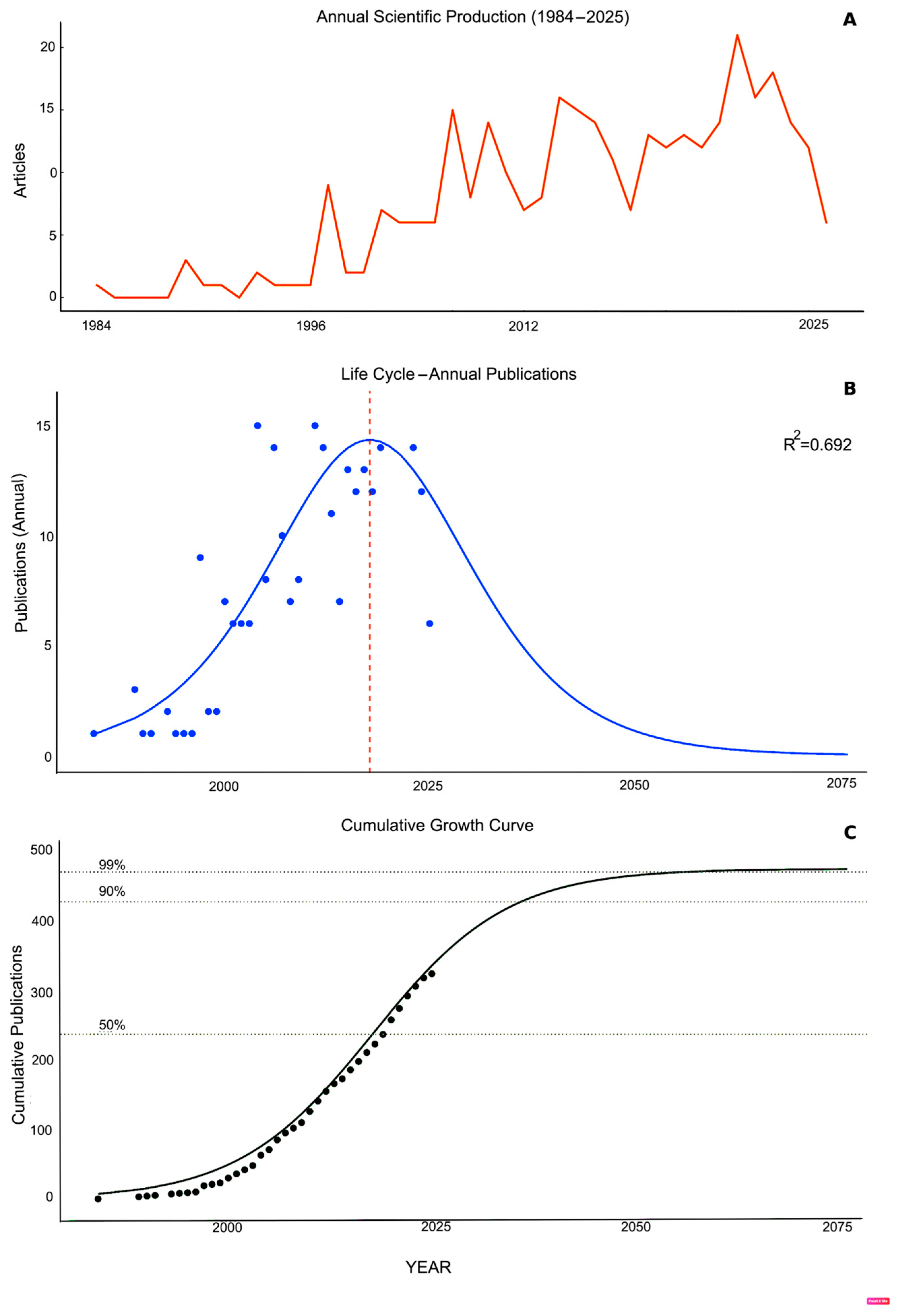
Most analyzed documents corresponded to scientific articles (252 documents), followed by technical reports (26 documents), reviews (12 documents), and other formats. Annual scientific production on the restoration of riparian ecosystems has shown sustained growth since 1984, with a notable increase in the number of publications starting in the 2000s. The number of published articles peaked between 2018 and 2020, followed by a decline in recent years. Overall, this temporal pattern reflects an evolution from an emergent topic to a more consolidated research field, with periods of intensified scientific activity associated with broader ecosystem restoration agendas (Figure 2A).
Figure 2.
Dynamics of scientific production on riparian restoration. (A) Annual scientific production. (B) Logistic fit to the annual publication series on riparian restoration; blue dots represent the observed annual number of publications, and the red dashed vertical line indicates the estimated inflection point of the logistic curve. (C) Logistic projection of publications on riparian restoration; black dots represent the cumulative observed publications, and the black continuous line corresponds to the fitted logistic growth model.
3.2. Temporal Dynamics of Scientific Production
The life cycle analysis of scientific production (Figure 2B) showed that the field of riparian ecosystem restoration is currently in an early maturity phase. The logistic model estimated a theoretical saturation level of K = 476 publications, of which the analyzed corpus already represents 68.2%, indicating that growth is beginning to decelerate. The year of highest productivity was estimated to be 2018, with an annual peak of 14 publications, a value consistent with the observed trend of sustained increase between 2000 and 2020. Model fit quality was moderate (R2 = 0.692; RMSE = 3.13; AIC = 90.3; BIC = 95.2), suggesting that although the general pattern follows a logistic dynamic, interannual fluctuations are associated with regional events or shifts in research agendas.
3.3. Cumulative Trajectory and Projections
The cumulative curve (Figure 2C) exhibited the typical sigmoidal pattern of consolidating fields, with clearly defined milestones: 10% of the projected total was reached around 1999.5, the growth midpoint (50% of K) in 2017.7, and 90% of accumulated knowledge is expected to be reached around 2035.9. According to this trend, the topic will transition into its final maturity phase between 2035 and 2055, when it is projected to reach 99% saturation. Projections indicate that by 2030, approximately 388 publications could be accumulated, and by 2035 around 424, with annual rates of 9 and 6 publications, respectively. Together, these results indicate that the field has already surpassed its rapid growth phase and is gradually approaching stabilization, accompanied by diversification of methodological approaches and an increasing number of studies applied to local contexts.
3.4. Geographic Patterns and Collaboration Networks
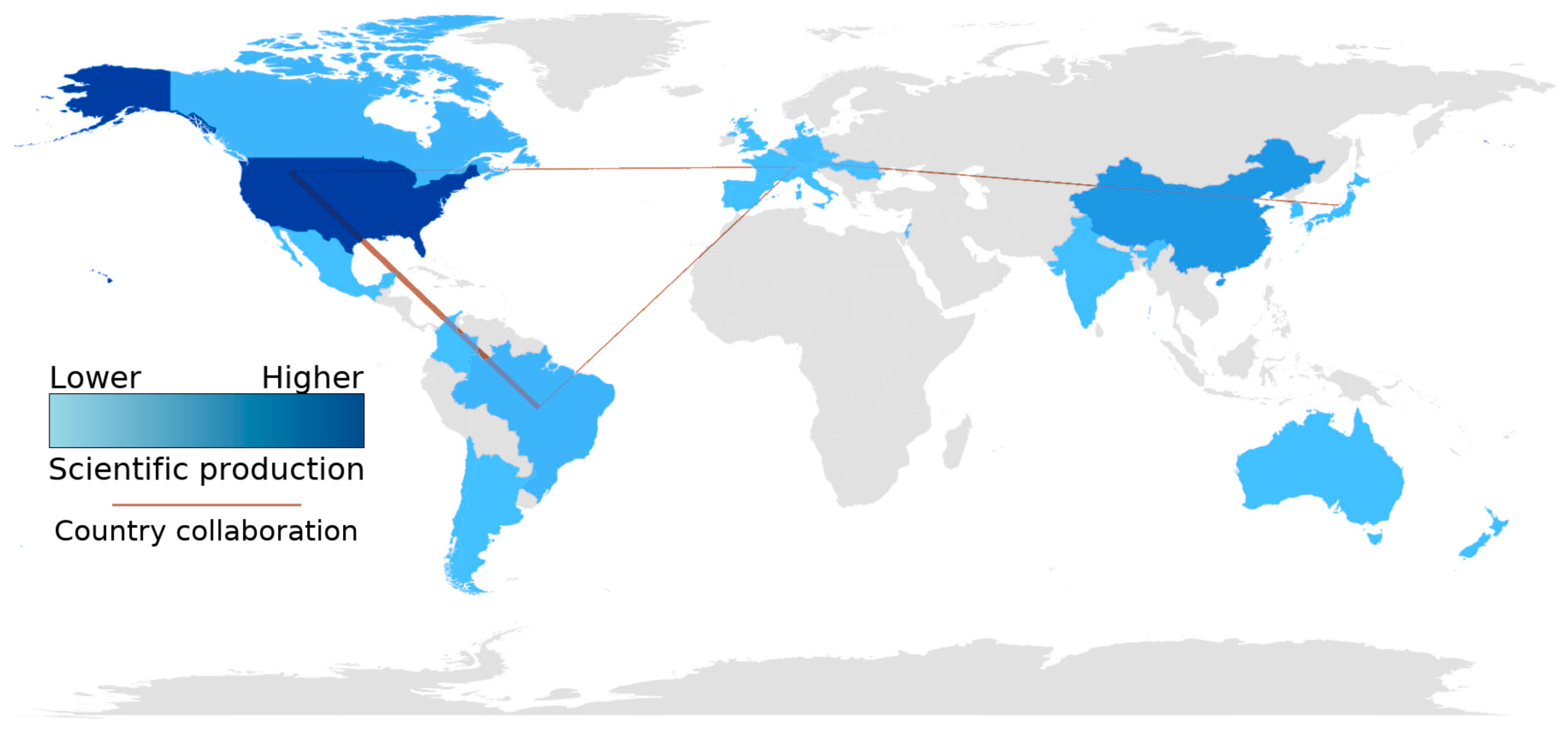
The analysis of the geographical distribution of scientific production shows that the United States, China, and some European and Latin American countries lead research on the restoration of riparian ecosystems. However, international collaboration is limited, with low co-authorship rates between countries. The strongest connection, although with a low frequency of interaction, is observed between the United States and Brazil, indicating the existence of regional research networks with specific interactions between countries (Figure 3).
Figure 3.
Country collaboration map.
In addition, the distribution of corresponding authors confirms a marked geographic concentration: North America contributed 39.1% of all publications, followed by Asia (18.5%) and Europe (17.8%). In contrast, South America (6.8%) and Africa (2.1%) remain substantially underrepresented, reinforcing the limited participation of regions where riparian degradation is often most severe. Overall, the results reveal a strong concentration of scientific production in a small group of countries, with notably lower participation from tropical regions and developing countries. At the geopolitical scale, 78.2% of all studies were led by institutions in the Global North, whereas only 21.8% originated from the Global South, indicating an uneven distribution of scientific leadership.
3.5. Patterns of Authorship and Most Influential Contributions
Lotka’s Law analysis of author productivity shows that more than four-fifths of the authors (80%) contributed only a single article on riparian restoration, about one in six (15%) published two papers, and fewer than 5% authored three or more contributions. This strongly skewed distribution indicates that scientific production in the field is highly concentrated in a small core of very productive researchers, while most authors participate only sporadically.
The analysis of scientific production over time shows that the most active authors in the field of riparian ecosystem restoration include Heidi McRoberts, Arthur J. Gold, Peter M. Groffman, Jones Ira, Philippe G. Vidon, and Timothy J. Beechie. In particular, authors such as Heidi McRoberts, Arthur J. Gold, and Peter M. Groffman have maintained consistent scientific output at different times, with periods of high activity represented by larger circles, indicating a higher number of publications in those years. Authors such as Philippe G. Vidon and Timothy J. Beechie have a lower number of publications but show a higher citation rate in certain years. Additionally, the distribution of points along the time axis indicates that some researchers have contributed to the field over several decades, while others have made more recent contributions.
The analysis of the most cited documents highlights a small set of contributions that structure the field. The article on stream restoration in urban catchments through redesigning stormwater systems by Walsh and co-authors stands out as the most influential, with 503 citations and an annual citation rate of 23.95. It is followed by the review of stream restoration techniques and prioritization strategies in Pacific Northwest watersheds by Roni and colleagues, with 470 citations and 19.58 citations per year. The study by Dosskey and co-authors on the role of riparian vegetation in protecting and improving chemical water quality in streams shows the highest annual impact, with 26.38 citations per year and the highest citation normalization (11.20). The disturbance-based ecosystem approach proposed by Reeves and collaborators and the ecological perspective on riparian and stream restoration developed by Kauffman and co-authors also make significant contributions, with more than 290 citations each, reflecting their relevance in aquatic habitat restoration (Table 1).
Table 1.
Most Global Cited Documents.
3.6. Thematic Trends and Keyword Analysis
The keyword analysis identified the most recurrent terms in research on the restoration of riparian ecosystems, thus defining the main thematic lines in the field. “Watershed management” was the most frequently used keyword, indicating a predominant focus on basin-scale management. Other recurrent terms such as “ecological restoration” and “riparian” highlight the central role of restoration actions and riparian ecosystems in the literature. Additionally, terms including “restoration”, “riparian restoration”, “restoration ecology”, “riparian forest”, “stream restoration”, “riparian vegetation”, and “water quality” demonstrate the importance attributed to riparian vegetation and water quality in these processes. In contrast, terms associated with community participation, such as “stakeholder engagement”, “participation”, or “local knowledge”, appeared with low frequency, suggesting that social dimensions have received comparatively less attention despite their relevance for the sustainability of restoration projects.
The analysis of the main thematic lines in the restoration of riparian ecosystems reveals that ecological restoration and ecosystem management constitute the predominant themes, followed by monitoring techniques and methodologies and the impact of anthropogenic pressures and climate change. The evaluation of ecosystem services and environmental policy and planning also represents a substantial proportion of the literature, reflecting a multidisciplinary approach that encompasses both ecological and governance aspects. In contrast, areas such as socio-economic aspects and public perception are represented by a small number of studies, indicating that the role of communities in restoration processes has been less frequently examined (Table S4). These patterns provide information on current research trends and offer a starting point for future work on the recovery of riparian ecosystems at a global scale.
3.7. Main Thematic Lines and Emerging Topics
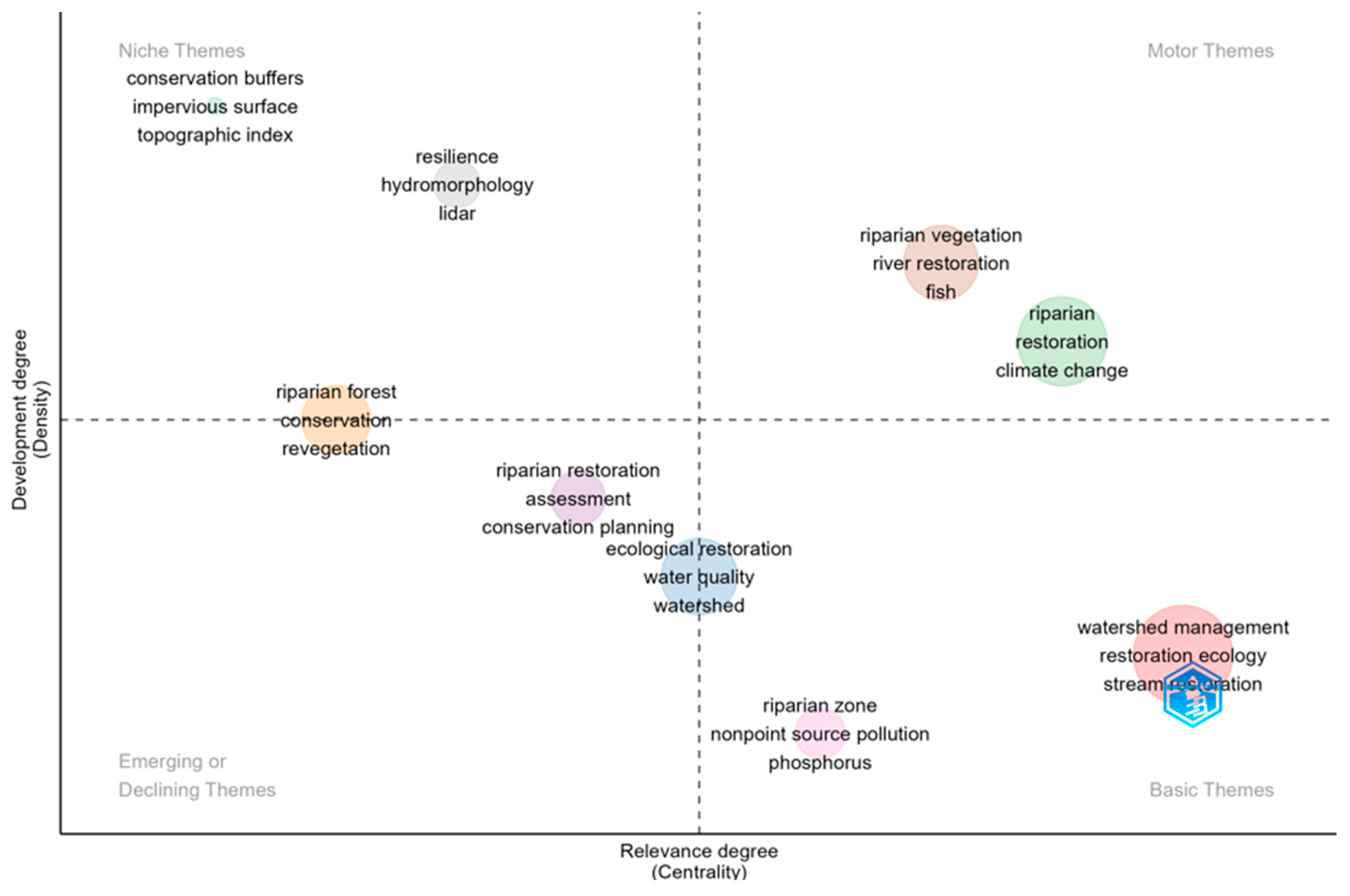
The thematic map derived from keyword co-occurrence identified “riparian restoration”, “conservation planning”, “ecological restoration”, “watershed”, and “water quality” as central and emerging topics, which have moderate relevance within the field but are still in the process of consolidation (Figure 4). These topics have developed in response to the growing need to address riparian ecosystem degradation, improve water quality, and strengthen conservation planning. Their development is closely linked to well-established research lines such as watershed management and restoration ecology, suggesting their future expansion and greater integration into the research agenda.
Figure 4.
Thematic map.
3.8. Restoration Approaches, Community Participation and Issues Addressed
The analysis of the reviewed literature shows that the restoration of riparian ecosystems has primarily focused on the provision of regulatory ecosystem services (87%), such as climate stabilization, water quality improvement, and protection against natural disasters. This category is followed by supporting services (61%), whereas provisioning services (3%) and cultural services (11%) are comparatively less represented. Regarding ecological restoration strategies, area protection (47%) and natural regeneration (32%) stand out as predominant approaches, suggesting a preference for methods that facilitate vegetation recovery and ecological processes with relatively low levels of intervention. Assisted regeneration (30%), artificial regeneration (17%), invasive species control (7%), and silviculture and agroforestry (7%) appear less frequently but still form part of the overall restoration portfolio (Table 2).
Table 2.
Percentage distribution of global perspectives in riparian ecosystem restoration.
Patterns of community participation show a clear predominance of top-down approaches. Top-down unidirectional arrangements, in which decisions are made mainly by external actors and information flows in a single direction, account for 23% of the cases, while top-down deliberative schemes represent 18%. Bottom-up approaches are rare, with only 1% of cases classified as bottom-up unidirectional and 2% as bottom-up deliberative. These figures indicate that, in most analyzed projects, local communities have played a limited role in driving restoration strategies.
With respect to the issues addressed in riparian areas, the literature places a strong emphasis on ecological (90%) and technical-scientific aspects (89%), reflecting dominant efforts to understand environmental degradation and evaluate the effectiveness of recovery strategies. Institutional issues are also frequently considered (77%), whereas hydrological (56%), socio-economic (27%), and natural hazard-related aspects (3%) appear less consistently. This profile suggests that, although governance and biophysical processes are widely acknowledged, socio-economic dimensions and risk reduction have received more limited attention (Table S5).
4. Discussion
Temporal patterns in scientific production reveal an evolution from emergent to more consolidated field status. These data reflect an evolution in research on the topic, with periods of greater scientific activity related to global ecosystem restoration initiatives undertaken by different countries. This pattern coincides with the promotion of global ecological restoration initiatives led by international organizations such as the IUCN and the Convention on Biological Diversity, which have encouraged conservation and watershed recovery strategies [2,48]. The logistic life-cycle analysis, which indicates an early maturity phase and a decelerating growth rate, is consistent with this shift from expansion to consolidation. However, the decline in publications in recent years may be associated with temporary delays in indexing by databases, editorial backlogs, or a shift in research focus toward applied studies and long-term evaluations [42]. Together, these elements indicate the maturation of the field and underline the need to consolidate monitoring and governance strategies to ensure the sustainability of restoration projects.
The geographic distribution of production reinforces this picture of uneven development. The results reveal a strong concentration of scientific production in countries such as the United States and China, with lower participation from tropical regions and developing countries. This suggests a geographic gap in research, as many areas with highly degraded riparian ecosystems, such as Latin America and Southeast Asia, still have limited representation in the scientific literature [11]. The lack of studies in these contexts could be related to limitations in research infrastructure, lack of funding, or lower integration of local communities in knowledge generation [47]. Language barriers and limited access to scientific publication systems may also contribute to this disparity. Additionally, the low connectivity in international collaboration, observed in the co-authorship network, highlights the need to strengthen global research networks to share methodological approaches and adapt restoration strategies to different socio-ecological contexts. This imbalance is even more pronounced when comparing geopolitical regions: 78.2% of all studies were led by institutions in the Global North, whereas only 21.8% originated from the Global South. This disparity indicates a structural gap in scientific leadership and limits the incorporation of diverse ecological, cultural, and socio-political contexts into the global understanding of riparian restoration.
The thematic structure of the literature mirrors these asymmetries. The keyword analysis shows a clear dominance of basin-scale and biophysical approaches, with “watershed management” emerging as the most frequent term and signaling a predominant focus on integrated catchment management [49,50,51]. Other terms such as “ecological restoration” and “riparian” highlight the importance of restoration actions and riparian ecosystems in the literature [28,52]. Additionally, recurrent use of “restoration”, “riparian restoration”, “restoration ecology”, “riparian forest”, “stream restoration”, “riparian vegetation”, and “water quality” underscores the central role of riparian vegetation and water quality in restoration processes [53,54,55,56,57,58,59]. This finding agrees with previous studies that have identified watershed restoration as a comprehensive strategy to improve water quality, reduce erosion, and enhance ecological connectivity [20,60,61,62]. However, the low frequency of terms associated with community participation, such as “stakeholder engagement”, “participation”, or “local knowledge”, suggests that these aspects have received less attention in the literature despite their importance in the sustainability of restoration projects [47]. This is consistent with studies emphasizing the need for a socio-ecological approach in riparian restoration, integrating traditional knowledge and promoting co-management with local communities to ensure the long-term success of interventions.
The analysis of main thematic lines confirms this predominance of ecological and management-oriented perspectives. Ecological restoration and ecosystem management constitute the core of the field [63,64,65], followed by monitoring techniques and methodologies [66,67,68] and the study of anthropogenic pressures and climate change [69,70,71,72,73]. Ecosystem service assessment and environmental policy and planning also emerge as important themes, reflecting efforts to connect ecological dynamics with decision-making and governance frameworks [74,75,76,77]. In contrast, socio-economic aspects and public perception remain marginal, represented by a small number of studies and indicating the need for more work on the role of communities in restoration processes [78,79].
The thematic map further highlights the consolidation of several emerging topics. “Riparian restoration”, “conservation planning”, “ecological restoration”, “watershed”, and “water quality” appear as topics with moderate centrality and density, suggesting that they are becoming increasingly integrated with other research fronts while still developing their internal coherence [80,81,82]. These themes have developed in response to the growing need to address riparian ecosystem degradation, improve water quality, and strengthen conservation planning. Their development is closely linked to well-established research lines, such as watershed management and restoration ecology, suggesting their future expansion. Additionally, their importance in the global environmental agenda, particularly in the restoration of ecosystem services and the mitigation of anthropogenic impacts, highlights their scientific and political relevance [78,79]. These themes are increasingly reflected in national and international environmental policies, and their implementation can directly inform land use planning, climate adaptation strategies, and biodiversity conservation programs. The application of new methodologies, such as remote sensing and hydrological modeling, is contributing to a more precise evaluation of their effectiveness, which will support their consolidation in the coming years. For instance, recent studies in semi-arid river basins have demonstrated how geospatial approaches enable a detailed assessment of water dynamics and support sustainable management decisions [83]. In this context, these emerging topics represent important opportunities to strengthen riparian restoration and its integration into environmental management policies on a global scale.
The review of restoration approaches shows that global practice has prioritized nature-based and low-impact strategies. The strong emphasis on regulatory ecosystem services, particularly climate stabilization, water quality improvement, and protection against natural disasters, reflects concerns about mitigating environmental degradation and climate change in riparian zones [84,85]. In this context, area protection and natural regeneration appear as predominant restoration strategies, consistent with the capacity of riparian ecosystems to recover when pressures are reduced and natural processes are allowed to operate [86,87]. The frequent use of these approaches suggests a preference for methods that facilitate vegetation recovery and ecological processes without intensive interventions [88,89,90,91,92]. This trend may be linked not only to ecological effectiveness but also to the economic feasibility of low-input strategies compared to more artificial or intensive methods [93,94,95,96,97,98,99]. Empirical evidence documenting consistent reductions in sediments and nutrients through riparian buffers and grass filters further supports arguments for their cost-effectiveness and central role in water quality protection [100,101,102].
Despite the recognition of these benefits, patterns of community participation remain predominantly top-down. The corpus shows a clear predominance of top-down unidirectional approaches, where decisions are made by external actors and information flows mainly in one direction. This configuration suggests that decision-making is still largely centralized within governmental and academic institutions, with limited feedback from local communities [20,103,104]. Previous research has shown that ecological restoration is more effective when it actively involves local actors in planning, execution, and monitoring [37,105,106]. Participatory restoration can generate benefits not only in terms of ecological success but also by building social resilience and strengthening local capacities [8]. It remains unclear whether the limited representation of bottom-up deliberative processes in the literature reflects a global trend in practice or is the result of underreporting, but in either case it represents a critical gap that needs to be addressed in future studies.
At the regional scale, the review shows clear contrasts in restoration outcomes that extend beyond biophysical drivers, reflecting interactions among hydrology, geomorphology, and land-use legacies that condition the feasibility and persistence of restoration effects [55,74,75,76]. In Mediterranean agricultural landscapes, effectiveness hinges on maintaining hydrological connectivity and reducing nutrient and sediment inputs, which favors area protection and natural regeneration as cost-effective pathways [7,10,21,22]; these gains are more likely when catchments approximate natural flow and sediment regimes and when environmental-flow recommendations align with reach-scale actions [55,78,79]. In tropical agricultural settings, outcomes depend strongly on landscape context and pressures from surrounding land use, with water-quality gains tied to riparian vegetation recovery and buffer functionality [19,20,21,22,44,57,84,85,86]. Here, landscape controls on riparian hydrology and well-designed buffer widths enhance nitrate retention and sediment trapping, reinforcing the central role of vegetation structure and placement [44,45,46,47,48,49,50,51,52].
In urbanized catchments, redesigning stormwater systems at the catchment scale is decisive for reach-scale ecological responses, explaining why projects limited to local channel works often underperform relative to system-wide interventions [42,58,59,60]. Additionally, transport infrastructure and lateral disconnection can dampen expected benefits unless addressed concurrently [67]. These patterns are consistent with the predominance we found of regulatory services and the emphasis on area protection and natural regeneration, suggesting that contexts where pressures can be reduced and hydrologic regimes partially restored tend to show more durable gains [55,56,57]. Robust monitoring and hydro-ecological tools further support these trajectories by linking vegetation responses to groundwater and flow variability [61,62,63]. Conversely, in highly degraded or flow-regulated systems, passive strategies frequently require complementary active measures (e.g., planting, invasive control) to overcome recruitment filters and altered disturbance regimes [13,14,15,16,17,18,64,65,66,67,68,77]. In such cases, room-for-rivers strategies, explicit ecological success standards, and hierarchical prioritization can help reconcile reach-scale designs with catchment-level drivers [30,60,77]. Finally, across regions, the translation of these biophysical preconditions into lasting outcomes is often contingent on local ordinances and implementation instruments (e.g., riparian buffer rules), which modulate on-the-ground effectiveness of otherwise sound designs [98,99].
The de facto limited representation of bottom-up deliberative processes in the corpus (≤2%) and the predominance of top-down approaches (23%) also reflect power asymmetries and institutional arrangements that shape both decision-making and long-term maintenance. The participation and governance literature indicates that institutional frameworks, formal rules (buffer ordinances, standards, permits), and financial incentives mediate the translation of ecological evidence into effective implementation [15,16,20,37,46,103,104]. In basins with polycentric governance and co-decision spaces, participation tends to move from one-way consultation to co-management, with benefits for compliance, monitoring, and social ownership [30,37,38,78,79,105,106]. By contrast, centralized decision-making, weak financing mechanisms, and misalignment across planning scales (catchment vs. reach) perpetuate piecemeal responses and reduce the persistence of restoration effects [58,59,60,103,104]. These findings suggest that assessing the quality of participation (not merely its presence) and the governance arrangements should be part of success criteria, alongside biophysical and ecosystem-service metrics [28,60,69,77,107,108,109,110].
From a methodological perspective, the bibliometric approach used in this study has made it possible to identify global patterns in the restoration of riparian ecosystems, including trends, gaps, and research opportunities [107,108]. However, this methodology presents certain inherent limitations, such as bias towards studies published in English and dependence on indexed databases, which may exclude gray literature and local knowledge not published in high-impact scientific journals [11]. In particular, relevant local reports and community-based assessments may have been excluded due to the criteria used, which focused on peer-reviewed journal articles.
Regarding future perspectives, this study highlights the need to strengthen the integration between science and policy in the restoration of riparian ecosystems. Despite the growing recognition of the importance of these ecosystems, challenges remain in the effective implementation of restoration strategies at local and regional levels [109]. The development of interdisciplinary approaches that combine ecology, economics, and governance will be key to improving the effectiveness of restoration projects and ensuring their long-term viability [33,108]. Additionally, the use of emerging technologies, such as remote sensing and simulation models, may offer new opportunities to evaluate and monitor restoration with greater precision and efficiency.
As a final contribution, this work calls for co-alliances that promote cooperation and co-creation, positioning communities as co-investigators and incorporating traditional knowledge into restoration processes [109]. This broader vision is essential to shift from tokenistic participation toward genuine collaboration, where local communities are not only consulted but empowered as active agents in the design and implementation of restoration strategies. Recognizing and valuing traditional ecological knowledge can enrich scientific approaches, improve cultural relevance, and enhance the legitimacy and long-term acceptance of restoration efforts [110]. Compared to previous reviews, this study makes a specific contribution by integrating a dual bibliometric and systematic analysis focused exclusively on the restoration of riparian ecosystems, with explicit classification of restoration strategies, ecosystem services, community participation approaches, and socio-environmental problems addressed. Unlike earlier works that broadly covered ecological restoration or watershed management, this study narrows the scope to riparian zones and offers a comparative global synthesis across 322 documents, highlighting underexplored themes such as deliberative participation, local knowledge integration, and regional research gaps. Furthermore, the study offers a structured typology to interpret current practices and outlines strategic opportunities for reinforcing restoration policies, scientific collaboration, and community-based interventions in future initiatives [107,111].
5. Conclusions
The analysis of the global literature indicates that research on riparian restoration is following a stabilizing trajectory, a pattern supported by the logistic model that places current output at roughly two-thirds of its projected maximum. This consolidation contrasts with the uneven development of practices worldwide, where natural regeneration and planting dominate despite the limited inclusion of cultural benefits or community driven processes. The synthesis shows that technical advances alone have not been enough to address the social and institutional constraints that shape outcomes, particularly in regions where ecological pressures interact with governance gaps. A key implication of these findings is that future progress will rely on approaches that intentionally connect scientific evidence with local decision-making and recognize the value of shared stewardship. Co-creation with communities and the integration of local knowledge emerge as essential elements for achieving restoration strategies capable of withstanding ecological and societal change.
Supplementary Materials
The following supporting information can be downloaded at: https://www.mdpi.com/article/10.3390/world6040164/s1. Table S1. PRISMA 2020 checklist; Table S2. Complete bibliometric dataset and processing metadata; Table S3. Classification of perspectives in riparian ecosystem restoration; Table S4. Main identified thematic lines; Table S5. Systematic literature review.
Author Contributions
J.M.B.M. and D.J.M.P. conceived and designed the study; J.M.B.M. performed the bibliometric and systematic analysis; J.M.B.M. and D.J.M.P. analysed and interpreted the data; D.J.M.P. contributed analytical tools and methodological guidance; J.M.B.M. wrote the manuscript. All authors have read and agreed to the published version of the manuscript.
Funding
This research received no external funding.
Institutional Review Board Statement
Not applicable.
Informed Consent Statement
Not applicable.
Data Availability Statement
Dataset available on request from the authors.
Acknowledgments
The authors express their gratitude to the BPIN 2021000100066 project, “Bioeconomic Strengthening for Social and Productive Reactivation Based on the Provision of Hydrological Ecosystem Services in the Context of Climate Change and the Challenges of COVID-19, in Priority Municipalities of the Cauca Department,” for the support provided in the development of this study. Their backing has been essential in strengthening the analysis of riparian ecosystem restoration and its importance in the provision of ecosystem services.
Conflicts of Interest
The authors declare no conflicts of interest.
Abbreviations
The following abbreviations are used in this manuscript:
| PRISMA | Preferred Reporting Items for Systematic reviews and Meta-Analyses |
| TC | Total Citations |
| IUCN | International Union for Conservation of Nature |
References
- Corvalán, C.; Hales, S.; McMichael, A.J.; Millennium Ecosystem Assessment; World Health Organization. Ecosystems and Human Well-Being: Health Synthesis; World Health Organization: Geneva, Switzerland, 2005; pp. 1–137. Available online: https://www.loc.gov/item/2023691852/ (accessed on 20 August 2025).
- Dosskey, M.G.; Vidon, P.; Gurwick, N.P.; Allan, C.J.; Duval, T.P.; Lowrance, R. Process-based principles for restoring river ecosystems. J. Am. Water Resour. Assoc. 2010, 46, 261–277. [Google Scholar] [CrossRef]
- Grizzetti, B.; Liquete, C.; Antunes, P.; Carvalho, L.; Geamănă, N.; Giucă, R.; Leone, M.; McConnell, S.; Preda, E.; Santos, R.; et al. Ecosystem services for water policy: Insights across Europe. Environ. Sci. Policy 2016, 66, 179–190. [Google Scholar] [CrossRef]
- Beechie, T.J.; Stefankiv, O.; Bond, M.; Pollock, M. Modeling riparian species occurrence from historical vegetation and hydrologic regime data. Ecosphere 2021, 12, e03525. [Google Scholar] [CrossRef]
- Richardson, D.M.; Holmes, P.M.; Esler, K.J.; Galatowitsch, S.M.; Stromberg, J.C.; Kirkman, S.P.; Pyšek, P.; Hobbs, R.J. Riparian vegetation: Degradation, alien plant invasions, and restoration prospects. Divers. Distrib. 2007, 13, 126–139. [Google Scholar] [CrossRef]
- du Plessis, N.S.; Rebelo, A.J.; Richardson, D.M.; Esler, K.J. Guiding restoration of riparian ecosystems degraded by plant invasions: Insights from a complex social-ecological system in the Global South. Ambio 2022, 51, 1552–1568. [Google Scholar] [CrossRef]
- Castellano, C.; Bruno, D.; Comín, F.A.; Rey Benayas, J.M.; Masip, A.; Jiménez, J.J. Environmental drivers for riparian restoration success and ecosystem services supply in Mediterranean agricultural landscapes. Agric. Ecosyst. Environ. 2022, 337, 108048. [Google Scholar] [CrossRef]
- Ramos, L.; Negreiros, D.; Goulart, F.F.; Figueiredo, J.C.G.; Kenedy-Siqueira, W.; Toma, T.S.P.; Justino, W.S.; Maia, R.A.; Oliveira, J.T.; Oki, Y.; et al. Dissimilar forests along the Rio Doce watershed call for multiple restoration references to avoid biotic homogenization. Sci. Total Environ. 2024, 930, 172720. [Google Scholar] [CrossRef]
- Fullerton, A.H.; Sun, N.; Baerwalde, M.J.; Hawkins, B.L.; Yan, H. Mechanistic simulations suggest riparian restoration can partly counteract climate impacts to juvenile salmon. J. Am. Water Resour. Assoc. 2022, 58, 525–546. [Google Scholar] [CrossRef]
- Mohan, M.; Chacko, A.; Rameshan, M.; Gopikrishna, V.G.; Kannan, V.M.; Vishnu, N.G.; Sasi, S.A.; Baiju, K.R. Restoring riparian ecosystems during the UN-Decade on Ecosystem Restoration: A global perspective. Anthr. Sci. 2022, 1, 42–61. [Google Scholar] [CrossRef]
- Zhao, Y.; Sun, B.; Shi, X.; Tao, Y.; Wang, Z.; Wang, S.; Ye, B. The relationship between riparian soil nutrients and water quality in inlet sections of lakes: A case study of the Kherlen River. Sustainability 2025, 17, 1367. [Google Scholar] [CrossRef]
- Shafroth, P.B.; Stromberg, J.C.; Patten, D.T. Woody riparian vegetation response to different alluvial water table regimes. West. N. Am. Nat. 2000, 60, 66–76. [Google Scholar]
- Kauffman, J.B.; Beschta, R.L.; Otting, N.; Lytjen, D. An ecological perspective of riparian and stream restoration in the western United States. Fisheries 1997, 22, 12–24. [Google Scholar] [CrossRef]
- Boudell, J.A.; Dixon, M.D.; Rood, S.B.; Stromberg, J.C. Restoring functional riparian ecosystems: Concepts and applications. Ecohydrology 2015, 8, 791–806. [Google Scholar] [CrossRef]
- Krall, M.; Roni, P. Effects of livestock exclusion on stream habitat and aquatic biota: A review and recommendations for implementation and monitoring. N. Am. J. Fish. Manag. 2023, 43, 287–305. [Google Scholar] [CrossRef]
- Cubley, E.S.; Richer, E.E.; Baker, D.W.; Lamson, C.G.; Hardee, T.L.; Bledsoe, B.P.; Kulchawik, P.L. Restoration of riparian vegetation on a mountain river degraded by historical mining and grazing. River Res. Appl. 2021, 38, 1841–1855. [Google Scholar] [CrossRef]
- Sweeney, B.W.; Czapka, S.J.; Yerkes, T. Riparian forest restoration: Increasing success by reducing plant competition and herbivory. Restor. Ecol. 2002, 10, 392–400. [Google Scholar] [CrossRef]
- Andrews, D.M.; Barton, C.D.; Czapka, S.J.; Kolka, R.K.; Sweeney, B.W. Influence of tree shelters on seedling success in an afforested riparian zone. New For. 2010, 39, 157–167. [Google Scholar] [CrossRef]
- De Mello, K.; Randhir, T.O.; Valente, R.A.; Vettorazzi, C.A. Riparian restoration for protecting water quality in tropical agricultural watersheds. Ecol. Eng. 2017, 108, 514–524. [Google Scholar] [CrossRef]
- Narendra, B.H.; Siregar, C.A.; Dharmawan, I.W.S.; Sukmana, A.; Pratiwi, I.B.; Pramono, I.B.; Basuki, T.M.; Nugroho, H.Y.S.H.; Supangat, A.B.; Purwanto, O.; et al. A review on sustainability of watershed management in Indonesia. Sustainability 2021, 13, 11125. [Google Scholar] [CrossRef]
- Dybala, K.E.; Clipperton, N.; Gardali, T.; Golet, G.H.; Kelsey, R.; Lorenzato, S.; Melcer, R.; Seavy, N.E.; Silveira, J.G.; Yarris, G.S. Population and habitat objectives for avian conservation in California’s Central Valley riparian ecosystems. San Franc. Estuary Watershed Sci. 2017, 15, 1. [Google Scholar] [CrossRef]
- Fullerton, A.H.; Beechie, T.J.; Baker, S.E.; Hall, J.E.; Barnas, K.A. Regional patterns of riparian characteristics in the western USA: Implications for restoration. Landsc. Urban Plan. 2006, 78, 86–100. [Google Scholar]
- Lozanovska, I.; Ferreira, M.T.; Aguiar, F.C. Functional diversity assessment in riparian forests—Multiple approaches and trends: A review. Ecol. Indic. 2018, 95, 781–793. [Google Scholar] [CrossRef]
- Nilsson, C.; Jansson, R.; Malmqvist, B.; Naiman, R.J. Restoring riverine landscapes: The challenge of identifying priorities, reference states, and techniques. Ecol. Soc. 2007, 12, 16. [Google Scholar] [CrossRef]
- Mondal, S.; Patel, P.P. Mapping, measuring and modelling common fluvial hazards in riparian zones: A brief review of relevant concepts and methods. In Geospatial Technology for Environmental Hazards; Springer: Cham, Switzerland, 2021; pp. 353–389. [Google Scholar] [CrossRef]
- Dwire, K.A.; Mellmann-Brown, S.; Gurrieri, J.T. Potential effects of climate change on riparian areas, wetlands, and groundwater-dependent ecosystems in the Blue Mountains, Oregon, USA. Clim. Serv. 2018, 10, 44–52. [Google Scholar] [CrossRef]
- Zhai, L.; Cheng, S.; Sang, H.; Xie, W.; Gan, L.; Wang, T. Remote sensing evaluation of ecological restoration engineering effect: A case study of the Yongding River Watershed, China. Ecol. Eng. 2022, 182, 106724. [Google Scholar] [CrossRef]
- Beechie, T.J.; Sear, D.A.; Olden, J.D.; Pess, G.R.; Buffington, J.M.; Moir, H.; Roni, P.; Pollock, M.M. Process-based principles for restoring river ecosystems. BioScience 2010, 60, 209–222. [Google Scholar] [CrossRef]
- Sanders, J.M.; Jackson, C.R.; Welch-Devine, M. Mowers versus growers: Riparian buffer management in working landscapes. J. Am. Water Resour. Assoc. 2023, 59, 563–578. [Google Scholar] [CrossRef]
- Rohde, S.; Hostmann, M.; Peter, A.; Ewald, K.C. Room for rivers: An integrative search strategy for floodplain restoration. Landsc. Urban Plan. 2006, 78, 50–70. [Google Scholar] [CrossRef]
- Page, M.J.; McKenzie, J.E.; Bossuyt, P.M.; Boutron, I.; Hoffmann, T.C.; Mulrow, C.D.; Shamseer, L.; Tetzlaff, J.M.; Akl, E.A.; Brennan, S.E.; et al. The PRISMA 2020 statement: An updated guideline for reporting systematic reviews. BMJ 2021, 372, n71. [Google Scholar] [CrossRef]
- Aria, M.; Cuccurullo, C. Bibliometrix: An R-tool for comprehensive science mapping analysis. J. Informetr. 2017, 11, 959–975. [Google Scholar] [CrossRef]
- Zheng, J.; Wang, L.; Li, C. Trends and Hotspots in Riparian Restoration Research: A Global Bibliometric Analysis during 1990–2022. Forests 2024, 14, 2205. [Google Scholar] [CrossRef]
- Goyal, K.; Kumar, S. Financial literacy: A systematic review and bibliometric analysis. Int. J. Consum. Stud. 2021, 45, 80–105. [Google Scholar] [CrossRef]
- Malapane, O.L.; Musakwa, W.; Chanza, N.; Radinger-Peer, V. Bibliometric analysis and systematic review of indigenous knowledge from a comparative African perspective: 1990–2020. Land 2022, 11, 1167. [Google Scholar] [CrossRef]
- Nyulas, J.; Dezsi, Ș.; Niță, A.; Toma, R.-A.; Lazăr, A.-M. Trends and future directions in analysing attractiveness of geoparks using an automated merging method of multiple databases—R-based bibliometric analysis. Land 2024, 13, 1627. [Google Scholar] [CrossRef]
- Rogers, E.M. Diffusion of Innovations, 5th ed.; Free Press: New York, NY, USA, 2003. [Google Scholar]
- Bettencourt, L.M.; Kaiser, D.I.; Kaur, J. Scientific discovery and topological transitions in collaboration networks. J. Informetr. 2009, 3, 210–221. [Google Scholar] [CrossRef]
- Small, H.; Upham, S.P. Citation structure of an emerging research area on the verge of application. Scientometrics 2009, 79, 365–375. [Google Scholar] [CrossRef]
- Aria, M.; Misuraca, M.; Spano, M. Mapping the evolution of social research and data science on 30 years of Social Indicators Research. Soc. Indic. Res. 2020, 149, 803–831. [Google Scholar] [CrossRef]
- Wang, Q. A bibliometric model for identifying emerging research topics. J. Assoc. Inf. Sci. Technol. 2018, 69, 290–304. [Google Scholar] [CrossRef]
- Walsh, C.J.; Fletcher, T.D.; Ladson, A.R. Stream restoration in urban catchments through redesigning stormwater systems: Looking to the catchment to save the stream. J. N. Am. Benthol. Soc. 2005, 24, 690–705. [Google Scholar] [CrossRef]
- Roni, P.; Beechie, T.J.; Bilby, R.E.; Leonetti, F.E.; Pollock, M.M.; Pess, G.R. A review of stream restoration techniques and a hierarchical strategy for prioritizing restoration in Pacific Northwest watersheds. N. Am. J. Fish. Manag. 2002, 22, 1–20. [Google Scholar] [CrossRef]
- Reeves, G.H.; Benda, L.E.; Burnett, K.M.; Bisson, P.A.; Sedell, J.R. A disturbance-based ecosystem approach to maintaining and restoring freshwater habitats of evolutionarily significant units of anadromous salmonids in the Pacific Northwest. Am. Fish. Soc. Symp. 1995, 17, 334–349. [Google Scholar]
- International Union for Conservation of Nature (IUCN). Restoration Intervention Typology for Terrestrial Ecosystems; IUCN: Gland, Switzerland, 2021; Available online: https://iucn.org/sites/default/files/content/documents/2021/iucn_restoration_intervention_typology.pdf (accessed on 25 August 2025).
- Reed, M.S.; Vella, S.; Challies, E.; de Vente, J.; Frewer, L.; Hohenwallner-Ries, D.; Huber, T.; Neumann, R.K.; Oughton, E.A.; Sidoli del Ceno, J.; et al. A Theory of Participation: What Makes Stakeholder and Public Engagement in Environmental Management Work? Restor. Ecol. 2017, 25, 745–756. [Google Scholar] [CrossRef]
- Fenten, T.; Dieperink, C. Governance conditions for a successful restoration of riverine ecosystems, lessons from the Rhine River Basin. Water 2024, 16, 2983. [Google Scholar] [CrossRef]
- Roni, P.; Hanson, K.; Beechie, T.J.; Pess, G.R.; Pollock, M.M.; Bartley, D.M. Habitat Rehabilitation for Inland Fisheries: Global Review of Effectiveness and Guidance for Rehabilitation of Freshwater Ecosystems; FAO Fisheries Technical Paper 484; FAO: Rome, Italy, 2005. [Google Scholar]
- Poff, N.L.; Allan, J.D.; Bain, M.B.; Karr, J.R.; Prestegaard, K.L.; Richter, B.D.; Sparks, R.E.; Stromberg, J.C. The natural flow regime. BioScience 1997, 47, 769–784. [Google Scholar] [CrossRef]
- Naiman, R.J.; Decamps, H.; Pollock, M. The role of riparian corridors in maintaining regional biodiversity. Ecol. Appl. 1993, 3, 209–212. [Google Scholar] [CrossRef] [PubMed]
- Allan, D.J.; Erickson, D.; Fay, J. The influence of catchment land use on stream integrity across multiple spatial scales. Freshw. Biol. 1997, 37, 149–161. [Google Scholar] [CrossRef]
- Bernhardt, E.S.; Palmer, M.A.; Allan, J.D.; Alexander, G.; Barnas, K.; Brooks, S.; Carr, J.; Clayton, S.; Dahm, C.; Follstad-Shah, J.; et al. Synthesizing U.S. river restoration efforts. Science 2005, 308, 636–637. [Google Scholar] [CrossRef]
- Sweeney, B.W.; Newbold, J.D. Streamside forest buffer width needed to protect stream water quality, habitat, and organisms: A literature review. J. Am. Water Resour. Assoc. 2014, 50, 560–584. [Google Scholar] [CrossRef]
- Lee, P.; Smyth, C.; Boutin, S. Quantitative review of riparian buffer width guidelines from Canada and the United States. J. Environ. Manag. 2004, 70, 165–180. [Google Scholar] [CrossRef]
- Mayer, P.M.; Reynolds, S.K.; McCutchen, M.D.; Canfield, T.J. Meta-analysis of nitrogen removal in riparian buffers. J. Environ. Qual. 2007, 36, 1172–1180. [Google Scholar] [CrossRef]
- Vidon, P.G.F.; Hill, A.R. Landscape controls on the hydrology of stream riparian zones. J. Hydrol. 2004, 292, 210–228. [Google Scholar] [CrossRef]
- Hill, A.R. Nitrate removal in stream riparian zones. J. Environ. Qual. 1996, 25, 743–755. [Google Scholar] [CrossRef]
- Sabater, S.; Butturini, A.; Clement, J.C.; Burt, T.; Dowrick, D.; Hefting, M.; Matre, V.; Pinay, G.; Postolache, C.; Rzepecki, M.; et al. Nitrogen removal by riparian buffers along a European climatic gradient: Patterns and factors of variation. Ecosystems 2003, 6, 20–30. [Google Scholar] [CrossRef]
- Lowrance, R.; Altier, L.S.; Newbold, J.D.; Schnabel, R.R.; Groffman, P.M.; Denver, J.M.; Correll, D.L.; Gilliam, J.W.; Robinson, J.L.; Brinsfield, R.B.; et al. Water quality functions of riparian forest buffers in Chesapeake Bay watersheds. Environ. Manag. 1997, 21, 687–712. [Google Scholar] [CrossRef]
- Wohl, E.; Bledsoe, B.P.; Jacobson, R.B.; Poff, N.L.; Rathburn, S.L.; Walters, D.M.; Wilcox, A.C. The natural sediment regime in rivers: Broadening the foundation for ecosystem management. BioScience 2015, 65, 358–371. [Google Scholar] [CrossRef]
- Dudgeon, D.; Arthington, A.H.; Gessner, M.O.; Kawabata, Z.I.; Knowler, D.J.; Lévêque, C.; Naiman, R.J.; Prieur-Richard, A.H.; Soto, D. Freshwater biodiversity: Importance, threats, status and conservation challenges. Biol. Rev. 2006, 81, 163–182. [Google Scholar] [CrossRef]
- Brown, B.L.; Swan, C.M.; Auerbach, D.A.; Campbell Grant, E.H.; Hitt, N.P.; Maloney, K.O.; Patrick, C. Metacommunity theory as a multispecies, multiscale framework for studying the influence of river network structure on riverine communities and ecosystems. J. N. Am. Benthol. Soc. 2011, 30, 310–327. [Google Scholar] [CrossRef]
- Wohl, E.; Lane, S.N.; Wilcox, A.C. The science and practice of river restoration. Water Resour. Res. 2015, 51, 5974–5997. [Google Scholar] [CrossRef]
- Bernhardt, E.S.; Palmer, M.A. River restoration: The fuzzy logic of repairing reaches to reverse catchment scale degradation. Ecol. Appl. 2011, 21, 1926–1931. [Google Scholar] [CrossRef] [PubMed]
- Palmer, M.A.; Bernhardt, E.S.; Allan, J.D.; Lake, P.S.; Alexander, G.; Brooks, S.; Carr, J.; Clayton, S.; Dahm, C.N.; Follstad Shah, J.; et al. Standards for ecologically successful river restoration. J. Appl. Ecol. 2005, 42, 208–217. [Google Scholar] [CrossRef]
- Loheide, S.P., II; Gorelick, S.M. Riparian hydroecology: A coupled model of the observed interactions between groundwater flow and meadow vegetation patterning. Water Resour. Res. 2007, 43, W07414. [Google Scholar] [CrossRef]
- Tabacchi, E.; Lambs, L.; Guilloy, H.; Planty-Tabacchi, A.-M.; Muller, E.; Décamps, H. Impacts of riparian vegetation on hydrological processes. Hydrol. Process. 2000, 14, 2959–2976. [Google Scholar] [CrossRef]
- Merritt, D.M.; Scott, M.L.; LeRoy Poff, N.; Auble, G.T.; Lytle, D.A. Theory, methods and tools for determining environmental flows for riparian vegetation: Riparian vegetation–flow response guilds. Freshw. Biol. 2010, 55, 206–225. [Google Scholar] [CrossRef]
- Nilsson, C.; Reidy, C.A.; Dynesius, M.; Revenga, C. Fragmentation and flow regulation of the world’s large river systems. Science 2005, 308, 405–408. [Google Scholar] [CrossRef]
- Petts, G.E.; Gurnell, A.M. Dams and geomorphology: Research progress and future directions. Geomorphology 2005, 71, 27–47. [Google Scholar] [CrossRef]
- Olden, J.D.; Naiman, R.J. Incorporating thermal regimes into environmental flows assessments: Modifying dam operations to restore freshwater ecosystem integrity. Freshw. Biol. 2010, 55, 86–107. [Google Scholar] [CrossRef]
- Blanton, P.; Marcus, W.A. Railroads, roads and lateral disconnection in the river landscapes of the continental United States. Geomorphology 2009, 112, 212–227. [Google Scholar] [CrossRef]
- Dodds, W.K.; Oakes, R.M. Headwater influences on downstream water quality. Environ. Manag. 2008, 41, 367–377. [Google Scholar] [CrossRef]
- Brierley, G.; Fryirs, K.; Cullum, C.; Tadaki, M.; Huang, H.Q.; Blue, B. Reading the landscape: Integrating the theory and practice of geomorphology to develop place-based understandings of river systems. Prog. Phys. Geogr. 2013, 37, 601–621. [Google Scholar] [CrossRef]
- Fryirs, K.; Brierley, G.J. Naturalness and Place in River Rehabilitation. Ecol. Soc. 2009, 14, 20. [Google Scholar] [CrossRef]
- Gregory, S.V.; Swanson, F.J.; McKee, W.A.; Cummins, K.W. An ecosystem perspective of riparian zones. BioScience 1991, 41, 540–551. [Google Scholar] [CrossRef]
- Roni, P.; Hanson, K.; Beechie, T. Global review of the physical and biological effectiveness of stream habitat rehabilitation techniques. N. Am. J. Fish. Manag. 2008, 28, 856–890. [Google Scholar] [CrossRef]
- Arthington, A.H.; Bunn, S.E.; Poff, N.L.; Naiman, R.J. The challenge of providing environmental flow rules to sustain river ecosystems. Ecol. Appl. 2006, 16, 1311–1318. [Google Scholar] [CrossRef]
- Richter, B.D.; Warner, A.T.; Meyer, J.L.; Lutz, K. A Collaborative and Adaptive Process for Developing Environmental Flow Recommendations. River Res. Appl. 2006, 22, 297–318. [Google Scholar] [CrossRef]
- Tockner, K.; Malard, F.; Ward, J.V. An extension of the flood pulse concept. Hydrol. Process. 2000, 14, 2861–2883. [Google Scholar] [CrossRef]
- Collins, B.D.; Montgomery, D.R.; Sheikh, A.J. Reconstructing the historical riverine landscape of the Puget Lowland. In Restoring Puget Sound Rivers; University of Washington Press: Seattle, WA, USA, 2003; 512p. [Google Scholar]
- Richardson, J.S.; Béraud, S. Effects of riparian forest harvest on streams: A meta-analysis. J. Appl. Ecol. 2014, 51, 1712–1721. [Google Scholar] [CrossRef]
- Kantharajan, G.; Pathak, A.K.; Sarkar, U.K.; Singh, R.; Kumar, R.; Shikha; Acharya, A.; Kumawat, T. Assessing deep pools and water spread dynamics in semi-arid Banas River, India: A geospatial approach for conservation and sustainable management. Environ. Sci. Pollut. Res. 2024, 31, 55736–55755. [Google Scholar] [CrossRef]
- Naiman, R.J.; Décamps, H. The ecology of interfaces: Riparian zones. Annu. Rev. Ecol. Syst. 1997, 28, 621–658. [Google Scholar] [CrossRef]
- Ward, J.V.; Tockner, K.; Schiemer, F. Biodiversity of floodplain river ecosystems: Ecotones and connectivity. Regul. Rivers Res. Manag. 1999, 15, 125–139. [Google Scholar] [CrossRef]
- Seavy, N.E.; Gardali, T.; Golet, G.H.; Griggs, F.T.; Howell, C.A.; Kelsey, R.; Small, S.L.; Viers, J.H.; Weigand, J.F. Why climate change makes riparian restoration more important than ever: Recommendations for practice and research. Ecol. Restor. 2009, 27, 330–338. [Google Scholar] [CrossRef]
- Postel, S.; Richter, B.D. Rivers for Life: Managing Water for People and Nature; Island Press: Washington, DC, USA, 2003. [Google Scholar]
- Naz, F.; Arif, M.; Xue, T.; Li, C. Artificially remediated plants impact soil physiochemical properties along the riparian zones of the Three Gorges Dam in China. Front. For. Glob. Change 2024, 7, 1301086. [Google Scholar] [CrossRef]
- Morelli, G.; Ciani, F.; Cocozza, C.; Costagliola, P.; Fagotti, C.; Friani, R.; Lattanzi, P.; Manca, R.; Monnanni, A.; Nannoni, A.; et al. Riparian trees in mercury-contaminated riverbanks: An important resource for sustainable remediation management. Environ. Res. 2024, 257, 119373. [Google Scholar] [CrossRef]
- Wenger, S.J. A Review of the Scientific Literature on Riparian Buffer Width, Extent and Vegetation; Institute of Ecology, Office of Public Service & Outreach, University of Georgia: Athens, GA, USA, 1999. [Google Scholar]
- Broadmeadow, S.; Nisbet, T.R. The effects of riparian forest management on the freshwater environment: A literature review of best management practice. Hydrol. Earth Syst. Sci. 2004, 8, 286–305. [Google Scholar] [CrossRef]
- Lind, L.; Maher Hasselquist, E.; Laudon, H. Towards ecologically functional riparian zones: A meta-analysis to develop guidelines for protecting ecosystem functions and biodiversity in agricultural landscapes. J. Environ. Manag. 2019, 249, 109391. [Google Scholar] [CrossRef]
- Lowrance, R.; Todd, R.; Fail, J.; Hendrickson, O.; Leonard, R.; Asmussen, L. Riparian forests as nutrient filters in agricultural watersheds. BioScience 1984, 34, 374–377. [Google Scholar] [CrossRef]
- Peterjohn, W.T.; Correll, D.L. Nutrient dynamics in an agricultural watershed: Observations on the role of a riparian forest. Ecology 1984, 65, 1466–1475. [Google Scholar] [CrossRef]
- Hefting, M.; Clément, J.C.; Dowrick, D.; Cosandey, A.C.; Bernal, S.; Cimpian, C.; Tatur, A.; Burt, T.P.; Pinay, G. Water table elevation controls on soil nitrogen cycling in riparian wetlands along a European climatic gradient. Biogeochemistry 2004, 67, 113–134. [Google Scholar] [CrossRef]
- Burt, T.P.; Pinay, G.; Matheson, F.E.; Haycock, N.E.; Butturini, A.; Clement, J.C.; Danielescu, S.; Dowrick, D.J.; Hefting, M.M.; Hillbricht-Ilkowska, A.; et al. Water Table Fluctuations in the Riparian Zone: Comparative Results from a Pan-European Experiment. J. Hydrol. 2002, 265, 129–148. [Google Scholar] [CrossRef]
- Jordan, T.E.; Weller, D.E.; Correll, D.L. Denitrification in surface soils of a riparian forest: Effects of water, nitrate and sucrose additions. Soil Biol. Biochem. 1998, 30, 833–843. [Google Scholar] [CrossRef]
- Weller, D.E.; Jordan, T.E.; Correll, D.L. Heuristic models for material discharge from landscapes with riparian buffers. Ecol. Appl. 1998, 8, 1156–1169. [Google Scholar] [CrossRef]
- Groffman, P.M.; Gold, A.J.; Simmons, R.C. Nitrate dynamics in riparian forests: Microbial studies. J. Environ. Qual. 1992, 21, 666–671. [Google Scholar] [CrossRef]
- Dosskey, M.G. Toward quantifying water pollution abatement in response to installing buffers on crop land. Environ. Manag. 2001, 28, 577–598. [Google Scholar] [CrossRef] [PubMed]
- Daniels, R.B.; Gilliam, J.W. Sediment and chemical load reduction by grass and riparian filters. Soil Sci. Soc. Am. J. 1996, 60, 246–251. [Google Scholar] [CrossRef]
- Lee, K.H.; Isenhart, T.M.; Schultz, R.C. Sediment and nutrient removal in an established multi-species riparian buffer. J. Soil Water Conserv. 2003, 58, 1–8. [Google Scholar] [CrossRef]
- Wenger, S.J.; Fowler, L. Protecting Stream and River Corridors: Creating Effective Local Riparian Buffer Ordinances; Institute of Ecology, Office of Public Service & Outreach, University of Georgia: Athens, GA, USA, 2000. [Google Scholar]
- Mander, Ü.; Hayakawa, Y.; Kuusemets, V. Purification processes, ecological functions, planning and design of riparian buffer zones in agricultural watersheds. Ecol. Eng. 2005, 24, 421–432. [Google Scholar] [CrossRef]
- Fausch, K.D.; Torgersen, C.E.; Baxter, C.V.; Li, H.W. Landscapes to riverscapes: Bridging the gap between research and conservation of stream fishes. BioScience 2002, 52, 483–498. [Google Scholar] [CrossRef]
- Vidon, P.; Allan, C.; Burns, D.; Duval, T.P.; Gurwick, N.; Inamdar, S.; Lowrance, R.; Okay, J.; Scott, D.; Sebestyen, S. Hot spots and hot moments in riparian zones: Potential for improved water quality management. J. Am. Water Resour. Assoc. 2010, 46, 278–298. [Google Scholar] [CrossRef]
- Gu, J.-Y.; Lee, J.-W.; Lee, S.-W.; Park, Y.; Park, S.-R. Enhancing stream ecosystems through riparian vegetation management. Land 2025, 14, 1248. [Google Scholar] [CrossRef]
- Michael-Bitton, G.; Zemah-Shamir, S.; Portnov, B. Managing stream restoration: Framing and assessing the stream ecosystem services and biodiversity index (SESBI). J. Environ. Manag. 2025, 388, 125938. [Google Scholar] [CrossRef] [PubMed]
- Shore, W.; Jaleta, M.; Zeleke, F.; Beyene, F. Exploring residents’ preferences for riparian restoration attributes in Lake Dambal watershed, Ethiopia: A choice experiment approach. J. Environ. Manag. 2025, 383, 125447. [Google Scholar] [CrossRef]
- Verdonschot, P.; Verdonschot, R. The role of stream restoration in enhancing ecosystem services. Hydrobiologia 2022, 849, 2895–2910. [Google Scholar] [CrossRef]
- Du, N.; Zhao, J.; Qin, K.; Wang, H.; Yang, Y.; Yang, F. Flooding and land use drive variation in phylogenetic structure and taxonomic diversity of plant communities in urban riparian zones of a regulated river. Urban For. Urban Green. 2025, 107, 128741. [Google Scholar] [CrossRef]
Disclaimer/Publisher’s Note: The statements, opinions and data contained in all publications are solely those of the individual author(s) and contributor(s) and not of MDPI and/or the editor(s). MDPI and/or the editor(s) disclaim responsibility for any injury to people or property resulting from any ideas, methods, instructions or products referred to in the content. |
© 2025 by the authors. Licensee MDPI, Basel, Switzerland. This article is an open access article distributed under the terms and conditions of the Creative Commons Attribution (CC BY) license (https://creativecommons.org/licenses/by/4.0/).