1. Introduction
Spur gears are widely used in automotive transmissions, industrial reducers, robotics, and precision mechanical systems due to their high efficiency, simple geometry, and ease of manufacturing. Accurate prediction of tooth contact behavior is critical for minimizing stress concentration, preventing premature failure, and improving load distribution under misalignment conditions [
1,
2]. The performance and durability of spur gears are strongly influenced by material selection, contact mechanics, and gear design. Traditional steels have been widely used for gear manufacturing; however, there is increasing interest in alternative materials, such as intermetallic compounds and Heusler alloys, which offer unique combinations of strength, hardness, and wear resistance [
3,
4,
5].
Accurate prediction of gear behavior under operational loads requires detailed understanding of tooth contact mechanics. Tooth contact analysis (TCA) is a critical computational tool for evaluating parameters such as path of contact, transmission error (TE), and contact stress [
6]. Conventional tooth contact analysis (TCA) relies on an implicit formulation of five non-linear equations with five unknowns, for which convergence is not guaranteed. Although several alternative TCA methods have been proposed to improve efficiency, most are based on discretized tooth surfaces and approximate solutions, often requiring additional optimization algorithms to identify initial contact conditions [
7,
8,
9]. This increases computational costs and complicates contact trace determination. Moreover, these methods are generally limited to specific engagement cases and cannot robustly handle complex misalignments or tooth surface modifications. Similar to the conventional approach, they also suffer from sensitivity to initial guesses, which may lead to numerical divergence. To address these limitations and improve convergence, a novel TCA method is introduced that overcomes the computational issues and is applicable to various material behaviors [
10].
Density functional theory (DFT) has emerged as a powerful method for predicting fundamental mechanical properties of materials at the atomic scale [
11,
12,
13]. By integrating DFT-derived elastic constants into TCA, it is possible to capture material-specific effects on gear contact performance, enabling more accurate prediction of stress distribution and TE for both conventional and advanced materials. Previous studies have applied TCA primarily to metals, but the combination with advanced DFT for spur gears remains limited. Diverging hypotheses exist regarding the suitability of intermetallics versus traditional steels for high-load applications, as intermetallics offer high hardness but may exhibit lower toughness [
14,
15].
Among intermetallic materials, MgCu with a CsCl-type structure has attracted attention due to its relatively low density combined with moderate elastic stiffness, making it a potential candidate for lightweight structural components. In contrast, quaternary Heusler alloys such as CuCoMnSn exhibit high structural stability and favorable elastic properties, and have been reported to possess robust mechanical performance alongside multifunctional characteristics [
16,
17]. These distinct material classes provide a meaningful basis for comparative evaluation against conventional carbon steel in gear applications. The availability of reliable DFT-derived elastic constants for these compounds further enables consistent material-informed contact analysis within the proposed framework. Recent work has also explored alternative meshing concepts and non-metallic contact solutions (for example, cycloidal reducers with plastic meshing elements) as routes to lower mass, lower noise, and higher efficiency in specific applications; such developments demonstrate the broader engineering interest in non-traditional gear materials and coupling strategies [
18,
19]. In the context of analytical and computational contact models, these alternative approaches further motivate material-informed TCA frameworks that can compare disparate material classes (metallic, intermetallic, polymeric/plastic) on an equal footing and under identical kinematic and loading conditions.
In previous studies, the authors developed a fast-converging tooth contact analysis (TCA) formulation and demonstrated its computational efficiency. In the present work, the novelty lies in integrating the previously validated TCA method with density functional theory (DFT)-derived material properties, enabling a material-informed evaluation of gear contact behavior. Specifically, the study provides a comparative investigation of MgCu intermetallic compounds with a CsCl-type structure, CuCoMnSn Heusler alloys, and conventional carbon steel for spur gear applications under misalignment conditions. The study aims to evaluate differences in contact path and stress among the three materials, highlighting the potential of alternative materials for high-performance gears and demonstrating the advantages of combining DFT-informed material modeling with the advanced TCA method for optimized spur gear design.
2. Novel Tooth Contact Analysis (TCA) Method
The tooth contact analysis (TCA) method is based on a geometrically exact formulation of surface tangency between mating gear teeth and is designed to overcome the convergence and computational limitations of classical TCA approaches. The method reformulates the three-dimensional tooth contact problem into a reduced nonlinear system with a minimal number of unknowns, while maintaining full spatial accuracy. The tooth flanks of the driving and driven gears are modeled as smooth parametric surfaces
and
, defined as
where
and
are surface parameters describing the radial and axial coordinates of the tooth surface, respectively,
is the angular position of the gear,
is the surface vector in the local coordinate system, and
is the rotation matrix about the gear axis. The surface normal vector at any point on
is given by
which is required for enforcing the contact tangency condition. Tooth contact is defined by two fundamental conditions, the first being the coincidence of position vectors at the contact point:
where
is the center distance vector between the two gears. The second condition is the collinearity of the surface normals at the contact point:
Unlike classical Litvin-based TCA formulations [
20] that require solving five nonlinear equations simultaneously, the presented method expresses the unknown parameters of the driven gear
explicitly as functions of the driving gear parameters
. By projecting the contact point onto the driven gear axis and enforcing geometric constraints, the driven gear surface parameters are obtained as functions
where the full formulations also can be found in previous work [
21]. The rotation angle of the driven gear is determined from vector projections on a plane perpendicular to its axis of rotation:
The rotation direction is determined from the sign of the scalar triple product with the rotation axis. Substituting these expressions into the normal collinearity condition yields a reduced system of two nonlinear equations:
with only two surface unknowns
and one independent parameter
. The reduced two-variable nonlinear system is solved using the Newton–Raphson method. Owing to the analytical reduction in the governing equations and the improved conditioning of the Jacobian matrix, the method demonstrates empirically robust convergence across the entire meshing cycle.
All numerical computations were performed in the Wolfram Mathematica environment. The solver was executed with a precision goal of 6 and an accuracy goal of 3, ensuring stable convergence to approximately five to six significant digits. To evaluate numerical robustness, 1000 randomly generated initial guesses within the admissible parameter space were tested. The proposed formulation achieved a convergence rate of 99.9%, with no divergence observed across the investigated meshing domain. The average number of iterations required per converged solution was approximately 4 steps, and no oscillatory or unstable iteration behavior was detected. The total computation time for 1000 random initial points was 32.4557 s, confirming the numerical stability and computational efficiency of the reduced two-variable TCA formulation throughout the meshing cycle.
To evaluate the contact stresses between mating gear teeth, the Hertzian contact theory is employed, following the analytical formulation reported in [
10]. The local contact conditions are governed by the surface curvatures of the mating tooth flanks, which are described through the principal curvatures of the surfaces. Tooth surface defined by the parametric equation
. The first and second fundamental form coefficients are defined as
The Gaussian curvature
and mean curvature
of the surface are then given by
The maximum and minimum principal radii of curvature are
The local contact is treated as elliptical area. The composite curvatures are defined as
The eccentricity
of the contact ellipse is obtained from
where
and
are the complete elliptic integrals of the first and second kind:
The semi-axes of the contact ellipse are then determined as
and the maximum Hertzian contact pressure is given by
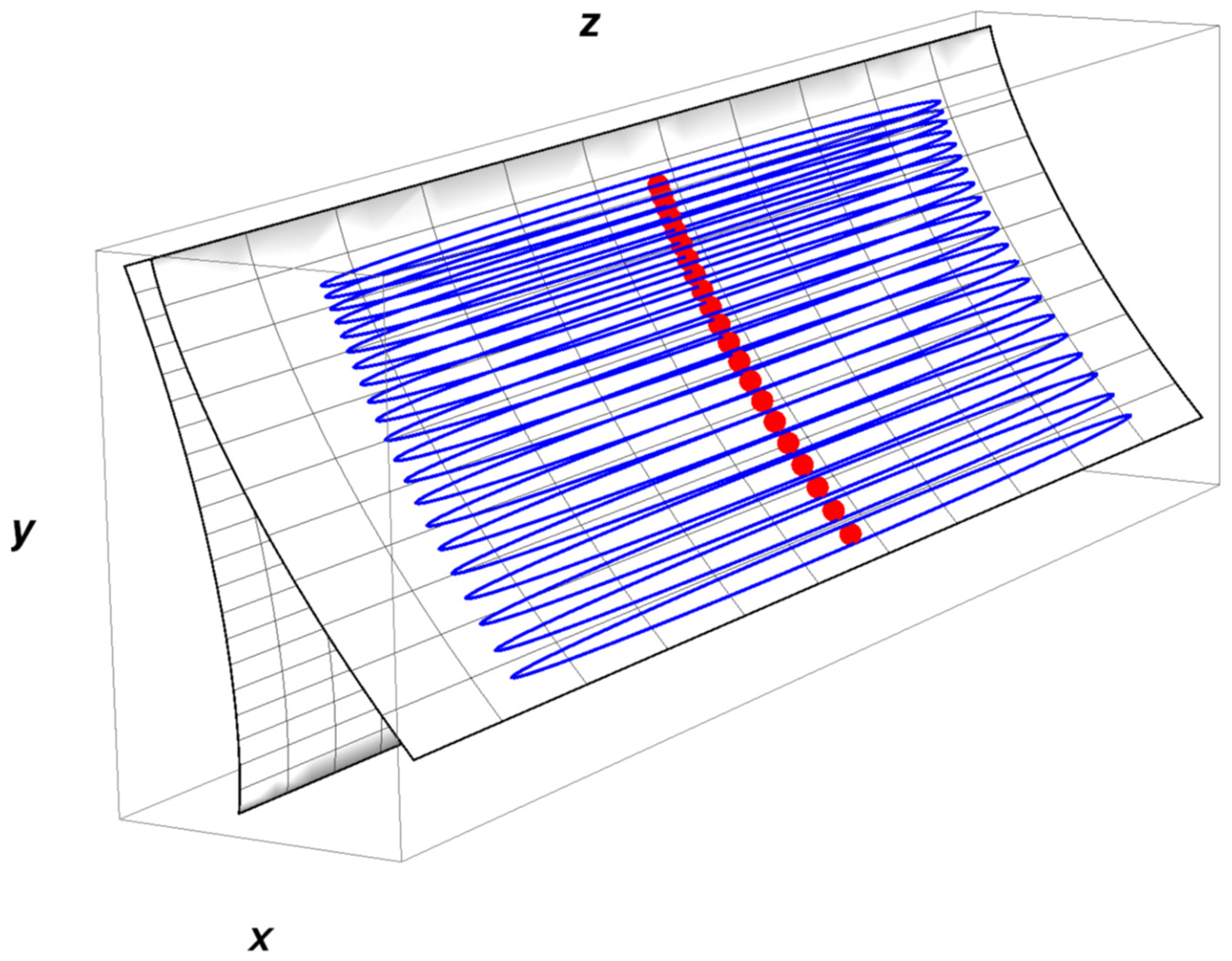
By combining Equations (1)–(17), the spur gear tooth contact in space is formulated, with the contact ellipses illustrated in
Figure 1. The main advantage of this novel TCA method is its reduced-order formulation, in which the tooth contact problem is simplified from a classical five-equation system to a compact nonlinear system with only two surface variables, ensuring robust numerical convergence across the admissible meshing domain without the need for carefully tuned initial guesses and maintaining stability throughout the entire contact cycle. The method offers high computational efficiency, making it well suited for extensive parametric investigations and comparative material studies. In addition, it enables material-informed analysis by directly incorporating elastic properties obtained from density functional theory (DFT) into the evaluation of contact stresses. The formulation is generally applicable to both modified and unmodified spur gears and can be readily extended to helical gears. Overall, the presented TCA framework provides a robust and efficient foundation for the comparative evaluation of advanced materials for spur gear applications.
In order to apply tooth surface crowning within the proposed framework, the modification is introduced directly at the level of the parametric surface definition. The modified tooth surface is expressed as
where
represents the involute surface and
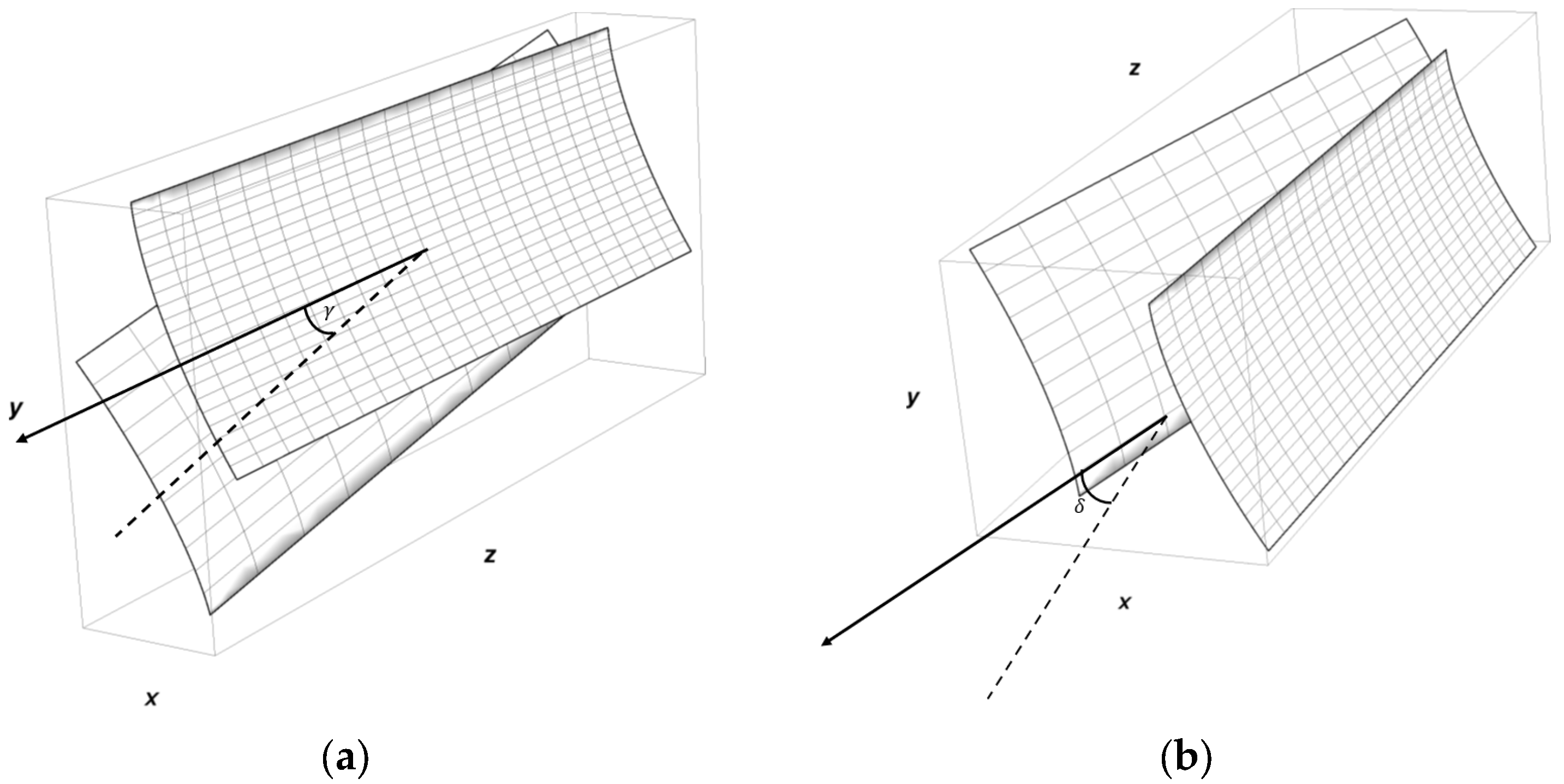
denotes the modification function applied along the tooth face. In the present study, longitudinal crowning is introduced in order to tolerate two angular misalignment types, in-plane and out-of-plane, as illustrated in
Figure 2. The quadratic modification, as shown in Equation (25), along the face-width direction redistributes the contact region toward the central portion of the tooth flank and reduces the likelihood of edge contact under shaft tilting conditions. As a result, the applied crowning improves load accommodation and stabilizes the contact path when angular deviations are present.
Since the proposed TCA formulation operates directly on the fully defined parametric surface, the applied modification is inherently incorporated into the evaluation of surface normals and tangency conditions. Therefore, no additional discretization, correction algorithms, or special treatment procedures are required for handling crowned geometries. The same formulation can be extended to helical gears by redefining the tooth surface as an involute helicoid, where the circumferential and axial coordinates are coupled through the helix angle. In this case, the parametric surface representation remains fully analytical, and the surface tangency conditions are enforced in an identical manner.
3. Density Functional Theory (DFT) Calculation Details
Density functional theory (DFT) was employed to obtain reliable elastic parameters for MgCu with a CsCl-type structure and the CuCoMnSn Heusler alloy, which were subsequently used as material inputs in the novel tooth contact analysis. In the present work, the elastic constants and derived mechanical properties were adopted from previous studies [
16,
17]. These studies employed well-established DFT methodologies and validated convergence criteria, ensuring the reliability of the reported elastic parameters. For both materials, the elastic behavior is described within the framework of linear elasticity. Owing to their cubic crystal symmetry, only three independent single-crystal elastic constants are required, namely
,
, and
. These elastic constants were originally obtained in the referenced works [
16,
17] by applying small homogeneous strains to the optimized crystal structures and calculating the corresponding stress response using Hooke’s law. The corresponding elastic constant values for each composite material are summarized in
Table 1. Using these elastic constants, the macroscopic mechanical parameters, such as the bulk modulus, shear modulus, Young’s modulus, and Poisson’s ratio, can subsequently be evaluated.
The bulk modulus
for a cubic system is given by
To represent polycrystalline behavior, the shear modulus
was calculated using the Voigt–Reuss–Hill (VRH) averaging scheme. The Voigt and Reuss bounds are defined as
and the effective shear modulus is obtained as
Using the bulk and shear moduli, Young’s modulus
and Poisson’s ratio
were determined from the standard isotropic relations
These elastic parameters provide a complete description of the linear mechanical response of the materials and are directly relevant to gear contact mechanics. The DFT-derived Young’s modulus and Poisson’s ratio were incorporated into the contact stress and deformation calculations within the novel tooth contact analysis framework.
Table 2 summarizes the bulk modulus
, shear modulus
, Young’s modulus
, and Poisson’s ratio
for the studied composite materials and carbon steel for comparison, illustrating the relative stiffness and ductility of each material.
By relying on previously validated DFT results, the present study ensures physically accurate material modeling while focusing on the comparative influence of elastic properties on spur gear meshing behavior using the tooth contact analysis method.
4. Material Effects on Crowned Spur Gear Mesh Under Misalignment
The material properties of gear teeth play a main role in determining the contact behavior, load distribution, and stress response of crowned spur gears under angular misalignment. To investigate this effect, several angular misalignment cases were considered, ranging from small to moderate deviations in the gear shaft alignment.
Table 2 summarizes the bulk modulus
, shear modulus
, Young’s modulus
, Poisson’s ratio
and density
for the materials considered. These parameters were used to model the gear teeth as isotropic elastic bodies in the analysis. For each angular misalignment case, the material-dependent contact patterns, contact ellipse size, and stress distributions were computed. Understanding these material effects under multiple misalignment scenarios is essential for selecting suitable gear materials, especially in high-precision or heavy-load applications where misalignment cannot be completely avoided. The crowned spur gear pair is defined by standard geometric parameters. A normal module of 2.5 mm and zero helix angle represent the spur gear configuration. Both the pinion and gear have 25 teeth with zero profile shift. The normal pressure angle is set to 20°,
Table 3. Flank widths for both pinion and gear are 15 mm. These parameters provide a baseline for investigating the influence of material properties and angular misalignment on gear mesh behavior. The parameters
u and
v, as shown in the figures below, denote the surface coordinates along the involute profile and face-width directions, respectively, and are expressed in millimeters.
To examine the influence of misalignment, two types of angular deviations were considered: out-of-plane misalignment
and in-plane misalignment
, both expressed in degrees. Out-of-plane misalignment (
) refers to tilting of the gear axis perpendicular to the tooth plane, while in-plane misalignment (
) represents rotation within the tooth plane. To improve load distribution and reduce edge contact under misalignment, a parabolic crowning profile was applied to the gear teeth. The crowning modifies the tooth surface along the flank width according to a quadratic law, which can be expressed as:
where
is the crowning displacement at a point along the flank,
is the crowning coefficient,
is the position along the tooth flank width, and
is the total flank width. The parabolic crowning coefficient was set as
, defining the magnitude of the crowning displacement along the tooth flank.
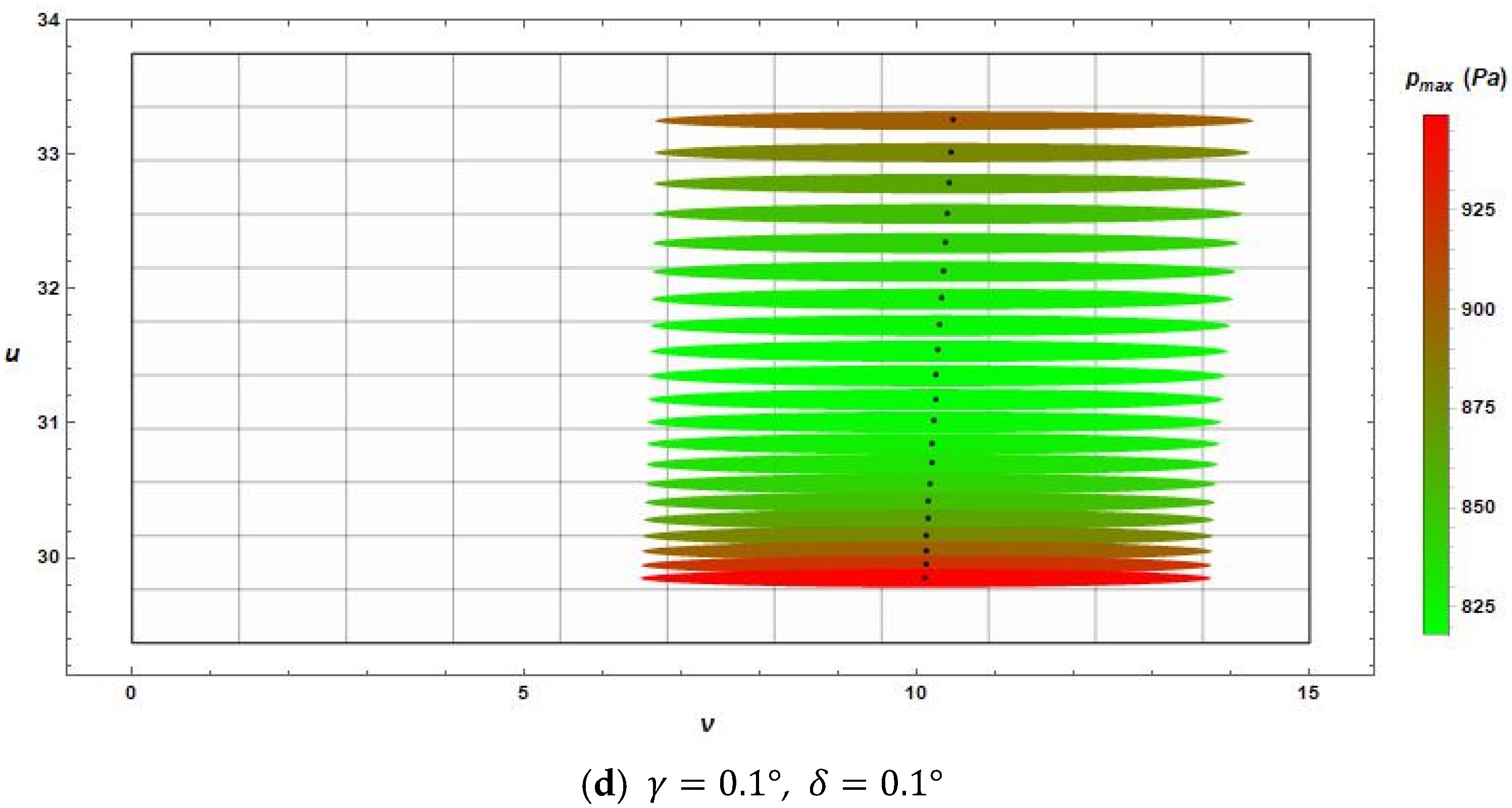
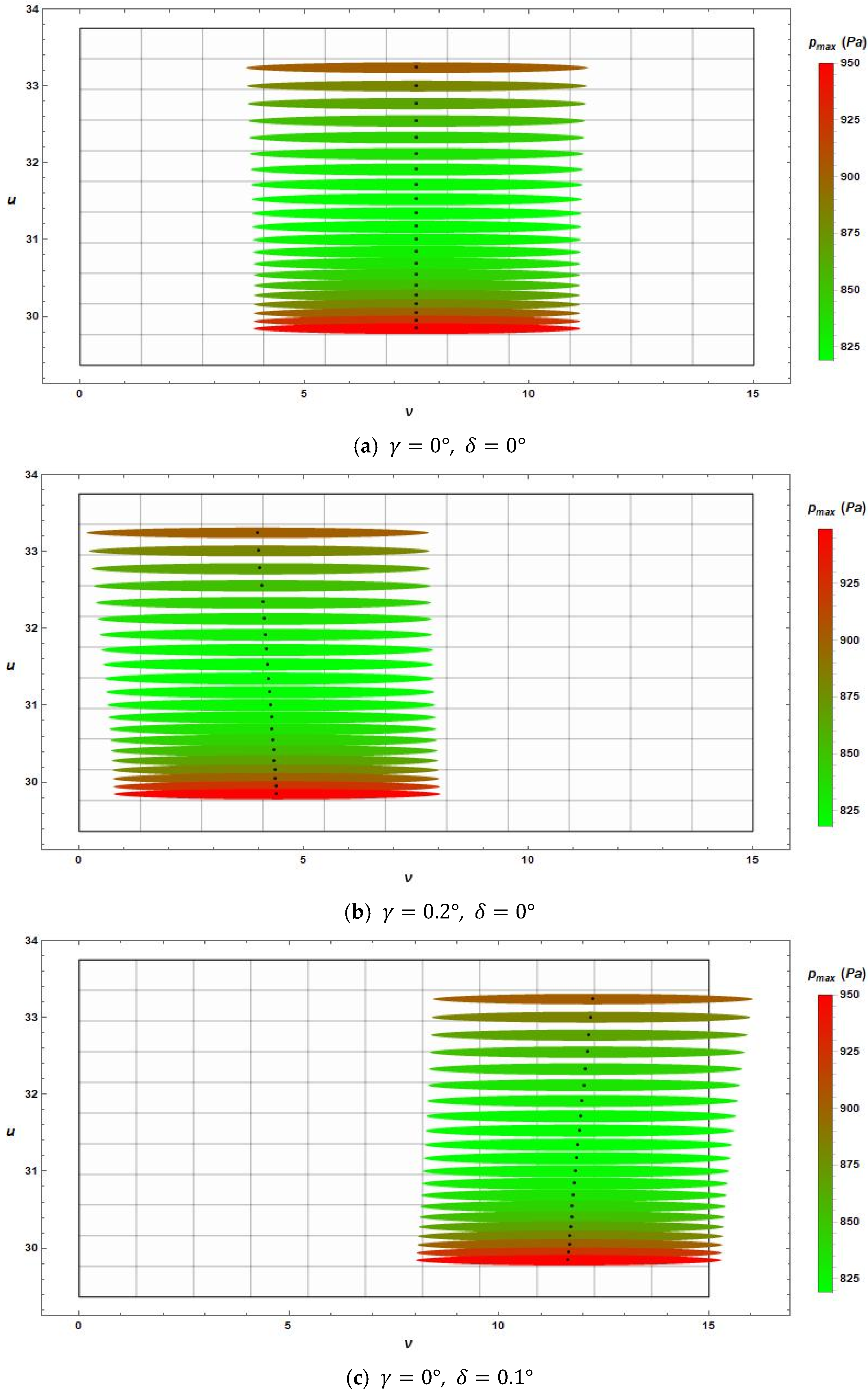
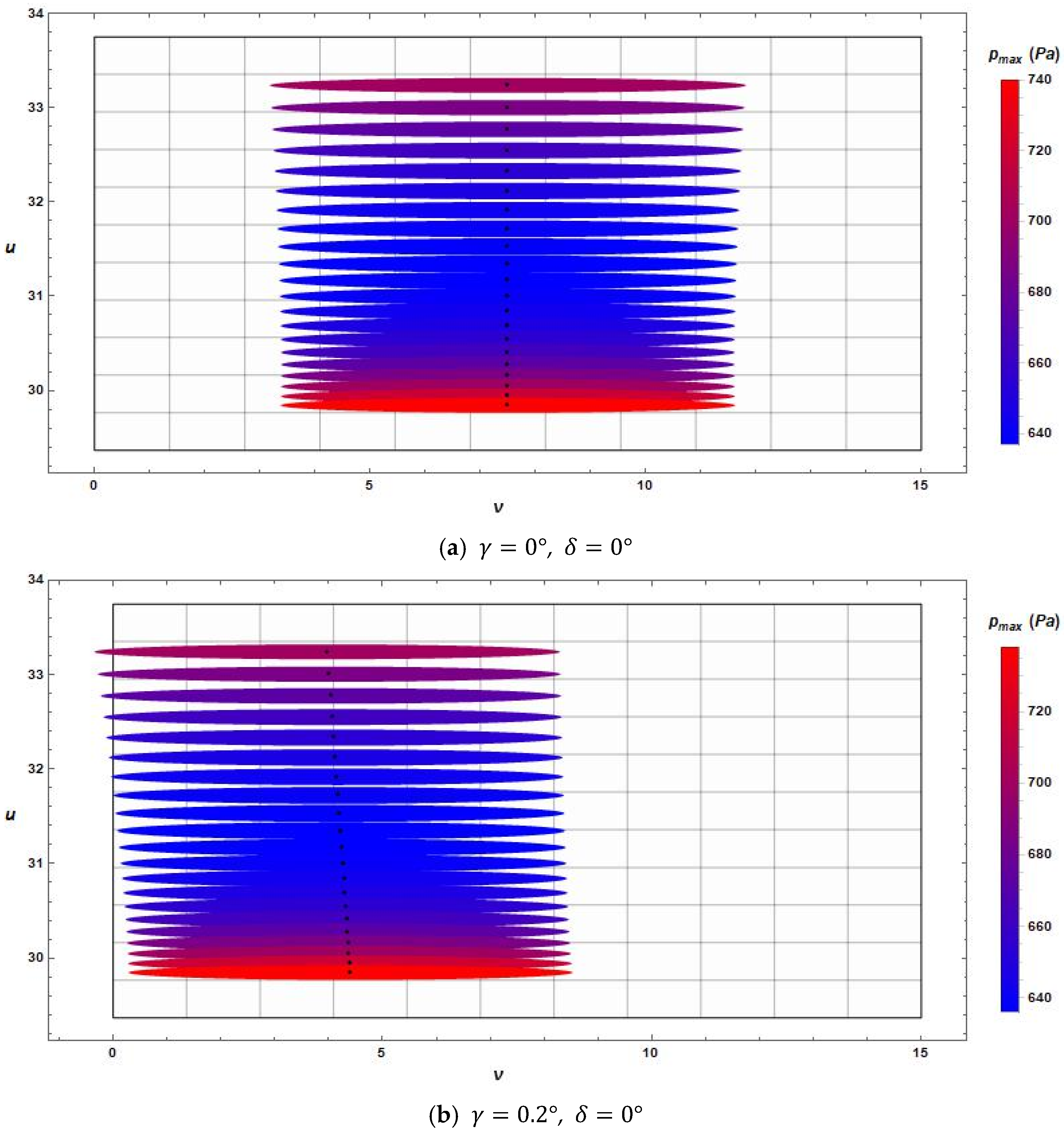
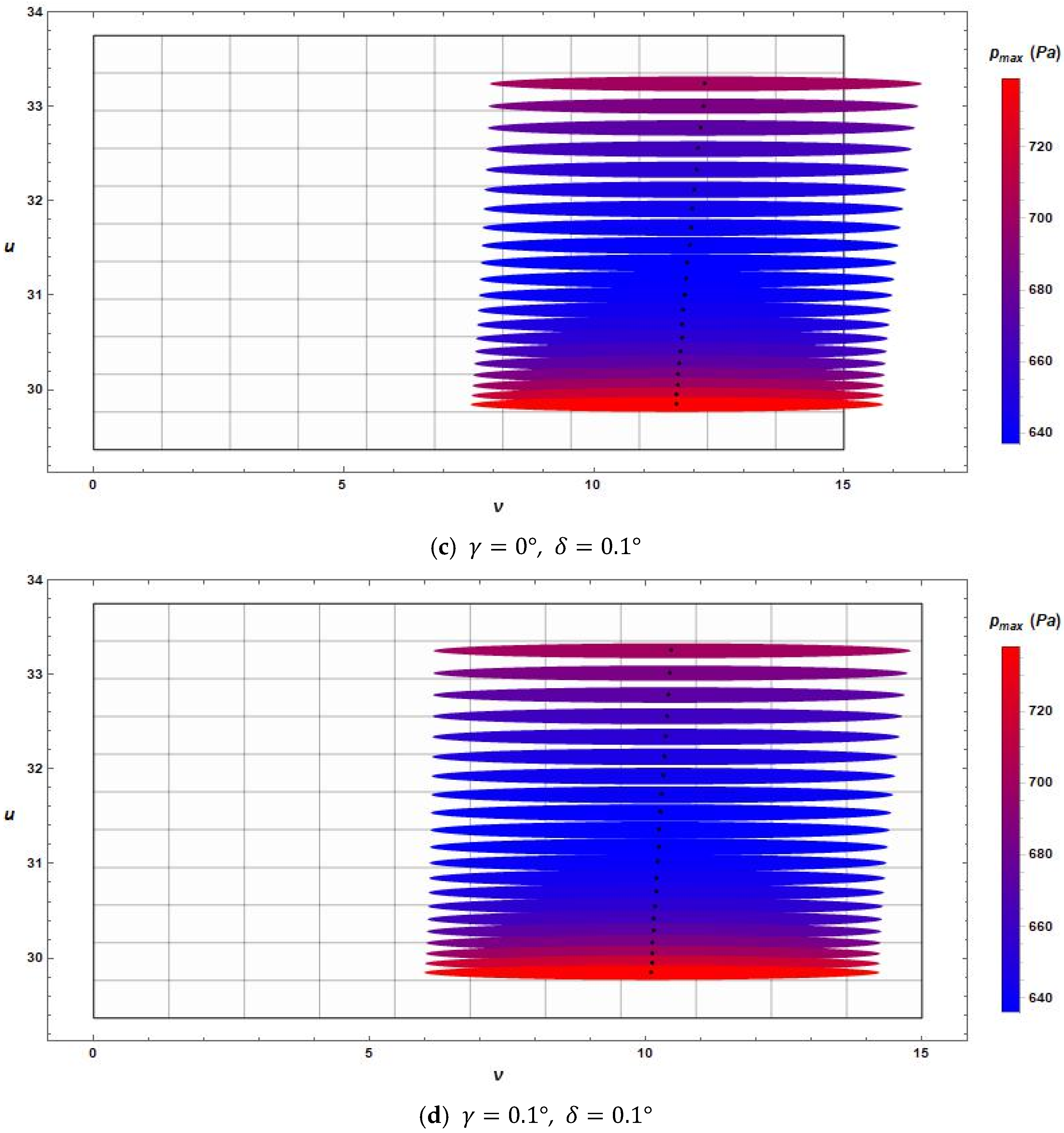
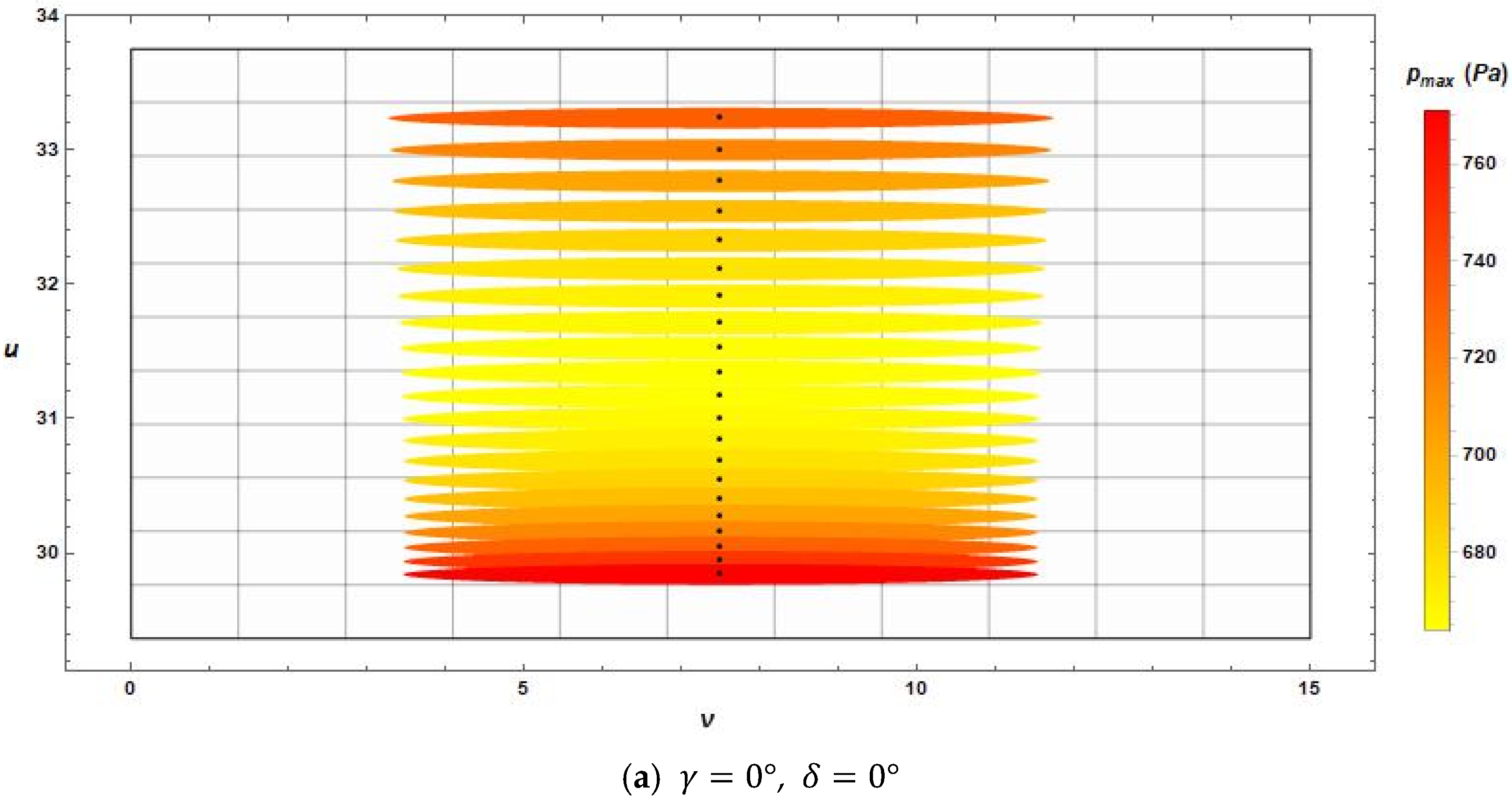
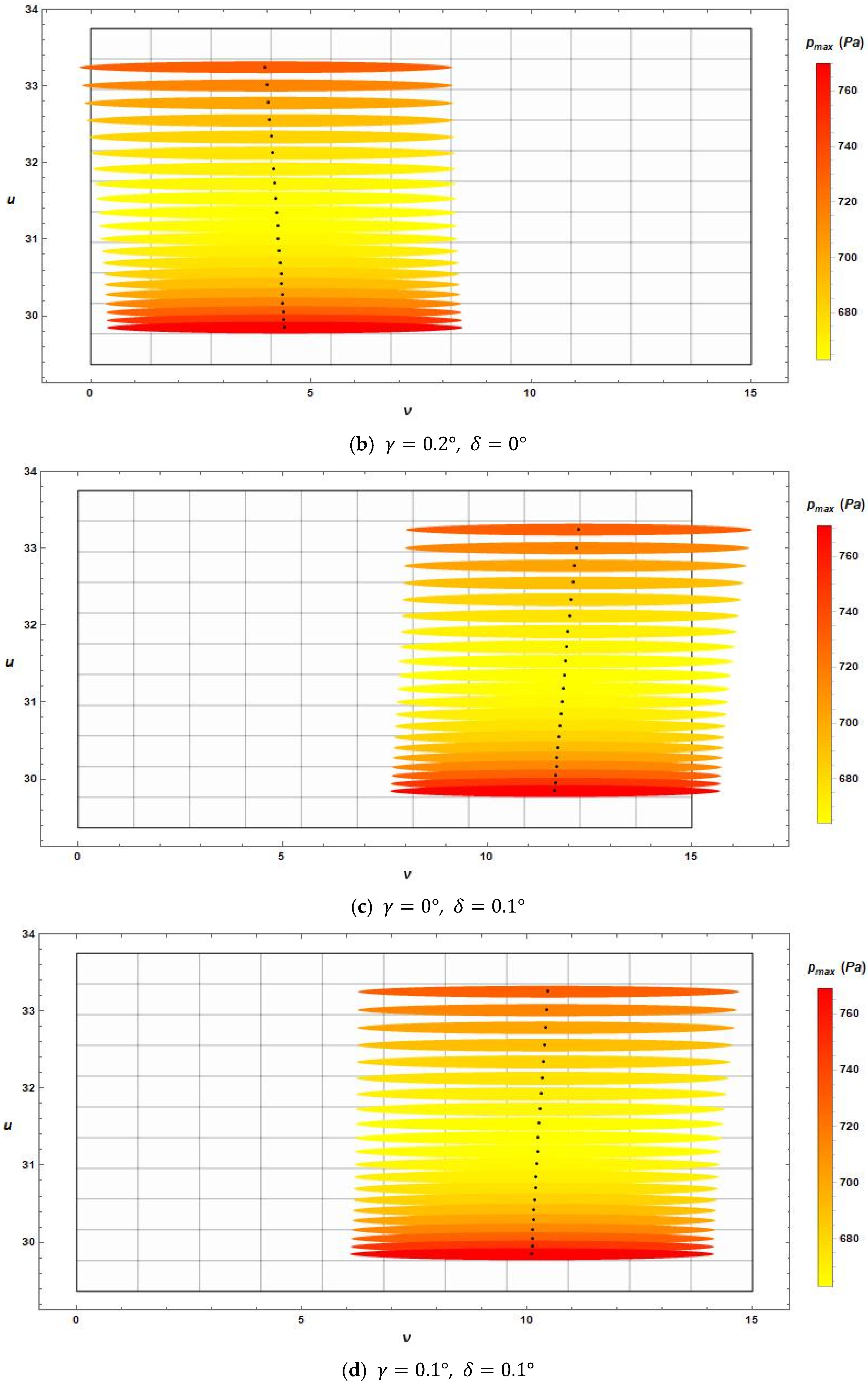
Figure 3,
Figure 4 and
Figure 5 present the distribution of maximum Hertzian contact stresses along the meshing cycle of crowned spur gears manufactured from carbon steel, CuCoMnSn quaternary Heusler alloys, and the MgCu intermetallic compound, respectively, under different combinations of out-of-plane (γ) and in-plane (δ) angular misalignments. In all cases, the stress evolution follows a symmetric trend with respect to the pitch point, with minimum stresses near the central contact region and increasing values toward the beginning and end of engagement due to curvature effects and load concentration.
Figure 3 (carbon steel) shows the highest overall contact stress levels, with peak values approaching ≈950 MPa. This behavior is consistent with the relatively high Young’s modulus and shear modulus of carbon steel, which result in reduced elastic compliance and smaller contact areas under load. Although steel exhibits moderate ductility, its higher stiffness promotes larger peak stresses, particularly under combined misalignment conditions, despite the presence of parabolic crowning.
Figure 4 (CuCoMnSn Heusler alloy) demonstrates a pronounced reduction in contact stresses compared to carbon steel, with peak values of approximately ≈740 MPa. This reduction is directly related to the elastic and mechanical characteristics of CuCoMnSn. The alloy crystallizes in the stable Heusler structure and exhibits a ductile mechanical response, as confirmed by Poisson’s ratio. The relatively lower shear modulus and higher Poisson’s ratio enhance elastic accommodation at the contact interface, leading to a wider effective contact area and reduced stress concentration under misalignment.
Figure 5 (MgCu intermetallic compound) shows intermediate stress levels, with peak stresses around ≈770 MPa, lying between those of carbon steel and CuCoMnSn. According to DFT studies, MgCu adopts a CsCl-type structure and exhibits anisotropic elastic behavior with a relatively high Young’s modulus but a brittle tendency. This brittle character limits elastic relaxation at the contact interface, resulting in higher stresses than the Heusler alloy, though still lower than carbon steel due to its lower overall stiffness. The anisotropy is reflected in the sensitivity of stress distribution to misalignment direction.
Overall, the results obtained using the proposed novel tooth contact analysis (TCA) method reveal a consistent contact behavior across all investigated materials. In all cases, regions of high contact stress are predominantly located near the tooth tip and root, reflecting the inherent curvature variations and load transfer characteristics during the meshing cycle. This overall similarity indicates that the new TCA model robustly captures the fundamental mechanics of spur gear engagement, independent of material type. Furthermore, certain angular misalignment conditions lead to a noticeable shift in the contact region toward the tooth edges. In particular, out-of-plane misalignment (γ) promotes more pronounced edge-proximate contact, resulting in increased local stress concentration compared to in-plane misalignment. These trends highlight the sensitivity of gear contact behavior to misalignment and confirm the capability of the proposed TCA framework to accurately resolve stress redistribution effects under realistic operating conditions.
From a comparative standpoint, the results of
Figure 3,
Figure 4 and
Figure 5 clearly demonstrate that material elastic compliance and ductility play a dominant role in controlling contact stress levels in crowned spur gears under misalignment. The ductile CuCoMnSn Heusler alloy exhibits the most favorable stress distribution, followed by MgCu, while carbon steel shows the highest stress concentrations. These findings are fully consistent with the DFT-predicted structural stability, elastic anisotropy, and mechanical behavior of the investigated materials and highlight the potential of Heusler alloys or MgCu as promising alternatives to conventional steel for high-performance and misalignment-tolerant gear applications. In addition to elastic and mechanical properties, material density plays an important role in gear material selection, particularly for lightweight and high-performance applications. Based on previous DFT studies [
19,
20] and as summarized in
Table 2, MgCu exhibits the lowest density (
= 5.0286 g cm
−3), followed by carbon steel (
= 8 g cm
−3), while CuCoMnSn shows the highest density (
= 9.20 g cm
−3). From a weight-sensitive design perspective, MgCu emerges as a promising candidate for lightweight gear applications, whereas CuCoMnSn may be more suitable where mechanical performance is prioritized over mass reduction. Moreover, prior studies report that the CuCoMnSn quaternary Heusler alloy exhibits regular half-metallic ferromagnetic behavior, attributed to the closed-shell character of Cu d-electrons, which may offer additional functional advantages beyond purely mechanical performance.
5. Conclusions
This study presented a material-informed comparative investigation of crowned spur gear contact behavior under angular misalignment using a reduced nonlinear two-variable tooth contact analysis (TCA) formulation integrated with density functional theory (DFT)-derived elastic properties. The primary objective was to evaluate how intrinsic material characteristics influence contact stress distribution, contact path evolution, and misalignment sensitivity within a unified analytical framework.
The main scientific contribution of this work lies in coupling first-principles-derived elastic constants with an analytically reduced TCA formulation, enabling consistent evaluation of advanced intermetallic and Heusler alloys alongside conventional carbon steel under identical geometric and loading conditions. Unlike classical TCA approaches that rely on solving a five-equation nonlinear system, the present formulation reduces the problem to a compact two-variable system while preserving full spatial accuracy, thereby improving numerical robustness and computational efficiency. The numerical results demonstrate that material selection significantly affects spur gear contact performance. Carbon steel, due to its relatively high stiffness, exhibits the highest peak contact stresses under combined in-plane and out-of-plane misalignment. The CuCoMnSn Heusler alloy shows improved stress accommodation and lower peak contact pressures, attributed to its elastic compliance and favorable Poisson’s ratio. The MgCu intermetallic compound produces intermediate stress levels while offering the advantage of substantially lower density, making it attractive for lightweight applications. This study further confirms that angular misalignment redistributes contact toward tooth edge regions, increasing stress concentration. The applied longitudinal crowning effectively mitigates edge loading, and the proposed TCA framework reliably captures these redistribution effects across all material types. The consistent qualitative contact behavior observed among materials indicates that the model robustly resolves geometric engagement mechanics while enabling quantitative differentiation based on material stiffness.
From an engineering perspective, the findings suggest that advanced intermetallic and Heusler alloys may serve as viable alternatives to conventional steel in misalignment-sensitive gear systems. MgCu offers potential advantages in weight-critical applications, whereas CuCoMnSn may be better suited for systems requiring enhanced stiffness and mechanical stability. Additionally, the reported half-metallic ferromagnetic characteristics of CuCoMnSn may provide functional opportunities beyond purely mechanical performance in specialized electromechanical systems. The computational framework demonstrated high numerical stability, rapid convergence, and suitability for extensive parametric studies, making it a practical tool for material selection and gear design optimization.
Future research should extend the present approach to: (i) expand the formulation to helical and non-involute gear geometries; (ii) include thermo-mechanical and tribological effects; and (iii) validate the computational predictions through experimental testing.
Overall, this work establishes a unified analytical platform for integrating advanced material modeling with robust tooth contact analysis, providing a foundation for optimized, material-informed spur gear design. All numerical simulations were performed in the Wolfram Mathematica computational environment, ensuring precise implementation of the nonlinear solver and efficient evaluation of the meshing cycle.



 ,
,