1. Introduction
The energy industry has been facing complicated challenges in identifying ways of improving heat transfer efficiency. While conventional liquids such as water and oil or even, sometimes, ethylene glycol are effective based on their thermal properties, their functional abilities are quite limited across different applications. Over the past two decades, incorporating nanoparticles (<100 nm) into fluids to form nanofluids has been found to improve the thermal efficiency of heat exchanging and cooling equipment [
1,
2,
3,
4]. However, a single-element nanofluid does not have every desirable characteristic needed for certain applications. While metallic nanoparticles (for example, Ag, Au, Al, Cu) have excellent thermal conductivity despite being chemically reactive, metal oxide nanoparticles (for example: CuO,
,
) have better chemical stability and poorer thermal conductivity compared to metallic ones. In this regard, by combining such metallic nanoparticles with carbon metal oxides, it could be possible to create superior physical and chemical properties while also improving the base fluid’s capacity for heat transfer. This combination is known as a hybrid nanofluid [
5,
6,
7,
8,
9]. The process involves forming a new type of hybrid nanofluid by combining two or more different nanoparticles in a base fluid or composite nanoparticles in a single phase fluid. The flow model’s decision to use hybrid nanofluid rather than mono nanofluid is driven by the latter’s ability to handle an improved and elevated temperature distribution. Hybrid nanofluids have applications in the manufacturing and development of heat exchangers [
10,
11], electronics [
12,
13], heat pipes [
14,
15], solar heating systems [
16,
17], nuclear power plants [
18], household refrigerators [
19] and transformers [
20], to name a few. Nevertheless, the choice of using nanoparticles to form hybrid nanofluids also requires appropriate justification to meet industrial standards and improve the performance of both base liquids and hybrid nanofluids collectively.
Carbon nanotubes (CNTs) (length/diameter = 1000) can improve the thermal properties of intrinsic materials [
21,
22]. The applications and evidential benefits of CNTs have been reported in the past across a broader range of industries, including how CNTs could enhance the heat conduction of base fluids. Among different types, single-walled CNTs (SWCNTs) and multi-walled CNTs (MWCNTs) have been considered [
23,
24,
25]. Despite being allotropes of carbon, CNTs possess high electrical conductivity. The rheological properties of fluids can be improved further due to the nanostructure and carbon atoms bonding, greater tensile strength, and, finally, thermal conductivity [
25]. Although the capability of MWCNTs as single nanoparticles has been investigated before, the inclusion of another type of nanoparticle to form hybrid nanofluids requires more justification. In a thermal boundary layer study, the existence of a magnetic dipole could impact the thermal transport phenomena and the dimension of the boundary layer. Ferrite nanoparticles could potentially improve thermal efficiency. The usage of magnetite material such as
was investigated in the past and promising outcomes were obtained in terms of thermal efficiency. Therefore, the combination of MWCNTs and
to form a hybrid nanofluid with water as a base fluid would be worth investigating. However, the consideration of magnetic nanoparticles (
) would also require understanding thermal radiation along with conductive and convective heat transfer. Thermal radiation refers to the transfer of heat that occurs due to the mobility of charged particles in a substance. It can be produced for materials that exhibit a positive temperature. Meanwhile, radiative heat transfer occurs due to the emission of energy as electromagnetic radiation.
Based on the quick overview on
hybrid nanofluid and conduction-convection-radiation effects, it is evident to delve into some of the relevant findings reported in the literature. The earlier study by Ganesan and Loganathan [
26] focused on the movement of fluid around a vertical cylinder that is in motion, considering the effects of radiation and mass transfer. Gan and Riffat [
27] examined an atrium’s airflow and thermal radiation integrated with photovoltaic. The investigation carried out by Molla et al. [
28] focused on the behavior of an optically condensed insoluble fluid as it flowed past a surface that had a wavy or curved shape. The researchers used an amalgam of both spontaneous and controlled heat transfer methods to investigate this phenomenon. The authors employed the Rosseland diffusion assumption in their study and investigated the effects of various factors on the flow and heat conveyance attributes. The study conducted by Molla et al. [
29] focused on the naturally convective boundary layer flow with radiation. It was reported that increasing the values of the radiation characteristic lead to a corresponding rise in local skin friction and Nusselt number. In their study, Siddiqa and Hossain [
30] examined the effect of radiative heat transfer on the mobility of electrically conducting fluid with a dominant cross field. Several researchers, including Makinde [
31], Elbashbeshy et al. [
32], Chaudhary et al. [
33], Dogonchi and Ganji [
34], Chaudhary and Choudhary [
35], and Alzahrani and Alshomrani [
36], investigated the field of radiative heat transfer in various flow regions. The study conducted by Hussain et al. [
37] examined the existence of radiation to compare the heat transfer characteristics of magnetohydrodynamic hybrid nanofluid flow. Two distinct hybrid nanofluids, consisting of SWCNT and MWCNT particles, were employed, with water serving as the foundation fluid. Hossain et al. [
38] have recently studied the impact of heat radiation on power law non-Newtonian water-copper nanofluid with natural convection and convective unidirectional circulation.
While MHD hybrid nanofluid flows with radiation effects have been investigated in various configurations, many existing studies have primarily considered similarity-based formulations, simplified boundary conditions, or isolated parametric influences. The concurrent interaction between radiative diffusion, magnetic damping through Lorentz forces, and buoyancy-driven convection within a non-similar conjugate conduction–convection framework has received comparatively less systematic attention. In particular, the transport modulation arising from the coupling of nanoparticle volume fraction, radiation parameter, and magnetic field strength in
hybrid nanofluids over a vertical surface remains insufficiently quantified. Therefore, the present study develops a non-similar boundary layer formulation to evaluate the combined effects of these parameters on momentum and thermal boundary layers, providing a detailed sensitivity-based analysis of skin friction and Nusselt number variations. The results offer physically interpretable insights into controllable heat transfer behavior in hybrid nanofluid-based thermal systems. In this study, the purpose was to understand the influence of radiation and surface temperature by representative parameters on the
hybrid nanofluid and water. The radiation parameter and surface temperature parameter were introduced for this purpose. The governing equations were converted into non-dimensional boundary layer equations, followed by solutions obtained by the implicit finite difference (IFD). The graphical analyses of the velocity profile, temperature distribution, Nusselt (
) number, skin friction, streamlines and isothermal lines are conducted using the aforementioned parameters. The study falls within an extended investigation in the past by Mazumder et al. [
39]. The findings from this study would provide evidential outcomes from the mathematical model to help the thermal industry in determining optimum thresholds of radiation and surface temperature parameters to maximize the thermal efficacy.
2. Formulation of the Problem
2.1. Mathematical Method
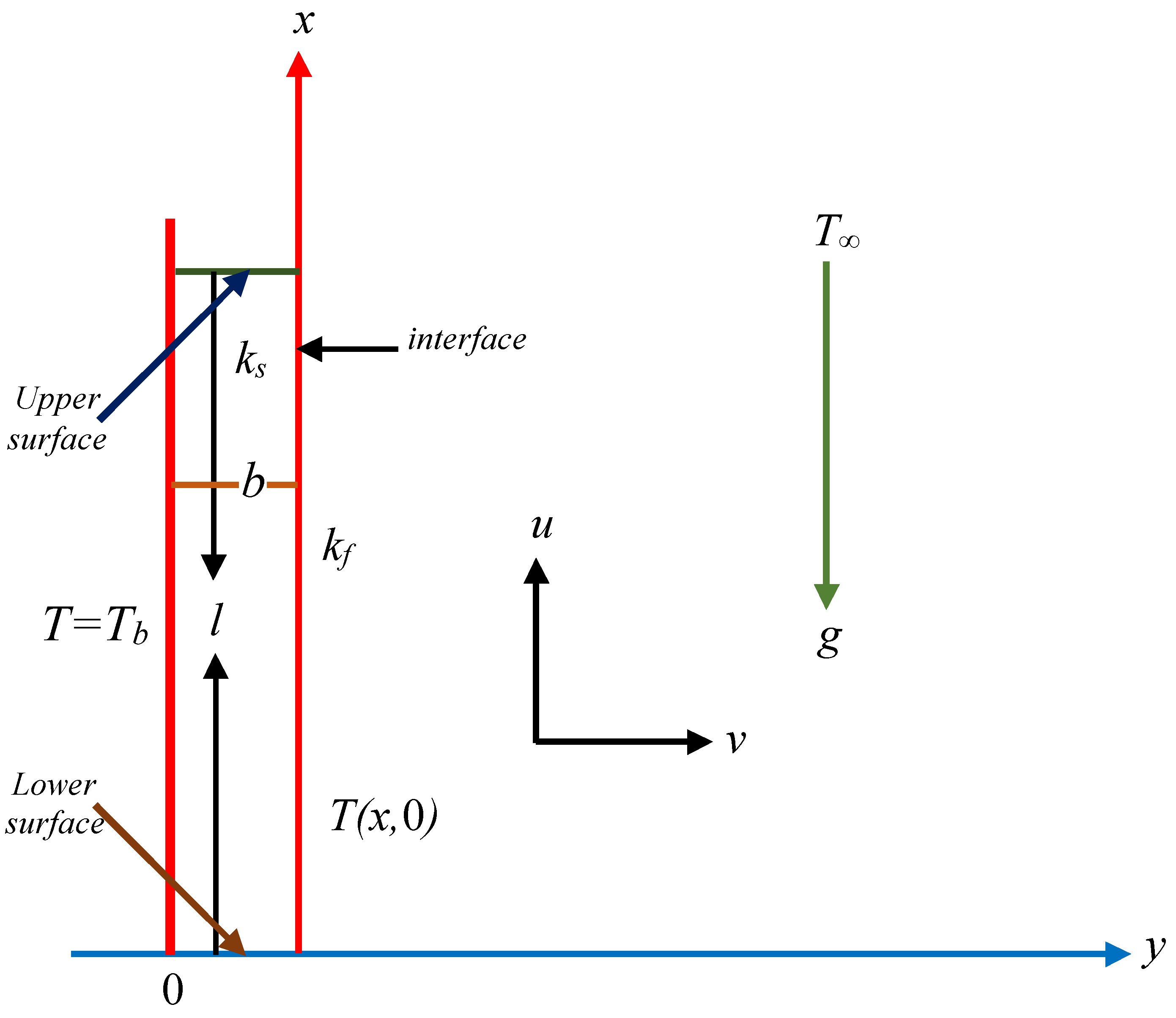
An investigation is made into the stable MHD boundary layer flow of a hybrid nanofluid with water as the base fluid across a vertical flat plate. It should be noted that the present formulation adopts an effective medium approach for the hybrid nanofluid, assuming homogeneous dispersion of MWCNT and nanoparticles within the base fluid. Microscale phenomena such as particle agglomeration, sedimentation, or interfacial slip mechanisms are not explicitly modeled; instead, their collective influence is represented through established thermophysical property correlations for density, viscosity, thermal conductivity, and heat capacity. This assumption is consistent with widely adopted theoretical and numerical studies of hybrid nanofluids. Furthermore, the radiative heat flux is incorporated using the Rosseland diffusion approximation, which models radiation as an additional diffusive transport mechanism within optically thick media. The objective of this study is therefore to provide a continuum-level, sensitivity-based evaluation of coupled momentum and heat transfer behavior under combined magnetic and radiative effects, rather than to resolve nanoparticle-scale microphysical interactions.
The model’s schematic diagram is shown in
Figure 1, along with the following explanations:
With the flow at , the y-axis is normal to the plate’s surface and the x-axis is perpendicular to it.
The fluid elements that define velocity along the x and y axes respectively are u and v.
The temperature on the surface is expected such that is higher than the ambient temperature i.e., > .
The thermal equations are modified by adding the term for thermal radiation
. The governing equations for steady, two-dimensional, incompressible boundary layer flow of the hybrid nanofluid consist of the continuity, momentum, and energy equations, which are expressed as follows [
40,
41]:
where
are the coordinates of dimensional Cartesian system,
along
are the velocity components,
g is the acceleration caused by gravity, and
is the density.
Equation (
1) represents the continuity equation, ensuring mass conservation within the boundary layer. Equation (
2) corresponds to the momentum equation, where the first term on the right-hand side represents viscous diffusion, the second term accounts for buoyancy effects due to temperature differences through the thermal expansion coefficient
, and the third term denotes the magnetic Lorentz force arising from the interaction between the imposed magnetic field and the electrically conducting hybrid nanofluid. Meanwhile, Equation (
3) is the energy equation, which includes conductive heat transfer and the radiative heat flux contribution modeled via the Rosseland approximation.
The boundary conditions are formally expressed as
The pair conditions interaction may be expressed as
The solids
temperature as shown by [
42,
43] is
where
q denotes the radiative heat flux component in the
y-direction, modeled using the Rosseland diffusion approximation. In addition,
b incorporates the conduction parameter
p and
. The Rosseland diffusion assumption employed by [
17,
18,
19,
20,
21,
22,
23,
24,
25,
26,
27,
28,
29], therefore simplifies the radiation flow of heat term and it is provided.
In this case, and stand for the mean absorbed coefficient and the constant of Stefan-Boltzmann, respectively.
2.2. Transformations
The subsequent non-dimensional variables are now introduced here.
Subsequent dimensionless controlling equations are produced by adding the metamorphosis group presented in Equation (
8) in Equations (
1)–(
3)
Consequently, the derived parameters without dimension are listed below:
is considered as Prandtl number. is considered as radiation flux (Rosseland diffusion approximate).
The existing problems boundary circumstances transform to:
We have taken into consideration during the entire experiment whereas p is the coupling conduction parameter described by .
In order to minimize the controlling Equations (
10) and (
11), we propose the subsequent modifications in an easy-to-read format
Here, is the similarity variable introduced through the coordinate transformation, representing the scaled transverse coordinate within the boundary layer. Meanwhile, denotes the dimensionless streamwise coordinate, representing the normalized distance along the vertical surface. This transformation allows the governing equations to retain streamwise dependence while enabling numerical marching in the flow direction.
Here,
is the stream variable that complies with equation Equation (
9) and is denoted by
Integrating the Equation (
13), given modification to Equations (
10) and (
11), we obtain
To reduce the coupled partial differential equations given in Equations (
10) and (
11), a non-similar transformation is introduced based on a stream function formulation. The stream function
is defined such that the continuity equation is identically satisfied through
and
. The coordinate transformation is constructed to retain the streamwise dependence while introducing a similarity-type transverse variable
, enabling numerical marching in the
x-direction. Substituting these transformations into the governing equations and applying the chain rule yields the resulting non-similar boundary layer equations presented in Equations (
15) and (
16).
The boundary circumstances described in Equation (
12) have a distinct structure:
2.3. Thermo-Physical Properties
The momentum and energy equations for atmospheric transmission are linked, and temperature or mass gradients control the movement. In the Boussinesq approximation, buoyant force described in the internal force phrase is the sole component that experiences density fluctuation. The thermal elongation, energy capacitance and feasible solidity of a hybrid nanofluid may thus be written as:
Hybrid nanofluid thermo-physical property source: (Takabi and Salehi [
44], Ghalambaz et al. [
45] and Patel et al. [
46]).
The hybrid nanofluids actual solidity
is
where,
is the solidity of core fluid,
and
are solidity of hybrid nanoparticles.
is the quantity percentage of hybrid nanofluids.
=
+
[
a =
and
c = MWCNT]
The Brinkman model [
47] is incorporated to obtain the viscosity (
) of a fluid that has tiny, stiff, circular components suspended in it at a low concentration.
Wherever
is the density of the core fluid.
The effective electrical conductivity is
The Maxwell-Garnett (MG) model may roughly predict the hybrid nanofluids’ effective thermalconductivity
as shown in [
48,
49].
Wherever
is the effective thermal conductivity of the fluid,
and
are the effective thermal conductivity of the hybrid nanoparticles.
The relevant key properties are presented in
Table 1 [
50].
In the present study, the total hybrid nanoparticle volume fraction is defined as , where and represent the volume fractions of and MWCNT nanoparticles, respectively. A fixed equal distribution between the two nanoparticle types is assumed throughout the simulations, such that . In this way, both nanoparticles contribute symmetrically to the resulting effective density, heat capacity, viscosity, and thermal conductivity.
2.4. Physical Quantities
Local skin friction coefficient and local
numbers were defined as:
where
and
are the shear stress and the heat flux, respectively. Using the new variables described in Equation (
8), Equation (
24) can be written as
The surface temperature was determined from the following equation:
The final governing Equations (
15) and (
16) and the boundary conditions Equation (
17) are solved by IFD, which has been discussed in the next section.
3. Numerical Model Development
In the first step, the local non-similar boundary layer Equations (
15) and (
16) will be transformed into a standard form as below:
Let
and
and
and
. Then the Equation (
15) becomes:
The Equation (
28) is discretized by the finite difference technique, where the diffusion and convection terms are by central difference. To ensure numerical stability, the
x-derivative term is discretized by the different backward formula. The following results in the creation of a system of algebraic equations:
For the transformed momentum Equation (
28) the matrix coefficients are as follows:
where
,
,
,
,
, and
Furthermore, for the energy Equation (
16) the matrix coefficients are as follows:
where
,
,
, and
.
Here
is the variable for the
U-velocity and temperature
h. The Equation (
29) is solved by Thomson algorithm. Velocity
component along the normal direction is attained after solving the equation (
) as follows:
The iteration commences from , and then continues downstream discretely. The tolerance is set at . A FORTRAN 90 code based on the aforementioned discretization was developed for this study.
For completeness, the detailed derivation of the transformed governing equations and intermediate mathematical steps is provided in
Appendix A.
5. Results and Discussions
The study investigated the impacts of conduction, convection, and radiation on a hybrid nanofluid over a vertical surface by IFD. The outcomes varied according to specific parameters such as , , M = (0.0, 0.3, 0.5, 0.8, 1.0), = (0.0, 0.1, 0.2, 0.3, 0.4), and = + = (0.0, 0.1, 0.15, 0.2). The primary focus was on examining M, , and to comprehend their impact on skin friction and the Nusselt number. Visual illustrations and comprehensive explanations for skin friction, Nusselt number, temperature, velocity, streamlines, and isotherms are included. It should be noted that all coordinates and velocity components presented in the following figures correspond to the nondimensional variables introduced through the transformations and therefore do not carry physical units.
5.1. Analyses on Skin Friction and Nusselt Numbers
5.1.1. Effects of Varying Fraction of Nanoparticles
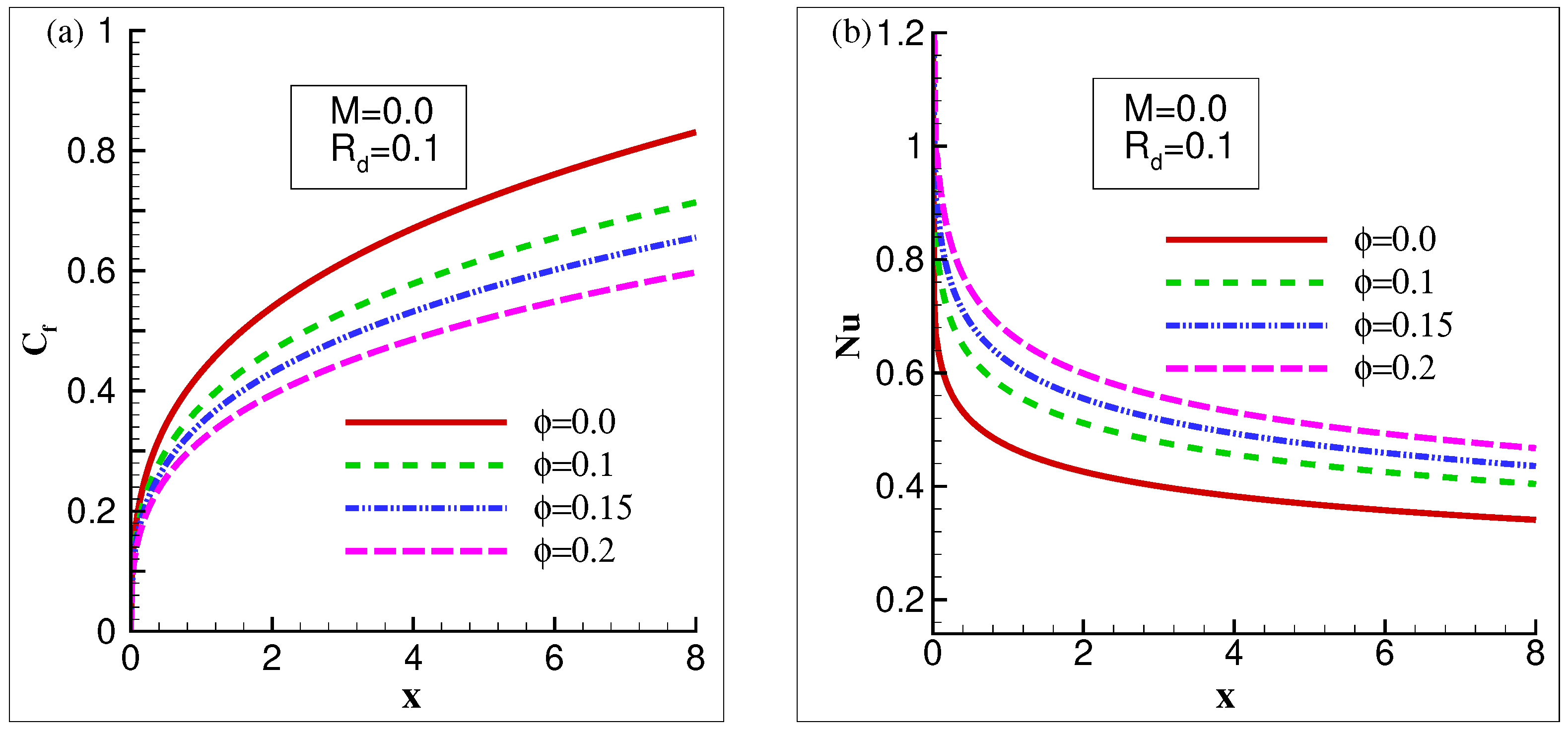
The impacts of the volumetric fraction of nanofluids (
) on the skin friction coefficient (
) and Nusselt number (
) were initially investigated under a fixed radiation parameter (
) and
at
, as shown in
Figure 3. The values of
showed the sensitivity of the mathematical model.
According to
Figure 3a, as the volume fraction
increased from 0.0 to 0.2, the skin friction coefficient
also increased concurrently. In the absence of
, the fluid mobility was restricted within the system, and hence
was found to have the most influence. Consequently, as
continued to increase, the influence of
kept on decreasing. As
increased from
to
, the peak value significantly decreased from
to
, respectively. The
reduction in
could be attributed to the increased mobility of the fluid particles due to the presence of nanoparticles. However, this was only in the case where the influence of the magnetic field was not present. As a result, it was expected that the increased fluid mobility would lead to an increase in heat transfer.
Figure 3b justified such anticipation, where it was observed that the heat dissipation rate was lower at
than at any of the reduced
values considered in this part of the study. The inclusion of nanoparticles improved the thermal conductivity. As the volume fraction increased, heat transfer efficiency also improved, which subsequently elevated the Nusselt number.
The observed reduction in with increasing can be interpreted through the competing effects of enhanced effective viscosity and modified buoyancy forces within the hybrid nanofluid. Although the addition of nanoparticles increases the dynamic viscosity according to the Brinkman model, it simultaneously alters the density and thermal expansion characteristics, thereby modifying the velocity gradients near the wall. The net effect is a reduction in the wall shear stress under the present parameter range. In contrast, the increase in the Nusselt number with higher is primarily attributed to the enhanced effective thermal conductivity of the hybrid nanofluid, which strengthens heat diffusion within the thermal boundary layer. As a result, the thermal boundary layer becomes thinner and the temperature gradient at the wall increases, leading to improved convective heat transfer performance.
5.1.2. Radiation Effects
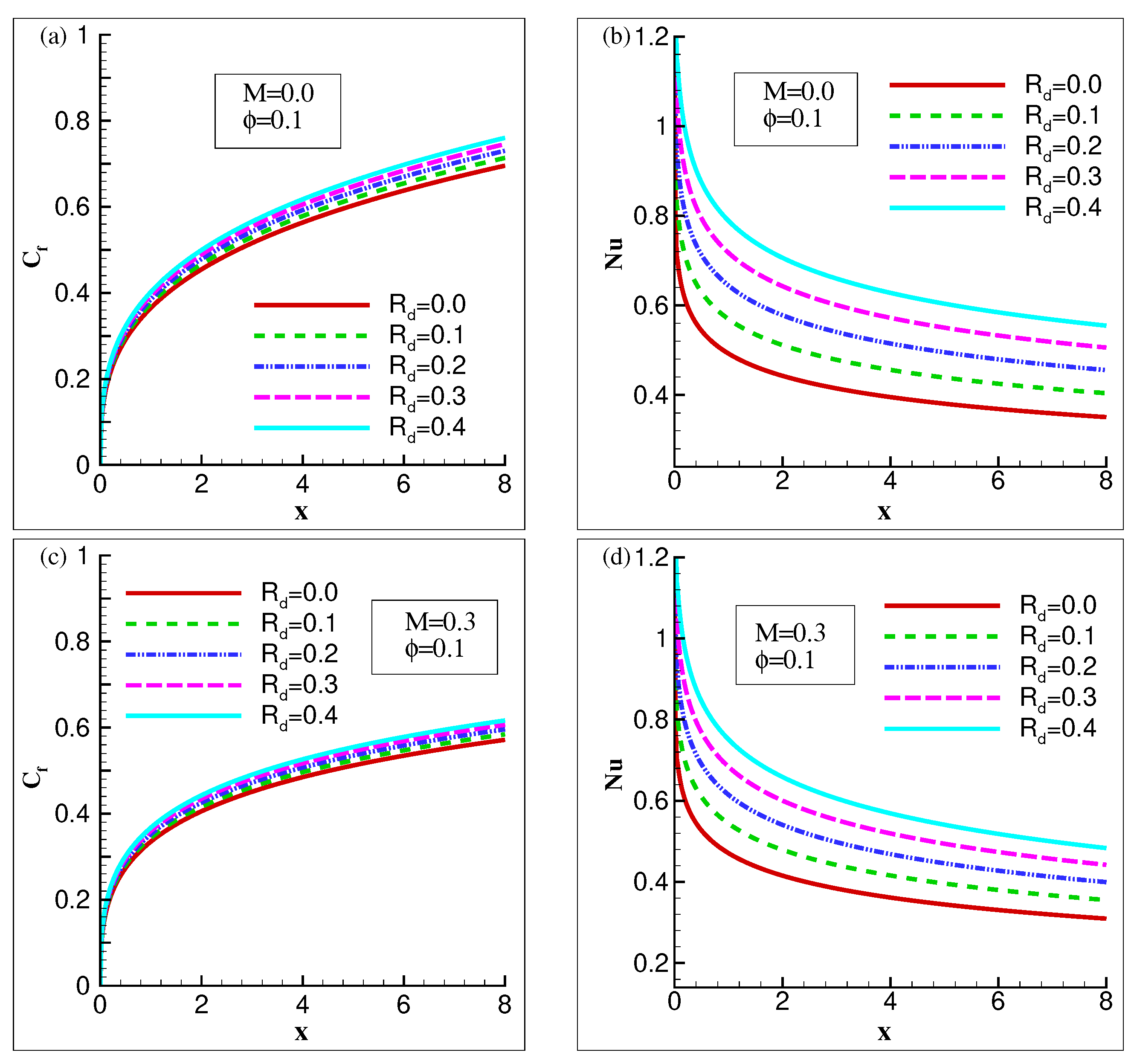
Figure 4a–d illustrates the relationship between the
values (0.0, 0.1, 0.2, 0.3, 0.4) and their impact on the skin friction coefficient (
) and the Nusselt number (
) at
,
,
,
and
,
respectively. It was observed that
influenced
and
numbers. Increased buoyancy-driven upward movement near the heated surface, together with heightened shear stresses, intensified skin friction (
) as radiation escalates. In
Figure 4a, the outer layer of the frictional fluid demonstrated an increase in shear stress as
values ascended. The increased velocities augmented the fluid’s shear stress, correlating with a heightened velocity gradient. A
increase in maximum skin friction was shown by the measured values of
and
for
and
respectively, at position
.
Figure 4b illustrates that the composite nanofluids exposed to increased radiation generally had elevated
numbers, attributable to enhanced heat transfer resulting from improved thermal conductivity and efficient energy retention. The obtained
numbers for
and
at position
were found to be
and
respectively, indicating an increase in the highest
number of
. As
increases, it indicates an enhanced contact with the thermal and momentum boundary layers, implying a positive correlation between growing
, skin friction, and the Nusselt number.
The aforementioned discussion pinpointed the findings at
. However, it was also essential to investigate the changes in the presence of the magnetic parameter.
Figure 4c,d contains the outcomes in the presence of
M. It was observed that in the presence of
M, the system was stabilized as the difference in the values of
was noticeable, regardless of the
values (
Figure 4a). The similar pattern was also observed in terms of
numbers as shown in
Figure 4d. If
Figure 4b,d are compared, it can be observed that the differences among the corresponding
values under varying
parameters were reduced. The findings from this segment suggested that if a potential heat exchanging device requires stabilizing the heat transfer functionality, the presence of a magnetic field is a sensible option. However, the usage of the magnetic parameter as a stabilizing parameter needs to be studied first to comprehensively understand the impact, as an increase in
M may lead to demobilizing the system that will stop the heat transfer phenomenon.
5.1.3. Effect of Magnetic Field Parameter
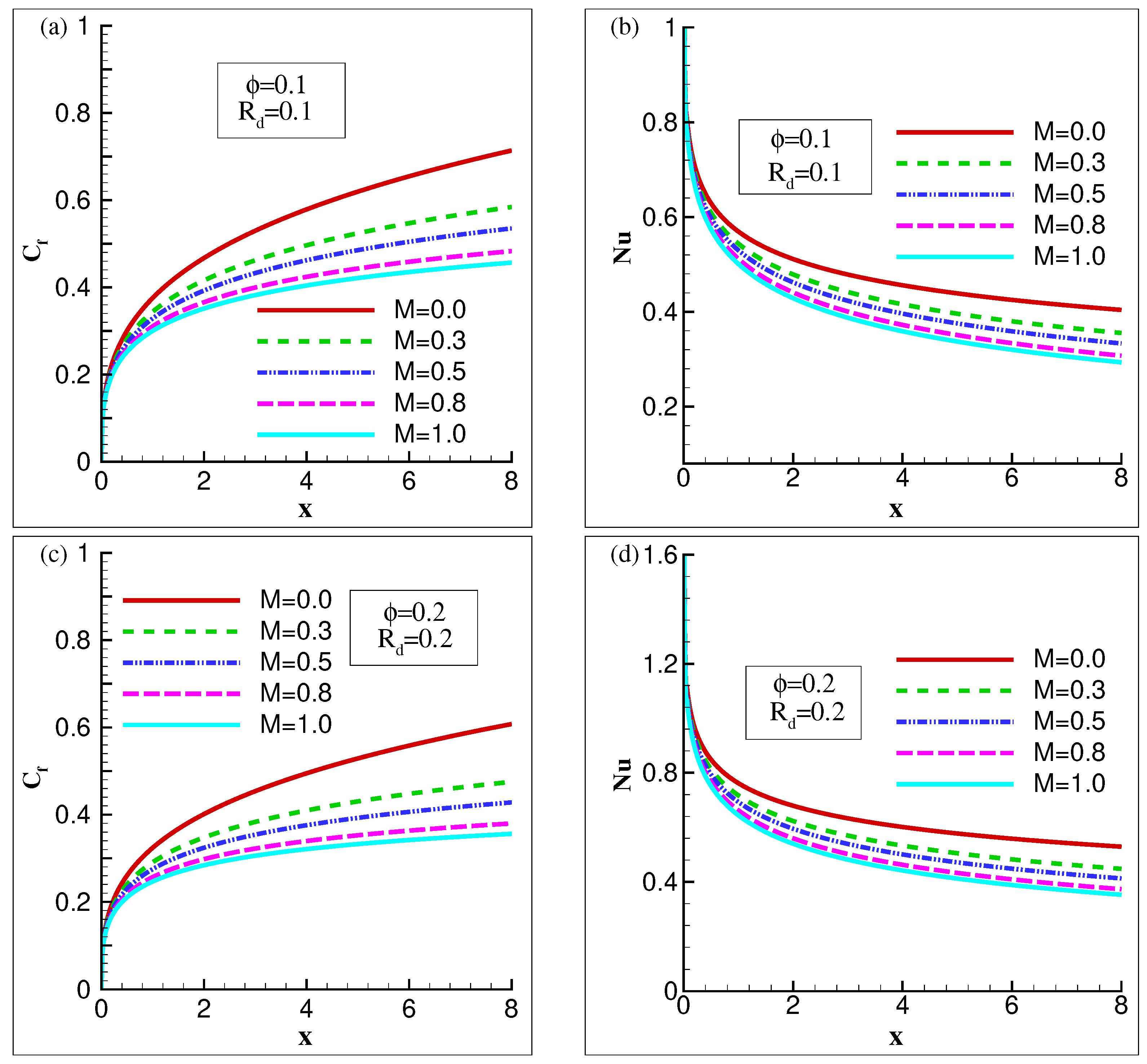
The impact of the magnetic field parameter,
M = (0.0, 0.3, 0.5, 0.8, and 1.0) is depicted in
Figure 5a–d for
=
,
and
,
, respectively. In all cases,
= 6.83 was considered.
As per
Figure 5a, the dominance of
continued to decrease as
M kept increasing. It was not surprising to find that at a constant
and
values,
was found to be dominating the system at
. However, at a non-zero value of
M, i.e., the presence of a magnetic field, the fluid mobility started to improve within the system, indicating an improvement in the thermal efficiency as shown in
Figure 5b. Increasing
and
values to
showed similar trends as shown in
Figure 5c,d. The peak values of
increased to
from 1 as
and
increased from
to
. However, the presence of a magnetic field eventually impacted the values of
in further improving the fluid mobility (
Figure 5c). The findings indicated that both the coefficient of local skin friction and the coefficient of local Nusselt number decreased due to the inhibiting effects of the magnetic field on the fluid flow. Due to increasing
M, the Lorentz force increased, and this elevated resistance to the fluid motion. As a consequence, velocity gradients at the surface diminished, resulting in lower
values in numerous instances, while a larger thermal boundary layer often lessened the temperature gradients at the wall, hence decreasing the Nusselt (
) number. As a result,
and local
numbers both decreased.
The reduction in both and with increasing magnetic parameter M is physically associated with the enhancement of the Lorentz force acting opposite to the fluid motion. As M increases, the induced electromagnetic resistance suppresses the velocity field within the momentum boundary layer, leading to a reduction in velocity gradients at the wall and consequently lower shear stress. This suppression also weakens convective transport, resulting in a thicker thermal boundary layer and diminished temperature gradients near the surface. Therefore, the magnetic field introduces a stabilizing effect on the flow while simultaneously reducing both momentum and heat transfer rates. The interplay between magnetic damping and buoyancy-driven convection governs the overall transport modulation observed in this section.
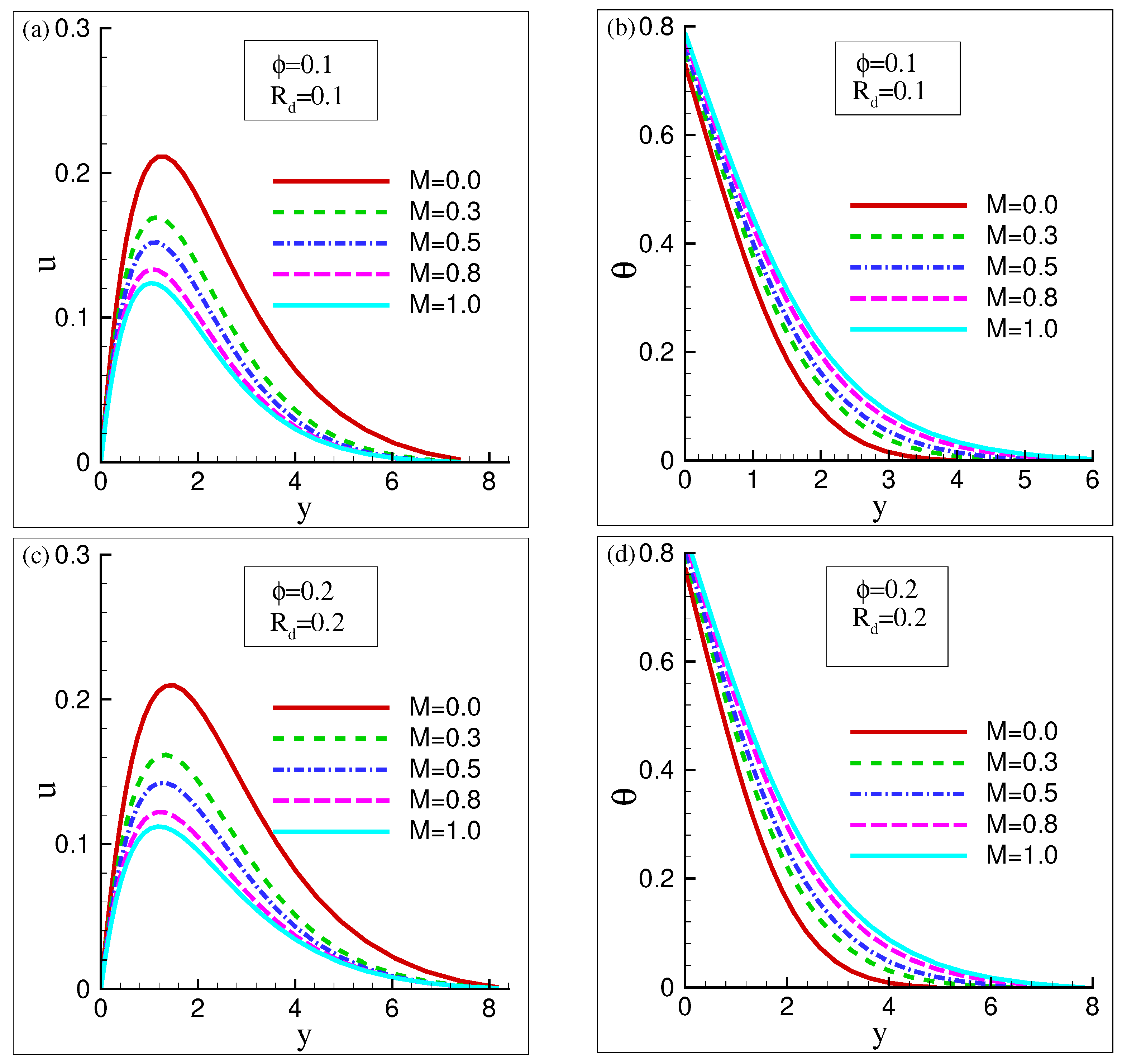
5.2. Impact on Velocity and Temperature
5.2.1. Effects of Volume Fraction of Nanoparticles
The effect of the volume fraction
,
, and
of the hybrid nanofluid on the fluid velocity (
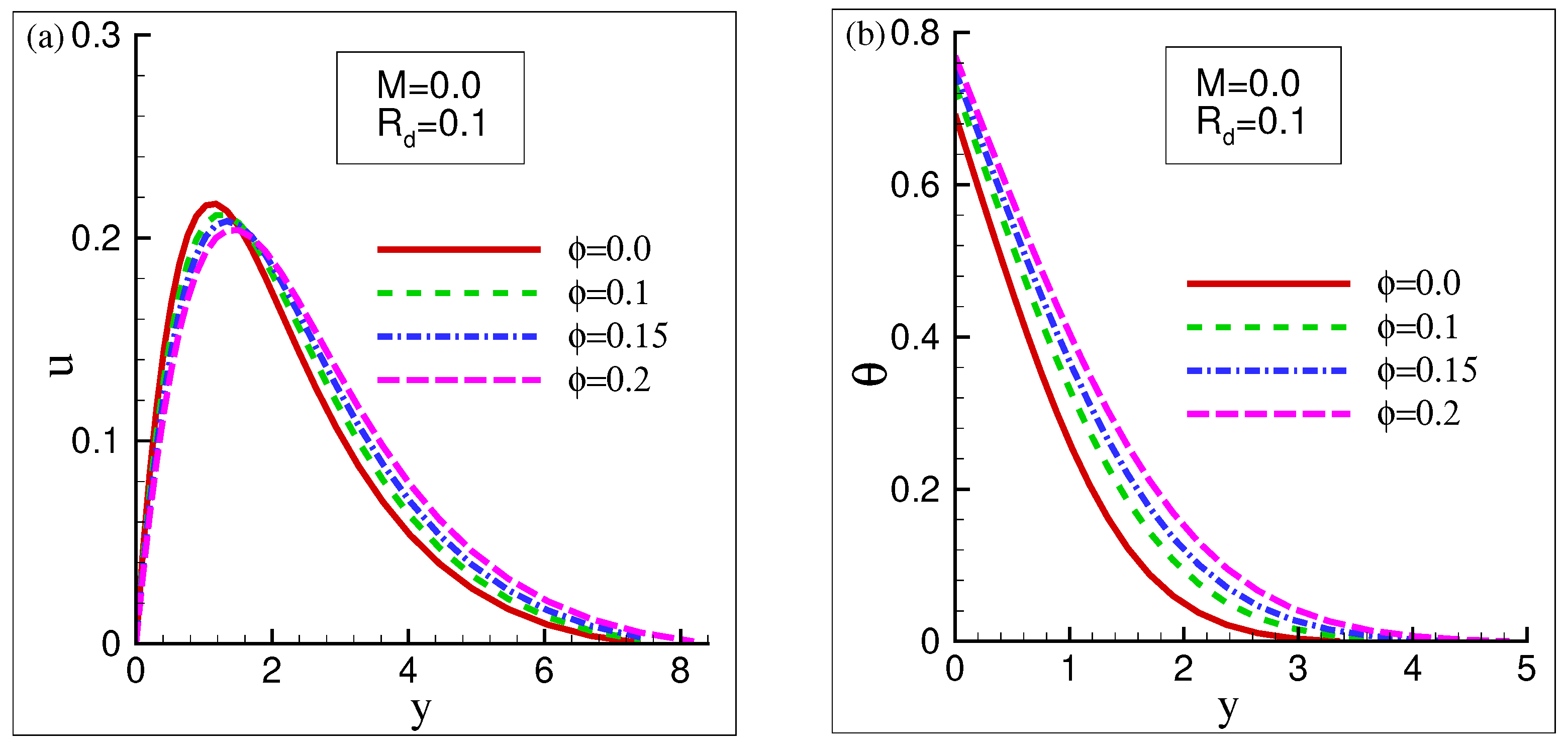
u) is illustrated in
Figure 6a. It was observed that as fluid particles start to move away from the boundary layer, the mobility starts to increase until reaching the peak around
. After that, a gradual decline was noticed, regardless of the
values. This indicated that the fluid velocity started to slow down due to the dominance of
, which was responsible for restricting the fluid movement. In addition, the inclusion of nanoparticles also slowed down the fluid mobility in such a way that the system does not significantly become unstable. However, this was obtained under
in the absence of a magnetic field.
Figure 6b illustrates the impact of the volume fraction parameter (
) of the hybrid nanofluid on the thermal circulation. The temperature of the hybrid nanofluid increases with higher values of the volume fraction parameter. The aforementioned figure indicates that the thermal boundary layer thickness for the fluid was greater than that of the standard fluid
, and therefore, the distribution of temperature started to get reduced before reaching
at
. This finding also seemed accurate as the changes in
number also demonstrated similar characteristics before.
The modification of the velocity and temperature profiles with increasing reflects the coupled influence of effective viscosity and thermal conductivity variations in the hybrid nanofluid. The increase in nanoparticle concentration enhances the dynamic viscosity, which suppresses momentum diffusion and reduces the peak velocity within the boundary layer. At the same time, the elevated effective thermal conductivity intensifies heat diffusion, resulting in a thicker thermal boundary layer and higher temperature levels away from the wall. Consequently, the momentum boundary layer experiences attenuation, whereas the thermal field becomes more diffused, consistent with the previously observed reduction in wall shear and enhancement in heat transfer rates.
5.2.2. Impacts of Radiation Parameters
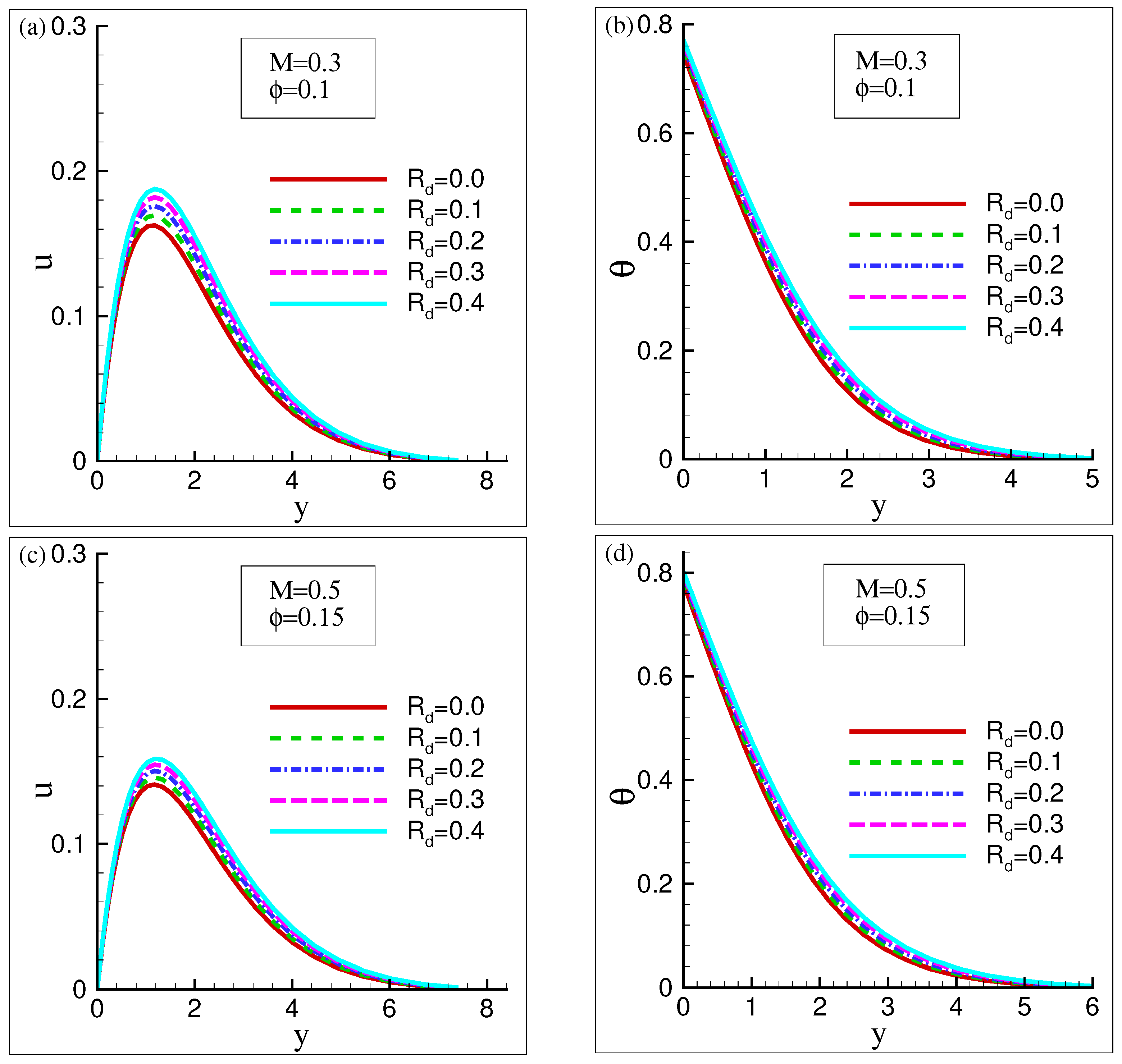
Figure 7 demonstrates the effect of
= (0.0, 0.1, 0.2, 0.3, 0.4) on temperature and velocity for
= 0.1 and
= 6.83. Radiation enhances the thermal energy absorption of the hybrid nanofluid, subsequently elevating the fluid temperature. The increase in temperature substantially decreases the fluid’s density as a result of thermal expansion, resulting in buoyancy-driven flow or natural convection.
Figure 7a illustrates that for each concentration of
, the maximum velocity values were displaced from the heated surface. This displacement occurred due to the fact that
induced increased velocity gradients, which subsequently elevated the associated temperature profile due to the enhanced heat absorption intensity of the hybrid nanofluid. Particularly when the temperature difference was present, this buoyancy effect raised the fluid velocity. The fluid’s velocity distribution was therefore affected by temperature variations. Consequently, a greater
resulted in a greater velocity and temperature dispersion.
played a substantial role in determining temperature and velocity in fluid flow. The temperature distribution in the fluid movement responded to changes in
. As shown in
Figure 7b, as
increased, so did the temperature.
represents the balance between radiative heat transfer and conduction, and a rise in
indicates that more radiative heat energy is entering, leading to a higher temperature than the initial stage. This allows radiation to influence the thermal boundary layers. For the hybrid nanofluid, velocity profiles increased with higher radiation (
), peaking at
. Observations reveal that as radiation increases, velocity initially rises before rapidly decreasing to a stable state at
, as shown in
Figure 7c. There were no significant changes observed in terms of
as
M and
increased to
and
, respectively. By comparing the reduced peak
u-velocity values, the observations seemed to be accurate.
The influence of the radiation parameter on both velocity and temperature profiles can be interpreted through its contribution to the effective thermal diffusion within the energy equation. An increase in enhances the radiative heat flux, effectively augmenting the thermal diffusivity of the fluid. This leads to elevated temperature levels within the boundary layer, which in turn intensifies buoyancy forces due to the temperature-dependent density variation. The strengthened buoyancy promotes fluid acceleration near the wall, thereby increasing the velocity magnitude. Consequently, radiation acts indirectly on the momentum field through thermal–buoyancy coupling, producing simultaneous thickening of the thermal boundary layer and enhancement of the velocity field within the considered parameter range.
5.2.3. Effects of Varying Magnetic Parameters
Figure 8a–d illustrates the influence of varying
M parameters on the velocity and temperature profiles in relation to
and
. The upsurge in
M resulted in a diminution in the velocity of the hybrid nanofluid while simultaneously raising its temperature. The findings were derived from the magnetic parameter
M values of 0.0, 0.3, 0.5, 0.8, and 1.0, alongside the volume fraction
(0.1 and 0.2) and a radiation parameter
(0.1 and 0.2). The impedance of the Lorentz force, induced by the magnetic field, functioned as a drag force. Velocity diminished across the flow area, particularly next to the boundary layers. The inhibition effect intensified with an increase in
M. Assuming convective thermal transfer was steady (e.g., a static radiation parameter), the heat dispersion from the outermost layer to the encircling fluid exhibited less sensitivity to flow velocity. Similarly, when
M augmented, the fluid temperature increased due to the predominance of conduction and radiation in heat transfer, while convection diminished. Nonetheless, the dampening effect of the magnetic field enhanced conduction and radiative heat transfer processes, resulting in elevated fluid temperatures at greater distances from the wall. At
, the hybrid nanofluid’s velocity profiles declined as the magnetic field (
M) increased. Investigations indicated that when
M kept on increasing, velocity first increased slowly before rapidly declining to a steady condition at
.
The modification of velocity and temperature fields with increasing magnetic parameter M is primarily governed by the Lorentz force generated due to the interaction between the imposed magnetic field and the electrically conducting hybrid nanofluid. As M increases, the induced electromagnetic force opposes the fluid motion, suppressing momentum transport within the boundary layer and reducing peak velocity values. This attenuation of convective motion diminishes the ability of the fluid to transport thermal energy away from the surface. Consequently, thermal energy accumulates within the boundary layer, leading to elevated temperature levels and thickening of the thermal boundary layer. Therefore, the magnetic field introduces a stabilizing but resistive influence on the flow, weakening convective heat transfer while enhancing the dominance of conductive and radiative transport mechanisms.
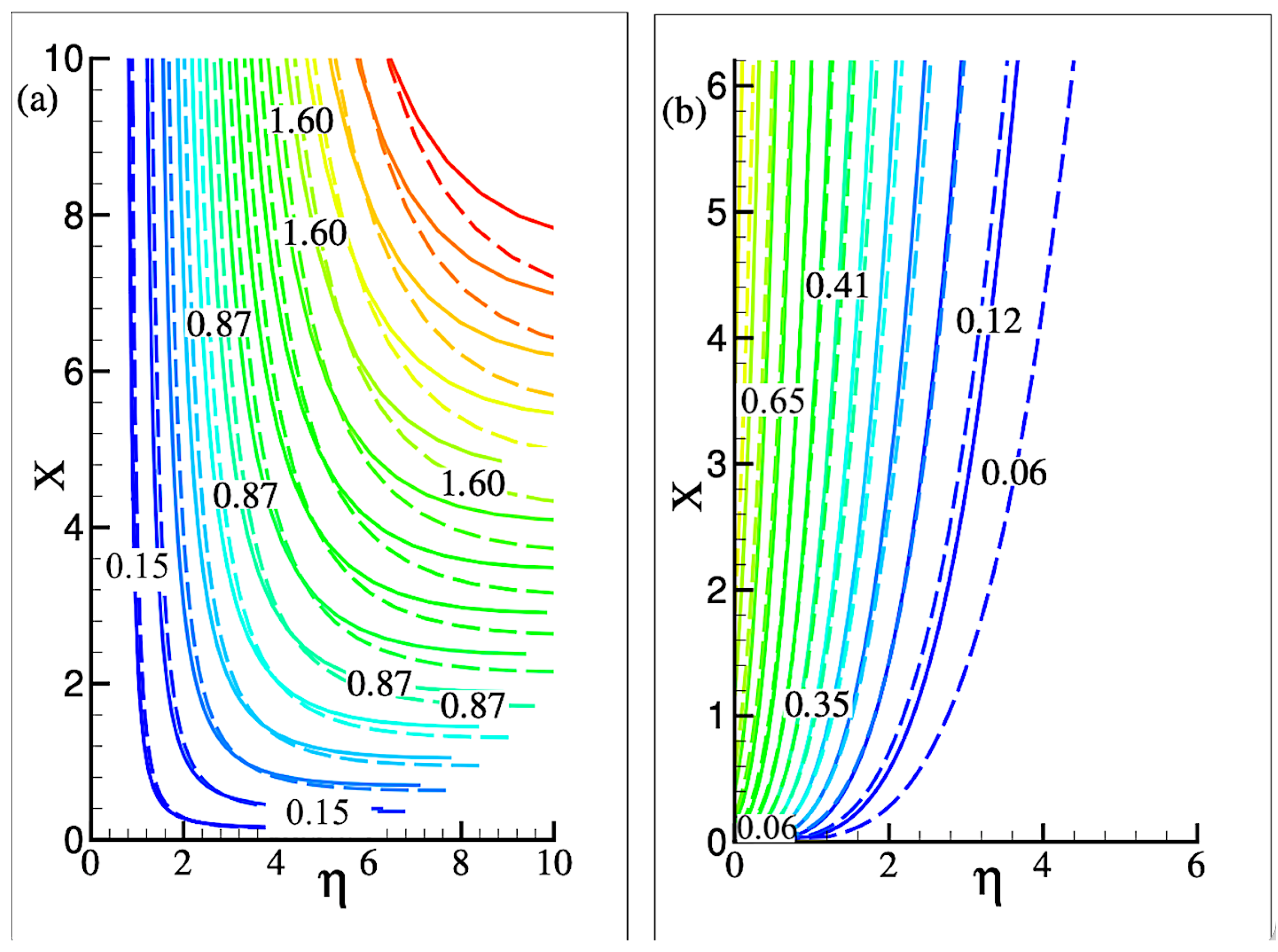
5.3. Evolution of Streamlines and Isotherms
5.3.1. Effect of Volume Fraction of Nanoparticles
Figure 9a,b represent the influence of different
parameters on the streamlines and isotherms, with
,
, and
. The solid lines represent
, while dotted lines denote
.
It was found that the fluid’s effective viscosity increased with a larger volume proportion of particles, as seen in
Figure 9a. In terms of isotherms, a larger volume proportion of thermally conductive particles, shown in
Figure 9b, increased the overall thermal conductivity, although this slowed down the flow and modified the flow patterns. More cohesive isotherms and a more consistent temperature distribution resulted from all of this. In terms of streamlines, the flow seemed to have demonstrated quasi-vertical patterns near the thermal boundary wall, and as the fluid started to move further away, the flow seemed to have distributed further within the system. A similar pattern was found in terms of isotherms as well.
The observed modification of streamline patterns with increasing reflects the attenuation of the momentum boundary layer due to enhanced effective viscosity of the hybrid nanofluid. The reduced velocity gradients near the wall result in a lower streamline density and weaker circulation intensity. In contrast, the isotherm distribution exhibits broader spreading within the domain as increases, which is consistent with the enhancement of effective thermal conductivity. The improved thermal diffusion promotes a more uniform temperature field, leading to a thicker thermal boundary layer. These streamline and isotherm variations are therefore consistent with the previously discussed reduction in wall shear stress and enhancement of heat transfer rates.
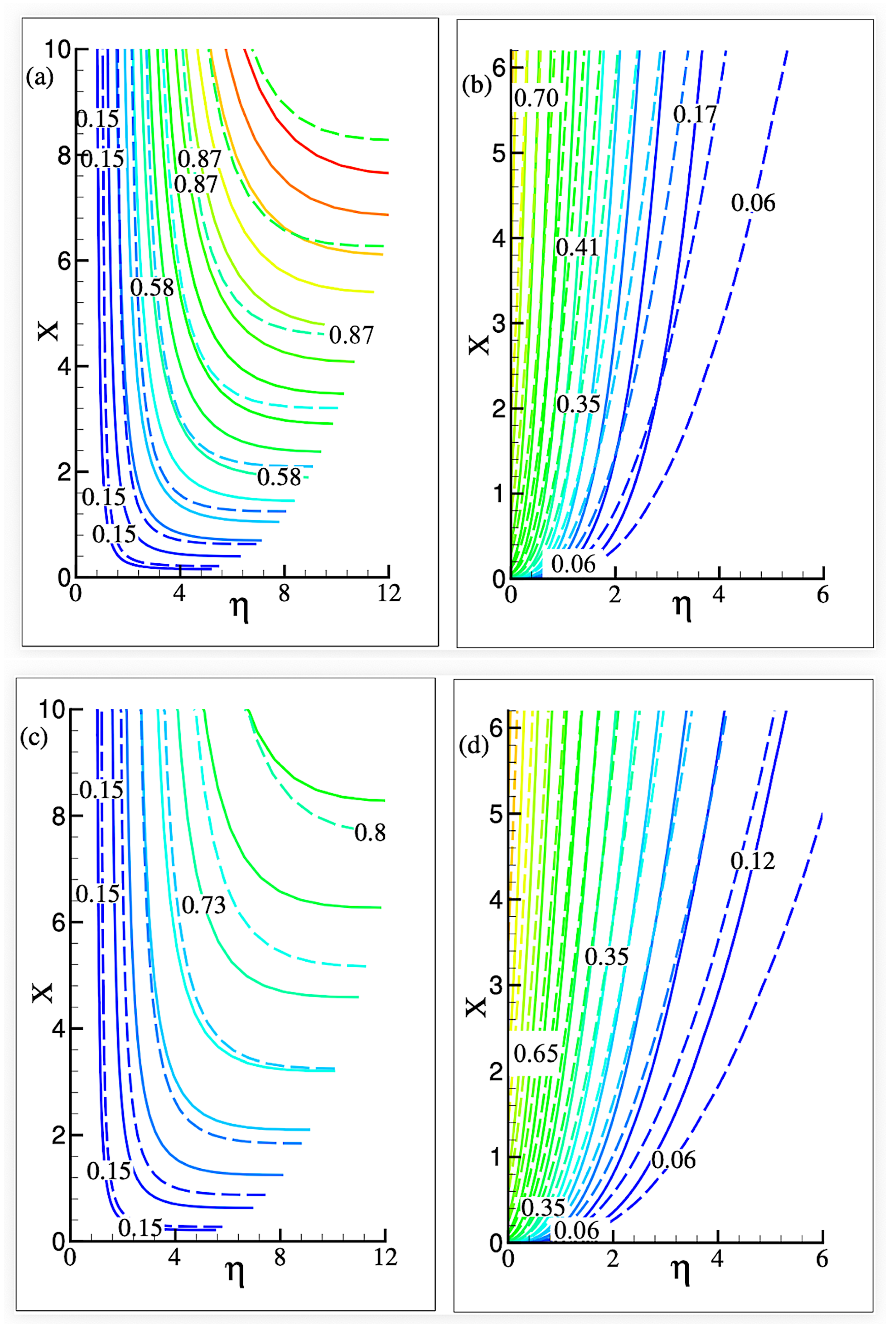
5.3.2. Influence of Radiation Parameter
The influence of the radiation parameter on streamline and isotherm structures is primarily associated with its enhancement of radiative heat diffusion within the thermal boundary layer. As increases, the augmented radiative contribution elevates the temperature field and promotes broader isotherm dispersion away from the wall. The resulting increase in temperature gradients intensifies buoyancy forces, which indirectly modify the streamline distribution by enhancing local fluid acceleration. Consequently, radiation affects the momentum field through thermal–buoyancy coupling, producing a more pronounced circulation pattern while simultaneously thickening the thermal boundary layer. These structural modifications in both streamlines and isotherms are consistent with the previously observed sensitivity of heat transfer rates to radiative effects.
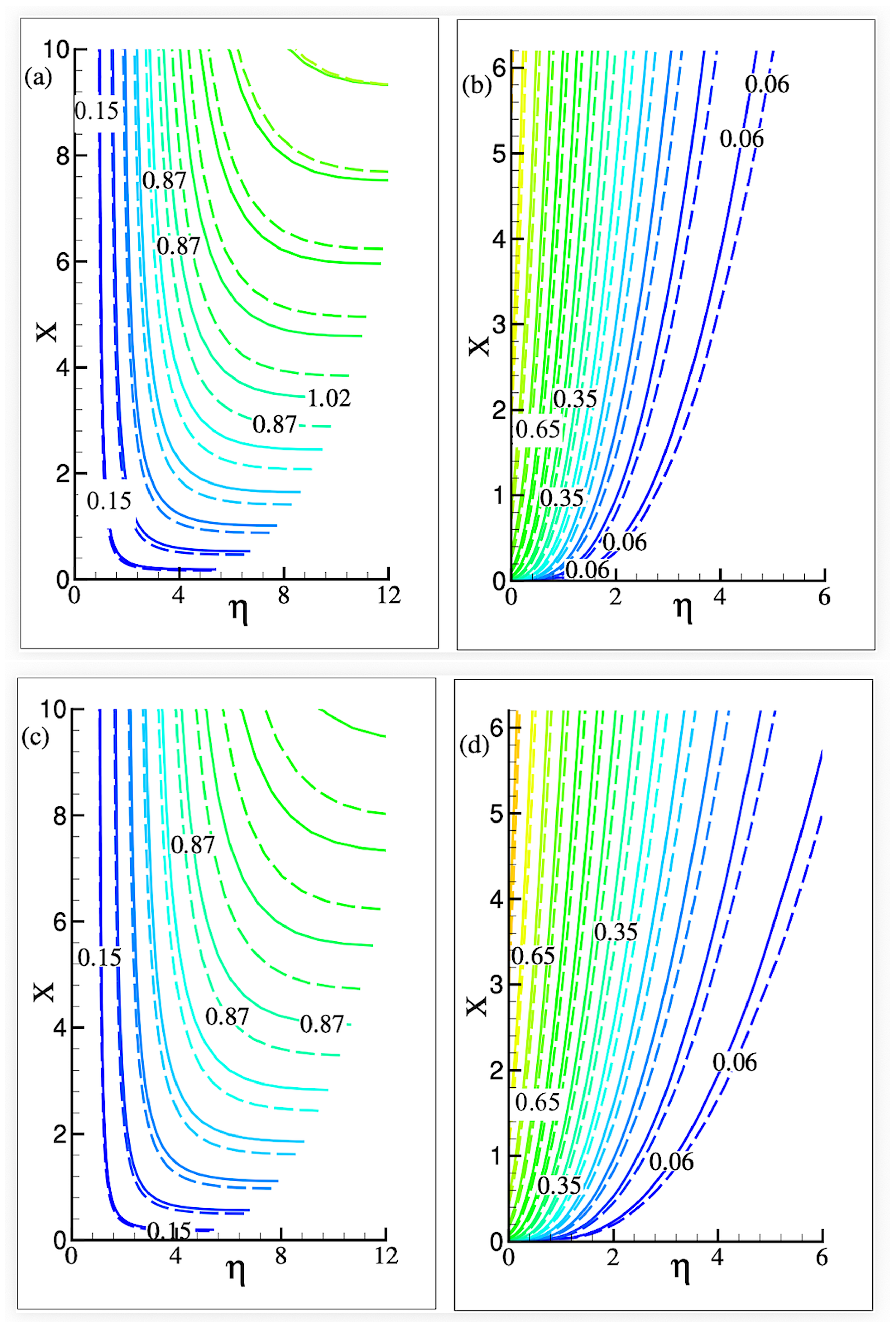
Figure 10a,b show the impact of radiation (
) on streamlines and isothermal lines with fixed values of
,
, and
, where solid lines correspond to
and dashed lines correspond to
. Meanwhile,
Figure 10c,d represent the influence of radiation (
) on streamlines and isotherms.
It was observed that radiation impacted fluid flow behavior by modifying the fluid’s thermal properties and temperature profile, which effectively affected streamline patterns. As radiation caused the fluid to absorb heat, temperature values increased, leading to thermal expansion. This can decrease fluid density, creating buoyancy-driven changes in velocity distribution and flow patterns. As per
Figure 10a,c, radiation increased the stream function magnitudes as the fluid steered away from the vertical plate, indicating buoyant flow and a thicker boundary layer near the heated surface. Consequently,
Figure 10b,d showed that with radiation, the isotherms expanded outward, indicating a smoother temperature gradient in the boundary layer. Greater radiation displaced the isotherms farther from the surface, warming adjacent fluid layers while gradually cooling the surface.
5.3.3. Effect of Magnetic Field
The modification of streamline and isotherm structures with increasing magnetic parameter M is governed by the enhanced Lorentz force opposing the fluid motion. As M increases, the electromagnetic resistance suppresses the velocity field, leading to weaker streamline circulation and reduced flow penetration into the boundary layer. This suppression diminishes convective heat transport, causing thermal energy to accumulate near the surface and resulting in denser isotherm clustering within the thermal boundary layer. Consequently, the magnetic field acts as a stabilizing influence on the flow while shifting the dominant heat transfer mechanism toward conductive and radiative diffusion. The streamline attenuation and thermal field thickening observed in this section are therefore consistent with the reduced wall shear stress and heat transfer rates discussed earlier.
We will now go over the method by which the magnetic field parameter
M influences the outer layer phases’ streamlines and isotherms with regard to varying
M, as shown in
Figure 11a,d. Solid lines represent
, while dotted lines indicate
in
Figure 11a,b. On the other hand, solid lines represent
and dotted lines represent
in
Figure 11c,d. In both cases,
,
, and
were considered.
By comparing the streamlines in
Figure 11a,c, it can be stated that the impact of increasing the magnetic field was more visible at
as the gaps between streamlines kept increasing. This was due to the increasing impact of the momentum and thermal boundary layers. Similar changes in the patterns were also observed in
Figure 11b,d where the isothermal distribution continued to expand further at
due to the increased distance from the boundary layer. It is postulated that the fluid was electrically conductive, which is why these findings occurred when a magnetic field was introduced to the flow field, which causes the flow to surge forward.
6. Conclusions
The present study developed a non-similar mathematical formulation to investigate coupled momentum and heat transport in an MWCNT– hybrid nanofluid over a vertical surface under the combined influence of magnetic and radiative effects. The analysis provided detailed insight into the competing mechanisms governing boundary layer behavior. The results demonstrate that increasing nanoparticle volume fraction enhances effective thermal conductivity, leading to improved heat transfer rates while simultaneously modifying wall shear stress through changes in viscosity and buoyancy-driven acceleration. The radiation parameter was shown to augment thermal diffusion, thereby intensifying buoyancy forces and indirectly influencing momentum transport. In contrast, the magnetic parameter introduces Lorentz-force-induced damping, suppressing velocity gradients and reducing both wall shear stress and convective heat transfer. These findings reveal the delicate balance between radiative enhancement and magnetic suppression in controlling hybrid nanofluid transport characteristics.
The study advances current understanding by systematically quantifying the coupled interaction between nanoparticle concentration, radiation effects, and magnetic field strength within a non-similar conjugate conduction–convection framework. The explicit formulation and numerical implementation provide a transparent theoretical foundation for analyzing parameter sensitivity in electrically conducting hybrid nanofluids. It should be noted that the present analysis is conducted within a continuum-level effective medium approximation. Microscale phenomena such as nanoparticle agglomeration, particle alignment, and interfacial slip mechanisms are not explicitly resolved. Additionally, experimental data corresponding to the exact configuration considered here are currently limited. Future work may focus on incorporating anisotropic nanoparticle effects, variable property models, and experimental validation to further strengthen the predictive capability of the formulation.
From an engineering perspective, the variations in Nusselt number directly influence the convective heat transfer coefficient, which governs the thermal effectiveness of heat exchangers and related energy systems. At the same time, changes in the skin friction coefficient reflect modifications in wall shear stress and pumping power requirements. The present results therefore provide quantitative insight into the trade-off between heat transfer enhancement and flow resistance in hybrid nanofluid-based devices. Such parametric sensitivity information can serve as input for the design and optimization of practical thermal systems where magnetic control or radiative effects are relevant.
Overall, the study provides a rigorous theoretical framework for understanding tunable transport behavior in hybrid nanofluid systems subjected to simultaneous magnetic and radiative influences.



 ,
,