1. Introduction
The natural lift force due to reservoir fluid pressure tends to decay over time [
1]. As a result, artificial lift methods are often introduced in the oil industry. The most popular artificial lift methods consist of sucker rod pumping systems, hydraulic pumping systems, electric submersible pumping systems, and gas lift systems [
2]. As one of the earliest inventions for land-based oil fields, sucker rod pumping systems have proven to be one of the most efficient, popular, and widely implemented artificial lift systems in the petroleum industry [
3,
4]. In fact, over
of the oil wells worldwide still depend on this oldest and yet extensively used mechanism [
5,
6]. As illustrated in
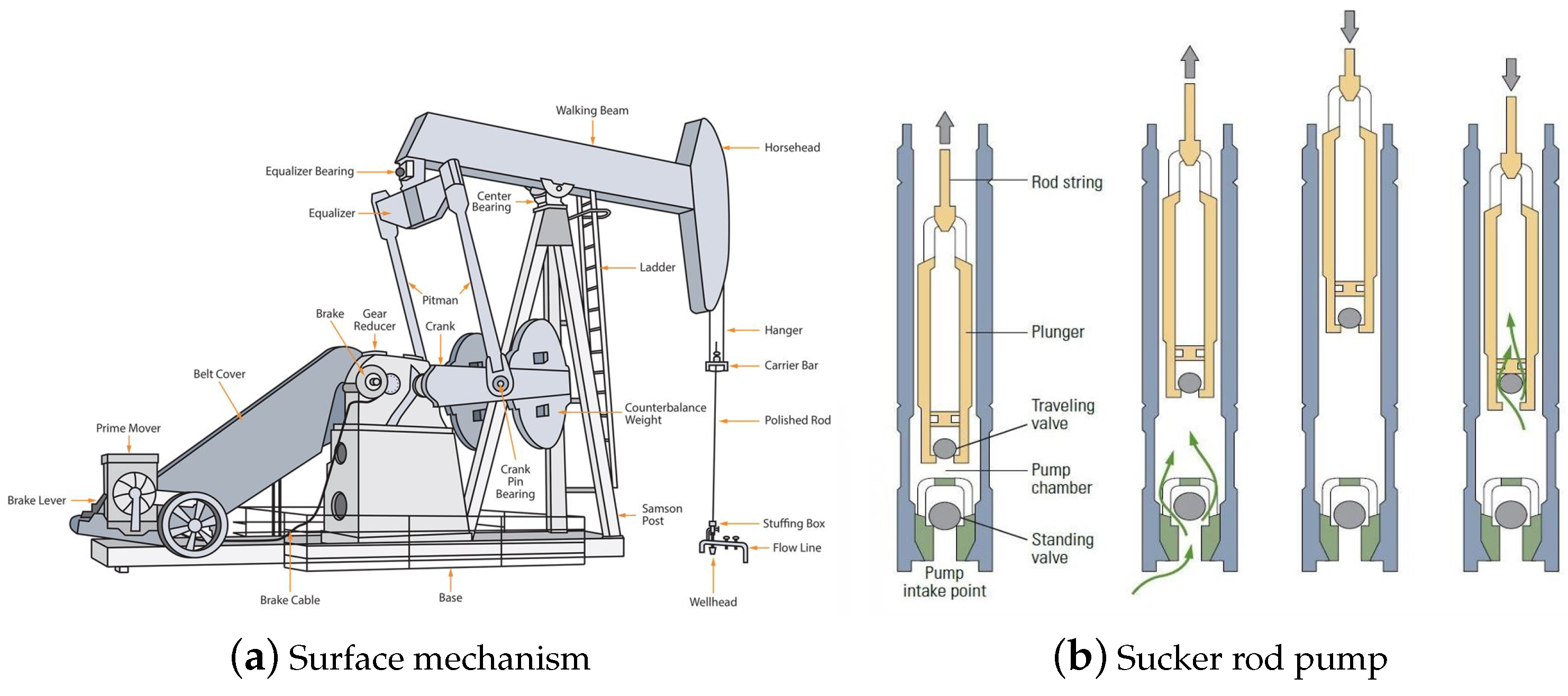
Figure 1, the components of the sucker rod pump system include a long rod connected to a plunger located deep underground, typically driven by a horse-head pump jack at the surface [
7]. As the mechanical lever lifts the rod string, the plunger travels upwards within the barrel, lifting a column of oil while replenishing the pump chamber. The reciprocating motion moves the sucker rod (also called the polished rod) and plunger up and down inside the well barrel [
8,
9]. All internal components of the sucker rod pump are enclosed within the well casing, as shown in
Figure 1. The sucker rod pump system features two valves, namely, the standing and traveling valves, which open and close at different times to facilitate fluid filling in the pump chamber and transfer to the surface. As depicted in
Figure 1, both the plunger connecting to the polished rod and the traveling valve are located within the barrel that houses the standing valve. As the polished rod is lifted during the up stroke, the traveling valve remains closed, which keeps the standing valve open and allows the barrel to refill with fluid from oil reservoir, as shown in
Figure 1. Moreover, as the well transitions from up-stroke to down-stroke, the fluid in the barrel is compressed due to the closing of the standing valve, whereas the traveling valve is opened, transferring fluid to the surface. Once the down stroke is complete, the traveling valve closes and the polished rod begins the next cycle of up- and down-stroke. Although the effectiveness and efficiency of this seemingly simple pumping mechanism have been studied for decades, there are still many engineering issues involved in this type of artificial lift systems, such as the safety and reliability of the structural materials [
10,
11].
In this paper, we focus on production efficiency with respect to the sucker rod pump, which consists of a moving contact area between the traveling unit (the plunger, including the chamber with the so-called traveling valve), and the well tube (the barrel, which includes the so-called standing valve) [
12]. Here, one mil denotes one thousandth of an inch. A clearance of 3 to 8 mils is often recommended in order to avoid direct contact or abrasion between the plunger and barrel and to allow the unimpeded passage of sand, gas bubbles, or other particles [
4]. Due to the clearance between the barrel and the plunger, a so-called slippage phenomenon occurs, consisting of the annulus column of oil returning to the pump chamber due to either the pressure difference at both ends of the plunger (characterized as the Poiseuille flow) or the motion of the plunger (characterized as the Couette flow) [
13,
14]. It has been the goal of many researchers to quantify this slippage phenomenon and derive empirical equations related to the sucker rod pump operational parameters [
15]. Again, it is important to recognize that this clearance is useful for ensuring lubrication between the plunger and the pump barrel and preventing excessive wear and tear along with galling [
16]. On the other hand, an estimated 2–
of oil is not recovered in respective daily operations [
17]. In practice, it has been reported that the slippage is related to the clearance
C, or two times the gap size
, defined as the difference between the inner radius of the barrel
and the outer radius of the plunger
, in a way resembling a combined relationship of a linear and a cubic functions [
18]. When dealing with sandy oil fields, the clearance is often set more than 3 mils in order to avoid abrasion and sticking [
19]. In the existing literature, it has been established that in order for viscous fluid to squeeze through a narrow annulus channel, the required pressure gradient or pressure drop given a fixed plunger length
will be proportional to the clearance
C to the power of three, namely,
. This derivation based on the Poiseuille flow is briefly summarized in the next section. Furthermore, the slippage issue is most prominent during the upward stroke, i.e., the sucking process. During the up-stroke, the plunger is moving upwards, and as a result drags fluid up instead of down. This shearing effect is due to the so-called Couette flow, which introduces a flow rate in a direction consistent with the plunger’s motion and proportional to the clearance
C. Note that in Couette flow, we focus only on the shear flow introduced by the translational motion of the inner wall, namely, the outer surface of the plunger [
14].
After a very concise yet self-contained review of Couette flow and Poiseuille flow as well as Bessel functions for cylinder coordinates and Fourier expansions for Cartesian coordinates, relaxation times have been estimated for transient flows within narrow annulus regions. Moreover, equivalent Cartesian coordinates have been adopted for cases with eccentricities. Earlier analytical and computational studies, verifications, and validations are also summarized. Finally, the appropriate sampling rate between 30 to 120 samples per second employed in engineering practice is confirmed to be sufficiently large in comparison with the calculated relaxation times for the transient viscous flow derived with the Bessel functions for the annulus region represented by the cylindrical coordinate system as well as its close approximation represented by the Cartesian coordinate system [
13,
14].
The focus of this paper is on data analysis procedures and inverse optimization methods which can be employed to obtain pump system parameters [
20,
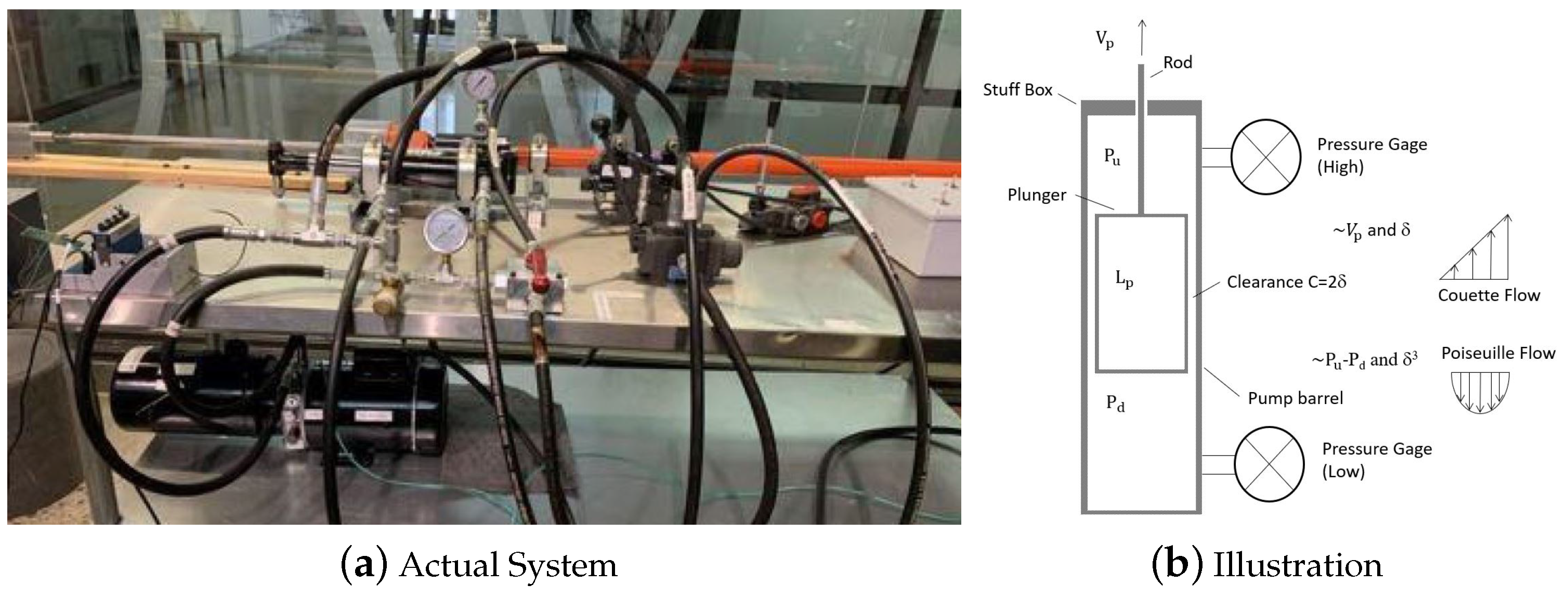
21]. Over time, optimizing the performance and reliability of these pumps has become essential, especially for minimizing downtime and addressing operational inefficiencies. To facilitate the study of sucker rod pump systems, an experimental setup with both horizontal and vertical configurations, as illustrated in
Figure 2 and
Figure 3, has been established at the McCoy School of Engineering at MSU Texas, a member of the Texas Tech university system, utilizing a Linear Variable Differential Transformer (LVDT) sensor (OMEGA Model LD620-25, M930415AK12-02, 102 Indiana Hwy. 212, Michigan City, IN 46360, USA) connected with National Instrument (NI) LabVIEW software (Version 2018, 11500 N Mopac Expwy, Austin, TX 78759, USA) and a set of two pressure gauges connected with Echometer Total Asset Monitor (TAM) software (Version 2.0, 5001 Ditto Lane, Wichita Falls, TX 76302, USA). The LVDT is strategically mounted next to the end of the plunger to provide precise and real-time measurements of its displacement throughout the pump’s cycle. By obtaining accurate displacement data along with pressure measures, it is possible to calculate key system parameters using our proposed mathematical models [
7,
22]. In today’s engineering environment, many of the system parameters can be derived through measurements and inverse optimization procedures [
23,
24]. In fact, with artificial intelligence (AI), this type of data analysis is expected to become more effective in comparison with the traditional first principle based direct measurements. The experimental setup we have established at the McCoy School of Engineering at MSU Texas will also be studied with different focuses in the near future, for example through the calibration of the LVDT’s internal mass and stiffness. With better mathematical models and associated system parameters derived with and confirmed by our in-house sucker rod pump system experimental setup, better understanding and management of the slippage issue can also be accomplished.
2. Poiseuille and Couette Flows
In this section, we summarize the Poiseuille flow and Couette flow related to the slippage issues as well as the relaxation time for the transient flow and eccentricity effects. Taking into consideration the excessively small gap or clearance in comparison with the barrel or plunger radius (often on the order of a few mils), we have compared and confirmed the matching of the relaxation times predicted with Bessel functions for cylindrical coordinates and those with Fourier expansions for Cartesian coordinates. We have also compared the largest relaxation time with the sampling rate, which is around 30 to 120 samples per second, for engineering practice and our experimental measurements. This comparison confirms that the quasi-static assumption in the field is sufficiently accurate and appropriate, as reported in [
13,
14]. Consider a pump system with the outer radius
of the plunger and inner radius
of the barrel. The gap, denoted as
, is small in comparison with the plunger’s outer radius
and length
. Both the Poiseuille flow due to the pressure difference and the Couette flow due to the plunger’s motion are considered as two linear viscous solutions which can be superimposed. As illustrated in
Figure 1,
Figure 2 and
Figure 3, the plunger is closely fitted within the pump barrel. In general, there will be a clearance of 3 mils for a typical oil well. Moreover, the friction force between the plunger and the barrel is due to viscous shear instead of Coulomb friction through direct contact or abrasion.
In this paper, we adopt a uniform notation consistent with our own experimental setup. As the plunger is lifted up, the pressure difference
or the pressure gradient
, with
as the plunger’s axial length, will drive the fluid from the high-pressure area, that is, the top of the plunger (also called the rod side or up-chamber) to the low-pressure area, that is, the bottom of the plunger (also called the cap side or down-chamber). Note that the so-called slippage is due to both Poiseuille flow and Couette flow within the annulus region; more specifically, the slippage direction is often referred to by the direction. Slippage from the top of the plunger to the pump chamber or the bottom of the plunger is aligned with the Poiseuille flow velocity when the plunger is lifted up [
25]; the other contribution to the slippage is due to Couette flow within the same annulus region, which is introduced by the plunger’s motion. It is important to recognize that during the up- and down-stroke, the Couette part of the slippage is in the same direction of the reciprocal plunger motion.
During the operation of the sucker rod pump systems, as illustrated in
Figure 1,
Figure 2 and
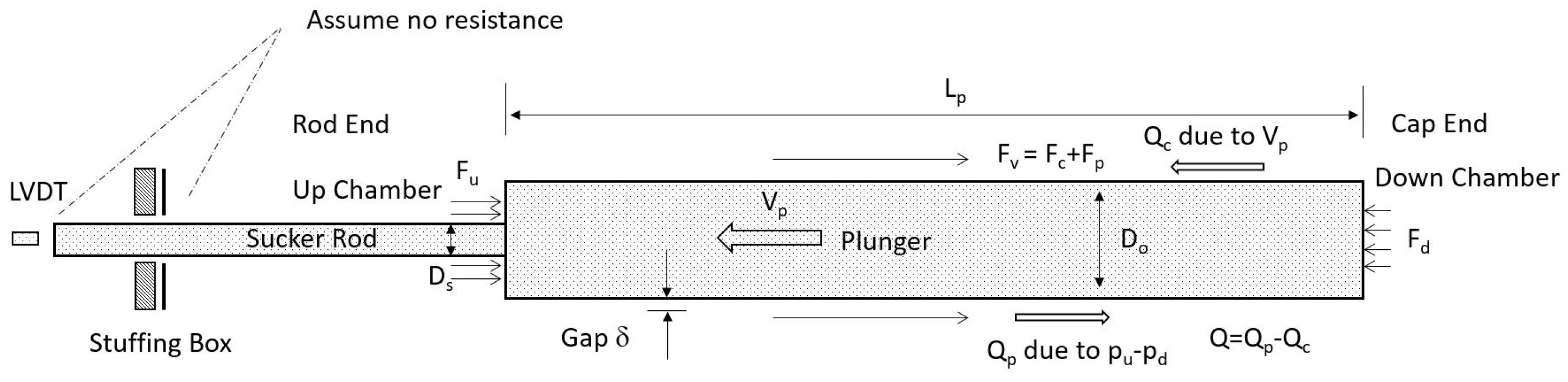
Figure 3, two fundamental fluid flows exist within the gap between the plunger outer surface and the barrel inner surface, one the pressure difference-driven Poiseuille flow, and the other the boundary motion-induced Couette flow. Couette flow is a steady-state, incompressible, and one-dimensional viscous fluid flow through two parallel plates with different velocities. The fluid motion is due to the moving surface’s dragging effect on the surrounding fluid due to the fluid viscosity with a so-called no-slip condition. In our system, as depicted in
Figure 4, the highest velocity of Couette flow occurs adjacent to the moving outer surface of the plunger with velocity
, which is determined by the above-ground polished rod motion along with the kinematic conditions
and
. Consequently, the viscous force
acting on the plunger will be in the opposite direction to the plunger velocity
, whereas the induced volume flow rate
will be in the same direction.
On the other hand, due to the pressure difference
or the pressure gradient in the axial direction from the up-chamber to the down-chamber, namely,
with the plunger length
, the Poiseuille flow direction is aligned with the pressure gradient direction so that the viscous shear force
acts on the plunger’s outer surface and the volume flow rate
, as shown in
Figure 4. Again, for the Poiseuille flow, we have the kinematic conditions
and
on the surfaces of the pump barrel and the plunger, respectively. Note that both the Poiseuille and Couette flows are idealized quasi-static or steady laminar flows. According to the specific geometries of typical sucker rod pump systems and their operating conditions, we may first ignore the inertial and time dependent effects and focus on the steady-state effects. Hence, the Navier–Stokes equation in the cylindrical coordinate system can be simplified as a combination of the Poiseuille flow and Couette flow, governed by the following equations:
with
z as the axial direction coordinate and
v the axial direction fluid velocity.
For the Couette flow, we have
. Therefore, the flow field is expressed as
with
and
.
Using Taylor expansion with the small gap assumption, we have the following simplified expression for the Couette flow field:
Notice that the gradient of the velocity profile at the plunger surface matches the approximation with respect to the thin gap. Moreover, the Couette flow rate
for the annulus region can still be written as
, which is in the same direction as the plunger velocity
, that is, from the down-chamber to the up-chamber, as stipulated in
Figure 4. Using Taylor expansions, as elaborated in [
14], we have
The expression in Equation (
4) matches the approximation of similar Couette flow results in rectangular domains. As a consequence, the viscous shear force
acting on the plunger’s outer surface in the direction from the up-chamber to the down-chamber, which is opposite to the Couette flow direction defined by the sucker rod velocity
, can be calculated as
In fact, the viscous shear force
acting on the plunger’s outer surface due to the Couette flow is opposite to the direction of the plunger’s motion
, defined as positive from the down-chamber to the up-chamber, and the estimate in the expression in Equation (
5) matches the simple approximation based on thin fluid layers as discussed in [
13]. Likewise, for the Poiseuille flow, the velocity profile within the annulus region expressed as Equation (
2) has the following coefficients:
Using the assumption of small clearance and Taylor expansion, following the derivation in [
14] for the Poiseuille flow gives us
where both Dirichlet velocity boundary conditions are satisfied at annulus surfaces with
and
, respectively.
Within the annulus region, we can easily establish the Poiseuille flow rate
as
. It is not too difficult to confirm that up to
, the flow rate due to the pressure difference
is indeed zero. At
we can establish the Poiseuille flow rate with
, as follows:
Consequently, the viscous shear force
acting on the plunger’s outer surface due to the pressure gradient in the direction from the up-chamber to the down-chamber can be calculated as
Notice that the viscous shear force
acting on the plunger’s outer surface is consistent with the Poiseuille flow direction; the leading term in Equation (
8) represents the half of the total normal force difference, attributed to the pressure difference, acting on the fluid within the annulus region [
14].
3. Time Scales and Perturbations
To further investigate the inertia effects, which are essential for the selection of sampling rates, we consider the overall governing equation for the viscous flow within the annulus region with
expressed as
where the fluid density is
, the axial
z direction is consistent with the direction of the flow with the plunger length
, and the pressure gradient
is expressed as
or
.
Note that the pressure difference
is positive when the pressure in the upper region is higher than that in the lower region, which is consistent with the slippage definition. Assuming that the plunger velocity is
, that is,
, by combining the Couette flow and Poiseuille flow we can arrive at the steady-state solution for the velocity profile
, expressed with
as follows:
It is important to point out that the plunger velocity
is negative when it is moving downwards, which is also consistent with the slippage definition. The final unsteady velocity profile
can be written as
, where the steady-state solution is expressed as
, as stipulated in Equation (
10), and the governing equation for the transient part
can be written as follows (with boundary conditions
and
):
Using the separation of variables method and common special functions [
26], we introduce
. As a consequence, we have
and the following governing equations in the cylindrical coordinate system:
where
is the kinematic viscosity and the time scale
is also called the relaxation time.
In general, for an exponential increase or decrease function expressed as
, the tangent line at the origin always provides an horizontal intercept
, and the function will approach the steady-state solutions within 5–6 times the relaxation time
. From Equation (
12), we have
and the characteristic expression for
is
, where the characteristic time
is determined by the boundary conditions of
, namely,
, along with Bessel functions of the first and second kinds
and
, respectively. Therefore, in order to have nontrivial solutions of coefficients
and
for the set of equations
the determinant of the coefficient matrix must be zero, namely,
Finally, the velocity profile can be expressed as
, where the special function can be expressed as
and the coefficient
is calculated as
.
Consider a practical case with and along with measured plunger velocity around , namely, . For the fluid considered in this paper, we assume that the density is about and the plunger length . Let us first evaluate the Reynolds numbers. Assuming that the dynamic viscosity for our example is , we have the Reynolds number based on the plunger diameter as 39,286, which suggests that the flow pattern on top of the plunger can be turbulent. Thus, three-dimensional computational fluid dynamics (CFD) modeling tools must be utilized. On the other hand, the Reynolds number based on the clearance is , which demonstrates that the viscous flows within the annulus region are laminar.
In order to further demonstrate this point about the relaxation time, we employ the perturbation approach utilizing the extreme condition when the plunger radius
is much large than the gap size
. As elaborated in [
13,
26], the two-dimensional governing equation expressed in the cylindrical coordinate system (
11) can be expressed in the equivalent Cartesian coordinate system with
y in the thickness direction as follows:
with the same Dirichlet boundary conditions
and
.
Using the same separation of variable method as stipulated in [
14], we introduce
. As a consequence, we have
, and the governing equations in the equivalent Cartesian coordinate system are
From Equation (
16) and the corresponding boundary conditions, we can easily obtain the sinusoidal expansion of the function
with the half-period
, namely,
, with the modal sequence number
n. Moreover, from Equation (
16) we have
As a consequence, Equation (
17) can be used to de-dimensionalize the relaxation times
and perform confirmation using the roots derived from on the corresponding Bessel functions of the first and second kinds [
13,
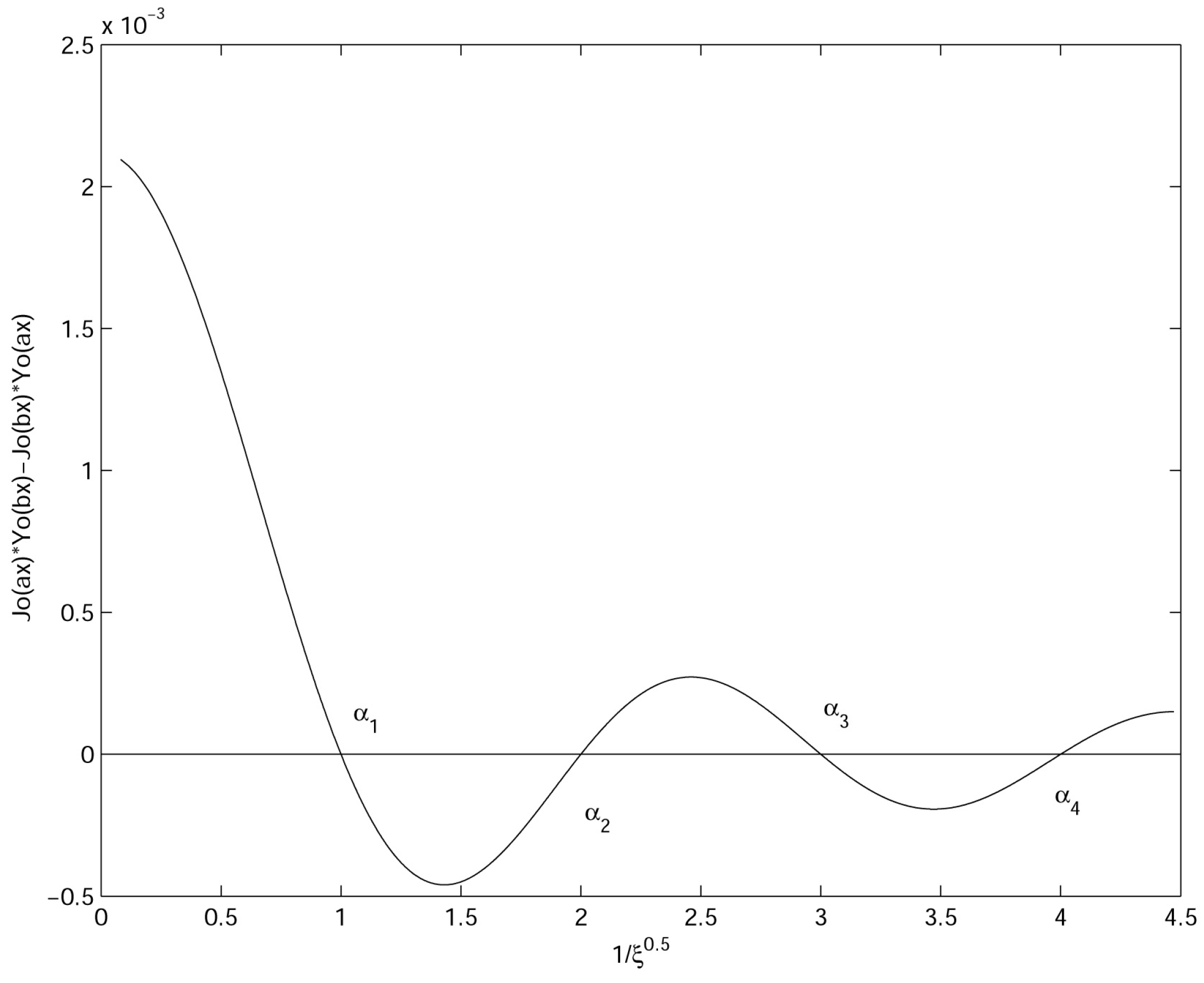
14]. Hence, we have the graphical representation shown in
Figure 5 for the determinant expressed in Equation (
13). The eigensolutions
with
relate to the non-dimensional characteristic time or relaxation time
. In this case, we have the largest characteristic time
. Furthermore,
evaluated by the roots in
Figure 5 can be simply expressed as
. This observation confirms that by simplifying the Bessel functions using the sinusoidal functions as
, it is clear that the typical sampling period of
is sufficiently larger than five or six times the largest intrinsic relaxation time, as predicted in
Figure 5. Therefore, the transient or time-dependent effects can be ignored and quasi-static analytical approaches can be adopted. Furthermore, we have an evaluation of the largest relaxation time
expressed with the mode number
,
. In the early computational simulation we applied the pressure differential for three out of four strokes, namely, 1295 sample points or
, leaving only the stroke during which both the traveling valve (TV) and the standing valve (SV) are closed. Notice that in this test case we have the stroke per minute (SPM) as
; thus, the period of the sucker rod pumping unit is about
. In order to be consistent with the rate of 120 sampling points per second, a sampling step size of
is also adopted. To keep the units consistent, the pressure unit is
, and the dynamic viscosity unit is
. However, since the spatial dimension is represented with
, conversion factors of
for the gravitational constant and 12 for foot and inch conversion must be adopted in the left-hand side (LHS) of the Navier–Stokes equation, which means that the density must be adjusted accordingly in addition to the standard conversion from
and
. Therefore, the actual input to computational programs if the dimensions are in
and the pressure differentials are in
are
for effective density and
for effective dynamic viscosity.
Finally, to incorporate the eccentricity effects as elaborated in [
13,
14], we denote
e as the shift of the center of the inner cylinder; hence, the eccentricity is measured by
. As discussed in [
13,
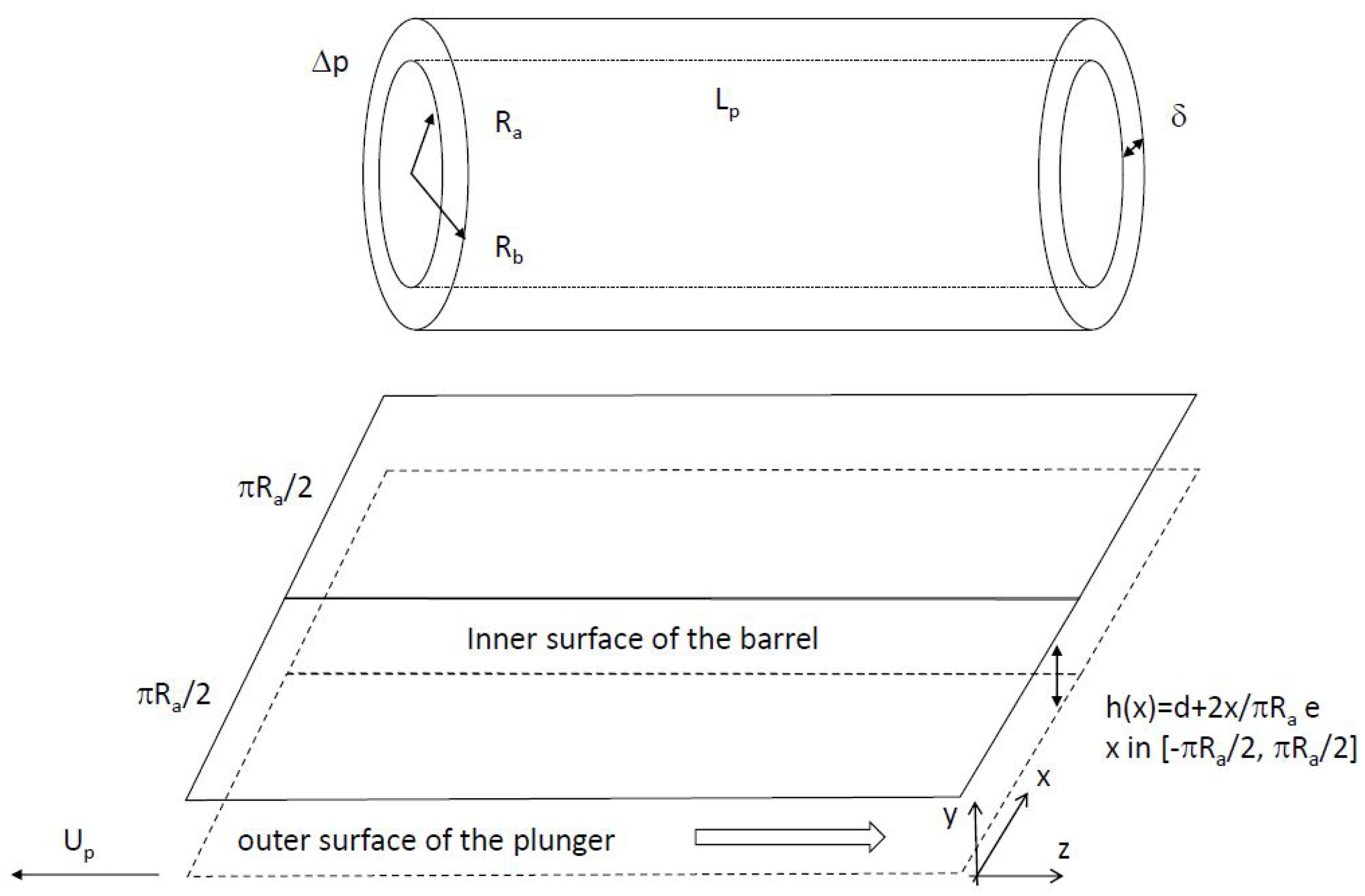
14], the eccentricity of the plunger’s lateral position in the barrel has a significant effect on viscous flows within the annulus region as well as the respective leakages. Again, to approximate the cylindrical coordinate system with an equivalent Cartesian coordinate system, we cut the perimeters along the radial directions aligned with the narrowest gap and express half of the perimeter represented with
, as shown in
Figure 6. Hence, we can simply interpolate the gap function
with the minimum and maximum gap sizes being
and
, respectively, and the governing equation for the axial velocity profile
:
Of course, we always have the eccentricity between 0 and 1, namely,
. Due to symmetry, we only need to consider half of the width in this case; therefore, the velocity component in the axial (
z) direction, satisfying the Dirichlet boundary conditions
at
and
, can be expressed as follows, which is also stipulated in Ref. [
13]:
Furthermore, we can establish the flow rate
through the annulus region with eccentricity
e as
. The flow rate due to the pressure difference
is then established as follows, with
and the eccentricity evaluated as
:
Notice that for concentric cases with
, the Poiseuille flow rate
derived using the Cartesian coordinate system in Equation (
20) matches the leading term derived using the cylindrical coordinate system in Equation (
7). Due to the complexity of the problem, as elaborated in [
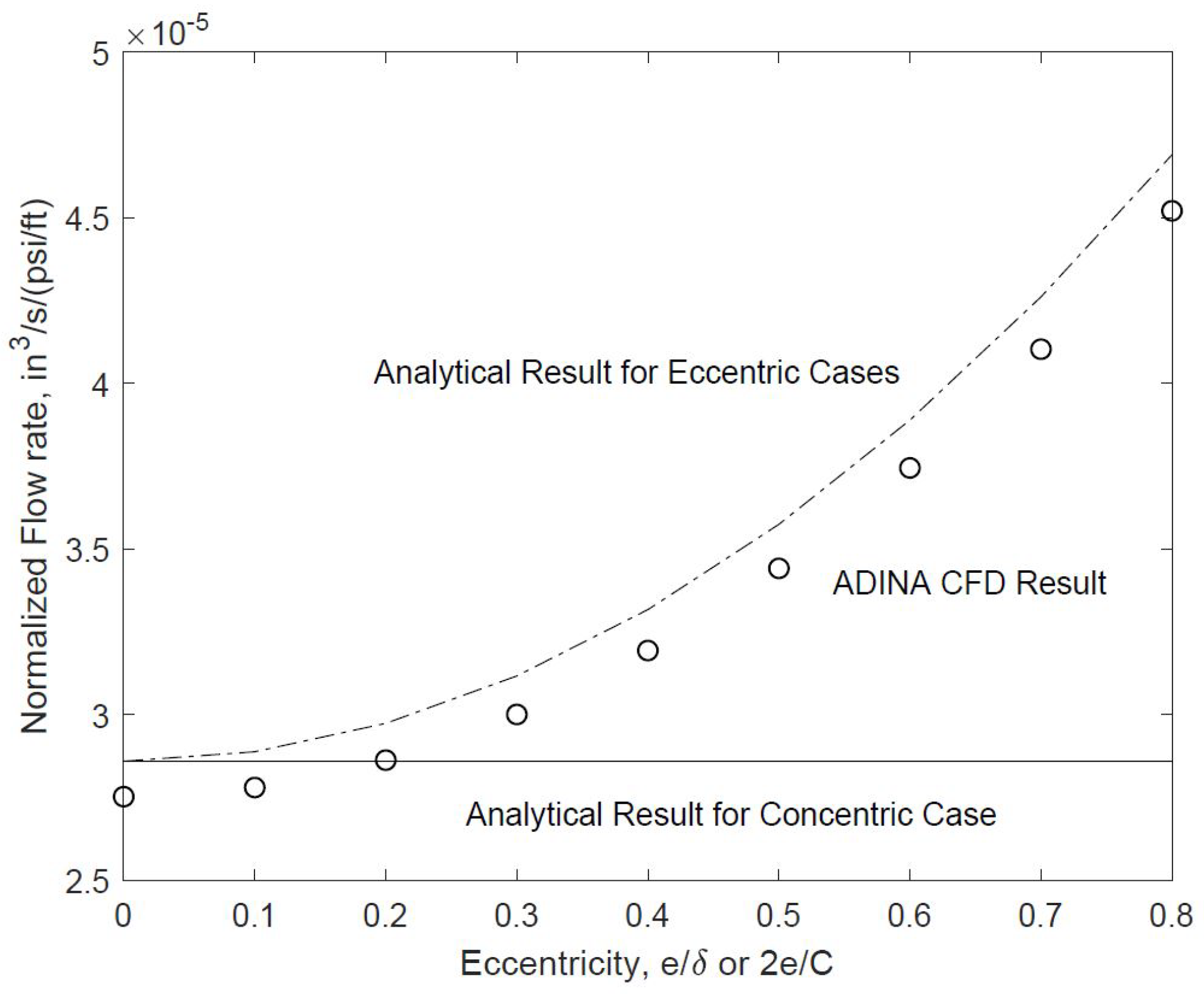
13], the same eccentricity issues have also been studied with computational tools. As confirmed in
Figure 7, the computational results match very well with the theoretical predications using Bessel functions in the cylindrical coordinate system and their sinusoidal approximations in the Cartesian coordinate system; more importantly, they also match the results when expanded to cases with eccentricities. Finally, the dynamical behaviors of the sucker rod pump system resembles those of viscoelastic materials, as elaborated in [
15,
22,
27].
4. Experimental Setup and Validation
The sucker rod experimental setup established in McCoy Engineering Hall at MSU Texas has both horizontal and vertical configurations. Two specific details are important with respect to the horizontal and the vertical configurations. First, in the vertical configuration, the gravitational constant plays an important role in the governing equations. Second, in the vertical configuration, the eccentricity issue can be minimized in comparison with the horizontal configuration. As shown in
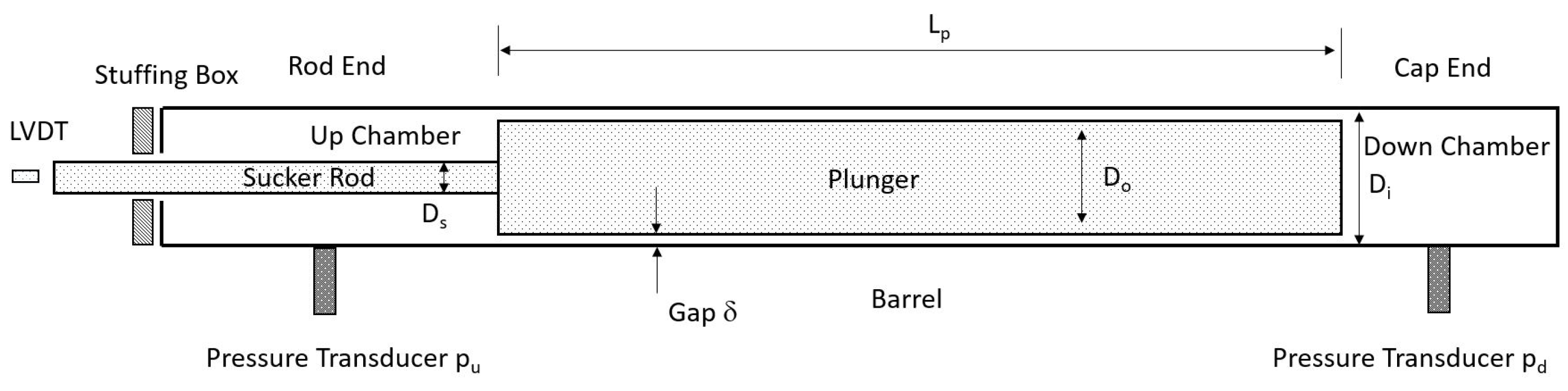
Figure 2, we have one solenoid valve with four ports and three positions. As depicted in
Figure 8, the down-chamber near the cap end corresponds to the sucker rod pump chamber, whereas the up-chamber near the rod end represents the oil well section above the plunger. The tight fit between the plunger and barrel is identical to a sucker rod pump system used in the petroleum industry. In order to simulate the up-stroke, the traveling valve (TV) is replaced with a fixed impermeable end. Furthermore, to ensure a tight seal between the air and liquid, we use the same stuff-box used in the petroleum industry to support the retracting sucker rod that is physically attached to the plunger. In order to measure the sucker rod displacement, an analogue Linear Variable Differential Transformer (LVDT) system is installed at the tip of the sucker rod. Transient pressures within both the down-chamber and up-chamber are measured using a sampling rate from 30 to 120 samples per second or 30 to
using the echometer pressure measurement system.
Assuming that the plunger is moving at this time instant with a velocity
to the left in a positive direction, as depicted in
Figure 4, we have viscous shear force
, since one of the external horizontal forces is acting on the plunger from left to right. Furthermore, the pressure in the down-chamber, denoted as
, exerts a leftward horizontal force
on the plunger, expressed as
, whereas the pressure in the up-chamber, denoted as
, exerts a rightward horizontal force
on the plunger, expressed as
, where
is the sucker rod radius. Note that in this work we also introduce the gauge pressure; thus, the atmospheric pressure
is not added through the cross-sectional area of the sucker rod. Moreover, for the vertical configuration, the gravitational constant
g must also be introduced.
Since the plunger is moving from the right to the left at this time instant, as illustrated in
Figure 4, the Couette flow
, as the secondary contribution of slippage, is in the same direction; moreover, the Poiseuille flow
due to pressure difference
, as the primary contribution of slippage, is from the right to the left. For the Poiseuille flow, as shown in
Figure 4, the viscous shear force acting on the plunger surface
is also in the negative direction, from the up-chamber to the down-chamber, and can be calculated as in Equation (
8). For the Couette flow, as shown in
Figure 4, the viscous shear force acting on the plunger surface
is in the negative direction, from the up-chamber to the down-chamber, and can be calculated as in Equation (
5). Overall, as shown in
Figure 4, the flow rate
Q from the left to the right is calculated as
, whereas the shear force to the right is calculated as
.
The following two governing equations are the key to analyzing the experimental data. First of all, we have the kinematic relationship based on the incompressibility of the hydraulic oil and the mass conservation within the cap end. Second, we must observe the dynamical balance of the plunger, or Newton’s second law. Assuming the transient rod displacement as
(
u) and the volume flow rate from the hydraulic pump with power
, denoted as
, the change of the cap end volume is then depicted as
with the transient plunger displacement
(abbreviated as
U), corresponding velocity
(abbreviated as
V or
), and volume flow rate from the hydraulic pump
expressed as
, or rather
.
In this experimental setup, the hydraulic pump has a peak power
, which is equivalent to
. Notice that a simpler kinematic relationship holds for the sealed cap end with
. Assuming that the total mass of the plunger with the polished rod is
m, for the acceleration
(or simply
a) we have
where
g stands for the gravitational constant, which is only needed for vertical configurations.
Notice here that the pressure measurements
in Equation (
22) are gauge pressure at both the down-chamber and up-chamber. Therefore, from the kinematic relationship in Equation (
21) and utilizing the leading terms in Equations (
4) and (
7) for viscous flow rates along with Equations (
5) and (
8) for viscous shear forces, we have
and
For the sucker rod experimental setup shown in
Figure 2 and
Figure 9, we employed MOBIL Hydraulic Oil DTE 24, which has a dynamic viscosity around
. In fact, this particular type of hydraulic oil is widely available in the State of Texas and is currently utilized in our Fluid Power Lab. However, notice that the dynamic viscosity can be sensitive to both impurities and temperature, which suggests a need for further validation with multiple inverse optimization procedures [
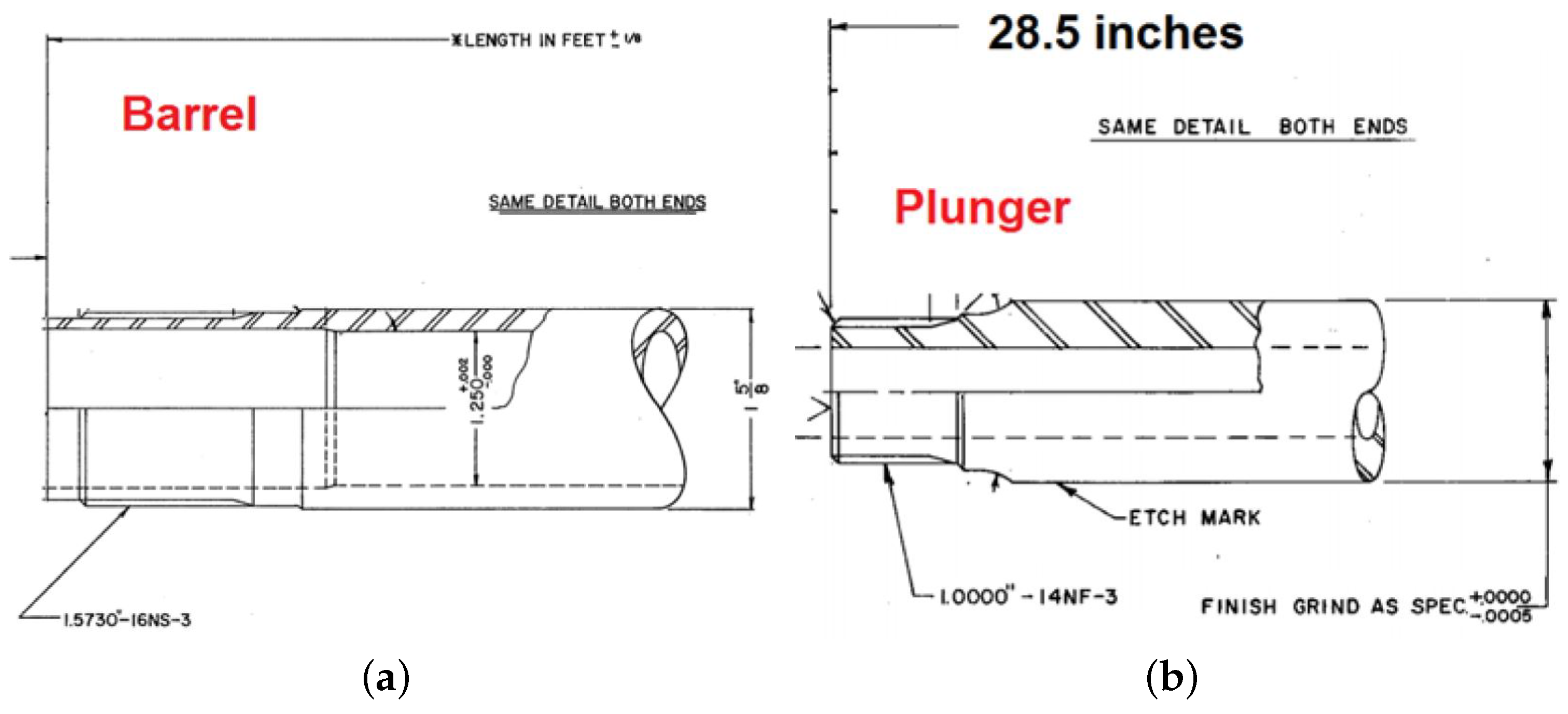
28]. The plunger length in the design is
with
and
. Hence, we have clearance of
or
or
with a plunger length
. The polished rod has a radius
and length
. Finally, in NI LabView measurement, the sensitivity or calibration factor for LVDT measurement in the horizontal configuration is
or
. In
Figure 9, the pressure transducers are connected with the Echometer pressure measurement system. Note that although in engineering practice the sucker rod does not introduce additional viscous shear forces into the pump system, in this experimental setup the gap between the sucker rod radius
and the plunger outer radius
is sufficiently small, and the viscous shear force due to Couette flow effects can also be estimated as
.
As depicted in
Figure 9 and
Figure 10, the preliminary experimental measures from NI LabView using LVDT and DAQ systems for displacement measurements and pressures in both the up-chamber and down-chamber use Echometer pressure measurement equipment for the horizontal configuration. In this case, the LVDT and Echometer pressure measurement sampling rates are both
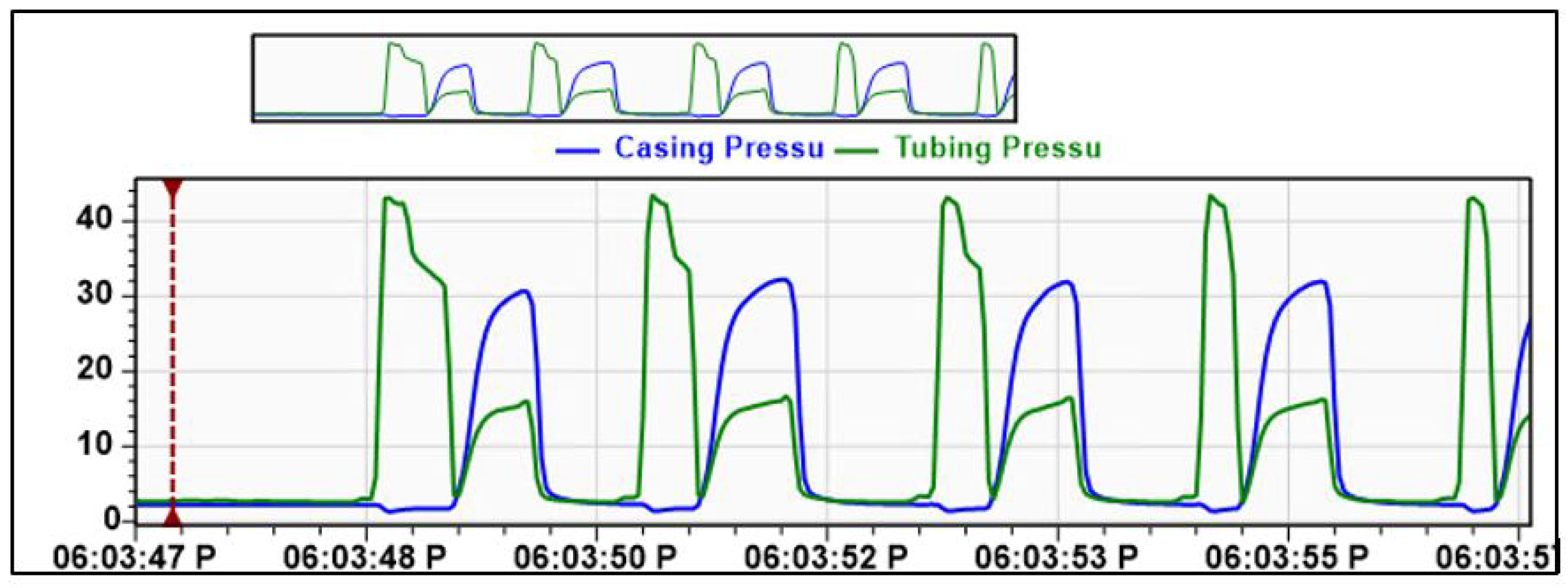
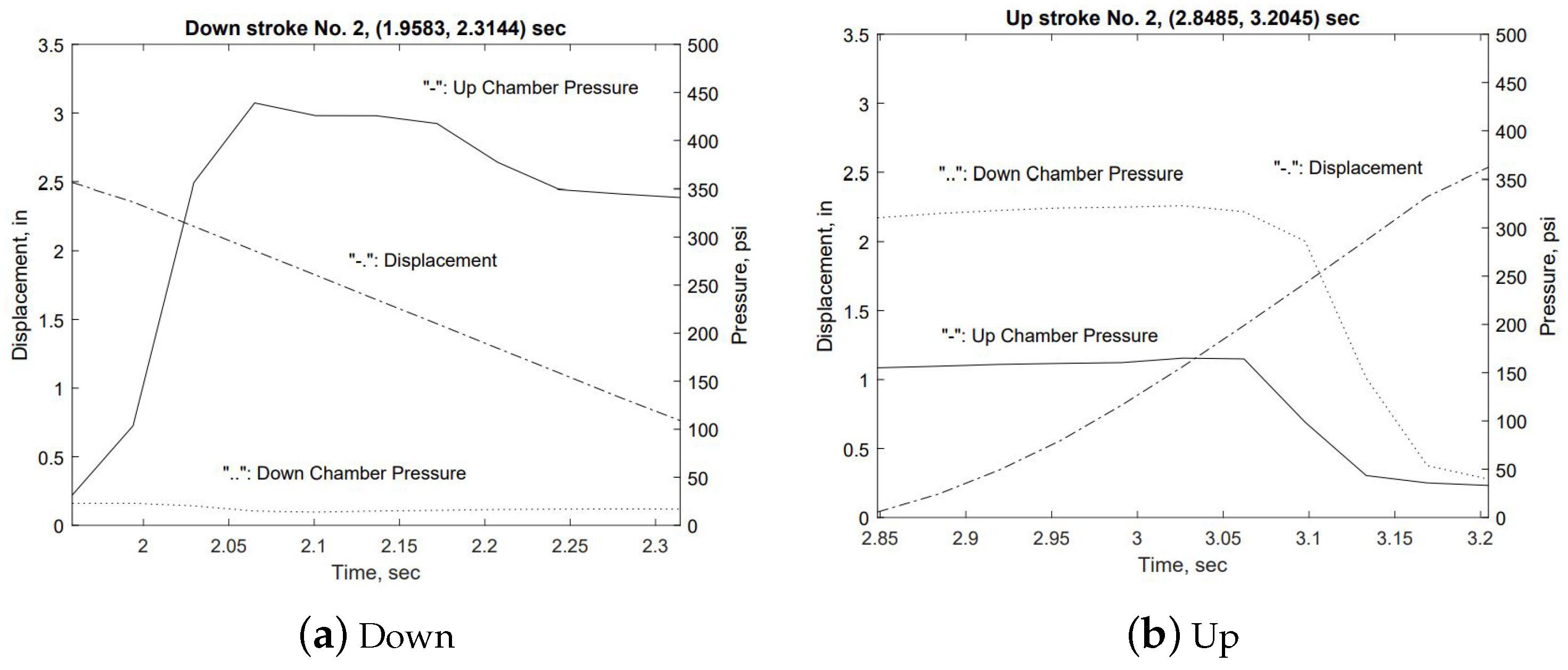
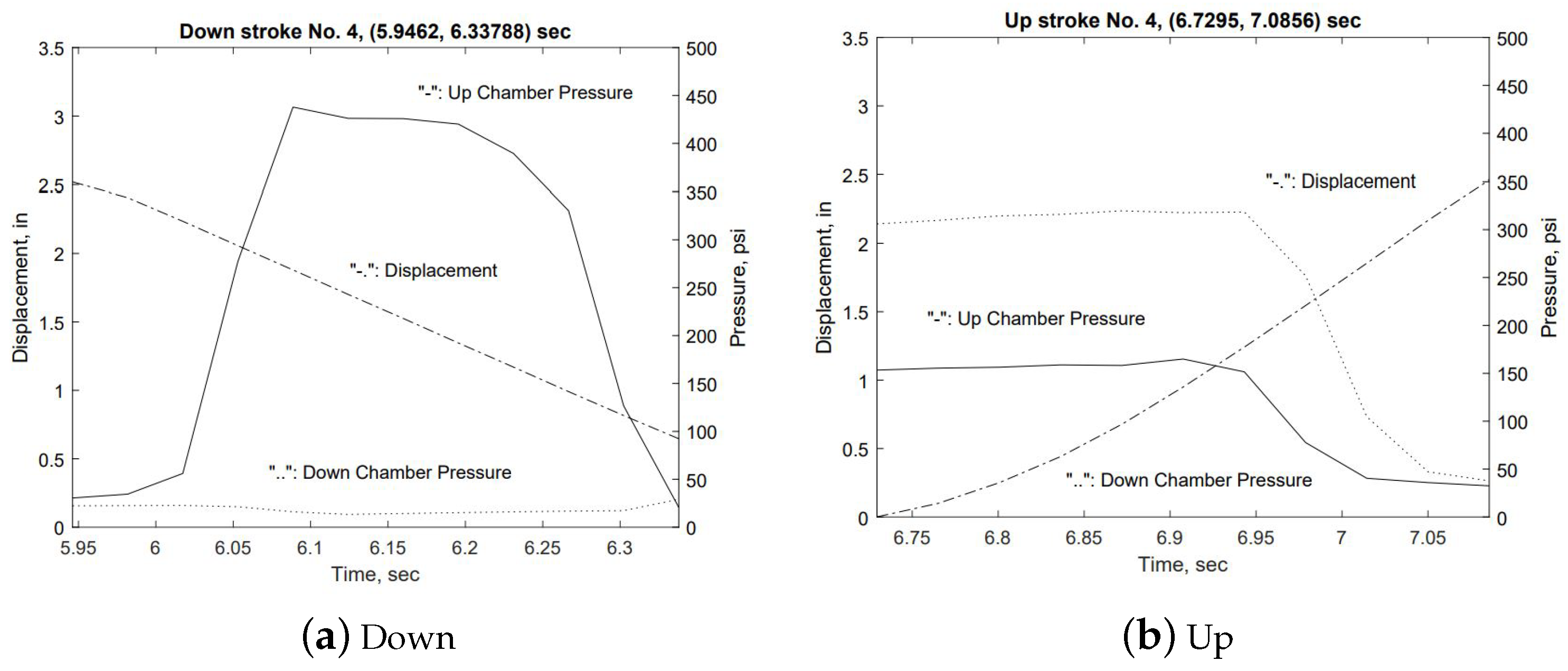
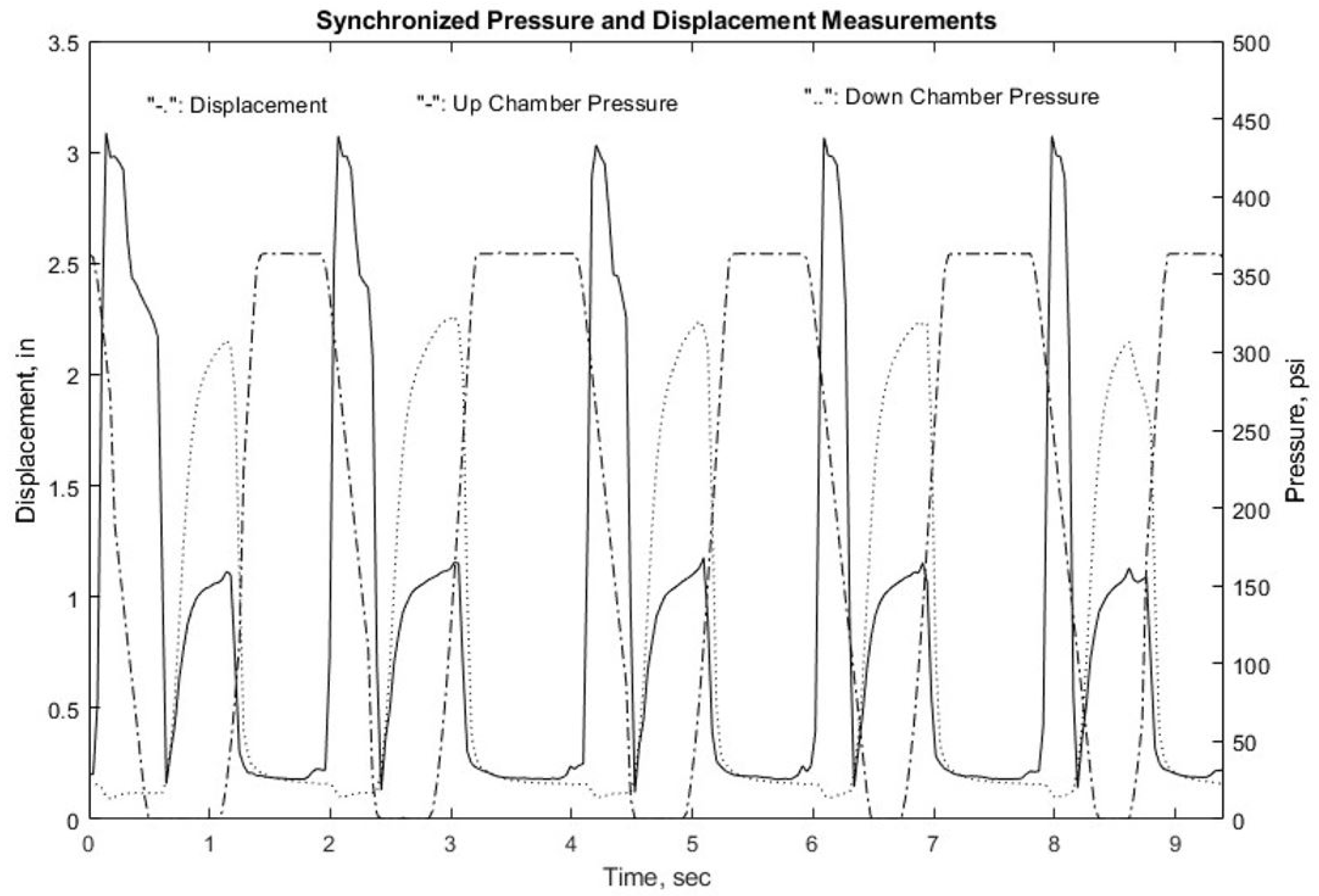
. Using a heuristic time synchronization method for LVDT and the pressure transducer, we also derived a synchronized set, as illustrated in
Figure 11,
Figure 12,
Figure 13,
Figure 14 and
Figure 15.
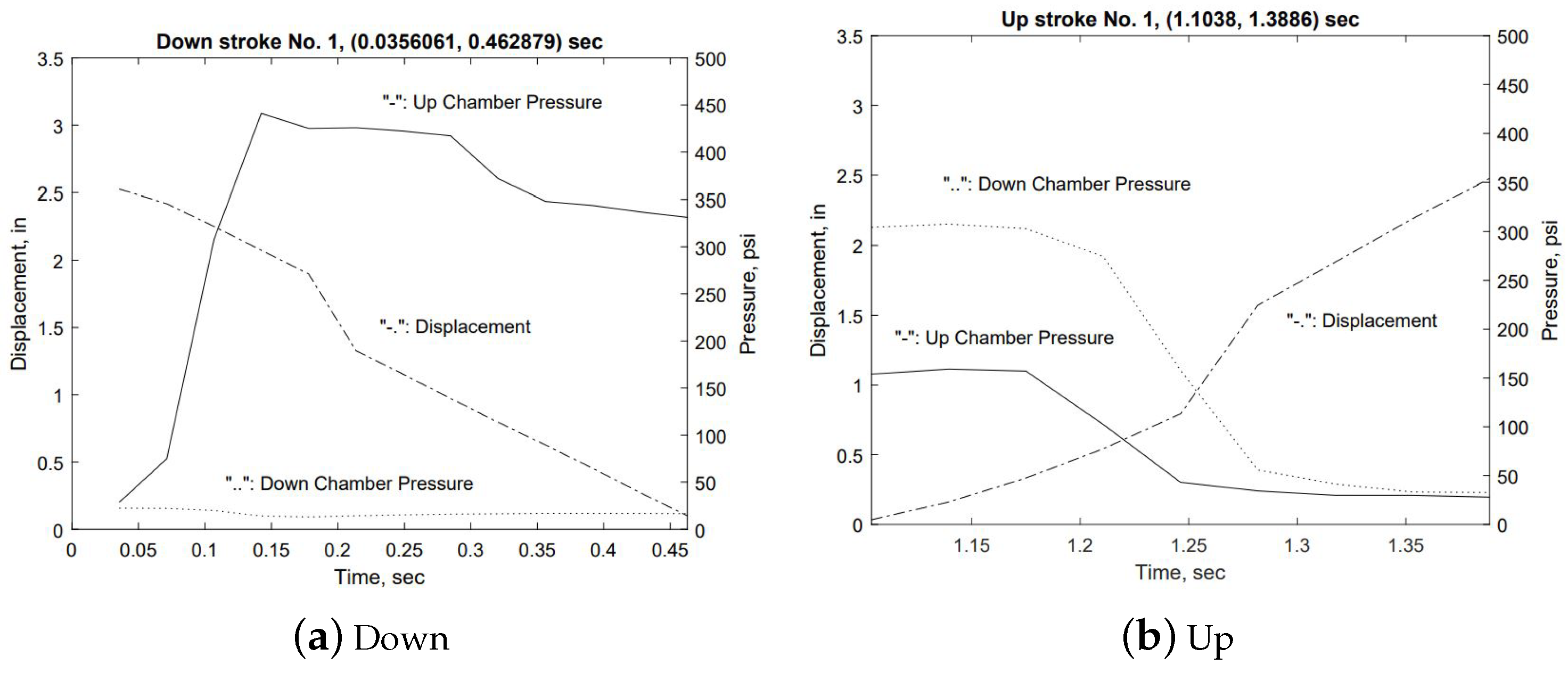
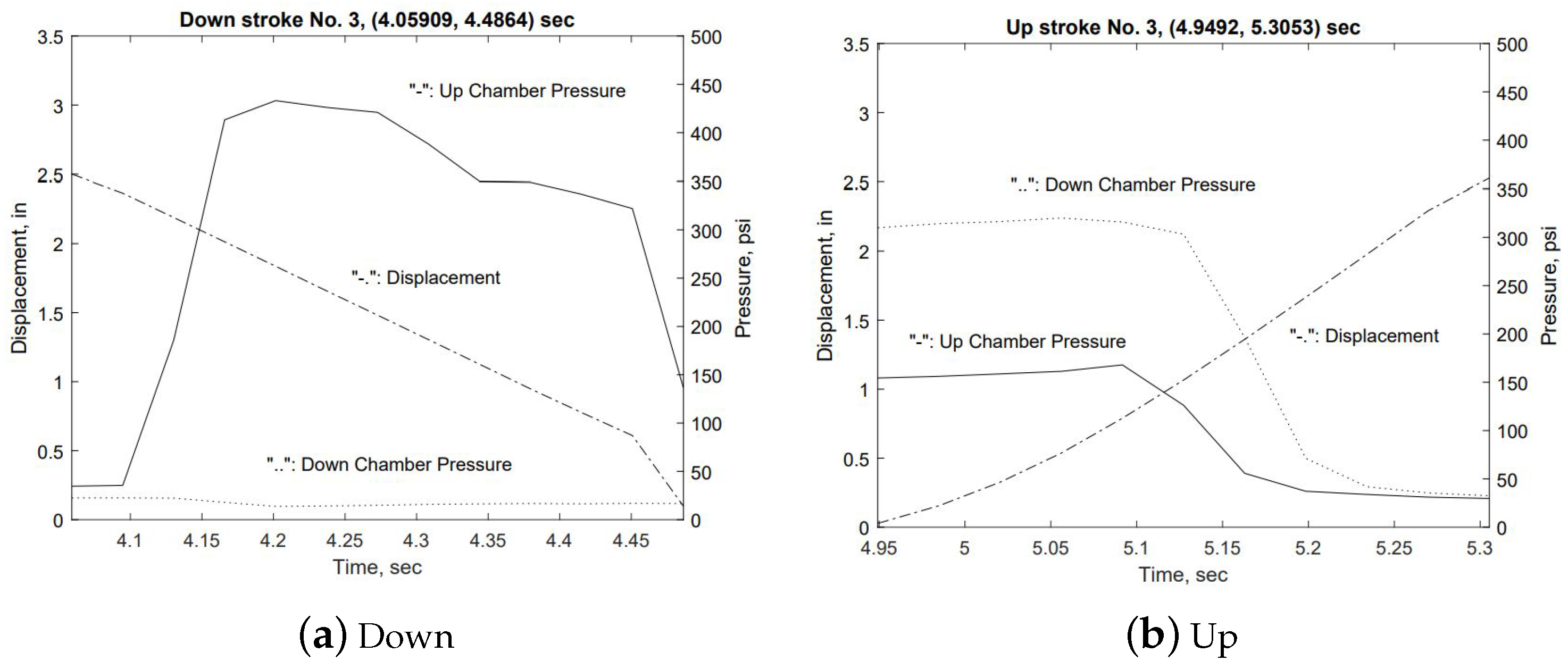
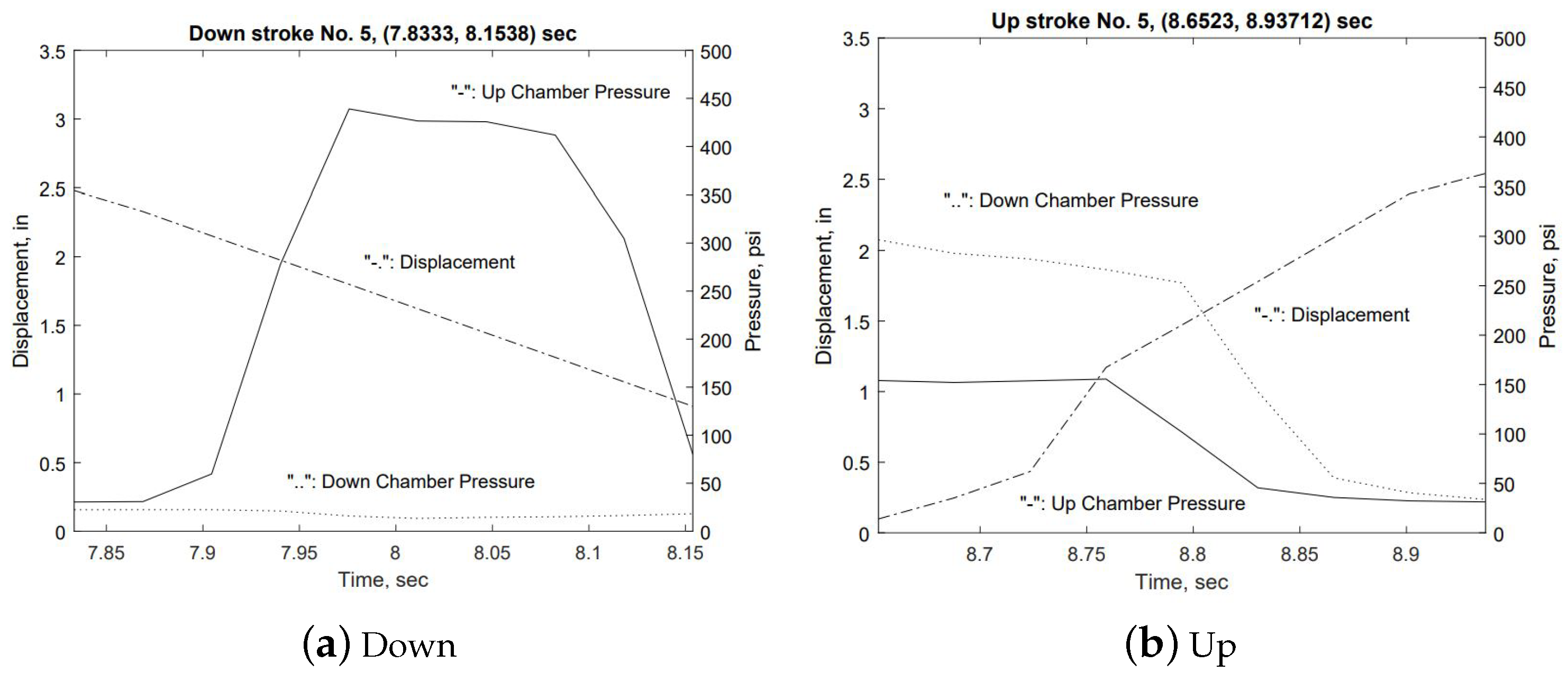
As illustrated in
Figure 12,
Figure 13 and
Figure 14, we have identified three fairly consistent sets of down- and up-strokes in which the up-chamber pressure is much higher than the down-chamber pressure for the down strokes, whereas for the up-strokes the down-chamber pressure is much higher than the up-chamber pressure. As a result, the velocity is from the left to the right, which is designated as the negative direction. When the cap end or down-chamber pressure is higher than the rod end or up-chamber pressure, then the rod is pushed to the left. The governing equations are illustrated with Equations (
23) and (
24), derived using both kinematic and dynamic relationships. For this experimental setup, the plunger length
and the sucker rod length
and
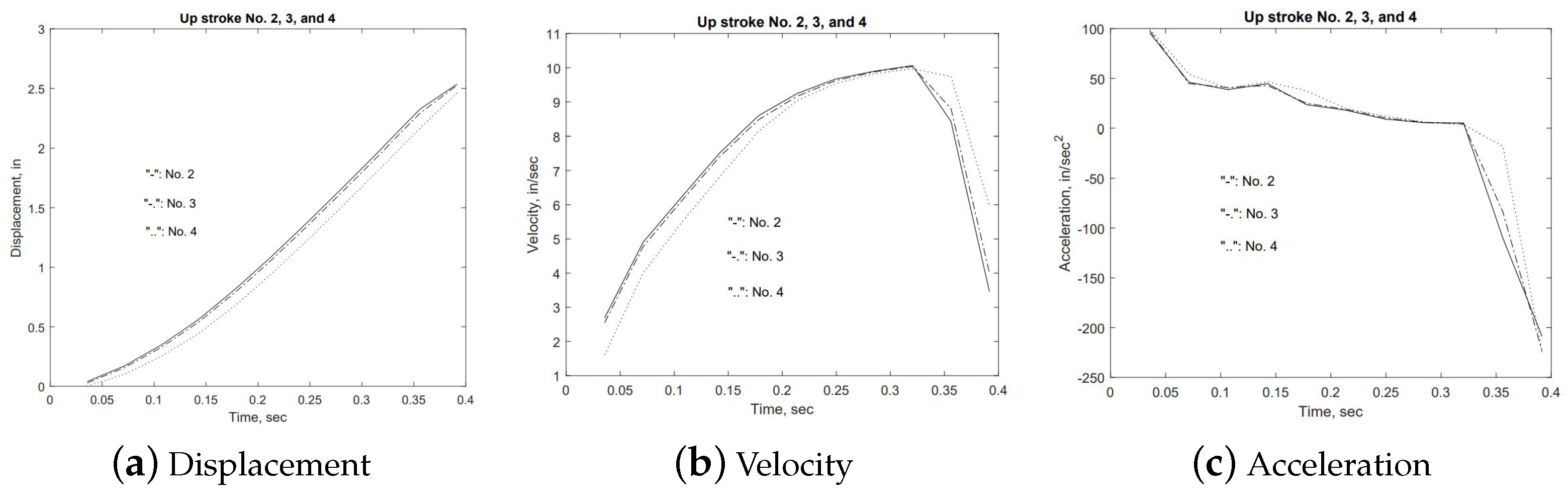
. As shown in
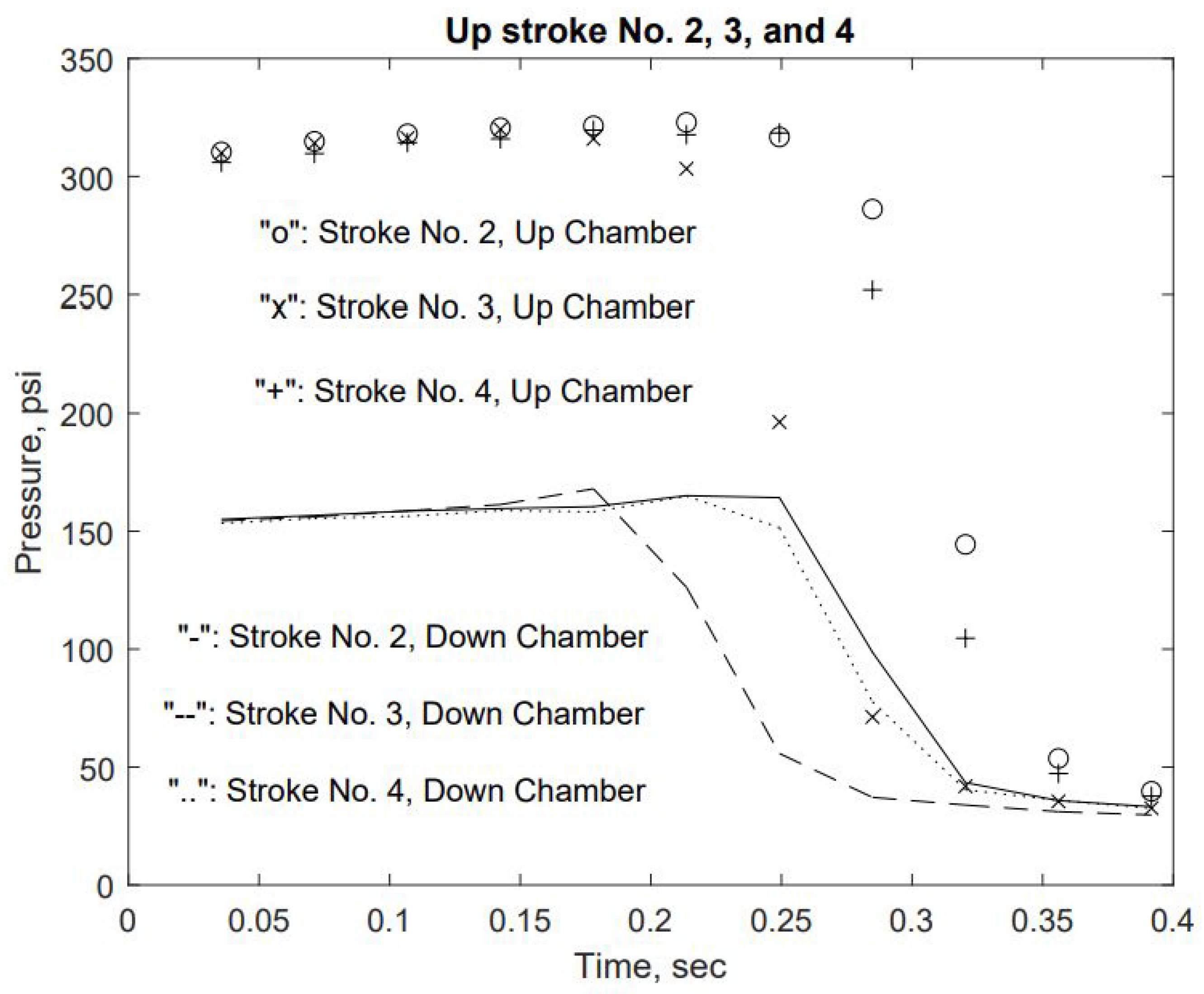
Figure 16 and
Figure 17, the second, third, and fourth up-strokes demonstrate the consistency of the experimental setup.
In the following equations, we attempt to utilize the inverse optimization strategy to determine the mass of the sucker rod and the plunger [
29]. Inverse optimization methods utilize experimental data to infer unknown parameters for either mathematical models or objective functions with direct error minimizations or optimization [
30,
31]. The calculated mass is also compared with the physical arrangements. Together with the sucker rod displacement, velocity, and acceleration data from the LVDT measurement, the pressure data obtained from the up-chamber and down-chamber of the system are used to verify the previously-developed theories. Furthermore, we have chosen to utilize the force–balance equation in the vertical direction in an attempt to define the forces and flow rates related to both the Poiseuille flow and Couette flow within the annulus region between the plunger and the barrel.
In this research, we employ an inverse optimization method to determine unknown parameters by minimizing errors between experimental data and analytical solutions [
32]. Unlike solving a forward (standard) optimization problem, in which system parameters are provided a priori, the inverse optimization method is introduced in this project for multiple reasons. The first advantage is the ability to estimate multiple parameters in complex systems such as sucker rod pump systems [
33,
34]. Moreover, we can alter the system parameters within the same system to match or predict experimental data. Such an iterative search process can be coupled with the Newton–Raphson methods for nonlinear system.
Using the free body diagram above, we were able to develop the following equilibrium equation based on Equation (
24) for the horizontal configuration:
where the upward positive displacement of the plunger is denoted as
U, with velocity
V, i.e.,
, and acceleration
a, i.e.,
, as presented in
Figure 16.
In the inverse optimization procedure with one parameter, the mass
m, we start by minimizing the error function
E defined with respect to the plunger mass
m, as follows:
where the subscript
i stands for the time step number and
N is the total number of time steps.
The inverse optimization procedure starts with the minimization of such an error function with respect to the mass
m. Thus, for this one-parameter inverse optimization procedure, we have the following equation:
Consequently, we have
which yields
, where the expressions
c and
b can be evaluated as
However, note the unit conversion from 1
to
, or rather
For the second up-stroke, we have
and
; hence,
. As shown in
Figure 3, the plunger section has length
and radius
along with sucker rod length
and radius
, as well as a transition section of one inch or so, yielding a total volume of
or total mass of
for steel. The close match between the estimated mass based on the inverse optimization method and the actual design volume and mass of the sucker rod and plunger system provides a strong quantitative comparison and validation [
35].
In similar experimental setups, it might be difficult to quantify the dynamic viscosity; therefore, it is also possible to follow up with a new inverse optimization procedure with two parameters, namely, the mass
m and dynamic viscosity
. We do this in order to test the model even further and extend our initial validation of the system performance for more accurate prediction of the slippage within the sucker rod pump system. We start with a similar equation to Equation (
25) and define the error function
as stipulated in Equation (
25) with respect to the plunger mass
m and dynamic viscosity
. Note that multiple system parameters or material constants can be introduced to validate the mathematical models with respective inverse optimization procedures [
36,
37]. In fact, most inverse optimization procedures are not automatic and must rely heavily on engineers and applied mathematicians’ intuition. Hence, in the two-parameter inverse optimization approach we have
Furthermore, we have
where the expressions
and
can be evaluated as
Again using the data for the second up-stroke, we have
with
to 3 as
,
, and
, respectively, and
with
as
and
which yields the solutions for
m around
and for the dynamic viscosity
around
. Similarly, to account for the stiffness effects of the LVDT system, a new error function
with respect to the plunger mass
m and stiffness
K can be defined as follows:
Again, a similar two-parameter inverse optimization can be introduced with respect to the mass
m and spring constant
K. Hence, the minimization problem yields
As a consequence, we have
which is equivalent to the following linear system equation:
where the expressions
and
can be evaluated as
Furthermore, we can also introduce a constant force
F to include a constant shift due to the relative displacement for the LVDT measurement and account for the gravitational force in the vertical configuration. Thus, a new error function
can be established with respect to the plunger mass
m, stiffness
K, and constant force
F:
For this three-parameter inverse optimization procedure, we derive the following equations:
Finally, given that the mass of the sucker rod and the plunger is fairly well documented and calibrated at around
, we can also focus on the dynamic viscosity, the LVDT-induced stiffness
K, and a constant
F. Hence, we have the following similar three-parameter inverse optimization procedure:
Moreover, we have the following linear system of equations:
where the expressions for the constants
and
can be evaluated as
Note again that the system is symmetric for this type of minimization problem. Again using the data for the second up-stroke, we obtain
with
to 6, as
,
,
,
,
, and 5; and
with
to 3, as
,
, and
, which yields the solution for the dynamic viscosity
around
and for the constants
K and
F as
and
. Note that the negative value of the stiffness
K is reasonable, since we assume upward motion and position as positive. It is clear that these data analysis procedures do produce system parameters within the same range. It is also obvious that which inverse optimization procedures should be chosen depends very much on the available information and the feasibility of different physical and mathematical models [
38,
39]. In fact, throughout the research on the slippage issues related to sucker rod pump systems it is evident that engineers’ physical understanding is essential to the solution of complex engineering problems and the optimization of engineering operations. In the future, comparing both horizontal and vertical configurations can allow us to better identify eccentricity effects. In today’s AI-driven economy, although the wealth of information on any engineering problems is at our finger tips, the creative and intuitive understanding of the physics and targeted optimization procedures still depends on individual engineers’ professionalism and critical thinking skills.