
Machine Learning and Deep Learning in Lung Cancer Diagnostics: A Systematic Review of Technical Breakthroughs, Clinical Barriers, and Ethical Imperatives

 , , , and
Abstract
1. Introduction
- Technical walls, such as the dataset’s bias and the domain shift when applying the model to a different dataset, lead to damaged model generalization.
- Clinical challenges include regulatory barriers, which refer to strict requirements for validation and approving ML/DL tools for clinical use, and radiologists’ suspicion of black box systems, which occur when ML/DL systems lack clarity, as they cannot examine how decisions were made.
- Ethical concerns like the demographic bias that occurs when training a ML/DL model on a demographic dataset (e.g., race, gender, age).
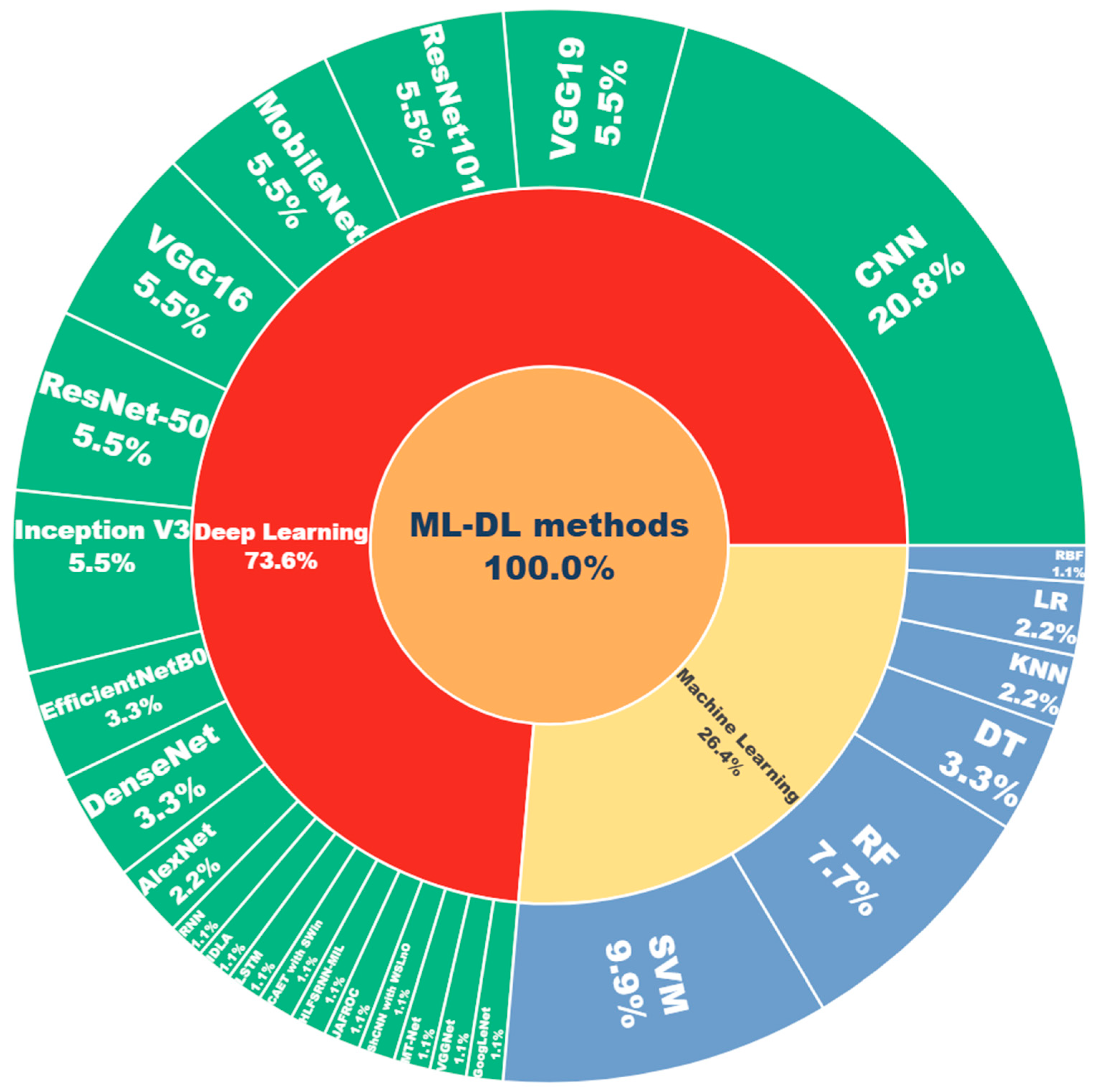
- Critically analyzes the contributions and classifies the challenges.
- Evaluates emerging solutions, including federated learning for data diversity, synthetic data generation for rare subcategories, and interpretable ML algorithms to build medicine or specialist trust.
- Redefines evaluation metrics by prioritizing clinical benefit (reducing time to diagnosis) over technical criteria.
- RQ1: What technical, clinical, and societal boundaries prevent high-performing ML/DL models from deploying in LC screening workflows?
- RQ2: How might new models, such as human-in-the-loop systems, lightweight architectures, and synthetic data, handle these challenges?
- RQ3: Which evaluation structures are required to ensure ML/DL tools are equitable, repeatable, and clinically impactful?
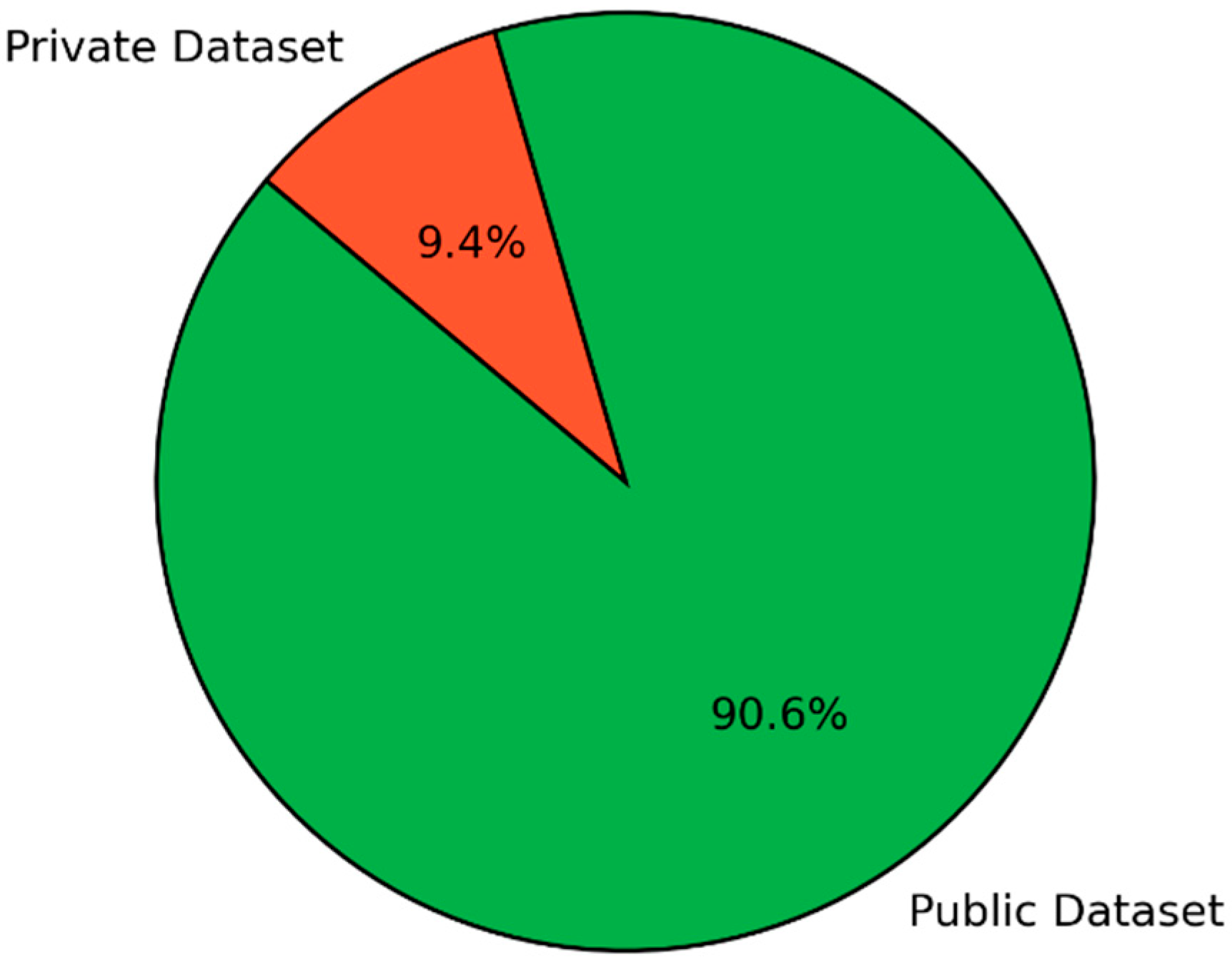
- RQ4: How does the heavy reliance on public datasets (e.g., LIDC-IDRI, LUNA16) in LC ML and DL research contribute to dataset imbalance, and what obstacles does this create for model generalizability and clinical applicability in real-world scenarios?
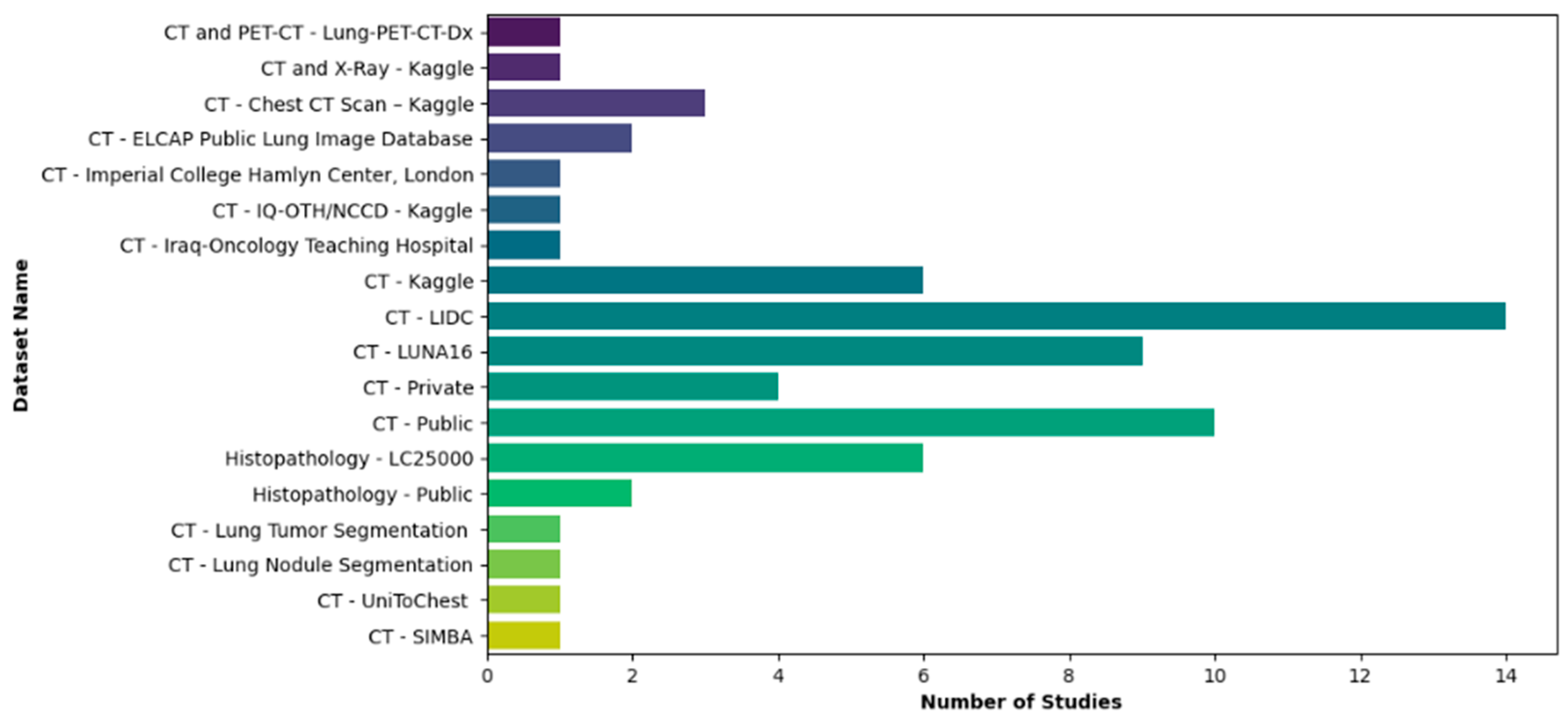
- RQ5: Which public datasets have been most frequently used in previous studies for LC detection and classification using ML and DL techniques?
1.1. Methodology
1.1.1. Research Design and Protocols
1.1.2. Search Strategy
- Keywords: “Lung cancer detection”, “Lung cancer classification”, “Machine learning”, “Deep learning”, “Medical image processing”, “Clinical validation”.
- Boolean Operators: (“Lung cancer detection” OR “Lung tumor classification” OR “Lung cancer segmentation”) AND (“Deep learning” OR “Machine learning”).
1.1.3. Study Selection Method
1.1.4. Inclusion and Exclusion Criteria
- Inclusion Criteria:
- Studies that developed or experimented with ML/DL-based models for the classification or detection of LC.
- Studies with near-clinical or clinical model validation.
- Studies that had reported performance in terms of clinically relevant measures (e.g., subtype generalization, sensitivity/specificity).
- Studies published in 2022–2024 in English.
- Exclusion Criteria:
- Non-English language articles.
- Studies published before 2022.
- Studies that were not ML/DL-based method-focused.
- Articles without clinical context or validation.
- Duplicate or redundant studies.
1.1.5. Data Extraction
- Bibliographic details: including the authors, publication year, and country of origin.
- Dataset characteristics: dataset name, modality (e.g., CT, PET-CT, histopathology, X-ray), number of patients or images, dataset type (public/private), data balance, class distribution, strengths, and known limitations. These elements were further summarized and presented in tabulated form in Section 2 (Technical Section).
- Study objective and task type: such as lung cancer detection, binary or multiclass classification, or segmentation.
- Technical methodology: including the implemented ML or DL model architecture, any transfer learning or hybrid strategies, preprocessing techniques, feature engineering (if applicable), and optimization/training procedures.
- Performance evaluation: based on commonly reported metrics such as accuracy, AUC, sensitivity, specificity, precision, recall, and F1-score.
- Clinical validation details: type of validation strategy (internal/external), dataset representativeness in clinical settings, use of real patient data, radiologist involvement, or comparison with current diagnostic practice.
2. Technical Advances in LC Detection
2.1. Datasets
2.1.1. Public Datasets

| Dataset Name | Modality | Size (Patients) | Strengths | Limitations |
|---|---|---|---|---|
| LIDC-IDRI [10] | CT | 1018 | Well-annotated, multicenter CT data | Limited to CT, no histopathology |
| NLST [11] | CT | 53,452 | Very large, longitudinal | Limited access, specific criteria |
| Duke LC Screening Dataset [19] | CT | 2061 | Large, well-curated | Limited clinical annotations |
| LUNA16 [12] | CT (nodules, non-nodules) | 888 | High-resolution, nodule-focused | No histopathology, weak labeling |
| LC25000 [13] | Histopathological (ADC, SCC, Benign) | 750 | Balanced classes, widely used | Synthetic generation concerns |
| IQ-OTH/NCCD [20] | CT (normal, benign, malignant) | 1190 | Includes benign and malignant categories | Limited diversity |
| Chest CT-Scan [21] | CT (ADC, LCC, Normal, SCC) | 1653 | Balanced classes, useful for multi-class | Limited sample size |
| Lung-PET-CT-Dx [22] | CT, PET-CT (ADC, SCC, LCC, SCLC) | 355 | Multimodal (CT + PET), rich annotations | Requires pre-processing expertise, fewer patients |
| Lung Cancer Alliance (LCA) [23] | CT (NSCLC and SCLC) | 76 | Real-world lung cancer cases | Limited dataset size |
| SPIE-AAPM-NCI Lung Nodule Classification Challenge [24] | CT | 70 | High-quality expert annotations | Limited sample size |
| Chest X-Ray [25] | X-ray (Normal and Pneumonia) | 5856 | Balanced and labeled X-ray data useful for binary classification | Only two classes (Normal vs. Pneumonia), not specific to lung cancer |
| Lung Tumor Segmentation [26] | CT | 63 | High-quality manual tumor segmentation in full CT volumes | Limited sample size; focus on segmentation tasks only |
| Lung Nodule Segmentation [27] | CT (nodule, cancer, and adenocarcinoma) | ~1650 | Rich instance-level annotations (pixel-wise masks per lesion) | No patient-level metadata (e.g., age, sex, diagnosis context) |
| NSCLC-Radiomics [14] | CT | 422 | Multi-institutional cohort, supports radiomics standardization | Manual delineations, outcome data |
| RIDER [15] | CT | ~100 | Intra-patient test–retest variability, ideal for robustness testing of radiomic features | Repeat scans, stability studies |
| Radiomic Features (various) [28] | CT-derived | Variable | Public/Private| multi-dataset aggregation, useful for feature reproducibility and benchmarking ML models | Quantitative features, diverse applications |
| NSCLC-Radiomics-Genomics [29] | CT, Genomics, Clinical | 89 | Multimodal, gene-expression data | Limited size, complex integration |
| NSCLC Radiogenomics (TCIA) [30] | CT, Genomics, Clinical | 211 | Combines imaging, gene expression, and survival data | Limited cohort; requires complex preprocessing |
| Internal NSCLC cohort [16] | CT and PET/CT + gene expression | 26 | Includes matched imaging and gene expression; radiogenomic analysis performed directly | Small sample size |
| UniToChest [31] | CT | 623 | Largest public lung nodule segmentation dataset. Manual annotations by radiologists | Focused on segmentation, not classification |
| SIMBA Public [32] | CT (Low-dose CT) | ~1000 | Includes low-dose CT scans used in CAD systems | Limited clinical metadata, not all scans labeled for malignancy |
2.1.2. Private Datasets
2.2. Traditional ML Models
2.2.1. ML on Public CT Datasets
| Study | Dataset | Task | Feature Extraction | Classifiers | Accuracy (%) | AUC (%) | Sensitivity (%) | Specificity (%) |
|---|---|---|---|---|---|---|---|---|
| [42] | SPIE-AAPM-NCI Lung Nodule Classification Challenge | Binary | - | KNN | 88.57 | - | - | - |
| [38] | LIDC-IDRI [10] | Binary | boosted and bagged ensemble classification trees | Ensemble Subspace KNN | 88.3 | 93.4 | 97.1 | 83.1 |
| [39] | LIDC-IDRI | Binary | CNN | SVM | 94.0 | - | - | - |
| [45] | LIDC-IDRI | Multiclass | - | VGG19 | 99.70 | - | - | - |
| [41] | LC25000 | Binary | EfficientNet-B0, LBP, and ViT | SVM | 99.87 | - | - | - |
| [40] | LUNA16 | Binary | AlexNet | SVM | 97.64 | - | 96.37 | 99.08 |
| [43] | LUNA16 | Multiclass | MIR + GLCM | SCNN + PNN | 97.50 | - | - | - |
| [44] | Lung-PET-CT-Dx | Multiclass | Radiomics | SVM | - | - | - | - |
2.2.2. ML on Private Datasets
2.3. DL Models
2.3.1. DL on Public Datasets
2.3.2. DL on Private Datasets
2.4. Performance Variability Across Open and Private Datasets
2.5. Analysis of Models Used and Datasets
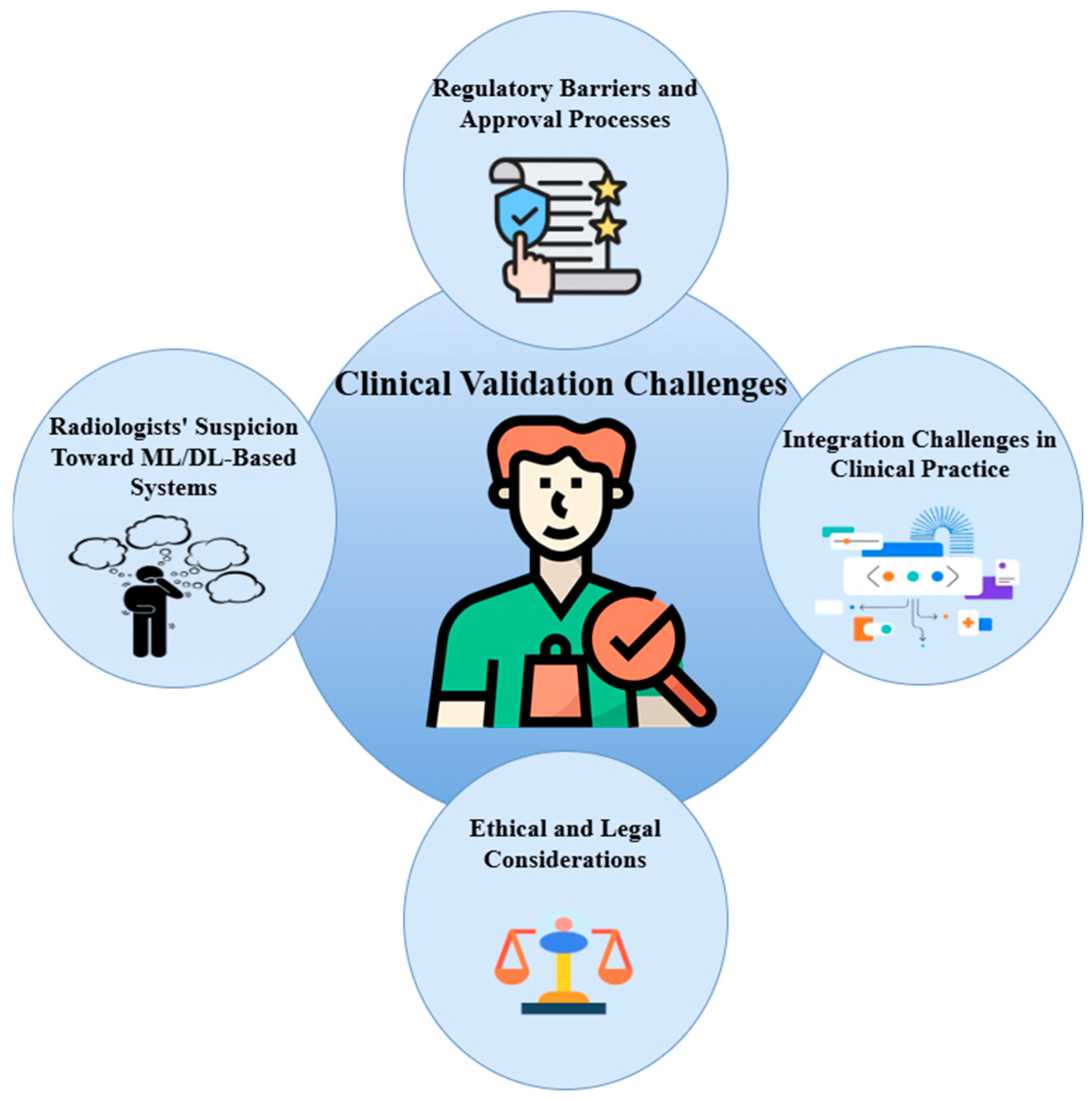
3. Clinical Validation Challenges
3.1. Regulatory Barriers and Approval Processes
- Clinical Trial Rules: ML/DL models must prove safety, efficacy, and generalizability through comprehensive clinical trials, which can be time-consuming and expensive [70].
- Dataset Standardization and Bias Limiting: Regulators request that ML/DL algorithms be trained on varied datasets to escape bias that could affect different patient populations [96].
- Explainability: Many ML/DL models lack interpretability, making regulatory approval more complex as authorities require clarity on decision-making processes [88].
3.2. Radiologists’ Suspicion Toward ML/DL-Based Systems
- Black Box Problem: ML/DL algorithms tend to work as “black boxes”, i.e., their decisions are not interpretable. This lack of interpretability makes it difficult for radiologists to trust ML/DL recommendations without knowing the reasons behind them. The work in [104] discusses the need to open the black box of ML in radiology, suggesting that the neighborhood of annotated cases may be one solution.
- Fear of Diagnostic Errors: While ML/DL models achieve high performance in controlled research, real clinical environments offer variability that can lead to misdiagnosis, with legal and ethical responsibility issues. The study in [105] highlighted the requirements to balance “black box” systems and explainable ML/DL in radiology to dispel such fears.
3.3. Integration Challenges in Clinical Practice
- ML/DL systems must smoothly integrate with current hospital systems; compatibility is considered a significant challenge [106].
- Implementing ML/DL diagnostic tools demands significant investments in infrastructure and staff training, which can be an obstacle for many healthcare facilities.
3.4. Ethical and Legal Considerations
- Protecting compliance with patient data privacy is critical to safeguarding patient confidentiality [109].
- Liability in a diagnostic mistake, whether it falls on the ML developers or healthcare providers, is essential in balancing the black box model vs. explainable model to deal with such ethical and legal concerns [110].
- Patients must be informed about the ML/DL-assisted diagnosis to ensure transparency and ethical standards in patient care [111].
3.5. Case Studies of Success and Failure
4. Ethical and Societal Implications
4.1. Algorithmic Bias and Health Disparities
- Training on demographically diverse, multi-institutional datasets to preserve population representativeness.
- Evaluating fairness and standard performance metrics to monitor sensitivity, specificity, or AUC variation across subgroups.
- Add interpretable model design (e.g., attention maps, SHAP) so clinicians can inspect model behavior and detect bias.
- Utilizing external validation pipelines, models trained on one dataset are tested on independent, demographically disparate cohorts.
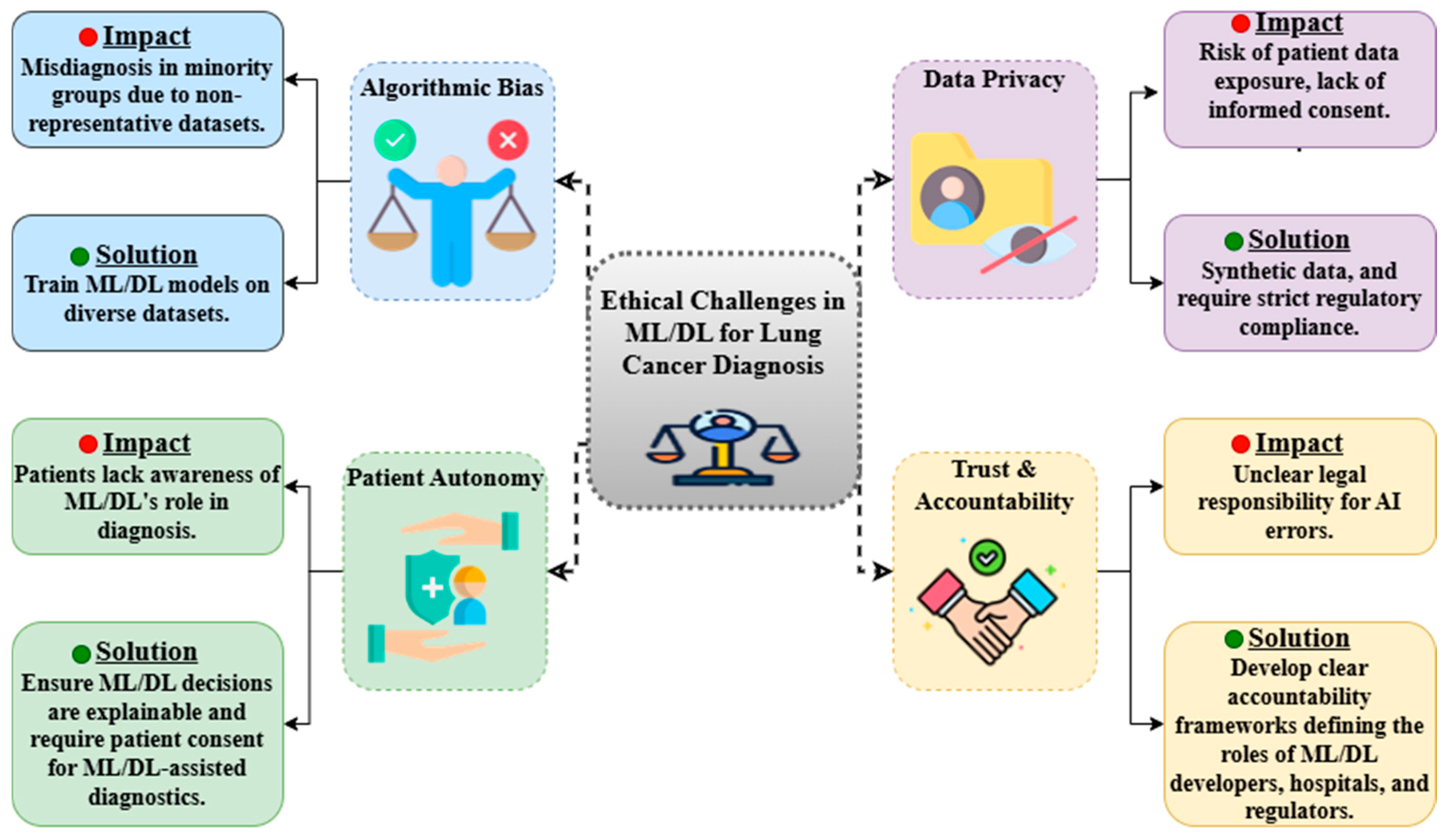
4.2. Impact of ML/DL on Ethical and Societal Dimensions
- Data privacy and ethical use of patient information. ML and DL models require large datasets for training and validation, which often include sensitive clinical data. Several studies [54,59,60,89] used publicly available CT and histopathological datasets such as LUNA16, LIDC-IDRI, and LC25000. Although these datasets were anonymized before release, they originally came from hospital environments, which raises questions about whether patients were fully informed and if their data can continue to be used for secondary research. Studies [117,118] emphasize the importance of Institutional Review Board (IRB) approval and recommend privacy-preserving methods such as federated learning. This technique allows training models across multiple sites without sharing raw data, helping balance data utility with confidentiality.
- Respecting patient autonomy and informed consent. Most ML/DL systems reviewed operate as black-box models with little opportunity for patient involvement, which may limit autonomy. For instance, in [47,97], models were trained using private clinical data without clarification on whether patients were notified about the use of their information in downstream AI applications. Another study [119] reports that many patients do not realize ML/DL systems are involved in their care, raising concerns about transparency. Future solutions should clearly inform patients, give them the option to decline or question AI-based decisions, and promote shared decision-making.
- Human oversight and model explainability in clinical decision-making. Although models such as [59,60,89] achieved very high accuracy (up to 99.94%), their use in clinical diagnosis requires more than just performance. In high-risk settings, clinicians must understand how the model reaches its conclusions. Studies [70,93,94] on integrated methods such as Grad-CAM, SHAP, attention-weight analysis, and attention-based visualization help radiologists interpret results, which is essential for building trust and ensuring patient safety. As highlighted in [120], model transparency should be considered not only a technical requirement but also an ethical one. Even so, current explainability methods—whether based on images or model features—are still limited and cannot explain true cause and effect relationships. For this reason, explainability in clinical ML/DL should be seen as a way to support clinician understanding and trust, rather than a replacement for clinical judgment or medical reasoning.
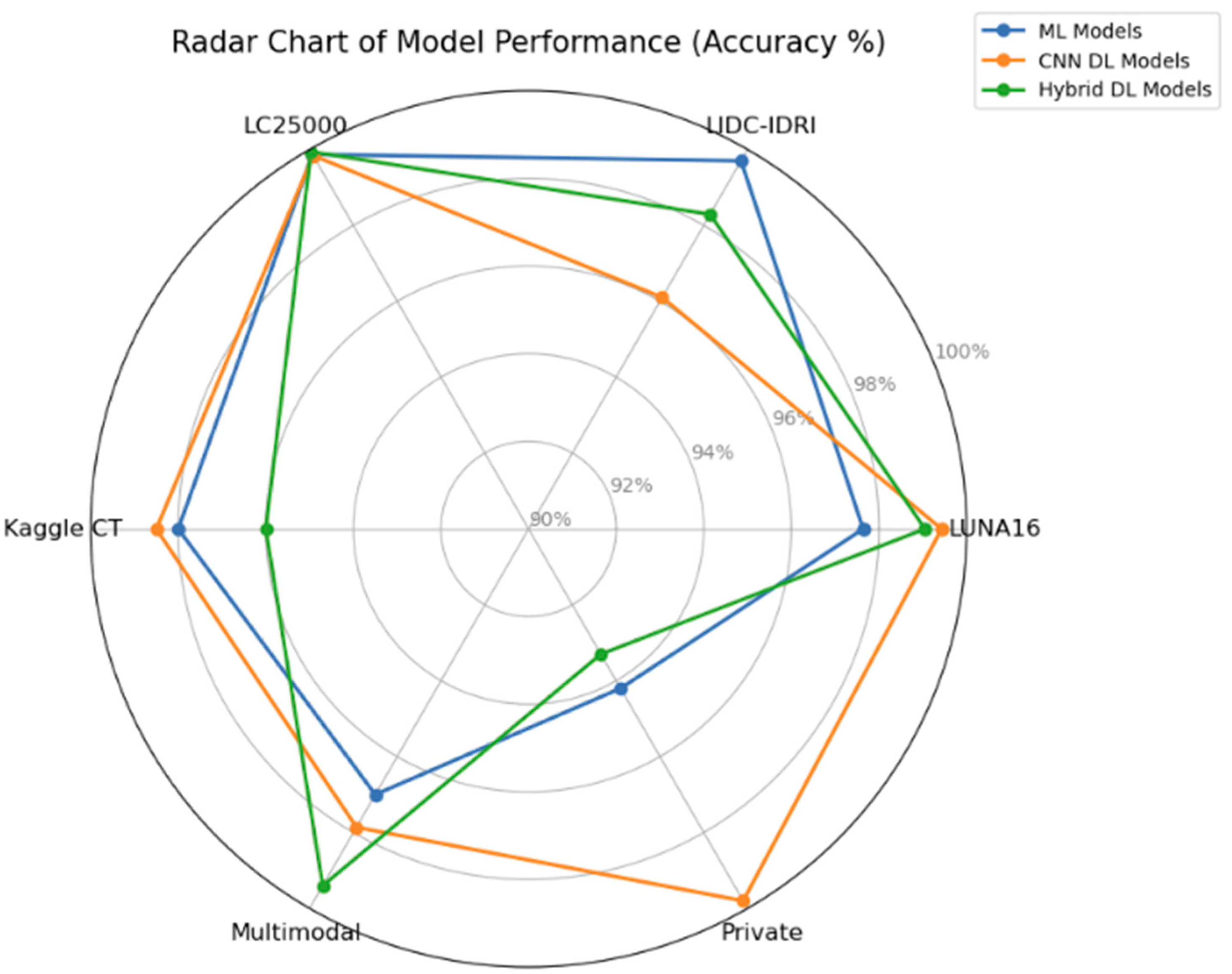
- Algorithmic bias and health equity. As discussed in Section 4.1, several studies ([34,35,37,47,97,98]) that relied on private datasets with limited demographic diversity reported lower AUC scores (74–93%), raising concerns about model fairness and generalizability. In addition, Refs. [114,115,116] found evidence of racial and demographic bias in cancer prediction models, showing how ML/DL systems can unintentionally disadvantage underrepresented groups. These findings highlight the need to ensure diverse training data and routinely evaluate model outcomes across different population groups, particularly in multiethnic clinical environments.
- Accountability and responsibility in ML/DL-based diagnosis. Implementing ML/DL systems in multimodal or real-time diagnostic workflows (e.g., [92,95,96]) introduces legal and ethical challenges, especially regarding liability in cases of misdiagnosis. When models are trained on complex multimodal datasets, the responsibility between developers, clinicians, and healthcare institutions becomes unclear [121]. This issue is further complicated by the use of black-box architectures (such as the 3D CNN in [97] or hybrid DL models in [98]), reinforcing the need for traceability and reliable post hoc error analysis.
- Societal trust and public acceptance. Long-term adoption of ML/DL tools in healthcare relies heavily on building societal and clinical trust. Models developed with transparent architectures and explainability features, such as in [93,94], are more likely to gain clinician support. In contrast, highly accurate yet non-transparent systems like those in [89] or [91], may face resistance if users do not understand their decision-making process. As argued in [122], earning trust requires not just high accuracy, but also fairness, accountability, and transparency.
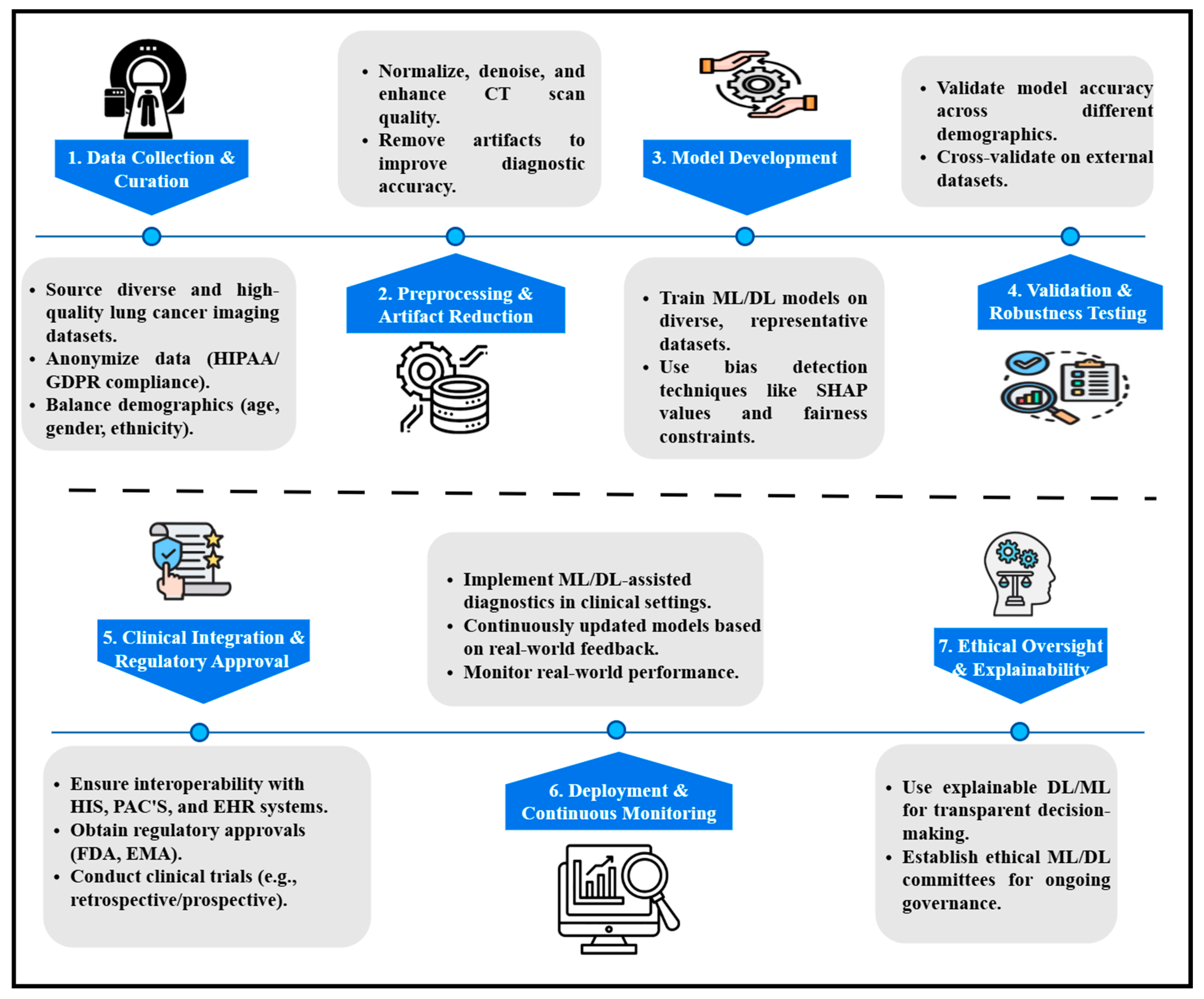
5. Critical Analysis and Recommendations
6. Conclusions
Answers to Research Questions
- RQ1: What technical, clinical, and societal boundaries prevent “practical and systemic barriers that limit widespread clinical adoption” of high-performing ML/DL models from deploying in LC screening workflows?
- RQ2: How might new models, such as human-in-the-loop systems, lightweight architectures, and synthetic data, handle these challenges?
- RQ3: What evaluation structures are required to ensure ML/DL tools are equitable, repeatable, and clinically impactful?
- RQ4: How does the heavy reliance on public datasets (e.g., LIDC-IDRI, LUNA16) in LC ML and DL research contribute to dataset imbalance, and what obstacles does this create for model generalizability and clinical applicability in real-world scenarios?
- RQ5: Which public datasets have been most frequently used in previous studies for LC detection and classification using ML and DL techniques?
Supplementary Materials
Author Contributions
Funding
Institutional Review Board Statement
Informed Consent Statement
Data Availability Statement
Conflicts of Interest
References
- Sung, H.; Ferlay, J.; Siegel, R.L.; Laversanne, M.; Soerjomataram, I.; Jemal, A.; Bray, F. Global cancer statistics 2020: GLOBOCAN estimates of incidence and mortality worldwide for 36 cancers in 185 countries. CA Cancer J. Clin. 2021, 71, 209–249. [Google Scholar] [CrossRef]
- Mapanga, W.; Norris, S.A.; Chen, W.C.; Blanchard, C.; Graham, A.; Baldwin-Ragaven, L.; Boyles, T.; Donde, B.; Greef, L.; Huddle, K.; et al. Consensus study on the health system and patient-related barriers for lung cancer management in South Africa. PLoS ONE 2021, 16, e0246716. [Google Scholar] [CrossRef]
- Collins, L.G.; Haines, C.; Perkel, R.; Enck, R.E. Lung cancer: Diagnosis and management. Am. Fam. Physician 2007, 75, 56–63. [Google Scholar]
- Kumar, V.; Prabha, C.; Sharma, P.; Mittal, N.; Askar, S.S.; Abouhawwash, M. Unified deep learning models for enhanced lung cancer prediction with ResNet-50–101 and EfficientNet-B3 using DICOM images. BMC Med. Imaging 2024, 24, 63. [Google Scholar] [CrossRef]
- Yadlapalli, S.; Bhavana, P.; Gunnam, K. Intelligent classification of lung malignancies using deep learning techniques. Int. J. Intell. Comput. Cybern. 2021, 14, 1147–1162. [Google Scholar] [CrossRef]
- Page, M.J.; McKenzie, J.E.; Bossuyt, P.M.; Boutron, I.; Hoffmann, T.C.; Mulrow, C.D.; Shamseer, L.; Tetzlaff, J.M.; Akl, E.A.; Brennan, S.E.; et al. The PRISMA 2020 statement: An updated guideline for reporting systematic reviews. Int. J. Surg. 2021, 88, 105906. [Google Scholar] [CrossRef] [PubMed]
- Barghouthi, E.D.; Owda, A.Y.; Asia, M.; Owda, M. Systematic Review for Risks of Pressure Injury and Prediction Models Using Machine Learning Algorithms. Diagnostics 2023, 13, 2739. [Google Scholar] [CrossRef] [PubMed]
- García-Méndez, S.; de Arriba-Pérez, F.; del Carmen, M. A Review on the Use of Large Language Models as Virtual Tutors. Sci. Educ. 2025, 34, 877–892. [Google Scholar] [CrossRef]
- Clark, K.; Vendt, B.; Smith, K.; Freymann, J.; Kirby, J.; Koppel, P.; Moore, S.; Phillips, S.; Maffitt, D.; Pringle, M.; et al. The Cancer Imaging Archive (TCIA): Maintaining and Operating a Public Information Repository. J. Digit. Imaging 2013, 26, 1045–1057. [Google Scholar] [CrossRef]
- Armato, S.G., III; McLennan, G.; Bidaut, L.; McNitt-Gray, M.F.; Meyer, C.R.; Reeves, A.P.; Zhao, B.; Aberle, D.R.; Henschke, C.I.; Hoffman, E.A.; et al. LIDC-IDRI (Lung Image Database Consortium and Image Database Resource Initiative) [Data set]. The Cancer Imaging Archive (TCIA), 2015. Available online: https://www.cancerimagingarchive.net/collection/lidc-idri/ (accessed on 1 January 2026). [CrossRef]
- National Cancer Institute. National Lung Screening Trial (NLST)—Cancer Data Access System (CDAS); National Cancer Institute: Bethesda, MD, USA, 2024. Available online: https://cdas.cancer.gov/nlst/ (accessed on 1 January 2026).
- LUNA16: Lung Nodule Analysis 2016. Available online: https://www.kaggle.com/datasets/fanbyprinciple/luna-lung-cancer-dataset (accessed on 1 January 2026).
- Benhammou, Y.; Acharya, U.; Mittal, M.; Javed, S.; Hage-Ali, A. LC25000: Lung and Colon Cancer Histopathological Image Dataset. 2020. Available online: https://academictorrents.com/details/7a638ed187a6180fd6e464b3666a6ea0499af4af (accessed on 1 January 2026).
- Aerts, H.J.W.L.; Velazquez, E.R.; Leijenaar, R.T.H.; Parmar, C.; Grossmann, P.; Carvalho, S.; Bussink, J.; Monshouwer, R.; Haibe-Kains, B.; Rietveld, D.; et al. Decoding tumour phenotype by noninvasive imaging using a quantitative radiomics approach. Nat. Commun. 2014, 5, 4006. [Google Scholar] [CrossRef]
- Zhao, B.; Tan, Y.; Tsai, W.-Y.; Schwartz, L.H.; Lu, L. Lung image database consortium (LIDC) and image database resource initiative (IDRI): A completed reference database of lung nodules on CT scans. Med. Phys. 2009, 36, 4400. [Google Scholar]
- Gevaert, O.; Xu, J.; Hoang, C.D.; Leung, A.N.; Xu, Y.; Quon, A.; Rubin, D.L.; Napel, S.; Plevritis, S.K. Non–small cell lung cancer: Identifying prognostic imaging biomarkers by leveraging public gene expression microarray data—Methods and preliminary results. Radiology 2012, 264, 387–396. [Google Scholar] [CrossRef]
- Park, B.W.; Kim, J.K.; Heo, C.; Park, K.J. Reliability of CT radiomic features reflecting tumour heterogeneity according to image quality and image processing parameters. Sci. Rep. 2020, 10, 3852. [Google Scholar] [CrossRef]
- Van Timmeren, J.E.; Cester, D.; Tanadini-Lang, S.; Alkadhi, H.; Baessler, B. Radiomics in medical imaging—‘how-to’ guide and critical reflection. Insights Imaging 2020, 11, 91. [Google Scholar] [CrossRef] [PubMed]
- Duke Lung Cancer Screening Dataset 2024 (DLCS). 2024. Available online: https://doi.org/10.5281/zenodo.13799069 (accessed on 1 January 2026).
- IQ-OTH/NCCD: Lung Cancer Dataset. Available online: https://www.kaggle.com/datasets/hamdallak/the-iqothnccd-lung-cancer-dataset (accessed on 26 July 2025).
- Chest CT-Scan Images Dataset. Available online: https://www.kaggle.com/datasets/mohamedhanyyy/chest-ctscan-images (accessed on 26 July 2025).
- Lung-PET-CT-Dx: PET/CT Lung Cancer Diagnosis Dataset. Available online: https://www.cancerimagingarchive.net/collection/lung-pet-ct-dx/ (accessed on 1 January 2026).
- Alliance, L.C. Early Lung Cancer Detection—The Lifesaving Scan Many Smokers Skip. 2023. Available online: https://wgntv.com/news/medical-watch/early-lung-cancer-detection-the-lifesaving-scan-many-smokers-skip/ (accessed on 1 January 2026).
- Armato, S.G., III; Hadjiiski, L.; Tourassi, G.D.; Drukker, K.; Giger, M.L.; Li, F.; Redmond, G.; Farahani, K.; Kirby, J.S.; Clarke, L.P. SPIE-AAPM-NCI Lung Nodule Classification Challenge Dataset. 2015. Available online: https://doi.org/10.7937/K9/TCIA.2015.A6V7JIWX (accessed on 1 January 2026).
- Chest X-Ray Images (Normal and Pneumonia). 2019. Available online: https://cir.nii.ac.jp/crid/1881428067966525440 (accessed on 1 January 2026).
- Lung Tumor Segmentation Dataset (CT Scan). Available online: https://www.kaggle.com/datasets/rasoulisaeid/lung-cancer-segment/data (accessed on 26 July 2025).
- Lung Nodule Segmentation Study Dataset. 2024. Available online: https://universe.roboflow.com/varun-18tlk/lung-nodule-segmentation-study/dataset/3 (accessed on 1 January 2026).
- Parmar, C.; Grossmann, P.; Bussink, J.; Lambin, P.; Aerts, H.J.W.L. Machine learning methods for quantitative radiomic biomarkers. Sci. Rep. 2015, 5, 13087. [Google Scholar] [CrossRef]
- Aerts, H.J.W.L.; Leijenaar, R.; Hoebers, F.; Dekker, A.; Lambin, P. NSCLC-Radiomics-Genomics; The Cancer Imaging Archive: Little Rock, AR, USA, 2014. [Google Scholar]
- Clark, K.; Vendt, B.; Smith, K.; Freymann, J.; Kirby, J.; Koppel, P.; Moore, S.; Phillips, S.; Maffitt, D.; Pringle, M.; et al. The Cancer Imaging Archive (TCIA): NSCLC-Radiogenomics Collection. 2013. Available online: https://www.cancerimagingarchive.net/collection/nsclc-radiogenomics/ (accessed on 1 January 2026).
- Chaudhry, H.A.H.; Renzulli, R.; Perlo, D.; Santinelli, F.; Tibaldi, S.; Cristiano, C.; Grosso, M.; Limerutti, G.; Fiandrotti, A.; Grangetto, M.; et al. Unitochest: A lung image dataset for segmentation of cancerous nodules on ct scans. In Proceedings of the International Conference on Image Analysis and Processing, Lecce, Italy, 23–27 May 2022; pp. 185–196. [Google Scholar]
- SIMBA Lung Nodule Database. Available online: http://www.via.cornell.edu/lungdb.html (accessed on 1 January 2026).
- Marchetti, M.; Barbu, A.; Kalra, M.K.; Dreyer, K.J.; Rubin, D.L. Multi-stage intermediate fusion for multimodal learning to classify lung cancer histology from CT and PET scans. arXiv 2020, arXiv:2012.00318. [Google Scholar]
- Mohamed, T.I.A.; Oyelade, O.N.; Ezugwu, A.E. Automatic detection and classification of lung cancer CT scans based on deep learning and ebola optimization search algorithm. PLoS ONE 2023, 18, e0285796. [Google Scholar] [CrossRef] [PubMed]
- Huang, J.; He, W.; Xu, H.; Yang, S.; Dai, J.; Guo, W.; Zeng, M. Evaluating histological subtypes classification of primary lung cancers on unenhanced computed tomography based on random Forest model. J. Healthc. Eng. 2023, 2023, 8964676. [Google Scholar] [CrossRef]
- Memorial Sloan Kettering Cancer Center (MSKCC). “Lung Adenocarcinoma (MSKCC, 2020): Targeted Sequencing of 604 Lung Adenocarcinoma Tumor/Normal Pairs via MSK-IMPACT [Data set],” 2020. Available online: https://www.cbioportal.org/study/summary?id=luad_mskcc_2020 (accessed on 1 January 2026).
- Shayesteh, S.P.; Shiri, I.; Karami, A.H.; Hashemian, R.; Kooranifar, S.; Ghaznavi, H.; Shakeri-Zadeh, A. Predicting lung cancer patients’ survival time via logistic regression-based models in a quantitative radiomic framework. J. Biomed. Phys. Eng. 2020, 10, 479. [Google Scholar] [CrossRef]
- Nissar, A.; Mir, A.H. Predictive Radiomics Based Ensemble Machine Learning Approach in CT Lung Nodule Diagnosis. J. Egypt. Natl. Cancer Inst. 2025, 37, 68. [Google Scholar] [CrossRef]
- Shafi, I.; Din, S.; Khan, A.; Díez, I.D.L.T.; Casanova, R.d.J.P.; Pifarre, K.T.; Ashraf, I. An Effective Method for Lung Cancer Diagnosis from CT Scan Using Deep Learning-Based Support Vector Network. Cancers 2022, 14, 5457. [Google Scholar] [CrossRef] [PubMed]
- Naseer, I.; Masood, T.; Akram, S.; Jaffar, A.; Rashid, M.; Iqbal, M.A. Lung Cancer Detection Using Modified AlexNet Architecture and Support Vector Machine. Comput. Mater. Contin. 2023, 74, 2039–2054. [Google Scholar] [CrossRef]
- Katar, O.; Yildirim, O.; Tan, R.-S.; Acharya, U.R. A Novel Hybrid Model for Automatic Non-Small Cell Lung Cancer Classification Using Histopathological Images. Diagnostics 2024, 14, 2497. [Google Scholar] [CrossRef]
- Ramkumar, K.; Natarajan, M. Performance Analysis For Detection And Classification Of Lung Cancer Using Machine Learning Approaches. Educ. Adm. Theory Pract. 2024, 30, 2174–2181. [Google Scholar]
- Gharaibeh, N.Y.; De Fazio, R.; Al-Naami, B.; Al-Hinnawi, A.-R.; Visconti, P. Automated Lung Cancer Diagnosis Applying Butterworth Filtering, Bi-Level Feature Extraction, and Sparce Convolutional Neural Network to Luna 16 CT Images. J. Imaging 2024, 10, 168. [Google Scholar] [CrossRef]
- Dunn, B.; Pierobon, M.; Wei, Q. Automated classification of lung cancer subtypes using deep learning and CT-scan based radiomic analysis. Bioengineering 2023, 10, 690. [Google Scholar] [CrossRef]
- Bouamrane, A.; Derdour, M. Enhancing Lung Cancer Detection and Classification Using Machine Learning and Deep Learning Techniques: A Comparative Study. In Proceedings of the 2023 International Conference on Networking and Advanced Systems (ICNAS), Algiers, Algeria, 21–23 October 2023; pp. 1–6. [Google Scholar] [CrossRef]
- Sun, H.; Zhang, C.; Ouyang, A.; Dai, Z.; Song, P.; Yao, J. Multi-classification model incorporating radiomics and clinic-radiological features for predicting invasiveness and differentiation of pulmonary adenocarcinoma nodules. Biomed. Eng. Online 2023, 22, 112. [Google Scholar] [CrossRef]
- Zhao, F.-H.; Fan, H.-J.; Shan, K.-F.; Zhou, L.; Pang, Z.-Z.; Fu, C.-L.; Yang, Z.-B.; Wu, M.-K.; Sun, J.-H.; Yang, X.-M.; et al. Predictive efficacy of a radiomics random forest model for identifying pathological subtypes of lung adenocarcinoma presenting as ground-glass nodules. Front. Oncol. 2022, 12, 872503. [Google Scholar] [CrossRef]
- Mishra, A.; Gangwar, S. Lung cancer detection and classification using machine learning algorithms. Int. J. Recent. Innov. Trends Comput. Commun 2023, 11, 277–282. [Google Scholar] [CrossRef]
- LeCun, Y.; Bengio, Y.; Hinton, G. Deep learning. Nature 2015, 521, 436–444. [Google Scholar] [CrossRef]
- Krizhevsky, A.; Sutskever, I.; Hinton, G.E. Imagenet classification with deep convolutional neural networks. In Proceedings of the Advances in Neural Information Processing Systems, Lake Tahoe, NV, USA, 3–6 December 2012; Volume 25. Available online: https://proceedings.neurips.cc/paper_files/paper/2012/file/c399862d3b9d6b76c8436e924a68c45b-Paper.pdf (accessed on 1 January 2026).
- Litjens, G.; Kooi, T.; Bejnordi, B.E.; Setio, A.A.A.; Ciompi, F.; Ghafoorian, M.; van der Laak, J.A.W.M.; van Ginneken, B.; Sánchez, C.I. A survey on deep learning in medical image analysis. Med. Image Anal. 2017, 42, 60–88. [Google Scholar] [CrossRef]
- Samek, W. Explainable artificial intelligence: Understanding, visualizing and interpreting deep learning models. arXiv 2017, arXiv:1708.08296. [Google Scholar] [CrossRef]
- Simonyan, K.; Zisserman, A. Very deep convolutional networks for large-scale image recognition. arXiv 2014, arXiv:1409.1556. [Google Scholar] [CrossRef]
- Wankhade, S.; Vigneshwari, S. A novel hybrid deep learning method for early detection of lung cancer using neural networks. Healthc. Anal. 2023, 3, 100195. [Google Scholar] [CrossRef]
- Reddy, N.S.; Khanaa, V. Intelligent deep learning algorithm for lung cancer detection and classification. Bull. Electr. Eng. Informatics 2023, 12, 1747–1754. [Google Scholar] [CrossRef]
- Shah, A.A.; Malik, H.A.M.; Muhammad, A.; Alourani, A.; Butt, Z.A. Deep learning ensemble 2D CNN approach towards the detection of lung cancer. Sci. Rep. 2023, 13, 2987. [Google Scholar] [CrossRef]
- Bhatia, I.; Aarti; Ansarullah, S.I.; Amin, F.; Alabrah, A. Lightweight Advanced Deep Neural Network (DNN) Model for Early-Stage Lung Cancer Detection. Diagnostics 2024, 14, 2356. [Google Scholar] [CrossRef]
- Lee, J.-D.; Hsu, Y.-T.; Chien, J.-C. Study of a Deep Convolution Network with Enhanced Region Proposal Network in the Detection of Cancerous Lung Tumors. Bioengineering 2024, 11, 511. [Google Scholar] [CrossRef]
- Srivastava, D.; Srivastava, S.K.; Khan, S.B.; Singh, H.R.; Maakar, S.K.; Agarwal, A.K.; Malibari, A.A.; Albalawi, E. Early Detection of Lung Nodules Using a Revolutionized Deep Learning Model. Diagnostics 2023, 13, 3485. [Google Scholar] [CrossRef]
- Mohandass, G.; Krishnan, G.H.; Selvaraj, D.; Sridhathan, C. Lung Cancer Classification using Optimized Attention-based Convolutional Neural Network with DenseNet-201 Transfer Learning Model on CT image. Biomed. Signal Process. Control 2024, 95, 106330. [Google Scholar] [CrossRef]
- Sivasankaran, P.; Dhanaraj, K.R. Lung Cancer Detection Using Image Processing Technique Through Deep Learning Algorithm. Rev. d’Intelligence Artif. 2024, 38, 297–302. [Google Scholar] [CrossRef]
- Hua, K.-L.; Hsu, C.-H.; Hidayati, S.C.; Cheng, W.-H.; Chen, Y.-J. Computer-aided classification of lung nodules on computed tomography images via deep learning technique. Onco Targets Ther. 2015, 8, 2015–2022. [Google Scholar] [CrossRef] [PubMed]
- Shetty, M.V.; Jayadevappa, D.; Tunga, S. Optimized Deformable Model-based Segmentation and Deep Learning for Lung Cancer Classification. J. Med. Investig. 2022, 69, 244–255. [Google Scholar] [CrossRef]
- Dong, Y.; Li, X.; Yang, Y.; Wang, M.; Gao, B. A Synthesizing Semantic Characteristics Lung Nodules Classification Method Based on 3D Convolutional Neural Network. Bioengineering 2023, 10, 1245. [Google Scholar] [CrossRef] [PubMed]
- Wu, K.; Peng, B.; Zhai, D. Multi-Granularity Dilated Transformer for Lung Nodule Classification via Local Focus Scheme. Appl. Sci. 2023, 13, 377. [Google Scholar] [CrossRef]
- Wang, Y.; Zhou, C.; Ying, L.; Chan, H.-P.; Lee, E.; Chughtai, A.; Hadjiiski, L.M.; Kazerooni, E.A. Enhancing Early Lung Cancer Diagnosis: Predicting Lung Nodule Progression in Follow-Up Low-Dose CT Scan with Deep Generative Model. Cancers 2024, 16, 2229. [Google Scholar] [CrossRef]
- Khademi, S.; Heidarian, S.; Afshar, P.; Naderkhani, F.; Oikonomou, A.; Plataniotis, K.N.; Mohammadi, A. Spatio-Temporal Hybrid Fusion of CAE and SWin Transformers for Lung Cancer Malignancy Prediction. In Proceedings of the ICASSP 2023–2023 IEEE International Conference on Acoustics, Speech and Signal Processing (ICASSP), Rhodes Island, Greece, 4–10 June 2023; pp. 1–5. [Google Scholar] [CrossRef]
- Katase, S.; Ichinose, A.; Hayashi, M.; Watanabe, M.; Chin, K.; Takeshita, Y.; Shiga, H.; Tateishi, H.; Onozawa, S.; Shirakawa, Y.; et al. Development and performance evaluation of a deep learning lung nodule detection system. BMC Med. Imaging 2022, 22, 203. [Google Scholar] [CrossRef]
- Tang, T.; Zhang, R. A Multi-Task Model for Pulmonary Nodule Segmentation and Classification. J. Imaging 2024, 10, 234. [Google Scholar] [CrossRef]
- Bilal, A.; Shafiq, M.; Fang, F.; Waqar, M.; Ullah, I.; Ghadi, Y.Y.; Long, H.; Zeng, R. IGWO-IVNet3: DL-Based Automatic Diagnosis of Lung Nodules Using an Improved Gray Wolf Optimization and InceptionNet-V3. Sensors 2022, 22, 9603. [Google Scholar] [CrossRef]
- Swaroop, S.; Sharma, S.; Janarthanan, S. Lung Cancer Classification and Through Deep Learning Model and Localization of Tumor. In Proceedings of the 2023 9th International Conference on Advanced Computing and Communication Systems (ICACCS), Coimbatore, India, 17–18 March 2023; pp. 1530–1534. [Google Scholar] [CrossRef]
- Oumlaz, M.; Oumlaz, Y.; Oukaira, A.; Benelhaouare, A.Z.; Lakhssassi, A. Advancing Pulmonary Nodule Detection with ARSGNet: EfficientNet and Transformer Synergy. Electronics 2024, 13, 4369. [Google Scholar] [CrossRef]
- Mathai, T.S.; Hou, B.; Summers, R.M. Longitudinal assessment of lung lesion burden in CT. In Proceedings of the Medical Imaging 2025: Computer-Aided Diagnosis, London, UK, 19–21 November 2025; pp. 669–678. [Google Scholar] [CrossRef]
- Kalkan, M.; Guzel, M.S.; Ekinci, F.; Sezer, E.A.; Asuroglu, T. Comparative Analysis of Deep Learning Methods on CT Images for Lung Cancer Specification. Cancers 2024, 16, 3321. [Google Scholar] [CrossRef]
- Saha, A.; Ganie, S.M.; Pramanik, P.K.D.; Yadav, R.K.; Mallik, S.; Zhao, Z. VER-Net: A hybrid transfer learning model for lung cancer detection using CT scan images. BMC Med. Imaging 2024, 24, 120. [Google Scholar] [CrossRef]
- Atiya, S.U.; Ramesh, N.V.K.; Reddy, B.N.K. Classification of non-small cell lung cancers using deep convolutional neural networks. Multimed. Tools Appl. 2024, 83, 13261–13290. [Google Scholar] [CrossRef]
- Nafea, A.A.; Ibrahim, M.S.; Shwaysh, M.M.; Abdul-Kadhim, K.; Almamoori, H.R.; AL-Ani, M.M. A Deep Learning Algorithm for Lung Cancer Detection Using EfficientNet-B3. Wasit J. Comput. Math. Sci. 2023, 2, 68–76. [Google Scholar] [CrossRef]
- Abumohsen, M.; Costa-Montenegro, E.; García-Méndez, S.; Owda, A.Y.; Owda, M. Advanced Deep Learning Techniques for Accurate Lung Cancer Detection and Classification. In Proceedings of the 2025 12th International Conference on Information Technology (ICIT), Amman, Jordan, 27–30 May 2025; pp. 7–12. [Google Scholar] [CrossRef]
- Santone, A.; Mercaldo, F.; Brunese, L. A Method for Real-Time Lung Nodule Instance Segmentation Using Deep Learning. Life 2024, 14, 1192. [Google Scholar] [CrossRef]
- Abunajm, S.; Elsayed, N.; ElSayed, Z.; Ozer, M. Deep learning approach for early stage lung cancer detection. arXiv 2023, arXiv:2302.02456. [Google Scholar] [CrossRef]
- Swain, A.K.; Swetapadma, A.; Rout, J.K.; Balabantaray, B.K. Classification of non-small cell lung cancer types using sparse deep neural network features. Biomed. Signal Process. Control 2024, 87, 105485. [Google Scholar] [CrossRef]
- Chen, H.; Zhang, X. HLFSRNN-MIL: A Hybrid Multi-Instance Learning Model for 3D CT Image Classification. Appl. Sci. 2024, 14, 6186. [Google Scholar] [CrossRef]
- Alazwari, S.; Alsamri, J.; Asiri, M.M.; Maashi, M.; Asklany, S.A.; Mahmud, A. Computer-aided diagnosis for lung cancer using waterwheel plant algorithm with deep learning. Sci. Rep. 2024, 14, 20647. [Google Scholar] [CrossRef]
- Karthikeyan, B.; Seethalakshmi, N.; Nandhini, V.; Vinoth, D.; Muthusamy, P.; Bellam, K. Multimodal Feature Fusion Using Optimal Transfer Learning Approach for Lung Cancer Detection and Classification on CT Images. Full Length Artic. 2024, 12, 84. [Google Scholar] [CrossRef]
- Ochoa-Ornelas, R.; Gudiño-Ochoa, A.; García-Rodríguez, J.A. A Hybrid Deep Learning and Machine Learning Approach with Mobile-EfficientNet and Grey Wolf Optimizer for Lung and Colon Cancer Histopathology Classification. Cancers 2024, 16, 3791. [Google Scholar] [CrossRef] [PubMed]
- Ahmed, A.A.; Fawi, M.; Brychcy, A.; Abouzid, M.; Witt, M.; Kaczmarek, E. Development and Validation of a Deep Learning Model for Histopathological Slide Analysis in Lung Cancer Diagnosis. Cancers 2024, 16, 1506. [Google Scholar] [CrossRef] [PubMed]
- Hasan, M.A.; Haque, F.; Sabuj, S.R.; Sarker, H.; Goni, O.F.; Rahman, F.; Rashid, M. An End-to-End Lightweight Multi-Scale CNN for the Classification of Lung and Colon Cancer with XAI Integration. Technologies 2024, 12, 56. [Google Scholar] [CrossRef]
- Mercaldo, F.; Tibaldi, M.G.; Lombardi, L.; Brunese, L.; Santone, A.; Cesarelli, M. An Explainable Method for Lung Cancer Detection and Localisation from Tissue Images through Convolutional Neural Networks. Electronics 2024, 13, 1393. [Google Scholar] [CrossRef]
- El-Aziz, A.A.A.; Mahmood, M.A.; El-Ghany, S.A. Advanced Deep Learning Fusion Model for Early Multi-Classification of Lung and Colon Cancer Using Histopathological Images. Diagnostics 2024, 14, 2274. [Google Scholar] [CrossRef]
- Liu, Y.; Wang, H.; Song, K.; Sun, M.; Shao, Y.; Xue, S.; Li, L.; Li, Y.; Cai, H.; Jiao, Y.; et al. CroReLU: Cross-Crossing Space-Based Visual Activation Function for Lung Cancer Pathology Image Recognition. Cancers 2022, 14, 5181. [Google Scholar] [CrossRef]
- Mamatha, B.; Rashmi, D.; Tiwari, K.S.; Sikrant, P.A.; Jovith, A.A.; Reddy, P.C.S. Lung Cancer Prediction from CT Images and using Deep Learning Techniques. In Proceedings of the 2023 Second International Conference on Trends in Electrical, Electronics, and Computer Engineering (TEECCON), Bengaluru, India, 23–24 August 2023; pp. 263–267. [Google Scholar] [CrossRef]
- Sait, A.R.W. Lung Cancer Detection Model Using Deep Learning Technique. Appl. Sci. 2023, 13, 12510. [Google Scholar] [CrossRef]
- Uddin, J. Attention-Based DenseNet for Lung Cancer Classification Using CT Scan and Histopathological Images. Designs 2024, 8, 27. [Google Scholar] [CrossRef]
- Rajasekar, V.; Vaishnnave, M.P.; Premkumar, S.; Sarveshwaran, V.; Rangaraaj, V. Lung cancer disease prediction with CT scan and histopathological images feature analysis using deep learning techniques. Results Eng. 2023, 18, 101111. [Google Scholar] [CrossRef]
- Alsheikhy, A.A.; Said, Y.; Shawly, T.; Alzahrani, A.K.; Lahza, H. A CAD system for lung cancer detection using hybrid deep learning techniques. Diagnostics 2023, 13, 1174. [Google Scholar] [CrossRef] [PubMed]
- Martis, J.E.; Sannidhan, M.S.; Balasubramani, R.; Mutawa, A.M.; Murugappan, M. Novel Hybrid Quantum Architecture-Based Lung Cancer Detection Using Chest Radiograph and Computerized Tomography Images. Bioengineering 2024, 11, 799. [Google Scholar] [CrossRef]
- Zheng, S.; Guo, J.; Langendijk, J.A.; Both, S.; Veldhuis, R.N.; Oudkerk, M.; van Ooijen, P.M.; Wijsman, R.; Sijtsema, N.M. Survival prediction for stage I-IIIA non-small cell lung cancer using deep learning. Radiother. Oncol. 2023, 180, 109483. [Google Scholar] [CrossRef]
- Subash, J.; Kalaivani, S. Dual-stage classification for lung cancer detection and staging using hybrid deep learning techniques. Neural Comput. Appl. 2024, 36, 8141–8161. [Google Scholar] [CrossRef]
- Devi, M.M.Y.; Jeyabharathi, J.; Kirubakaran, S.; Narayanan, S.; Srikanth, T.; Chakrabarti, P. Efficient segmentation and classification of the lung carcinoma via deep learning. Multimed. Tools Appl. 2024, 83, 41981–41995. [Google Scholar] [CrossRef]
- U.S. Food and Drug Administration. Proposed Regulatory Framework for Modifications to Artificial Intelligence/Machine Learning-Based Software as a Medical Device (SaMD); U.S. Food and Drug Administration: Silver Spring, MD, USA, 2019. Available online: https://www.fda.gov (accessed on 1 January 2026).
- European Medicines Agency. Artificial Intelligence in the Medicinal Product Lifecycle; European Medicines Agency: Amsterdam, The Netherlands, 2023. Available online: https://www.ema.europa.eu (accessed on 1 January 2026).
- World Health Organization. Ethics and Governance of Artificial Intelligence for Health; World Health Organization: Geneva, Switzerland, 2021; Available online: https://www.who.int (accessed on 1 January 2026).
- Liu, X.; Rivera, S.C.; Moher, D.; Calvert, M.J.; Denniston, A.K. CONSORT-AI Extension: Reporting Guidelines for Clinical Trials of Artificial Intelligence Interventions. Nat. Med. 2020, 26, 1364–1374. [Google Scholar] [CrossRef] [PubMed]
- Baselli, G.; Codari, M.; Sardanelli, F. Opening the black box of machine learning in radiology: Can the proximity of annotated cases be a way? Eur. Radiol. Exp. 2020, 4, 30. [Google Scholar] [CrossRef]
- De-Giorgio, F.; Benedetti, B.; Mancino, M.; Sala, E.; Pascali, V.L. The need for balancing ‘black box’ systems and explainable artificial intelligence: A necessary implementation in radiology. Eur. J. Radiol. 2025, 185, 20–45. [Google Scholar] [CrossRef]
- Nagendran, M.; Chen, Y.; A Lovejoy, C.; Gordon, A.C.; Komorowski, M.; Harvey, H.; Topol, E.J.; Ioannidis, J.P.A.; Collins, G.S.; Maruthappu, M. Artificial intelligence versus clinicians: Systematic review of design, reporting standards, and claims of deep learning studies. BMJ 2020, 368, m689. [Google Scholar] [CrossRef]
- Abumihsan, A.; Owda, M.; Owda, A.Y.; Gasir, F.; Abumohsen, M.; Stergioulas, L. A Novel Deep Learning Approach for Enhanced Ischemic Brain Stroke Detection from CT Images Using Deep Feature Extraction and Optimized Feature Selection. In Proceedings of the 2025 12th International Conference on Information Technology (ICIT), Amman, Jordan, 27–30 May 2025; pp. 1–6. [Google Scholar]
- Chronicle, S.F. AI was Meant to Cut Health Care Costs. It Turns Out to Need Expensive Human Support. 2024. Available online: https://www.sfchronicle.com/health/article/ai-health-care-needs-costly-human-oversight-20028092.php (accessed on 1 January 2026).
- Herington, J.; McCradden, M.D.; Creel, K.; Boellaard, R.; Jones, E.C.; Jha, A.K.; Rahmim, A.; Scott, P.J.; Sunderland, J.J.; Wahl, R.L.; et al. Ethical Considerations for Artificial Intelligence in Medical Imaging: Data Collection, Development, and Evaluation. J. Nucl. Med. 2023, 64, 1848–1854. [Google Scholar] [CrossRef] [PubMed]
- Hantel, A.; Walsh, T.P.; Marron, J.M.; Kehl, K.L.; Sharp, R.; Van Allen, E.; Abel, G.A. Perspectives of Oncologists on the Ethical Implications of Using Artificial Intelligence for Cancer Care. JAMA Netw. Open 2024, 7, e244077. [Google Scholar] [CrossRef]
- Wall Street Journal. Khosla Ventures Backs U.K. Startup’s Plan to Bring Cancer AI Tool to U.S.; Wall Street Journal: New York, NY, USA, 2024; Available online: https://www.wsj.com/articles/khosla-ventures-backs-u-k-startups-plan-to-bring-cancer-ai-tool-to-u-s-556455b5 (accessed on 1 January 2026).
- Times, F. Harvard’s ‘Chief’ AI Model Detects Multiple Cancer Types with High Accuracy; Financial Times: London, UK, 2024. Available online: https://www.ft.com/content/0a8f2c61-77f4-43ce-87d2-a7b421bbda85 (accessed on 1 January 2026).
- Trentz, C.; Engelbart, J.; Semprini, J.; Kahl, A.; Anyimadu, E.; Buatti, J.; Casavant, T.; Charlton, M.; Canahuate, G. Evaluating machine learning model bias and racial disparities in non-small cell lung cancer using SEER registry data. Health Care Manag. Sci. 2024, 27, 631–649. [Google Scholar] [CrossRef]
- Seyyed-Kalantari, L.; Zhang, H.; McDermott, M.B.A.; Chen, I.Y.; Ghassemi, M. Underdiagnosis bias of artificial intelligence algorithms applied to chest radiographs in under-served patient populations. Nat. Med. 2021, 27, 2176–2182. [Google Scholar] [CrossRef] [PubMed]
- Sourlos, N.; Wang, J.; Nagaraj, Y.; van Ooijen, P.; Vliegenthart, R. Possible Bias in Supervised Deep Learning Algorithms for CT Lung Nodule Detection and Classification. Cancers 2022, 14, 3867. [Google Scholar] [CrossRef] [PubMed]
- Chassagnon, G.; Vakalopoulou, M.; Paragios, N.; Revel, M.P. Artificial intelligence applications for COVID-19 pandemic management in imaging. Lancet Digit. Health 2021, 3, e235–e243. [Google Scholar]
- Kaissis, G.A.; Makowski, M.R.; Rückert, D.; Braren, R.F. Federated learning for privacy-preserving artificial intelligence in medicine. Nat. Mach. Intell. 2021, 3, 473–484. [Google Scholar] [CrossRef]
- Mittelstadt, B. Principles alone cannot guarantee ethical AI. Nat. Mach. Intell. 2022, 4, 104–110. [Google Scholar] [CrossRef]
- Holzinger, A.; Langs, G.; Denk, H.; Zatloukal, K.; Müller, H. Causability and explainability of artificial intelligence in medicine. Wiley Interdiscip. Rev. Data Min. Knowl. Discov. 2021, 11, e1405. [Google Scholar] [CrossRef]
- Beede, E.; Baylor, E.; Hersch, F.; Iurchenko, A.; Wilcox, L.; Ruamviboonsuk, P.; Vardoulakis, L.M. A human-centered evaluation of a deep learning system deployed in clinics for the detection of diabetic retinopathy. Proc. ACM Human-Computer Interact. 2020, 4, 1–12. [Google Scholar] [CrossRef]
- Banerjee, I.; Ding, Y.; Kim, J.; Shah, N.H. Fairness and algorithmic bias in machine learning for healthcare. J. Biomed. Inform. 2022, 128, 104036. [Google Scholar] [CrossRef]
- National Institute of Standards and Technology. Artificial Intelligence Risk Management Framework (AI RMF 1.0); National Institute of Standards and Technology: Gaithersburg, MD, USA, 2023. Available online: https://www.nist.gov (accessed on 1 January 2026).


| Dataset Name | Modality | Size (Patients) | Strengths | Limitations |
|---|---|---|---|---|
| Iraq-Oncology Teaching Hospital Dataset [34] | CT (normal, benign, and malignant) | 110 | Clinical data from real patients | Limited annotation detail, lacks multicenter diversity |
| Zhongshan Hospital [35] | CT—radiomic (ADC, SCC, SCLC) | 852 | Institutional clinical imaging data | Limited demographic and pathological variation |
| Structural and Functional Radiomics [17] | CT—radiomic | 83 | Focused histological subtype classification; | No raw images, limited generalizability |
| MSKCC Lung [36] | CT, Clinical | ~200 | Rich clinical-genomic data | Restricted access |
| Moffitt-Maastricht Lung Adenocarcinoma [37] | CT (contrast-enhanced; adenocarcinoma with survival labels) | 59 | Includes real patient survival data; pre-treatment radiomics; clinical features | Small cohort size, lacks diversity and public annotations |
| Study | Dataset | Task | Feature Extraction | Classifiers | Accuracy (%) | AUC (%) | Sensitivity (%) | Specificity (%) |
|---|---|---|---|---|---|---|---|---|
| [46] | Not mentioned | Binary | Radiomics + Clinical | SVM | - | 94.20 | - | - |
| [47] | Not mentioned | Binary | Radiomics | RF | - | 92.0 | - | - |
| [37] | Moffitt-Maastricht Lung Adenocarcinoma | Binary | Radiomics | LR | 64.40 | NR | 80.0 | – |
| [48] | Not mentioned | Binary | Clinical attributes | DT | 100.0 | - | - | 100.0 |
| [35] | Zhongshan Hospital | Multiclass | Radiomics | RF | - | 74.0, 77.0, 88.0 | - | - |
| Study | Model | Task | Accuracy (%) | AUC (%) | Sensitivity (%) | Specificity (%) |
|---|---|---|---|---|---|---|
| [54] | 3D-CNN + RNN | Binary | 95.00 | - | 87.00 | - |
| [55] | CNN + IDLA | Binary | 92.81 | - | 92.85 | - |
| [56] | Deep Ensemble 2D CNN | Binary | 95.00 | - | - | - |
| [57] | WSDI + SS-CL | Binary | - | - | - | - |
| [58] | Faster R-CNN + DCNN | Binary | 95.32 | - | - | - |
| [59] | HFR-CNN | Binary | 97.00 | - | - | - |
| [60] | AtCNN + DenseNet201 | Binary | 99.43 | - | - | - |
| Study | Model | Task Type | Accuracy (%) | AUC (%) | Sensitivity (%) | Specificity (%) |
|---|---|---|---|---|---|---|
| [97] | 3D CNN | Binary | - | 76 | - | - |
| [34] | EOSA with CNN | Binary | 93.21 | - | - | - |
| [98] | Hybrid Xception and custom CNN model (XC–CNN), ALNN | Binary | 93.3 | - | - | - |
| [99] | CNN | Multiclass | 99.8 | - | - | - |
| Aspect | Open (Public) Datasets | Private (Non-Open) Datasets |
|---|---|---|
| Dataset Type | Public/Open-source [54,59,60,68,85,89] | Institution-specific/Not publicly shared [34,35,37,47,97,98] |
| Common Datasets Used | LUNA16, LIDC-IDRI, LC25000, Kaggle CT [59,60,68,85,89] | Hospital CT archives, radiomics from local studies [34,35,37,47,97] |
| Availability | Freely accessible (public sources) | Restricted access or not shared [34,35,37,47] |
| Size | Large (e.g., >500 patients or >5000 images) [10,12,13] | Small to medium (e.g., <300 patients) [35,37,47] |
| Diversity | Low to moderate [54,59,60] | High (real-world variability) [34,35,97,98] |
| Image Format | Mostly DICOM or JPEG (LUNA16, LIDC: DICOM; LC25000: JPEG) | Mostly DICOM [34,35,97] |
| Annotation Quality | High (multi-reader, standardized) [10,12] | Moderate (institution-dependent) [35,47] |
| Reported Model Performance | Often very high (ideal conditions): [60] 99.43%, [89] 99.94% | Moderate to low (more realistic) [35]: AUC 74–88%; [97]: AUC 76% |
| Typical Accuracy/AUC | >95% accuracy/AUC in many studies [60,77,89] | Typically 74–93% accuracy/AUC [34,35,47,97] |
| Generalizability | Low (dataset-specific tuning) [54,57] | High potential (clinically reflective) [34,35] |
| Reproducibility | High (easy to reproduce with public datasets) | Low (non-reproducible) [35,47] |
| Clinical Relevance | Limited (controlled, ideal conditions) [59,60] | High (represents real clinical scenarios) [34,97,98] |
| Study | Model | Task | Accuracy (%) | AUC (%) | Sensitivity (%) | Specificity (%) |
|---|---|---|---|---|---|---|
| [61] | DBN, CNN, SDAE | Binary | 79.76–81.19 | - | - | - |
| [62] | DBN, CNN | Binary | - | - | 73.40–73.30 | - |
| [63] | WSLO + ShCNN | Binary | 90.91 | - | - | - |
| [65] | SCCNN | Binary | 95.45 | - | - | - |
| [66] | MGDFormer | Binary | 96.10 | 98.50 | - | - |
| [67] | GP-WGAN | Binary | - | 86.20 | - | - |
| [64] | CAET-SWin | Binary | 82.65 | - | - | - |
| [68] | R-CNN | Multiclass | - | - | 98.00 | - |
| [69] | MT-Net | Multiclass | 91.90 | - | - | - |
| [70] | GWO + InceptionNet-V3 | Multiclass | - | - | 100.00 | 94.74 |
| Study | Model | Task | Accuracy (%) | AUC (%) | Sensitivity (%) | Specificity (%) |
|---|---|---|---|---|---|---|
| [71] | CNN | Binary | 97.10 | - | - | - |
| [72] | ARSGNet | Binary | 98.17 | - | - | - |
| [73] | 3D nnU-Net | Binary | - | - | 68.40 | 71.30 |
| [74] | Inception-ResNetV2 (best), UNet (segm.) | Binary + Segm. | 98.50 | - | - | - |
| [75] | VER-Net (VGG19 + EffNetB0 + ResNet101) | Multiclass (4-class) | 91.00 | - | 91.00 | - |
| [76] | DSTL (DCNN + VGG16, InceptionV3, ResNet50) | Multiclass (4-class) | 92.57 | - | - | - |
| [77] | EfficientNet-B3 | Multiclass (4-class) | 96.00 | - | - | - |
| [78] | DenseNet201 | Multiclass (4-class) | 98.95 | 99.00 | 99.00 | 99.00 |
| [79] | YOLO-based model | Detection, Classification, Segmentation | 75.70 | - | 73.80 | - |
| [80] | CNN (IQ-OTH/NCCD) | Multiclass (3-class) | 99.00 | - | - | - |
| Study | Model | Task Type | Accuracy (%) | Sensitivity (%) | Specificity (%) | Precision (%) | AUC (%) |
|---|---|---|---|---|---|---|---|
| [81] | ResNet-50, VGG-16, Inception v3 | Binary | 98.29 | - | - | - | - |
| [82] | HLFFF + SRNN (ResNet-50) | Binary | 99.20/99.40 | - | - | - | - |
| [83] | CADLC-WWPADL (MobileNet + WWPA + SAE) | Binary | 99.05 | - | - | - | - |
| [84] | MFFOTL-LCDC (SqueezeNet + CapsNet + ROA) | Binary | 97.78 | - | - | - | - |
| Study | Model | Task Type | Accuracy (%) | AUC (%) | Sensitivity (%) | Specificity (%) |
|---|---|---|---|---|---|---|
| [85] | MEGWO-LCCHC | Binary | 94.80 | - | - | - |
| [86] | CNN + SepCNN | Binary | 97.00 | - | - | - |
| [87] | LW-MS CNN | Multiclass | 99.20 | - | - | - |
| [88] | VGG-16 (best among CNNs) | Multiclass | 99.20 | - | - | - |
| [89] | ResNet101V2 + NASNet + EfficientNet-B0 | Multiclass | 99.94 | - | 99.80 | - |
| [90] | SENet50_CroReLU | Multiclass | 98.33 | - | - | - |
| [91] | CNN GD (best among multiple models) | Multiclass | 99.84 | - | - | - |
| Study | Model | Task Type | Accuracy (%) | AUC (%) | Sensitivity (%) | Specificity (%) |
|---|---|---|---|---|---|---|
| [92] | CNN + DenseNet + MobileNet V3 | Multiclass | 98.60 | - | - | - |
| [93] | ATT-DenseNet | Multiclass | 94.00–95.40 | - | - | - |
| [94] | CNN GD (best among CNN, VGG, Inception) | Multiclass | 97.86 | - | 96.79 | - |
| [95] | VGG-19 + LSTM | Binary | 99.40 | - | - | - |
| [96] | Hybrid DL + Quantum (VGG16, ResNet50-V2, DenseNet201) | Binary | 92.12 | - | 94.00 | 90.00 |
| Criterion | Requirements | Validation Method |
|---|---|---|
| Generalizability | The ML/DL model should perform well across diverse populations and institutions and be tested on more than two external datasets. | Multi-center trials, external dataset examination. |
| Bias Mitigation | Secure fairness by addressing demographic imbalances (performance disparities across age, gender, and ethnicity). | Bias assessment metrics, subgroup analysis. |
| Interpretability | ML/DL decisions should be explainable for clinical trust. | Explainable ML/DL techniques, heatmaps, and SHAP values. |
| Robustness | ML/DL must handle noise and variations in clinical data. | Stress testing, adversarial robustness testing. |
| Data Privacy | Protect patient secrecy and comply with regulations. | Federated learning, differential privacy. |
| Clinical Workflow Integration | Seamless compatibility with HIS, PACS, and EHR. | Pilot studies, specialist feedback. |
| Continuous Learning | ML/DL should adjust to evolving medical knowledge. | Periodic model retraining, real world monitoring. |
Disclaimer/Publisher’s Note: The statements, opinions and data contained in all publications are solely those of the individual author(s) and contributor(s) and not of MDPI and/or the editor(s). MDPI and/or the editor(s) disclaim responsibility for any injury to people or property resulting from any ideas, methods, instructions or products referred to in the content. |
© 2026 by the authors. Licensee MDPI, Basel, Switzerland. This article is an open access article distributed under the terms and conditions of the Creative Commons Attribution (CC BY) license.
Share and Cite
Abumohsen, M.; Costa-Montenegro, E.; García-Méndez, S.; Owda, A.Y.; Owda, M. Machine Learning and Deep Learning in Lung Cancer Diagnostics: A Systematic Review of Technical Breakthroughs, Clinical Barriers, and Ethical Imperatives. AI 2026, 7, 23. https://doi.org/10.3390/ai7010023
Abumohsen M, Costa-Montenegro E, García-Méndez S, Owda AY, Owda M. Machine Learning and Deep Learning in Lung Cancer Diagnostics: A Systematic Review of Technical Breakthroughs, Clinical Barriers, and Ethical Imperatives. AI. 2026; 7(1):23. https://doi.org/10.3390/ai7010023
Chicago/Turabian StyleAbumohsen, Mobarak, Enrique Costa-Montenegro, Silvia García-Méndez, Amani Yousef Owda, and Majdi Owda. 2026. "Machine Learning and Deep Learning in Lung Cancer Diagnostics: A Systematic Review of Technical Breakthroughs, Clinical Barriers, and Ethical Imperatives" AI 7, no. 1: 23. https://doi.org/10.3390/ai7010023
APA StyleAbumohsen, M., Costa-Montenegro, E., García-Méndez, S., Owda, A. Y., & Owda, M. (2026). Machine Learning and Deep Learning in Lung Cancer Diagnostics: A Systematic Review of Technical Breakthroughs, Clinical Barriers, and Ethical Imperatives. AI, 7(1), 23. https://doi.org/10.3390/ai7010023