


Abstract
Employing the single item search algorithm of N dimensional database it is shown that: First, the entanglement developed between two any-size parts of database space varies periodically during the course of searching. The periodic entanglement of the associated reduced density matrix quantified by several entanglement measures (linear entropy, von Neumann, Renyi), is found to vanish with period . Second, functions of equal entanglement are shown to vary also with equal period. Both those phenomena, based on size-independent database bi-partition, manifest a general scale invariant property of entanglement in quantum search. Third, measuring the entanglement periodicity via the number of searching steps between successive canceling out, determines N, the database set cardinality, quadratically faster than ordinary counting. An operational setting that includes an Entropy observable and its quantum circuits realization is also provided for implementing fast counting. Rigging the marked item initial probability, either by initial advice or by guessing, improves hyper-quadratically the performance of those phenomena.
PACS:
03.67.Lx
1. Introduction
Entanglement is believed to be a necessary resource for quantum computational speedup. Especially to oracle based algorithms such as Grover’s algorithm (for the original papers on the algorithm see [1,2,3,4] and for some later developments see e.g., [5,6,7]), the question has been studied extensively see e.g., [8,9,10,11,12], and for general quantum algorithms see the review [13].
This work reveals and studies analytically the periodic variation of the entanglement in a generalized version of Grover’s search. In that general variant of the algorithm the initial probability of its single marked item has been has rigged from probability to . By rigging the initial probability of the marked item, (an act stemmed either by prior information or by guess about the target item), a hyper-quadratic reduction of the classical search complexity is achieved. The algorithm is mathematically formulated in terms of the so called “Oracle matrix algebra”, determined by a Boolean characteristic function , c.f. [14,15,16,17]. The work proceeds by treating a set of cardinality N as a search-able database with no additional structure. Within this formalism, search appears as a periodic orbit, formed by a collection of qubits encoding algorithm’s database, enumerated by . Searching manifests itself by means of quantum entanglement. This entanglement is developed between any two arbitrary parts which may partitioned the database space. The interesting feature of this type of bi-partite entanglement is its periodic variation in the course of searching. Indeed it is explicitly shown that the entanglement, quantified by various measures, has a periodically vanishing behaviour. The period of these vanishing moments is of order for and . Specifically for i.e., in the case of standard search algorithm, the period is , i.e., it equals the order of search complexity of the algorithm (further analysis below). This result motivates further the introduction of the fast counting problem. The problem concerns the fast determination of the database cardinality N in less than N counts of some sort to be determined (for a similar problem see [18]). The proposed solution shows that by using the periodicity of entanglement the task of fast counting is accomplished quadratically faster that N.
In outline this work, within the framework of the quantum search algorithm, deals with the following three topics:
First, it demonstrates the periodic evolution of entanglement as a function of search time (number of iterations) with period . This entanglement, quantified by measures such that Renyi, von Neumann and Wootters measures [19,20,21], refers to quantum entanglement developed between any two parts comprising by r and qubits of the total n qubit database. The entanglement is found to be independent of the size r, a result which implies a scale invariance (c.f. [22]) (Section 3).
Second, it proves generally that the periodic entanglement function of merit (e.g., Renyi entropy), takes all its possible values, at least one and at most four times within the period interval of order ; it also provides a specific example of this phenomenon via a few qubit database (Section 4).
Third, it proposes a way to utilize the quadratic speedup in search time and the consequential periodic variation of database entanglement in order to speedup the counting of the dimension N of database in units of search trials. This proposal is complemented by finding an operational way for simulating the measurements of entanglement by means of an appropriate observable. This observable is identified as a generalized Y quantum unitary channel for which a unitary dilation is determined, a Hamiltonian model of which is also provided (Section 5).
Finally the work extends standard quantum search to the case of search with rigged initial probability and explains some ensuing consequences on the entanglement periodicity (Section 2).
2. Search with Rigged Marked Item Probability
(The reading of this section would require some knowledge of the algebraic framework of “Oracle algebra” which is provided in Appendix A).
Define Let be the initial distribution of items-vector in database Hilbert space. Mark a single item with probability so that the initial vector equals where and Operating m times on the initial state with search operator where , yields a state that projects on target item with probability
At m-th step the density matrix is
with , where the mean values of the algebra generators, abbreviated to . The first time when equals Initial and target states are unitarilly related i.e., [14,15,16,17].
The evolved state projects on the target state with probability determined exclusively by the -matrix element of the combined unitary operators explicitly i.e., by the -matrix element of its element-wise product with its complex conjugate. This suggests that any unitary transformation on the initial vector that accepts the marked vector as fixed point up to a phase i.e., gives an equal complexity search algorithm; such transformations belong to group, hence the algorithm’s search evolution orbit belongs to the Grassmannian space ([20]; see also the hidden subgroup problem aspects of Grover’s algorithm [23]).
The asymptotic limit when and , yields and Some indicative choices of probability p would provide new possibilities for search complexity and associated counting time (see related subsequent analysis). The following cases of p are interesting for : (i) in general for we obtain (ii) for and we obtain the standard optimal result (iii) for quadratically larger item probability and , we obtain a quadratic speed up of search complexity (iv) slowing down parameter below its classical value (with is also possible: e.g., the choice yields while if then
3. Reduced Subsystems of Database Qubits
Let (one marked item, e.g., ), and and let We get the r-qubit reduced density matrix from the n-qubit one by tracing out -qubits (without including the marked item).
Next we adopt a unifying notation for describing the density matrix via index s, where for total qubits or for r qubits and for the rest of the qubits. Also the corresponding dimension index with values or and . Then we write
The following outline shows the parameters relevant to the two cases:
Given the relations the two sets of Bloch vector components are related as
where and . Also which implies for the Bloch components that and which in turn implies the periodicity of the Bloch vector components of the reduced density matrix and with exactly the same period Further we notice that due to special relation between reduced and un-reduced density matrix Bloch vector components, the period of the later ones do not depend on the parameter r, for any partition scheme of the set of database qubits; e.g., for and .
As a consequence of this property, any polynomial or analytic functional of the -periodic reduced density matrix will inherit its periodicity to the functional, which now is also periodic with a new period depending on . As a particular such functional we can use e.g., the entropic measure of the entanglement developed between any two subsets of the total database. Such a function would also be periodic in the number of search iterations. This is the origin of the entanglement periodicity between any two parts.
Explicitly for such a case the S dimensional density matrix would read
where
Remark 1.
(1) By way of example consider the particular cases (one, three marked items), with vectors and respectively. The density matrix in its N dimensional representation reads respectively,
where the elements of the matrices above have be given by means of the symbols ★, , , the explicit values of which are as follows:
The structure of the matrix is a cross shape with the cross point filled with stars and crossing lines decorated with boxes while the rest of the sites are filled with triangles. While the thickness and position of the crossing box varies depending on k, the shape of the cross is permanent and characterizes the underline “Oracle algebra” structure of the algorithm.
(2) The matrices , are homogeneous of degree 2 with respect to their arguments , .
(3) The success probability is periodic with respect to m, i.e., , with period . This implies that , are periodic functions with period . Further any homogeneous function of degree 2 with respect to , are also periodic with period E.g., the components and are periodic with period This property induces periodicity to operator and to each of its matrix representations i.e., , for and respectively.
(4) Analytic functions of (e.g., entanglement measures) are periodic with respect to m with period equal to the period of the smallest non-zero degree monomial in
(5) If e.g., then so practically the target item is reached after a single step.
(6) In the uniform case of not rigged probability i.e., the tilted parameters become no-tilded i.e., angles and parameters become respectively , , and For , we have
Entanglement in quantum search: Next we investigate the periodicity of the variation of quantum entanglement in the course of search. Firstly designate by and , two sequences of moments of projectivity of the density matrix, meaning steps when becomes projective matrix, in which cases the entanglement is zero.
Entanglement measures: Next we specialize to some important cases of entanglement measures, such as: Quantum Renyi (Ren), von Neumann entropy (vN), and Wooters concurrence (W), with definitions
respectively [19,20,21], for reduced density matrix
For Wooters concurrence, the ’s are in decreasing order the square roots of the eigenvalues of the matrix where
In any representation the reduced matrix has the eigenvalues with algebraic multiplicity , and (c.f. Appendix B, Proof of Lemma 2).
The quantum Renyi entropy () is
then recall that where
Let any functional measure F on the density matrix set , either of polynomial or analytic type, such that the following is valid, iff Consider the density matrix when it is reduced to a state of arbitrary r qubits i.e.,
Proposition 1.
The following properties are. satisfied by :
(i) it is a periodic state wrt m, i.e., in any representation of the oracle algebra
(ii) during the course of search it becomes a projective state (pure state) for any r i.e., at moments given by arithmetic progressions or . The asymptotic form of these sequences for the case and in general are or and in particular in the uniform case, when we have respectively that or
(iii) the extremal points of Renyi functional are: the sequences of minima are identified as and so that and the maxima and so that
Figure 1 and Figure 2 display the three measures for (Figure 1), and Renyi entropy for (Figure 2); details in figure captions.
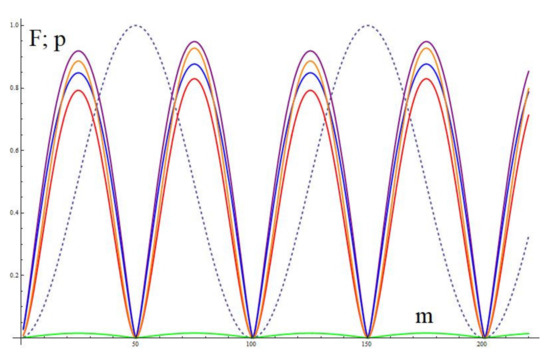
Figure 1.
Parameters , , Success probability: Blue dashed line, Entropies: von Neumann: Red line ; Orange line , Renyi: Blue line ; Purple line , Concurrency : Green line.
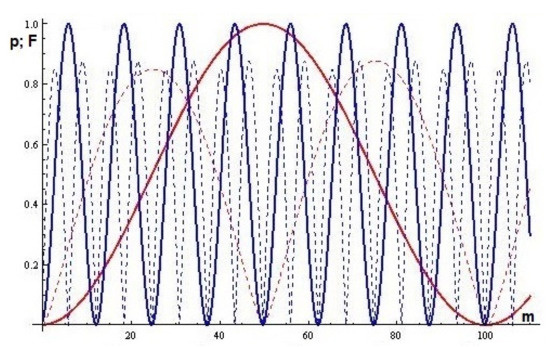
Figure 2.
Success prob.: Red line for ; Blue line for , Renyi entropy: Red dashed line for , Renyi entropy: Blue dashed line for .
The important point about these displays is that all zeros of the entropic measures are placed on the horizontal line of m’s and they belong to two inter-lasing sequences, and . This property is true for any of the three displayed measures i.e., R, vN and W. The distance between every second zero equals the period . This period is in fact related to success probability p via the formula , (see Appendix B).
Concerning the behaviour of the entropy vs. #steps in Figure 1 and Figure 2: The plots of all entropic measures have common intervals of monotonicity, common positions of maxima and minima as well as that their common minima are vanishing points i.e., zeros.
Noticeable is the fact that the common intervals and minima, maxima, refer only to the entropic measures between them and not between the measures and the curve of success probability, c.f. the broken line vs. full lines in Figure 1.
Also this situation is independent from the relative size of the splitting r vs. of database qubits. Therefore we have a scale invariance of the position of the zeros for all entropy measures and all database splitting schemes.
Figure 3, displays the equal entanglement configurations determined by investigating their contours on the plane where various quantum search algorithms are located.
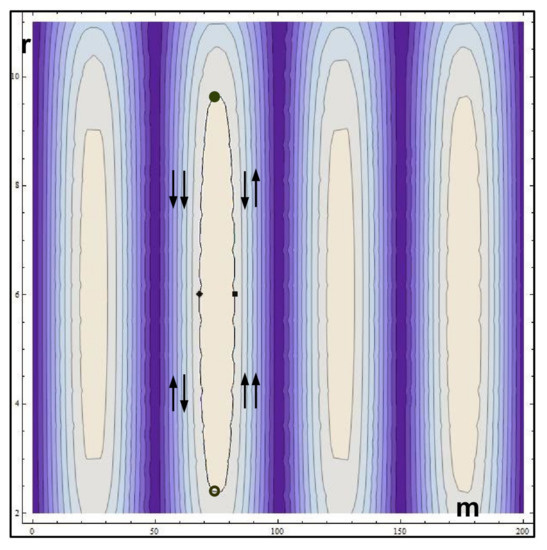
Figure 3.
For , , , , Renyi entropy (Contour Plot).
The following statements refer to the content of that figure:
(i) The equal Renyi entropy contours are organized in the contour curves wrt the iterations m and the number of remaining qubits r after database splitting;
(ii) Tracing any contour provides all pairs of fixed entanglement developed after m iterations between the two splitting sets with r and qubits respectively. Starting from e.g., point , of maximal m (box), and by tracing counter-clockwise its contour we encounter decreasing and increasing of values of m and r as it is indicated by up and down arrows in the figure. Before returning to the initial point all equal entropy points have been traced out with landmarks the points (disk), (diamond) and (circle), where be the middle points. Operationally this indicates the various ways one can generate an equally entangled bi-partition of database by fiddling around with interaction time m and splitting dimensionR
(iii) All periodic zero-entanglement instances correspond to straight vertical parallel lines (dark in black-white or blue in color plot), which are independent from the values of r; (c.f. a similar scaling invariance discussed in [22]).
To provide an analytic explanation of the situation on Figure 3 we study the quantum Renyi entropy with respect to the variables which is
where .
By introducing the effective variables as
the entropy reads
This formula implies that is constant with respect to the variation of and iff their product remains constant when variables m and r are varying.
4. Equal Entanglement Pre-Images
Regarding the number of iterations of the algorithm m as a continuous variable for the function and taking into account that is periodic with period , a reasonable question can be posed: given a certain amount of entanglement what are the values of m associated with it, lying in the basic period interval ? Equivalently, what are the pre-images of the entanglement function for fixed ?
Lemma 1.
The function takes all its possible resulting values, at least one and at most four times in the basic period interval .
Proof.
(A short technical part of the proof is deferred to Appendix B and its main part is provided below).
Let the points with abscissas in interval as follows
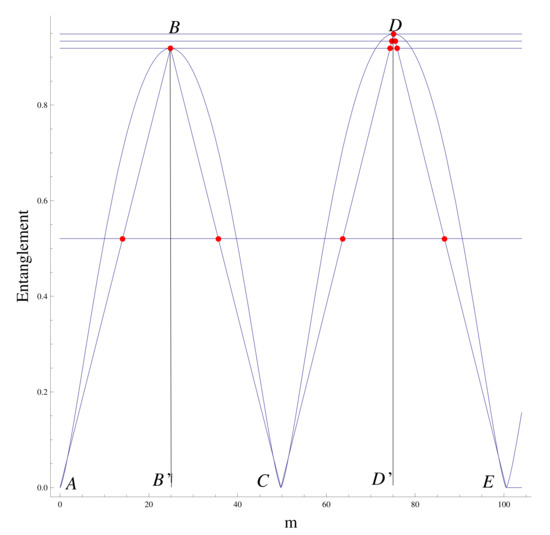
Moreover the function is strictly increasing in each one of the intervals , and strictly decreasing in each one of the intervals , since for all it holds that the sign of its first derivative on is positive for , and negative for (c.f. Figure 4).
Figure 4.
Plots of and tent map for Red dots stand for the approximate points of equal entanglement.
Remark 2.
is continuous on with respect to m and vanishes only at points . Therefore, it preserves its sign in each one of the open intervals.
Applying the Intermediate Value Theorem for and taking into account its monotonicity, we obtain that:
(i) if c is a number between and , then there are exactly four points s.t. and .
(ii) if , then there are exactly three points s.t. and
(iii) if c is a number between and , then there are exactly two s.t. and .
(iv) if (global maximum) then there is unique point m s.t. , .
Although we have proved the existence of ’s, the corresponding equations can not be easily solved analytically but ’s can be approximated. To this end we consider the piece-wise linear function below which is a tent map for both the intervals , and reads
where equals the slope of the line determined by the points
and then we solve the equations instead of □
Remark 3.
Recall that the tent map with parameter μ is the real-valued (and continuous) function
where μ is a positive real constant and maps on to itself. Our function is an obvious linear generalization of the tent map for both the intervals
Numerical Example: (c.f. Figure 4, red dots stand for the approximate points of equal entanglement).
,
(a) for , the four points are ,
(b) for , the three points are ,
(c) for , the two points are ,
(d) for , the unique point is .
Remark 4.
Since we have that E.g., For and we have that and respectively.
5. Fast Counting and the Entropy Observable
Counting the number of elements of a given finite set , requires a number of counts equal to the cardinality N of set ; one count for each element, as common sense asserts. Fast counting is a novel method that solves this problem in quantum setting, achieving counting in quadratically less than N counts, by casting the counting problem in the language of quantum algorithms. This is shown to be possible by employing Grover’s fast quantum search algorithm, after it has been reformulated mathematically in terms of the so called “Oracle matrix algebra”, by treating set as a search-able database. Within this formalism, search appears as a SU(2) periodic orbit, formed by a collection of qubits encoding the database space of the algorithm. It has been previously shown that multi-particle entanglement developed among the qubits of two parts of a bi-partition of the database Hilbert space is periodic with respect to the number of queries which is of the order of . Therefore measuring the entanglement by means of any of the measures developed before would determines the cardinality N of in only measurements or counts. Operationally the period finding amounts to determine the distance (expressed as numbers of queries) between any two successive zeros for some chosen measure. In effect the counting method proposed would lead to a quadratic reduction of the number of necessary N counts. To emphasize the operational character of the counting method an appropriate quantum observable, namely the Entropy observable, will be introduced and be implemented by means of a specific quantum circuit. Measuring the search step between successive zeros of that observable on a database reduced density matrix would allow the determination of cardinality N quadratically faster than usual counting as was mentioned.
Quantum measurement of Entropy observable: Next we provide a operational way of obtaining the entropy of the reduced density of matrix of quantum search at the m-th step. Since provides a measure of entanglement between database qubits, then a quantum measurement like estimation to and its possible implementation would be an indispensable aspect of the algorithm. The following lemma summarizes the operational procedure.
Lemma 2.
The entropy of the reduced evolved density matrix equals
where the the map
identified as a generalized Y channel is unitarilly generated as
where a unitary dilation is generated by the Hamiltonian
by means of an auxiliary qubit in state
Closing we note further that for employing other measures for the counting method, e.g., the Renyi entropy etc we will need an extension of the previous Lemma. Indeed a general measure in the form of Renyi entropy would require positive integer powers of the reduced density (recall that the definition of Renyi entropy involves real powers of density matrix in general), to be provided by means of an operational method. To address this question we formulate the next Lemma 3.
Lemma 3.
Let the S dimensional reduced density matrix , its ℓ-th power for all equals
where be the product of the non-zero eigenvalues of and , where is related to Chebyshev polynomials of the second kind via relation with
with initial conditions and
6. Discussion and Conclusions
While addressing the question of the resource responsible for the computation advantage of a given quantum algorithm or some other quantum technological task, the quantum entanglement has been considered as the main factor. However there are some important obstructions for such a claim: first an ambiguous measure of quantum advantage should be chosen and its causal relation with a measure for entanglement should be demonstrated. While there are examples where such a claim is corroborated, other cases are known where this is not evident [24]. As alternatives to such counterexamples other resources beyond quantum entanglement have been considered e.g., coherence, distinguish-ability, contextuality, interference etc (see [25] and references therein).
The paper in fact relates its content with the problem of resources of the quantum advantage exhibiting by quantum algorithms though it does not addresses it directly. This assertion is based on the fact that the fast counting problem that is investigated aims at determining the size(cardinality) N of a given set S has two solutions. A classical solution (the convention element counting procedure) with complexity(counting cost) N, and a quantum solution, suggested in the paper, with complexity(counting cost) . The source of quadratic speed in counting is by construction due to the quantum entanglement developed among elements of the set S, following the formalism of quantum search algorithm or some of its variants.
Measuring the number of iterations of the algorithm intervening among two successive canceling out (of any measure) of entanglement, determines the period , from which the integral part N is obtained. It is in fact the entanglement among database parts via its quadratic-ally fast periodic zeroing that promotes entanglement to be a resource of the computational (counting) advantage.
Several questions can be put forward for future investigations: is the studied phenomenon of the entanglement periodicity robust under e.g., tri-partition or even successive partitions of database total state vector space; how is the periodic oscillation of entanglement could be re-configured in the case of collective quantum search [16], where multiple searchers are combining their algorithms by merging and/or concatenating their oracle algebra representations to achieve additional search complexity reductions? Can the accelerated period of entanglement is valid for other measures of correlation like the ones mentioned previously? How the fast counting procedure is modified in the case of open, dissipative extensions of quantum search as those analysed in [25] and the more complicated ones as in [15,17] as well?
Author Contributions
Conceptualization, D.E. and C.K.; writing—original draft preparation, D.E. and C.K.; supervision, D.E. All authors have read and agreed to the published version of the manuscript.
Funding
This research received no external funding.
Institutional Review Board Statement
Not applicable.
Informed Consent Statement
Not applicable.
Data Availability Statement
Not applicable.
Conflicts of Interest
The authors declare no conflict of interest.
Appendix A. Oracle Algebra
In the following the definition of the oracle algebra and its representations are presented.
Definition A1.
Let a Boolean function and the orthogonal vectors and with and which generate the space span and the unit element The oracle algebra is defined as the vector space generated by the elements
with algebra commutation relations (cyclically), and everything i.e., , oracle algebra is isomorphic to matrix algebra. There are two basic matrix representations of provided by the algebra homomorphisms and as follows: the two dimensional and the N dimensional where . Explicitly any element is represented in by a 2-dim matrix or by a N-dim matrix respectively.
Examples A1.
Let and if i.e., then the projection of A in space via leads to the matrix where the matrix elements are
As to the N-dim representation we can compute that where and which provides the matrix
where
Additionally regarding the representations of the generic element
treated above we can show that
as manifestation of the homomorphic property of Indeed by means of the operators , where that satisfy the relations and their corresponding N-dim matrix representations where which satisfy the respective relations we can verify that by direct calculation that the matrix form of A in space satisfies the mentioned property.
Numerical examples: For with and zero elsewhere, we obtain
Appendix B. Proofs
Proof of Lemma 1.
The statement of lemma follows immediately from the Intermediate Value Theorem, which states that if g is a real single valued continuous function on a closed interval and c is any number between and inclusive, then there is at least one number k in the closed interval such that . Moreover, if then □
Proof of Lemma 2.
Consider the trace inner product for For oracle algebra generators we obtain so the density matrix is expressed as where is abbreviated to For powers of Bloch vector components e.g., ( via property we write (
which after the identification with the expectation value of observable in state one obtains Applying this same idea to e.g., the linear entropy function for state defined as
it is obvious that we need to devise an operational way to obtain the value of entropy in the course of search/counting i.e., the vs. To this end we express the linear entropy in terms of the expectation value of observable of a doubled version of the initial quantum system being in state as follows Utilizing the identity, we write
where unitary CP map has been introduced, with generators The mean value in question is cast in the form
where the dual CP map
has been introduced.
Next we provide a unitary dilation to the map which eventually determines a Hamiltonian for the measurement of entropy. Let an auxiliary quantum system with two states described by density matrix and the unitary operator V on
If the total system is described initially by and evolves as and if the interaction is terminated by decoupling auxiliary system from the main system via the partial trace over the auxiliary system), then this leads to map i.e.,
Due to relation the map becomes In this form is identified with a collective Y unitary channel of two system with generators and a unitary dilation V as in the rhs of the last equation above. □
Proof of Lemma 3.
The following items are valid (abbreviations: stand for respectively, and for ):
(i) The characteristic equation and the eigenvalues of rank 2 matrix are respectively and of multiplicity , and with multiplicity 1.
(ii) Due to Cayley-Hamilton theorem it holds that namely , where equality arises from Vieta’s formula valid for any n degree polynomial with roots
(iii) We have that and for all we assume (c.f. [26]),
from which we obtain and Further , so and and thus
This recurrence relation reminds the Chebyshev polynomials relation viz. , where the variable term t however appears in the “wrong” side. Motivated by this feature we proceed as follows: we solve our recurrence relation and compare the solution the the Chebyshev polynomial solution. Anticipating the final result we say that the association between our polynomial system and Chebyshev polynomials is in terms of a in-homogeneous relation with variable coefficients and different argument between the two types of polynomials c.f. the stated relation in Lemma 3.
To proceed with the solution of our recurrence relation we consider the shifted sequence which is identified with the intermediate sequence as Solving the recurrence relation obeyed by viz. and compare them with the solution of Chebyshev polynomials of the second kind via another intermediate sequence we obtain the solution
satisfying the initial conditions and □
Proof.
(Proposition): (i) C.f. Remarks: 3; (ii) To show the projectivity of the reduced matrix recall the definition
Verifying this relation we obtain that
Recall that the definition of and the additional relation from the main text (indices have been drop)
We discern the following cases:
(I) If , then
(Ia) If then becomes , equivalently . Due to the periodicity of we obtain the arithmetic progression Ib) If then, from Equation (10) we verify that no new solution exist for II) If then following a similar procedure we find a second arithmetic progression for m viz. The asymptotic forms follow directly from the above formulas. □
Proof.
(Statements): Root finding of entropy functions Next we prove the following statements:
(i) the measures of entropy of entanglement (von Neumann), quantum Renyi entropy and linear entropy mentioned in the main text, vanish simultaneously during search at step m iff or The is direct verification and we only need to recall the eigenvalues reported above in the proof of Lemma 2 and the expression of the entropies in terms of the non zero eigenvalues viz. and (ii) the distance between every second zero of the entropies is related to probability p via formula . Indeed, this distance equals the period , so and the result follows. □
References
- Grover, L.K. Quantum computers can search arbitrarily large databases by a single query. Phys. Rev. Let. 1997, 79, 325–328. [Google Scholar] [CrossRef] [Green Version]
- Grover, L.K. A fast quantum mechanical algorithm for database search. In Proceedings of the 28th Annual ACM Symposium on the Theory of Computing, New York, NY, USA, 29 May 1996; pp. 212–218. [Google Scholar]
- Grover, L.K. Quantum Computers Can Search Rapidly by Using Almost Any Transformation. Phys. Rev. Let. 1998, 80, 4329–4332. [Google Scholar] [CrossRef] [Green Version]
- Boyer, M.; Brassard, G.; Hoyer, P.; Tapp, A. Tight bounds on quantum searching. In Proceedings of the 4th Workshop on Physics and Computation, Boston, MA, USA, 22–24 November 1996; pp. 36–43. [Google Scholar]
- Long, G.-L. Grover algorithm with zero theoretical failure rate. Phys. Rev. A 2001, 64, 022307. [Google Scholar] [CrossRef] [Green Version]
- Toyama, F.M.; Dijk, W.V.; Nogami, Y. Quantum search with certainty based on modified Grover algorithms: Optimum choice of parameters. Quantum Inf. Process. 2013, 12, 1897–19112. [Google Scholar] [CrossRef]
- Jin, S.; Wu, S.; Zhou, G.; Li, Y.; Li, L.; Li, B.; Wang, X. A query-based quantum eigensolver. Quantum Eng. 2020, 2, e49. [Google Scholar] [CrossRef]
- Bruss, D.; Macchiavello, C. Multipartite entanglement in quantum algorithms. Phys. Rev. A 2011, 83, 052313. [Google Scholar] [CrossRef] [Green Version]
- Meyer, D.A.; Wallach, N.R. Global entanglement in multiparticle systems. J. Math. Phys. 2002, 43, 4273–4278. [Google Scholar] [CrossRef] [Green Version]
- Biham, O.; Nielsen, M.A.; Osborne, T.J. Entanglement monotone derived from Grover’s algorithm. Phys. Rev. A 2002, 65, 062312. [Google Scholar] [CrossRef] [Green Version]
- Fang, Y.; Kaszlikowski, D.; Chin, C.; Tay, K.; Kwek, L.C.; Oh, C.H. Entanglement in the Grover search algorithm. Phys. Lett. A 2005, 345, 265–272. [Google Scholar] [CrossRef]
- Rungta, P. The quadratic speedup in Grover’s search algorithm from the entanglement perspective. Phys. Lett. A 2009, 373, 2652–2659. [Google Scholar] [CrossRef] [Green Version]
- Ding, S.; Jin, Z. Review on the study of entanglement in quantum computation speedup. Chin. Sci. Bull. 2007, 52, 2161–2166. [Google Scholar] [CrossRef]
- Ellinas, D.; Konstandakis, C. Matrix algebra for quantum search algorithm: Non unitary symmetries and entanglement. In Proceedings of the of QCMC 2010, Brisbane, Australia, 23 July 2011; pp. 4–9. [Google Scholar]
- Ellinas, D.; Konstandakis, C.J. Parametric quantum search algorithm by CP maps: Algebraic, geometric and complexity aspects. Phys. A Theor. Math. 2013, 46, 415303. [Google Scholar] [CrossRef]
- Ellinas, D.; Konstandakis, C. Faster Together: Collective Quantum Search. Entropy 2015, 17, 4838–4862. [Google Scholar] [CrossRef] [Green Version]
- Ellinas, D.; Konstandakis, C. Parametric quantum search algorithm as quantum walk: A quantum simulation. Rep. Math. Phys. 2016, 77, 105–128. [Google Scholar] [CrossRef]
- Mosca, M. Counting by quantum eigenvalue estimation. Theor. Comput. Sci. 2001, 264, 139–153. [Google Scholar] [CrossRef] [Green Version]
- Nielsen, M.A.; Chuang, I.L. Quantum Computation and Quantum Information; Cambridge University Press: Cambridge, UK, 2000. [Google Scholar]
- Zyczkowski, K.; Bengtsson, I. Geometry of Quantum States: An Introduction to Quantum Entanglement; Cambridge University Press: Cambridge, UK, 2006. [Google Scholar]
- Wootters, W.K. Entanglement of formation of an arbitrary state of two qubits. Phys. Rev. Lett. 1998, 80, 2245. [Google Scholar] [CrossRef] [Green Version]
- Rossi, M.; Bruss, D.; Macchiavello, C. Scale invariance of entanglement dynamics in Grover’s quantum search algorithm. Phys. Rev. A 2013, 87, 022331. [Google Scholar] [CrossRef] [Green Version]
- Lomonaco, S.J.; Kauffman, L.H. Is Grover’s algorithm a quantum hidden subgroup algorithm? Quantum Inf. Process 2007, 6, 461–476. [Google Scholar] [CrossRef] [Green Version]
- Vedral, V. The elusive source of quantum speedup. Found. Phys. 2020, 40, 1141–1154. [Google Scholar] [CrossRef] [Green Version]
- Gebhart, V.; Pezzè, L.; Smerzi, A. Quantifying computational advantage of Grover’s algorithm with the trace speed. Sci. Rep. 2021, 11, 1288. [Google Scholar] [CrossRef]
- Bacry, H. SL (2, C), SU (2), and Chebyshev polynomials. J. Math. Phys. 1987, 28, 2259. [Google Scholar] [CrossRef]
Publisher’s Note: MDPI stays neutral with regard to jurisdictional claims in published maps and institutional affiliations. |
© 2022 by the authors. Licensee MDPI, Basel, Switzerland. This article is an open access article distributed under the terms and conditions of the Creative Commons Attribution (CC BY) license (https://creativecommons.org/licenses/by/4.0/).