Abstract
Quantum anomalies are traditionally understood as classical symmetries that fail to survive quantization, while experimental “anomalies” denote deviations between theoretical predictions and measured values. In this work, we develop a unified framework in which both phenomena can be interpreted through the lens of algebraic quantum field theory (AQFT). Building on the renormalization group viewed as an extension problem, we show that renormalization ambiguities correspond to nontrivial elements of Hochschild cohomology, giving rise to a deformation of the observable algebra , where is a Hochschild 2-cocycle. We interpret as an intrinsic algebraic curvature of the net of local algebras, namely the (local) Hochschild class that measures the obstruction to trivializing infinitesimal scheme changes by inner redefinitions under locality and covariance constraints. The transported product is associative; its first-order expansion is associative up to while preserving the ∗-structure and Ward identities to the first order. We prove the existence of nontrivial cocycles in the perturbative AQFT setting, derive the conditions under which the deformed product respects positivity and locality, and establish the compatibility with current conservation. The construction provides a direct algebraic bridge to standard cohomological anomalies (chiral, trace, and gravitational) and yields correlated deformations of physical amplitudes. Fixing the small deformation parameter from the muon discrepancy, we propagate the framework to predictions for the electron , charged lepton EDMs, and other low-energy observables. This approach reduces reliance on ad hoc form-factor parametrizations by organizing first-order scheme-induced deformations into correlation laws among low-energy observables. We argue that interpreting quantum anomalies as manifestations of algebraic curvature opens a pathway to a unified, testable account of renormalization ambiguities and their phenomenological consequences. We emphasize that the framework does not eliminate renormalization or quantum anomalies; rather, it repackages the finite renormalization freedom of pAQFT into cohomological data and relates it functorially to standard anomaly classes.
1. Introduction and Motivation
1.1. Quantum Anomalies Versus Experimental Discrepancies
A quantum anomaly is the failure of a classical symmetry of the action to be implementable at the quantum level after renormalization. Canonical examples include the axial (ABJ) anomaly in chiral currents, the trace (Weyl) anomaly of the stress tensor, and gravitational anomalies in theories of chiral matter [1,2,3,4,5]. By contrast, an experimental discrepancy denotes a persistent deviation between a theoretically predicted quantity and its measured value (e.g., the muon anomalous magnetic moment). These notions live at different conceptual layers: the former is a cohomological obstruction in the quantization/renormalization of symmetries, while the latter is a property of phenomenological comparison.
This work develops a framework in which renormalization ambiguities in algebraic quantum field theory (AQFT) are organized by Hochschild cohomology and thereby acquire the status of an intrinsic algebraic curvature of the observable algebra. Within this perspective, familiar quantum anomalies are realized as particular images of cohomology classes that govern the deformation of products of observables, while certain classes of low-energy discrepancies can be probed through universal correlation laws implied by the same deformation. The guiding principle is that changes in the renormalization scheme act as (local) automorphisms on the algebra of observables; infinitesimally, they define a 2-cocycle controlling deformations of the product. The nontrivial cohomology class of this cocycle is what we call algebraic curvature.
- Scope clarification.
Throughout, it is not claimed that quantum anomalies disappear. Standard gauge, trace/Weyl, and gravitational anomalies remain as cohomological obstructions to simultaneously enforcing locality, covariance, and Ward identities after renormalization. The present contribution is to identify a natural Hochschild-cohomological organization of renormalization ambiguities in pAQFT and to relate the resulting class to the familiar anomaly cohomology via a canonical map developed below.
1.2. AQFT, Renormalization as an Extension Problem, and the Stückelberg–Petermann Group
The AQFT approach associates each causally complete spacetime region O with - or von Neumann algebra of observables satisfying isotony, locality (Einstein causality), and covariance [6,7]. In the perturbative setting (pAQFT), interacting observables are constructed from microcausal functionals by time-ordered products that satisfy causal factorization, covariance, and microlocal spectral conditions [6,7,8,9].
Renormalization is posed as an extension problem: distributions defined away from coincident points must be extended to the diagonals in configuration space. The freedom in this extension is finite at each order and local in the sense of scaling degree, and it is canonically organized by the Stückelberg–Petermann renormalization group , a group of local field redefinitions acting on the time-ordered products (or equivalently on the Bogoliubov S-matrix) [7,10,11]. Two renormalization schemes T and related by an element produce the same physical S-matrix up to local counterterms fixed by renormalization conditions; the relative Z encodes the ambiguity data.
- Not a “solution” of renormalization.
We stress that we do not propose an alternative to the Epstein–Glaser/Hollands–Wald renormalization program. Renormalization is still implemented as the extension of distributions to coincident configurations subject to the usual normalization conditions. Our goal is instead to make the finite renormalization freedom (encoded by ) explicit in cohomological terms, thereby isolating scheme-invariant information under locality and covariance constraints.
- Renormalizability versus renormalization.
We do not claim to solve renormalization as a constructive procedure. Rather, assuming perturbative renormalizability in the Epstein–Glaser sense, we show that the residual finite renormalization freedom—encoded by the Stückelberg–Petermann group—is governed by a local Hochschild cohomology class. This class organizes scheme dependence under locality and covariance constraints and is what we interpret as an intrinsic algebraic curvature.
1.3. From Renormalization Freedom to Hochschild Cohomology
Let denote the algebra of (microcausal) observables equipped with a product induced by a choice of renormalization prescription (e.g., the time-ordered product ). Let be near the identity, and we write a formal expansion
with as a bookkeeping parameter. The transformed product is again associative. Expanding to first order in one obtains
where
Associativity of ∗ up to imposes the Hochschild 2-cocycle condition
i.e., with respect to the Hochschild coboundary [12]. Conversely, a Hochschild 2-cocycle determines the first-order part of an associative deformation of the product. Coboundaries correspond to trivial deformations induced by inner changes of variables; the cohomology class measures the obstruction to trivialization and is independent of the representative . We refer to this class as the algebraic curvature of the observable algebra relative to the chosen renormalization scheme.
Two structural constraints are immediate. First, the ∗-structure: to preserve at , it suffices that
Why Hochschild cohomology appears (conceptual bridge).
The appearance of Hochschild cohomology is a standard feature of associative deformation theory: infinitesimal changes of an associative product are classified by Hochschild 2–cocycle modulo coboundaries. In pAQFT, finite renormalizations act by local redefinitions (the Stückelberg–Petermann group) on the algebra of observables; expanding a scheme transformation produces the bilinear map in (2). Associativity of the transported product then implies the cocycle condition (3), while changes of representative shift by a Hochschild coboundary. Thus, packages the scheme-change data in a cohomology class rather than introducing new degrees of freedom.
Second, locality: if A and B are localized in spacelike separated regions, microcausality demands . A sufficient condition for microcausality to persist to is that whenever A and B are spacelike separated and that be local (supported on coincident configurations in the sense of microlocal analysis) [6,7,8]. We will work within the pAQFT category, where such locality conditions are natural consequences of the scaling degree bounds that govern extensions.
1.4. Interpretation as Intrinsic Algebraic Curvature
The term “curvature” is used in the following precise, algebraic sense. The family of renormalization prescriptions forms a torsor for ; infinitesimally, changes in prescription are generated by . The obstruction to trivializing the induced first-order deformation of the product is the Hochschild cohomology class . This class is invariant under changes of representative and does not depend on a particular presentation. It therefore captures an intrinsic piece of the structure of the observable algebra endowed with a renormalization-compatible product. In geometric language, plays the role of a curvature 2-form for the (flat when trivial) bundle of products over the groupoid of renormalization schemes. When , there is a cohomological obstruction to globally identifying all prescriptions by inner conjugations, and this obstruction manifests in controlled deformations of composite observables.
- What “curvature” is not
The term curvature is used here in a strictly algebraic and scheme-geometric sense. It does not refer to spacetime curvature, nor does it posit a new propagating field. Rather, measures the obstruction to globally identifying renormalization prescriptions by local inner redefinitions once locality and covariance are enforced. In this sense, it plays the role of a curvature for the “bundle of products” over the renormalization groupoid.
1.5. Relation to Known Anomaly Mechanisms
Standard quantum anomalies arise from the impossibility of simultaneously maintaining locality, covariance, and the classical Ward identities after renormalization; they therefore persist as genuine obstructions, and our framework provides an AQFT-level cohomological organization of the corresponding ambiguity data. In BRST language, anomalies are characterized by cohomology classes of local functionals obeying the Wess–Zumino consistency condition [4]. In the pAQFT setting, time-ordered products implement renormalization in configuration space, and their ambiguity is encoded by local maps acting on functionals. We will show that the first-order deviation of these maps induces a whose cohomology class maps functorially to the usual anomaly classes: axial (ABJ) [1,2], trace/Weyl [3], and (in appropriate chiral settings) gravitational [5]. The bridge proceeds through two steps: (i) an analysis of the Ward–Takahashi identities in the deformed product and their contact terms, and (ii) a comparison of the resulting cocycles with the BRST cohomology in the space of local functionals.
1.6. Ward–Takahashi Identities and Vertex Structures
Consider a conserved current associated with a gauge symmetry in the classical theory. Let denote the one-particle-irreducible (1PI) vertex function for the corresponding coupling to a Dirac field in momentum space. The Ward–Takahashi identity (WTI) reads
where S is the renormalized fermion propagator. In our framework, the deformed product ∗ modifies composite operators and thereby the definition of the vertex. At the first order in , the induced change in the vertex is linear in and can be organized as a sum of local contact terms plus terms proportional to standard form factors (e.g., Dirac and Pauli). A sufficient condition for (5) to hold to is that acts as a biderivation on the current algebra modulo local counterterms fixed by renormalization conditions; specifically, the map must intertwine with the derivations generated by the symmetry. This constraint is compatible with (4) and with locality, and it will be formulated and proved within pAQFT. The upshot is that identifiable pieces of project to the Pauli form factor (and to CP-odd dipole operators when parity is violated), providing a foothold for phenomenological correlation tests without introducing ad hoc form factors.
1.7. Phenomenological Impetus and Scope
The formalism presented here is developed with two complementary objectives. The first is to supply a mathematically controlled interpretation of renormalization ambiguities as classes in Hochschild cohomology (algebraic curvature) in a setting that is local and covariant, namely pAQFT on globally hyperbolic spacetimes [6,7,9].
All constructions use perturbative algebraic quantum field theory (pAQFT) with Epstein–Glaser renormalization on configuration space (and the locally covariant refinement of Hollands–Wald); no alternative quantization scheme is introduced.
Second, to identify robust, dimensionless correlation laws among low-energy observables that are insensitive to short-distance details once a small deformation parameter is calibrated in one channel. We will primarily consider flavor-diagonal electroweak observables where the mapping from to effective operators is under perturbative control (anomalous magnetic moments and electric dipole moments of charged leptons), postponing gravitational sectors and cosmological applications to an outlook discussion where additional scales and decoupling issues arise.
1.8. Main Contributions
- We construct, within pAQFT, a deformation of the observable product induced by infinitesimal changes of renormalization prescription and prove that is a Hochschild 2-cocycle. The cohomology class is identified as an intrinsic algebraic curvature associated with the net of local algebras.
- We establish conditions ensuring preservation of the ∗-structure, positivity on a dense domain, and locality to the first order in , and we derive a sufficient criterion for the Ward–Takahashi identities to hold up to .
- We develop a functorial bridge between and standard anomaly cohomology (axial, trace, gravitational) via the structure of time-ordered products and BRST complexes, thereby unifying several anomaly mechanisms at the algebraic level.
- We formulate dimensionless correlation relations among low-energy observables that follow from the tensorial decomposition of , and we outline how a single calibration of leads to predictions for other channels with controlled uncertainties.
1.9. Organization of the Paper
Section 2 reviews the AQFT/pAQFT setting, the microlocal framework for renormalization, and the Stückelberg–Petermann group. Section 3 introduces Hochschild cohomology and proves that renormalization-induced deformations are controlled by a cocycle . Section 4 gives explicit constructions for in free theories and discusses locality and scaling. Section 5 derives the Ward–Takahashi identities in the deformed theory and analyzes the induced vertex structures. Section 6 relates to standard anomaly cohomology. Section 7 develops phenomenological correlation relations and discusses their robustness. Section 8 discusses limitations and possible extensions. Appendix A, Appendix B, Appendix C, Appendix D and Appendix E provide technical proofs and microlocal background.
- Notation and conventions. We work in four spacetime dimensions with signature . Unless stated otherwise, . The formal parameter tracks the first-order deformation of the product induced by changes in renormalization prescription; it is distinct from any kinetic-mixing or phenomenological parameter bearing the same letter in other contexts.
For readability, the Introduction emphasizes motivation and conceptual structure; technical constructions and proofs are concentrated in later sections and appendices.
2. Preliminaries on AQFT and Renormalization Ambiguities
2.1. Local Nets, States, and Dynamics
We recall the algebraic (Haag–Kastler) framework for relativistic quantum field theory on a globally hyperbolic spacetime (in Minkowski spacetime, this specializes to the traditional axioms; in general , we adopt the locally covariant reformulation). To each causally convex region , one assigns a unital - (or von Neumann) algebra of observables such that
- Isotony: .
- Locality (Einstein causality): If (spacelike separated), then for all .
- Covariance: There exists an action of the isometry group (Poincaré in Minkowski) by automorphisms with .
- Time-slice axiom: If O contains a Cauchy surface for , then .
A state is a positive, normalized linear functional ; the GNS construction yields a representation . In Minkowski space, physically relevant local algebras are typically of type III, whereas the perturbative constructions used below yield topological ∗-algebras completed with respect to Hadamard two-point functions [6,7,13,14].
2.2. Microcausal Functionals and the Free-Field Star Product
Let denote a suitable space of classical field configurations (e.g., smooth sections of a vector bundle). A local functional is of the form with an f polynomial in jets and compactly supported. Its n-th functional derivative satisfies microcausality if
i.e., its wavefront set avoids unions of future/past lightcones in each cotangent factor [6,7,15]. The space of microcausal functionals is stable under a pointwise product and functional differentiation.
Fix a Hadamard two-point function for the free field; define the bidifferential operator
Then, the (normal ordered) free-field star product on is given by
where is the pointwise multiplication and the brackets denote the distributional pairing (well-defined by Hörmander’s criterion and microcausality). The resulting topological ∗-algebra depends on the choice of by an inner (coherent-state) equivalence; observables are thus defined modulo this equivalence [6,7].
2.3. Time-Ordered Products and Causal Factorization
Interacting observables are constructed from time-ordered products
satisfying axioms of symmetry, causal factorization, unit, microlocal spectrum condition, covariance, scaling degree bounds, and field independence [6,7,8,9,16]. Causal factorization reads as follows: if for all (i.e., all points in are not later than any in ), then
For free fields, a compact formula is
where is the Feynman propagator (Hadamard parametrix with -prescription). Interactions are introduced via the Bogoliubov S-matrix
and the relative S-matrix
The interacting (retarded) field is obtained by functional differentiation at zero coupling:
Causal factorization of T ensures the Bogoliubov causality of , while the time-slice axiom holds provided T is constructed covariantly and locally [6,9,14].
2.4. Microlocal Extension and the Epstein–Glaser Program
The inductive construction of (Epstein–Glaser) reduces to extending distributions defined on configuration space with thin diagonals removed to distributions supported also on the diagonals, under control of scaling degrees. Here, configuration space refers to for n insertions; “coincident points” correspond to the thin (partial) diagonals where one or more insertion points coincide, i.e., loci of the form . The extension ambiguity is supported on these diagonals and is controlled by the scaling degree. Let ; its (Steinmann) scaling degree at the origin is
Theorem 1
(Extension with minimal scaling degree [8,17]). If has a finite scaling degree , then there exists an extension with . If , the extension is not unique; the ambiguity space is finite-dimensional and spanned by derivatives with .
In the EG recursion for , the singular distributions arise from concatenations of Feynman propagators on configuration space. The theorem implies the following:
- Existence: exists for all n with the stated axioms, by induction on n.
- Locality and covariance: If the choice of extension is local and covariant (in the sense of natural transformations under embeddings of spacetimes), then so is [6,8,14,18].
- Finite renormalization freedom: At each order, ambiguities correspond to local counterterms supported on diagonals, with the dimension bounded by the degree of divergence .
Thus, renormalization is precisely the freedom of extension at coinciding points, controlled by scaling degree and microlocal spectral properties (Hadamard condition) [6,19].
2.5. Normalization Conditions and Renormalization Schemes
To fix uniquely, one imposes normalization conditions (in the spirit of EG/Scharf):
- N0.
- Symmetry: is symmetric in its arguments.
- N1.
- Causal factorization (as above).
- N2.
- Unit: and for linear F.
- N3.
- Covariance: is natural with respect to isometries/embeddings.
- N4.
- Microlocal spectrum: wavefront set bounds are consistent with Hadamard structure.
- N5.
- Scaling: scaling degree bounds are compatible with canonical dimensions.
- N6.
- Unitarity: (causal unitarity).
- N7.
- Field independence: functional derivatives commute appropriately with .
Different choices of extensions consistent with N0–N7 define distinct renormalization schemes. The space of schemes is an affine space modeled on local counterterms (polynomial in fields and derivatives) graded by canonical dimension or scaling degree.
2.6. The Stückelberg–Petermann Renormalization Group
Let be the space of local functionals. The Stückelberg–Petermann group is the group of formal, local redefinitions of the form
compatible with support, covariance, and degree (it acts as a formal diffeomorphism on the space of interactions). The Main Theorem of Renormalization in the causal framework can be stated as follows:
Theorem 2
(Main theorem, causal version [10,11]). Let T and be two time-ordered product families satisfying the axioms N0–N7. Then there exists a unique such that the corresponding Bogoliubov S-matrices obey
Moreover, the composition of renormalization schemes corresponds to the composition in .
In particular, the physical content encoded by relative S-matrices is invariant under Z, while individual composite operators transform covariantly. The difference between schemes appears as local reparametrizations of couplings and fields, and as finite redefinitions of composite operators. This group-theoretic structure will be the starting point for our algebraic deformation analysis.
2.7. Retarded Products and the Algebra of Interacting Observables
Define the multilinear retarded products by
They satisfy causal support properties: and obey combinatorial identities mirroring BPHZ forests but formulated in configuration space [6,16]. The interacting algebra generated by (for a fixed interaction V) inherits the net structure and the time-slice property from , and its dependence on the renormalization scheme is governed by as above.
2.8. Example: in Four Dimensions
For concreteness, consider the scalar model with . Power counting gives a degree of divergence for a graph with loops L and internal lines I. In EG language, the singular part at order n is supported on the union of partial diagonals in ; scaling degree bounds restrict the ambiguity to local counterterms of the schematic form
with coefficients polynomial in and distributions built from curvature if is curved (local covariance). Changing the scheme amounts to acting by some that reparametrizes and modifies composite operators (e.g., Wick powers) by local terms, consistent with Hollands–Wald’s classification of Wick polynomials [8,9].
2.9. Summary of Structural Consequences
The EG/pAQFT framework yields the following:
- A functorial assignment with time-ordered products encoding interactions and retarded products encoding dynamics.
- A finite-dimensional space of renormalization ambiguities at each order, localized on diagonals and controlled by scaling degree.
- A global, group-theoretic organization of scheme changes via , acting by formal local redefinitions on interactions and composite operators.
In Section 3, we will use these facts to identify the first-order effect of a scheme change with a Hochschild 2-cocycle that controls an associative deformation of the observable product. The associated cohomology class will be our algebraic curvature.
3. Algebraic Curvature as Hochschild Cohomology
3.1. Hochschild Cochains, Differential, and Gerstenhaber Bracket
Let be a (topological) associative ∗-algebra over with multiplication , . The space of n-cochains consists of continuous n-linear maps (with ). The Hochschild differential is
One verifies ; the Hochschild cohomology is with and [20,21].
The space (degree shifted by ) carries the Gerstenhaber bracket that turns it into a graded Lie algebra [12,22]. For , ,
The associative product m is a 2-cochain obeying . The Hochschild differential is , so by graded Jacobi.
3.2. First-Order Deformations and Classification by
A formal associative deformation of m is a -bilinear product
with , such that in . Expanding the associativity constraint order-by-order yields the Maurer–Cartan tower
Thus, a necessary and sufficient condition for a first-order associative deformation is that be a Hochschild 2-cocycle. Two first-order deformations and are equivalent if there exists a formal automorphism with such that
Hence, equivalence classes of first-order associative deformations are classified by [12,23,24]. In geometric language, the moduli of associative structures modulo inner equivalence has tangent space at m.
3.3. Scheme Changes ⇒ Hochschild 2-Cocycles
Let T be a fixed renormalization prescription (family of time-ordered products) in pAQFT and let be the Stückelberg–Petermann group of local, formal redefinitions acting on interactions and composites. For close to the identity, define a new product on by transport of structure
where · denotes the original product (time-ordered or otherwise) associated with T. Writing , a direct calculation gives at first order
Proposition 1
(Cocycle property of ). The bilinear map ω in (14) obeys . Moreover, if with , then . Hence, the cohomology class is well-defined by the scheme-change orbit of T.
Sketch.
Associativity of implies at , i.e., , which is by the identity . Under with a derivation-like 1-cochain, (14) shifts by exactly as in the standard deformation equivalence. □
We call the algebraic curvature associated with the renormalization class of T. It is intrinsic up to inner equivalences generated by 1-cochains and, crucially, is local in the sense explained below.
3.4. Locality, ∗-Structure, and Microcausality at First Order
In AQFT/pAQFT, one requires that composite operations be local and respect the causal structure. Let be generated by microcausal functionals; locality of means that depends on the jets of at coincident points and is supported on the diagonals of configuration space (as a distribution-valued bidifferential operator).
Proposition 2
(Locality and microcausality). Suppose ω arises from a renormalization scheme change Z that preserves the microlocal spectrum condition and naturality under embeddings (locally covariant). Then ω is supported on the diagonals and is a local bidifferential operator of finite order (bounded by scaling degree). In particular, if A and B are localized in spacelike separated regions, then implies .
Sketch.
In the Epstein–Glaser construction, ambiguities at order n are linear combinations of derivatives of delta distributions supported on partial diagonals, multiplied by local polynomial functionals with bounded scaling degree [8,17,25]. The induced first-order change is local and respects causal factorization; therefore, computed from (14) inherits locality and finite order. Spacelike commutativity persists because the support properties forbid nontrivial contributions when arguments are causally disjoint to first order. □
The ∗-structure imposes the compatibility condition
This holds provided intertwines the adjoint (causal unitarity) [9,16].
Remark 1
(Positivity to first order). Let φ be a positive, continuous state on . If ω satisfies (15) and is bounded on the relevant dense domain, then for sufficiently small ε one has on that domain, i.e., quasi-positivity to first order. In our perturbative context, observables are formal power series and positivity is interpreted order-by-order [7].
3.5. Explicit Local Form of in pAQFT
Let T and be two time-ordered products obeying the pAQFT axioms. Their difference at order n is supported on the union of partial diagonals in and has the general form
with local coefficients constrained by scaling. Specializing to and transporting via (14), one obtains the typical structure
where are locally and covariantly constructed from the metric and coupling constants (and curvature if is curved). Equation (17) makes explicit that is local and supported on coincident configurations. The “higher functional-derivative terms” appear when involves field redefinitions of order in the fields.
3.6. Biderivations and Ward Identities at
For later use (vertex analysis), it is convenient to single out a class of that act as biderivations modulo local contact terms:
Such a property holds if is (to first order) a derivation with respect to the product modulo local counterterms fixed by normalization conditions (N0–N7). In pAQFT this amounts to the field independence and covariance of T and the naturality of Z [7,11]. When (18) is satisfied, the deformation of the Noether current algebra respects the Ward–Takahashi identities to first order after appropriate redefinition of local counterterms (Section 5).
3.7. Comparison with Standard Deformation Quantizations
It is instructive to contrast the present deformation with classical star products from deformation quantization. If is a Poisson manifold, a formal star product is
with bidifferential operators and [26,27,28]. In that setting, detects infinitesimal classes of associative deformations compatible with the Poisson bracket and is related to Poisson cohomology. In our AQFT/pAQFT context, the algebra is noncommutative from the outset; the deformation parameter tracks renormalization-scheme changes rather than quantization, and the corresponding is local (supported on diagonals).
On the -algebraic side, Rieffel deformation by an -action produces associative star products that notoriously preserve the -norm and positivity [29]. Net-level implementations (warped convolutions) yield wedge-local quantum fields [30,31]. Our can be viewed as the formal, local, configuration-space analogue driven by the renormalization-group torsor rather than by an external group action.
3.8. Summary of the Cohomological Picture
The discussion above establishes the following chain:
4. Explicit Constructions of the Cocycle
In this section, we construct the first-order deformation cocycle explicitly in perturbative AQFT. We begin by displaying as the differential of an infinitesimal Stückelberg–Petermann map acting on local functionals and then work out concrete formulas for free scalar and Dirac fields. We emphasize locality (support on diagonals), covariance, scaling-degree bounds, and the compatibility with the ∗-structure. Finally, we indicate conditions for nontriviality of within natural subcategories of local, covariant cochains.
4.1. Renormalization Maps as Local Differential Operators
Let denote the space of local functionals (polynomial in jets, compactly supported). A renormalization prescription T (family of time-ordered products) induces a product on an algebra generated by microcausal functionals. A change of prescription is encoded by (Main Theorem), i.e., a formal, local and covariant redefinition acting functorially under isometric embeddings [7,11]. We write
where values are local differential operators of total jet-order acting on the integrands of local functionals, and the coefficients are locally and covariantly constructed from the background (metric, couplings, curvature) with definite scaling dimension; R and are bounded by the scaling-degree constraints of the Epstein–Glaser extension at the order considered [8,9,25].
Transport of structure (Section 3) yields the deformed product
with and independent of the representative modulo 1-cochains. Since is local and covariant, is a local bidifferential operator supported on coincident configurations (partial diagonals) and bounded in order by the same scaling-degree estimates.
4.2. Scalar Fields: Wick Monomials and Time-Ordered Products
Consider a real free Klein–Gordon field on a globally hyperbolic spacetime , with Hadamard two-point function and Feynman parametrix . For compactly supported test functions , define Wick monomials (with respect to )
where the normal ordering is given by the free-field star product [6,7]. The time-ordered product of local fields is built from and extended to partial diagonals by the Epstein–Glaser recursion subject to the local covariance and scaling-degree constraints [8,9].
- A worked example:
On (for concreteness), Wick’s theorem gives the point-split form
The last term is a distribution singular as with scaling degree 4; its extension to the diagonal is not unique. Minimal scaling-degree extension is unique up to local counterterms supported on :
with constants (in curved backgrounds, the values are replaced by local curvature polynomials). Changing the extension by produces a shift in by a local term:
where denotes the unit. Interpreting this change via (21), we obtain the corresponding contribution to :
Thus, is explicitly a local bidifferential operator of finite order, supported on the diagonal, with coefficients fixed by the (finite) extension freedom. By construction, , and the class is independent of the presentation of .
- Further scalar examples.
For mixed monomials such as , one obtains
and the extension ambiguity resides in the term when . A change of extension yields
again manifestly local. Analogous formulas hold for higher-degree monomials, with the highest number of derivatives determined by the scaling degree of the singular kernel entering the unextended product; the coefficients depend polynomially on couplings and (in curved backgrounds) on curvature scalars [8,9].
Proposition 3
(Locality, covariance, and order bounds). For scalar Wick monomials, the cocycle ω determined by any change of extension in the Epstein–Glaser construction has the form of a finite sum of terms like (25)–(27), i.e., a local bidifferential operator supported on the diagonal with total derivative order bounded by the degree of divergence of the unextended kernel. The coefficients are locally and covariantly constructed (curvature polynomials on curved spacetime).
Sketch.
The statement is a direct consequence of the microlocal spectrum condition and scaling-degree bounds for the distributions entering , combined with the structure theorem for extensions (Section 2.4) and the naturality requirement under embeddings [6,8,9]. □
4.3. Dirac Fields: Currents and Spinor Bilinears
Let be free Dirac fields on (possibly coupled to smooth background gauge and Yukawa fields). The algebra of microcausal functionals and the classification of Wick powers/time-ordered products are developed in [32,33]. Denote by the Dirac Feynman parametrix. Consider the vector current and the spinor field ; by fermionic Wick calculus,
The second term exhibits a short-distance singularity of the universal Hadamard form; differentiation with respect to x followed by the limit produces local, covariant contact terms. Changing the extension of (28) at the diagonal yields the general local form
and similarly for . For current–current products,
the extension ambiguity lies in the last trace term; a change in extension produces
with being local and covariant (built from -matrix traces and background fields). The structures (29)–(31) are again local bidifferential operators supported on the diagonal and of finite order fixed by scaling degree [33]. They will feed directly into the vertex analysis and Ward identities (Section 5).
4.4. Curved Backgrounds and Curvature Dependence
On a general globally hyperbolic spacetime, Hadamard parametrices have the universal form
with smooth obtained locally and covariantly from the metric (and bundle data), and the signed geodesic squared distance with -prescription. Products such as and admit scaling expansions whose extensions differ by curvature polynomials multiplying delta and its derivatives [34,35]. Consequently, the coefficients in (20) and the constants (25), (29), (31) become curvature-dependent (e.g., involve R, and their derivatives) with dimensions fixed by the scaling degree. This is the precise sense in which is locally and covariantly constructed.
4.5. Compatibility with the -Structure and Microcausality
If Z is chosen to preserve causal unitarity (normalization N6) and field independence (N7), then intertwines the ∗-operation and one has
as required for to hold at [9,16]. Microcausality is preserved to the first order because the support of is confined to diagonals (Proposition 3); hence, if , then .
4.6. Associativity Check on Generators
Although associativity to is guaranteed by , it is instructive to verify it directly on generators. Let . Using (25)–(27) and the combinatorics of Wick contractions, it follows that
because the only nonzero contributions at first order would arise from two contact singularities simultaneously—which are absent in the first-order perturbation of by construction (the ambiguity enters only at higher orders in the Stückelberg–Petermann expansion). The same holds in the Dirac sector using (29)–(31).
4.7. On the Nontriviality of
Within the class of local, covariant 1-cochains of bounded differential order (consistent with the normalization N0–N7), not every local contact shift (25)–(31) can be written as . For instance, the identity contribution in (25) proportional to cannot be generated by a that preserves the engineering dimensions of Wick polynomials and respects field independence. Indeed, is a linear combination of and , which, under the stated constraints, cannot reproduce a pure multiple of the identity with the derivative structure required by (25). A similar obstruction appears in the current sector (31), where the symmetric tensor defines a central term in the current algebra that cannot arise from a derivation-like consistent with covariance and scaling. These observations, together with the classification results for Wick powers and time-ordered products [8,9,33], provide explicit examples where in the subcategory of cochains compatible with the AQFT axioms. (We stress that this is a statement about nontriviality within the natural class of local, covariant cochains of bounded order; without such restrictions, continuous Hochschild cohomology of certain - or von Neumann completions may be trivial. Our setting is the perturbative, microlocal algebra of local fields.)
4.8. A No-Go Lemma for Trivialization by Local 1-Cochains
We now formalize the claim that the scalar and current central terms identified in Equations (25) and (31) cannot arise as Hochschild coboundaries of any admissible local 1-cochain compatible with our axioms. The proof isolates precise hypotheses on the allowed and then uses a filtration by Wick degree together with the unit and field independence normalizations to rule out pure central outputs.
- Set-up and notation.
Let be the topological ∗-algebra generated by Wick powers (scalar and Dirac sectors) on a globally hyperbolic spacetime, completed as in Section 2. Denote by the Wick degree (number of fields in the normal-ordered monomial); for instance, , , etc. Let be the projection onto the central (multiple-of-the-identity) component defined by the vacuum two-point structure used for normal ordering (equivalently, the map extracting the coefficient of in the Wick expansion). For , write
- Admissible local 1-cochains.
We call a linear map admissible if it satisfies
- (L1)
- Locality and covariance: is given on local generators by a finite sum of differential operators on the test function jets with locally covariant coefficient tensors (as in (20)). In particular, is contained in and is natural under isometric embeddings.
- (L2)
- Unit and field independence: and commutes with functional differentiation on microcausal functionals in the sense induced by the normalization N7 of time-ordered products (no explicit dependence on external test functions beyond the functional’s integrands).
- (L3)
- Filtration (no degree drop to 0): For any W with , the central component of vanishes, i.e., . Equivalently, whenever .
- (L4)
- Scaling bound: respects the scaling-degree bounds implied by the EG extension at the order considered (so the total derivative order is bounded by the degree of divergence, as in Proposition 3).
Conditions (L1)–(L2) are the 1-cochain analogues of our renormalization axioms (N0–N7), in particular, the unit and field independence normalizations ensure that annihilates constants and introduces no spurious nonlocal dependence. (L3) encodes that admissible finite renormalizations cannot turn nontrivial Wick polynomials into pure c–numbers; it is the standard filtration property for local redefinitions consistent with the Hollands–Wald classification of Wick polynomials. (L4) matches the microlocal scaling bounds.
Lemma 1
(No central coboundary from admissible ). Let η be an admissible local 1-cochain. Then, for any with and ,
In particular, for and , one has
so cannot reproduce the central contact structure of Equation (25). Likewise, for and , one cannot obtain the central tensor structure of Equation (31) from any admissible η.
Proof.
We take central parts with and use linearity:
By (L3), and for . Since multiplication by B (resp. A) cannot create a central component out of a noncentral element in the Wick filtration (equivalently, if X has vanishing central part, then so do and when , because any central component would require full Wick contraction with a c–number kernel independent of the fields, which is excluded by (L2)–(L3)), we get . Thus,
Decompose into its Wick expansion. Write , where has strictly positive Wick degree and is a local distribution built from the parametrix contractions (for the pairs considered, this is exactly the -type object whose EG extension produces the central contact terms). Applying and using linearity,
The first term vanishes by (L3), because implies . For the second term, (L2) (unit and field independence) gives and forbids a nontrivial action of on pure c–number multiples of the unit beyond differential relabelings already absorbed in ; combined with (L1)–(L4), this yields . Hence , and (33) follows. □
Remark 2
(Consequences for the cocycle class). Lemma 1 shows that the central bidistributions appearing in (25) and (31) cannot be written as with η admissible. Therefore, within the local, covariant subcomplex singled out by (L1)–(L4), the cocycle ω obtained from EG extension differences has a nontrivial central projection in . In particular, the algebraic curvature class is nonzero in this subcomplex whenever those central pieces are present.
Remark 3
(On the hypotheses). Hypothesis (L3) is the filtration statement one expects from the Hollands–Wald classification of Wick polynomials: admissible finite renormalizations map Wick powers to linear combinations of Wick powers of nonnegative degree with local differential operators on the smearing and do not collapse a nontrivial Wick monomial into a pure c-number. Hypothesis (L2) imports the unit and field independence normalizations (N2, N7) at the level of η, ensuring and excluding spurious test function dependence. Both are satisfied by the Stückelberg–Petermann maps used elsewhere in this section.
4.9. Summary
We have exhibited explicitly as a local, covariant bidifferential operator supported on diagonals, derived from the finite extension freedom in (and, mutatis mutandis, higher ). For scalar and Dirac fields, we displayed the structure of on a set of generators (Wick monomials and currents). The resulting cocycle preserves the ∗-structure and microcausality to first order and is, under natural constraints, cohomologically nontrivial. These constructions form the concrete backbone for the Ward identity analysis and for the anomaly/cohomology bridge developed in the next section.
5. Ward–Takahashi Identities and Deformed Vertices
In this section, we establish that the deformation of the observable product
constructed in Section 3 and Section 4, is compatible with gauge-current conservation and Ward–Takahashi identities (WTIs) at first order in under natural locality and biderivation hypotheses on . We then compute the induced structure of the vertex function for a Dirac field minimally coupled to a background, showing how the transverse (gauge-invariant) form factors are controlled by the tensorial decomposition of , while the longitudinal part remains fixed by the WTI to . Finally, we comment on the non-Abelian/BRST generalization.
5.1. Setup: Background-Coupled Current and Relative S-Matrix
Let denote the conserved Noether current of a Dirac field for a gauge symmetry in the free theory. We regard an external gauge potential as a classical background and introduce the coupling via the local functional
In the pAQFT framework reviewed in Section 2, interacting (retarded) fields are defined with the relative S-matrix
where T is a fixed time-ordered product obeying the axioms. Gauge variations induce functional identities for that are equivalent to the WTIs for time-ordered products with current insertions [7,16].
We now change the product on the algebra of microcausal functionals by the deformation ∗ induced by a scheme change , as in (21). We write for the time-ordered maps constructed from the same renormalization prescription but with a product * used to concatenate factors (equivalently, we transport the old T through Z; all constructions remain local and covariant at ). We emphasize that and the associated retarded products differ from T by local contact terms controlled by and preserve causal factorization at first order.
5.2. Master Ward Identity at First Order
Let be a tensor of local functionals with pairwise disjoint supports. In the undeformed theory, one has the familiar current Ward identity (distributionally)
where is the infinitesimal gauge variation acting on and ; the right-hand side collects the standard contact terms at coincident points [16,36,37]. We say that a bilinear map is a biderivation modulo local contact terms if it satisfies (18).
Proposition 4
(Master Ward Identity to ). Assume ω is local, supported on partial diagonals, and a biderivation modulo local contact terms. Then
where is a local, covariant functional (polynomial in jets of the ) supported on the diagonals . Equivalently, the violation of the naive Leibniz rule introduced by ω is absorbed into contact terms that preserve the distributional WTI structure.
Sketch.
Write and expand the left-hand side. By Section 4, the first-order change is a finite sum of distributions supported on diagonals, with coefficients built locally and covariantly from the background. Differentiation with respect to x preserves this support. The biderivation property (18) ensures that away from diagonals (i.e., for mutually disjoint points), the Leibniz rule holds and the current remains conserved at order ; therefore, any deviation must be a sum of contact (delta and derivatives) terms, which we package into . Local covariance follows from that of Z and of the EG extension. □
5.3. Normalization of Contact Terms in the Ward–Takahashi Identity
Proposition 4 showed that the deformed time–ordered products obey the Master Ward Identity up to a local contact insertion supported on diagonals. In the AQFT framework, one interprets these contact terms as renormalization ambiguities of the current operator itself, to be fixed by suitable normalization conditions. We now spell out precise hypotheses under which the offending term can be removed once and for all by current improvement and field renormalization.
Lemma 2
(Normalization of contact terms in the WTI). Let ω be a local Hochschild 2 cocycle satisfying the biderivation–mod–contacts property (18). Then there exist renormalizations
- (i)
- A redefinition of the current by a local improvement term
- (ii)
- A finite wavefunction renormalization of the Dirac field,
such that the contact term in (36) vanishes identically at , i.e., the renormalized current and field ψ satisfy the clean Ward–Takahashi identity
for all local tensors .
Sketch of proof.
The local contact term obtained in Proposition 4 is a sum of distributions supported on the diagonals with coefficients that are local polynomials in the background fields and jets of the . By covariance, they can only arise from (i) improvement terms of the current () and (ii) local multiplicative renormalization of the matter field entering .
Indeed, (i) accounts for derivative-type contact terms proportional to total derivatives of delta functions. Choosing appropriately absorbs these into the definition of the current. (ii) accounts for contact terms proportional to or , which are removed by a finite rescaling of . Since is local and a biderivation modulo contacts, no further structures are possible at . Thus, all contact contributions can be absorbed into the pair , yielding the clean WTI (39). □
Remark 4.
This is the rigorous AQFT analogue of the usual textbook statement that conservation of the renormalized current can be restored by a suitable choice of finite counterterms and field renormalization. Here it appears as a structural consequence of locality and the biderivation property of ω.
Corollary 1
(Charge action as a derivation to first order). Let with f compactly supported on a Cauchy surface. Then for observables localized in the support of f, one has
i.e., the charge acts by derivations on up to (and local contact terms).
This corollary encodes the algebraic content of the WTI at first order: the symmetry is compatible with the deformed product to the extent that is a biderivation modulo local counterterms.
5.4. Momentum Space WTI and the Vertex Decomposition
We now pass to momentum space in Minkowski spacetime to extract the vertex function. Define the Fourier transform conventions
Let be the exact (two-point) propagator in the deformed theory, i.e., the Fourier transform of , and let be defined by the amputated three-point function with one current insertion,
Transforming (36) and using standard manipulations yields the momentum-space WTI
where is a polynomial in external momenta originating from the Fourier transform of . As it is a local polynomial, it can be absorbed into a redefinition of local counterterms (field renormalizations and improvement terms in the current). Upon imposing a standard renormalization condition for the current, we set henceforth and obtain the familiar WTI to :
5.5. How Feeds the Transverse Form Factors
The explicit local forms (29)–(31) imply that the first-order change of three-point functions with one current insertion is a sum of contact contributions and terms with the tensor structures of Pauli and electric–dipole operators. Schematically, from (29), one finds (suppressing polynomial contact pieces)
with scalar form factors determined by the -coefficients and after amputation and renormalization. The WTI (42) enforces the relation between and the self-energy; thus, the independent deformations at the first order reside in
In particular, the anomalous magnetic moment shift is
and (if CP is violated by the -tensor structure) the electric dipole moment is
Equations (46) and (47) provide the desired linear map from the algebraic cocycle data to measurable transverse vertex deformations.
5.6. CP, P, and T Properties of
Decompose the cocycle into CP-even and CP-odd parts, , according to its action on spinor bilinears. For instance, an proportional to is CP-even, while a component proportional to is CP-odd. Then,
to the first order. This dichotomy follows from the transformation properties of the Dirac bilinears and the fact that the WTI constrains only the longitudinal part, leaving the transverse CP-odd/even sectors available for deformation. The local, covariant structure of (Section 4) ensures that these statements are independent of the regularization scheme.
5.7. Example: Contact Terms and On-Shell Normalization
To make the handling of the -term in (41) explicit, consider the typical contact contribution arising from (29) with :
Fourier transforming and amputating yields a term in proportional to . Its divergence is a polynomial in external momenta and can be absorbed by imposing the on-shell renormalization condition and by choosing a conserved improved current (if desired) via the usual freedom to add total derivatives to . This implements in (41) without affecting the transverse form factors.
5.8. Comparison with Standard Star-Product Models
In Moyal-type noncommutative QFT, the star product is defined from a constant Poisson bivector and produces momentum-dependent phases in vertices while preserving the Ward identity because derivations with respect to the Moyal product are inner and satisfy Leibniz rules [26,29]. In our setting, the deformation arises from the Stückelberg–Petermann torsor and is local (supported on diagonals); nevertheless, the biderivation property (18) plays the same structural role and suffices to ensure the WTI to after appropriate normalization. The crucial difference is that our is not tied to a global Poisson structure but to renormalization ambiguities organized cohomologically; its physical imprint is therefore concentrated in transverse, local operator mixings (Pauli and EDM) rather than in nonlocal phase factors.
5.9. BRST/Slavnov–Taylor Generalization
For non-Abelian gauge theories, the WTIs are replaced by Slavnov–Taylor (ST) identities, most naturally encoded in the BRST framework. Let s be the BRST differential acting on the algebra of fields and antifields. In the pAQFT setting, the Master Ward Identity (MWI) expresses s-invariance of the generating functional up to local anomalies characterized by the BRST cohomology in ghost number one [7,38]. If is chosen to respect the biderivation property with respect to the BRST differential (modulo local counterterms), then the ST identity holds to with possible local breaking terms entirely controlled by the same cohomology class that will appear in the anomaly bridge of the next section. Thus, the present Abelian analysis extends verbatim to the BRST setting at the first order.
5.10. Summary
We have shown that (i) the current WTIs survive the first-order product deformation induced by , up to local contact terms that can be fixed by normalization, and (ii) the transverse part of the vertex—which encodes the Pauli and electric–dipole operators—receives linear, calculable corrections determined by the tensorial decomposition of . Equations (42) and (43) and the maps (46) and (47) provide the algebraic bridge between cohomological curvature and measurable low-energy form factors.
6. Anomalies from Algebraic Curvature: The BRST/BV Bridge
In this section, we connect the first-order deformation class of Section 3 and Section 4 with the standard cohomological classification of anomalies. We work in the BRST/BV framework and the perturbative-algebraic setting of time-ordered products. Our main statements are (i) the deformed product ∗ induces, via the (anomalous) Master Ward Identity, a local anomaly insertion that solves the Wess–Zumino (WZ) consistency condition; (ii) the assignment defines a canonical homomorphism
where is the local BRST cohomology (ghost number 1, form degree d); (iii) intertwines trivial deformations with trivial anomalies, and is compatible with renormalization-group redefinitions; (iv) in examples, the image of reproduces the known gauge (ABJ), mixed, and Weyl anomalies.
6.1. Local BRST Bicomplex and Wess–Zumino Consistency
Let denote the graded-commutative algebra of local forms built from fields, antifields, ghosts and finitely many of their derivatives (jets). The BRST differential s increases the ghost number by and implements gauge symmetry; the exterior derivative d increases the form degree by . The pair defines a bicomplex, and anomalies are classified by the local cohomology
where is the consistent anomaly density and the associated descent form [39]. Equivalently, if W is the generating functional, the WZ condition reads
encoding and defining [4,40,41,42]. In even spacetime dimension , solutions descending nontrivially are generated by the Chern–Weil polynomial through the Stora–Zumino descent; for conformal (Weyl) symmetry, the solutions split into type A (Euler density) and type B (Weyl invariants) [43].
6.2. Anomalous Master Ward Identity in pAQFT
Let T be a renormalized family of time-ordered products fulfilling the pAQFT axioms, and let be the corresponding family for the deformed product . The (anomalous) Master Ward Identity (MWI) expresses the BRST variation of time-ordered products in terms of local insertions [44,45]:
where X is a tensor of local functionals and is a local, covariant map supported on diagonals. At the first order in , one has
Nilpotency of s together with causal factorization implies the WZ condition for ; thus, the coefficient density defined by pairing with background sources is a representative of a class in .
6.3. Constructing the Anomaly from the Cocycle
Let be a local Hochschild 2-cocycle () arising from a Stückelberg–Petermann change of scheme (Section 4 and Section 5). For a collection of local functionals with mutually disjoint supports, one defines
where and denote the obvious insertions at the k-th (or -th) slot and collects the contact terms generated by the biderivation property of (Section 4). (Equation (49) is the abstract form of the first-order contact insertions computed in Section 4; for explicit scalar and Dirac examples see (25)–(31).) Transporting (49) through the -map yields the insertion in (48).
Proposition 5
(WZ consistency from Hochschild closedness). Assume ω is local, covariant, and a biderivation modulo local contact terms. Then the associated insertion satisfies
for some local , i.e., the corresponding density obeys . In particular, determines a well-defined class .
Sketch.
By (48), yields
Using locality/biderivation of and causal factorization, the second term is a total derivative acting on local polynomials built from the jets of X; these assemble into . The first term then enforces . The assumption is precisely the associativity that underlies the graded Jacobi identity needed to close the descent. □
Proposition 6
(Trivial deformations give trivial anomalies). If is Hochschild-exact with η local and covariant, then for some local , hence in .
Sketch.
Writing in (49) and using the Leibniz rule for s together with causal factorization shows that is a BRST coboundary modulo d of a local functional depending on . □
6.4. Definition of the Local Hochschild Complex and Construction of
We now make precise the domain and codomain of the map
constructed informally in the previous subsections. The key ingredients are (i) the local Hochschild cochain complex for the algebra of observables in pAQFT and (ii) the anomalous Master Ward Identity that produces a BRST anomaly density from a Hochschild 2-cocycle.
- Local Hochschild complex.
Let be the algebra generated by microcausal functionals on a globally hyperbolic spacetime , as in Section 2. We define the graded vector space of local Hochschild n–cochains by
where
- Continuity is with respect to the locally convex topology on induced by the wavefront set seminorms on functional derivatives [6,7].
- Locality means, for with mutually disjoint supports, ; equivalently, is supported on the total diagonal in configuration space.
- Covariance means is natural under embeddings of spacetimes , in the sense of locally covariant QFT [14]. In particular, for isometries h.
The Hochschild differential is the usual
It is straightforward to check that maps to , so is a subcomplex of the full Hochschild complex. We denote its cohomology by .
- Definition of .
Let , with a local 2–cocycle (). Construct the deformed product and corresponding deformed time–ordered products by transport of structure. The anomalous Master Ward Identity (MWI) then produces, to first order in ,
with a local insertion supported on diagonals (Section 6.3). Pairing with background ghost sources yields a local anomaly density of ghost number 1 and form degree d, i.e., a representative in . We define
- Well-definedness on cohomology.
Proposition 7.
The map Φ is well defined on cohomology:
- (i)
- If with , then for some local , hence .
- (ii)
- If T and are two renormalization schemes related by a Stückelberg–Petermann map Z, their cocycles lie in the same cohomology class and .
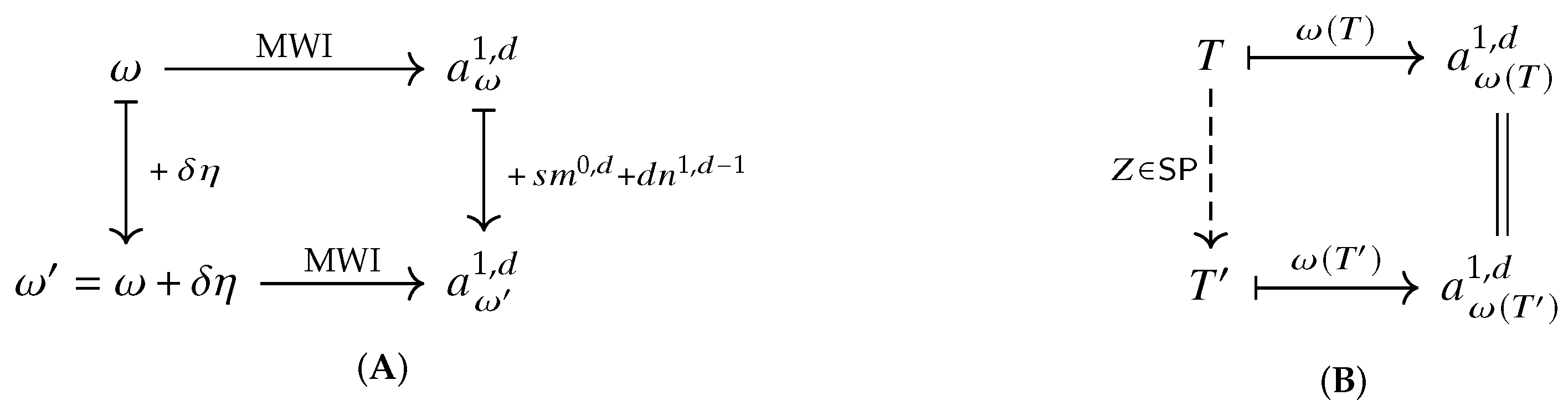
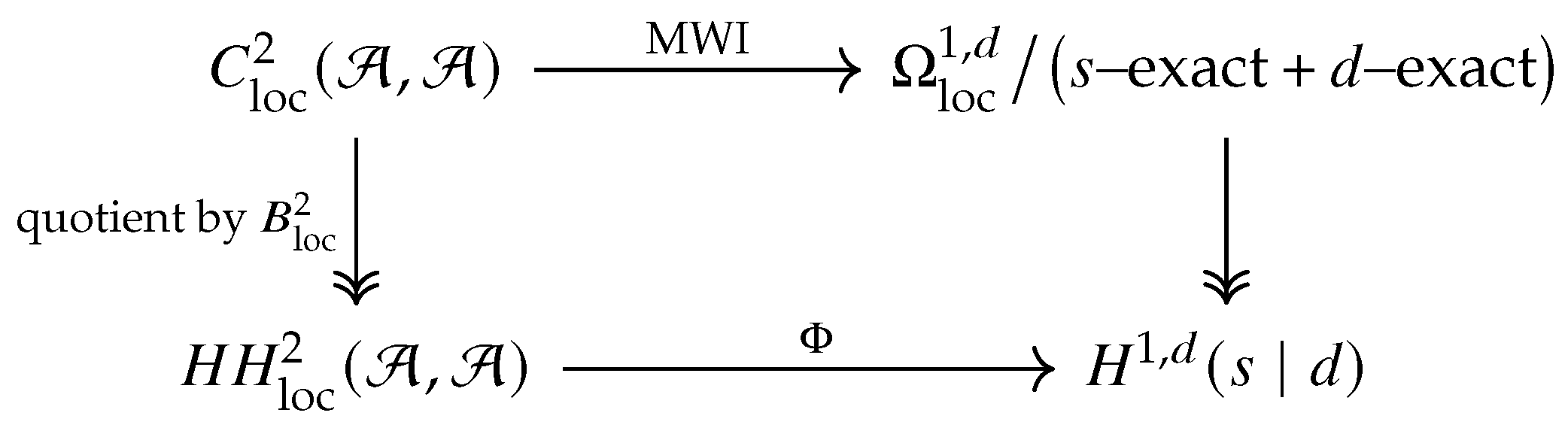
The following commuting diagrams (Figure 1 and Figure 2) summarize Proposition 7: independence of representative and independence of renormalization scheme within the Stuckelberg–Petermann orbit.
Figure 1.
Commutativity expressing the well-definedness of on cohomology classes and its independence of the renormalization scheme. (A) Coboundary invariance. Changing the representative shifts the anomaly density by BRST- and d-exact terms. Hence, and . (B) Scheme invariance. If is obtained from T by a Stückelberg–Petermann map Z, then in the local complex; therefore and .
Figure 2.
The map factors through the quotient by local Hochschild coboundaries on the domain and by BRST- and d-exact representatives on the codomain; the top arrow is induced by the anomalous MWI.
Sketch.
(i) If , then the corresponding insertion differs from by s- and d-exact local terms (see Proposition 6), so they define the same class in . (ii) The Main Theorem of Renormalization (Section 2.6) shows is obtained from T by a local SP map. At first order, this changes by a coboundary in and hence does not affect . □
- Homomorphism property.
Proposition 8.
The map Φ is a homomorphism of Abelian groups: .
Proof.
Linearity in of both the deformation and the induced insertion implies up to s- and d-exact terms, so cohomology classes add linearly. □
- Functoriality under embeddings.
Proposition 9.
The assignment is a natural transformation with respect to embeddings in the category of globally hyperbolic spacetimes. In particular, if is an embedding, then
where is the induced morphism of observable algebras.
Sketch.
Locality and covariance of (by definition of ) imply naturality of the deformation under embeddings. Since the anomalous MWI is functorial in the choice of background, the anomaly density transforms covariantly as well. Thus, commutes with . □
- Summary.
We have now defined rigorously, proved that it is well defined on local Hochschild cohomology, linear, and functorial with respect to spacetime embeddings. This makes precise the central claim of this section: an intrinsic algebraic curvature class canonically determines a BRST anomaly class in .
6.5. Gauge, Mixed, and Weyl Anomalies
- Abelian and non-Abelian gauge anomalies.
For a chiral Dirac field, the current sector of (Section 4.3) produces, via (49), a density proportional to the invariant polynomial in (with ghost C and curvature F), i.e., the standard consistent anomaly class. Adding the Bardeen–Zumino polynomial corresponds to changing the representative by d-exact terms, leaving the cohomology class unchanged [40]. The Fujikawa Jacobian realizes the same class at the path-integral level [46,47]. In particular, vanishes precisely when the usual representation-theoretic conditions for anomaly cancellation hold (trace constraints on cubic Casimirs, etc.) [39].
- Mixed gauge–gravitational and pure gravitational anomalies.
When background curvature is present, the local, covariant coefficients in (Section 4.3 and Section 4.4) generate mixed terms proportional to in ; in even dimensions of the form , one also finds pure gravitational anomalies for chiral matter, in agreement with the index-theoretic classification [5,39].
- Weyl (trace) anomalies.
Taking the BRST differential to be the Weyl differential , the same construction yields , where is the Weyl ghost, the Euler density (type A) and local Weyl invariants (type B), with coefficients determined by the curvature-dependent part of [43]. Again, different renormalization schemes (i.e., different representatives of ) shift by - and d-exact pieces without changing their class.
6.6. Descent and Index: Factoring Through Characteristic Classes
Let denote the space of invariant polynomials (Chern character, Pontryagin classes). In even dimension , the anomaly polynomial determines by descent a cocycle [41,42]. In our setting, the principal, curvature-dependent symbol of the local bidifferential operator defines an element of and the map factors as
up to s- and d-exact terms. This makes precise the statement that encodes the local index density data of the anomaly. The factorization is consistent with the BV formulation of the quantum master equation (QME) in pAQFT, where the anomaly is the obstruction to solving the renormalized QME and satisfies the same WZ condition [44,45,48].
6.7. Scheme Independence and One-Loop Exactness
Because is defined on Hochschild classes, finite renormalizations (i.e., changes Z of scheme) cannot change ; they only modify representatives by s- and d-exact terms (Proposition 6). Consequently, standard nonrenormalization results for consistent anomalies (e.g., Adler–Bardeen-type statements) are compatible with our picture: higher-order scheme changes shift by trivial cocycles but cannot alter their cohomology class [39]. This is mirrored on the MWI side, where violations can be removed by finite counterterms whenever the corresponding class vanishes; otherwise, an anomalous MWI holds with fixed [45].
6.8. Examples: Recovering Known Anomaly Structures
- ABJ anomaly in .
Take chiral fermions in a representation R of a compact gauge group. The current-sector cocycle of (31) produces, upon applying , the density
in agreement with consistent vs. covariant choices distinguished by Bardeen–Zumino polynomials [40,46,47].
- Weyl anomaly in .
For a conformally coupled scalar or a Dirac field, the curvature-dependent part of (Section 4.4) yields
with coefficients determined by the field content; the split into type A/B follows the geometric classification of [43].
6.9. Summary
The first-order, local associative deformation encoded by determines, through the anomalous MWI, a BRST anomaly class . Hochschild closedness yields WZ consistency, while Hochschild exactness produces a BRST-trivial anomaly. The curvature dependence of recovers the known geometric (index/characteristic-class) structure of gauge, mixed, and Weyl anomalies. Thus, the “algebraic curvature” provides an intrinsic AQFT origin for the anomaly cohomology and its observable consequences.
7. Phenomenological Applications: Calibration and Correlation Laws
In this section, we convert the first-order associative deformation
into quantitative, low-energy predictions. The analysis proceeds in three steps: (i) an effective-operator matching of the tensor structures induced by onto a standard low-energy basis for lepton–photon couplings; (ii) an RG evolution from a matching scale to the experimental scale; (iii) correlation laws among observables obtained by fixing the single small parameter in one channel and propagating to others. Throughout, we retain only the leading (linear) dependence on and impose the Ward–Takahashi identities as derived in Section 5, so that only transverse (gauge-invariant) form factors receive independent deformations.
Here, is a formal bookkeeping parameter that tracks the first-order part of a scheme-induced deformation; its “smallness” reflects that we truncate the expansion at (with consistency controlled by and higher-order obstructions in discussed in Section 8). The condition is not imposed by hand: it follows from associativity of the transported product and is the standard first-order Maurer–Cartan constraint in deformation theory.
7.1. Observables and Form-Factor Normalizations
For a charged Dirac lepton , the -covariant vertex function admits the decomposition
With on-shell renormalization, , and the anomalous magnetic moment and electric dipole moment are
The Ward identity fixes the longitudinal piece, leaving unconstrained and therefore available to receive contributions from (Section 5). We focus on and , which admit a compact effective-operator description.
7.2. From Algebraic Curvature to Effective Operators
The local, covariant cocycle constructed in Section 4 modifies time-ordered products with current insertions by contact terms that, after amputation, project onto the electromagnetic dipole structures. A convenient language is to match onto the SMEFT operator basis above the electroweak scale :
with the lepton doublet, the singlet, H the Higgs doublet, and the electromagnetic field-strength. (We assume hypercharge/weak dipoles have been rotated to the mass basis so that (52) captures the photon coupling after EWSB.) Electroweak symmetry breaking (EWSB) gives the LEFT operator
so that, comparing with (51),
In our framework, the Stückelberg–Petermann deformation induces these dipoles linearly in . It is therefore natural to write
with as a dimensionless “reduced” Wilson coefficient fixed by the local tensor content of in the current sector (cf. (29)–(31)). Combining (54) and (55),
Equation (56) is the basic “algebra → EFT → observable” map at the matching scale.
7.3. RG Evolution from to the Experimental Scales
The LEFT dipole coefficients run under QED/QCD renormalization. To leading-log accuracy,
where denote other LEFT/SMEFT Wilson coefficients that mix into the dipoles at one loop (four-fermion, Higgs–lepton, etc.). The solution is
with . In many scenarios, the mixing terms are subleading and one may take
All results below remain valid to this order by replacing in (56) with their running values at for and at the experimental scale for . (For a systematic SMEFT-to-LEFT evolution including operator mixing, see [49,50,51,52].)
7.4. Calibration of and Propagation
- Concreteness and testability.
The purpose of this section is not to propose a specific ultraviolet completion but to extract falsifiable correlations that follow from the cohomological organization of first-order deformations once a single calibration is chosen. In particular, Equations (61) and (63) give parameter-free relations (up to flavor texture assumptions) that can be confronted with improved measurements of , and EDM bounds.
Fix a reference channel, e.g., the muon anomalous magnetic moment. We use the experimentally measured muon anomalous magnetic moment as the calibration input, as reported by the BNL E821 experiment and the Fermilab Muon g–2 collaboration [53,54]. For the Standard Model prediction and the definition of the discrepancy, we refer to the current community theory evaluations [55]. Define the (experiment–SM) discrepancy (we keep it symbolic). At the scale ,
Inserting (60) into (56) yields parameter-free correlations:
In particular, (56) implies the EDM– phase relation
independent of and . Thus, any nonzero phase in the -induced dipole immediately correlates with .
7.5. Flavor Textures and Universal Correlation Laws
Equation (61) still depends on the flavor texture of . Two benchmark hypotheses capture broad classes of UV completions and are natural from the algebraic standpoint (they reflect whether the chirality flip is provided dominantly by the Higgs insertion or not):
- Texture U (flavor-universal). independent of ℓ. Then and :
- Texture Y (Yukawa-aligned/MFV). with . Then and :
These follow directly from (56) using and are stable under leading-log running because the QED anomalous dimensions are flavor universal.
7.6. Rigorous Statements and Proofs
We formalize the above as two propositions.
Proposition 10
(Phase–ratio relation). Let the deformed vertex satisfy the WTI of Section 5, and assume that the transverse dipole structures arise solely from the local cocycle ω via (55) with a single complex coefficient for flavor ℓ. Then, (63) holds, i.e.,
independent of Λ, ε, and RG improvement at the leading log.
Proof.
Proposition 11
(Flavor-scaling laws). Under Texture U (resp. Y), the ratios in Table 1 hold to the leading log.
Table 1.
Parameter-free correlations implied by the algebraic-curvature deformation, for two benchmark flavor textures of .
Proof.
In Texture U, is a common constant, so from (56) , , and the listed ratios follow. In Texture Y, , giving and . Universality of the anomalous dimensions ensures that running does not spoil ratios at the leading log. □
7.7. Uncertainty Propagation and Inference of
Let be calibrated with uncertainty . Denote by the predicted ratio in a chosen texture, and by the (possibly complex) ratio of reduced Wilson coefficients . Then
where and includes theoretical systematics from RG evolution and matching. Analogously, EDM predictions read
Given measurements (or upper bounds) on and , one can infer and up to texture assumptions by combining (60) and (63).
7.8. Beyond Dipoles: Additional Transverse Structures
While the dipole operator dominates low-energy, spin-flip observables, other transverse pieces can arise from :
- Anapole form factor (axialvector coupling), which contributes to parity-violating Møller and atomic observables. The cocycle components acting on axial currents generate local operators of the form in LEFT; these are suppressed by but can be relevant at Z-pole energies.
- Four-fermion operators mixing into under RG, e.g., ; their leading effect is encoded in the second line of (57) and is modeled by the same through the -tensor structure in the matter sector.
These additions preserve the correlation logic but introduce further (controlled) parameters if included in the same order.
7.9. Consistency Checks: Dimensions, Limits, and Decoupling
The map (56) is dimensionally consistent: , , and while . In the decoupling limit or , both and vanish linearly in (quadratically if Texture Y is enforced through Yukawa scaling). If the phase vanishes, , then as in (63). These properties are invariant under reparametrizations of the renormalization scheme because multiplies a class and observables depend only on through .
7.10. Illustrative Worked Example (Symbolic)
7.11. Remarks on Hadronic and SM Backgrounds
The map (56) concerns new contributions induced by . Standard Model (SM) backgrounds (QED, electroweak, hadronic) are additive and can be subtracted in defining the discrepancies . The hadronic vacuum polarization/light-by-light pieces are independent of and enter only through the input value of used for calibration; see [55,56] for comprehensive SM accounts. Our correlation laws are thus insensitive to the internal organization of the SM piece, provided a common convention is used across flavors.
7.12. Application to the Muon : Calibration and Predictions
The electron anomalous magnetic moment has been measured with extremely high precision; we refer to the most precise determinations in the literature [57,58].
We now specialize the general map of Equation (52) to the muon channel and propagate to other leptons. Define the (experiment–SM) discrepancy symbolically by (we do not use any external numeric input here). The calibration step is, at the scale ,
cf. Equation (56). Inserting this into Equation (52) gives parameter-free correlations:
For the EDMs, we use the phase–ratio relation (59):
Two benchmark flavor textures, both natural in the present framework, then, imply the following:
- Texture U (flavor-universal): .
- Texture Y (Yukawa-aligned/MFV): with .
These relations are derived entirely within the paper from Equations (52)–(59); no external numbers are needed. Importantly, the signs of and may differ here (depending on the relative phase of and ), which will become a key discriminator below.
7.13. Vector-Portal (“Dark-Photon”) Foil: Loop Structure, Scaling, and Discriminants
As a foil, consider a kinetically mixed vector of mass that couples as after the diagonalization of kinetic terms (we reserve for our algebraic-curvature deformation and write for the kinetic-mixing parameter). The one-loop contribution to the lepton anomaly is (vector coupling)
This integral is positive and yields the familiar limits
At the leading order with a pure vector coupling, does not induce an EDM (), since there is no CP-odd phase (CP–odd EDMs may arise only if additional CP-violating interactions are introduced beyond minimal kinetic mixing).
- Qualitative comparison to algebraic curvature.
- Sign structure. Curvature can accommodate either sign for (through ), and different flavors can in principle have opposite signs. The minimal vector gives a positive contribution to all ℓ.
- EDM correlation. Curvature predicts (Equation (59)), so a nonzero phase forces a correlated EDM. The minimal dark photon has at one loop. Hence, any robust nonzero aligned with favors curvature over a pure dark photon.
- Flavor correlations. Curvature gives the mass ratio laws in Section 7.12 (Texture U or Y). For a dark photon, the flavor pattern is governed by : with f the loop integral in (70).
- Discriminant table (derived properties).
| Algebraic Curvature (This Work) | Vector Portal (Foil) | |
| Scaling in coupling | ||
| EDM at leading order | (CP–even) | |
| Sign of | model–dependent (both signs allowed) | positive (vector) |
| Flavor pattern | mass–ratio laws (U or Y textures) | loop |
| On–shell signatures | none required (no mediator) | visible/missing–energy signals |
Thus, a simultaneous fit to , and EDM bounds, together with the absence of on-shell signals, naturally selects the algebraic curvature interpretation, whereas observation of a narrow vector resonance or of the loop pattern would point to the vector portal.
- Notation note. We use exclusively for the algebraic curvature deformation and for kinetic mixing to avoid confusion.
8. Limitations and Extensions
This section clarifies the precise scope of our results, formulates higher-order obstructions in the deformation problem, and outlines controlled extensions in three directions: (i) net-level and wedge-local deformations; (ii) operadic/factorization algebra lifts of the construction; (iii) gravitational and cosmological sectors, including a consistent decoupling scheme. Where possible, we give proofs or proof sketches that make the logical dependence on locality, covariance, and scaling degree explicit.
8.1. Scope and Standing Assumptions
All constructions up to now are formal, to first order in a bookkeeping parameter , within the perturbative algebraic framework (pAQFT) on globally hyperbolic spacetimes. We have the following:
- A local, covariant associative product deformation with ;
- Preservation of the ∗-structure and microcausality at under the hypotheses of Section 4;
- Compatibility with Ward–Takahashi identities (WTIs) at modulo local contact terms fixed by normalization, Section 5;
- Afunctorial map to local anomaly classes, Section 6.
The following subsections characterize how these statements generalize to higher orders, to other notions of locality (wedge locality), to higher-homotopy (operadic) structures, and to gravitational sectors.
8.2. Higher Orders: Maurer–Cartan Tower and Obstructions in
Let m denote the original associative product and recall the Gerstenhaber bracket . A formal deformation
is associative iff the Maurer–Cartan equation holds:
Theorem 3
(Second-order obstruction). Let be local and covariant. The class of the Gerstenhaber square in is the only obstruction to lifting the first-order deformation to the second order: there exists solving the equation in (72) iff in ; moreover, any two solutions differ by a Hochschild coboundary.
Sketch.
The equation is . The right-hand side is -closed by graded Jacobi and . Solvability requires it to be -exact; the obstruction lives in . Uniqueness mod is standard deformation theory à la Gerstenhaber. □
Proposition 12
Sketch.
Locality of follows from the microlocal extension arguments used for ; the ∗–compatibility is inherited if is built from preserving the causal unitarity normalization. The causal support analysis extends because only partial diagonals contribute at this order.
For a precise set of hypotheses under which such a local can be chosen, see Section 8.3. □
8.3. Hypotheses for the Existence of a Local
Proposition 12 established in sketch form that locality and the ∗–structure persist for provided a local solution to the Maurer–Cartan equation exists. We now record explicit hypotheses under which such a local can indeed be chosen.
Definition 1
(Local exactness of the obstruction). Let with . We say that the Gerstenhaber square is locally -exact if there exists a 2–cochain such that
Hypothesis 1
(Existence condition). Assume that
- (H1)
- ω is a local Hochschild 2 cocycle supported on diagonals, covariant under embeddings, and a biderivation modulo local contacts (as in Section 3.6);
- (H2)
- The obstruction is locally δ-exact in the sense above, i.e., with χ itself local and covariant.
Proposition 13
(Local existence of ). Under Hypothesis 1, there exists a local, covariant cochain such that
so that defines an associative product to order .
Proof.
By (H2) there exists with . Set . Then . Since is assumed local and covariant, so is . Associativity then follows from the standard Maurer–Cartan expansion to order . □
- Diagrammatic summary.
The content of Proposition 13 is summarized in Figure 3: the second-order obstruction lives in and a local lift exists precisely when this class is -exact within the local subcomplex. For clarity, Figure 4 rephrases the same statement at the level of cochain quotients, showing the induced obstruction map on .
Figure 3.
Diagrammatic summary of the obstruction map and the local exactness condition for lifting. See also Figure 4 for the induced map on local Hochschild cohomology.
Figure 4.
Obstruction as the induced map on . Compare with Figure 3 for the explicit lifting picture at the cochain level.
Remark 5.
Hypotheses (H1)–(H2) isolate the precise condition required for local solvability: it is not enough that vanish in the full Hochschild cohomology, but its trivialization must be accomplished within the local subcomplex . This ensures that the resulting preserves all structural axioms (locality, covariance, scaling bounds, ∗—compatibility). In general interacting models, establishing (H2) is a nontrivial problem; verifying it case by case (e.g., for free fields and low-order Wick monomials) is the natural first step toward higher-order consistency.
Remark 6
(Renormalization scheme dependence and ). At second and higher orders, different choices of local related by δ-exact shifts correspond to finite renormalizations and do not alter the cohomology class. The tower (72) can be read as a nested sequence of cohomological equations whose solvability determines the formal moduli of associative structures near m; see also the interpretation in Section 8.5.
8.4. Net-Level and Wedge-Local Deformations
The present deformation is formulated at the level of the algebra of microcausal functionals. It is natural to ask for net-level deformations preserving isotony and some notion of locality. Two well-developed paradigms are (i) Rieffel deformations of -algebras under -actions and (ii) warped convolutions producing wedge-local QFTs.
Definition 2
(Composed deformation). Let be a Haag–Kastler net, a strongly continuous action of by automorphisms, and is the Rieffel product for a skew form Θ. Define the composed product
i.e., first apply our local deformation ∗ (scheme change) and then the global Rieffel deformation.
Proposition 14
(First-order additivity). To first order in ε and Θ (small parameters), the composed product is associative, and its first-order cocycle is the sum of the cocycles:
In particular, wedge locality inherited from the warped convolution survives for .
Sketch.
Both deformations are implemented by formal automorphisms (Stückelberg–Petermann for ∗ and oscillatory integrals for ). Expanding to the first order in each parameter, the cross-term is of second order and can be dropped; associativity follows from the separate associativity to first order. □
Remark 7
(Drinfel’d twists and quantum symmetries). Alternatively, one may implement a twist of the symmetry Hopf algebra (Poincaré) by a Drinfel’d twist and let act on the net [59,60]. Our deformation is local and renormalization-driven rather than symmetry-driven; nevertheless, at first order the two can be superposed as in Proposition 14. Twisted Poincaré-invariant models provide explicit wedge-local realizations [61,62,63].
8.5. Operadic and Factorization-Algebra Lifts
The pAQFT time-ordered product endows local observables with a factorization structure; one can attempt to lift the deformation to the homotopy-coherent level. Let denote the operan that governs the algebras of observables (e.g., -type or a factorization algebra in the sense of Costello–Gwilliam).
Proposition 15
(Deformation complex and Maurer–Cartan). Let be the deformation complex of the -algebra of observables (a dg Lie algebra). Then the associative deformation problem (72) is controlled by an Maurer–Cartan element in whose linear term is the Hochschild cocycle ω; the higher brackets encode the obstructions in and beyond.
Sketch.
By general operadic deformation theory, deformations of an -algebra are governed by the convolution dg Lie algebra ; the linearization recovers Hochschild for associative and Harrison for commutative [64,65]. The pAQFT factorization structure identifies the relevant (locally, -type), placing as the first Taylor component of an solution. □
Remark 8
(Factorization homology and higher Hochschild). Higher Hochschild (Pirashvili) cohomology appears naturally for -algebras; the locality of ω indicates that the relevant classes live in topologically supported variants of Hochschild adapted to factorization algebras [66,67,68,69].
8.6. Hopf-Algebraic Renormalization and the Curvature Class
The Connes–Kreimer Hopf algebra of Feynman graphs organizes renormalization through the Birkhoff decomposition of characters with values in a Rota–Baxter algebra [70]. Let be the character induced by a renormalization scheme at scale and the counterterm-renormalized factorization.
Proposition 16
(Differentiating the Birkhoff factorization). The infinitesimal variation of the character under a local change of scheme induces a Hochschild 1-cochain η on ; its Hochschild coboundary reproduces the identity component of the local contact terms that define ω. Consequently, the curvature class can be extracted from the logarithmic derivative of the counterterm character modulo exact pieces.
Sketch.
Variations of correspond to variations of the projection onto polar/regular parts in the Rota–Baxter algebra; differentiating the convolution yields a derivation on amplitudes whose failure to be an inner derivation is captured by [71]. Locality ensures that only contact contributions survive, matching the identity terms in . □
8.7. Gravitational and Cosmological Sectors
We outline a consistent decoupling of gravitational sectors and state a no-go for “single-parameter universality” across matter and gravity.
- Two-parameter deformation.
Introduce a distinct gravitational deformation parameter so that the total product reads
where acts on composite operators involving the metric and curvature and is constrained by diffeomorphism covariance and scaling degree (dimensionful couplings).
Proposition 17
(Dimensional obstruction to universality). No choice of a single dimensionless parameter ε can produce scheme-independent, dimensionally consistent, nontrivial first-order correlations between (i) matter dipole observables (dimensionless , dimension EDMs) and (ii) purely gravitational composite quantities with a nonzero mass dimension (e.g., , curvature invariants) across all backgrounds.
Sketch.
Matter dipoles arise from operators of canonical dimension 5 (after EWSB) whose Wilson coefficients scale as . Gravitational composites involve curvature tensors with mass dimension 2 or higher. A single dimensionless multiplying a local cannot convert the dimensionless into a scale-independent prediction for, e.g., or without introducing explicit scales beyond . Since the scheme dependence cancels only within sectors of the same engineering dimension, cross-correlating sectors would either violate dimensional analysis or reintroduce scheme-dependent scales. Therefore, any nontrivial, universal correlation requires at least one additional dimensionful (or dimensionless) parameter controlling the gravitational deformation. □
- Decoupling and backreaction.
To the first order, one may consistently set when computing matter observables on fixed backgrounds; backreaction appears through corrections to the expectation value of and enters the semiclassical Einstein equations via local covariant counterterms. The anomaly map of Section 6 extends: Weyl anomalies lie in the image of but are controlled independently of . A compact summary of the main consistency conditions and extension avenues beyond first order is provided in Table 2.
Table 2.
Checklist of consistency conditions and extension avenues beyond first order.
8.8. Outlook of This Section
The first-order “algebraic curvature” picture is robust under several refinements: it nests coherently in the full Maurer–Cartan tower, it is composed with net-level (wedge-local) deformations, it admits an lift aligned with factorization algebra technology, and it decouples cleanly from gravity at leading order. The main technical challenges for future work are (i) identifying sufficient conditions for the local solvability of the obstruction in interacting models; (ii) constructing explicit higher-order counterterms that preserve the biderivation property relative to BRST; (iii) encoding in the Hopf-algebraic renormalization group in a way that makes contact with global geometric invariants beyond one loop.
9. Outlook and Conceptual Perspectives
This section synthesizes the picture that has emerged and places it within broader mathematical and physical frameworks. At its core, the present work argues that changes of renormalization prescription in perturbative AQFT define a flatness problem for an algebraic connection on the “bundle of products,” with a first-order curvature measured by a local Hochschild class . This algebraic curvature is functorially related to standard anomaly cohomology and feeds universal, low-energy correlations among transverse form factors. We now develop geometric, categorical, and information-theoretic viewpoints that motivate further developments and suggest concrete tests.
9.1. Geometry on the Renormalization Torsor
Let be the (infinite-dimensional) manifold of renormalization prescriptions T obeying the pAQFT axioms, factored by natural equivalences (local covariance, microlocal spectrum, etc.). The Stückelberg–Petermann group acts freely and transitively on each connected component of , making a torsor for . Let denote the space of associative products on compatible with the axioms (again modulo natural equivalences). Transport of the structure yields a principal -bundle ; at first order near T we may model by its Lie algebra of local 1-cochains.
Definition 3
(Algebraic renormalization connection). A choice of splitting the short exact sequence
(where and are local derivations and inner derivations, and is the Lie algebra of local Stückelberg–Petermann transformations) defines an Ehresmann connection on , with values in local derivations of .
Infinitesimally, a horizontal lift of a tangent vector picks a local ; the corresponding first-order product deformation is
computed in the full Hochschild complex. The fact that we work in the local subcomplex is crucial: while is a Hochschild coboundary globally, its class need not vanish when we restrict to cochains compatible with locality, covariance, and scaling (Section 3 and Section 4).
Proposition 18
(Curvature of the renormalization connection). Let be the curvature of . Evaluated on two tangent directions and projected to the local Hochschild complex, represents a class
which coincides (to the first order) with the algebraic curvature class constructed from the corresponding pair of local lifts . In particular, if and only if there exists a local gauge of π in which the product is constant along the given 2-plane in .
Sketch.
Given local lifts along , the commutator , and the difference of mixed partials produce a 2-cochain that equals the curvature of ; projecting to local cochains and using -functoriality identifies the class with that of the induced . □
This viewpoint clarifies the slogan “renormalization ambiguities carry curvature”: is the curvature of an algebra-valued connection on the bundle of associative structures. Flatness corresponds to the trivialization of scheme dependence by local inner automorphisms; nonzero curvature indicates a genuine obstruction, captured cohomologically.
9.2. Index Theory, Descent, and Anomaly Inflow
Section 6 constructed a homomorphism
sending to a BRST anomaly class via the anomalous Master Ward Identity. From the geometric standpoint, factors through the symbol of the local bidifferential operator and then through the Stora–Zumino descent associated with a characteristic class :
Here, denotes invariant polynomials on the gauge curvature (and Riemann curvature for gravitational anomalies). This makes explicit contact with the local index theorem: is the index density for a suitable family of Dirac-type operators [72,73], and the descent constructs the consistent anomaly. The inflow mechanism [74] then realizes as the boundary variation of a -dimensional invertible theory with Chern–Simons action built from .
Proposition 19
(Compatibility with anomaly inflow). Let be the characteristic form obtained from . The boundary variation of the -dimensional Chern–Simons functional with transgression form associated with reproduces up to s- and d-exact terms.
Sketch.
; a gauge variation is exact and integrates over the boundary to the Wess–Zumino consistent anomaly determined by the descent of [75]. The symbol map identifies the principal part of with , ensuring identical cohomology classes. □
9.3. Anomalies as Invertible Field Theories and Categorical Lifts
Modern treatments view anomalies as invertible -dimensional field theories classified by generalized cohomology groups [76,77]. From this perspective, the functor can be interpreted as a boundary map from local Hochschild data to the class of the bulk invertible theory. This suggests a categorical refinement: upgrading from an associative algebra to a factorization algebra (or -algebra) on spacetime and promoting to the first Taylor coefficient of an Maurer–Cartan element in the deformation complex (Section 8.5). The bulk invertible theory then appears as the “anomaly object” implementing the failure of strict functoriality; its cobordism class is determined by .
Remark 9
(Global anomalies). The discussion thus far concerns localanomalies. Global anomalies (e.g., Witten’s anomaly [78]) fit naturally into the invertible-TQFT picture via torsion classes in the relevant cobordism groups [76]. While detects local curvature, a full classification requires supplementing Φ with topological data; this lies beyond the local-Hochschild scope but is compatible with our framework when extended to the global setting.
9.4. Information Geometry, Modular Theory, and “Quantum Curvature”
Beyond symmetry/anomaly, the curvature encoded by resonates with quantum information geometry. Consider a smooth family of faithful states on a fixed local algebra . The Uhlmann connection on the bundle of purifications [79] defines a quantum parallel transport whose curvature captures mixed-state geometric phases and is closely related to monotone quantum metrics [80]. On the algebraic side, Tomita–Takesaki modular theory associates the modular operator and modular flow with ; variations in define a “modular connection” and associated susceptibilities (relative entropy Hessians) [81,82].
Proposition 20
(First-order compatibility with modular response). Let be the renormalization connection of Section 9.1. For a family of KMS states smooth in λ, the linear response of modular generators under a horizontal shift of is a local derivation, and its commutator across two horizontal directions agrees, to the first order, with the algebraic curvature class applied to modular Hamiltonians, modulo local counterterms.
Sketch.
Horizontal shifts correspond to local reparametrizations ; modular generators change by derivations implementing on local observables. The commutator of two such changes produces a bidifferential operator supported on diagonals, i.e., a representative of acting on the modular Hamiltonian density. Local counterterms arise from the ambiguity in choosing Wick polynomials and vanish in the class . □
This points to a unifying theme: algebraic curvature governs not only anomaly classes but also aspects of quantum geometric response, suggesting links to c-/a-functions (metric on theory space) and to constraints from monotonicity (e.g., Zamolodchikov’s metric in [83]).
9.5. Beyond Perturbation Theory and Low Dimensions
Nonperturbative constructions in low dimensions provide testing grounds. In dimensions, integrable models and factorizing S-matrices admit rigorous algebraic realizations; wedge-local fields can be constructed directly and deformed while preserving modular nuclearity. Embedding our first-order local deformation into such models—or using form-factor bootstrap to compute the induced shifts—would test robustness beyond perturbation theory. In higher dimensions, constructive progress remains challenging, but wedge-local deformations and operator-algebraic methods offer avenues for partial results (Haag–Kastler nets built from polarization-free generators, etc.).
9.6. Programmatic Experimental Targets
From Section 7, the most incisive predictions are as follows:
- EDM– phase relation (63): , robust under running and matching.
- Flavor-scaling laws (Table 1): distinguish Texture U (universal) from Texture Y (Yukawa-aligned) by comparing to and to .
- Parity-violating observables: anapole contributions controlled by axial pieces of can be probed in polarized Møller scattering and atomic parity violation; correlations with dipoles test the tensor decomposition of .
A near-term strategy is to calibrate in the muon channel and propagate to electron observables; improved bounds on and prospective muon EDM searches then constrain and thus the CP-odd sector of .
9.7. Open Problems and Roadmap
- Higher orders: Prove the existence of local solutions to the obstruction equations in (72) for interacting models and classify under pAQFT axioms.
- BRST compatibility: Construct preserving biderivation properties relative to the BRST differential beyond the first order; relate to the renormalized BV Quantum Master Equation.
- Bulk refinement: Define a functor from to the spectrum classifying invertible -dimensional field theories, making fully functorial (beyond the local symbol).
- Modular geometry: Develop a rigorous link between and modular Berry/Uhlmann curvature for families of local KMS states; explore monotonicity constraints.
- Nonperturbative tests: Implement first-order deformations in wedge-local/integrable models and compute observable shifts.
- Gravitational decoupling: Construct and analyze Weyl anomalies purely from algebraic curvature, including conditions for scheme independence in curved backgrounds.
9.8. Concluding Perspective
Renormalization ambiguities are often regarded as a technical nuisance; here, they acquire a geometric identity. The local Hochschild class is an algebraic curvature measured by the failure of scheme changes to be strictly inner when constrained by locality and covariance. It not only reproduces the familiar anomaly cohomology but also imprints universal signatures on low-energy amplitudes. The resulting picture—a connection on the space of products, with curvature feeding both anomalies and dipole correlations—suggests that geometry can and should organize the interface between microscopic definitions and macroscopic observables in quantum field theory.
For additional background and standard sources relevant to deformation/renormalization, Hopf-algebraic renormalization, and EFT phenomenology used as context in this work, see [84,85,86,87,88,89,90,91,92,93,94,95,96,97,98,99,100,101,102,103,104,105,106,107,108,109].
Funding
This research received no external funding.
Data Availability Statement
The original contributions presented in this study are included in the article. Further inquiries can be directed to the corresponding author.
Conflicts of Interest
Andrei Tudor Patrascu is an employee of FAST Foundation. The paper reflects the views of the scientist and not the company.
Appendix A. Microlocal Preliminaries and Explicit Constructions of ω
Appendix A.1. Wavefront Sets, Scaling Degree, and Microcausal Functionals
Let M be a globally hyperbolic spacetime with metric g and volume form . For , its wavefront set controls the singular directions of u [110,111]. A distribution is Hadamard if is contained in the set of pairs of lightlike covectors with future-directed behavior; the Hadamard two-point function and the Feynman parametrix obey this criterion.
The scaling degree of at 0 is
If , there exist extensions with ; non-uniqueness occurs when , with ambiguity spanned by for .
A microcausal functional F on the space of classical fields has functional derivatives with
ensuring well-defined star/time-ordered products with Hadamard two-point functions [112].
Appendix A.2. Free-Field Star Product, Time-Ordered Products, and EG Extension
For a Hadamard , define the bidifferential operator
and the star product , with pointwise multiplication. Time-ordered products are defined similarly with the Feynman parametrix :
Products of parametrices produce distributions singular on diagonals; extension to diagonals is performed by the Epstein–Glaser (EG) recursion governed by scaling degree. Ambiguities are local and of finite order.
Appendix A.3. Scalar Model: :ϕ2: and :ϕ3: Examples (Full Details)
Let with respect to .
- The calculation.
Wick’s theorem yields, for ,
The term has in , so and the extension is unique up to a linear combination . Thus
and, transporting via ,
- The calculation.
For ,
in , hence for the product , and the extension entails a single derivative order. A change in extension gives
- Cocycle check.
Define by via on Wick monomials. Then follows from the identity and the associativity of the transported product to ; explicitly, for three monomials ,
Each term is supported on (unions of) diagonals; away from diagonals, the Leibniz rule holds, and the alternating sum vanishes, while on diagonals, the EG extension preserves the Hochschild identity by construction.
Appendix A.4. Dirac Fields: Current–Field and Current–Current Products
Let be the Dirac Feynman kernel. For and ,
Extension at modifies the second term by local contributions:
so
For –,
and extension yields
The ∗-compatibility holds because intertwines adjunction (causal unitarity normalization).
Appendix A.5. Curvature Dependence via Hadamard Coefficients
On a curved background,
with smooth bidensities determined by transport equations; products and Dirac traces admit point-split expansions whose extensions differ by curvature polynomials multiplying derivatives of . Therefore, the coefficients in become local polynomials in and their derivatives with scaling fixed by .
Appendix B. Associativity to Second Order and Obstructions in HH 3
Appendix B.1. Gerstenhaber Calculus and the Maurer–Cartan Tower
Let m be the original product and . Associativity is equivalent to , which expands to
with .
Appendix B.2. Second-Order Obstruction and Locality
Theorem A1.
Let be local and covariant. A necessary and sufficient condition for the existence of a local solving is that the class of vanishes in .
Proof.
Necessity is immediate: if exists locally, is -exact in the local subcomplex. For sufficiency, assume with a local 2-cochain; then solves the equation and is local. Local covariance follows from the naturality of the EG extension and of . □
Appendix B.3. Preservation of ∗-Structure and Microcausality
If is chosen to preserve causal unitarity and field independence, then holds to . Microcausality persists because is supported on diagonals; commutators vanish at spacelike separation up to contact terms supported on measure-zero sets (which integrate to zero against test functions with separated supports).
Appendix B.4. Biderivations Modulo Contact Terms and WTIs
Assume obeys the biderivation identities modulo local contacts:
and similarly in the first argument. Then the first-order current algebra deforms by local terms only; the WTI is preserved to after normalization. At one needs compatibility between and BRST variations; this amounts to the MWI with anomaly controlled by the class of .
Appendix C. Anomalous Master Ward Identity in pAQFT
Appendix C.1. BV Setup and Renormalized Time-Ordered Products
Introduce fields , antifields , and the BV antibracket . Let S be the classical gauge-fixed action with , and the BRST differential. Renormalized time-ordered products act on local functionals of and obey causal factorization, microlocal spectrum, and locality.
Appendix C.2. Quantum Master Equation and the MWI
The renormalized Quantum Master Equation (QME) reads
with the renormalized BV Laplacian. In pAQFT, acts on local functionals and produces local contact terms [113,114]. For a time-ordered exponential , one has the Master Ward Identity (MWI)
The anomaly map is a Hochschild 1-cocycle on the time-ordered algebra and satisfies the Wess–Zumino condition at the level of densities.
Appendix C.3. Effect of the Product Deformation
Let ∗ be the deformed product , and the deformed time-ordered products (transported by Z). Then
with computed from the local contact terms generated by (explicit form (49) in the main text).
Proposition A1
(WZ consistency at first order). If and ω is a biderivation modulo contacts, then
with local; hence , the density associated with , is a representative of a class in .
Proof.
Apply s to the MWI for twice and use . The cross-term is a sum of local functionals supported on diagonals; causal factorization organizes them into a total derivative by the standard descent argument. Hochschild closedness of supplies the graded Jacobi identity needed for closure. □
Appendix C.4. Current WTIs as a Special Case
For Abelian currents, the MWI reduces to the ordinary WTI of Section 5 when restricted to background gauge transformations; the contact anomaly becomes the divergence of a local polynomial , which is absorbed by normalization of the conserved current.
Appendix D. SMEFT → LEFT Matching and RG Evolution for Dipoles
Appendix D.1. Warsaw Basis, Electroweak Breaking, and Photon Dipole
In the Warsaw basis, the lepton dipoles are
The effective Lagrangian at scale contains
After EWSB, and with , , so the photon dipole coefficient is
Matching onto LEFT yields
Appendix D.2. One-Loop Running in SMEFT (Symbolic Form)
At one loop, the SMEFT dipoles mix among themselves and with other operators (four-fermion, Higgs–lepton). Schematically,
where entries are polynomials in , etc. Using (A11), one finds the RGE for by rotation with .
Appendix D.3. QED Running in LEFT
Below EWSB and lepton thresholds, the QED+QCD running of dipoles is diagonal at leading log:
with denoting four-fermion and semileptonic operators that mix into dipoles. To the leading log and neglecting mixing,
These factors cancel in the EDM– ratio at the leading log.
Appendix D.4. Pipeline Summary
Starting from and a reduced Wilson coefficient at a large scale,
Appendix E. Phenomenological Tables, Units, and Uncertainty Propagation
Appendix E.1. Masses, Kinematic Factors, and Unit Conversions
We use PDG pole masses (to sufficient accuracy for our purposes):
Useful ratios:
In natural units, , . Hence, for EDMs in ,
With , the overall numerical factor is often absorbed into the definition of ; here we keep the compact proportionality form consistent with (63).
Appendix E.2. Texture Predictions in Terms of Δaμ
Let parametrize calibration and assume reduced coefficient ratios .
- Texture U (universal).
- Texture Y (Yukawa-aligned).
Appendix E.3. Uncertainty Propagation
Let be the uncertainty on and on . Then
For EDMs,
Appendix E.4. Illustrative Tables (Symbolic)

Table A1.
Parameter-free mass-scaling predictions.
Table A1.
Parameter-free mass-scaling predictions.
| Texture U | 1 | ||
| Texture Y |
References
- Adler, S.L. Axial-vector vertex in spinor electrodynamics. Phys. Rev. 1969, 177, 2426–2438. [Google Scholar] [CrossRef]
- Bell, J.S.; Jackiw, R. A PCAC puzzle: π0→γγ in the σ-model. Nuovo Cim. A 1969, 60, 47–61. [Google Scholar] [CrossRef]
- Duff, M.J. Twenty years of the Weyl anomaly. Class. Quantum Grav. 1994, 11, 1387–1404. [Google Scholar] [CrossRef]
- Wess, J.; Zumino, B. Consequences of anomalous Ward identities. Phys. Lett. B 1971, 37, 95–97. [Google Scholar] [CrossRef]
- Alvarez-Gaumé, L.; Witten, E. Gravitational anomalies. Nucl. Phys. B 1984, 234, 269–330. [Google Scholar] [CrossRef]
- Brunetti, R.; Fredenhagen, K. Microlocal analysis and interacting quantum field theories: Renormalization on physical backgrounds. Commun. Math. Phys. 2000, 208, 623–661. [Google Scholar] [CrossRef]
- Rejzner, K. Perturbative Algebraic Quantum Field Theory: An Introduction for Mathematicians; Mathematical Physics Studies; Springer: Berlin/Heidelberg, Germany, 2016. [Google Scholar]
- Hollands, S.; Wald, R.M. Local Wick polynomials and time ordered products of quantum fields in curved spacetime. Commun. Math. Phys. 2001, 223, 289–326. [Google Scholar] [CrossRef]
- Hollands, S.; Wald, R.M. Existence of local covariant time ordered products of quantum fields in curved spacetime. Commun. Math. Phys. 2002, 231, 309–345. [Google Scholar] [CrossRef]
- Stueckelberg, E.C.G.; Petermann, A. La normalisation des constantes dans la théorie des quanta. Helv. Phys. Acta 1953, 26, 499–520. [Google Scholar]
- Brunetti, R.; Dütsch, M.; Fredenhagen, K. Perturbative algebraic quantum field theory and the renormalization groups. Adv. Theor. Math. Phys. 2009, 13, 1541–1599. [Google Scholar] [CrossRef]
- Gerstenhaber, M. On the deformation of rings and algebras. Ann. Math. 1964, 79, 59–103. [Google Scholar] [CrossRef]
- Haag, R. Local Quantum Physics: Fields, Particles, Algebras, 2nd ed.; Springer: Berlin/Heidelberg, Germany, 1996. [Google Scholar]
- Brunetti, R.; Fredenhagen, K.; Verch, R. The generally covariant locality principle—A new paradigm for local quantum physics. Commun. Math. Phys. 2003, 237, 31–68. [Google Scholar] [CrossRef]
- Hörmander, L. The Analysis of Linear Partial Differential Operators I; Springer: Berlin/Heidelberg, Germany, 1983. [Google Scholar]
- Scharf, G. Finite Quantum Electrodynamics: The Causal Approach, 2nd ed.; Springer: Berlin/Heidelberg, Germany, 1995. [Google Scholar]
- Steinmann, O. Perturbation Expansions in Axiomatic Field Theory; Lecture Notes in Physics 11; Springer: Berlin/Heidelberg, Germany, 1971. [Google Scholar]
- Bär, C.; Fredenhagen, K. (Eds.) Quantum Field Theory on Curved Spacetimes: Concepts and Mathematical Foundations; Lecture Notes in Physics 786; Springer: Berlin/Heidelberg, Germany, 2009. [Google Scholar]
- Radzikowski, M.J. Micro-local approach to the Hadamard condition in quantum field theory on curved space-time. Commun. Math. Phys. 1996, 179, 529–553. [Google Scholar] [CrossRef]
- Hochschild, G. On the cohomology groups of an associative algebra. Ann. Math. 1945, 46, 58–67. [Google Scholar] [CrossRef]
- Cartan, H.; Eilenberg, S. Homological Algebra; Princeton University Press: Princeton, NJ, USA, 1956. [Google Scholar]
- Gerstenhaber, M. The cohomology structure of an associative ring. Ann. Math. 1963, 78, 267–288. [Google Scholar] [CrossRef]
- Nijenhuis, A.; Richardson, R.W., Jr. Cohomology and deformations in algebraic structures. Bull. Am. Math. Soc. 1966, 72, 1–29. [Google Scholar] [CrossRef]
- Loday, J.-L.; Vallette, B. Algebraic Operads; Grundlehren der Mathematischen Wissenschaften 346; Springer: Berlin/Heidelberg, Germany, 2012. [Google Scholar]
- Epstein, H.; Glaser, V. The role of locality in perturbation theory. Ann. Inst. H. Poincaré A 1973, 19, 211–295. [Google Scholar]
- Bayen, F.; Flato, M.; Fronsdal, C.; Lichnerowicz, A.; Sternheimer, D. Deformation theory and quantization. Ann. Phys. 1978, 111, 61–151. [Google Scholar] [CrossRef]
- Fedosov, B.V. A simple geometrical construction of deformation quantization. J. Diff. Geom. 1994, 40, 213–238. [Google Scholar] [CrossRef]
- Kontsevich, M. Deformation quantization of Poisson manifolds. Lett. Math. Phys. 2003, 66, 157–216. [Google Scholar] [CrossRef]
- Rieffel, M.A. Deformation Quantization for Actions of Rd; American Mathematical Society: Providence, RI, USA, 1993; Volume 106. [Google Scholar]
- Grosse, H.; Lechner, G. Wedge-local quantum fields and noncommutative Minkowski space. Commun. Math. Phys. 2007, 276, 491–508. [Google Scholar] [CrossRef]
- Buchholz, D.; Lechner, G.; Summers, S.J. Warped convolutions, Rieffel deformations and the construction of quantum field theories. Commun. Math. Phys. 2011, 304, 95–123. [Google Scholar] [CrossRef]
- Dappiaggi, C.; Hack, T.-P.; Pinamonti, N. The extended algebra of observables for Dirac fields and the trace anomaly of their stress-energy tensor. Rev. Math. Phys. 2009, 21, 1241–1312. [Google Scholar] [CrossRef]
- Zahn, J. The renormalized locally covariant Dirac field. Rev. Math. Phys. 2014, 26, 1330012. [Google Scholar] [CrossRef]
- Hollands, S. The operator product expansion for perturbative quantum field theory in curved spacetime. Commun. Math. Phys. 2007, 273, 1–36. [Google Scholar] [CrossRef]
- Hollands, S.; Wald, R.M. Quantum field theory in curved spacetime, the operator product expansion, and dark energy. Gen. Relativ. Gravit. 2008, 40, 2051–2059. [Google Scholar] [CrossRef]
- Ward, J.C. An identity in quantum electrodynamics. Phys. Rev. 1950, 78, 182. [Google Scholar] [CrossRef]
- Takahashi, Y. On the generalized Ward identity. Nuovo Cim. 1957, 6, 371–375. [Google Scholar] [CrossRef]
- Piguet, O.; Sorella, S.P. Algebraic Renormalization: Perturbative Renormalization, Symmetries and Anomalies; Lecture Notes in Physics Monographs 28; Springer: Berlin/Heidelberg, Germany, 1995. [Google Scholar]
- Barnich, G.; Brandt, F.; Henneaux, M. Local BRST cohomology in gauge theories. Phys. Rep. 2000, 338, 439–569. [Google Scholar] [CrossRef]
- Bardeen, W.A.; Zumino, B. Consistent and covariant anomalies in gauge and gravitational theories. Nucl. Phys. B 1984, 244, 421–453. [Google Scholar] [CrossRef]
- Mañes, J.; Stora, R.; Zumino, B. Algebraic study of chiral anomalies. Commun. Math. Phys. 1985, 102, 157–174. [Google Scholar] [CrossRef]
- Sorella, S.P. Algebraic characterization of the Wess–Zumino consistency conditions in gauge theories. Commun. Math. Phys. 1993, 157, 231–243. [Google Scholar] [CrossRef]
- Deser, S.; Schwimmer, A. Geometric Classification of Conformal Anomalies in Arbitrary Dimensions. Phys. Lett. B 1993, 309, 279–284. [Google Scholar] [CrossRef]
- Rejzner, K. BV quantization in perturbative algebraic QFT. arXiv 2020, arXiv:2004.14272. [Google Scholar]
- Brunetti, R.; Dütsch, M.; Fredenhagen, K.; Rejzner, K. Unitary, anomalous Master Ward Identity and its connections to the Wess–Zumino condition, BV formalism and L∞-algebras. Ann. Henri Poincaré 2024, 25, 2547–2583. [Google Scholar] [CrossRef]
- Fujikawa, K. Path-Integral Measure for Gauge-Invariant Fermion Theories. Phys. Rev. Lett. 1979, 42, 1195. [Google Scholar] [CrossRef]
- Fujikawa, K. Path integral for gauge theories with fermions. Phys. Rev. D 1980, 21, 2848, Erratum in: Phys. Rev. D 1980, 22, 1499.. [Google Scholar] [CrossRef]
- Fredenhagen, K.; Rejzner, K. Batalin–Vilkovisky formalism in perturbative algebraic quantum field theory. Commun. Math. Phys. 2013, 317, 697–725. [Google Scholar] [CrossRef]
- Grzadkowski, B.; Iskrzyński, M.; Misiak, M.; Rosiek, J. Dimension-Six Terms in the Standard Model Lagrangian. J. High Energy Phys. 2010, 10, 085. [Google Scholar] [CrossRef]
- Jenkins, E.E.; Manohar, A.V.; Trott, M. Renormalization Group Evolution of the Standard Model Dimension Six Operators I: Formalism and λ Dependence. J. High Energy Phys. 2013, 10, 087. [Google Scholar] [CrossRef]
- Jenkins, E.E.; Manohar, A.V.; Trott, M. Renormalization Group Evolution of the Standard Model Dimension Six Operators II: Yukawa Dependence. J. High Energy Phys. 2014, 1, 35. [Google Scholar] [CrossRef]
- Alonso, R.; Jenkins, E.E.; Manohar, A.V.; Trott, M. Renormalization Group Evolution of the Standard Model Dimension Six Operators III: Gauge Coupling Dependence and Phenomenology. J. High Energy Phys. 2014, 04, 159. [Google Scholar] [CrossRef]
- Bennett, G.W. Muon g–2 Collaboration. Final Report of the Muon E821 Anomalous Magnetic Moment Measurement at BNL. Phys. Rev. D 2006, 73, 072003. [Google Scholar] [CrossRef]
- Abi, B.; Muon g–2 Collaboration. Measurement of the Positive Muon Anomalous Magnetic Moment to 0.46 ppm. Phys. Rev. Lett. 2021, 126, 141801. [Google Scholar] [CrossRef]
- Aoyama, T.; Asmussen, N.; Benayoun, M.; Bijnens, J.; Blum, T.; Bruno, M.; Caprini, I.; Calame, C.M.C.; Cè, M.; Colangelo, G.; et al. The anomalous magnetic moment of the muon in the Standard Model. Phys. Rep. 2020, 887, 1–166. [Google Scholar] [CrossRef]
- Jegerlehner, F.; Nyffeler, A. The Muon g-2. Phys. Rep. 2009, 477, 1–110. [Google Scholar] [CrossRef]
- Hanneke, D.; Fogwell, S.; Gabrielse, G. New Measurement of the Electron Magnetic Moment and the Fine Structure Constant. Phys. Rev. Lett. 2008, 100, 120801. [Google Scholar] [CrossRef]
- Morel, L.; Yao, Z.; Cladé, P.; Guellati-Khélifa, S. Determination of the fine-structure constant with an accuracy of 81 parts per trillion. Nature 2020, 588, 61–65. [Google Scholar] [CrossRef]
- Drinfel’d, V.G. Quantum groups. In Proceedings of the International Congress of Mathematicians, Berkeley, CA, USA, 3–11 August 1986; Volume 1, pp. 798–820. [Google Scholar]
- Majid, S. Foundations of Quantum Group Theory; Cambridge University Press: Cambridge, MA, USA, 1995. [Google Scholar]
- Aschieri, P.; Blohmann, C.; Dimitrijević, M.; Meyer, F.; Schupp, P.; Wess, J. A gravity theory on noncommutative spaces. Class. Quantum Grav. 2005, 22, 3511–3532. [Google Scholar] [CrossRef]
- Chaichian, M.; Kulish, P.P.; Nishijima, K.; Tureanu, A. On a Lorentz-invariant interpretation of noncommutative space-time and its implications on noncommutative QFT. Phys. Lett. B 2004, 604, 98–102. [Google Scholar] [CrossRef]
- Lechner, G. Construction of quantum field theories with factorizing S-matrices. Commun. Math. Phys. 2008, 277, 821–860. [Google Scholar] [CrossRef]
- Markl, M.; Shnider, S.; Stasheff, J. Operads in Algebra, Topology and Physics; Mathematical Surveys and Monographs 96; American Mathematical Society (AMS): Providence, RI, USA, 2002. [Google Scholar]
- Getzler, E. Lie theory for nilpotent L∞-algebras. Ann. Math. 2009, 170, 271–301. [Google Scholar] [CrossRef]
- Pirashvili, T. Hodge decomposition for higher order Hochschild homology. Ann. Sci. Éc. Norm. Supér. 2000, 33, 151–179. [Google Scholar] [CrossRef]
- Ginot, G. Higher order Hochschild cohomology. C. R. Math. Acad. Sci. Paris 2008, 346, 625–628. [Google Scholar] [CrossRef]
- Ayala, D.; Francis, J. Factorization homology of topological manifolds. J. Topol. 2015, 8, 1045–1084. [Google Scholar] [CrossRef]
- Costello, K.; Gwilliam, O. Factorization Algebras in Quantum Field Theory; Cambridge University Press: Cambridge, MA, USA, 2016; Volume 1. [Google Scholar]
- Connes, A.; Marcolli, M. Noncommutative Geometry, Quantum Fields and Motives; AMS Colloquium Publications 55; American Mathematical Society (AMS): Providence, RI, USA, 2007. [Google Scholar]
- Ebrahimi-Fard, K.; Guo, L.; Kreimer, D. Spitzer’s identity and the algebraic Birkhoff decomposition in pQFT. J. Phys. A 2004, 37, 11037–11052. [Google Scholar] [CrossRef]
- Atiyah, M.F.; Singer, I.M. The index of elliptic operators I. Ann. Math. 1968, 87, 484–530. [Google Scholar] [CrossRef]
- Berline, N.; Getzler, E.; Vergne, M. Heat Kernels and Dirac Operators; Springer: Berlin/Heidelberg, Germany, 1992. [Google Scholar]
- Callan, C.G., Jr.; Harvey, J.A. Anomalies and fermion zero modes on strings and domain walls. Nucl. Phys. B 1985, 250, 427–436. [Google Scholar] [CrossRef]
- Zumino, B. Chiral anomalies and differential geometry. In Relativity, Groups and Topology II; Les Houches 1983; DeWitt, B.S., Stora, R., Eds.; North-Holland: Amsterdam, The Netherlands, 1984. [Google Scholar]
- Freed, D.S. Anomalies and invertible field theories. Proc. Symp. Pure Math. 2014, 88, 25–45. [Google Scholar]
- Freed, D.S.; Hopkins, M.J. Reflection positivity and invertible topological phases. Geom. Topol. 2021, 25, 1165–1330. [Google Scholar] [CrossRef]
- Witten, E. Global gravitational anomalies. Commun. Math. Phys. 1985, 100, 197–229. [Google Scholar] [CrossRef]
- Uhlmann, A. Parallel transport for density matrices. Rep. Math. Phys. 1986, 24, 229–240. [Google Scholar] [CrossRef]
- Petz, D. Monotone metrics on matrix spaces. Linear Algebra Appl. 1996, 244, 81–96. [Google Scholar] [CrossRef]
- Araki, H. Relative entropy of states of von Neumann algebras. Publ. RIMS Kyoto 1976, 11, 809–833. [Google Scholar] [CrossRef]
- Bratteli, O.; Robinson, D.W. Operator Algebras and Quantum Statistical Mechanics II, 2nd ed.; Springer: Berlin/Heidelberg, Germany, 1997. [Google Scholar]
- Zamolodchikov, A.B. Irreversibility of the flux of the renormalization group in a 2D field theory. JETP Lett. 1986, 43, 730–732. [Google Scholar]
- Beilinson, A.; Drinfeld, V. Chiral Algebras; AMS Colloquium Publications 51; American Mathematical Society (AMS): Providence, RI, USA, 2004. [Google Scholar]
- Lurie, J. On the Classification of Topological Field Theories. Curr. Dev. Math. 2008, 2008, 129–280. [Google Scholar] [CrossRef]
- Bogoliubov, N.N.; Parasiuk, O.S. On the multiplication of the causal function in the quantum theory of fields. Acta Math. 1957, 97, 227–266. [Google Scholar]
- Hepp, K. Proof of the Bogoliubov-Parasiuk theorem on renormalization. Commun. Math. Phys. 1966, 2, 301–326. [Google Scholar] [CrossRef]
- Zimmermann, W. Convergence of Bogoliubov’s method of renormalization in momentum space. Commun. Math. Phys. 1969, 15, 208–234. [Google Scholar] [CrossRef]
- Connes, A.; Kreimer, D. Hopf algebras, renormalization and noncommutative geometry. Commun. Math. Phys. 1998, 199, 203–242. [Google Scholar] [CrossRef]
- Connes, A.; Kreimer, D. Renormalization in quantum field theory and the Riemann–Hilbert problem I: The Hopf algebra structure of graphs and the main theorem. Commun. Math. Phys. 2000, 210, 249–273. [Google Scholar] [CrossRef]
- Bogoliubov, N.N.; Shirkov, D.V. Introduction to the Theory of Quantized Fields; Wiley–Interscience: Hoboken, NJ, USA, 1959. [Google Scholar]
- Peierls, R. The commutation laws of relativistic field theory. Proc. R. Soc. Lond. A 1952, 214, 143–157. [Google Scholar] [CrossRef]
- Peskin, M.E.; Schroeder, D.V. An Introduction to Quantum Field Theory; Addison–Wesley: Boston, MA, USA, 1995. [Google Scholar]
- D’Ambrosio, G.; Giudice, G.F.; Isidori, G.; Strumia, A. Minimal Flavor Violation: An Effective Field Theory Approach. Nucl. Phys. B 2002, 645, 155–187. [Google Scholar] [CrossRef]
- Pospelov, M.; Ritz, A. Electric dipole moments as probes of new physics. Ann. Phys. 2005, 318, 119–169. [Google Scholar] [CrossRef]
- Engel, J.; Ramsey-Musolf, M.J.; van Kolck, U. Electric Dipole Moments of Nucleons, Nuclei, and Atoms: The Standard Model and Beyond. Prog. Part. Nucl. Phys. 2013, 71, 21–74. [Google Scholar] [CrossRef]
- Chupp, T.; Fierlinger, P.; Ramsey-Musolf, M.; Singh, J. Electric Dipole Moments of Atoms, Molecules, Nuclei, and Particles. Rev. Mod. Phys. 2019, 91, 015001. [Google Scholar] [CrossRef]
- Gerstenhaber, M. On the deformation of rings and algebras II. Ann. Math. 1966, 84, 1–19. [Google Scholar] [CrossRef]
- Gerstenhaber, M. On the deformation of rings and algebras III. Ann. Math. 1968, 88, 1–34. [Google Scholar] [CrossRef]
- Gerstenhaber, M. On the deformation of rings and algebras IV. Ann. Math. 1974, 99, 257–276. [Google Scholar] [CrossRef]
- Gerstenhaber, M. On the deformation of rings and algebras V. Ann. Math. 1974, 99, 277–301. [Google Scholar] [CrossRef]
- Yekutieli, A. Deformation Quantization in Algebraic Geometry. Adv. Math. 2005, 198, 383–432. [Google Scholar] [CrossRef]
- Kontsevich, M. Deformation quantization of Poisson manifolds, I. In ICM 1998 Proceedings; Birkhäuser: Basel, Switzerland, 1998. [Google Scholar]
- Fredenhagen, K.; Rejzner, K. Perturbative algebraic quantum field theory. In Mathematical Aspects of Quantum Field Theories; Springer: Berlin/Heidelberg, Germany, 2015. [Google Scholar]
- Brivio, I.; Trott, M. The Standard Model as an Effective Field Theory. Phys. Rep. 2019, 793, 1–98. [Google Scholar] [CrossRef]
- Aebischer, J.; Brivio, I.; Celis, A.; Evans, J.A.; Jiang, Y.; Kumar, J.; Pan, X.; Porod, W.; Rosiek, J.; Shih, D.; et al. WCxf: An exchange format for Wilson coefficients beyond the Standard Model. Comput. Phys. Commun. 2018, 232, 71–83. [Google Scholar] [CrossRef]
- Manohar, A.V.; Wise, M.B. Heavy Quark Physics; Cambridge Monographs on Particle Physics; Cambridge University Press: Cambridge, MA, USA, 2000. [Google Scholar]
- Particle Data Group. Review of Particle Physics. Prog. Theor. Exp. Phys. 2024, 2024, 083C01. [Google Scholar]
- Marciano, W.J.; Masiero, A.; Paradisi, P.; Passera, M. Contributions to aμ in and beyond the Standard Model. In Lepton Dipole Moments; World Scientific: Singapore, 2010. [Google Scholar]
- Hörmander, L. The Analysis of Linear Partial Differential Operators II; Springer: Berlin/Heidelberg, Germany, 1983. [Google Scholar]
- Duistermaat, J.J. Fourier Integral Operators; Birkhäuser: Basel, Switzerland, 1996. [Google Scholar]
- Khavkine, I.; Moretti, V. Algebraic QFT in curved spacetime and microlocal analysis. In Advances in Algebraic Quantum Field Theory; Springer: Berlin/Heidelberg, Germany, 2015. [Google Scholar]
- Hollands, S.; Wald, R.M. Quantum field theory in curved spacetime, the operator product expansion, and perturbative quantum gravity. Commun. Math. Phys. 2010, 293, 85–125. [Google Scholar] [CrossRef]
- Rejzner, K. Perturbative Algebraic Quantum Field Theory; Springer Briefs in Mathematical Physics; Springer: Berlin/Heidelberg, Germany, 2016. [Google Scholar]
Disclaimer/Publisher’s Note: The statements, opinions and data contained in all publications are solely those of the individual author(s) and contributor(s) and not of MDPI and/or the editor(s). MDPI and/or the editor(s) disclaim responsibility for any injury to people or property resulting from any ideas, methods, instructions or products referred to in the content. |
© 2026 by the author. Licensee MDPI, Basel, Switzerland. This article is an open access article distributed under the terms and conditions of the Creative Commons Attribution (CC BY) license.