1. Introduction
The search for a quantum theory of gravity has traditionally begun from a single, rarely questioned premise: that the spacetime metric of general relativity is a fundamental field which must be quantized. This premise underlies canonical quantization, loop variables, spin foams, string theory, causal sets, and related approaches [
1,
2,
3,
4,
5]. Yet no observation has ever revealed quantum excitations of the metric, discrete geometric spectra, or gravitons in the same empirical sense that photons, phonons, or other collective quanta appear in their respective domains [
6]. Several persistent conceptual difficulties in quantum gravity—including the problem of time, perturbative nonrenormalizability, and the absence of local gauge-invariant observables—can be reinterpreted as indications that the metric may be a macroscopic, rather than microscopic, variable [
7,
8,
9].
This perspective aligns with a broad and growing body of work suggesting that spacetime geometry functions as a collective or hydrodynamic descriptor, analogous to pressure, density, or strain in condensed-matter systems. Quantizing such variables can be formally carried out, but it does not describe the underlying microscopic degrees of freedom. In this view, attempts to quantize the metric are not inconsistent, but may be physically misdirected. Emergent-gravity frameworks—including induced gravity, thermodynamic and entropic approaches, and analog-gravity models—reinforce this interpretation by treating geometry as an effective description of deeper dynamics rather than a fundamental entity [
10,
11,
12,
13,
14].
A common conceptual obstacle faced by emergent-spacetime programs deserves clarification. It is natural to imagine spacetime as a pre-existing stage in which fields and particles reside, and therefore difficult to accept that spacetime itself might arise from a deeper physical substrate. Even when one speaks of a “spacetime medium,” intuition tends to picture something embedded within space, as a fluid exists within a container. This picture is misleading. In emergent frameworks, the substrate is not a substance inside spacetime; rather, the familiar relativistic arena is the large-scale, collective behavior of that substrate [
15,
16]. Observers, matter, and interactions all arise within the same effective spacetime, and therefore experience local physics exactly as in conventional relativity.
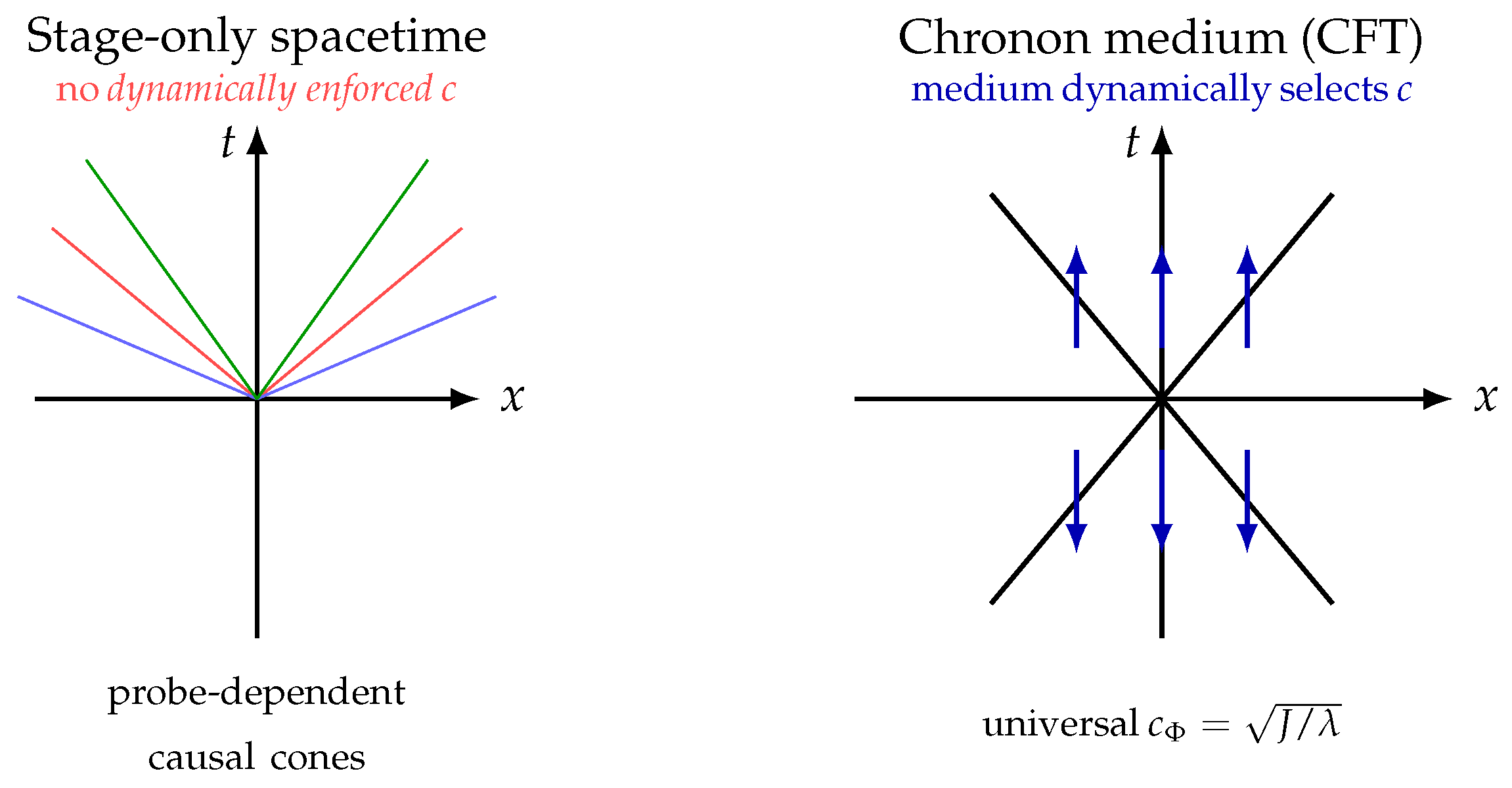
This distinction is crucial for understanding the origin of the invariant speed of light. In a purely geometric “stage-only” spacetime, nothing enforces a universal causal cone: different probes could, in principle, propagate at different limiting speeds depending on their coupling to the background structure. By contrast, a dynamical substrate naturally selects a unique characteristic propagation speed shared by all its excitations. In such a framework, the invariant speed is not imposed as a postulate of geometry, but emerges as a constitutive property of the underlying medium [
12,
17]. This mechanism is illustrated schematically in
Figure 1.
In this work we develop one concrete realization of this idea, termed Chronon Field Theory (ChFT). ChFT is built on a single dynamical field, a smooth unit timelike covector
, governed by a variational principle called the Temporal Coherence Principle (TCP). The TCP posits that local causal directions tend to align, and assigns an energetic cost to misalignment, in close analogy with nonlinear sigma models and alignment phenomena in condensed-matter systems [
18,
19]. Importantly, ChFT does not assume a spacetime metric a priori. Instead, the metric, causal structure, and invariant speed emerge dynamically from the coherent phase of
[
20].
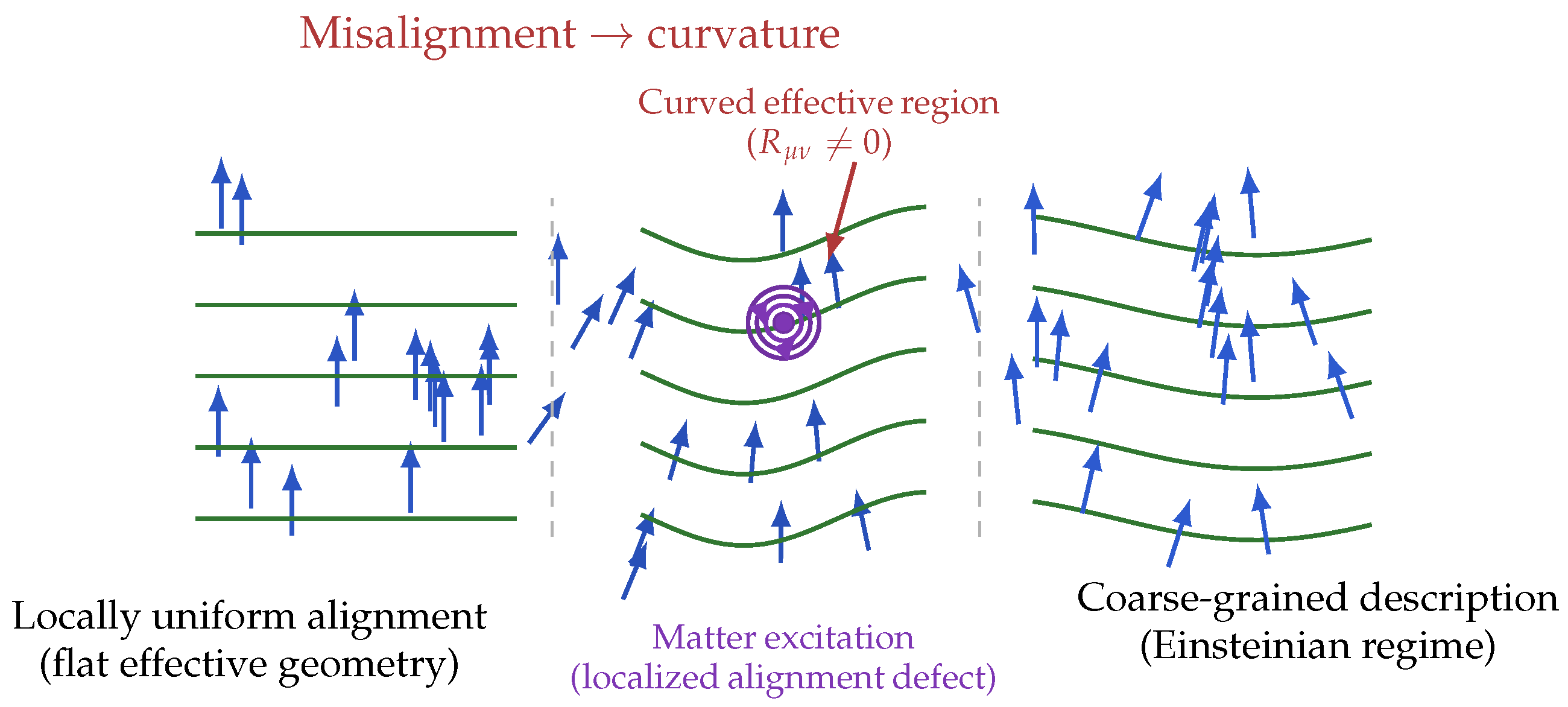
In appropriate long-wavelength and low-vorticity limits, the TCP equation reproduces a wide range of familiar physical laws. The Einstein field equations arise as the hydrodynamic response of the aligned causal medium [
11,
21]; Schrödinger-type quantum evolution emerges from the phase-coherent, paraxial regime of chronon excitations [
22,
23,
24,
25]; and Navier–Stokes-type equations describe slow relaxation of misalignment [
26,
27].
Gauge-field-like structures arise at the level of transverse phase and polarization holonomy, providing a natural setting for effective gauge connections. The present work focuses on the emergence of spacetime geometry, universal causal structure, and quantum phase dynamics; a detailed derivation of specific gauge groups and matter representations lies outside its scope and is left to future work and companion papers.
Although the chronon field
selects a preferred local causal direction at the microscopic level, ChFT does not predict observable violations of Lorentz invariance. This is ensured by the Co-Moving Concealment Principle (CCP): all propagating excitations, clocks, and measuring devices arise from, and propagate within, the same chronon medium. Because the emergent metric is constructed from
itself, every observer samples the same local causal structure. As a result, the preferred direction is dynamically hidden, and local Lorentz invariance is preserved operationally [
17,
28]. The physical content of this principle is discussed in detail in
Section 7.
The purpose of the present paper is therefore not to propose a new method for quantizing spacetime geometry, but to explore the consequences of treating geometry as an emergent, macroscopic variable. Within this perspective, the long-standing tension between general relativity and quantum mechanics is reframed: the two theories appear as complementary effective descriptions of a single underlying causal medium, valid in different coherence and wavelength regimes [
9,
13]. The central claims investigated here are the following: (i) spacetime geometry need not be quantized because it is not fundamental, and (ii) a unified description of gravity and quantum dynamics follows naturally once the underlying causal substrate is modeled explicitly.
The remainder of the paper is organized as follows.
Section 2 explains why the quantization of geometry is not physically compelled.
Section 3 introduces the chronon field and the Temporal Coherence Principle (TCP).
Section 4 derives emergent gravitational dynamics.
Section 5 discusses the universality of
c.
Section 6 describes the emergence of quantum dynamics from chronon coherence.
Section 7 addresses Lorentz invariance and the Co-Moving Concealment Principle.
Section 8 discusses phenomenological consequences and observational constraints.
Section 9 positions the framework relative to existing approaches, and
Section 10 summarizes the results and outlines future directions. Essential technical details are presented in
Appendix A,
Appendix B and
Appendix C.
2. Why Geometry Need Not Be Quantized
The widespread expectation that gravity must be quantized arises from extending canonical quantization to the spacetime metric [
1]. This expectation is natural, but it is not logically compelled. It presumes that metric
is a microscopic dynamical field on the same footing as gauge fields or matter degrees of freedom. In this section we present three complementary lines of reasoning suggesting that the metric is instead a macroscopic, collective variable, and therefore not an appropriate target for fundamental quantization: (i) geometry behaves as an emergent descriptor of underlying dynamics, (ii) no experiment has revealed quantum features of spacetime geometry, and (iii) the perturbative nonrenormalizability of general relativity is characteristic of effective, rather than microscopic, variables [
9,
29].
2.1. Geometry as a Collective Variable
In many-body physics, continuum quantities such as pressure, temperature, strain, and vorticity summarize the large-scale organization of microscopic constituents. These variables are indispensable for macroscopic description, yet they do not correspond to independent microscopic degrees of freedom. Although such fields can be formally quantized, doing so does not reveal the true underlying dynamics. Instead, the resulting theories typically lack a clear microscopic interpretation [
26,
30].
We argue that the spacetime metric plays a similar role. The tensor
encodes the coarse-grained causal and geometric structure of an underlying physical system that governs signal propagation and dynamical response. Curvature, in this view, reflects spatial and temporal variation in that underlying structure, much as elastic strain reflects the collective deformation of a solid. Geometry therefore functions as a hydrodynamic or collective descriptor, not as a fundamental microscopic field [
15,
16].
This interpretation is consistent with a wide range of emergent-gravity ideas. Sakharov’s induced gravity [
10], Jacobson’s thermodynamic derivation of the Einstein equation [
11], analog-gravity models [
12,
14], and entropic or thermodynamic approaches to spacetime dynamics [
13] all treat the metric as an effective construct arising from deeper degrees of freedom. Across these frameworks, the metric does not appear as a primary variable, but as a collective quantity encoding the macroscopic response of an underlying substrate.
Chronon Field Theory (ChFT) makes this structure explicit. The fundamental field is the smooth timelike covector
, while the spacetime metric and curvature arise from the coherent organization of
over large scales [
20]. From this perspective, quantizing
would be analogous to quantizing the temperature field of a fluid: formally possible, but physically misdirected.
2.2. Absence of Experimental Evidence for Quantized Geometry
Despite decades of increasingly precise experimental and observational efforts, no empirical evidence has been found for quantized spacetime geometry, discrete geometric spectra, or quantum excitations of the metric. This absence is striking given the ubiquity of quantum collective phenomena in other domains of physics.
A number of representative examples illustrate this point. Interferometric experiments, including LIGO, VIRGO, GEO600, and atom interferometers, show no sign of Planck-scale stochastic fluctuations or spacetime “foam” at sensitivities far beyond those predicted by simple discrete-geometry models [
31,
32,
33]. Precision tests of Lorentz invariance, using cosmic rays, gamma-ray bursts, blazar spectra, and high-energy neutrinos, reveal no dispersion anomalies down to extremely small fractional levels [
34,
35,
36]. Polarization measurements from distant astrophysical sources place very tight bounds on vacuum birefringence and metric-induced anisotropies [
37,
38].
Equally notable is the absence of any direct or indirect signature of gravitons as quanta of the spacetime metric, despite the widespread observation of analogous quanta—such as phonons and magnons—in other collective systems [
6]. While these results do not exclude quantum gravity in principle, they strongly suggest that spacetime remains smooth down to the smallest scales currently accessible, consistent with the interpretation of geometry as an emergent, macroscopic field.
2.3. Nonrenormalizability as a Diagnostic of Emergence
Perturbative quantization of the Einstein–Hilbert action leads to a nonrenormalizable theory, with new divergences appearing at each loop order [
39,
40]. Rather than signaling a fundamental inconsistency, this behavior is familiar from effective field theories: nonrenormalizability typically indicates that the chosen variables are not the true microscopic degrees of freedom [
29,
41].
Quantizing collective variables in condensed-matter systems provides a direct analogy. Attempting to quantize fluid velocity or elastic strain results in nonrenormalizable theories precisely because those fields describe coarse-grained organization rather than underlying constituents [
30]. General relativity exhibits the same structural feature. Its ultraviolet divergences arise because the metric encodes macroscopic causal organization, not microscopic dynamics.
From this viewpoint, the difficulty of quantizing gravity is not a failure of quantization itself, but a diagnostic that the metric is an emergent variable. Once the underlying degrees of freedom are identified—as in analog-gravity systems, thermodynamic derivations, or, in the present work, the chronon field—the demand to quantize geometry loses its physical motivation.
In ChFT, the fundamental dynamics are formulated directly in terms of . The spacetime metric emerges only after coarse-graining the alignment dynamics of the chronon field, and the quartic vorticity term in the TCP Lagrangian introduces a natural coherence scale that regularizes short-distance behavior. General relativity therefore appears as a long-wavelength effective theory, and its nonrenormalizability is reinterpreted as a signature of emergence rather than a fundamental obstruction.
2.4. Why Geometry Cannot Support Quantum Behavior
A deeper reason why spacetime geometry should not be quantized is that the metric does not support the structural features that underlie quantization in known physical systems. Across condensed-matter physics, quantum behavior is invariably associated with the existence of stable, localized, topologically protected excitations carrying a finite minimum action or circulation—such as vortices in superfluids, flux tubes in superconductors, or solitons stabilized by higher-order gradient terms [
12,
19,
42]. These structures provide the root cause of quantization, including the appearance of discrete spectra and universal action units.
By contrast, the spacetime metric
admits no known mechanism for supporting localized, topologically stable minimum-action excitations. Purely geometric degrees of freedom lack conserved topological charges whose stability would enforce quantization, and no analog of a protected defect, vortex, or soliton exists in the metric sector itself [
43,
44]. As a result, there is no structural basis for associating the metric with a quantum of action or a discrete excitation spectrum.
This observation aligns with the absence of empirical evidence for gravitons or quantized geometric modes, and with the long-standing difficulties faced by metric quantization approaches [
29,
40]. In Chronon Field Theory, by contrast, quantization arises naturally from stable vorticity defects of the causal-alignment field, whose existence and minimum action are ensured by the quartic stabilization term. Quantum behavior thus originates in the underlying causal medium, while the metric emerges only as a coarse-grained descriptor incapable of supporting quantum dynamics on its own, consistent with the Real–Now–Front quantum foundations framework [
25].
2.5. Why Spacetime Can Be Treated as an Emergent Medium
Treating spacetime as an emergent medium rather than a fundamental stage may at first appear unconventional, yet this perspective offers a natural explanatory framework for several striking features of relativistic physics. In Chronon Field Theory, the notion of a “medium” does not refer to a substance embedded in spacetime, nor to a detectable preferred frame, but to a set of underlying degrees of freedom whose coherent organization gives rise to effective geometric and causal relations at macroscopic scales [
14,
15].
2.5.1. Universality of the Invariant Speed
One of the most robust empirical facts in modern physics is the existence of a single invariant propagation speed shared by all massless probes, including photons, gravitational waves, and effectively massless neutrinos [
32,
45]. Within a purely kinematic or stage-based description of spacetime, this universality is imposed as an axiom. In a medium-based emergent framework, by contrast, the light cone acquires a dynamical interpretation: it corresponds to the characteristic cone of pattern-preserving disturbances in the underlying causal-alignment field [
12,
17]. Lorentz invariance then appears as the symmetry of an ordered phase of the medium, rather than as a primitive postulate.
2.5.2. Curvature as a Response Property
Einstein’s field equations describe spacetime curvature as responding to energy–momentum in a manner formally analogous to an elastic deformation. While this analogy is often invoked heuristically, it lacks a clear physical basis if the metric is regarded as a purely abstract geometric object. In an emergent framework, curvature instead arises as a coarse-grained response of the underlying alignment degrees of freedom [
11,
13]. From this perspective, Einstein’s equations acquire the interpretation of constitutive relations, relating stress–energy to geometric strain in the effective medium.
2.5.3. Dynamical Origin of Causal Structure
A medium-based description also provides a natural mechanism for enforcing a universal causal speed. In Chronon Field Theory, causal disturbances propagate as coherent excitations of the alignment field, with a propagation speed fixed by the effective stiffness parameters of the underlying dynamics. All emergent excitations inherit this same characteristic speed, ensuring the observed universality of causal propagation without requiring independent assumptions for different sectors [
20,
21].
These considerations do not compel a medium-based interpretation of spacetime, but they illustrate why such an approach is physically natural and conceptually economical. By shifting the burden of explanation from geometric axioms to dynamical coherence, emergent spacetime frameworks provide a promising arena in which longstanding conceptual puzzles of gravity and quantum theory can be reformulated in a more unified manner.
3. Chronon Field Theory and the Temporal Coherence Principle (TCP)
Chronon Field Theory (ChFT) is formulated as a continuum theory describing the coherent organization of causal directions. Its central object is a single dynamical field whose alignment properties determine the effective spacetime structure experienced by all excitations. In this section we introduce the fundamental field, the governing variational principle, and the linearized dynamics that lead to a universal propagation speed.
Despite the historical use of the term ‘chronon’ to denote hypothetical time quanta, ChFT does not posit discrete particles of time, collapse mechanisms, or microscopic clocks. The chronon field is a continuous order parameter describing causal alignment, analogous to director fields in condensed matter.
3.1. Fundamental Field and Kinematic Setup
The fundamental dynamical variable of Chronon Field Theory is a smooth, future-directed, unit timelike covector field
satisfying
The orientation of
defines the local direction of causal propagation. The unit-norm constraint ensures that
generates a congruence of timelike curves in the sense of Lorentzian geometry [
46,
47], while leaving the metric itself to be determined dynamically rather than assumed a priori.
At this stage no spacetime metric is postulated. Instead,
is introduced as an auxiliary differentiable structure sufficient to define local gradients and variations. As shown in later sections, the requirement that the dynamical equations for
be hyperbolic uniquely selects a Lorentzian metric compatible with the unit constraint (
1). In this way, metric structure emerges as a derived quantity rather than a fundamental input, in close analogy with emergent effective metrics in analog-gravity systems [
14,
48].
Physically,
should be interpreted as an order parameter encoding local causal alignment. It does not represent a particle current, a material flow within spacetime, nor a fundamental time variable or “clock” field, and it should not be interpreted as a quantized unit of time. Rather, it describes the microscopic substrate from which spacetime structure itself emerges. Observers, clocks, and matter excitations arise only after the coherent phase of
has formed, as in other emergent-order-parameter descriptions of macroscopic physics [
15,
26].
The introduction of a unit timelike covector naturally raises questions concerning additional degrees of freedom, constraint structure, and the possible emergence of extra propagating modes. A systematic analysis shows that no such modes arise in the coherent low-vorticity regime relevant for gravitational dynamics. The full degree-of-freedom counting, including the role of hypersurface orthogonality and constraint enforcement, is presented in
Appendix B.
3.2. The Temporal Coherence Principle
The dynamics of the chronon field are governed by the Temporal Coherence Principle (TCP), which states that neighboring causal directions tend to align. Misalignment carries an energetic cost, analogous to gradient energy in nonlinear sigma models or spin-alignment energy in condensed-matter systems [
30,
49].
This principle is encoded in the TCP Lagrangian
where the vorticity tensor
measures local rotational misalignment of causal directions.
The three parameters of the theory have clear physical interpretations. The coefficient
sets the stiffness of the causal medium and controls the energetic penalty for misalignment. The parameter
enforces the unit-norm constraint dynamically, in direct analogy with constrained sigma models [
49]. The quartic vorticity term weighted by
provides a short-distance regulator, stabilizing localized excitations in a manner closely analogous to Skyrme-type terms in nonlinear field theories [
19,
50].
The competition between the quadratic and quartic terms defines a coherence length
which characterizes the scale below which misalignment is suppressed and above which smooth, coherent behavior emerges, as in other stabilized continuum field theories [
18].
3.3. Effective Quadratic Structure in the Coherent Regime
Although the Temporal Coherence Principle is formulated in terms of the full alignment dynamics of the chronon field, its behavior simplifies considerably in the coherent, low-vorticity regime relevant for macroscopic physics. In this regime, fluctuations of are smooth, hypersurface-orthogonal, and dominated by second-derivative contributions.
Under these conditions, the quadratic sector of the TCP Lagrangian acquires a universal effective form. Up to total derivatives and subleading acceleration terms, the alignment energy reduces to the combination
which governs the propagation and deformation of coherent causal alignment.
This specific structure is dynamically selected by hyperbolicity and stability requirements. Alternative quadratic contractions either fail to produce a well-posed causal evolution or introduce ghost-like modes. The emergence of Equation (
5) is therefore not imposed by symmetry or geometric assumption, but follows from the requirement that the chronon medium admit stable, Lorentzian signal propagation.
The geometric interpretation of this effective quadratic structure becomes manifest in the long-wavelength limit, where it may be re-expressed in terms of spacetime curvature. This reinterpretation, and its connection to gravitational dynamics, will be developed in the following section.
Importantly, the hyperbolic structure of the linearized equations does not introduce additional massless vector or scalar modes beyond those associated with the emergent metric; this is demonstrated explicitly through constraint and mode analysis in
Appendix B.
3.4. Linearized Dynamics and Universal Propagation Speed
Varying the action associated with Equation (
2) with respect to
yields the full Euler–Lagrange equation
where
contains higher-derivative contributions arising from the quartic vorticity term.
In the regime where vorticity is small compared to the coherence scale,
, the leading dynamics reduce to
This equation serves as the root equation governing causal alignment.
The root equation is not interpreted as assigning absolute, directly measurable energy scales to the chronon field. Rather, it defines a structural and relational dynamical framework in which all physically meaningful quantities arise only through dimensionless ratios and emergent effective constants, in accordance with general principles of effective field theory [
41]. In particular, the invariant propagation speed and other observable parameters are determined by relations among the TCP coefficients, not by any absolute normalization of the equation itself.
Linearizing around a coherent background
with
and
, one finds that transverse fluctuations satisfy a hyperbolic wave equation. In the local rest frame of the background, the dispersion relation takes the form
with a universal propagation speed
All small-amplitude excitations propagate at the same characteristic speed
, independent of their detailed structure. This universality is a constitutive property of the chronon medium and provides the mechanism by which a single invariant speed emerges dynamically, rather than being imposed as a geometric axiom, in agreement with empirical constraints from multi-messenger astrophysics [
32,
45].
3.5. Scope, Assumptions, and Regimes of Validity
Chronon Field Theory (ChFT) is formulated deliberately as a continuum effective framework intended to capture the coherent, long-wavelength organization of causal structure. No assumption is made regarding the ultimate microscopic constitution of the chronon substrate, nor is any claim advanced that the chronon field
represents a fundamental particle field. Instead,
should be understood as an order parameter describing coarse-grained causal alignment, analogous to velocity fields in fluids or director fields in nematic media [
26,
30].
As an effective theory, ChFT is not intended to provide direct observables at the level of
itself. The chronon field is not operationally measurable in isolation, and no experiment is proposed to detect a local “rest frame” of the substrate. Physical observables arise only after the emergent metric, matter excitations, and dynamical fields have formed. Clocks, rods, and detectors are constructed from the same coherent phase of the chronon medium and therefore probe only relational, emergent structures, as emphasized in relational and operational approaches to spacetime physics [
2,
51].
As with any effective theory, the central results of ChFT rely on a controlled set of assumptions whose physical meaning, domain of validity, and limitations should be stated explicitly. We therefore summarize here the assumptions employed throughout the paper and clarify which conclusions are robust consequences of the framework and which are contingent on particular modeling choices.
3.5.1. Coherence and Low-Vorticity Regime
All emergence results derived in this work assume that the chronon field
resides in a coherent phase characterized by small vorticity,
where
is the coherence length set by the TCP parameters. This regime ensures hypersurface orthogonality of
and suppresses higher-derivative corrections from the quartic vorticity term. The emergence of a Lorentzian metric, the ADM kinetic structure, and the Einstein–Hilbert action all rely on this controlled expansion. Outside the coherent regime, an effective spacetime description is not expected to apply.
3.5.2. Long-Wavelength and Derivative Expansion
The gravitational sector is derived in the limit , where curvature varies slowly compared to the coherence scale. In this regime, the quadratic alignment energy dominates, while subleading curvature and higher-gradient terms generate corrections suppressed by powers of . General Relativity therefore appears as the leading-order hydrodynamic response of the causal medium, in direct analogy with other effective field theories. Corrections at shorter wavelengths lie beyond the scope of the present work.
3.5.3. Choice of Foliation and Hypersurface Orthogonality
The emergence of the ADM kinetic structure and the identification of the Einstein–Hilbert action make use of the hypersurface-orthogonal sector of solutions. This choice is not a gauge fixing but a dynamical restriction selecting the coherent gravitational regime. Configurations with large vorticity or non-integrable congruences do not admit an effective spacetime interpretation and are not described by the Einsteinian limit of the theory.
3.5.4. Emergent Quantum Dynamics and Phase Coherence
The derivation of Hamilton–Jacobi and Schrödinger-type dynamics assumes the existence of phase-coherent chronon excitations with slowly varying envelopes. Quantum behavior emerges only in regimes where dissipation, decoherence, and strong vorticity are negligible. The resulting Schrödinger equation should therefore be understood as an effective description of coherent wave dynamics, not as a fundamental quantization postulate.
3.5.5. Robust Versus Model-Contingent Results
Within these assumptions, several conclusions are robust: (i) the emergence of a Lorentzian causal structure, (ii) the existence of a unique characteristic cone and universal limiting speed, (iii) the recovery of Einstein gravity at long wavelengths, and (iv) the appearance of phase-based Hamilton–Jacobi dynamics. Other features—such as the detailed form of dispersive corrections, the numerical value of the effective action scale, and the structure of gauge and matter sectors—depend on additional modeling choices and are presented here as illustrative rather than exhaustive.
Finally, the arguments developed in this paper rely solely on the existence of a smooth causal alignment field obeying the Temporal Coherence Principle and admitting a hyperbolic linearized regime. They do not depend on whether the underlying substrate is discrete or continuous at more fundamental scales, nor on any particular microscopic realization. Questions concerning the ultimate origin or UV completion of the chronon medium lie outside the scope of the present work and are not required for the emergence results established here.
6. Emergent Quantum Dynamics from Chronon Coherence
In Chronon Field Theory, quantum dynamics do not arise from canonical quantization or operator postulates imposed at the outset. Instead, they emerge from the phase-coherent regime of the chronon field governed by the Temporal Coherence Principle. When causal alignment is sufficiently uniform, small perturbations of the chronon field propagate as coherent waves whose phase structure reproduces the Hamilton–Jacobi and Schrödinger equations in appropriate limits. This section makes this emergence explicit and clarifies the scope and novelty of the result.
The general strategy—deriving classical and quantum dynamics from wave coherence and phase structure—has historical roots in early wave mechanics and hydrodynamic formulations of quantum theory [
22,
58,
59,
60], but here it is embedded in a relativistic causal-medium framework rather than postulated a priori.
6.1. Linearized Chronon Waves and Phase Structure
We consider small perturbations around a coherent background configuration
satisfying
. Writing
with
and imposing the transverse condition
, the linearized TCP Equation (
7) yields a wave equation for the perturbations.
In the local rest frame of the background chronon field, the spatial components
satisfy
where
and
. This equation describes hyperbolic propagation of coherent chronon waves with a universal characteristic speed.
The key observation is that these excitations possess a well-defined phase structure. In regimes where dissipation and vorticity corrections are negligible, the phase of
varies smoothly over spacetime, allowing a controlled eikonal expansion, as in standard treatments of wave propagation in relativistic and semiclassical systems [
23].
6.2. Eikonal Expansion and Hamilton–Jacobi Dynamics
To extract the phase dynamics, we introduce a WKB-type ansatz for each transverse polarization,
where
is a rapidly varying phase and
is a slowly varying amplitude.
Substituting this ansatz into Equation (
28) and expanding in powers of
, the leading-order terms yield the eikonal equation
This is precisely the relativistic Hamilton–Jacobi equation for a particle of effective mass
propagating in the emergent metric
[
61].
It is important to emphasize that this result does not constitute a rediscovery of Hamilton–Jacobi theory. Rather, it establishes that the Hamilton–Jacobi structure arises
necessarily from the phase dynamics of a coherent causal medium governed by the TCP. The classical action
S appears here as a phase variable associated with chronon-wave coherence, rather than as an independently postulated quantity, in line with relational and emergent-action viewpoints [
24,
62].
6.3. Paraxial Limit and Schrödinger Equation
To recover nonrelativistic quantum dynamics, we write the phase as
and expand Equation (
30) in the paraxial (low-velocity) limit. To leading order, this yields the nonrelativistic Hamilton–Jacobi equation
Introducing the complex wavefunction
and using Equation (
32), one obtains
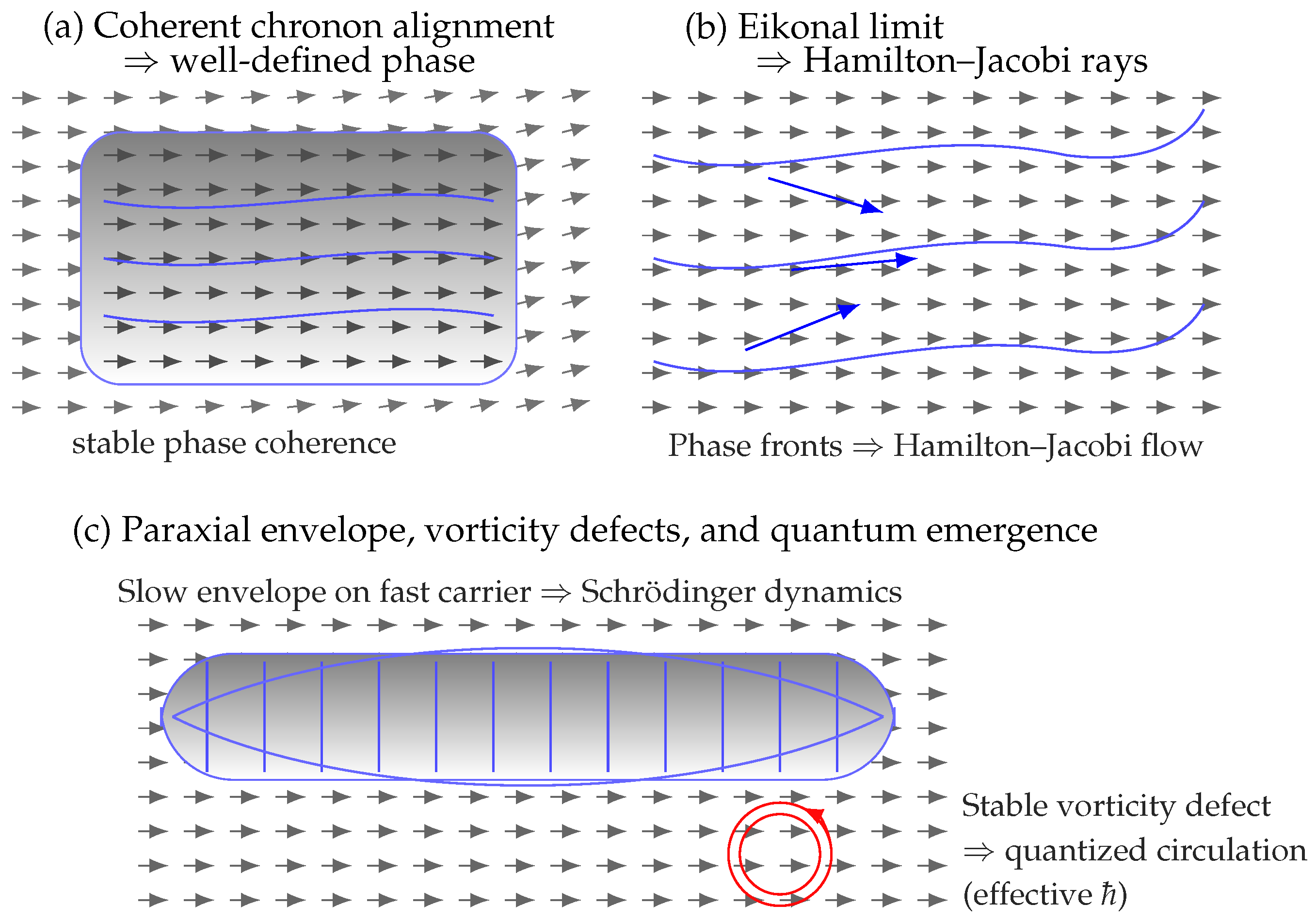
which is the Schrödinger equation. See
Figure 3 for a schematic illustration.
As in other semiclassical and emergent approaches, the mathematical steps connecting Hamilton–Jacobi theory to Schrödinger dynamics are standard [
23,
24]. The significance of the present derivation lies not in the algebraic transformation itself, but in the physical origin of the phase
W and the action scale
, which arise from chronon coherence rather than being postulated or introduced via canonical quantization.
6.4. Topological and Solitonic Origin of the Action Quantum
The appearance of a finite action scale in Chronon Field Theory is not merely a consequence of topological quantization, but depends crucially on the existence and stability of localized, finite-action excitations of the chronon field. In particular, emerges only because the TCP dynamics admit a stable minimum-action soliton that survives in three spatial dimensions.
The antisymmetric vorticity tensor
defines a natural two-form associated with rotational misalignment of causal directions. For configurations with nontrivial topology, the associated vorticity flux through a closed two-surface
,
defines a conserved topological charge. However, such a charge acquires physical meaning only if it can be supported by a stable, localized field configuration of finite action.
In purely quadratic gradient theories, Derrick’s theorem forbids the existence of stable, finite-energy solitons in three spatial dimensions [
43]. In Chronon Field Theory this obstruction is evaded by the quartic vorticity term in the TCP Lagrangian,
which provides a short-distance stiffness that balances gradient energy and prevents collapse or dissipation of localized vorticity structures. This mechanism is directly analogous to Skyrme-type stabilization in nonlinear field theories [
19,
50].
The existence of such a stabilized minimum-action soliton implies that the vorticity flux must be quantized in order for the chronon phase to remain single-valued:
This condition is closely analogous to Onsager–Feynman quantization of circulation in superfluids and magnetic flux quantization in superconductors [
63,
64,
65], with the crucial difference that the present quantization arises from causal alignment rather than from a microscopic complex order parameter.
Estimating the typical vorticity magnitude in the solitonic core as
, with coherence length
and combining this with the flux quantization condition yields
where
is a dimensionless constant determined by normalization conventions and soliton geometry. No fine-tuning is required: the action quantum is fixed by the same TCP parameters that determine the universal propagation speed and the coherence scale of the chronon medium.
Thus
arises as a finite minimum action carried by a stable topological excitation of the causal-alignment field. Classical behavior corresponds to the eikonal limit of chronon-wave propagation, while quantum behavior reflects the unavoidable presence of this minimum-action unit associated with solitonic coherence. A detailed geometric analysis of this mechanism is given in [
25].
Figure 3 is a schematic illustration of emergent quantum dynamics.
6.5. Emergent Gauge Structure and Matter Degrees of Freedom
The emergence of quantum phase coherence also raises the question of gauge interactions and matter degrees of freedom. Within Chronon Field Theory, gauge structure is not introduced as an independent fundamental ingredient, but arises from the organization of transverse degrees of freedom associated with the causal-alignment field.
At the effective level, local reorientations of these transverse structures give rise to connection-like variables whose holonomy governs the evolution of internal phase and polarization, closely paralleling the role of gauge connections in conventional field theory [
66,
67]. From this perspective, gauge fields appear as collective variables encoding the response of the coherent medium to local changes in internal alignment, rather than as fundamental forces acting on a pre-existing spacetime background.
The present work does not attempt a detailed derivation of specific gauge groups or matter representations. Instead, it identifies the structural setting in which such degrees of freedom may emerge alongside geometry and quantum dynamics from the same underlying coherence principle. A more complete development of this sector, including symmetry structure and phenomenological implications, is left for future work.
7. Lorentz Invariance and the Co-Moving Concealment Principle
A recurrent concern in any framework that introduces a distinguished causal direction is the potential violation of Lorentz invariance. Chronon Field Theory indeed posits a smooth, future-directed timelike covector field at the microscopic level. However, this does not imply observable Lorentz violation. The crucial point is that ChFT is formulated as a fully emergent framework: spacetime geometry, matter fields, and all physical measuring devices arise from the same underlying causal-alignment substrate. As a result, there exists no external reference structure relative to which motion with respect to could be operationally detected.
Concerns of this type have long been central to the quantum-gravity and Lorentz-violation literature, where preferred structures often lead to experimentally testable effects unless carefully suppressed [
34,
35,
36]. The resolution proposed here is structural rather than phenomenological. In particular, we show that the absence of observable Lorentz violation follows from the structure of the observable degrees of freedom in the theory, rather than from fine-tuning or parameter suppression.
In this section we clarify the distinction between microscopic causal alignment and operational reference frames, and introduce the Co-Moving Concealment Principle (CCP). The CCP states that when both spacetime and matter are entirely emergent from a single causal medium, preferred-frame effects are not merely suppressed but are operationally undefined. This distinguishes ChFT sharply from hybrid or partially emergent approaches—such as æther or foliation-based models—in which matter fields are not fully co-emergent with the substrate and preferred-frame effects remain, in principle, observable [
28,
68].
7.1. Preferred Direction vs. Observable Frames
The chronon field defines a local direction of causal alignment. At the microscopic level, this direction is distinguished: it determines the ordering along which coherence, propagation, and reconstruction occur. This fact alone, however, does not imply the existence of an observable preferred frame.
In physics, reference frames are defined operationally through the behavior of physical systems such as rods, clocks, and signal propagation [
46]. A preferred direction becomes physically meaningful only if it can be identified relative to measuring devices constructed independently of the structure in question. In Chronon Field Theory, no such external structure exists. The chronon field does not reside within an already-given spacetime; rather, spacetime geometry and all physical excitations arise jointly from its coherent phase.
Crucially, particles in ChFT are not defined as objects propagating relative to a universal medium. Instead, particle excitations are identified operationally and relationally through interaction processes among co-emergent degrees of freedom, in direct analogy with standard quantum field theory. An electron, photon, or other particle acquires physical meaning only through its interactions with other emergent excitations; there is no notion of particle–medium interaction with the chronon field itself.
As a consequence, although the chronon field supplies a microscopic causal ordering, it does not define a measurable rest frame. No observable can be constructed that probes motion relative to the chronon substrate, because all detectors, clocks, and reference systems are themselves formed from the same coherent phase. This operational inaccessibility is formalized by the Co-Moving Concealment Principle.
The distinction between a preferred direction at the level of the underlying causal alignment and an observable preferred frame is therefore essential. Chronon Field Theory introduces the former while explicitly excluding the latter. Lorentz invariance is preserved exactly at the level of the observable algebra, even though the microscopic description is not manifestly Lorentz invariant.
7.2. The Co-Moving Concealment Principle (CCP)
This distinction is formalized by the Co-Moving Concealment Principle:
Co-Moving Concealment Principle (CCP). All propagating excitations, matter degrees of freedom, clocks, and measuring devices arise from and propagate within the same coherent chronon medium. Because the emergent metric and causal structure are constructed from the chronon field itself, every physical observer is necessarily co-moving with the local chronon frame.
The CCP is not an auxiliary assumption introduced to evade experimental constraints. It is a direct consequence of the substrate-based construction of spacetime in ChFT. Since all physical structures are excitations of the same causal medium, no observer can be dynamically decoupled from the chronon field in order to probe its motion or orientation relative to an external background.
This mechanism parallels the unobservability of absolute motion in condensed-matter analog gravity systems, where all low-energy probes propagate with respect to the same effective medium and no internal observer can access the microscopic rest frame [
12,
14].
As a result, the chronon direction is dynamically concealed. Although it plays a fundamental role in generating causal structure, it does not define a measurable velocity or orientation relative to physical apparatus.
7.3. Observable Algebra and Concealment
The CCP may be stated more precisely as a restriction on the algebra of physical observables. In an emergent spacetime theory, observables must be constructed from local, diffeomorphism-invariant functionals of the dynamical fields and must be operationally accessible to observers built from those same fields.
7.3.1. Proposition (Observable Concealment)
In Chronon Field Theory, all local observables accessible to physical experiments can be expressed as functionals of the emergent metric and matter fields propagating on it. No local observable depends on independently of the emergent metric.
7.3.2. Sketch of Argument
Any local observable must be invariant under diffeomorphisms and constructed from the fields that define rods, clocks, and signal propagation. The only rank-two tensor that defines operational spacetime intervals is the emergent metric , which itself is a functional of . Contractions involving alone reduce either to constants via the unit constraint or to components already encoded in . There exists therefore no independent tensorial structure built from that survives in the observable sector.
A direct corollary is the absence of any operationally meaningful boost observable.
7.3.3. Lemma (Absence of Boost Order Parameter)
There exists no scalar, vector, or tensor observable whose expectation value distinguishes motion relative to the chronon frame.
Any candidate observable sensitive to relative motion would require a contraction of the form , where is the four-velocity of a detector or clock. However, detector worldlines, time standards, and synchronization procedures are themselves constructed from excitations propagating in the emergent metric. As a result, is always defined relationally with respect to , and the contraction reduces to a constant. No boost-dependent observable exists.
These results formalize the CCP as a statement about the structure of the observable algebra, rather than as a phenomenological claim.
7.4. Why Preferred-Frame Effects Are Unobservable
The unobservability of preferred-frame effects in ChFT follows from three structural facts.
First, all signal propagation is governed by the same universal dispersion relation derived from the TCP. Gravitational, electromagnetic, and matter excitations all propagate with the same characteristic speed
at leading order. There is no sector-dependent propagation speed that could serve as an operational marker of a preferred frame, consistent with stringent experimental bounds on Lorentz violation [
32,
45,
69].
Second, clocks and rods are constructed from the same chronon excitations whose dynamics they are used to measure. Timekeeping processes, length standards, and synchronization protocols are therefore defined intrinsically within the chronon medium. No experiment can place a measuring device “at rest” relative to spacetime while allowing the chronon field to move past it, because spacetime itself is an emergent manifestation of chronon coherence.
Third, any local experiment samples only relational quantities defined within the emergent metric. Because the metric is built from
, all local measurements are automatically adapted to the chronon-aligned frame. This relational character echoes arguments in canonical and relational approaches to quantum gravity, where absolute structures are likewise unobservable [
7,
8,
70].
Taken together, these facts imply that preferred-frame effects are not merely suppressed or fine-tuned away; they are operationally undefined. Lorentz symmetry survives as an exact symmetry of observable physics, even though the microscopic description is not formulated in a manifestly Lorentz-invariant manner.
7.5. Comparison with Aether, Foliation-Based, and Emergent Frameworks
It is instructive to contrast Chronon Field Theory (ChFT) and the Co-Moving Concealment Principle (CCP) with other approaches that introduce preferred structures, emergent metrics, or relational notions of spacetime. Although these frameworks share superficial similarities, they differ crucially in what is taken to be fundamental, how matter couples to the underlying structure, and whether preferred directions are operationally observable.
Table 1 presents a summary of comparison of Chronon Field Theory with representative frameworks.
7.5.1. Einstein–Aether and Lorentz-Violating Models
In Einstein–Aether theories, the spacetime metric is fundamental and the timelike æther field represents an additional dynamical structure embedded within spacetime. Matter fields propagate relative to both the metric and the æther, leading generically to observable preferred-frame effects unless parameters are tightly constrained [
28,
38]. Multiple propagation speeds and sector-dependent Lorentz violations are therefore characteristic features of these models.
Hořava–Lifshitz gravity similarly introduces a preferred foliation at a fundamental level, explicitly breaking Lorentz invariance in the ultraviolet and relying on renormalization-group flow to recover approximate symmetry in the infrared [
68]. Here again, the preferred structure is physical and, in principle, observable.
7.5.2. Analog-Gravity Systems
Analog-gravity models provide valuable insight into emergent metric phenomena, demonstrating how effective Lorentzian geometries and horizons can arise in condensed-matter and fluid systems. However, in such systems the underlying medium exists within an external laboratory spacetime, and the preferred rest frame of the medium is operationally accessible to external observers. As a result, Lorentz symmetry is approximate and explicitly broken at higher energies [
71,
72].
ChFT differs in a crucial respect: there exists no external background or laboratory frame. The chronon field does not reside in spacetime; rather, spacetime and all physical probes arise from its coherent phase. The analog-gravity intuition is therefore structural rather than literal.
7.5.3. Relational Approaches
Relational and operational approaches to spacetime emphasize that physical observables must be defined through relations among dynamical degrees of freedom, without reference to absolute background structures. In this respect, ChFT is closest in spirit to relational frameworks. However, ChFT goes further by providing a concrete dynamical substrate whose coherence generates the relational spacetime itself, rather than treating relationality as a purely interpretational principle.
7.5.4. Operational Novelty of the Co-Moving Concealment Principle
The distinctive feature of ChFT is not the mere presence of a microscopic timelike alignment field, but the structure of the observable sector. Because matter fields, clocks, and measuring devices are fully co-emergent with the chronon medium, no observable can be constructed that measures motion relative to the chronon frame. In particular, there exists no operationally meaningful boost observable.
Thus, the CCP should not be understood as a mechanism that suppresses Lorentz violation. Rather, it asserts the stronger claim that preferred-frame effects are operationally undefined. Lorentz symmetry survives exactly in the observable algebra, even though the microscopic description is not manifestly Lorentz invariant.
In this sense, Chronon Field Theory does not belong to the class of Lorentz-violating or æther theories. The chronon field defines the causal substrate from which spacetime arises, not a preferred direction within spacetime, and the existence of a microscopic alignment structure is fully compatible with exact operational Lorentz invariance.
8. Phenomenological Consequences and Observational Tests
Although Chronon Field Theory is formulated as a substrate-based framework, its physical viability ultimately depends on phenomenological consequences that follow directly from the Temporal Coherence Principle (TCP). It is therefore important to distinguish between structural predictions of the framework, which are robust consequences of the coherence dynamics, and illustrative phenomenological estimates, which depend on simplified modeling assumptions and order-of-magnitude arguments.
In the coherent regime relevant for observable physics, the leading TCP dynamics enforce a universal invariant propagation speed shared by all massless and effectively massless excitations. This universality is a structural prediction of the theory and follows directly from the characteristic-cone analysis presented in
Section 5.2. Subleading effects arise from the quartic vorticity term in the TCP Lagrangian and manifest as suppressed, higher-order dispersive corrections.
Crucially, these effects do not signal Lorentz violation. The characteristic cone governing signal propagation remains universal and invariant due to the co-moving concealment mechanism established in
Section 7. Instead, the phenomenology consists of small, channel-independent dispersive corrections whose cumulative impact can be amplified over cosmological distances.
This structure closely parallels, but is conceptually distinct from, dispersion effects studied in quantum-gravity phenomenology and effective field theory extensions of the Standard Model [
36,
73]. In Chronon Field Theory, dispersion arises from coherence dynamics of the causal substrate itself, rather than from explicit Lorentz-violating operators.
8.1. Derivation of Vacuum Dispersion from Quartic Vorticity
We now derive the leading dispersive correction implied by the TCP dynamics. Consider small transverse perturbations
about a coherent background
, satisfying the linearized root Equation (
7). Retaining the leading contribution of the quartic vorticity term to the dispersion relation yields schematically
Solving for
, one obtains
where
is the coherence length and
is a dimensionless coefficient of order unity determined by the detailed tensor structure of the quartic vorticity term.
At leading order, all massless and effectively massless excitations propagate with the same invariant speed
. The correction in Equation (
42) induces a weak, frequency-dependent modification of the group velocity while preserving a unique universal characteristic cone. This behavior is a robust structural consequence of the TCP dynamics and distinguishes the present framework from Lorentz-violating dispersion models, in which different sectors typically propagate on inequivalent cones [
34,
38].
8.2. Cosmological Accumulation of Dispersive Effects
Although the correction in Equation (
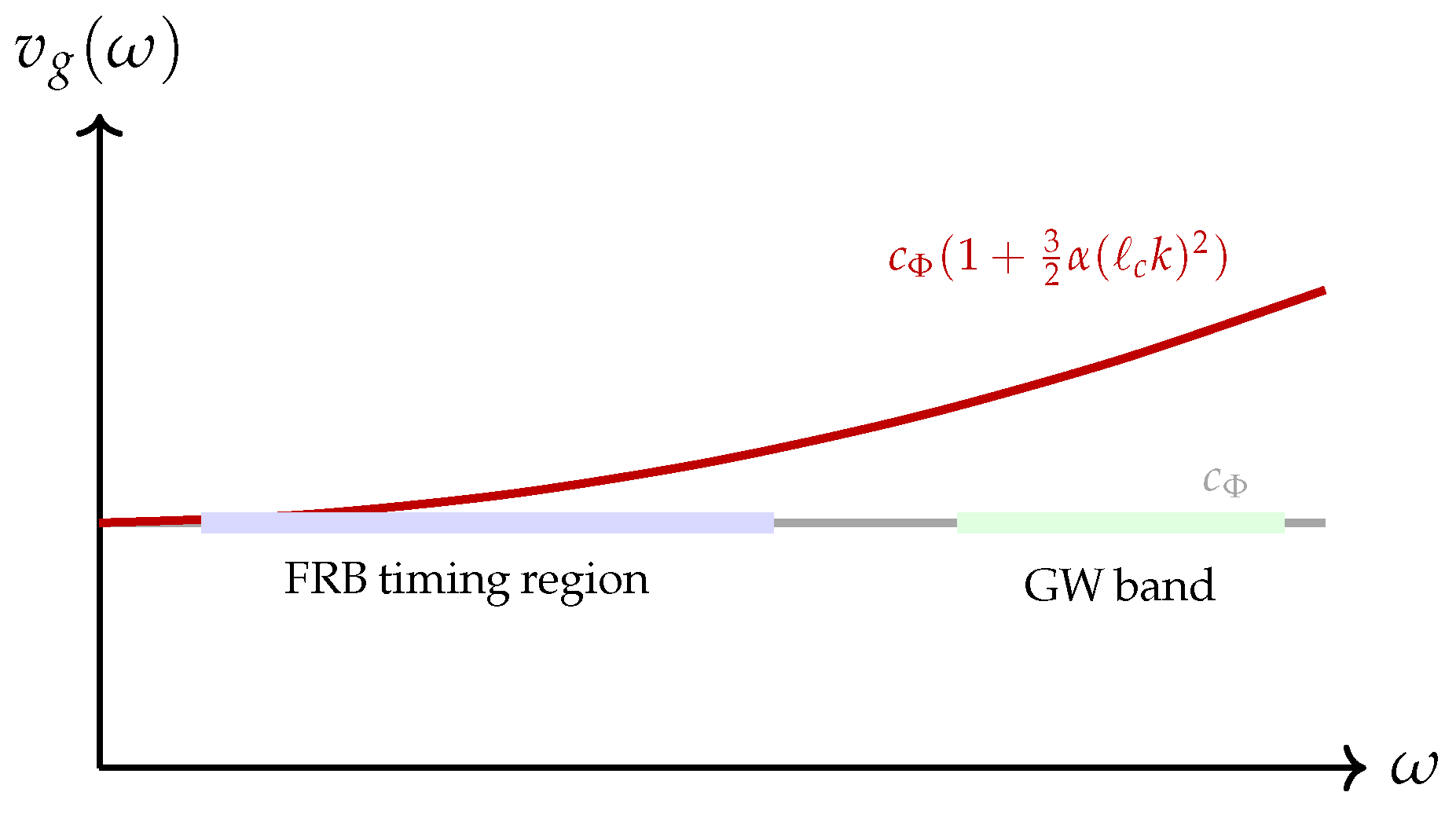
42) is negligible at laboratory scales, it can accumulate over cosmological distances. The associated group velocity is
For a signal propagating over a comoving distance
D, the relative arrival-time delay between two frequency components
and
is
This accumulation mechanism is generic to dispersive media and has been widely discussed in the context of high-energy astrophysical probes of quantum spacetime [
74,
75]. Here it is employed as an illustrative consistency test of the TCP framework rather than as a precision prediction.
8.3. Fast Radio Bursts and Multi-Messenger Constraints
Fast radio bursts (FRBs) provide some of the most sensitive current probes of frequency-dependent vacuum dispersion. These millisecond-duration transients originate at cosmological distances and exhibit broadband spectra extending to gigahertz frequencies. Observed arrival-time delays are consistent with plasma dispersion in the intergalactic medium, leaving little room for additional propagation effects [
76,
77].
Requiring the chronon-induced delay (
44) to remain subdominant yields an order-of-magnitude upper bound on the coherence length,
depending on assumptions about source distance, spectral bandwidth, and astrophysical modeling uncertainties. This bound should be interpreted as indicative rather than exclusionary.
Complementary constraints arise from multi-messenger observations. The near-simultaneous detection of gravitational waves and gamma rays from GW170817 constrains relative propagation speeds of gravitational and electromagnetic signals to better than one part in
, strongly supporting the universality of
and limiting any sector-dependent dispersion [
32,
45]. High-energy neutrino observations provide independent confirmation of universal propagation across particle species [
69].
8.4. Bounds on Model Parameters
The observational considerations above translate into parametric bounds on the TCP parameters. Using
and identifying
with the observed speed of light, current data imply
Combined with the identification , these bounds restrict the allowed range of the stiffness and vorticity parameters without fine-tuning. A broad region of parameter space remains in which general relativity and quantum dynamics are recovered to high accuracy, while leaving open the possibility of detectable deviations in future high-precision astrophysical observations.
Importantly, all phenomenological constraints discussed here arise from universal dispersion and coherence effects, not from observable Lorentz violation. They therefore serve as consistency checks of the TCP framework rather than as signatures of preferred-frame physics, sharply distinguishing Chronon Field Theory from hybrid or explicitly Lorentz-violating models [
28,
68].
Figure 4 is a schematic explanation of TCP-induced vacuum dispersion.
9. Relation to Existing Approaches
The idea that spacetime geometry may be emergent rather than fundamental has a long and diverse history spanning quantum gravity, condensed-matter analogies, thermodynamics, and relational approaches. Chronon Field Theory (ChFT) belongs to this broad family of ideas, but differs in both emphasis and construction. In this section we situate ChFT within the existing landscape of emergent gravity and emergent quantum dynamics, clarify points of overlap, and highlight the distinctive features of the present framework.
9.1. Induced Gravity and Thermodynamic Approaches
One influential line of thought treats gravity as an induced or emergent phenomenon arising from microscopic degrees of freedom. Sakharov’s induced gravity proposal [
10] demonstrated that the Einstein–Hilbert action can appear as a radiative correction generated by quantum matter fields propagating on a background spacetime. In this picture, the metric retains a geometric interpretation, but its dynamics are not fundamental.
Closely related ideas appear in thermodynamic and entropic approaches to gravity. Jacobson famously derived the Einstein field equations from the Clausius relation applied to local Rindler horizons [
11], suggesting that spacetime dynamics encode an equation of state rather than microscopic laws. Subsequent work by Padmanabhan and others further developed the view of gravity as an emergent, thermodynamic phenomenon [
13].
Chronon Field Theory is compatible with the central insight of these approaches—that geometry behaves as a macroscopic, collective variable—but differs in its constructive emphasis. Rather than deriving gravity from horizon thermodynamics or quantum fluctuations of matter fields, ChFT introduces an explicit causal-alignment field whose coherent dynamics directly generate spacetime geometry and its elastic response. Thermodynamic interpretations may emerge at the coarse-grained level, but are not taken as the starting point of the theory.
9.2. Analog Gravity and Emergent Lorentz Symmetry
Analog gravity models provide concrete realizations of emergent spacetime phenomena in laboratory systems. In superfluids, Bose–Einstein condensates, water waves, and other condensed-matter settings, collective excitations propagate in an effective curved geometry determined by the background medium [
12,
14,
71]. These systems demonstrate explicitly that Lorentzian metrics, horizons, and even Hawking-like radiation can arise from nonrelativistic substrates.
A particularly important lesson from analog gravity is the emergence of Lorentz symmetry at low energies. Although the microscopic dynamics of the medium violate Lorentz invariance, the long-wavelength excitations often exhibit an effective relativistic symmetry with a universal limiting speed. Recent experimental work, including the observation of phase-space horizons in water-wave systems, illustrates both the power and the limitations of this analogy [
72].
Chronon Field Theory shares the substrate-based intuition of analog gravity, but differs in a crucial respect. In laboratory analogs, the underlying medium exists within an external spacetime and possesses an operationally accessible rest frame. In ChFT, by contrast, the chronon field does not reside within spacetime; rather, spacetime and all physical probes arise from its coherent phase. The Co-Moving Concealment Principle formalizes this distinction, extending insights from analog systems while eliminating the presence of any external frame relative to which preferred motion could be detected.
9.3. Emergent Quantum Dynamics and Hydrodynamic Analogs
The emergence of quantum dynamics from wave-like or hydrodynamic structures has a long history. Pilot-wave theories, Madelung hydrodynamics, and modern fluid analogs have demonstrated that Schrödinger-type equations can often be reformulated in terms of underlying phase and flow variables [
22,
78,
79].
Chronon Field Theory is aligned with these approaches in emphasizing phase coherence and collective dynamics as the origin of quantum behavior. However, ChFT differs in scope and interpretation. Quantum dynamics do not arise from an externally imposed pilot wave or from a dual classical-quantum ontology, but emerge from the same causal-alignment field that generates spacetime geometry. In this sense, gravitational and quantum phenomena are unified at the level of the underlying medium rather than being coupled post hoc.
9.4. Comparison with Quantum Gravity Programs
Most mainstream approaches to quantum gravity adopt what may be termed a
metric-first strategy, in which spacetime geometry is assumed to be fundamental and the primary task is to quantize it. Canonical quantum gravity, loop quantum gravity, spin-foam models, and string theory all fall into this category, despite substantial differences in formalism and interpretation [
1,
2,
3,
4,
80].
In contrast, substrate-based approaches adopt a pre-geometric or medium-first viewpoint, in which spacetime geometry arises as a collective description of deeper degrees of freedom. ChFT belongs to this second class. It does not attempt to quantize the metric, nor does it introduce quantum geometry at the fundamental level. Instead, it seeks to identify the minimal dynamical structure required for relativistic causality, universal propagation speed, and phase-coherent dynamics to emerge.
From this perspective, ChFT does not compete directly with metric-first quantum gravity programs on their own terms. Rather, it addresses a complementary question: whether the difficulties encountered in quantizing gravity—such as perturbative nonrenormalizability and the absence of local observables [
29,
40]—may reflect a misidentification of the fundamental degrees of freedom. ChFT offers an alternative resolution by reframing the quantum gravity problem as one of emergence rather than quantization.
9.5. Distinctive Features of Chronon Field Theory
While ChFT shares broad motivations with other emergent spacetime frameworks, it possesses several distinctive features.
First, the theory is built around a single causal-alignment field governed by a variational principle, rather than relying on thermodynamic postulates, statistical ensembles, or externally imposed quantization rules. This allows gravitational and quantum phenomena to be derived within a unified dynamical framework.
Second, the universal propagation speed and Lorentzian signature arise dynamically from stability and coherence requirements, rather than being assumed as axioms. Operational Lorentz invariance is protected by the Co-Moving Concealment Principle, not by parameter tuning or renormalization effects.
Third, quantum dynamics emerge from phase coherence and topological quantization of the chronon field, providing a physical origin for the action quantum within the same framework that generates spacetime geometry. Classical and quantum behavior thus appear as complementary regimes of a single causal medium.
Finally, ChFT is formulated explicitly as a continuum effective theory with clearly stated scope and assumptions. It does not claim to identify the ultimate microscopic structure of nature, but demonstrates that a wide range of observed physical laws can arise from minimal causal-alignment dynamics. This combination of conceptual economy, dynamical closure, and careful scope definition distinguishes Chronon Field Theory within the landscape of emergent spacetime approaches.
10. Discussion and Conclusions
The results developed in this work support a coherent reinterpretation of the quantum gravity problem. Rather than treating spacetime geometry as a fundamental entity requiring quantization, Chronon Field Theory proposes that geometry, relativistic causality, and quantum dynamics emerge collectively from a deeper causal-alignment substrate. Within this perspective, several long-standing conceptual tensions in fundamental physics acquire a unified and physically transparent explanation, echoing earlier arguments that the metric may function as an effective or thermodynamic variable rather than a microscopic degree of freedom [
10,
11,
13].
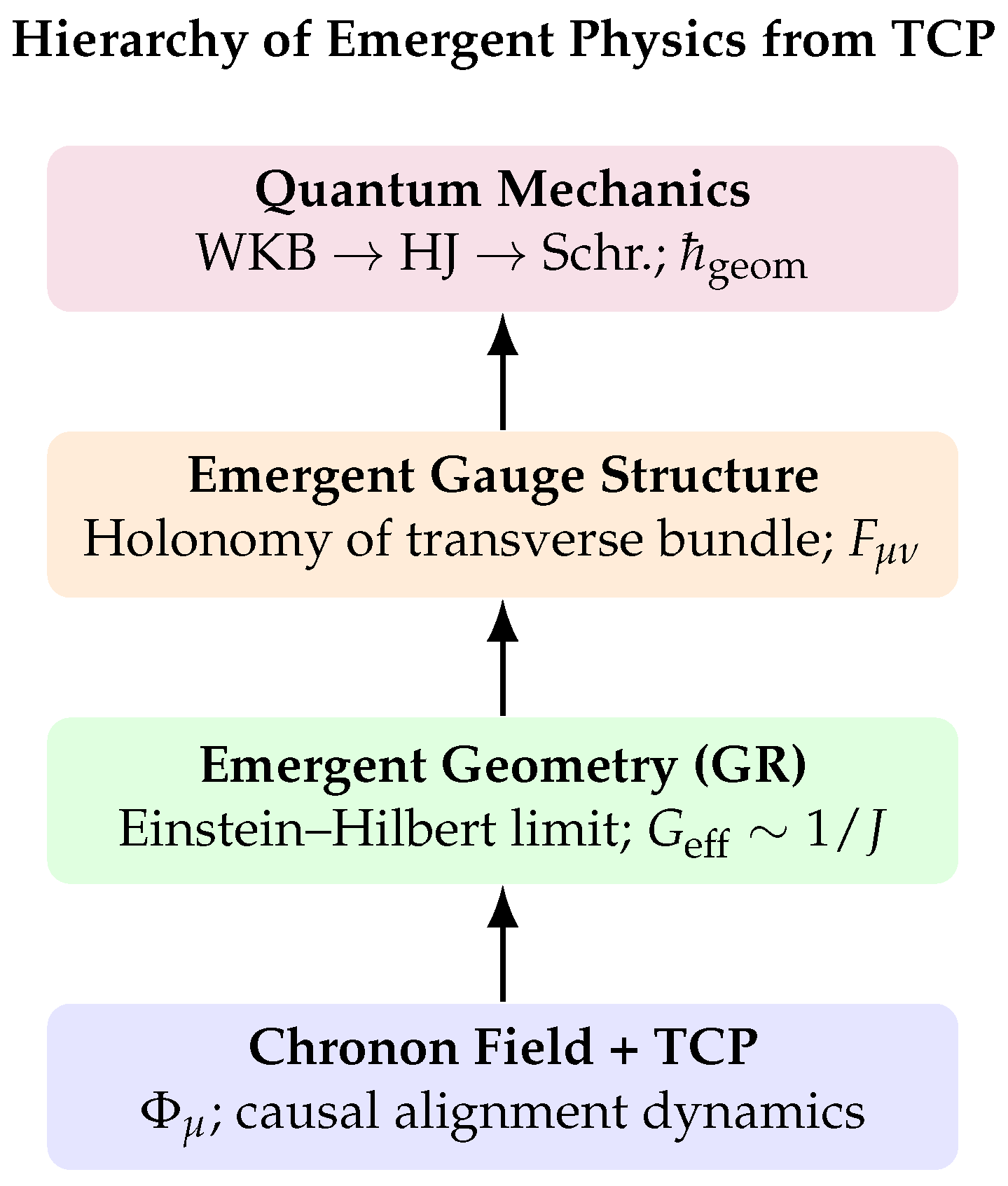
A central outcome of the analysis is that gravitational dynamics, quantum phase evolution, and gauge structure arise as complementary limits of a single variational principle. The Temporal Coherence Principle provides a common dynamical origin for phenomena that are traditionally treated as logically independent: the Einstein field equations describe the elastic response of the causal medium, while Schrödinger dynamics reflect its phase-coherent excitation regime. The invariant speed of light and Lorentzian signature emerge from stability and universality requirements rather than being imposed as axioms, in line with lessons drawn from analog-gravity and condensed-matter systems [
12,
14].
Equally important is what the framework does not require. No quantization of spacetime geometry is assumed, and no fundamental discreteness of space or time is postulated. The theory is formulated as a continuum effective description with clearly stated scope and assumptions. Within this domain, the nonrenormalizability of gravity is reinterpreted as a diagnostic of emergence rather than an indication of inconsistency, consistent with the view of general relativity as an effective field theory [
9,
29]. Quantum behavior appears not as a primitive postulate, but as a consequence of topological and phase-coherence properties of the underlying causal medium.
The Co-Moving Concealment Principle plays a key conceptual role in reconciling the existence of a causal substrate with exact operational Lorentz invariance. By recognizing that all physical measuring devices arise from the same coherent medium, the apparent tension between microscopic causal alignment and observable symmetry is resolved without invoking fine-tuning or explicit symmetry breaking. This places Chronon Field Theory outside the class of Lorentz-violating or æther-based modifications of relativity [
28,
68], and closer in spirit to emergent and analog gravity frameworks [
12,
14].
Among the structural consequences of the framework, the emergence of a universal causal cone deserves particular emphasis. In conventional approaches this universality is typically imposed as a kinematic axiom or protected by symmetry assumptions. Here it arises directly from the characteristic structure of the coherence dynamics, independent of excitation channel. This provides a concrete dynamical explanation for the observed universality of the invariant speed across electromagnetic, gravitational, and other massless probes, while remaining consistent with stringent phenomenological constraints from high-precision tests of Lorentz invariance and multi-messenger observations [
32,
36,
45].
From a phenomenological standpoint, the framework remains tightly constrained by existing observations. Universal propagation speed, the absence of detectable Lorentz violation, and stringent bounds on vacuum dispersion are all naturally accommodated. At the same time, the theory makes concrete predictions regarding higher-order dispersive effects and coherence scales, leaving open the possibility of future empirical tests as observational precision continues to improve [
73,
76].
Several directions for further development suggest themselves. On the theoretical side, it would be valuable to explore more detailed models of the chronon substrate and its possible relation to statistical or quantum many-body systems, in the spirit of other medium-based approaches to spacetime [
12,
15]. The emergence of specific gauge symmetries and matter representations warrants further investigation. On the phenomenological side, refined modeling of astrophysical signal propagation and cosmological coherence effects may yield sharper constraints or novel observational signatures.
As illustrated in
Figure 5, unification in this framework occurs not through quantization of spacetime geometry, but through the emergence of multiple effective theories from a single coherence principle. In this sense, the statement that “gravity and quantum theory are complementary limits of one substrate” becomes a structural and operational claim rather than a philosophical one: each layer arises as a distinct regime of the same causal-alignment dynamics, without introducing independent fundamental structures.
Taken together, the framework developed here demonstrates that a wide range of observed physical laws can emerge from minimal causal-coherence dynamics, without postulating quantum geometry at the fundamental level. Whether this perspective ultimately leads to a deeper understanding of nature remains an open question, but the results presented here provide a concrete and internally consistent basis on which that question can be explored.
A key implication of this framework is that spacetime geometry itself does not fluctuate quantum mechanically. Instead, quantum behavior is attributed to underlying non-metric structures, while the metric arises as an emergent, effectively classical entity. This separation leads to experimentally testable consequences—particularly in precision tests of Lorentz invariance, analog-gravity systems, and interferometric probes—that allow the framework to be empirically distinguished from conventional approaches to quantum gravity.