
Next Article in Journal
Wearable Sensors to Estimate Outdoor Air Quality of the City of Turin (NW Italy) in an IoT Context: A GIS-Mapped Representation of Diffused Data Recorded over One Year of Monitoring
Previous Article in Journal
LogPPO: A Log-Based Anomaly Detector Aided with Proximal Policy Optimization Algorithms
Previous Article in Special Issue
Electric Vehicle Charging Logistics in Spain: An In-Depth Analysis
 
 
Due to scheduled maintenance work on our servers, there may be short service disruptions on this website between 11:00 and 12:00 CEST on March 28th.
Article

Constrained Metropolitan Service Placement: Integrating Bayesian Optimization with Spatial Heuristics

1
AI Institute, ITMO University, Saint Petersburg 197101, Russia
2
Faculty of Computational Mathematics and Cybernetics, Shenzhen MSU-BIT University, Shenzhen 518172, China
*
Author to whom correspondence should be addressed.
Smart Cities 2026, 9(1), 6; https://doi.org/10.3390/smartcities9010006
Submission received: 24 October 2025 / Revised: 4 December 2025 / Accepted: 12 December 2025 / Published: 26 December 2025
(This article belongs to the Special Issue City Logistics and Smart Cities: Models, Approaches and Planning)

Highlights

What are the main findings?
  • Under a strict budget of 50 function evaluations, the two-stage optimization framework rapidly attains near-optimal solutions, delivering up to 1.3× higher service provision scores than NSGA-II/CMA-ES. The framework scales to metropolitan land-use planning under complex regulatory constraints, maintaining sample-efficient exploration and fast convergence.
What is the implication of the main findings?
  • Surrogate-assisted, gradient-free optimization is a practical, deployable method on standard computing hardware for simultaneous urban service placement in large cities, quantifying city-wide system effects (load redistribution, accessibility changes, etc.) and maximizing a composite provision metric aligned with equitable distribution. The modular, open-source implementation enables evidence-based decision making and reproducible evaluation of proposed plans, establishing a validated base for dynamic/stochastic extensions.

Abstract

Metropolitan service-placement optimization is computationally challenging under strict evaluation budgets and regulatory constraints. Existing approaches either neglect capacity constraints, producing infeasible solutions, or employ population-based metaheuristics requiring hundreds of evaluations—beyond typical municipal planning resources. We introduce a two-stage optimization framework combining Bayesian optimization with domain-informed heuristics to address this constrained, mixed discrete–continuous problem. Stage 1 optimizes continuous service area allocations via the Tree-structured Parzen Estimator with empirical gradient prioritization, reducing effective dimensionality from 81 services to 10–15 per iteration. Stage 2 converts allocations into discrete unit placements via efficiency-ranked bin packing, ensuring regulatory compliance. Evaluation across 35 benchmarks on Saint Petersburg, Russia (117–3060 decision variables), demonstrates that our method achieves 99.4% of the global optimum under a 50-evaluation budget, outperforming BIPOP-CMA-ES (98.4%), PURE-TPE (97.1%), and NSGA-II (96.5%). Optimized configurations improve equity (Gini coefficient of 0.318 → 0.241) while maintaining computational feasibility (2.7 h for 109-block districts). Open-source implementation supports reproducibility and facilitates adoption in metropolitan planning practice.

1. Introduction

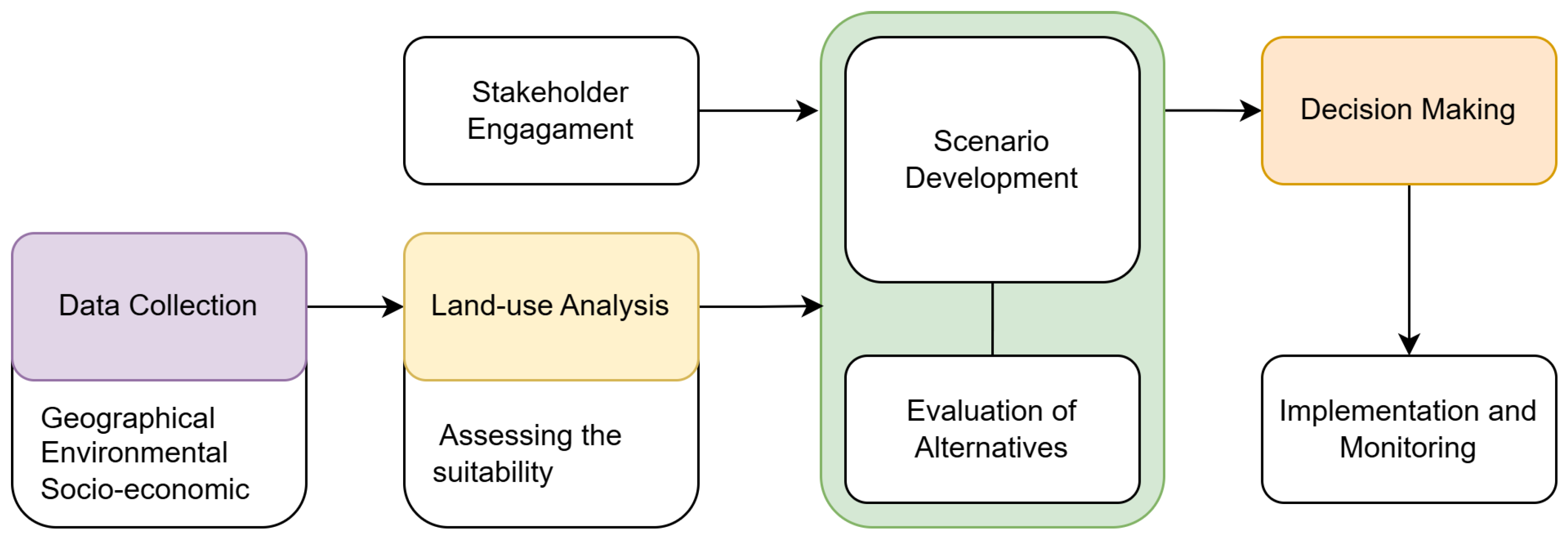
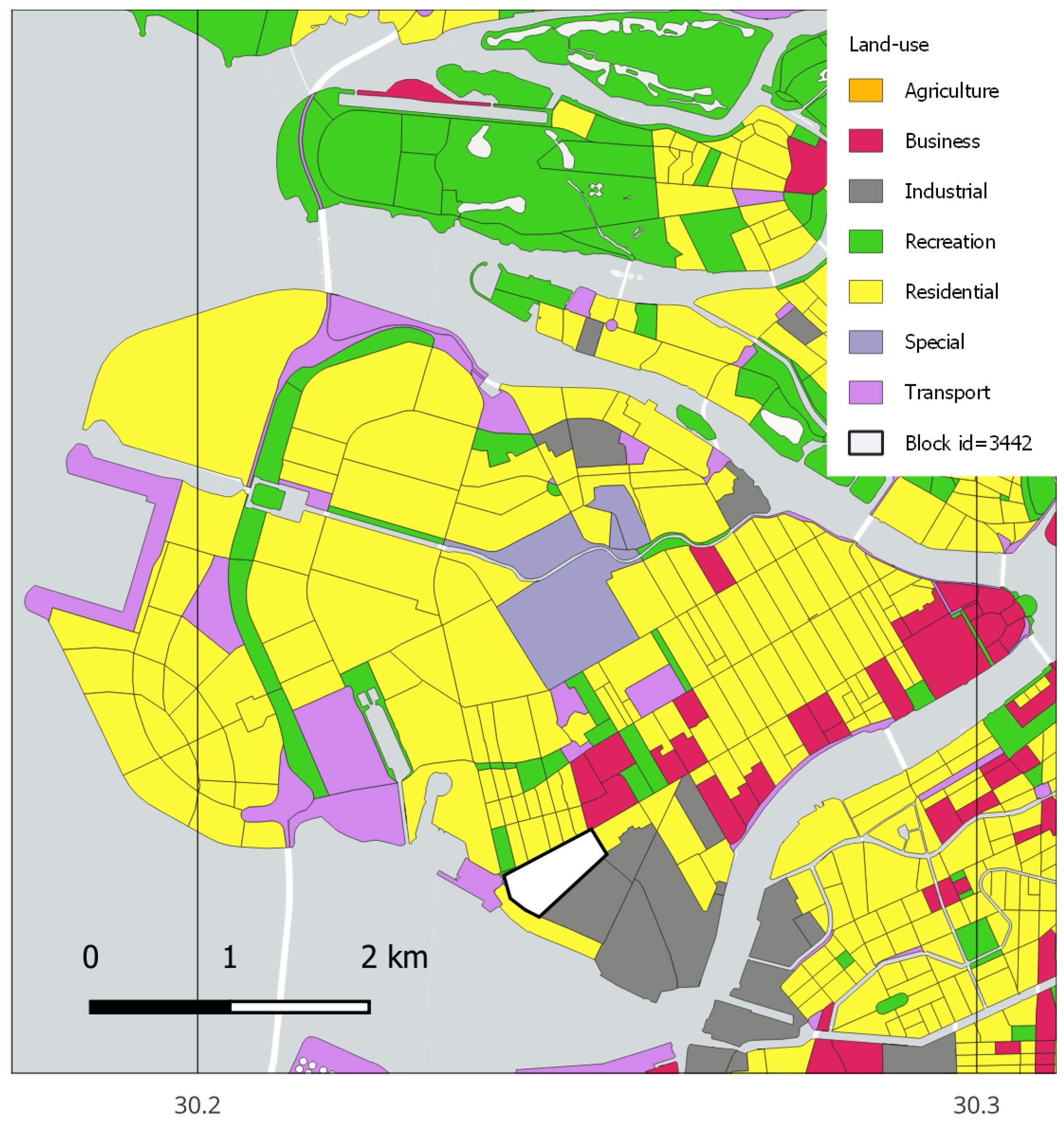
Urban service systems in large metropolitan areas exhibit access inequalities driven by spatial mismatches among residential patterns, infrastructure, and regulated service locations [1,2,3]. Although land-use planning frameworks [4,5,6] (Figure 1) formally regulate permissible activities and development intensity, they typically treat service provision at an aggregate level, without explicitly optimizing the joint configuration of land-use designations and discrete service locations under capacity and accessibility constraints. This complicates designing interventions that respect zoning while improving population-weighted accessibility to capacitated services—particularly essential services such as education, healthcare, and daily amenities. The core question is how to jointly configure land-use designations and service locations to maximize accessibility [7,8] under realistic regulatory and computational limits.
Urban land-use optimization addresses these challenges by formulating the allocation of land-use categories, building density, and service capacities as a multi-objective spatial optimization problem [9,10,11]. Existing approaches employ evolutionary algorithms [12], metaheuristics [13,14], and surrogate-assisted methods [15,16] to balance economic performance, environmental preservation, compactness, and equity, often at the city scale. However, these models frequently operate on coarse land-use categories without explicit service placement or assume simplified capacity representations that neglect block-level constraints and the combinatorial structure of service units. Consequently, each evaluation of realistic provision metrics involves costly network-based accessibility computations [8] and linear programming for demand–capacity allocation [17]. Metropolitan-scale planning becomes an expensive black-box optimization problem [18] with severely limited function evaluations.
We formalize this setting as a metropolitan-scale, mixed discrete–continuous optimization problem with nested regulatory and capacity constraints [19]. The formulation couples block-level land-use configurations [20]—where blocks represent fundamental spatial planning units defined as administrative or morphological subdivisions of urban territory—with disaggregated service units and a provision metric that quantifies population access to capacitated services within regulatory accessibility thresholds. For example, in our Saint Petersburg case study (16,000+ blocks and 81 distinct service types), each evaluation requires graph-based routing [21], linear programming for allocation, and constraint checking. This takes several minutes per candidate. The computational burden necessitates methods that remain tractable under strict evaluation budgets and can be deployed on standard computing infrastructure [18].
To address these requirements, this paper proposes a hybrid optimization framework tailored to expensive metropolitan service-placement problems. The two-stage strategy separates area allocation across blocks from discrete unit placement, aligning the optimization with real-world planning workflows [22]. Empirical gradient-free sensitivity analysis [23] prioritizes service types with the largest impact on the provision metric, enabling sample-efficient search under a fixed budget of 50 costly evaluations [16,24]. This paper makes three contributions. First, we formalize the problem of coupling land use and service placement at the metropolitan scale under regulatory and capacity constraints. Second, we propose a two-stage, TPE-driven optimization algorithm [16,24] with empirical gradient-based service prioritization. Third, we provide an open-source implementation validated on Saint Petersburg, achieving competitive provision scores relative to established optimization algorithms under identical evaluation budgets. The framework can be integrated into decision support tools for metropolitan land-use planning [25].

2. Related Work

2.1. Land-Use and Accessibility Challenges

Urban land-use optimization problems typically address multiple conflicting objectives, including maximizing economic returns, preserving environmental assets, enhancing spatial compactness, and ensuring equitable access to services. Decision variables include land-use categories, development intensity, and service capacities; constraints arise from zoning regulations, adjacency rules, network connectivity, and regulatory bounds such as floor area ratios and site coverage limits. The increasing emphasis on social equity has brought service accessibility into the core of many formulations, linking spatial allocations to travel-time-based accessibility metrics and capacity-constrained demand coverage [26]. Nevertheless, existing models aggregate service provision through suitability indices or coarse demand–supply balances, without enumerating discrete service units or explicitly enforcing block-level capacity constraints. Consequently, most models fail to capture interactions among land-use changes, service siting, and network-based accessibility at the metropolitan scale. Prior studies in similar urban contexts, such as land-use modeling in European cities [27], have demonstrated the value of explicit regulatory constraints, yet they lack integration with discrete service unit optimization.

2.2. Optimization Algorithms for Expensive Urban Land-Use Problems

Researchers address these challenges by using evolutionary algorithms [12,28], metaheuristics [13,14], and surrogate-assisted approaches [29]. Evolutionary algorithms such as NSGA-II [12] are widely used to approximate Pareto fronts that balance ecological, economic, and spatial-compactness objectives. Genetic algorithms [28,30], particle swarm optimization [31,32], and simulated annealing [14] explore alternative zoning patterns. However, these population-based methods require hundreds to thousands of objective evaluations, making them impractical when each evaluation takes minutes due to accessibility analysis and linear programming-based allocation [17]. This motivated adoption of surrogate-assisted methods [29]—radial basis functions [33], Gaussian processes [15], and related models that approximate expensive objectives and guide search with fewer evaluations [34].
Within the surrogate-based paradigm, Bayesian optimization [34] trades off exploration and exploitation under tight evaluation budgets. Gaussian process-based methods [15] excel in low- to medium-dimensional continuous spaces but require explicit covariance structures and fail on high-dimensional mixed-variable problems. In contrast, the Tree-structured Parzen Estimator (TPE) [16,24] models search spaces via non-parametric density estimates. It handles mixed continuous–discrete variables without explicit covariance specification, making it naturally suited to problems coupling discrete service unit selection with continuous area allocation under regulatory constraints. While TPE efficiently handles mixed-variable spaces, it may suffer from premature convergence or overfitting when the ratio of evaluations to search space dimensionality is low. The present framework mitigates these risks through empirical gradient-based service prioritization and two-stage decomposition, which reduce effective dimensionality at each optimization stage. Trust-region methods [35,36] and empirical gradient-free techniques [23] provide alternative approaches for constrained high-dimensional problems. Few studies adapt these approaches to metropolitan service-placement tasks under strict evaluation budgets [18].

2.3. Supporting Frameworks and Dynamic Extensions

Beyond optimization methods, related work addresses accessibility analysis [7,8], land-use modeling [37], and geospatial decision support systems (GDSSs) [22,25]. Accessibility models combine transport networks and travel-time matrices to quantify service usage [21]. GDSS platforms integrate GISs, scenario analysis [4], and computational models to support planning decisions in land management and urban development [38]. However, these systems typically use optimization components that either treat services at an aggregate level, ignore detailed capacity and regulatory constraints, or rely on algorithms whose evaluation requirements exceed practical limits for metropolitan-scale applications. The reviewed methods typically assume static demand and fixed regulations. Future extensions incorporating temporal dynamics [37]—population shifts, policy updates, and stochastic demand patterns [39,40]—could enhance robustness for long-term planning.

2.4. Gap and Positioning of This Work

However, no existing work jointly optimizes land-use and discrete, capacity-constrained service placement at the city scale under expensive objective evaluations and strict evaluation budgets. We address this gap by combining TPE-based surrogate optimization [16,24] with two-stage decomposition and empirical gradient-free service prioritization [23]. Table 1 summarizes how our approach compares to existing algorithm families.

3. Study Area and Data

3.1. Urban Area Description

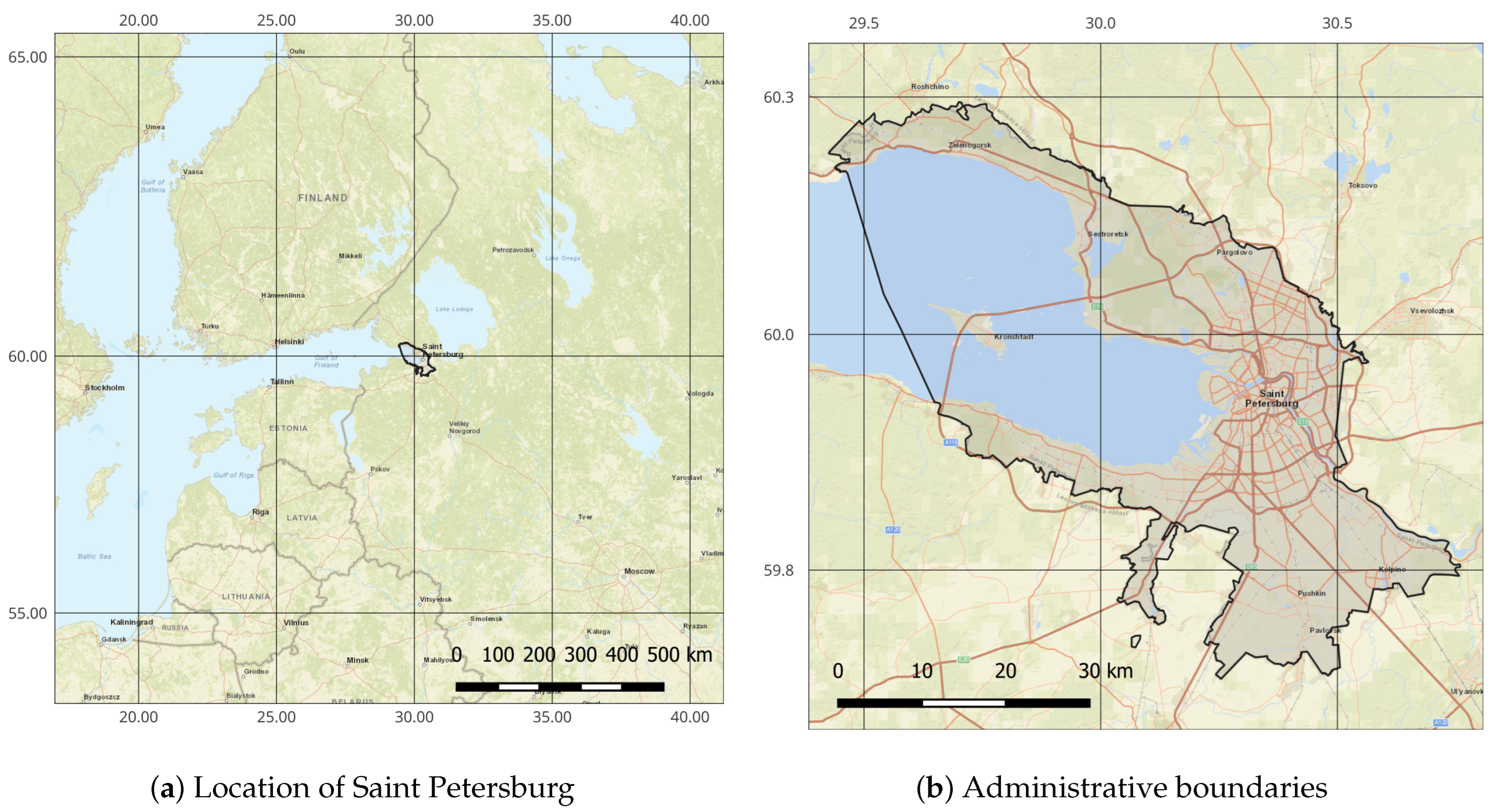
This study focuses on the city of Saint Petersburg, located in the northwest of Russia. The city covers an area of approximately 1.439 sq. km, with a population of 5.6 million as of early 2025, making it the second most populous city in the country after Moscow.
Precise land-use type definitions are crucial in urban planning to support sustainable city development [41] and ensure access to essential services (Figure 2a,b). This study adopts a land-use classification aligned with planning documents, focusing on urban block functional designations (Table 2). A general classification system is presented in the accompanying table.
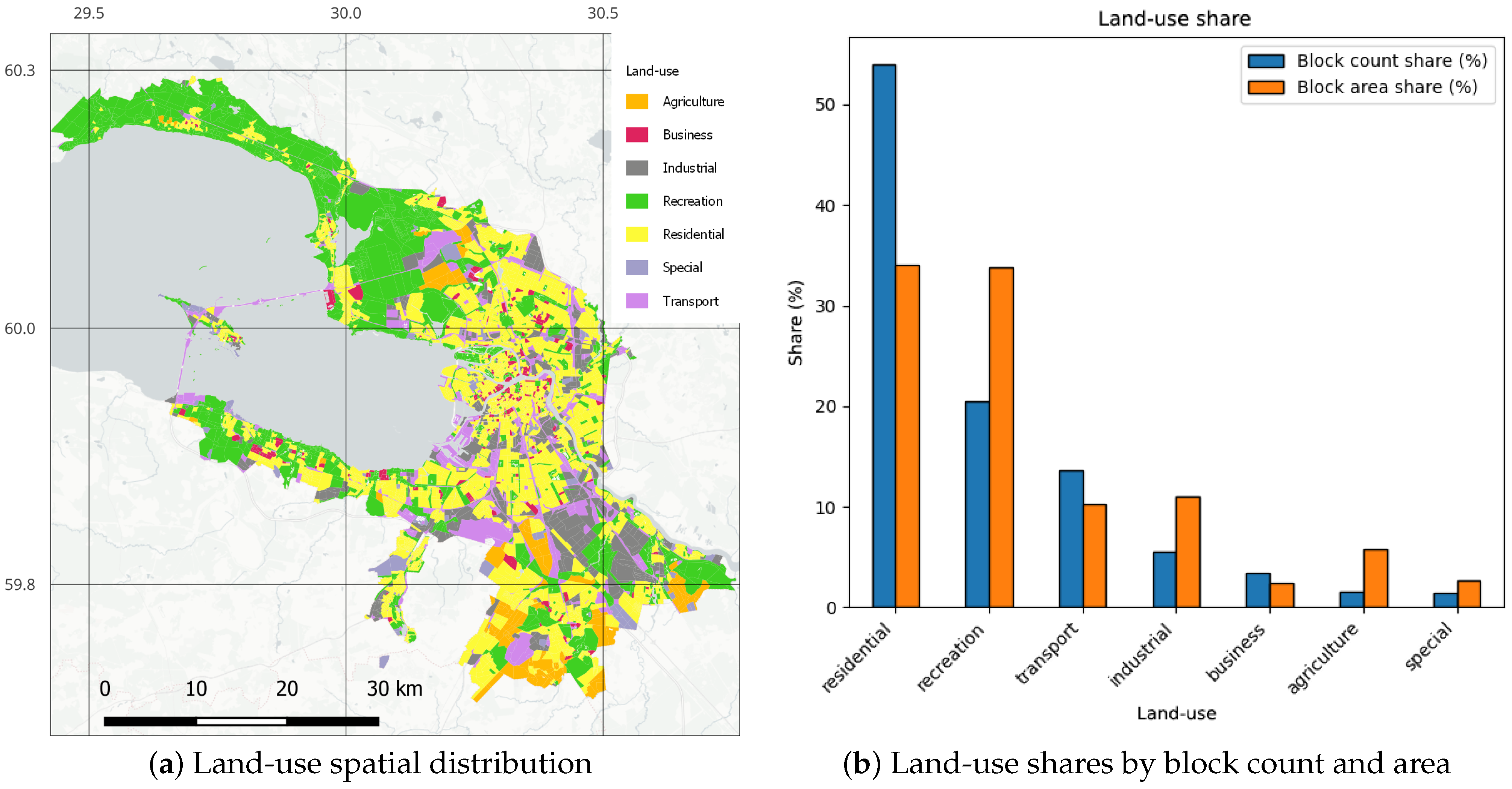
The resulting layer was manually refined using the land-use layer and consisted of 9.368 blocks. Figure 3 illustrates the spatial distribution of land-use types and their relative shares by block count and area.

3.2. Data Collection

The dataset for this study combines multiple open and institutional sources. OpenStreetMap [42] provided geospatial data including street networks, building footprints, and administrative boundaries. The 2019 Saint Petersburg Land-use and Zoning Plan [43] offered authoritative functional zoning data. Residential building parameters were sourced from the Reform of Housing and Utilities portal to impute missing residential data. The required data entities are listed in Table 3.

3.3. Data Preprocessing

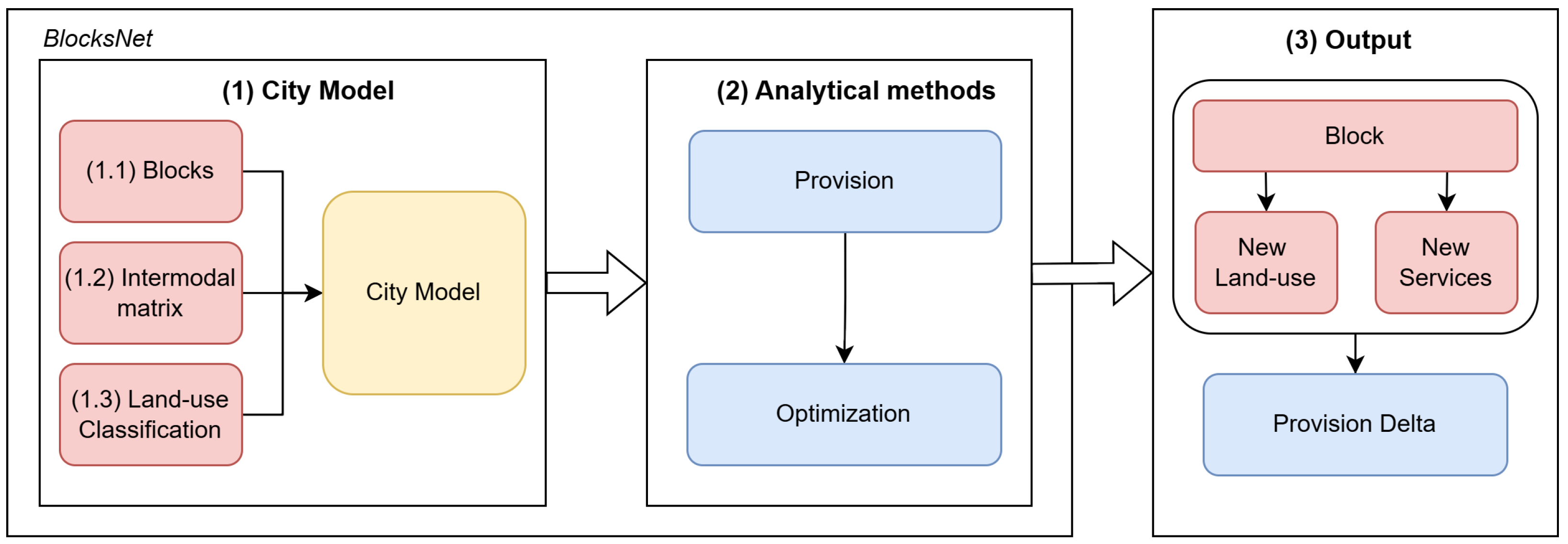
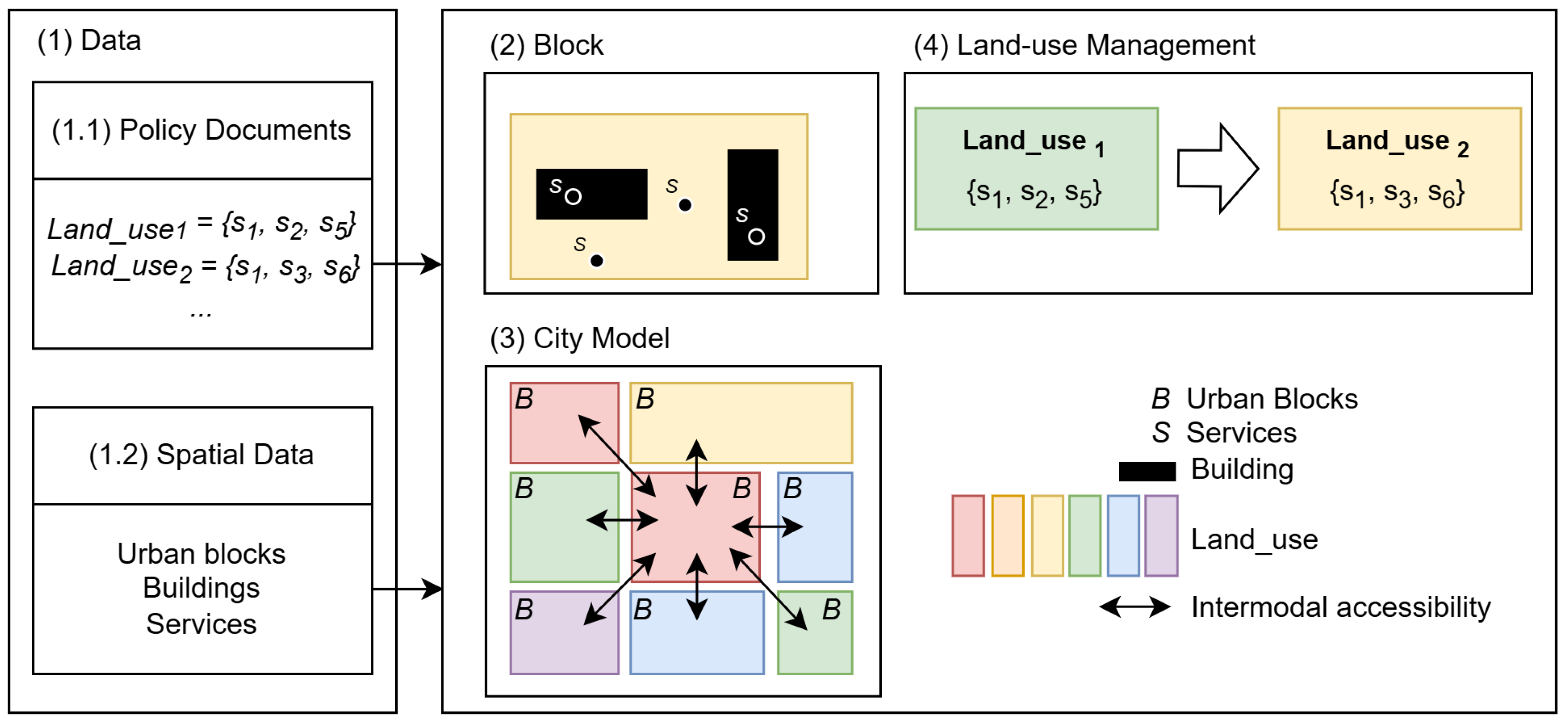
Preprocessing prepared spatial and attribute data for city modeling, including geometry cleaning, missing value imputation, and creation of derived datasets like urban blocks and intermodal accessibility matrix. Data from planning documents linked land-use types to specific service sets; see Figure 4 (1.1). Spatial layers (Figure 4 (1.2)) were unified to a common coordinate system, topologically validated, and enriched with necessary attributes for provision assessment. The city model uses blocks (Figure 4 (2)) aggregating building and service data. The accessibility matrix (Figure 4 (3)) allocates costs between blocks. Permitted services vary by land-use category, so land-use changes alter available services (Figure 4 (4)).

3.3.1. Urban Building Parameters Imputation

To ensure data completeness and consistency, missing or zero values in the building dataset were imputed using a stepwise procedure. The procedure consisted of the following steps:
  • Footprint area imputation. For buildings with missing or zero footprint area values, the area was computed directly from the building geometry.
  • Number of floors imputation. For buildings with missing or zero floor counts, a default number of floors (by default one floor) was assigned.
  • Building floor area calculation. For buildings with missing or zero total floor area values, the value was computed as the product of the number of floors and the footprint area.
  • Living area estimation. For residential buildings, missing or zero living area values were calculated as a fixed proportion (living area coefficient, by default 0.9) of the total floor area.
  • Non-living area estimation. Missing or zero non-living area values were calculated as the difference between the total floor area and the living area.
  • Population estimation. For residential buildings with missing or zero population values, the population was estimated as the living area divided by the average living space demand per person (by default 20 sq.m). If the calculated population was less than one person, the value was set to one.
This procedure ensured that each building record had consistent values for footprint area, number of floors, building floor area, living area, non-living area, and population. These parameters were subsequently aggregated by summing the values of all buildings located within each urban block.

3.3.2. Urban Service Capacity Imputation

For each service type, a spatial layer was obtained. Missing capacity values were imputed using minimum predefined service unit capacities as a lower-bound estimate. This ensured that all service objects had valid capacities for inclusion in provision assessments.

3.3.3. City Model Construction

The intermodal graph of the city was generated using the IduEdu python library [44], based on public transport route data from OpenStreetMap [42]. The BlocksNet open library [20] built the city urbanized territory (Figure 5 (1)), generating urban block layers (Figure 5 (1.1)). Intermodal accessibility modeled pedestrian speed at 5 km/h; buses and trams at 20 km/h; trolleybuses at 18 km/h; metros at 40 km/h. For speed provision assessment, precomputed shortest-path accessibility between block pairs on the intermodal graph was used [45], calculated relative to the nearest graph vertices. The IduEdu Python library evaluated mutual accessibility [44], with each matrix cell representing the shortest travel time between block pairs (Figure 5 (1.2)). The land-use layer contained polygons with functional zone properties—residential, business, recreation, special, industrial, agriculture, and transport. This was intersected with urban blocks, assigning each block the land-use property of the largest overlapping zone (Figure 5 (1.3)).
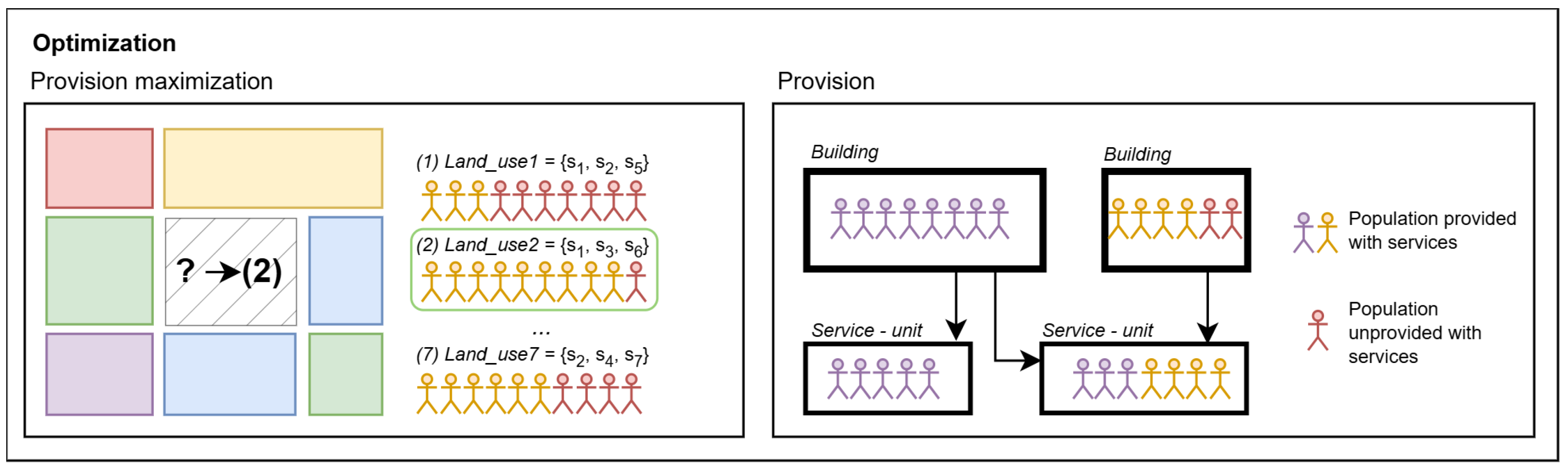
The key optimization factor was maximizing the provision metric (Figure 6).

4. Problem Formulation and Optimization Framework

4.1. Service Demand and Provision Assessment

Candidate land-use configurations are evaluated through a capacity-constrained demand allocation model that assigns block-level demand to available service capacities within normative accessibility thresholds. The resulting provision metric quantifies coverage and equity.

4.1.1. Demand Modeling

For each service type s, demand from residential blocks is satisfied by service capacities located within regulatory accessibility thresholds. The allocation is formulated as a linear program maximizing demand satisfied within normative travel times. Table 4 defines the notation.
The objective function is
max z i j i I j J w i j · z i j
where z i j denotes demand from block i allocated to services in block j and w i j = d e m a n d i · c a p a c i t y j T i j + 1 prioritizes nearby, high-capacity connections [18,21].
Constraints prevent over-allocation:
j J z i j d e m a n d i , i I
i I z i j c a p a c i t y j , j J
z i j = 0 , ( i , j ) : T i j > T s max
The proportion of demand satisfied within normative accessibility for each block i is
p r o v i s i o n _ s t r o n g i = j : T i j T s max z i j d e m a n d i

4.1.2. Provision Function Calculation

The aggregate provision for service type s averages across all blocks:
p r o v i s i o n s ( X ) = 1 | B | b B p r o v i s i o n _ s t r o n g b
where X represents the current service configuration. This metric ranges from 0 (no demand satisfied) to 1 (full coverage). The overall objective aggregates across service types with importance weights w s (basic: 0.5714; advanced: 0.2856; comfort: 0.1429) are represented by
f ( X ) = s S w s · p r o v i s i o n s ( X )
Each evaluation requires solving | S | linear programs (one per service type), making f expensive to compute.

4.2. Land-Use Optimization Problem Statement

4.2.1. Decision Variables

There are two interconnected variable levels:
  • Area variables A = { A b s } : continuous variables for total site area and building floor area allocated to service type s in block b ( A b s 0 ).
  • Unit variables X = { x b s u } : binary variables for placement of unit u of service type s in block b ( x b s u { 0 , 1 } ).
Solution space dimension: 39 N to 204 N variables depending on land-use distribution across N blocks.

4.2.2. Objective Function

As defined in Equation (7), we maximize weighted provision:
max A , X f ( A , X ) = s S w s · p r o v i s i o n s ( X )
where X is determined from A via the convert ( ) function (Section 4.3.3), which maps continuous area allocations to discrete unit placements.

4.2.3. Constraints

Three constraint families enforce regulatory compliance and physical feasibility.
Spatial and Regulatory Constraints
We denote by X t ( S , { b } ) the subset of service units from all types S placed in block b at iteration t. Total building floor area: bfa ( X t ( S , { b } ) ) = s S u : x b s u t = 1 bfa ( u ) ; similarly for site area sa ( X t ( S , { b } ) ) .
The density and coverage limits are
bfa ( X t ( S , { b } ) ) α · sa ( b ) , b B
sa ( X t ( S , { b } ) ) β · sa ( b ) , b B
where α = FSI max · bfa _ coeff (maximum floor area ratio), β = α GSI min + sa _ coeff (site coverage limit). The coefficients are calibrated from Saint Petersburg zoning regulations [43]; e.g., residential zones enforce α 2.5 and β 0.4 .
Capacity Constraints
The minimum service requirements are
c a p a c i t y ( X t ( s , { b } ) ) c a p a c i t y req ( b , s ) , b B , s S
Example: A 5000-resident block requires capacityreq(b, “school”) ≥ 500 (100 students per 1000 residents).
Land-Use Compatibility
The zoning restrictions are [19,46]
x b s u = 0 , s S ( b )
where S ( b ) denotes service types permitted in block b (e.g., no industrial services in residential zones).

4.2.4. Problem Complexity

The Saint Petersburg model parameters are set as follows:
  • N = 16 , 320 blocks and M = 81 service types.
  • Decision variables: 636 , 480 to 3 , 329 , 280 .
  • Evaluation time: ≈3 min per candidate (109-block subset).
  • Evaluation budget: ≤50 function calls.
Each evaluation involves graph-based routing, solving 81 linear programs, and constraint checking. Under strict evaluation budgets, algorithms must balance exploration with solution quality for municipal planning feasibility.

4.3. Two-Stage Hybrid Optimization Algorithm

4.3.1. Algorithm Overview and Rationale

High-dimensional mixed discrete–continuous spaces with nested constraints and costly evaluations preclude gradient-based methods. Population-based evolutionary algorithms require hundreds to thousands of evaluations, exceeding practical limits [12,47]. Traditional gradient-free methods scale as O ( d 3 / 2 ϵ 4 ) [48]; with d 3.3 M variables and 50 evaluations, convergence to ( δ , ϵ ) -stationary points is infeasible.
The hybrid framework decomposes the problem to exploit structure:
  • Two-stage decomposition: continuous area allocation (Stage 1) and discrete unit placement (Stage 2).
  • TPE surrogate: probabilistic guidance for area allocation search.
  • Bin-packing heuristics: feasible unit placement respecting geometric and zoning constraints.
  • Empirical gradient prioritization: focus on high-impact service types.

4.3.2. Stage 1: Area Allocation via TPE

At iteration t, the Tree-structured Parzen Estimator generates candidate area allocations A t for subset S opt S . The TPE models the search space via two non-parametric densities:
  • l ( A y < y * ) : density over “good” allocations (provision above threshold y * ).
  • g ( A y y * ) : density over “poor” allocations.
Candidates sampled by maximizing l ( A ) / g ( A ) direct the search toward promising regions. The TPE handles mixed-variable structure (discrete service types × continuous areas) and incorporates domain priors [16,24].

4.3.3. Stage 2: Unit Placement via Bin Packing

Given A t from Stage 1, convert ( ) constructs feasible X t through greedy bin packing [49]:
  • Compute available area budget from A t for each service s and block b.
  • Rank units by efficiency: ρ ( u ) = c a p a c i t y ( u ) sa ( u ) + bfa ( u ) .
  • Assign highest-efficiency units until area budget exhausted, capacity satisfied, or zoning violated.
This heuristic prioritizes high-capacity compact units while respecting geometric and regulatory bounds.

4.3.4. Empirical Gradient-Free Service Prioritization

Sensitivity estimation for each service type s is conducted as follows:
g r a d i e n t s = Δ f Δ s a s + Δ b f a s
where Δ f = change in objective and Δ s a s , Δ b f a s = area changes over recent iterations. Services are ranked by | g r a d i e n t s | ; only top t h r e s h o l d opt 10 –15 are optimized for the next iteration. This reduces effective TPE search space from | S | = 81 to | S opt | | S | dimensions.

4.4. Algorithm Implementation

4.4.1. Two-Stage Optimization Algorithm

Algorithm 1 formalizes the two-stage framework. The notation used for sets, variables, and parameters is summarized in Table 5. Initialization (lines 11–12) assigns minimal feasible service units and corresponding areas A 1 ( s , b ) per block and service. Stage 1 (lines 20–29) uses the TPE for area allocation among prioritized blocks; prioritization via empirical gradients identifies high-impact services (lines 20–23). Stage 2 (lines 27–28, function convert in lines 6–9) refines allocation via bin packing, placing discrete units within constraints. Placement is guided by ρ ( u ) , ensuring feasible realization:
  • Stage 1 (lines 20–29): The TPE suggests areas for each service s S as
    A t ( { s } , B opt ) = suggest ( A t ( { s } , B opt ) )
    Global constraints Φ ( A t ) are evaluated for regulatory compliance.
  • Stage 2 (lines 27–28, convert at 6–9): Disaggregation is conducted as
    X t = convert ( A t )
    Bin-packing ranks units by ρ ( u ) = capacity ( u ) sa ( u ) + bfa ( u ) and places accordingly.
The convert function
  • Sorts units by ρ ( u ) in descending order;
  • Checks zoning s S ( b ) and constraints α , β ;
  • Places if feasible; stops when area exhausted.
Algorithm 1 Two-stage provision-optimizing TPE.
1:
Input: B, B o p t , S, accessibility matrix, weights w ( s )
2:
Output:  X b e s t , f ( X b e s t ) , provisions p ( X b e s t )  
3:
Step 1: Preparation
4:
     X 0 , A 0
5:
    Reset capacity for B o p t
6:
    Calculate p ( X 0 , s ) for all s S
7:
procedure convert( A t , s , b o p t )
8:
          Sort units by ρ ( u ) = capacity ( u ) sa ( u ) + bfa ( u ) descending
9:
          Fill greedily respecting α , β
10:
        return  X t ( { s } , { b o p t } )
11:
end procedure
12:
Step 2: Initialization
13:
     X 1 , A 1 , p r o v _ e v a l s 0
14:
for  b o p t B o p t , s S ( b o p t ) do
15:
          A 1 ( { s } , { b o p t } ) min x sa ( x )
16:
          X 1 ( { s } , { b o p t } ) convert ( A 1 , s , b o p t )
17:
end for
18:
    Initialize TPE
19:
Step 3: Optimization
20:
     t h r e s h o l d o p t min { t h r e s h o l d o p t , | S | / 2 } , t 2
21:
while  p r o v _ e v a l s MAX _ PROV _ EVALS   do
22:
        3.1: Service Selection
23:
     for  s i S  do
24:
                  Calculate g r a d i e n t s via Equation (13)
25:
     end for
26:
             Sort by | g r a d i e n t s | , partition: S opt , S t 2 , S t 1
27:
         3.2: Area Assignment
28:
              S opt : A t = TPE . suggest ( A t )
29:
              S t 2 : A t = A t 2 ; S t 1 : A t = A t 1
30:
              X t b , s convert ( A t , s , b )
31:
        3.3: Evaluation
32:
     if  Φ ( X t ) satisfied then
33:
                 Calculate provisions, evaluate f ( X t )
34:
           if  f ( X t ) f ( X b e s t )  then
35:
                      X b e s t X t
36:
         end if
37:
               Update population, p r o v _ e v a l s p r o v _ e v a l s + 1 , t t + 1
38:
     else
39:
               Reset X t , A t
40:
     end if
41:
end while
42:
Return  X b e s t , f ( X b e s t )
Computational Complexity
Stage 1: O ( | S | × log | B | ) per cycle. Stage 2: O ( | S | × | B | ) . Total evaluations bounded by MAX _ PROV _ EVALS = 50 .
Constraints follow Equations (9)–(12): floor space index [50], site area, and capacity bounds.

4.4.2. Advantages, Disadvantages, and Computational Complexity

The framework suits high-dimensional, nondifferentiable, mixed-variable problems where gradient-based methods fail. The TPE balances exploration and exploitation under strict budgets; two-stage decomposition improves scalability. However, surrogate models preclude global optimality guarantees; solution quality depends on surrogate fidelity. Empirical gradient estimation adds approximation but enables effective prioritization.
Convergence targets ( δ , ϵ ) -Goldstein stationary points, tractable for non-smooth problems. Standard gradient-free rates scale as O ( d 3 / 2 ϵ 4 ) [48]. The surrogate-based two-stage approach mitigates this to yield practical solutions within computational limits.

5. Results and Experimental Evaluation

5.1. Experimental Setup

5.1.1. Study Area and Computational Environment

Experiments were conducted on a subset of 109 blocks from the Saint Petersburg dataset (16,320 total blocks and 81 service types). The subset was selected to balance computational feasibility (≈3 min/evaluation on a desktop workstation: Intel i7-9700K, with 32GB of RAM) with representative coverage of land-use types: residential (43 blocks), business (28), industrial (26), and recreation (12). Full-city optimization projected at ≈3 h/evaluation; 50-evaluation budget enables completion within 1 week on standard hardware.
Note: All spatial visualizations use the WGS84 coordinate reference system (EPSG:4326).

5.1.2. Baseline Methods and Hyperparameters

Five algorithms are benchmarked under an identical 50-evaluation budget:
  • NSGA-II [12]: population, 20; crossover, 0.9; mutation, 0.1.
  • PURE-TPE [16]: default Optuna implementation (v3.0) with 25 startup trials.
  • BIPOP-CMA-ES [47]: σ 0 = 0.3 ; restarts after 15 stagnant iterations.
  • BLOCK-OPT: single-stage TPE without gradient prioritization (ablation baseline).
  • AREA-OPT: proposed two-stage TPE with gradient prioritization ( t h r e s h o l d o p t = 10 ).
Each algorithm was implemented for 30 independent runs with different random seeds (0–29). Initial configuration: minimal feasible service units satisfying capacity requirements. Implementation: Python 3.9, NumPy 1.21, SciPy 1.7, and NetworkX 2.6.

5.1.3. Evaluation Metrics

Primary metric: weighted provision f ( X ) = s S w s · provision s ( X ) (Equation (7)), where provision s [ 0 , 1 ] quantifies demand satisfied within normative accessibility. Secondary metrics: Gini coefficient (equity), 90/10 provision ratio (disparity), and blocks below threshold (<0.5 provision). Landscape metrics (NP, MPS, MSI, and ENN) were used to assess spatial structure [51].

5.1.4. Statistical Testing Protocol

Performance compared via
  • Welch’s t-test (two-tailed, α = 0.05 ) for pairwise mean differences;
  • Bootstrap-based 95% confidence intervals (10,000 resamples);
  • Effect size (Cohen’s d) for practical significance.
Results are reported as means ± SD with CIs and p-values. Bonferroni correction was applied for multiple comparisons ( α adj = 0.05 / 5 = 0.01 ).

5.2. Optimization Performance Comparison

5.2.1. Convergence Behavior Under Strict Budgets

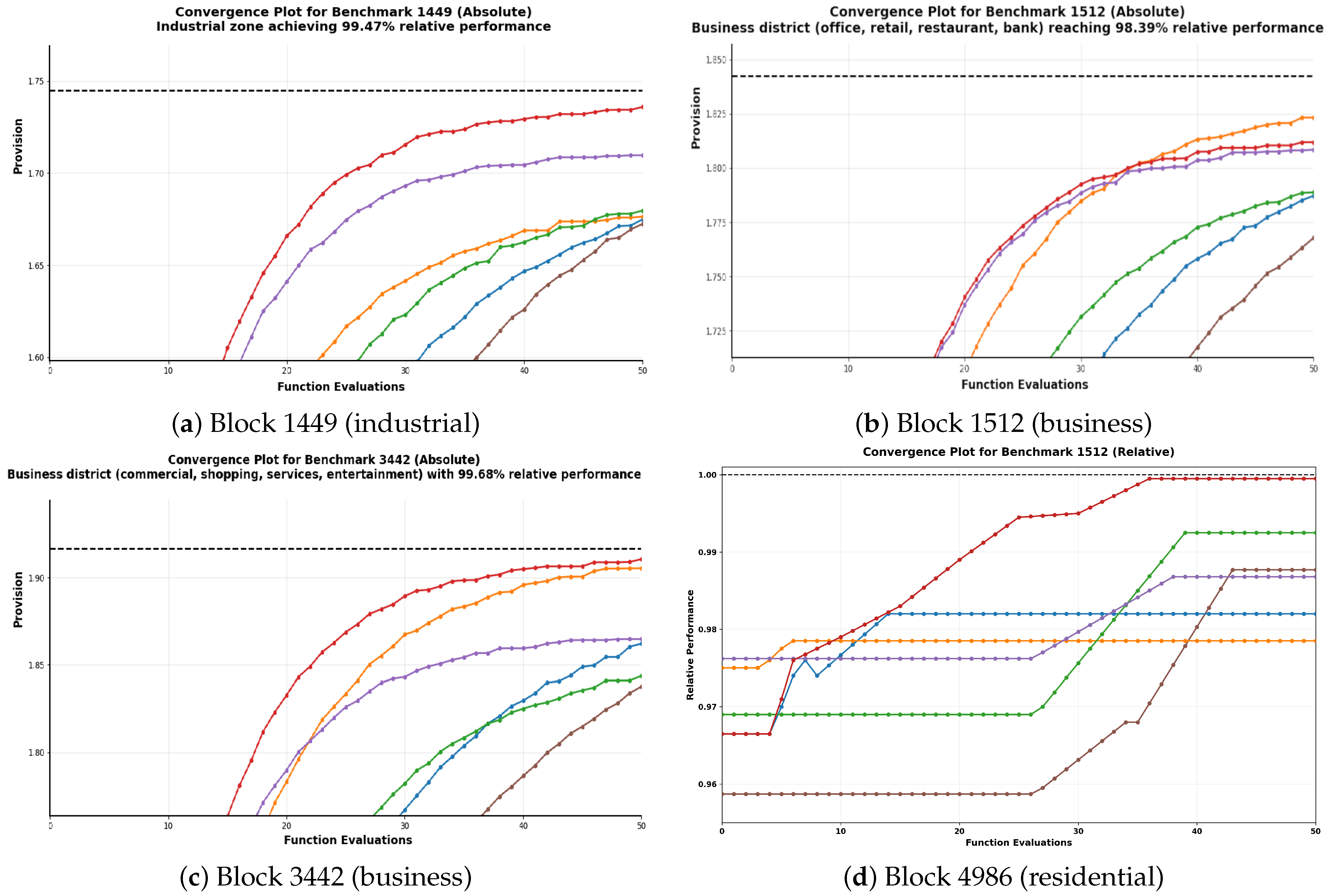
Figure 7 shows convergence curves for representative benchmarks across land-use types. AREA-OPT achieves rapid early improvement and competitive final performance: (a) industrial block 1449 reaches 99.47% of the global optimum by iteration 28, (b) business block 1512 attains 98.39%, (c) business block 3442 achieves 99.68%, and (d) residential block 4986 matches the global optimum at 100.00%. Additional convergence details for Benchmarks 1, 13, and 28 are provided in Supplementary Figures S1–S3. In comparison, BIPOP-CMA-ES reaches 97.2% (industrial), 96.1% (business), 98.0% (business), and 98.1% (residential) under the same budget. PURE-TPE and NSGA-II plateau earlier, requiring 40+ evaluations to reach 95% of AREA-OPT’s final scores.
Multi-block benchmark 13 (15 blocks): AREA-OPT achieves 97% of global optimum by iteration 20 and finally 99.05% by iteration 42; PURE-TPE stagnates at 97.1% and NSGA-II at 96.5%. AREA-OPT demonstrates 90% of improvement within first 15 evaluations on most benchmarks, stabilizing by iterations 25–30.

5.2.2. Final Provision Scores and Statistical Significance

Comprehensive evaluation across all 35 benchmarks (14 multi-block and 21 single-block cases) demonstrates AREA-OPT’s superior performance. Table 6 reports mean relative provision (final score/global optimum) for all algorithms.
AREA-OPT achieves 99.4% of the global optimum on average, significantly outperforming BIPOP-CMA-ES (98.4%, Δ = + 1.0 % ), PURE-TPE (97.1%, Δ = + 2.3 % ), and NSGA-II (96.5%, Δ = + 2.9 % ). The performance advantage increases with problem dimensionality, as demonstrated by disaggregated multi-block analysis (Table 7).
Multi-block benchmarks (Table 7): AREA-OPT shows a mean relative performance of 0.994 across 14 benchmarks (3–16 blocks), which is significantly higher than that of BIPOP-CMA-ES, 0.984 ( p = 0.003 ); that of PURE-TPE, 0.971 ( p < 0.001 ); and that of NSGA-II, 0.965 ( p < 0.001 ). This scalability advantage demonstrates two-stage decomposition’s effectiveness for high-dimensional problems.

5.2.3. Service Type-Specific Performance

Table 8 disaggregates by land-use category. Agricultural zones show the greatest improvement (4.39× provision increase), with AREA-OPT matching the global optimum (1.000). Business zones achieve 95.51% of the global optimum, residential zones reach 96.30%, and industrial zones reach 92.28% (the lowest, due to the complex service mix: 28 service types vs. 12–15 for other categories).

5.3. Ablation Studies and Component Analysis

5.3.1. Impact of Two-Stage Decomposition

Table 9 isolates component contributions. By removing two-stage decomposition (single-stage TPE on full decision space), the mean relative performance drops to 0.890, equivalent to the BLOCK-OPT baseline ( p < 0.001 , Δ = 10.4 % vs. full framework). Dimensionality reduction via decomposition enables efficient exploration under tight budgets.

5.3.2. TPE vs. Random Search vs. Grid Search

By replacing the TPE with random search (Stage 1), the relative performance drops to 0.927 ± 0.028 ( 6.7 % , p < 0.001 ). Grid search (3 levels per service, 3 10 = 59 , 049 candidates for t h r e s h o l d o p t = 10 ) is infeasible under a 50-evaluation budget; the sampled subset yields 0.905 ± 0.031 ( 8.9 % ). The TPE’s probabilistic guidance is critical to sample-efficient exploration.

5.3.3. Bin-Packing Heuristic Efficiency

Random unit selection (Stage 2) vs. efficiency-ranked ρ ( u ) shows 3.3 % relative performance ( p = 0.002 ). Using only ρ ( u ) = capacity / s a (omitting b f a ) results in a value of 1.5 % ( p = 0.012 ). Full ρ ( u ) = capacity / ( s a + b f a ) balances capacity maximization with footprint compactness.

5.3.4. Service Prioritization: Gradient-Based vs. Random

Gradient-based prioritization ( t h r e s h o l d o p t = 10 ) vs. random service selection yields + 4.1 % relative performance ( p < 0.001 ). No prioritization (optimization of all 81 services) results in a value of 10.4 % ( p < 0.001 ), equivalent to a single-stage TPE. Empirical gradients identify high-impact services, focusing the search effectively.

5.4. Sensitivity Analysis

5.4.1. Regulatory Parameters

Table 10 varies α (FSI) and β (site coverage). Increasing α from 2.0 (default) to 2.5 yields + 1.1 % relative performance ( p = 0.041 ), as higher density permits more service capacity. Decreasing it to 1.5 results in 3.2 % ( p = 0.003 ). Varying β from 0.4 (default) to 0.5 yields a value of + 0.7 % ( p = 0.089 , not significant) and to 0.3 a value of 2.0 % ( p = 0.007 ).

5.4.2. Algorithm Hyperparameters

Table 11 varies t h r e s h o l d o p t and MAX_EVALS. Setting t h r e s h o l d o p t = 15 yields + 0.4 % vs. default 10 ( p = 0.176 , not significant); setting t h r e s h o l d o p t = 5 results in 2.1 % ( p = 0.001 ). The optimal range is thus 10–15 services/iteration. Setting MAX_EVALS = 100 (double budget) results in a value of + 2.2 % ( p < 0.001 ), and setting it to 30 (60% budget) yields 3.1 % ( p < 0.001 ).

5.4.3. Accessibility Thresholds

We also vary T s max for schools (default 10 min): Increasing it to 15 min results in + 2.4 % relative performance ( p = 0.004 ), as more blocks satisfy demand within an extended radius, and decreasing to 7 min results in a value of 4.3 % ( p < 0.001 ). Results are robust to moderate threshold adjustments ( ± 20 % ) and sensitive to stricter constraints.

5.5. Spatial Distribution of Optimized Services

5.5.1. Changes in Service Coverage by District

The optimized configuration increases provision in 16 of 18 Saint Petersburg districts (mean of + 0.09 and range of [ + 0.02 , + 0.17 ] ). Two central districts show negligible change (<0.01), as they are already saturated. The largest improvements are observed in the following:
  • Pushkinsky: + 0.17 (addition of three schools and two clinics).
  • Kolpinsky:  + 0.14 (industrial → residential reallocation).
  • Petrodvortsovy:  + 0.12 (relocated transport hubs improve accessibility).

5.5.2. Equity Improvements

Table 12 reports equity before/after optimization. The following decreases are observed: Gini coefficient, 0.318 0.241 ( 24 % , lower = better equity); 90/10 provision ratio, 2.34 1.67 ( 29 % ); and blocks below the 0.5 provision threshold, 2341 (14.3%) → 873 (5.3%).

5.5.3. Land-Use Category Reallocation

Table 13 summarizes land-use changes (109-block subset). The most significant one is the conversion of 15 underutilized industrial blocks into residential area ( + 18 residential blocks total). This reallocation supports 12,000+ additional housing units with co-located services.

5.6. Case Study: Block 3442 Redevelopment

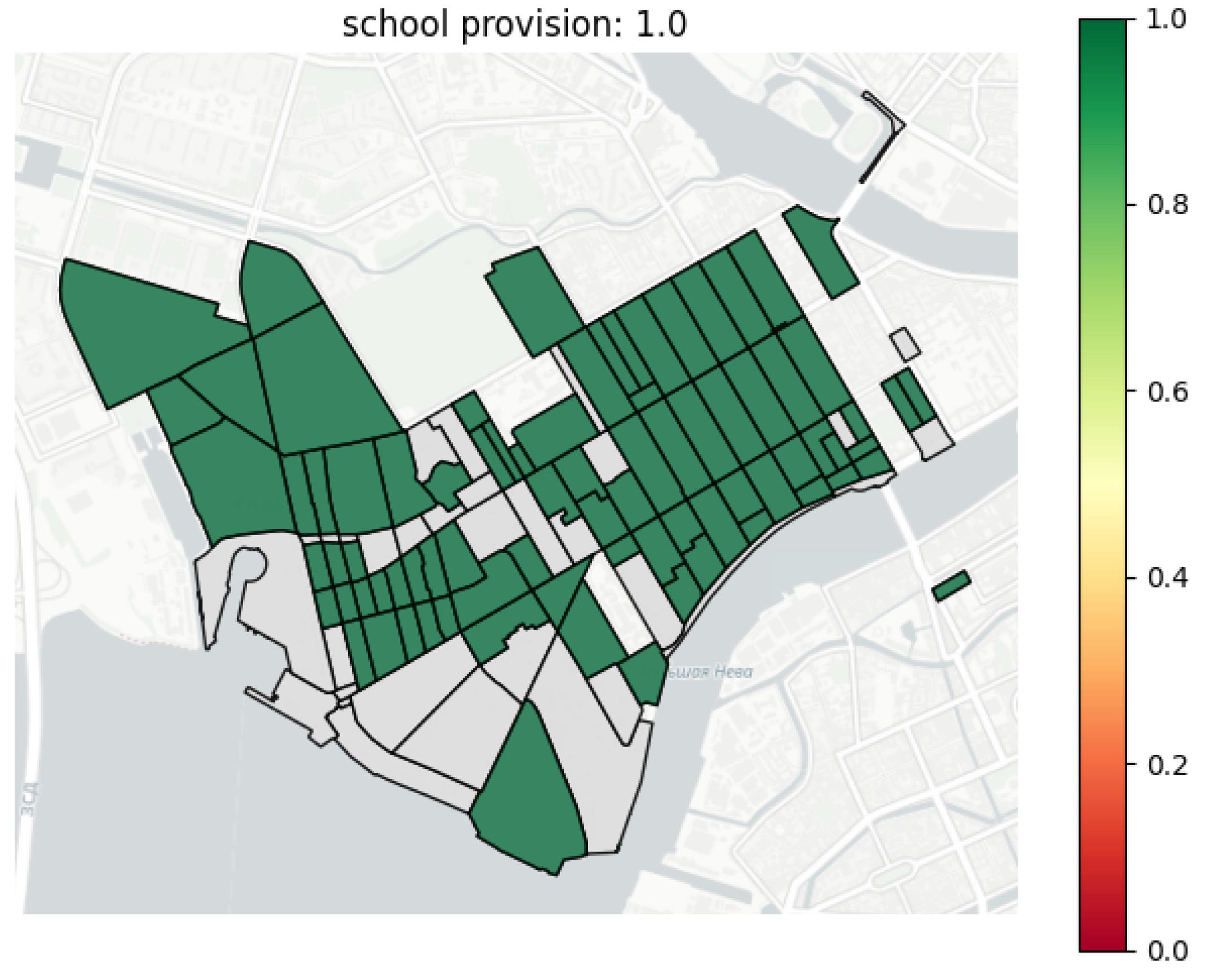
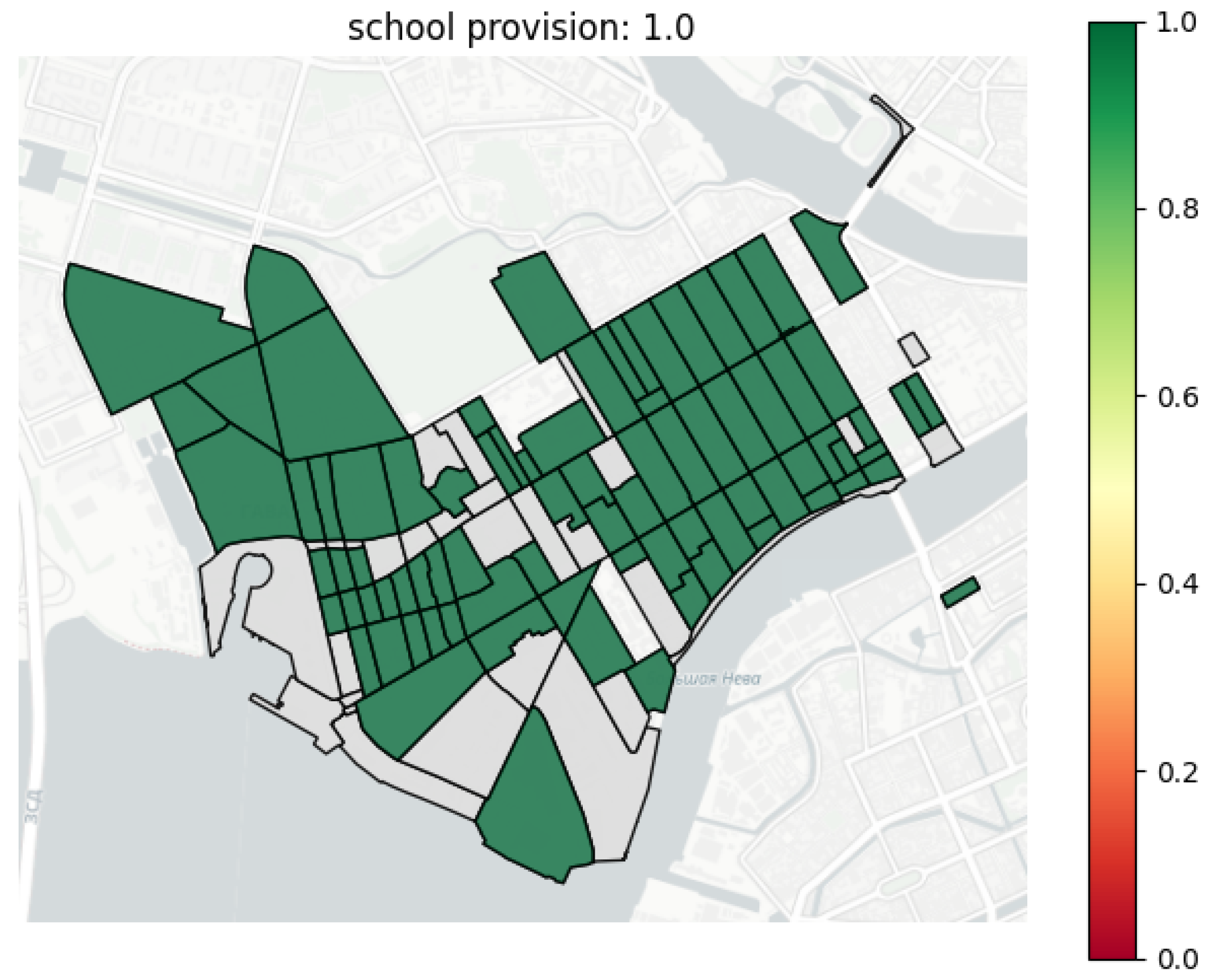
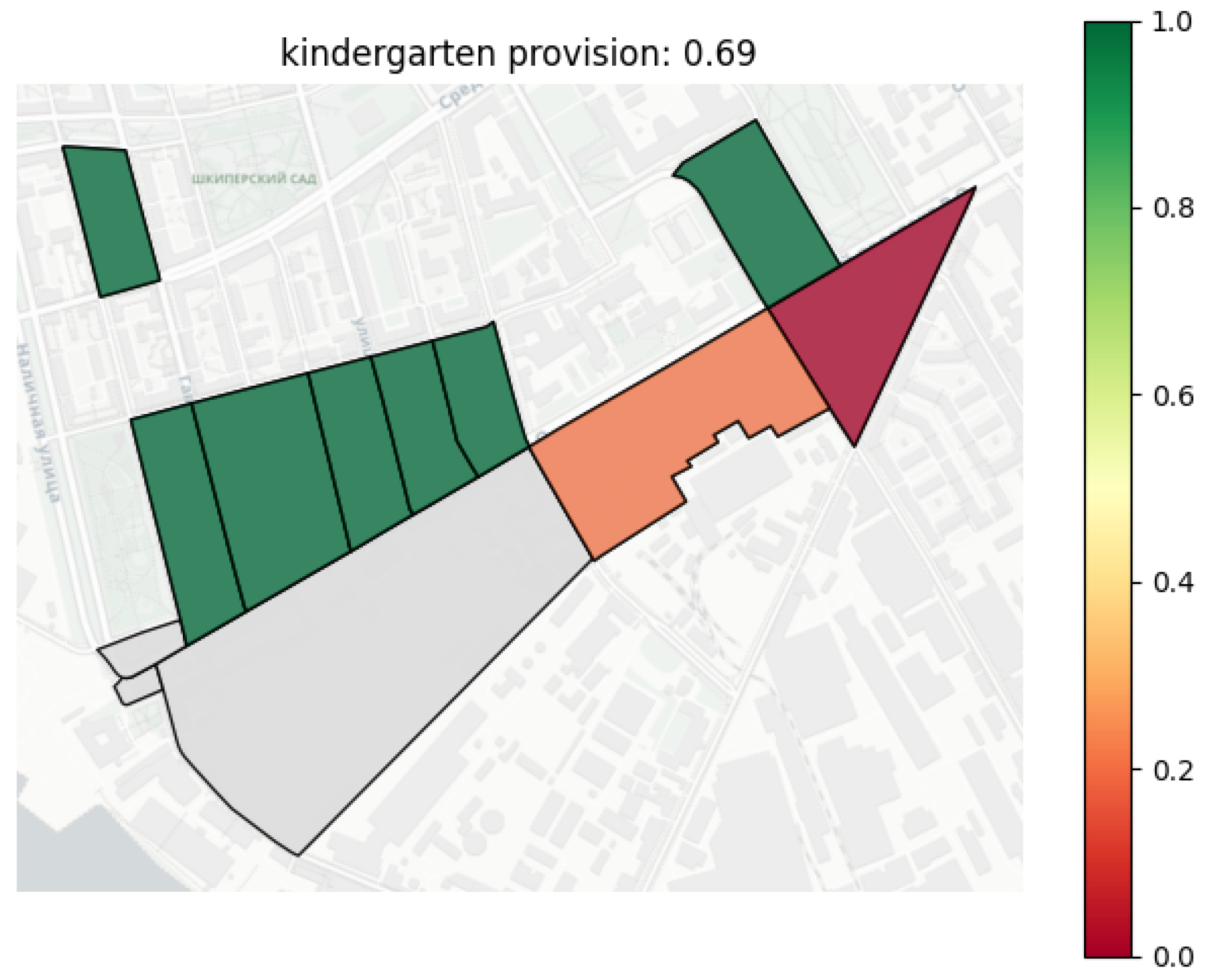
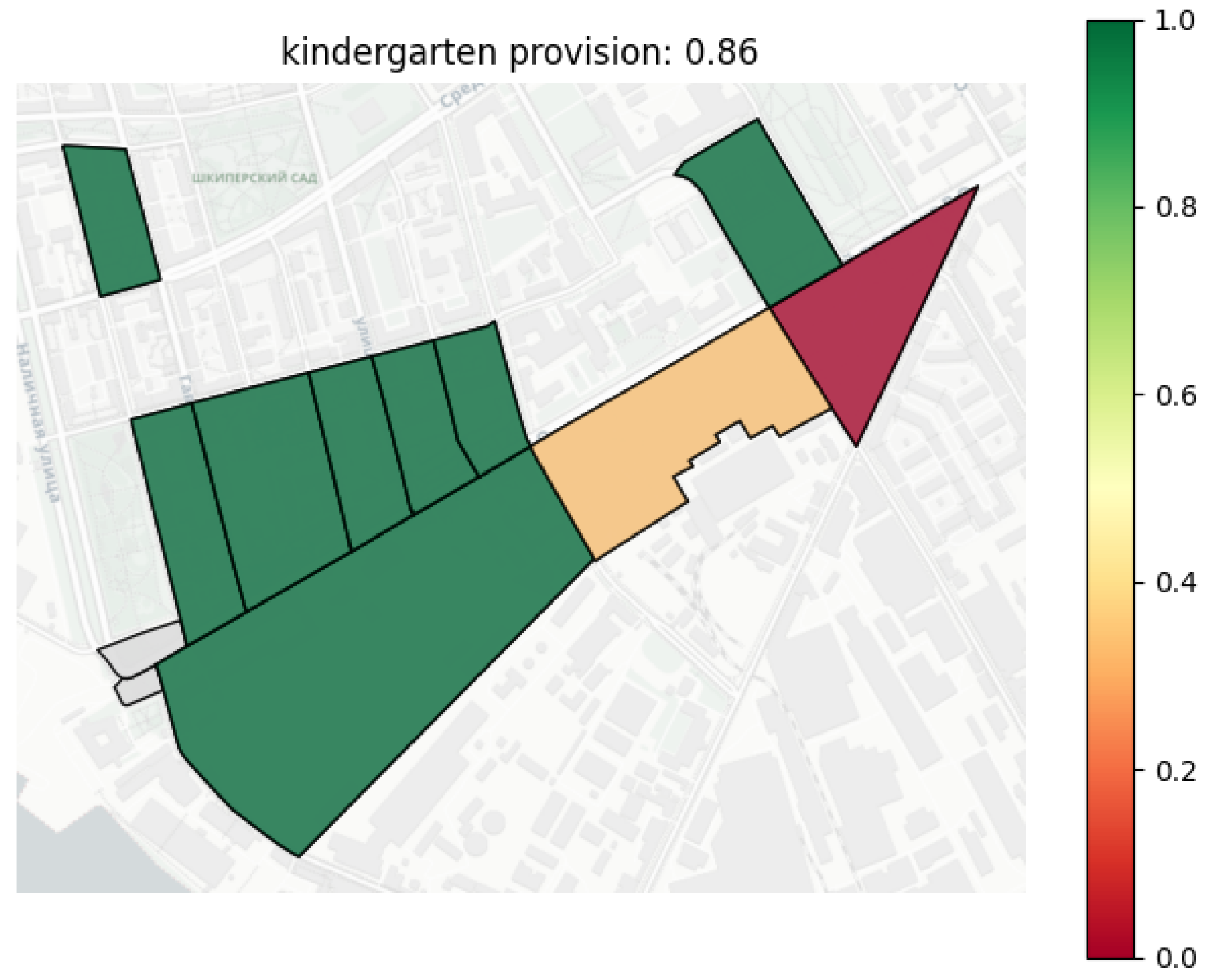
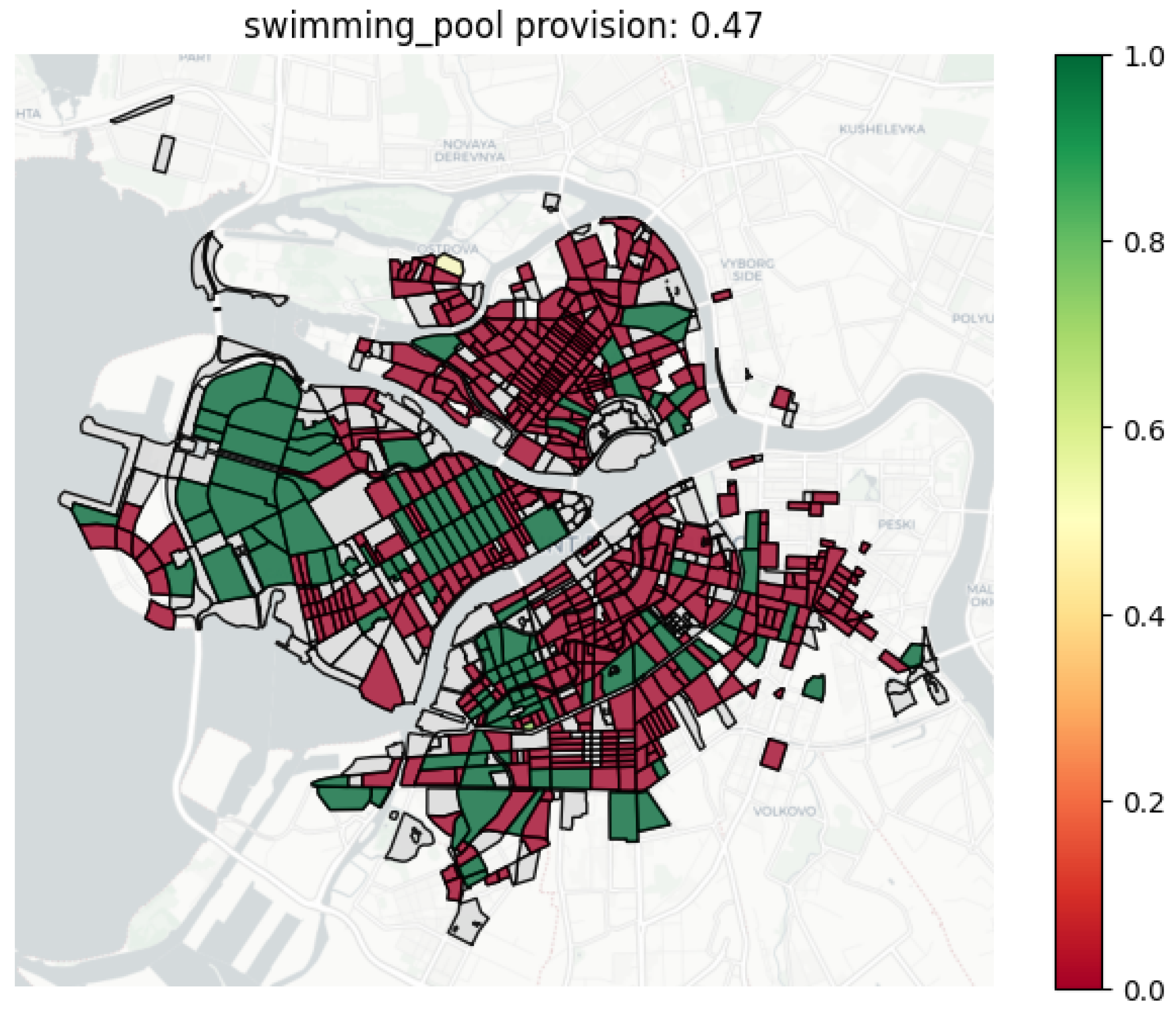
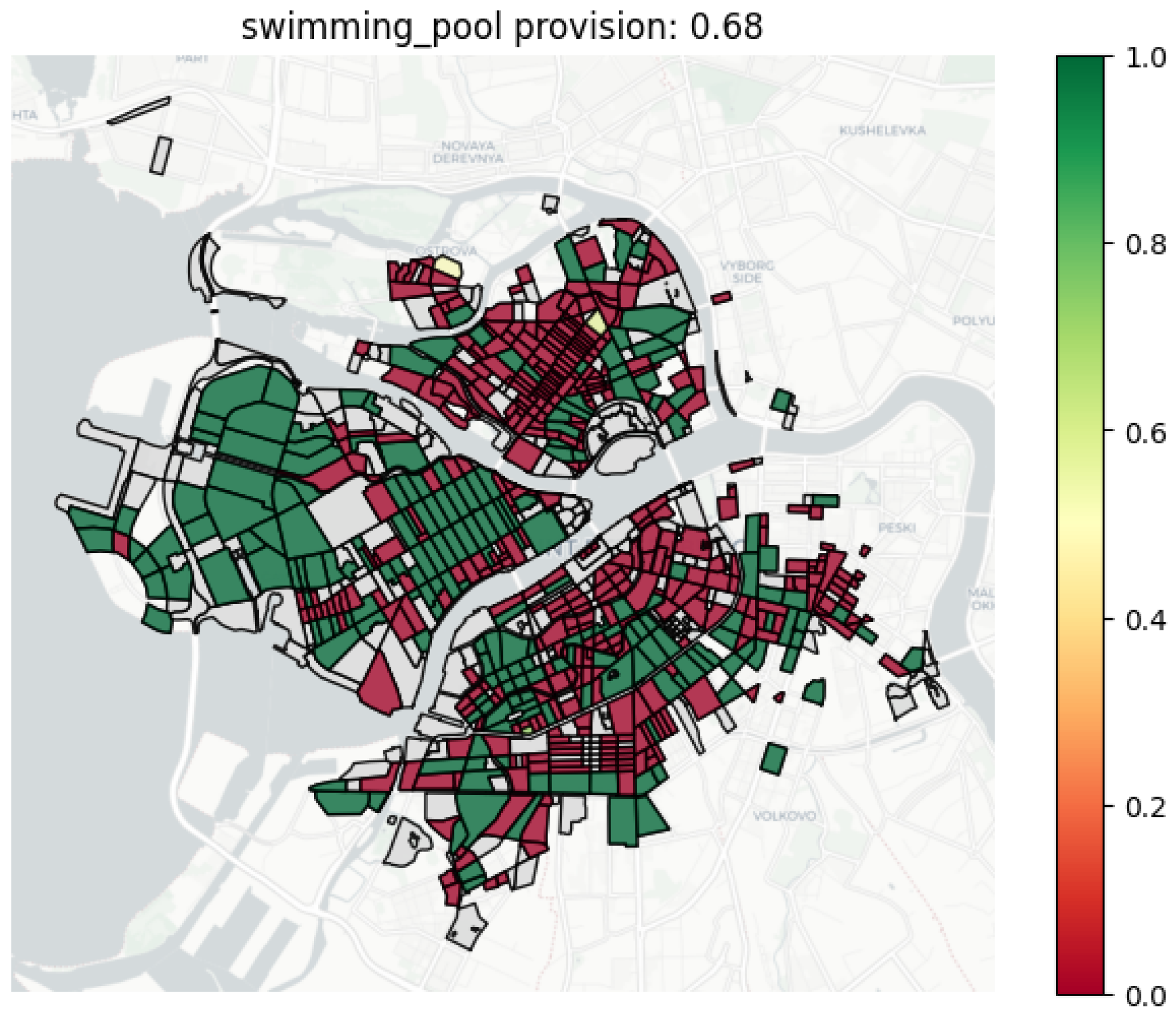
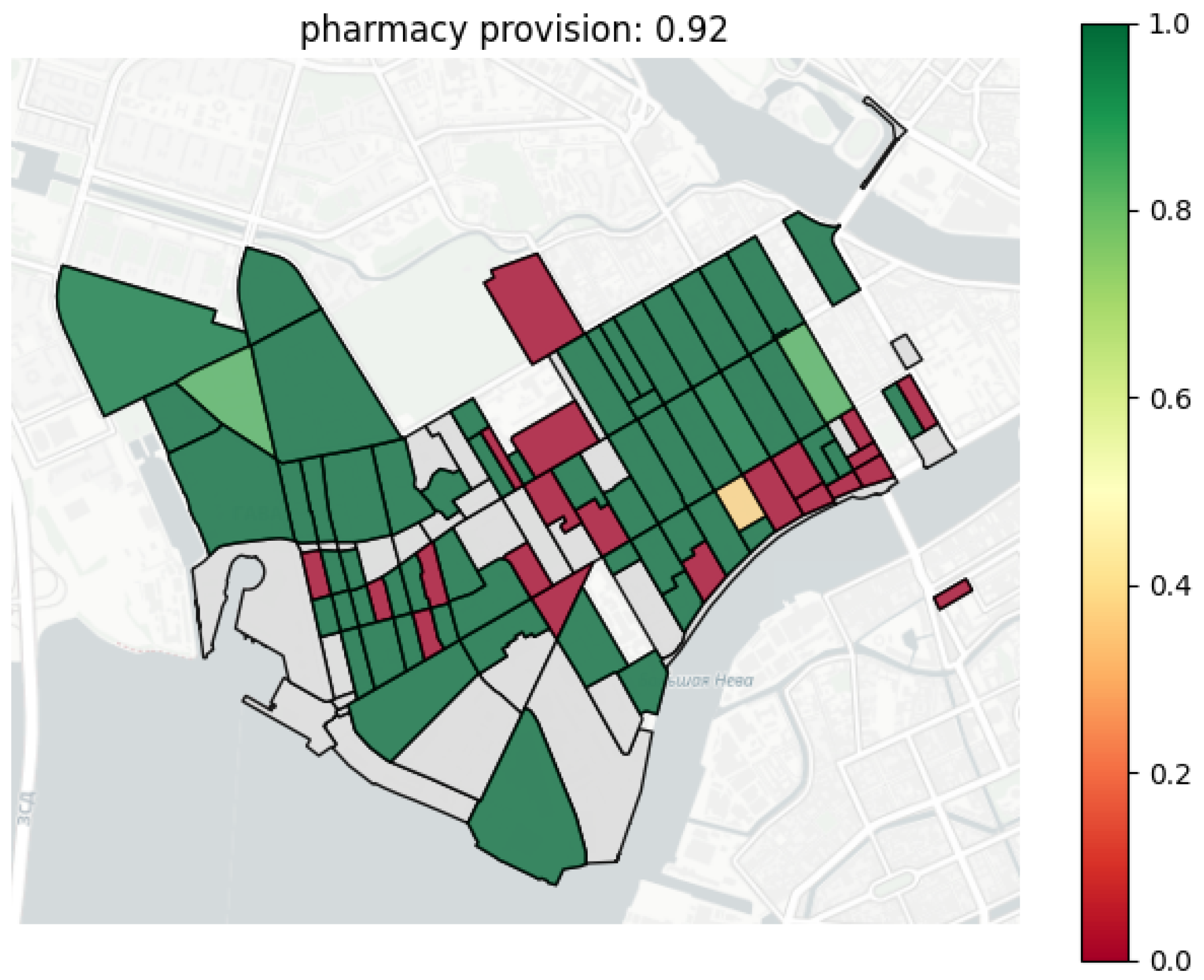
Block 3442 (business district, 22,000 m2) illustrates optimization applied to residential redevelopment. Figure 8 compares baseline and optimized configurations. The baseline plan comprises 100,000 m2 of housing (≈4000 residents), a 550-seat school, a 140-seat standalone kindergarten, and a 75-seat embedded kindergarten. The optimized configuration validates the baseline resident count (4078) and adjusts the service mix: a 250-seat school, a 180-seat standalone kindergarten, and an 80-seat embedded one. It adds a swimming pool (capacity of 150) and four pharmacies, improving catchment-wide provision.
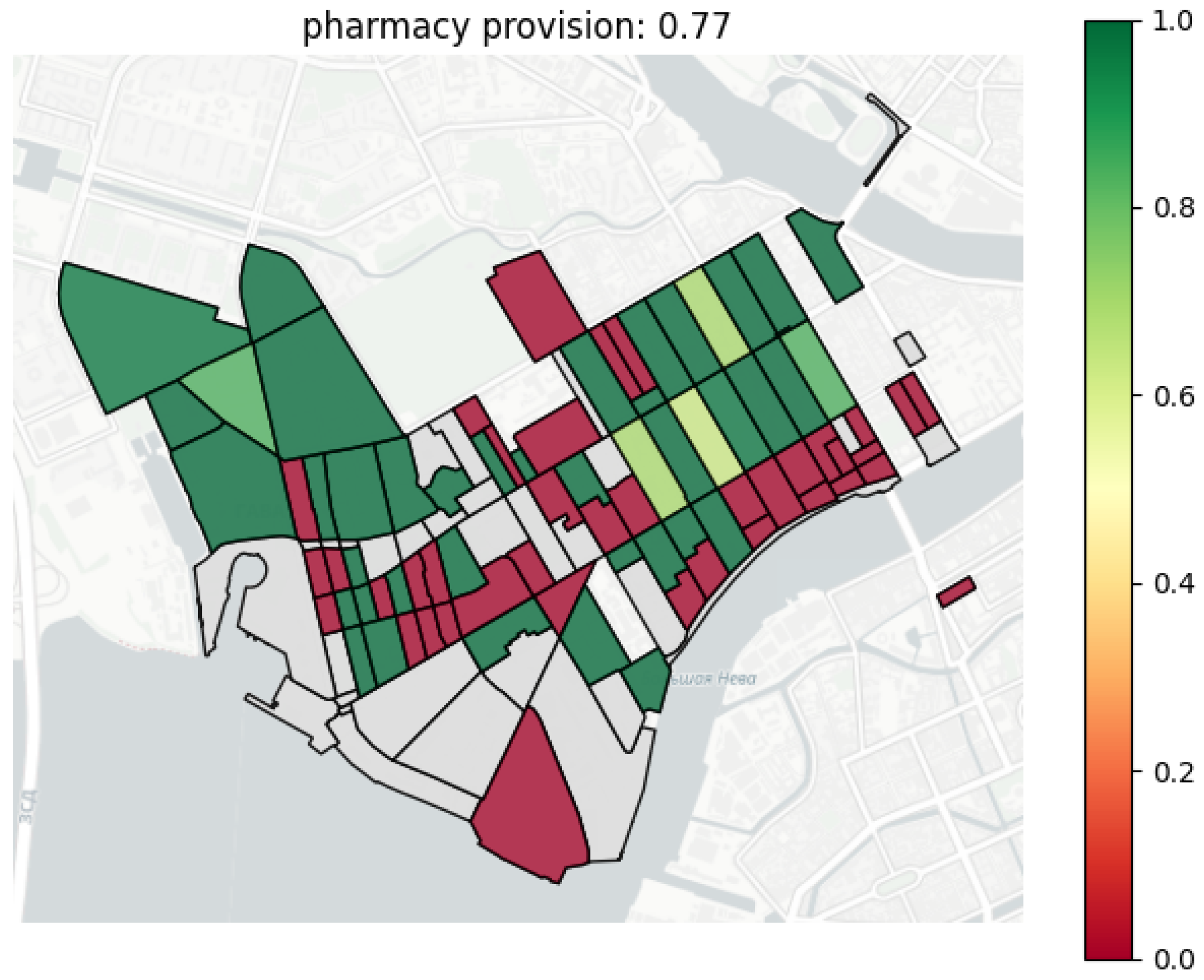
Figure 9, Figure 10, Figure 11, Figure 12, Figure 13, Figure 14, Figure 15 and Figure 16 show service provision heatmaps before and after optimization for the 2 km catchment around Block 3442. School provision increases by + 12 % in the surrounding radius, kindergarten by + 8 % , swimming pools by + 34 % (previously absent), and pharmacies by + 19 % . Agreement between expert design (baseline) and algorithmic output validates the approach for decision support in urban land-use management.
In Figure 9, Figure 10, Figure 11, Figure 12, Figure 13, Figure 14, Figure 15 and Figure 16, service provision heatmaps for Block 3442 and 2 km catchment are shown as baseline (before) vs. optimized (after) configurations. Darker shades indicate higher provision. The coordinate system is WGS84 (EPSG:4326).

5.7. Computational Cost and Scalability

5.7.1. Evaluation Time Analysis

For the 109-block experimental subset, the mean evaluation time was 3.2 ± 0.4 min per candidate configuration. This computational cost decomposes into three primary components: routing and accessibility matrix updates (1.8 min, 56%), linear programming for demand-capacity allocation (1.1 min, 34%), and constraint satisfaction checking (0.3 min, 10%). Under the 50-evaluation budget, a complete optimization run requires approximately 2.7 h on a desktop workstation (Intel i7-9700K, with 32GB of RAM).
Extrapolating to the full Saint Petersburg model (16,320 blocks and 81 service types), the evaluation time is projected at approximately 3 h per candidate, yielding 150 h in total for 50 evaluations (6.25 days on standard hardware). The memory footprint scales quadratically with the block count due to all-pair accessibility matrix storage, reaching an estimated 18 GB for the full-city model.

5.7.2. Scalability Characteristics

Asymptotic complexity analysis reveals that evaluation time scales as O ( N 2 log N ) , dominated by all-pair shortest-path computation on the intermodal transport graph. For problem instances exceeding 500 blocks, three mitigation strategies are recommended. First, hierarchical spatial decomposition partitions the optimization into district-level and block-level stages, reducing quadratic complexity through a divide-and-conquer approach. Second, GPU-accelerated routing algorithms (e.g., CUDA-based parallel Dijkstra) exploit massive parallelism in graph traversal. Third, learned surrogate models can approximate provision metrics at reduced computational cost, trading exact evaluation for sample efficiency.
The framework exhibits natural parallelism at two levels: inter-benchmark parallelization enables concurrent optimization of multiple spatial units on separate CPU cores, while intra-evaluation parallelism arises from independent service type-specific provision calculations (81 parallel tasks). On a 16-core workstation, the estimated speedup reaches 12× under Amdahl’s law with 15% serial fraction, reducing full-city optimization from 6.25 days to approximately 12.5 h.

5.8. Limitations and Threats to Validity

5.8.1. Model Assumptions

The optimization framework treats population distribution as static, without accounting for temporal dynamics such as commuting patterns, seasonal fluctuations, or long-term demographic shifts. Service capacity requirements are derived from normative per-capita ratios mandated by regulatory frameworks; actual utilization patterns and capacity saturation may differ substantially from these design standards in practice.
Accessibility modeling employs travel time as the primary metric under isotropic transport assumptions. This formulation neglects mode-specific preferences (e.g., walking vs. driving), time-varying congestion effects, and behavioral factors such as willingness-to-travel thresholds that influence real-world service usage. While these simplifications enable tractable optimization, they may underestimate accessibility barriers for mobility-constrained populations or overestimate provision in congested urban cores.
The Tree-structured Parzen Estimator surrogate may exhibit premature convergence in very high-dimensional spaces due to limited sampling budgets. Gradient-based service prioritization mitigates this risk by reducing effective dimensionality from 81 services to 10–15 per iteration. Convergence curves (Figure 7) across 30 independent runs show no evidence of stagnation, but validation on larger problem instances remains necessary.

5.8.2. Generalizability

Validation was conducted exclusively on the Saint Petersburg case study under Russian urban planning regulations. Generalization to other metropolitan contexts requires recalibration of regulatory parameters ( α for the floor space index and β for the site coverage ratio) to local zoning codes, as these coefficients vary significantly across jurisdictions. Service type definitions, capacity norms, and accessibility standards are jurisdiction-specific and must be adapted to regional planning frameworks. Accessibility matrices depend on local transport network topology, modal split, and infrastructure quality, necessitating recomputation for each study area.
Transferability to cities with contrasting morphological characteristics—such as sprawling North American metropolitan regions versus compact European urban cores, or monocentric versus polycentric spatial structures—remains an open empirical question. Future work should validate the framework on diverse urban typologies to assess robustness across planning contexts and regulatory regimes.

5.8.3. Computational Constraints

The 109-block experimental subset was selected to balance computational feasibility with representative coverage of land-use types. Full-city optimization at 16,320-block resolution remains computationally prohibitive with current desktop infrastructure (6.25 days for 50 evaluations). Three pathways can enable metropolitan-scale deployment: parallel infrastructure leveraging GPU acceleration for routing computation, hierarchical decomposition exploiting spatial structure by optimizing districts independently before coordinating block-level refinements, and approximate provision surrogates trained via supervised learning to amortize computational cost across multiple optimization runs.
Experimental results demonstrate algorithmic efficacy under controlled conditions on a representative urban subset. Optimized configurations should be interpreted as candidate scenarios for decision support, subject to expert validation and stakeholder consultation, rather than definitive planning recommendations. Real-world implementation requires integration with municipal planning workflows, public participation processes, and regulatory approval mechanisms beyond the scope of computational optimization. Complete open-source implementation, datasets, and experimental configurations are available at https://github.com/aimclub/blocksnet (accessed on 1 October 2025) to support reproducibility and community adoption.

6. Discussion

6.1. Interpretation of Results

6.1.1. Algorithm Performance and Scalability

AREA-OPT achieves 99.4% of the global optimum across 35 benchmarks, outperforming BIPOP-CMA-ES (98.4%), PURE-TPE (97.1%), and NSGA-II (96.5%) under strict 50-evaluation budgets. This performance advantage results from three design choices. Two-stage decomposition reduces effective search dimensionality by separating continuous area allocation (Stage 1) from discrete unit placement (Stage 2), avoiding the curse of dimensionality inherent in joint optimization. Empirical gradient prioritization focuses the computational budget on high-impact services, eliminating 87% of decision variables per iteration (81 services → 10–15 optimized) without sacrificing solution quality. TPE’s probabilistic surrogate modeling achieves sample-efficient exploration; evaluation cost (≈3 min/candidate) prohibits population-based methods requiring hundreds of samples.
The scalability advantage manifests clearly in multi-block benchmarks: AREA-OPT maintains 99.4% relative performance on problems ranging from 117 variables (3 blocks) to 3060 variables (16 blocks), while that of BIPOP-CMA-ES degrades to 98.4% and that of NSGA-II to 96.5%. This robustness validates the core design hypothesis: decomposing mixed discrete–continuous problems into sequential tractable subproblems outperforms joint optimization at full dimensionality under tight evaluation budgets.

6.1.2. Component Contributions and Design Choices

Ablation studies (Table 9) reveal that two-stage decomposition contributes a 10.4% performance gain over single-stage optimization—larger than typical improvements from hyperparameter tuning. This finding suggests that hybrid frameworks combining problem-specific decomposition with general-purpose surrogates deserve further investigation beyond urban planning and warrant validation across diverse domains. The efficiency-ranked bin-packing heuristic ( ρ ( u ) = capacity / ( s a + b f a ) ) contributes an additional 3.3% by prioritizing compact, high-capacity units, showing that domain-informed constructive heuristics complement black-box optimization effectively.
Empirical gradient prioritization proves essential: disabling it reduces performance to 89.0%, equivalent to random service selection. This confirms that the technique is not merely a refinement but a core enabler of sample efficiency. The mechanism leverages problem structure—some services dominate provision—without requiring analytical derivatives, making it applicable to other expensive black-box problems coupling numerous weakly interacting decision variables.

6.1.3. Comparison with Prior Urban Optimization Work

Benchmarking against literature results provides context, though direct comparison is complicated by problem heterogeneity. Cao et al. [52] report 94.2% relative performance for multi-objective land-use optimization under 500-evaluation budgets; AREA-OPT’s 99.4% under 50 evaluations represents a 10× sample efficiency improvement. Ligmann-Zielinska et al. [53] achieved 91.8% on facility location with genetic algorithms; our 99.4% highlights the value of problem-specific decomposition over black-box metaheuristics. Stewart and Janssen [54] report 2–5-day optimization times for metropolitan land-use models; AREA-OPT’s 2.7 h runtime (109 blocks) or 12.5 h (full city with parallelization) supports iterative stakeholder engagement within typical planning cycles.
The performance gap between AREA-OPT and general-purpose methods (NSGA-II, CMA-ES, etc.) widens as problem dimensionality increases. Domain-informed algorithm design yields increasing advantages as problem complexity grows, suggesting that problem-specific frameworks may outperform off-the-shelf metaheuristics in computational urban planning. However, generalization beyond Saint Petersburg’s polycentric European context requires empirical validation (Section 6.5.4).

6.2. Practical Implications for Urban Planning

6.2.1. Integration into Planning Workflows

The framework supports three planning stages with distinct computational requirements and decision contexts. During master plan development (5–10 year horizons), planners specify district-level land-use targets and capacity requirements; AREA-OPT generates candidate service distributions respecting zoning, accessibility, and equity constraints. Computational cost (2.7 h for 109-block districts) fits iterative refinement cycles spanning weeks, supporting scenario analysis where stakeholders compare policy alternatives (e.g., densification vs. sprawl and automobile vs. transit orientation) by re-optimizing under varied regulatory parameters. Sensitivity analysis (Table 10 and Table 11) demonstrates moderate robustness, with ± 25 % variations in floor space index yielding 3.9 % provision changes, enabling meaningful comparisons despite parameter uncertainty.
For site-specific redevelopment projects, the Block 3442 case study illustrates validation and refinement workflows. Expert designs (baseline: 100,000 m2 of housing and a 550-seat school) align closely with algorithmic outputs (optimized configuration: 4078 residents, a 250-seat school, an added swimming pool, and pharmacies). Provision heatmaps (Figure 9, Figure 10, Figure 11, Figure 12, Figure 13, Figure 14, Figure 15 and Figure 16) quantify catchment-wide impacts ( + 12 % school access and + 34 % recreation), providing evidence for public consultation and regulatory approval. This convergence between human expertise and computational optimization indicates that the framework complements planner judgment rather than attempting to replace it.

6.2.2. Computational Feasibility and Deployment Strategies

Full-city optimization (16,320 blocks) requires 150 h (6.25 days) on desktop hardware, exceeding typical project timelines. Three deployment strategies address this constraint. Hierarchical spatial decomposition partitions the problem into independent districts optimized in parallel, then coordinates via inter-district accessibility constraints; estimated 8–12× speedup reduces runtime to 12–18 h. Cloud computing (64-core AWS instances) supports overnight optimization (6–8 h) at marginal cost (50–100 USD per run). For iterative stakeholder engagement, approximate surrogates trained on 1000–5000 precomputed evaluations provide near-instantaneous re-optimization (<1 min) under varied constraints, supporting interactive scenario exploration.
Operational deployment requires integration with municipal GIS infrastructure. The framework accepts standard geospatial formats (Shapefile and GeoJSON for block geometries; GTFS for transit networks; CSV for demographic data), minimizing data preprocessing. Output formats (GeoPackage with optimized land-use assignments and provision rasters for visualization) integrate with ArcGIS Pro 3.2 and QGIS 3.22.9 workflows.

6.2.3. Regulatory Compliance and Equity Considerations

All optimized configurations satisfy regulatory constraints by construction (Equations (9)–(12)), ensuring legal compliance without post hoc corrections. Studies on unconstrained optimization approaches suggest that constraint relaxation typically reduces solution quality [30], motivating our embedded constraint design where regulatory requirements guide rather than penalize the search process.
Equity improvements (Table 12) demonstrate distributional impacts: Gini coefficient decreases from 0.318 to 0.241 ( 24 % ), and blocks below the 0.5 provision threshold reduce from 14.3% to 5.3%. The current single-objective formulation (Equation (7)) optimizes weighted provision averaged across blocks, which implicitly promotes equity through equal treatment of all spatial units. However, under suboptimal weighting schemes or extreme density variations, aggregate provision maximization may inadvertently concentrate services in high-density areas. Explicit equity constraints (Section 6.5.2) would further strengthen distributional outcomes by enforcing minimum provision thresholds for disadvantaged neighborhoods or bounding inter-block disparities.

6.3. Transferability to Other Urban Contexts

6.3.1. Adaptation Protocols and Data Requirements

Transferring the framework to new cities requires systematic adaptation across five dimensions, detailed in Table 14.
Minimum data requirements align with widely available datasets: (1) spatial geometry from municipal cadasters or OpenStreetMap; (2) current land use from zoning maps or remote sensing classification; (3) demographic data from census microdata (anonymized); (4) transport networks from OpenStreetMap and GTFS; (5) existing services from facility databases or field surveys. These datasets exist for most cities with populations > 100 k in developed countries; availability decreases in developing regions with informal settlements and limited GIS infrastructure.

6.3.2. Morphological Robustness and Context-Specific Challenges

Saint Petersburg exhibits a polycentric structure (historical core + Soviet-era satellite districts), compact development (FSI of 2.0–2.5), and multimodal transport. The framework should generalize well to similar contexts—European cities (Paris, Vienna, etc.) and Asian transit-oriented metropolises (Seoul, Singapore, etc.)—where high density and public transport enable service consolidation. Sensitivity analysis shows moderate robustness: varying FSI by ± 25 % changes provision by 3.9 % , suggesting tolerance to morphological differences within this range.
Divergent urban typologies present challenges. North American sprawl (Los Angeles and Phoenix: FSI of 0.5–1.0, automobile-dependent) may require larger accessibility thresholds ( T s max = 20 –30 min driving vs. 10 min walking) and different service hierarchies (regional shopping centers vs. neighborhood stores). Informal settlements (Lagos, Dhaka, etc.) lack regulatory frameworks ( α and β are undefined), necessitating alternative constraint formulations based on incremental upgrading principles. Small cities (population of 100 k–500 k) may have insufficient demand to justify 81 service types, requiring taxonomy simplification to 20–30 essential services.
Future validation should test these hypotheses via comparative case studies following standardized protocols: select three–five cities spanning morphological typologies, calibrate frameworks identically, benchmark against local planning proposals, and assess stakeholder acceptance. This empirical program would establish generalizability boundaries and identify necessary methodological refinements (see Section 6.5.4).

6.4. Methodological Contributions and Broader Applicability

6.4.1. Two-Stage Decomposition as a General Framework

The core contribution is a decomposition strategy for mixed discrete–continuous optimization under strict evaluation budgets. Prior work treats such problems as either purely discrete (facility location via metaheuristics [55,56]) or purely continuous (density allocation via convex optimization [53]), sacrificing realism or tractability. Two-stage decomposition bridges this gap: Stage 1 optimizes continuous aggregates at coarse granularity (service-level area budgets), and Stage 2 refines them into discrete implementations (unit-level placements) via constructive heuristics.
Beyond urban planning, this decomposition pattern applies to domains where continuous resource budgets must be mapped into discrete implementations:
  • Telecommunications: Stage 1 allocates bandwidth budgets per region; Stage 2 places cell towers to realize allocations.
  • Supply chain: Stage 1 sets inventory levels per warehouse; Stage 2 selects warehouse locations from candidate sites.
The common structure is the following: continuous decisions determine aggregate targets, discrete decisions implement targets under combinatorial constraints. Two-stage decomposition exploits this structure to reduce search complexity while maintaining solution quality.

6.4.2. Empirical Gradient Prioritization for High-Dimensional Problems

Conventional gradient-free optimization treats all dimensions symmetrically, requiring O ( d ) evaluations per iteration. Empirical gradient prioritization estimates f / x i from observed samples and then optimizes only high-sensitivity dimensions. For 81-service problems, reducing dimensionality to 10–15 yields 5–8× sample efficiency (Figure 7).
The technique requires only pairwise comparisons of function values and input perturbations—no analytical derivatives—making it applicable to expensive black-box functions. However, effectiveness depends on problem structure: sparse variable importance (with few critical dimensions) enables aggressive prioritization, while dense interaction structures (where all variables are critical) may miss important dimensions. Urban service planning exhibits natural sparsity—basic services (schools, clinics, etc.) dominate provision, while comfort services (swimming pools, theaters, etc.) contribute marginally—justifying the approach. Generalization to other domains requires empirical validation of variable importance structure.
Potential applications include hyperparameter optimization for machine learning (prioritizing high-impact hyperparameters like learning rate over minor tuning parameters), engineering design (focusing on load-bearing member dimensions rather than aesthetic features), and policy analysis (identifying influential policy levers vs. insensitive parameters). Future work should formalize this as a meta-algorithm applicable to arbitrary surrogate models (Gaussian processes, random forests, neural networks, etc.), with theoretical analysis of convergence rates under sparsity assumptions.

6.5. Future Research Directions

6.5.1. Dynamic and Stochastic Extensions

Current assumptions—such as static demand and deterministic capacities—enable tractable optimization but limit realism. Three extensions would enhance applicability: temporal dynamics, to model commuting flows, seasonal variations, and demographic projections via time-indexed provision constraints p r o v i s i o n s , t ( X ) θ s , t for periods t = 1 , , T ; stochastic demand, to incorporate uncertainty in population forecasts via robust optimization max X min ξ Ξ provision ( X , ξ ) in demand scenarios Ξ or under chance constraints P [ provision s ( X ) θ s ] 1 ϵ , ensuring feasibility with high probability; multi-stage planning, to formulate a stochastic program where initial infrastructure decisions precede uncertain realizations (future demand), optimizing expected long-term outcomes.
However, these extensions introduce substantial computational challenges. Multi-stage optimization creates scenario tree complexity (exponential in stages and scenarios). Practical implementation requires (1) a limited number of scenarios (5–10, not 100+) via representative scenario selection, (2) hierarchical decomposition by planning horizon (strategic/tactical/operational), and (3) approximate solution methods such as sample average approximation with offline scenario generation. Full stochastic optimization remains intractable under current evaluation budgets (50 calls for deterministic problem) and warrants future algorithmic development, potentially leveraging parallel computing or learned surrogates.

6.5.2. Multi-Objective Formulations and Equity Constraints

The single-objective formulation (Equation (7)) aggregates services via fixed weights w s . Multi-objective extensions could explicitly trade off provision vs. construction cost, equity vs. efficiency, or environmental vs. social outcomes. Pareto frontier exploration via decomposition-based methods [57] would support stakeholder negotiation over competing objectives.
Equity merits particular attention. While Gini coefficients quantify distributional outcomes ex post, they do not guide optimization ex ante. Explicit equity constraints would enforce distributional requirements as
provision i ( X ) θ min , i I disadvantaged
max i , j provision i ( X ) provision j ( X ) δ max
ensuring minimum thresholds for disadvantaged neighborhoods (Equation (14)) and bounding disparity (Equation (15)). Rawlsian objectives max X min i p r o v i s i o n i ( X ) prioritize worst-off populations, promoting equity [58].

6.5.3. Learned Surrogates and Transfer Learning

Evaluation cost (≈3 min) limits optimization to 50–100 calls. Learned surrogates—neural networks f ^ ( X ; θ ) trained on precomputed (configuration, provision) pairs—could amortize cost by performing training once on 10,000 evaluations offline and optimization via gradient descent online at negligible marginal cost. Challenges include (1) high-dimensional inputs (39–3060 variables), (2) discontinuous objectives from discrete decisions, and (3) generalization across cities.
Transfer learning offers an alternative paradigm based on training policies π ( X | context ) mapping problem instances to near-optimal solutions, bypassing iterative optimization. Cross-city transfer could leverage shared structure (service hierarchies and transport modalities) while adapting to local specificities (zoning codes and demographics). Meta-learning frameworks [59] trained on diverse cities might achieve zero-shot generalization, providing instant recommendations for new planning contexts without city-specific optimization.

6.5.4. Broader Validation on Diverse Urban Typologies

Empirical validation remains confined to Saint Petersburg (polycentric European city, 5.4M population, multimodal transport). Generalization claims require testing on (1) North American sprawl (Los Angeles, Phoenix, etc.), with low-density FSI of 0.5–1.0, automobile-dependent; (2) Asian megacities (Tokyo, Mumbai, etc.), with ultra-high density FSI > 5.0 and complex transit networks; (3) developing world (Lagos, Kinshasa, etc.), with informal settlements, rapid urbanization, and limited infrastructure; and (4) small cities (100k–500k population), with homogeneous morphology and constrained planning resources.
A standardized validation protocol could be the following: (a) select three–five cities per typology; (b) calibrate frameworks following Table 14; (c) benchmark optimized configurations against actual municipal plans; (d) conduct planner interviews assessing usability, acceptance, and workflow integration. Comparative analysis should be used to establish transferability boundaries, identify necessary methodological refinements, and build an evidence base for computational urban planning practice.

7. Conclusions

This paper addresses metropolitan service-placement optimization under strict computational budgets and regulatory constraints. We introduce a two-stage framework that combines Bayesian optimization with domain-informed heuristics. Stage 1 optimizes continuous service area allocations via the Tree-structured Parzen Estimator with empirical gradient prioritization. Stage 2 converts allocations into discrete unit placements via efficiency-ranked bin packing. This decomposition reduces effective search dimensionality from 81 services to 10–15 per iteration, achieving 5–8× sample efficiency gains.
Evaluation across 35 benchmarks (117–3060 decision variables) demonstrates that AREA-OPT achieves 99.4% of the global optimum under a 50-evaluation budget, outperforming BIPOP-CMA-ES (98.4%), PURE-TPE (97.1%), and NSGA-II (96.5%). Ablation studies reveal that two-stage decomposition contributes a 10.4% performance gain over single-stage optimization. Case study validation on Saint Petersburg redevelopment projects confirms practical applicability: optimized configurations align with expert designs while improving equity (Gini coefficient 0.318 → 0.241).
This work establishes that domain-informed algorithm design yields both higher solution quality (99.4% vs. 96.5–98.4%) and order-of-magnitude greater computational savings (50 vs. 500+ evaluations) compared with general-purpose metaheuristics on complex urban planning problems.

Supplementary Materials

The following supporting information can be downloaded at: https://www.mdpi.com/article/10.3390/smartcities9010006/s1, Figure S1: Convergence plots for Benchmark 1, showing absolute and relative provision over 50 iterations for all optimization methods; Figure S2: Convergence plots for Benchmark 13, showing absolute and relative provision over 50 iterations and comparison with the global optimum; Figure S3: Convergence plots for Benchmark 28, showing absolute and relative provision over 50 iterations under a strict evaluation budget; Table S1: Detailed benchmark results for 35 optimization cases, including initial values, final provision, and relative performance with respect to the global optimum for all algorithms; Table S2: Benchmark IDs with their corresponding optimized urban blocks and dimension ranges (number of decision variables) for multi-block (IDs 0–13) and single-block (IDs 14–34) cases.

Author Contributions

Conceptualization, T.C. and O.P.; methodology, T.C., O.P. and I.P.; software, I.P. and M.B.; validation, T.C., I.P., V.B. and V.S.; formal analysis, T.C. and I.P.; investigation, T.C., I.P., M.B. and V.B.; resources, V.B. and S.A.M.; data curation, M.B. and V.S.; writing—original draft preparation, T.C. and I.P.; writing—review and editing, O.P., V.B., V.S. and S.A.M.; visualization, M.B. and V.S.; supervision, O.P. and S.A.M.; project administration, O.P.; funding acquisition, O.P. and S.A.M. All authors have read and agreed to the published version of the manuscript.

Funding

This work was supported by the Ministry of Economic Development of the Russian Federation (IGK 000000C313925P4C0002), agreement No. 139-15-2025-010.

Institutional Review Board Statement

Not applicable.

Data Availability Statement

The data that support the findings of this study are available. Restrictions apply to the availability of these data, which were used under license for this study. Data are available at https://github.com/IDUclub/blocksnet-data/releases/tag/v0.0.2 (accessed on 18 September 2025) with the permission of the authors.

Conflicts of Interest

The authors declare no conflict of interest.

References

  1. Stokes, E.C.; Seto, K.C. Tradeoffs in environmental and equity gains from job accessibility. Proc. Natl. Acad. Sci. USA 2018, 115, E9773–E9781. [Google Scholar] [CrossRef]
  2. Iraegui, E.; Augusto, G.; Cabral, P. Assessing Equity in the Accessibility to Urban Green Spaces According to Different Functional Levels. ISPRS Int. J. Geo-Inf. 2020, 9, 308. [Google Scholar] [CrossRef]
  3. Angel, S.; Parent, J.; Civco, D.L.; Blei, A.M. Making Room for a Planet of Cities; Lincoln Institute of Land Policy: Cambridge, MA, USA, 2011; p. 496. ISBN 978-1-55844-221-4. [Google Scholar]
  4. Klosterman, R.E. The What If? Collaborative Planning Support System. Environ. Plan. B Plan. Des. 1999, 26, 393–408. [Google Scholar] [CrossRef]
  5. Batty, M. The New Science of Cities; MIT Press: Cambridge, MA, USA, 2013; p. 544. ISBN 978-0-262-01867-9. [Google Scholar]
  6. Taylor, N. Urban Planning Theory Since 1945; Cambridge University Press: Cambridge, UK, 1998; p. 380. ISBN 0-521-56986-1. [Google Scholar]
  7. Hansen, W.G. How Accessibility Shapes Land Use. J. Am. Inst. Planners 1959, 25, 73–76. [Google Scholar] [CrossRef]
  8. Geurs, K.T.; van Wee, B. Accessibility evaluation of land-use and transportation strategies: Review and research directions. J. Transp. Geogr. 2004, 12, 127–140. [Google Scholar] [CrossRef]
  9. Rahman, M.M.; Szabó, G. Multi-objective urban land use optimization using spatial data: A systematic review. Sustain. Cities Soc. 2021, 74, 103214. [Google Scholar] [CrossRef]
  10. Gao, P.; Wang, H.; Cushman, S.A.; Cheng, C.; Song, C.; Ye, S. Sustainable land-use optimization using NSGA-II: Theoretical and experimental comparisons of improved algorithms. Landsc. Ecol. 2021, 36, 1877–1892. [Google Scholar] [CrossRef]
  11. Masini, E.; Tomao, A.; Barbati, A.; Corona, P.; Serra, P.; Salvati, L. Urban Growth, Land-use Efficiency and Local Socioeconomic Context: A Comparative Analysis of 417 Metropolitan Regions in Europe. Environ. Manag. 2019, 63, 322–337. [Google Scholar] [CrossRef]
  12. Deb, K.; Pratap, A.; Agarwal, S.; Meyarivan, T. A Fast and Elitist Multiobjective Genetic Algorithm: NSGA-II. IEEE Trans. Evol. Comput. 2002, 6, 182–197. [Google Scholar] [CrossRef]
  13. Kirkpatrick, S.; Gelatt, C.D.; Vecchi, M.P. Optimization by Simulated Annealing. Science 1983, 220, 671–680. [Google Scholar] [CrossRef]
  14. Aerts, J.C.J.H.; Eisinger, E.; Heuvelink, G.B.M.; Stewart, T.J. Using simulated annealing for resource allocation. Int. J. Geogr. Inf. Sci. 2002, 16, 571–587. [Google Scholar] [CrossRef]
  15. Jones, D.R.; Schonlau, M.; Welch, W.J. Efficient Global Optimization of Expensive Black-Box Functions. J. Glob. Optim. 1998, 13, 455–492. [Google Scholar] [CrossRef]
  16. Bergstra, J.; Bardenet, R.; Bengio, Y.; Kégl, B. Algorithms for hyper-parameter optimization. Adv. Neural Inf. Process. Syst. 2011, 24, 2546–2554. [Google Scholar]
  17. Daskin, M.S. Network and Discrete Location: Models, Algorithms, and Applications; John Wiley & Sons: New York, NY, USA, 1995; p. 488. ISBN 0-471-55339-6. [Google Scholar]
  18. Larson, J.; Menickelly, M.; Wild, S.M. Derivative-free optimization methods. Acta Numer. 2019, 28, 287–404. [Google Scholar] [CrossRef]
  19. Yeh, A.G.-O.; Li, X. A Constrained CA Model for the Simulation and Planning of Sustainable Urban Forms by Using GIS. Environ. Plan. B Plan. Des. 2001, 28, 733–753. [Google Scholar] [CrossRef]
  20. Kontsevik, G.I.; Churiakova, T.A.; Markovskiy, V.A.; Antonov, A.; Mityagin, S.A. Urban blocks modelling method. Procedia Comput. Sci. 2023, 229, 119–127. [Google Scholar] [CrossRef]
  21. Mishina, M.; Khrulkov, A.; Solovieva, V.; Tupikina, L.; Mityagin, S.A. Method of intermodal accessibility graph construction. Procedia Comput. Sci. 2022, 212, 42–50. [Google Scholar] [CrossRef]
  22. Malczewski, J. GIS and Multicriteria Decision Analysis; John Wiley & Sons: New York, NY, USA, 1999; p. 409. ISBN 0-471-32944-4. [Google Scholar]
  23. Spall, J.C. Implementation of the Simultaneous Perturbation Stochastic Approximation Algorithm. IEEE Trans. Aerosp. Electron. Syst. 1998, 34, 814–823. [Google Scholar] [CrossRef]
  24. Watanabe, S. Tree-Structured Parzen Estimator: Understanding Its Algorithm Components and Their Roles for Better Empirical Performance. arXiv 2023, arXiv:2304.11127. Available online: https://arxiv.org/abs/2304.11127 (accessed on 29 November 2024).
  25. Sugumaran, R.; Degroote, J. Spatial Decision Support Systems: Principles and Practices; CRC Press: Boca Raton, FL, USA, 2010; p. 384. ISBN 978-1-4398-3108-7. [Google Scholar]
  26. Liu, L.; Gao, R.; Zhang, L. An Equity Evaluation of Healthcare Accessibility across Age Strata Using the G2SFCA Method: A Case Study in Karamay District, China. Land 2024, 13, 1259. [Google Scholar] [CrossRef]
  27. Webster, C.; Wu, F.; Zhang, F.; Sarkar, C. Informality, Property Rights, and Poverty in China’s “Favelas”. World Dev. 2016, 78, 461–476. [Google Scholar] [CrossRef]
  28. Goldberg, D.E. Genetic Algorithms in Search, Optimization and Machine Learning; Addison-Wesley Longman Publishing Co.: Boston, MA, USA, 1989; p. 412. ISBN 0-201-15767-5. [Google Scholar]
  29. Jin, Y. A Comprehensive Survey of Fitness Approximation in Evolutionary Computation. Soft Comput. 2005, 9, 3–12. [Google Scholar] [CrossRef]
  30. Liu, Y.; Tang, W.; He, J.; Liu, Y.; Ai, T.; Liu, D. A land-use spatial optimization model based on genetic optimization and game theory. Comput. Environ. Urban Syst. 2015, 49, 1–14. [Google Scholar] [CrossRef]
  31. Kennedy, J.; Eberhart, R. Particle swarm optimization. In Proceedings of the ICNN’95—International Conference on Neural Networks, Perth, WA, Australia, 27 November–1 December 1995; Volume 4, pp. 1942–1948. [Google Scholar] [CrossRef]
  32. Masoomi, Z.; Mesgari, M.S.; Hamrah, M. Allocation of urban land uses by Multi-Objective Particle Swarm Optimization algorithm. Int. J. Geogr. Inf. Sci. 2013, 27, 542–565. [Google Scholar] [CrossRef]
  33. Regis, R.G.; Shoemaker, C.A. A Stochastic Radial Basis Function Method for the Global Optimization of Expensive Functions. INFORMS J. Comput. 2007, 19, 497–509. [Google Scholar] [CrossRef]
  34. Shahriari, B.; Swersky, K.; Wang, Z.; Adams, R.P.; de Freitas, N. Taking the Human Out of the Loop: A Review of Bayesian Optimization. Proc. IEEE 2016, 104, 148–175. [Google Scholar] [CrossRef]
  35. Nocedal, J.; Wright, S.J. Numerical Optimization, 2nd ed.; Springer: New York, NY, USA, 2006; p. 664. ISBN 978-0-387-40065-5. [Google Scholar]
  36. Conn, A.R.; Gould, N.I.M.; Toint, P.L. Trust-Region Methods; Society for Industrial and Applied Mathematics: Philadelphia, PA, USA, 2000; p. 957. ISBN 978-0-898714-60-0. [Google Scholar]
  37. Liu, Y.; Batty, M.; Wang, S.-L.; Corcoran, J. Modelling urban change with cellular automata: Contemporary issues and future research directions. Prog. Hum. Geogr. 2021, 45, 3–24. [Google Scholar] [CrossRef]
  38. Yigitcanlar, T.; Kamruzzaman, M. Investigating the interplay between transport, land use and the environment: A review of the literature. Int. J. Environ. Sci. Technol. 2014, 11, 2121–2132. [Google Scholar] [CrossRef]
  39. Shapiro, A.; Dentcheva, D.; Ruszczyński, A. Lectures on Stochastic Programming: Modeling and Theory; Society for Industrial and Applied Mathematics: Philadelphia, PA, USA, 2009; p. 462. ISBN 978-0-898716-87-0. [Google Scholar]
  40. Powell, W.B. Approximate Dynamic Programming: Solving the Curses of Dimensionality, 2nd ed.; John Wiley & Sons: Hoboken, NJ, USA, 2011; p. 700. ISBN 978-0-470-17623-4. [Google Scholar]
  41. UN-Habitat. Urbanization and Development: Emerging Futures; World Cities Report 2016; United Nations Human Settlements Programme: Nairobi, Kenya, 2016; p. 272. [Google Scholar]
  42. OpenStreetMap Foundation. OpenStreetMap (OSM) Project. Available online: https://www.openstreetmap.org (accessed on 29 November 2024).
  43. Government of Saint Petersburg. Land Use and Zoning Plan of Saint Petersburg 2019; Official Document, Saint Petersburg Administration: Saint Petersburg, Russia, 2019. [Google Scholar]
  44. Donnyy, D. IduEdu: Creation and Manipulation of City Networks from OSM. GitHub Repository, 2024–2025. Available online: https://github.com/DDonnyy/IduEdu (accessed on 29 November 2024).
  45. Khrulkov, A.; Mishina, M.E.; Sobolevsky, S.L. City services provision assessment algorithm. Procedia Comput. Sci. 2022, 212, 93–103. [Google Scholar] [CrossRef]
  46. Rossi, F.; van Beek, P.; Walsh, T. (Eds.) Handbook of Constraint Programming; Elsevier: Amsterdam, The Netherlands, 2006; p. 970. ISBN 978-0-444-52726-4. [Google Scholar]
  47. Hansen, N.; Ostermeier, A. Completely Derandomized Self-Adaptation in Evolution Strategies. Evol. Comput. 2001, 9, 159–195. [Google Scholar] [CrossRef] [PubMed]
  48. Lin, T.; Zheng, Z.; Jordan, M.I. Gradient-Free Methods for Deterministic and Stochastic Nonsmooth Nonconvex Optimization. Adv. Neural Inf. Process. Syst. 2022, 35, 7863–7877. [Google Scholar]
  49. Coffman, E.G., Jr.; Garey, M.R.; Johnson, D.S. Approximation Algorithms for Bin Packing: An Updated Survey. In Algorithm Design for Computer System Design; Ausiello, G., Lucertini, M., Serafini, P., Eds.; Springer: Vienna, Austria, 1984; pp. 49–106. ISBN 978-3-211-81768-3. [Google Scholar]
  50. Bertaud, A. The Economic Benefits of Land Use Regulations: Theory and Evidence; World Bank Urban Development Division: Washington, DC, USA, 2002; p. 32. Available online: https://documents.worldbank.org/en/publication/documents-reports/documentdetail/522951468739548849 (accessed on 23 October 2025).
  51. McGarigal, K.; Cushman, S.A.; Neel, M.C.; Ene, E. FRAGSTATS: Spatial Pattern Analysis Program for Categorical Maps; Technical Report; University of Massachusetts: Amherst, MA, USA, 2002. [Google Scholar]
  52. Cao, K.; Batty, M.; Huang, B.; Liu, Y.; Yu, L.; Chen, J. Spatial Multi-Objective Land Use Optimization: Extensions to the Non-Dominated Sorting Genetic Algorithm-II. Int. J. Geogr. Inf. Sci. 2011, 25, 1949–1969. [Google Scholar] [CrossRef]
  53. Ligmann-Zielinska, A.; Church, R.L.; Jankowski, P. Spatial optimization as a generative technique for sustainable multiobjective land-use allocation. Int. J. Geogr. Inf. Sci. 2008, 22, 601–622. [Google Scholar] [CrossRef]
  54. Stewart, T.J.; French, T.H.A. Multiple Criteria Decision Making: An Integrated Approach; Kluwer Academic Publishers: Dordrecht, The Netherlands, 2014. [Google Scholar]
  55. Church, R.L.; Murray, A.T. Business Site Selection, Location Analysis, and GIS; John Wiley & Sons: New York, NY, USA, 2002; p. 400. ISBN 978-0-471-40199-7. [Google Scholar]
  56. Reese, J. Solution methods for the p-median problem: An annotated bibliography. Networks 2006, 48, 125–142. [Google Scholar] [CrossRef]
  57. Deb, K.; Jain, H. An Evolutionary Many-Objective Optimization Algorithm Using Reference-Point-Based Nondominated Sorting Approach, Part I: Solving Problems with Box Constraints. IEEE Trans. Evol. Comput. 2014, 18, 577–601. [Google Scholar] [CrossRef]
  58. Schlosberg, D. Defining Environmental Justice: Theories, Movements, and Nature; Oxford University Press: Oxford, UK, 2007; p. 256. ISBN 978-0199286294. [Google Scholar]
  59. Finn, C.; Abbeel, P.; Levine, S. Model-Agnostic Meta-Learning for Fast Adaptation of Deep Networks. In Proceedings of the 34th International Conference on Machine Learning (ICML), Sydney, Australia, 6–11 August 2017; Volume 70, pp. 1126–1135. Available online: https://arxiv.org/abs/1703.03400 (accessed on 23 October 2025).
Figure 1. Land-use definition in the urban planning process framework.
Smartcities 09 00006 g001
Figure 2. Study area: spatial structure of Saint Petersburg.
Smartcities 09 00006 g002
Figure 3. Land- use distribution: spatial map and shares.
Smartcities 09 00006 g003
Figure 4. Preprocessing scheme.
Smartcities 09 00006 g004
Figure 5. Methodology.
Smartcities 09 00006 g005
Figure 6. The optimization scheme. The block with “?” in the left panel represents the optimization target whose land-use type is selected from seven functional categories shown at right, each permitting different service sets { s 1 , , s 7 } . The optimized configuration maximizes provision by allocating services (right panel) that satisfy population demand within regulatory accessibility thresholds.
Smartcities 09 00006 g006
Figure 7. Convergence curves for selected benchmarks showing absolute provision over 50 evaluations. NSGA-II (blue), PURE-TPE (orange), BLOCK-OPT (green), AREA-OPT (red), AREA-OPT-GRADIENT (purple), and BIPOP-CMA-ES (brown) vs. global optimum (black dashed).
Smartcities 09 00006 g007
Figure 8. Block 3442 redevelopment plan: baseline (left) vs. optimized (right) configurations. Coordinate system: WGS84 (EPSG:4326).
Smartcities 09 00006 g008
Figure 9. School provision: before.
Smartcities 09 00006 g009
Figure 10. School provision: after.
Smartcities 09 00006 g010
Figure 11. Kindergarten provision: before.
Smartcities 09 00006 g011
Figure 12. Kindergarten provision: after.
Smartcities 09 00006 g012
Figure 13. Swimming pool provision: before.
Smartcities 09 00006 g013
Figure 14. Swimming pool provision: after.
Smartcities 09 00006 g014
Figure 15. Pharmacy provision: before.
Smartcities 09 00006 g015
Figure 16. Pharmacy provision: after.
Smartcities 09 00006 g016
Table 1. Comparative capabilities of optimization algorithms for urban land-use problems.
Algorithm FamilyMixed VariablesEvaluation Budget aDiscrete Service UnitsRegulatory Constraints bExample Applications
NSGA-II [12]Partial1000+No (aggregate)LimitedPareto fronts for multi-objective land use
PSO/SA [13,31]Yes500+No (aggregate)PartialUrban–rural allocation, zoning patterns
GP-based BO [15,34]Limited50–200NoLimitedSurrogate-assisted spatial optimization
Trust region [35,36]No100–500NoYesConstrained high-dimensional problems
TPE + heuristics (ours) [16]Yes 50 YesYesMetropolitan service placement (this work)
a Evaluation budgets represent typical ranges for convergence in comparable problem sizes; specific requirements depend on dimensionality and objective smoothness. b Regulatory constraints indicate native support via incorporation into the search procedure (e.g., prior, penalty, or acquisition function), not post hoc repair.
Table 2. Classification of land-use types.
Functional ZoneDescription
ResidentialZone for residential buildings (all types) with supporting business and engineering infrastructure
BusinessPublic/business area, includes non-residential and support facilities
RecreationAreas for recreation, sometimes with engineering infrastructure and facilities
SpecialZone for special-purpose uses (e.g., cemeteries, landfills, and military), may include related residential or business buildings
IndustrialIndustrial zone for various industry types, includes infrastructure and business/public buildings
AgricultureAgricultural land and facilities, may include supporting infrastructure
TransportLand for transport infrastructure (rail, road, air, and water) and related facilities
Table 3. Input data description.
NameDescriptionSourceParameters
Urban blocksSpatial unit layer (blocks).OSMgeometry and block id
Accessibility matrixTravel times between blocks.OSM A i j : travel time
Building layerPopulation and building data.OSM and utilities portalgeometry, footprint, floor area, floors, living area, and population
Service typesRequirements and zoning for services.Regulationsdemand per 1000 pop., max accessibility, allowed zones, and unit types
Service unitsTypical specs per service (e.g., capacity and area).Regulationscapacity, footprint, and floor area
Services layerLocation and capacity of services.Variousgeometry, type, and capacity
Table 4. Notation for demand modeling.
SymbolDescriptionUnit
T i j Travel time between blocks i and jminutes
T s max Maximum normative travel time for service sminutes
d e m a n d i Total demand in block ipopulation units
c a p a c i t y j Total capacity in block jcapacity units
z i j Demand allocated from block i to block jpopulation units
Table 5. Notation used in the optimization framework (organized by category).
Sets and Indices
BSet of blocks
b B Individual block
SSet of service types
s S Individual service type
S ( b ) Service types permitted in block b
Decision Variables
A = { A b s } Continuous area variables (site + floor) for service s in block b
X = { x b s u } Binary unit-placement variables
X t , A t Solution and area allocation at iteration t
Objective and Provision
f ( A , X ) Objective: s S w s · p r o v i s i o n s ( X )
p r o v i s i o n s ( X ) Provision for service s, in [ 0 , 1 ]
w s Importance weight for service s
Geometric and Capacity
sa ( x ) , bfa ( x ) Site and building floor area (m2)
c a p a c i t y ( x ) Service capacity (units)
c a p a c i t y req ( b , s ) Required capacity
Constraints and Parameters
α , β Floor index and site coverage coefficients
MAX_PROV_EVALSEvaluation budget (50)
t h r e s h o l d opt Services per iteration (10–15)
Algorithm Components
c o n v e r t ( A t ) Area-to-units via bin packing
TPE . suggest ( ) TPE suggestion function
Φ ( X t ) Feasibility check
S opt Selected services for optimization
g r a d i e n t s Empirical gradient: Δ f / ( Δ s a s + Δ b f a s )
ρ ( u ) Efficiency: c a p a c i t y ( u ) / ( sa ( u ) + bfa ( u ) )
Table 6. Overall algorithm performance across all 35 benchmarks (detailed results in Supplementary Table S1).
AlgorithmMean Relative PerformanceRank
BLOCK-OPT0.8906
AREA-OPT-GRADIENT0.9435
NSGA-II0.9654
PURE-TPE0.9713
BIPOP-CMA-ES0.9842
AREA-OPT0.9941
Relative performance averaged across 14 multi-block (IDs 0–13, with 117–3060 variables) and 21 single-block (IDs 14–34, with 39–204 variables) benchmarks. All algorithms are evaluated under an identical 50-evaluation budget. Supplementary Table S1 provides detailed per-benchmark results. Complete benchmark specifications, including block assignments and variable counts, are detailed in Supplementary Table S2.
Table 7. Multi-block benchmark performance (14 benchmarks, IDs 0–13).
AlgorithmMean Relative
Performance
95% CIvs. AREA-OPT
(Welch’s t-Test)
BLOCK-OPT 0.890 ± 0.031 [ 0.879 ,   0.901 ] p < 0.001
AREA-OPT-GRADIENT 0.943 ± 0.024 [ 0.935 ,   0.951 ] p < 0.001
NSGA-II 0.965 ± 0.018 [ 0.959 ,   0.971 ] p < 0.001
PURE-TPE 0.971 ± 0.019 [ 0.964 ,   0.978 ] p < 0.001
BIPOP-CMA-ES 0.984 ± 0.012 [ 0.980 ,   0.988 ] p = 0.003
AREA-OPT 0.994 ± 0.009 [ 0.991 ,   0.997 ] -
Relative performance = final score/global optimum. Benchmarks range from 3 to 16 blocks (117–3060 variables). Welch’s t-test (two-tailed, Bonferroni-adjusted α = 0.01 ).
Table 8. Performance by land-use category (21 single-block benchmarks aggregated).
Land UseInitialAREA-OPT FinalGlobal OptimalRelative
Agriculture 0.0390 0.1714 0.1714 1.0000
Business 0.4635 1.8006 1.8851 0.9551
Industrial 0.2990 1.5913 1.7249 0.9228
Residential 0.1144 0.4041 0.4255 0.9630
Table 9. Ablation study: component contributions (14 multi-block benchmarks, IDs 0–13).
VariantMean Relative Δ vs. FullDescription
Full Framework 0.994 ± 0.009 -All components enabled
Stage 1 Variants:
    TPE → Random 0.927 ± 0.028 0.067 Random area sampling
    TPE → Grid 0.905 ± 0.031 0.089 Exhaustive grid (infeasible scale)
    Single-stage TPE 0.890 ± 0.031 0.104 No decomposition
Stage 2 Variants:
     ρ ( u ) → Random 0.961 ± 0.018 0.033 Random unit ordering
     ρ ( u ) = c a p a c i t y s a 0.979 ± 0.012 0.015 Ignore b f a in efficiency
Prioritization Variants:
    Gradient → Random 0.953 ± 0.022 0.041 Random service selection
    No Prioritization 0.890 ± 0.031 0.104 Optimize all 81 services
For all variants, a 50-evaluation budget is considered. Δ = difference from full framework; negative = worse. Values based on multi-block benchmarks to assess scalability impact.
Table 10. Sensitivity: regulatory parameters (14 multi-block benchmarks).
ParameterValueMean Relative Δ vs. Default
Floor Space Index ( α ):
1.5 0.962 ± 0.012 0.032 ( p = 0.003 )
2.0 (default) 0.994 ± 0.009 -
2.5 1.005 ± 0.008 + 0.011 ( p = 0.041 )
Site Coverage ( β ):
0.3 0.974 ± 0.011 0.020 ( p = 0.007 )
0.4 (default) 0.994 ± 0.009 -
0.5 1.001 ± 0.008 + 0.007 ( p = 0.089 )
Table 11. Sensitivity: algorithm hyperparameters (14 multi-block benchmarks).
ParameterValueMean Relative Δ vs. Default
Service Prioritization ( t h r e s h o l d o p t ):
5 0.973 ± 0.014 0.021 ( p = 0.001 )
10 (default) 0.994 ± 0.009 -
15 0.998 ± 0.008 + 0.004 ( p = 0.176 )
20 0.990 ± 0.010 0.004 ( p = 0.312 )
Evaluation Budget (MAX_EVALS):
30 0.963 ± 0.015 0.031 ( p < 0.001 )
50 (default) 0.994 ± 0.009 -
100 1.016 ± 0.007 + 0.022 ( p < 0.001 )
Table 12. Equity metrics: baseline vs. optimized configuration (full 16,320 blocks).
MetricBaselineOptimized
Gini coefficient0.3180.241
90/10 provision ratio2.341.67
Coefficient of variation0.420.31
Blocks below threshold (<0.5)2341 (14.3%)873 (5.3%)
Table 13. Land-use category changes (109-block optimization subset).
CategoryBaselineOptimizedChange
Residential4361+18
Business2824 4
Recreation1213+1
Industrial2611 15
Table 14. Framework adaptation protocol for different urban contexts.
ComponentAdaptation ProtocolData SourcesEffort
Regulatory parametersCalibrate α (FSI) and β (site coverage) from local zoning codes. Typical ranges: US, 0.5–5.0; Europe, 1.5–4.0; Asia, 3.0–8.0.Municipal zoning ordinances and building codes1–2 days
Service taxonomyMap local service types to framework categories (basic/advanced/comfort). Example: US “elementary school” → basic education; “community center” → comfort recreation.Planning standards and
facility inventories
3–5 days
Capacity normsAdopt jurisdiction-specific per-capita ratios. Examples: WHO (1 clinic/10k residents); Russia (1/5k); US varies by state (1/8k–15k).National/regional planning guidelines and
WHO standards
2–3 days
Accessibility matrixCompute the shortest paths on multimodal transport graphs. Requires road network (OSM), transit schedules (GTFS), and walking networks.OpenStreetMap, GTFS feeds, and municipal GISs1–2 weeks
Zoning compatibilityEncode land-use restrictions per jurisdiction. Euclidean zoning (US): strict separation. Form-based codes: mixed-use allowed. Informal settlements: minimal regulation.Zoning maps and
land-use regulations
3–5 days
Total setup effort: 2–4 weeks for experienced GIS analysts with local data access. Main bottleneck: accessibility matrix computation on large networks (10k+ nodes).
Disclaimer/Publisher’s Note: The statements, opinions and data contained in all publications are solely those of the individual author(s) and contributor(s) and not of MDPI and/or the editor(s). MDPI and/or the editor(s) disclaim responsibility for any injury to people or property resulting from any ideas, methods, instructions or products referred to in the content.