Review

Multidimensional Analysis of HBIM Segmentation: A Roadmap Towards Standardization

by
Demitrios Galanakis
1,
Emmanuel Maravelakis
1,*,
Nectarios Vidakis
2,
Markos Petousis
2,
Antonios Konstantaras
1 and
Massimiliano Pepe
3
1
Department of Electronic Engineering, Hellenic Mediterranean University, 73100 Chania, Greece
2
Department of Mechanical Engineering, Hellenic Mediterranean University, 71410 Heraklion, Greece
3
Department of Engineering and Geology (InGeo), “G. d’Annunzio” University of Chieti-Pescara, Viale Pidaro 42, 65127 Pescara, Italy
*
Author to whom correspondence should be addressed.
Heritage 2026, 9(6), 232; https://doi.org/10.3390/heritage9060232 (registering DOI)
Submission received: 16 April 2026 / Revised: 6 June 2026 / Accepted: 8 June 2026 / Published: 12 June 2026
(This article belongs to the Special Issue Applications of Digital Technologies in the Heritage Preservation)

Abstract

This paper presents a multidimensional analysis of Historic Building Information Modeling (HBIM) segmentation, offering a roadmap towards standardization, a key dimension towards broader adoption within the Cultural Heritage (CH) sector. HBIM faces multiple challenges related to the lack of standardized protocols and varying definitions of Level of Detail (LOD) across applications. Amid the advancements of the fourth industrial revolution, integrating Building Information Modeling (BIM) improves sustainability and digital governance, aligning with the sustainable development agenda. Despite increasing academic interest, the implementation of HBIM remains limited, primarily due to the complexities and heterogeneities inherent in CH artifacts. This study begins with a purely qualitative strategy. Then, it introduces multidimensional and hierarchical clustering analysis to classify the unique characteristics of various HBIM applications such as segmentation, input, and data-capturing media. At the same time, it is a tool for fine-tuning keyword-based selection criteria, which is crucial in systematic or semi-systematic surveys in HBIM segmentation. The thematic analysis output is interrupted just before the conceptualization step, and theme extraction is diverted to correspondence analysis implemented in R, an open-source statistical package. Among the key findings of this paper is the classification of four distinct HBIM application clusters, revealing how specific workflows align with data acquisition methods, input formats, and Level of Detail (LOD) requirements. The analysis exposes critical standardization bottlenecks hindering wider-scale industry adoption, highlighting that challenges are domain-specific. Strong evidence shows that 3D modeling has not reached the required maturity level, with persisting challenges distributed non-uniformly within the applications spectrum. Finally, AI-driven automation relates with poor LOD outcome.

1. Introduction

1.1. HBIM Notion and Challenges

Historic (or Heritage) Building Information Modeling (HBIM) offers significant potential for the preservation and management of cultural heritage structures [1,2]. By generating intricate and data-rich three-dimensional models, HBIM enhances the management and conservation efforts of historic structures while facilitating a more profound examination and comprehension of the construction methods and historical context of these sites. HBIM was initially envisaged as a reverse engineering breakthrough allowing for an automated conversion of real-time 3D complex buildings to conventional 3D survey engineering drawings. However, this method, which was first utilized with a Riegl range finder with a CCD high-resolution camera mounted to the top to be efficient, relies on a rich database of mathematical primitives onto which the PC will be projected. Therefore, in the original paper, the author explicitly describes this innovative workflow as a two-stage approach that will greatly benefit the conservation and restoration community given the foreseen growth of photogrammetry and terrestrial laser scanning technologies [3].
Nowadays, amid the fourth industrial revolution [4], Building Information Modeling (BIM), which sets the intermediate for the HBIM expansion, is not only a tool towards the sustainability 2030 Agenda [5,6], but also a direct requirement by many European countries that seek new more efficient schemes for risk management, digital governance, automation, collaboration and competitiveness [4]. Target 11.4 of the United Nations Sustainable Development Goals (SDGs) addresses the obligation by party members to safeguard the “world’s cultural and natural heritage” (UN, Sustainable Development). Many countries are already working on how to fully implement BIM within the context of the Architectural Engineering and Construction (AECO) industry [4].
Despite the imperative of safeguarding CH assets for the sake of future generations [2,7], HBIM is still limited to a few facility management organizations [8], even though its popularity keeps gaining traction within the academia [5]. The main impediment to the progress of HBIM, according to the contemporary literature, is compounded by the lack of standardization, which is an overarching idea linking heterogeneity, complexity, and uncertainty [9] of CH assets with AI hype [10,11,12,13] and the scan-to-BIM modeling methodology [5,8,14,15,16,17]. Specifically, authors in [8,15] emphasize the Level of Detail (LOD), which is a measure of the graphical representation of a monument, essential for modeling [18] yet with its definition varying per application field. Scholars of references [2,5,19] are focusing on the diversity of HBIM workflows, trying to establish a pattern of existing challenges, problems, and literature gaps; lastly, semantic enrichment of the PC [20] is thoroughly investigated as it provides a milestone in HBIM establishment.

1.2. State of the Art of HBIM Review Paper

In the literature, there are a lot of related review papers focusing on HBIM, either explicitly [6,14] or indirectly, as in the case of [13,21], where the HBIM notion is conveyed through the greater construct of CH conservation. Authors in [14] present a synthesis of all the potential integration of Geographic Information Systems (GISs) into HBIM. The author in [5] reflects on the current state of Artificial Intelligence (AI) integration into HBIM practice, examining PC segmentation automation. The authors of ref. [15] critically review PC segmentation, using abductive reasoning in a grounded theory-driven research analysis utilized by NVivo. Similarly, ref. [10] surveys the current state-of-the-art Deep Learning (DL)-based segmentation schemes, with special attention given to the available benchmark data, organized in internal structure and aimed geometry. The authors of [6,20] examine PC segmentation and semantization algorithms, along with their Data Acquisition (DAC) technique, which can be classified in terms of data input type (2D/3D), registration platform (handheld or ground-based), Terrestrial LASER Scanners (TLSs) or 3D reconstruction technology based on computer vision such as Structure from Motion (SfM) and Multi-View Stereo (MVS) algorithms. The authors of [16] systematically approach HBIM, following the PRISMA protocol, and shift their interest to a simulation of Building Energy Modeling to HBIM. In addition, the recent few-shot learning methods for point cloud segmentation show the potential for further automation and accuracy in the segmentation of architectural cultural heritage [21]. Finally, the authors of [2], likewise their predecessor in [16], explore HBIM’s workflow and try to identify key challenges to each included subprocess.

1.3. Research Gap

Numerous lines of research have shown that parameter modeling, modeling software [8], segmentation [20], segmentation automation [5,10,15,20,22], data acquisition [6,20], data type [8,20], 3D reality capture media [13,20], Level of Detail (LOD) [5,15,18], BIM authoring tool [8], storing data format [6,8,23], plugin [2], technology integration [8,13,14], challenges [2] and gaps [8] can vary case by case; to the best of the authors’ knowledge, only a few authors, like in [6,13], attempted a multi-domain integrative review in a systematic, transparent, and traceable manner.
The above-stated research gap confers the idea of standardization, which encompasses open benchmarks, reproducibility, explainability, and standardized evaluation protocols, and is crucial for large-scale adoption within the CH sector [5,14,15], not from the constitutional perspective, as in the case of Organizational Information Requirements (ORIs) described in [8], but from the end user’s side, which does not necessarily hold a strong background of all the available methodologies, regarding segmentation, automation, AI integration, modeling, and HBIM parameterization. As clearly stated in [19], one should go beyond “manually” appraising the available literature to fully understand the knowledge gaps objectively and unbiasedly. Purely qualitative literature reviews, even when following rigorous scientific schemes, such as PRISMA protocols [6,24], are, to some extent, vulnerable to weakening reliability [19]. The authors of [2] present a remarkable work summarizing each constituent element, thoroughly investigating each stage, and underscoring current trends, challenges, and gaps. However, qualitative “statistical” processing remains unclear since their methodology framework concludes on data transferring to proprietary software. The author of reference [5] also attempts a survey under strict searching and cataloging conditions, but the qualitative data processing stage is not included in the analysis. Finally, concerning the volume of identified papers, the author of [5] conceived 54 papers, the authors of [2] concluded with 94 items, and the authors of [20] validated 96 papers at last but on a slightly broader scientific field.

1.4. Criticalities in the HBIM Process

This survey is fueled in some ways by the lack of concordance between reviewers concerning the most contributing factor to HBIM’s limited applicability. According to the authors of [14], modeling, or more specifically, scan-to-BIM modeling, seems to be the bottleneck to expansion. Level of Detail (LOD), according to articles [5,15], is a key definition, with the authors of references [5,8,15] emphasizing the standardization dimension. From the functional definition point of view, modeling is heavily loaded since it can spread from modeling structural stability [7,25,26] to modeling for lightweight visualization purposes [27,28]. From a different perspective, complexity and heterogeneity are the main limitations, according to the authors of [20]. On the contrary, the authors of [2] foresee further integration of exploration and visualization technologies, within only slight optimization steps needed in the DAC: modeling precision and cross-vendor.
Concurrently, the authors of reference [14] state that still, in 2020, scan-to-BIM remains a manual process; the work of [8] delists the concept of a “one-size-fits-all”, which is a fundamental premise of scan-to-BIM modeling; ref. [20] introduces the concept of a smart point cloud. This idea is attributed initially to Poux [29] as an alternative to streamlining segmentation tasks. The statement is aligned with the “third stand” of the conclusion remarks made by Murphy back in 2009 [3].
Considering the above, HBIM exhibits uneven maturity across applications [13] with persisting bottlenecks affecting scan-to-BIM, automation, and high-LOD modeling, and rapidly advancing areas covering interoperability, XR, preventive conservation, and digital twin integration. While the authors of [30] underline the significance of a wider adoption framework, others well-recognized in the field debate on this foreseen rapid growth in Reality Capturing (RC) technology, which in certain cases may even be negatively correlated with interpretation quality since the in situ surveyor is no longer required to “scrutinize the architecture” [31]. Thus, all stakeholders and scholars should act prudently and in coordination to tackle shortcomings and further motivate young researchers in the field.

1.5. Research Aim

The main purpose of this study is to identify current trends in the literature, explore impeding obstacles and challenges in HBIM segmentation, and “unravel” the interdependence between different applications and all the parameters or methodologies included in order to provide a structured roadmap less susceptible to bias for researchers and professionals in the sector, especially when handling mixed mode data in a systematic fashion. To this aim, a semi-structured approach is adopted that deploys statistical meta-analysis in the identified literature [32]. In a similar manner, [15]’s codification strategy follows abductive reasoning guided by thematic analysis, as described in [32]. Thematic analysis originates from purely qualitative research strategies and consists of a systematic approach to theme extraction [32]. Multidimensional analysis and hierarchical clustering are intervened just before the thematic analysis’s last step, theming and conceptualization, contributing thus to transferability and credibility, which could be limiting factors in a qualitative study [33].
The main questions to answer in this paper are:
Research Question 1: Which segmentation technique/type is preferred under different scenarios of HBIM (application ~ input ~ acquisition media ~ level of detail)?
Research Question 2: How do different HBIM applications diversify in terms of segmentation, data collection, input, representation accuracy, and challenges?
Research Question 3: Which keyword-based combinations better reflect HBIM segmentation from the application’s perspective?

2. Materials and Methods

2.1. Paper Organization

This paper is organized as follows. The Literature Identification Section explains the process of identifying relevant studies, detailing the databases, keywords, timeframe, and screening methods used. The Inclusion and Exclusion Criteria Section outlines the specific criteria for selecting studies, justifying the inclusion and exclusion of specific works based on factors like study design and population. In the Qualitative Analysis: Thematic Analysis Section, this paper describes how qualitative data were analyzed, focusing on data coding, theme development, and ensuring trustworthiness. The Quantitative Analysis: Statistical Analysis Section covers the statistical methods used to analyze the quantitative data, including descriptive statistics, tests applied, software tools, and the assumptions underlying the analyses. The Results Section presents the findings from both qualitative and quantitative analyses, summarizing themes and statistical outcomes with brief interpretations. The Discussion Section interprets these results in the context of the research questions, compares them with the existing literature, discusses their implications, and acknowledges limitations while suggesting directions for future research. Finally, the Conclusion summarizes the key findings and their significance, and provides recommendations for practice or future research in the HBIM field.

2.2. Literature Identification

The semi-systematic search of HBIM segmentation methodologies was conducted using keywords selected based on related studies in this field, in slightly different but overlapping domains [13,30,31].
A list of keywords related to “HBIM segmentation” was thus created as follows: TITLE-ABS-KEY: (“Historic building information Modeling” OR “HBIM” OR “cultural heritage” OR “Built heritage” OR “digital cultural heritage” OR “H-BIM” OR “masonry wall” OR “digital cultural heritage” AND “ segmentation “ OR “semantization” OR “classification” OR “Semantic annotation” OR “Semantic Segmentation” OR “point cloud classification” OR “Structural analysis” OR “Automatic segmentation” OR “Mesh segmentation” OR “Segmentation algorithm”).
Scopus was selected as the primary database for conducting this research, since Scopus is now considered the largest existing multidisciplinary database, offering extensive coverage of peer-reviewed journals and publications [34]. As of 15 April 2026, Scopus held more than 3700 records that comply with the search query. Even after restricting “language” to English and “document type” to articles, the results still exceed 1500. Nevertheless, if HBIM is set explicitly as an inclusion requirement, then, for recent articles published after 2020, we get almost 30 papers in response. However, the publication works of some charismatic figures in the field of CH and PC segmentation did not prioritize HBIM in their keyword selection [35,36,37], leading to some fundamental gaps in the collected corpus. Therefore, a systematic literature review would have to review countless papers that would not necessarily engulf the latest advances in the segmentation field. Conversely, if segmentation for CH applications is a multifaceted concept scattered in different disciplines, then it is difficult for the researcher to objectively and unbiasedly identify the relevant literature. In this sense, a semi-systematic approach was selected, specially designed for themes that cannot be natively treated in a fully systemic approach [38].

2.3. Inclusion and Exclusion Criteria

The study selection criteria included publication period, language, source type, and relevance to at least one of the framed research questions. For the publication period, articles before 2020 were excluded in order to focus more on the recent advances in HBIM segmentation. While the authors acknowledge that foundational pioneering efforts in semi-automatic segmentation were established well before this date [3,29], the justification here is that [5], back in 2023, underscored that no case studies exist that fulfill the geometric accuracy requirements and still most of the identified cases rely on manual processes. The authors of [2,15] mention an uptrend in signal reversal: the first in the adoption of Machine Learning (ML) and Deep Learning (DL) for H-BIM applications in 2020 and the second on the year-wise distribution of HBIM-related publications. Regarding specificity to framed research questions, studies that do not investigate any segmentation automation or application integration [39,40,41,42] and those that address segmentation automation but not under the scope of a specific HBIM application were omitted from the analysis. In total, 92 papers collected qualified for the search identification criteria.

2.4. Qualitative Analysis: Thematic Analysis

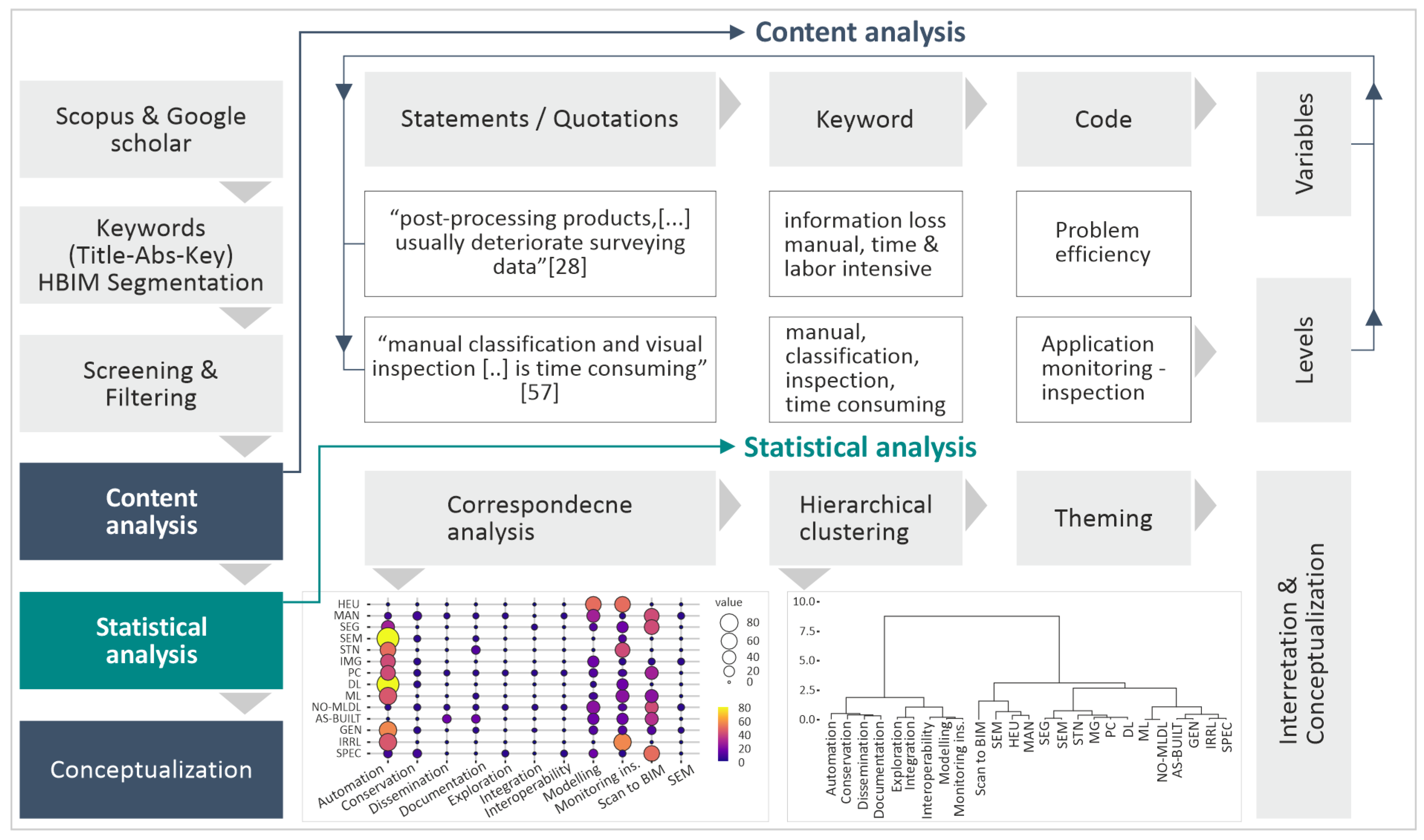
Regarding content analysis, theme extraction and qualitative analysis followed the process described in [32] up to the third step, which resolves in the code generation step. Thematic or content analysis is a semi-structured method to interpret complex qualitative data robustly and concretely. It is broadly used as a tool to explore and categorize textual information [33]. It encompasses six different stages: (1) data transcription, (2) data familiarization, (3) pattern recognition, (4) code attribution, (5) theme extraction, and (6) concept formulation and validation using a previously generated codification scheme. It is an iterative process that forms a conceptual model in a concrete and traceable manner [32].
To mitigate confirmation bias during manual variable extraction and thematic coding, several safeguards were implemented. Two researchers independently coded each article, with discrepancies resolved through consensus meetings. A detailed codebook, developed and pilot-tested from the established literature, guided the coding process to ensure consistency and transparency. Inter-coder reliability was assessed at multiple stages using percentage agreement, and, where feasible, coders were not blinded to the initial construct of this study but worked independently on the hypotheses during the initial coding/variable formation step. These measures were taken to enhance the objectivity and reproducibility of the extracted data used in subsequent quantitative analyses.
Thematic encoding was utilized for variables’ name identification, that is, to fill in columns in the final data that will resemble predictors. Then for each article, observation index values were extracted recurrently. Some variables’ names are common in the general academic nomenclature: “Problem statement”, “Study design”, “Limitations”, “Gaps & Challenges”, and “Future research” are characteristic examples of it. Others are defined explicitly within the reviewed articles [17,43], such as “Level of Detail” and “Level of Maturity”, and the third category consists of codes that emerged from the content analysis, as in the case of “Segmentation targets”, “Input”, “Projection Method”, and “Scan-to-BIM”. The content optimization process resolves when a minimum number of keyword code combinations converges to consistent themes.
Table 1 serves two purposes: first, it summarizes thematic analysis results; second, it includes each article’s identification matrix within the applications category. Specifically, emerging themes, along with their values or levels, since they consist of categorical data, are found in the first two columns, where a short description of each value and the code used later in the forthcoming quantitative analysis are listed in the 3rd and 4th columns, respectively.
As illustrated in Figure 1, the collected literature is filtered, and an appraisal phase estimates whether inclusion criteria are met. Then each article is subjected to content analysis [32], where short phrases or words are mapped to sentences. Abductive codification in this phase aims to extract variables’ names, which consist of the dimensions or the predictors of the conceptual model. Once variables’ names and types have been determined, a second iteration is launched to determine the levels of each individual variable for each article in the database. At the end of the thematic analysis, a matrix element is formed where columns contain variables’ names and rows contain values assigned to each variable indexed across individuals. Here, in contrast to conventional thematic analysis, we divert two final stages, theming and conceptualization [32], to a robust statistical tool able to operate on multidimensional categorical data in a transparent and traceable manner, namely correspondence analysis [122,123,124].

2.5. Quantitative Analysis

Correspondence Analysis (CA) is a statistical method widely used as a dimension reduction tool [122,123,124] and consists of a method to visualize a two-way samples-by-variables contingency table [125]. Assuming the contingency matrix contains n-observations distributed over p-predictors, then each row in this matrix represents a point in the p-dimensional space [125]. In contrast with some other broadly exploited dimension reduction methods, such as Principal Components Analysis (PCA) [124], CA and Multiple Correspondence Analysis (MCA), a method closely related to CA, operate directly on categorical or mixed mode data. MCA has been used in similar contexts; for example, ref. [122] utilized MCA in a high-complexity regime trying to decode complex behavior within the financial sector. Ref. [123] applied CA in a two-fold case study, examining clustering discrimination and gradience estimation in two different contexts.
Different applications “APPs”, which emerged from the content analysis, are considered to be the samples, and variables “Input”, “Segmentation”, Machine Learning/Deep Learning Implementation “ML.DL”, and Level of Detail “LOD” are the variables. The main idea is that applications are characterized jointly by these variables. The “Input” variable was further flattened to a binary one consisting only of two levels, PC or IMG; the “NO-MLDL” tag was assigned to NONE within the “ML.DL” variable; and the “IRRL” value attribute encompassed cases where LOD is irrelevant. The premise behind these substitutions is that small under-represented categories will tend to strongly dispart themselves from the joint plot. This case was also validated with MCA applying directly to the raw qualitative data matrix. Correspondence Analysis (CA) was chosen instead of Multiple Correspondence Analysis (MCA) because of the structure of the data. The data were reduced to a simpler two-way table by converting the predictor variables into binary categories (e.g., PC or IMG) and combining missing information into general categories. The grouping and simplification of variables made CA the more suitable choice for dimensionality reduction, while MCA was more suitable for more detailed multi-level data. CA was used to clearly define the relationships between data without exaggerating the impact of rare categories, which is often the problem with MCA. Consequently, the 2D biplot created using the CA gave a more clear and stable representation of the data patterns. Additionally, MCA was used as a validation process to make sure that the simplification process did not introduce bias into the analysis. Finally, counts on the contingency matrix were converted to relative frequencies by dividing by the grand total in a normalization step, which is known to affect the way total inertia is computed [125].
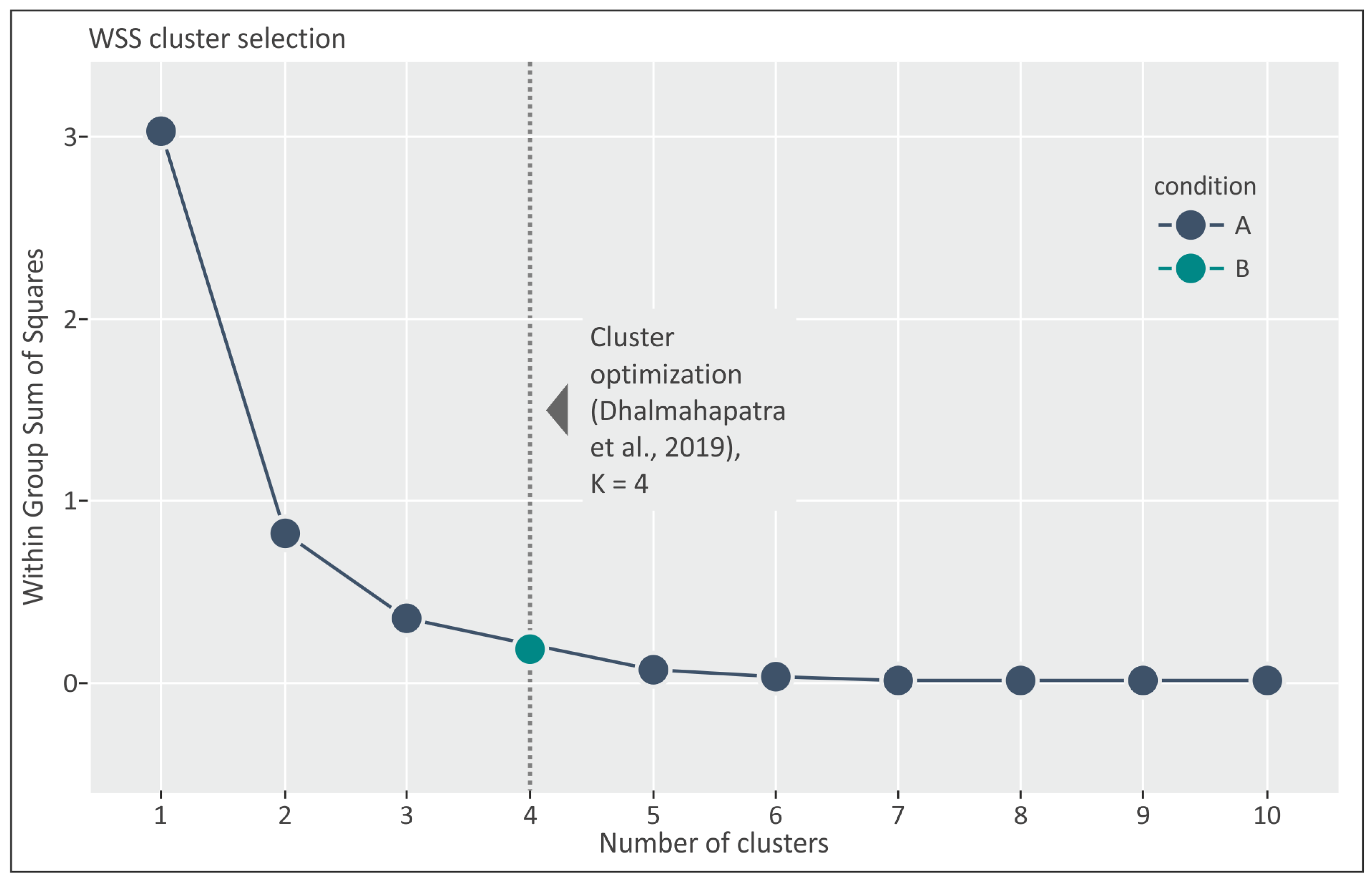
Following a similar path to [122], the exact numbers of dimensions was selected using a scree plot and clustering was utilized in R, R version 4.4.2 [126] within RStudio version 2026 [127] Integration Development Environment (IDE), an open-source statistical processing language. Hierarchical clustering utilized the hclust() function with a “ward.2” linkage method selection as indicated in [128]. The exact number of clusters was estimated following the semi-deterministic Elbow rule [124], which “penalizes” clusters using the Within-cluster Sum of Squares (WSS) variation criterion. After the cluster optimization loop, similar applications are organized together and examined in terms of their constituent elements, which are the conceived HBIM modeling parameters, with modeling being used here in its broader context. Spider plots or radar-grams are created for exploring between- and within-group differences with relative frequencies handling distributions along the axes. In the final step, a bespoke scenario demonstrates how “HBIM segmentation” can be investigated within the perspective of a specific application. To address this issue CA and HC results are used to list authors’ keywords as explicitly provided within the original articles. This step could precede keyword-based selection, thus contributing to transferability and traceability in the literature identification process.

3. Results

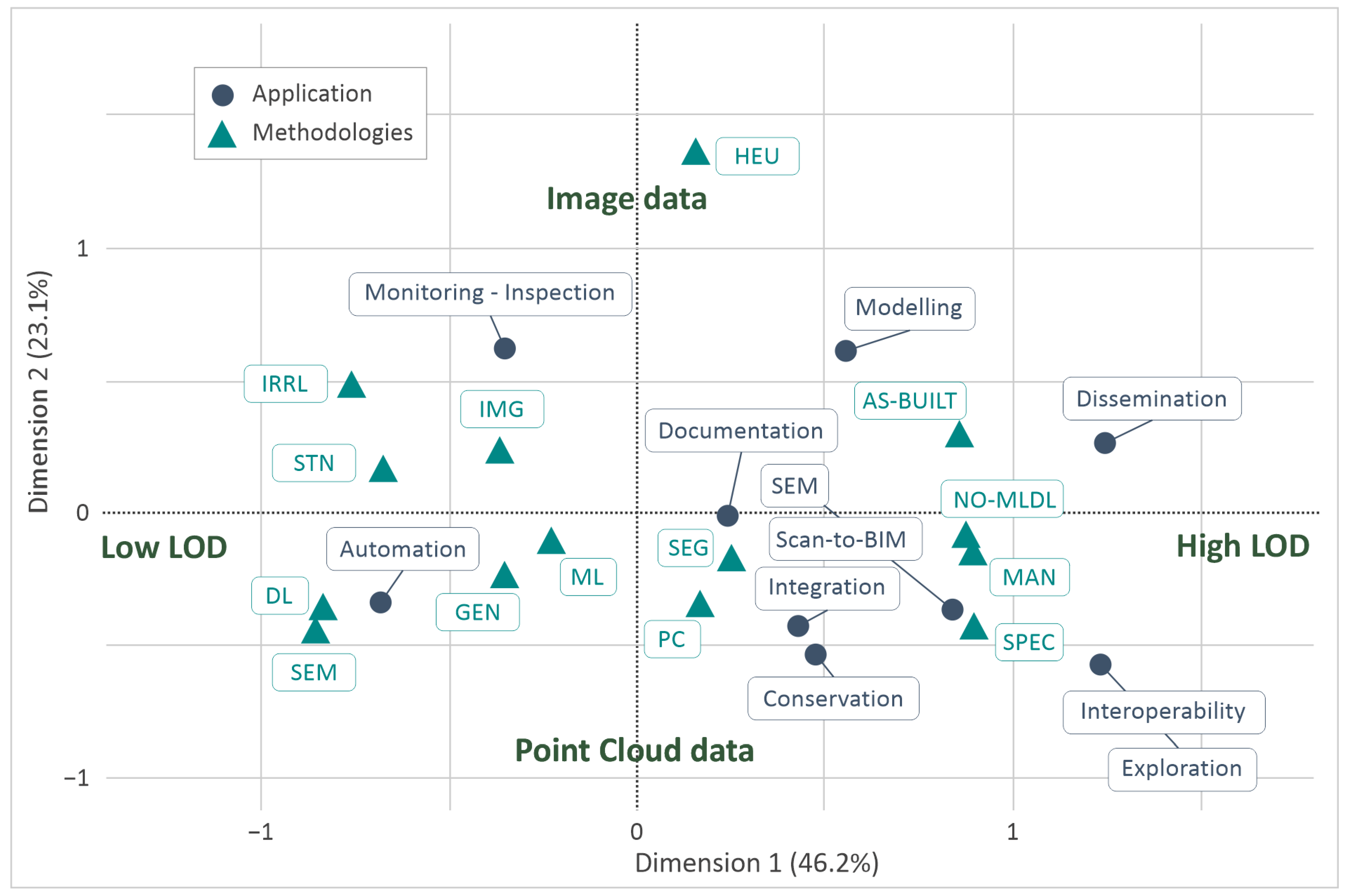
The forthcoming analysis explores the potential of the presented workflow in the interpretation of mixed-mode data in a comprehensive and traceable manner. With respect to RQ1, a biplot was created in Figure 2 portraying data in a two-dimensional space, indicated by Dimension 1 and Dimension 2 on the abscissa and the ordinate. These dimensions, which resulted from the analysis and are shown on the plot, account for 69.3% of the total variance in the sample. Each point on the scatterplot consists of the perpendicular projection of the applications onto the 2D plane [125] and corresponds to various levels of categorical data. Once data are projected onto a 2D space, it becomes easier to infer “within-set” associations [123]. The legend, on the right-hand side, separates columns, HBIM methodologies from rows, and different applications in HBIM. Biplot interpretation is not straightforward, therefore some additional directions are provided. Points in the cloud, close together and belonging to the same class, share similar characteristics, whereas points well-separated exhibit weak association [125]. The greater the distance of a single point from the origin, the more distinct its profile is in the dataset. Finally, rows (applications) and columns (methodologies) can also be negatively correlated, as indicated by vectors forming obtuse angles. CA analysis and biplots were computed in R [126,127] with the FactoMineR [128] library.
As shown in Figure 2, semantization “SEM” is positively correlated with “Automation” applications, and conversely, manual operations are negatively correlated with “Monitoring–Inspection”. “Exploration”, “Interoperability” and “Scan-to-BIM” are positively and strongly related to manual segmentation while “Modeling” forms a diverse group. Manual segmentation method, “MAN” separates well from semantization, “SEM” and bespoke implementations, “HEU”, with three together forming an equilateral triangle. Segmentation methodologies distribution correlates to the combined effect of “LOD” and “Input”. The left-to-right reading of the biplot shows that semantization strategies deploy “DL” architecture but result in lower representation accuracy models, “GEN”, whereas, in the exact opposite direction, manual segmentation outperforms automated alternatives measured in “LOD” and conceives PC as its primary input. Considering the distance to the origin criterion, segmentation, “SEG” and ML-based utilizations share mild dissimilarities. On the opposite side of the spectrum, stone-by-stone, “STN” segmentation mostly diversifies in terms of data input and heuristics, exhibiting the most distinct separation from all the rest. Lastly, semantization, referring to application type, indicated by the red “SEM” color text, does not coincide with the semantization technique, which is depicted using a turquoise color.
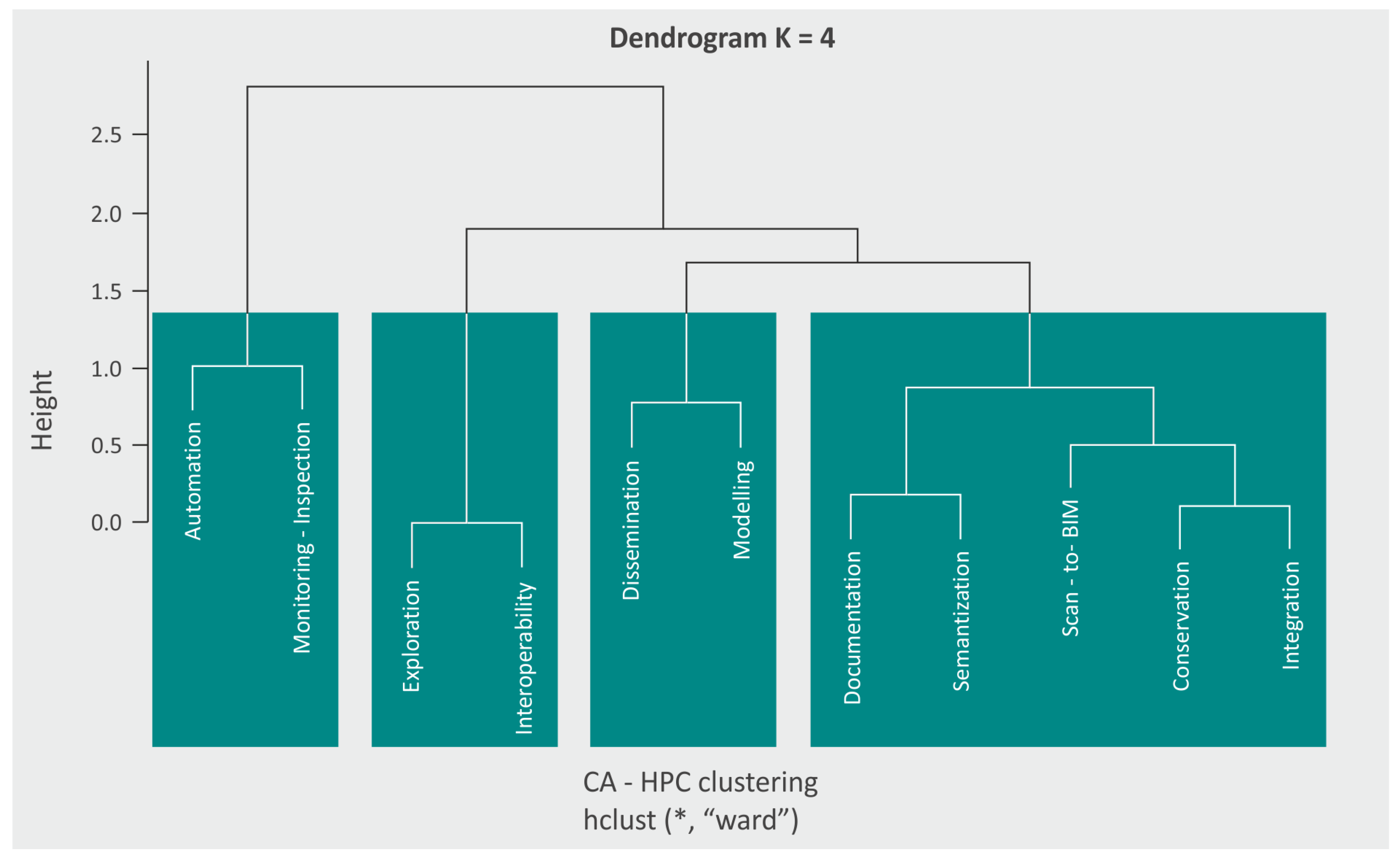
To address RQ2, hierarchical clustering (Figure 3) is executed immediately after CA analysis. In this sense, applications that share similar profiles fall into the same group, making it easier to interpret which feature and selected methodology contributed to the expressed between- and within-group variation, and how. The clustering algorithm adopted is agglomerative hierarchical clustering and is executed in R following previously published works in the field [128]. Ward’s hierarchical clustering algorithm initially positions each point in a single cluster, estimates dissimilarity, agglomerates clusters that exhibit the least dissimilarity and finally re-computes any dissimilarity between the agglomerated cluster and all the rest until a single cluster is formed [129]. The output dendrogram using Ward’s linkage is preferable as it can outperform traditional Euclidean distance-based metrics in interpretability [130]. The leaves on the dendrogram’s horizontal axis represent groups or clusters, and the vertical axis contains the dissimilarity metric (Figure 3).
Elbow’s rule (Figure 4) was used to set the optimal number of k-clusters [124]. The response axis shows the estimated Within Sum of Squares (WSS) against the considered K-number, which in this case varied from one to ten. Figure 4 shows the estimated Within Sum of Squares (WSS) against the considered K-number. The bend or “knee” location marks the optimal cluster size. As easily indicated, a further increase in the number of conceived clusters does not significantly contribute to the model.
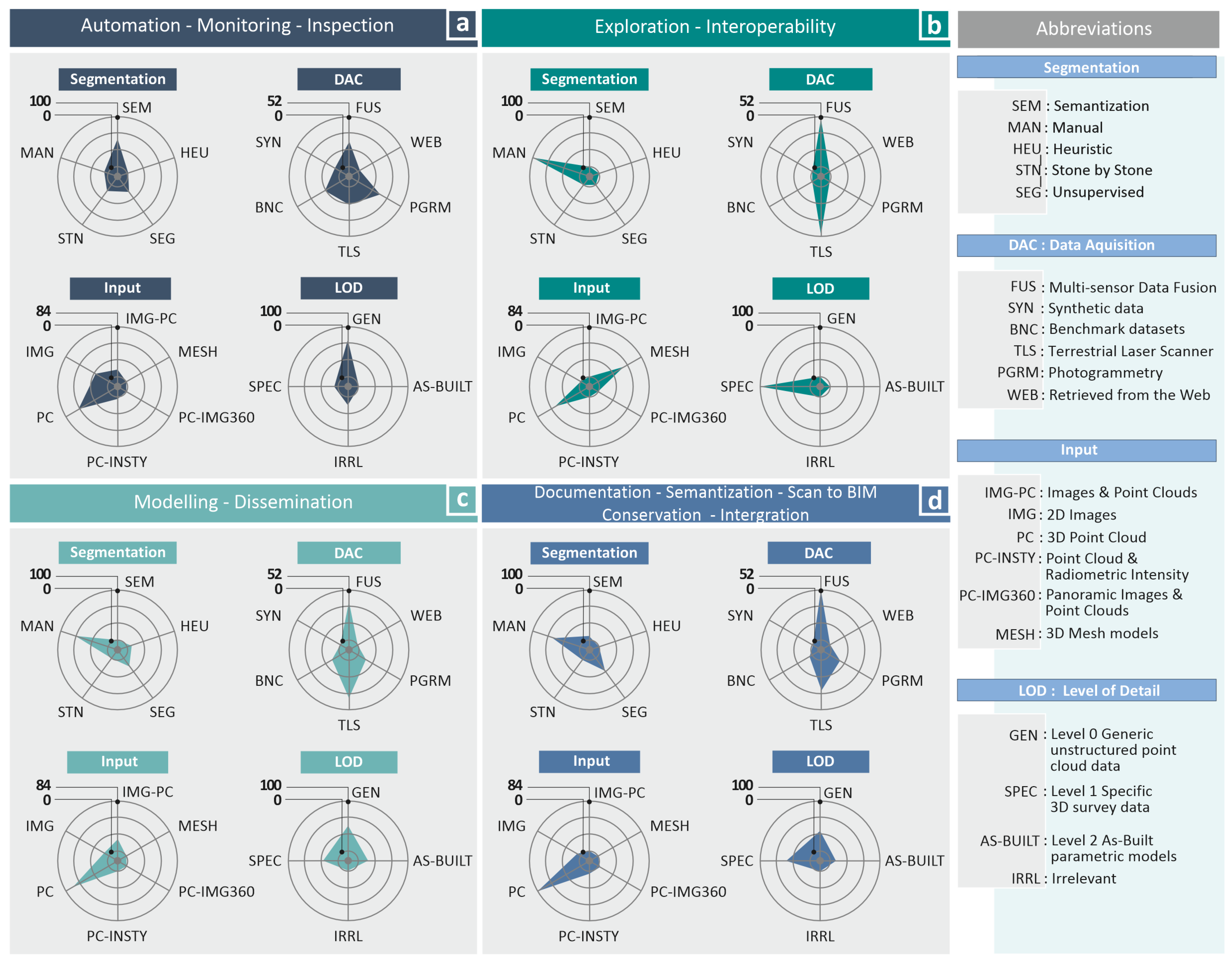
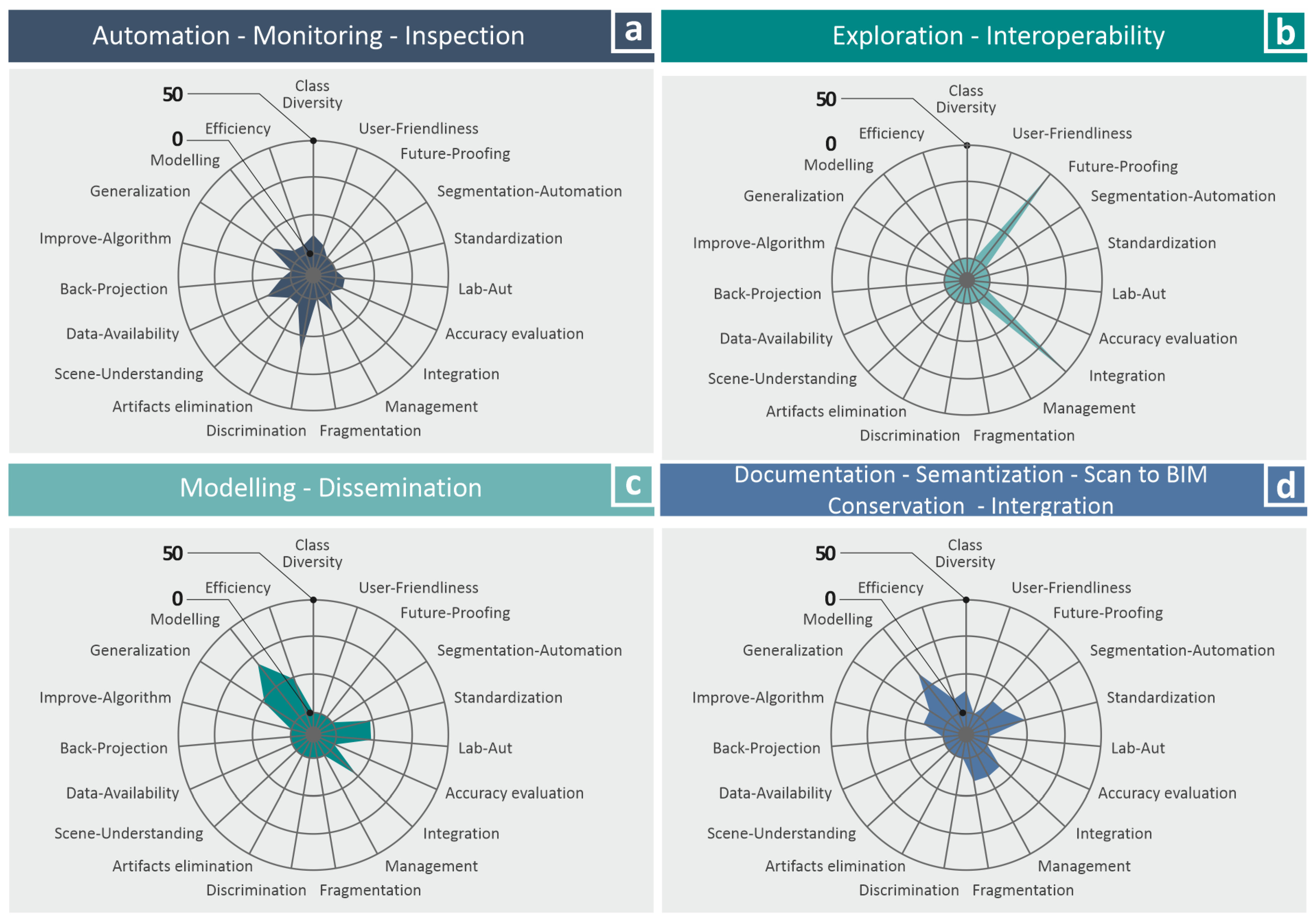
Parameter modeling [8], segmentation automation [8,20] input data and acquisition media [20], along with LoD [5,8,15], are considered principal components of the HBIM process, and understanding the interrelation between these parameters and the aimed application could facilitate research in this field. Within this scope, radar chart-like (Figure 5) representations are utilized through FMSB [131]. Key parameters per application cluster are grouped by hierarchical clustering, summarizing key findings. From top to bottom and left to right, the sub-figures accommodate “Segmentation”, “DATA.ACQ”, “Input”, and “LOD”. For each cluster, frequency results are organized in this polar configuration for ease of comparison, with each polar axis corresponding to different variable values. Similarly, the distribution of the challenges per group of applications is presented in Figure 6.
Spider plots (Figure 5) help identify similarities within a specific application domain and extract the optimal parameters that are handcrafted by popularity (implicitly related to frequency). Conversely, cross-application variability can be identified by examining the whole plane, with specific attention given to a single key parameter.
Regarding RQ2 and segmentation, the automation group is characterized by semantization. Exploration, dissemination, and modeling applications are strongly dependent on manual operations, with the exploration group exhibiting the highest use of manual segmentation methods. With respect to data acquisition, the automation monitoring and inspection group presents the greatest flexibility, integrating both 2D and 3D data from various sources in multi-modal data collection schemes. On the other side of the spectrum, exploration and interoperability, group two, is the more demanding one, with excessively high dependence on mixed-mode data collections and LIDAR-based acquisition media. Input type also separates well the exploration/interoperability and documentation/semantization/scan-to-BIM/conservation/integration groups, with the two main input sources being point cloud and mesh in the first case and almost exclusively point cloud in the latter one. Representation accuracy, defined by LOD, strongly diversifies cluster two, the exploration-inclined applications group, and cluster one, which is the automation and monitoring group. As depicted, LOD is highly correlated with segmentation methodology. Finally, LOD leans towards “AS-BUILT” in clusters three and four, which emphasize dissemination, modeling and scan-to-BIM applications.
Figure 6 provides a guide to the expected challenges that can act as laggards in HBIM wider-scale adoption. If examined sequentially, cluster mapped to monitoring/automation and semantization exhibits various challenges, with protruding ones attributed to discrimination. The modeling and dissemination cluster raises concerns with respect to modeling and, to a smaller degree, generalization, efficiency, integration, standardization, and label transfer. Futureproofing and integration are the only highlighted challenges in the exploration and interoperability group. Group four, addressing scan-to-BIM operations, which is by far the most inclusive cluster, faces multiple but mild challenges, with modeling being the dominating one, in terms of relative frequency. Standardization is coming next, and class diversity, generalization, integration, management, discrimination, and efficiency are slightly visible and represented as themes. Also, it is worth considering that discrimination is the leading challenge in the automation group, with diversity, generalization, management and class diversity filling the middle part of the challenge distribution. Focusing on specific sub-dimensions, previously denoted as variables’ levels, modeling, along with a slight contribution from standardization and integration themes, dichotomizes the collected sample. Discrimination on its own extracts applications strongly relying on automation and futureproofing or integration can easily identify applications endemic to 3D model exploration or cross-product and cross-domain collaboration.
With respect to RQ3, as previously described in the previous section, keywords assigned by the authors on the original articles are organized following agglomerative clustering, and the results are summarized below (Table 2). Each row contains keywords identified after removing duplicates. Keywords can be considered as the first steps in a systematic literature review where queries are provided in selected databases given a specific protocol [33]. Nonetheless, keyword-based combinations cannot always easily be identified in advance, and for that purpose, an approach often met in the literature is to conduct a pilot study in a preceding step to draft a state-of-the-art nomenclature [33]. According to the author, this “read now, decide later” scheme lacks traceability and robustness. As an alternative, clustering using CA and HC could determine keyword combinations, even in overlapping scientific domains, in a sensible and traceable fashion.
Specifically, when monitoring is the aimed application, dynamic graph convolutional neural networks [86], EdgeConv [82], watershed [46], Random Sample Consensus (RANSAC) [85] and random forest [78] and stone-by-stone [75] emerge as relevant key items. OpenBIM [48], OpenSees [98], and TeamWork [48] tags connote dissemination and are identified in the relevant cluster. Asset Management Systems (AMSs) [120], GIS, webGIS [120], augmented reality, HoloLens, and mixed reality [28] address HBIM’s integration potential that emerged as themes on the corresponding cluster. Finally, HBIM, scan-to-BIM, BlenderBIM [76], holistically circumscribe the HBIM reverse modeling aspect in cluster two.
In terms of exhaustiveness, “HBH (Historical Built Heritage); HBIM; H-BIM; HBIM (Historical Building Modeling); HBIM for conservation and maintenance; HBIM interoperability; Heritage; Heritage architecture; Heritage at risk; Heritage building information modeling; Heritage-BIM; Historic Building Information Modeling (HBIM); Historic building structures; historic digital survey” and “Segmentation; Semantic annotation; Semantic enrichment; Semantic segmentation” decipher the concept of diversification in the field of HBIM segmentation.
The keyword clusters shown in RQ3 (Table 2) are intended to support researchers in building realistic and efficient queries to search the databases. These clusters can be used in practice to create Boolean search strings: keywords in a cluster should be linked by the OR operator and different clusters by the AND operator. For instance, a search term could be “Historic Building Information Modeling” OR “HBIM” OR “historic building” OR “H-BIM” AND “segmentation” OR “semantic annotation” OR “classification” AND “point cloud” OR “mesh”. These search terms need to be adjusted to the syntax needs of each database, and the use of quotation marks for searching by phrases is recommended. Additional terms derived from cluster analysis should also be used. Pilot searches are suggested to improve the sensitivity and specificity of the results. This way, the identification of the literature can be transparent and reproducible, which can be used for systematic and semi-systematic reviews.
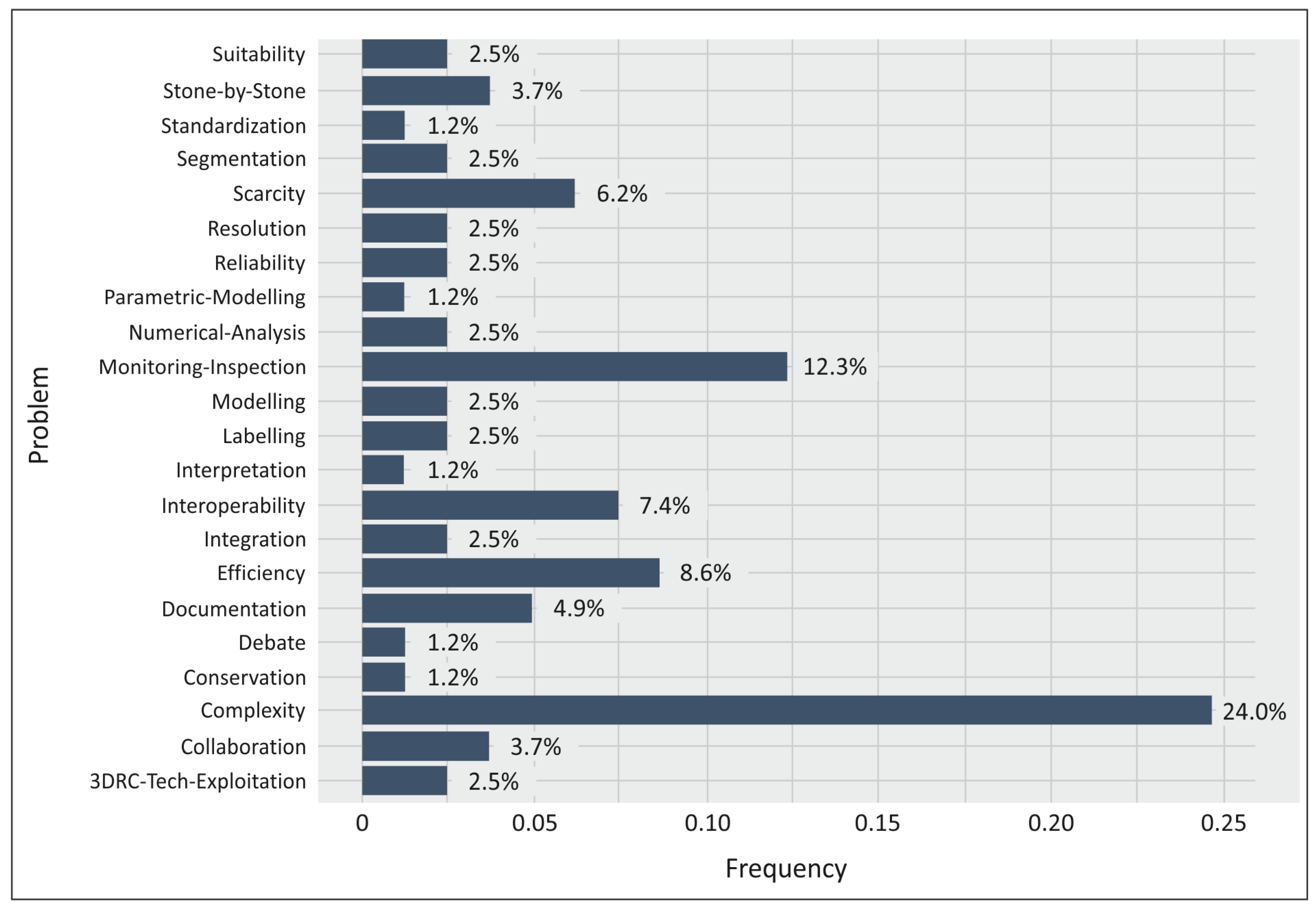
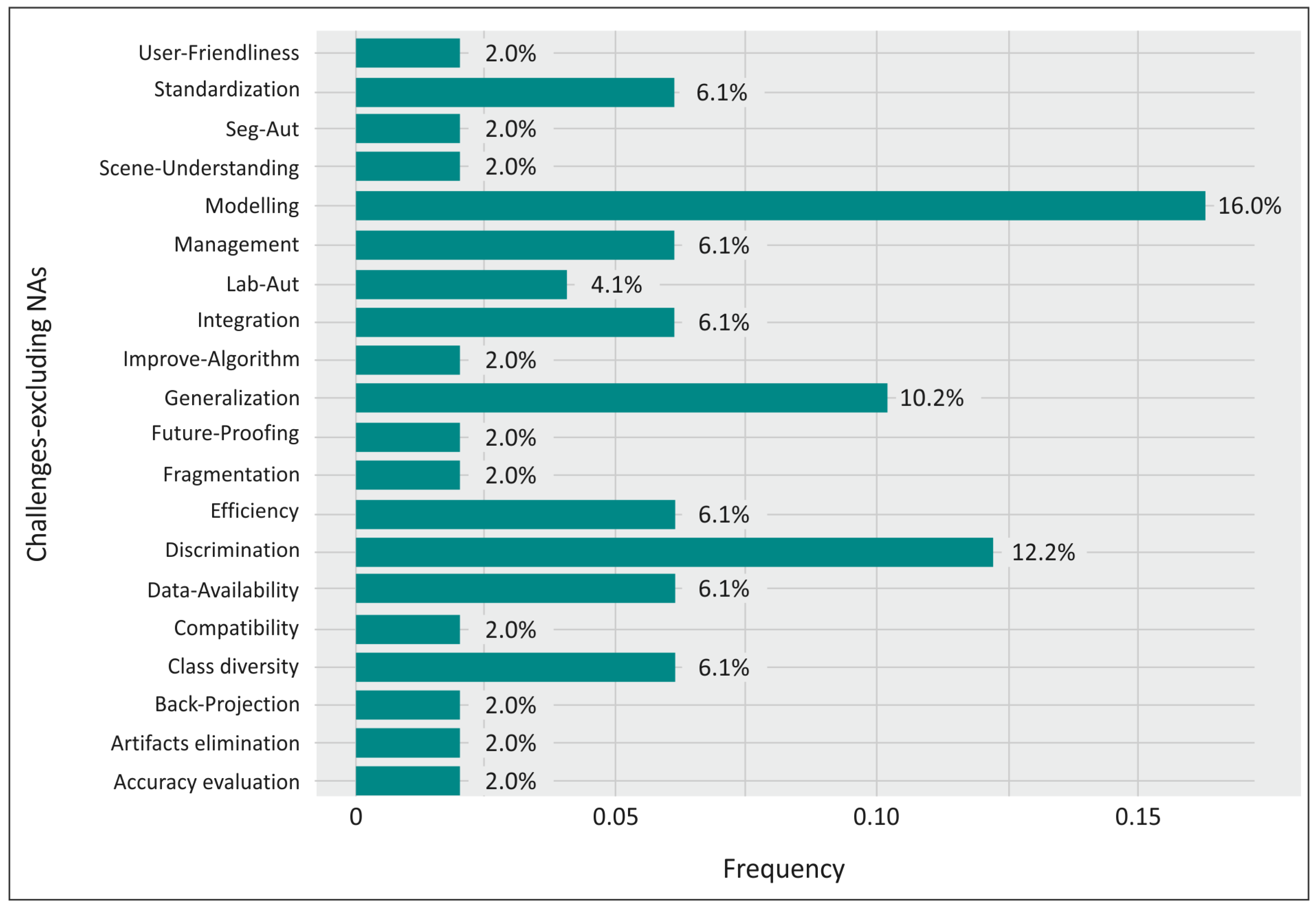
In this penultimate step, before the Conclusions Section, two frequency plots disclose descriptives regarding encountered problems (Figure 7) and challenges (Figure 8) using deductive reasoning under thematic content analysis. Figure 7 emphasizes complexity, which is thematically linked to textual segments such as “labor intensive”, “time-consuming” “proneness to human errors”. Monitoring/inspection applications are in second place and efficiency; interoperability and scarcity fill the middle section of the distribution. Interpretation, parametric modeling, standardization, and spark debate have sporadically emerged as an issue of concern. Regarding challenges, a similar approach was followed. As illustrated in Figure 7, modeling at 16% outrivals the scene, with discrimination power and lack of generalization accounting for almost 38% of the total variance. Standardization, management, integration, efficiency, data availability, and class diversity account for another 36% percent, each equally represented.
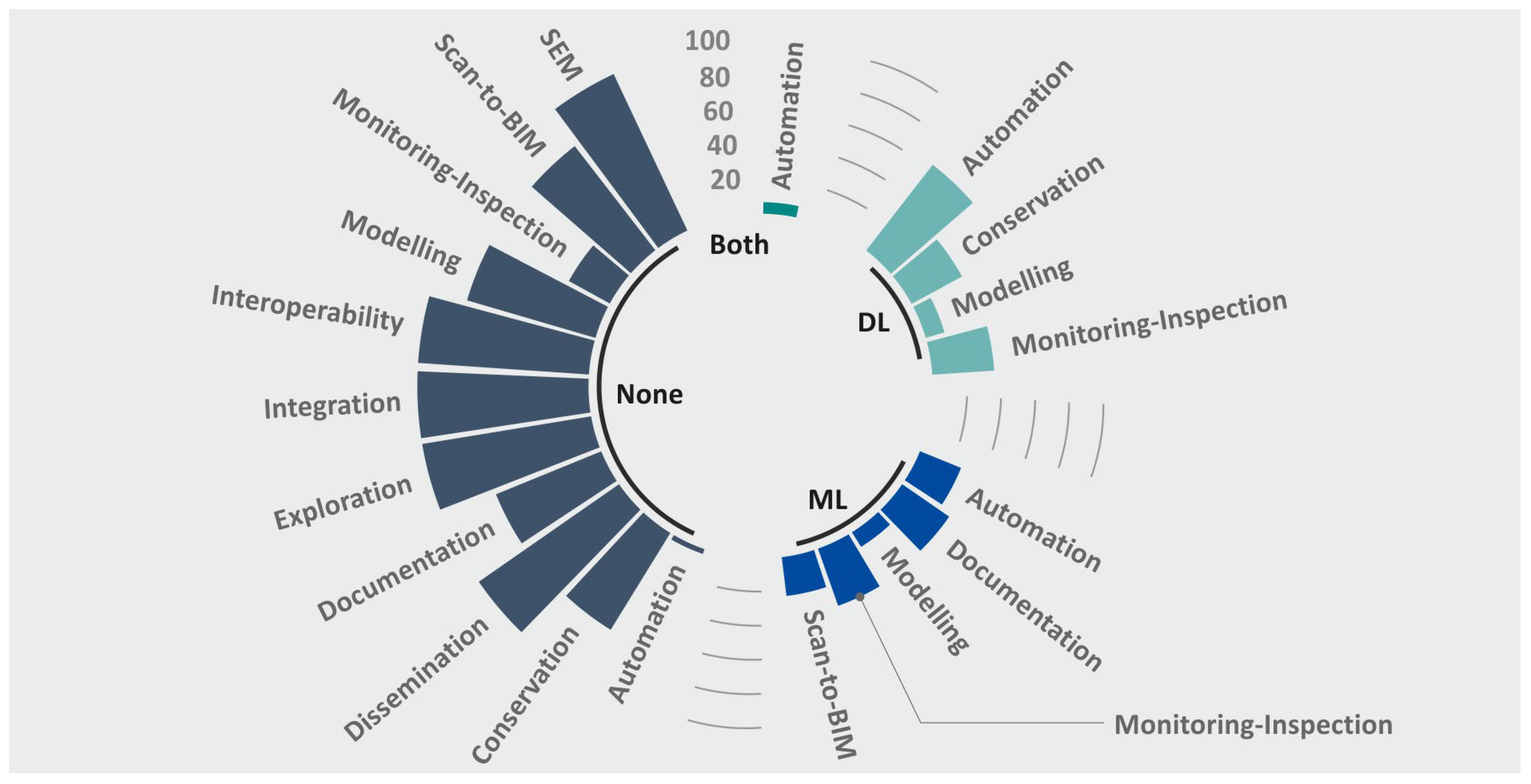
Figure 9 prioritizes segmentation automation endeavors, either through Machine Learning (ML), Deep Learning (DL), or combinations of both (BOTH) in a comparative analysis across the identified applications. Segmentation methodologies are placed within the polar circles, rendering groups and applications distributed radially on the exterior. Cross-tabulation of variables segmentation with applications, depicted in Figure 9, denotes manual or software-assisted segmentation attempts as “NONE” since the main emphasis is on ML- or DL-based integration. Modeling dissipates across all segmentation categories, whereas scan-to-BIM, exploration, and dissemination applications are not represented in DL or DL-combined-with-ML workflows. Semantization within the scope of HBIM seems to be performed with manual processes, whereas scan-to-BIM and documentation show positive signs regarding ML-based integration. Monitoring/inspection outpaces every other application, with only a tiny portion performed manually. Conversely, the remaining monitoring attempts deploy either ML- or DL-based implementations, with ML slightly outperforming. Finally, modeling applications rely on manual supervision, with less than 20% examining fully automated alternatives.

4. Discussion

The multidimensional and clustering results of this study yielded some critical strategic indicators for HBIM projects and related workflows from an operational point of view. The level of automation and the accuracy of representation are inversely related, which indicates that, for high LOD architectural cases, fully automated DL or ML segmentation schemes are not yet able to completely substitute manual interventions. Moreover, the fact that bottlenecks are found in specific applications suggests that one single all-encompassing software package will not meet all needs. In particular, the software interoperability and the absence of standardized protocols are still problematic for 3D modeling and data dissemination pipelines, while the automation and monitoring clusters face limitations mostly due to object discrimination capabilities. DL architectures are inherently data dependent, with 2D imagery being the primary source, which requires strategic multi-sensor data integration and fusion at the early stages of the field to optimize the field performance. Thus, the need to integrate TLS point clouds with high-resolution photogrammetry or UAV imagery during the survey planning stage is operationally necessary to meet the requirements of high-precision geometric reconstruction and the ability of fast segmentation with AI.
While this review demonstrates the relevance and significant potential of HBIM methodologies for heritage research and management, it is important to acknowledge that the specific conditions of each case study, including the software environments employed, reported implementation costs, and the realities of long-term use, were critically evaluated only to the extent that such details were available in the source literature. The depth of reporting on these practical aspects varied considerably across studies, which limited the degree of systematic cross-case comparison possible.
Geeting into more details and examining the biplot in Figure 2, segmentation on the point cloud, when aiming for high representation accuracy modeling applications, primarily relies on manual operations. This is also evident in the bar plot (Figure 8), where the segmentation method “High LOD-requirements applications dominate NONE” addresses manual operations. These findings are in agreement with similar results that raise concerns about the efficiency of AI integration in HBIM operations [5] and domain diversity leads to a multitude of evaluation logics [6]. Looking at the radargrams (Figure 5), one can say that LOD and segmentation are strongly and inversely correlated, as illustrated in the upper right quadrant, with manual segmentation collimating with specific, “SPEC” LOD. Applications with high representation requirements still depend on manual operations. This separation axis has also emerged in the joint plots resulting from the CA analysis (Figure 2).
Fully automated segmentation plans are the choice of preference for automation and monitoring or inspection-related applications that can utilize ML- or DL-based networks. Since DL “architecture” inherently consumes 2D images, it is not by chance that images constitute a significant input. That is visible in both the biplot ortho-projected space and the spider plots (Figure 5), with cluster one forming the broader polygon in the input and data acquisition distribution. Similarly, stone-by-stone segmentation relying on image data underperforms in terms of comprehensiveness of the delivered geometry, measured by LOD. Finally, heuristics form a group of their own, with a very distinct profile and that is, to a certain extent, expected given that these strategies usually bespoke frameworks targeting a particular application [110].
When segmentation is investigated in the top-to-bottom approach (Figure 2), and through the applications lens, high visual fidelity applications, if not operated at hand within the modeling environment of modeling software, are automated in an unsupervised manner, a term that typifies segmentation, “SEG”, as functionalized in Table 1. On the contrary, semantization and fully autonomous plans are adopted for data extraction situations, as in the case of monitoring, where it is presumably vital to detect rather than model. Segmentation fuzziness concerns have been identified within the retrieved literature [22].
Regarding application diversification, the CA biplot (Figure 2) shows that high-accuracy applications for visualization or documentation purposes are positively correlated. Conversely, automation and monitoring/inspection applications are well separated from the rest of the point cloud, thus joining the same group in the dendrogram (Figure 3). Within-group variance is better decoded through the radar plots (Figure 2 and Figure 3). LOD requirement is the most influential component, with segmentation following next (Figure 5). Acquisition media, coded DAC, are broader in the case of clusters one and four, leading to greater diversity in terms of pc capturing devices and methodologies and narrower in clusters two and three (Figure 5). However, it is worth considering that these groups are favorably distributed in the sample, and that is in concordance with the appraisal scheme for paper selection, since HBIM segmentation is at the core of this attempt. As expected in Figure 5, the “Input” variable correlates with DAC; therefore, this feature could also be excluded from the explanatories. Something that arose from this analysis, highlighted in both the biplot and the radar plot, is that modeling strongly deviates from all the rest (Figure 5). Looking at the modeling cluster (bottom left quadrant in the spider plot), the manual method dominates segmentation methodologies. Returning to the content analysis results, as visualized in Figure 7, modeling is the most prominent among all the other challenges, followed by discrimination ability at 12.2% and generalization at 10.2%. These results are in agreement with previous results that posit modeling as a persistent problem of HBIM expansion [5].
Applications also vary in terms of the expected challenges, as shown in Figure 6. Clusters 2 and 4, encompassing modeling, dissemination, exploration, interoperability and scan-to-BIM applications, are hindered by modeling, where monitoring/automation/semantization need improvements in the discriminating power. The conservation/documentation/integration group experiences modeling issues with secondary lobes extending towards integration/management and standardization. Similar problems were met in the automation and monitoring inspection, with prominence in discrimination power rather than modeling. Given that these groups are adequately represented, it makes sense to assume that monitoring drives this variation. Finally, thematic analysis results in themes for problems and challenges after concurrently examining multiple dimensions, like “study design”, “input”, “output” parameters, “2D to 3D projections”, “ML” or “DL” architecture, “DAC”, “segmentation targets” and, if available, highlights, key findings, problems, research gaps, and challenges. Since problem statements, gaps, and challenges are not mandatory fields within a manuscript, thematic encoding is utilized as a yardstick for missing values.
Concerning RQ3, the main argument was how to collect the available literature in a traceable and objective manner in a transdisciplinary approach. The “rule of thumb” would be to expect the user to locate all the relevant literature following some rigorous protocols and then narrow down the corpus following explicitly defined filtering and screening phases [2,4,5,14,15,16,19]. However, although this “read-now-select-later” method provides an invaluable quality assurance tool, it does not necessarily guide the inexperienced researcher. Alternatively, the combined effect of multidimensional analysis and clustering could provide various keyword combinations in a standardized fashion.
Based on the clustering results, authors’ keywords are organized in groups pointing towards specific applications cohesively. Clustering can be applied to authors, dates, or any other attribute that leads to different interpretations. Within the HBIM segmentation context, monitoring/automation applications share similar profiles. Therefore, “segmentation; semantic annotation; semantic enrichment; semantic segmentation” provide a robust entry for segmentation, with “edgeconv; watershed; RANSAC; DGCNN; edge detection; U-Net; dilated convolution; singular value decomposition” pointing towards specific algorithms. When segmentation is performed manually, as in cluster 4, “parametric models; parametric objects; photogrammetry; procedural modeling; random forest; rapid mapping; restoration project; Revit; scan-to-BIM; segmentation algorithm CANUPO; semantic annotation; semantic segmentation; shape descriptor; visual programming VPL; VPL scripting; CAD” become essential keywords to start with.
Reflecting on the results discussed in Figure 7, modeling, generalization, and discrimination power are the major impediments to HBIM mesh segmentation automation in the broader sense. According to the available literature, these challenges are linked to the inherent complexity of CH artifacts, which leads to cumbersome and time plus labor-intensive processes [46,49,57,118]. However, modeling and standardization do not affect all applications uniformly, as seen in Figure 5. Automation and exploration are not so severely affected by peculiarity as in the case of modeling and scan-to-BIM, clusters three and four, respectively.
Finally, detected trends, leaving complexity out of the frame, monitoring/inspection, efficiency, documentation and interoperability are gaining attention within the scientific community (Figure 8). ML and DL have progressively penetrated CH conservation and preservation, primarily from the object detection and identification side (Figure 9). Regarding semantization and modeling, human intervention prevails in terms of adoption frequency, and DL seems to supersede ML methods in segmentation automation.

5. Conclusions

The purpose of this manuscript was twofold: first, to explore HBIM segmentation methodologies as a function of aiming applications, and second, to validate and valorize thematic analysis and multidimensional statistical processing in a mixed-mode strategy. The final selected sample consists of 92 papers, similar to what other authors have used in the past [4,5,14]. Nevertheless, for the first time, to the authors’ knowledge, each step of this mixed-mode analysis is thoroughly described. This work follows a semi-structural research identification methodology inspired by [2,4,16,19] but introduces open-source statistical analysis software just before the output layer. Data extraction and codification are driven by thematic content analysis [32], except for theme merging and conceptualization, which is diverted to correspondence analysis [122,123].
Among the main contributions of this paper is that modeling still comprises a decisive factor in HBIM segmentation, ranking second after LOD. Challenges and problems are not uniformly distributed between different application clusters. LOD correlates with segmentation and DAC with input. Correspondence analysis and hierarchical clustering successfully detect dissimilarity axes and consistently identify between and within group variations. Segmentation is, to a great extent, still relying on manual operations, especially in the domain of high LOD requirements. The latter converges with concerns stated in [5]. Semantization is compromised by representational accuracy, and TLS-driven point clouds are gaining popularity, which was not the case in the past [20]. Labeling, data availability, and diversity in the field of CH are contributing factors as well, but accuracy and encapsulated spatial resolution are the core of HBIM’s plateau. Finally, standardization and integration are key factors when aiming for documentation, dissemination, and integration applications.
It is important to recognize that, despite nearly a century of international efforts, no unified standardization of principles for heritage safeguarding has been achieved. Preservation practices continue to be shaped by a diversity of regulations and principles that vary across regions, countries, cities, and communities. While Europe accounts for approximately 43% of sites inscribed in the UNESCO World Heritage List, the remaining 57%—many situated in developing countries—face additional technological, economic, and institutional challenges that further complicate standardization efforts. Even where convergent standards and regulatory frameworks exist, the full standardization of cataloging systems, inventory records, and software platforms remains elusive. These disparities are not solely technical, they are deeply intertwined with local priorities, resource constraints, and institutional structures. Although this study focuses on segmentation methodologies within the HBIM domain, we acknowledge that broader systemic factors, including regional and global inequities, influence the adoption and effectiveness of standardization initiatives. Future research and policy should therefore address these complexities to foster more inclusive and adaptable safeguarding strategies for global heritage. In conclusion, HBIM segmentation remains constrained by manual effort, LOD requirements, representational accuracy, data scarcity, and limited automation at high detail levels; however, apparently the broader maturation of HBIM will also depend on interoperable standards, open benchmarks, explainable AI, governance frameworks, and accessible multidisciplinary infrastructures [6,17].
There are limitations to this research. The literature research is not systematic, but semi-systematic; therefore, there is an inherent selection bias mainly attributed to modelling ambiguity, pragmatically speaking. In order to overcome the multidisciplinary and fragmented nature of the HBIM segmentation literature, a semi-systematic approach was selected, which is reproducible in terms of its conceptualization but not exhaustively reproducible in the initial qualitative data and specifically the theme keyword/code extraction step, which heavily relies on researchers’ experience in qualitative data analysis. The selection of databases, keywords and inclusion/exclusion criteria could have limited the number of relevant studies identified, given the multitude of available keyword combinations in heritage BIM automation endeavors. Future research could include AI- or large language model-driven automations in order to minimize bias and increase transparency in keyword/code extraction, thus enriching systematic reviewing in general. Furthermore, segmentation, 3D modeling and HBIM are overloaded terms in 3D reverse engineering, rendering optimization quite problematic. The semantic segmentation still deviates from segmentation and this is attributed to the perceived LOD of the final outcome. Lastly, this research is slightly biased towards automation since segmentation is the pivoting point in most automation applications, highlighted by the discrepancy between the keyword list sizes in RQ3. Despite these limitations, this is considered a worthy research attempt, given that CA and HC concisely and consistently demonstrate key differences in HBIM segmentation methodologies.

Author Contributions

Conceptualization, E.M. and D.G.; methodology, E.M. and D.G.; software, D.G. and A.K.; validation, M.P. (Massimiliano Pepe) and N.V.; formal analysis, D.G., E.M. and M.P. (Markos Petousis); investigation, D.G.; resources, D.G., E.M. and M.P. (Massimiliano Pepe); data curation, D.G. and A.K.; writing—original draft preparation, D.G., E.M. and M.P. (Massimiliano Pepe); writing—review and editing, D.G., E.M.; visualization, D.G.,N.V. and M.P. (Markos Petousis); supervision, E.M.; project administration, E.M. All authors have read and agreed to the published version of the manuscript.

Funding

This research received no external funding.

Data Availability Statement

Derived data supporting the findings are available on request from the corresponding author. The literature analyzed in this study consists of peer-reviewed articles identified using the Scopus database.

Conflicts of Interest

The authors declare no conflict of interest.

References

  1. Dore, C.; Murphy, M. Semi-Automatic Techniques for as-Built BIM Façade Modeling of Historic Buildings. In Proceedings of the 2013 Digital Heritage International Congress (DigitalHeritage), Marseille, France, 28 October–1 November 2013; Volume 1, pp. 473–480. [Google Scholar] [CrossRef]
  2. Penjor, T.; Banihashemi, S.; Hajirasouli, A.; Golzad, H. Heritage Building Information Modeling (HBIM) for Heritage Conservation: Framework of Challenges, Gaps, and Existing Limitations of HBIM. Digit. Appl. Archaeol. Cult. Herit. 2024, 35, e00366. [Google Scholar] [CrossRef]
  3. Murphy, M.; Mcgovern, E.; Pavia, S. Historic Building Information Modelling (HBIM). Struct. Surv. 2009, 27, 311–327. [Google Scholar] [CrossRef]
  4. Fernández-Mora, V.; Navarro, I.J.; Yepes, V. Integration of the Structural Project into the BIM Paradigm: A Literature Review. J. Build. Eng. 2022, 53, 104318. [Google Scholar] [CrossRef]
  5. Cotella, V.A. From 3D Point Clouds to HBIM: Application of Artificial Intelligence in Cultural Heritage. Autom. Constr. 2023, 152, 104936. [Google Scholar] [CrossRef]
  6. Banfi, F.; Liu, W. The State of HBIM in Digital Heritage: A Critical and Bibliometric Assessment of Six Emerging Frontiers (2015–2025). Appl. Sci. 2026, 16, 906. [Google Scholar] [CrossRef]
  7. Maravelakis, E.; Giannioti, G.; Psalti, A.; Tsakoumaki, M.; Pocobelli, D.P.; Xinogalos, M.; Galanakis, D.; Bilalis, N.; Stavroulakis, G. 3D Modeling & Analysis Techniques for the Apollo Temple in Delphi. Buildings 2023, 13, 1730. [Google Scholar] [CrossRef]
  8. Lovell, L.J.; Davies, R.J.; Hunt, D.V.L. The Application of Historic Building Information Modelling (HBIM) to Cultural Heritage: A Review. Heritage 2023, 6, 6691–6717. [Google Scholar] [CrossRef]
  9. Mania, K.; Psalti, A.; Lala, D.M.; Tsakoumaki, M.; Polychronakis, A.; Rempoulaki, A.; Xinogalos, M.; Maravelakis, E. Combining 3D Surveying with Archaeological Uncertainty: The Metopes of the Athenian Treasury at Delphi. In Proceedings of the 2021 12th International Conference on Information, Intelligence, Systems & Applications (IISA), Chania Crete, Greece, 12–14 July 2021; pp. 13–16. [Google Scholar] [CrossRef]
  10. Vinodkumar, P.K.; Karabulut, D.; Avots, E.; Ozcinar, C.; Anbarjafari, G. A Survey on Deep Learning Based Segmentation, Detection and Classification for 3D Point Clouds. Entropy 2023, 25, 635. [Google Scholar] [CrossRef]
  11. Galanakis, D.; Lucho, S.; Maravelakis, E.; Bolanakis, N.; Konstantaras, A.; Vidakis, N.; Petousis, M.; Treuillet, S.; Desquesnes, X.; Brunetaud, X. Segment Anything Model for Scan-to-Structural Analysis in Cultural Heritage. In Proceedings of the 2024 5th International Conference in Electronic Engineering, Information Technology & Education (EEITE), Chania, Greece, 29–31 May 2024; pp. 1–7. [Google Scholar] [CrossRef]
  12. Shrestha, P.; Kapali, S.; Pokharel, V.; Tandukar, J.; Giri, S.; Aryal, A. 3D Reconstruction of Cultural Heritage Sites; A Case Study of Patan Durbar Square. Digit. Appl. Archaeol. Cult. Herit. 2026, 40, e00492. [Google Scholar] [CrossRef]
  13. Sharma, H. Applications of Artificial Intelligence and Machine Learning in the Preservation and Analysis of Heritage Structures: A Comprehensive Review. Arch. Comput. Methods Eng. 2025, 33, 3001–3033. [Google Scholar] [CrossRef]
  14. Yang, X.; Grussenmeyer, P.; Koehl, M.; Macher, H.; Murtiyoso, A.; Landes, T. Review of Built Heritage Modelling: Integration of HBIM and Other Information Techniques. J. Cult. Herit. 2020, 46, 350–360. [Google Scholar] [CrossRef]
  15. Gil, A.; Arayici, Y.; Kumar, B.; Laing, R. Machine and Deep Learning Implementations for Heritage Building Information Modelling: A Critical Review of Theoretical and Applied Research. J. Comput. Cult. Herit. 2024, 17, 36. [Google Scholar] [CrossRef]
  16. Costa, A.P.; Cuperschmid, A.R.M.; Neves, L.O. HBIM and BEM Association: Systematic Literature Review. J. Cult. Herit. 2024, 66, 551–561. [Google Scholar] [CrossRef]
  17. Pocobelli, D.P.; Boehm, J.; Bryan, P.; Still, J.; Grau-Bové, J. BIM for Heritage Science: A Review. Herit. Sci. 2018, 6, 23–26. [Google Scholar] [CrossRef]
  18. Rodriguez-Garcia, B.; Miguel-Alonso, I.; Guillen-Sanz, H.; Bustillo, A. LoDCalculator: A Level of Detail Classification Software for 3D Models in the Blender Environment. SoftwareX 2025, 30, 102107. [Google Scholar] [CrossRef]
  19. Adegoriola, M.I.; Lai, J.H.K.; Chan, E.H.; Amos, D. Heritage Building Maintenance Management (HBMM): A Bibliometric-Qualitative Analysis of Literature. J. Build. Eng. 2021, 42, 102416. [Google Scholar] [CrossRef]
  20. Yang, S.; Hou, M.; Li, S. Three-Dimensional Point Cloud Semantic Segmentation for Cultural Heritage: A Comprehensive Review. Remote Sens. 2023, 15, 548. [Google Scholar] [CrossRef]
  21. Liu, R.; Zhao, J.; Zhang, Y.; Yang, Y.; Cui, Z.; Zhao, J. Learning Discriminative Universal Background Knowledge for Few-Shot Point Cloud Semantic Segmentation of Architectural Cultural Heritage. npj Herit. Sci. 2026, 14, 26. [Google Scholar] [CrossRef]
  22. Zhao, J.; Hua, X.; Yang, J.; Yin, L.; Liu, Z.; Wang, X. A Review of Point Cloud Segmentation of Architectural Cultural Heritage. ISPRS Ann. Photogramm. Remote Sens. Spat. Inf. Sci. 2023, X-1/W1-202, 247–254. [Google Scholar] [CrossRef]
  23. López, F.J.; Lerones, P.M.; Llamas, J.; Gómez-García-Bermejo, J.; Zalama, E. A Framework for Using Point Cloud Data of Heritage Buildings Toward Geometry Modeling in A BIM Context: A Case Study on Santa Maria La Real De Mave Church. Int. J. Archit. Herit. 2017, 11, 965–986. [Google Scholar] [CrossRef]
  24. Moher, D.; Liberati, A.; Tetzlaff, J.; Altman, D.G. Preferred Reporting Items for Systematic Reviews and Meta-Analyses: The PRISMA Statement. J. Clin. Epidemiol. 2009, 62, 1006–1012. [Google Scholar] [CrossRef]
  25. Volanis, G.; Galanakis, D.; Bolanakis, N.; Maravelakis, E.; Borg, R.P.; Stavroulakis, G.E. Modelling and Stability Assessment of the Rock Cliffs and Xrobb L-Ġħaġin Neolithic Structure in Malta. Heritage 2024, 7, 2944–2958. [Google Scholar] [CrossRef]
  26. Tapkin, S.; Tercan, E.; Motsa, S.; Drosopoulos, G.; Stavroulaki, M.; Maravelakis, E.; Stavroulakis, G. Structural Investigation of Masonry Arch Bridges Using Various Nonlinear Finite-Element Models. J. Bridg. Eng. 2022, 27, 04022053. [Google Scholar] [CrossRef]
  27. Comte, F.; Pamart, A.; Réby, K.; De Luca, L. Strategies and Experiments for Massive 3d Digitalization of the Remains after the Notre Dame de Paris Fire. Int. Arch. Photogramm. Remote Sens. Spat. Inf. Sci.-ISPRS Arch. 2024, 48, 127–134. [Google Scholar] [CrossRef]
  28. Teruggi, S.; Grilli, E.; Fassi, F.; Remondino, F. 3D Surveying, Semantic Enrichment and Virtual Access of Large Cultural Heritage. ISPRS Ann. Photogramm. Remote Sens. Spat. Inf. Sci. 2021, 8, 155–162. [Google Scholar] [CrossRef]
  29. Poux, F.; Neuville, R.; Billen, R. Point Cloud Classification of Tesserae from Terrestrial Laser Data Combined with Dense IMAGE Matching for Archaeological Information Extraction. ISPRS Ann. Photogramm. Remote Sens. Spat. Inf. Sci. 2017, 4, 203–211. [Google Scholar] [CrossRef]
  30. Paris, L.; Rossi, M.L.; Cipriani, G. Modeling as a Critical Process of Knowledge: Survey of Buildings in a State of Ruin. ISPRS Int. J. Geo-Inf. 2022, 11, 172. [Google Scholar] [CrossRef]
  31. Forster, A.; Valero, E.; Bosché, F.; Hyslop, E.; Wilson, L. Digital Toolkit to Assist the Interpretation of Traditional Masonry Construction. Int. J. Archit. Herit. 2024, 18, 725–739. [Google Scholar] [CrossRef]
  32. Naeem, M.; Ozuem, W.; Howell, K.; Ranfagni, S. A Step-by-Step Process of Thematic Analysis to Develop a Conceptual Model in Qualitative Research. Int. J. Qual. Methods 2023, 22, 1–18. [Google Scholar] [CrossRef]
  33. Vaismoradi, M.; Turunen, H.; Bondas, T. Content Analysis and Thematic Analysis: Implications for Conducting a Qualitative Descriptive Study. Nurs. Health Sci. 2013, 15, 398–405. [Google Scholar] [CrossRef]
  34. Carrera-Rivera, A.; Ochoa, W.; Larrinaga, F.; Lasa, G. How-to Conduct a Systematic Literature Review: A Quick Guide for Computer Science Research. MethodsX 2022, 9, 101895. [Google Scholar] [CrossRef] [PubMed]
  35. Ibrahim, Y.; Nagy, B.; Benedek, C. Deep Learning-Based Masonry Wall Image Analysis. Remote Sens. 2020, 12, 3918. [Google Scholar] [CrossRef]
  36. Idjaton, K.; Janvier, R.; Balawi, M.; Desquesnes, X.; Brunetaud, X.; Treuillet, S. Detection of Limestone Spalling in 3D Survey Images Using Deep Learning. Autom. Constr. 2023, 152, 104919. [Google Scholar] [CrossRef]
  37. Billi, D.; Croce, V.; Bevilacqua, M.G.; Caroti, G.; Pasqualetti, A.; Piemonte, A.; Russo, M. Machine Learning and Deep Learning for the Built Heritage Analysis: Laser Scanning and UAV-Based Surveying Applications on a Complex Spatial Grid Structure. Remote Sens. 2023, 15, 1961. [Google Scholar] [CrossRef]
  38. Snyder, H. Literature Review as a Research Methodology: An Overview and Guidelines. J. Bus. Res. 2019, 104, 333–339. [Google Scholar] [CrossRef]
  39. Rocha, G.; Mateus, L.; Fernández, J.; Ferreira, V. A Scan-to-Bim Methodology Applied to Heritage Buildings. Heritage 2020, 3, 47–67. [Google Scholar] [CrossRef]
  40. Heesom, D.; Boden, P.; Hatfield, A.; Rooble, S.; Andrews, K.; Berwari, H. Developing a Collaborative HBIM to Integrate Tangible and Intangible Cultural Heritage. Int. J. Build. Pathol. Adapt. 2021, 39, 72–95. [Google Scholar] [CrossRef]
  41. Moyano, J.; Cabrera-Revuelta, E.; Nieto-Julián, J.E.; Fernández-Alconchel, M.; Fernández-Valderrama, P. Evaluation of Geometric Data Registration of Small Objects from Non-Invasive Techniques: Applicability to the HBIM Field. Sensors 2023, 23, 1730. [Google Scholar] [CrossRef]
  42. Adán, A.; Ramón, A.; Vivancos, J.L.; Vilar, A.; Aparicio-Fernández, C. Automatic Generation of As-Is BEM Models of Buildings. J. Build. Eng. 2023, 73, 106865. [Google Scholar] [CrossRef]
  43. Buldo, M.; Agustin-Hernandez, L.; Verdoscia, C.; Tavolare, R. A Scan-to-Bim Workflow Proposal for CULTURAL heritage. Automatic Point Cloud Segmentation and Parametric-Adaptive Modelling of Vaulted Systems. Int. Arch. Photogramm. Remote Sens. Spat. Inf. Sci.-ISPRS Arch. 2023, 48, 333–340. [Google Scholar] [CrossRef]
  44. Pellis, E.; Murtiyoso, A.; Masiero, A.; Tucci, G.; Betti, M.; Grussenmeyer, P. 2D To 3D Label Propagation for the Semantic Segmentation of Heritage Building Point Clouds. Int. Arch. Photogramm. Remote Sens. Spat. Inf. Sci.-ISPRS Arch. 2022, 43, 861–867. [Google Scholar] [CrossRef]
  45. Bacharidis, K.; Sarri, F.; Ragia, L. 3D Building Façade Reconstruction Using Deep Learning. ISPRS Int. J. Geo-Inf. 2020, 9, 322. [Google Scholar] [CrossRef]
  46. Barrile, V.; Fotia, A. A Proposal of a 3D Segmentation Tool for HBIM Management. Appl. Geomat. 2022, 14, 197–209. [Google Scholar] [CrossRef]
  47. Singh, S.K.; Maity, D.; Kumawat, P.K. Deep Learning-Based Damage Detection and Segmentation in the Battledore of Darbhanga Fort. J. Cult. Herit. 2025, 73, 510–523. [Google Scholar] [CrossRef]
  48. Nieto-Julián, J.E.; Lara, L.; Moyano, J. Implementation of a Teamwork-Hbim for the Management and Sustainability of Architectural Heritage. Sustainability 2021, 13, 2161. [Google Scholar] [CrossRef]
  49. Le-Tien, M.; Nguyen-Tan, K.; Raffin, R. Automatic Indexation of Cultural Heritage 3D Object. Comput. Sci. 2025, 26, 5–25. [Google Scholar] [CrossRef]
  50. Pellis, E.; Masiero, A.; Tucci, G.; Betti, M.; Grussenmeyer, P. Assembling an Image and Point Cloud Dataset for Heritage Building Semantic Segmentation. Int. Arch. Photogramm. Remote Sens. Spat. Inf. Sci.-ISPRS Arch. 2021, 46, 539–546. [Google Scholar] [CrossRef]
  51. Funari, M.F.; Hajjat, A.E.; Masciotta, M.G.; Oliveira, D.V.; Lourenço, P.B. A Parametric Scan-to-FEM Framework for the Digital Twin Generation of Historic Masonry Structures. Sustainability 2021, 13, 11088. [Google Scholar] [CrossRef]
  52. Requena-Garcia-Cruz, M.V.; Gómez-Sánchez, J.C.; Gónzalez-de-León, I.; Morales-Esteban, A. Finite Element Modelling Approaches for Assessing Column Stability in Heritage Structures: A Case Study of the Mosque–Cathedral of Córdoba. Modelling 2025, 6, 130. [Google Scholar] [CrossRef]
  53. Angulo-Fornos, R.; Castellano-Román, M. HBIM as Support of Preventive Conservation Actions in Heritage Architecture. Experience of the Renaissance Quadrant Facade of the Cathedral of Seville. Appl. Sci. 2020, 10, 2428. [Google Scholar] [CrossRef]
  54. Fu, Z.; Yu, G.; Zhang, S.; Zhang, Z. A Multi-Scale Semantic Segmentation Approach for Architectural Pattern Recognition in Traditional Cantonese Ancestral Halls. npj Herit. Sci. 2025, 13, 669. [Google Scholar] [CrossRef]
  55. Barrile, V.; Bernardo, E.; Bilotta, G. An Experimental HBIM Processing: Innovative Tool for 3D Model Reconstruction of Morpho-Typological Phases for the Cultural Heritage. Remote Sens. 2022, 14, 1288. [Google Scholar] [CrossRef]
  56. Musicco, A.; Galantucci, R.A.; Bruno, S.; Verdoscia, C.; Fatiguso, F. Automatic Point Cloud Segmentation for the Detection of Alterations on Historical Buildings through an Unsupervised and Clustering-Based Machine Learning Approach. ISPRS Ann. Photogramm. Remote Sens. Spat. Inf. Sci. 2021, 5, 129–136. [Google Scholar] [CrossRef]
  57. Fiorillo, F.; Perfetti, L.; Cardani, G. Automated Mapping of the Roof Damage in Historic Buildings in Seismic Areas with UAV Photogrammetry. Procedia Struct. Integr. 2022, 44, 1672–1679. [Google Scholar] [CrossRef]
  58. Wang, L.; Huang, M.; Xiao, X.; Wu, R.; Li, D.; Chen, C.; Zhao, M. Multi-Scale Neighborhood Selection Network for the Great Wall Point Cloud Segmentation. npj Herit. Sci. 2025, 13, 241. [Google Scholar] [CrossRef]
  59. Croce, V.; Bevilacqua, M.G.; Caroti, G.; Piemonte, A. Connecting Geometry and Semantics via Artificial Intelligence: From 3D Classification of Heritage Data to H-BIM Representations. Int. Arch. Photogramm. Remote Sens. Spat. Inf. Sci.-ISPRS Arch. 2021, 43, 145–152. [Google Scholar] [CrossRef]
  60. Galanakis, D.; Maravelakis, E.; Idjaton, K.; Phaedra, D.; Konstantaras, A.; Bolanakis, N. Stone by Stone Segmentation from the Orthophoto to the 3D CAD Model of a Masonry Façade. In Proceedings of the 2023 4th International Conference in Electronic Engineering, Information Technology & Education (EEITE), Chania, Greece, 15–18 May 2023; pp. 149–153. [Google Scholar]
  61. Battini, C.; Ferretti, U.; De Angelis, G.; Pierdicca, R.; Paolanti, M.; Quattrini, R. Automatic Generation of Synthetic Heritage Point Clouds: Analysis and Segmentation Based on Shape Grammar for Historical Vaults. J. Cult. Herit. 2024, 66, 37–47. [Google Scholar] [CrossRef]
  62. Martinelli, L.; Calcerano, F.; Gigliarelli, E. Methodology for an HBIM Workflow Focused on the Representation of Construction Systems of Built Heritage. J. Cult. Herit. 2022, 55, 277–289. [Google Scholar] [CrossRef]
  63. Calvano, M.; Martinelli, L.; Calcerano, F.; Gigliarelli, E. Parametric Processes for the Implementation of HBIM—Visual Programming Language for the Digitisation of the Index of Masonry Quality. ISPRS Int. J. Geo-Inf. 2022, 11, 93. [Google Scholar] [CrossRef]
  64. Moyano, J.; Carreño, E.; Nieto-Julián, J.E.; Gil-Arizón, I.; Bruno, S. Systematic Approach to Generate Historical Building Information Modelling (HBIM) in Architectural Restoration Project. Autom. Constr. 2022, 143, 104551. [Google Scholar] [CrossRef]
  65. Costantino, D.; Vozza, G.; Alfio, V.S.; Pepe, M. Strategies for 3d Modelling of Buildings from Airborne Laser Scanner and Photogrammetric Data Based on Free-Form and Model-Driven Methods: The Case Study of the Old Town Centre of Bordeaux (France). Appl. Sci. 2021, 11, 10993. [Google Scholar] [CrossRef]
  66. Pellis, E.; Murtiyoso, A.; Masiero, A.; Tucci, G.; Betti, M.; Grussenmeyer, P. An Image-Based Deep Learning Workflow for 3D Heritage Point Cloud Semantic Segmentation. Int. Arch. Photogramm. Remote Sens. Spat. Inf. Sci.-ISPRS Arch. 2022, 46, 429–434. [Google Scholar] [CrossRef]
  67. Templin, T.; Popielarczyk, D. The Use of Low-Cost Unmanned Aerial Vehicles in the Process of Building Models for Cultural Tourism, 3D Web and Augmented/Mixed Reality Applications. Sensors 2020, 20, 5457. [Google Scholar] [CrossRef]
  68. Morbidoni, C.; Pierdicca, R.; Paolanti, M.; Quattrini, R.; Mammoli, R. Learning from Synthetic Point Cloud Data for Historical Buildings Semantic Segmentation. J. Comput. Cult. Herit. 2020, 13, 34. [Google Scholar] [CrossRef]
  69. Xie, J.; Li, M.; Wu, J.; Zhang, X.; Zhang, J. Semantic Segmentation of Building Façade Materials and Colors for Urban Conservation. npj Herit. Sci. 2025, 13, 378. [Google Scholar] [CrossRef]
  70. Valero, E.; Bosché, F.; Forster, A. Automatic Segmentation of 3D Point Clouds of Rubble Masonry Walls, and Its Application to Building Surveying, Repair and Maintenance. Autom. Constr. 2018, 96, 29–39. [Google Scholar] [CrossRef]
  71. Matrone, F.; Lingua, A.; Pierdicca, R.; Malinverni, E.S.; Paolanti, M.; Grilli, E.; Remondino, F.; Murtiyoso, A.; Landes, T. A Benchmark for Large-Scale Heritage Point Cloud Semantic Segmentation. Int. Arch. Photogramm. Remote Sens. Spat. Inf. Sci.-ISPRS Arch. 2020, 43, 1419–1426. [Google Scholar] [CrossRef]
  72. Liu, Z.; Brigham, R.; Long, E.R.; Wilson, L.; Frost, A.; Orr, S.A.; Grau-Bové, J. Semantic Segmentation and Photogrammetry of Crowdsourced Images to Monitor Historic Facades. Herit. Sci. 2022, 10, 27. [Google Scholar] [CrossRef]
  73. Cao, Y.; Scaioni, M. Label-Efficient Deep Learning-Based Semantic Segmentation of Building Point Clouds at LOD3 Level. Int. Arch. Photogramm. Remote Sens. Spat. Inf. Sci.-ISPRS Arch. 2021, 43, 449–456. [Google Scholar] [CrossRef]
  74. Balado, J.; Díaz-Vilariño, L.; Azenha, M.; Lourenço, P.B. Automatic Detection of Surface Damage in Round Brick Chimneys by Finite Plane Modelling from Terrestrial Laser Scanning Point Clouds. Case Study of Bragança Dukes’ Palace, Guimarães, Portugal. Int. J. Archit. Herit. 2023, 17, 389–403. [Google Scholar] [CrossRef]
  75. Idjaton, K.; Desquesnes, X.; Treuillet, S.; Brunetaud, X. Stone-by-Stone Segmentation for Monitoring Large Historical Monuments Using Deep Neural Networks. In Proceedings of the Pattern Recognition. ICPR International Workshops and Challenges; Del Bimbo, A., Cucchiara, R., Sclaroff, S., Farinella, G.M., Mei, T., Bertini, M., Escalante, H.J., Vezzani, R., Eds.; Springer International Publishing: Cham, Switzerland, 2021; pp. 235–248. [Google Scholar]
  76. Lombardi, M.; Rizzi, D. Semantic Modelling and HBIM: A New Multidisciplinary Workflow for Archaeological Heritage. Digit. Appl. Archaeol. Cult. Herit. 2024, 32, e00322. [Google Scholar] [CrossRef]
  77. Angeloni, R.; Mariotti, C.; Petetta, L.; Coppetta, L. Enabling Scan-To-Bim Workflow for Heritage Conservation and Management Process. Int. Arch. Photogramm. Remote Sens. Spat. Inf. Sci.-ISPRS Arch. 2023, 48, 79–86. [Google Scholar] [CrossRef]
  78. Croce, V.; Caroti, G.; De Luca, L.; Jacquot, K.; Piemonte, A.; Véron, P. From the Semantic Point Cloud to Heritage-Building Information Modeling: A Semiautomatic Approach Exploiting Machine Learning. Remote Sens. 2021, 13, 461. [Google Scholar] [CrossRef]
  79. Poux, F.; Neuville, R.; Van Wersch, L.; Nys, G.A.; Billen, R. 3D Point Clouds in Archaeology: Advances in Acquisition, Processing and Knowledge Integration Applied to Quasi-Planar Objects. Geosciences 2017, 7, 96. [Google Scholar] [CrossRef]
  80. Loverdos, D.; Sarhosis, V. Image2DEM: A Geometrical Digital Twin Generator for the Detailed Structural Analysis of Existing Masonry Infrastructure Stock. SoftwareX 2023, 22, 101323. [Google Scholar] [CrossRef]
  81. Nieto-Julián, J.E.; Antón, D.; Moyano, J.J. Implementation and Management of Structural Deformations into Historic Building Information Models. Int. J. Archit. Herit. 2020, 14, 1384–1397. [Google Scholar] [CrossRef]
  82. Moyano, J.; León, J.; Nieto-Julián, J.E.; Bruno, S. Semantic Interpretation of Architectural and Archaeological Geometries: Point Cloud Segmentation for HBIM Parameterisation. Autom. Constr. 2021, 130, 103856. [Google Scholar] [CrossRef]
  83. Arnold, N.; Angelov, P.; Viney, T.; Atkinson, P. Automatic Extraction and Labelling of Memorial Objects from 3D Point Clouds. J. Comput. Appl. Archaeol. 2021, 4, 79–93. [Google Scholar] [CrossRef]
  84. Boyko, N.; Rizhko, M. Application of Semantic Segmentation of Clouds of Points for Preservation of Cultural Heritage. In Proceedings of the CITRisk’2021: 2nd International Workshop on Computational & Information Technologies for Risk-Informed Systems; CEUR Workshop Proceedings: Aachen, Germany, 2021; Volume 3101, pp. 245–252. [Google Scholar]
  85. Musicco, A.; Buldo, M.; Rossi, N.; Tavolare, R.; Verdoscia, C. Enhancing 3D Modeling Efficiency Via Semi-Automatic Point Cloud Segmentation and Multi-Lod Mesh Reconstruction. Scires-It 2024, 14, 233–250. [Google Scholar] [CrossRef]
  86. Güneş, M.C.; Mertan, A.; Sahin, Y.H.; Unal, G.; Özkar, M. Semi-Automated Minimization of Brick-Mortar Segmentation Errors in 3D Historical Wall Reconstruction. Autom. Constr. 2024, 167, 105693. [Google Scholar] [CrossRef]
  87. Haznedar, B.; Bayraktar, R.; Ozturk, A.E.; Arayici, Y. Implementing PointNet for Point Cloud Segmentation in the Heritage Context. Herit. Sci. 2023, 11, 2. [Google Scholar] [CrossRef]
  88. Kutlu, H.; Brucker, F.; Kallendrusch, B.; Santos, P.; Fellner, D.W. AI Based Image Segmentation of Cultural Heritage Objects Used for Multi-View Stereo 3D Reconstructions. In Eurographics Workshop on Graphics and Cultural Heritage; The Eurographics Association: Eindhoven, The Netherlands, 2023; pp. 75–79. [Google Scholar] [CrossRef]
  89. Kyriakaki-Grammatikaki, S.; Stathopoulou, E.K.; Grilli, E.; Remondino, F.; Georgopoulos, A. Geometric Primitive Extraction From Semantically Enriched Point Clouds. Int. Arch. Photogramm. Remote Sens. Spat. Inf. Sci.-ISPRS Arch. 2022, 46, 291–298. [Google Scholar] [CrossRef]
  90. Matrone, F.; Martini, M. Transfer Learning and Performance Enhancement Techniques for Deep Semantic Segmentation of Built Heritage Point Clouds. Virtual Archaeol. Rev. 2021, 12, 73–84. [Google Scholar] [CrossRef]
  91. Morbidoni, C.; Pierdicca, R.; Quattrini, R.; Frontoni, E. Graph CNN with Radius Distance for Semantic Segmentation of Historical Buildings TLS Point Clouds. Int. Arch. Photogramm. Remote Sens. Spat. Inf. Sci.-ISPRS Arch. 2020, 44, 95–102. [Google Scholar] [CrossRef]
  92. Pierdicca, R.; Paolanti, M.; Matrone, F.; Martini, M.; Morbidoni, C.; Malinverni, E.S.; Frontoni, E.; Lingua, A.M. Point Cloud Semantic Segmentation Using a Deep Learning Framework for Cultural Heritage. Remote Sens. 2020, 12, 1005. [Google Scholar] [CrossRef]
  93. Ponciano, J.J.; Prudhomme, C.; Boochs, F. From Acquisition to Presentation—The Potential of Semantics to Support the Safeguard of Cultural Heritage. Remote Sens. 2021, 13, 2226. [Google Scholar] [CrossRef]
  94. Croce, V.; Adeline, M.; Gabriella, C.; Piemonte, A.; De Luca, L.; Véron, P. Semi-Automatic Classification of Digital Heritage on the Aïoli Open Source 2D/3D Annotation Platform via Machine Learning and Deep Learning. J. Cult. Herit. 2023, 62, 187–197. [Google Scholar] [CrossRef]
  95. Huynh, V.N.; Nguyen, H.H.; Raffin, R. A Versatile Multi-Space DBSCAN Framework for Rough Surface Object Segmentation. Multimed. Tools Appl. 2025, 84, 39473–39497. [Google Scholar] [CrossRef]
  96. Betsas, T.; Georgopoulos, A. 3D Edge Detection and Comparison Using Four-Channel Images. Int. Arch. Photogramm. Remote Sens. Spat. Inf. Sci.-ISPRS Arch. 2022, 48, 9–15. [Google Scholar] [CrossRef]
  97. Nieto-Julián, J.E.; Farratell, J.; Bouzas Cavada, M.; Moyano, J. Collaborative Workflow in an HBIM Project for the Restoration and Conservation of Cultural Heritage. Int. J. Archit. Herit. 2022, 17, 1813–1832. [Google Scholar] [CrossRef]
  98. Leonardi, M.L.; Granja, J.; Oliveira, D.V.; Azenha, M. Scalable BIM Based Open Workflow for Structural Analysis of Masonry Building Aggregates. Comput. Struct. 2024, 297, 107321. [Google Scholar] [CrossRef]
  99. Abbate, E.; Invernizzi, S. HBIM Parametric Modelling from Clouds to Perform Structural Analyses Based on Finite Elements: A Case Study on a Parabolic Concrete Vault. Appl. Geomat. 2022, 14, 79–96. [Google Scholar] [CrossRef]
  100. Yang, S.; Hou, M.; Shaker, A.; Li, S. Modeling and Processing of Smart Point Clouds of Cultural Relics with Complex Geometries. ISPRS Int. J. Geo-Inf. 2021, 10, 617. [Google Scholar] [CrossRef]
  101. Patrucco, G.; Setragno, F. Multiclass Semantic Segmentation for Digitisation of Movable Heritage Using Deep Learning Techniques. Virtual Archaeol. Rev. 2021, 12, 85–98. [Google Scholar] [CrossRef]
  102. Escudero, P.A.; López González, M.C.; García Valldecabres, J.L. Optimising Floor Plan Extraction: Applying DBSCAN and K-Means in Point Cloud Analysis of Valencia Cathedral. Heritage 2024, 7, 5787–5799. [Google Scholar] [CrossRef]
  103. Aricò, M.; Lo Brutto, M.; Maltese, A. A Scan-to-BIM Approach for the Management of Two Arab-Norman Churches in Palermo (Italy). Heritage 2023, 6, 1622–1644. [Google Scholar] [CrossRef]
  104. Intignano, M.; Biancardo, S.A.; Oreto, C.; Viscione, N.; Veropalumbo, R.; Russo, F.; Ausiello, G.; Dell’acqua, G. A Scan-to-bim Methodology Applied to Stone Pavements in Archaeological Sites. Heritage 2021, 4, 3032–3049. [Google Scholar] [CrossRef]
  105. Avena, M.; Colucci, E.; Sammartano, G.; Spanò, A. HBIM Modelling for an Historical Urban Centre. Int. Arch. Photogramm. Remote Sens. Spat. Inf. Sci.-ISPRS Arch. 2021, 43, 831–838. [Google Scholar] [CrossRef]
  106. Özkan, T.; Pfeifer, N.; Styhler-Aydın, G.; Hochreiner, G.; Herbig, U.; Döring-Williams, M. Historic Timber Roof Structure Reconstruction through Automated Analysis of Point Clouds. J. Imaging 2022, 8, 10. [Google Scholar] [CrossRef]
  107. Colucci, E.; Xing, X.; Kokla, M.; Mostafavi, M.A.; Noardo, F.; Spanò, A. Ontology-Based Semantic Conceptualisation of Historical Built Heritage to Generate Parametric Structured Models from Point Clouds. Appl. Sci. 2021, 11, 2813. [Google Scholar] [CrossRef]
  108. Vieira, M.M.; Gonçalves, J.E.; Dárcio, D.M.; Mesquita, E.F.T.; Lima, J.M. Semi-Automatic Scan-to-BIM Procedure Applied to Architectural Ornaments of Nossa Senhora Do Rosário Church, Aracati-CE. J. Build. Pathol. Rehabil. 2024, 9, 75. [Google Scholar] [CrossRef]
  109. Dong, Y.; Li, Y.; Hou, M. The Point Cloud Semantic Segmentation Method for the Ming and Qing Dynasties’ Official-Style Architecture Roof Considering the Construction Regulations. ISPRS Int. J. Geo-Inf. 2022, 11, 214. [Google Scholar] [CrossRef]
  110. Galanakis, D.; Maravelakis, E.; Phaedra, D.; Vidakis, N.; Petousis, M.; Konstantaras, A.; Tsakoumaki, M. SVD-Based Point Cloud 3D Stone by Stone Segmentation for Cultural Heritage Structural Analysis—The Case of the Apollo Temple at Delphi. J. Cult. Herit. 2023, 61, 177–187. [Google Scholar] [CrossRef]
  111. Teruggi, S.; Grilli, E.; Russo, M.; Fassi, F.; Remondino, F. A Hierarchical Machine Learning Approach for Multi-Level and Multi-Resolution 3d Point Cloud Classification. Remote Sens. 2020, 12, 2598. [Google Scholar] [CrossRef]
  112. Robador González, M.D.; Nieto-Julián, J.E.; Millán-Millán, P.M.; Galera-Rodríguez, A.; Bruno, S.; Debenedictis, D.; Moyano, J. Management Properties and Procedures in the Information Model of the Historic Building Hbim on Building Facades. Int. Arch. Photogramm. Remote Sens. Spat. Inf. Sci.-ISPRS Arch. 2023, 48, 1323–1330. [Google Scholar] [CrossRef]
  113. Artopoulos, G.; Maslioukova, M.I.; Zavou, C.; Loizou, M.; Deligiorgi, M.; Averkiou, M. An Artificial Neural Network Framework for Classifying the Style of Cypriot Hybrid Examples of Built Heritage in 3D. J. Cult. Herit. 2023, 63, 135–147. [Google Scholar] [CrossRef]
  114. Błaszczak-Bąk, W.; Suchocki, C.; Janicka, J.; Dumalski, A.; Duchnowski, R.; Sobieraj-Żłobińska, A. Automatic Threat Detection for Historic Buildings in Dark Places Based on the Modified OPTD Method. ISPRS Int. J. Geo-Inf. 2020, 9, 123. [Google Scholar] [CrossRef]
  115. Gong, Y.; Zhang, F.; Jia, X.; Huang, X.; Li, D.; Mao, Z. Deep Neural Networks for Quantitative Damage Evaluation of Building Losses Using Aerial Oblique Images: Case Study on the Great Wall (China). Remote Sens. 2021, 13, 1321. [Google Scholar] [CrossRef]
  116. Alshawabkeh, Y.; Baik, A. Integration of Photogrammetry and Laser Scanning for Enhancing Scan-to-HBIM Modeling of Al Ula Heritage Site. Herit. Sci. 2023, 11, 147. [Google Scholar] [CrossRef]
  117. Galantucci, R.A.; Musicco, A.; Verdoscia, C.; Fatiguso, F. Machine Learning for the Semi-Automatic 3D Decay Segmentation and Mapping of Heritage Assets. Int. J. Archit. Herit. 2023, 19, 389–407. [Google Scholar] [CrossRef]
  118. Réby, K.; Guilhelm, A.; De Luca, L. Semantic Segmentation Using Foundation Models for Cultural Heritage: An Experimental Study on Notre-Dame de Paris. In Proceedings of the 2023 IEEE/CVF International Conference on Computer Vision Workshops (ICCVW), Paris, France, 2–6 October 2023; Volume 2023, pp. 1681–1689. [Google Scholar] [CrossRef]
  119. Massafra, A.; Prati, D.; Predari, G.; Gulli, R. Wooden Truss Analysis, Preservation Strategies, and Digital Documentation through Parametric 3D Modeling and HBIM Workflow. Sustainability 2020, 12, 4975. [Google Scholar] [CrossRef]
  120. Sammartano, G.; Avena, M.; Fillia, E.; Spanò, A. Integrated HBIM-GIS Models for Multi-Scale Seismic Vulnerability Assessment of Historical Buildings. Remote Sens. 2023, 15, 833. [Google Scholar] [CrossRef]
  121. Nguyen, T.A.; Do, S.T.; Le-Hoai, L.; Nguyen, V.T.; Pham, T.A. Practical Workflow for Cultural Heritage Digitalization and Management: A Case Study in Vietnam. Int. J. Constr. Manag. 2023, 23, 2305–2319. [Google Scholar] [CrossRef]
  122. Drago, C.; Minnetti, F.; Di Nallo, L.; Manzari, A. Uncovering Patterns of Fintech Behavior in Italian Banks: A Multidimensional Statistical Analysis. SSRN Electron. J. 2023, 73, 102598. [Google Scholar] [CrossRef]
  123. van Dam, A.; Dekker, M.; Morales-Castilla, I.; Rodríguez, M.; Wichmann, D.; Baudena, M. Correspondence Analysis, Spectral Clustering and Graph Embedding: Applications to Ecology and Economic Complexity. Sci. Rep. 2021, 11, 8926. [Google Scholar] [CrossRef]
  124. Dhalmahapatra, K.; Shingade, R.; Mahajan, H.; Verma, A.; Maiti, J. Decision Support System for Safety Improvement: An Approach Using Multiple Correspondence Analysis, t-SNE Algorithm and K-Means Clustering. Comput. Ind. Eng. 2019, 128, 277–289. [Google Scholar] [CrossRef]
  125. Greenacre, M.J. Biplots in Correspondence Analysis. J. Appl. Stat. 1993, 20, 251–269. [Google Scholar] [CrossRef]
  126. R Core Team. R: A Language and Environment for Statistical Computing; R Foundation for Statistical Computing: Vienna, Austria, 2024. [Google Scholar]
  127. Posit Team. RStudio: Integrated Development Environment for R; Posit Team: Boston, MA, USA, 2024. [Google Scholar]
  128. Lê, S.; Josse, J.; Husson, F. FactoMineR: A Package for Multivariate Analysis. J. Stat. Softw. 2008, 25, 1–18. [Google Scholar] [CrossRef]
  129. Murtagh, F.; Legendre, P. Ward’s Hierarchical Clustering Method: Clustering Criterion and Agglomerative Algorithm. arXiv 2011, arXiv:1111.6285. [Google Scholar] [CrossRef]
  130. Miyamoto, S.; Abe, R.; Endo, Y.; Takeshita, J.I. Ward Method of Hierarchical Clustering for Non-Euclidean Similarity Measures. In Proceedings of the 2015 7th International Conference of Soft Computing and Pattern Recognition (SoCPaR), Fukuoka, Japan, 13–15 November 2015; Volume 2016, pp. 60–63. [Google Scholar] [CrossRef]
  131. Nakazawa, M. fmsb: Functions for Medical Statistics Book with some Demographic Data. R package version 0.7.6. 2010.
Figure 1. On the left-hand side the articulated workflow, with thematic analysis, correspondence analysis and clustering subprocesses emphasized on the right-hand side.
Heritage 09 00232 g001
Figure 2. Biplot of the correspondence analysis with applications variants occupying rows (individuals) and HBIM methodologies placed in columns (variables). Variables comprise Level of Detail (LoD), input, data acquisition and segmentation method.
Heritage 09 00232 g002
Figure 3. Hierarchical tree summarizing the similarities as outlined using Ward’s method for agglomerative grouping (four clusters), where the symbol “*” represents the dissimilarity matrix derived from correspondence analysis that serves as the data input for the hclust() function in the R environment.
Heritage 09 00232 g003
Figure 4. Within Group Sum of Squares (WSS) clustering optimization algorithm (number of clusters K) [124].
Heritage 09 00232 g004
Figure 5. Multidimensional radar charts displaying the relative frequencies of key HBIM methodology across the four indtified clusters of applications. (1) Segmentation (top left in each quadrant). (2) Data acquisition (DAC—top right). (3) Input (bottom left) and (4) Level of Detail (LOD—bottom right).
Heritage 09 00232 g005
Figure 6. Radar charts displaying challenges organized in different application scenarios indicated in the subtitles.
Heritage 09 00232 g006
Figure 7. Frequency plots of problems identified in the reviewed literature.
Heritage 09 00232 g007
Figure 8. Frequency plots of challenge themes.
Heritage 09 00232 g008
Figure 9. Circular plot representing relationships between segmentation method and application.
Heritage 09 00232 g009
Table 1. Description of variables.
Variable NameLevelsDescriptionAbbreviation
ProblemLabelingLabeling automation procedure aims to classify each available point or pixel in a given scene [44]LABELING
ResolutionInformation per unit area [45]RESOLUTION
ComplexityTime and resource-intensive process with increased vulnerability to human errors [46]COMPLEXITY
CollaborationData interchangeability between software and liveware [47,48]COLLABORATION
EfficiencyOptimization in resource allocation [28]EFFICIENCY
ScarcityDataset availability for AI training and experimentation [49,50]SCARCITY
ReliabilityMetric precision of the acquired data [36]RELIABILITY
Numerical analysisSimulate and model the static and dynamic behavior of building structures [51,52]NUMERICAL-ANALYSIS
3D Reality Capture (3DRC) technology exploitationValidate automation alternatives within the scan-to-BIM framework [43]3DRC-TECH-EXPLOITATION
DocumentationCollect tangible and intangible data in an efficient pipeline that alleviates loss of information, unnecessary duplicates and redundant work [53,54]DOCUMENTATION
InteroperabilityExport modeling output in a cross-vendor cross-platform format that ensures interoperability among different users and software [55]INTEROPERABILITY
SegmentationData clustering in an unsupervised manner can act directly on color attributes, geometry, backscattered intensity, or various combinations of all of the above [56]SEGMENTATION
Monitoring/inspectionAutomated mapping and identification of various types of building pathologies [57,58]MONITORING-INSPECTION
ModelingRefers to a process that results in a model that can simulate a real case phenomenon. Within the BIM’s concept, simulation addresses the shape of the building or in each best-case scenario functionality, materiality and topology of all of its constituent elements [30]MODELING
DebateFocus researchers on a specific topic of great significance in a comprehensive and informative manner [37]DEBATE
Stone-by-stone segmentationRefer to a binary classification problem as in the case of [59,60] or a segmentation algorithm that resolves to instance recognition at the last execution step [61]STONE-BY-STONE
InterpretationAnalytical recording is conducted objectively leading to a better understanding and interpretation of the building structure as a whole [31]INTERPRETATION
SuitabilityAssess BIM’s potential in a use case that strongly diverges from the conventional ones [30]SUITABILITY
IntegrationData enhancement either in terms of visual representation accuracy or exploration and exploitation capabilities [17]INTEGRATION
Maintenance and ConservationDesign and develop an Asset Information Model (AIM) that facilitates maintenance and conservation activities [62]CONSERVATION
Parametric modelingBuild mathematically defined objects that have their functionality or morpho-typological characteristics dependent on user set rules and constraints [63]PARAMETRIC-MODELING
StandardizationEstablish a structured framework that defines concepts, categories and workflows thus enabling data interoperability and data comparison [64]STANDARDIZATION
SegmentationHeuristicBespoke diligent segmentation algorithms usually lag behind in terms of cross-domain generalization [65]HEU
ManuallySegmentation taking place within a BIM authoring tool [66]MAN
No segmentation requiredMesh is not decomposed to meaningful entities but is optimized for computer graphics-related applications [67]None
SegmentationSegmentation automation primarily relying on unsupervised clustering algorithms [22]SEG
SemantizationIdentification and annotation of all the constituents’ architectural elements in the scene [68]SEM
Software-assistedSegmentation is performed by third-party software and then decimated elements are re-imported back to HBIM handling platforms [46]SOFT
Stone-by-stoneSegmentation targets consist of individual stones rendering a masonry wall construction [69,70]STN
Data acquisition [DATA.ACQ]FusionTLS along with photogrammetry [71]FUS
PhotogrammetryComputer vision-based technique that considers multiple overlapping photos from different angles and returns a 3D model along with its color and texture attributes [72]PGRM
BenchmarkDeploy DL and ML techniques on validated dataset [73]BNC
Terrestrial LASER scannerUtilization of 3DRC range finders [74]TLS
Synthetic dataGenerated data using already available 3D objects [68]SYN
Retrieved from the web/cloud Retrieve image data through crowdsourcing [46]WEB
Benchmark data enriched with augmentation Enrich benchmark data through augmentationBNC-SYN
Machine Learning (ML)/Deep Learning (DL)-based automation
[ML.DL]
Deep learningDeep learning of transferred learning implementations for pc/images segmentationDL
Machine learning Machine learning-driven automationML
Combination of both ML and DLCombination or comparison of different modalities [37]BOTH
NoneNo use of statistical inference for segmentation purposesNONE
ImagesSegmentation applied to 2D data [75]IMG
Images and PCSegmentation runs on 2D and then results transferred back to 3D space [76]IMG-PC
MeshSegmentation performed by mesh editing software [44]MESH
Point cloud PC
360° images and point cloudAd hoc diligent segmentation algorithms usually lag behind in terms of cross-domain generalization [77]PC-IMG360
Point cloud and radiometric intensitySegmentation requires 3D spatial data along with backscattered intensity [78]PC-INSTY
Application
[APP]
AutomationAutomation may refer to any of the entailed steps in the scan-to-BIM reversed engineering framework [22,28,37,44,45,46,59,68,72,73,78,79,80,81,82,83,84,85,86,87,88,89,90,91,92,93,94,95]AUTOMATION
SemantizationSerialize production of semantically rich PCs [96]SEM
DisseminationMesh is not decomposed to meaningful entities but is optimized for computer graphics-related applications [67]DISSEMINATION
DocumentationDocumentation as mentioned herein refers to rigorous data cataloguing and data interpretation [28,31,48]DOCUMENTATION
ModelingModeling comprises parametric modeling and numerical modeling [30,51,62,65,97,98,99,100,101,102]MODELING
Scan-to-BIMPresent and validate various scan-to-BIM modalities [28,44,46,55,63,64,77,78,103,104,105,106,107,108,109,110]Scan-to-BIM
Monitoring/inspectionAutomate visual inspections and overcome practical implications [56,57,74,111,112,113,114,115,116,117]MONITORING-INSPECTION
ConservationExploit segmentation algorithms within the context of conservation and preservation [53,118,119]CONSERVATION
IntegrationDevelop a real-time asset management system that utilizes both HBIM and GIS capabilities [120]INTEGRATION
ExplorationCH maintenance and conservation enhancement using Augmented Reality (AR), Virtual Reality (VR) and Mixed Reality (MR) [121]EXPLORATION
InteroperabilityDeveloping and presenting flexible workflows that utilize open standards and open-source alternatives [76]INTEROPERABILITY
Level of Detail [LOD] [15]As-built (Level 2)Output data consist of parametric models [17]AS-BUILT
Generic (Level 0)Unstructured pc data. In contrast with the definition provided in [17], data have not been collected using manual surveysGEN
Specific (Level 1)Data obtained from a 3D survey are transferred to a 3D editing and visualization tool [17]SPEC
IrrelevantLOD is not relevantIRRL
Level of Maturity [LOM] [15]Level 23D data managed by BIM-compatible software [17]BIM
Level 3BIM data shared in a collaborative environment [17]FLO
Level 1Data stored in 3D data handling software [17]MNGD
ChallengesClass diversityClass diversity accounts for the heterogeneity which is endogenous to the CH domain [44]CLASS DIVERSITY
EfficiencyAs described in the problem identification section aboveEFFICIENCY
ModelingAs described in the problem identification section aboveMODELING
GeneralizationAddresses cross-discipline and upscaling generalization potential [91]GENERALIZATION
Improve suggested algorithmConsiders fine-tuning of the same algorithm [55]IMPROVE-ALGORITHM
2D label transferringUnderscores information loss attributed to inefficient label propagation algorithms [48]BACK-PROJECTION
Data availabilityRaises issues regarding insufficient data for AI training data [50]DATA-AVAILABILITY
Scene recognitionAddresses object detection problems within a 2D or 3D environment [56]SCENE-UNDERSTANDING
Artifacts eliminationConsiders noise reduction usually attributed to instance segmentation problems [56]ARTIFACTS ELIMINATION
Discrimination powerStreamlines segmentation of hard-to-discern objects [113]DISCRIMINATION
FragmentationRaises concerns about fragmentation in terms of storing formats or processing workflows, which leads to inefficient digitizing plans [77]FRAGMENTATION
ManagementHBIM’s potential for management and maintenance is sought [104]MANAGEMENT
IntegrationAs described in the problem identification section aboveINTEGRATION
AccuracyConsiders modeling accuracy, which poses a threat to efficiencyACCURACY EVALUATION
Label automationStreamlines manual annotations [101]LAB-AUT
StandardizationAs described in the problem identification section aboveSTANDARDIZATION
Segmentation automationAs described in the problem identification section aboveSEG-AUT
Future proofing Emphasizes the HBIM intrinsic peculiarities that undermine HBIM’s applicability [76]FUTURE-PROOFING
CompatibilityCross-platform, cross-vendor and cross-discipline compatibility [67]COMPATIBILITY
User friendlinessDemocratization of state-of-the-art execution workflows to be inclusive and manageable by non-AI experts [90]USER-FRIENDLINESS
Table 2. Authors’ keywords grouped per application cluster.
ClusterKeyword Organization
Cluster 1: Monitoring/Automation3D point cloud; 2D/3D annotation transfer; 3D acquisition; 3D architectural heritage; 3D façade reconstruction; 3d heritage; 3D point cloud; Aioli; architecture; artificial intelligence; autoencoder; benchmark; brick segmentation; building information modeling; buildings with linear repetitive symmetrical stru; built heritage; classification; computer vision; convolutional neural networks; cultural heritage; cultural heritage management; damage detection; damage survey; dataset; deep learning; deep neural networks; DGCNN; diagnostic; diagnostic analysis; digital archive; digital cultural heritage; digital heritage; dilated convolution; documentation application; dynamic; dynamic graph convolutional neural network; edge extraction from relief; edgeconv; facades; finite element modeling FEM; geo-referenced data; graph convolutional neural networks; H-BIM; heritage buildings; heritage management; historic building information modeling; historical building; image processing; image processing; image Segmentation; imagery data; information technologies; knowledge model; label transfer; label-efficient; laser scanner; level of detail; linked open data; LoD3 building; loss of material; machine learning; masonry; Mesh Reconstruction; Mesh segmentation; Missing object localization; Monitoring; Multi-resolution; object extraction; object recognition; OptD method; orthomosaic; photogrammetry; point cloud; point cloud processing; point cloud segmentation; point cloud semantic segmentation; point clouds; primitive extraction; Python; quantitative damage evaluation; radius distance; random forest; random forest; RANSAC; reduction; remote sensing; risk-informed systems; round chimneys; scan-to-BIM; segmentation; semantic annotation; semantic enrichment; semantic segmentation; singular value decomposition; stone deterioration; stone-by-stone; structural analysis; structure from motion; style classification; supervised learning; surface damage; symmetry surface extraction; synthetic data; synthetic point cloud; terrestrial laser scanning; threats; transfer learning; UAV photogrammetry; UAVs; U-Net; VPL; watershed; weakly supervised; weathering forms; 3D; 3d point clouds; 3D point clouds; 3D reality capture of architecture; 3D survey of cultural heritage; aerial oblique image; architectural heritage; artificial Intelligence; as-is modeling; automatic segmentation; Borobudur reliefs; brick segmentation; bricks; built heritage; classification; color-based segmentation; computer graphics Fforum; crowdsourced image processing; defect detection; image; unsupervised deep learning
Cluster 2: Exploration and Interoperability3D laser scanning; BIM; hi-tech; scan-to-BIM; cultural heritage preservation; Blender; BlenderBIM; digital archaeology; extended matrix; semantic modeling
Cluster 3: Dissemination and Modeling3D model; aerial hybrid sensors; automatic masking; built heritage; Church of the Company of Jesus; city model; close-range photogrammetry; complex geometry; conservation; cultural heritage; documentation; deep learning; digital survey; digitalization; FEM; finite element modeling; free-form; generative programming; information modeling; intervention in the architectural heritage; k-means; lidar clouds; masonry structures; model-driven; modeling; movable heritage; point cloud; ruins; scanning laser; scan-to-BIM; scan-to-FEM; semantic segmentation; structural assessment; sustainability; TeamWork project; VPL; 3D models; analysis; built; cataloguing; database; DBSCAN; digital twin; element; interoperability; LiDAR clouds; OpenBIM; OpenSees; seismic; structural assessment
Cluster 4: Documentation, Semantization, Scan-to-BIM, Conservation and Integration3D BIM model; 3D classification; 3D edge detection; AMS; architectural modeling; artificial intelligence; augmented reality; BIM; churches; classification; conservation and management; cultural management; damage assessment; deep learning; digital; digital documentation; digital reality capture; digital replica; digital toolkit; foundation models; gGenerative algorithms; GIS; GIS-BIM visualization; HBH (Historical Built Heritage); HBIM; H-BIM; HBIM (historical building modeling); HBIM for conservation and maintenance; HBIM interoperability; heritage; heritage architecture; heritage at risk; heritage building information modeling; heritage-BIM; Historic Building Information Modeling (HBIM); historic building structures; historic digital survey; historical urban centers; HoloLens; image segmentation; implementation of deformations; information management; information models; information system; interoperability; laser scanning and photogrammetry; machine learning; management of deformations; masonry buildings; masonry interpretation; metamodeling; mixed reality; multi-scale documentation; multi-sensor 3D survey; MVS; ontology; parametric modeling; parametric models; parametric objects; photogrammetry; point cloud; point cloud classification; point cloud processing; point cloud segmentation; point clouds; preventive conservation; procedural modeling; random forest; rapid mapping; restoration project; Revit; scan-to-BIM; segmentation; segmentation algorithm CANUPO; seismic analysis; semantic annotation; semantic segmentation; SfM; shape descriptor; stone geometry; stratigraphic study; structural systems reverse engineering; teamwork; terrestrial laser scanning; UAV clouds; UAVs; urban heritage; visual programming in BIM; VPL; VPL scripting; vulnerability; webGIS; 3D edge comparison; 3D geodatabase; 3D modeling; 3d models; 3D point cloud; 3D survey; architectural heritage; automatic segmentation; CAD; cloud to 3D model comparison; cloud segmentation; conceptualization; cultural heritage; digital twin; HBIM applications;
Disclaimer/Publisher’s Note: The statements, opinions and data contained in all publications are solely those of the individual author(s) and contributor(s) and not of MDPI and/or the editor(s). MDPI and/or the editor(s) disclaim responsibility for any injury to people or property resulting from any ideas, methods, instructions or products referred to in the content.