
Red Dyes in Transition: Investigating Natural and Synthetic Colourants in Javanese Batik Textiles by HPLC-DAD-MS/MS and SERS


Abstract
1. Introduction
2. Materials and Methods
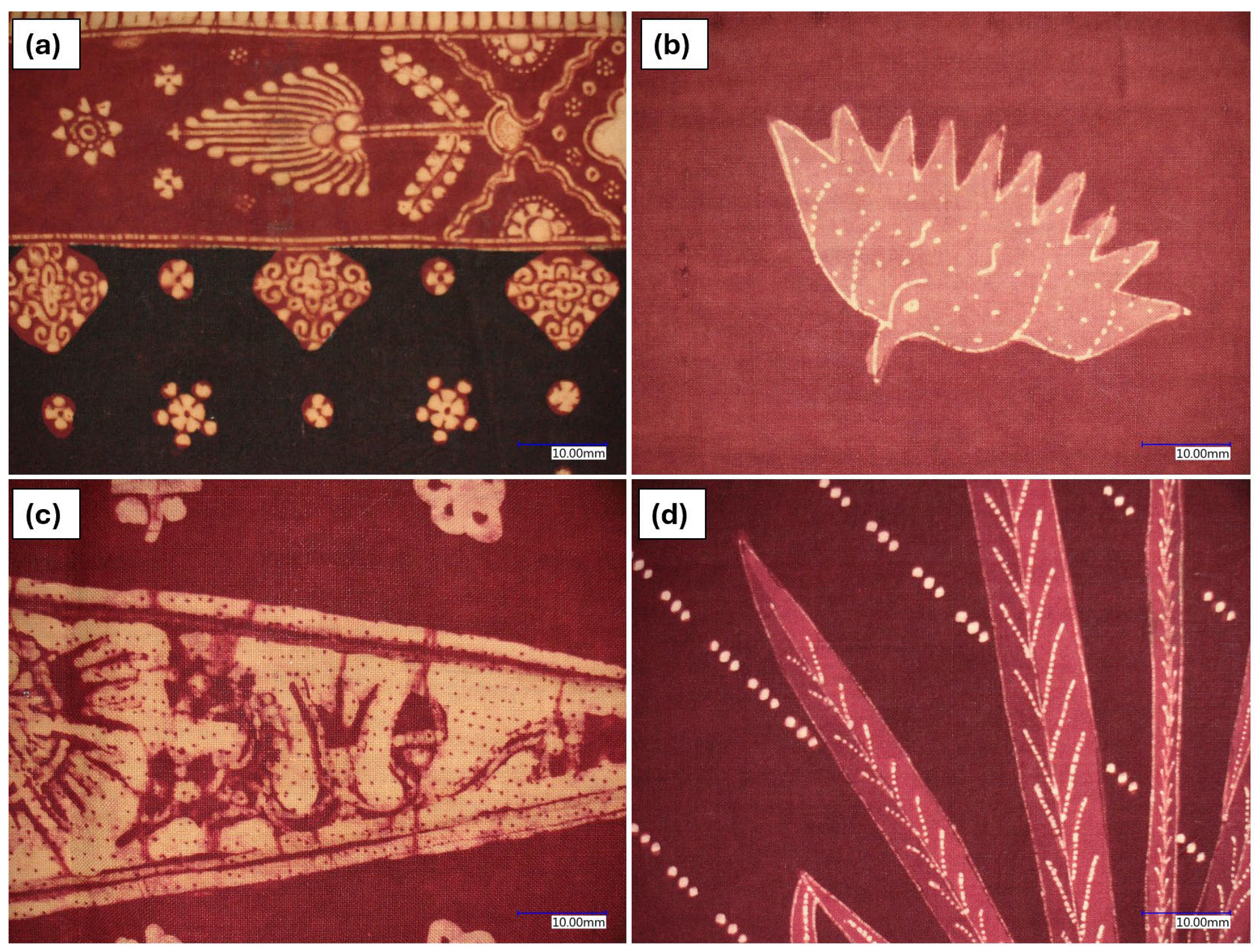
2.1. Batik Textile Samples
2.2. Reference Samples
2.3. Surface-Enhanced Raman Spectroscopy (SERS)
2.4. HPLC-DAD-MS/MS
2.5. p-XRF Spectrometer
2.6. Colourimetry
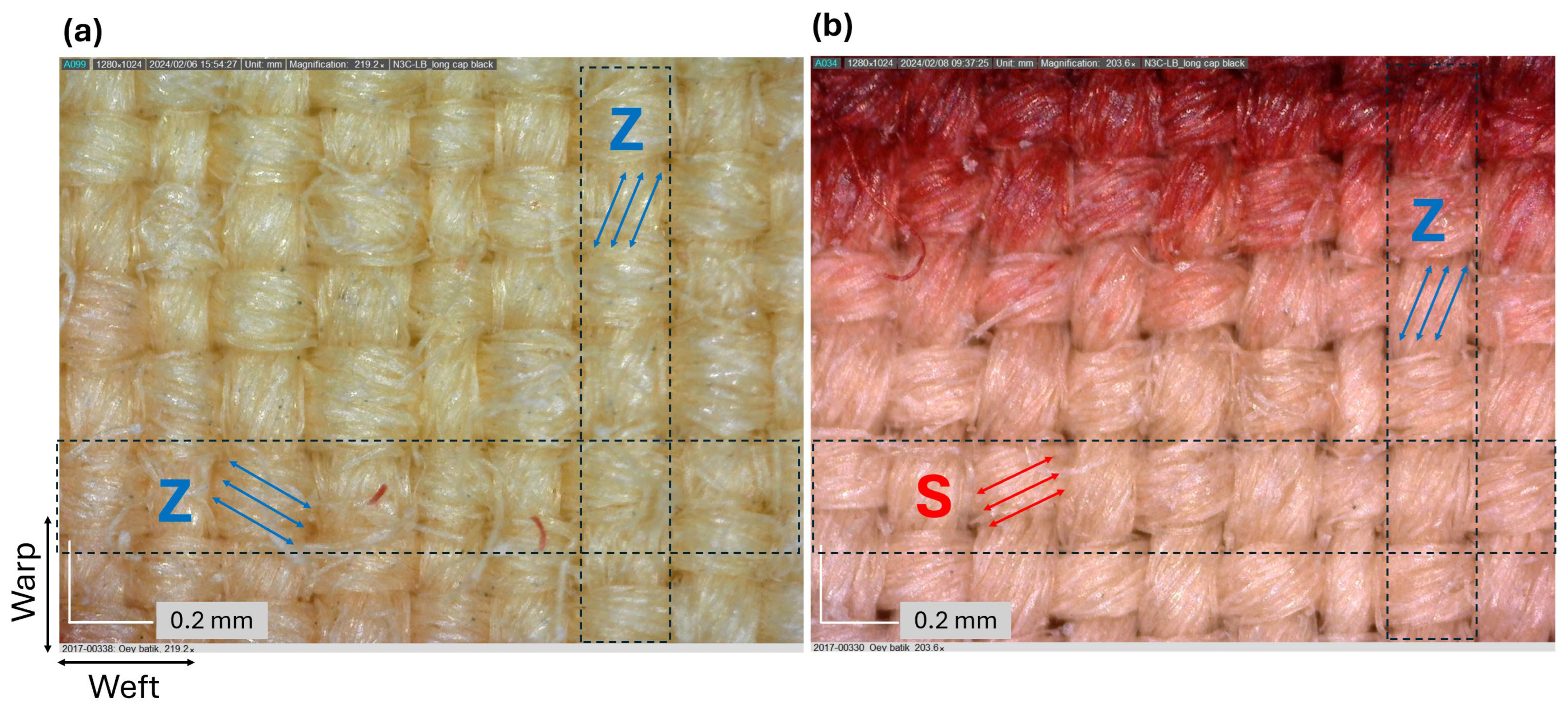
2.7. Optical Microscope and Thread Count Analysis
3. Results
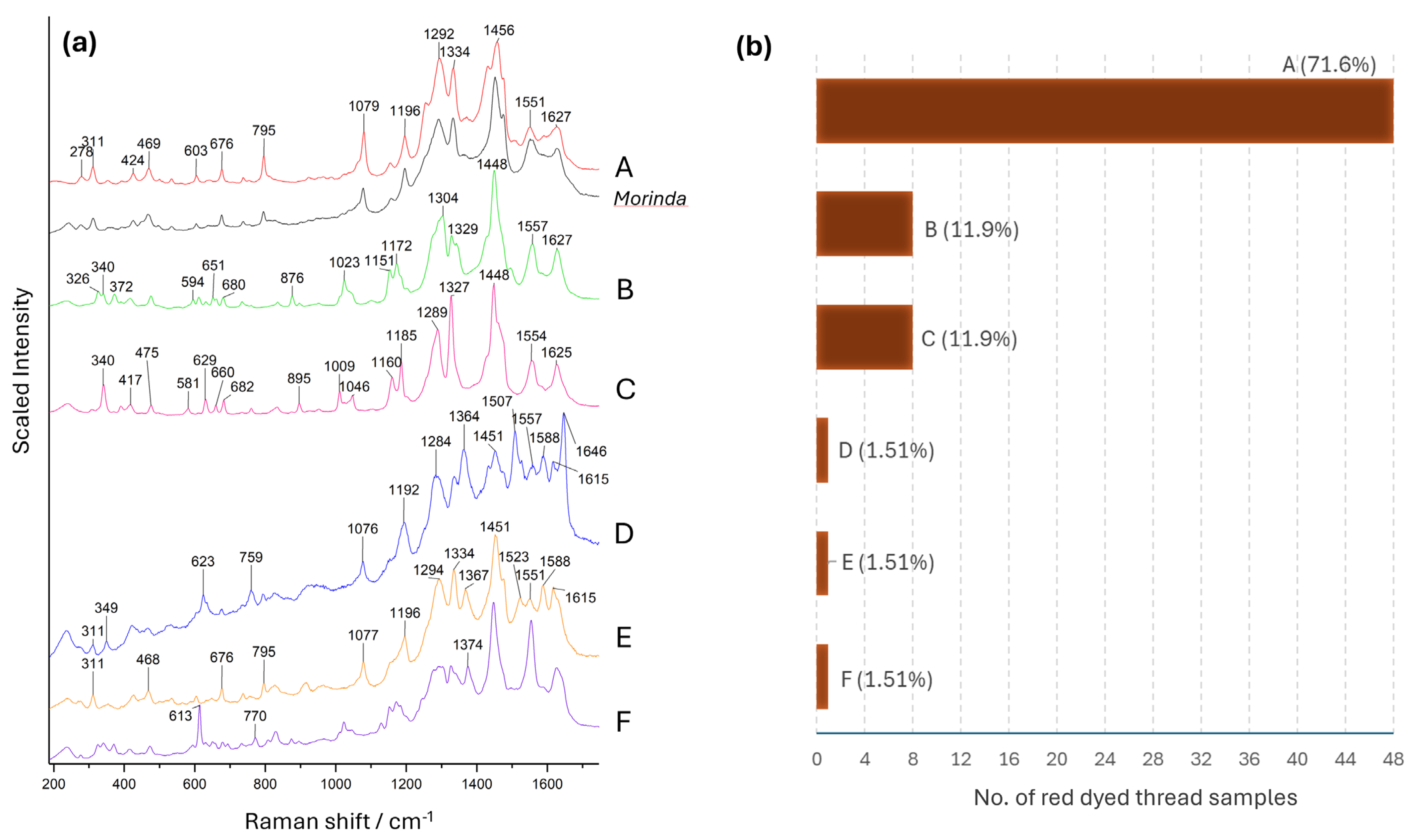
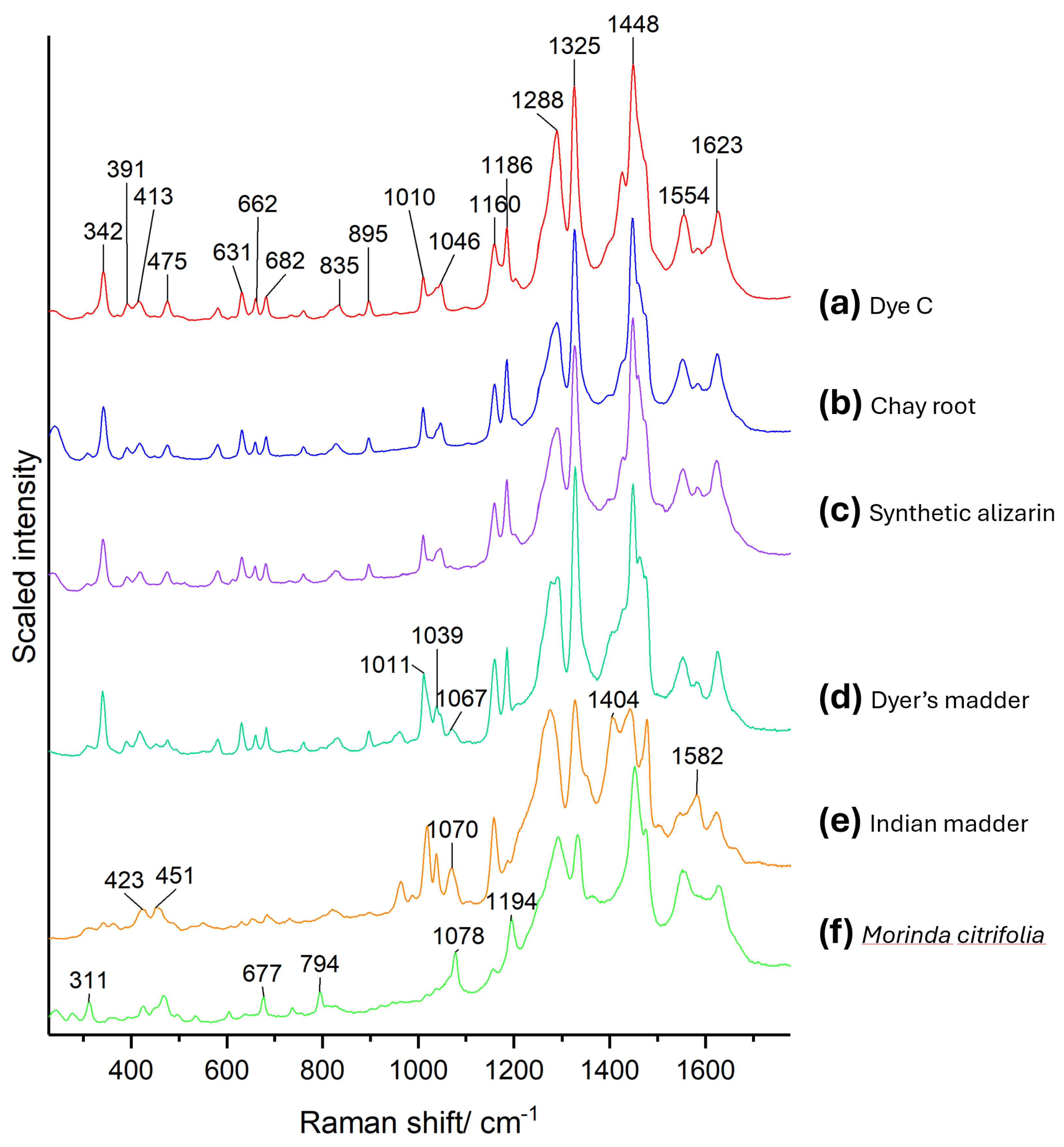
3.1. SERS
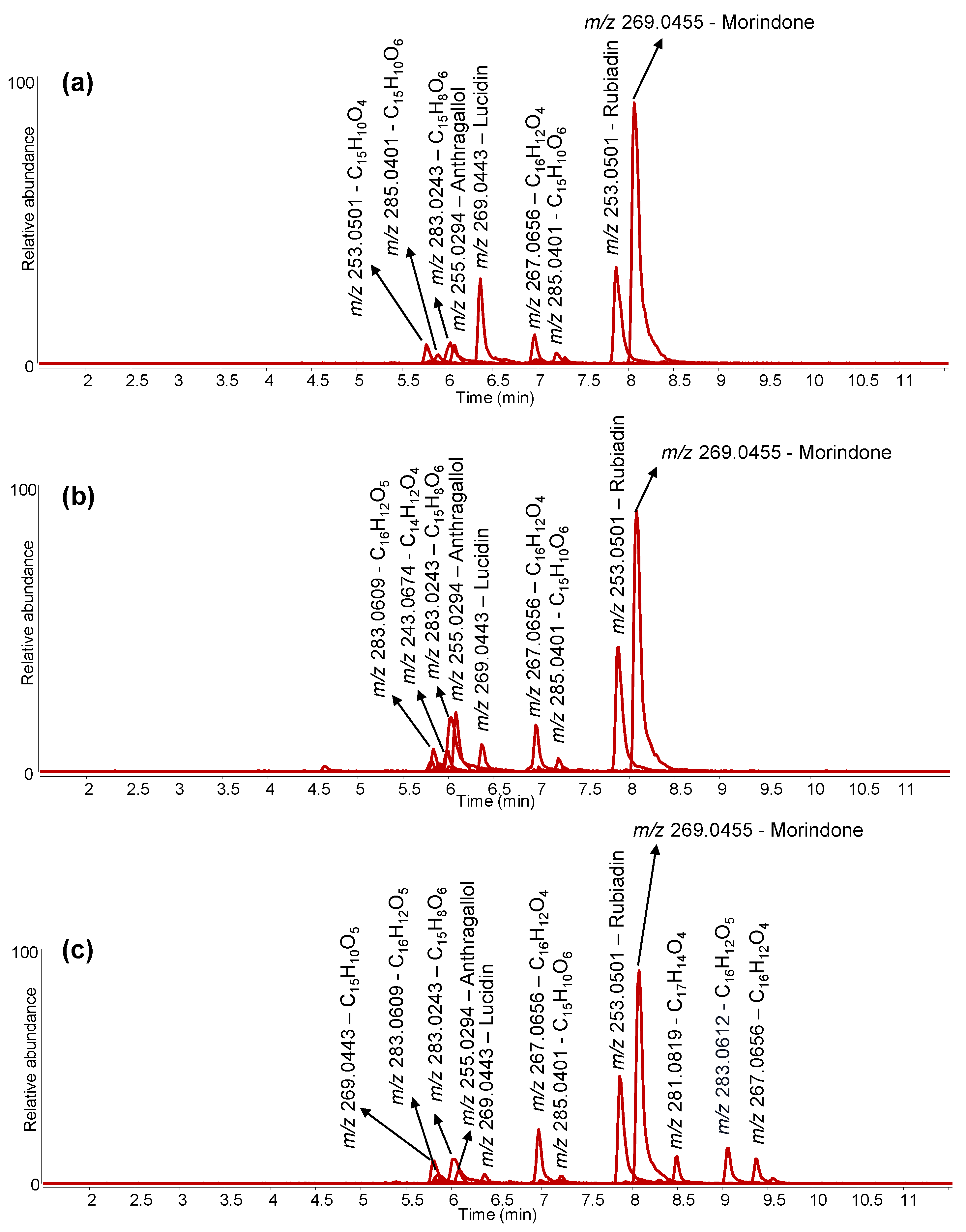
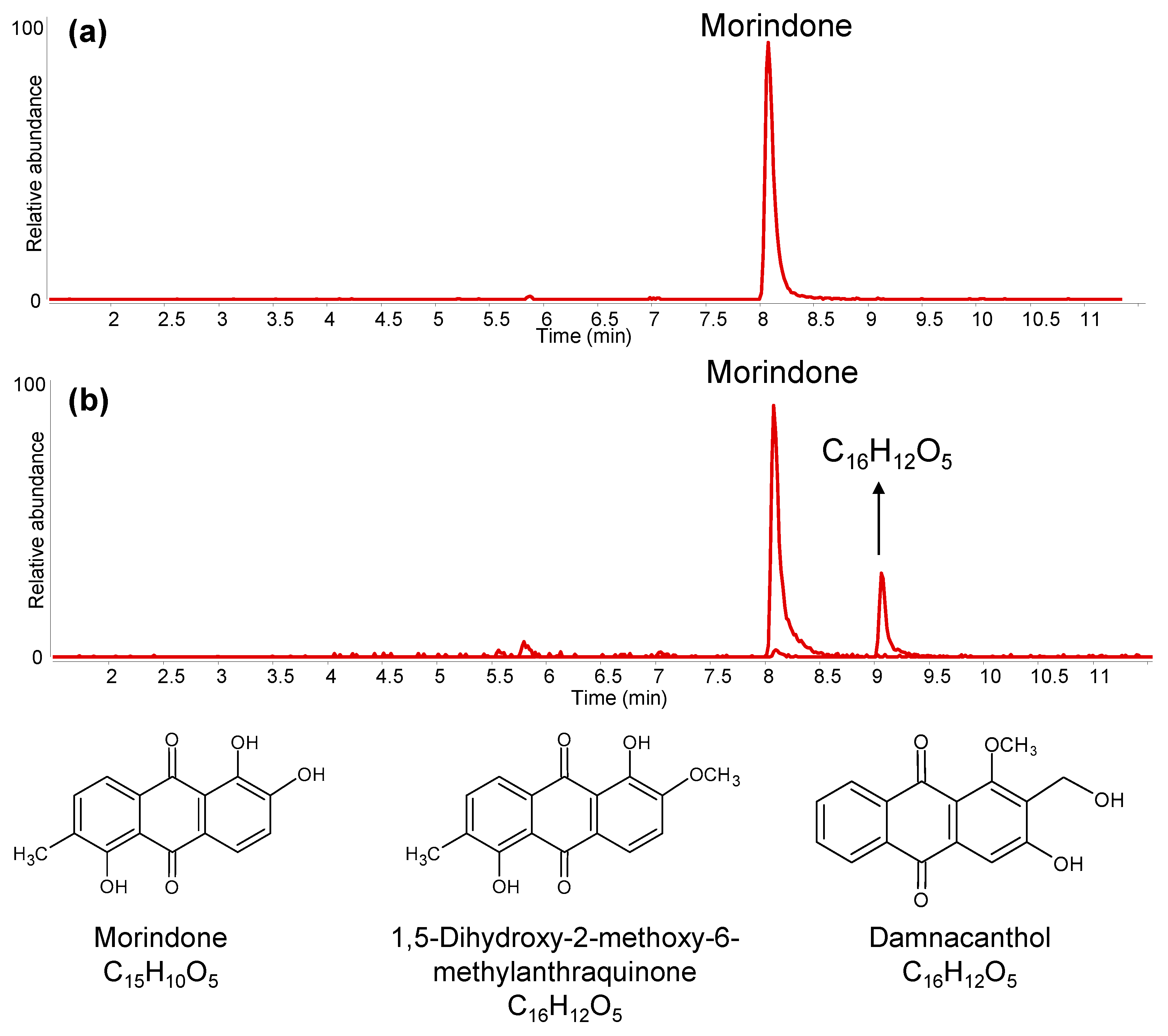
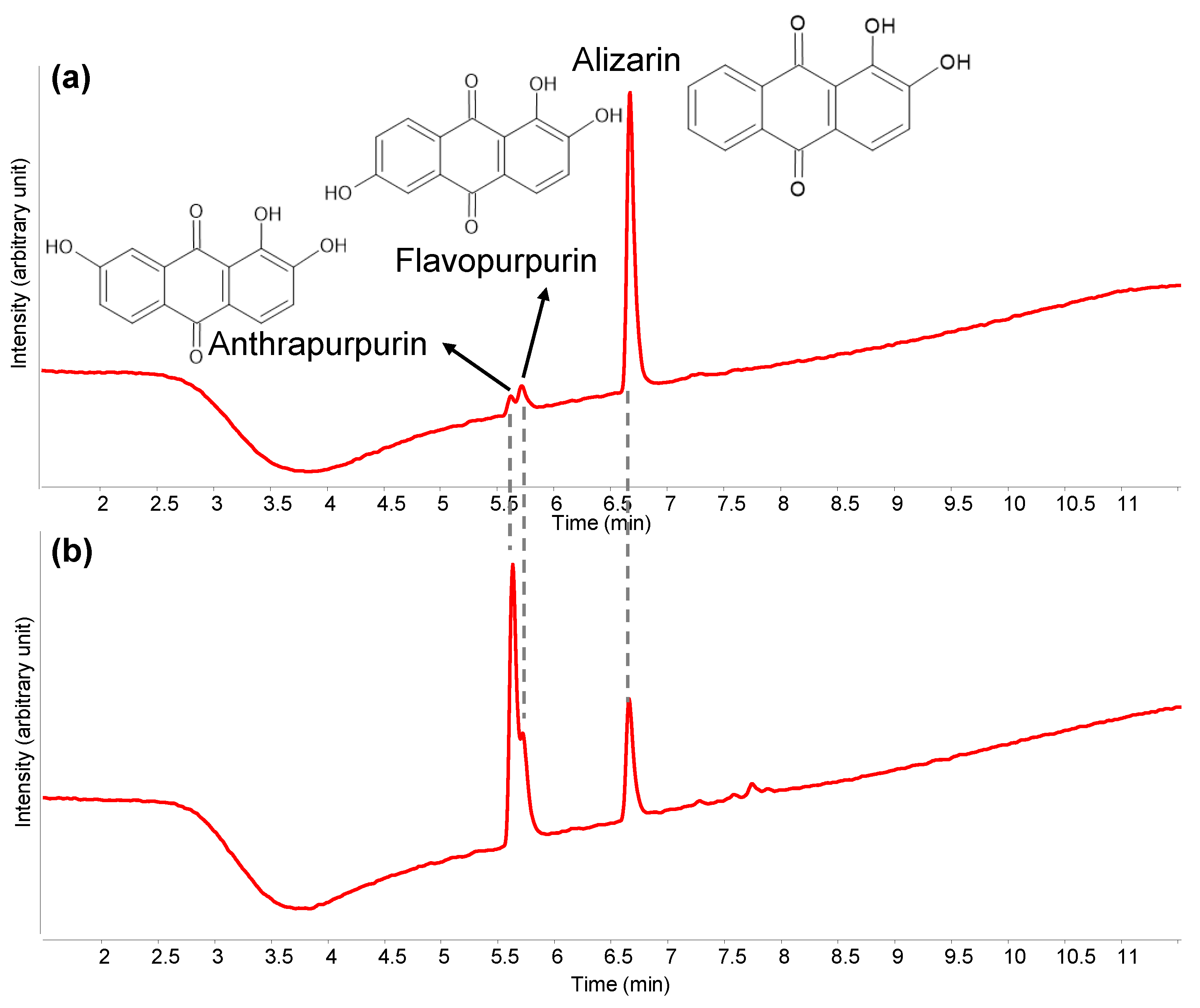
3.2. HPLC-DAD-MS/MS
3.3. p-XRF
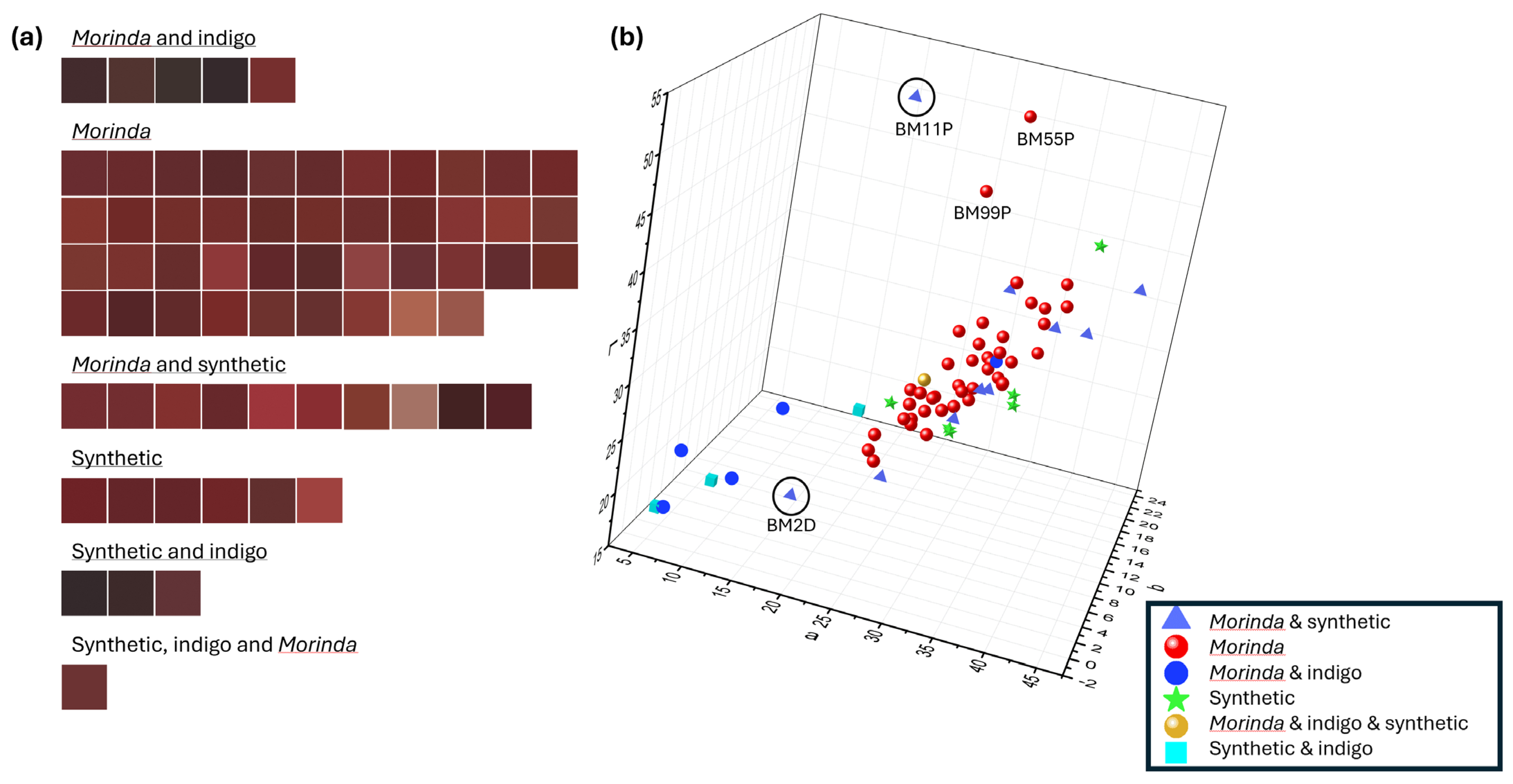
3.4. Colourimetry
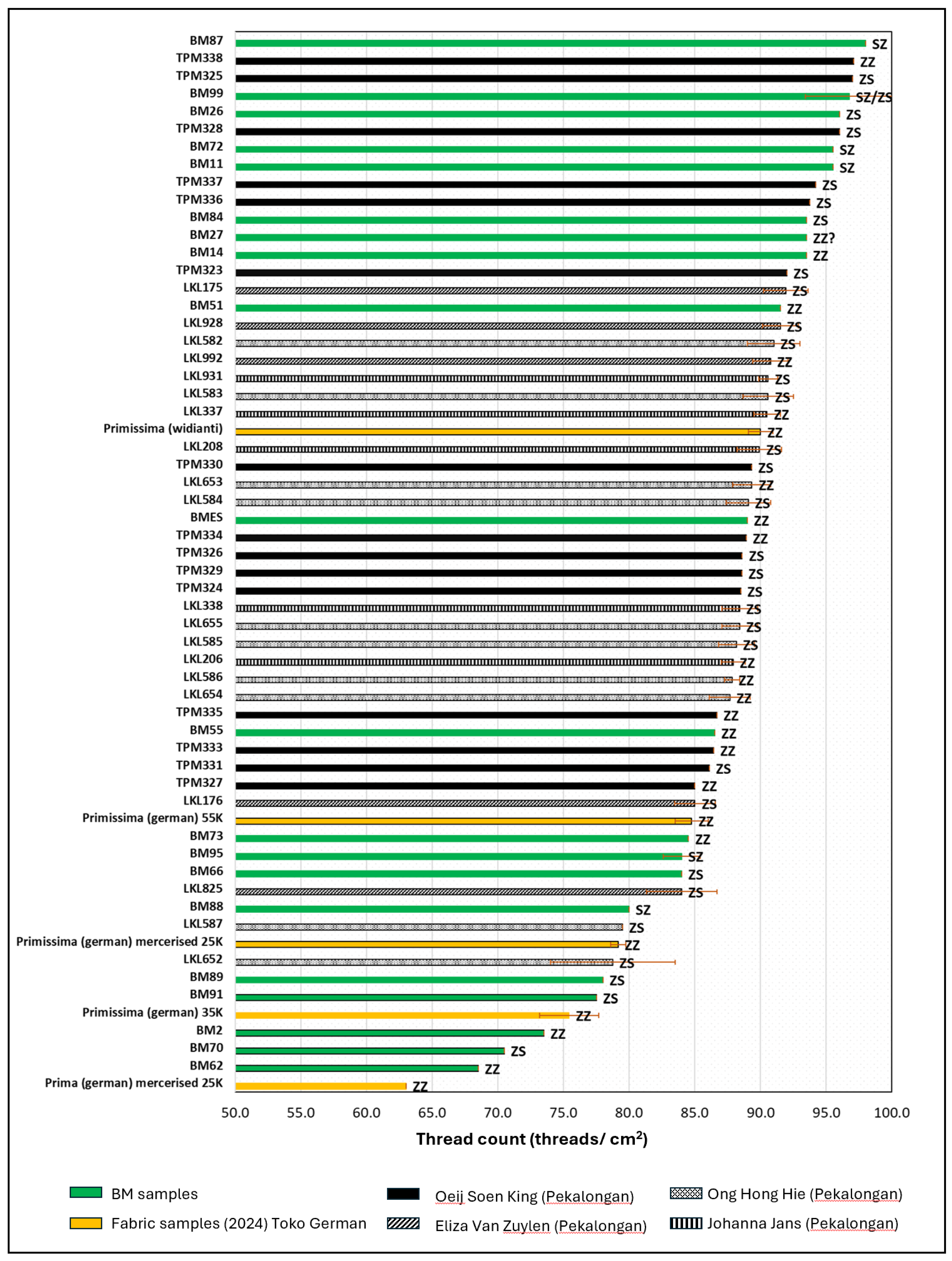
3.5. Fabric Analysis
4. Discussion
4.1. Correlating SERS and HPLC Data
4.2. Compositional Variability of Dye Sources
4.3. Synthetic Dye Usage in Late 19th to Early 20th Century Batiks
5. Conclusions
Supplementary Materials
Author Contributions
Funding
Data Availability Statement
Acknowledgments
Conflicts of Interest
Abbreviations
| HPLC | High-Performance Liquid Chromatography |
| SERS | Surface-Enhanced Raman Spectroscopy |
| XRF | X-ray Fluorescence |
| DM | Digital Microscopy |
| TPM | The Peranakan Museum |
| LKL | Mr and Mrs Lee Kip Lee (Private Collection) |
| BM | The British Museum |
References
- Jasper, J.E.; Pirngadie, M. De Inlandsche Kunstnijverheid in Nederlandsch Indië; Mouton & Co.: The Hague, The Netherlands, 1912; Volume 2, p. 451. [Google Scholar]
- Gittinger, M. Splendid Symbols: Textiles and Tradition in Indonesia; Oxford University Press: Singapore, 1990; p. 243. [Google Scholar]
- Rismantojo, S. Peranakan Batik: Cultures Connection in Indonesia, Malay Peninsula, and Thailand. New Viridian J. Arts Humanit. Soc. Sci. 2021, 1, 57–72. [Google Scholar]
- Ishwara, H.; Yahya, L.R.S.; Moeis, X.; Rambe, A. Batik Pesisir: An Indonesian Heritage: Collection of Hartono Sumarsono, 1st ed.; Kepustakaan Populer Gramedia: Jakarta, Indonesia, 2012. [Google Scholar]
- Lee, P. In-laws and ingenuity: Nyonya Oeij Soen King and Nyonya Oeij Kok Sing as batik entrepreneurs. In Batik Nyonyas: Three Generations of Art and Entrepreneurship—Nyonya Oeij Soen King, Nyonya Oeij Kok Sing, Jane Hendromartono; Chong, A., Ed.; Asian Civilisations Museum: Singapore, 2024; pp. 16–77. [Google Scholar]
- Chua, L.; Komatsu, M. The red dyes and fabric of the batiks of Oeij Soen King and her circle. In Batik Nyonyas: Three Generations of Art and Entrepreneurship—Nyonya Oeij Soen King, Nyonya Oeij Kok Sing, Jane Hendromartono; Chong, A., Ed.; Asian Civilisations Museum: Singapore, 2024; pp. 122–131. [Google Scholar]
- Shahid, M.; Wertz, J.; Degano, I.; Aceto, M.; Khan, M.I.; Quye, A. Analytical methods for determination of anthraquinone dyes in historical textiles: A review. Anal. Chim. Acta 2019, 1083, 58–87. [Google Scholar] [CrossRef]
- Graaff, J.H.; Roelofs, W.G.T.; Bommel, M.R. A Colourful Past: The Origins, Chemistry and Identification of Natural Dyestuffs; Abegg-Stiftung: Riggisberg, Switzerland, 2007. [Google Scholar]
- Petroviciu, I.; Teodorescu, I.; Vasilca, S.; Albu, F.; Medvedovici, A. Liquid chromatography as analytical tool for the study of natural and early synthetic dyes in traditional Saxon textiles. Herit. Sci. 2023, 11, 164. [Google Scholar] [CrossRef]
- Tamburini, D. On the reliability of historic books as sources of reference samples of early synthetic dyes–The case of “The Coal Tar Colours of the Farbwerke vorm. Meister, Lucius & Brüning, Höchst on the Main, Germany–A General Part” (1896). Dye. Pigment. 2024, 221, 111796. [Google Scholar] [CrossRef]
- Bruni, S.; Guglielmi, V.; Pozzi, F. The identification of ancient textile dyes by surface-enhanced Raman spectroscopy (SERS) on silver and gold colloids. In Proceedings of the 5th International Congress on the Application of Raman Spectroscopy in Art and Archaeology, Bilbao, Spain, 14–18 September 2009. [Google Scholar]
- Lee, J.; Kim, M.J.; Van Elslande, E.; Walter, P.; Lee, Y. Identification of Natural Dyes in Ancient Textiles by Time-of-Flight Secondary Ion Mass Spectrometry and Surface-Enhanced Raman Spectroscopy. J. Nanosci. Nanotechnol. 2015, 15, 8701–8705. [Google Scholar] [CrossRef]
- Jurasekova, Z.; del Puerto, E.; Bruno, G.; García-Ramos, J.V.; Sanchez-Cortes, S.; Domingo, C. Extractionless non-hydrolysis surface-enhanced Raman spectroscopic detection of historical mordant dyes on textile fibers. J. Raman Spectrosc. 2010, 41, 1455–1461. [Google Scholar] [CrossRef]
- Yao, M.; Liu, J.; Narengaowa; Li, Y.; Zhao, F. In situ detection of natural dyes in archaeological textiles by SERS substrates immobilized on the fiber. J. Microchem. 2023, 192, 108939. [Google Scholar] [CrossRef]
- Xi, X.-H.; Zhang, Y.; Yan, S.; Wang, P.-S.; Ma, H.; Ren, M.; Liu, G.-K.; Lei, Y.; Ren, B.; Wang, X. Rapid and Accurate Identification of Dyes on Ancient Textiles by SERS with a Negligibly Invasive Approach. J. Raman Spectrosc. 2024, 55, 1281–1288. [Google Scholar] [CrossRef]
- Woodhead, A.L.; Cosgrove, B.; Church, J.S. The purple coloration of four late 19th century silk dresses: A spectroscopic investigation. Spectrochim. Acta A 2016, 154, 185–192. [Google Scholar] [CrossRef] [PubMed]
- Casadio, F.; Leona, M.; Lombardi, J.R.; Van Duyne, R. Identification of Organic Colorants in Fibers, Paints, and Glazes by Surface Enhanced Raman Spectroscopy. Acc. Chem. Res. 2010, 43, 782–791. [Google Scholar] [CrossRef]
- Committee, A.M. AMC technical brief No 80: Surface-enhanced Raman spectroscopy (SERS) in cultural heritage. Anal. Methods 2017, 9, 4338–4340. [Google Scholar] [CrossRef]
- Pozzi, F.; Porcinai, S.; Lombardi, J.R.; Leona, M. Statistical methods and library search approaches for fast and reliable identification of dyes using surface-enhanced Raman spectroscopy (SERS). Anal. Methods 2013, 5, 4205–4212. [Google Scholar] [CrossRef]
- Bersani, D.; Conti, C.; Matousek, P.; Pozzi, F.; Vandenabeele, P. Methodological evolutions of Raman spectroscopy in art and archaeology. Anal. Methods 2016, 8, 8395–8409. [Google Scholar] [CrossRef]
- Cesaratto, A.; Leona, M.; Pozzi, F. Recent advances on the analysis of polychrome works of art: SERS of synthetic colorants and their mixtures with natural dyes. Front. Chem. 2019, 7, 105. [Google Scholar] [CrossRef]
- Marcaida, I.; Maguregui, M.; Morillas, H.; García-Florentino, C.; Pintus, V.; Aguayo, T.; Campos-Vallette, M.; Madariaga, J.M. Optimization of sample treatment for the identification of anthraquinone dyes by surface-enhanced Raman spectroscopy. Anal. Bioanal. Chem. 2017, 409, 2221–2228. [Google Scholar] [CrossRef] [PubMed]
- Pozzi, F.; Lombardi, J.R.; Bruni, S.; Leona, M. Sample Treatment Considerations in the Analysis of Organic Colorants by Surface-Enhanced Raman Scattering. Anal. Chem. 2012, 84, 3751–3757. [Google Scholar] [CrossRef]
- Leona, M.; Stenger, J.; Ferloni, E. Application of surface enhanced Raman scattering techniques to the ultrasensitive identification of natural dyes in works of art. J. Raman Spectrosc. 2006, 37, 981–992. [Google Scholar] [CrossRef]
- Rambaldi, D.C.; Pozzi, F.; Shibayama, N.; Leona, M.; Preusser, F.D. Surface-enhanced Raman spectroscopy of various madder species on wool fibers: The role of pseudopurpurin in the interpretation of the spectra. J. Raman Spectrosc. 2015, 46, 1073–1081. [Google Scholar] [CrossRef]
- Zaffino, C.; Bruni, S.; Guglielmi, V.; De Luca, E. Fourier-transform surface-enhanced Raman spectroscopy (FT-SERS) applied to the identification of natural dyes in textile fibers: An extractionless approach to the analysis. J. Raman Spectrosc. 2014, 45, 211–218. [Google Scholar] [CrossRef]
- Poulin, J. A New Methodology for the Characterisation of Natural Dyes on Museum Objects Using Gas Chromatography–Mass Spectrometry. Stud. Conserv. 2018, 63, 36–61. [Google Scholar] [CrossRef]
- Degani, L.; Riedo, C.; Gulmini, M.; Chiantore, O. From Plant Extracts to Historical Textiles: Characterization of Dyestuffs by GC–MS. Chromatographia 2014, 77, 1683–1696. [Google Scholar] [CrossRef]
- Keijzer, R.; Bommel, M.R. TLC and HPLC Analysis of Red and Violet Cotton Yarns of Indonesian Textiles. Dye. Hist. Archaeol. 2005, 20, 70–79. [Google Scholar]
- Do, K.L.; Mushtaq, A.; Liu, J.; Zhao, F.; Su, M. Unveiling the Use of Natural and Early Synthetic Dyes in Indonesian Historical Silk Textiles. Fibers Polym. 2024, 25, 2233–2244. [Google Scholar] [CrossRef]
- Mouri, C. Analysis of dyes in Noro Priestess Textiles from the Ryukyu Kingdom. Dye. Hist. Archaeol. 2021, 33/34, 102–117. [Google Scholar]
- Gaibor, A.P.; Joosten, I.; Bolk, S. Research into the Chemical Composition of Organic Dyes in 19th Century Sarongs; RCE project 2021-082; Rijksdienst voor het Cultureel Erfgoed, Rijkserfgoedlaboratorium: Amsterdam, The Netherlands, 2022. [Google Scholar]
- Tamburini, D.; Shimada, C.M.; McCarthy, B. The molecular characterization of early synthetic dyes in E. Knecht et al’s textile sample book “A Manual of Dyeing” (1893) by high performance liquid chromatography—Diode array detector—Mass spectrometry (HPLC-DAD-MS). Dye. Pigment. 2021, 190, 109286. [Google Scholar] [CrossRef]
- Widiawati, D. The Revival of the Usage of Natural Fibers and Natural Dyes in Indonesian Textile. J. Vis. Art Des. 2009, 3, 115–128. [Google Scholar] [CrossRef]
- Mohanty, B.C.; Chandramouli, K.V.; Naik, H.D. Natural Dyeing Processes of India; Calico Museum of Textiles: Ahmedabad, India, 1987. [Google Scholar]
- Tamburini, D.; Cartwright, C.R.; Pullan, M.; Vickers, H. An investigation of the dye palette in Chinese silk embroidery from Dunhuang (Tang dynasty). Archaeol. Anthropol. Sci. 2019, 11, 1221–1239. [Google Scholar] [CrossRef]
- Tamburini, D. Investigating Asian colourants in Chinese textiles from Dunhuang (7th–10th century AD) by high performance liquid chromatography tandem mass spectrometry—Towards the creation of a mass spectra database. Dye. Pigment. 2019, 163, 454–474. [Google Scholar] [CrossRef]
- Bruni, S.; Guglielmi, V.; Pozzi, F. Historical organic dyes: A surface-enhanced Raman scattering (SERS) spectral database on Ag Lee–Meisel colloids aggregated by NaClO4. J. Raman Spectrosc. 2011, 42, 1267–1281. [Google Scholar] [CrossRef]
- Chen, K.; Leona, M.; Vo-Dinh, K.C.; Yan, F.; Wabuyele, M.B.; Vo-Dinh, T. Application of surface-enhanced Raman scattering (SERS) for the identification of anthraquinone dyes used in works of art. J. Raman Spectrosc. 2006, 37, 520–527. [Google Scholar] [CrossRef]
- Cardon, D. Natural Dyes: Sources, Tradition, Technology and Science; Archetype Publicaitons Ltd.: London, UK, 2007. [Google Scholar]
- Lv, L.; Chen, H.; Ho, C.-T.; Sang, S. Chemical components of the roots of Noni (Morinda citrifolia) and their cytotoxic effects. Fitoterapia 2011, 82, 704–708. [Google Scholar] [CrossRef]
- Hou, S.; Ma, D.; Wu, S.; Hui, Q.; Hao, Z. Morinda citrifolia L.: A Comprehensive Review on Phytochemistry, Pharmacological Effects, and Antioxidant Potential. Antioxidants 2025, 14, 295. [Google Scholar] [CrossRef]
- Ee, G.; Wen, Y.P.; Sukari, M.; Go, R.; Lee, H.L. A new anthraquinone from Morinda citrifolia roots. Nat. Prod. Res. 2009, 23, 1322–1329. [Google Scholar] [CrossRef]
- Chen, V.J.; Smith, G.D.; Whitaker, M.R.; von Rabenau, B. Identification of Red Dyes in Selected Textiles from Chin and Karen Ethnic Groups of Myanmar by LC-DAD-ESI-MS. Dye. Hist. Archaeol. 2021, 33, 92–101. [Google Scholar]
- Adam, T. The Art of Batik—Weaving and Dyeing in Java; Holyoake Press: Holyoke, MA, USA, 2010. [Google Scholar]
- Richardson, D.; Richardson, S. Morinda. Available online: https://www.asiantextilestudies.com/morinda (accessed on 12 December 2025).
- Keijzer, R. The Bühler Collection of Indonesian Dyeplants. Dye. Hist. Archaeol. 1997, 15, 3–26. [Google Scholar]
- Sabatini, F.; Bacigalupo, M.; Degano, I.; Javér, A.; Hacke, M. Revealing the organic dye and mordant composition of Paracas textiles by a combined analytical approach. Herit. Sci. 2020, 8, 122. [Google Scholar] [CrossRef]
- Schmitt, M.; Boras, S.; Tjoa, A.; Watanabe, T.; Jansen, S. Aluminium Accumulation and Intra-Tree Distribution Patterns in Three Arbor aluminosa (Symplocos) Species from Central Sulawesi. PLoS ONE 2016, 11, e0149078. [Google Scholar] [CrossRef]
- Cárcamo-Vega, J.J.; Sepúlveda, M.; Casanova-González, E.; Gutiérrez, S.; Mitrani, A.; Dauelsberg, E.J.; Aliaga Á, E.; Lemp, C.; Ruvalcaba-Sil, J.L. New insights into archaeological textiles (1000–1450AD) from the coastal region of the Atacama Desert: Preliminary evidence of a cochineal and shellfish purple dye combination. PLoS ONE 2025, 20, e0325623. [Google Scholar] [CrossRef]
- Roojen, P.v. Batik Design; The Pepin Press: Amsterdam, The Netherlands, 1993. [Google Scholar]
- De Luca, E.; Redaelli, M.; Zaffino, C.; Bruni, S. A SERS and HPLC study of traditional dyes from native Chinese plants. Vibrat. Spec. 2018, 95, 62–67. [Google Scholar] [CrossRef]
- Pozzi, F.; Zaleski, S.; Casadio, F.; Van Duyne, R.P. SERS Discrimination of Closely Related Molecules: A Systematic Study of Natural Red Dyes in Binary Mixtures. J. Phys. Chem. C 2016, 120, 21017–21026. [Google Scholar] [CrossRef]
- Shadi, I.T.; Chowdhry, B.Z.; Snowden, M.J.; Withnall, R. Semi-quantitative analysis of alizarin and purpurin by surface-enhanced resonance Raman spectroscopy (SERRS) using silver colloids. J. Raman Spectrosc. 2004, 35, 800–807. [Google Scholar] [CrossRef]
- Calà, E.; Gosetti, F.; Gulmini, M.; Serafini, I.; Ciccola, A.; Curini, R.; Salis, A.; Damonte, G.; Kininger, K.; Just, T.; et al. It’s Only a Part of the Story: Analytical Investigation of the Inks and Dyes Used in the Privilegium Maius. Molecules 2019, 24, 2197. [Google Scholar] [CrossRef]
- Whitney, A.V.; Van Duyne, R.P.; Casadio, F. An innovative surface-enhanced Raman spectroscopy (SERS) method for the identification of six historical red lakes and dyestuffs. J. Raman Spectrosc. 2006, 37, 993–1002. [Google Scholar] [CrossRef]
- Welham, R. The early history of the synthetic dye industry. J. Soc. Dye. Colour. 1963, 79, 146–152. [Google Scholar] [CrossRef]
- van Bommel, M.R.; de Keijzer, M. Bright Colours from the Past: The History, Chemistry, Characterisation and Application of Synthetic Dyes Between 1856 and 1914; Springer Nature: Berlin/Heidelberg, Germany, 2025. [Google Scholar]
- Tamburini, D.; Dyer, J.; Cartwright, C.; Green, A. Changes in the production materials of Burmese textiles in the nineteenth century—dyes, mordants and fibres of Karen garments from the British Museum’s collection. Herit. Sci. 2023, 11, 150. [Google Scholar] [CrossRef]
- Knecht, E.; Rawson, C.; Loewenthal, R. A Manual of Dyeing: For the Use of Practical Dyers, Manufacturers, Students, and All Interested in the Art of Dyeing; C. Griffin & Co.: London, UK, 1893; Volume 2. [Google Scholar]




| Batik No. | Museum | Workshop | Origin | Dyed Samples |
|---|---|---|---|---|
| TPM323 | TPM | Oeij | Pekalongan | Red |
| TPM324 | TPM | Oeij | Pekalongan | Red, blue |
| TPM325 | TPM | Oeij | Pekalongan | Red, yellow |
| TPM326 | TPM | Oeij | Pekalongan | Red |
| TPM327 | TPM | Oeij | Pekalongan | Red, dark red, blue, light blue |
| TPM328 | TPM | Oeij | Pekalongan | Red, blue |
| TPM329 | TPM | Oeij | Pekalongan | Red |
| TPM330 | TPM | Oeij | Pekalongan | Red, blue |
| TPM331 | TPM | Oeij | Pekalongan | Red |
| TPM333 | TPM | Oeij | Pekalongan | Red |
| TPM334 | TPM | Oeij | Pekalongan | Red |
| TPM335 | TPM | Oeij | Pekalongan | Red |
| TPM336 | TPM | Oeij | Pekalongan | Red |
| TPM337 | TPM | Oeij | Pekalongan | Red, dark red |
| TPM338 | TPM | Oeij | Pekalongan | Red |
| LKL582 | LKL | Ong | Lasem | Red |
| LKL583 | LKL | Ong | Lasem | Red |
| LKL584 | LKL | Ong | Lasem | Red |
| LKL585 | LKL | Ong | Lasem | Red |
| LKL586 | LKL | Ong | Lasem | Red |
| LKL587 | LKL | Ong | Lasem | Red |
| LKL652 | LKL | Ong | Lasem | Red |
| LKL653 | LKL | Ong | Lasem | Red, dark red |
| LKL654 | LKL | Ong | Lasem | Red |
| LKL655 | LKL | Ong | Lasem | Red, dark red, blue |
| LKL175 | LKL | Van Zuylen | Pekalongan | Red |
| LKL176 | LKL | Van Zuylen | Pekalongan | Red, blue |
| LKL928 | LKL | Van Zuylen | Pekalongan | Red |
| LKL825 | LKL | Van Zuylen | Pekalongan | Red |
| LKL992 | LKL | Van Zuylen | Pekalongan | Red, blue |
| LKL206 | LKL | Jans | Pekalongan | Red, dark red, blue |
| LKL208 | LKL | Jans | Pekalongan | Red, bright red |
| LKL337 | LKL | Jans | Pekalongan | Red |
| LKL338 | LKL | Jans | Pekalongan | Red |
| LKL931 | LKL | Jans | Pekalongan | Red |
| BM2 | BM | Unknown | Madura | Dark red |
| BM11 | BM | Mevr Fisfer | Pekalongan | Pink, light red, dark red |
| BM14 | BM | Unknown | North coast | Red |
| BM26 | BM | Mevr Fisfer | Pekalongan | Light red, dark red |
| BM27 | BM | Unknown | Pekalongan | Red |
| BM51 | BM | Catharina Oosterom? | Java | Red |
| BM55 | BM | Unknown | Pekalongan | Pink, red |
| BM62 | BM | Unknown | Java | Red |
| BM66 | BM | Unknown | Java | Red |
| BM70 | BM | Unknown | Java | Dark red |
| BM72 | BM | Unknown | Java | Red |
| BM73 | BM | Unknown | Java | Red |
| BM84 | BM | Unknown | Madura | Rust, red |
| BM87 | BM | Unknown | Java | Red |
| BM88 | BM | Unknown | Java | Dark red |
| BM89 | BM | Unknown | Cirebon | Red |
| BM91 | BM | Unknown | Java | Red |
| BM95 | BM | Unknown | Java | Red |
| BM99 | BM | Unknown | Java | Red, pink |
| BMES | BM | Unknown | Made Java, purchased Europe | Red |
| Sample No. | SERS | HPLC | Other Colours |
|---|---|---|---|
| TPM323 | A | Morinda I | |
| TPM324 | B | Morinda I, Synthetic Alizarin II | Blue: indigo |
| TPM325 | B | Morinda I, Synthetic Alizarin II | Yellow: synthetic alizarin, Morinda traces |
| TPM326 | A | Morinda II | |
| TPM327 | A | Morinda I | Blue: indigo |
| TPM327D | A | Morinda I, indigo | |
| TPM328 | A | Morinda I | Blue: indigo |
| TPM329 | A | Morinda II | |
| TPM330 | A | Morinda I | Blue: indigo |
| TPM331 | A | Morinda I | |
| TPM333 | A | Morinda I | |
| TPM334 | A | Morinda II | |
| TPM335 | A | Morinda I | |
| TPM336 | A | Morinda II | |
| TPM337 | A | Morinda II | |
| TPM337D | A | Morinda II, indigo | |
| TPM338 | A | No sample | |
| LKL582 | A | Morinda II | |
| LKL583 | A | Morinda II | |
| LKL584 | A | Morinda II | |
| LKL585 | A | Morinda II | |
| LKL586 | A | Morinda II | |
| LKL587 | A | Morinda II | |
| LKL652 | C | Synthetic Alizarin I, auramine | |
| LKL653 | C | Synthetic Alizarin I, auramine | |
| LKL653D | C | Synthetic Alizarin I, auramine, indigo | |
| LKL654 | C | Synthetic Alizarin I | |
| LKL655 | B | Synthetic Alizarin II | Blue: indigo |
| LKL655D | F | Synthetic Alizarin II, indigo, yellow dye | |
| LKL175 | A | Morinda I | |
| LKL176 | C | Synthetic Alizarin I, indigo | |
| LKL928 | A | Morinda II | |
| LKL825 | C | Synthetic Alizarin I, auramine | |
| LKL992 | C | Morinda II, Synthetic Alizarin I | |
| LKL206 | A | Morinda II | Blue: indigo |
| LKL206D | A | Morinda II, indigo | |
| LKL208 | B | Morinda II, Synthetic Alizarin II | |
| LKL208B | B | Synthetic Alizarin II, Morinda II | |
| LKL337 | A | Morinda II | |
| LKL338 | A | Morinda II | |
| LKL931 | A | Morinda II | |
| BM2D | A and E | Morinda I, fuchsin | |
| BM11P | D | Morinda I, rhodamine B | |
| BM11L | A | Morinda I | |
| BM11D | A | Morinda I | |
| BM14 | A | Morinda II | |
| BM26L | A | Morinda I | |
| BM26D | A | Morinda I | |
| BM27 | A | Morinda I, indigo | |
| BM51 | A | Morinda I | |
| BM55P | A | Morinda I | |
| BM55 | A | Morinda I, Synthetic Alizarin I (minor), indigo | |
| BM62L | B | Synthetic Alizarin II | |
| BM66 | A | Morinda I | |
| BM70D | C | Morinda I, Synthetic Alizarin I (major) | |
| BM72 | A | Morinda I | |
| BM73 | A | Morinda I | |
| BM84R | B | Morinda I, Synthetic Alizarin II | |
| BM84 | B | Morinda I, Synthetic Alizarin II | |
| BM87 | A | Morinda I | |
| BM88D | A | Morinda I, indigo | |
| BM89 | A | Morinda I | |
| BM91 | A | Morinda II | |
| BM95 | A | Morinda I | |
| BM99 | A | Morinda II | |
| BM99P | A | Morinda II | |
| BMES | A | Morinda I | |
| Morinda citrifolia-dyed cotton from India | A | Morinda I | |
| Morinda citrifolia-dyed cotton from Bali | A | Morinda I | |
| Morinda citrifolia-dyed cotton from Sumba | A | Morinda II |
| SERS Result | HPLC Result | SERS Wavenumbers (cm−1) | Remarks |
|---|---|---|---|
| Dye A (Morinda) | Morinda I or Morinda II | 1627 m, 1551 m, 1474 sh, 1456 vs, 1432 sh, 1334 s, 1292 vs, 1196 s, 1079 s, 795 m, 676, 603, 469, 424, 311, 278 | Bold bands are markers of Morinda |
| Dye B | Synthetic Alizarin II * | 1627 m, 1557 m, 1448 vs, 1329 s, 1304 vs, 1172 m, 1151 m, 1023, 876, 680, 651, 594, 469, 424, 372, 340, 326 | Bold bands are markers of Synthetic Alizarin II |
| Dye C | Synthetic Alizarin I * | 1625 m, 1554 m, 1448 vs, 1327 vs, 1289 s, 1185 m, 1160, 1046, 1009, 895, 682, 660, 629, 581, 475, 417, 340 m | Bold bands are markers of Synthetic Alizarin I |
| Dye D | Morinda I, rhodamine B | 1646 vs, 1615, 1588, 1557, 1507 vs, 1451, 1364 s, 1284 s, 1192 m, 1076, 759, 623, 349, 311 | Similar to Dye E; bold bands are likely markers of rhodamine B |
| Dye E | Morinda I, fuchsin | 1615 m, 1588 m, 1551, 1523, 1451 vs, 1367 s, 1334 vs, 1294 s, 1196, 1077, 795, 676 sp, 468, 311 | Similar to Dye D; bold bands are likely markers of fuchsin |
| Dye F | Synthetic Alizarin II, indigo, yellow dye | 1624 m, 1554 m, 1448 vs, 1374, 1293 (br), 1277, 1246, 1172 m, 1149 m, 1129, 1022 894, 876, 832, 808, 770, 731, 691, 677, 649, 628, 613 s, 593, 472, 413, 371, 342, 324 | Similar to Dye B, except for a few bands in bold |
Disclaimer/Publisher’s Note: The statements, opinions and data contained in all publications are solely those of the individual author(s) and contributor(s) and not of MDPI and/or the editor(s). MDPI and/or the editor(s) disclaim responsibility for any injury to people or property resulting from any ideas, methods, instructions or products referred to in the content. |
© 2026 by the authors. Licensee MDPI, Basel, Switzerland. This article is an open access article distributed under the terms and conditions of the Creative Commons Attribution (CC BY) license.
Share and Cite
Chua, L.; Tamburini, D.; Komatsu, M.; Lee, P.; Green, A. Red Dyes in Transition: Investigating Natural and Synthetic Colourants in Javanese Batik Textiles by HPLC-DAD-MS/MS and SERS. Heritage 2026, 9, 231. https://doi.org/10.3390/heritage9060231
Chua L, Tamburini D, Komatsu M, Lee P, Green A. Red Dyes in Transition: Investigating Natural and Synthetic Colourants in Javanese Batik Textiles by HPLC-DAD-MS/MS and SERS. Heritage. 2026; 9(6):231. https://doi.org/10.3390/heritage9060231
Chicago/Turabian StyleChua, Lynn, Diego Tamburini, Miki Komatsu, Peter Lee, and Alexandra Green. 2026. "Red Dyes in Transition: Investigating Natural and Synthetic Colourants in Javanese Batik Textiles by HPLC-DAD-MS/MS and SERS" Heritage 9, no. 6: 231. https://doi.org/10.3390/heritage9060231
APA StyleChua, L., Tamburini, D., Komatsu, M., Lee, P., & Green, A. (2026). Red Dyes in Transition: Investigating Natural and Synthetic Colourants in Javanese Batik Textiles by HPLC-DAD-MS/MS and SERS. Heritage, 9(6), 231. https://doi.org/10.3390/heritage9060231