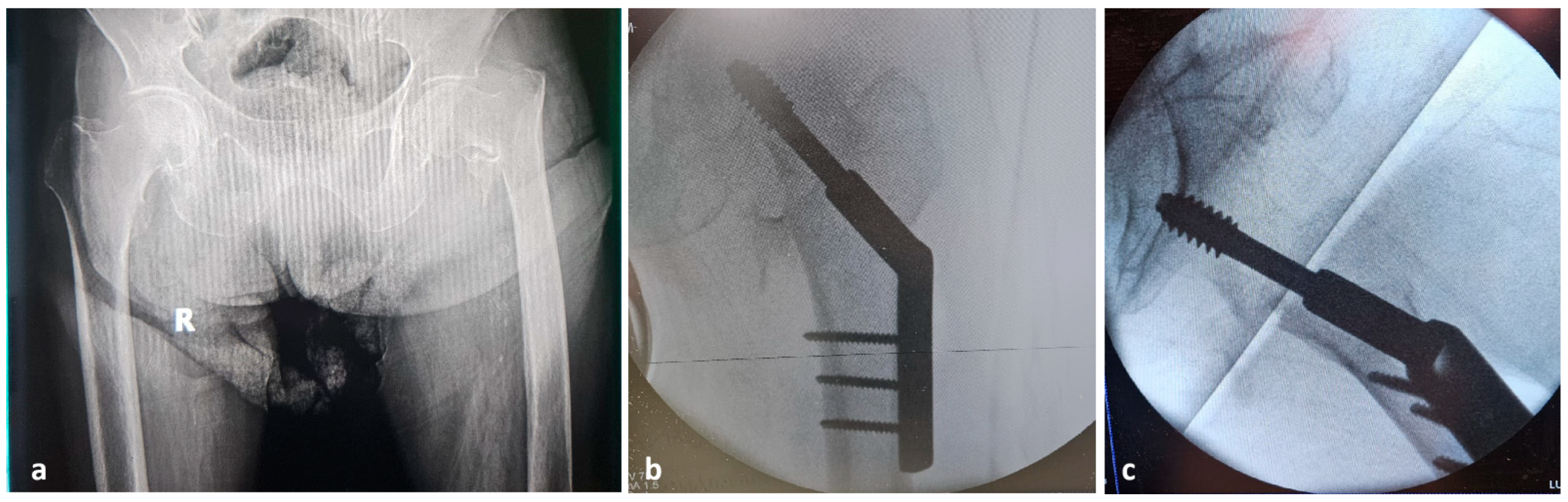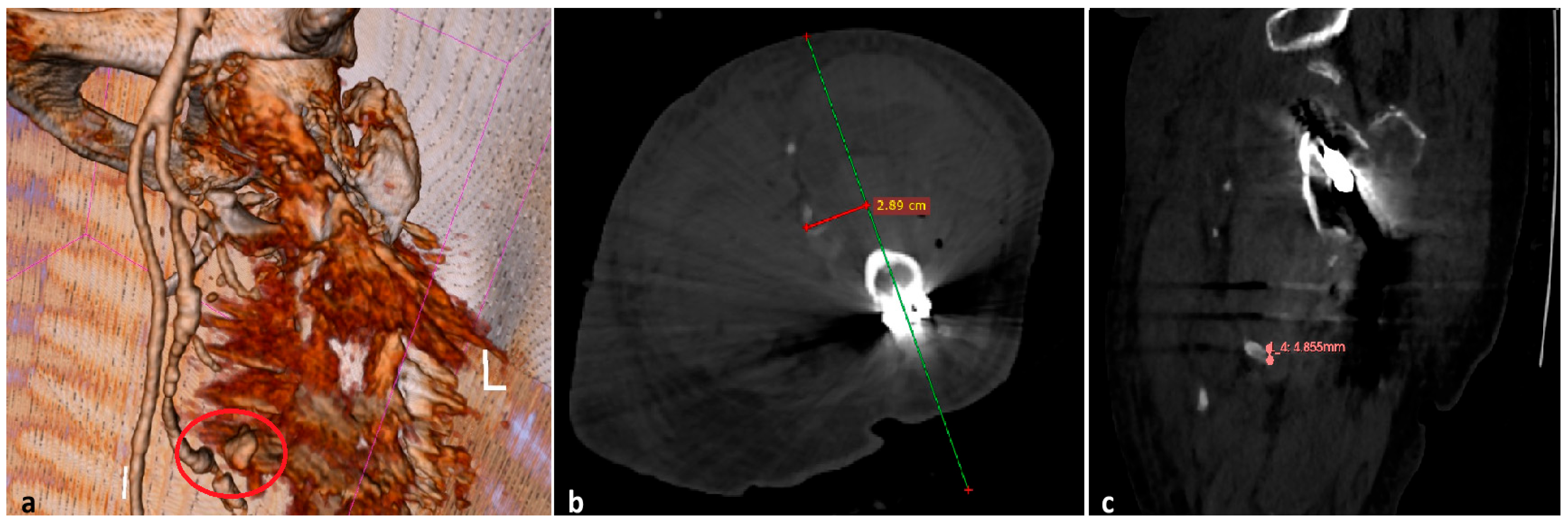

Vascular Complications Following Trans-Trochanteric Fracture: Case Report and Literature Review

Abstract
1. Introduction and Clinical Significance
2. Case Presentation

3. Discussion
3.1. Clinical and Paraclinical Diagnosis
3.2. Treatment and Prognosis
3.3. Risk Factors
3.4. Preventive Considerations
- Postoperative surveillance—A sudden drop in hemoglobin levels, expanding hematoma, or persistent thigh pain should prompt immediate imaging evaluation (Doppler ultrasound or CT angiography). Clinicians should also be aware that beta-blocker therapy may mask tachycardia, potentially delaying recognition of internal bleeding [2,20].
3.5. Limitation
4. Conclusions
Author Contributions
Funding
Institutional Review Board Statement
Informed Consent Statement
Data Availability Statement
Conflicts of Interest
References
- Barquet, A.; Gelink, A.; Giannoudis, P.V. Proximal Femoral Fractures and Vascular Injuries in Adults: Incidence, Aetiology and Outcomes. Injury 2015, 46, 2297–2313. [Google Scholar] [CrossRef] [Scilit]
- Segal, D.; Yaacobi, E.; Marom, N.; Feldman, V.; Aliev, E.; Palmanovich, E.; Bartal, G.; Brin, Y.S. The Incidence of Life Threatening Iatrogenic Vessel Injury Following Closed or Open Reduction and Internal Fixation of Intertrochanteric Femoral Factures. Int. Orthop. 2017, 41, 1845–1850. [Google Scholar] [CrossRef] [Scilit] [PubMed]
- Regus, S.; Lang, W. Arterial Injury and Pseudoaneurysm Formation after Lesser Trochanter Fracture. Int. J. Surg. Case Rep. 2015, 14, 4–6. [Google Scholar] [CrossRef] [Scilit] [PubMed]
- Orapiriyakul, W.; Chewakidakarn, C.; Dissaneewate, K.; Dissaneewate, P.; Kritsaneephaiboon, A. Silent Iatrogenic Pseudoaneurysm after Intertrochanteric Fracture Fixation with Proximal Femoral Nailing and Cerclage Wiring: Case Report and Review of Literature. Eur. J. Orthop. Surg. Traumatol. Orthop. Traumatol. 2023, 33, 2667–2681. [Google Scholar] [CrossRef] [Scilit] [PubMed]
- Potenza, V.; Saputo, U.; Catellani, F.; Farsetti, P.; Caterini, R. Laceration of a Branch of the Profunda Femoris Artery Caused by a Spike of the Displaced Lesser Trochanter in an Inter-Trochanteric Femoral Fracture. A Case Report. Int. J. Surg. Case Rep. 2016, 24, 195–198. [Google Scholar] [CrossRef] [Scilit]
- Samaan, M.; Idres, F.A.; Hawa, Y.; Madania, M. Late Deep Femoral Artery Injury after Intertrochanteric Hip Fracture Treatment: A Case Report. Int. J. Surg. Case Rep. 2023, 105, 107983. [Google Scholar] [CrossRef] [Scilit]
- Agustín, M.R.; Sauras, Á.C.; Granados, A.C.U.; Fuentes, J.G.; Reyes, L.I.; García, M.R. Seudoaneurisma de la arteria femoral lateral: Revisión sistemática a propósito de una complicación infrecuente en pacientes con fracturas pertrocantéricas. Rev. Asoc. Argent. Ortop. Traumatol. 2022, 87, 95–110. [Google Scholar] [CrossRef] [Scilit]
- Kim, J.S.; Lee, S.A.; Chee, H.K.; Hwang, J.J.; Kim, H.Y.; Kim, J.Y.; Choi, S.M.; Kim, Y.H.; Lee, W.S. Femoral Arteriovenous Fistula Associated with Surgery of Proximal Femoral Fracture: A Systematic Review of the Literature and Case Presentation. Ann. Transl. Med. 2020, 8, 291. [Google Scholar] [CrossRef] [Scilit]
- Vande Voorde, K.; Dauwe, J.; Van Oost, J. Late Presentation of an Iatrogenic Pseudoaneurysm of the Profunda Femoris Artery Following Intramedullary Nailing. Case Rep. Orthop. 2018, 2018, 8270256. [Google Scholar] [CrossRef] [Scilit]
- Yoon, H.K.; Oh, H.C.; Park, J.; Oyunbat, C.; Kim, T. Rupture of the Deep Femoral Artery during Proximal Femoral Nailing Following an Intertrochanteric Fracture: A Case Report. Hip Pelvis 2016, 28, 54–59. [Google Scholar] [CrossRef] [Scilit]
- Zhang, B.-F.; Cong, Y.-X.; Wang, P.-F.; Huang, H.; Wang, H.; Zhuang, Y. Deep Femoral Artery Branch Pseudoaneurysm Formation and Injury after Hip Fracture Surgery. Medicine 2018, 97, e9872. [Google Scholar] [CrossRef] [Scilit]
- Bowden, S.; Jaberi, A.; Roche-Nagle, G. Large Pseudoaneurysm Arising from the Deep Femoral Artery after Hip Fracture Fixation. J. Surg. Case Rep. 2020, 2020, rjaa408. [Google Scholar] [CrossRef] [Scilit]
- Hamdulay, K.; Beresford, T. Profunda Femoris Pseudoaneurysm Rupture Post Dynamic Hip Screw Fixation after Physiotherapy. Ann. R. Coll. Surg. Engl. 2021, 103, e81–e84. [Google Scholar] [CrossRef] [Scilit] [PubMed]
- Lal, A.; Jesudason, E.; Gwyn, R. Iatrogenic Injury to Profunda Femoris During a Dynamic Hip Screw Fixation for Intertrochanteric Fracture. Cureus 2023, 15, e33894. [Google Scholar] [CrossRef] [Scilit] [PubMed]
- Runge, N.E.; Sanii, R.; Kasto, J.; McCall, D.P. Pseudoaneurysm Development after Short Cephalomedullary Femoral Nailing: A Case Report. J. Orthop. Rep. 2024, 3, 100265. [Google Scholar] [CrossRef] [Scilit]
- Elzayat, M.; Ahmed, A.; O’Connell, J.; Davitt, S.; O’Neill, B.J. Pseudoaneurysm as a Complication of Femur Fracture Fixation. J. Orthop. Case Rep. 2025, 15, 146–149. [Google Scholar] [CrossRef] [Scilit]
- Toyota, T.; Horiuchi, H.; Takizawa, T.; Yamazaki, I.; Matsunaga, D.; Nakamura, Y.; Akizuki, S. A Case of Femoral Pseudoaneurysm after Surgery for Intertrochanteric Fracture. J. Orthop. Sci. Off. J. Jpn. Orthop. Assoc. 2017, 22, 362–365. [Google Scholar] [CrossRef] [Scilit]
- Murata, K.; Nagira, K.; Ishida, K.; Hayashi, I.; Okuno, M.; Nagashima, H. Pseudoaneurysms after Osteosynthesis of Hip Fractures: A Report of Two Cases and a Review of the Literature. JOS Case Rep. 2023, 2, 113–117. [Google Scholar] [CrossRef] [Scilit]
- Khoshnevis, J.; Sobhiyeh, M.R.; Fallah Zavareh, M. Deep Femoral Artery Branch Pseudoaneurysm After Orthopedic Procedure Requiring Surgical Treatment: A Case Report. Trauma Mon. 2012, 17, 305–308. [Google Scholar] [CrossRef] [Scilit]
- Neubauer, T.; Grechenig, S.; Leitner, L.; Auffarth, A.; Plecko, M. Vascular Complications in Plating of the Proximal Femur: Review. Arch. Orthop. Trauma Surg. 2016, 136, 539–551. [Google Scholar] [CrossRef] [Scilit]
- Arbeloa-Gutierrez, L.; Arenas-Miquelez, A.; Muñoa, L.; Gordillo, A.; Eslava, E.; Insausti, I.; Martínez de Morentin, J. Lateral Circumflex Femoral Artery False Aneurysm as a Complication of Intertrochanteric Hip Fracture with Displaced Lesser Trochanter. J. Surg. Case Rep. 2019, 2019, rjz184. [Google Scholar] [CrossRef] [Scilit]
- Kim, J.W.; Lee, J.I.; Park, K.C. Pseudoaneurysm of the Deep Femoral Artery Caused by a Guide Wire Following Femur Intertrochanteric Fracture with a Hip Nail: A Case Report. Acta Orthop. Traumatol. Turc. 2017, 51, 266–269. [Google Scholar] [CrossRef] [Scilit]
- Lee, P.Y.F.; Rao, P.V.R.; Golding, D.M.; Brock, J. Delayed Profunda Femoris Artery Bleeding After Intramedullary Nailing of an Unstable Intertrochanteric Fracture: A Case Report. JBJS Case Connect. 2017, 7, e60. [Google Scholar] [CrossRef] [Scilit] [PubMed]
- Lidder, S.S.; Epstein, D.J.; Courtice, V.; George, M.D. Proximal Femoral Erosion: A Sequelae of Psuedoaneursym Formation Following Operative Fixation of an Intertrochanteric Neck of Femur Fracture. Indian J. Orthop. 2019, 53, 479–481. [Google Scholar] [CrossRef] [Scilit] [PubMed]
- Mayurasakorn, C.; Phiphobmongkol, V.; Sridermma, W.; Bavonratanavech, S. Profunda Femoris Artery Injury Caused by Lesser Trochanter Fragment in Intertrochanteric Fracture: A Case Report. Trauma Case Rep. 2018, 13, 14–17. [Google Scholar] [CrossRef] [Scilit]
- Pandey, N.N.; Raju, S.N.; Rajagopal, R.; Kumar, S. Iatrogenic Profunda Femoris Artery Pseudoaneurysm: Late Presentation with Successful Endovascular Microcoil Embolisation. BMJ Case Rep. 2018, 11, e228314. [Google Scholar] [CrossRef] [Scilit]
- Piolanti, N.; Giuntoli, M.; Nucci, A.M.; Battistini, P.; Lisanti, M.; Andreani, L. Profunda Femoris Artery Pseudoaneurysm after Intramedullary Fixation for a Pertrochanteric Hip Fracture. J. Orthop. Case Rep. 2017, 7, 74–77. [Google Scholar] [CrossRef] [Scilit]
- Kulshrestha, V.; Dhillan, R.; Sood, M. Unusual Presentation of a Profunda Femoris Pseudoaneurysm Following Osteosynthesis of Proximal Femur Fracture. J. Mar. Med. Soc. 2020, 22, 87. [Google Scholar] [CrossRef] [Scilit]
- Harvey, L.S.; Langdon, S.; Lao, D.J.; Jim, J.; Lund, E.A.; Busel, G.A. Femoral Artery Pseudoaneurysm from Heterotopic Ossification after Fixation of Intertrochanteric Hip Fracture: A Case Report. J. Orthop. Case Rep. 2024, 14, 67–72. [Google Scholar] [CrossRef] [Scilit]
- Kulkarni, S.L.; Daragad, M.; R, R.; Manoj, N. A Rare Case of Pseudoaneurysm of Profunda Femoris Artery Following Surgical Fixation of an Intertrochanteric Fracture. J. Orthop. Case Rep. 2025, 15, 174–178. [Google Scholar] [CrossRef] [Scilit]
- Patel, P.V.; Patel, J.S.; Parmar, S.C. Pseudoaneurysm of the Profunda Femoris Artery Following Hip Surgery. Int. Surg. J. 2023, 10, 1103–1105. [Google Scholar] [CrossRef]
- Čičak, S.; Kocur, J.; Farkaš, V.; Čičak, P.; Ištvanić, S.; Lovrić, M.; Perić, M.; Koruga, N.; Ištvanić, T. Delayed Deep Femoral Artery Injury Secondary to Migrated Lesser Trochanter Fragment After Intertrochanteric Fracture Fixation: A Case Report and Updated Literature Review. Geriatr. Orthop. Surg. Rehabil. 2025, 16, 21514593251351188. [Google Scholar] [CrossRef] [Scilit]
- Gong, J.; Liu, P.; Cai, M. Imaging Evaluation of the Safe Region for Distal Locking Screw of Proximal Femoral Nail Anti-Rotation in Patients with Proximal Femoral Fracture. Med. Sci. Monit. Int. Med. J. Exp. Clin. Res. 2017, 23, 719–724. [Google Scholar] [CrossRef] [Scilit] [PubMed]
- Montoli, C.; Pasquali, C.; Paiusco, E.; Pellecchia, V.; Vulcano, E. Lesser Trochanter Migration Following Intramedullary Fixation of an Intertrochanteric Femur Fracture. Case Rep. Orthop. 2016, 2016, 9348032. [Google Scholar] [CrossRef] [Scilit] [PubMed]
- Valli, F.; Teli, M.G.; Innocenti, M.; Vercelli, R.; Prestamburgo, D. Profunda Femoris Artery Pseudoaneurysm Following Revision for Femoral Shaft Fracture Nonunion. World J. Orthop. 2013, 4, 154–156. [Google Scholar] [CrossRef] [Scilit] [PubMed]
- Craxford, S.; Gale, M.; Lammin, K. Arterial Injury to the Profunda Femoris Artery Following Internal Fixation of a Neck of Femur Fracture with a Compression Hip Screw. Case Rep. Orthop. 2013, 2013, 181293. [Google Scholar] [CrossRef] [Scilit]
- Sun, Q.; Fan, G.; Li, X.; Gong, J.; Ge, W.; Cai, M. Relationship Between Femur and Femoral Arteries for Identifying Risk Factors for Vascular Injury. Med. Sci. Monit. Int. Med. J. Exp. Clin. Res. 2017, 23, 1733–1740. [Google Scholar] [CrossRef] [Scilit]
- Kim, B.-S.; Kim, S.-T.; Shin, S.; Yu, C.G. Delayed Pseudoaneurysm of Deep Femoral Artery Caused by Migration of Lesser Trochanter, Subsequent to an Intertrochanteric Fracture Surgery—A Case Report. J. Musculoskelet. Trauma 2021, 34, 76–79. [Google Scholar] [CrossRef] [Scilit]
- Jain, V.T.; Katariya, J.; Archik, S. Pseudoaneurysm of Profunda Femoris Artery: A Rare Complication after Intramedullary Fixation for an Intertrochanteric Femur Fracture. Int. J. Res. Orthop. 2019, 5, 969–973. [Google Scholar] [CrossRef] [Scilit]
- A Platform for Scientific Journals and Research Publications. Available online: https://ecronicon.net/assets/ecor/pdf/ECOR-14-01048.pdf (accessed on 18 September 2025).
- Cho, H.M.; Heo, H.; Jung, M.C. Iatrogenic Injury to the Descending Branch of the Lateral Circumflex Femoral Artery during Intertrochanteric Fracture Fixation: A Case Report of Guide Pin-Related Vascular Complication. Acta Orthop. Traumatol. Turc. 2025, 59, 237–240. [Google Scholar] [CrossRef] [Scilit]
- Beckett, N.C.; Haglin, J.; Van Schuyver, P.; Spangehl, M.J.; Kalani, M.A.; Lyons, M.K.; Bathini, A.R.; Bingham, J.S. Traumatic Disruption of Profunda Femoris Artery Branch Following Treatment of an Intertrochanteric Hip Fracture With a Cephalomedullary Nail. Case Rep. Orthop. 2024, 2024, 5590091. [Google Scholar] [CrossRef] [Scilit]
- Huh, S.H.; Cho, H.-M.; Park, J. Injury of the Ascending Branch of the Lateral Femoral Circumflex Artery Caused by a Spike of the Displaced Lesser Trochanter in an Intertrochanteric Femoral Fracture: A Case Report. J. Korean Fract. Soc. 2021, 34, 71. [Google Scholar] [CrossRef] [Scilit]
- Castelli, V.; Faustino, C.B.; Fioranelli, A.; Volpiani, G.; Park, J.H.; Santos, V.P.; Wolosker, N. Pseudoaneurysm and Arteriovenous Fistula of the Deep Femoral Artery after Complete Rupture of the Vastus Medialis Muscle: Endovascular Treatment. J. Vasc. Bras. 2022, 21, e20190001. [Google Scholar] [CrossRef] [Scilit]


| First Author/Year/Reference | Article Type/Total Nr. of Cases/Incidence | Fracture Type (n) | Fracture Treatment (n) | Type of Lesion (n) | Location (n) | Mechanism of Injury (n) | Diagnosis (n) | Vascular Treatment (n) | Outcome (n) |
|---|---|---|---|---|---|---|---|---|---|
| Barquet et al., 2015 [1] | Systematic review/ 182/0.49% | Trochanteric (n = 132) Subtrochanteric (n = 12) Trochantero-diaphyseal (n = 5) Femoral neck (n = 28) Proximal femur- unspecified (n = 5) | Non-surgical (n = 3); Screws (n = 6); Pins (n = 2); Nail (n = 3); Nail plate (n = 19); Sliding nail plate (n = 1) SHS (n = 71); SHS + stabilizing plate (n = 1); SHS + antirotation screw (n = 1) Valgus osteotomy + SHS (n = 1) DLBP Gannet (n = 1); PCCP (n = 1) Ender nails (n = 5) Cephalomedullary nail -short (n = 45) Cephalomedullary nail -long (n = 9) Cephalomedullary nail long + cerclage (n = 1); Intramedullary nail- unspecified (n = 2); Gliding nail/revision (n = 1); Dynamic condylar screw/revision (n = 1); 958 angled blade plate (n = 2); Gamma nail-short (n = 2); PFN/PFNA (n ≥ 3) ORIF/undetermined (n = 3) | Pseudoaneurysm (n = 130); Laceration (n = 42); Thrombosis (n = 31); Arteriovenous fistula (n = 5); Intimal flap tear (n = 2); Compression (n = 1); Hematoma (n = 1) | Deep femoral artery (n = 129); Superficial femoral artery (n = 18); External iliac artery (n = 8); Internal iliac artery (n = 1); Common femoral artery (n = 5); Medial circumflex artery (n = 1); Lateral circumflex artery(n = 4); Obturator artery (n = 3); Popliteal artery (n = 4); Superior gluteal artery (n = 2); Common iliac vein (n = 1); External iliac vein (n = 3); Common femoral vein (n = 2); Unspecified vessel (n = 1) | Lesser trochanter fragment (n = 74); Overshot drill bit (n = 43); Protruding screw (n = 27); Traction/orthopedic table (n = 12); Retractor (n = 7) Other bone fragment (n = 9); Guide wire/reamer (n = 2); Implant migration (n = 5); Ender nails (n = 1); External fixator screw (n = 1); Cerclage wire(n = 1) | Angiography (n = 92); CT/CTA (n = 41); Ultrasound (n = 31) MRI (n = 2); Venography (n = 4); X-rays (n = 2) Intraoperative finding (n = 10) | Artery repair (n = 54); Artery ligation (n = 38); End-to-end anastomosis (n = 6); Vein repair/ligation (n = 7); Bypass graft (n = 3); Endovascular embolization (n = 38); Stent (n = 12); Thrombectomy/angioplasty (n = 4) Bone fragment removal (n = 5); Conservative (n = 9); Amputation (n = 2); Death before treatment (n = 4) | Uneventful recovery (n = 140); Death-vascular-related (n = 5); Death -unrelated (n = 3); Amputation (n = 2); Infection- controlled (n = 2); Infection-persistent (n = 1); Gangrene/toe resection (n = 2); Occlusion (n = 1); Vein thrombosis (n = 1); Neurological impairment (n = 2); Functional limitation (n = 1); Girdlestone procedure (n = 1); Other sequelae (n = 21) |
| Agustín et al., 2022 [7] | Systematic review/ 40/20 unique cases | Intertrochanteric (n = 15); Subtrochanteric (n = 3); Femoral neck (n = 1); Pathological intertrochanteric (n = 1) | DHS/SHS (n = 9); PFN/PFNA (n = 7); Gamma nail (n = 2); Arthroplasty (n = 1) Other (n = 1) | Pseudoaneurysm (n = 17); Laceration (n = 2); Thrombosis (n = 1) | Deep femoral artery (n = 15); Superficial femoral artery (n = 2); External iliac artery (n = 1); Obturator artery (n = 1); Lateral circumflex femoral artery (n = 1) | Protruding screw (n = 7); Overshot drill bit (n = 5); Lesser trochanter fragment (n = 3); Implant migration (n = 2); Guide wire (n = 1); Other (n = 2) | Angiography (n = 7); CT/CTA (n = 5); Ultrasound-based (n = 6); MRI (n = 1); Intraoperative finding (n = 1) | Surgical repair/ligation/graft (n = 12); Endovascular (n = 6); Conservative (n = 1); Amputation (n = 1) | Uneventful recovery (n = 16); Death (n = 1); Chronic pain/sequelae (n = 1); Recurrence/reintervention (n = 1) Not specified (n = 1) |
| Segal et al., 2017 [2] | Retrospective cohort study/ 1469/0.2% (3 cases) | Intertrochanteric (n = 3) | Gamma nail (n = 2); DHS (n = 1) | Active bleeding/pseudoaneurysm (n = 3) | Deep femoral artery (n = 3) | Overdrill (n = 2) Lesser trochanter fragment (n = 1) | CTA (n = 3) | Conservative (n = 1); Coil embolization (n = 1) Thrombin injection (n = 1) | Uneventful recovery (n = 3) |
| Kim et al., 2020 [8] | Case report and literature review/1/- | Intertrochanteric (n = 1) | Gamma nail (n = 1) | Arteriovenous fistula (n = 1) | Common femoral artery, superficial femoral artery, deep femoral artery and femoral vein (n = 1) | Overdrill/implant manipulation (n = 1) | Doppler ultrasound initial (n = 1); CTA confirmation (n = 1) | Open surgical repair with vein graft (n = 1) | Uneventful recovery (n = 1) |
| Orapiriyakul et al., 2022 [4] | Case report and literature review/1/- | Intertrochanteric (n = 1) | PFN + cerclage wire (n = 1) | Pseudoaneurysm (n = 1) | Branch of deep femoral artery (n = 1) | Cerclage wire (n = 1) | Doppler ultrasound -initial (n = 1); CTA confirmation (n = 1) | Open surgical repair with direct suture (n = 1) | Uneventful recovery (n = 1) |
| Samaan et al., 2023 [6] | Case report/1/- | Intertrochanteric (n = 1) | DHS (n = 1) | Laceration/perforation with active bleeding (n = 1) | Deep femoral artery (n = 1) | Long self-tapping DHS screws (n = 1) | Doppler ultrasound- false negative (n = 1) Intraoperative finding (n = 1) | Arteriorrhaphy (direct suture) + screw removal (n = 1) | Uneventful recovery (n = 1) |
Disclaimer/Publisher’s Note: The statements, opinions and data contained in all publications are solely those of the individual author(s) and contributor(s) and not of MDPI and/or the editor(s). MDPI and/or the editor(s) disclaim responsibility for any injury to people or property resulting from any ideas, methods, instructions or products referred to in the content. |
© 2025 by the authors. Licensee MDPI, Basel, Switzerland. This article is an open access article distributed under the terms and conditions of the Creative Commons Attribution (CC BY) license (https://creativecommons.org/licenses/by/4.0/).
Share and Cite
Bot, R.; Tirla, A.; Cavalu, S.D. Vascular Complications Following Trans-Trochanteric Fracture: Case Report and Literature Review. Reports 2025, 8, 191. https://doi.org/10.3390/reports8040191
Bot R, Tirla A, Cavalu SD. Vascular Complications Following Trans-Trochanteric Fracture: Case Report and Literature Review. Reports. 2025; 8(4):191. https://doi.org/10.3390/reports8040191
Chicago/Turabian StyleBot, Robert, Adrian Tirla, and Simona Daniela Cavalu. 2025. "Vascular Complications Following Trans-Trochanteric Fracture: Case Report and Literature Review" Reports 8, no. 4: 191. https://doi.org/10.3390/reports8040191
APA StyleBot, R., Tirla, A., & Cavalu, S. D. (2025). Vascular Complications Following Trans-Trochanteric Fracture: Case Report and Literature Review. Reports, 8(4), 191. https://doi.org/10.3390/reports8040191