

You are currently viewing a new version of our website. To view the old version click .

Particles, Volume 7, Issue 2

June 2024 - 12 articles

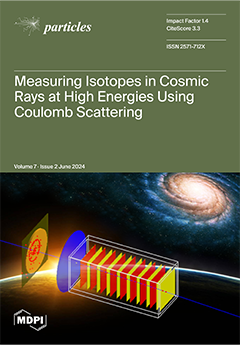
Cover Story: This paper delves into a pioneering approach in the study of Cosmic Rays (CRs), unveiling a new technique capable of detecting isotopes at the formidable energy levels of up to 100 GeV/nucleon. By utilizing Coulomb scattering in conjunction with sophisticated velocity measurements, this innovative method sidesteps the traditional reliance on magnetic spectrometers. Primarily focusing on key isotopes such as deuterium (D) and protons (p), it employs the GEANT4 simulation package to assess its effectiveness. Future instruments are set to exploit this technique, potentially transforming our understanding of galactic propagation and reshaping existing models of the cosmic environment. View this paper
  • Issues are regarded as officially published after their release is announced to the table of contents alert mailing list .
  • You may sign up for email alerts to receive table of contents of newly released issues.
  • PDF is the official format for papers published in both, html and pdf forms. To view the papers in pdf format, click on the "PDF Full-text" link, and use the free Adobe Reader to open them.

Articles (12)

  • Article
  • Open Access
9 Citations
1,379 Views
13 Pages

13 June 2024

This study explores the potential for dark matter annihilation within brown dwarfs, investigating an unconventional mechanism for neutrino production. Motivated by the efficient accumulation of dark matter particles in brown dwarfs through scattering...

  • Article
  • Open Access
1 Citations
2,190 Views
12 Pages

2 May 2024

Analyzing the isotopic composition of cosmic rays (CRs) provides valuable insights into the galactic environment and helps refine existing propagation models. A particular interest is devoted to secondary-to-primary ratios of light isotopic component...

  • Article
  • Open Access
1 Citations
2,657 Views
12 Pages

2 May 2024

The effective action in the renormalizable quantum theory of gravity provides entropy because the total Hamiltonian vanishes. Since it is a renormalization group invariant that is constant in the process of cosmic evolution, we can show conservation...

  • Article
  • Open Access
2 Citations
2,353 Views
30 Pages

22 April 2024

A model of a physical vacuum defined by a Gross–Pitaevskij equation and characterized by dissipative features close to the Planck scale is proposed, which provides an emergent explanation of scales, hierarchies and Higgs mass generation of the...

  • Review
  • Open Access
1,897 Views
18 Pages

Feature Selection Techniques for CR Isotope Identification with the AMS-02 Experiment in Space

  • Marta Borchiellini,
  • Leandro Mano,
  • Fernando Barão and
  • Manuela Vecchi

20 April 2024

Isotopic composition measurements of singly charged cosmic rays (CR) provide essential insights into CR transport in the Galaxy. The Alpha Magnetic Spectrometer (AMS-02) can identify singly charged isotopes up to about 10 GeV/n. However, their identi...

  • Article
  • Open Access
3 Citations
2,610 Views
24 Pages

12 April 2024

We derive a Nambu–Jona-Lasinio (NJL) model from a non-local gauge theory and show that it has confining properties at low energies. In particular, we present an extended approach to non-local QCD and a complete revision of the technique of Bend...

  • Article
  • Open Access
2 Citations
2,244 Views
10 Pages

11 April 2024

The establishment of the mid-infrared and terahertz free-electron laser (MIR/THz FEL) facility is ongoing at the PBP-CMU Electron Linac Laboratory (PCELL) in Chiang Mai University. The facility utilizes an S-band radio-frequency (RF) gun and a linear...

  • Review
  • Open Access
2 Citations
2,411 Views
55 Pages

10 April 2024

We review the hadronic light-by-light (HLbL) contribution to the muon anomalous magnetic moment. Upcoming measurements will reduce the experimental uncertainty of this observable by a factor of four; therefore, the theoretical precision must improve...

  • Review
  • Open Access
8 Citations
4,398 Views
18 Pages

9 April 2024

It is known that dimensional constants, such as ℏ, c, G, e, and k, are merely human constructs whose values and units vary depending on the chosen system of measurement. Therefore, the time variations in dimensional constants lack operational signifi...

of 2

Get Alerted

Add your email address to receive forthcoming issues of this journal.

XFacebookLinkedIn
Particles - ISSN 2571-712X