


Abstract
A new type of parametrization for parton distribution functions in the proton, based on their -evolution at large and small x values, is constructed. In our analysis, the valence and nonsinglet parts obey the Gross–Llewellyn–Smith and Gottfried sum rules, respectively. For the singlet quark and gluon densities, momentum conservation is taken into account. Then, using the Kimber–Martin–Ryskin prescription, we extend the consideration to Transverse Momentum Dependent (TMD, or unintegrated) gluon and quark distributions in the proton, which currently plays an important role in a the number of phenomenological applications. The analytical expressions for the latter, valid for both low and large x, are derived for the first time.
1. Introduction
The parton (quark and gluon) distribution functions (PDFs) in the proton are a necessary part of any theoretical study performed within the quantum chromodynamics (QCD). They encode information on the non-perturbative structure of the proton and are directly related to the calculated cross sections (or other observables) via a certain QCD factorization theorem. The QCD evolution leads to their essential dependence on the probing scale , which can be described by the Dokshitzer–Gribov–Lipatov–Altarelli–Parisi (DGLAP) equations [1,2,3,4]. Usually, the latter are solved numerically with leading (LO), next-to-leading (NLO) or even next-to-next-to-leading order (NNLO) accuracy, where a number of corresponding phenomenological parameters of initial parton distributions are fitted at HERA, LHC and fixed target experiments at various ranges (several recent PDF fits, as well as the references to the previous studies, can be found [5,6,7,8,9,10,11,12,13,14,15,16,17,18,19,20,21,22]). Large uncertainties for many processes at the LHC originate, of course, mainly from our restricted knowledge of the parton distributions (see, for example, [23] and references therein). Thus, studying the proton PDFs from both theoretical and experimental points of view is an important and urgent task.
In the present paper, we continue with the idea [24] to present more information on the PDFs from the theoretical side. The approach consists of two basic steps. First, we find the asymptotics of solutions of the DGLAP equations for the parton densities at small and large values of the Bjorken variable x. Second, we combine these two solutions and then interpolate between them to obtain analytical expressions for PDFs over the full range of x.
In a sense, this is not a very new idea. A similar approach was proposed [25,26,27] about 50 years ago. However, in the present paper, the parametrizations are constructed in quite a different way. In particular, following [24], they include important subasymptotic terms which are fixed exactly by the momentum conservation and also by the Gross–Llewellyn–Smith and Gottfried sum rules (see [28,29], respectively). Such calculations will be performed for the first time providing the community with a new type of parametrization of gluon and quark densities in the proton valid at low and large x. Moreover, we extend our consideration [30,31] and derive analytical expressions for Transverse Momentum Dependent (TMD) parton distributions using the Kimber–Martin–Ryskin (KMR) framework [32,33,34]. These quantities are known to be a very suitable tool to investigate less inclusive processes which proceed at high energies with large momentum transfer and/or contain multiple hard scales (see, for example, review [35] and references therein). Our main motivation is that up until now, there are no analytical expressions for gluon and especially quark TMDs (both sea and valence) valid in a wide x region (in our previous study [30,31], only the small x limit was considered and a phenomenological model for the large x region was applied).
The analysis of the present paper is limited to LO in the perturbation theory, which is reasonable [36] for those processes at the LHC for which the NLO corrections are not known at present. Moreover, most phenomenological applications involving TMDs are currently performed at LO also (see, for example, [31,37,38,39,40] and references therein). On the other hand, the consideration of PDFs at LO is a necessary first step in studying PDFs and TMDs at higher orders. These higher order corrections can be treated like those from [27,41,42].
The outline of our paper is the following. In Section 2, we describe our theoretical input. Section 3 and Section 4 contain low x and large x PDF asymptotics. Parametrizations of parton densities, their properties and numerical results for PDFs are given in Section 5. Section 6 is devoted to TMD parton densities in the Kimber–Martin–Ryskin framework. Section 7 contains our conclusions. The most complicated calculations are presented in Appendices.
2. Theoretical Input
In this section, we briefly present the theoretical part of our analysis. The reader is referred to [43,44] for more details.
The deep-inelastic scattering (DIS) , where l and N are the incoming lepton and nucleon, and is the outgoing lepton, in one of the basic processes for studying the nucleon structure. The DIS cross-section can be split to the lepton and hadron parts
The lepton part is evaluated exactly, while the hadron one, , can be presented in the following form
where the symbol … stands for those parts which depend on the nucleon spin. The functions with , 2 and 3 are the DIS structure functions (SFs) and q and p are the photon and parton momenta. Moreover, the two variables
determine the basic properties of the DIS process. Here, is the “mass” of the virtual photon and/or boson, and the Bjorken variable x () is the part of the hadron momentum carried by the scattering parton (quark or gluon).
2.1. Mellin Transform
The Mellin transform diagonalizes the evolution of the parton densities. In other words, the evolution of the Mellin moment with a certain value n does not depend on the moment with another value .
The Mellin moments of the SF
can be represented as the sum
where are the coefficient functions and are the matrix elements of the Wilson operators , which in turn are process-independent.
Phenomenologically, the matrix elements are equal to the Mellin moments of the PDFs , where are the distributions (all parton densities are multiplied by x, i.e., in LO the structure functions are some combinations of the parton densities) of quarks (), antiquarks () with and gluons (), i.e.,
The coefficient functions are represented by
and responsible for the relationship between SFs and PDFs. Indeed, in the x-space the relation (5) is replaced by
where ⊗ denotes the Mellin convolution
Applying (5) and (8), one can fit the shapes of PDFs , which are process-independent and use them later for other processes. Note that the factorization scale is often taken as . Here, we will follow this choice.
2.2. Quark Densities
The distributions of the u and d quarks contain the valence and sea parts:
The distributions of the other quark flavors and of all the antiquarks contain the sea parts only:
It is useful to define combinations [42] of quark densities (here, we consider all quark flavors. In fact, heavy quarks factorize out when becomes less then their masses, and we should exclude them from the -region): the valence part , the sea one and the singlet one :
Since the PDFs, which contribute to the structure functions, are accompanied by some numerical factors, there are also nonsinglet parts
which contain the difference in the densities of quarks and antiquarks with different values of charges.
As an example, we consider electron-proton scattering, where the corresponding SF has the form
In a four-quark case (when b and t quarks are separated out), we will have [42]
where
2.3. DGLAP Equations
The PDFs obey the DGLAP equations [1,2,3,4]:
where and are so-called splitting functions. Anomalous dimensions (ADs) of the twist-two Wilson operators in the brackets b are the Mellin transforms of the corresponding splitting functions
At LO of perturbation theory, ADs
have the following form [42]:
where , for SU(N) group and f is the number of active (massless) quarks and
with Euler -function and Euler constant .
In the Mellin moment space, the DGLAP equation becomes the standard renormalization group equation. At LO we have
To solve (22), it is more convenient to move to the ± components [42,45], that leads to the diagonal form:
where
The solutions of (21) and (23) have the following form:
where is some initial scale and
The singlet quark and gluon densities can be expressed through their “±” components as
where
and
2.4. Special Cases
A special case of parton evolution is the case for the valence part, which corresponds to the number of structural quarks in a considered hadron. For example, for a proton . So, we have
which is the so-called Gross-Llewellyn-Smith sum rule [28].
Indeed, for this case, and
For the NS part, the corresponding sum rule, so-called Gottfried sum rule [29], is written as
with [46]
We note that the result (32) is correct in a case of flavor-symmetric sea. Moreover, has only very weak -dependence (see [47]), which comes beyond LO from the so-called analytic continuation [47,48,49] of the corresponding Wilson coefficients. So, the values of the Gottfried sum rule [29] can be taken below as
For the sea quark and gluon densities the special case is , that corresponds to the conservation of the total momentum carried by quarks and gluons, i.e.,
i.e.,
Let us consider the case more accurately. We have
and thus,
Using these values, we obtain
because and . Thus, the “−”-components are -independent. Moreover,
i.e., the sum of the “−” components of the singlet and gluon densities is responsible for the momentum conservation. For the “+” components we have
and thus,
i.e., the sum of the “+” components of the singlet and gluon densities is exactly zero.
3. Low Asymptotics
According to (12), the singlet quark density contains the valence part and the sea part .
3.1. Nonsinglet and Valence Parts
At small-x values, the NS and valence parts have the following asymptotics [25,26,50,51]:
where the variable s is defined in Equation (26) and
and are free parameters and is the Euler -function. It follows from the Regge calculus that the constant . Moreover, the evolution of this parton density shows that must be independent [25,26].
3.2. Singlet Part
It was pointed out [52] that HERA small-x data can be well interpreted in terms of the so-called doubled asymptotic scaling (DAS) phenomenon related to the asymptotic behavior of the DGLAP evolution discovered many years ago [53]. The study [52] was extended [54,55,56] to include the finite parts of anomalous dimensions of Wilson operators and Wilson coefficients (in the standard DAS approximation [53] only the AD singular parts were used) (see review [43] and discussions therein). This leads to predictions [55,56] of the small-x asymptotic form of PDFs in the framework of the DGLAP dynamics, which were obtained starting at some with the flat function
where are free parameters that have to be determined from the data. We refer to the approach of [54,55,56] as generalized DAS approximation. In this approach, the flat initial conditions (45) determine the basic role of the AD singular parts as in the standard DAS case, whereas the contributions coming from AD finite parts and Wilson coefficients can be considered as corrections which are, however, important for achieving better agreement with experimental data.
The generalized DAS approach has been successfully used to fit the experimental data for and SFs (see Refs. [52,55,56,57,58,59,60,61,62], respectively). In addition, it helps to extract gluon density and SF from experimental data of and its derivative with respect to (see [63,64] and [65,66,67], respectively), to estimate the charm part of [68] and, finally, it leads to useful links between SFs [69,70,71]. Moreover, the generalized DAS approach provides the correct - dependence of slope [72] and reasonable asymptotics for nucleon PDFs [73,74]. All the described cases take place for small values of the Bjorken variable x.
The generalized DAS approach also leads to simple and convenient low-x forms for non-integrated quark and gluon densities [30,31], the application of which will be extended to the entire area x in Section 6.
Hereafter, we consider for simplicity only the LO approximation (both the LO and NLO results and their applications can be found in [55,56]). The small-x asymptotic expressions for the sea quark and gluon densities can be written as follows:
where , for the color group, and () are the combinations of the modified Bessel functions (at , i.e., ) and usual Bessel functions (at , i.e., ):
where and
and
are the singular and regular parts of the anomalous dimensions and is the first coefficient of the QCD -function in the -scheme. The results for the parameters and can be found in [61]; they were obtained for .
It is convenient to have the following expressions:
4. Large Asymptotics
The large x asymptotics of the valence, nonsinglet and sea quark densities have the following form (see [25,26,50,51] and Appendix A):
where
with and being free parameters, is the Euler constant and
The constant can be estimated from the quark counting rules [75,76,77] as
5. Parametrizations
Here, we present parametrizations of the nonsinglet and singlet quark and gluon densities constructed similar to ones obtained earlier [24] in the valence case.
5.1. Nonsinglet and Valence Parts
The nonsinglet and valence quark parts , where , can be represented in the following form (similar studies were carried out in [78,79,80] (see also the review [43])):
which is constructed as a combination of the small x and large x asymptotics and an additional term proportional to , which is subasymptotic in both of these regions. The -dependence of the parameters in (56) is given by (51) and (44). The -dependence of magnitude is determined by the corresponding sum rules (see below).
5.2. Sea and Gluon Parts
The sea and gluon parts can be represented as combinations of the ± terms:
where and are shown in (53). We note that one can set and . In this case, small-x asymptotics is suppressed for large x in comparison with the subasymptotic behavior of . Moreover, the small-x asymptotics will contain the same powers of the factor for quarks and gluons.
We would like to note that the valence quarks contribute to the “−”-component but not to “+”-one. So,
The parameters involved in (56)–(58) can be fitted, for example, from the comparison with known parametrizations of the NNPDF group [7] and/or taking into account the sum rules shown in the next section.
5.3. Properties of Parameterizations
The obtained above parametrizations of parton distributions in the proton must obey sum rules given by (30) and (32).
5.3.1. Gross–Llewellyn–Smith and Gottfried Sum Rules
Additional relations between the parameters in (56) stems from the LO Gross–Llewellyn–Smith sum rule [28] and Gottfried sum rule [29]:
where the value of can be found in (34).
So, we have the following relations:
i.e.,
The valence and NS densities at low and large x asymptotics are proportional to each other. So, we can apply the following notations:
5.3.2. Momentum Conservation
We would like to note that comparing (61) and (65) at we have
Moreover,
where
If the argument of is large, which is the case (see Section 5.4 below), we have the approximation
where and are given in Section 3.2 and is the Euler constant. The evaluation of the results (72) can be found in Appendix B. Then, at we will have relations between , and :
So, the final results for , and can be obtained from experimental data for the sea quark and gluon densities at (i.e., for ):
with and .
5.4. Results for Parton Densities
From numerical analysis we have , i.e., the large x behavior is defined by the valence quarks. Then, the results for with or g in (57) are strongly simplified:
Similar simplification takes place also for in (74). To obtain it, we should take in the results (75).
Moreover, we also have simplifications for with or g in (65), for in (71) and for in (73). Indeed, we should replace in (65) by
and in (73) by the results (76) with . The results in (71) should be replaced by
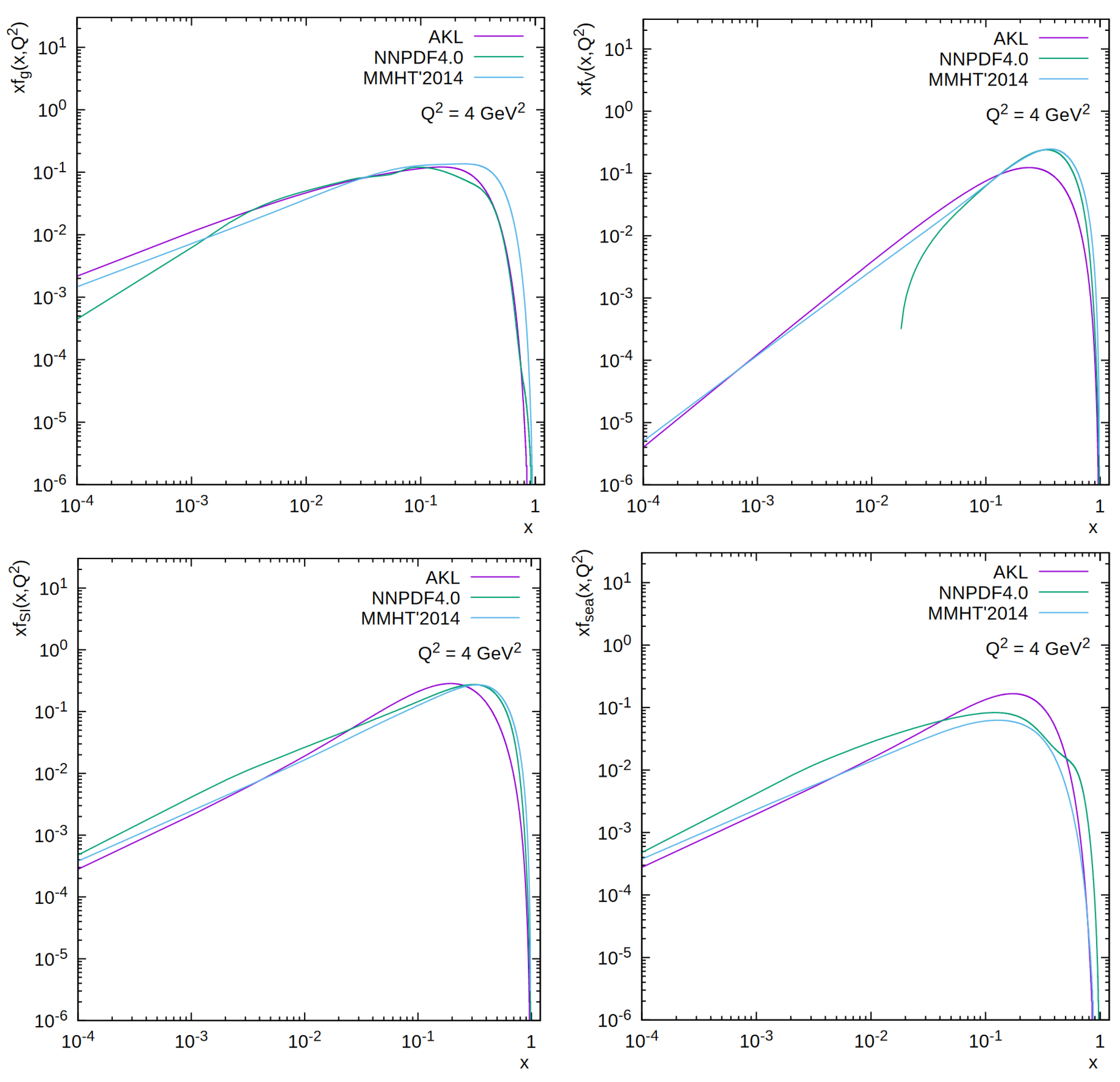
The values of all the parameters involved in derived expressions can be determined from the comparison with known parametrizations of numerical solutions of the DGLAP equations and/or taking into account the sum rules. In our analysis, we employ the latest parametrizations proposed by the NNPDF Collaboration, namely, NNPDF4.0 set [7]. The results of our fit are collected in Table 1. Additionally, in Figure 1 we show a comparison between our PDFs (labeled as AKL) and corresponding results obtained by the MMHT’2014 [81] and NNPDF groups. We find good agreement between our analytical derivation and relevant numerical analyses.

Table 1.
The fitted values of various parameters involved in our analytical expressions for PDFs in the proton.
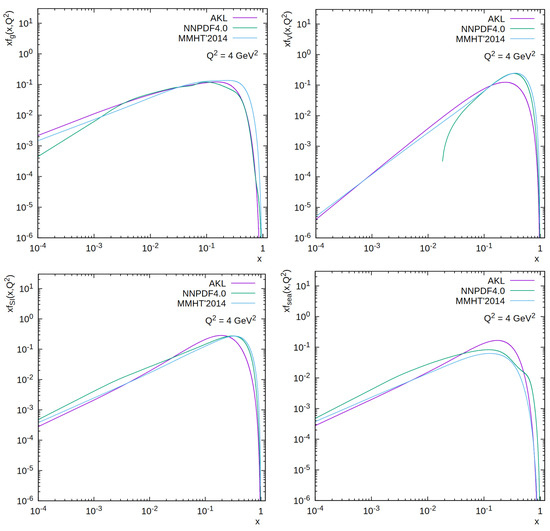
Figure 1.
The gluon, valence, singlet and sea quarks densities in the proton calculated as a function of the longitudinal momentum fraction x at hard scale GeV. The purple curve corresponds to the results obtained with AKL, the green and blue curves with NNPDF4.0 (LO) and MMHT’2014 (LO) parton density functions, respectively.
6. TMD Parton Densities in the Proton
Now, we turn to the derivation of analytical expressions for the TMD gluon and quark density functions in the proton. Our consideration is based on the KMR procedure [32,33], which is a formalism to construct the TMDs from conventional PDFs. The key assumption is that the transverse momentum dependence of the parton distributions enters only at the last evolution step, so conventional PDFs can be used up to this step. There are known differential and integral formulations of the KMR approach in the literature (see [82,83,84] for more information and discussion). Below we derive expressions for the TMDs using both of these schemes.
6.1. Differential Formulation
In the differential formulation of the KMR procedure, we have the TMD parton densities , where , q or g as
where the Sudakov form factor has the following form:
with the splitting functions
related with the LO anomalous dimensions (19) as
The PDFs have the following form:
Since
we see that the have similar form
Using the expressions (56)–(57) for PDFs , we obtain the the final results for TMDs (the complete results are shown in Appendix C):
where we neglected the derivations of . Indeed, the magnitudes of intermediate terms have slow s dependence and their derivations can be neglected.
6.2. Integral Formulation
Following the investigations performed in [30], we can obtain the following results (, ):
where
with
and
As in (85), we neglected contributions coming from the magnitudes , where , ±.
6.3. Sudakov form Factors
For the Sudakov form factors, we have [31]:
where
6.4. Cut-Off Parameter
For phenomenological applications, the cut-off parameter usually has one of two basic forms:
that reflects two cases: is for the strong ordering, is for the angular ordering (see [82]). In all the cases above, except the results for , we can simply replace the parameter by and/or . For the Sudakov form factors, we note that the parameters (with ) contribute to the integrand and, thus, their momentum dependence changes the results in (90). Perfoming the correct evaluation (see [31]), we have
Analytic evaluation of is a very cumbersome procedure, which will be accomplished in the future. For the sake of simplifying our analysis, below we use numerical results for .
6.5. Results for TMD Parton Densities
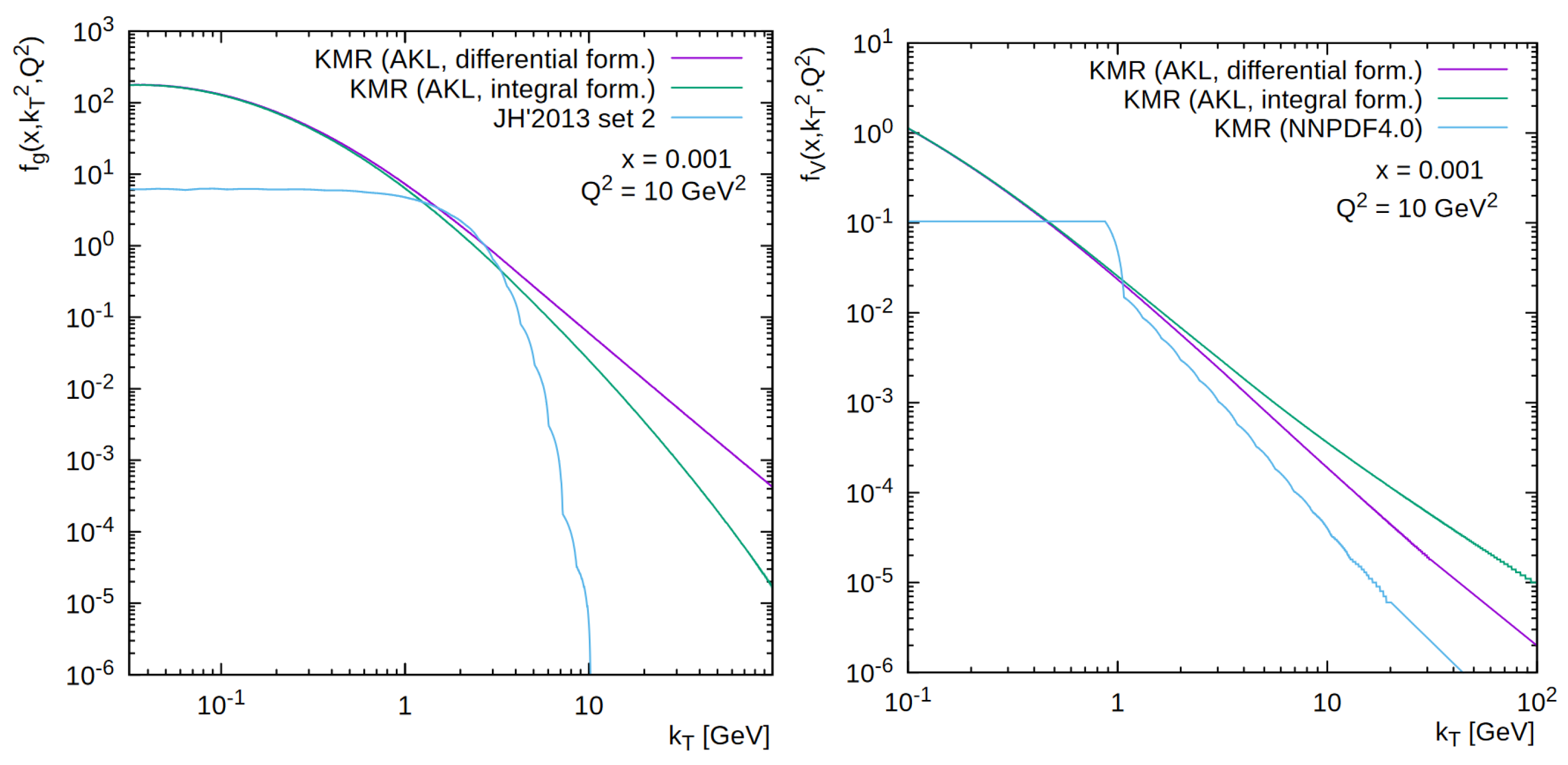
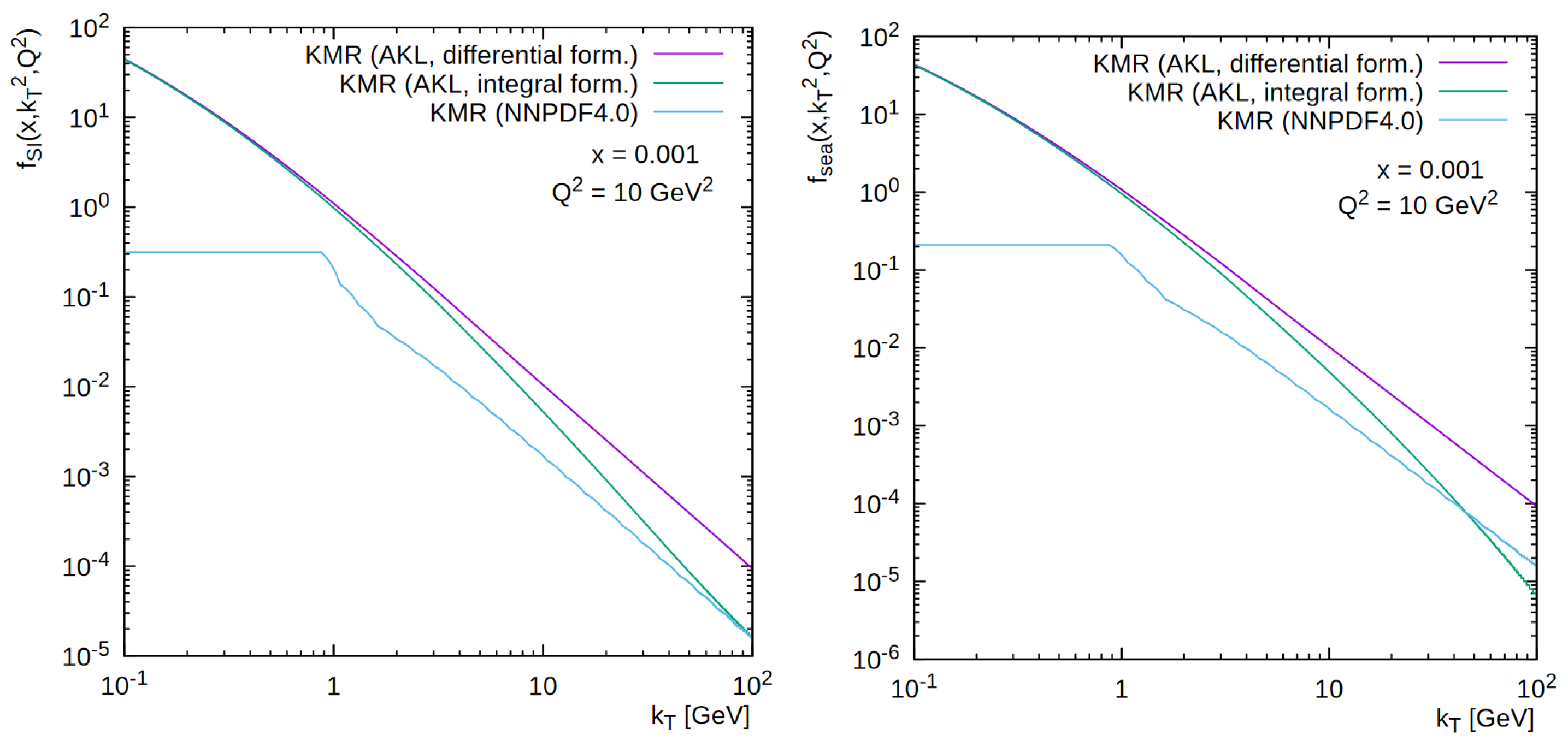
Our results for the TMD quark and gluon densities in the proton, obtained in both differential and integral formulations of the KMR procedure, are shown in Figure 2. Note that the cut-off parameter is taken in the form corresponding to the angular ordering condition. We find that the difference between these two scenarios originates at large parton transverse momenta only, whereas at low they match each other. In addition, we plot here for comparison results derived in other approaches. So, we show the TMD gluon distribution obtained from the numerical solution [85] of the Catani–Ciafaloni–Fiorani–Marchesini (CCFM) evolution equation [86,87,88,89], namely, JH’2013 set 2. The CCFM equation smoothly interpolates between the small-x BFKL gluon dynamics and large-x DGLAP one, and JH’2013 set 2 gluon is often used in different phenomenological applications (see, for example, [37,38,39,40]). Moreover, we plot here results for the TMD PDFs obtained within the KMR approach where the NNPDF4.0 set has been used as the input. One can see that all these TMDs have different shapes in and different overall normalization. The step behavior at low GeV is related to a special normalization condition usually applied in the KMR scheme (see [32,33] for more information). Studying the phenomenological consequences of the observed differences is an important and interesting task, but it is out of our present consideration.
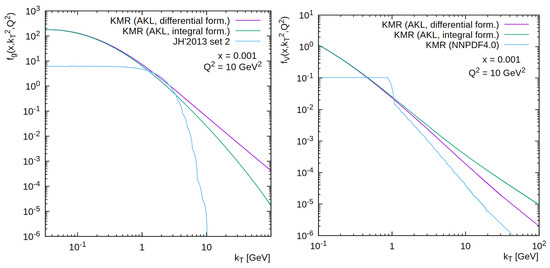
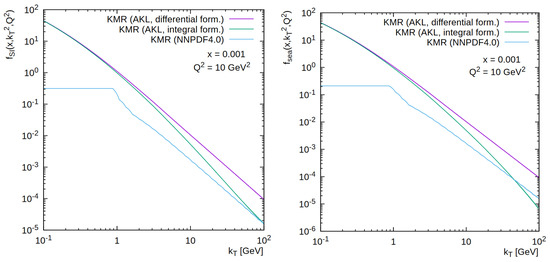
Figure 2.
The TMD gluon, valence, singlet and sea quarks densities in the proton calculated as a function of the parton transverse momentum at longitudinal momentum fraction and hard scale GeV. The purple and green curves correspond to the results obtained with AKL sets, which were obtained from differential and integral formulations of KMR approach, respectively. The blue curve corresponds to the results obtained with TMD gluon distribution JH’2013 set 2 and with TMD quark distributions calculated numerically in the traditional KMR scenario, where the conventional parton densities from standard NNPDF (LO) set are used as an input.
7. Conclusions
In the paper, we have proposed analytical expressions for the proton PDFs based on their exact asymptotics at small and large x values. The derived parameterizations contain subasymptotic terms, which are fixed by momentum conservation and, in the nonsinglet and valence parts, by the Gross–Llewellyn–Smith and Gottfried sum rules (see [28,29], respectively). The rest of the parameters are fixed by comparison with a recent numerical solution of the DGLAP equation performed by the NNPDF group [7] and presented in Table 1. Then, our consideration has been extended to the parton densities, dependent on the transverse momentum (TMDs). These quantities are often used in phenomenological applications and are widely discussed in the literature. We employ the popular Kimber–Martin–Ryskin formalism [32,33,34] and derive the TMD quark and gluon distributions in the proton within both differential and integral formulations of the KMR scheme. In the calculations, we have considered different treatments of kinematical constraint, reflecting the angular and strong ordering conditions. The analytical expressions for the PDFs and TMDs (in particular, for the quark TMDs), valid at both low and large x, have been obtained for the first time. As the next step, we plan to use the presented PDF sets to study PDF modifications in nuclei and, of course, to extend the present investigations beyond LO. In these investigations, we will follow [73,74,90,91,92,93,94,95,96], respectively.
Author Contributions
Investigation, N.A.A., A.V.K. and A.L.; Writing—original draft, N.A.A., A.V.K. and A.L. All authors have read and agreed to the published version of the manuscript.
Funding
Data Availability Statement
Not applicable.
Acknowledgments
We thank M.A. Malyshev for very useful discussions and remarks.
Conflicts of Interest
The authors declare no conflict of interest.
Appendix A. PDF Asymptotics at Large x Values
Using large n expansion for as
of some auxiliary anomalous dimension , we see for the general renorm-group exponent
Let some Mellin moment of corresponding PDF following (18), have the -dependence
Then we can see that the result (A3) for can be rewritten as
with some free parameters , and . For the initial condition , we have the same result but with the replacement .
It is convenient to use the Sterling formula
at large z values, where is the Bernoulli number.
So, for large z and fixed values, we have after a little algebra
and, thus,
So, the Mellin moment can be represented as
For the PDF we have ()
where . The constant can be neglected.
So, finally we have
where
Appendix A.1. O(n0) Accuracy
At accuracy,
and, thus, the -evolutions of the singlet quark and gluon densities are not related to each other.
The corresponding anomalous dimesions have the following form
and parton densities
have the large x asymptotics
where and are given in Equations (52).
Appendix A.2. O(n−1) Accuracy
At accuracy,
where are given in Equation (53).
Using these results, we have
i.e., the evolution of the “±”-components is the same as in the previous subsection.
The corresponding projectors have the following form:
where and are given in Equation (53).
Thus, now the contributions of the initial quarks (gluons) to the final quarks (gluons) during evolution are the same as in the previous subsection (see Equation (A18)) but there are additional contributions: initial quarks to gluons and vice versa. The last contributions have an unusual form ∼ at large n values.
So, for the -evolutions of the singlet quark and gluon densities we have
where
Thus, the NS and valence parton densities have the large x asymptotics, shown in Equation (51) of the main text. For the singlet quark and gluon densities the situation is different. Their large x asymptotics contain standard contributions: the “+”-component for the gluon density and the “−”-component for the sea quark density (see Equation (A18), for example). However, there are also additional parts, ∼ in Equation (51), coming from the contributions ∼ and ∼ in (A23). We will sketch a way to calculate the additional parts in Appendix B.
Appendix B. Results at Large ν Values
To obtain the results it is convenient to calculate the inverse Mellin transform of the auxiliary function
To do it, we expand the denominator of as
Since
then the function , which is the inverse Mellin transform of
has the form
In the r.h.s. we will have powers of Polygamma functions
At large -values, and , . So, we can neglect contributions from , and obtain
So, we have
To obtain the contribution ∼ in Equations (65) and (73), it is convenient to calculate the following auxiliary integral
Expanding the denominator as in Equation (A25), we have
As it was shown above in Equations (A28) and (A31) the integral in the r.h.s. has the following form
So, for the auxiliary integral we have
To obtain the results (72) it is convenient to consider the following auxiliary integral
Expanding Bessel function, we have
As it was above in Equation (A34), the integral in the r.h.s. can be rewritten as
Appendix C. Differential Formulation of KMR Approach
Now we can find the results for TMD parton densities without derivatives. Derivation of is as follows
and derivations of conventional PDFs are as follows
where
So, the results for the TMD parton densities read the form (84) with
References
- Gribov, V.N.; Lipatov, L.N. Deep inelastic e p scattering in perturbation theory. Sov. J. Nucl. Phys. 1972, 15, 438. [Google Scholar]
- Lipatov, L.N. The parton model and perturbation theory. Sov. J. Nucl. Phys. 1975, 20, 94. [Google Scholar]
- Altarelli, G.; Parisi, G. Asymptotic Freedom in Parton Language. Nucl. Phys. 1977, 126, 298. [Google Scholar] [CrossRef]
- Dokshitzer, Y.L. Calculation of the Structure Functions for Deep Inelastic Scattering and e+ e- Annihilation by Perturbation Theory in Quantum Chromodynamics. Sov. Phys. JETP 1977, 46, 641. [Google Scholar]
- Hou, T.J.; Gao, J.; Hobbs, T.J.; Xie, K.; Dulat, S.; Guzzi, M.; Huston, J.; Nadolsky, P.; Pumplin, J.; Schmidt, C.; et al. New CTEQ global analysis of quantum chromodynamics with high-precision data from the LHC. Phys. Rev. D 2021, 103, 014013. [Google Scholar] [CrossRef]
- Bailey, S.; Cridge, T.; Harland-Lang, L.A.; Martin, A.D.; Thorne, R.S. Parton distributions from LHC, HERA, Tevatron and fixed target data: MSHT20 PDFs. Eur. Phys. J. C 2021, 81, 341. [Google Scholar] [CrossRef]
- NNPDF Collaboration; Ball, R.D.; Carrazza, S.; Cruz-Martinez, J.; Del Debbio, L.; Forte, S.; Giani, T.; Iranipour, S.; Kassabov, Z.; Latorre, J.I.; et al. An open-source machine learning framework for global analyses of parton distributions. Eur. Phys. J. C 2021, 81, 958. [Google Scholar]
- Abt, I.; Aggarwal, R.; Andreev, V.; Arratia, M.; Aushev, V.; Baghdasaryan, A.; Baty, A.; Begzsuren, K.; Behnke, O.; Belousov, A.; et al. Impact of jet-production data on the next-to-next-to-leading-order determination of HERAPDF2.0 parton distributions. Eur. Phys. J. C 2022, 82, 243. [Google Scholar] [CrossRef]
- Alekhin, S.; Blümlein, J.; Moch, S.; Placakyte, R. Parton distribution functions, αs, and heavy-quark masses for LHC Run II. Phys. Rev. D 2017, 96, 014011. [Google Scholar] [CrossRef]
- Jimenez-Delgado, P.; Reya, E. Delineating parton distributions and the strong coupling. Phys. Rev. D 2014, 89, 074049. [Google Scholar] [CrossRef]
- Parente, G.; Kotikov, A.V.; Krivokhizhin, V.G. Analysis of deep inelastic structure functions in perturbative QCD at three loops. Phys. Lett. 1994, 333, 190. [Google Scholar] [CrossRef]
- Kataev, A.L.; Kotikov, A.V.; Parente, G.; Sidorov, A.V. Next-to-next-to-leading order QCD analysis of the CCFR data xF3 and F2 structure functions of the deep-inelastic neutrino-nucleon scattering. Phys. Lett. 1996, 388, 179. [Google Scholar] [CrossRef]
- Kataev, A.L.; Kotikov, A.V.; Parente, G.; Sidorov, A.V. Next-to-next-to-leading order QCD analysis of the revised CCFR data for xF3 structure function and the higher twist contributions. Phys. Lett. 1998, 417, 374. [Google Scholar] [CrossRef]
- Sidorov, A.V. QCD analysis of the CCFR data for x F(3) and higher twist contribution. Phys. Lett. 1996, 389, 379. [Google Scholar]
- Kataev, A.L.; Parente, G.; Sidorov, A.V. Higher twists and alpha(s)(M(Z)) extractions from the NNLO QCD analysis of the CCFR data for the xF(3) structure function. Nucl. Phys. 2000, 573, 405. [Google Scholar] [CrossRef]
- Kataev, A.L.; Parente, G.; Sidorov, A.V. Improved fits to the xF3 CCFR data at the next-to-next-to-leading order and beyond. Phys. Part. Nucl. 2003, 34, 20. [Google Scholar] [CrossRef]
- Shaikhatdenov, B.G.; Kotikov, A.V.; Krivokhizhin, V.G.; Parente, G. QCD coupling constant at NNLO from DIS data. Phys. Rev. D 2010, 81, 034008. [Google Scholar] [CrossRef]
- Kotikov, A.V.; Krivokhizhin, V.G.; Shaikhatdenov, B.G. Strong coupling constant from QCD analysis of the fixed-target DIS data. JETP Lett. 2015, 101, 141–145. [Google Scholar] [CrossRef]
- Kotikov, A.V.; Krivokhizhin, V.G.; Shaikhatdenov, B.G. Improved nonsinglet QCD analysis of fixed-target DIS data. J. Phys. G 2015, 42, 095004. [Google Scholar] [CrossRef][Green Version]
- Kotikov, A.V.; Krivokhizhin, V.G.; Shaikhatdenov, B.G. Analytic and ’frozen’ QCD coupling constants up to NNLO from DIS data. Phys. Atom. Nucl. 2012, 75, 507–524. [Google Scholar] [CrossRef]
- Kotikov, A.V.; Krivokhizhin, V.G.; Shaikhatdenov, B.G. Gottfried sum rule in QCD NS analysis of DIS fixed target data. Phys. Atom. Nucl. 2018, 81, 244–252. [Google Scholar] [CrossRef]
- Krivokhizhin, V.G.; Kotikov, A.V. A systematic study of QCD coupling constant from deep-inelastic measurements. Phys. Atom. Nucl. 2005, 68, 1873–1903. [Google Scholar] [CrossRef]
- Demartin, F.; Forte, S.; Mariani, E.; Rojo, J.; Vicini, A. The impact of PDF and alphas uncertainties on Higgs Production in gluon fusion at hadron colliders. Phys. Rev. D 2010, 82, 014002. [Google Scholar] [CrossRef]
- Illarionov, A.Y.; Kotikov, A.V.; Parzycki, S.S.; Peshekhonov, D.V. New type of parametrizations for parton distributions. Phys. Rev. D 2011, 83, 034014. [Google Scholar] [CrossRef]
- Lopez, C.; Yndurain, F.J. Behavior of Deep Inelastic Structure Functions Near Physical Region Endpoints From QCD. Nucl. Phys. B 1980, 171, 231. [Google Scholar] [CrossRef]
- Lopez, C.; Yndurain, F.J. Behavior at x = 0, 1, Sum Rules and Parametrizations for Structure Functions Beyond the Leading Order. Nucl. Phys. B 1981, 183, 157. [Google Scholar] [CrossRef]
- Yndurain, F.J. Quantum Chromodynamics (An Introduction to the Theory of Quarks and Gluons); Springer: Berlin/Heidelberg, Germany, 1983. [Google Scholar]
- Gross, D.J.; Smith, C.H.L. High-energy neutrino—Nucleon scattering, current algebra and partons. Nucl. Phys. B 1969, 14, 337. [Google Scholar] [CrossRef]
- Gottfried, K. Sum rule for high-energy electron—Proton scattering. Phys. Rev. Lett. 1967, 18, 1174. [Google Scholar] [CrossRef]
- Kotikov, A.V.; Lipatov, A.V.; Shaikhatdenov, B.G.; Zhang, P. Transverse momentum dependent parton densities in a proton from the generalized DAS approach. JHEP 2020, 28. [Google Scholar] [CrossRef]
- Kotikov, A.V.; Lipatov, A.V.; Zhang, P.M. Transverse momentum dependent parton densities in processes with heavy quark generations. Phys. Rev. D 2021, 104, 054042. [Google Scholar] [CrossRef]
- Kimber, M.A.; Martin, A.D.; Ryskin, M.G. Unintegrated parton distributions. Phys. Rev. D 2001, 63, 114027. [Google Scholar] [CrossRef]
- Watt, G.; Martin, A.D.; Ryskin, M.G. Unintegrated parton distributions and inclusive jet production at HERA. Eur. Phys. J. C 2003, 31, 73. [Google Scholar] [CrossRef]
- Martin, A.D.; Ryskin, M.G.; Watt, G. NLO prescription for unintegrated parton distributions. Eur. Phys. J. C 2010, 66, 163. [Google Scholar] [CrossRef]
- Angeles-Martinez, R.; Bacchetta, A.; Balitsky, I.I.; Boer, D.; Boglione, M.; Boussarie, R.; Ceccopieri, F.A.; Cherednikov, I.O.; Connor, P.; Echevarria, M.G.; et al. Transverse momentum dependent (TMD) parton distribution functions: Status and prospects. Acta Phys. Polon. B 2015, 46, 2501. [Google Scholar] [CrossRef]
- Sherstnev, A.; Thorne, R.S. Parton Distributions for LO Generators. Eur. Phys. J. 2008, 55, 553–575. [Google Scholar] [CrossRef]
- Maciula, R.; Pasechnik, R.; Szczurek, A. Production of forward heavy-flavor dijets at the LHCb within the kT-factorization approach. Phys. Rev. D 2022, 106, 054018. [Google Scholar] [CrossRef]
- Baranov, S.P.; Lipatov, A.V.; Prokhorov, A.A. Role of initial gluon emission in double J/Ψ production at central rapidities. Phys. Rev. D 2022, 106, 034020. [Google Scholar] [CrossRef]
- Abdulov, N.A.; Jung, H.; Lipatov, A.V.; Lykasov, G.I.; Malyshev, M.A. Employing RHIC and LHC data to determine the transverse momentum dependent gluon density in a proton. Phys. Rev. D 2018, 98, 054010. [Google Scholar] [CrossRef]
- Abdulov, N.A.; Lipatov, A.V.; Malyshev, M.A. Inclusive Higgs boson production at the LHC in the kt-factorization approach. Phys. Rev. D 2018, 97, 054017. [Google Scholar] [CrossRef]
- Ahrens, V.; Ferroglia, A.; Neubert, M.; Pecjak, B.D.; Yang, L.L. Renormalization-Group Improved Predictions for Top-Quark Pair Production at Hadron Colliders. JHEP 2010, 97. [Google Scholar] [CrossRef]
- Buras, A. Asymptotic Freedom in Deep Inelastic Processes in the Leading Order and Beyond. Rev. Mod. Phys. 1980, 52, 199. [Google Scholar] [CrossRef]
- Kotikov, A.V. Deep inelastic scattering: Q**2 dependence of structure functions. Phys. Part. Nucl. 2007, 38, 1, Erratum in Phys. Part. Nucl. 2007, 38, 828. [Google Scholar] [CrossRef]
- Krivokhizhin, V.G.; Kotikov, A.V. Functions of the nucleon structure and determination of the strong coupling constant. Phys. Part. Nucl. 2009, 40, 1059. [Google Scholar] [CrossRef]
- Kotikov, A. Parton distributions at low x and gluon- and quark average multiplicities. arXiv 2015, arXiv:1502.07108. [Google Scholar]
- Arneodo, M.; Arvidson, A.; Badelek, B.; Ballintijn, M.; Baum, G.; Beaufays, J.; Bird, I.G.; Bjorkholm, P.; Botje, M.; Broggini, C.; et al. A Reevaluation of the Gottfried sum. Phys. Rev. D 1994, 50, R1–R3. [Google Scholar] [CrossRef]
- Kotikov, A.V.; Velizhanin, V.N. Analytic continuation of the Mellin moments of deep inelastic structure functions. arXiv 2005, arXiv:hep-ph/0501274. [Google Scholar]
- Kazakov, D.I.; Kotikov, A.V. Total αs correction to the ratio of the deep inelastic scattering cross-sections R=σL/σT in QCD. Nucl. Phys. 1988, 307, 791, Erratum in Nucl. Phys. 1990, 345, 299. [Google Scholar] [CrossRef]
- Kotikov, A.V. The extraction of gluon distribution from DIS structure funstions. Phys. Atom. Nucl. 1994, 57, 133. [Google Scholar]
- Gross, D.I. How to Test Scaling in Asymptotically Free Theories. Phys. Rev. Lett. 1974, 32, 1071. [Google Scholar] [CrossRef]
- Gross, D.I.; Treiman, S.B. Hadronic Form-Factors in Asymptotically Free Field Theories. Phys. Rev. Lett. 1974, 32, 1145. [Google Scholar] [CrossRef]
- Ball, R.D.; Forte, S. Double asymptotic scaling at HERA. Phys. Lett. B 1994, 335, 77. [Google Scholar] [CrossRef][Green Version]
- De Rújula, A.; Glashow, S.L.; Politzer, H.D.; Treiman, S.B.; Wilczek, F.; Zee, A. Possible NonRegge Behavior of Electroproduction Structure Functions. Phys. Rev. D 1974, 10, 1649. [Google Scholar] [CrossRef]
- Mankiewicz, L.; Saalfeld, A.; Weigl, T. On the analytical approximation to the GLAP evolution at small x and moderate Q**2. Phys. Lett. B 1997, 393, 175. [Google Scholar] [CrossRef]
- Kotikov, A.V.; Parente, G. Small x behaviour of parton distributions with soft initial conditions. Nucl. Phys. B 1999, 549, 242. [Google Scholar] [CrossRef]
- Illarionov, A.Y.; Kotikov, A.V.; Parente, G. Small x behavior of parton distributions. A study of higher twist. Phys. Part. Nucl. 2008, 39, 307. [Google Scholar] [CrossRef]
- Kotikov, A.V.; Shaikhatdenov, B.G. Q2-evolution of parton densities at small x values. Phys. Part. Nucl. 2017, 48, 829. [Google Scholar] [CrossRef]
- Kotikov, A.V.; Shaikhatdenov, B.G. Q2-evolution of parton densities at small x values. Effective scale for combined H1 and ZEUS F2 data. Phys. Atom. Nucl. 2015, 78, 525. [Google Scholar] [CrossRef]
- Kotikov, A.V.; Shaikhatdenov, B.G. Q2-evolution of parton densities at small x values. Combined H1 and ZEUS F2 data. Phys. Part. Nucl. 2013, 44, 543. [Google Scholar] [CrossRef]
- Kotikov, A.V.; Shaikhatdenov, B.G. Q2-evolution of parton densities at small x values and H1 and ZEUS experimental data. AIP Conf. Proc. 2015, 1606, 159–167. [Google Scholar]
- Cvetic, G.; Illarionov, A.Y.; Kniehl, B.A.; Kotikov, A.V. Small-x behavior of the structure function F(2) and its slope ∂lnF(2)/∂ln(1/x) for ’frozen’ and analytic strong-coupling constants. Phys. Lett. B 2009, 679, 350. [Google Scholar] [CrossRef]
- Illarionov, A.Y.; Kotikov, A.V. at low x. Phys. Atom. Nucl. 2012, 75, 1234–1239. [Google Scholar] [CrossRef]
- Kotikov, A.V. Gluon distribution as function of F2 and dF2/dlnQ**2 at small x. JETP Lett. 1994, 59, 667–670. [Google Scholar]
- Kotikov, A.V.; Parente, G. The Gluon distribution as a function of f2 and dF2 - dlnQ**2 small x. The Next-to-leading analysis. Phys. Lett. B 1996, 379, 195–201. [Google Scholar] [CrossRef][Green Version]
- Kotikov, A.V. Longitudinal structure function F(L) as function of F2 and dF2/dlnQ**2 at small x. J. Exp. Theor. Phys. 1995, 80, 979–982. [Google Scholar]
- Kotikov, A.V.; Parente, G. The Longitudinal structure function FL as a function of F2 and dF2/dlnQ**2 at small x. The Next-to-leading analysis. Mod. Phys. Lett. A 1997, 12, 963–974. [Google Scholar] [CrossRef]
- Kotikov, A.V.; Parente, G. Indirect determination of the ratio R = Sigma(L)/Sigma(T) at small x from HERA data. J. Exp. Theor. Phys. 1997, 85, 17–19. [Google Scholar] [CrossRef]
- Illarionov, A.Y.; Kniehl, B.A.; Kotikov, A.V. Heavy-quark contributions to the ratio F(L)/F(2) at low x. Phys. Lett. B 2008, 663, 66–72. [Google Scholar] [CrossRef][Green Version]
- Kotikov, A.V. On the behavior of DIS structure function ratio R (x, Q**2) at small x. Phys. Lett. B 1994, 338, 349–356. [Google Scholar] [CrossRef]
- Kotikov, A.V. Gluon distribution as function of F(L) and F(2) at small x. Phys. Rev. D 1994, 49, 5746–5752. [Google Scholar] [CrossRef]
- Kotikov, A.V.; Parente, G. QCD relations between structure functions at small x. arXiv 1997, arXiv:hep-ph/9710252. [Google Scholar]
- Kotikov, A.V.; Parente, G. Small x behavior of the slope dlnF(2)/dln(1/x) in the framework of perturbative QCD. J. Exp. Theor. Phys. 2003, 97, 859–867. [Google Scholar] [CrossRef][Green Version]
- Kotikov, A.V.; Shaikhatdenov, B.G.; Zhang, P. Application of the rescaling model at small Bjorken x values. Phys. Rev. D 2017, 96, 114002. [Google Scholar] [CrossRef]
- Kotikov, A.V.; Shaikhatdenov, B.G.; Zhang, P. Antishadowing in the rescaling model at x∼0.1. Phys. Part. Nucl. Lett. 2019, 16, 311. [Google Scholar] [CrossRef]
- Matveev, V.A.; Muradian, R.M.; Tavkhelidze, A.N. Automodellism in the large—Angle elastic scattering and structure of hadrons. Lett. Nuovo Cim. 1973, 7, 719. [Google Scholar] [CrossRef]
- Brodsky, S.J.; Farrar, G.R. Scaling Laws at Large Transverse Momentum. Phys. Rev. Lett. 1973, 31, 1153. [Google Scholar] [CrossRef]
- Brodsky, S.J.; Ellis, J.; Cardi, E.; Karliner, M.; Samuel, M.A. Pade approximants, optimal renormalization scales, and momentum flow in Feynman diagrams. Phys. Rev. 1997, 56, 6980. [Google Scholar] [CrossRef]
- Kotikov, A.V. THE BEHAVIOR OF THE STRUCTURE FUNCTIONS AND RATIO R = sigma-L/sigma-T IN DEEP INELASTIC SCATTERING FOR x approximates 0 AND x approximates 1 AND THEIR SCHEME INVARIANT PARAMETRIZATION. JINR Preprint: JINR-E2-88-422. 1988. Available online: https://inspirehep.net/literature/265682 (accessed on 30 October 2022).
- Kotikov, A.V.; Maksimov, S.I.; Vovk, V.I. QCD parameterization for structure functions of deep inelastic scattering. Theor. Math. Phys. 1991, 84, 744. [Google Scholar]
- Kotikov, A.V.; Maximov, S.I.; Parobij, I.S. QCD parameterization of the parton distributions of deep inelastic scattering. Theor. Math. Phys. 1997, 111, 442. [Google Scholar] [CrossRef]
- Harland-Lang, L.A.; Martin, A.D.; Motylinski, P.; Thorne, R.S. Parton distributions in the LHC era: MMHT 2014 PDFs. Eur. Phys. J. C 2015, 75, 204. [Google Scholar] [CrossRef]
- Golec-Biernat, K.; Stasto, A.M. On the use of the KMR unintegrated parton distribution functions. Phys. Lett. B 2018, 781, 633. [Google Scholar] [CrossRef]
- Guiot, B. Pathologies of the Kimber-Martin-Ryskin prescriptions for unintegrated PDFs: Which prescription should be preferred? Phys. Rev. D 2020, 101, 054006. [Google Scholar] [CrossRef]
- Valeshabadi, R.K.; Modarres, M. On the ambiguity between differential and integral forms of the Martin–Ryskin–Watt unintegrated parton distribution function model. Eur. Phys. J. C 2022, 82, 66. [Google Scholar] [CrossRef]
- Hautmann, F.; Jung, H. Transverse momentum dependent gluon density from DIS precision data. Nucl. Phys. B 2014, 883, 1. [Google Scholar] [CrossRef]
- Ciafaloni, M. Coherence Effects in Initial Jets at Small q**2/s. Nucl. Phys. B 1988, 296, 49. [Google Scholar] [CrossRef]
- Catani, S.; Fiorani, F.; Marchesini, G. QCD Coherence in Initial State Radiation. Phys. Lett. B 1990, 234, 339. [Google Scholar] [CrossRef]
- Catani, S.; Fiorani, F.; Marchesini, G. Small x Behavior of Initial State Radiation in Perturbative QCD. Nucl. Phys. B 1990, 336, 18. [Google Scholar] [CrossRef]
- Marchesini, G. QCD coherence in the structure function and associated distributions at small x. Nucl. Phys. B 1995, 445, 49. [Google Scholar] [CrossRef]
- Kotikov, A.V. THE EMC RATIO AS A FUNCTION OF x, Q**2 IN THE RESCALING MODEL. Sov. J. Nucl. Phys. 1989, 50, 127–128. [Google Scholar]
- Kotikov, A.V.; Lipatov, A.V.; Parente, G.; Zotov, N.P. The Contribution of off-shell gluons to the structure functions F(2)**c and F(L)**c and the unintegrated gluon distributions. Eur. Phys. J. C 2002, 26, 51. [Google Scholar] [CrossRef]
- Kotikov, A.V.; Lipatov, A.V.; Zotov, N.P. The Contribution of off-shell gluons to the longitudinal structure function F(L). Eur. Phys. J. C 2003, 27, 219. [Google Scholar] [CrossRef]
- Kotikov, A.V.; Lipatov, A.V.; Zotov, N.P. The Longitudinal structure function F(L): Perturbative QCD and k(T) factorization versus experimental data at fixed W. J. Exp. Theor. Phys. 2005, 101, 811–816. [Google Scholar] [CrossRef]
- van Hameren, A. A note on QED gauge invariance of off-shell amplitudes. arXiv 2019, arXiv:1902.01791. [Google Scholar]
- Nefedov, M.; Saleev, V. On the one-loop calculations with Reggeized quarks. Mod. Phys. Lett. A 2017, 32, 1750207. [Google Scholar] [CrossRef]
- Caporale, F.; Celiberto, F.G.; Chachamis, G.; Gordo Gomez, D.; Sabio Vera, A. Inclusive three- and four-jet production in multi-Regge kinematics at the LHC. AIP Conf. Proc. 2017, 1819, 060009. [Google Scholar]
Publisher’s Note: MDPI stays neutral with regard to jurisdictional claims in published maps and institutional affiliations. |
© 2022 by the authors. Licensee MDPI, Basel, Switzerland. This article is an open access article distributed under the terms and conditions of the Creative Commons Attribution (CC BY) license (https://creativecommons.org/licenses/by/4.0/).